On 18 November 2026 Voyager 1 reaches one light-day from Earth, about 25.89 billion kilometres, a few weeks after a two-day pause in contact that its engineers fixed by switching thrusters. This film explains what a light-day is, how the 1977 launches used a rare line-up of the giant planets and gravity assists, what Voyager 1 found at Jupiter and Saturn, the Golden Record and the Pale Blue Dot, how it crossed the edge of the Sun's bubble into interstellar space in 2012, and how a 23-watt transmitter, the Deep Space Network’s giant dishes at three sites and a slowly fading plutonium power supply keep it talking.
Interactive 3D film10 min1977 to 2026Published 5 November 2026
The most distant thing humans have made is about to pass a milestone.
On the eighteenth and nineteenth of October 2026, the giant dishes that listen for Voyager 1 heard nothing at all.
Was the old probe finally gone? On the twentieth, to the team’s relief, its signal came back.
Now NASA says that on the eighteenth of November, Voyager 1 will be one light-day from Earth: so far away that its radio signal needs a whole day to reach us.
How did a probe launched in 1977 get that far, and how do we still hear it?
48 hours
of silence, 18–20 October
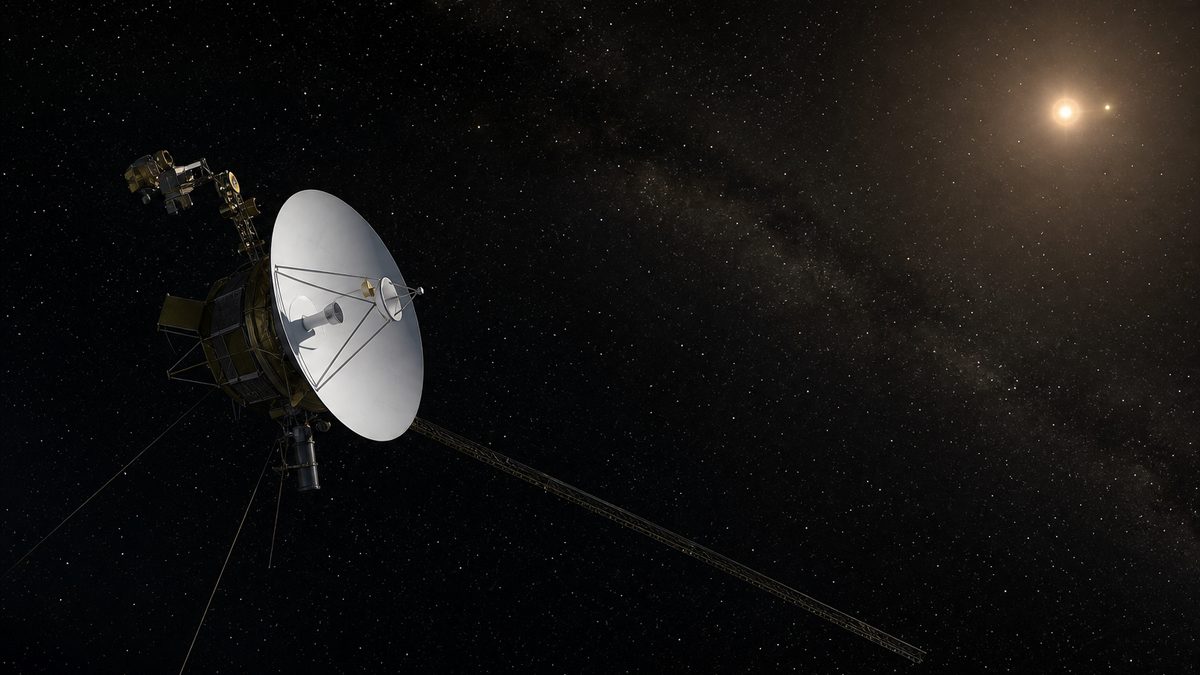
October 2026Alone out there A probe like Voyager, far beyond the planets. AI-generated illustration.
25.89 billion km
from Earth: one light-day
18 November 2026
What a light-day is
A tour of the giant planets
The edge of the Sun’s bubble
How we still hear it
Coming up
Prologue
A pause, then a milestone
NASA JPL (29 October 2026): the Deep Space Network could not detect Voyager 1 on scheduled attempts on 18 and 19 October; the signal returned on 20 October. One set of thrusters stopped working, fault protection switched to the backups and paused normal operations; the cause is under investigation. On 18 November 2026 Voyager 1 will be 25.89 billion km (16.09 billion miles) from Earth, one light-day.
EarthSky (2026): it took Voyager 1 about 49 years, 2 months and 11 days after launch to reach one light-day.
The 3D scenes are simplified teaching models, not to scale.
Light travels about three hundred thousand kilometres every second. Sunlight takes about eight minutes to reach us.
In one whole day, light covers almost twenty-six billion kilometres. That distance is one light-day, and Voyager 1 is reaching it now.
Press Send in the scene. A command from Earth takes almost a full day to arrive, and the reply needs another day to come back.
That is why, in October, the team waited about two days for every answer.
d=ct
c
speed of light, ~300,000 km/s
t
one day = 86,400 s
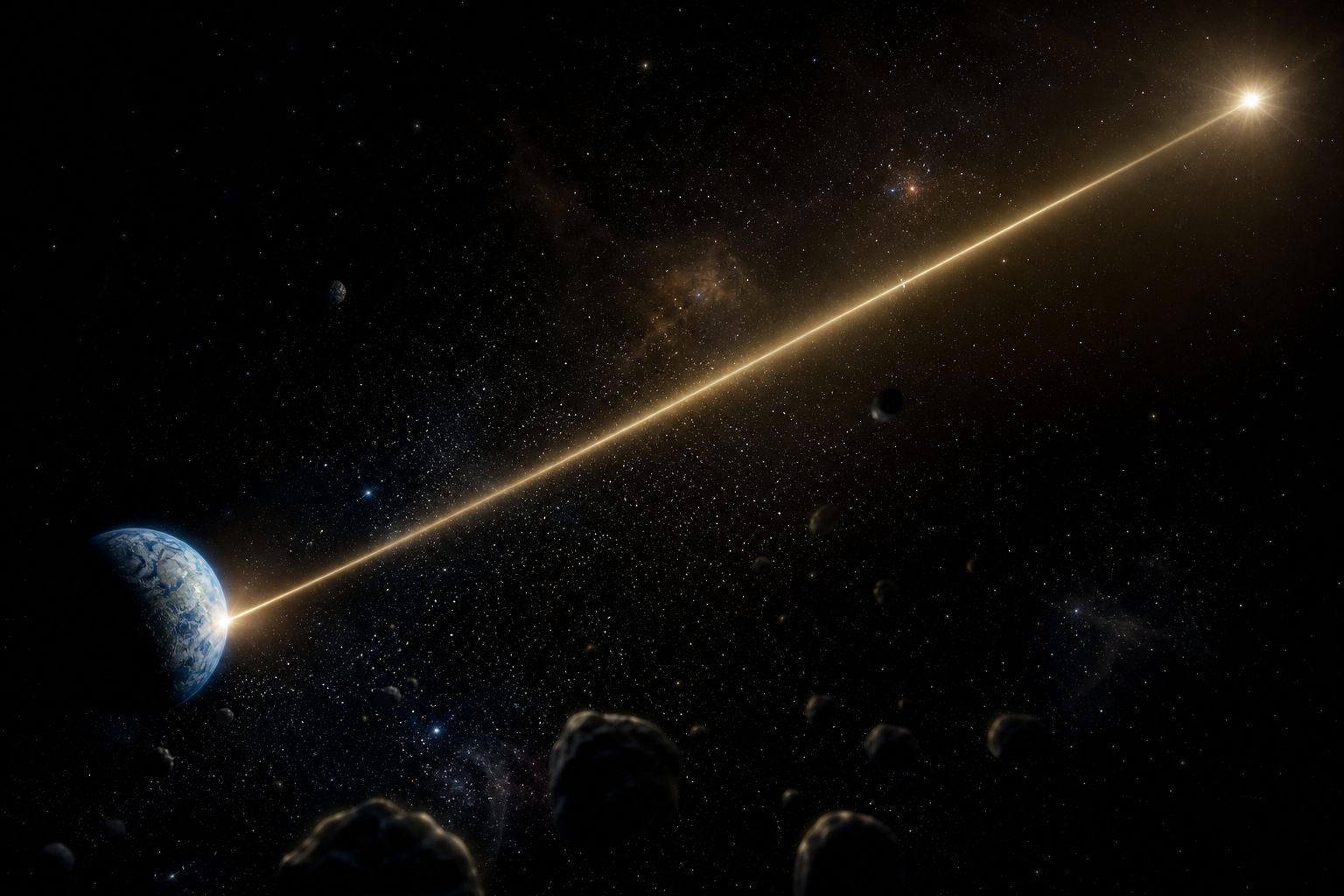
Distance from speed and timeEight minutes old The sunlight you see left the Sun about eight minutes ago. AI-generated illustration.A day-long crossing Even light needs a day to cross this gap. AI-generated illustration.
8 min
Sun to Earth
~1 day
Earth to Voyager 1
~2 days
command and reply
Light travel times
You wait two days before you finally get a response.Suzanne Dodd, Voyager project manager, JPL
October 2026
Chapter I · A day of light
A distance measured in time
NASA: light travels about 300,000 km (186,000 miles) per second; sunlight reaches Earth in about 8 minutes; a light-year is about 9.46 trillion km. Multiplying the speed of light by the 86,400 seconds in a day gives about 25.9 billion km, the 25.89 billion km NASA gives for Voyager 1 on 18 November 2026.
NASA (April 2026): a one-way command to Voyager 1 already took about 23 hours. Project manager Suzanne Dodd (JPL, October 2026): “you wait two days before you finally get a response.”
Try it: press Send a command. The scene runs at 3 hours per second.
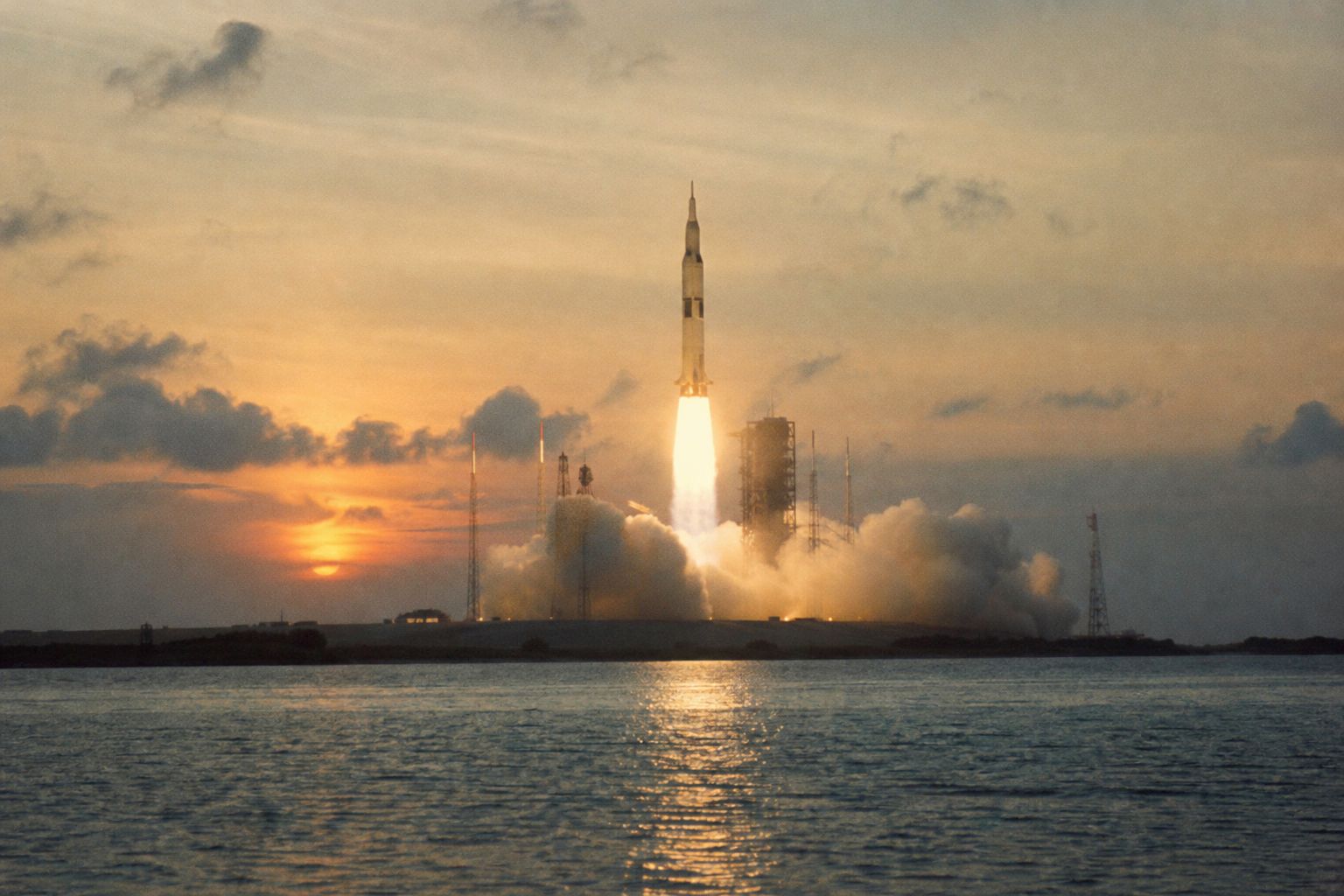
Voyager 2 was launched first, on the twentieth of August 1977. Voyager 1 followed sixteen days later, on the fifth of September.
Voyager 1 took a faster path, and reached Jupiter four months before its twin.
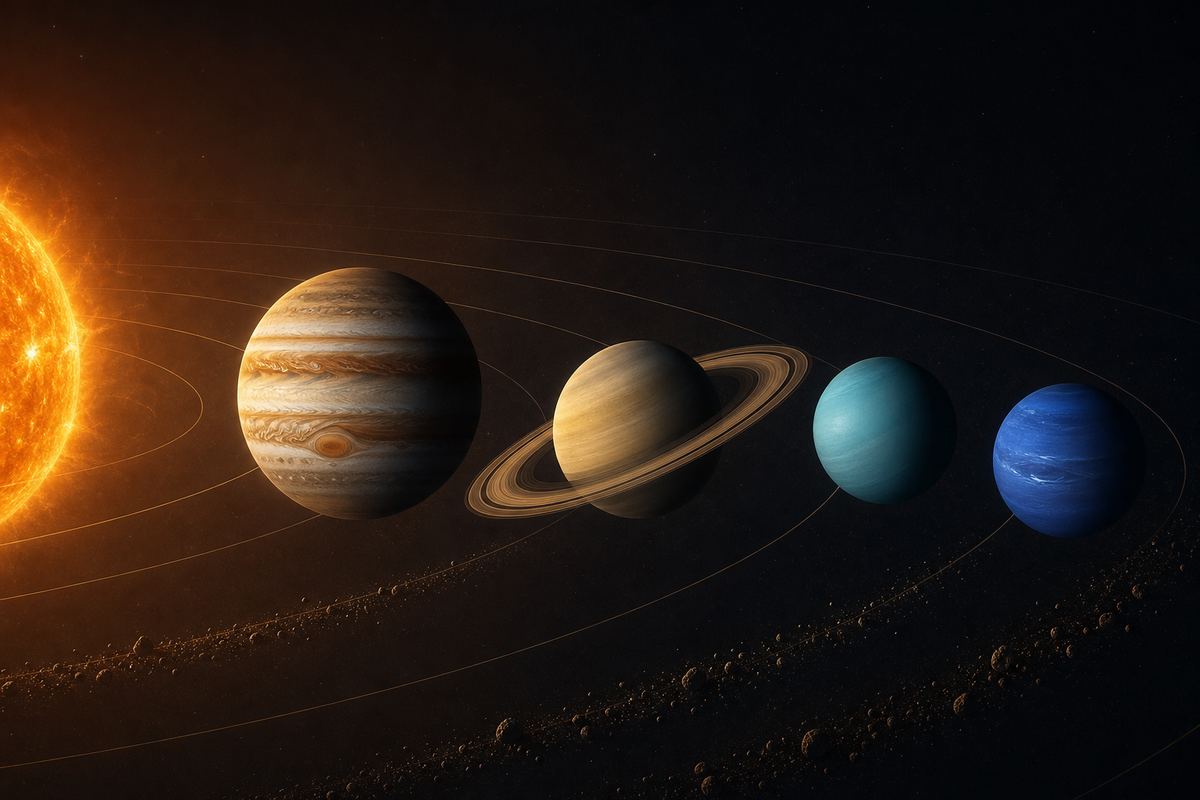
The timing was no accident. About once every one hundred and seventy-five years, the giant planets line up so that one probe can visit them in turn.
A bigger plan to visit all of them was cancelled in 1971, so the Voyagers were sent to Jupiter and Saturn.
20 Aug 1977 Voyager 2, Cape Canaveral
5 Sep 1977 Voyager 1, Titan IIIE-Centaur rocket
Launch orderLift-off A rocket climbing from a seaside pad, in the style of the 1970s. AI-generated illustration.The line-up Jupiter, Saturn, Uranus and Neptune on one side of the Sun. AI-generated illustration.
1971
the “Grand Tour” is cancelled
The original plan
Chapter II · The grand tour
A launch window once in 175 years
NASA: Voyager 2 launched on 20 August 1977 and Voyager 1 on 5 September 1977, both on Titan-Centaur rockets from Cape Canaveral. Voyager 1 left 16 days later on a faster trajectory and reached Jupiter four months earlier. The alignment of the outer planets that allowed one spacecraft to visit them in turn happens about every 175 years.
NASA History: the original “Grand Tour” plan was cancelled in 1971 and replaced by a Jupiter and Saturn mission. Use the year buttons to move both Voyagers along their paths.
The 3D scenes are simplified teaching models, not to scale.
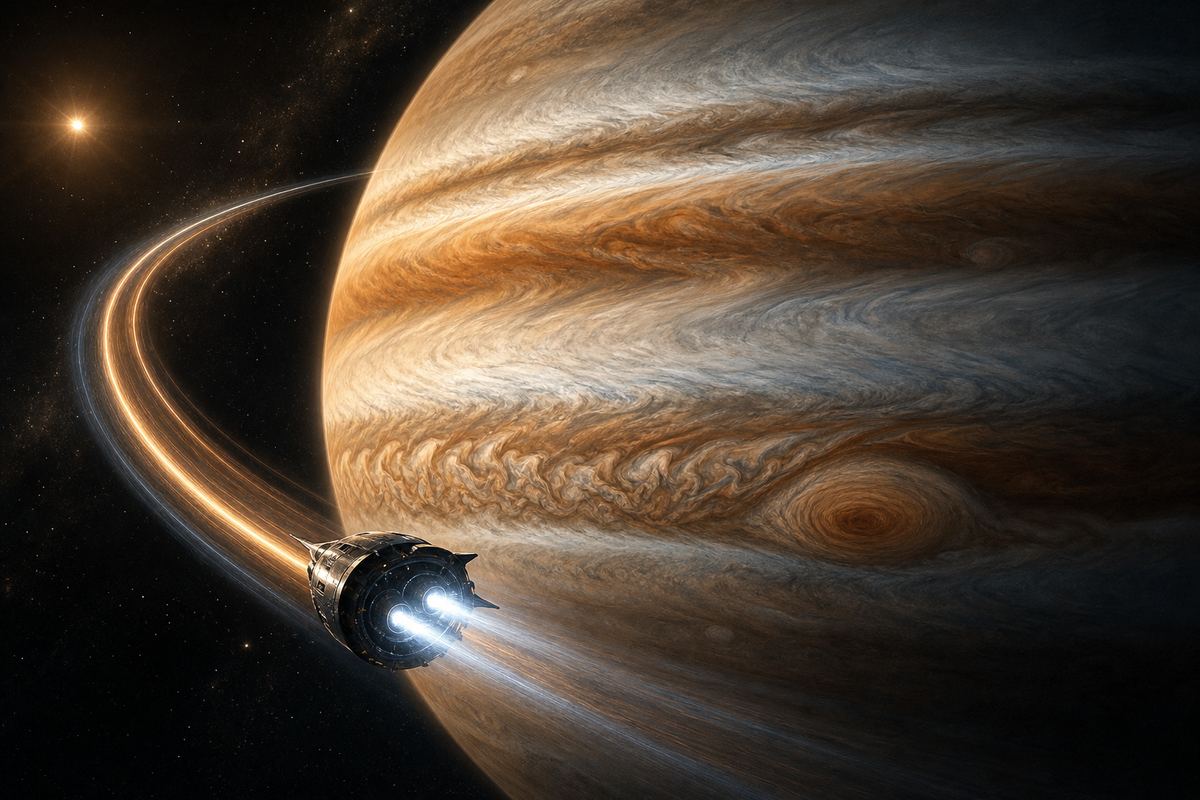
The trick that made the journey possible is called a gravity assist.
As the probe swings close past a planet that is itself racing round the Sun, the planet’s gravity bends its path and drags it along, so it leaves faster than it came.
The Voyagers used this again and again. It cut the journey to Neptune from about thirty years to twelve.
Now take the planet away. Without it, the probe just carries on in a straight line at the same speed.
A bent path A close pass bends a spacecraft’s course. AI-generated illustration.
without assists
~30
with assists
12
Earth to Neptune
1973–74
Mariner 10, at Venus on the way to Mercury
First tried
Chapter II · The grand tour
The gravity assist
NASA: using each planet’s gravity to bend the path and speed up the spacecraft cut the flight time to Neptune from 30 years to 12. The technique had first been demonstrated by Mariner 10 in 1973–74.
In the scene, the probe gains speed only when the planet is there: switch the planet off to compare. The numbers in the toy model are made up to show the idea.
The 3D scenes are simplified teaching models, not to scale.
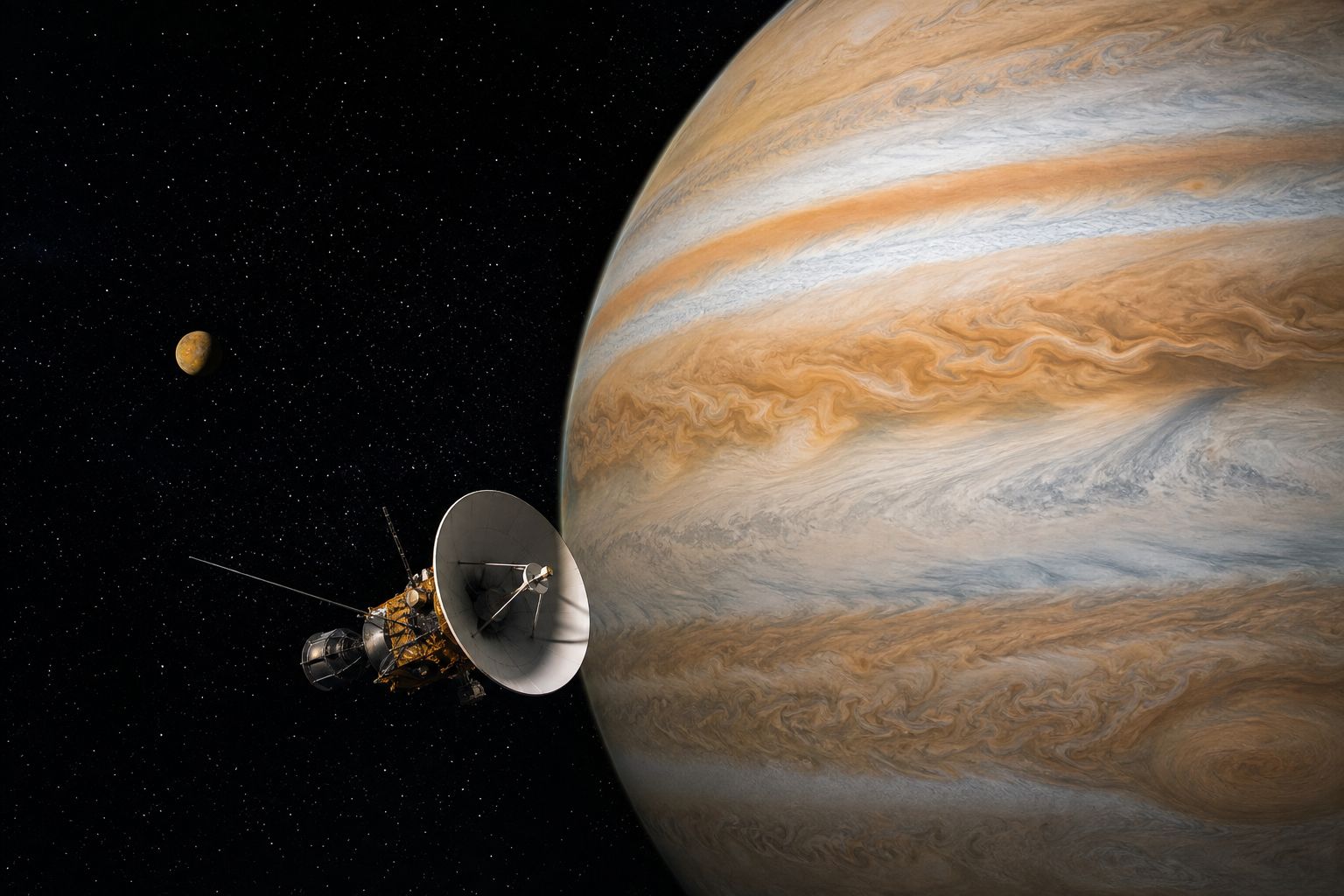
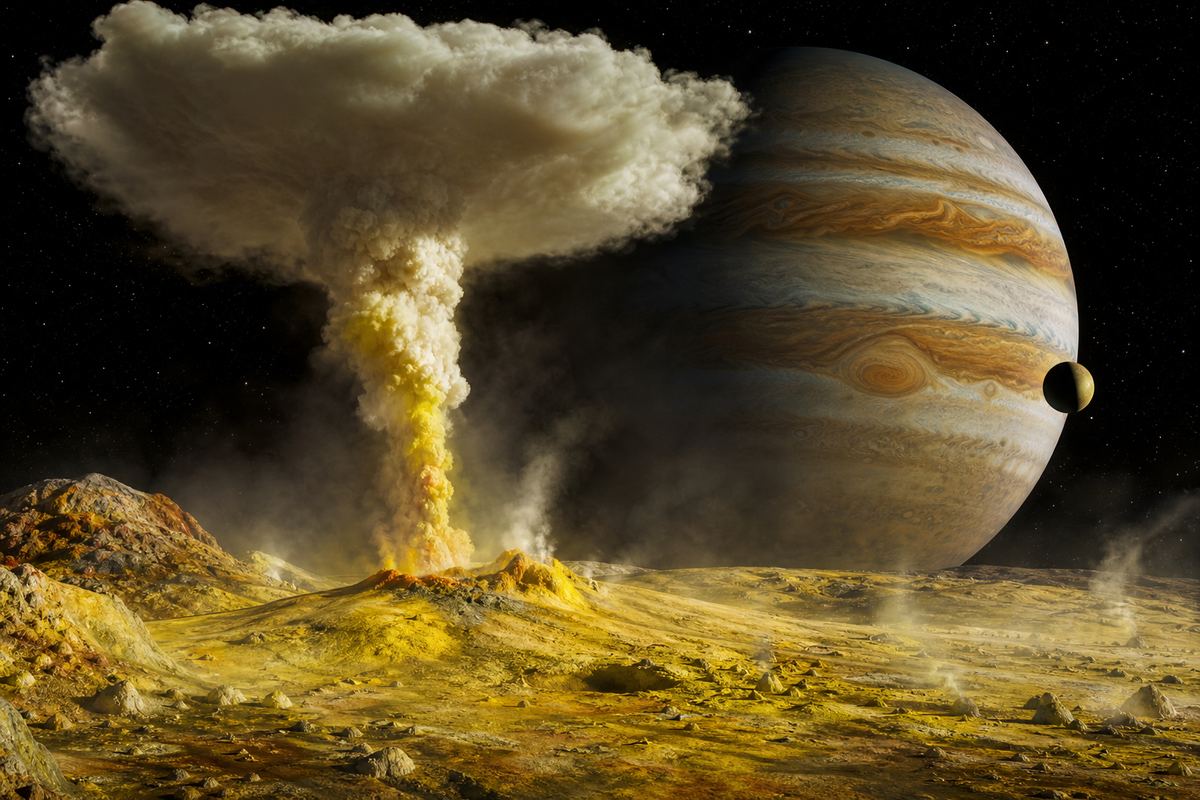
Voyager 1 passed Jupiter on the fifth of March 1979, about two hundred and eighty thousand kilometres from the planet.
Its cameras caught something nobody had seen before: volcanoes erupting on the moon Io, the first active volcanoes ever found beyond Earth.
Jupiter’s gravity then flung the probe on towards Saturn.
Fly-by A probe passing the largest planet. AI-generated illustration.Io A volcanic plume rising from Io, with Jupiter behind. AI-generated illustration.
~280,000 km
Voyager 1, 5 March 1979
9 July 1979
Voyager 2 follows
Closest approach
Chapter II · The grand tour
Jupiter and Io
NASA: Voyager 1 made its closest approach to Jupiter on 5 March 1979, at about 280,000 km (174,000 miles); Voyager 2 followed on 9 July 1979. The Voyagers discovered active volcanism on Io, the first seen anywhere other than Earth.
The 3D scenes are simplified teaching models, not to scale.
On the twelfth of November 1980, Voyager 1 reached Saturn.
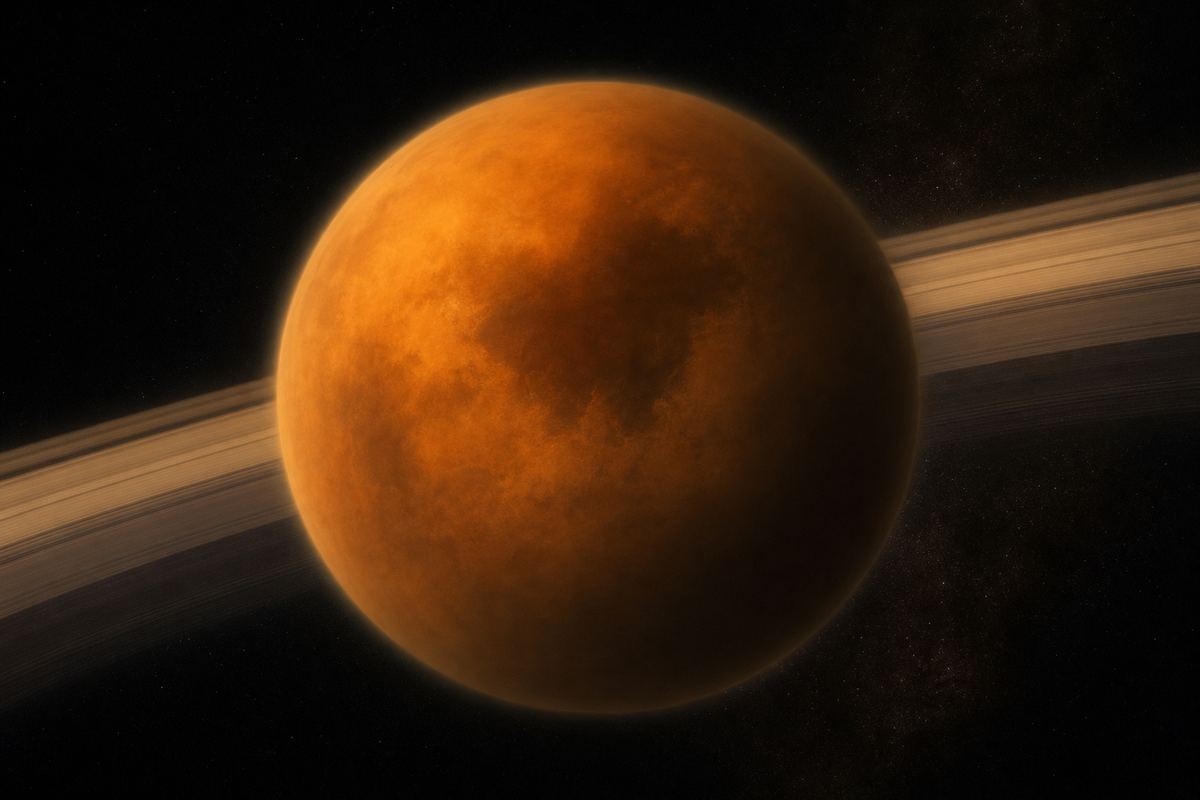
About eighteen hours earlier, it had flown within about six and a half thousand kilometres of Titan, a moon hidden under thick haze.
Voyager measured Titan’s air: it turned out to be mostly nitrogen with about ten percent methane, with a pressure at the surface about sixty percent higher than on Earth.
The close pass had a price. It threw Voyager 1 up and out of the flat disc in which the planets orbit, so it would never visit another one. Voyager 2 went on to Uranus and Neptune.
Titan An orange world wrapped in smog, Saturn’s rings faint behind it. AI-generated illustration.
mostly N₂
nitrogen
~10%
methane
~93 K
at the surface, about −180 °C
Titan’s air (Voyager 1)
25 Aug 1981 Saturn
24 Jan 1986 Uranus
25 Aug 1989 Neptune
Voyager 2 kept going
Chapter II · The grand tour
Titan, and the way out
NASA History: on 12 November 1980 Voyager 1 passed within 4,034 miles (about 6,490 km) of Titan, about 18 hours before its closest approach to Saturn. It found an atmosphere of mostly nitrogen with about 10% methane, a surface pressure about 60% higher than Earth’s and a temperature of about 93 K. The Titan trajectory took Voyager 1 below Saturn’s south pole and out of the plane of the planets, so it visited no more planets.
NASA: Voyager 2 passed Saturn on 25 August 1981, Uranus on 24 January 1986 and Neptune on 25 August 1989; between them the two craft explored four giant planets and 48 moons.
The 3D scenes are simplified teaching models, not to scale.
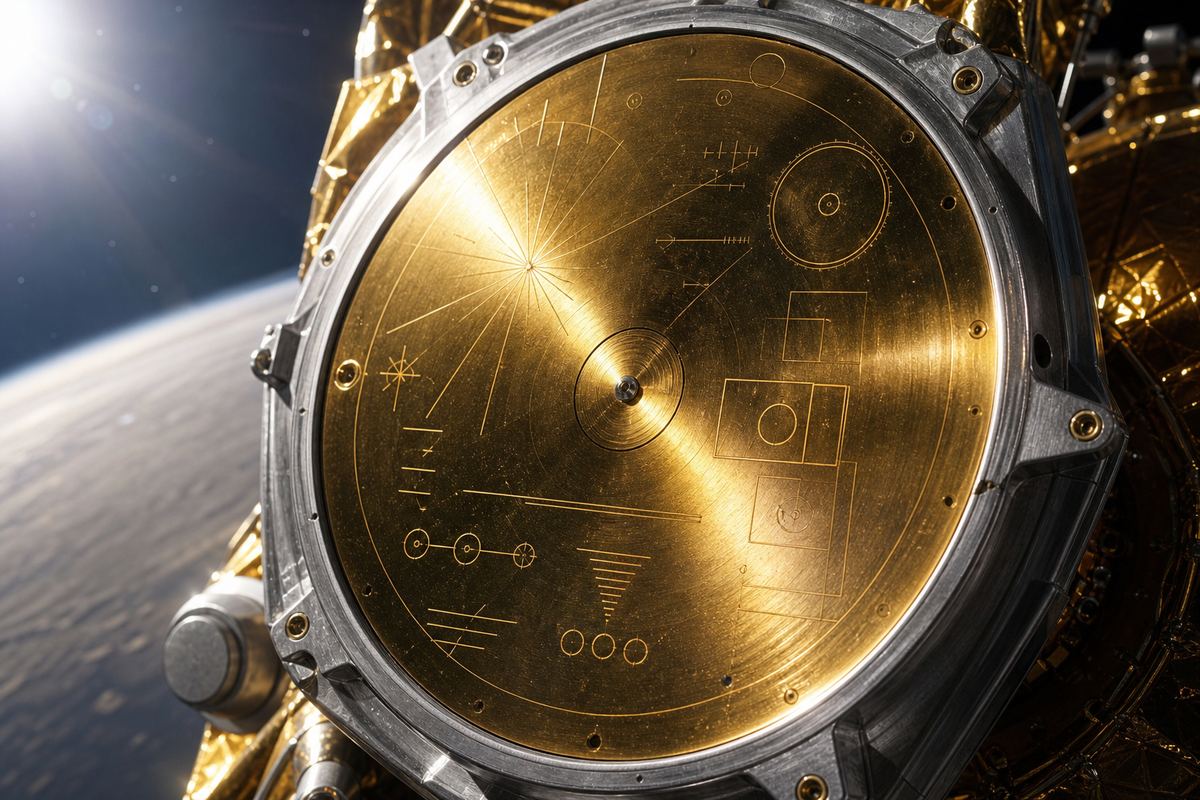
Each Voyager carries a message for anyone who might find it: a twelve-inch record made of gold-plated copper.
A committee chaired by the astronomer Carl Sagan chose what went on it: one hundred and fifteen pictures, the sounds of Earth, and ninety minutes of music.
There are spoken greetings in fifty-five languages, and printed messages from the American president and the head of the United Nations.
Its cover carries diagrams that explain how to play it, and where it came from.
Gold on copper A gold-plated disc in its cover, bolted to the spacecraft. AI-generated illustration.
115
images, stored as analog signals
90 min
of music
55
languages of greeting, Akkadian to Wu
On the recordSounds of Earth Surf, thunder, birds and whales: the record mixes nature with people. AI-generated illustration.
how to play the record
where Earth is
Engraved on the cover
Chapter III · Messages and a portrait
The Golden Record
NASA: each Voyager carries a 12-inch gold-plated copper disc. Its contents were selected by a committee chaired by Carl Sagan of Cornell University: 115 images encoded in analog form, natural sounds, a 90-minute selection of music, spoken greetings in 55 languages from Akkadian to Wu, and printed messages from US President Jimmy Carter and UN Secretary-General Kurt Waldheim. The cover carries diagrams explaining how to play it and showing the location of Earth.
The 3D scenes are simplified teaching models, not to scale.
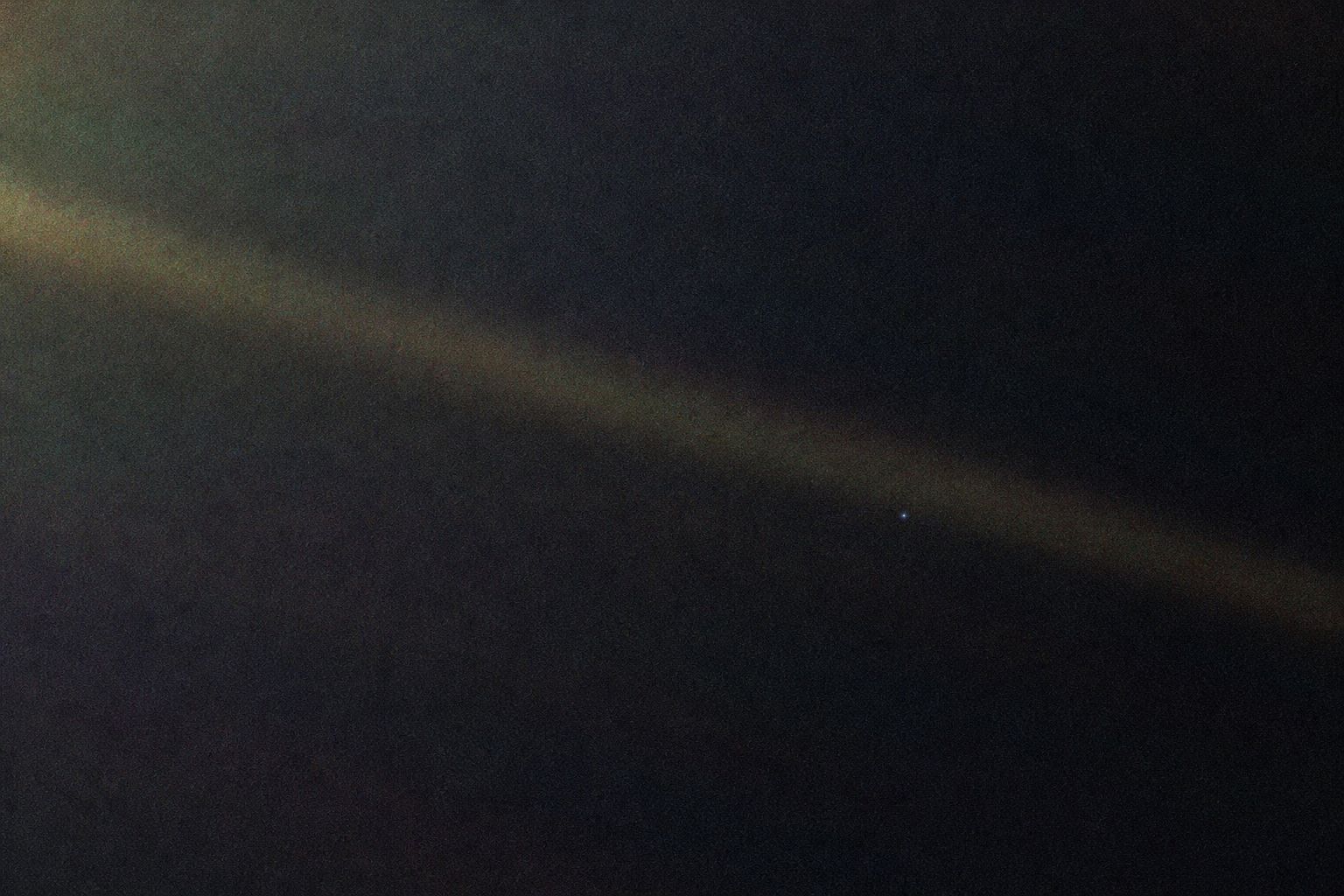
On the fourteenth of February 1990, about six billion kilometres from the Sun, Voyager 1 turned its cameras back towards home.
It took sixty images to build a family portrait of six planets. In one of them, Earth is about a single pixel: a pale blue dot.
The idea came from Carl Sagan, who had first suggested it in 1981.
Thirty-four minutes after the pictures of Earth, the cameras were powered off.
~6 billion km
from the Sun
14 February 1990Home, from afar An impression of Earth as a speck in a ray of scattered sunlight. AI-generated illustration.The family portrait Sixty frames, six planets: most of them single specks of light. AI-generated illustration.
05:22 GMT
14 February 1990
Cameras off
Chapter III · Messages and a portrait
The Pale Blue Dot
NASA: on 14 February 1990, about 6 billion km (3.7 billion miles) from the Sun, Voyager 1 took 60 images for a “family portrait” of six planets; in its picture Earth is about a pixel in size. Carl Sagan first suggested the image in 1981. The cameras were powered off at 05:22 GMT, about 34 minutes after the Earth images.
The 3D scenes are simplified teaching models, not to scale.
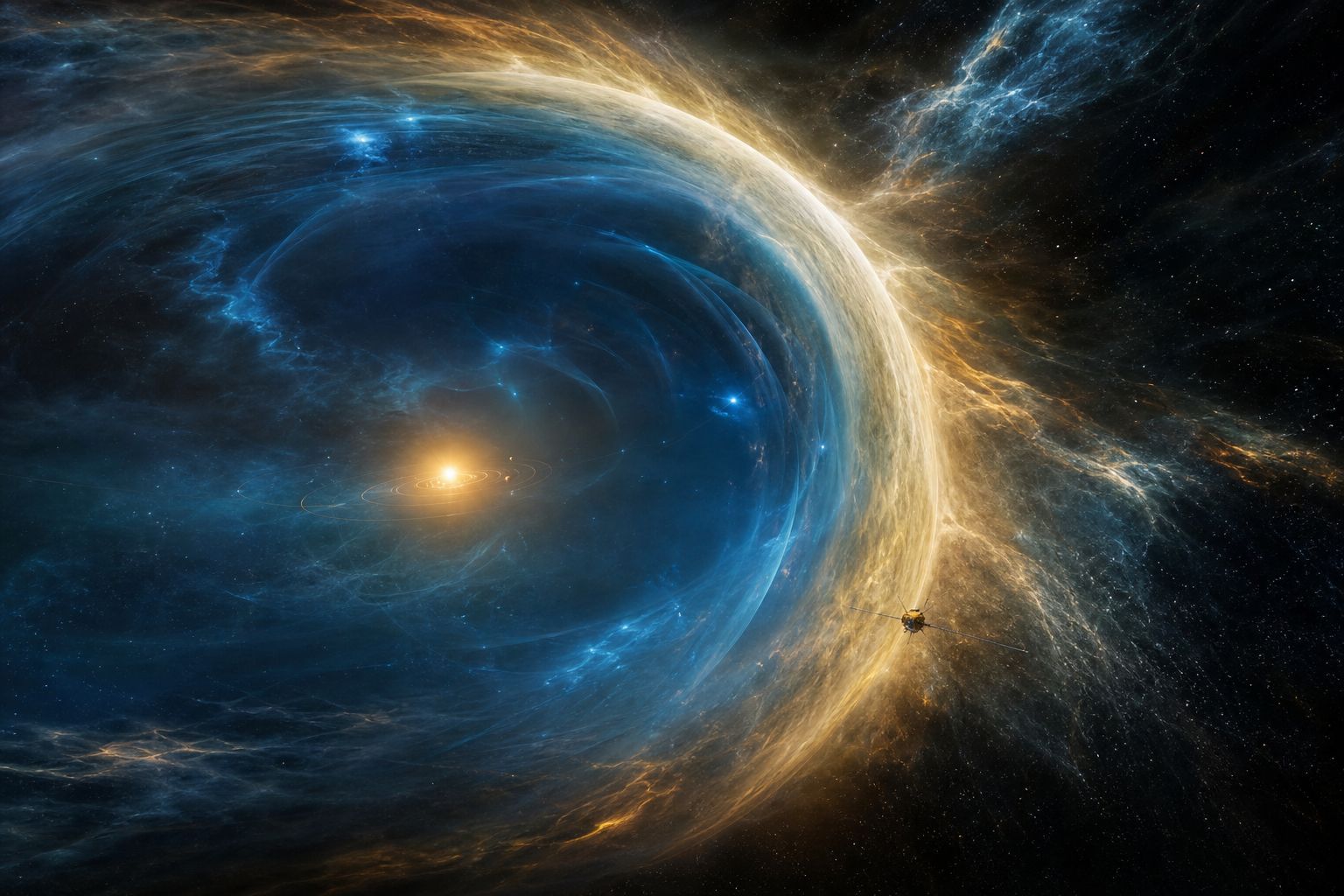
The Sun blows a constant stream of charged particles, the solar wind, which carves out an enormous bubble around it called the heliosphere.
Far out, the wind slows down abruptly as it meets the thin gas between the stars. That boundary is called the termination shock.
Voyager 1 crossed it on the sixteenth of December 2004, about ninety-four times as far from the Sun as Earth is.
Voyager 2 crossed it in 2007, at about eighty-four.
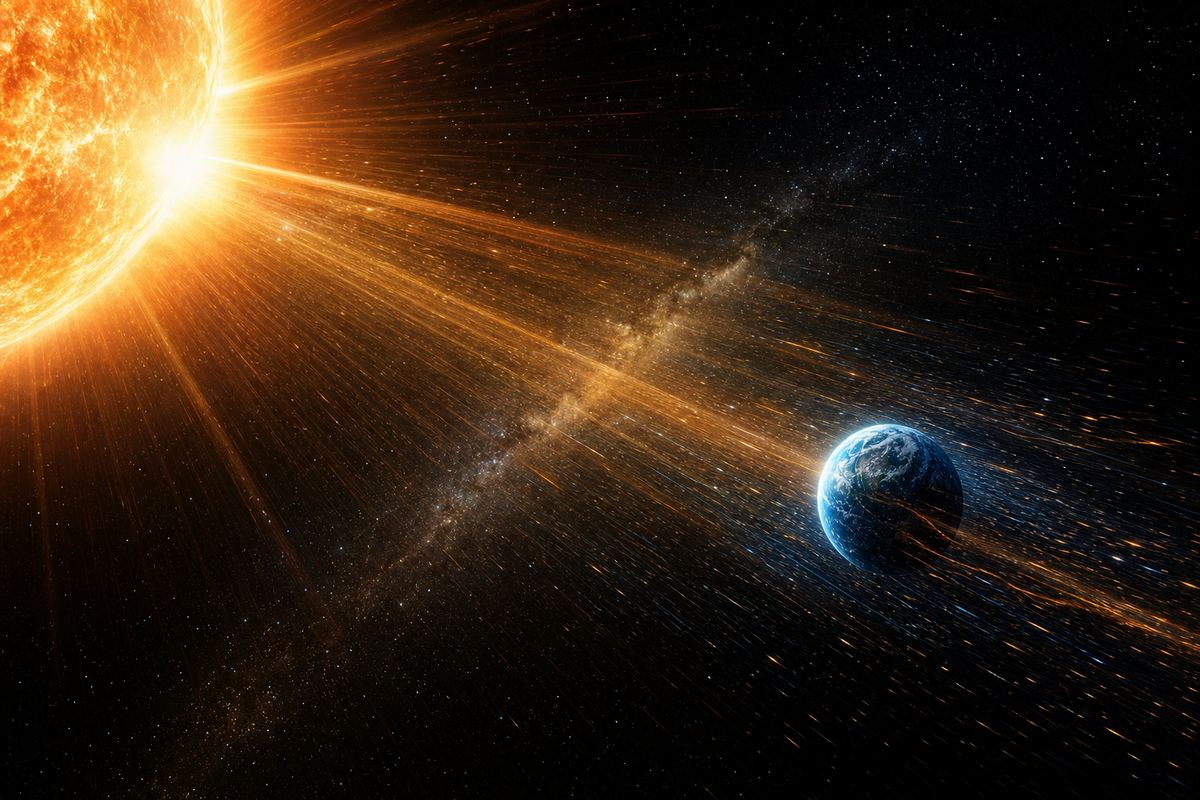
A bubble in space An impression of the heliosphere ploughing through interstellar gas. AI-generated illustration.The solar wind Charged particles stream out from the Sun in every direction. AI-generated illustration.1AU≈150million km
AU
astronomical unit: the Earth–Sun distance
The yardstick
Voyager 1, Dec 2004
~94
Voyager 2, Aug 2007
~84
Where each crossed the shock
Chapter IV · The edge of the bubble
The termination shock
NASA: the heliosphere is a bubble around the Sun created by the outward flow of the solar wind. Voyager 1 crossed the termination shock on 16 December 2004 at about 94 AU; Voyager 2 crossed it in August 2007 at about 84 AU. One astronomical unit (AU), the Earth–Sun distance, is about 150 million km.
In the scene, switch the solar wind and the interstellar gas on and off. The bubble’s real shape is simplified.
The 3D scenes are simplified teaching models, not to scale.
Beyond the shock lies the heliopause, the outer edge of the bubble, where the solar wind gives way to the gas between the stars.
Voyager 1 crossed it on the twenty-fifth of August 2012. But nobody could be sure for a year, because its sensor for plasma, the electrically charged gas of space, had stopped working long before.
The proof came from the Sun. An outburst in March 2012 set the gas around the probe vibrating like a violin string. The pitch of that vibration revealed the gas’s density: more than forty times denser than in the bubble’s outer layer.
In September 2013, NASA announced that Voyager 1 was in interstellar space. Voyager 2 followed in 2018.
Mar 2012 a solar outburst sets off
25 Aug 2012 particle readings change abruptly
Oct–Nov 2012, Apr 2013 plasma waves recorded
12 Sep 2013 NASA announces it
How the crossing was confirmedRinging gas An impression of plasma waves rippling through thin interstellar gas. AI-generated illustration.
>40×
denser plasma than in the bubble’s outer layer
2018
Voyager 2 crosses, 5 Nov
Interstellar space
Chapter IV · The edge of the bubble
The heliopause
NASA (12 September 2013): Voyager 1 entered interstellar space on or about 25 August 2012, when its particle readings changed abruptly. Its plasma instrument no longer worked, so the proof came from plasma waves recorded in October–November 2012 and on 9 April 2013, set off by a solar outburst in March 2012; they showed plasma more than 40 times denser than inside the heliosphere. NASA: Voyager 2 entered interstellar space on 5 November 2018.
NASA describes this as entering interstellar space; it does not mean Voyager 1 has left the reach of the Sun’s gravity.
The 3D scenes are simplified teaching models, not to scale.
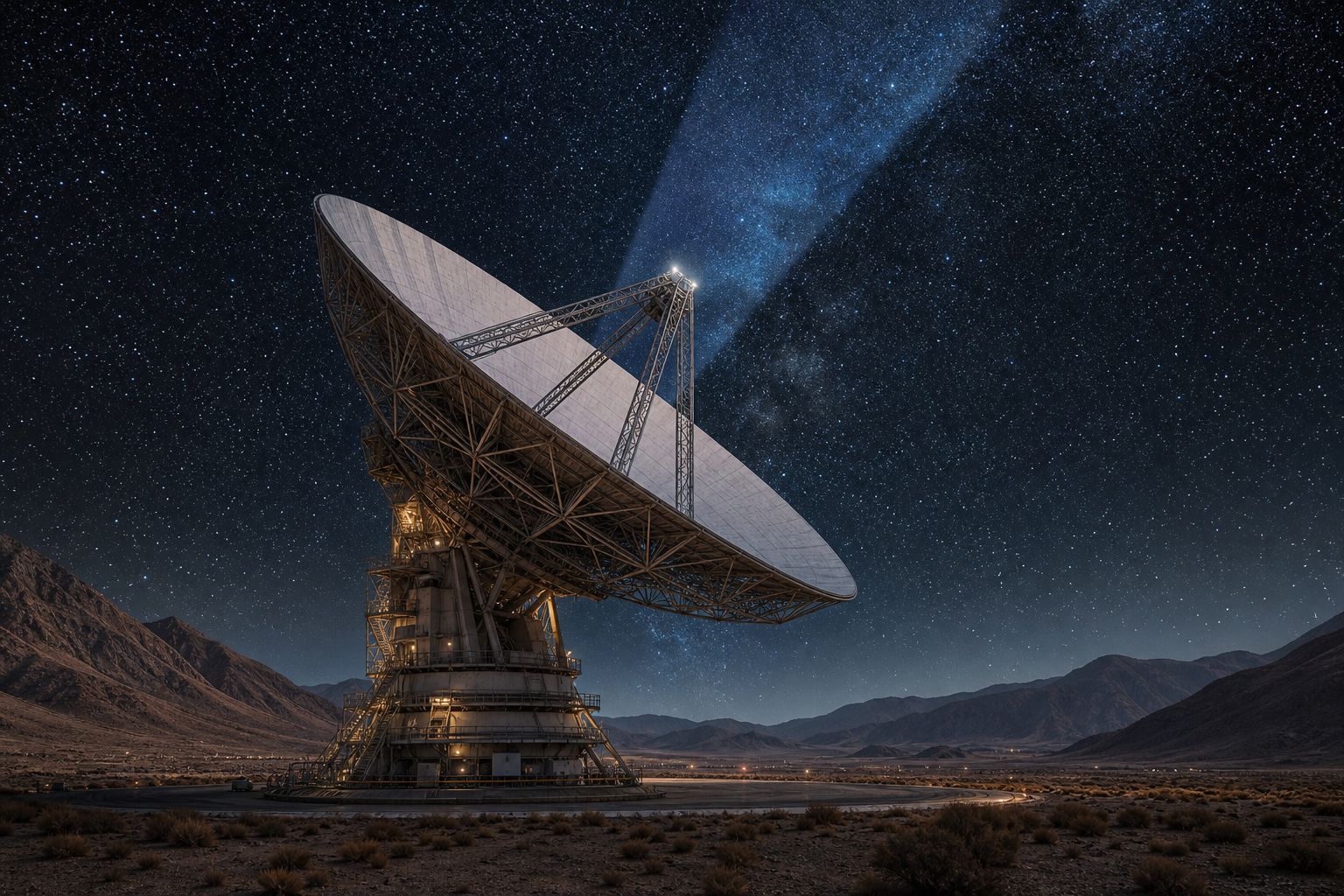
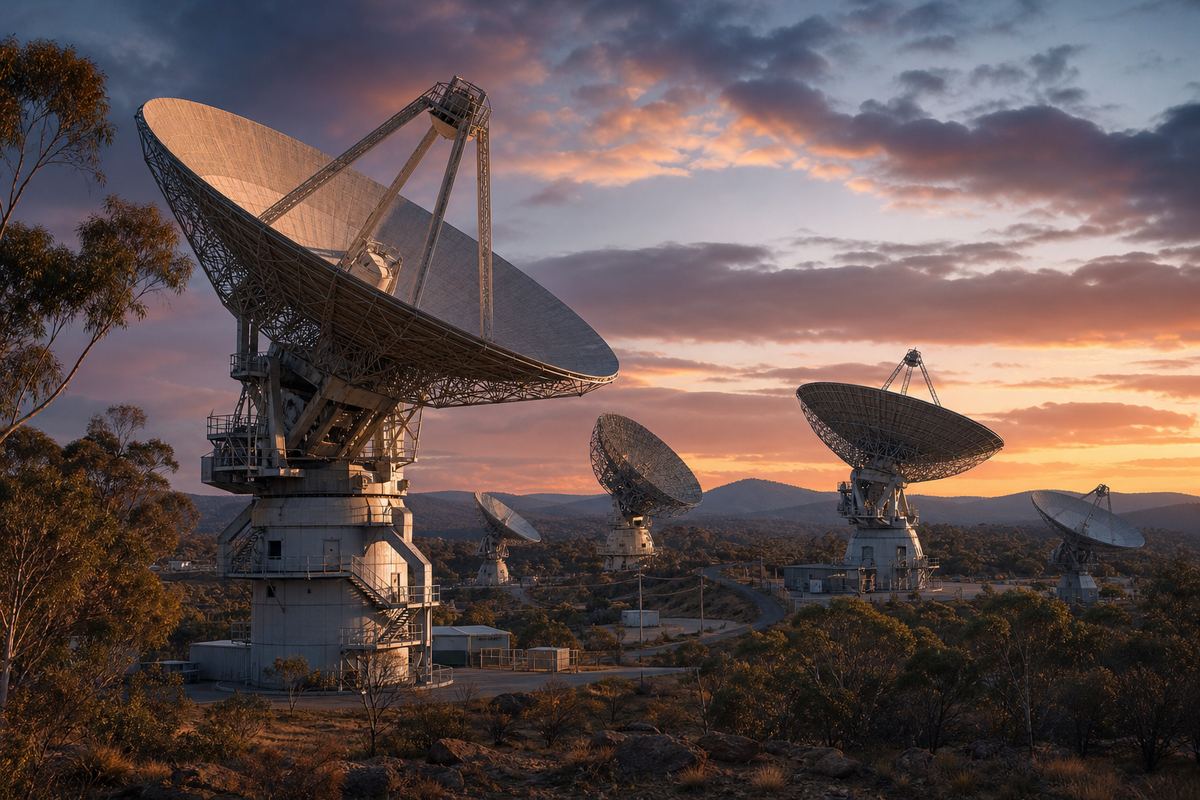
To talk to Voyager, NASA uses the Deep Space Network: dish antennas at three sites, at Goldstone in California, near Madrid in Spain, and near Canberra in Australia.
Spread around the globe, they keep a distant probe in view as the Earth turns.
Each site has a dish seventy metres across. Voyager’s transmitter puts out about twenty-three watts, about as much as a refrigerator light bulb.
By the time that signal reaches Earth, it is a tiny fraction of a billionth of a billionth of a watt. It carries data at about one hundred and sixty bits per second.
A 70-metre ear A giant dish in a desert valley, tilted to the sky. AI-generated illustration.Round the clock Big dishes and small ones share each site. AI-generated illustration.
70 m
largest dish at each site
~23 W
Voyager’s transmitter
~160 bit/s
data rate today
The linkFaint data Night shift: waveforms from a very weak signal. AI-generated illustration.
Chapter V · Keeping in touch
The Deep Space Network
NASA: the Deep Space Network has complexes at Goldstone (near Barstow, California), near Madrid and near Canberra, placed so that missions stay in contact as Earth turns. Each has one 70 m (230 ft) dish, one 26 m dish and several 34 m dishes. Only Canberra’s 70 m dish can send commands to Voyager 2, which is visible only from the southern hemisphere.
NASA (2013): Voyager’s transmitter is about 23 watts, “refrigerator light bulb” power, and its signal arrives as a fraction of a billion-billionth of a watt; data come down at about 160 bits per second. At Jupiter in 1979 the link carried up to 115,200 bits per second.
The 3D scenes are simplified teaching models, not to scale.
Voyager runs on heat from decaying plutonium-238, turned into electricity by three radioisotope generators.
At launch each one gave about one hundred and fifty-eight watts. The supply now falls by about four watts every year.
So engineers keep switching things off. Voyager 1 launched with ten instruments, and two are still working.
In September 2026 they swapped three devices for lower-power ones. Without that, they say, another instrument might have had to go off as early as the summer of 2027.
Heat into power A finned power unit: plutonium’s heat in, electricity out. AI-generated illustration.
3 × ~158 W
at launch
−4 W
every year
Power supply
at launch, 1977
10
working, 2026
2
Voyager 1’s instruments
Feb 2025 cosmic ray instrument off
Apr 2026 low-energy particle instrument off
Sep 2026 three devices swapped for low-power ones
Recent switch-offs
Chapter V · Keeping in touch
Power
NASA: each Voyager carries three radioisotope thermoelectric generators that turn heat from the decay of plutonium-238 into electricity; each gave about 158 W at launch. The supply drops by about 4 W a year. Voyager 1 launched with 10 instruments; after the cosmic ray subsystem was turned off on 25 February 2025 and the low-energy charged particle instrument on 17 April 2026, two still work, measuring plasma waves and the magnetic field.
JPL (29 October 2026): in early September engineers turned off three devices and replaced them with lower-power alternatives; without this, another instrument would likely have had to be turned off as early as summer 2027.
Use the 1977 and 2026 buttons to compare.
The 3D scenes are simplified teaching models, not to scale.
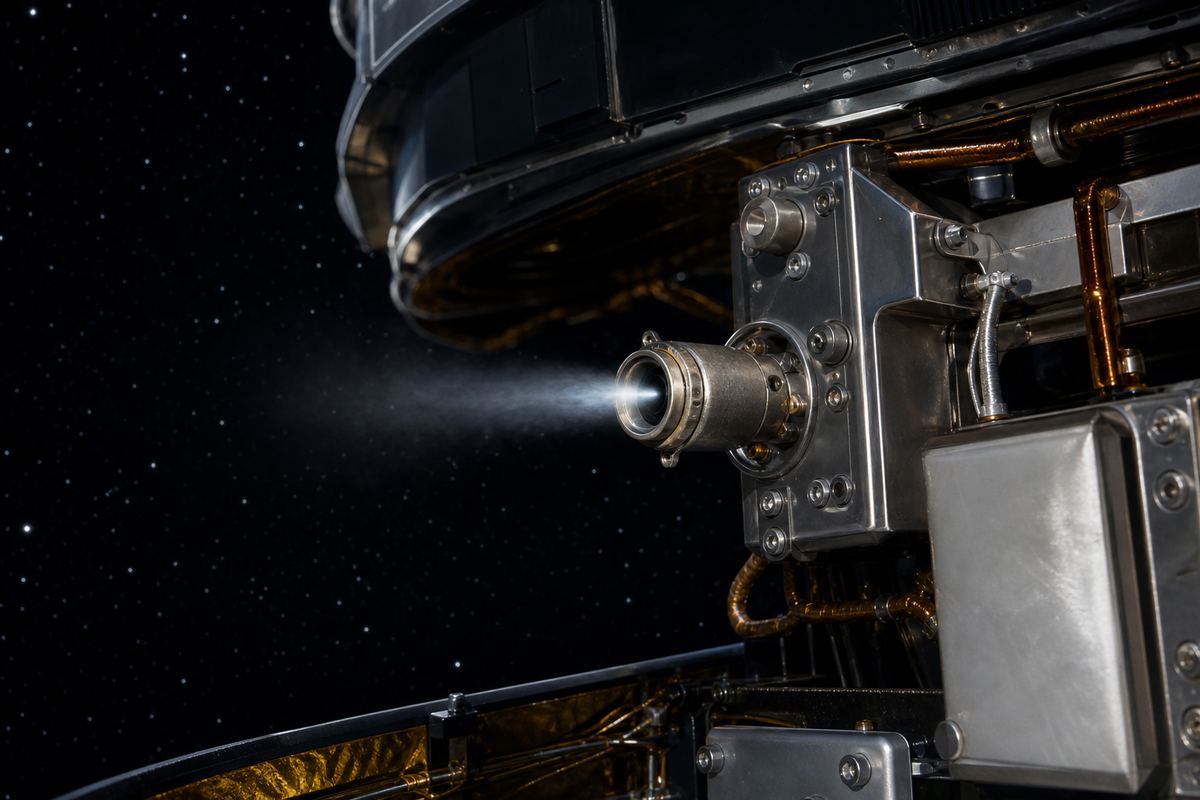
The October pause showed how the probe looks after itself. When one set of thrusters stopped, an automatic system called fault protection switched to the backups and paused normal work, giving engineers time to diagnose the problem.
What caused the loss of contact is still being investigated.
NASA hopes to keep at least one instrument running into the 2030s. Voyager 2, about three billion kilometres closer, will reach a light-day of its own in 2035.
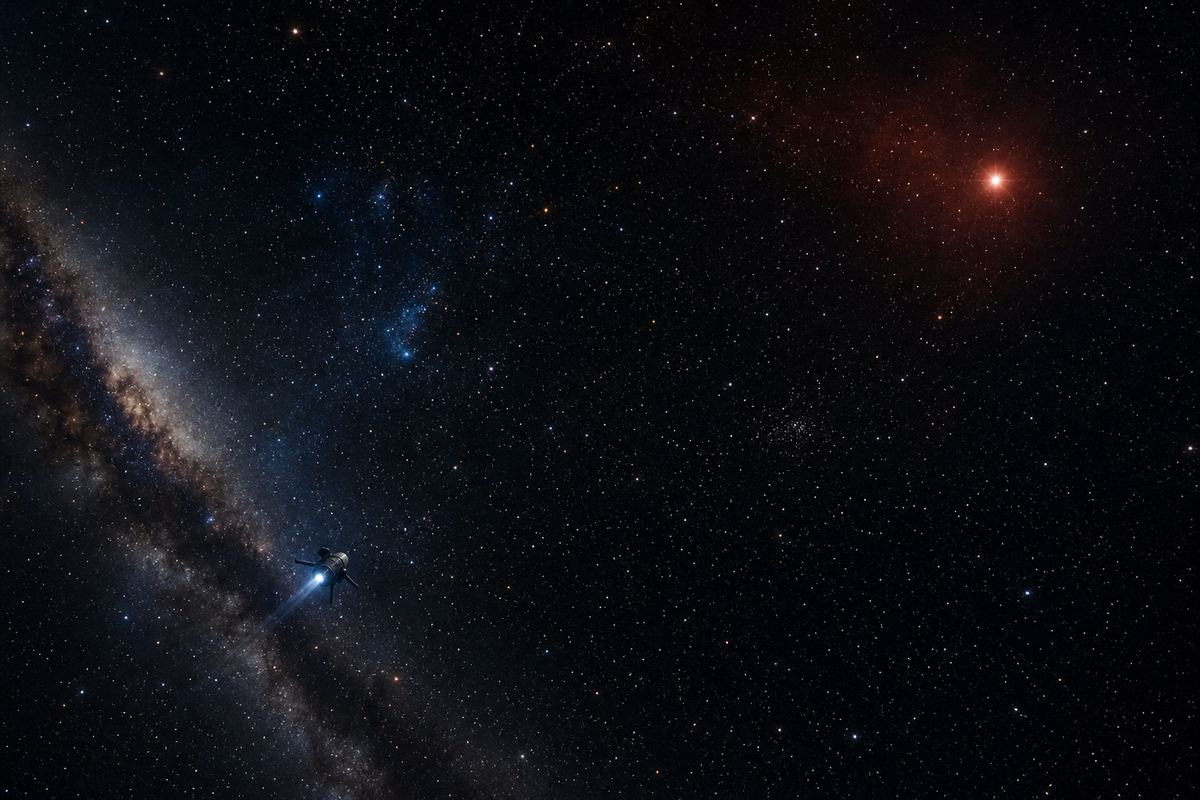
After it falls silent, Voyager 1 will keep coasting. Around the year forty thousand, it will pass within about one point seven light-years of a faint star.
Thrusters The probe carries more than one set of thrusters, so a backup can take over. AI-generated illustration.
switch to backup thrusters
go into a safe, stable state
pause normal work for the engineers
Fault protection
18 Nov 2026 Voyager 1: one light-day
2030s last science instrument, NASA hopes
Nov 2035 Voyager 2: one light-day
What comes nextA star called AC+79 3888 Around the year 40,272: a faint red star, and a silent probe. AI-generated illustration.
Chapter V · Keeping in touch
The long goodbye
NASA JPL (2026): Voyager 1 travels at about 61,155 km/h (38,000 mph). After the thruster problem in October 2026, automatic fault protection switched to backup thrusters and paused normal operations; the cause is under investigation. NASA (2025): the team aims to keep at least one science instrument running into the 2030s, though unforeseen problems could end the mission sooner.
EarthSky (2026): Voyager 2 is about 3.2 billion km closer and reaches one light-day in November 2035. NASA FAQ: in about the year 40,272 Voyager 1 will pass within 1.7 light-years of the star AC+79 3888.
The 3D scenes are simplified teaching models, not to scale.
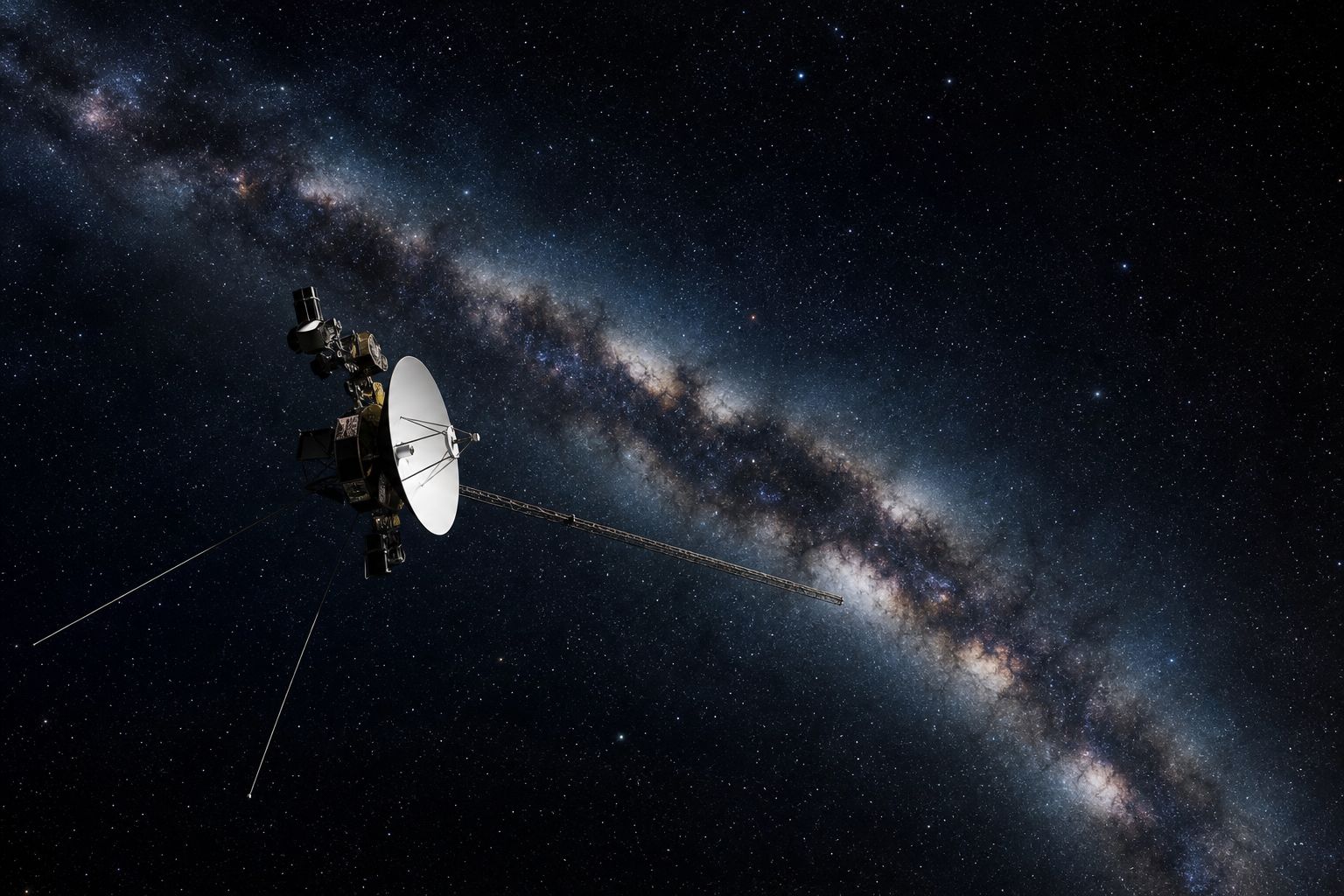
In forty-nine years, Voyager 1 has gone from a launch pad in Florida to the gas between the stars.
It is still moving at about seventeen kilometres every second.
It has been the most distant object ever made by people since 1998, and it is still sending back science.
Its voice now takes a whole day to reach us. We are still listening.
1977 launch, 5 Sep
1979–80 Jupiter, Saturn, Titan
1990 Pale Blue Dot
1998 passes Pioneer 10: most distant
2004 termination shock
2012 interstellar space
2026 one light-day, 18 Nov
Voyager 1: a timeline
~61,000 km/h
about 17 km every second
Speed todayStill going A lone probe against the Milky Way. AI-generated illustration.
a light-day ≈ 25.9 billion km
gravity assists made the tour possible
a ~23 W voice, heard by 70 m dishes
Remember
Epilogue · Sources
Sources
Every fact in this film comes from the sources below, mostly NASA and JPL. The chapter stills and pictures are AI-generated illustrations, not spacecraft images. The 3D scenes are simplified teaching models: distances are squeezed, the planets are drawn where the Voyagers met them, and the heliosphere’s shape is schematic. NASA: Voyager 1 has been the most distant human-made object since 17 February 1998, when it passed Pioneer 10.