Every year the UN General Assembly votes on a resolution calling on the United States to end its embargo on Cuba, and in October 2026 Cuba accused Washington of pressuring countries ahead of the vote. This film explains the fundamentals: Cuba's ties to the United States before 1959, the revolution and the nationalisations, the export ban of 1960 and Kennedy's full embargo of 1962, what an embargo is, Soviet support and the crisis after 1991, the laws of 1992, 1996 and 2000 that wrote the embargo into US law, the thaw of 2014 to 2016 and the tightening since, each government's account in its own terms, the UN votes since 1992, and what it would take to lift the embargo.
Interactive 3D film10 min1898 to 2026Published 25 October 2026
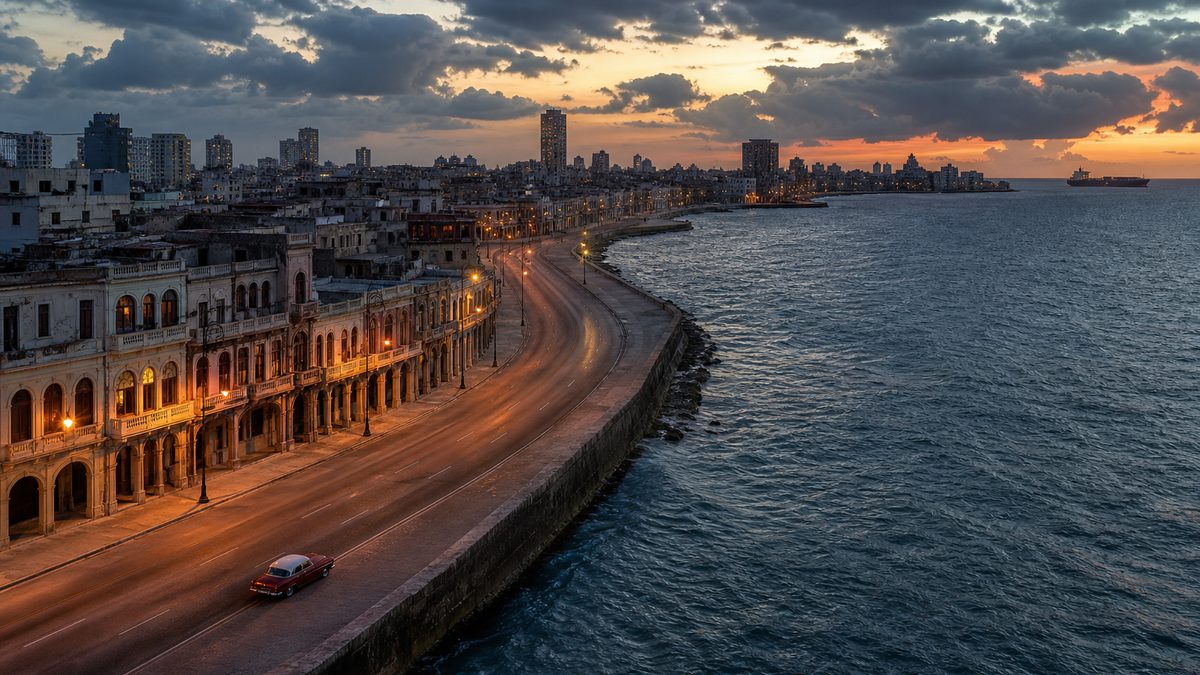
Cuba lies about 150 kilometres from Florida, yet for more than sixty years almost no trade has crossed the strait between them. The reason is a United States embargo.
Every year, Cuba asks the UN General Assembly to call for its end. The vote is not binding, but in 2025 it passed by 165 to 7, with 12 abstentions.
This year's vote is expected around 27 October. On the 21st, Cuba's foreign minister, Bruno Rodríguez, accused Washington of threatening countries that vote with Cuba.
The US ambassador, Mike Waltz, urged a no vote, saying the resolution gives Cuba's government an excuse to justify oppression.
≈150 km
Florida to Cuba at the narrowest
1960
first US ban on exports to Cuba
Next door, closed
For ending the embargo
165
Against
7
Abstained
12
UN General Assembly, 29 October 2025 No votes: the US, Israel, Argentina, Hungary, North Macedonia, Paraguay and Ukraine (UN News).
“A new and dangerous way of conducting multilateral diplomacy.”Bruno Rodríguez, Cuba’s foreign minister, on X, 21 Oct 2026 (Al Jazeera)
“An excuse to justify oppression, to justify the misery of the Cuban people.”Mike Waltz, US ambassador to the UN, on the resolution, October 2026 (Reuters)
The US view: an excuse for Havana
Prologue
The vote ahead
Al Jazeera and Reuters (21–22 October 2026): Cuba’s foreign minister Bruno Rodríguez said the United States was threatening UN members with visa denials, suspended cooperation, sanctions and tariffs if they voted with Cuba, and urging some to abstain or stay away; the vote on the non-binding resolution was expected on 27 or 28 October. Reuters reported that US ambassador Mike Waltz had urged countries to vote against it, calling it “an excuse to justify oppression, to justify the misery of the Cuban people”; Al Jazeera reported that the US administration says the Cuban government, not the embargo, is to blame for Cuba’s economic situation. UN News: on 29 October 2025 the resolution passed 165 to 7, with 12 abstentions.
The globe is a teaching model: trade arcs are schematic, their thickness is not to scale, and the outline of Cuba is simplified.
Cuba was a Spanish colony until 1898, when the United States defeated Spain in the Spanish–American War.
After a US occupation, the United States required Cuba to write the Platt Amendment into its constitution. It let Washington intervene in Cuban affairs, and lease land for a naval base at Guantánamo Bay, which it still holds.
Most of those terms were dropped in 1934. The base stayed.
≈150 km
93 miles: Key West to the Cuban shore, at the narrowest
≈1,800 m
deepest soundings in the strait
Across the strait
1898 Spanish–American War; Spain leaves Cuba
1901 Platt Amendment written into Cuba’s constitution
1902 US troops withdraw
1903 Guantánamo Bay leased as a naval station
1934 New treaty drops most Platt terms
A protected republic
16–11
vote to accept the Platt Amendment, with 4 abstaining
Cuba’s assembly, 12 June 1901
Chapter I · Next door
The Platt Amendment
Wikipedia, Straits of Florida: the strait is 93 miles (150 km) wide at its narrowest, between Key West and the Cuban shore, and has been sounded to about 1,800 m. Wikipedia, Platt Amendment: passed as part of the US Army Appropriations Act of 1901 after the Spanish–American War, it set seven conditions, including that the United States “may exercise the right to intervene” in Cuba and that Cuba lease land for naval stations. Cuba’s constitutional assembly accepted it on 12 June 1901 by 16 to 11, with four abstentions. US troops withdrew in 1902; the 1903 treaty led to the lease at Guantánamo Bay, which the US still controls. Most provisions were repealed by the 1934 Treaty of Relations.
On screen: the dashed line is the narrowest crossing; the outline of Cuba is simplified.
The globe is a teaching model: trade arcs are schematic, their thickness is not to scale, and the outline of Cuba is simplified.
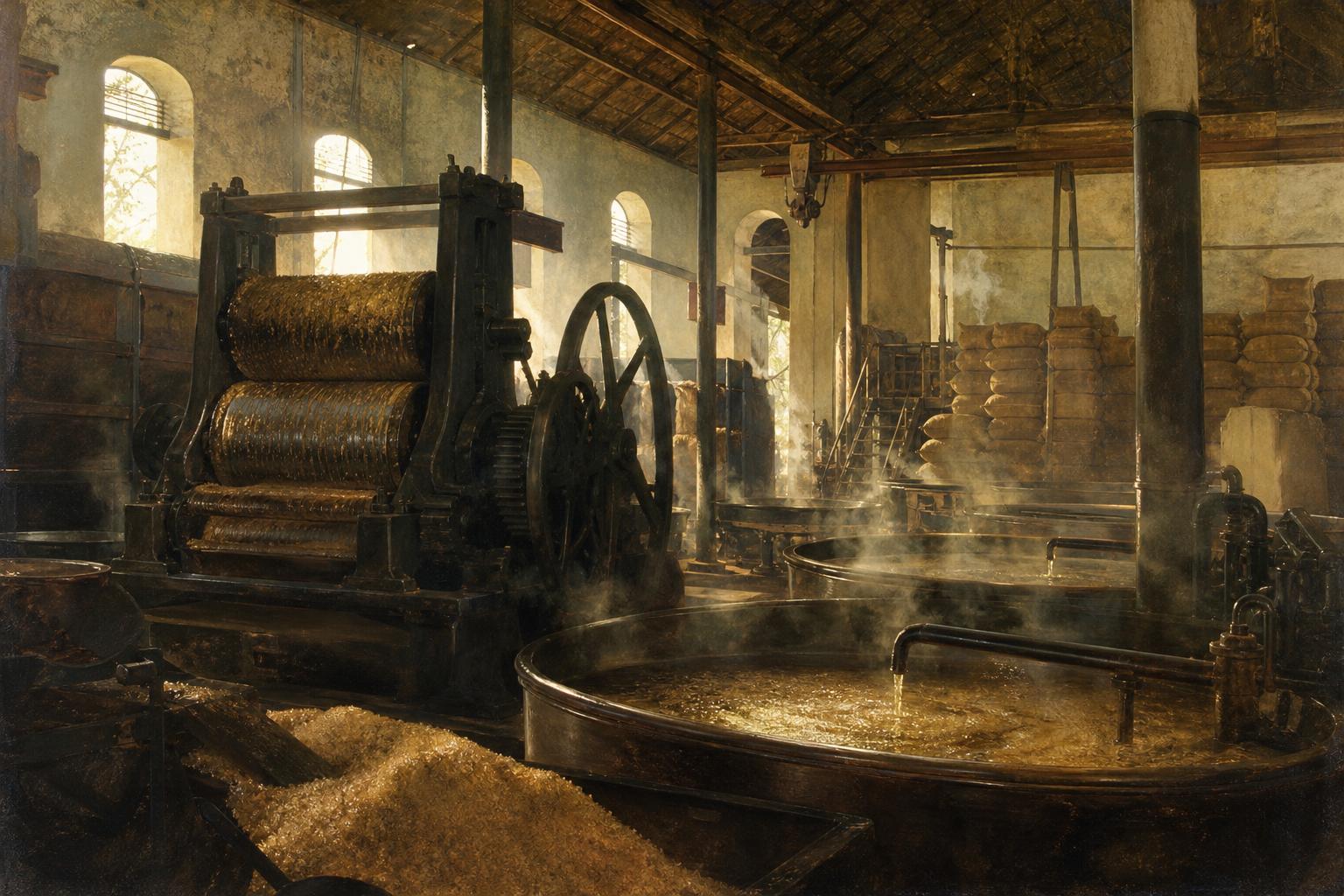
By the 1950s, Cuba's economy ran on sugar, and its biggest customer was the United States, which bought it under a quota: a guaranteed share of the American market.
Until 1960, Cuba supplied over a third of the sugar Americans needed. US investment reached about a billion dollars by 1959, in sugar mills, oil refineries, and the telephone and power companies.
The sugar mill Rollers crush the cane; the juice is boiled down to raw sugar. AI-generated illustration.
> 1/3
of US sugar needs supplied by Cuba until 1960
≈ $1 bn
US investment in Cuba, January 1959
Cuba and the US before 1959
44 / 161
mills owned by US investors in 1950, about 47% of output
Who milled the sugar
Chapter I · Next door
A sugar economy
José Alvarez, University of Florida IFAS: Cuba supplied over one-third of total US sugar requirements until 1960, under quotas set by the Sugar Act of 1948 and its amendments; US investment in Cuba was estimated at about $1 billion when Batista was overthrown on 1 January 1959; US investors owned 44 of 161 sugar mills, about 47% of output, in 1950. Wikipedia, US embargo against Cuba: the property later nationalised included American-owned oil refineries, the Cuban electricity and telephone companies and sugar mills.
On screen: gold arcs carry sugar north, blue arcs carry goods south. Thickness is schematic.
The globe is a teaching model: trade arcs are schematic, their thickness is not to scale, and the outline of Cuba is simplified.
On 1 January 1959, rebels led by Fidel Castro took power. Their land reform took over large estates, including American-owned ones, and Cuba turned to the Soviet Union for arms and oil.
In mid-1960, US-owned refineries refused to process Soviet crude, and Cuba seized them. Washington stopped buying Cuban sugar. Cuba nationalised American companies.
On 19 October 1960, the United States banned exports to Cuba, except food and medicine. A US commission later certified 5,913 American claims for the seized property, worth about 1.9 billion dollars. They remain unpaid.
“…the expropriation of extensive American properties without acceptable provision for compensation.”President Eisenhower to Harold Macmillan, 11 July 1960
29 Jun – 1 Jul Cuba takes over the refineries
July US cancels Cuba’s sugar quota
6 Aug US-owned refineries, phone and power companies, 36 mills nationalised
13 Oct 382 large firms and 37 banks, Cuban and foreign, nationalised
19 Oct US bans exports, except food and medicine
1960, step by step
Export ban
exempt: nonsubsidised food, medicines and medical supplies
19 October 1960Claims on paper Deeds and maps: claims certified by the US Foreign Claims Settlement Commission accrue 6% a year. AI-generated illustration.
Chapter II · The break
Nationalisations and the first ban
Wikipedia, US embargo against Cuba: after the revolution of 1 January 1959, Cuba began buying arms from the Soviet Union in May 1960 and agreed to take Soviet oil; when Esso, Texaco and Shell refused to refine it, Cuba took over the refineries on 29 June and 1 July 1960, and the US cancelled Cuba’s sugar quota (Eisenhower suspended purchases on 2 July, per the Cubarte chronology). Cubarte chronology: on 6 August Cuba nationalised US-owned refineries, the electricity and telephone companies and 36 sugar mills; on 13 October it nationalised 382 large enterprises, 105 sugar mills and 37 banks, Cuban and foreign. Wikipedia: compensation was offered in Cuban bonds, to be paid from sugar sales to the US, which US authorities rejected; no compensation was paid. US Office of the Historian (FRUS doc. 551): Eisenhower’s letter to Harold Macmillan of 11 July 1960 cited “the expropriation of extensive American properties without acceptable provision for compensation”. US Office of the Historian: on 19 October 1960 the State Department announced it was “prohibiting American exports to Cuba except for nonsubsidized foodstuffs, medicines, and medical supplies.” Central Penn Business Journal (2015): the Foreign Claims Settlement Commission certified 5,913 claims worth about $1.9 billion, accruing 6% a year.
The globe is a teaching model: trade arcs are schematic, their thickness is not to scale, and the outline of Cuba is simplified.
In January 1961 the two countries broke off relations. In April, Cuban exiles trained by the CIA landed at the Bay of Pigs, and were defeated within days.
Then on 3 February 1962, President John F. Kennedy proclaimed an embargo on all trade: now Cuban goods were banned from the United States too. Compare the routes before and after.
The proclamation cited Cuba's alignment with the communist powers led by the Soviet Union, and aimed to isolate its government. For now, the embargo rested on a president's order.
1,400+
exile fighters, trained and funded by the CIA
3 days
until the landing collapsed
Bay of Pigs, 17–20 April 1961
“…isolating the present Government of Cuba and thereby reducing the threat posed by its alignment with the communist powers.”Proclamation 3447, 3 February 1962
Banned all imports of Cuban goods
Kept the 1960 ban on US exports
In force from 7 February 1962
Legal basis: Foreign Assistance Act of 1961
What the proclamation did
Chapter II · The break
The embargo on all trade
Wikipedia, Bay of Pigs Invasion: in April 1961 over 1,400 Cuban exiles, funded and trained by the CIA, landed in southwestern Cuba and were defeated; the US had severed diplomatic relations in January 1961. The American Presidency Project: Proclamation 3447, signed by John F. Kennedy on 3 February 1962 under section 620(a) of the Foreign Assistance Act of 1961, banned the import of all goods of Cuban origin and continued the ban on US exports, effective 12:01 a.m. on 7 February 1962. It cited “the subversive offensive of Sino-Soviet Communism with which the Government of Cuba is publicly aligned” and aimed at “isolating the present Government of Cuba”. Wikipedia: Kennedy widened the measures in 1962, and the Cuban Assets Control Regulations followed in 1963.
Try it: “Before” shows the trade of the 1950s; “After 1962” shows the routes the embargo closed.
The globe is a teaching model: trade arcs are schematic, their thickness is not to scale, and the outline of Cuba is simplified.
What exactly is an embargo? Sanctions are any withdrawal of normal trade or finance for political ends. An embargo is the broadest kind: a ban on trade with a whole country.
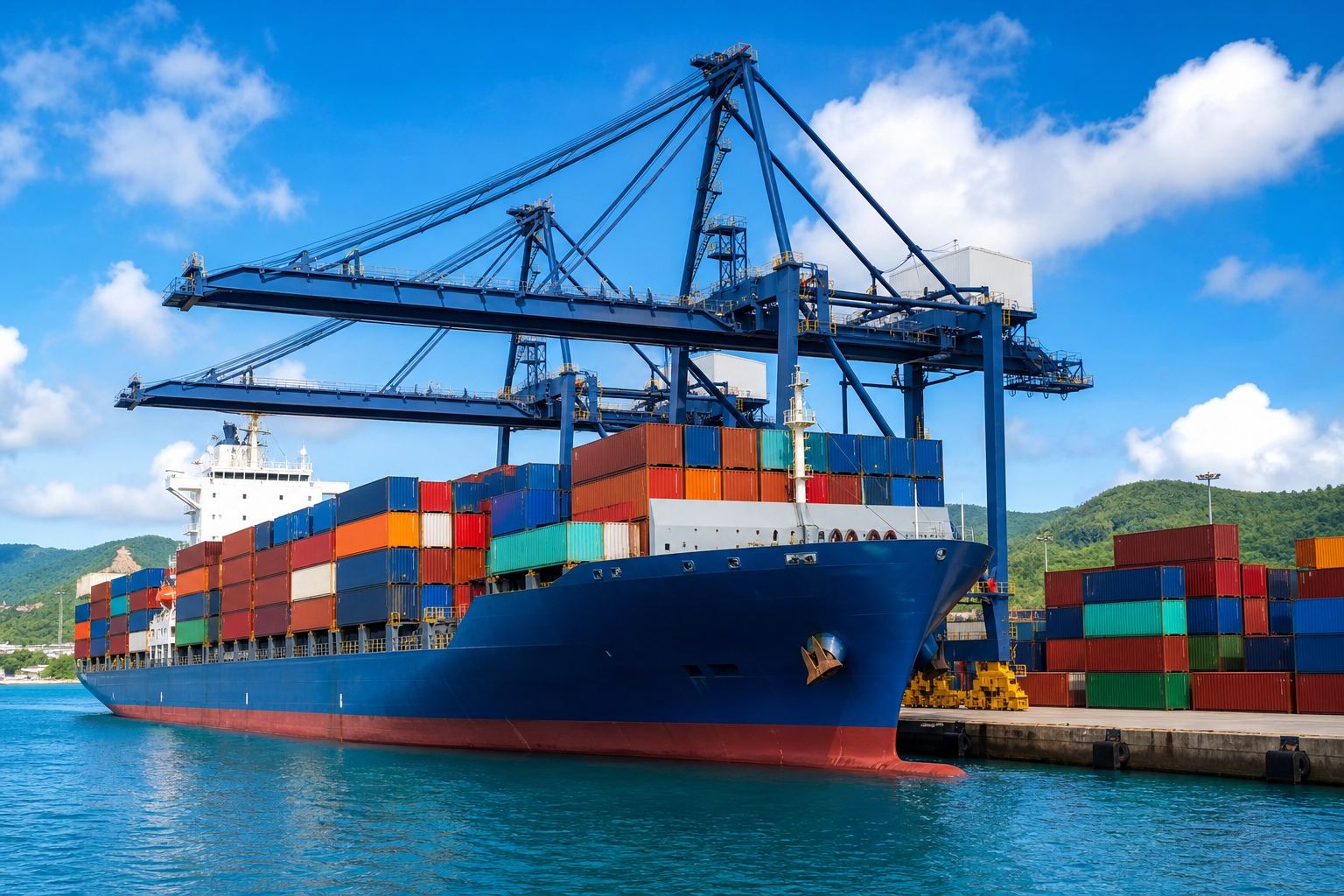
Switch it off and on. Other countries can still trade with Cuba, but the nearest, largest market is closed, so goods come from further away, and banks grow wary, because firms that deal with Cuba risk US penalties.
It costs both sides. In early 2009, the US Chamber of Commerce put the cost to the American economy at 1.2 billion dollars a year.
Comprehensive: no trade with a whole country, like the US embargo on Cuba
Targeted: named firms, groups or people
Secondary: aimed at third countries’ firms
Kinds of sanctions (CFR)
≈ 370 km
from Miami, straight line
≈ 7,790 km
from Rotterdam, straight line
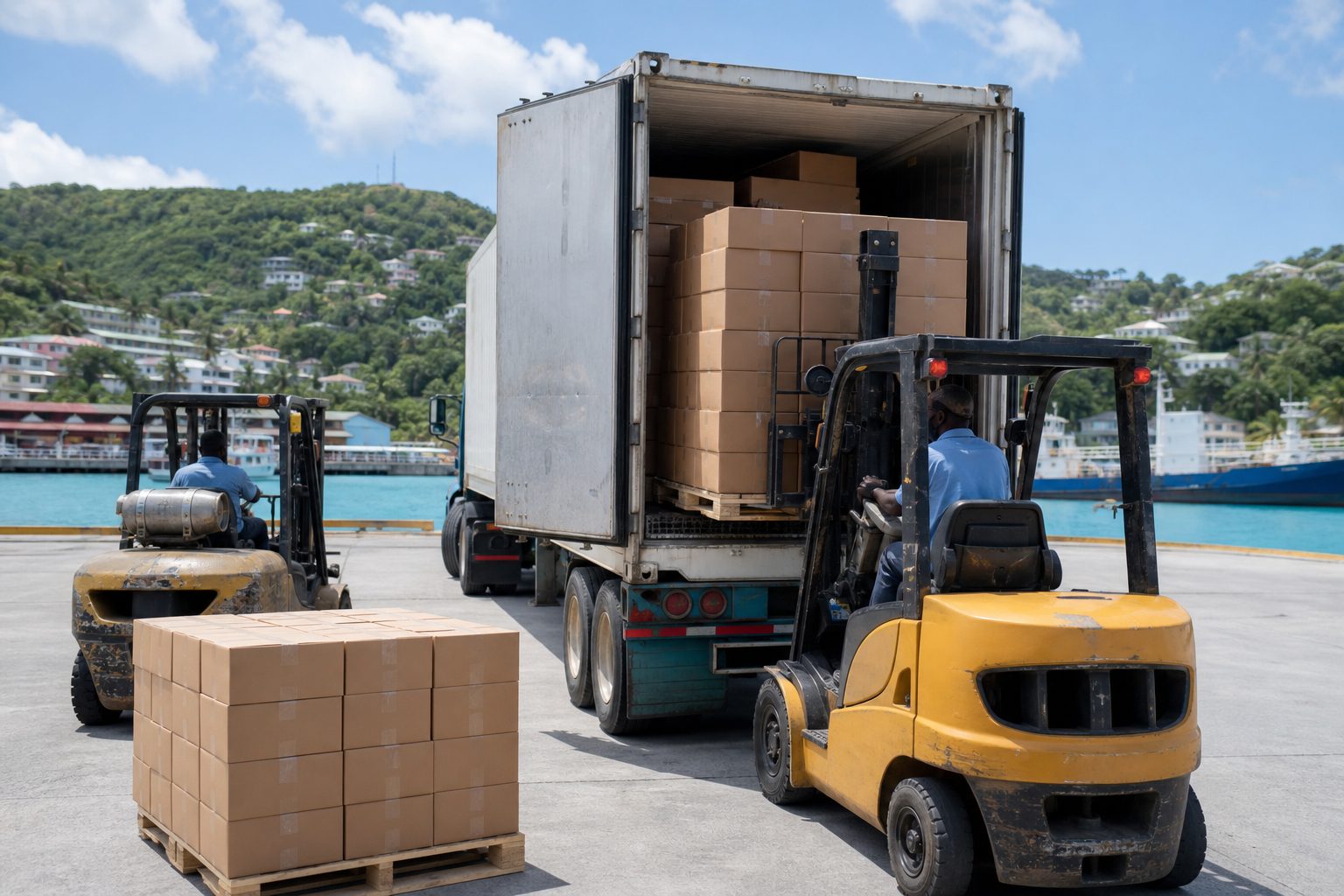
Distance to Havana (computed)The long way round Containers can still reach Cuba, from Europe, Asia or Latin America. AI-generated illustration.
$1.2 bn / yr
lost to the US economy, in a business letter to President-elect Obama co-signed by the US Chamber of Commerce (COHA)
The US side of the bill
Chapter III · What an embargo does
Embargo and sanctions
Council on Foreign Relations: economic sanctions are “the withdrawal of customary trade and financial relations for foreign- and security-policy purposes”; comprehensive sanctions prohibit commercial activity with an entire country, as in the long-standing US embargo of Cuba, while targeted sanctions block named businesses, groups or individuals, and secondary sanctions reach the firms of third countries. Council on Hemispheric Affairs (12 January 2009): a letter to President-elect Obama from a dozen leading US business organisations, including the US Chamber of Commerce, put the embargo’s cost to the US economy at $1.2 billion a year. Christian Science Monitor (1992): US penalties fall on parent companies whose foreign subsidiaries trade with Cuba. Cuban Ministry of Foreign Affairs: between March 2024 and February 2025, 40 foreign banks refused transactions with Cuban banks.
Try it: the readout gives the great-circle distance from each supplier’s port to Havana, computed from coordinates. Real shipping routes are longer.
The globe is a teaching model: trade arcs are schematic, their thickness is not to scale, and the outline of Cuba is simplified.
Cuba moved closer to the Soviet Union. In October 1962, Soviet nuclear missiles on the island brought the two superpowers to the brink, until Moscow agreed to remove them.
For three decades, Moscow was Cuba's main support. From 1972 Cuba belonged to Comecon, the Soviet-led trade bloc, selling its sugar and buying Soviet oil below world prices.
In the late 1980s, Soviet subsidies averaged about 4.3 billion dollars a year, around a fifth of Cuba's national income.
13 days
16–28 October 1962
The Cuban Missile Crisis
1960 First trade deal: Soviet oil, Cuban sugar
1962 Missile crisis
1972 Cuba joins Comecon
1989–1991 The Soviet bloc collapses
Cuba and the Soviet bloc
$4.3 bn / yr
on average (Cuba Platform)
≈21%
of Cuba’s gross national product
Soviet subsidies, 1986–1990
Chapter IV · Moscow’s island
The Soviet lifeline
Wikipedia, Cuban Missile Crisis: a 13-day confrontation between the United States and the Soviet Union, from 16 to 28 October 1962, over Soviet nuclear missiles deployed in Cuba, ending with their withdrawal. Wikipedia, US embargo against Cuba: Cuba and the Soviet Union signed a trade agreement in 1960 under which the Soviet Union would supply oil and buy Cuban sugar. Encyclopedia.com: Cuba joined Comecon in 1972. Cuba Platform: Soviet oil was sold to Cuba below market prices, and Soviet subsidies averaged $4.3 billion a year from 1986 to 1990, equal to 21.2% of Cuba’s GNP.
The globe is a teaching model: trade arcs are schematic, their thickness is not to scale, and the outline of Cuba is simplified.
Then the Soviet Union collapsed in 1991, and that support vanished. Oil imports fell to about a tenth of what they had been.
The economy shrank by about a third. The government gave the crisis a mild official name: the Special Period in Time of Peace.
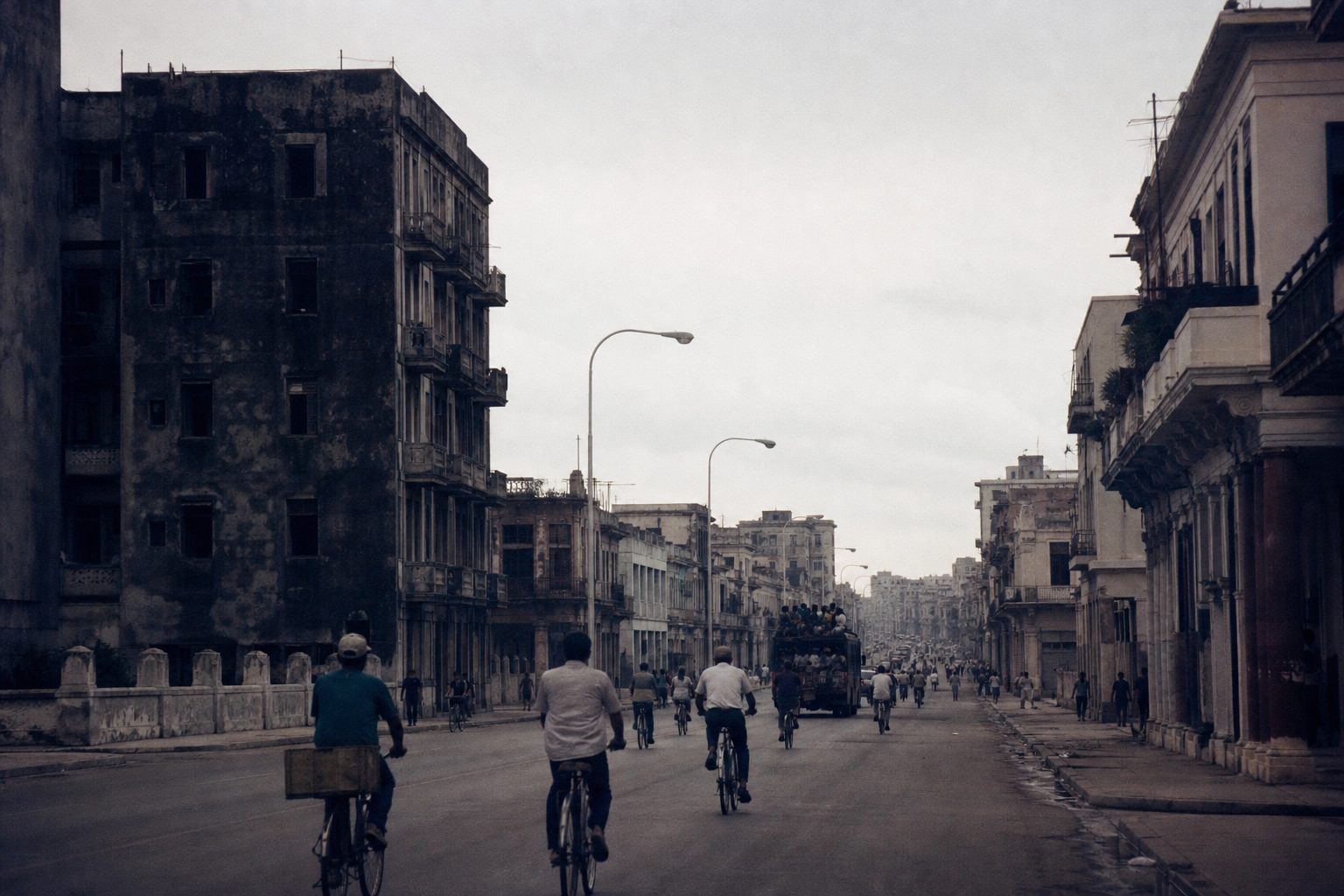
Power cuts lasted up to sixteen hours, and 1.2 million bicycles were bought from China.
The US Department of Agriculture estimated that daily food energy fell from about 3,050 calories per person in 1989 to about 2,100 in 1993.
≈10%
of earlier oil imports still arriving
−35%
GDP in the years after 1991
After the Soviet collapse
1991
when the crisis began
Mid-1990s
its worst years; things improved late in the decade
The Special PeriodHavana by bicycle About half a million more bicycles were made in Cuba itself. AI-generated illustration.
1989
3,052
1993
2,099
Daily food energy per person (USDA) A drop of about 31% in four years.
Chapter IV · Moscow’s island
The Special Period
Wikipedia, Special Period: after the Soviet Union collapsed in 1991, Cuba’s oil imports dropped to 10% of pre-1990 amounts and imports and exports both fell by over 80%; power outages could last up to sixteen hours and waiting for a bus could take three hours; 1.2 million bicycles were bought from China and about half a million more produced in Cuba. A US Department of Agriculture report cited there estimated daily intake fell from 3,052 calories in 1989 to 2,099 in 1993. The government called the crisis the “Special Period in Time of Peace”; in the years after the Soviet collapse GDP shrank 35%.
Try it: compare the arcs of 1989 with those of 1993.
The globe is a teaching model: trade arcs are schematic, their thickness is not to scale, and the outline of Cuba is simplified.
After the Soviet collapse, Congress tightened the embargo instead of easing it.
The Cuban Democracy Act of 1992 banned trade with Cuba by companies abroad owned by US firms, and kept ships that traded in Cuba out of US ports for 180 days.
In February 1996, Cuban fighter jets shot down two small planes of Brothers to the Rescue, a Miami exile group that searched the strait for rafters. Four men died.
Weeks later, Congress passed the Helms–Burton Act. It turned the embargo into law, so only Congress can lift it, and let Americans sue foreign firms using property seized from them.
180 days
a ship that traded in Cuba may not load or unload freight in the US
$705 m
trade with Cuba by US firms’ foreign subsidiaries in 1990 (CS Monitor)
Cuban Democracy Act, 1992
2
unarmed civilian Cessnas shot down near the 24th parallel
4
killed: three US citizens and one US resident
24 February 1996
Title I: the embargo becomes law
Title III: lawsuits over confiscated property, suspended every six months until 2019
Title IV: entry bans for foreign executives
Canada and the EU protested its reach abroad
Helms–Burton, signed 12 March 1996
Chapter V · Written into law
From proclamation to statute
Christian Science Monitor (1992): the Torricelli bill, which became the Cuban Democracy Act of 1992, barred US firms from trading with Cuba through foreign-based subsidiaries; that trade had tripled from 1988 to 1990, reaching $705 million, and Britain, Canada and others objected. 22 U.S. Code § 6005: a vessel that enters a Cuban port to trade may not, within 180 days, load or unload freight anywhere in the United States without a Treasury licence. WLRN (2026): Brothers to the Rescue, a Miami group founded by Cuban exile José Basulto, flew over the straits looking for rafters; on 24 February 1996 Cuban fighters shot down two of its unarmed Cessnas near the 24th parallel, killing all four men aboard; the Cuban pilot said the planes ignored warnings and kept approaching the Cuban coast. President Clinton, signing Helms–Burton on 12 March 1996, said the dead were three US citizens and one US resident. Wikipedia, Helms–Burton Act: passed on 6 March and signed on 12 March 1996; Title I codified the embargo; Title III lets US nationals sue those “trafficking” in confiscated property; presidents suspended Title III suits every six months until 2019. Canada and European governments objected to its extraterritorial reach.
On screen: a ship that calls at Havana is held away from US ports. Schematic.
The globe is a teaching model: trade arcs are schematic, their thickness is not to scale, and the outline of Cuba is simplified.
In 2000, pressed by American farmers, Congress allowed one exception: food and medicine could be sold to Cuba, but only for cash, because US credit stayed banned.
Step through the years to see which laws applied.
Cuba bought nothing until Hurricane Michelle damaged its farms in late 2001. By 2003, its purchases from US firms reached about 257 million dollars a year.
Food · medicine
allowed
Cash only
no US credit for Cuban buyers
Trade Sanctions Reform Act, 28 Oct 2000Paid before unloading Under the 2000 law, US food reaches Cuba only on cash terms. AI-generated illustration.
2001
4.3
2002
138.6
2003
256.9
Cuban purchases from US firms Cuba rose from 226th to 35th among US farm export markets, 2000 to 2003.
Chapter V · Written into law
Food for cash
Wikipedia, US embargo against Cuba: in response to pressure from American farmers and agribusiness, the Trade Sanctions Reform and Export Enhancement Act, passed in October 2000 and signed by Bill Clinton, allowed the sale of agricultural goods and medicine to Cuba; Cuba must pay cash for all food imports from the US, as credit is not allowed. José Alvarez, University of Florida IFAS: Clinton signed the act on 28 October 2000; Cuba made no purchases until December 2001, after Hurricane Michelle; purchases were $4.3 million in 2001, $138.6 million in 2002 and $256.9 million in 2003, and Cuba rose from 226th to 35th among US food and farm export markets.
Try it: the year buttons list the main laws and rules in force in that year.
The globe is a teaching model: trade arcs are schematic, their thickness is not to scale, and the outline of Cuba is simplified.
On 17 December 2014, President Barack Obama and Raúl Castro, Fidel's brother and successor, announced they would restore relations.
Cuba came off the US list of state sponsors of terrorism in May 2015, and embassies reopened that July.
In 2016, for the first time, the United States abstained in the UN vote. But the embargo itself is law, and Congress did not lift it.
Obama · Castro
simultaneous announcements, after a prisoner exchange
17 December 2014
17 Dec 2014 Restoring relations announced; prisoner exchange
11 Apr 2015 Obama and Castro meet in Panama
29 May 2015 Off the terrorism list
20 Jul 2015 Embassies reopen
The thaw
For
191
Against
0
Abstained: US, Israel
2
UN vote, 26 October 2016
Congress
the embargo is US law since 1996
Who can lift it
Chapter VI · Thaw and freeze
The Cuban thaw
Congressional Research Service (2019): in December 2014 President Obama announced a shift from sanctions to engagement; Cuba’s designation as a state sponsor of terrorism was rescinded in May 2015 and diplomatic relations were restored in July 2015; five rounds of regulatory changes in 2015–2016 eased travel, remittances, trade, telecommunications and banking. Wikipedia, Cuban thaw: Obama and Raúl Castro met at the Summit of the Americas in Panama on 10–11 April 2015; Cuba was removed from the list on 29 May 2015 and embassies reopened on 20 July 2015. UN News: on 26 October 2016 the resolution passed with 191 in favour; the United States and Israel abstained, the first US abstention. Reuters (2026): only the US Congress can lift the embargo.
The globe is a teaching model: trade arcs are schematic, their thickness is not to scale, and the outline of Cuba is simplified.
From 2017, President Donald Trump reversed much of that. In 2019 he allowed the Helms–Burton lawsuits, and in January 2021 he put Cuba back on the terrorism list, citing its refusal to hand Colombian rebels back to Colombia.
Joe Biden added sanctions after the July 2021 protests over shortages. In January 2025 Biden moved to take Cuba off the list; days later, back in office, Trump reversed that.
In January 2026, Trump declared a national emergency over Cuba, citing its ties to hostile governments and human rights abuses, and threatened tariffs on countries that ship it oil.
In mid-2026, the UN human rights chief said these fuel restrictions were directly harming Cubans, and urged that sanctions be lifted.
Jun 2017 New limits on travel and on firms run by Cuba’s military
2019 Title III lawsuits allowed
Jan 2021 Back on the terrorism list, citing Colombian ELN rebels
Jan 2025 Removal announced by Biden, revoked by Trump on 20 Jan
29 Jan 2026 Executive Order 14380: oil-supplier tariffs authorised
Freeze again
Sanctions
on Cuba’s defence minister and a special police brigade, over the protest crackdown (Axios)
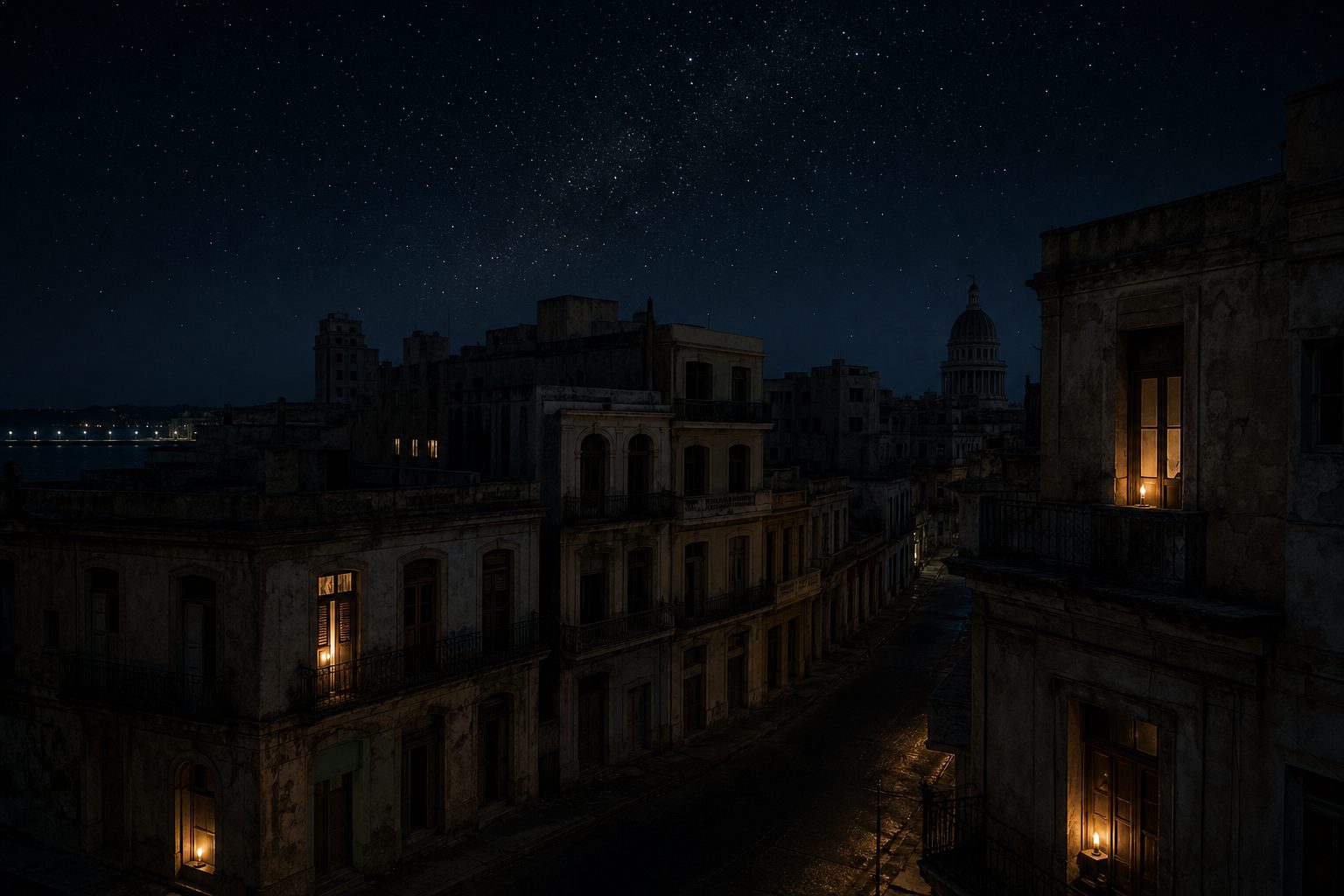
22 July 2021Blackout A Havana street lit by candles during a power cut. AI-generated illustration.
“Directly harming Cubans, especially the most vulnerable.”Volker Türk, UN High Commissioner for Human Rights, 2026 (UN News)
He also urged Cuba’s authorities to respect civil liberties and release those arbitrarily detained.
Chapter VI · Thaw and freeze
The freeze
Congressional Research Service (2019): in June 2017 President Trump issued a national security memorandum restricting transactions with companies controlled by Cuba’s military and ending individual people-to-people travel. Wikipedia, Helms–Burton Act: in 2019 Trump let the suspension of Title III lapse. AFP via Philstar (21 January 2025): Trump put Cuba back on the list in his final days in office in 2021, citing its refusal to extradite members of the Colombian rebel group ELN; the Biden administration announced its removal in its final days, tied to the release of 553 prisoners, and Trump reversed it hours after his inauguration on 20 January 2025. Axios: on 22 July 2021 the US sanctioned Cuba’s defence minister and a special brigade of the interior ministry over the crackdown on island-wide protests driven by food and medicine shortages. Baker McKenzie: Executive Order 14380 of 29 January 2026 declared a national emergency with respect to Cuba and authorised tariffs on goods from countries that supply oil to its government, citing its support for hostile governments and groups, foreign intelligence facilities and human rights abuses. UN News (2026): Volker Türk said the fuel restrictions and sanctions were “directly harming Cubans, especially the most vulnerable”, urged their immediate lifting, and urged Cuba’s authorities to respect civil liberties and release those arbitrarily detained.
The globe is a teaching model: trade arcs are schematic, their thickness is not to scale, and the outline of Cuba is simplified.
The two governments tell this story in very different terms.
Washington's account: the embargo answers property seized without compensation, and presses for free elections and human rights. It blames Cuba's government, not the embargo, for the economy.
Havana's account: it calls the policy a blockade, el bloqueo, and the main obstacle to Cuba's development. Its latest report claims about 7.6 billion dollars of damage in one year, and 170.7 billion over six decades.
Yet the same report concedes that not all of Cuba's problems come from it.
1960: expropriation “without acceptable provision for compensation”
1962: Cuba’s alignment with the communist powers
1996: “a peaceful transition to a representative democracy and market economy”
2026: human rights, ties to hostile states and groups
The US government’s stated reasons
5,913
certified US claims, never settled
≈ $1.9 bn
value when seized, before interest
The property claims
≈ $7.6 bn
damage claimed, March 2024 – February 2025
$170.7 bn
claimed over six decades
Cuba’s government, report of 2025
“All of Cuba’s problems are not entirely due to the blockade, but it would be untrue for anyone not to recognize this policy as the main obstacle to our development.”Cuban Ministry of Foreign Affairs, 2025
Chapter VII · Two accounts, one vote
In their own words
The United States’ stated reasons have changed over time. Eisenhower (1960, FRUS doc. 551) cited the expropriation of American property “without acceptable provision for compensation”; Proclamation 3447 (1962) cited Cuba’s alignment with “Sino-Soviet Communism”; the Helms–Burton Act (1996) aims at “a peaceful transition to a representative democracy and market economy in Cuba”; Executive Order 14380 (2026) cites human rights abuses and support for hostile governments and groups. Al Jazeera (2026): the administration says the Cuban government, not the embargo, is to blame for the economic situation. The Cuban government calls the embargo a blockade. Its Ministry of Foreign Affairs report for 2025 estimates damage of US$7,556,100,000 (about $7.6 billion) between 1 March 2024 and 28 February 2025 and $170.7 billion over six decades, calls the policy the main obstacle to Cuba’s development, and states that not all of Cuba’s problems are entirely due to it. These are each government’s own figures and claims; neither is independently verified here.
Try it: each button shows one government’s case in its own terms. Neither is endorsed here.
Since 1992, the General Assembly has backed Cuba's resolution every year except 2020, during the pandemic. The first vote passed with only 59 in favour; most countries abstained.
Support grew past 185 by the 2010s. In 2024, only the United States and Israel voted no.
In 2025, US diplomats lobbied against it, and Bloomberg reported that sixteen countries changed their votes. Poland, among others, cited Cuba's support for Russia in its war on Ukraine.
59
for
3
against: US, Israel, Romania
71
abstained
24 November 1992, resolution 47/19
1992
59
2010
187
2016
191
2024
187
2025
165
Votes in favour
No: US, Israel, Argentina, Hungary, North Macedonia, Paraguay, Ukraine
Abstained: 12, including Poland, Czechia, Romania and the Baltic states
Not binding on the United States
2025: no and abstain
33
resolutions adopted, 1992–2025
34th
vote expected late October 2026
Count so far
Chapter VII · Two accounts, one vote
Thirty-three votes
Wikipedia, US embargo against Cuba (table of resolutions, with links to each UN document): the General Assembly has adopted the resolution every year since 1992 except 2020, when the vote was postponed to June 2021 because of the COVID-19 pandemic; the 1992 vote (resolution 47/19) was 59 for, 3 against (the US, Israel, Romania) and 71 abstaining; support was 185 or more in most years from 2008 to 2024. UN News: 2016, 191 for with the US and Israel abstaining; 2024, 187 to 2 with Moldova abstaining; 29 October 2025, 165 to 7 with 12 abstentions, the 33rd consecutive year. UN Geneva: Poland, also speaking for Czechia, Estonia, Latvia and Lithuania, cited Cuba’s support for Russia’s invasion of Ukraine; Bloomberg Law reported that the Trump administration mobilised US diplomats against the resolution and that 16 countries changed their votes. Green Left (1994) gives the 1992 tally as 59 for, 3 against and 71 abstaining; UN News gives 2010 as 187 to 2 with 3 abstentions. General Assembly resolutions are not binding.
Try it: pick a year to see its full count. Columns are drawn from the vote table; 2020 has no vote.
So what would end it? Congress can repeal or change the laws.
Or, under Helms–Burton, a president can lift it once Cuba has a transition government that frees political prisoners, commits to free elections, and includes neither Fidel Castro, who died in 2016, nor Raúl.
The UN vote cannot do either. It shows how many governments side with Cuba's call, which is why both sides lobby so hard.
Until Washington changes its laws, or Havana meets their conditions, those 150 kilometres of sea will stay far wider than they look.
Congress
can repeal or amend the laws (Reuters)
President
only once the conditions of 22 U.S.C. § 6065 or § 6066 are met
Who holds the key
All political prisoners released
Free, fair, monitored elections within 18 months
A government without Fidel or Raúl Castro
Or a democratically elected government that respects civil liberties
What a president needs first (22 U.S.C. § 6065–6066)
1960 US export ban
1962 Embargo on all trade
1992 Cuban Democracy Act; first UN vote
1996 Helms–Burton writes it into law
2000 Food and medicine, for cash
2014–2016 The thaw
2017–2026 Tightening again
Oct 2026 The 34th UN vote
Sixty-six years
Stills are AI-generated
Trade arcs and Cuba’s outline are schematic
Each government’s claims are attributed, not endorsed
About this film
Epilogue · Sources
Sources
Every fact in this film comes from the sources below. 22 U.S. Code § 6065 lists what a Cuban transition government must do, including releasing all political prisoners, committing to free and fair elections within 18 months and not including Fidel or Raúl Castro; § 6066 sets the conditions for a democratically elected government. Reuters (2026): only the US Congress can lift the embargo. The chapter stills and pictures are AI-generated illustrations. The globe uses NASA Blue Marble imagery; trade arcs, their thickness and the outline of Cuba are schematic, and distances in the interactive moments are great-circle distances computed from coordinates. Figures given by the US and Cuban governments are attributed to them and not independently verified.