Halloween falls on Saturday 31 October 2026, and the US National Retail Federation expects record spending of $13.5 billion. This film follows the night back through the evidence: the Gaelic festival of Samhain and what the early Irish texts do and do not say about it, the Christian feasts of All Saints and All Souls and how 1 November became their date, the word 'Halloween' itself, souling, soul cakes and guising, turnip lanterns and the tale of Stingy Jack, the Irish and Scottish emigrants who carried the customs to North America, where pumpkins replaced turnips and 'trick or treat' was first printed in 1927, and why historians still disagree about how much of Halloween is pagan and how much is Christian.
Interactive 3D film9 min2nd century to 2026Published 27 October 2026
A pagan festival, or the eve of a Christian feast?
Is Halloween an ancient Celtic festival of the dead, or simply the eve of a Christian feast? Ask where the night comes from, and you will usually hear one of those two answers.
This year it falls on Saturday the thirty-first of October 2026, and in the United States alone, retailers expect a record thirteen and a half billion dollars of spending.
Historians still argue about where it began. Let's follow the evidence, one clue at a time.
A Celtic festival of the dead, later Christianised
The eve of All Saints’ Day, 1 November
Two popular answers
$13.5 bn
expected spending, a record (2025: $13.1 bn)
74%
of Americans plan to celebrate
US Halloween, 2026 (NRF forecast)
Samhain: what the texts say
All Saints and All Souls
Soul cakes, disguises, lanterns
The journey to North America
In this film
Prologue
A record night
National Retail Federation (22 September 2026): Halloween spending in the United States is expected to reach a record $13.5 billion, up from $13.1 billion in 2025; 74% of Americans plan to celebrate, spending $115.14 each on average. The survey asked 7,889 consumers on 1–9 September 2026 (margin of error ±1.1 points). Britannica: Halloween, on 31 October, begins Allhallowtide, the three days of All Hallows’ Eve, All Saints’ Day and All Souls’ Day; in much of Europe and most of North America it is now largely secular.
The hill, the wheel of the year, the lanterns and the globe are teaching graphics, not reconstructions of real places or objects.
In Ireland and Scotland, home of the Gaels, the first of November was Samhain: the end of the harvest and the start of winter, the darker half of the year. Samhain is still the Irish word for November.
The Gaelic day ran from sunset to sunset, so the festival began on the evening of the thirty-first of October.
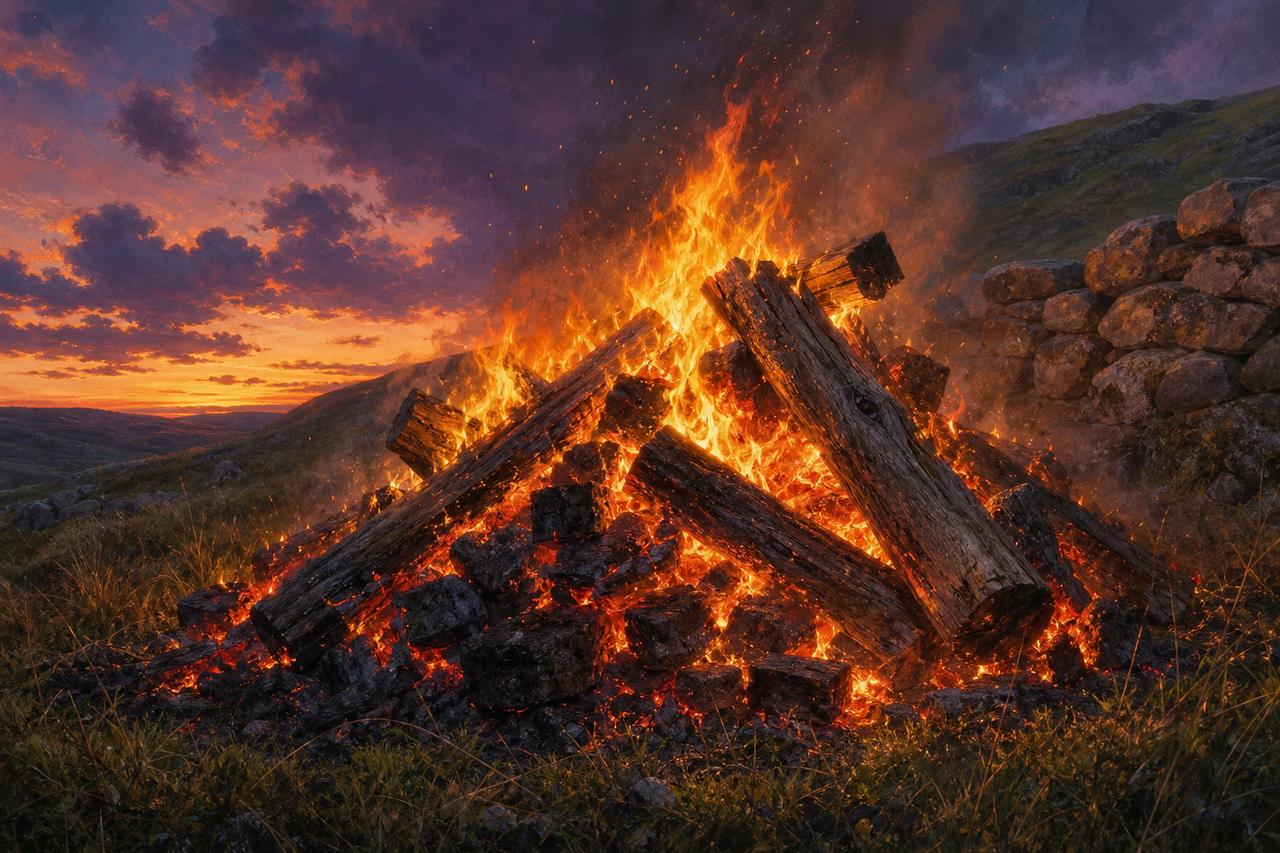
Bonfires were thought to protect and cleanse, and families sometimes relit their hearth fires from the communal blaze. The Hill of Ward, in Ireland, is thought to have been the site of a great Samhain fire.
The oldest clue is a bronze calendar from Roman Gaul, in today's France, made in the second century; it marks a month called Samon. Samhain itself appears in Irish writing from the ninth century, and a tenth-century tale lists it first among four seasonal festivals.
Samhain
“summer’s end”; also the Gaelic name for November
A word
31 Oct, dusk
Samhain begins
1 Nov
the festival day
A day from sunsetSummer’s end The Hill of Ward is also known by its old name, Tlachtga. AI-generated illustration.
2nd century Coligny calendar (Gaul): month SAMON
9th century Samhain in early Irish literature
10th century Tochmarc Emire: first of four festivals
Earliest evidence
Chapter I · Samhain
Summer’s end
Wikipedia, Samhain: a Gaelic festival on 1 November marking the end of the harvest season and the beginning of winter or the “darker half” of the year; it is also the Irish and Scottish Gaelic name for November. Because the Celtic day ran from sunset to sunset, celebrations began on the evening of 31 October. Samhain appears in early Irish literature from the 9th century; the 10th-century tale Tochmarc Emire lists it first among four seasonal festivals. The 2nd-century Gaulish Coligny calendar has a month SAMON, and a day marked “TRINOX SAMONI”, “the three nights of Samon”, possibly a festival.
The Coligny calendar is a set of bronze fragments found in France; linking its month SAMON to the word Samain is the reading given by Wikipedia’s summary of the scholarship.
The hill, the wheel of the year, the lanterns and the globe are teaching graphics, not reconstructions of real places or objects.
The early stories treat Samhain as a time when the boundary with the Otherworld grew thin. The aos sí, the spirits of the land, had to be kept friendly with offerings of food and drink.
But those tales were written down in the Christian era, and they describe gatherings, feasts and fires, not religious rites. The historian Ronald Hutton says we have virtually no idea what rites were held.
The only historical mention of pagan rites at Samhain comes from Geoffrey Keating, a writer who died in 1644, and no one knows his source.
Much of the popular picture, a Celtic new year and a festival of the dead, comes from scholars of the late nineteenth century, such as James Frazer. Today those ideas are disputed. Switch between what the texts say and what was claimed later.
Written by Christian monks The Irish tales that mention Samhain were written down in the Christian era, centuries after pagan times. AI-generated illustration.
We “have virtually no idea” what rites were marked on Samhain.Ronald Hutton, as quoted by Snopes
A historian’s caution
1644
death of Geoffrey Keating, whose source is unknown
The only mention of rites
“Celtic New Year” (John Rhys, James Frazer): disputed
“Festival of the dead” later Christianised (Frazer): contested
Claims from the late 1800s
Chapter I · Samhain
What we know, and what we don’t
Wikipedia, Samhain: Samhain was seen as a liminal time when the boundary with the Otherworld could be crossed more easily; the aos sí had to be propitiated with offerings of food and drink, and a modern reference work, Patricia Monaghan’s Encyclopedia of Celtic Mythology and Folklore (2004), calls it “essentially a festival for the dead.” Bonfires were deemed to have protective and cleansing powers. The Hill of Ward (Tlachtga) is thought to have been the site of a great Samhain gathering and bonfire. Hutton: “No doubt there were [pagan] religious observances as well, but none of the tales ever portrays any”; the only historical reference to pagan rites comes from Geoffrey Keating (died 1644), whose source is unknown.
In the late 19th century John Rhys and James Frazer suggested Samhain was the “Celtic New Year”; Hutton states that “the medieval records furnish no evidence that 1 November was a major pan-Celtic festival.” Snopes quotes the folklorist Steve Roud: the facts are “far more elusive and complex” than the popular belief in a pagan festival of the dead. Try it: switch between the two views.
The hill, the wheel of the year, the lanterns and the globe are teaching graphics, not reconstructions of real places or objects.
The other half of the story is Christian. The early Church honoured its martyrs, and over time one feast came to honour all the saints together.
In the eighth century, Pope Gregory the Third set the first of November as a time to honour all saints. In 835, the Frankish Empire made it the official date.
Eastern churches still keep All Saints on a different day: the first Sunday after Pentecost.
Why that date? James Frazer argued it was chosen to replace Samhain. Ronald Hutton argues the date came from the Germanic peoples of continental Europe, not from the Celts. The evidence does not settle it.
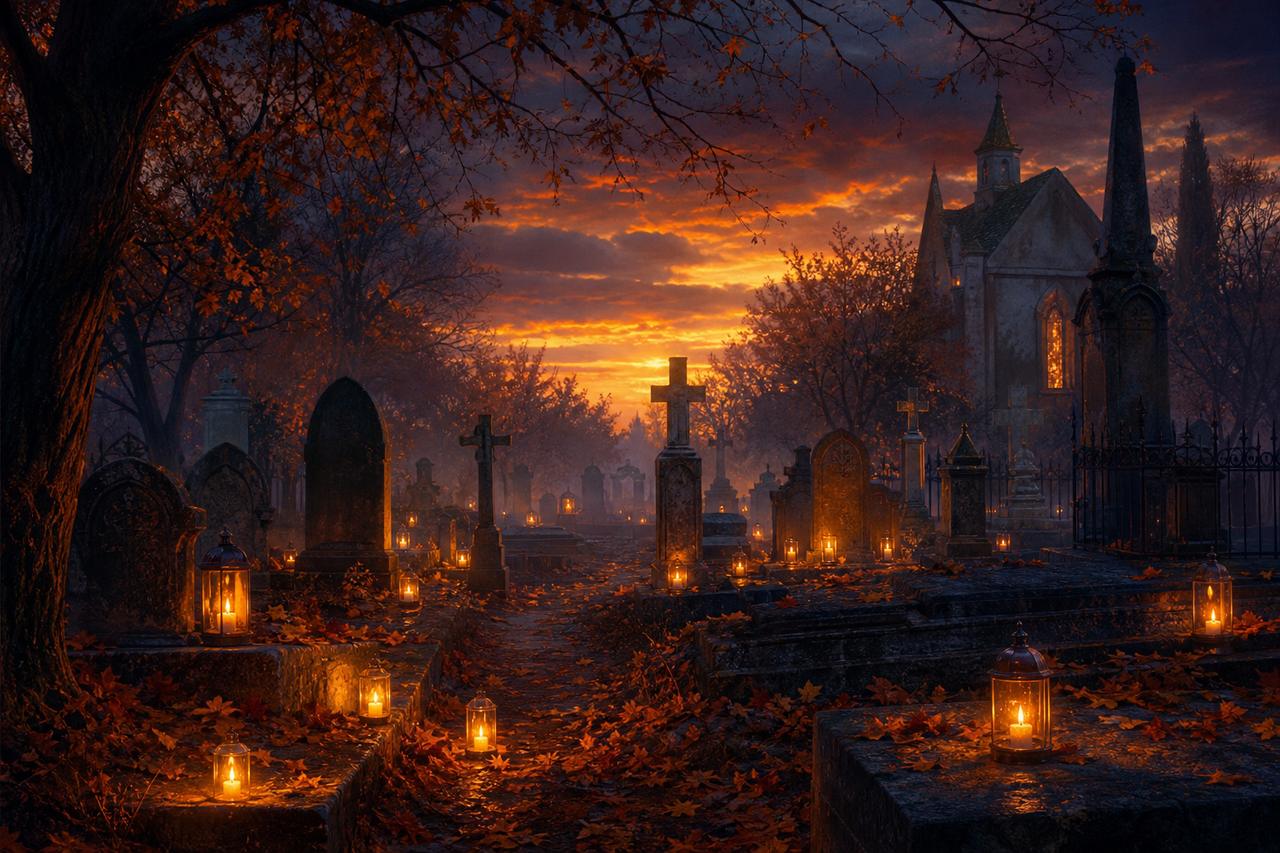
All Hallows All Saints’ Day is also called All Hallows’ Day or Hallowmas; “hallow” means a saint, a holy person. AI-generated illustration.
8th century Pope Gregory III: 1 November for all saints
835 Frankish Empire adopts 1 November officially
Fixing the date
Frazer: chosen to replace Samhain
Hutton: a Germanic, not Celtic, idea
Why 1 November? Two views
Chapter II · Saints and souls
All Saints’ Day
HISTORY.com: “In the 8th century, Pope Gregory III designated November 1 as a time to honor all saints.” Wikipedia, Samhain: the Frankish Empire officially adopted 1 November as All Saints’ Day in 835; Frazer linked the date to Samhain, while Hutton argues that it was a Germanic idea. Britannica: All Saints’ Day (All Hallows’ Day, Hallowmas) is celebrated on 1 November in Western churches and on the first Sunday after Pentecost in Eastern churches.
The film does not name an exact year for Gregory III’s decision: sources place it within his papacy in the 8th century.
The hill, the wheel of the year, the lanterns and the globe are teaching graphics, not reconstructions of real places or objects.
A day for the souls of everyone else followed. Odilo, abbot of the great monastery of Cluny, set the second of November aside to pray for all the faithful dead, probably after 1030. The custom soon spread across the Western Church.
At Cluny it was kept with almsgiving, prayer and Masses for the souls in purgatory.
So the season became three days: the eve, All Saints, and All Souls. Tap a day to see what it was for.
The eve was All Hallows' Even. Shortened, it became Hallowe'en, a name first recorded around the 1550s.
All Souls’ Day All Souls was for every faithful departed person, not only the saints. AI-generated illustration.
31 Oct: All Hallows’ Eve
1 Nov: All Saints’ Day
2 Nov: All Souls’ Day
AllhallowtideAll Hallows’ Even→Hallowe’enWhere the word comes from “even” = evening before a holiday; “hallow” = saint. First records: around the 1550s.
Chapter II · Saints and souls
Three days for the dead
Wikipedia, Odilo of Cluny: Odilo instituted All Souls’ Day in Cluny and its monasteries, “probably not in 998 but after 1030”, as an annual day for all the faithful departed, kept with almsgiving, prayer and sacrifices for souls in purgatory; it was soon adopted across the Western Church. HISTORY.com gives “around A.D. 1000”. Britannica: Allhallowtide is All Hallows’ Eve (31 October), All Saints’ Day (1 November) and All Souls’ Day (2 November). Dictionary.com: the name Halloween is a shortening of “Allhallows Even”, where “even” means the evening before a holiday; the first records date from around the 1550s.
Try it: tap each of the three days on the wheel.
The hill, the wheel of the year, the lanterns and the globe are teaching graphics, not reconstructions of real places or objects.
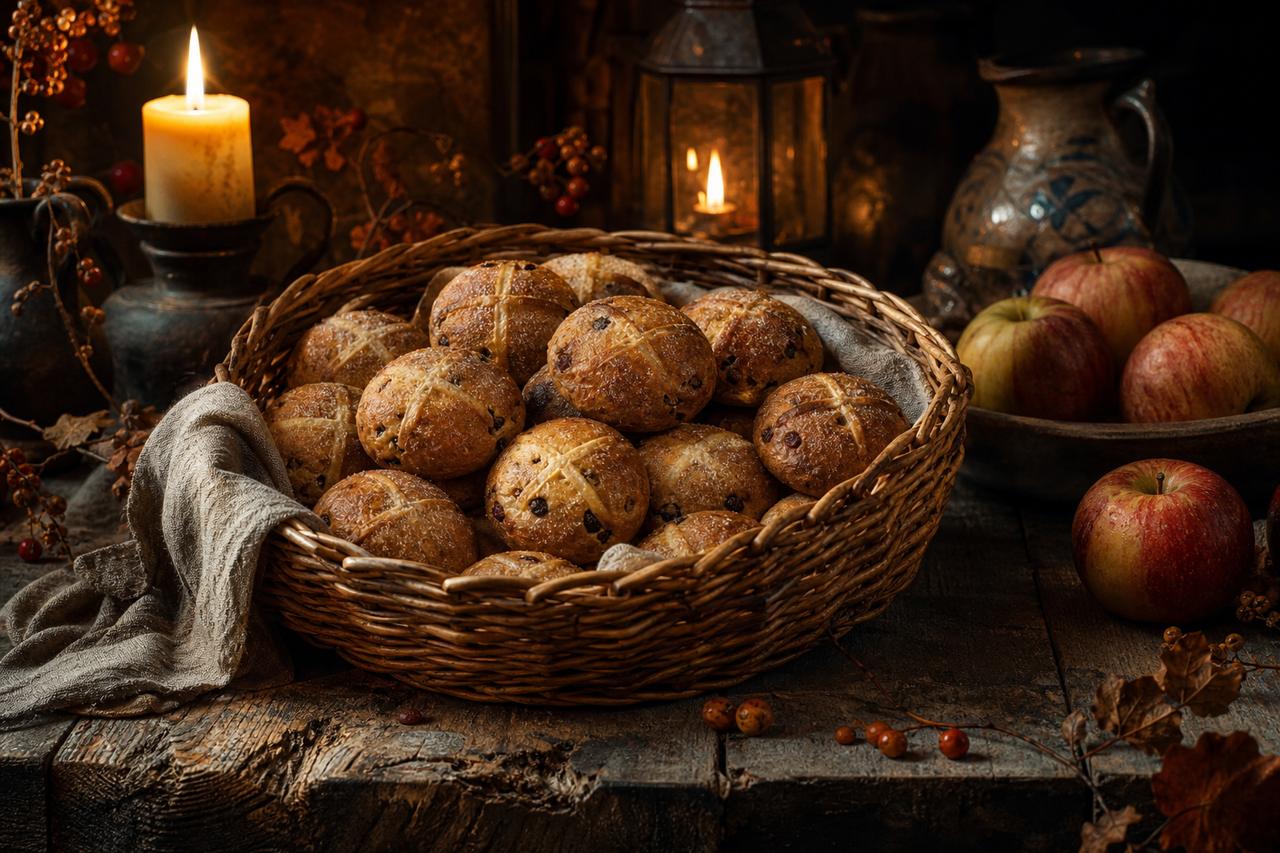
Many of today's customs grew up around these days. In England, the poor went from house to house at Allhallowtide, and families gave them soul cakes in return for prayers for their dead. It was called going a-souling.
In Scotland, from at least the sixteenth century, people went door to door in disguise at this season, reciting songs or verses in exchange for food. This was guising.
Some historians see in these the roots of trick-or-treating. Why the disguises? Some say to hide from spirits. That is a possibility, but no one can confirm it.
The folklorist Steve Roud adds a caution: souling is reported in the nineteenth century, and there is no evidence this time of year was celebrated in England before the Christian feast existed.
Soul cakes Arthur McCalla notes that in parts of Europe children later took up the custom, collecting food, money and even beer. AI-generated illustration.
Souling (England): soul cakes for prayers
Guising (Scotland, 16th century on): disguises, verses for food
Door-to-door customs
A disguise to fool spirits is “a possibility, but one that we cannot confirm.”Ronald Hutton, as quoted by Snopes
Why costumes?
The facts are “far more elusive and complex” than the popular belief.Steve Roud, as quoted by Snopes
A folklorist’s caution
Chapter III · Cakes, masks and lanterns
Souling and guising
HISTORY.com: poor citizens begged for food and families gave them pastries called “soul cakes” in exchange for their promise to pray for the family’s dead relatives; the practice was called “going a-souling”. Dr Arthur McCalla (Mount Saint Vincent University): many historians see an early form of trick-or-treating in All Souls’ customs. Wikipedia, Samhain: from at least the 16th century in Scotland, mumming and guising, going door to door in costume and usually reciting songs or verses in exchange for food, were part of the festival.
Snopes quotes Steve Roud: souling is “reported in the nineteenth century”, and “there is no evidence that this time of year was celebrated in England before the Christian feast was created.” The disguise-from-spirits idea is described as one account among several.
The hill, the wheel of the year, the lanterns and the globe are teaching graphics, not reconstructions of real places or objects.
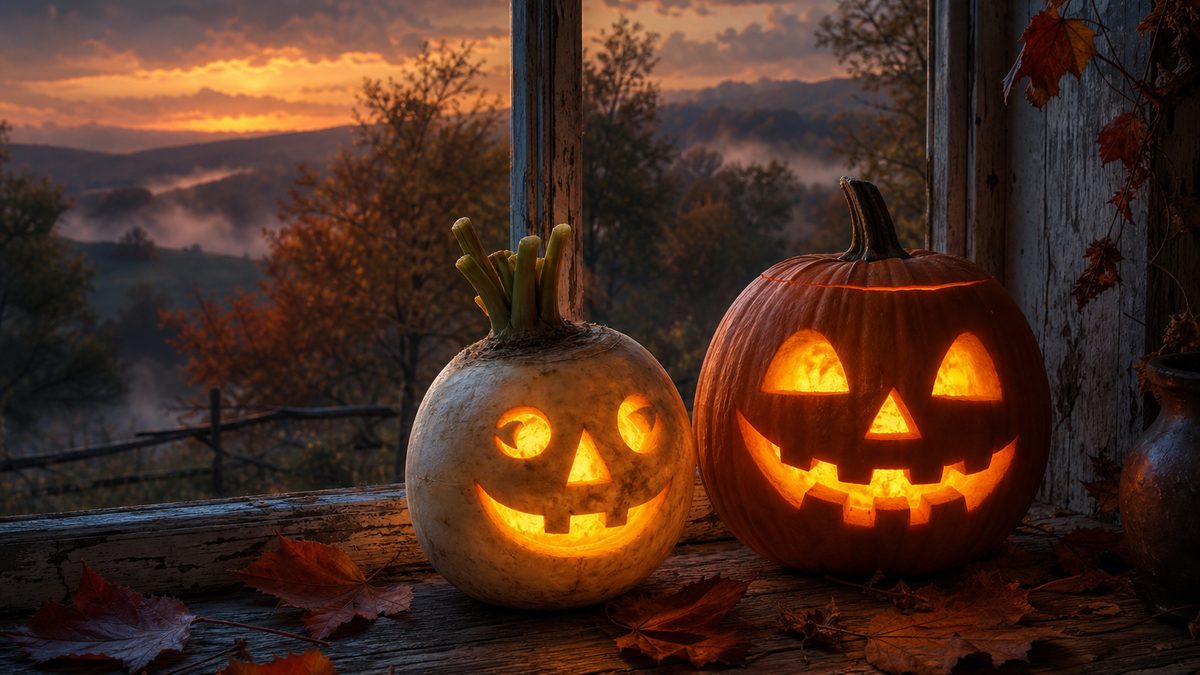
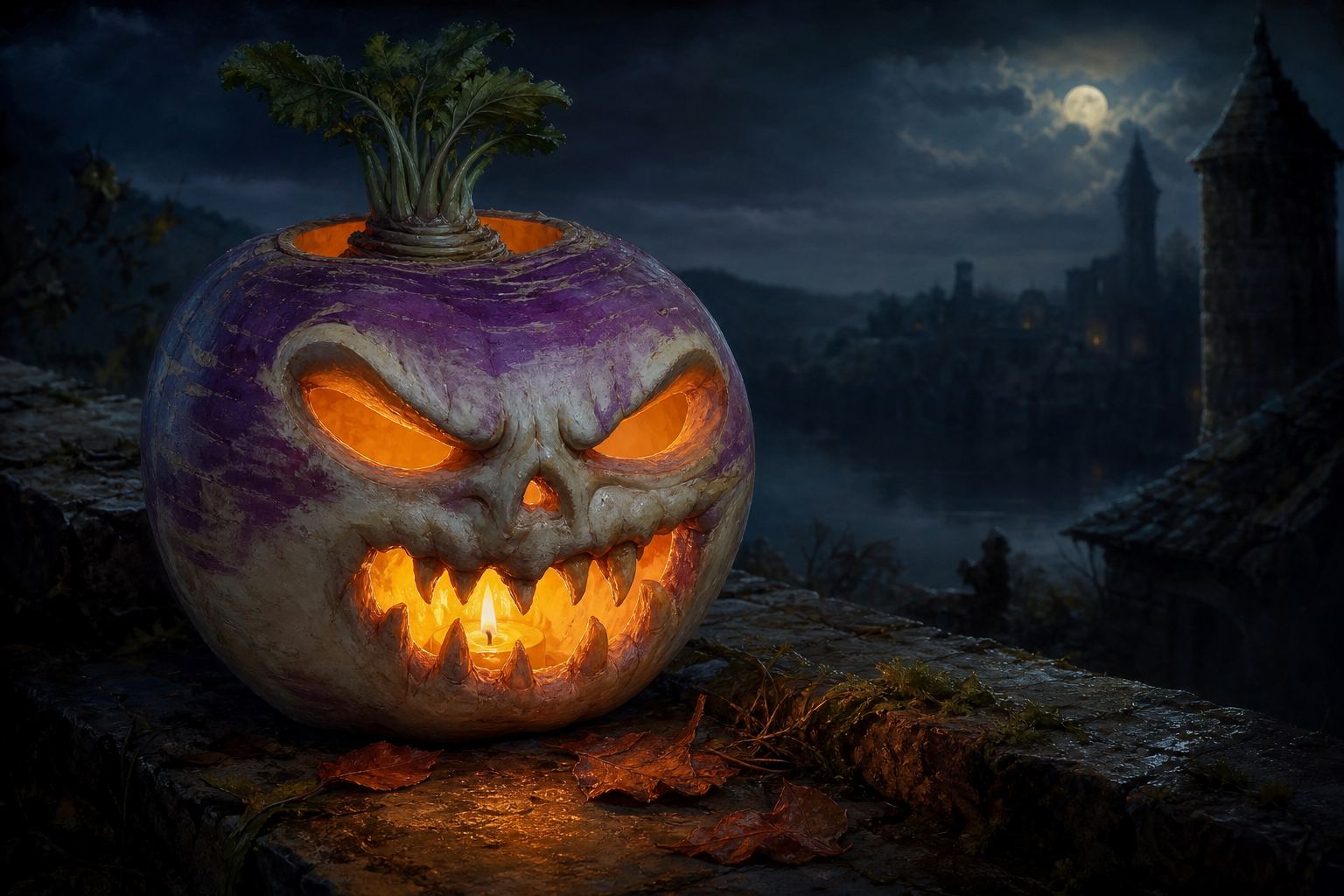
Then there are the lanterns. In Ireland and Britain, people hollowed out turnips or mangel-wurzels and carved them with grotesque faces.
An Irish tale tells of Stingy Jack, who tricked the devil. Barred from both heaven and hell, he was left to wander the night with only a coal to light his way.
Jack of the lantern: jack-o'-lantern. Light the turnip, then see what came next.
The first jack-o’-lanterns Turnips, beets and even potatoes were used before pumpkins. AI-generated illustration.
Jack, doomed to wander with only a coal to light his way.Irish folk tale, as told by Arthur McCalla
The legend
Turnip
Ireland and Scotland
17th c.
when the Stingy Jack myth is placed
Before pumpkins
Chapter III · Cakes, masks and lanterns
Jack of the lantern
Wikipedia, Samhain: turnips or mangel wurzels were hollowed out to act as lanterns and often carved with grotesque faces; these are an ancestor of the jack-o’-lantern. The Canadian Encyclopedia: Irish and British jack-o’-lanterns were originally hollowed-out turnips, beets or potatoes, and it ties the myth of Stingy Jack to the 17th century. Dr Arthur McCalla: the Irish tale of Jack, who trapped the devil and was later doomed to wander with only a coal to light his way, inspired the turnip lanterns.
Try it: switch the lantern between a turnip and a pumpkin. The 3D lanterns are schematic.
The hill, the wheel of the year, the lanterns and the globe are teaching graphics, not reconstructions of real places or objects.
In the mid-nineteenth century, Irish and Scottish emigrants brought these customs to North America. Millions of Irish people left during the Great Famine, when the potato crop failed.
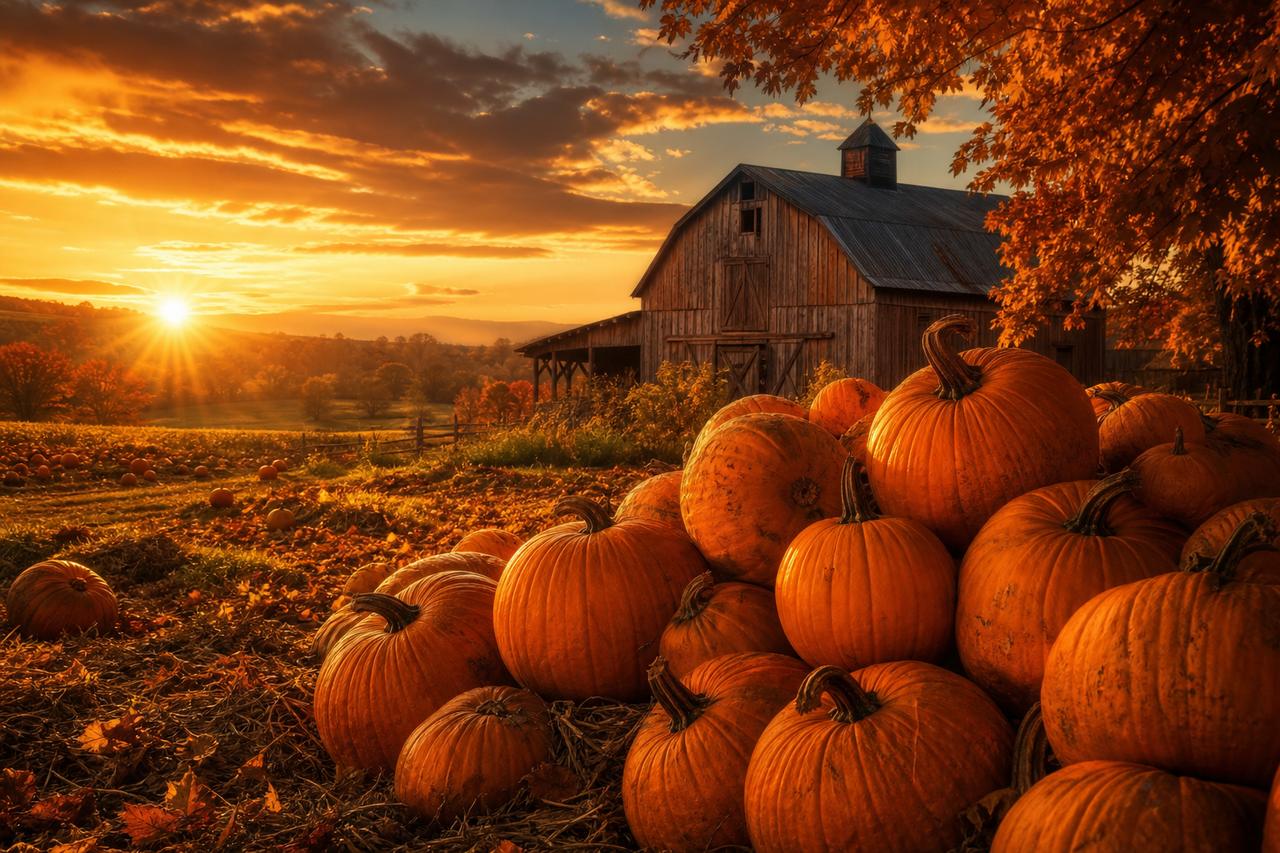
In the New World they found a bigger, softer vegetable to carve: the pumpkin, native to the Americas. The first public report of a pumpkin jack-o'-lantern in North America comes from Kingston, Ontario, in 1886.
By about 1900, the pumpkin lantern was the main symbol of Halloween in North America.
Irish and Scottish emigrants, mid-to-late 19th century
Millions of Irish fleeing the Potato Famine (HISTORY.com)
Who carried the customsA new lantern Pumpkins are native to the Americas and easier to carve than turnips. AI-generated illustration.
mid-1800s Irish and Scottish immigrants arrive
1886 Kingston, Ontario: first public report of a pumpkin lantern
c. 1900 the jack-o’-lantern becomes the main symbol
Halloween in North America
Chapter IV · Across the ocean
The pumpkin crossing
The Canadian Encyclopedia: Scottish and Irish immigrants brought Halloween customs to Canada in the mid-to-late 1800s; in North America they switched to the larger native pumpkin. “The first public report in North America of a jack-o’-lantern carved from a pumpkin was in Kingston, Ontario, in 1886”; by around 1900 the jack-o’-lantern had become the main symbol of Halloween in North America. HISTORY.com: millions of Irish fleeing the Irish Potato Famine helped popularise Halloween in the second half of the 19th century.
Try it: send the ships across. Routes and ship counts on the globe are schematic.
The hill, the wheel of the year, the lanterns and the globe are teaching graphics, not reconstructions of real places or objects.
Halloween in North America was rowdy at first. People played pranks, some set fires and left farmers' gates open. In the twentieth century, community leaders worked to tame it into a night for children.
The first recorded costumes on Halloween in North America were in Vancouver, in 1898. And the words 'trick or treat' were first printed in a newspaper in Lethbridge, Alberta, in November 1927.
Between the 1920s and the 1950s, older customs like souling became the trick-or-treating we know.
After the baby boom of the 1950s, Halloween moved further into homes and schools.
“People would set fires and leave farmers’ gates open.”Dr Arthur McCalla, Mount Saint Vincent University
A rowdy night
“The youthful tormentors were at back door and front demanding edible plunder by the word ‘trick or treat’.”As quoted by The Canadian Encyclopedia
Lethbridge Herald, 4 November 1927
1898 costumes, Vancouver
1927 “trick or treat” in print, Lethbridge
1920s–50s the modern custom takes shape
From souling to trick-or-treatInto the home McCalla notes that treat-exchanging in the community stayed popular with children. AI-generated illustration.
Chapter IV · Across the ocean
From pranks to treats
Dr Arthur McCalla: Irish immigrants brought dressing up, dancing, pranks and ghost stories; these were not always harmless, as “people would set fires and leave farmers’ gates open”; community leaders in the 20th century worked to “domesticate” the holiday, and the 1950s baby boom pushed it further into homes and schools. The Canadian Encyclopedia: the first recorded dressing in disguise on Halloween in North America was in Vancouver in 1898; the first recorded use of the term “trick or treat” in North America was in the Lethbridge Herald on 4 November 1927. HISTORY.com: “Between the 1920s and 1950s, older practices such as souling evolved into the modern American tradition of trick-or-treating.”
The hill, the wheel of the year, the lanterns and the globe are teaching graphics, not reconstructions of real places or objects.
Today Halloween is big business. American shoppers are expected to spend four point four billion dollars on costumes this year, four point three billion on decorations and four point one billion on candy.
Nearly a billion of the costume money is for pets.
In much of Europe and most of North America, the night is now largely secular. For most people who celebrate it, it is not about saints, souls or spirits at all.
Costumes
4.4
Decorations
4.3
Candy
4.1
US Halloween spending, 2026 forecast
$2.0 bn
adults
$1.5 bn
children
$0.92 bn
pets
Costume money, 2026A secular night NRF: 71% plan to buy costumes, 78% decorations and 96% candy; 74% plan to celebrate. AI-generated illustration.
Chapter V · A $13.5 billion night
A $13.5 billion night
National Retail Federation (22 September 2026): costumes $4.4 billion (71% plan to buy; adults $2 billion, children $1.5 billion, pets $0.92 billion), decorations $4.3 billion (78%), candy $4.1 billion (96%). Britannica: in much of Europe and most of North America, Halloween is now largely secular, its observance mostly nonreligious.
Try it: show all three categories, or split the costume money. Figures are a survey-based forecast, not final sales.
The hill, the wheel of the year, the lanterns and the globe are teaching graphics, not reconstructions of real places or objects.
So, pagan or Christian? The fairest answer is: both, tangled together. Many scholars think Samhain and the Christian feasts influenced each other, and both shaped the modern night.
Some historians, such as Beth Allison Barr, see Halloween's roots as mostly Christian; she cites Nicholas Rogers, who finds that Samhain offered little in the way of actual ritual. Others see older beliefs living on in the customs.
What no one disputes is the route: from Gaelic fires and Christian prayers to a turnip, a pumpkin and a knock at the door. When children go door to door this Halloween, they are repeating something people did centuries ago.
Happy Halloween.
Stills are AI-generated illustrations
Contested claims are attributed
3D scenes are schematic
About this film
Influence ran both ways (Wikipedia, summarising)
Mostly Christian roots (Barr, citing Rogers)
Little evidence for Samhain rites (Hutton, Roud)
Older customs persisted (McCalla)
Where the scholars stand
2nd c. Coligny calendar: SAMON
9th c. Samhain in Irish texts
835 1 Nov: All Saints (Frankish Empire)
after 1030 2 Nov: All Souls (Cluny)
1550s “Halloween” first recorded
1886 Pumpkin lantern, Kingston
1927 “Trick or treat” in print
2026 $13.5 bn forecast in the US
The road to Halloween
Epilogue · Sources
Sources
Every fact in this film comes from the sources below. Wikipedia, Samhain: “It is believed that Samhain and All Saints’/All Souls’ influenced each other and the modern Halloween”; scholars disagree on how much, and some argue the influence ran the other way. The historian Beth Allison Barr argues that Halloween’s roots are mostly Christian, quoting Nicholas Rogers: “there is no hard evidence that Samhain was specifically devoted to the dead or to ancestor worship”; Snopes cites Rogers, via Barr, that Samhain “did not offer much in the way of actual ritual practices”. Dr Arthur McCalla argues that the Church co-opted many Celtic beliefs and practices and that Samhain customs persisted in Ireland and Scotland. The chapter stills and pictures are AI-generated illustrations; the hill, wheel, lanterns and globe are teaching graphics.