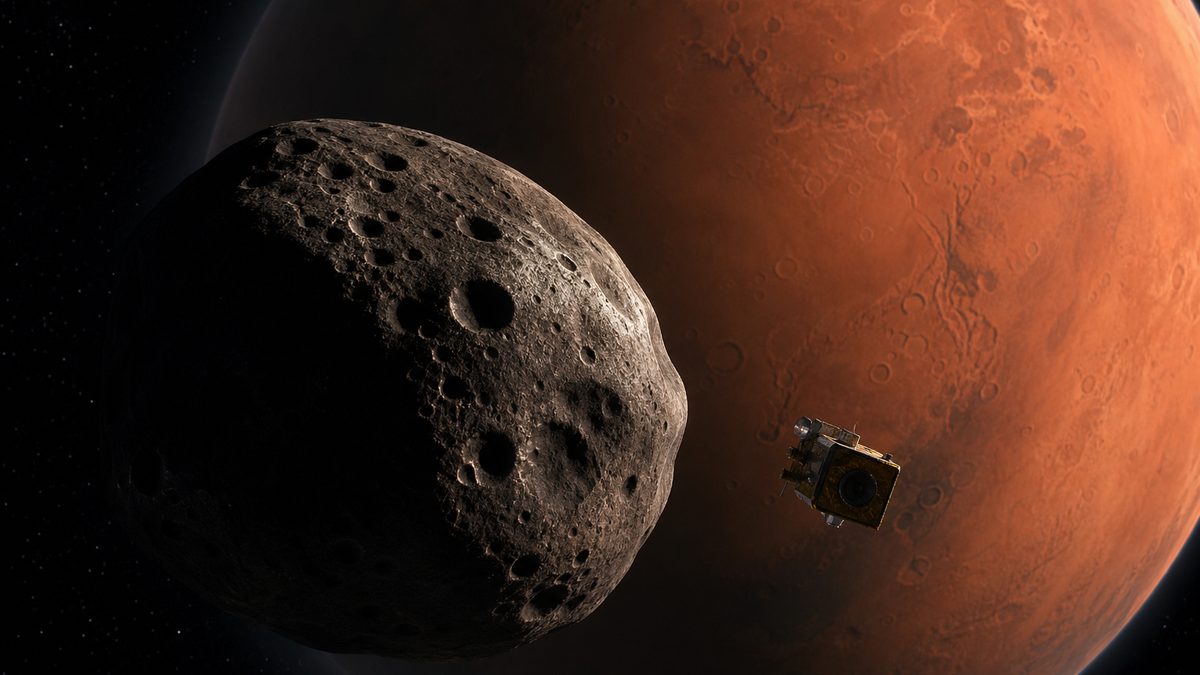
On 20 October 2026 (Japan time) JAXA launched MMX, a spacecraft that is to land on Mars's moon Phobos and bring a sample back to Earth in 2031. This film explains what it is going to: the two small moons Asaph Hall found in 1877, how a spacecraft gets to Mars on a Hohmann transfer and why launch windows come about every 26 months, why Phobos orbits inside Mars's synchronous orbit and is slowly spiralling inward while Deimos drifts away, what the Roche limit is and why Phobos is expected to break into a ring tens of millions of years from now, and the two competing ideas for where the moons came from: captured asteroids, or debris from a giant impact. Launch at the right and wrong moment, watch the tides at work, change the Roche limit, break up Phobos, compare the origin stories and land the rover.
Interactive 3D film8 min1877 to 2031 (planned)Published 21 October 2026
Mars has two tiny moons, and one of them is slowly falling toward the planet.
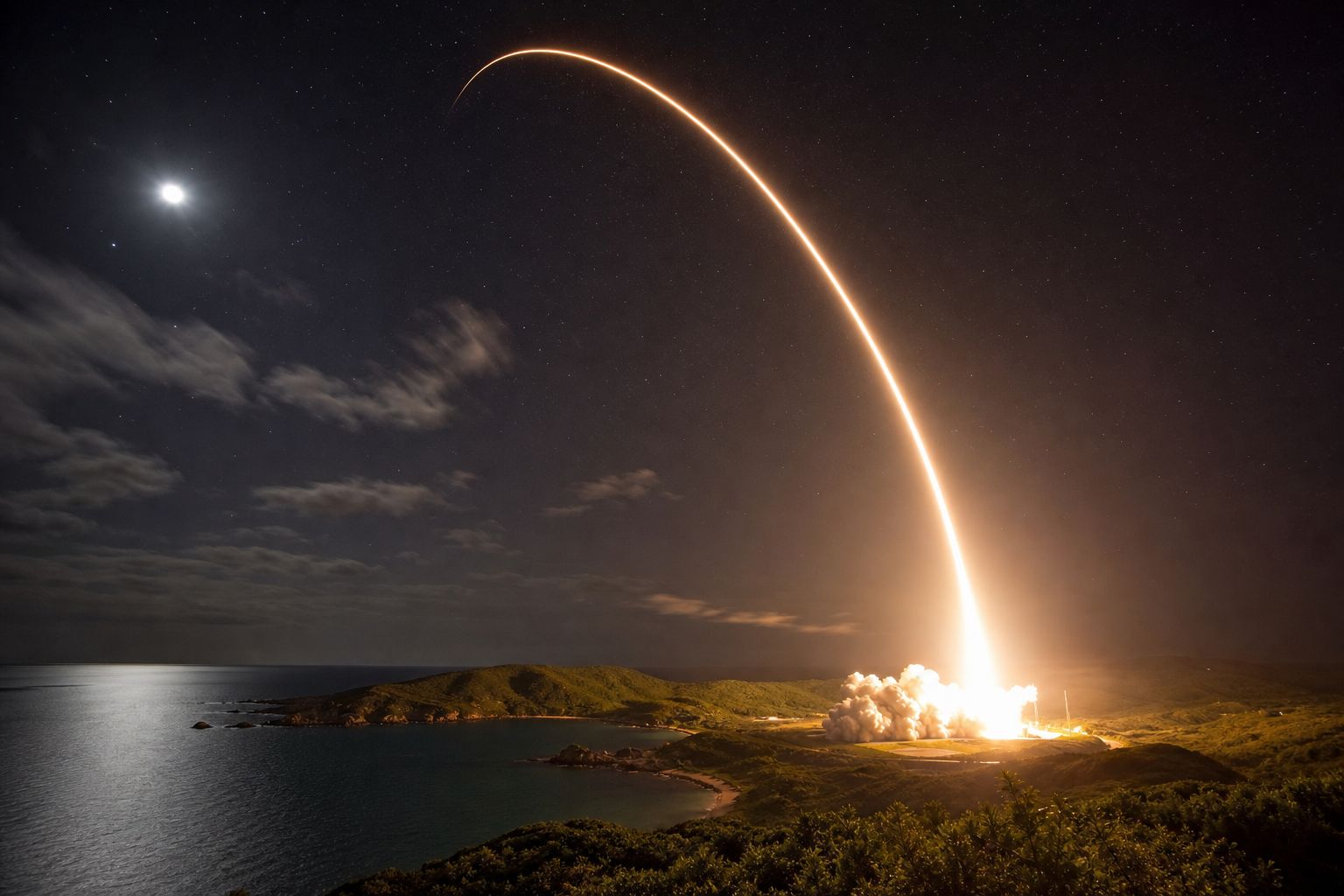
On the twentieth of October 2026, Japan time, an H3 rocket launched JAXA's MMX spacecraft toward that moon, Phobos. The plan: land, collect at least ten grams, and bring them home in 2031.
Nobody knows where these moons came from: captured asteroids, or pieces of Mars? A few grams of its dust could tell.
04:41
Japan time, 20 Oct 2026 (evening of 19 Oct in Europe)
10th
flight of Japan’s H3 rocket
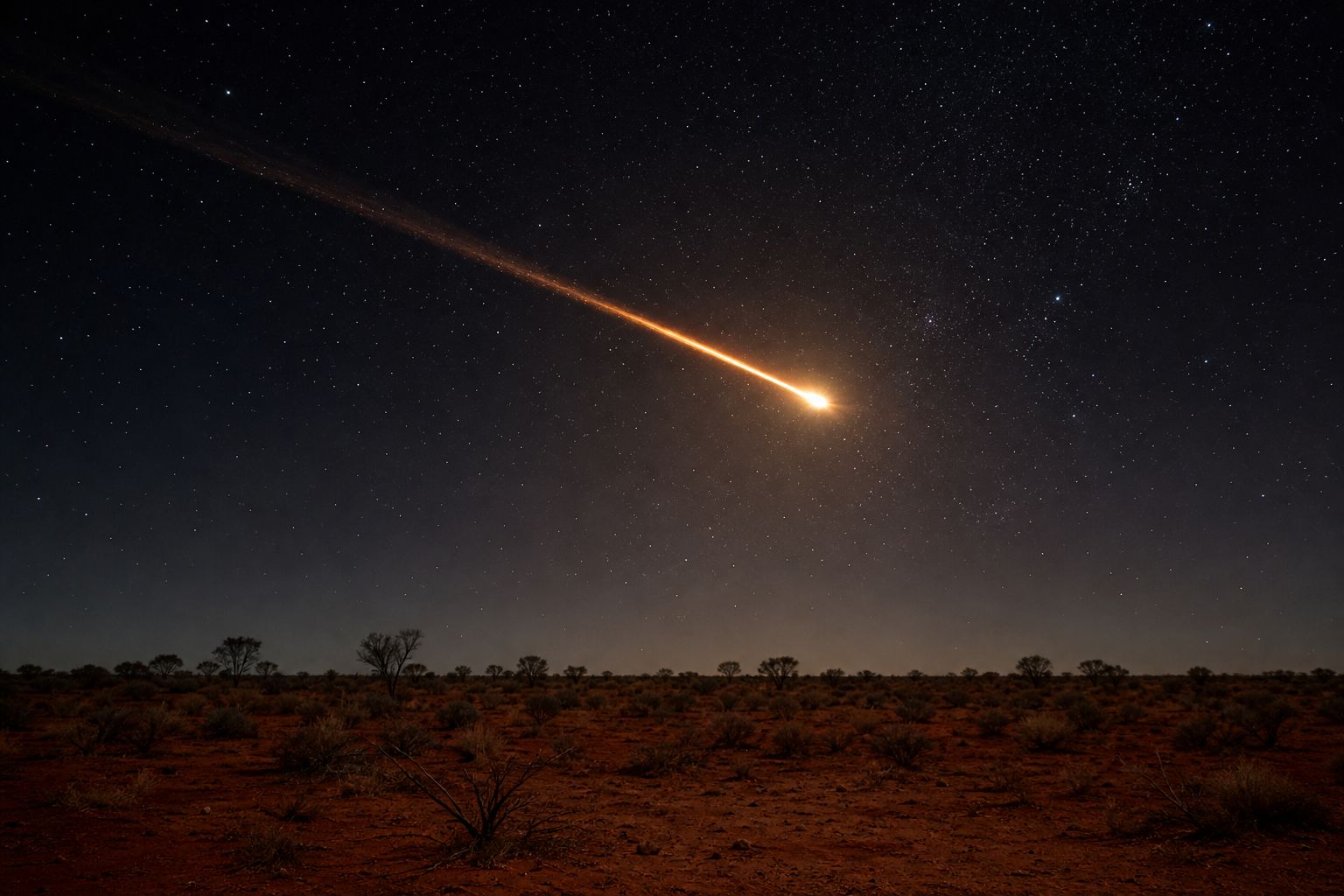
Launch (Space.com)Tanegashima Reuters: the first interplanetary mission flown on an H3. AI-generated still.
~3 years
around Mars before heading home
≥10 g
of Phobos to bring back
The plan (Space.com)
Prologue · The launch
MMX leaves Earth
Space.com: JAXA’s Martian Moons eXploration (MMX) lifted off on the tenth flight of the H3 rocket from Tanegashima Space Center at 19:41 GMT on 19 October 2026 (04:41 on 20 October in Japan). It is to reach Mars in August 2027, spend about three years in the Martian system, land twice on Phobos and return a capsule with a planned 10 g of sample to Australia in 2031. Reuters (via The Jerusalem Post) confirmed the launch and called it the H3’s first interplanetary mission.
The spacecraft’s path in the scene is schematic.
Dates after October 2026 are JAXA’s plans, not events. Sources give slightly different dates for the landings.
In August 1877, with Mars close to Earth, Asaph Hall searched the sky around it with the world's largest telescope of the day, at the US Naval Observatory in Washington.
Within a week he found two faint points of light moving with Mars, and named them Phobos and Deimos, fear and dread, after the sons of the Greek god of war. He found Deimos first, the night after he had nearly given up.
A 26-inch refractor Space.com: a 26-inch refracting telescope; the number is the width of its main lens, about 66 cm. AI-generated still.
first Deimos, the night after Hall nearly gave up
+6 nights Phobos
18 Aug both announced
August 1877 (NASA, Space.com)
9+ km
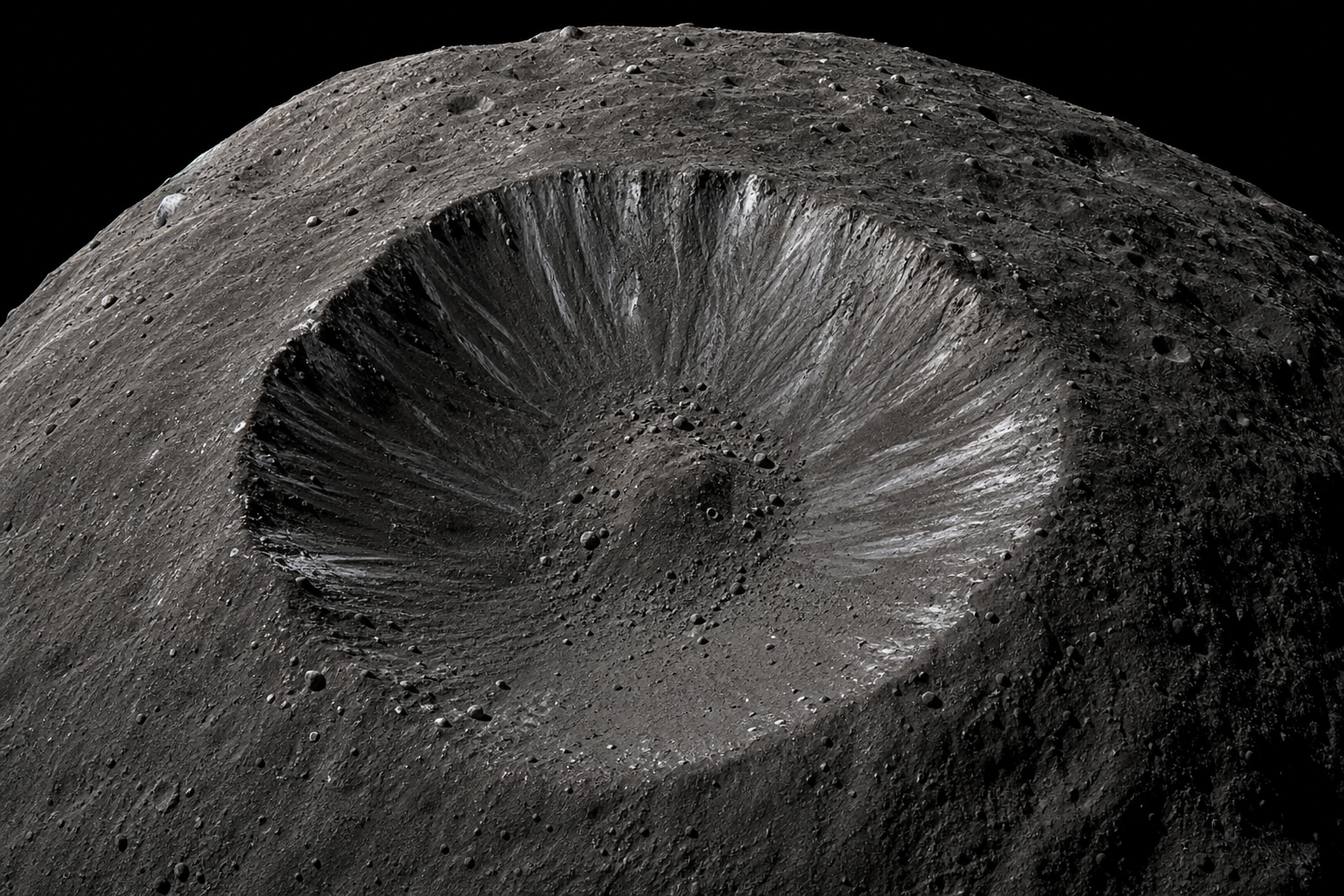
the largest crater on Phobos, named after Angeline Stickney Hall, mathematician and Hall’s wife
Stickney crater (NASA APOD)
Chapter I · Two small moons
Asaph Hall, 1877
Space.com: Asaph Hall, working at the US Naval Observatory in Washington, D.C., with a 26-inch refractor, then the largest telescope in the world, found Deimos and, six days later, Phobos; he announced both on 18 August 1877. NASA: Hall found Deimos the night after he had nearly given up, and named the moons after the mythological sons of Ares, the Greek counterpart of Mars: Phobos, fear, and Deimos, dread. Freedman & Kaufmann: the search came during a favourable opposition, when Mars is close to Earth.
NASA APOD: Stickney is named after Chloe Angeline Stickney Hall, mathematician and Asaph Hall’s wife; the crater is over 9 km across.
The 3D scenes are simplified models. Distances from Mars are to scale, but the two moons are drawn about fifty times larger than they are so that you can see them; the tidal bulge is hugely exaggerated.
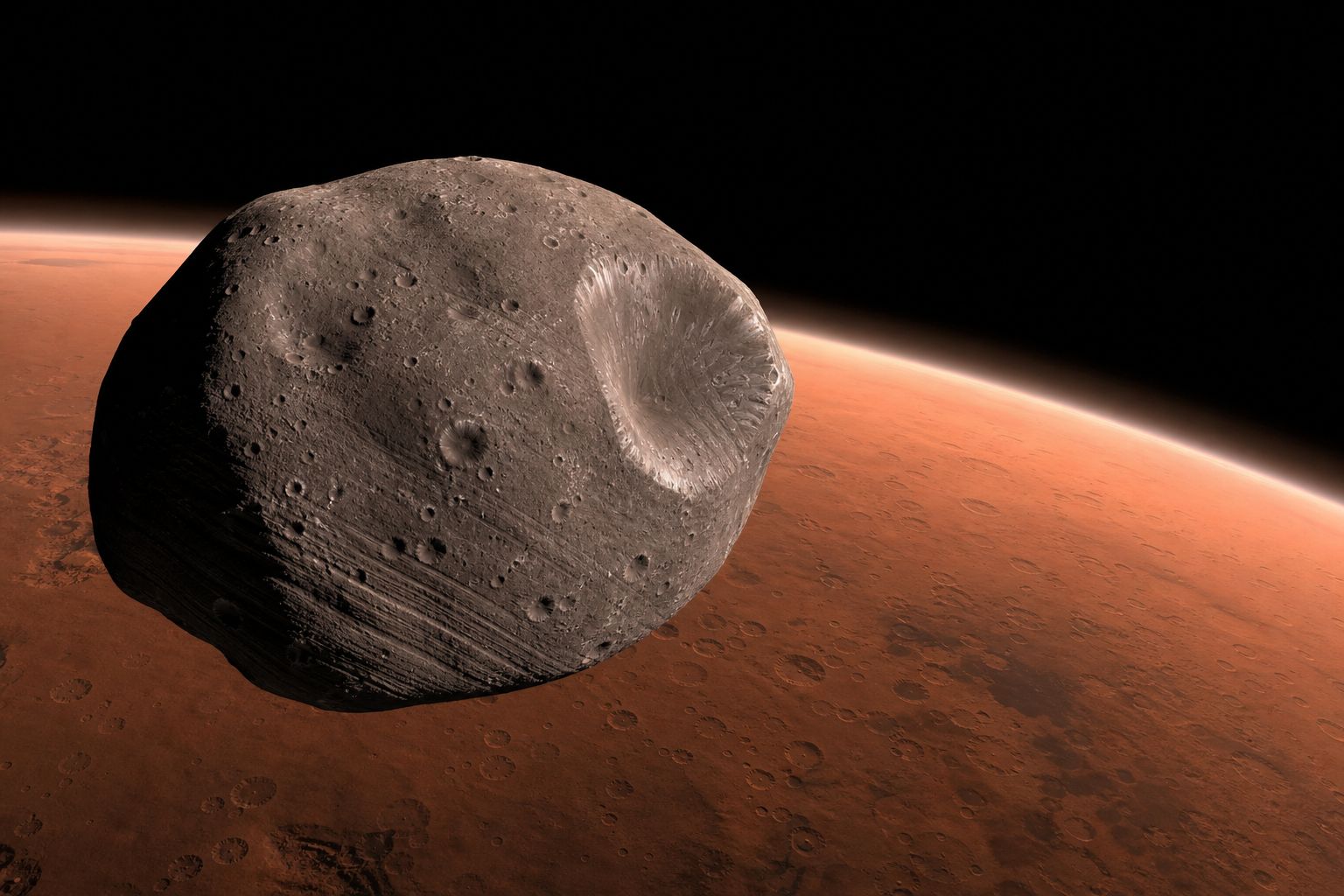
Neither moon is round. Phobos is about twenty-six kilometres long, Deimos about fifteen: too small for gravity to pull them into spheres.
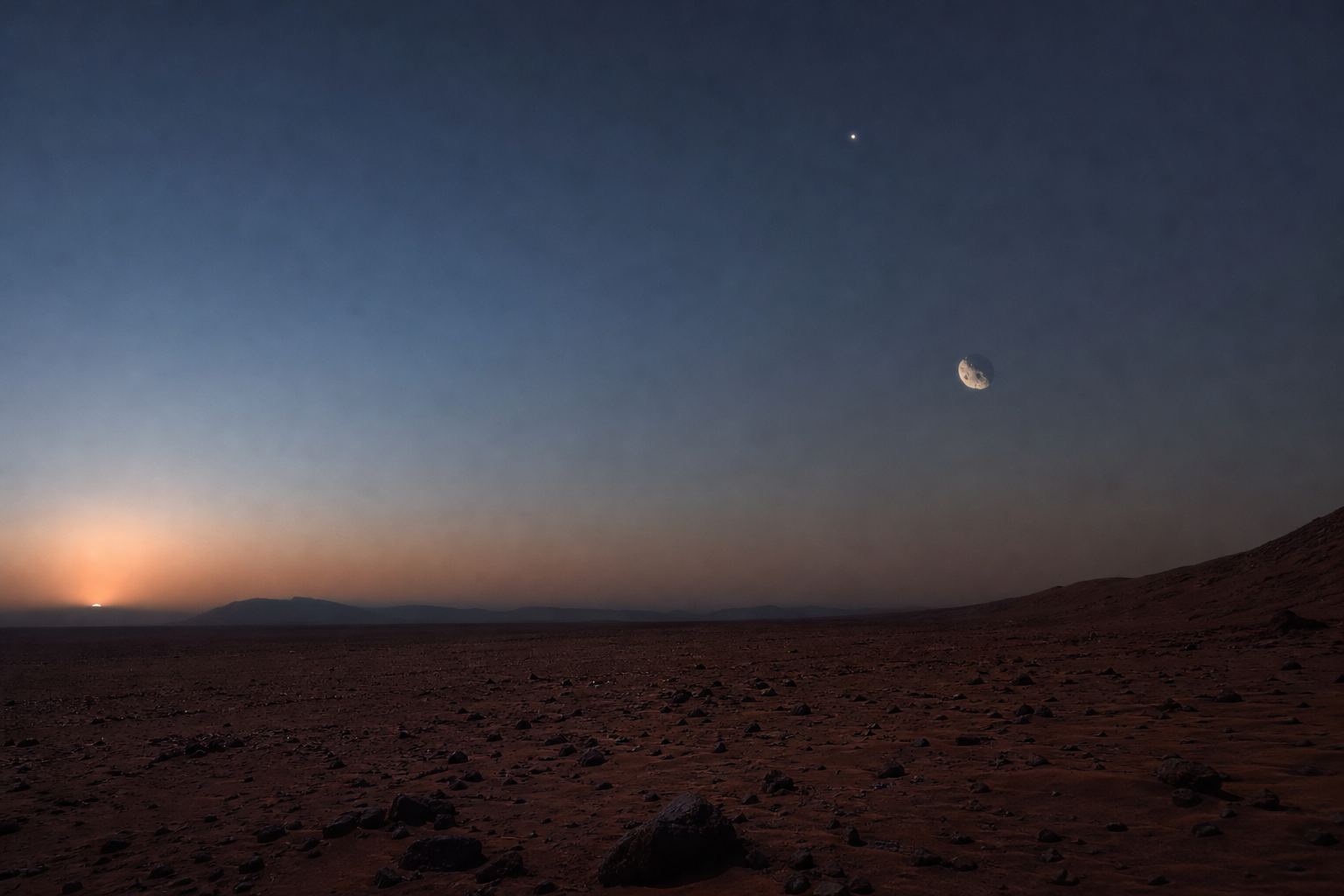
Phobos orbits just six thousand kilometres above the surface of Mars, closer to its planet than any other known moon. It goes round three times while Mars turns once, so from the ground it rises in the west and sets in the east.
Deimos, farther out, takes thirty hours. Both are among the darkest objects in the solar system. Speed up time.
Phobos
26 km
Deimos
15 km
Longest dimension (Britannica, Universe Today)
Moonrise in the west Wikipedia: Phobos crosses the Martian sky in about four hours, about twice a Martian day. AI-generated still.
9,378 km
Phobos, one lap in 7 h 39 min
23,460 km
Deimos, one lap in 30 h 18 min
From the centre of Mars (Britannica, Universe Today)Always the same face NASA: both moons always show the same face to Mars. Britannica: Phobos reflects only about 6% of sunlight. AI-generated still.
Chapter I · Two small moons
Phobos and Deimos today
Britannica: Phobos measures about 26 × 22 × 18 km and orbits 9,378 km from the centre of Mars (the closest known moon to its planet) in about 7 h 39 min, on a nearly circular orbit tilted about 1° to the equator, while Mars turns in 24 h 37 min; it reflects about 6% of sunlight. Universe Today: Deimos is about 15 × 12 × 11 km and orbits about 23,460 km from the centre of Mars every 30 h 18 min. NASA: Phobos is about 6,000 km above the surface; both moons are among the darkest objects in the solar system and always show the same face to Mars. Wikipedia: Phobos rises in the west and sets in the east.
The 3D scenes are simplified models. Distances from Mars are to scale, but the two moons are drawn about fifty times larger than they are so that you can see them; the tidal bulge is hugely exaggerated.
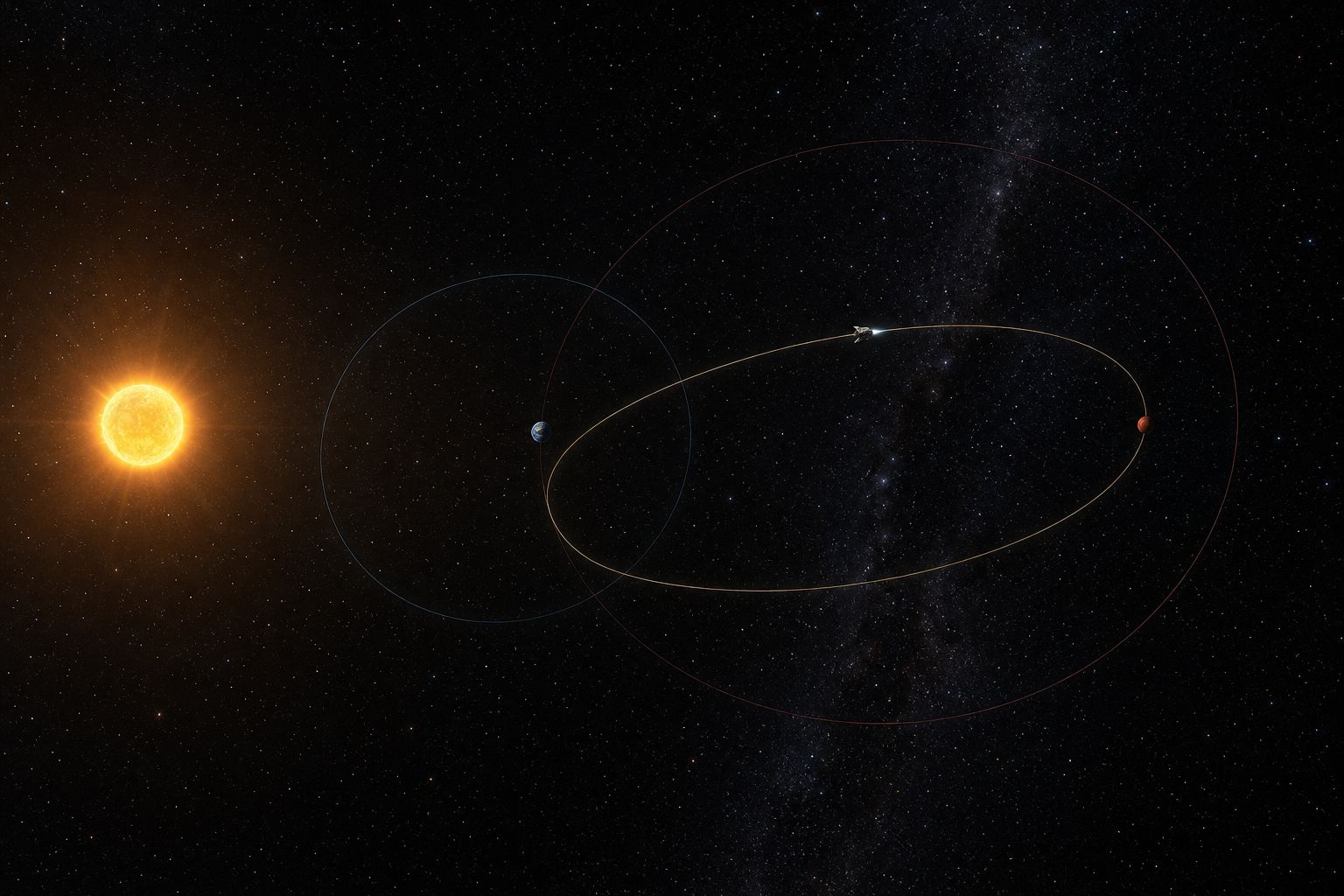
Getting there is not a matter of pointing. A spacecraft leaving Earth already moves with Earth around the Sun, so it uses that speed rather than fighting it. The cheapest route, described by Walter Hohmann in 1925, is half an ellipse around the Sun: one engine burn to leave Earth, then about eight and a half months of coasting.
Mars keeps moving meanwhile, so at launch it must be about forty-four degrees ahead of Earth. That line-up, the launch window, comes round about every twenty-six months.
Real missions bend the simple model: Perseverance took 203 days in 2020 and 2021, and MMX is expected to need about ten months. Try launching at the wrong moment, then the right one.
Two moving targets NASA compares it to throwing a dart at a moving target. AI-generated still.a=21+1.52≈1.26AU2T=21a3/2≈259days
a
half the long axis of the ellipse; 1 AU is Earth’s distance from the Sun
T
time for a full lap, in years (Kepler’s third law)
Worked as in the NASA JPL lesson, with circular orbits.
779.94 days
the time for Earth to lap Mars once: about 25.6 months
≈44°
Mars ahead of Earth at launch
Synodic period (NASA)
Hohmann model
~259
Perseverance, 2020–21
203
MMX, planned (~10 months)
~300
Earth to Mars, days
Chapter II · The road to Mars
Hohmann transfers and launch windows
NASA Basics of Space Flight: on a Hohmann transfer the spacecraft accelerates in the direction of Earth’s motion around the Sun so that its new orbit touches Earth’s orbit at perihelion and Mars’s at aphelion; it must leave at the right time to arrive when Mars is there. NASA JPL lesson: with circular orbits at 1 and 1.52 AU the ellipse has a semi-major axis of about 1.26 AU and the trip takes about 259 days, during which Mars moves about 136°, so it must be about 44° ahead at launch. Linda Hall Library: Walter Hohmann described this minimum-energy route in his 1925 book. NASA JPL (Mars 2020 press kit): Earth laps Mars about once every 26 months and launch opportunities recur at the same rate. NSSDC: Mars’s synodic period is 779.94 days. Wikipedia (Mars 2020): Perseverance launched on 30 July 2020 and landed on 18 February 2021, 203 days later. Space.com: MMX is expected to take about 10 months.
How to use: press Launch now at any moment and watch whether Mars is there when the craft arrives. Jump to window skips ahead to the next good line-up. The gold dot marks where Mars must be at launch.
The transfer scene assumes circular orbits in one plane, as the NASA JPL lesson does; real trajectories differ by days to weeks.
Now the falling moon. About twenty thousand four hundred kilometres from the centre of Mars, a moon would circle exactly as fast as Mars spins. This is called the synchronous orbit.
Phobos is far inside that line. Its pull raises a slight bulge in the solid rock of Mars. Mars turns more slowly than Phobos orbits, so the bulge lags behind and tugs it back. Losing energy, Phobos sinks into a lower orbit, about two metres a century.
Deimos, just outside, is pulled forward and drifts slowly away, as our Moon does from Earth. Switch between the two.
20,428 km
synchronous orbit (Planetary Society)
9,378 km
Phobos: well inside
23,460 km
Deimos: about 3,000 km outside
Distance from the centre of Mars
Phobos raises a bulge on Mars
Mars spins slower than Phobos orbits
the bulge lags behind and pulls back
Phobos loses energy and spirals in
Why Phobos falls (Freedman & Kaufmann)Low and fast Freedman & Kaufmann: seen from Mars, Deimos takes about three days to cross the sky. AI-generated still.
1.8 m
per century (NASA)
~2 m
per century (NASA Goddard, 2015)
Measured fall
Chapter III · A falling moon
Tides on Mars
Freedman & Kaufmann (Universe): a synchronous orbit keeps a satellite over one spot on the equator; Deimos orbits just beyond it and, like Earth’s Moon, is slowly moving away. Phobos orbits faster than Mars rotates, which holds the tidal bulge it raises on Mars behind the line joining them; the bulge’s gravity pulls Phobos backward, slowing it so that it drifts toward the planet. The Planetary Society: Mars’s synchronous (stationary) orbit has a radius of 20,428 km from the centre, about 3,000 km inside the orbit of Deimos. NASA: Phobos is spiralling inward about 1.8 m per century; NASA Goddard (2015): about 2 m per hundred years. Britannica: the inward pull shows in precise position measurements over the past century.
The 3D scenes are simplified models. Distances from Mars are to scale, but the two moons are drawn about fifty times larger than they are so that you can see them; the tidal bulge is hugely exaggerated.
Two metres a century never stops, but Phobos will not simply crash. In 1848 Édouard Roche worked out how close a moon held together only by its own gravity can get to a planet.
Closer than that, the planet pulls the near side harder than the far side. That difference, the tidal force, stretches the moon, and the stretch wins.
For Phobos that limit is about ten thousand six hundred kilometres from the centre of Mars. It is already inside, and survives only because its rock has some strength. A denser moon could come closer. Change the density.
the closest a large moon can come before tides overcome its own gravity
first worked out by Édouard Roche (1820–83)
Saturn’s rings lie inside Saturn’s limit
The Roche limit (Britannica)
~2½
planet radii from the centre, for a moon made of similar stuff
Rule of thumb (Britannica)d≈2.44RM(ρmρM)1/3
RM
radius of Mars, 3,389.5 km
ρM
density (rho) of Mars, 3.93 g/cm³
ρm
density of the moon, ~1.9 g/cm³ for Phobos
The form for a moon with no strength (fluid). Our arithmetic: d ≈ 10,600 km from the centre for Phobos.
~10,600 km
Roche limit for a fluid Phobos
9,378 km
where Phobos is now
From the centre of Mars
Chapter IV · The Roche limit
Édouard Roche’s limit
Britannica: the Roche limit is the minimum distance to which a large satellite can approach its primary before tidal forces overcome the satellite’s own gravity; for bodies of similar composition it is about 2½ times the radius of the larger body, and it was first calculated by the French astronomer Édouard Roche (1820–83). Wikipedia: Roche first calculated it in 1848. Science Notes gives the fluid-body form d = 2.44 R (ρM/ρm)^(1/3) and the rigid-body form d ≈ 1.26 R (ρM/ρm)^(1/3). With Mars’s radius of 3,389.5 km and density of 3,934 kg/m³ (NASA NSSDC) and Phobos’s 1.87 g/cm³, the fluid limit works out at about 10,600 km from the centre of Mars and the rigid limit at about 5,500 km; this film did that arithmetic itself.
Both limits assume the moon is held together by gravity alone. Real rock also has strength, so a moon can survive inside them for a while. Black & Mittal (2015) put Phobos’s breakup closer still, at about 1.2 Mars radii (about 4,070 km from the centre).
Buttons change the density of the moon; the two rings show the fluid and rigid limits.
The 3D scenes are simplified models. Distances from Mars are to scale, but the two moons are drawn about fifty times larger than they are so that you can see them; the tidal bulge is hugely exaggerated.
What may happen tens of millions of years from now.
A 2015 study from the University of California, Berkeley, expects the cracked, porous moon to break up in twenty to forty million years, about six hundred and eighty kilometres above the surface.
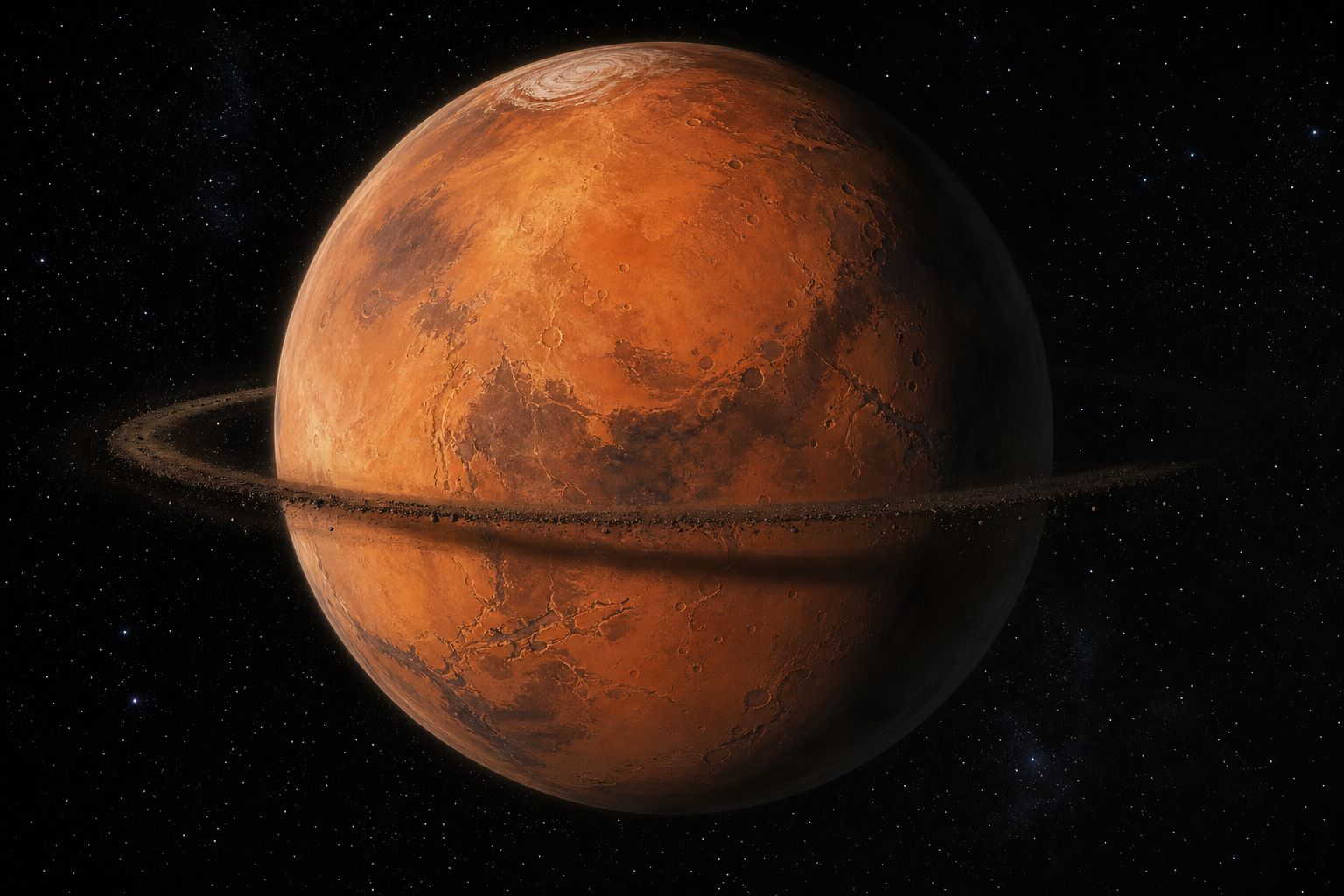
The rubble would spread into a dark ring that could last from one to a hundred million years, slowly draining onto the planet.
Mars would be a ringed planet for a while, like Saturn but far darker. Break Phobos apart.
20–40 million years
until Phobos breaks up
~680 km
above the surface (1.2 Mars radii from the centre)
Black & Mittal, Nature Geoscience 2015A dark ring Berkeley: at first it could be about as dense as one of Saturn’s most massive rings, but much darker. AI-generated illustration.
Dismembering it is analogous to pulling apart a granola bar.Benjamin Black, UC Berkeley, 2015 (NASA Goddard gives 30–50 million years)
Chapter IV · The Roche limit
The demise of Phobos
UC Berkeley: in “The demise of Phobos and development of a Martian ring system” (Nature Geoscience, November 2015), Benjamin Black and Tushar Mittal conclude that Phobos, highly fractured and porous, will likely break apart in 20 to 40 million years at about 1.2 Mars radii from the centre (about 680 km above the surface), forming a ring that could last from about 1 million to 100 million years; a ring formed closer in would spread and drain away sooner. Mittal: at first it could be comparable in density to one of Saturn’s most massive rings. NASA and NASA Goddard give 30–50 million years; Goddard’s Terry Hurford argued in 2015 that the grooves on Phobos may be early tidal stretch marks, while other studies link them to the Stickney impact.
The breakup in the scene is schematic and hugely sped up.
The 3D scenes are simplified models. Distances from Mars are to scale, but the two moons are drawn about fifty times larger than they are so that you can see them; the tidal bulge is hugely exaggerated.
So where did the moons come from? One idea: they are asteroids, captured by Mars's gravity.
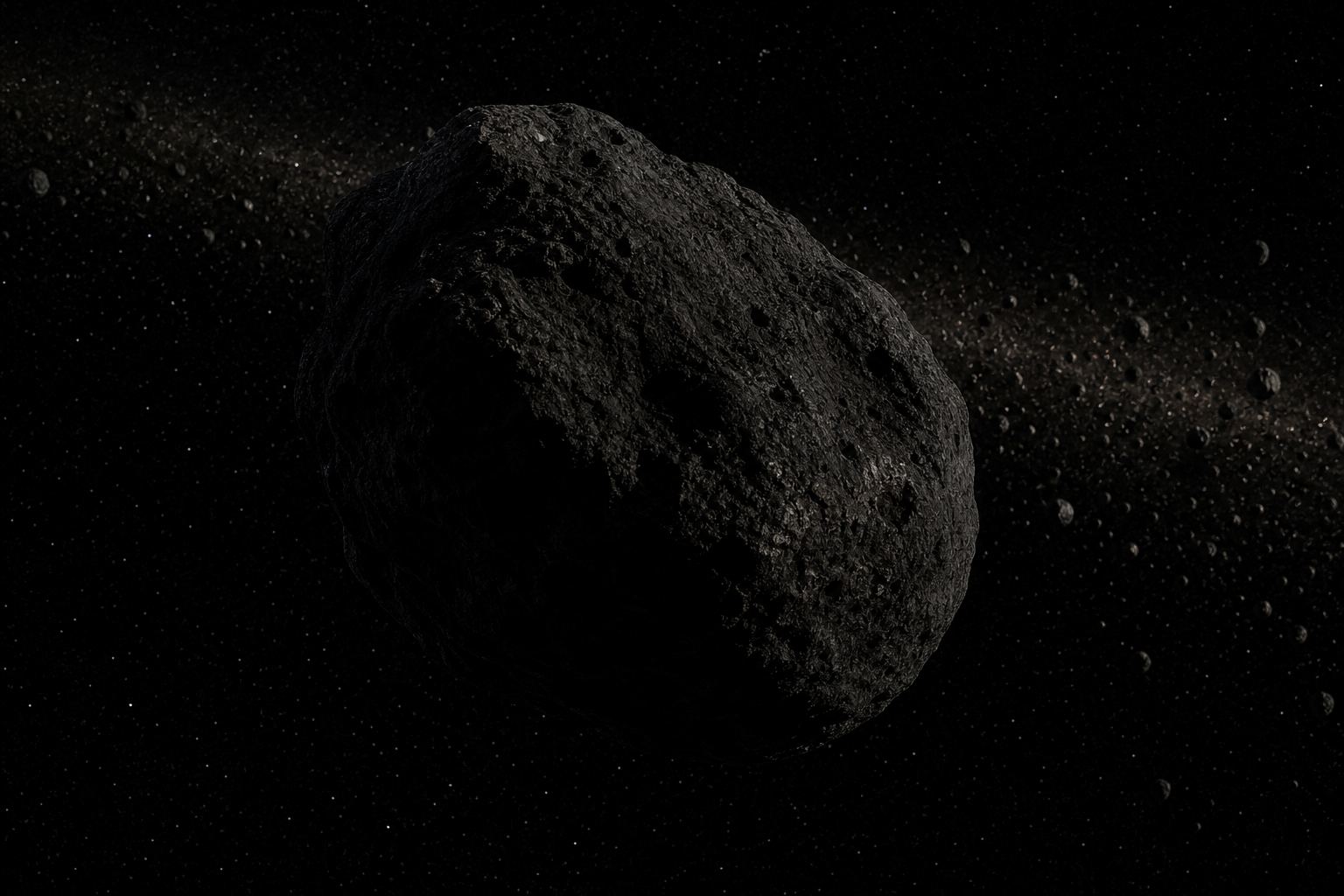
They look the part: dark and carbon-rich, like the meteorites called carbonaceous chondrites. Their low density, under two grams per cubic centimetre, fits too.
But captured asteroids should arrive on stretched, tilted paths. These two circle almost exactly above Mars's equator.
A dark asteroid Wikipedia: Phobos’s light and density resemble the dark, carbon-rich asteroid families astronomers label C and D. AI-generated still.
1.9
Phobos
1.76
Deimos
< 10%
of sunlight reflected
Density, grams per cubic centimetre (Freedman & Kaufmann)
~1°
tilt of Phobos’s orbit to Mars’s equator
How flat (Britannica)
Chapter V · Where did they come from?
The capture idea
Britannica: Phobos’s density (about 1.9 g/cm³) and reflectance (about 6%) are similar to carbonaceous chondrite meteorites, suggesting it may be a captured asteroid-like object. Freedman & Kaufmann: both moons reflect little sunlight (typically under 10%) and have low densities (about 1,900 and 1,760 kg/m³), typical of carbon-rich asteroids. Wikipedia: Phobos’s spectra, albedo and density resemble C- or D-type asteroids, and capture would require the orbit to be circularised by atmospheric drag and tides. CNRS (2016): nearly circular orbits in Mars’s equatorial plane are hard to explain by capture. Space.com: telescope spectra fit captured early-solar-system asteroids, but the question is unresolved.
The capture path in the scene is a sketch of the idea, not a simulation of a real orbit.
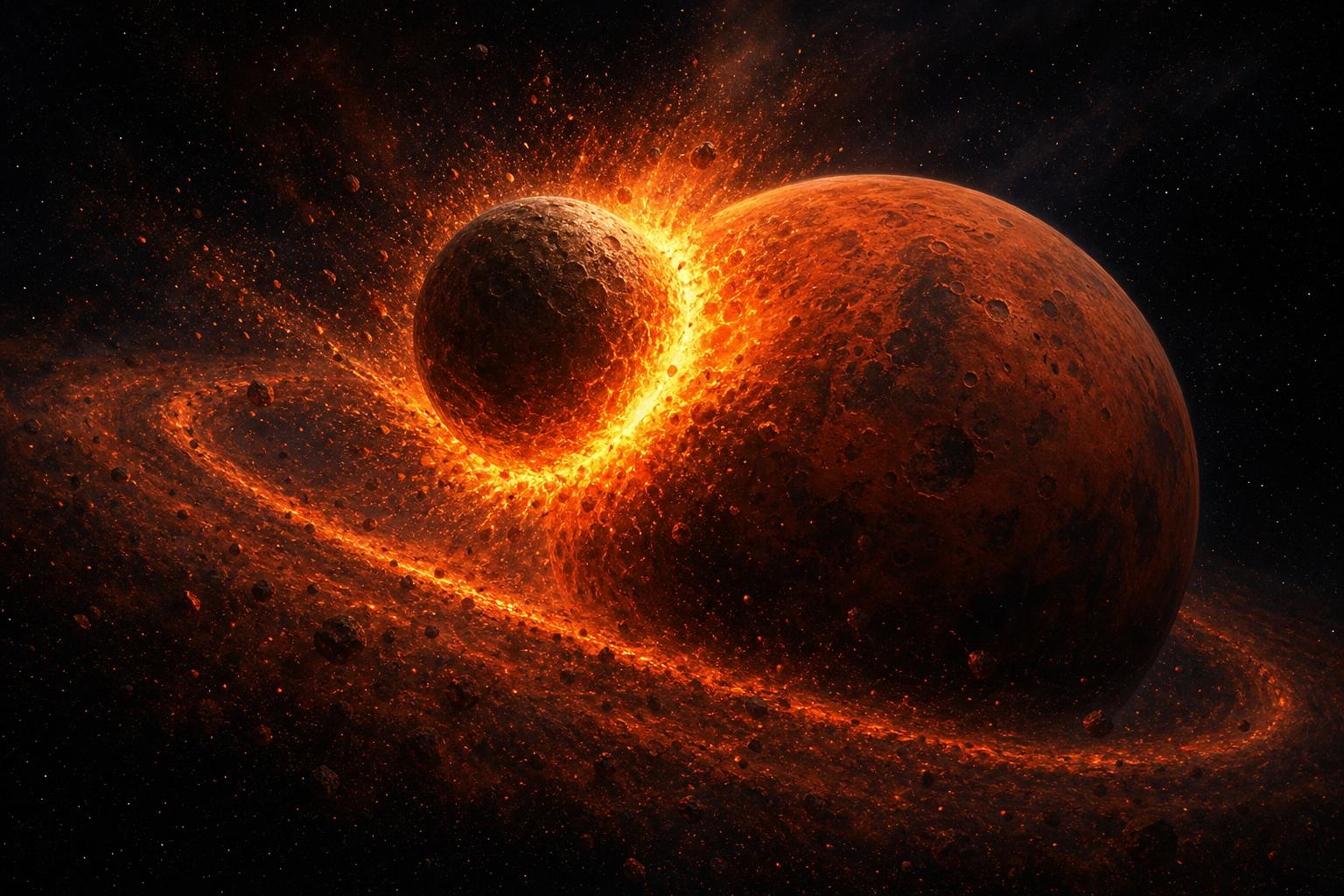
The other idea starts with a collision. In 2016 Pascal Rosenblatt's team proposed that a body a third the size of Mars hit the young planet and threw debris into a disk.
The disk built about ten small moons and one big one, about a thousand times bigger than Phobos. Mars's tides pulled most of them down, leaving Phobos and Deimos.
That fits the neat equatorial orbits. But telescopes have not settled which idea is right. Compare the two.
A giant impact CNRS: the same impact might also explain the Borealis basin, the low northern half of Mars. AI-generated illustration.
impact 100–800 million years after Mars began to form
thousands of years the moons gather from fine dust
a few million years tides pull most of them onto Mars
today Phobos and Deimos remain
The 2016 scenario (Rosenblatt et al.)
capture: fits the dark, carbon-rich look
impact: fits the circular, equatorial orbits
neither: settled from afar
The score so far
Chapter V · Where did they come from?
The giant-impact idea
CNRS (4 July 2016): in Nature Geoscience, Pascal Rosenblatt, Sébastien Charnoz and colleagues modelled a protoplanet about a third the size of Mars striking the young planet 100 to 800 million years after it began forming; the debris formed a wide disk in which about ten small moons and one large moon, about 1,000 times the size of Phobos, gathered within a few thousand years; a few million years later Mars’s tides pulled most of them, including the large one, back onto the planet, leaving Phobos and Deimos. The building blocks would be very fine dust, which may explain the moons’ porosity. A companion study by Ronnet, Vernazza, Mousis and colleagues argued against capture. Space.com and ESA describe the origin as still open.
The impact sequence in the scene is a schematic sketch of the published scenario.
Three earlier probes set out for Phobos. Phobos 1 was lost on the way in 1988, Phobos 2 fell silent in 1989 before releasing its landers, and Russia's Phobos-Grunt never left Earth orbit in 2011.
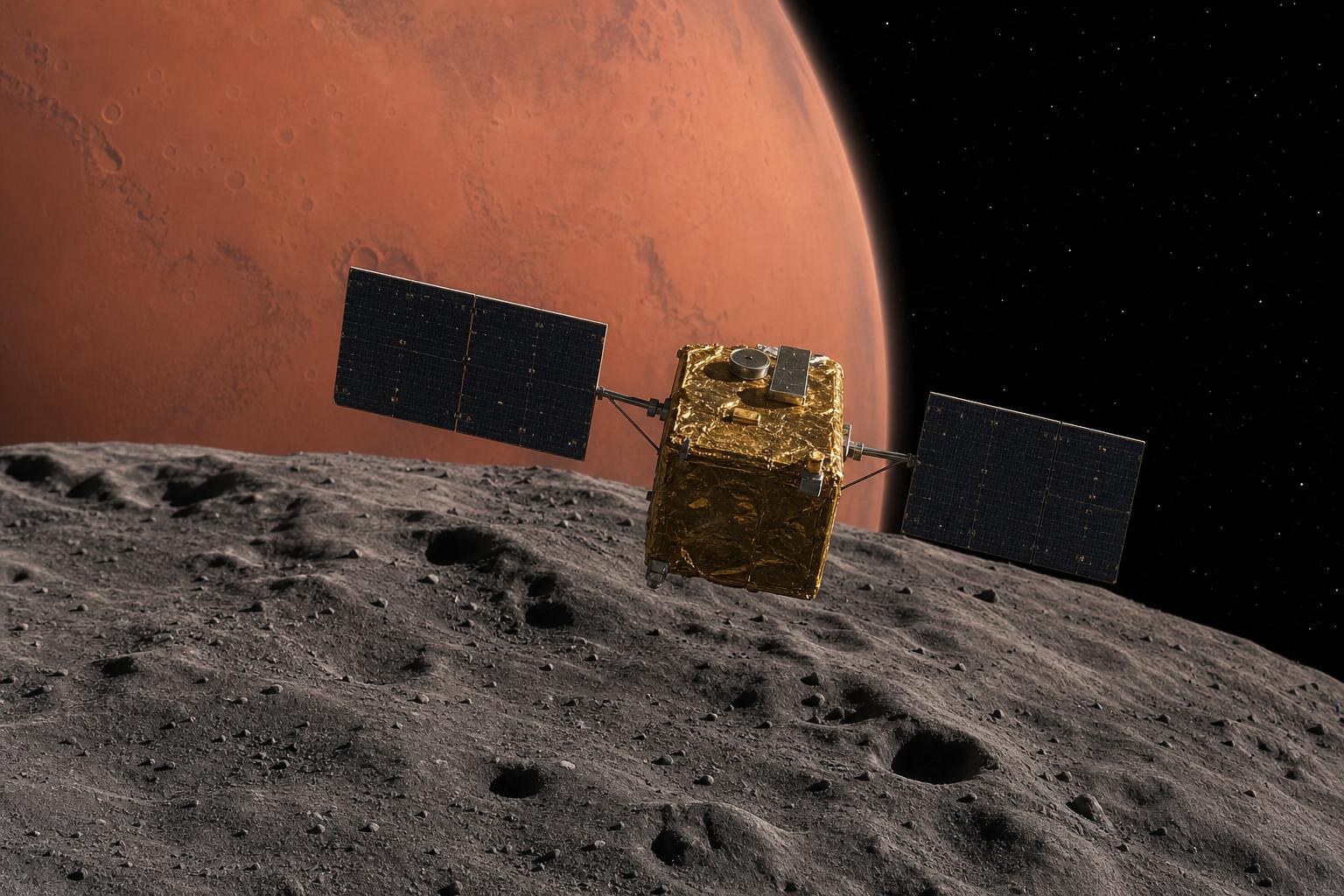
Phobos is too small to orbit in the usual way, so MMX will fly a quasi-satellite orbit: it circles Mars side by side with the moon, and seen from Phobos it seems to loop around it.
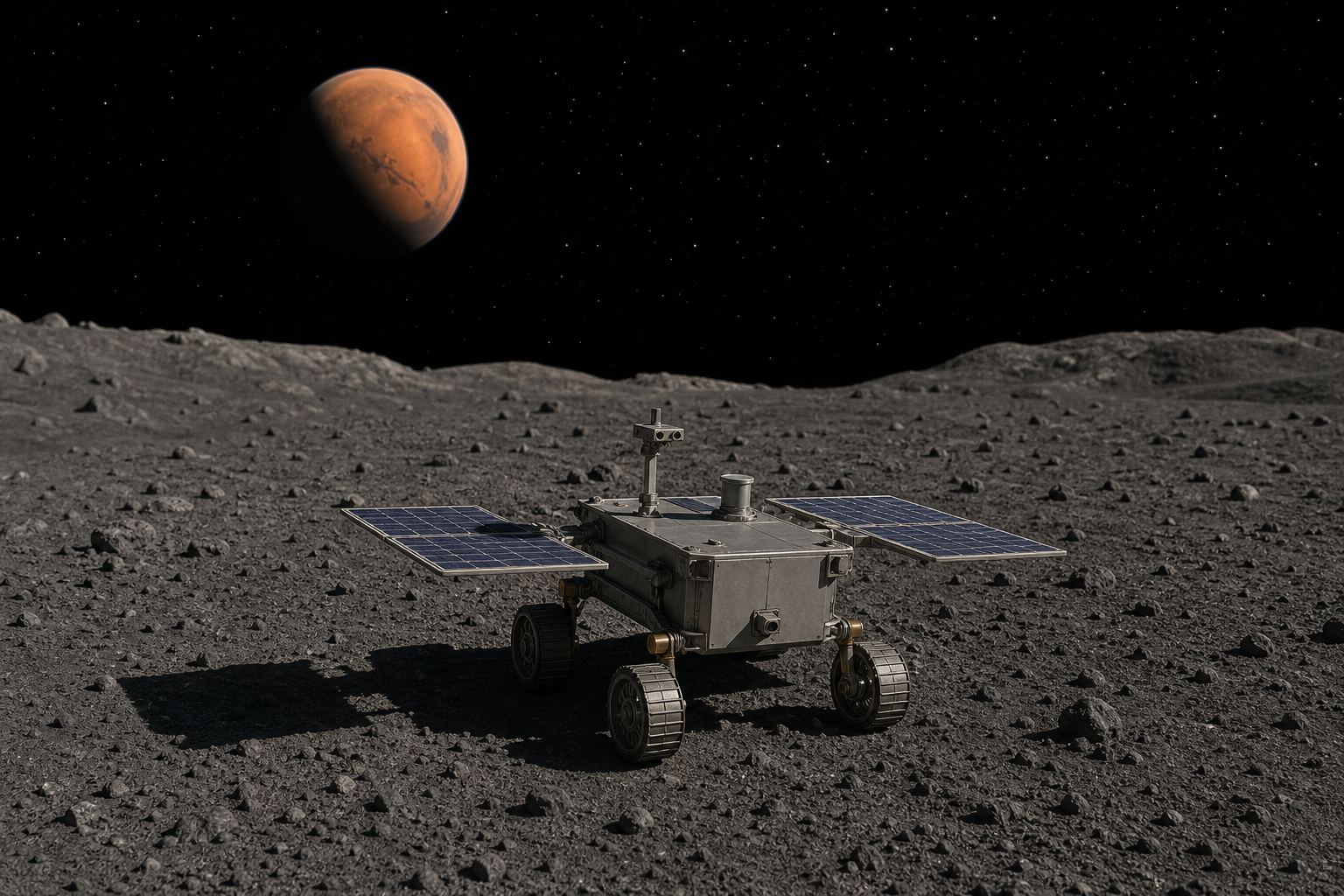
From there it maps the surface, then drops IDEFIX, a twenty-five-kilogram French-German rover, from forty to a hundred metres up.
On Phobos it weighs about as much as fifteen grams on Earth. Drop the rover.
1988 Phobos 1 lost on the way after a wrong command
1989 Phobos 2 photographs the moon; contact lost before landing
2011–12 Phobos-Grunt stuck in Earth orbit, falls back
Earlier missions to PhobosMapping Phobos ESA: the main spacecraft and rover carry 11 instruments, including two high-resolution cameras. AI-generated illustration, not the real spacecraft.
Aug 2027
arrival at Mars
Sep 2027
first spacecraft ever in a quasi-satellite orbit of Phobos
30–200 km
provisional heights above Phobos
Planned (ESA, JAXA)
Japan’s space agency (JAXA): spacecraft and mission
French and German space agencies (CNES, DLR): the IDEFIX rover
NASA: a spectrometer and a sampler
European Space Agency (ESA): tracking stations and radio parts
Who built whatIDEFIX DLR: it lands, stands itself up and runs on solar power, with a Raman spectrometer and a heat sensor. AI-generated illustration, not the real rover.
Chapter VI · Bringing back a piece
Quasi-satellite orbit and IDEFIX
Wikipedia (Phobos, Phobos 2): Phobos 1 and 2 launched in July 1988; Phobos 1 was lost after an erroneous command; Phobos 2 reached Mars orbit on 29 January 1989 and returned 37 images of Phobos, but contact was lost on 27 March 1989 before its landers were released. Britannica: Phobos-Grunt (launched 9 November 2011) was to return about 200 g of Phobos soil but did not leave Earth orbit; it re-entered in January 2012. Wikipedia (MMX): Phobos and Deimos lack enough mass for conventional satellite orbits, so MMX will use quasi-satellite orbits. JAXA MMX news: in such an orbit the spacecraft follows the moon around Mars and, seen from the moon, appears to orbit it; provisional altitudes range from 30–50 km to 100–200 km. ESA: MMX enters Mars orbit in August 2027 and Phobos’s quasi-satellite orbit from September 2027; the 25 kg Idefix rover would weigh the equivalent of about 15 g on Phobos. DLR: the rover is lowered from 40 to 100 m, stands itself up, runs on solar power and carries the miniRAD radiometer and RAX Raman spectrometer with CNES cameras. CNES: gravity on Phobos is about 1,800 times weaker than on Earth.
In the scene the loop around Phobos is drawn as seen from the moon, and its size is not to scale.
Dates after October 2026 are JAXA’s plans, not events. Sources give slightly different dates for the landings.
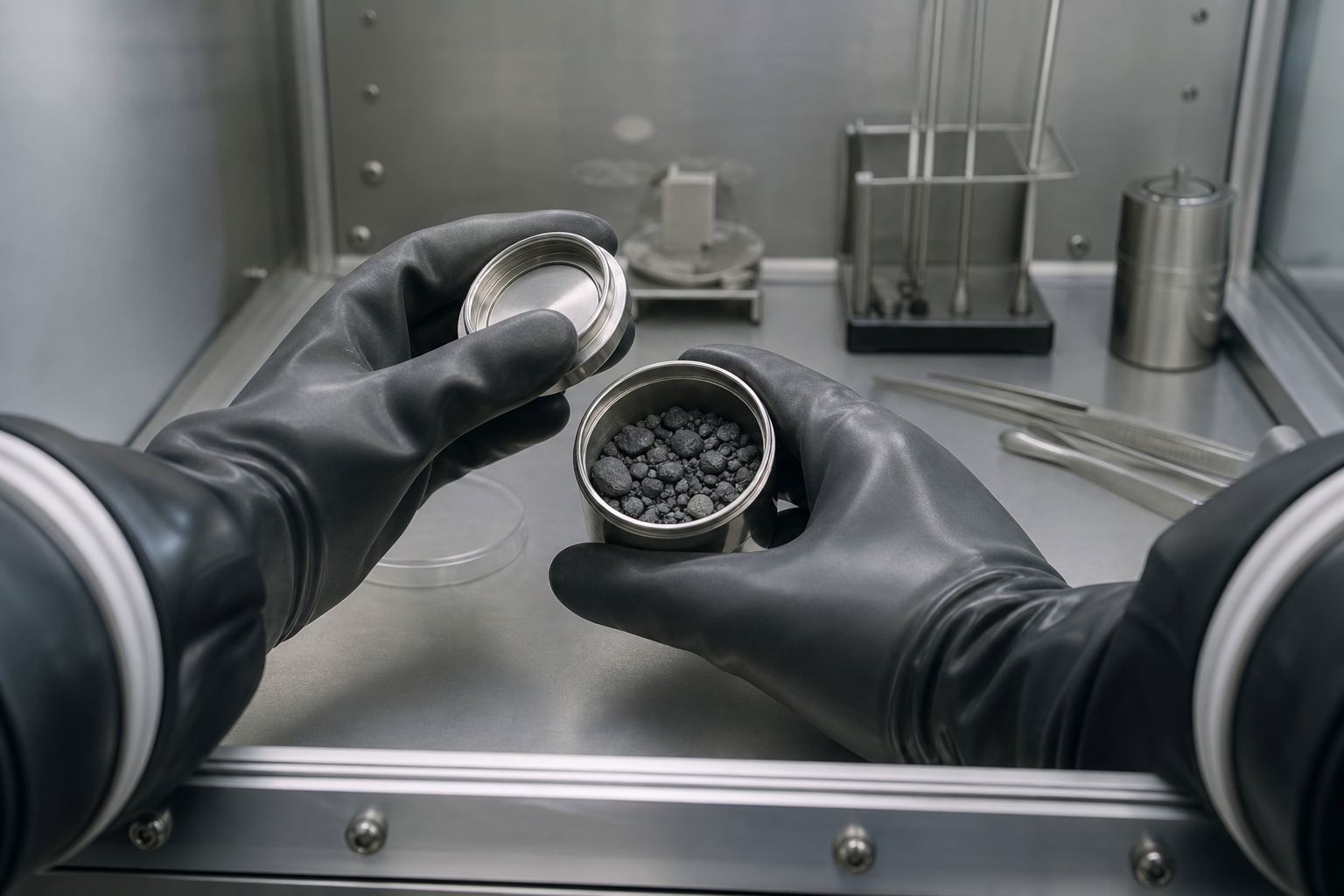
Then the spacecraft touches down. A corer on a robotic arm digs deeper than two centimetres, and a gas jet blows surface soil into a container: at least ten grams in all.
JAXA has done this twice, on asteroids: Hayabusa from Itokawa, and Hayabusa2, which returned about five point four grams from Ryugu in 2020.
If all goes to plan, MMX leaves Mars in November 2030, and its capsule lands in Australia in 2031. Touch down and take a sample.
both designed to finish within 2.5 hours
the gas-jet sampler is NASA’s, built by Honeybee Robotics
two separate touchdowns are planned
Two samplers (Wikipedia, Space.com)
Hayabusa2, Ryugu (2020)
~5.4 g
MMX goal, Phobos (2031)
≥10 g
Samples JAXA has brought home
Home in 2031 (planned) Space.com: the capsule comes down in Australia’s Woomera region; at least 15% of the sample is reserved for NASA. AI-generated still.
Chapter VI · Bringing back a piece
Sampling and the way home
Wikipedia (MMX): the C-SMP coring sampler, fired by the robotic arm, collects regolith from deeper than 2 cm and is designed for over 10 g; the P-SMP pneumatic sampler near a landing-leg footpad uses a gas burst to push about 10 g of surface soil into its container; both are to finish within 2.5 hours. Space.com: the pneumatic sampler is NASA’s (built by Honeybee Robotics); two separate touchdowns are planned; MMX departs for Earth in November 2030 and the capsule lands in Australia’s Woomera region in 2031; at least 15% of the sample goes to NASA. JAXA: Hayabusa and Hayabusa2 built Japan’s technology for landing on small bodies and collecting samples. JAXA (Hayabusa2 press material): Hayabusa returned samples in 2010; Hayabusa2’s total Ryugu sample was about 5.4 g. JAXA and Sky & Telescope: the Hayabusa2 capsule was recovered at Woomera, Australia, on 6 December 2020; Hayabusa had returned tiny shards of asteroid Itokawa.
Dates after October 2026 are JAXA’s plans, not events. Sources give slightly different dates for the landings.
In the lab, the grains can do what telescopes cannot. A captured asteroid should keep easily lost elements like hydrogen and potassium; hot impact debris should have lost them.
Some grains may even be pieces of Mars itself, blasted onto Phobos by ancient impacts. Either way, a few grams could show how Mars got its moons, and how rocky planets grow.
MMX reaches Mars in August 2027, and its grains should reach laboratories in 2031. Which idea would you bet on?
Into the lab Space.com: more hydrogen, chlorine, sodium and potassium would favour capture; space weathering can also strip them, so results need care. AI-generated still.
1877 Hall finds Phobos and Deimos
1925 Hohmann describes the transfer orbit
1989 Phobos 2 photographs Phobos
2015 future-ring study
2016 giant-impact model
2026 MMX launches
2031 sample return (planned)
Timeline
2
ideas the grains will test
≥10 g
of Phobos to test them with
Still open
Epilogue
Sources
Every date and number in this film comes from the sources below. Where sources differ, the film says which one it follows. Space.com: a captured body should keep volatile elements such as hydrogen, chlorine, sodium and potassium, while debris from a giant impact would be heated and depleted in them, though long exposure to space can also deplete them; JAXA scientists think some grains may be Martian rock blasted onto Phobos. ESA: the samples could also show how rocky planets form.
Dates after October 2026 are JAXA’s plans, not events. Sources give slightly different dates for the landings.
Stills are AI-generated illustrations, not photographs of the moons or the spacecraft.
The 3D scenes are simplified models. Distances from Mars are to scale, but the two moons are drawn about fifty times larger than they are so that you can see them; the tidal bulge is hugely exaggerated.
The transfer scene assumes circular orbits in one plane, as the NASA JPL lesson does; real trajectories differ by days to weeks.