Brazil is holding a presidential runoff because no one won more than half the valid votes in the first round. Why do some countries vote twice, some rank candidates, and some hand out seats in proportion to votes? This film explains the main families of electoral systems, the spoiler effect, why plurality voting tends to produce two big parties, and two famous results from mathematics: Condorcet's paradox and Arrow's impossibility theorem. Count the same nine ballots under three rules yourself, and see why every system is a trade-off. The film takes no side on any election or party.
Interactive 3D film8 min1785 to 2026Published 17 October 2026
On the fourth of October 2026, more than a hundred million Brazilians voted for president. Flávio Bolsonaro came first with about forty-seven percent of the valid votes; President Lula da Silva had about forty-five.
Neither passed half, so under Brazil's rules the two meet again in a runoff on the twenty-fifth. Elsewhere, the first-place finisher would simply have won. Why do countries count votes in such different ways?
Brasília Brazil’s capital is a planned city, built in the late 1950s. AI-generated still.
Flávio Bolsonaro
~47%
Lula da Silva
44.9%
10 others
~8%
needed to win outright
> 50%
Brazil, first round, 4 Oct 2026 (Al Jazeera)
Prologue · The news
A runoff in Brazil
Al Jazeera reported that in the first round on 4 October 2026, with nearly 99% counted, Flávio Bolsonaro had about 47% of valid votes and President Luiz Inácio Lula da Silva 44.9%. Because neither reached the 50% threshold needed to win outright, the two meet in a runoff on 25 October.
This film is about the rules of counting, not about the candidates. “About 8%” for the others is the remainder of the reported shares.
How to use: pick a chapter or press ← →; drag to rotate. Several steps have buttons you can press.
An electoral system is the rule that turns votes into winners and seats. It decides how a ballot is marked, how the ballots are counted, and how many seats each area elects.
There are three big families: plurality and majority systems, proportional systems, and mixed systems that combine the two. Each answers a different question about what a fair result is.
Some elections choose one person, such as a president or a mayor; others fill hundreds of seats in a parliament. The same rule rarely suits both.
district size: how many seats per area
formula: how votes become winners
ballot: one mark, a ranking, or a party choice
Three parts of any system (ACE)
plurality / majority: the most votes, or over half
proportional: seats in step with votes
mixed: some seats each way
Three families
one winner: a president, a mayor
many winners: a parliament or council
Two kinds of election
Chapter I · Most votes wins
What an electoral system is
The ACE Electoral Knowledge Network defines an electoral system as the manner in which votes are translated into seats, with three key elements: district size, electoral formula and ballot structure. It groups systems into plurality/majority, proportional representation and mixed families.
Candidates A, B and C and the toy country on screen are invented for teaching; they stand for no real party or person.
The simplest rule is plurality, often called first past the post. Each voter marks one candidate, and whoever gets the most votes wins, even without a majority.
Here nine voters choose between A, B and C. C gets four votes, more than anyone else, so C wins, although five of the nine voted for someone else. Each voter also ranks the others: the two A voters would pick B next, while all seven of the rest would pick A next.
Supporters point to its strengths: it is easy to understand, quick to count, and gives each area one clearly responsible representative.
Counting Plurality counting is just one pile per candidate. AI-generated still.
A
2
B
3
C
4
First choices of 9 voters (toy example)
2 voters: A, then B, then C
3 voters: B, then A, then C
4 voters: C, then A, then B
The 9 full rankings (toy example)
for: simple, fast, one local representative
against: a winner can lack majority support
Plurality, in brief
Chapter I · Most votes wins
First past the post
ACE: under first past the post the winning candidate is the one who gains more votes than any other candidate, even if this is not an absolute majority of valid votes. The nine-voter example in this film comes from the Encyclopedia of Mathematics: two voters rank A > B > C, three rank B > A > C, four rank C > A > B.
Candidates A, B and C and the toy country on screen are invented for teaching; they stand for no real party or person.
Plurality has a well-known weakness. If two similar candidates run, they can split the votes of people who think alike, and let a third candidate win with fewer supporters.
This is called the spoiler effect, or vote splitting. It pushes voters to think tactically: not who do I like most, but who can actually win. Add or remove the second candidate and watch the winner change.
X
55%
Y
45%
A toy district: one candidate per side
X
30%
X2
25%
Y
45%
The same voters, with a similar second candidate
vote tactically for a likely winner
parties merge or stand down candidates
What voters do about it
Chapter I · Most votes wins
Vote splitting
Because plurality needs only more votes than any rival, not a majority (ACE), two candidates with overlapping support can divide it, allowing a candidate preferred by fewer voters to win. Political scientists call this vote splitting or the spoiler effect; it gives voters an incentive to vote tactically for a candidate who can win.
Candidates A, B and C and the toy country on screen are invented for teaching; they stand for no real party or person.
Over many elections, the spoiler effect has a side effect. Smaller parties struggle to win seats, voters drift to the two strongest, and politics tends to settle into two big parties.
The French political scientist Maurice Duverger described this pattern in the 1950s, and it became known as Duverger's law. It is a tendency, not an iron rule: some plurality countries have several strong parties, often based in particular regions.
the plurality rule … favors the two-party systemWilliam Riker, summarising Duverger’s law (APSR, 1982)
mechanical: small parties win few seats
psychological: voters avoid “wasting” votes
a tendency, with regional exceptions
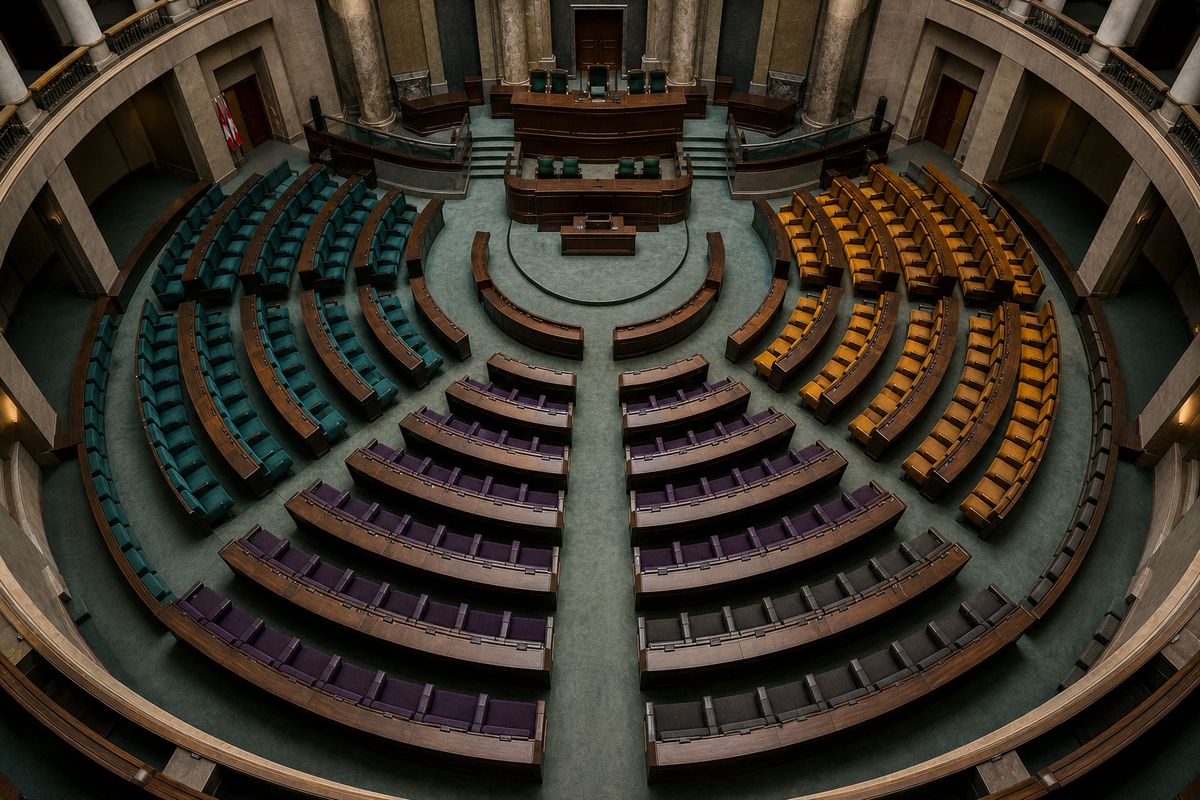
Why it happensTwo blocks Under plurality, chambers often divide into two large groups. AI-generated still.
Chapter I · Most votes wins
Duverger’s law
William Riker’s 1982 essay in the American Political Science Review discusses the propositions collectively called Duverger’s law, that the plurality rule for selecting the winner of elections favours the two-party system, and notes that revised versions are not wholly accepted. Political scientists usually treat it as a strong tendency rather than a law without exceptions.
Duverger set out his laws in Les partis politiques (1951). Political scientists describe two mechanisms behind the tendency: a mechanical one (small parties win few seats) and a psychological or strategic one (voters avoid wasting votes).
Candidates A, B and C and the toy country on screen are invented for teaching; they stand for no real party or person.
Brazil’s rule: if no one has a majority, vote again.
A two-round system asks for more: an absolute majority, more than half the votes. If nobody gets it, the top two face each other in a second round.
Back to our nine voters. In round one, A is last and drops out. A's two voters prefer B to C, so in round two B beats C, five to four. The winner has changed, and no ballot did.
Supporters say a runoff guarantees majority backing. Critics point to the cost of a second election, and to the risk that a widely acceptable candidate is knocked out in round one, as A was here.
> 50%
to win in round one
top 2
go to round two
Two-round rule (ACE)
B (3 + 2 from A)
5
C
4
Round two, same 9 ballots
for: the winner has majority backing
against: a second election costs time and money
against: a broadly acceptable candidate can go out early
The debate over runoffs
Chapter II · Majorities
The two-round system
ACE: the two-round system aims to produce a winner with an absolute majority (more than 50%); if no candidate achieves one in the first round, a second round of voting is held. In the Encyclopedia of Mathematics example, two-round voting eliminates A first, after which B beats C.
The model assumes voters in round two keep the same rankings; in real elections, turnout and minds can change between rounds.
Candidates A, B and C and the toy country on screen are invented for teaching; they stand for no real party or person.
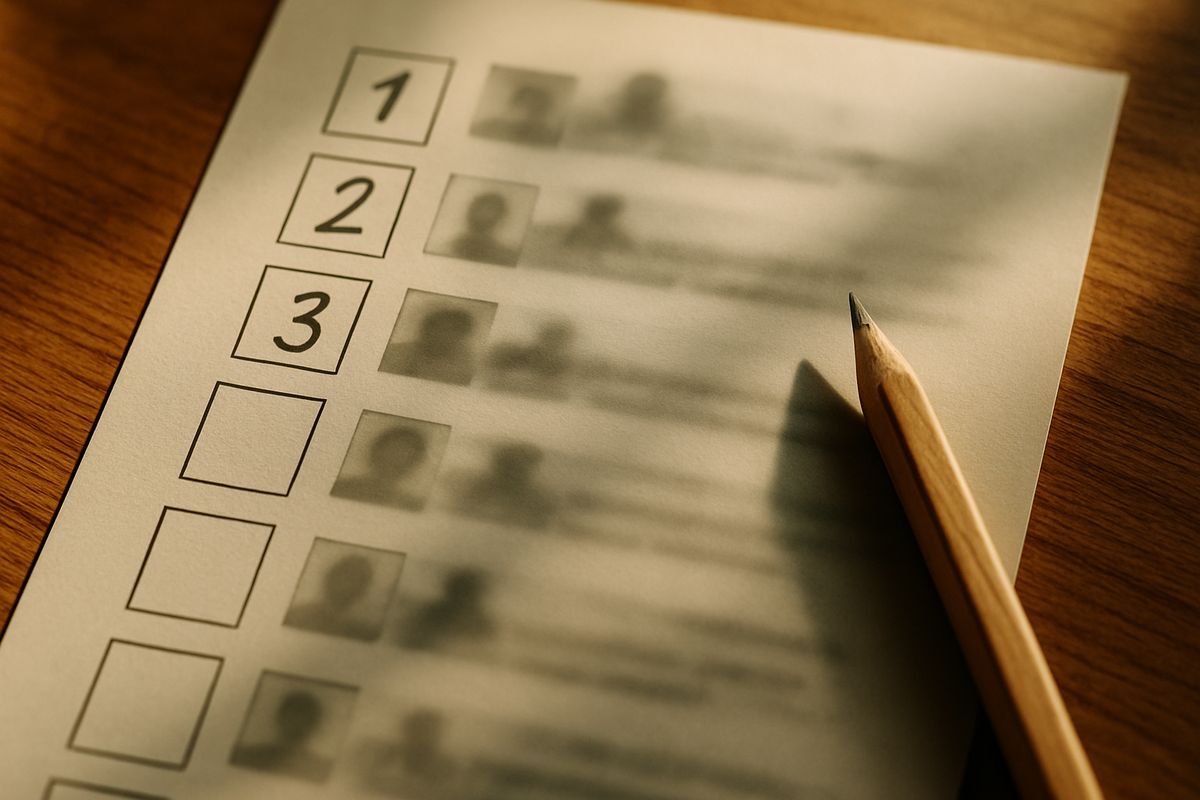
Ranked or preferential voting runs the runoff on paper.
Holding a second election costs time and money. Preferential voting, also called ranked-choice or the alternative vote, does it in one go: voters number the candidates one, two, three.
If no one has a majority of first choices, the last candidate is removed and those ballots move to their next choice, until someone passes half.
Australia has elected its House of Representatives this way since 1918.
With our nine ballots, it gives the same winner as the runoff: B.
The aim is to tame the spoiler effect: a vote for a smaller candidate is not wasted, because it moves on if that candidate is eliminated.
A ranked ballot Voters write 1, 2, 3 instead of a single cross. AI-generated still.
count first choices
over half? that candidate wins
if not, drop the last; move those ballots to their next choice
repeat
Counting a ranked ballot
1918
preferential voting introduced
> 50%
needed to win a House seat
Australia (Parliamentary Education Office)
B
5
C
4
Ranked count of the 9 ballots, final round
for: one trip to the polls, fewer wasted votes
against: longer count, harder ballot to fill in
Ranked voting, in brief
Chapter II · Majorities
Preferential voting
ACE describes the alternative vote as aiming for an absolute majority by using voters’ second and later preferences. Australia’s Parliamentary Education Office: preferential voting was introduced in 1918 under the Commonwealth Electoral Act; for the House of Representatives a candidate must win more than half of the vote, which helps ensure representatives have broad support.
Candidates A, B and C and the toy country on screen are invented for teaching; they stand for no real party or person.
Now ask a different question: who would win every one-on-one contest? Look again at the nine ballots. A against B: six voters prefer A. A against C: five prefer A.
So A beats both rivals head to head, yet A came last on first choices and lost under every counting rule we tried.
A candidate who beats every other one-on-one is called a Condorcet winner, after the French mathematician the Marquis de Condorcet, who studied voting in 1785. Same ballots, three rules, three winners. Compare them all.
2 voters: A > B > C
3 voters: B > A > C
4 voters: C > A > B
The nine ballots (Encyclopedia of Mathematics)
6 – 3
A beats B
5 – 4
A beats C
A head to head
plurality: C
runoff or ranked choice: B
head to head (Condorcet): A
Three rules, three winners
Chapter III · The mathematics
The Condorcet winner
The Encyclopedia of Mathematics example: with two voters ranking A, B, C; three ranking B, A, C; and four ranking C, A, B, plurality elects C, two-round and instant-runoff voting elect B, yet A beats B 6–3 and C 5–4, so A is the Condorcet winner. The entry cites Condorcet’s Essai of 1785.
Candidates A, B and C and the toy country on screen are invented for teaching; they stand for no real party or person.
Condorcet found something stranger. Sometimes majorities go round in a circle: most voters prefer A to B, most prefer B to C, and yet most prefer C to A.
Like rock, paper, scissors, every option loses to another. Each voter is perfectly consistent; it is the group that is not. This is Condorcet's paradox.
voter 1: A > B > C
voter 2: B > C > A
voter 3: C > A > B
Three voters, three rankings (classic example)A cycle A beats B 2–1, B beats C 2–1, C beats A 2–1. AI-generated illustration.
Chapter III · The mathematics
Condorcet’s paradox
Encyclopedia of Mathematics: with three or more candidates, majority preferences can form a cycle, A beating B, B beating C and C beating A, so that no candidate beats all others. The three-voter example on screen is the standard illustration: each pair is decided 2–1.
Candidates A, B and C and the toy country on screen are invented for teaching; they stand for no real party or person.
In 1951 the American economist Kenneth Arrow proved a far-reaching result. He wrote down a few conditions that any fair way of combining voters' rankings ought to meet.
For example: if every voter prefers A to B, the group should too; and the group's choice between A and B should not change just because voters changed their minds about C.
Then he proved that with three or more options, no ranking method can meet them all: the only rules that meet the others hand every decision to a single voter, a dictator. Every ranking system has to give something up. Arrow shared the Nobel Prize in economics in 1972.
unanimity: if everyone prefers A to B, so does the group
independence: A vs B depends only on how voters rank A and B
no dictator: no single voter always decides
Some of Arrow’s conditions
1951
Social Choice and Individual Values
1972
Nobel Prize in economics, shared
Kenneth Arrow (Britannica)
Chapter III · The mathematics
Arrow’s impossibility theorem
Britannica: the impossibility theorem was first formulated in Kenneth J. Arrow’s Social Choice and Individual Values (1951); Arrow shared the 1972 Nobel Prize in Economics with Sir John Hicks. The Encyclopedia of Mathematics summarises it: no decision method satisfies a small set of reasonable axioms when there are three or more alternatives.
The conditions are paraphrased. The theorem applies to methods that combine rankings; scoring methods are analysed separately by social choice theorists.
Proportional representation matches seats to votes.
For a parliament there is another approach. Proportional representation, or PR, elects several members per area and shares the seats out in step with the votes: a party with thirty percent of the vote gets about thirty percent of the seats.
Smaller parties win seats, so parliaments are more varied, but one party rarely wins a majority alone, and governments are usually coalitions. Compare the same votes under both systems in this toy country.
In list systems, voters usually choose a party, and the party's list of candidates decides which people fill its seats.
30% → ~30%
votes to seats
Proportional representation (ACE)A varied chamber PR needs districts that elect several members at once. AI-generated still.
plurality: clearer winners, less proportional
PR: fairer shares, more coalitions
The trade-off
Chapter IV · Seats
Proportional representation
ACE: under proportional representation seats are allocated in rough step with vote shares; a party winning 30 per cent of the vote receives approximately 30 per cent of the seats. PR requires multi-member districts; its two major types are list PR and the single transferable vote. ACE also notes that women’s representation is on average higher under PR.
That proportional systems more often produce coalition governments is a widely observed tendency, not a rule.
Candidates A, B and C and the toy country on screen are invented for teaching; they stand for no real party or person.
Many countries mix the two. In Thailand's 2023 election each voter had two ballots: one for a local candidate, one for a party.
Four hundred members were elected in districts by plurality, and one hundred from party lists, shared out by the party vote, without regard to the district seats a party had won.
Systems like this are called parallel. In others, called mixed-member proportional, the list seats top each party up until its share of all seats roughly matches its share of the party vote.
Bangkok Thailand’s House of Representatives has 500 seats. AI-generated still.
400
district seats, plurality
100
party-list seats
2
ballots per voter
Thailand 2023 (The Diplomat)
parallel: the two parts are counted separately
mixed-member proportional: list seats correct the total
Two kinds of mixed system (ACE)
Chapter IV · Seats
Thailand’s mixed system in 2023
The Diplomat: for 2023 Thailand returned to two ballots, one for a constituency candidate and one for a party; 400 constituency seats, one member per district, and 100 party-list seats, and the list seats were allocated without regard to how many constituency seats a party won. ACE classifies mixed systems as parallel or mixed-member proportional.
The film describes the rules, not the parties or the outcome.
Candidates A, B and C and the toy country on screen are invented for teaching; they stand for no real party or person.
Mathematics proved that no ranking rule can satisfy every fair-sounding condition at once. Each system trades something: simplicity, a clear winner, a broad majority, or seats that mirror the votes.
So when Brazil votes again on the twenty-fifth, or any country goes to the polls, it is worth remembering: the rules of counting are part of the result, and choosing them is itself a political decision.
Every one of these systems was chosen by people, and people can change them.
1785 Condorcet’s essay on voting
1918 Australia adopts preferential voting
1951 Arrow’s impossibility theorem
2023 Thailand votes with two ballots
25 Oct 2026 Brazil’s presidential runoff
MilestonesThe rules are part of the result All stills and illustrations in this film are AI-generated.
plurality: simplicity, a local link
runoff / ranked: majority support
proportional: seats that mirror votes
What each rule values
Epilogue · Sources
How voting systems work
The classification of electoral systems, the Condorcet paradox and Arrow’s theorem are established political science and mathematics. Duverger’s law is a well-supported tendency rather than a strict law. The film describes rules and takes no position on any party, candidate or election.
Candidates A, B and C and the toy country are invented. All stills are AI-generated.