On 25 October 2026 clocks across Europe went back one hour as summer time ended. This film explains the system behind it: why noon moves fifteen degrees of longitude every hour, how every town once kept its own time, how railways brought London time to Britain and four zones to the United States in 1883, how the 1884 International Meridian Conference chose Greenwich, how GMT gave way to UTC, why China keeps one zone while India and Nepal use half and quarter hours, how Thailand set its clocks to UTC+7 in 1920, how the International Date Line bends around Kiribati and Samoa, and how summer time began in 1916 and why Europe still argues about ending it.
Interactive 3D film11 min1522 to 2026Published 25 October 2026
In the early hours of Sunday, 25 October 2026, clocks across the European Union went back one hour as summer time ended. Three in the morning became two again: the hour that happened twice.
The United States follows on the first of November. So who decides what time it is? Not the Sun. Zone lines are drawn by governments, and this film shows how that came to be.
The hour that happened twice An autumn night in a European town square. AI-generated still.
03:00 → 02:00
Paris, night of 24–25 Oct 2026
1 Nov
US clocks go back, 2 a.m. → 1 a.m.
This autumn’s change
26 h
between the earliest and the latest clocks on Earth
The world’s clocks today
Why noon moves with longitude
Railways, Greenwich and UTC
Zones drawn by governments
The date line and summer time
In this film
Prologue
The night the clocks went back
Sortir à Paris: in France, on the night of Saturday 24 to Sunday 25 October 2026, clocks went back from 3 a.m. to 2 a.m. under EU Directive 2000/84/EC, which sets the change on the last Sunday of October; because 31 October 2026 is a Saturday, the 25th is the earliest possible date. Time Out: in the UK the clocks went back from 2 a.m. to 1 a.m. on the same day, returning to Greenwich Mean Time. Voz, citing NIST: in the US, daylight saving time ends at 2 a.m. local time on Sunday 1 November 2026.
The globe is a teaching model: the Earth’s tilt and the Sun’s position are real, but zone bands are drawn as plain 15° strips, while real zone borders follow countries.
For most of history, time came from the Sun. Noon was the moment the Sun stood highest in your sky, when a sundial's shadow was shortest.
But the Earth turns. One full turn relative to the Sun takes twenty-four hours, so noon sweeps westward by fifteen degrees of longitude every hour, or one degree every four minutes.
So noon arrives at a different moment in every town east or west of you. Move the marker fifteen degrees east, and noon there came an hour earlier.
The Sun at its highest
The shortest shadow of the day
The Sun due south, seen from Europe
Noon, by the Sun24h360∘=15∘per hour
360∘
one full turn of the Earth
24h
one solar day
The Earth’s turn, shared out
1° = 4 min
of longitude, of time
15° = 1 h
the width of an ideal zone
Rule of thumb
Chapter I · Noon moves
Fifteen degrees an hour
Acadia University: the Sun’s hour angle, measured westward from the local meridian, grows by 15° per hour. Local time uses the hour angle at your own position; standard time uses it at the meridian of your zone. Each zone is about one hour, or 15° of longitude, wide, and converting a difference in longitude to time uses 4 minutes per degree.
Try it: the readout gives the Sun’s local time at the marker while it is noon at Greenwich, on an equinox.
The globe is a teaching model: the Earth’s tilt and the Sun’s position are real, but zone bands are drawn as plain 15° strips, while real zone borders follow countries.
So each town set its clocks by its own Sun, using local mean time: the Sun's average pace at that town's longitude.
In England, Bristol's clocks ran ten minutes behind London's, and Leeds six minutes behind. When travel was by horse, a few minutes made no difference.
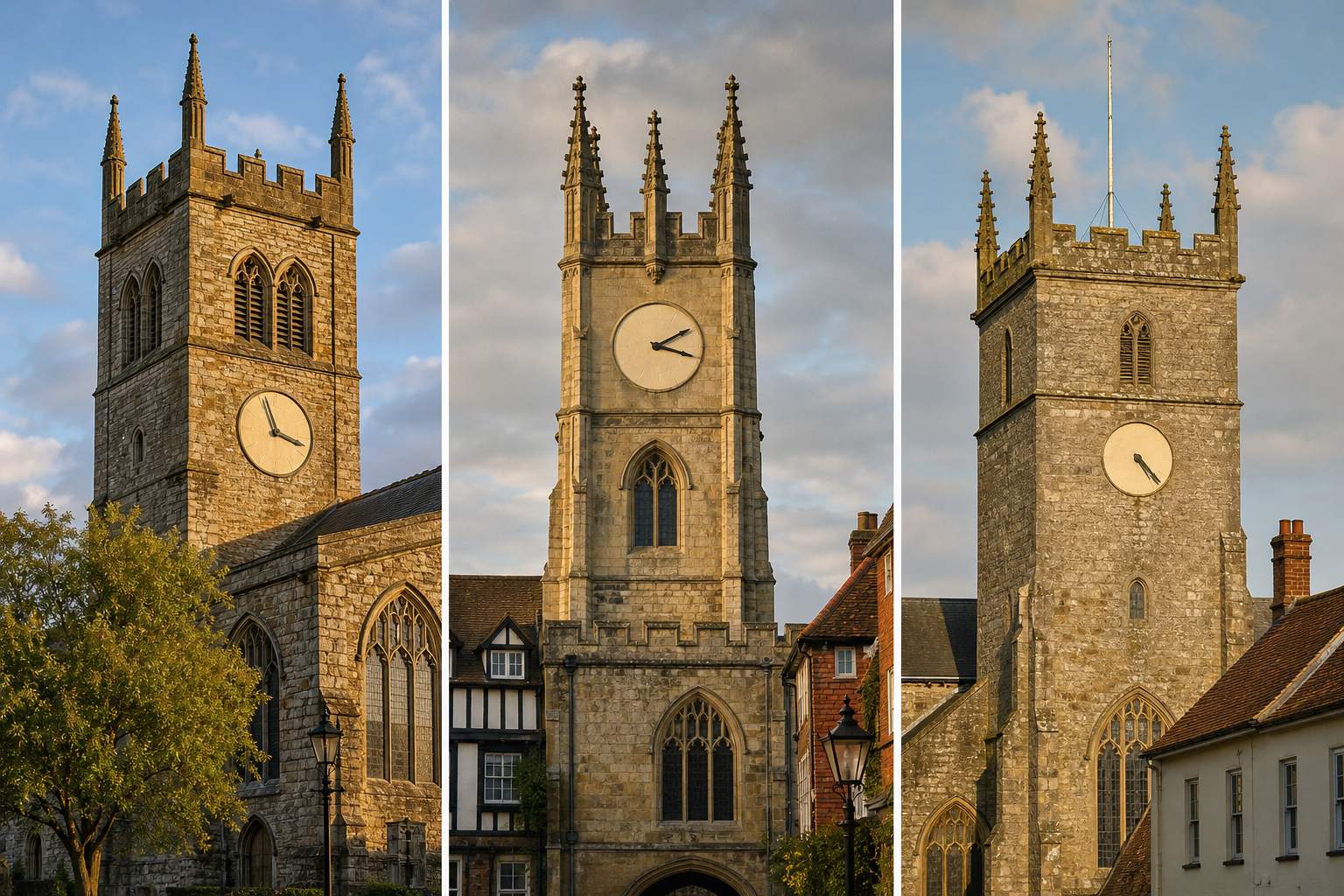
Three towns, three times Church clocks in three market towns, each set by its own Sun. AI-generated still.
London
0
Leeds
6
Bristol
10
Minutes behind London Further west means later: Bristol lies about 2.6° west of London.
+16 / −14 min
how far a sundial runs ahead of, or behind, a steady clock during the year
Why “mean” time
Chapter I · Noon moves
Mean time, town by town
Wikipedia, equation of time: the difference between sundial (apparent solar) time and clock (mean solar) time reaches about +16 min 33 s around 3 November and about −14 min 6 s around 11 February, because of the Earth’s elliptical orbit and its axial tilt. Mean solar time is the average that a steady clock keeps. Wikipedia, railway time: in Britain, local times differed by up to twenty minutes from London’s; Leeds was six minutes behind London and Bristol ten minutes behind.
On screen: the globe shows each town’s local mean time, worked out from its longitude at 4 minutes a degree.
The globe is a teaching model: the Earth’s tilt and the Sun’s position are real, but zone bands are drawn as plain 15° strips, while real zone borders follow countries.
Railways changed that. A timetable needs one clock, and in 1840 the Great Western Railway set all its stations to London time.
Soon the body that coordinated Britain's railways recommended Greenwich time, kept at the Royal Observatory in Greenwich, London, and sent along the railways' own telegraph wires.
Towns slowly followed the trains, and in 1880 a new law made Greenwich Mean Time the legal time across all of Great Britain.
1 time
for every Great Western station: London’s
up to 20 min
spread of local times across Britain
November 1840
A timetable gives one time per station
With local times, every connection is a sum
Why trains need one time
1840 Great Western Railway adopts London time
1847 Railway Clearing House: Greenwich time at all stations
1855 Greenwich signals sent by telegraph across Britain
1880 GMT becomes the legal time
Britain on one time
Royal Observatory
in Greenwich, London, where Greenwich time was kept
Greenwich
GMT
legal time across Great Britain
40 years
after the first railway adopted London time
By law, 2 August 1880
Chapter II · Railway time
London time on the rails
Wikipedia, railway time: the Great Western Railway was the first to standardise its timetable on Greenwich Mean Time, in November 1840. On 22 September 1847 the Railway Clearing House decreed that GMT be adopted at all stations as soon as the General Post Office permitted it. By 1852 a telegraph link ran from an electro-magnetic clock at Greenwich to London Bridge, and by 1855 Greenwich time signals could be sent along railway telegraph lines across Britain. The Statutes (Definition of Time) Act 1880, royal assent 2 August 1880, gave a single standard time for Great Britain legal force.
Try it: “local” shows each town’s own mean time; “railway” sets them all to Greenwich.
The globe is a teaching model: the Earth’s tilt and the Sun’s position are real, but zone bands are drawn as plain 15° strips, while real zone borders follow countries.
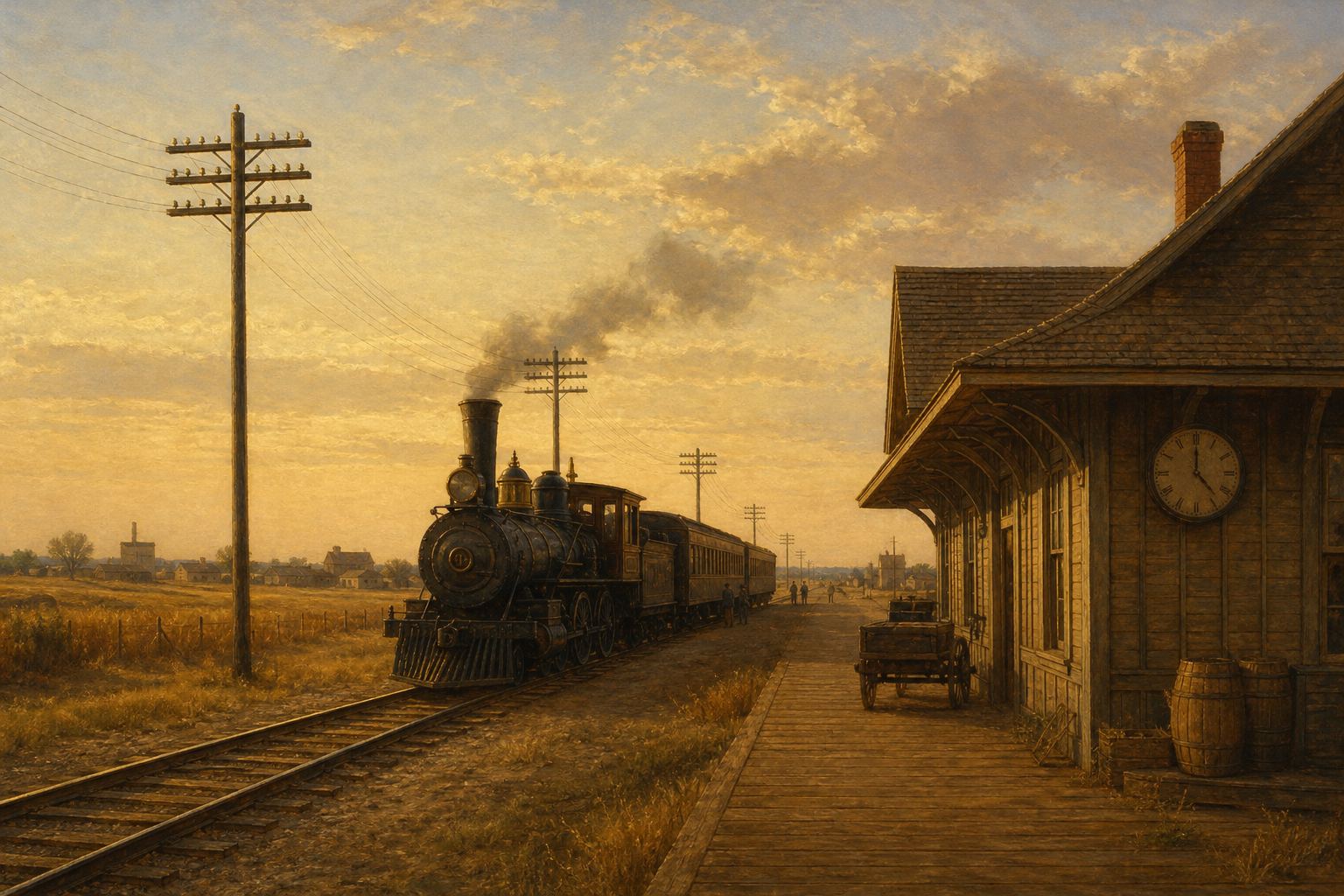
North America was far wider, and its railroads ran on around fifty different times. They adopted a plan drawn up by the railway manager William F. Allen.
At noon on 18 November 1883, the railroads of the United States switched to four zones, each one hour wide: Eastern, Central, Mountain and Pacific.
In some cities that day, people heard noon twice: once by the old Sun time, and again by the new standard time. The zones became US law only in 1918. Compare Sun time with zone time across the map.
A prairie depot, 1883 Telegraph wires carried the new time along the tracks. AI-generated still.
~50
railway times before 1883
4
US zones after 18 November 1883
Railroad times
18 Nov 1883 Railroads adopt standard time at noon
19 Mar 1918 Standard Time Act makes the zones US law
From railroads to law
2
noons in some cities: solar, then standard
~16 min
apart, in some places
18 November 1883
Chapter II · Railway time
The day of two noons
IEEE History (ETHW): North American railroads switched to “Standard Railway Time” at noon on 18 November 1883, with four zones one hour wide: Eastern, Central, Mountain and Pacific. Charles Dowd’s proposal, revised in 1872, was among the plans before it, and Congress made the standard law with the Standard Time Act of 19 March 1918. Wikipedia, railway time: William Frederick Allen devised the scheme adopted, replacing about 50 different railway times. History Is Now: in a few cities that afternoon held two noons, one solar and one standard.
Try it: “Sun time” colours every place by its own solar hour, a smooth blend; “zone time” gives each 15° strip one hour. Real zone borders follow states and provinces.
The globe is a teaching model: the Earth’s tilt and the Sun’s position are real, but zone bands are drawn as plain 15° strips, while real zone borders follow countries.
Zones need a starting line. In October 1884, forty-one delegates from twenty-five nations met in Washington, D.C., at the International Meridian Conference.
Greenwich was already the most used: in 1879 the railway engineer Sandford Fleming counted that ships carrying seventy-two percent of the world's tonnage used charts based on it.
The vote for Greenwich as the prime meridian, zero degrees longitude, was twenty-two in favour, San Domingo, now the Dominican Republic, against, and France and Brazil abstaining.
The conference did not create time zones. France kept the Paris meridian, and when it switched in 1911, it avoided the name Greenwich altogether.
25
nations (some accounts count 26)
41
delegates
Washington, October 1884Zero degrees A meridian line set into the ground at an observatory, as imagined. AI-generated still.
In favour
22
Against (San Domingo)
1
Abstained (France, Brazil)
2
The vote on Greenwich
9 min 21 s
“Paris mean time, retarded by” this much: Greenwich time, unnamed
1978
wording replaced by “UTC”
France, 1911
Greenwich as 0° longitude
A universal day, from midnight at Greenwich
No time zones: left to each country
What the conference adopted
Chapter III · Line zero
Choosing Greenwich
The Greenwich Meridian (thegreenwichmeridian.org): 41 delegates from 25 nations met in Washington in October 1884 (Wikipedia counts 26 countries). In a table of 1879, Sandford Fleming found Greenwich was used by 65% of ships and 72% of tonnage. Wikipedia, International Meridian Conference: the Greenwich resolution passed 22 to 1, San Domingo (now the Dominican Republic) against, France and Brazil abstaining; delegates held that standard time was outside the conference’s remit, so no time zones were adopted; it did adopt a universal day beginning at mean midnight at the prime meridian. France adopted Greenwich-based time in 1911 as “Paris mean time, retarded by 9 minutes and 21 seconds”, replaced by “Coordinated Universal Time” in 1978. Wikipedia, Sandford Fleming: a Scottish-born engineer who worked in Canada; he had proposed 24 time zones, each an hour or 15° wide, which the conference did not adopt.
On screen: the gold line is the Greenwich meridian; the zone strips are counted from it.
The globe is a teaching model: the Earth’s tilt and the Sun’s position are real, but zone bands are drawn as plain 15° strips, while real zone borders follow countries.
Countries adopted zones one by one, each an offset from Greenwich. Today the reference is Coordinated Universal Time, UTC, the world's common standard time.
UTC is kept by atomic clocks. Because Earth's spin is slightly irregular, an extra second, a leap second, has been added now and then; in 2022 countries voted to stop by 2035.
UTC itself is not a zone. Zones are offsets from it, from twelve hours behind to fourteen hours ahead.
1960 Three observatories coordinate their time signals
1963 UTC adopted as a standard
1967 “UTC” becomes the official abbreviation
30 Jun 1972 First leap second
From GMT to UTC
GMT → UTC
UTC is the effective successor of Greenwich Mean Time
The world’s reference
27
added since 1972, all of them extra seconds
2035
deadline to stop them (vote of 18 Nov 2022)
Leap seconds
Atomic clocks tick steadily
Earth’s spin is slightly irregular
A leap second keeps the two within a second
Why leap seconds
UTC−12
furthest behind
UTC+14
furthest ahead
26 h
between them
The span of the world’s clocks
Chapter III · Line zero
Coordinated Universal Time
Wikipedia, Coordinated Universal Time: coordinated time signals began on 1 January 1960; UTC was adopted as a standard in 1963 and its abbreviation became official in 1967; the first leap second was added on 30 June 1972. UTC is derived from International Atomic Time, an average of hundreds of atomic clocks, and is kept within about a second of mean solar time at 0° longitude; as of 2022, 27 leap seconds had been added, all positive. It is the effective successor of GMT, and is a time standard, not a time zone: zones are offsets from it, from UTC−12 to UTC+14. Scientific American: on 18 November 2022 the General Conference on Weights and Measures (CGPM) voted to stop adding leap seconds by 2035.
Try it: the buttons move UTC by an hour; the readout gives the clock time in several cities. How atomic clocks work is told in our film on atomic clocks.
The globe is a teaching model: the Earth’s tilt and the Sun’s position are real, but zone bands are drawn as plain 15° strips, while real zone borders follow countries.
Zone lines are drawn by governments, not by the Sun. China stretches across about five zones' worth of longitude, yet it keeps one official time, Beijing Time, eight hours ahead of UTC. Most regions switched to it around 1949 and 1950; the far west went back and forth until 1986.
In the far west, the Sun runs about three hours behind the clock. On the first of January, daylight in Akto, in Xinjiang, begins at about a quarter past ten, Beijing Time.
Many people there also use an unofficial local time, two hours behind Beijing. Switch between the official clock and the Sun to see the gap.
UTC+8
Beijing Time, the one official time
5
geographical zones the country spans
China
1914 Beijing mean time becomes official
1918 Five zones proposed, +5:30 to +8:30
c. 1949–50 Beijing Time for most regions
1969–86 Xinjiang alternates, then keeps Beijing Time
China’s clocks
10:16
Akto, Xinjiang, far west
06:54
Fuyuan, Heilongjiang, far east
Daylight begins, 1 January (Beijing Time)Morning in the far west A winter morning, well after the official start of the day. AI-generated still.
UTC+6
used side by side with Beijing Time
10:00–19:00
office hours, Beijing Time = 08:00–17:00 local
Xinjiang Time (unofficial)
Chapter IV · Clocks and countries
One time for China
Wikipedia, time in China: China spans five geographical time zones but officially uses one, UTC+8, Beijing Time. Most regions switched to Beijing Time around 1949–1950; Tibet used it by the mid-1950s and Xinjiang alternated between its own time and Beijing Time from 1969 to 1986. Xinjiang Time (Ürümqi Time), UTC+6, is unofficial; some local authorities use both, and offices often open 10:00–19:00 Beijing Time, 08:00–17:00 local. A 2010 table gives daylight on 1 January starting at 10:16 Beijing Time in Akto, Xinjiang, and 06:54 in Fuyuan, Heilongjiang.
Try it: “Beijing clock” shows the official time in Beijing and Kashgar; “the Sun” shows each city’s own solar time, on 1 January. The highlighted area is a rough box around China’s span of longitude, not its border.
The globe is a teaching model: the Earth’s tilt and the Sun’s position are real, but zone bands are drawn as plain 15° strips, while real zone borders follow countries.
Not every offset is a whole hour. India is five and a half hours ahead of UTC, and its neighbour Nepal five hours and forty-five minutes.
Thailand used Bangkok mean time, six hours, forty-two minutes and four seconds ahead of Greenwich, until 1920.
On 1 April 1920, then the Thai new year, a royal decree of King Rama the Sixth moved clocks forward by seventeen minutes and fifty-six seconds, to seven hours ahead of Greenwich.
That is the time of the meridian at 105 degrees east, which passes through Ubon Ratchathani province.
India
+5:30
Nepal
+5:45
Thailand
+7:00
Hours ahead of UTC India’s time follows the meridian at 82.5° E. Other 45-minute zones: the Chatham Islands (+12:45).
Bangkok’s own Sun Until 1920, Bangkok’s clocks followed its own sunrise and noon, at about 100.5° east. AI-generated still.
+6:42:04
Bangkok mean time, 1880–1920
+17 min 56 s
the clocks’ jump
1 April 1920
00:00 → 00:17:56
old time to new time, at the switch
Midnight, 1 April 1920
UTC+7
since 1920, with no summer time
105° E
its meridian, through Ubon Ratchathani
Thai standard time
Chapter IV · Clocks and countries
India, Nepal and Thailand
Wikipedia, UTC+05:30: India and Sri Lanka use UTC+5:30, with a central meridian of 82.5° E. Wikipedia, UTC+05:45: Nepal uses UTC+5:45, one of three 45-minute zones with the Chatham Islands (UTC+12:45) and unofficial Australian Central Western Time (UTC+8:45). Thailand.go.th: King Rama VI issued the standard-time decree, which took effect on 1 April 1920 (B.E. 2463), then New Year’s Day. Wikipedia, time in Thailand: Bangkok mean time, UTC+6:42:04, was used from 1880 to 31 March 1920; at the change clocks went from 00:00 to 00:17:56; standard time follows the 105th meridian east, which passes through Ubon Ratchathani province; Thailand has never observed daylight saving time.
Try it: the buttons set Bangkok’s clock before and after 1 April 1920, at the moment it is midnight UTC.
The globe is a teaching model: the Earth’s tilt and the Sun’s position are real, but zone bands are drawn as plain 15° strips, while real zone borders follow countries.
Sail west all the way round the world and you see one sunrise fewer than the people you left behind, so your count of days falls one behind theirs.
Magellan's expedition sailed west. When the survivors reached the Cape Verde islands in July 1522, their careful log said Wednesday; the people on shore said it was Thursday.
Today the International Date Line, roughly along the 180th meridian in the Pacific, sets this right. Cross it heading west and the date jumps forward a day; heading east, you live the same date twice.
Each zone: set your watch back an hour
24 zones: a whole day
Your calendar ends one day behind
Going round the world westward
…they were answered that to the Portuguese it was Thursday, at which they were much amazed.Antonio Pigafetta, Cape Verde, 9 July 1522 (by the crew’s count)
+1 day
heading west: Sunday becomes Monday
same date twice
heading east: Monday becomes Sunday again
Crossing the line
Mostly along 180°, through open ocean
Bends so each country keeps one date
Drawn simplified on the globe
The line on the map
Chapter V · Where the day begins
A day lost at sea
R. H. van Gent (Utrecht University): on Wednesday 9 July 1522 by their own count, the surviving crew of Magellan’s expedition reached Santiago in the Cape Verde Islands; Antonio Pigafetta wrote that “to the Portuguese it was Thursday, at which they were much amazed”, though his log had been kept without a break. Sailing west around the globe had shifted their count by a day. timeanddate.com: the International Date Line is an imaginary line defining the boundary between one day and the next; it roughly follows 180° longitude but bends around national borders. Travelling west across it adds a day; travelling east subtracts one.
Try it: a ship crosses the line; the readout gives the date on board. The line on the globe is simplified.
The globe is a teaching model: the Earth’s tilt and the Sun’s position are real, but zone bands are drawn as plain 15° strips, while real zone borders follow countries.
No international law fixes the line, so it bends as countries choose. Kiribati once straddled it: its two halves were a day apart, with four shared working days a week.
In 1995 Kiribati moved the line to its eastern edge. Its Line Islands are now fourteen hours ahead of UTC, among the first places to start each new day.
In 2011 Samoa crossed too, to align its working week with Australia and New Zealand: Thursday the 29th of December was followed directly by Saturday the 31st. Move the line through the years and watch it bend.
1 day
between its west and east
4
shared working days a week
Kiribati before 1995Islands on the edge of the day A South Pacific island village near the date line. AI-generated still.
1995 Kiribati moves the line to its eastern edge
2011 Samoa and Tokelau move to the Asian side
The line moves
Thu 29
the last day east of the line
Sat 31
the next day; Friday 30 never happened
Samoa, December 2011
UTC−11 → UTC+13
the same hour of the day, a date later
Samoa’s clocks
Chapter V · Where the day begins
Kiribati and Samoa
timeanddate.com: the International Date Line is not set by international law; each country chooses its own date and time zone. Samoa moved from UTC−11 to UTC+13 and skipped 30 December 2011, followed by Tokelau, mainly to simplify trade with Australia and New Zealand; Kiritimati, in Kiribati’s Line Islands, is on UTC+14. R. H. van Gent (Utrecht University): the line once split Kiribati, so its western part was always 24 hours ahead and official business between the halves was possible on only four days a week; in 1995 President Teburoro Tito moved the line to the republic’s eastern boundary. In Samoa and Tokelau, Thursday 29 December 2011 was followed by Saturday 31 December. US Department of State: in 1995 Kiribati announced that its entire territory would fall west of the line; Samoa’s stated reason was closer business hours with trading partners in Asia and Oceania.
Try it: the three buttons draw the line before 1995, after 1995 and after 2011. Its path is simplified.
The globe is a teaching model: the Earth’s tilt and the Sun’s position are real, but zone bands are drawn as plain 15° strips, while real zone borders follow countries.
Our last change is the one that happened this weekend. In 1907 a London builder, William Willett, published a pamphlet called The Waste of Daylight.
His idea: move clocks forward in spring, so that summer daylight that came while people slept would fall in the evening instead. Eighty minutes, in four steps of twenty, and back in September.
Willett died in 1915. A year later, in wartime, Germany and Austria-Hungary became the first countries to move their clocks, on 30 April 1916, to save coal, and Britain followed on 21 May.
1907
printed at Willett’s own expense
The Waste of Daylight, 1907
80 min
forward in April
4 × 20 min
in four stages, then back in September
Willett’s plan
1907 The Waste of Daylight
1915 Willett dies
30 Apr 1916 Germany and Austria-Hungary, to save coal
21 May 1916 Britain moves its clocks forward
From pamphlet to law
≈ 20:21
sunset on Greenwich Mean Time
≈ 21:21
sunset on summer time
London, 21 June (computed)
Chapter VI · Summer time
The Waste of Daylight
Western Front Association: in 1907 the builder William Willett published “The Waste of Daylight” at his own expense, proposing that clocks be advanced 80 minutes in April, in four steps of 20 minutes, and set back in September. He died in 1915, before the idea was adopted. Germany and Austria-Hungary were the first to introduce daylight saving time, on 30 April 1916, as a way to conserve coal; in Britain, Parliament passed the bill on 17 May 1916 and the clocks went forward an hour on Sunday 21 May.
Try it: sunrise and sunset for London on 21 June are computed from the Sun’s position (a standard approximation, to within a few minutes), with and without summer time.
The globe is a teaching model: the Earth’s tilt and the Sun’s position are real, but zone bands are drawn as plain 15° strips, while real zone borders follow countries.
Today about seventy countries and territories change their clocks. In the European Union, a directive sets the dates: the last Sunday of March and the last Sunday of October.
In 2018 about four point six million people answered an EU consultation, and eighty-four percent wanted the changes to end. Parliament agreed in 2019, but the member states have not, partly over which time to keep.
Supporters of permanent summer time value lighter evenings. The American Academy of Sleep Medicine favours permanent standard time, which it says suits the body clock better. Compare the two in Paris: in winter, permanent summer time would put sunrise after half past nine.
~70
countries and territories (Time Out)
Mar · Oct
last Sundays, EU Directive 2000/84/EC
Changing clocks todayThe case for summer time A long summer evening by a river. AI-generated still.
End the changes
84%
Keep them
16%
EU consultation, 2018 (≈4.6 million replies) Parliament’s vote, 26 March 2019: 410 for, 192 against (Sortir à Paris).
The case for standard time A winter morning on the way to school, still dark. AI-generated still.
Permanent summer time: lighter evenings, dark winter mornings
Permanent standard time: lighter mornings, earlier sunsets
The choice, in winter and summer
Chapter VI · Summer time
Should Europe stop changing its clocks?
European Commission: since 2001, Directive 2000/84/EC makes member states switch to summer time on the last Sunday of March and back on the last Sunday of October. In 2018 a public consultation drew around 4.6 million replies, 84% in favour of ending the changes; on 12 September 2018 the Commission proposed ending them; on 26 March 2019 the European Parliament backed ending them by 2021; the Council has not finalised its position. Sortir à Paris: Parliament’s vote was 410 to 192; member states disagree over summer or standard time and fear a patchwork of times; on 20 October 2025 Spain’s prime minister Pedro Sánchez proposed ending the changes from 2026, but there is no majority in the Council and the directive remains in force. American Academy of Sleep Medicine (2024): the US should eliminate seasonal changes in favour of permanent standard time, which it says aligns best with human circadian biology. Time Out: about 70 territories use daylight saving time. In France, a 2019 National Assembly consultation found about 84% for ending the change and about 59% for permanent summer time (Sortir à Paris).
Try it: sunrise and sunset in Paris on 21 December and 21 June are computed from the Sun’s position, a standard approximation, under each choice.
The globe is a teaching model: the Earth’s tilt and the Sun’s position are real, but zone bands are drawn as plain 15° strips, while real zone borders follow countries.
A time zone, then, is an agreement. The Sun still sets noon in each place, but railways, treaties, governments and trade decide what our clocks say.
That is why the same moment can be a Sunday morning in Paris, a Sunday afternoon in Bangkok, and still Saturday night in Los Angeles.
Will Europe stop changing its clocks, and which time will each country keep? What will replace the leap second after 2035? Those questions are still open.
1522 Magellan’s crew finds its log a day behind
1840–1880 Britain moves to railway time, then GMT by law
1883 Four railroad zones in the United States
1884 Greenwich chosen as the prime meridian
1916 First summer time
1920 Thailand adopts UTC+7
1995 · 2011 Kiribati and Samoa move the date line
2026 Europe still changes its clocks
How the world got its time zones
Sun 07:00
Paris (UTC+1)
Sun 13:00
Bangkok (UTC+7)
Sat 23:00
Los Angeles (UTC−7, still on summer time)
One moment, three clocks (Sunday 25 Oct 2026, 06:00 UTC)
Will the EU stop changing its clocks?
Permanent summer or standard time, country by country?
What replaces the leap second after 2035?
Still open
Stills are AI-generated
The globe and its zone strips are simplified
Sunrise times are computed approximations
About this film
Epilogue · Sources
Sources
Every fact in this film comes from the sources below. The chapter stills and pictures are AI-generated illustrations. The globe uses NASA Blue Marble imagery; the Sun’s position, the Earth’s tilt and the sunrise and sunset times in the interactive moments are computed with standard approximations, and the zone strips and the date line are simplified. Clock times in other cities are worked out from their UTC offsets.