On 3 November 2026 Americans vote for all 435 seats in the House of Representatives, 35 of the 100 Senate seats and 39 governors, with both chambers narrowly held by Republicans. This film explains the system behind the vote: the compromise of 1787 that gave the House seats by population and every state two senators; why two chambers make laws hard to pass; how House seats are shared out after each census and how district lines are drawn, and the 1812 map that gave gerrymandering its name; why only a third of the Senate is elected at a time, and how senators came to be chosen by voters in 1913; the filibuster and the 60-vote rule; how a bill becomes a law or meets a veto; and why the president's party usually loses seats in a midterm.
Interactive 3D film9 min1787 to 2027Published 29 October 2026
How the US Congress works, and what a midterm decides.
On 3 November 2026, Americans vote in the midterm elections, held halfway through a president's four-year term. Every seat in the House of Representatives is on the ballot, and about a third of the Senate. Early voting has already been under way for weeks, and more than a hundred million people are expected to vote.
Congress is both chambers together, and Republicans hold each by a narrow margin, so the result will decide who controls it. To see how it works, we start with how Congress was built, in the summer of 1787.
435
House seats: all of them
35
of 100 Senate seats
39
state governors, also on the ballot (not part of Congress)
On the ballot, 3 November
100 million+
voters expected, according to Reuters
Turnout, if like 2022
The compromise of 1787
How House seats and districts are drawn
The Senate, its classes and the filibuster
How a bill becomes a law, and the midterm pattern
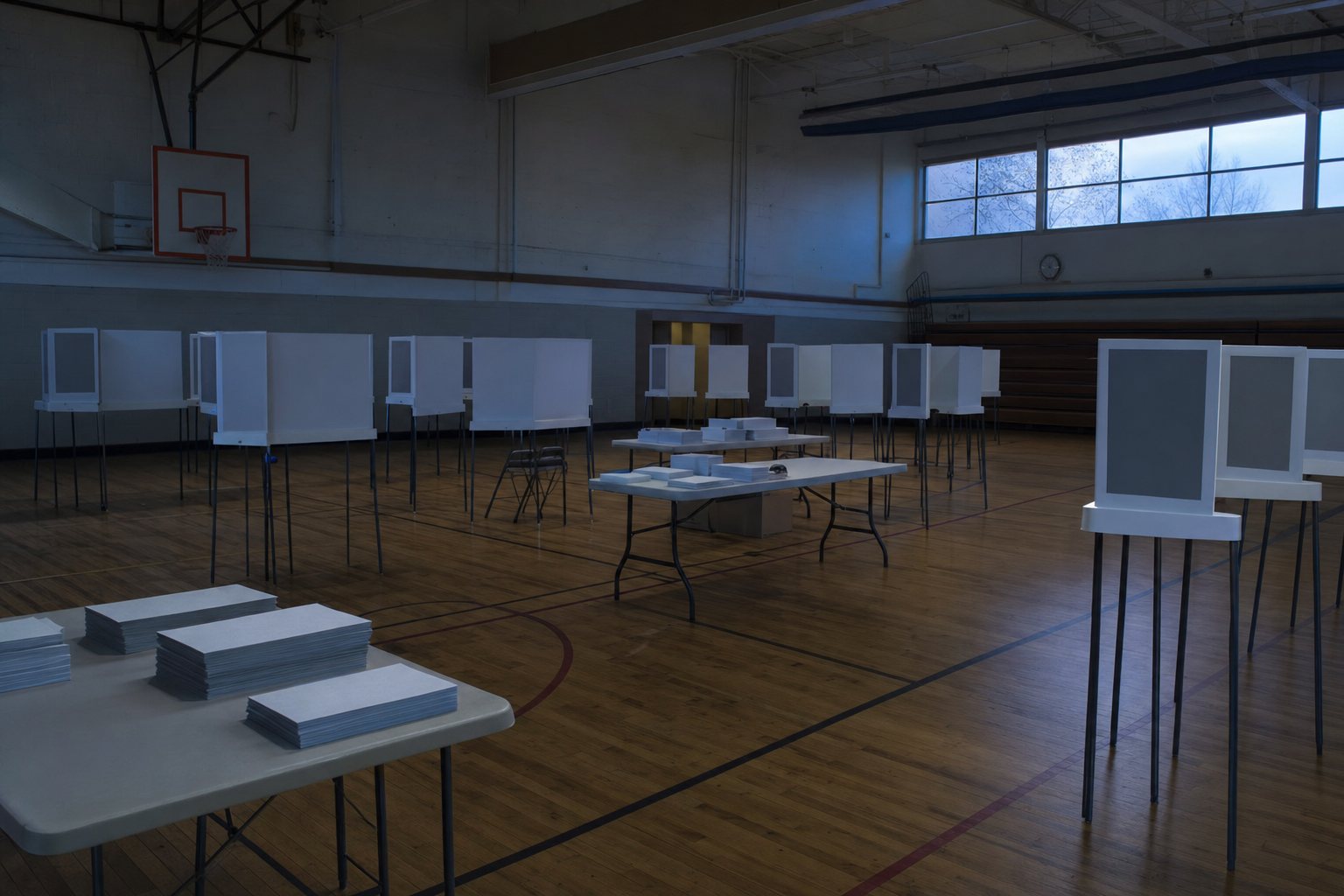
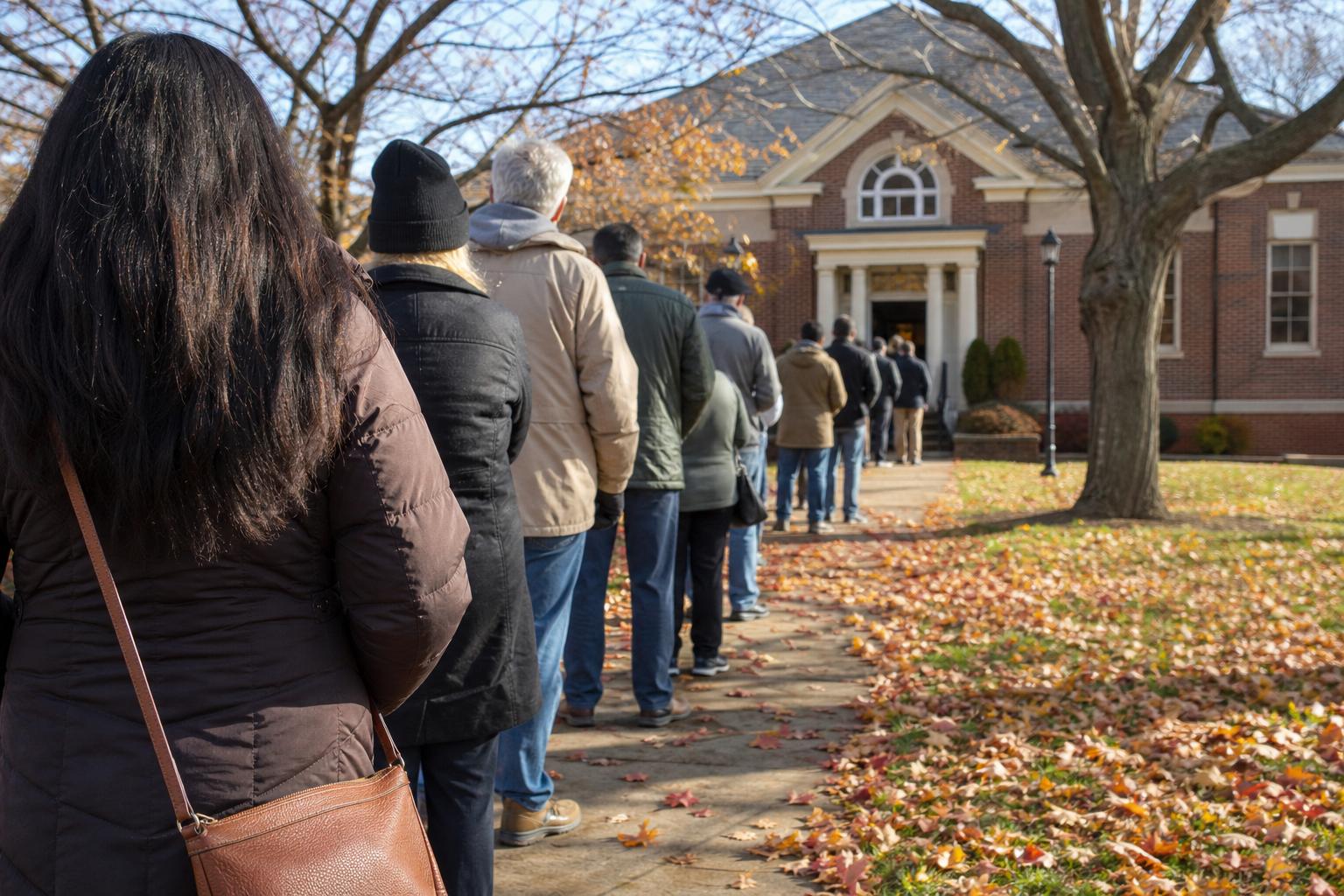
In this filmA polling place before dawn Elections are run by counties and towns, not by the federal government, so the rules differ from state to state. AI-generated still.
Prologue
The 2026 midterms
Khaleej Times, from Reuters, 19 October 2026: the election is on 3 November 2026, with early voting already under way; on the ballot are the House, the Senate and governors in 39 of 50 states. More than 100 million people are likely to vote if turnout resembles 2022. Ballotpedia: all 435 House districts and 35 Senate seats (33 regularly scheduled and 2 special elections, in Florida and Ohio) are up; winners take office on 3 January 2027. Wikipedia, midterm election: a midterm is held near the midpoint of a president’s four-year term, on the Tuesday after the first Monday in November.
This film describes how the institutions work; it takes no side in the election.
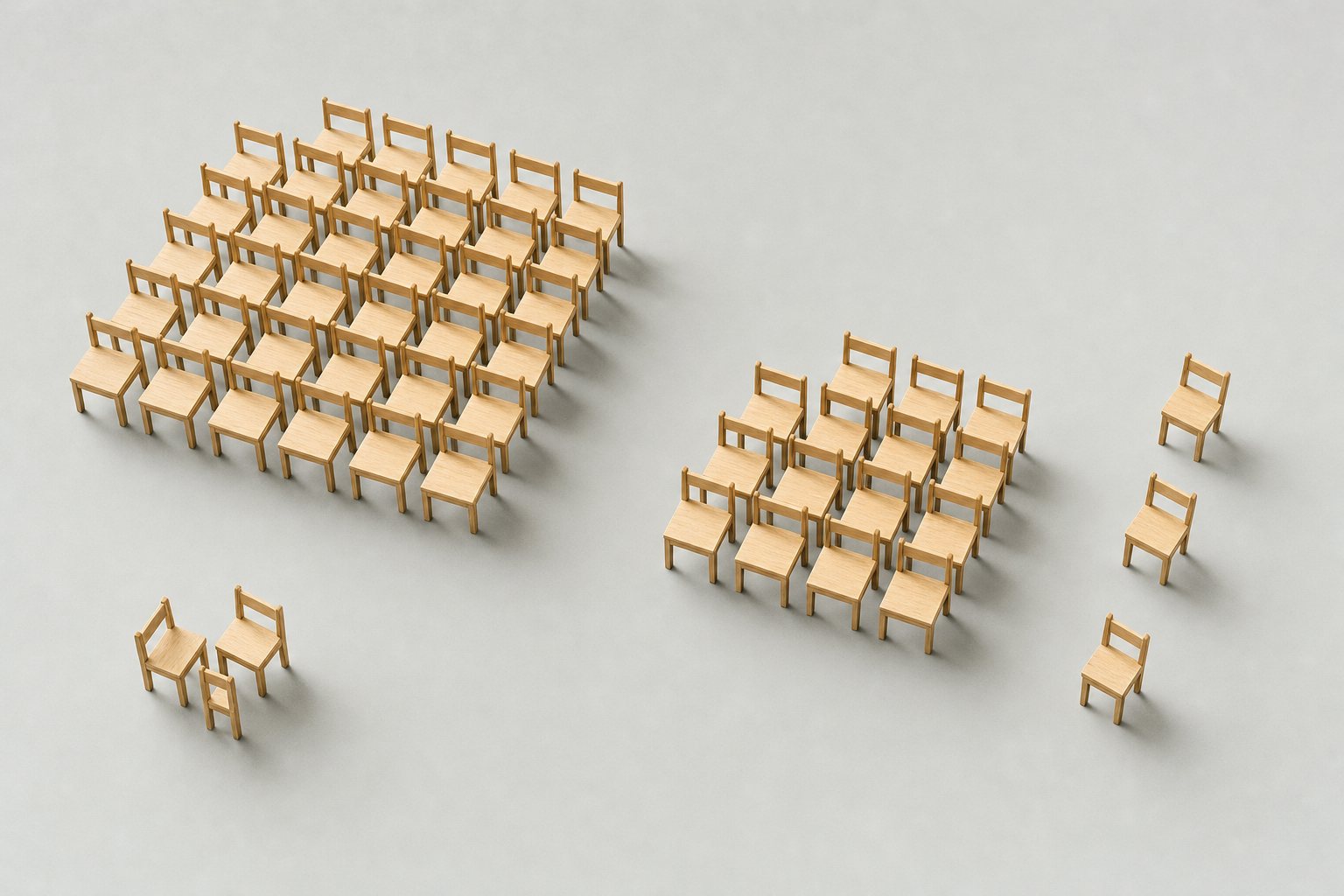
The 3D chambers are diagrams: each dot is one seat, and colours show only what the narration describes, not real members.
In 1787, delegates met in Philadelphia to write a constitution, and nearly split over one question. Should a big state have more votes in Congress than a small one?
Large states wanted seats by population. Small states wanted every state to count the same. On 16 July, by a single vote, the convention adopted a plan from two Connecticut delegates, Roger Sherman and Oliver Ellsworth.
It did both. In the House of Representatives, seats follow population. In the Senate, every state has two. Delegates had already agreed that House members would serve two years and senators six, with senators picked by each state's own legislature. Compare the three ways of counting.
Writing a constitution Quills and parchment, as in the summer of 1787. AI-generated still.
Virginia Plan: seats by population
New Jersey Plan: equal seats per state
Two plans
1 vote
the margin that adopted the compromise
16 July 1787
California
52
Texas
38
Florida
28
Wyoming
1
House seats after the 2020 census In the Senate, each of them has exactly two.
House: two-year terms, aged 25+
Senate: six-year terms, aged 30+
Senators chosen by state legislatures
Settled before 16 July
Chapter I · The great compromise
The Connecticut Compromise
US Senate Historical Office: on 16 July 1787, at Independence Hall in Philadelphia, the convention adopted by one vote the “Great Compromise” devised by Connecticut delegates Roger Sherman and Oliver Ellsworth: in the House each state gets seats in proportion to its population, and in the Senate all states have the same number. OpenStax: large states had backed representation by population (the Virginia Plan) and small states equal representation (the New Jersey Plan). Geography Realm: after the 2020 apportionment California has 52 seats, Texas 38, Florida 28 and Wyoming one.
Try it: the columns show each state’s seats by population, by equal shares, and in the compromise. Only four states are drawn.
The 3D chambers are diagrams: each dot is one seat, and colours show only what the narration describes, not real members.
Two chambers also mean two locks on every law. A bill must pass the House and the Senate in exactly the same words before it can go to the president.
That was deliberate. It makes laws hard to pass, slows hasty action, and favours leaving things as they are. A House elected every two years answers quickly to voters; a Senate on six-year terms changes slowly. The same law has to satisfy both.
435
House: two-year terms, aged 25+
100
Senate: six-year terms, aged 30+
Two chambersTwo locks, two keys The two chambers are not equal in everything: only the Senate confirms judges and ratifies treaties. AI-generated still.
Make lawmaking deliberately difficult
Discourage hasty action
Favour the status quo
What two locks do
every 2 years
the whole House faces voters
every 6 years
each senator does
Two clocks
Chapter I · The great compromise
Two locks on every law
OpenStax: both chambers must pass identical bills, which makes lawmaking deliberately difficult, discourages hasty action and favours the status quo. House members serve two-year terms and must be at least 25; senators serve six-year terms and must be at least 30 (US Senate Historical Office).
The 3D chambers are diagrams: each dot is one seat, and colours show only what the narration describes, not real members.
The House has had 435 seats since 1913, and a law of 1929 fixed that number. Every ten years, after the census counts the population, those seats are shared out again among the fifty states.
Every state gets at least one, and a formula, used since 1941, divides the rest by population. After the 2020 census, Texas gained two seats, five states gained one, and seven states lost one.
So each member now speaks for about seven hundred and sixty thousand people, compared with about thirty-four thousand in 1790. Watch the seats move after the 2020 count.
1929 Reapportionment Act caps the House at 435
1941 Huntington–Hill formula adopted
1959–62 437 for a while, for Alaska and Hawaii
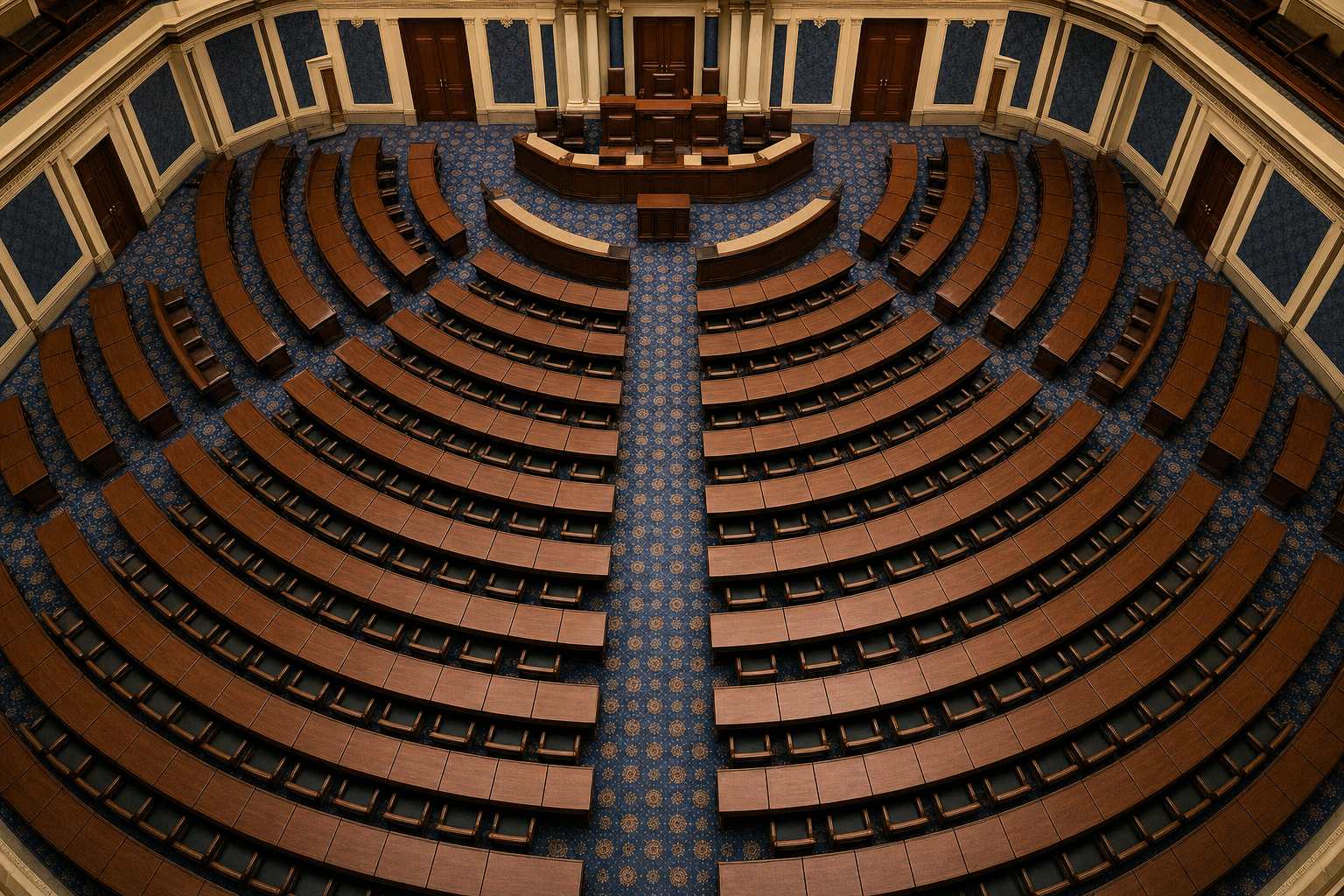
Fixing the HouseFour hundred and thirty-five desks Six states have only one representative each, so their single district is the whole state. AI-generated still.
Texas: +2
+1: Colorado, Florida, Montana, North Carolina, Oregon
−1: California, Illinois, Michigan, New York, Ohio, Pennsylvania, West Virginia
After the 2020 censusThe count comes first The census counts everyone living in the country, citizen or not; that count, not the voter rolls, decides the seats. AI-generated still.
After the 1790 census
34,436
After the 2020 census
761,169
People per House member
Chapter II · The House
Sharing out 435 seats
Wikipedia, congressional apportionment: after every census the 435 House seats are redistributed among the 50 states; each state gets at least one. The Huntington–Hill method has been used since the 1940 census reapportionment, adopted in 1941. The House has had 435 seats since 1913 (after the 1910 census); the Reapportionment Act of 1929 capped it there, apart from a temporary 437 for Alaska and Hawaii from 1959 to 1962. After the 2020 census the average district had about 761,169 people, against about 34,436 after the 1790 census. In the 2020 cycle Texas gained two seats; Colorado, Florida, Montana, North Carolina and Oregon one each; California, Illinois, Michigan, New York, Ohio, Pennsylvania and West Virginia lost one each.
Try it: “after 2020” lights the 7 seats that moved between states; the rest stay where they were.
The 3D chambers are diagrams: each dot is one seat, and colours show only what the narration describes, not real members.
How do you share 435 seats fairly? The formula used since 1941 first gives every state one seat. That leaves 385 to hand out, one at a time.
Each seat goes to the state with the highest priority value. Take the seats it already has, multiply by one more than that, and take the square root. Divide the population by that number.
Every time a state wins a seat, its value falls, so a state with many seats finds the next one harder to win. Hand out the seats yourself, for three imaginary states.
50
seats, one per state
385
left to assign one by one
Before the formula startsA=n(n+1)P
P
the state’s population
n
seats it already holds
Priority valueHanding the seats out Each seat a state wins makes the next one harder to win, so the biggest states stop gaining first. AI-generated still.
≈ 28.0 million
priority for its 2nd seat
≈ 16.2 million
for its 3rd
California, worked example
Chapter II · The House
Huntington–Hill
Wikipedia, Huntington–Hill method: each of the 50 states first receives one seat, leaving 385; the rest are assigned one at a time to the state with the highest priority value, its population divided by √(n(n+1)), where n is the number of seats it already holds. Each seat won lowers that state’s next priority. The divisor is the geometric mean of n and n+1. With California’s 2020 population of 39,576,757, its first priority is about 28.0 million and its second about 16.2 million. The method has been used since 1941.
Try it: three invented states of 6, 3 and 1 million people share 10 seats; press “next seat” to award them one by one.
The 3D chambers are diagrams: each dot is one seat, and colours show only what the narration describes, not real members.
Once a state knows how many seats it has, it draws the district lines, each holding roughly the same number of people. Who draws them, and how, can change the result.
In 1812, Massachusetts governor Elbridge Gerry signed a law redrawing the districts to favour his party. One district was so twisted that an artist added a head, wings and claws to its map and called it a salamander. A newspaper editor replied: a Gerry-mander. The word stuck.
The same voters can elect very different delegations. Here, fifteen voters prefer gold and ten prefer teal. Draw five districts one way, then the other, and count the winners.
After each census, every state redraws its lines
Districts hold roughly equal populations
RedistrictingThe “Gerry-mander” A district map given head, wings and claws: the 1812 cartoon in spirit, not a copy. AI-generated still.
Boston Gazette
printed the cartoon of the new district
Within a month
3 – 2
districts drawn as rows
5 – 0
districts drawn as columns
Same 25 votersWhere the line falls The lines are redrawn after every census, and in most states it is the state legislature that draws them. AI-generated still.
Chapter II · The House
Where a gerrymander comes from
Wikipedia, congressional apportionment: after apportionment each state draws its own district boundaries, aiming for roughly equal populations. Mass Moments: in February 1812 Governor Elbridge Gerry of Massachusetts signed a bill that let the legislature redraw districts to favour his party; opponents likened one district in Essex County to a monster, the artist Gilbert Stuart reportedly gave a map of it a head, wings and claws, and newspaper editor Benjamin Russell suggested “Gerry-mander”, a cartoon of which ran in the Boston Gazette. The word now means any deliberate redrawing of lines to sway an election.
Try it: the 25 voters never move; only the district lines change. The example is invented to show the arithmetic.
This film describes how the institutions work; it takes no side in the election.
Senators serve six years, but they are not elected all at once. In 1789 the first senators were divided by lot into three classes, so that about a third of the Senate comes up every two years.
Two thirds always carry over, which gives the Senate continuity: it is called a continuing body, one that never starts over from scratch. The framers wanted stability, and change that comes gradually.
At first, state legislatures chose the senators. Deadlocks left seats empty for long periods: Delaware went two years without a senator after one stalemate. Reformers pushed for change, and in 1913 the Seventeenth Amendment, a change to the Constitution, gave the choice to voters. Pick a class to see which third is up.
2
senators per state
6 years
a term
~1/3
elected every two years
The Senate
A continuing bodyHow the Senate describes itself: its rules carry over from one two-year Congress to the next
~2/3
of senators stay on after each election
Carrying over
1789 Classes drawn by lot
1895 A stalemate leaves Delaware unrepresented for two years
8 Apr 1913 Seventeenth Amendment ratified
Choosing senators
33 + 2
a regular class of 33, plus two special elections
Up in 2026
Chapter III · The Senate
A third at a time
US Senate, Senate classes: the Constitution divides senators into three classes; at the first session in 1789 senators were assigned to classes by lot, with the first class serving two years, the second four and the third six. About a third face election every two years and about two thirds carry over, so the Senate is a “continuing body” that does not adopt new rules at the start of each Congress; the framers wanted stability and gradual change. US Senate, Seventeenth Amendment: state legislatures chose senators until 1913; deadlocks left seats vacant, and Delaware went two years without representation after an 1895 stalemate. Connecticut’s ratification on 8 April 1913 completed the amendment. Ballotpedia: 35 seats are up in 2026, 33 regular and 2 special.
Try it: each class lights about a third of the 100 seats. Which real senators sit in which class is not shown.
The 3D chambers are diagrams: each dot is one seat, and colours show only what the narration describes, not real members.
The Senate has jobs of its own. It approves many of the president's nominees and treaties, and when the House impeaches an official, formally charging them, the Senate holds the trial and decides on removal.
It also has a famous rule. A senator can try to block a vote by keeping the debate going: a filibuster. Until 1917 there was no way to stop one.
That year the Senate let two thirds of the senators voting end debate, a step called cloture. In 1975 it set the bar at three fifths of all senators: sixty of the hundred. So ending a filibuster takes sixty votes, not the fifty-one that make a simple majority. Count the votes both ways.
Final approval of many nominees
Approval of treaties
Impeachment trials (the House impeaches)
The Senate’s own powersCounting the votes A vote board in a dim chamber. AI-generated still.
talk
prolonging debate to delay or prevent a vote
A filibuster
before 1917 No way to force a vote
1917 Cloture: two thirds of those voting
1975 Three fifths: 60 of 100
Ending a filibuster
Simple majority
51
Cloture since 1975
60
Cloture 1917–1975, if all 100 vote
67
Votes needed
Chapter III · The Senate
Sixty, not fifty-one
OpenStax: the Senate gives final approval to many presidential nominees and treaties; the House can impeach federal officials, and the Senate conducts the trial and decides on removal. US Senate, filibusters and cloture: a filibuster is a loosely defined term for action designed to prolong debate and delay or prevent a vote. Before 1917 Senate rules had no way to end debate; that year the Senate adopted a cloture rule letting two thirds of those voting end a filibuster, and in 1975 the threshold was changed to three fifths of senators duly chosen and sworn, 60 of 100. Some kinds of business now need only a simple majority; this film does not cover those exceptions.
Try it: the same 100 seats, with the bar set at 51 or at 60.
The 3D chambers are diagrams: each dot is one seat, and colours show only what the narration describes, not real members.
Most bills can start in either chamber, but the Constitution says bills for raising revenue, taxes, must start in the House. The Senate may amend them. Once both chambers have passed the same text, it goes to the president.
The president can sign it into law, or veto it and send it back with objections. If the president does neither within ten days, Sundays excepted, it becomes law anyway, unless Congress has adjourned, in which case it does not.
Congress can still win: two thirds of each chamber can pass the bill over the veto. Follow a bill down each path.
All Bills for raising Revenue shall originate in the House of Representatives.US Constitution, Article I, Section 7
House
first; the Senate may amend it
Where a tax bill starts
Sign: it becomes law
Veto: back with objections
No action for 10 days (Sundays excepted): law, unless Congress has adjourned
On the president’s desk
10
days, Sundays excepted, for the president to act
Ten days
2/3
of the House
2/3
of the Senate
Overriding a veto
Chapter IV · Making a law
Article I, Section 7
National Constitution Center, Article I, Section 7: “All Bills for raising Revenue shall originate in the House of Representatives”, though the Senate may amend them. A bill that has passed both chambers is presented to the president; if the president disapproves, it is returned with objections to the chamber where it began, and two thirds of each chamber can pass it over the veto. If the president neither signs nor returns it within ten days, Sundays excepted, it becomes law unless Congress’s adjournment prevents its return. OpenStax: both chambers must pass identical bills.
Try it: the token runs House → Senate → president, then down the path you choose.
The 3D chambers are diagrams: each dot is one seat, and colours show only what the narration describes, not real members.
The president is not on the ballot, but the party is.
The midterms have a strong historical pattern. Since the Second World War, the president's party has lost on average twenty-six House seats and four Senate seats.
There are exceptions. The president's party gained House seats in 1934, 1998 and 2002. But losses are the rule: sixty-three House seats in 2010, forty-one in 2018, nine in 2022.
Fewer people vote, too: about forty per cent of those eligible in a midterm, against fifty to sixty in a presidential year. But a pattern is not a forecast; every election is decided by its own voters. Play back three recent midterms.
−26
average House seats lost by the president’s party
−4
average Senate seats lost
Since the Second World War
1934: gained
+9
1998: gained
+4
2002: gained
+8
2010: lost
−63
2018: lost
−41
2022: lost
−9
House seats won or lost by the president’s party
8
midterms in which the president’s party gained seats, since senators were directly elected
The exceptionsA November morning Voters queue outside a polling place. AI-generated still.
~40%
of eligible voters in a midterm
50–60%
in a presidential year
Fewer voters, too
Chapter V · The midterms
The midterm pattern
Wikipedia, United States midterm election: since the Second World War the president’s party has lost an average of 26 House seats and 4 Senate seats in midterms. The party gained House seats in only a few midterms, including 1934 (+9), 1998 (+4) and 2002 (+8). Recent losses: 2010, −63 House seats; 2018, −41; 2022, −9. Midterm turnout is lower: about 40% of eligible voters, against about 50–60% in presidential elections.
Try it: the 435 dots show the president’s party’s House seats before and after each midterm (2010: 256 → 193; 2018: 241 → 200; 2022: 222 → 213).
This film describes how the institutions work; it takes no side in the election.
The 3D chambers are diagrams: each dot is one seat, and colours show only what the narration describes, not real members.
Going into this election, Republicans hold the House by two hundred and eighteen to two hundred and fourteen, plus one independent who sides with them and two vacant seats. In the Senate it is fifty-three to forty-seven, counting two independents who side with the Democrats.
According to Reuters, Democrats need a net gain of four seats in each chamber to take control; Republicans keep control if they hold their net losses below that. About ten Senate races could decide it.
Whoever wins, the new Congress is sworn in on 3 January 2027.
218–214
House: plus 1 independent with the Republicans, 2 vacant
53–47
Senate: the 47 include 2 independents
Before the vote
+4
net Democratic gain needed in the House
+4
in the Senate
To change control
About ten races could decide control
Among them: Maine, Ohio, North Carolina, Iowa, Georgia
Senate races to watch, per Reuters
218
of 435 House seats
51, or 50 + VP
in the 100-seat Senate
A majority
3 Jan 2027
sworn in
The new Congress
Chapter V · The midterms
The numbers going in
Khaleej Times, from Reuters, 19 October 2026: Republicans hold the House 218–214, with two vacancies and one independent who caucuses with Republicans, and the Senate 53–47; Democrats need a net gain of four seats in each chamber for control. Ballotpedia: the Senate has 53 Republicans, 45 Democrats and 2 independents who caucus with the Democrats; winners begin their terms on 3 January 2027. Reuters lists ten Senate races, including Maine, Ohio, North Carolina, Iowa and Georgia, that could decide control.
Figures as reported before the vote; sources differ slightly on House vacancies.
This film describes how the institutions work; it takes no side in the election.
The 3D chambers are diagrams: each dot is one seat, and colours show only what the narration describes, not real members.
Two chambers chosen in different ways, on different clocks: a House that answers to voters every two years, and a Senate that changes only a third at a time.
The framers built it to be slow and hard to capture all at once. So on the night of 3 November, watch two numbers: 218 in the House, and in the Senate 51, or 50 plus the vice-president's tie-breaking vote. Whoever reaches them will hold Congress from January.
1787 The Great Compromise
1789 Senate classes drawn by lot
1812 The “Gerry-mander”
1913 Senators elected by voters
1917 First cloture rule
1929 House fixed at 435
1975 Cloture at 60 votes
3 Jan 2027 The next Congress begins
How Congress took shapeSworn in on 3 January The Twentieth Amendment moved that date from March to January in 1933, to shorten the wait after an election. AI-generated still.
3 Nov 2026
the Tuesday after the first Monday in November
Election day
3 Jan 2027
the next Congress
Sworn in
Epilogue
Sources and notes
Every figure in this film comes from the sources below, which were read for it. Seat counts are those reported before the vote and may differ slightly between sources. The film describes the rules of the institutions and takes no side in the election. The 3D chambers are diagrams, not seating plans. All stills are AI-generated illustrations, not photographs of real places or people.