On 13 October 2026 a SpaceX Dragon lifted off with supplies and the last pair of new roll-out solar wings for the International Space Station. This film explains how the station works: why it stays up and why its crew floats even though gravity there is 90% as strong as on the ground, why thin air drags it down and how it is pushed back up, how it was built in 42 flights, how sunlight powers it, how it turns water into air and recycles 98% of its water, what weightlessness does to bones, and how it will end. Stop its sideways speed, fire a reboost, build it module by module and switch day to night.
Interactive 3D film9 min1984 to 2030Published 18 October 2026
Right now, about four hundred kilometres above you, a structure the length of a football field is falling, and it never hits the ground. People have lived inside it since November 2000.
On the thirteenth of October 2026, a Dragon cargo ship lifted off from Florida to resupply it, with nearly three tonnes of supplies and the last pair of a new kind of solar wing. Two days later, it docked.
This is the International Space Station. How does it stay up, and how does a crew of usually seven breathe, drink and stay healthy inside?
109 m
end to end
~400 km
above the ground
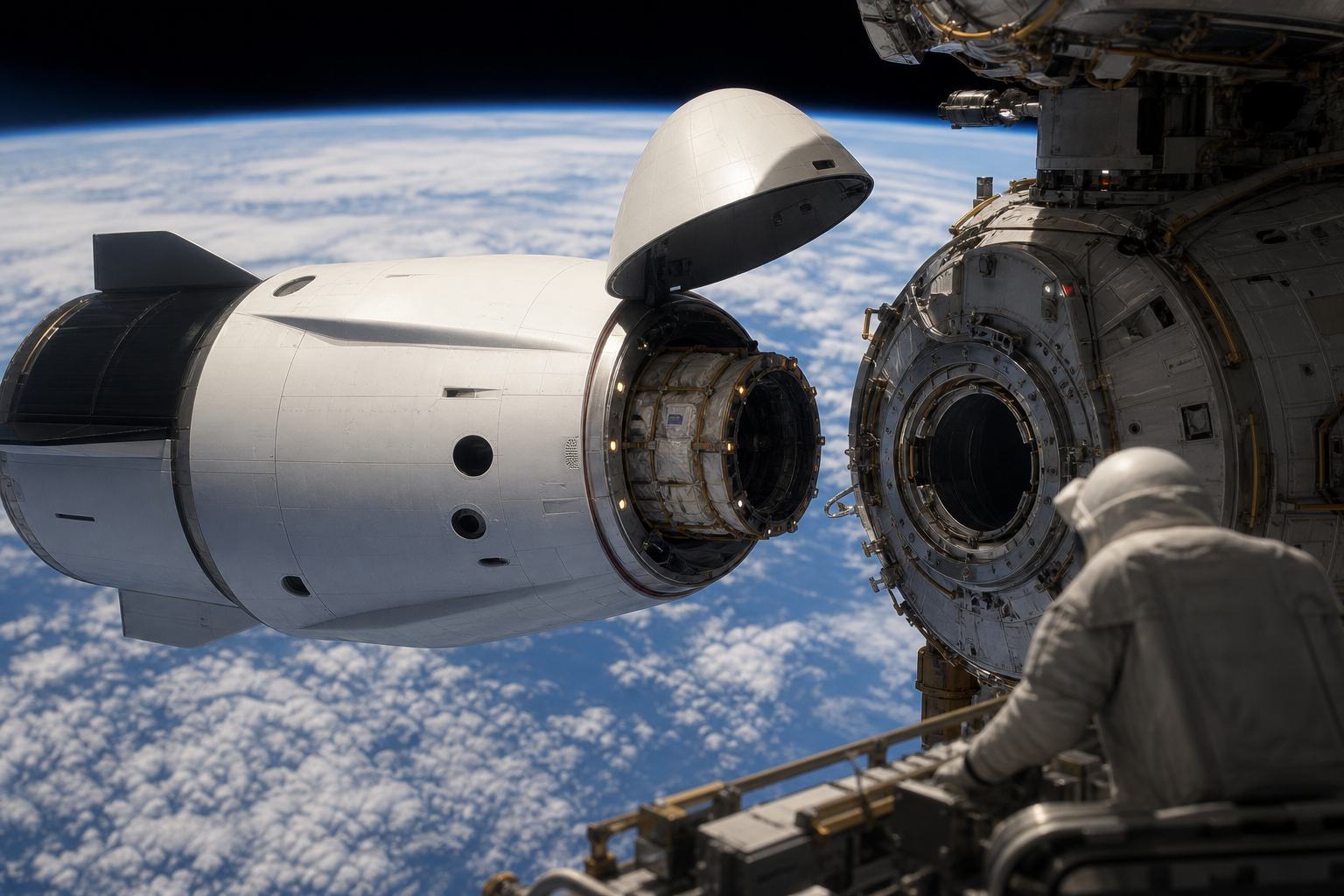
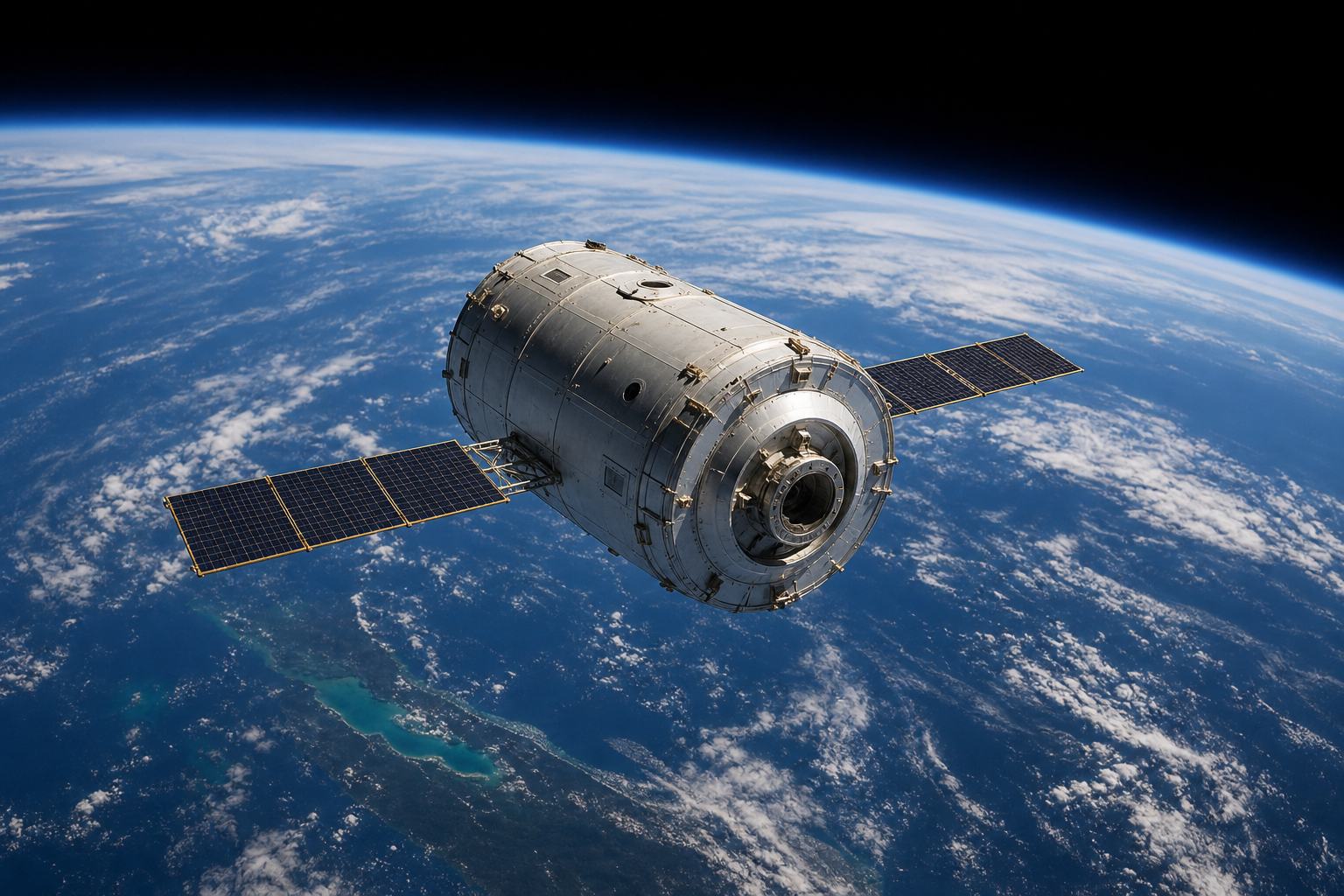
The stationCargo Dragon According to Space.com, Dragon is the only cargo ship now flying that can also bring cargo back to Earth. AI-generated still.
2,860 kg
of supplies and science
15 Oct
docked at the Harmony module
CRS-35
why it stays up
how sunlight powers it
how it makes air and recycles water
what weightlessness does to the body
This film
Prologue · The news
The last pair of new wings
NASA’s CRS-35 mission launched on a SpaceX Falcon 9 from Cape Canaveral on 13 October 2026 with about 6,300 pounds (2,860 kg) of cargo. In Dragon’s unpressurised trunk were two Roll-Out Solar Array wings, which Spaceflight Now describes as the fourth and final pair bound for the station. Space.com reports that Dragon docked at the Harmony module on 15 October at 10:27 a.m. EDT; it is to stay about a month.
How to use: pick a chapter or press ← →; drag to rotate. Most steps have buttons you can press.
The 3D scenes are schematic and not to scale: the orbit is drawn far higher than it really is, so the station can be seen.
The station flies about four hundred kilometres above the ground. That sounds far, but on a globe the size of a football it would sit only about seven millimetres off the surface.
It moves at about twenty-eight thousand kilometres an hour, almost eight kilometres every second.
At that speed it laps the planet every ninety minutes: sixteen orbits a day, and for the crew, sixteen sunrises and sixteen sunsets.
~400 km
above the ground
6,371 km
Earth’s average radius, for scale
Altitude
28,000 km/h
17,500 miles per hour
~7.8 km/s
NASA rounds it to “five miles per second”
Speed
~90 min
per orbit
16
orbits every 24 hours
One day on board
Chapter I · Falling
Low Earth orbit
NASA gives the station’s altitude as 200 to 250 miles (about 320–400 km) and its speed as 17,500 mph, about five miles per second. It completes an orbit roughly every 90 minutes, 16 orbits in 24 hours.
The football comparison: 400 km is about 6.3% of Earth’s 6,371 km radius. On a football 22 cm across (11 cm radius), 6.3% of the radius is about 7 mm.
The 3D scenes are schematic and not to scale: the orbit is drawn far higher than it really is, so the station can be seen.
Up there, gravity has hardly weakened. At the station's height it is still about ninety percent as strong as on the ground.
So why do astronauts float? Because the station and everyone in it are falling, all the time, together. Nothing presses them against the floor, because the floor is falling just as fast.
What keeps the fall from ever reaching the ground is sideways speed. It falls sideways so fast that it keeps missing the Earth: as it drops, the curved surface drops away beneath it just as much. Take that speed away, and watch. Then try half speed.
~90%
of its strength on the ground
100 → 90
NASA: a 100-pound person would weigh about 90 pounds at that height
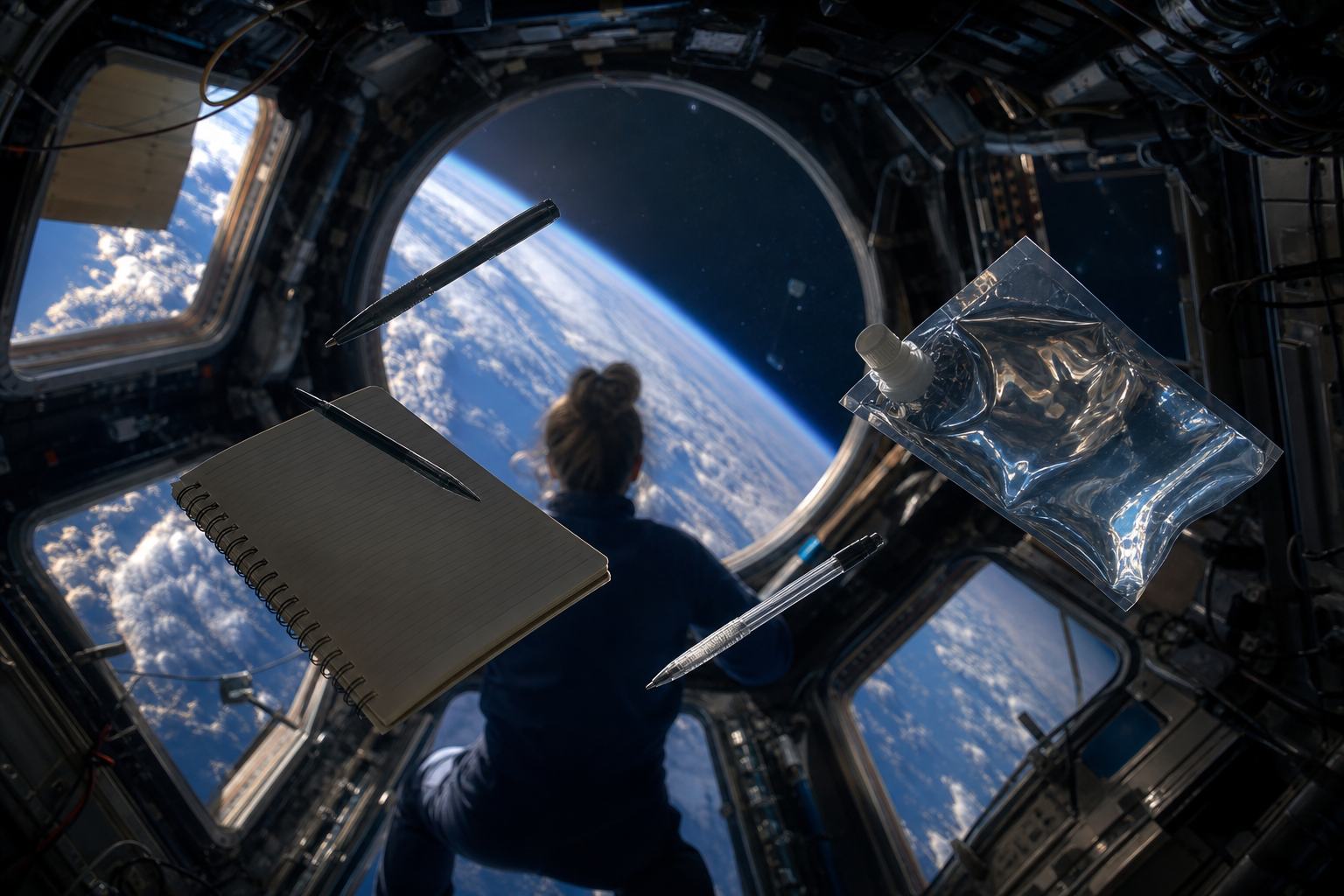
Gravity at 400 kmFree fall Pens, pouches and people all fall at the same rate, so nothing settles on the floor. AI-generated still.
orange arrow: gravity, always toward the centre
green arrow: sideways speed
no green arrow: nothing to carry it past the Earth
In the scenev=rGM≈7.7km/s
G
gravitational constant
M
mass of the Earth
r
distance from Earth’s centre: 6,371 + 400 km
The speed of a circular orbit at the station’s height. Slower, and the orbit dips into the air.
Chapter I · Falling
Microgravity is free fall
NASA: at the station’s altitude gravity is about 90% as strong as at the surface. Astronauts appear weightless because they and the station are in free fall, falling toward Earth together at the same rate.
The orbital speed in the equation follows from Newton’s law of gravitation (GM = 3.986 × 10¹⁴ m³/s², r ≈ 6,771 km), which gives about 7.7 km/s, close to NASA’s 17,500 mph (7.8 km/s).
In the scene, press “Stop sideways speed”: with nothing moving it sideways, the station falls straight down. Schematic.
There is a catch. Four hundred kilometres up, the air is extremely thin, but it is not gone, and the station, with its huge solar wings, makes a big target.
That faint drag steals a little speed on every lap, and the station sinks by roughly a hundred metres a day.
So from time to time a docked spacecraft, most often a Russian Progress cargo ship, fires its thrusters and lifts the station back up. Press the button to fire one.
a trace of atmosphere still reaches 400 km
the station moves through it at ~8 km/s
large solar wings catch more of it
Why there is drag
~100 m
per day, according to ESA
~3 km
in a month without a boost
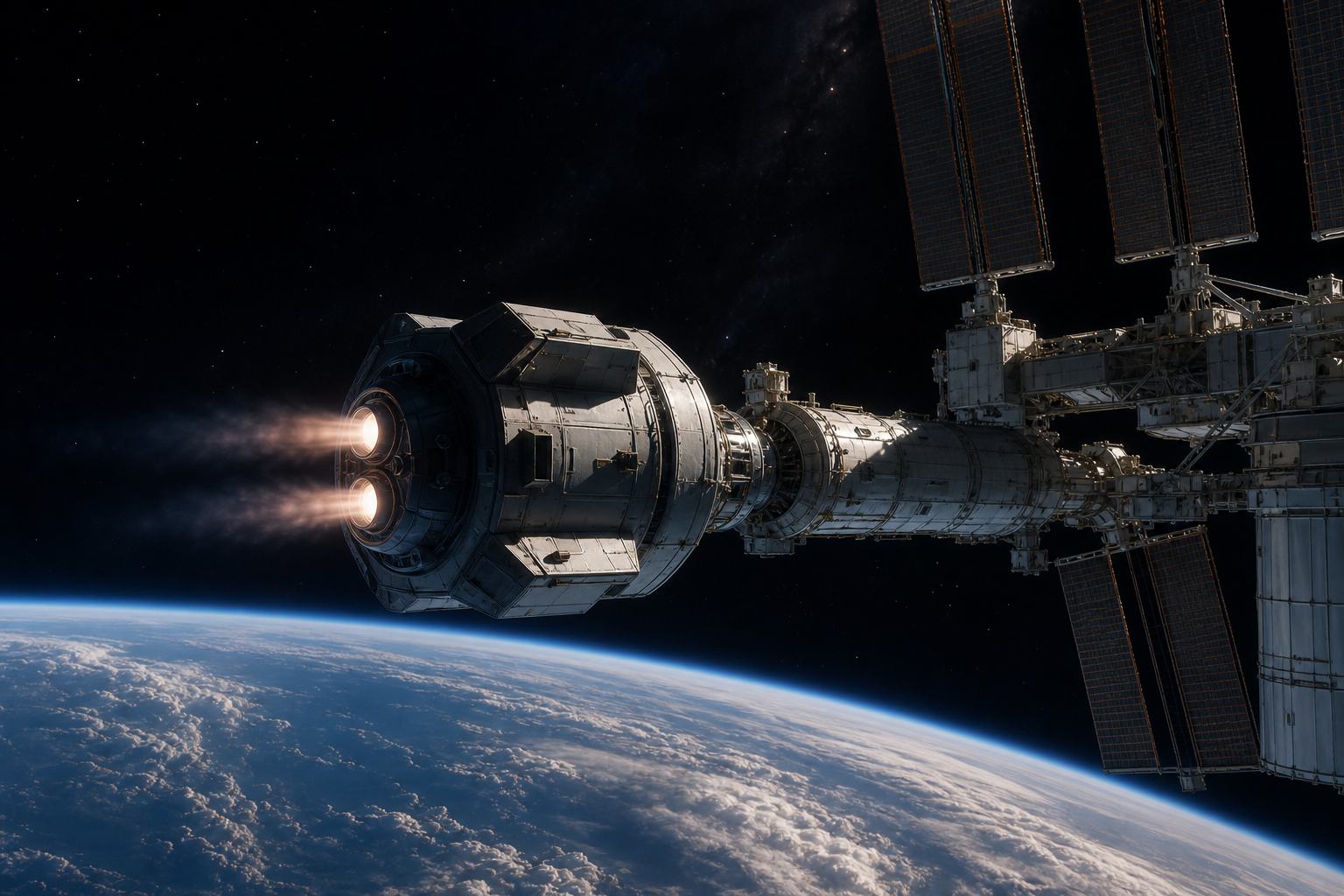
Altitude lostA reboost burn Inside, loose objects and the crew drift slowly toward the back as the station speeds up around them. AI-generated still.
most often Russian Progress cargo ships
in the past, Europe’s ATV cargo ships
burns are planned by flight controllers on the ground
Who does the pushing
Chapter I · Falling
Reboosts
ESA: the station orbits at about 400 km, where the thin atmosphere still slows it; drag lowers it by roughly 100 m a day. Regular orbit-raising burns, mostly by Russian Progress cargo ships (and in the past by ESA’s Automated Transfer Vehicles), make up the loss.
The real rate of decay changes with solar activity, which heats and puffs up the upper atmosphere. The sawtooth in the scene is schematic.
The idea took shape in 1984, when US President Ronald Reagan directed NASA to build a space station. Europe, Japan and Canada joined in the 1980s, and Russia in 1993.
The first piece, the Zarya module, rode a Russian Proton rocket from Baikonur in Kazakhstan on the twentieth of November 1998.
Two years later, on the second of November 2000, the first crew moved in: the American Bill Shepherd and the Russians Sergei Krikalev and Yuri Gidzenko. Someone has lived on board ever since.
1984 Reagan directs NASA to build a station
1998 Zarya, the first module, launches
2000 Expedition 1 moves in
Beginnings
Europe, Japan, Canada: agreements in 1985 and 1988
Russia: invited in December 1993
a new partnership agreement: 1998
Who joined, whenZarya, alone For its first weeks the future station was a single module with two small solar wings. AI-generated still.
25+ years
of continuous human presence
9,481 days
from 2 Nov 2000 to 18 Oct 2026
Never empty
Chapter II · Building it
Zarya and Expedition 1
ISS National Lab: Reagan directed NASA to build an international space station in his 1984 State of the Union address. Zarya launched on 20 November 1998 aboard a Russian Proton rocket from the Baikonur Cosmodrome in Kazakhstan. Expedition 1 (Bill Shepherd of NASA, Sergei Krikalev and Yuri Gidzenko of Roscosmos) arrived on 2 November 2000, and human presence has been uninterrupted since.
JAXA: Canada, ESA and Japan signed memoranda in 1985 and the intergovernmental agreement in September 1988; Russia was invited in December 1993, and a new agreement followed in 1998. A module is one of the station’s room-sized building blocks. The model in the scene is simplified.
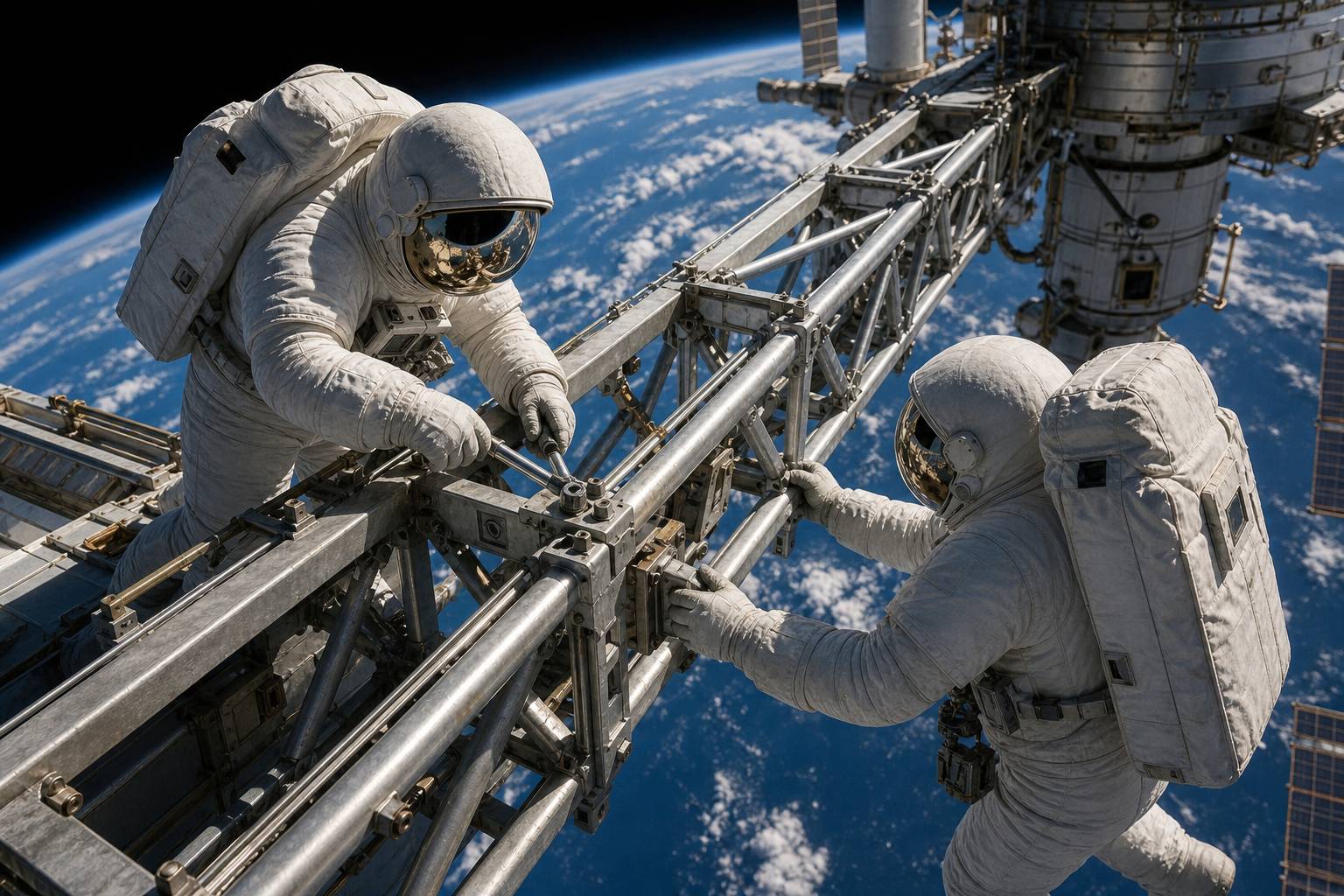
Putting it together took forty-two assembly flights, thirty-seven of them by American space shuttles and five by Russian rockets, with astronauts on spacewalks bolting the pieces together. Press Build to put it together yourself.
The result is a hundred and nine metres from end to end and weighs about four hundred and twenty tonnes. Inside, there is about as much air-filled living space as in a Boeing 747.
It is run by five space agencies, from the United States, Russia, Europe, Japan and Canada, on behalf of fifteen countries.
US space shuttle
37 flights
Russian Proton / Soyuz
5 flights
Assembly flights
26 Nov 2021
Russia’s Prichal docking node added
The latest pieceSpacewalk The long truss carries the solar wings, radiators and cables; its segments were bolted on in orbit. AI-generated still.
419,725 kg
mass
1,005 m³
pressurised volume
5 · 15
agencies · countries
By the numbers
Chapter II · Building it
Facts and figures
NASA: 42 assembly flights (37 on US space shuttles, 5 on Russian Proton/Soyuz rockets). Length 356 ft (109 m); mass 925,335 lb (419,725 kg); pressurised volume 35,491 cubic feet (1,005 m³), comparable to a Boeing 747. The most recent module, Russia’s Prichal, was added on 26 November 2021. Five space agencies representing 15 countries operate the station.
The five agencies are NASA, Roscosmos, ESA (Europe), JAXA (Japan) and the Canadian Space Agency.
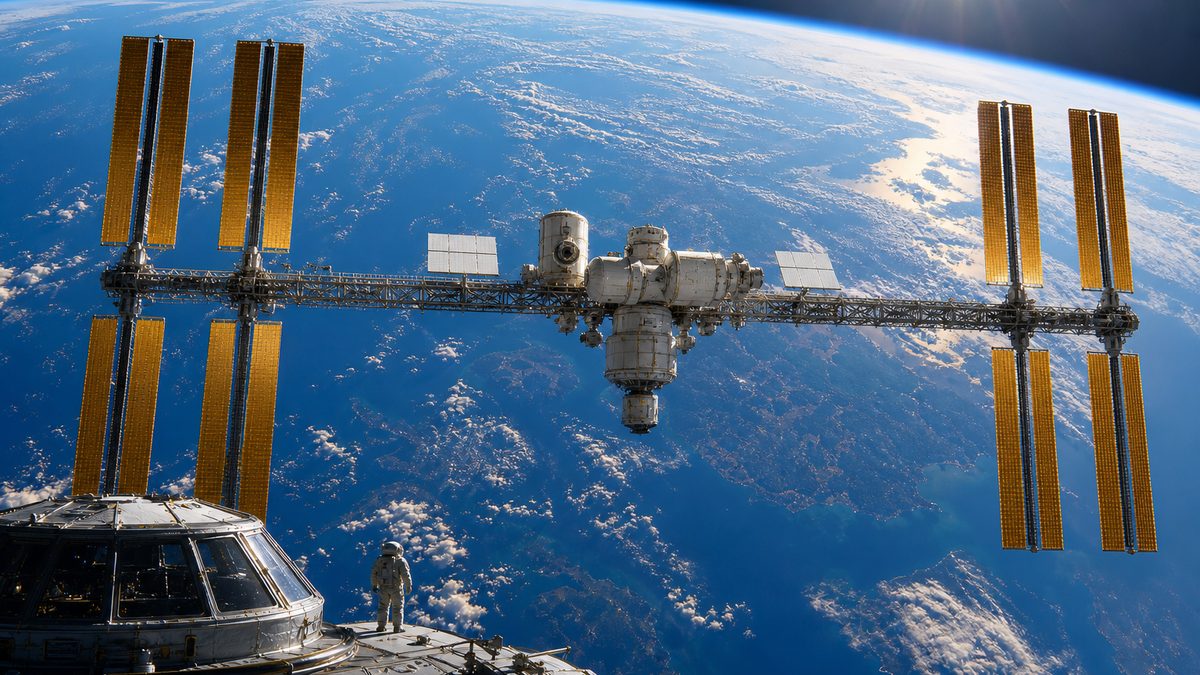
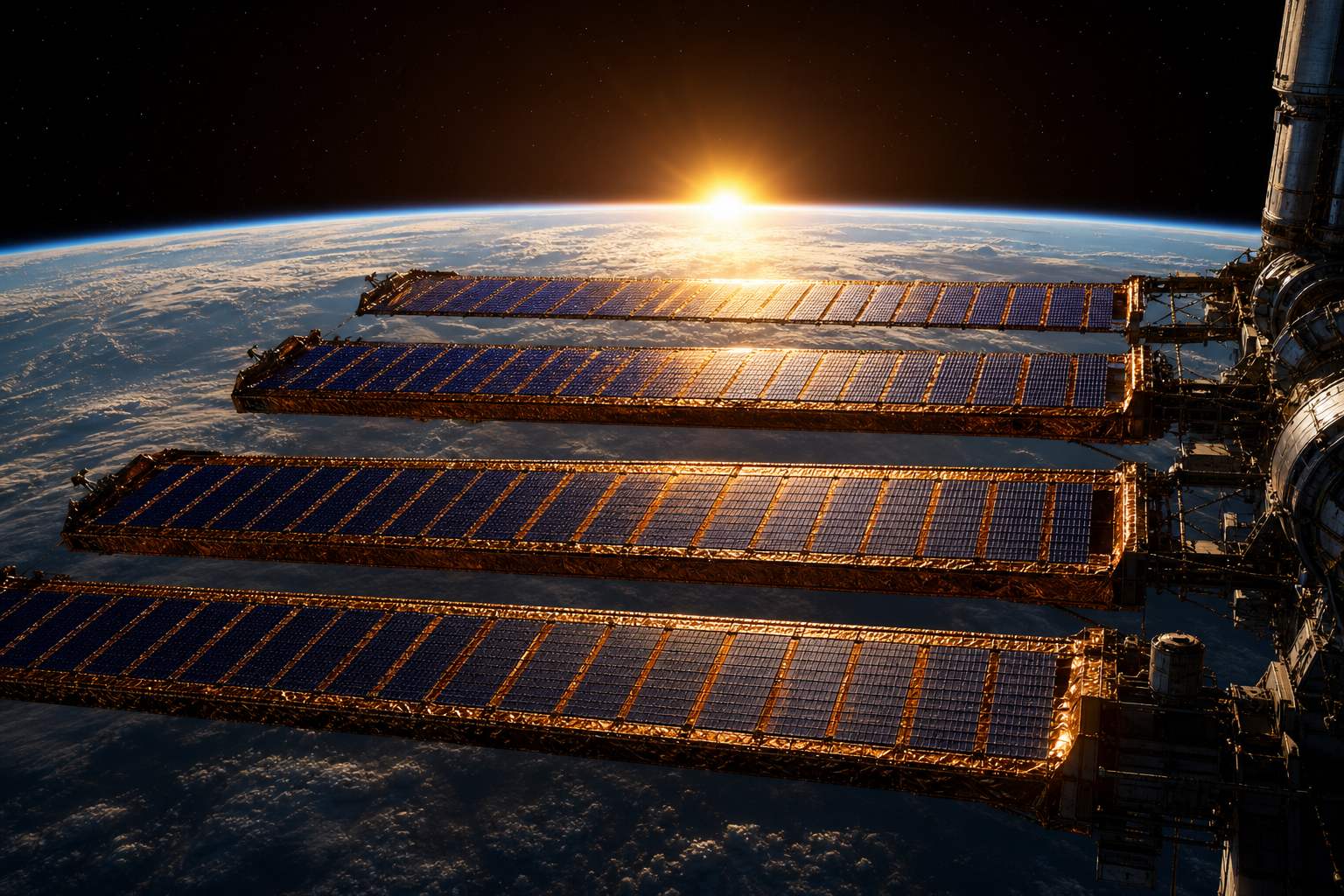
Everything on board runs on sunlight. Eight main solar wings stretch a hundred and nine metres from tip to tip, as wide as the station is long, and wider than the wingspan of the largest airliner.
The wings turn to follow the Sun around each orbit. In orbital daytime, the original eight arrays could produce up to about a hundred and sixty kilowatts.
But for part of every orbit the station is in Earth's shadow. Batteries store power for that orbital night; between 2017 and 2021 spacewalkers swapped the old ones for lithium-ion.
Station solar wings, tip to tip
109 m
Airbus A380 wingspan
80 m
Span
Sun-tracking wings Each wing is a blanket of photovoltaic cells on a mast that rotates to face the Sun. AI-generated still.
sunlight: wings power the station and charge batteries
shadow: batteries take over
16 times a day, every day
Day and night in orbit
Chapter III · Sunlight
Solar arrays and batteries
NASA: the solar array wingspan is 356 ft (109 m), more than the Airbus A380’s 262 ft (80 m). In 2021 NASA said the eight arrays generate up to 160 kW in orbital daytime. A series of spacewalks from 2017 to 2021 replaced the older nickel-hydrogen batteries with lithium-ion ones (AP); they store power from the arrays for orbital night.
How long the night lasts depends on the angle between the orbit and the Sun, which changes through the year. Press Day / Night in the scene.
The original wings were designed to last fifteen years, and the first pair went up in December 2000. By the 2020s they were reaching the end of their design life.
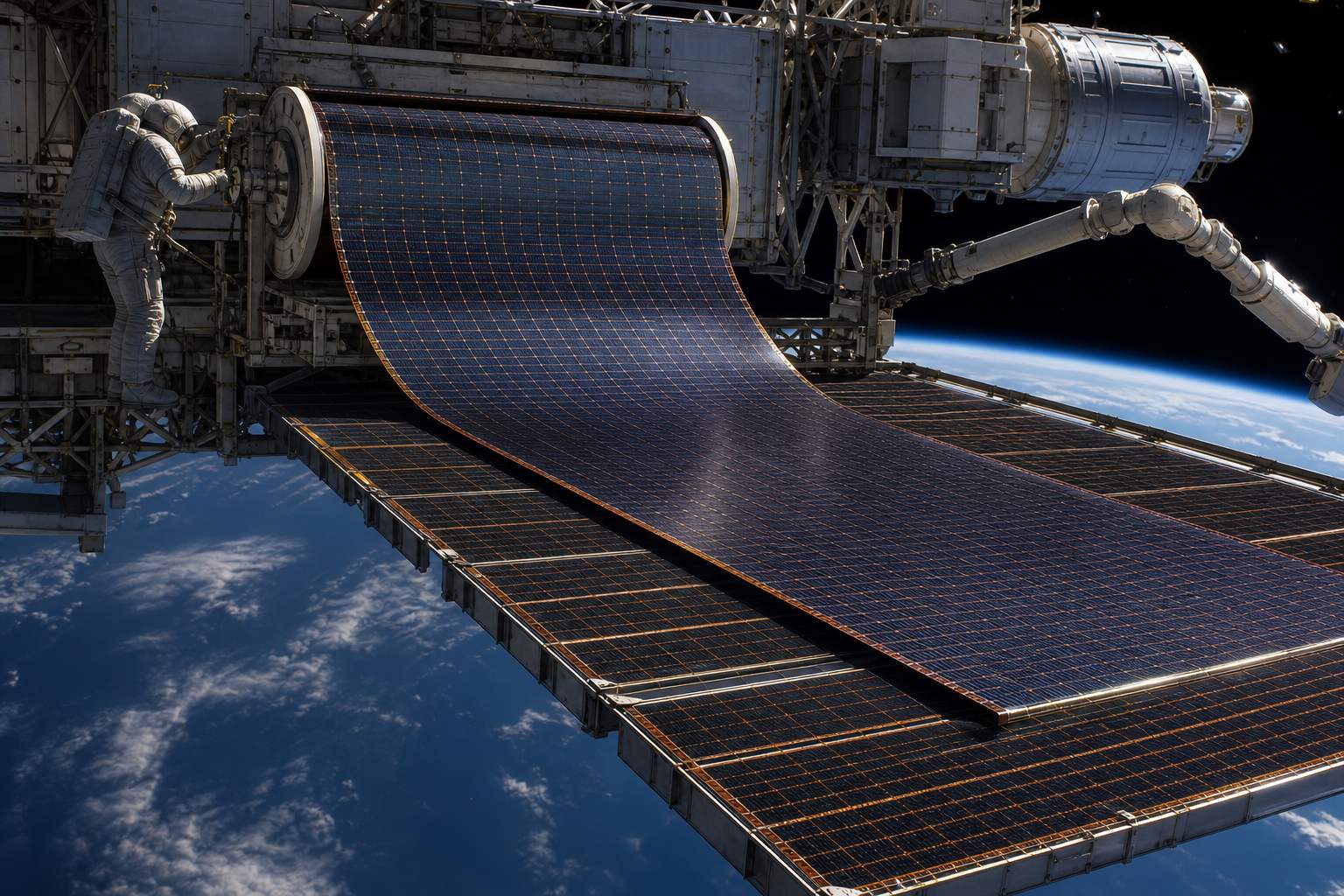
NASA's answer was a lighter kind of panel that unrolls like a carpet. Each new roll-out array gives more than twenty kilowatts and is mounted in front of an old wing, shading about half of it; together, old and new give more power than the old wing alone.
The first ones arrived in 2021, each needing two spacewalks to fit. The pair Dragon carried this October is, according to Spaceflight Now, the fourth and final pair.
15 years
design life
Dec 2000
first pair deployed
The old wingsRoll-out solar array The new array is stored as a roll and stretched out by two booms, over an older wing. AI-generated still.
the old wing keeps the mast, Sun tracking and wiring
its uncovered half still makes power
the new array adds more than 20 kW on top
Why cover an old wing?
160 kW
before
up to 215 kW
after
NASA’s 2021 plan, for six new arrays
Chapter III · Sunlight
iROSA: ISS Roll-Out Solar Arrays
NASA (2021): the original arrays were designed for 15 years; the first pair was deployed in December 2000. Each new roll-out array produces more than 20 kW. Six were planned at first, mounted in front of six existing arrays and shading a bit more than half their length, raising available power from up to 160 kW to up to 215 kW. Each installation takes two spacewalks.
Spaceflight Now calls the CRS-35 wings the fourth and final pair of ROSAs bound for the station, each capable of more than 20 kW for more than 10 years. The 215 kW figure is NASA’s 2021 estimate for the first six.
A crew in a sealed can uses up oxygen and breathes out carbon dioxide all day long. So the station has to make fresh air, not just clean it.
The oxygen comes from water. Electricity from the solar wings splits water molecules into oxygen, which goes into the cabin, and hydrogen.
Carbon dioxide is pulled out of the air by filters called molecular sieves. Some of it then meets that leftover hydrogen in a Sabatier reactor, a hot chamber with a catalyst, which turns them into water again, plus methane that is vented into space.
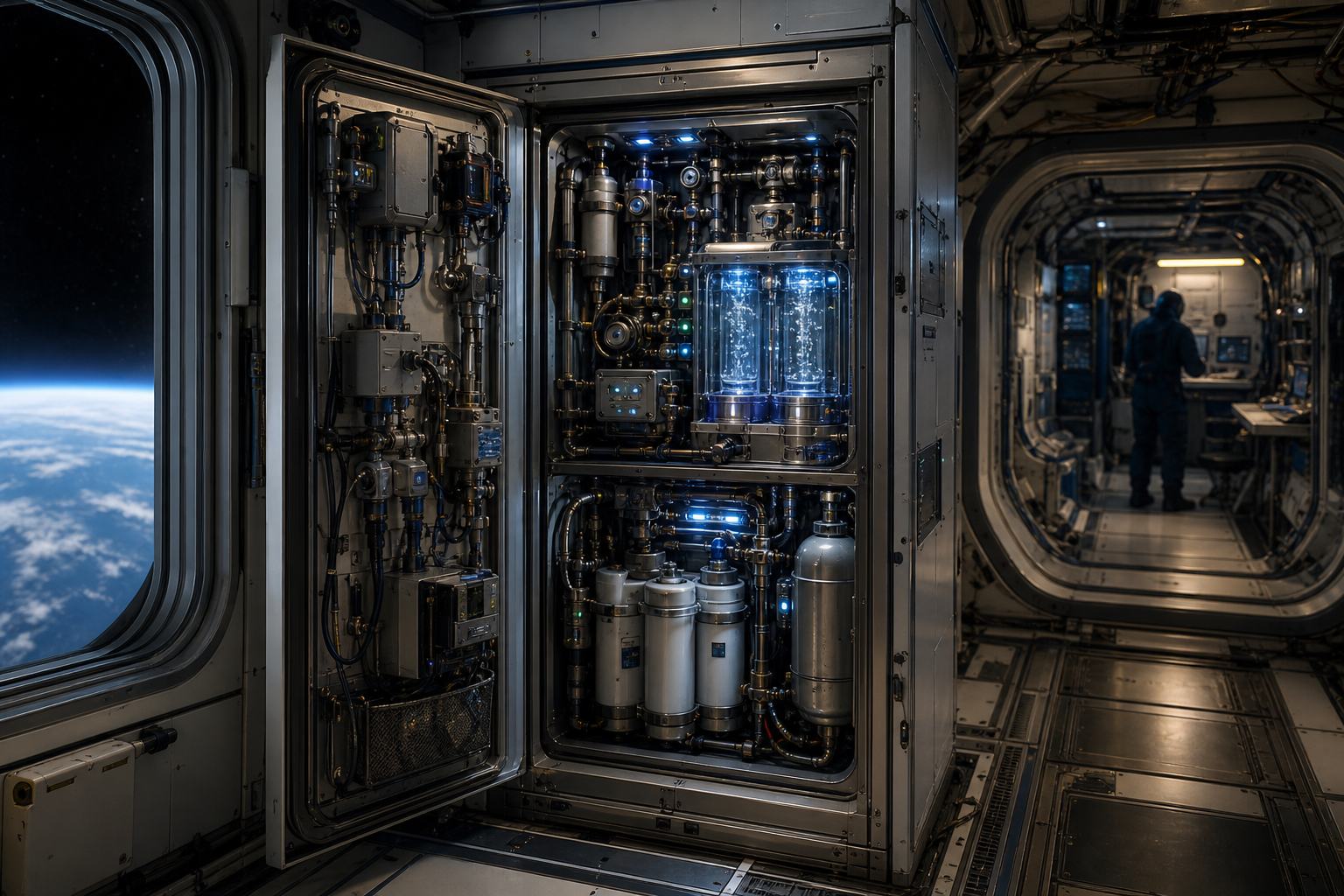
Life-support racks In the US segment the main systems fill four refrigerator-sized racks in the Tranquility module. AI-generated still.2H2Oelectricity2H2+O2Electrolysis: the oxygen goes to the cabin; the hydrogen is vented or reused.CO2+4H2→CH4+2H2OThe Sabatier reaction: exhaled carbon dioxide becomes water again.
activated charcoal for trace gases
a catalytic oxidiser
a lithium hydroxide bed
Other filters
Chapter IV · Air and water
Making air
NASA ECLSS: the oxygen generation assembly uses electrolysis, powered by the solar arrays, to split water into oxygen (into the cabin) and hydrogen (vented or sent on). Molecular sieves remove carbon dioxide; a Sabatier reactor combines hydrogen with that carbon dioxide to make water and methane, and the methane is released into space.
Trace gases are removed separately, with activated charcoal, a catalytic oxidiser and lithium hydroxide. The loop in the scene is a diagram, not a plumbing plan.
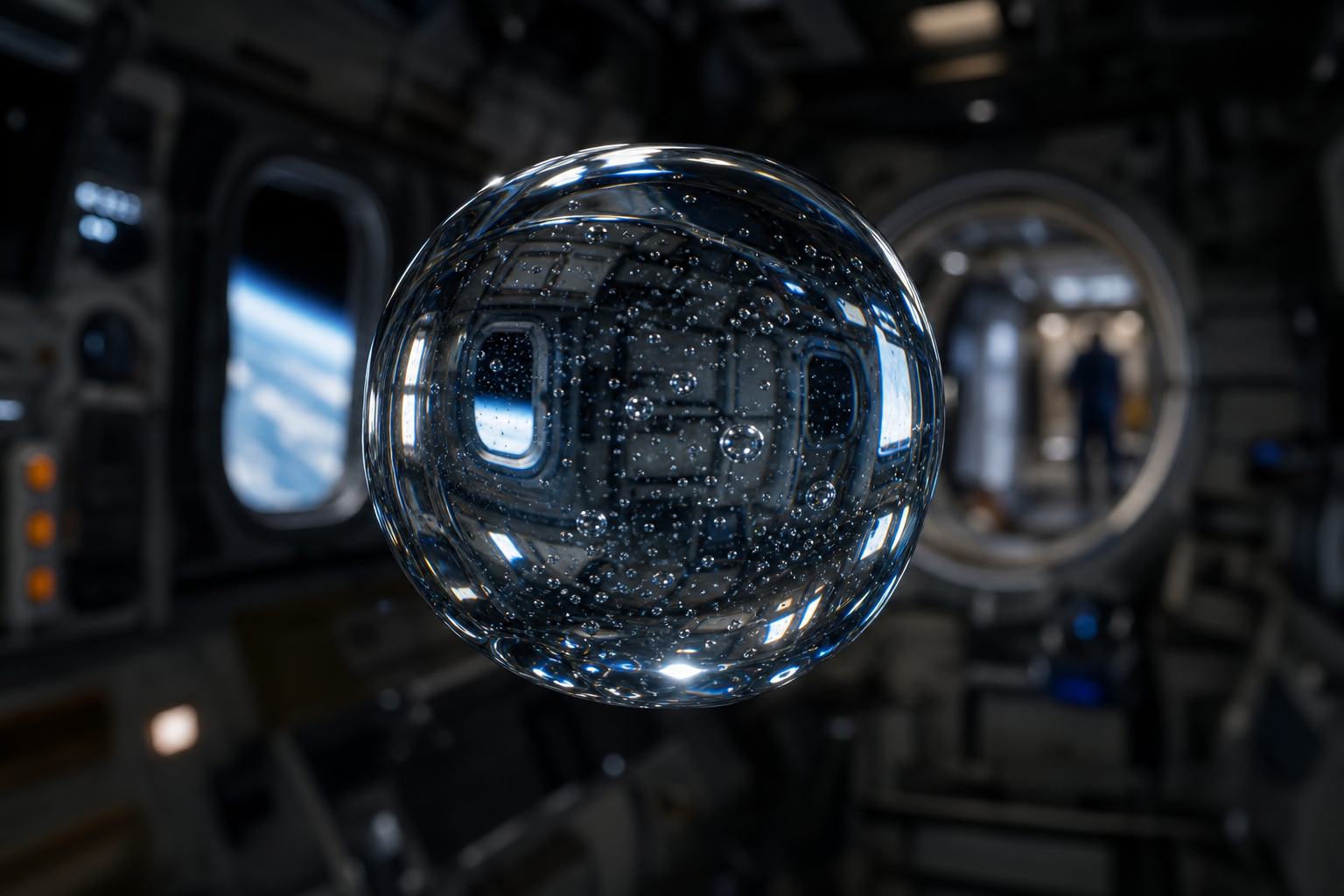
Water is just as precious. Each astronaut uses about four litres a day for drinking, food and washing, and every litre launched from Earth is expensive.
Dehumidifiers catch the moisture from breath and sweat. Urine is distilled, and a brine processor squeezes out the last of the water left in the salty leftovers.
Together they recover about ninety-eight percent of the water. As a NASA engineer put it, the crew is not drinking urine; they are drinking water that has been reclaimed, filtered and cleaned.
~3.8 L
about one US gallon a day
Per personWater in weightlessness With nothing pulling it down, surface tension pulls loose water into a wobbling ball. AI-generated still.
before the brine processor
93–94%
with it (2023)
98%
Water recovered
sensors test the purity
water that fails goes round again
iodine is added to stop microbes
Before anyone drinks it
Chapter IV · Air and water
Water recovery
In June 2023 NASA said the station’s Water Recovery System had reached about 98% recovery. Advanced dehumidifiers capture moisture from breath and sweat; the urine processor distils urine; the Brine Processor Assembly extracts the remaining water from the leftover brine. Before it, about 93–94% was recoverable. Each crew member uses about a gallon of water a day.
The quotation is from Jill Williamson, ECLSS water subsystems manager. Clean water is checked by sensors and dosed with iodine to stop microbes growing.
Floating is fun, but the body notices. With no weight to carry, bones and muscles that normally hold us up start to weaken.
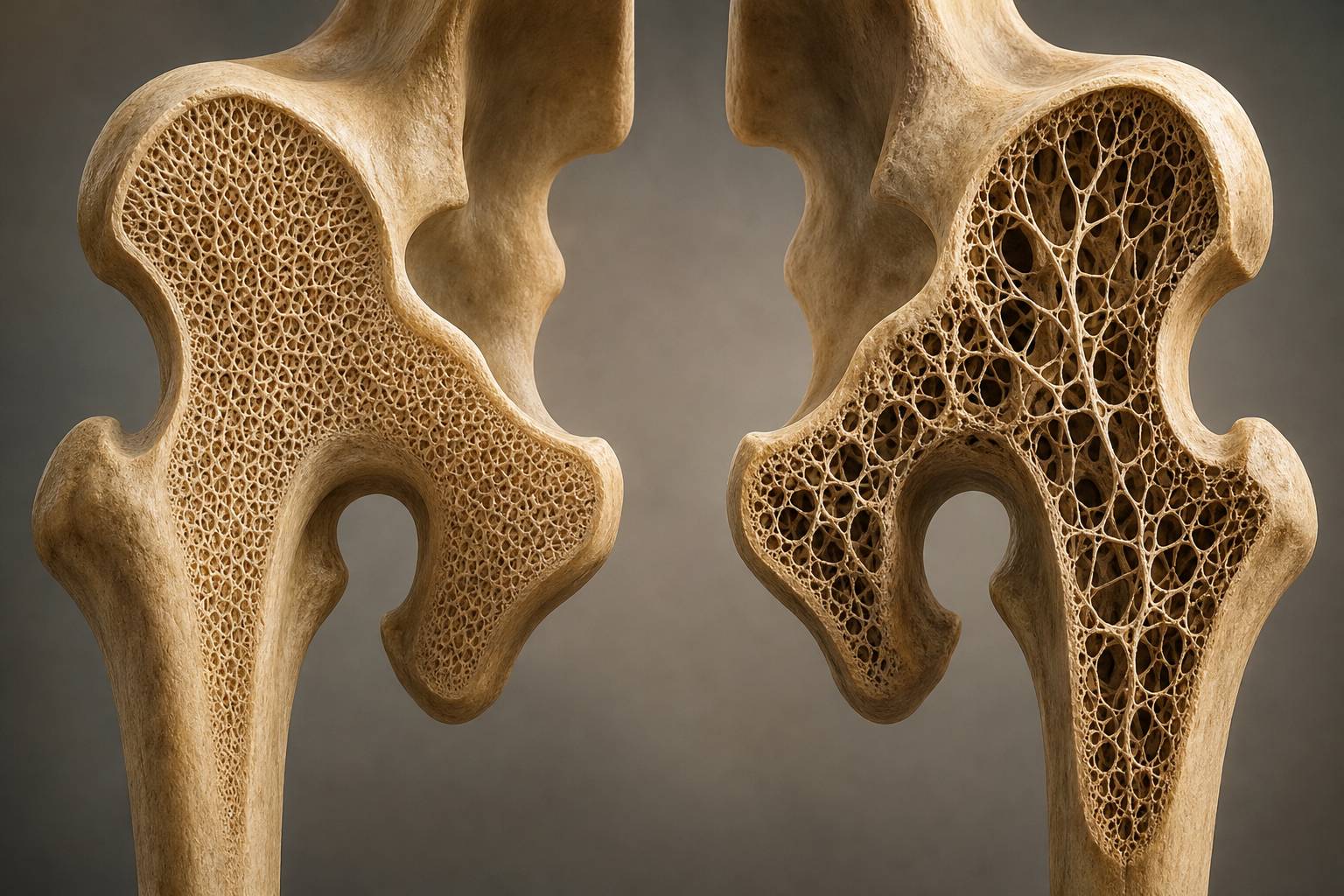
NASA says astronauts can lose up to one to two percent of their bone density a month in the hip and spine. On Earth, older women after menopause and much older men lose about half to one percent a year.
That is why every astronaut works out for at least two hours a day, held down to the machines with straps so they do not drift away.
Inside a hip bone Spongy bone is a lattice; without load, the body thins it out. Illustration, not a scan. AI-generated.
in orbit: up to 1–2% a month
up to 12–24%
on Earth, at higher-risk ages
0.5–1%
Bone density lost in one year, upper estimates
the hip
the spine
bones that carry our weight on Earth
Where it shows most
2 h+
of exercise every day
The cure
Chapter V · Living there
Bones and muscles
NASA: astronauts can lose up to 1% to 2% of bone density per month in the hip and spine, compared with about 0.5% to 1% per year in postmenopausal women and much older men on Earth. Crew members exercise at least two hours a day.
This is general education about spaceflight, not health advice.
Above all, the station is a laboratory. By 2019 it had hosted nearly three thousand investigations from researchers in more than a hundred countries.
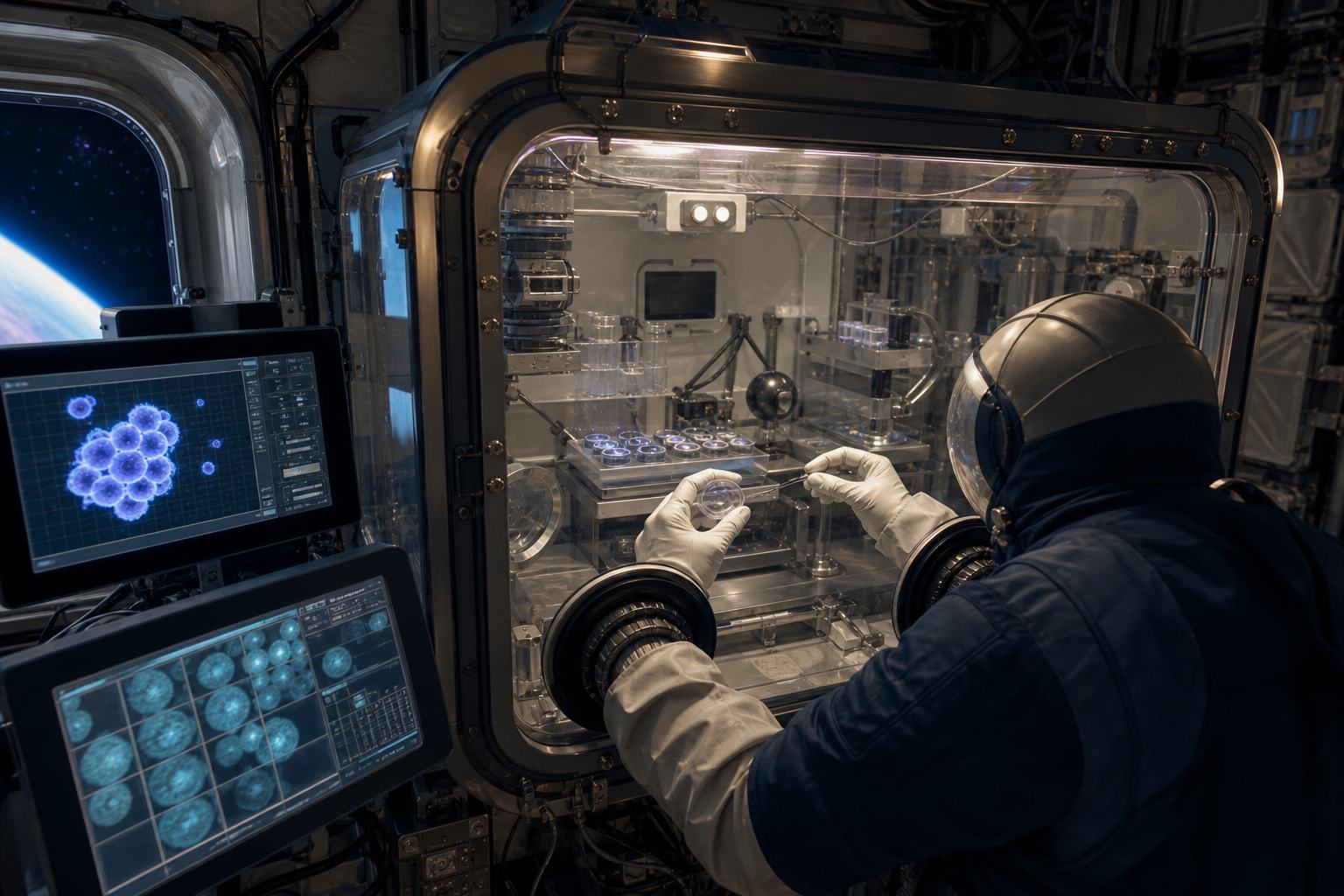
In free fall, heavier things do not sink and lighter ones do not rise, so liquids, flames and living cells behave in ways that gravity hides on the ground. Press the button to release some water.
This month's cargo alone brought equipment to make artificial retinas, heart tissue for testing drugs, tiny brain organoids for studying diseases such as Parkinson's, and a new kind of glass.
~3,000
investigations
108+
countries and areas
Research to 2019A glovebox Sealed gloveboxes keep loose liquids and cells from floating off into the cabin. AI-generated still.
artificial retina manufacturing
3D heart tissue models for drug tests
brain organoids: Alzheimer’s, Parkinson’s, MS
glass made from heavier elements not usually used for glass
CRS-35 science
Chapter V · Living there
Science on board
NASA: nearly 3,000 research investigations from researchers in more than 108 countries and areas, through Expedition 60 (2019). Space.com lists CRS-35 science including equipment for making artificial retinas, 3D heart tissue models for drug testing, brain organoids for research on neurodegenerative diseases, and a study of how a new type of glass forms.
Brain organoids are clusters of cells grown in a dish that copy some features of brain tissue; they are research tools, not treatments.
The station's orbit is tilted fifty-one point six degrees to the equator, so its path sweeps back and forth across most of the planet. NASA says it passes over more than ninety percent of the world's people.
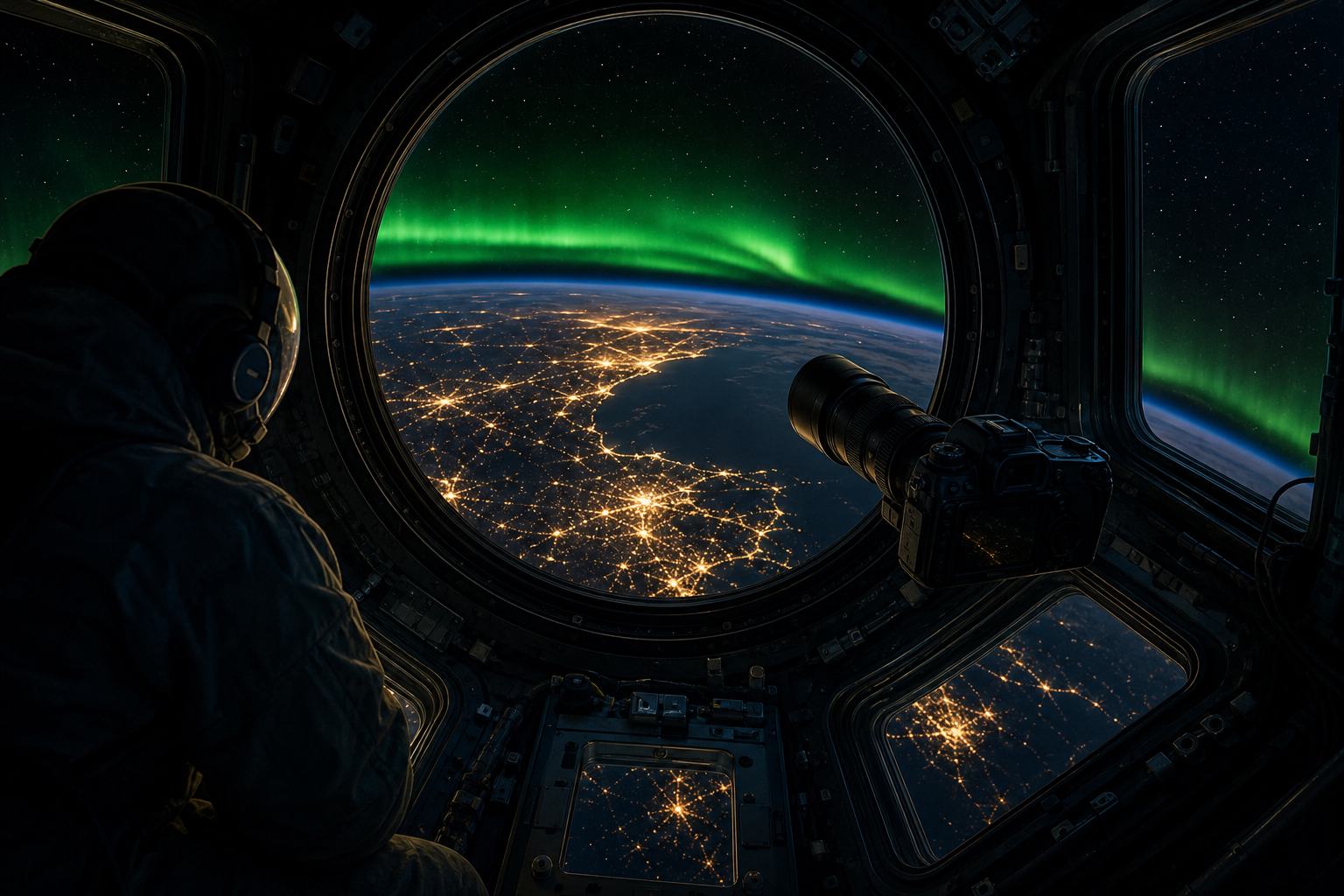
Crews have taken millions of photographs of Earth through its windows. Speed up time to watch the path shift west as the Earth turns.
And from the ground you can see it too: around dawn or dusk it can outshine every star and planet, a steady light that does not blink, crossing the sky in a few minutes.
51.6°
orbit tilt to the equator
90%+
of the world’s people overflown
Coverage
the orbit is tilted, so it swings north and south
Earth turns beneath it, so each lap crosses new ground
press Ground track to draw its path
Why it covers so muchThe view down Crews have taken more than 3.5 million photographs of Earth, NASA says. AI-generated still.
look around dawn or dusk
only the Sun and Moon are brighter at its best
no blinking: a plane blinks, the station does not
NASA’s Spot the Station lists passes for your town
How to spot it
Chapter VI · Overhead
Seeing the station
The station’s orbit is inclined 51.6° to the equator (The Conversation), chosen partly so that launches from Baikonur drop debris away from China. NASA: it flies over more than 90% of Earth’s population, and crews have taken more than 3.5 million photographs of Earth.
The Planetary Society: the station is best seen near dawn or dusk; at its brightest only the Sun and Moon outshine it; it does not blink, and it usually crosses the sky in minutes. People in the far north or far south rarely see it.
The station will not fly forever. NASA and its partners plan to retire it around 2030. Russia had committed only to 2028, but in July 2026 the head of its space agency agreed to stay until 2030.
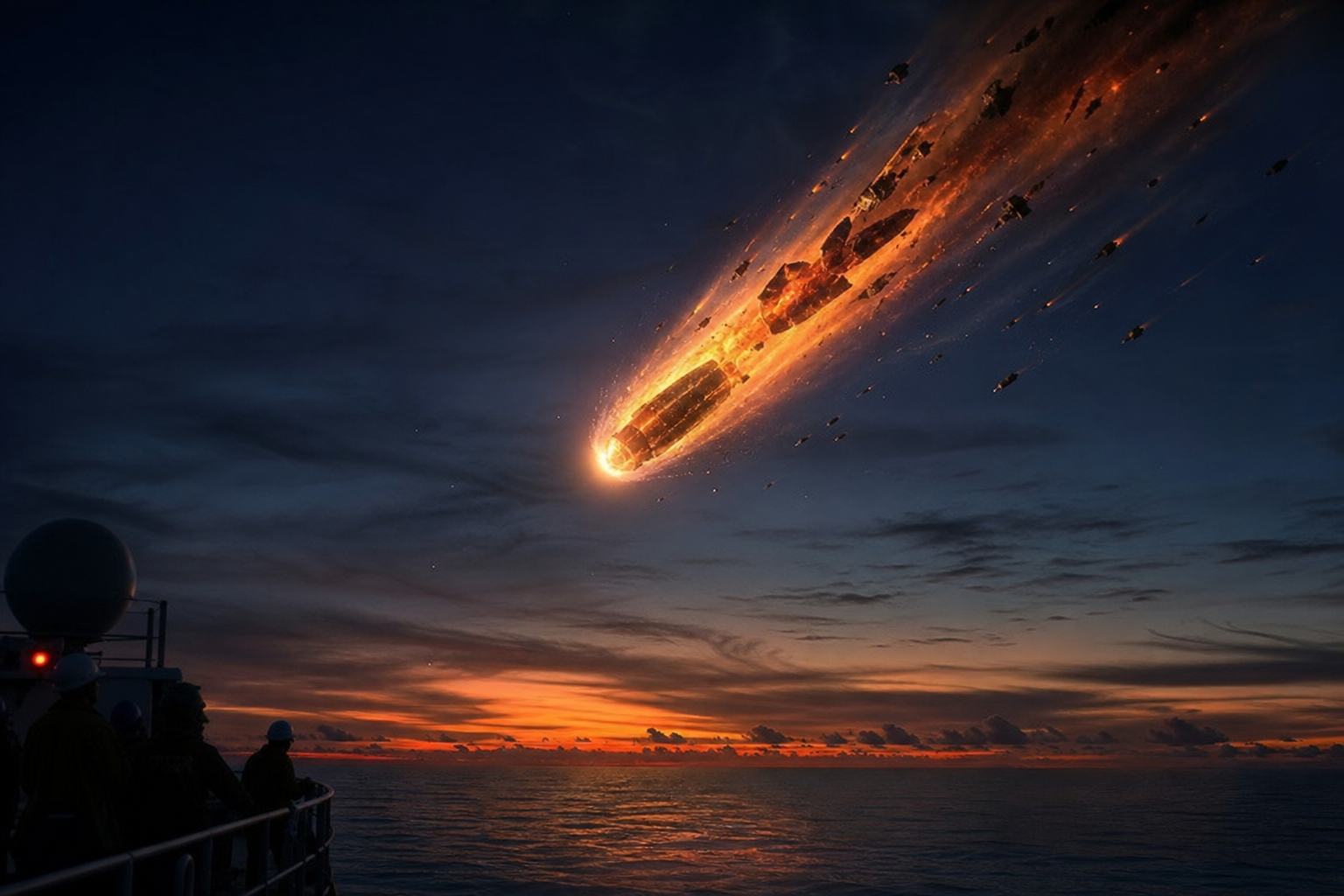
In June 2024 NASA awarded SpaceX eight hundred and forty-three million dollars to build a deorbit vehicle. It will push the station down into the atmosphere in a controlled way, to keep falling pieces away from populated areas.
2024 SpaceX picked to build the deorbit vehicle
Jul 2026 Roscosmos agrees to stay to 2030
~2030 planned retirement
The end of the mission
lowering the orbit on purpose
the drag from Chapter I helps pull it down
a final push steers the fall away from people
What deorbiting means
$843 million
contract, June 2024
US Deorbit VehicleRe-entry (artist’s impression) Most of the station will burn up; what survives is meant to fall far from people. AI-generated still.
Chapter VI · Overhead
Retirement
In June 2024 NASA awarded SpaceX an $843 million contract to build the US Deorbit Vehicle, which NASA will own and operate to push the station into the atmosphere while avoiding risk to populated areas. NASA and its partners plan to retire the station around 2030 (AP, via KSL). In July 2026 Roscosmos chief Dmitry Bakanov agreed, in talks with NASA Administrator Jared Isaacman, that Russia would support operations through 2030 instead of 2028; NASA told SpacePolicyOnline his account was correct.
The descent in the scene is schematic; press Deorbit to replay it.
So the station stays up because it falls sideways fast enough to keep missing the Earth, and it keeps its crew alive by turning sunlight into power, water into air, and old water into new.
Until about 2030 it is still up there, falling around the Earth sixteen times a day. Some evening soon, look up.
1984 Station directed
1998 Zarya launched
2000 First crew; first solar wings
2021 First roll-out arrays; Prichal
2023 98% water recovery
2026 Last roll-out pair (CRS-35)
~2030 Planned retirement
The station’s life
orbit = falling while moving sideways
power = sunlight by day, batteries by night
life support = reusing the same air and water again and again
Three ideas
25+ years
crewed without a break
5
space agencies
So far
Epilogue
Sources
Every number in this film comes from the sources below. Where figures change over time (power, partners’ commitments), the date is given.
Stills are AI-generated illustrations, not photographs.
The 3D scenes are schematic and not to scale: the orbit is drawn far higher than it really is, so the station can be seen.
The Moscow Times and Interfax also reported the July 2026 Russian decision; this film cites SpacePolicyOnline, which asked NASA.