In 2026 the European Physical Society gave its Europhysics Prize to three physicists for altermagnetism, which it describes as a third basic kind of magnetic order. To see why that matters, this film goes back to the beginning: the lodestone and the compass, Gilbert's little Earth, Ørsted's current, the electromagnet, the electron's spin, why paired electrons cancel, how iron's domains line up and how heat destroys them, antiferromagnets, the magnets inside motors, MRI scanners and hard drives, and finally the altermagnet. Cut a magnet in half, switch a current on, magnetise iron, heat it past its Curie point and switch between three kinds of magnetic order.
Interactive 3D film8 min1088 to 2026Published 20 October 2026
Why does a piece of iron stick to a magnet, while a plastic spoon does not? And why does a compass needle point north?
In 2026 the European Physical Society gave its Europhysics Prize to three physicists for what it calls a third basic kind of magnetic order: altermagnetism.
To see why that matters, we start at the beginning.
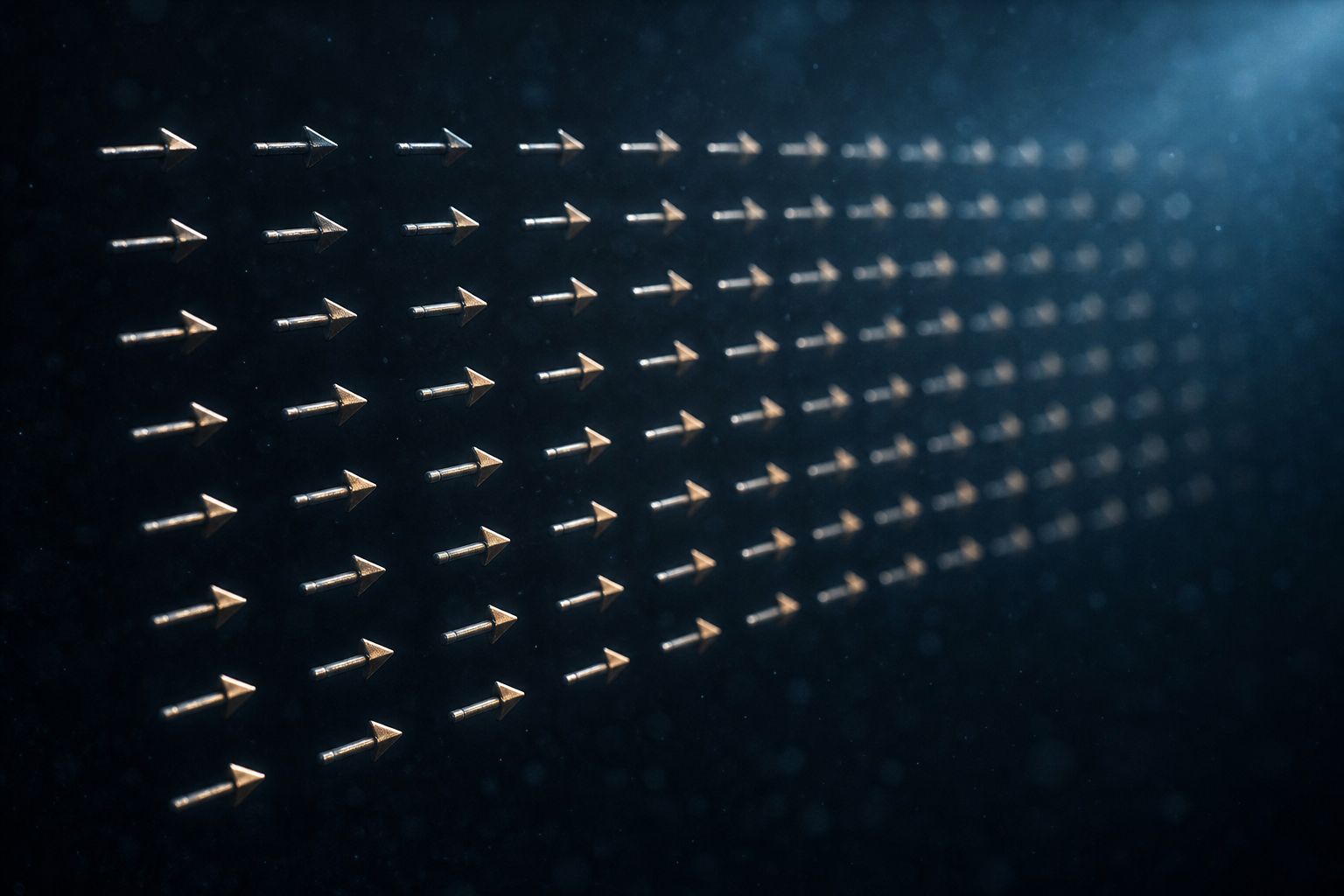
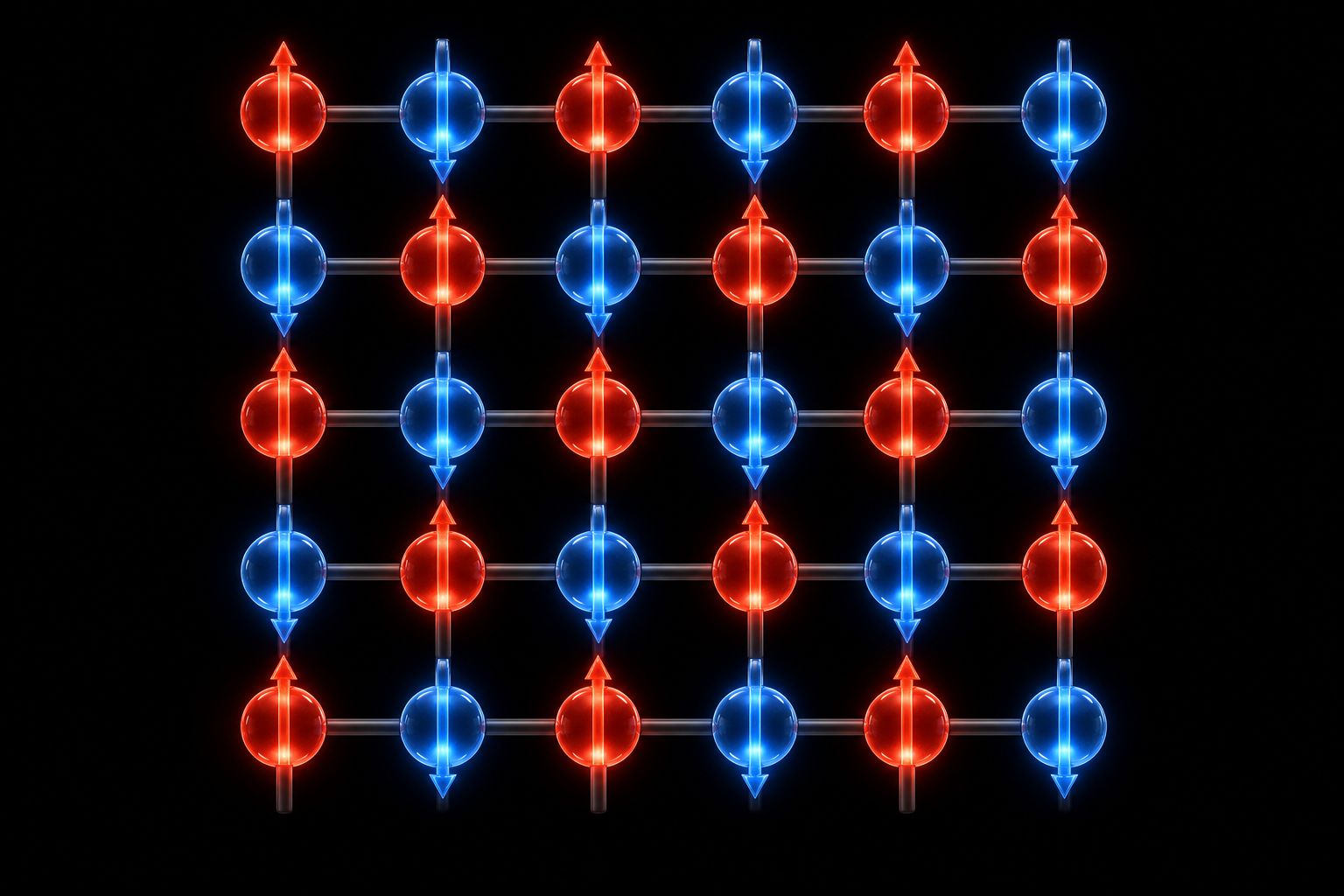
A crowd that agrees Each arrow stands for one atom’s tiny magnet. AI-generated still.
Ordered magnets, spins along one line (“collinear”)
Prologue · The news
The 2026 Europhysics Prize
Johannes Gutenberg University Mainz reports that the Condensed Matter Division of the European Physical Society awarded the 2026 Europhysics Prize, given since 1975, to Jairo Sinova (Mainz), Libor Šmejkal (Max Planck Institutes for the Physics of Complex Systems and for Chemical Physics of Solids, and the Czech Academy of Sciences) and Tomas Jungwirth (Institute of Physics of the Czech Academy of Sciences and the University of Nottingham), for altermagnetism, which the university describes as a third elementary form of collinear magnetism alongside ferromagnetism and antiferromagnetism. The prize was announced in July 2026 and presented in Graz in September; ScienceDaily carried the release on 18 October 2026.
How to use: pick a chapter or press ← →; drag to rotate. Several steps have buttons you can press.
The 3D atoms, arrows, field lines and filings are simplified teaching models, not to scale.
A rock that pulls on iron and turns to face north.
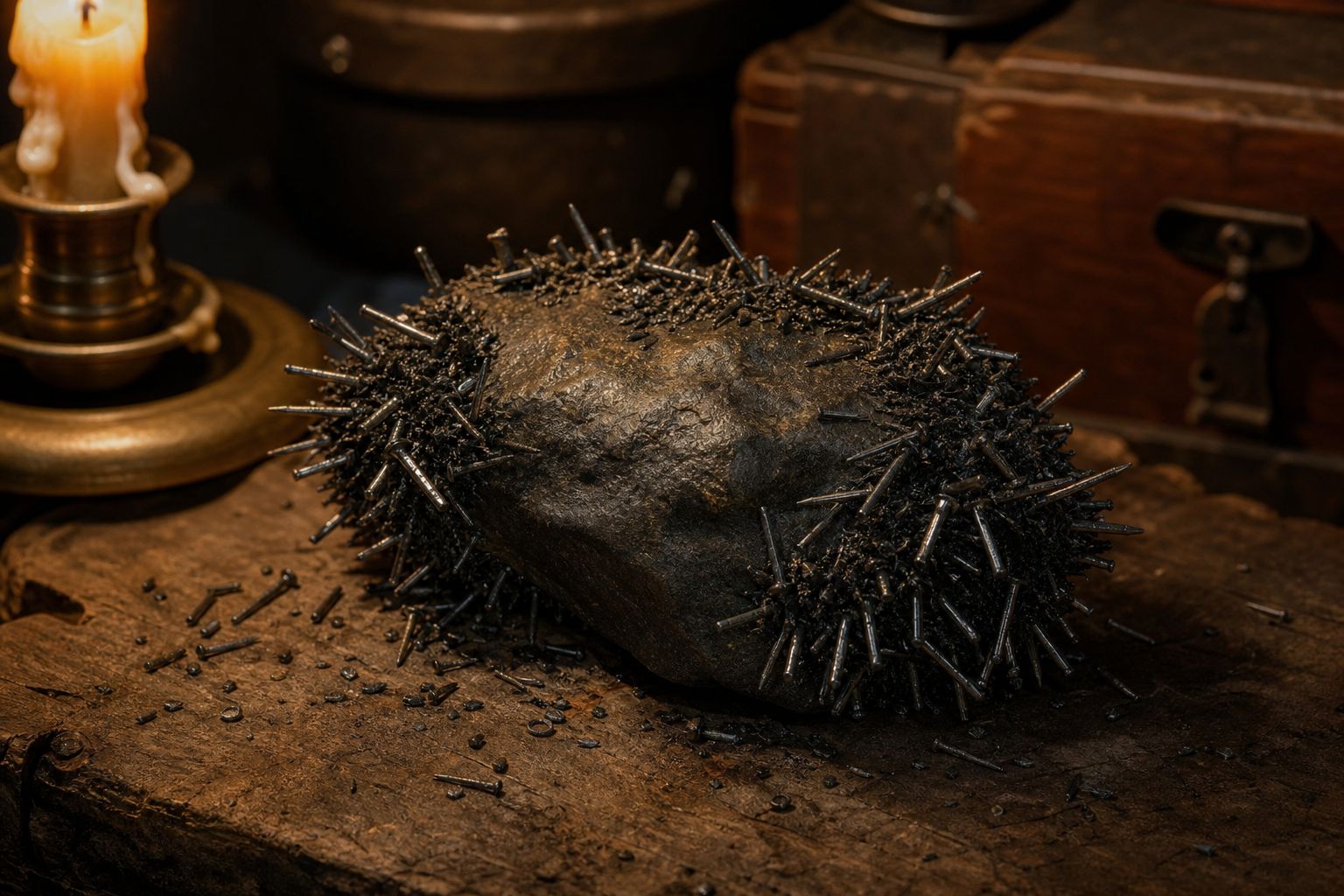
It begins with a stone. Lodestone is a piece of the mineral magnetite that nature has magnetised, most likely by lightning. It pulls on iron.
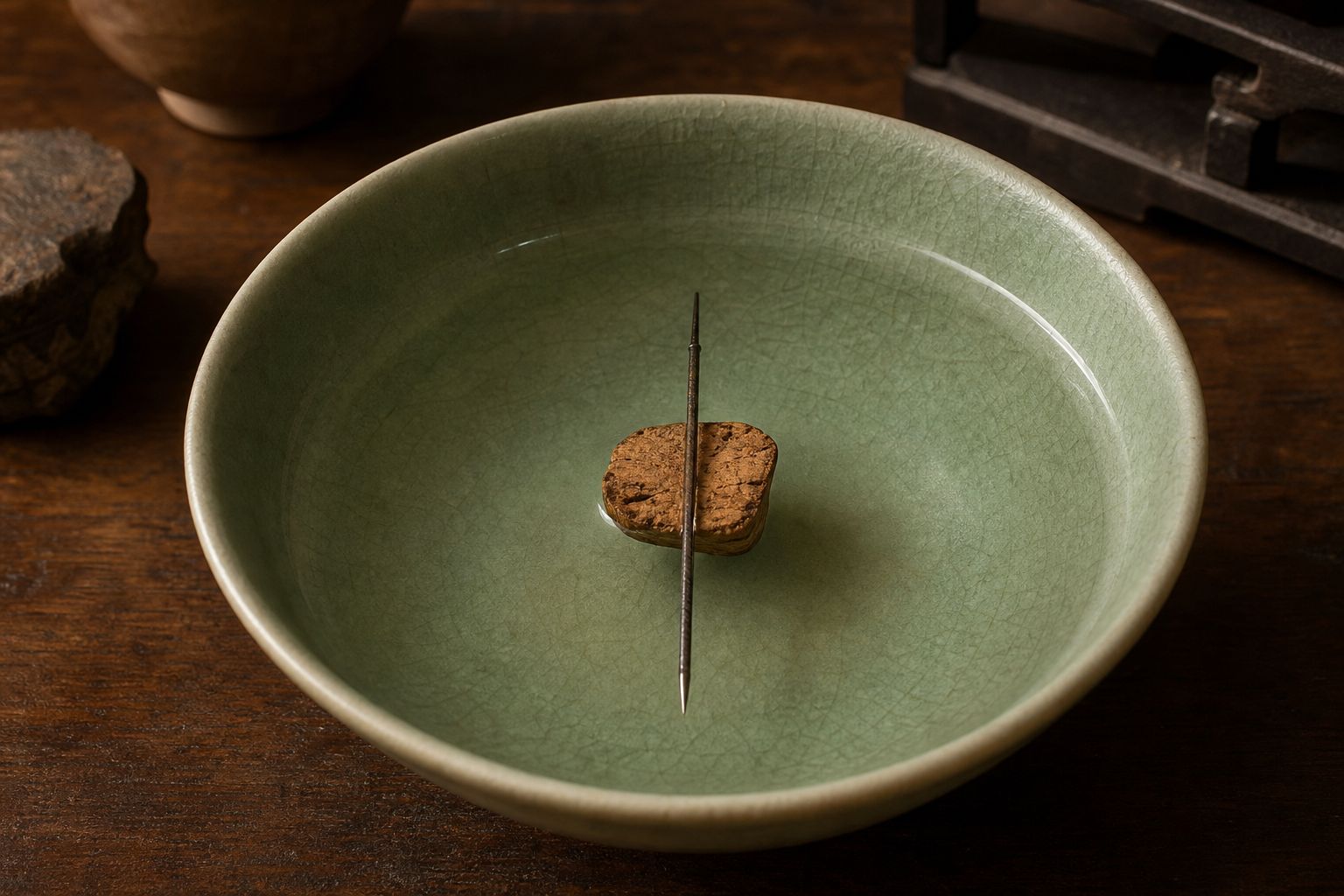
In China, in 1088, the scholar Shen Kuo described needles rubbed on lodestone. Hung from a silk thread, they settled along the north–south line.
A few decades later, Zhu Yu recorded sailors steering in dark weather by a south-pointing needle.
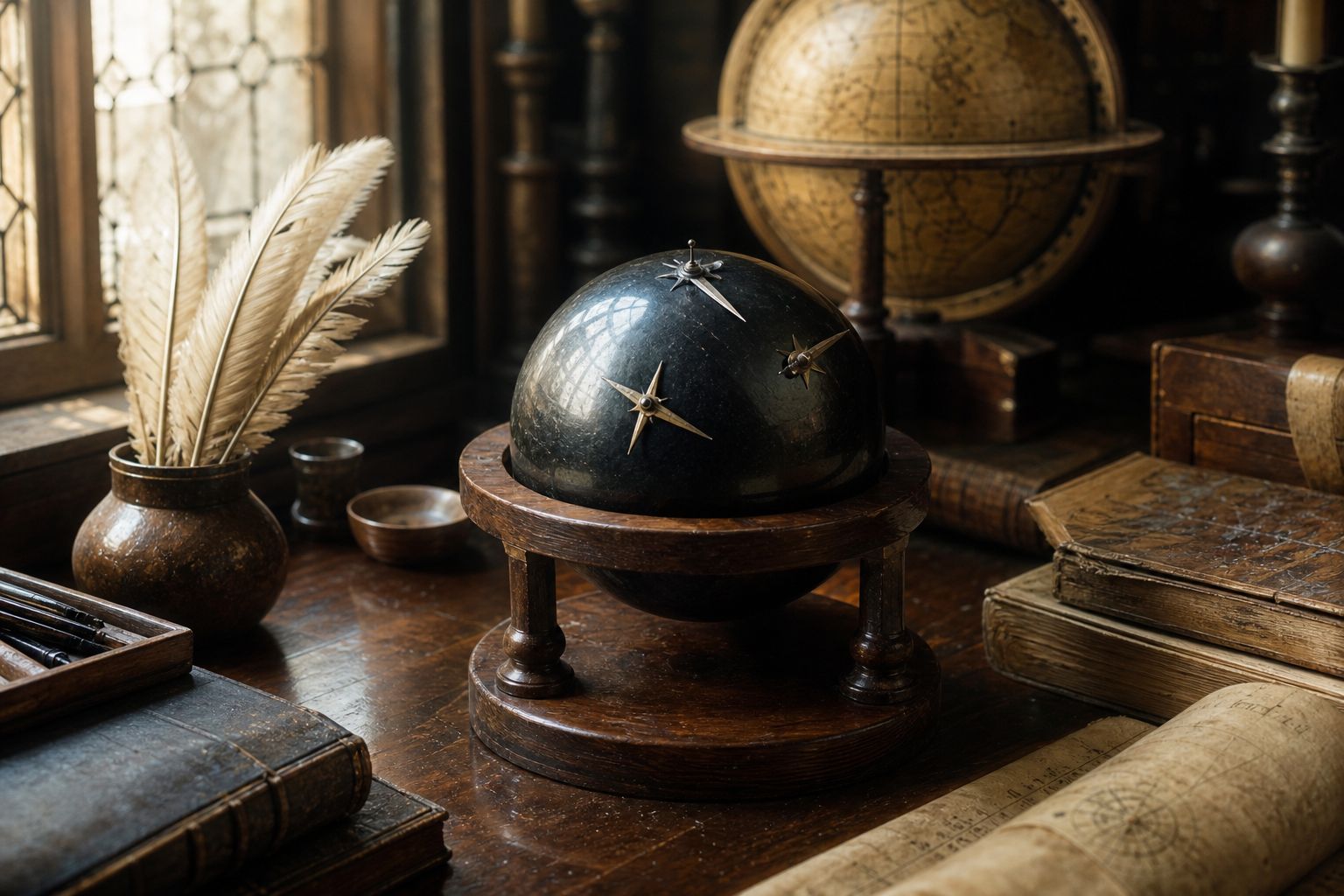
Lodestone Most lodestones are found near the surface, which fits the lightning idea. AI-generated still.A floating needle A magnetised needle free to turn settles along the north–south line. AI-generated still.
1088 Shen Kuo, Dream Pool Essays
1111–1117 Zhu Yu: pilots use the needle at sea
c. 1190 Alexander Neckam, England
The compass, first records
Chapter I · The stone that points
Lodestone and the first compasses
Lodestones are naturally magnetised pieces of the mineral magnetite; the leading theory is that they are magnetised by the strong fields around lightning bolts, which fits their mostly near-surface location. The first incontestable Chinese reference to a magnetised needle is Shen Kuo’s Dream Pool Essays of 1088. Zhu Yu’s Pingzhou Table Talks (1111–1117) records pilots using a south-pointing needle in dark weather, the earliest explicit record of the compass at sea. In Europe, Alexander Neckam described a compass needle around 1190.
The 3D atoms, arrows, field lines and filings are simplified teaching models, not to scale.
But why should a needle point north? In 1600 the English physician William Gilbert published De Magnete, On the Magnet.
He shaped a lodestone into a ball, a little Earth, and moved a tiny needle over it. The needle pointed to the poles and dipped downward.
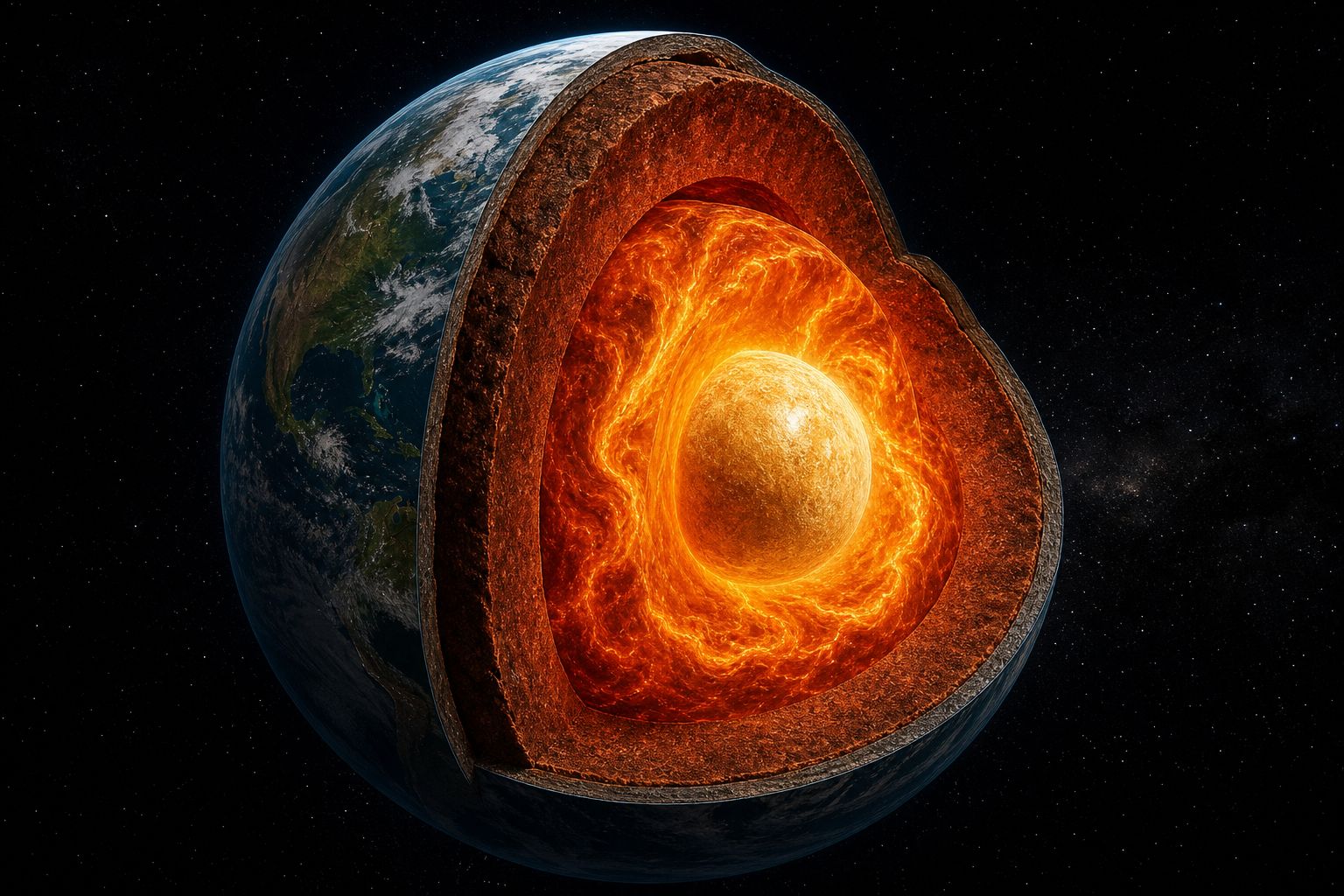
His conclusion: the Earth itself is a giant magnet. Today we know why. Molten metal churning in Earth's outer core carries electric currents, and those currents make the field.
Gilbert’s terrella Gilbert called the ball a terrella, “little Earth”, and his needle a versorium. AI-generated still.
written in Latin, in six books
the dip of the needle had been found by Robert Norman in 1581
Gilbert became physician to Elizabeth I in 1601
De Magnete (London, 1600)Earth’s dynamo About 97–99% of the field at the surface comes from the liquid outer core (NASA). AI-generated illustration.
~20,000 nT
at the magnetic equator
~65,000 nT
near the poles
Earth’s field at the surface (NASA)
Chapter I · The stone that points
Gilbert and the geodynamo
William Gilbert (1544–1603), later physician to Elizabeth I, published De Magnete in London in 1600. Moving a small needle over a spherical lodestone he called a terrella, he found it pointed to the poles and dipped as compasses do, and concluded that the Earth itself is a giant magnet. NASA explains that the main field is produced by electric currents driven by a self-sustaining dynamo in Earth’s conducting liquid outer core; it supplies about 97–99% of the field at the surface, roughly 20,000 nT (nanotesla) at the magnetic equator and 65,000 nT near the poles.
Geographic and magnetic poles are not in exactly the same place; the 3D globe simplifies this.
The 3D atoms, arrows, field lines and filings are simplified teaching models, not to scale.
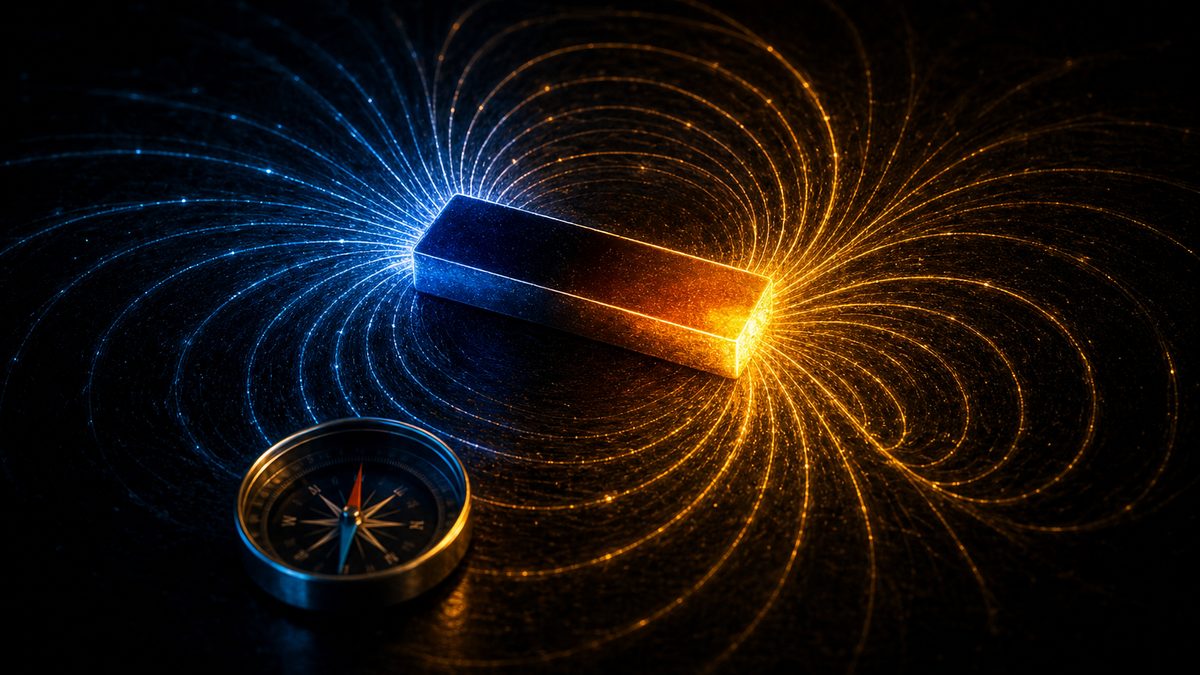
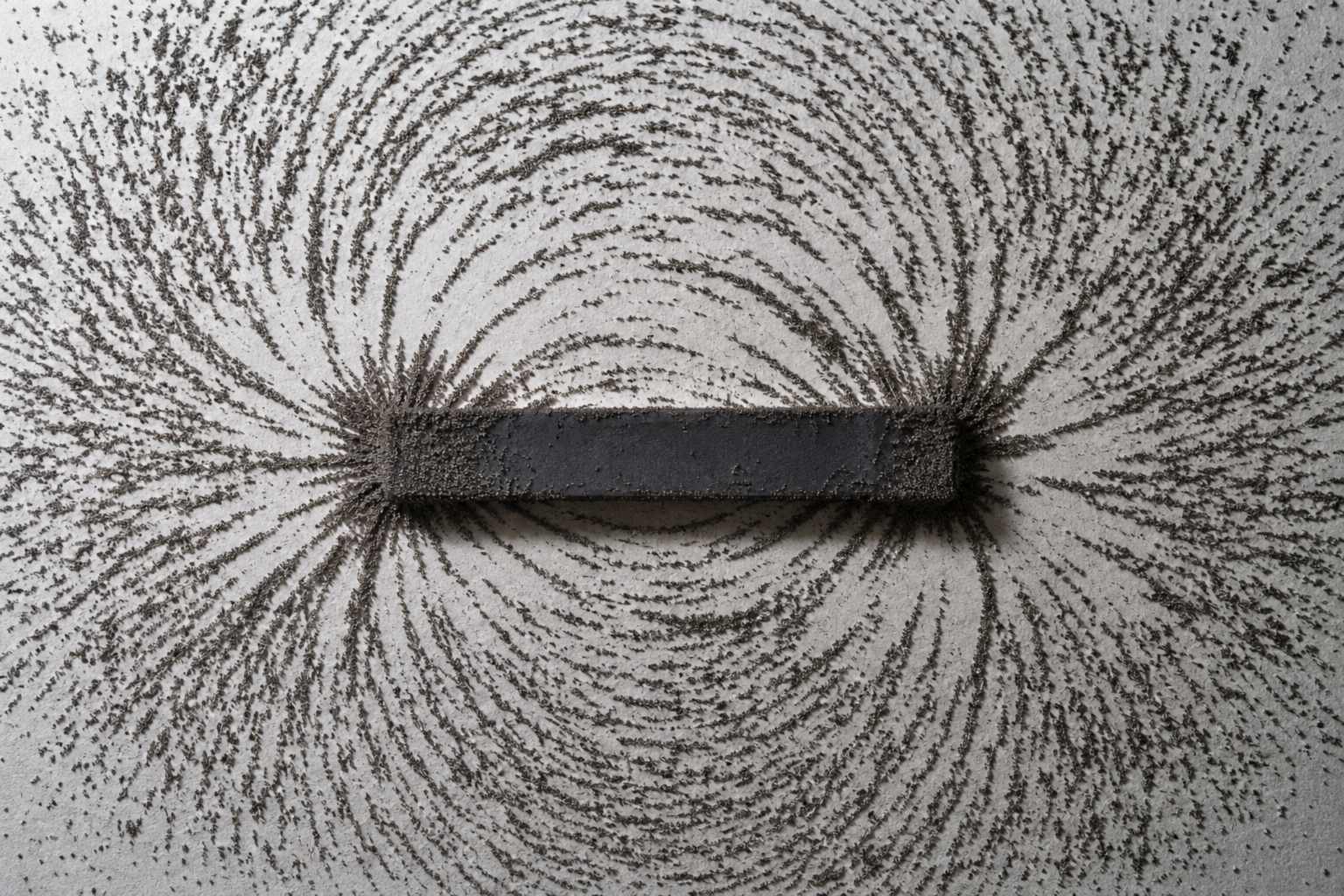
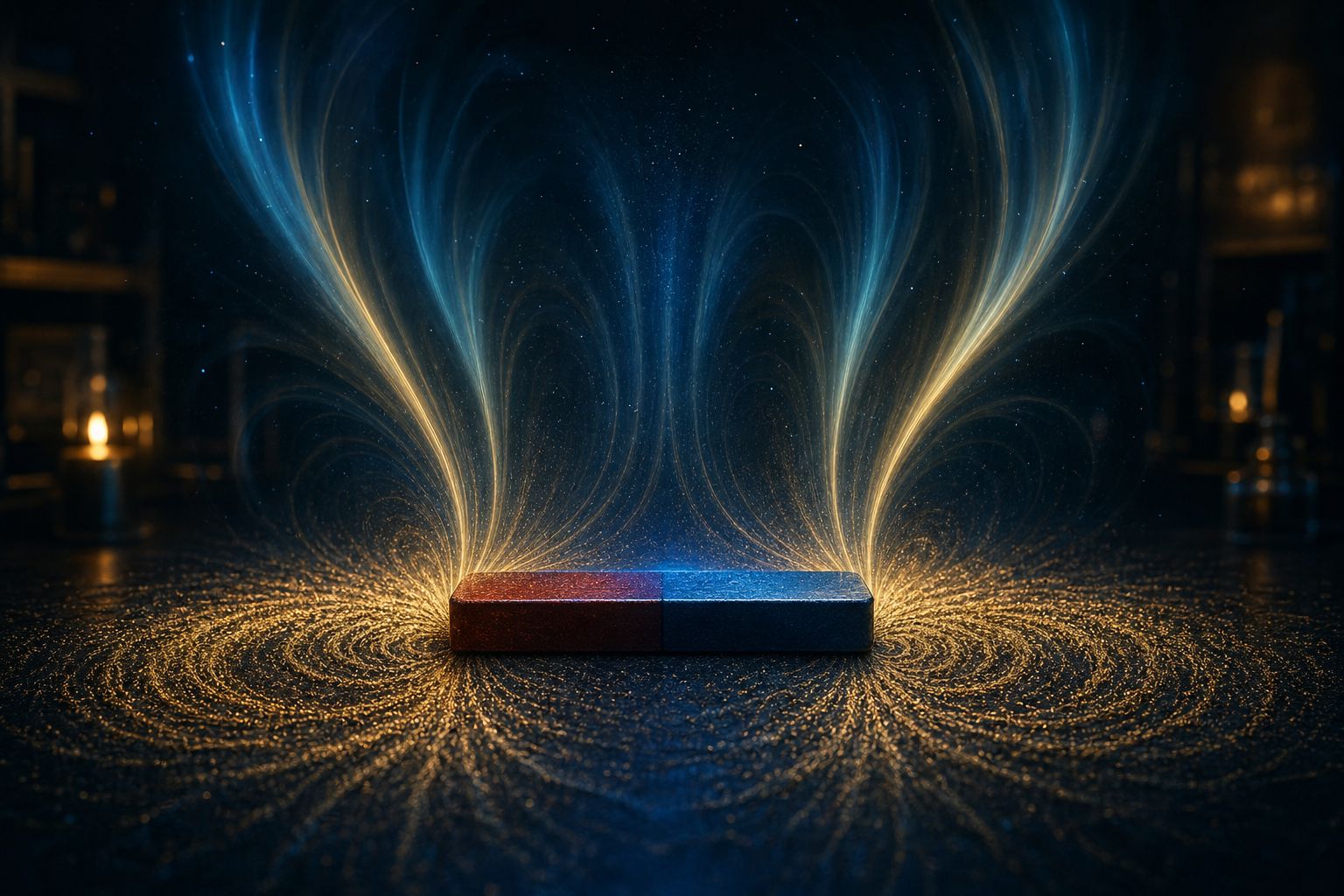
Every magnet is surrounded by a magnetic field, a region where it can push and pull on iron. Iron filings line up along curves called field lines.
The lines leave one end, the north pole, loop around, and enter the other end, the south pole. Opposite poles attract; like poles repel.
Poles never come alone. Cut a magnet in half and you get two smaller magnets, each with its own north and south. Try it.
Iron filings Each filing becomes a tiny magnet and turns to lie along the field. AI-generated still.
form closed loops, continuing inside the magnet
crowd together where the field is strong
never cross one another
Field lines (NCERT)
0
isolated poles ever found
2
poles in every piece
Magnetic monopoles
Chapter II · Fields and currents
Magnetic fields and poles
The NCERT physics textbook states that the field lines of a magnet form continuous closed loops, that iron filings sprinkled around a bar magnet show its two poles, and that, unlike electric charges, isolated north and south poles (magnetic monopoles) do not exist: a bar magnet broken in two gives two similar, slightly weaker magnets. A freely suspended magnet’s north-seeking end points towards geographic north.
The 3D atoms, arrows, field lines and filings are simplified teaching models, not to scale.
Electricity and magnetism turn out to be one thing.
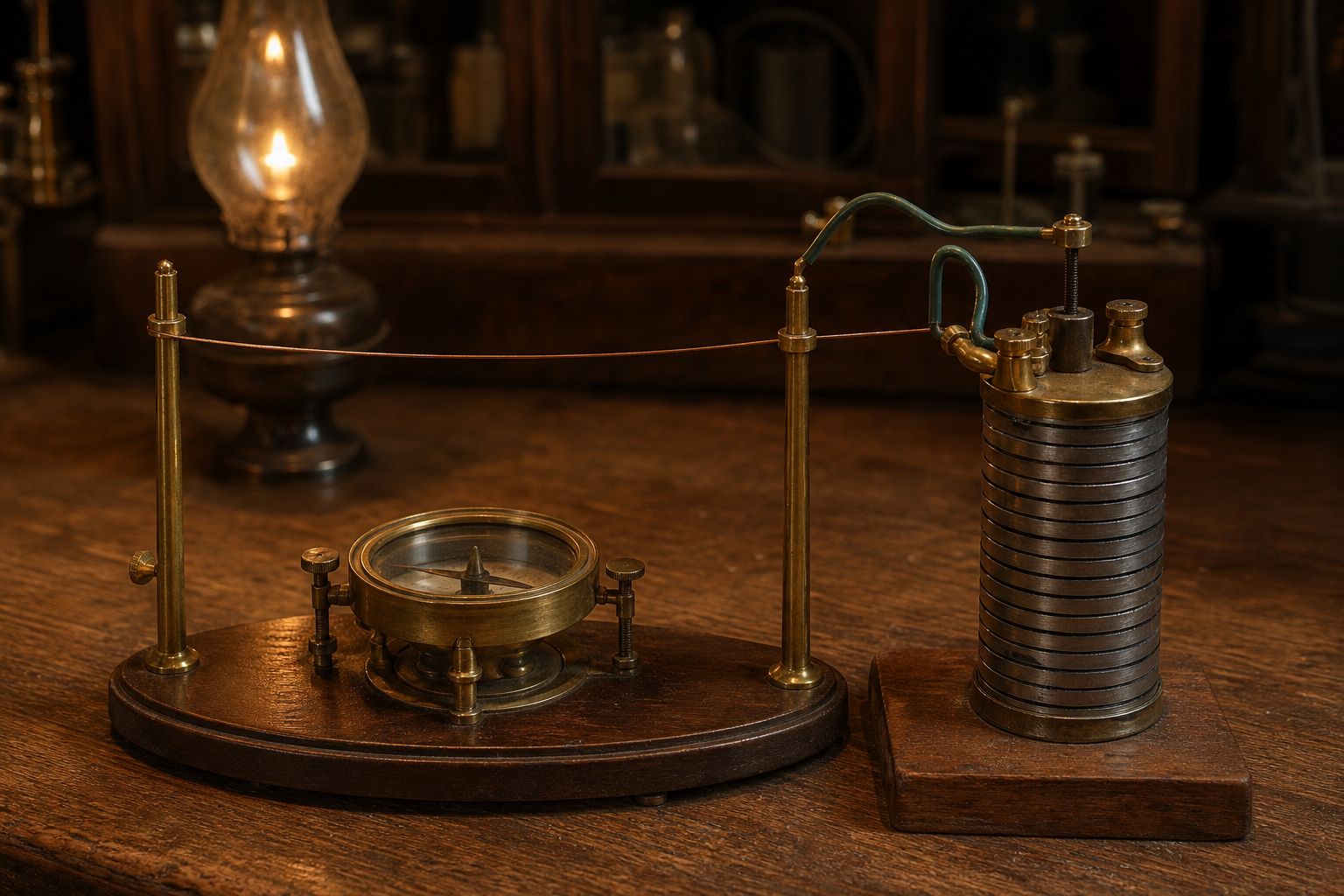
For centuries, electricity and magnetism seemed unrelated. Then, on 21 April 1820, during a lecture in Copenhagen, Hans Christian Ørsted switched on a current, and a nearby compass needle swung.
An electric current makes a magnetic field. Around a straight wire, the field lines are circles, like rings around the wire.
Switch the current off and the field is gone. Reverse it, and the needles turn the other way. Try the switch.
A lecture bench, 1820 The needle moved so little that the audience did not notice (APS). AI-generated still.
21 Apr 1820 Ørsted sees the needle move
21 Jul 1820 he publishes in a pamphlet
1820s Ampère writes the mathematics of forces between currents
From a needle to a law (APS)
no current: no field
more current: stronger field
reverse the current: reverse the field
The rule of the field
Chapter II · Fields and currents
Ørsted, 1820
APS News: on 21 April 1820, while setting up a lecture demonstration in Copenhagen, Hans Christian Ørsted noticed that a compass needle moved away from magnetic north when he switched on an electric current. The effect was small and the audience did not notice. He published on 21 July 1820. André-Marie Ampère soon worked out a mathematical law for the magnetic forces between current-carrying wires; about a decade later, Michael Faraday showed the reverse effect, a changing magnetic field inducing a current.
The 3D atoms, arrows, field lines and filings are simplified teaching models, not to scale.
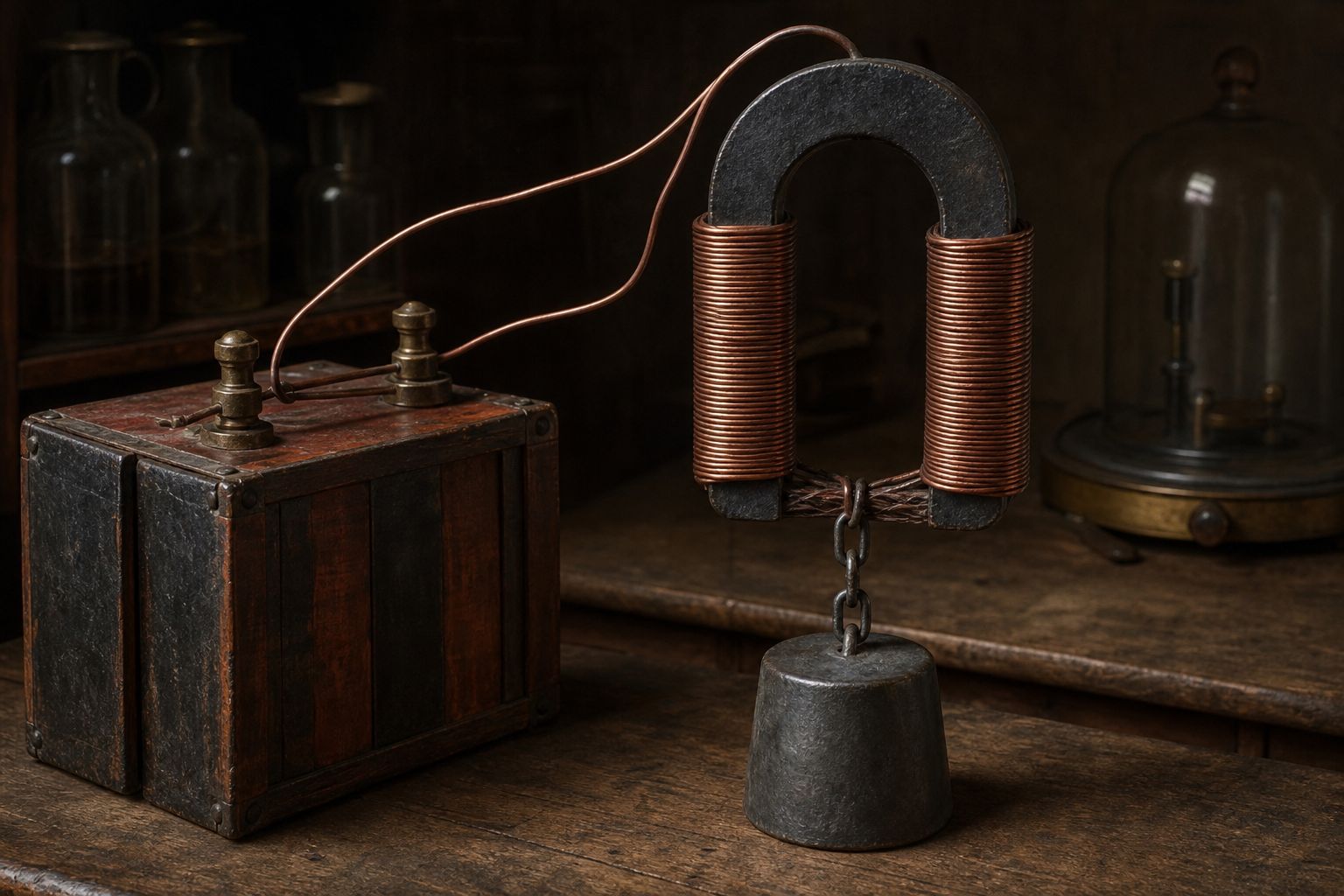
Wind the wire into a coil, and the rings add up into a field shaped just like a bar magnet's. Slide iron inside, and the field becomes thousands of times stronger.
In 1824 William Sturgeon built such an electromagnet in England. It lifted about four kilograms.
Joseph Henry's soon held over nine hundred. An electromagnet is a magnet with a switch: turn it on and the iron block jumps up.
A horseshoe electromagnet Sturgeon’s first one had about 18 turns of bare copper wire on a bent iron bar. AI-generated still.
Sturgeon, 1825 report
~4 kg
Joseph Henry, 1830s
936 kg
What early electromagnets lifted
cranes that lift scrap steel
relays, bells and loudspeakers
the coils of electric motors
Electromagnets today
Chapter II · Fields and currents
The electromagnet
A current through a coil makes a field concentrated along its axis; an iron core makes it thousands of times stronger than the coil alone, and the field disappears when the current stops. William Sturgeon made the first electromagnet in 1824: a horseshoe of iron with about 18 turns of bare copper wire. In 1825 he reported that the seven-ounce (about 200 g) magnet lifted nine pounds (about 4 kg). From 1830 Joseph Henry used silk-insulated wire with many more turns; one of his magnets supported 2,063 lb (936 kg).
The 3D atoms, arrows, field lines and filings are simplified teaching models, not to scale.
A lodestone has no wires. So where are its currents?
But a lodestone has no wires. Where does its magnetism come from? From inside its atoms.
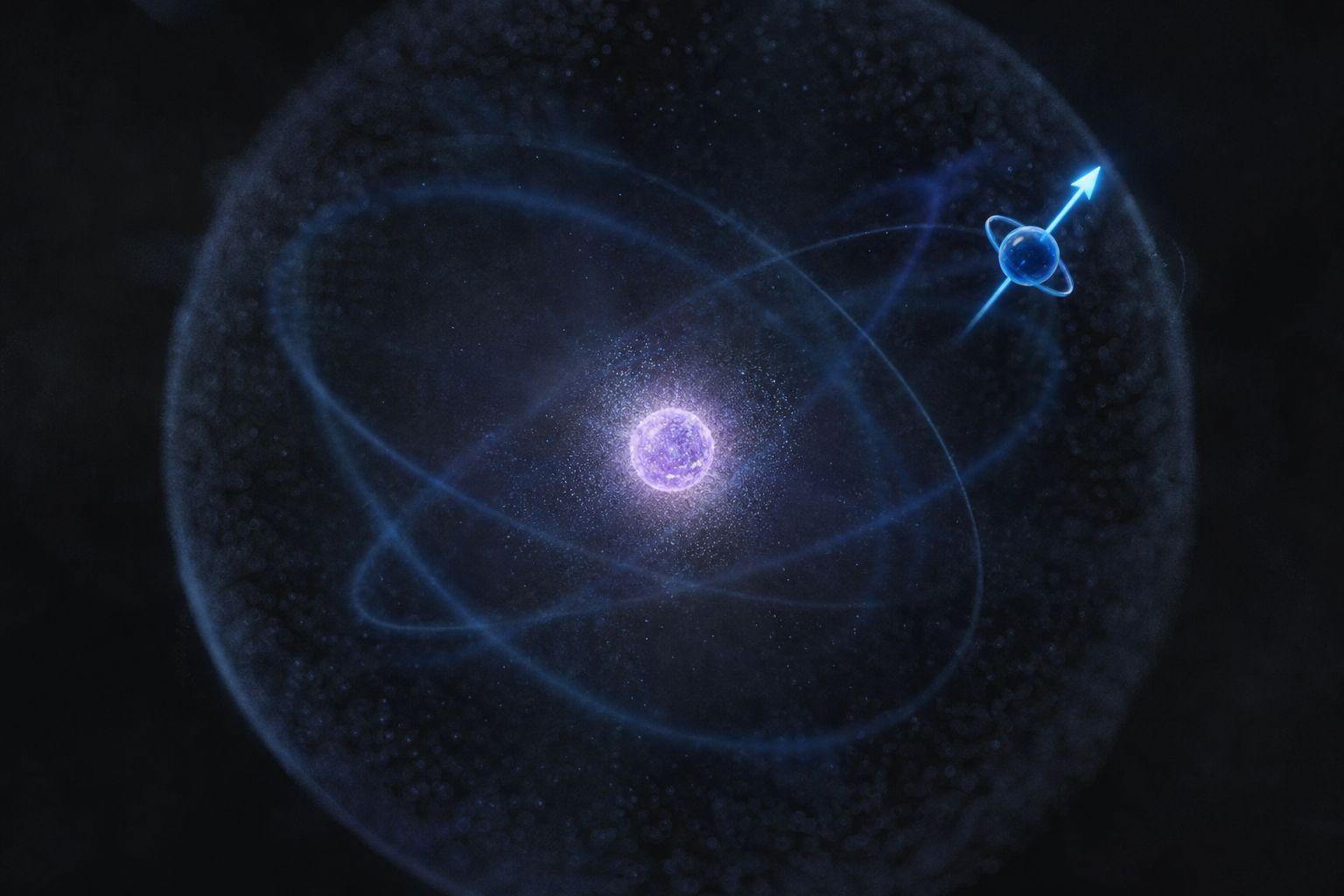
Every atom holds electrons, tiny particles with negative charge. An electron moving around its atom is like a minute loop of current.
Each electron also has a built-in property called spin, which makes it a tiny bar magnet in its own right. Such a tiny magnet is called a magnetic moment.
An atom Electrons form a cloud around a nucleus far smaller than the atom. AI-generated illustration.
orbital motion of the electrons
the electrons’ intrinsic spin
Two sources of an atom’s magnetism (LibreTexts)
the name is historical
a quantum property every electron always has, like its charge
measured along a direction, it is either “up” or “down”
Spin is not a spinning ball
Chapter III · Inside the atom
The electron as a magnet
LibreTexts: the magnetism of metals and other materials is determined by the orbital and spin motions of their unpaired electrons; the electron’s magnetic dipole moment is generated by its intrinsic spin. In the 3D model the large arrow through the orbit shows the moment of the orbital motion, the small arrow on the electron its spin.
Electrons do not really move in neat circles; the orbit is a classroom picture.
The 3D atoms, arrows, field lines and filings are simplified teaching models, not to scale.
If every electron is a magnet, why isn't everything magnetic? Because electrons usually come in pairs, with their spins pointing opposite ways.
The two tiny magnets cancel. In water, wood or plastic, nearly every electron has a partner, so they barely react to a magnet.
But iron, cobalt and nickel keep several unpaired electrons, so each of their atoms is a small magnet. Still, that alone does not make a magnet.
one spin up, one spin down
their fields cancel
the material is weakly pushed away by a magnet (diamagnetic)
Paired electrons (LibreTexts)
all electrons paired
0
iron atom: unpaired electrons
4
Net tiny magnet per atom (schematic)
Fe
iron
Co
cobalt
Ni
nickel
Ferromagnetic at room temperature
Chapter III · Inside the atom
Paired and unpaired electrons
LibreTexts: diamagnetic substances are characterised by paired electrons, whose magnetic fields cancel; they are weakly repelled by a magnetic field. An atom with one or more unpaired electrons is paramagnetic and is attracted to a field. HyperPhysics names iron, nickel, cobalt and some rare earths (gadolinium, dysprosium) as ferromagnetic. An isolated iron atom has four unpaired electrons, as the chart shows; in solid iron the figure per atom is smaller.
The 3D atoms, arrows, field lines and filings are simplified teaching models, not to scale.
In iron, something more happens. A quantum effect with no everyday equivalent, the exchange interaction, makes the spins of neighbouring atoms line up the same way. This is ferromagnetism.
Atoms that agree form regions called magnetic domains. In an ordinary nail, the domains point every which way, and cancel each other out.
Bring a magnet near, and the domains already lined up with its field grow and swallow their neighbours. Now the nail is a magnet. Press apply field.
diamagnetic: weakly pushed away (water, wood)
paramagnetic: weakly pulled, no order
ferromagnetic: spins lock together
How materials react to a magnetDomains, seen from above Domains are about 0.1 mm to a few millimetres across (HyperPhysics). AI-generated still.
0.0002
tesla applied (tesla: unit of field strength)
~1
tesla inside the iron
Soft iron amplifies (HyperPhysics)
Chapter IV · Order in iron
Ferromagnetism and domains
HyperPhysics: in ferromagnets a quantum-mechanical interaction locks the moments of neighbouring atoms into parallel order, so unpaired electron spins line up within regions called domains, about 0.1 mm to a few mm across. In an external field, domains already aligned with it grow at the expense of their neighbours; in annealed iron an applied field of about 0.0002 T (tesla) can produce about 1 T. LibreTexts names this coupling the exchange interaction.
Tesla (T) is the unit of magnetic field strength. Earth’s field is about 0.00005 T.
The 3D atoms, arrows, field lines and filings are simplified teaching models, not to scale.
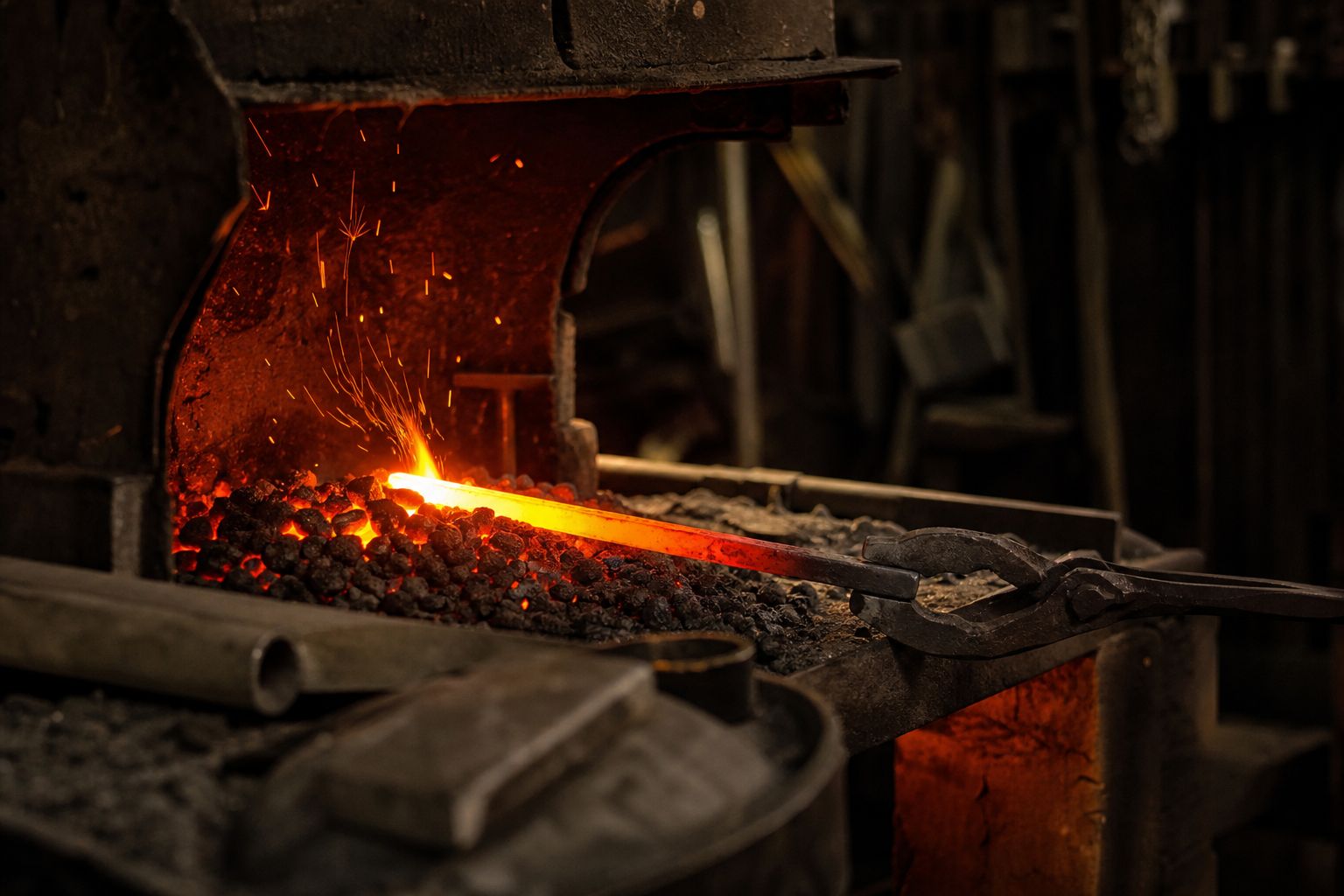
Heat fights that order. As iron gets hotter, its atoms jiggle harder, and the spins wobble out of line.
At about 770 degrees Celsius, iron's Curie temperature, named after Pierre Curie, the order collapses. The domains vanish, and iron stops being ferromagnetic.
Cool it again and the domains return, but pointing at random. The magnet has been wiped. Try heating it yourself.
Red-hot iron Iron glows red at temperatures not far below its Curie point. AI-generated still.
nickel
354 °C
neodymium magnets
310–400 °C
iron
770 °C
cobalt
1,130 °C
Curie temperatures
moments point at random
the metal is only weakly attracted (paramagnetic)
Pierre Curie measured the transition in 1895
Above the Curie point
Chapter IV · Order in iron
The Curie temperature
Above its Curie temperature a ferromagnet loses its permanent magnetism and becomes paramagnetic: its moments are disordered, so it is non-magnetic without an applied field. The temperature is named after Pierre Curie, who studied the transition in 1895. Values listed on Wikipedia: iron 770 °C (1043 K, also given by HyperPhysics), cobalt 1130 °C, nickel 354 °C, neodymium magnets 310–400 °C.
Temperatures on the buttons are illustrative steps; the arrows are a toy model.
The 3D atoms, arrows, field lines and filings are simplified teaching models, not to scale.
Spins can also be ordered another way. In some materials, such as chromium, the exchange interaction makes neighbours point in opposite directions: up, down, up, down.
This is antiferromagnetism. In 1970 the French physicist Louis Néel shared the Nobel Prize in Physics for his work on it.
Its opposite spins cancel exactly, so from outside it looks unmagnetic. For a century, magnets whose spins lock into order came in just these two families. Compare them.
Alternating spins Each atom is still a magnet; only the total is zero. AI-generated still.
for fundamental work and discoveries concerning antiferromagnetism and ferrimagnetismNobel Prize citation for Louis Néel, 1970 (shared with Hannes Alfvén)
ferromagnet spins parallel; strong net magnet
antiferromagnet spins alternate; net zero
Materials whose spins lock in order: two families, until recently
Chapter IV · Order in iron
Antiferromagnetism
In an antiferromagnet a negative exchange interaction between neighbouring atoms (LibreTexts gives body-centred cubic chromium as the example) makes their moments point in opposite directions, so the magnetisation is compensated; above the Néel temperature the material becomes paramagnetic. Louis Néel shared the 1970 Nobel Prize in Physics with Hannes Alfvén, “for fundamental work and discoveries concerning antiferromagnetism and ferrimagnetism”. Mainz University and ScienceDaily note that for over 100 years collinear magnets were sorted into these two categories.
The 3D atoms, arrows, field lines and filings are simplified teaching models, not to scale.
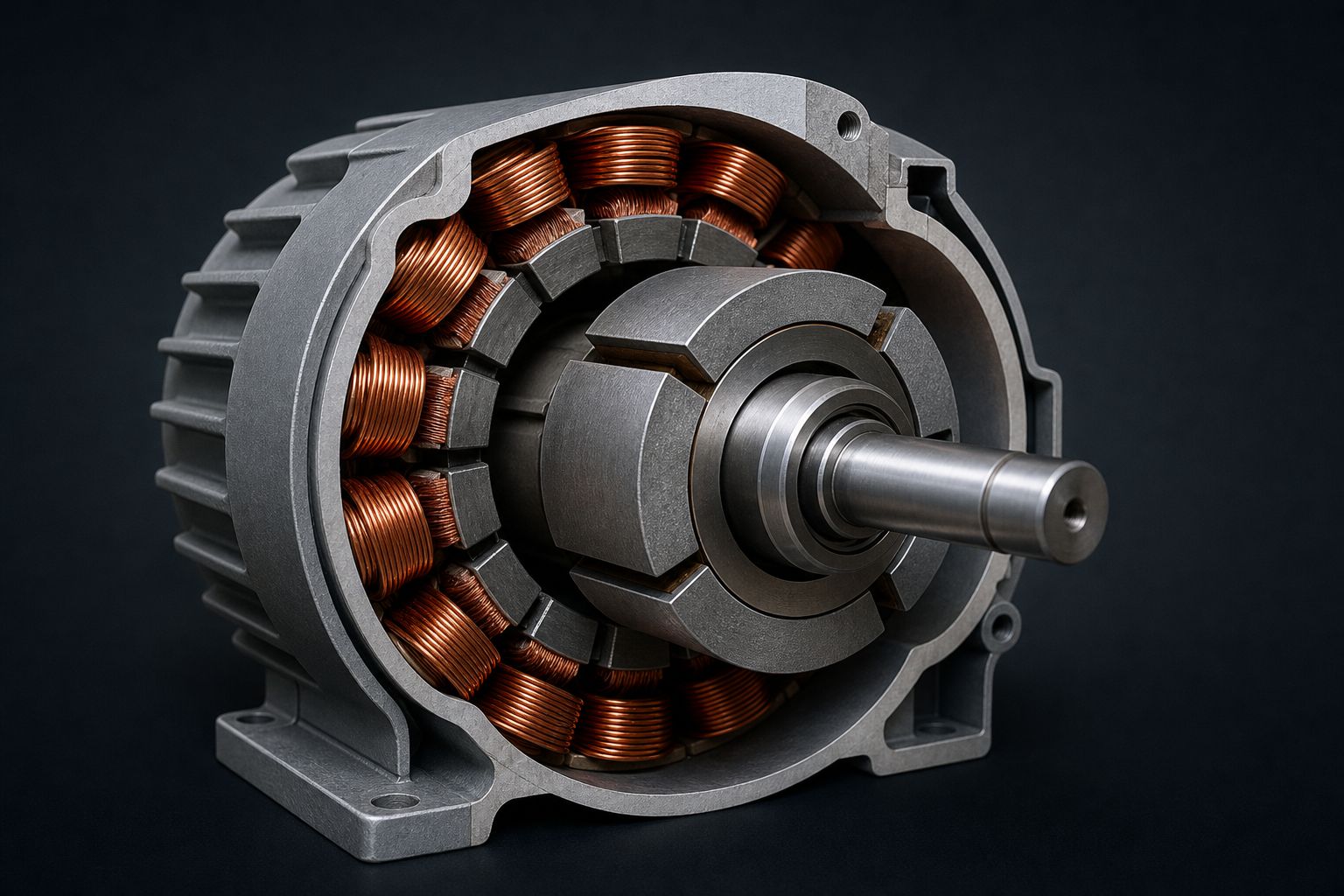
An electric motor turns because the current in its coils pushes against a magnet's field. Motors use about half of the world's electricity.
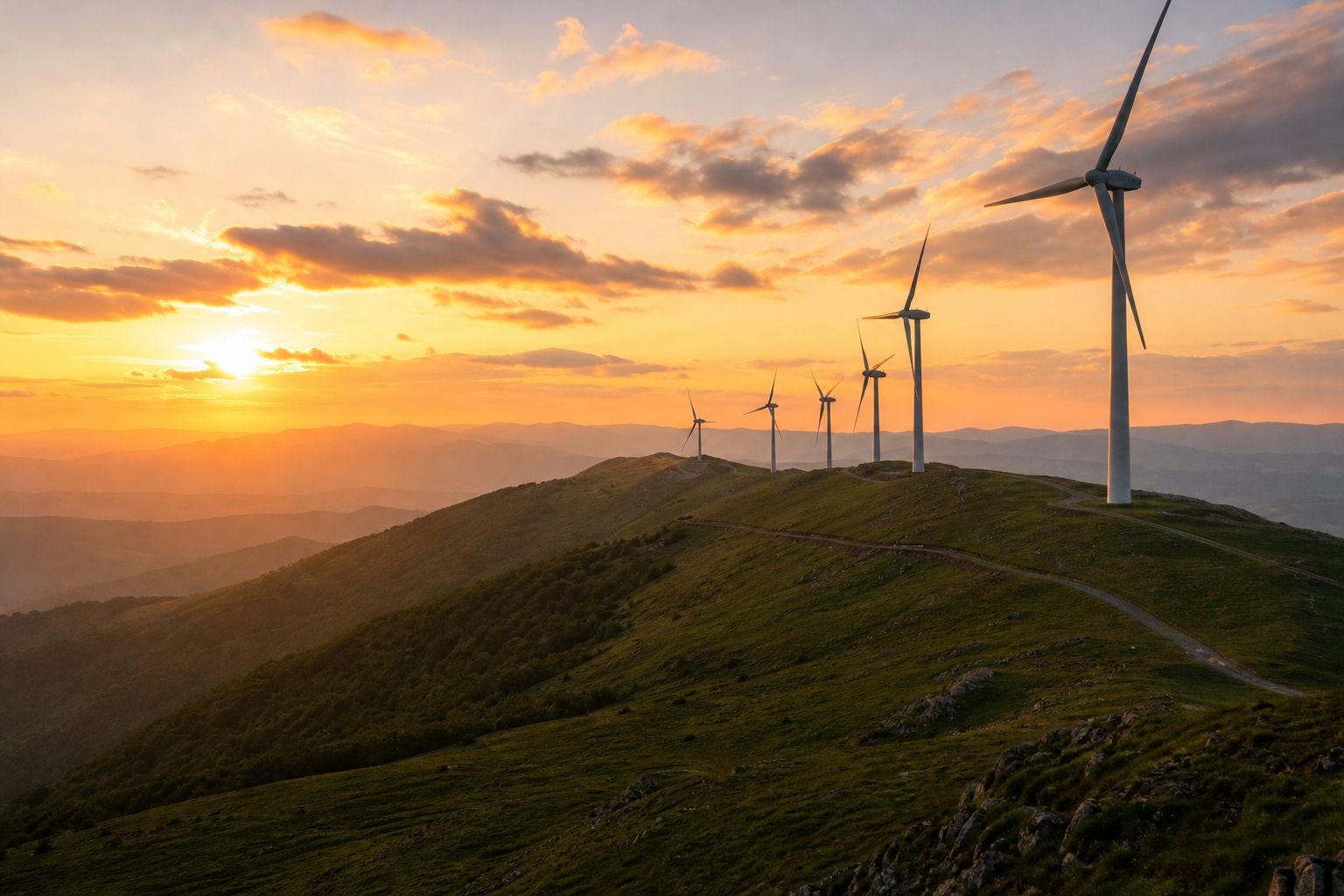
In 1984, General Motors and Sumitomo each developed neodymium magnets. They are the strongest permanent magnets on sale, used in many electric cars and wind turbines.
Hospital MRI scanners use giant superconducting electromagnets to line up hydrogen nuclei in the body. A radio pulse tips them, and the signal they send back becomes the image, without X-rays.
Inside a motor Copper windings on the outside, curved permanent magnets on the rotor. AI-generated still.Wind turbines Some turbine generators use permanent neodymium magnets instead of field coils. AI-generated still.Nd2Fe14B
Nd
neodymium, a rare-earth metal
Fe
iron, which carries most of the magnetism
B
boron
0.00005 T
Earth’s field, roughly
1.5 T
most MRI scanners: superconducting coils, no resistance when very cold
3 T
stronger MRI systems
How strong is a tesla?
Chapter V · Magnets at work
Magnets at work
Electric motors produce torque from the interaction between a magnetic field and the current in a wire winding, and consume about 50% of the world’s electricity. Neodymium magnets, an alloy forming the Nd₂Fe₁₄B crystal, were developed independently in 1984 by General Motors and Sumitomo Special Metals; they are the strongest permanent magnets commercially available and are used in hybrid and electric vehicle drive motors, some wind turbine generators, hard-disk head actuators and headphones. Most clinical MRI systems operate at 1.5 T, with 3 T systems also common; most use superconducting magnets cooled by liquid helium. The field aligns hydrogen nuclei, a radio pulse tips them, and the signal they give back is turned into an image (National MagLab); MRI uses no ionising radiation.
The motor in 3D is a simplified model, not a real design.
This is general education about how the machines work, not medical advice.
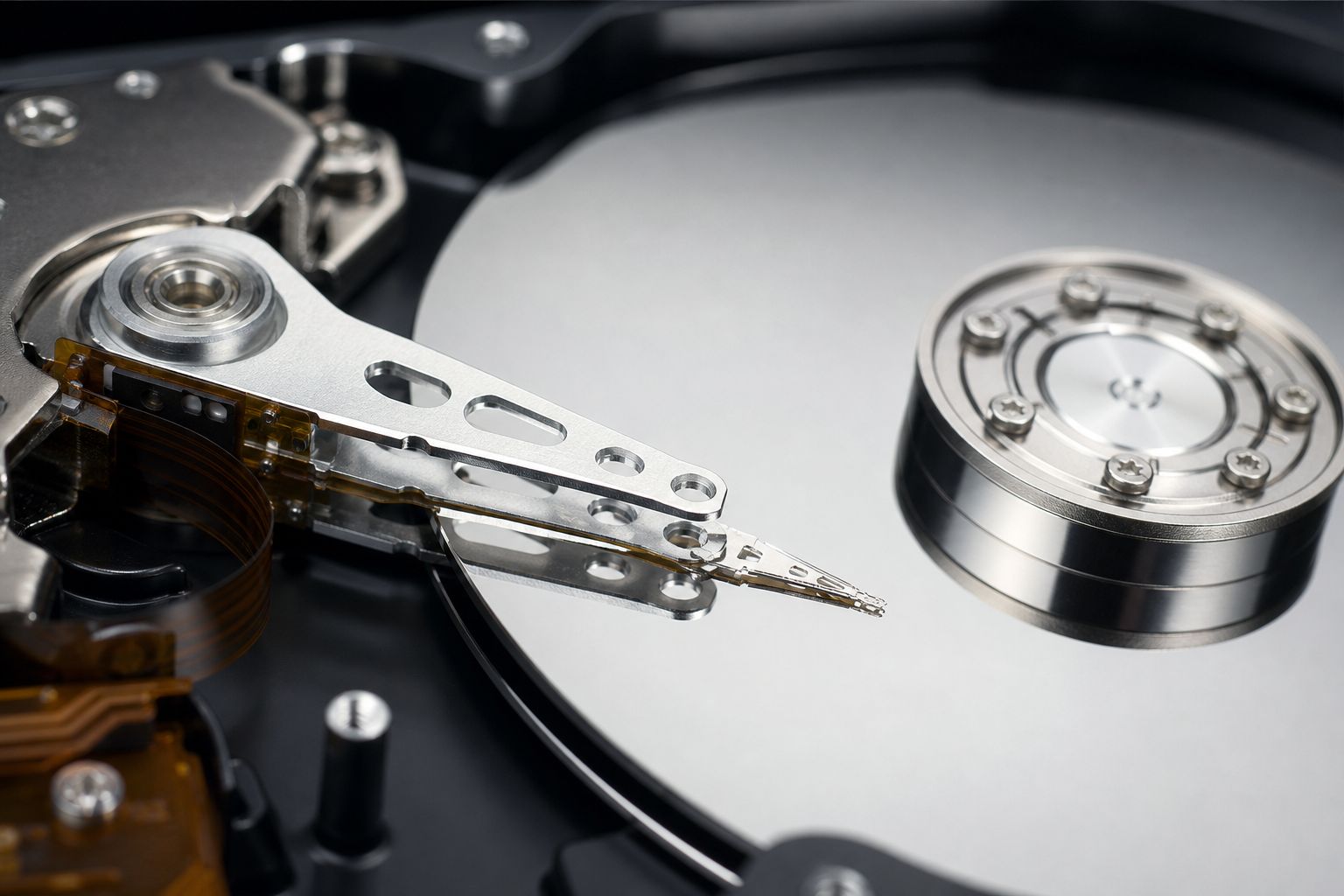
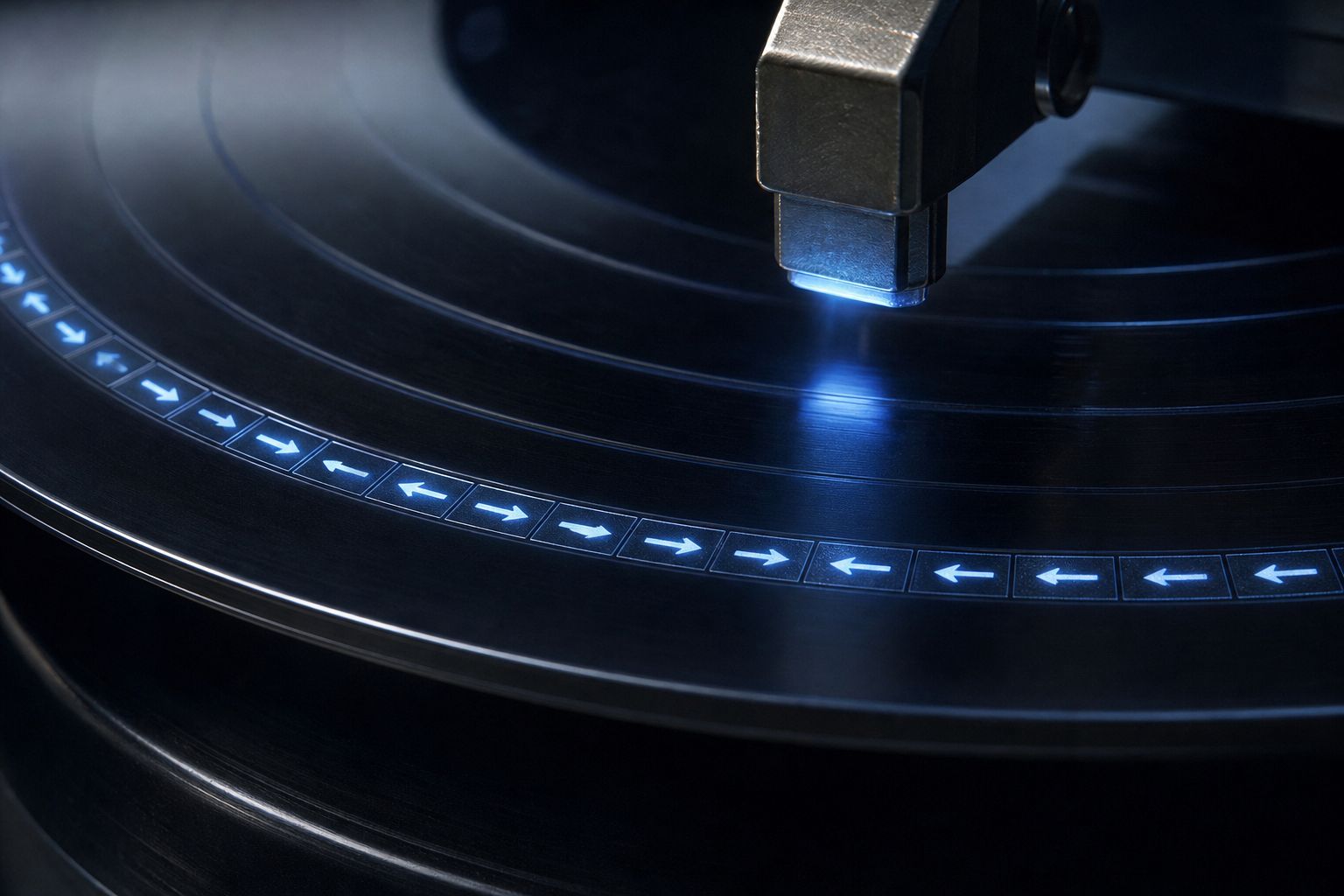
A hard drive stores data as tiny magnetised patches on a spinning disk. One direction means one, the other means zero.
From 1997, drives read them using an effect found in 1988 by Albert Fert and Peter Grünberg: giant magnetoresistance. In very thin layers of metal, a tiny change in magnetism makes a big change in electrical resistance.
It works because electrons carry spin as well as charge. The pair shared the 2007 Nobel Prize; since about 2005 a related spin effect has taken over. Electronics that uses spin is called spintronics.
A hard disk The read head flies just above the platter without touching it. AI-generated still.
1988 Fert and Grünberg find GMR independently
1997 first GMR read head
2005 TMR heads begin to replace GMR
2007 Nobel Prize in Physics
Giant magnetoresistance (Nobel Prize press release)Magnetic bits Bits lie along circular tracks under a head that never touches the disk. AI-generated illustration.
1997–2005
GMR heads
2005 on
TMR heads, also spin-based
What has read hard drives (UK REF case study)
Chapter V · Magnets at work
Hard drives and giant magnetoresistance
The 2007 Nobel Prize in Physics went to Albert Fert and Peter Grünberg “for the discovery of Giant Magnetoresistance”, which each found independently in 1988: very small magnetic changes give rise to large differences in electrical resistance. A GMR read-out head converts the disk’s tiny magnetic patterns into changes in current, the ones and zeros of the data. The first such head was launched in 1997 and quickly became standard; the press release calls GMR one of the first real applications of nanotechnology. GMR depends on the spin of the conducting electrons. A UK research impact case study reports that GMR heads were used from 1997 until 2005 and were then gradually replaced by heads based on tunnel magnetoresistance (TMR), another effect that depends on electron spin.
The 3D atoms, arrows, field lines and filings are simplified teaching models, not to scale.
A magnet with no net field that still sorts electrons by spin.
Which brings us back to the prize. From 2019, Šmejkal, Sinova, Jungwirth and colleagues used the symmetries of crystals to predict a third kind of order.
In an altermagnet, neighbouring spins point opposite ways, so, like an antiferromagnet, it has no overall magnetism. But the two sets of atoms sit in the crystal at different angles.
So electrons travelling one way through the crystal have mostly one spin, and those travelling another way mostly the other, something once thought to need a ferromagnet. The spin alternates with direction: hence the name.
In 2024, experiments on manganese telluride and chromium antimonide measured this splitting. Spin-sorted currents with no net magnetism, plus very fast magnetic dynamics, are why the team sees altermagnets as candidates for future spintronics: still a prospect, not a product.
2019 concept proposed at Mainz
2022 symmetry classification, hundreds of candidates
2024 measured in MnTe and CrSb; named a Science breakthrough
2026 Europhysics Prize
From prediction to prize (Mainz University)
ferromagnet: net magnetism, spin-split electrons
antiferromagnet: no net magnetism, no spin splitting
altermagnet: no net magnetism, spin-split electrons
Three kinds of order (spins along one line)
ferromagnet: mostly “up”, whichever way they move
antiferromagnet: no preference
altermagnet: “up” along one axis, “down” along the other
Which spin do moving electrons carry? (schematic)Measuring the splitting Teams used photoemission: light knocks electrons out and their energies and directions are recorded. AI-generated still.
MnTe
Nature, February
CrSb
Nature Communications, March
Published in 2024 “Splitting”: electrons with spin up and spin down end up with different energies.
Chapter VI · A third kind
Altermagnetism
Mainz University (2024 release): researchers at Mainz proposed the concept in 2019; Mainz University (2026 release): in 2022 the team published a complete symmetry classification and identified hundreds of candidate materials. Altermagnets have no net magnetisation, like antiferromagnets, yet show electronic properties once thought exclusive to ferromagnets, including highly spin-polarised currents together with ultrafast magnetic dynamics, which is why they are described as attractive candidates for next-generation spintronic devices; the spin polarisation alternates with direction, which gives the name. In February 2024 Krempaský and colleagues reported in Nature photoemission measurements of the predicted spin splitting in MnTe (manganese telluride); in March 2024 a Nature Communications paper reported a splitting of about 0.6 eV in CrSb (chromium antimonide) thin films. Science listed the discovery among the physics breakthroughs of 2024. Mainz and ScienceDaily describe possible uses in spintronics and information technology with words such as “could” and “potentially”: these are research prospects, not existing products.
In the model, red and blue dots are electrons with opposite spins; the “different angles” are drawn as atoms stretched along two diagonals. Real altermagnet crystals are more complex.
The 3D atoms, arrows, field lines and filings are simplified teaching models, not to scale.
Alternate them and the magnetism hides; alternate them in a crystal where the two sets sit at different angles, and the electrons still feel their spin. From a stone that found north and south to devices still being imagined, it all comes down to the electron's spin.
1088 magnetised needle, China
1600 Gilbert: the Earth is a magnet
1820 Ørsted: currents make magnetism
1970 Nobel Prize for antiferromagnetism
1988 giant magnetoresistance
2024 altermagnets measured
MilestonesField lines All stills and illustrations in this film are AI-generated.
ferro: all together
antiferro: alternate, hidden
alter: alternate, still spin-split
Three kinds of order
Epilogue · Sources
How magnets work
Field lines, electromagnetism, electron spin, ferromagnetism, domains, the Curie temperature and antiferromagnetism are established physics found in textbooks and the sources below. Altermagnetism is recent: predicted from 2019, classified in 2022 and measured in 2024 in published, peer-reviewed experiments; its possible applications are still research prospects.
The 3D atoms, arrows, field lines and filings are simplified teaching models, not to scale. All stills are AI-generated.