After Israel's Knesset election of 27 October 2026, the near-complete count left neither main bloc with the 61 seats needed for a majority. This film explains how coalition governments are made: why proportional representation rarely gives one party a majority, how Israel's electoral threshold and its rules for forming a government work, the simple models political scientists use to predict who teams up with whom and how much power a small party holds, and what Germany, Belgium, the Netherlands, Thailand, Britain and Scandinavia show about coalition deals, long formations and minority governments.
Interactive 3D film9 min1949 to 2026Published 31 October 2026
One hundred and twenty seats. To govern, you want sixty-one of them. After Israel's election on 27 October 2026, nobody had them.
In the near-complete count, a bloc led by Benjamin Netanyahu had fifty-three seats, an opposition bloc led by Gadi Eisenkot forty-eight, and Arab-led parties nineteen.
Fifty-three plus nineteen would make a majority. But according to ABC News, both bloc leaders have ruled out governing with the Arab-led parties.
So who governs when no one wins? In much of the world the answer is a coalition, a government built after the vote, by bargaining.
1
chamber, elected for terms expected to last four years (CFR)
120 ÷ 2 + 1
the smallest majority
The Knesset
Netanyahu bloc
53 seats
Eisenkot-led opposition
48 seats
Arab-led parties
19 seats
Near-complete count (Al Jazeera, 29 Oct 2026)
53 + 19 = 72
seats: enough for a majority, but ruled out by both bloc leaders
On paper (ABC News)
151
seats for the largest party, which did not lead the government
Coming up: Thailand, 2023
Prologue
Israel’s 2026 election
Al Jazeera (29 October 2026), citing Haaretz with more than 99% of ballots tallied: Netanyahu’s bloc 53 of 120 seats, the Eisenkot-led opposition bloc 48, and Arab list parties 19 combined; neither bloc reached the 61 seats needed for a majority, and the results were provisional until certified. ABC News reported the same bloc totals and that both Netanyahu and Eisenkot had ruled out coalitions with Arab parties. Wikipedia lists 4 November 2026 as the date for confirming official results. This film explains the rules and does not predict who will form the government.
Try it: show where the 61-seat line falls.
The seat charts and clocks are simplified teaching models. Parties A–G are made up; real seat counts appear only where a source is named.
Israel elects its parliament, the Knesset, in one nationwide vote. People vote for a party's list, not a local candidate, and seats are shared out in proportion to the votes.
That is proportional representation. When many parties each win a slice, one party rarely reaches half. In Israel, no single party has ever won a majority of the seats on its own.
So ever since the first Knesset in 1949, governing there has meant building a coalition.
A party list, not a person Each ballot names a party; its list decides who sits. AI-generated still.
One nationwide constituency
Each party ranks its own list
Seats go down the list in order
How seats are filled (CFR)
0
single-party majorities in the Knesset
Since 1949 (CFR)
Chapter I · Why no one wins outright
One nationwide list vote
Council on Foreign Relations: Knesset seats are allocated by nationwide proportional representation; voters choose a party rather than individual candidates, each party ranks its list before the election, and seats go to the names in that order. “No single party has ever won a majority of the seats in the Knesset,” so coalitions are required. Wikipedia (2026 election): the system is closed-list proportional representation in a single nationwide constituency.
How electoral systems themselves differ is told in the PlanetPast film on voting systems; this film starts after the votes are counted.
Try it: replay the seats filling in.
The seat charts and clocks are simplified teaching models. Parties A–G are made up; real seat counts appear only where a source is named.
There is one filter before the seats are shared. A party must win at least 3.25 percent of the vote, about four seats' worth, or it gets no seats at all.
In 1984 the bar was one percent, and by 2013 it was two. In 2014 the Knesset raised it to 3.25. Votes for parties below the line are, in effect, wasted.
Try it on a made-up election: press one, two or 3.25 percent, and watch the smallest parties drop out.
3.25%
of valid votes
≈ 4
seats’ worth
Israel’s threshold (Israel Policy Forum)
1984 1%
2013 2%
11 Mar 2014 3.25%, passed 67–0; the opposition boycotted the vote (Times of Israel)
The bar rises
1984
~60,000
2013
~270,000
Wasted votes, below the bar (IPF)
Chapter I · Why no one wins outright
The 3.25 percent bar
Israel Policy Forum (2019): the threshold was 1% in 1984 and 2% in 2013, and the Knesset raised it to 3.25% in 2014, equal to about four seats; parties below it win no seats, and their ballots are essentially wasted — about 60,000 in 1984 and nearly 270,000 in 2013. The Times of Israel and INSS: the Governance Law that raised the threshold from 2 to 3.25 percent passed on 11 March 2014 by 67–0; the opposition factions, including the Arab parties, opposed it and boycotted the vote.
Try it: set the bar to 1, 2 or 3.25 percent. The seat count here is a simple proportional rounding, not Israel’s exact formula.
The seat charts and clocks are simplified teaching models. Parties A–G are made up; real seat counts appear only where a source is named.
Israel has no single written constitution; its Basic Laws do that job. Under the Basic Law on the government, a new government takes office only after the Knesset votes to accept it, a vote of confidence.
To govern safely, a coalition wants a majority behind it: at least sixty-one of the hundred and twenty. Parties add their seats together until they cross that line.
But seats are not all that gets added. Each partner brings demands: ministries, laws, budgets and lines it will not cross. A coalition is a deal as much as a sum.
Now try it yourself: press the party buttons and add seats until you pass sixty-one.
“The Government is constituted when the Knesset has expressed confidence in it.”English text, Jewish Virtual Library
Basic Law: The Government (2001), section 13(d)
14
quasi-constitutional laws, a constitution in all but name
Basic Laws of Israel (Wikipedia)Adding up Stacks of very different heights, pushed together. AI-generated still.
Which party gets which ministry
Laws to pass, or to block
Budgets for their voters
Who becomes prime minister
What partners bargain over
7
parties, A 34 down to G 8
19
ways to win with no spare partner
Your turn (made-up parliament)
Chapter II · Counting to 61
A majority behind the government
Basic Law: The Government (2001), section 13(d): the Government presents itself to the Knesset and asks for its confidence; “the Government is constituted when the Knesset has expressed confidence in it,” and the ministers then take office. Section 5(b): the Prime Minister must be a member of the Knesset. Wikipedia (Basic Laws of Israel): Israel has an uncodified constitution; its Basic Laws are quasi-constitutional laws that act as a de facto constitution. A coalition with 61 or more of the 120 seats can win confidence votes on its own.
Try it: tap parties A–G to add them to a coalition and watch the total.
The seat charts and clocks are simplified teaching models. Parties A–G are made up; real seat counts appear only where a source is named.
In Israel the first move belongs to the President. About a week after the vote the official results arrive, and the President consults every party group in the Knesset.
Then the President gives the task to the member thought most able to build a government. It does not have to be the leader of the biggest party.
That member gets twenty-eight days, and the President can add up to fourteen more.
The consultations Party by party, the President hears who they back. AI-generated still.
The invitation goes to the leader the President believes can build a coalition, not necessarily the largest party.paraphrase
Council on Foreign Relations
8 + 7
days: official results, then consultations (2021 timetable)
57
days at most from the vote to the end of the first mandate
The first mandate (Basic Law, s. 8)
Chapter III · Who gets to try
The President’s move
Basic Law: The Government, section 7(a): after consulting representatives of the party groups, the President assigns the task of forming a government to “a Knesset Member who has notified him that he is prepared to accept the task”; section 8: that member has 28 days, which the President may extend by periods totalling no more than 14 days. The Jewish Press (2021): the Central Elections Committee delivers the official results to the President eight days after the election, and the President then has seven days for consultations. Council on Foreign Relations: the invitation need not go to the largest party.
Try it: add the 14-day extension to the clock.
The seat charts and clocks are simplified teaching models. Parties A–G are made up; real seat counts appear only where a source is named.
If the first attempt fails, the President can pick a second member, who gets another twenty-eight days.
If that fails too, the Knesset itself gets a last chance. A majority of its members can sign a letter naming a candidate of their own. They have three weeks to do it, and that person then gets two weeks.
If nobody succeeds, the Knesset is dissolved and Israel votes again. Until a new government takes office, the outgoing one keeps working.
s. 9 a second member: 28 days
s. 10 61 members ask for their own candidate: 14 days
s. 11 no government: the Knesset dissolves
The fallback steps (Basic Law)
3
days for the President to pick a second member (s. 9)
61
signatures needed: the candidate must also agree in writing (s. 10)
Sections 9 and 10
“The outgoing Government shall continue to carry out its functions until the new Government is constituted.”Basic Law: The Government (2001)
Section 30(b)
Chapter III · Who gets to try
Second chances, then new elections
Basic Law: The Government (2001): if the first member fails, the President may within three days assign the task to another Knesset member, who has 28 days (section 9); within 21 days after that, a majority of Knesset members may ask in writing that a named member who has agreed in writing be assigned the task, and that member has 14 days (section 10); if no government is formed, the Knesset is treated as having decided to dissolve and new elections follow (section 11); and the outgoing government continues to carry out its functions until the new one is constituted (section 30(b)). The Jewish Press (2021) gives the same sequence, with 61 members as the majority.
Try it: step through the fallback stages.
The seat charts and clocks are simplified teaching models. Parties A–G are made up; real seat counts appear only where a source is named.
Which parties end up together? Political scientists have built simple models. In 1962 William Riker proposed what he called the size principle.
Parties form coalitions just as large as they believe will win, and no larger. Every extra partner wants a share of the ministries, so a bare majority leaves more for each.
That is a minimal winning coalition: drop any one member and it loses. The seats of the made-up parties A to G are on screen, and this parliament has nineteen such coalitions.
“Participants create coalitions just as large as they believe will ensure winning and no larger.”The Theory of Political Coalitions
William H. Riker, 1962Fewer partners, bigger shares A balance tipped by a small weight. AI-generated still.
19
minimal winning coalitions
62
seats, the fewest a winner can have: A + C + F is one of three
In the made-up parliament (A–G)
Chapter IV · Who teams up with whom
Riker’s size principle
William H. Riker, The Theory of Political Coalitions (Yale University Press, 1962): in situations like n-person zero-sum games with side-payments, “participants create coalitions just as large as they believe will ensure winning and no larger,” so only minimum winning coalitions occur. Office-seeking theories of this kind treat a party’s reward as its share of government posts, which is why they favour small coalitions (Reuse & Gross, 2026). A minimal winning coalition is one that loses its majority if any single member leaves. The counts of 19, and of three coalitions with 62 seats (A + C + F, B + C + E + G, C + D + E + F + G), are worked out for the made-up parliament in the scene.
This is a model: a simple idea that political scientists test against real coalitions, not a law that parties must follow.
Try it: show the smallest winning coalition, then an oversized one.
The seat charts and clocks are simplified teaching models. Parties A–G are made up; real seat counts appear only where a source is named.
Riker's model ignores what parties believe. Robert Axelrod added it: line the parties up from left to right.
His minimal connected winning coalition is made of parties that sit next to each other on that line, with no gap in the middle. A partner far across the spectrum is a harder deal.
In our made-up chart the parties sit in that order, from G on the far left to C on the far right, so a connected coalition is one unbroken wedge.
Office: share the posts among as few as possible
Policy: partners close in ideas
Two families of models (Reuse & Gross, 2026)
62
a smallest winner, A + C + F, has a gap
66
smallest connected winner, G + A + F + D
In the made-up parliamentOne wedge of seats Neighbouring blocks of seats, lit together. AI-generated still.
Chapter IV · Who teams up with whom
Axelrod’s connected coalitions
Reuse & Gross (Government and Opposition, 2026), describing Axelrod (1970) and De Swaan (1973): policy-based theories include the minimal range theory, which expects the minimal winning coalition with the smallest ideological range between partners to form, and the stricter minimal connected winning theory, in which coalitions of parties adjacent to each other on the main policy dimension are more likely to form than others. In the made-up parliament, parties are seated in the order G, A, F, D, B, E, C from left to right.
This is a model: a simple idea that political scientists test against real coalitions, not a law that parties must follow.
Try it: compare the connected coalition with the one that jumps a gap.
The seat charts and clocks are simplified teaching models. Parties A–G are made up; real seat counts appear only where a source is named.
Three votes can buy no more power than two. Here is why. In 1954 Lloyd Shapley and Martin Shubik suggested a way to measure power: imagine the parties joining one by one, in every possible order.
The party whose arrival turns a losing group into a winning one is pivotal. A party's power is the share of orders in which it is pivotal.
Take three parties with four, three and two votes, where six wins. There are six possible orders.
The biggest party is pivotal in four of them, the others in one each. So the party with three votes has exactly as much power as the party with two.
φi=n!orders in which i is pivotal
φi
the Shapley–Shubik power of party i
n!
“n factorial”: the number of possible orders, 3! = 3 × 2 × 1 = 6
The pivotal piece A small key between two heavy doors. AI-generated still.
4 · 3 · 2 → the 3
4 · 2 · 3 → the 2
3 · 4 · 2 and 3 · 2 · 4 → the 4
2 · 4 · 3 and 2 · 3 · 4 → the 4
The six orders: who is pivotal
4 votes
4/6
3 votes
1/6
2 votes
1/6
Power in the vote [6: 4, 3, 2] (LibreTexts)
Chapter IV · Who teams up with whom
The Shapley–Shubik power index
Lippman, Math in Society (LibreTexts): the Shapley–Shubik power index was introduced in 1954 by economists Lloyd Shapley and Martin Shubik; in each sequential coalition, the pivotal player is the one whose joining changes the coalition from losing to winning, and a player’s index is the number of times it is pivotal divided by the number of sequential coalitions, N!. In the worked example [6: 4, 3, 2], the player with 4 votes is pivotal 4 times out of 6, and the players with 3 and 2 votes once each, so each of the smaller two holds 1/6 of the power.
This is a model: a simple idea that political scientists test against real coalitions, not a law that parties must follow.
Try it: step through all six orders and watch who is pivotal.
The seat charts and clocks are simplified teaching models. Parties A–G are made up; real seat counts appear only where a source is named.
Contracts, long waits and governments without majorities.
In Germany, the deal is written down. After the election of 23 February 2025, the conservative CDU and CSU and the Social Democrats agreed a coalition agreement on 9 April.
It sets out the government's plans for four years, and the talks also settle which party runs which ministry.
Koalitionsvertrag A bound agreement and a pen, before the signing. AI-generated still.
23 Feb federal election
28 Mar coalition talks under way
9 Apr CDU, CSU and SPD present the agreement
Germany, 2025 (The Brussels Times)
Foreign and Economics: the conservatives
Finance and Defence: the SPD
Ministries, as media reported
Chapter V · Around the world
Germany’s coalition agreement
The Brussels Times (9 April 2025): after the elections of 23 February, the Christian Democrats (CDU), their Bavarian allies the Christian Social Union (CSU) and the Social Democrats (SPD) announced on 9 April that they had agreed a coalition agreement setting out the government’s plans for the next four years; talks had concluded late on 8 April. According to media reports cited by the paper, the Foreign and Economics ministries would go to the conservatives and Finance and Defence to the SPD.
Try it: share out the ministries between two partners (illustrative).
The seat charts and clocks are simplified teaching models. Parties A–G are made up; real seat counts appear only where a source is named.
Bargaining can take a long time. After Belgium's election in June 2010, it took five hundred and forty-one days to swear in a new government, in December 2011.
Meanwhile a caretaker government stayed on with limited powers, and the budget was extended month by month.
In the Netherlands, forming a cabinet took two hundred and twenty-five days in 2017, then two hundred and ninety-nine across 2021 and 2022.
541
days of negotiation and formation
13 Jun 2010 → 6 Dec 2011
election to swearing-in
Belgium, 2010–11 (Wikipedia)A long wait Calendar pages falling in an empty corridor. AI-generated still.
Belgium 2010–11
541 days
Netherlands 2021–22
299 days
Netherlands 2017
225 days
Thailand 2023 (to PM vote)
100 days
Germany 2025 (to agreement)
45 days
Days to form (sources in panel)
Chapter V · Around the world
Long formations and caretakers
Wikipedia (2010–2011 Belgian government formation): after the election of 13 June 2010, the Di Rupo I government was sworn in on 6 December 2011, ending 541 days of negotiation and formation; the outgoing Leterme government stayed on with limited powers, and with no 2011 budget the state ran on resolutions extending the 2010 budget month by month. Wikipedia (list of Dutch cabinet formations): the 2017 formation of the third Rutte cabinet took 225 days and the 2021–2022 formation of the fourth Rutte cabinet took 299 days, the longest on the list; DutchNews (28 October 2021) reported that the 2021 talks had passed the 225-day mark. Thailand: election on 14 May 2023, prime minister elected on 22 August 2023 (BenarNews), 100 days. Germany: election on 23 February 2025, agreement on 9 April 2025 (The Brussels Times), 45 days. The day counts for Thailand and Germany are worked out from those dates.
Try it: pick a country to see its clock.
The seat charts and clocks are simplified teaching models. Parties A–G are made up; real seat counts appear only where a source is named.
A government does not always need a majority of its own. A minority government can survive if other parties agree to back it on two kinds of vote: confidence, and the budget, known as supply.
In 2017 Britain's Conservatives, short of a majority, made such a deal with Northern Ireland's Democratic Unionist Party. In Sweden, the government formed after the 2022 election relied on the Sweden Democrats in the same way.
In Israel, though, the Israel Democracy Institute noted in 2020 that no minority government had ever been formed straight after an election.
Confidence: does the government keep parliament’s backing?
Supply: passing the budget
Other laws: the partners vote as they like
No cabinet posts, unlike a coalition
Confidence and supply (Wikipedia)Outside the cabinet Empty chairs after late-night talks. AI-generated still.
2017–19 UK: Conservatives with DUP support
2020 Denmark: 48 governing seats, 43 supporting, of 179
Governing from a minority
Tidö
the agreement that gave a centre-right coalition outside support
Sweden, after 2022 (Wikipedia)
8 of 9
minority governments then in office were in Europe
0
Israeli minority governments formed right after an election
Israel Democracy Institute, 2020
Chapter V · Around the world
Minority governments
Wikipedia (confidence and supply): a minority government can be supported by other parties on votes of confidence and on supply, the budget, while those parties stay free on other legislation and, unlike coalition partners, hold no cabinet posts; after the 2017 general election Theresa May’s Conservatives reached such an agreement with the Democratic Unionist Party, which lasted until the 2019 election; after the 2022 election in Sweden a centre-right coalition governed under the Tidö Agreement with confidence and supply from the Sweden Democrats. Israel Democracy Institute (Ofer Kenig, 8 March 2020): minority governments are far from rare; eight of the nine then in office were in Europe, including Denmark’s single-party minority government with 48 governing and 43 supporting seats, in the 179-seat Folketing (IDI counts the 175 seats of Denmark proper); Israel had no precedent for forming a minority government immediately after an election.
Try it: put the made-up minority government to a confidence vote, a budget vote and an ordinary bill.
The seat charts and clocks are simplified teaching models. Parties A–G are made up; real seat counts appear only where a source is named.
Who chooses the prime minister matters too. In Thailand's election of May 2023, the Move Forward party won the most seats: one hundred and fifty-one.
It put together an eight-party coalition holding three hundred and twelve of the five hundred House seats, a clear majority of the House.
But under the constitution of the time, the prime minister was chosen by both houses sitting together, and that included a Senate of two hundred and fifty members appointed under the previous military government.
500
elected House seats
8
parties in the Move Forward-led coalition
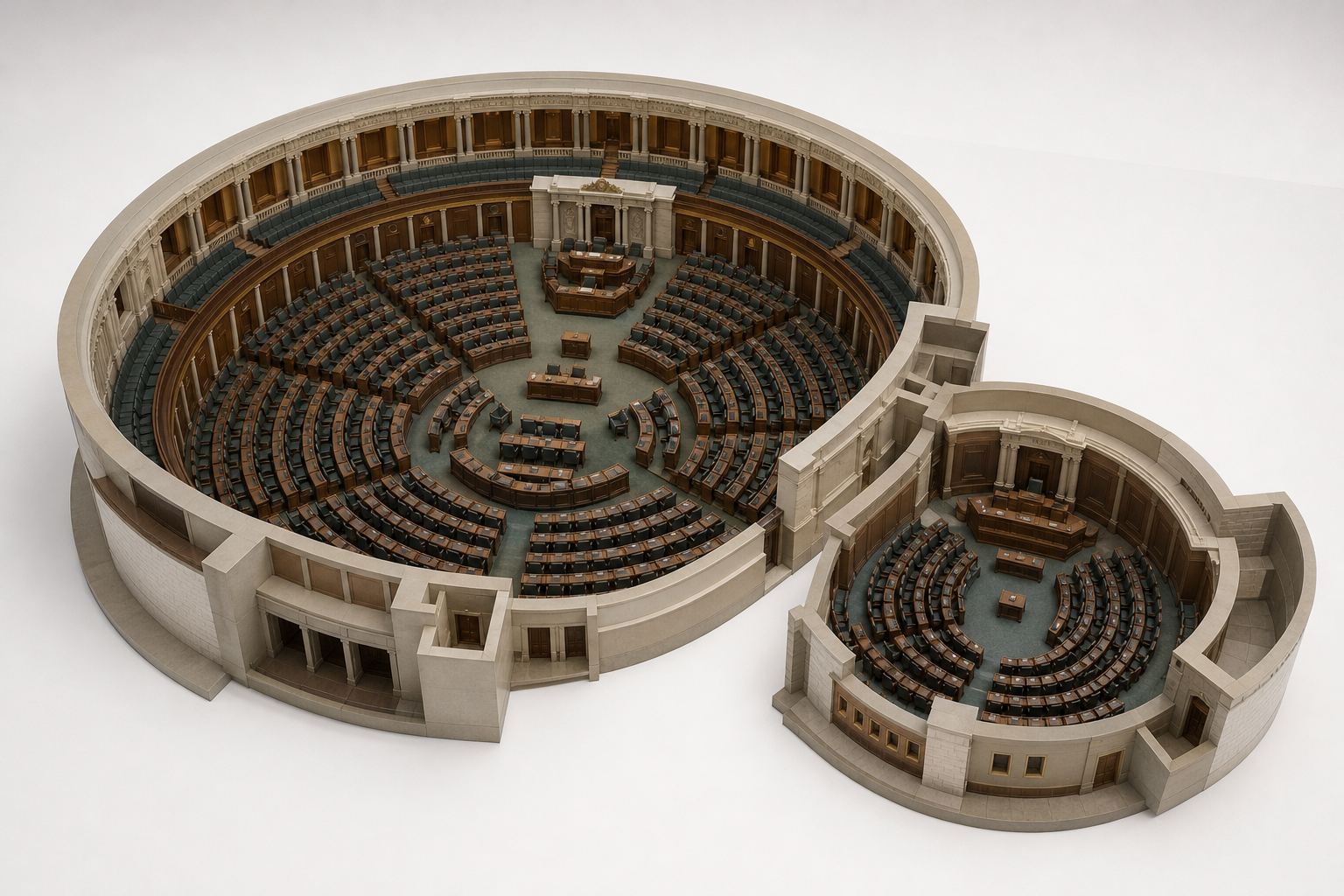
After the vote (Al Jazeera)Two chambers, one vote A large chamber and a smaller one, as a model. AI-generated still.
750
members when both houses are full
312 / 750
the coalition’s share: under half
The joint sitting (schematic arithmetic)
Chapter V · Around the world
Thailand, 2023
Al Jazeera (7 August 2023): Move Forward won 151 seats, and its eight-party coalition held 312 of the 500 House seats; under the military-enacted constitution, a joint sitting of the elected House and the 250-member Senate, which was appointed by a previous military government, votes for the prime minister, and Move Forward’s leader Pita Limjaroenrat twice failed to win enough support. BenarNews (22 August 2023): Pheu Thai formed a government with ten other parties, and lawmakers elected Srettha Thavisin with 482 votes in favour, 165 against and 81 abstentions; BenarNews reported that parliament had blocked Pita’s nomination twice in July over his proposal to amend the lèse-majesté law.
The 2023 election as a voting system is told in the PlanetPast film on voting systems.
Try it: compare the House alone with both houses sitting together. Seat colours are schematic.
The seat charts and clocks are simplified teaching models. Parties A–G are made up; real seat counts appear only where a source is named.
In July, parliament twice blocked the nomination of Move Forward's leader, Pita Limjaroenrat. BenarNews reported that the objection was his proposal to amend the lèse-majesté law, which protects the monarchy from insult.
In August, Pheu Thai, the runner-up, formed an eleven-party coalition, and its candidate Srettha Thavisin was elected prime minister with four hundred and eighty-two votes.
The party with the most seats did not lead the government. In a coalition system, winning the most seats and forming the government are two different things.
14 May general election
July nomination blocked twice
7 Aug Pheu Thai agrees a coalition with Bhumjaithai (Al Jazeera)
22 Aug prime minister elected (BenarNews)
2023, as reported
482
for
165
against
81
abstaining
22 August 2023 (BenarNews)Most seats, not the government A parliament building at dusk. AI-generated still.
Chapter V · Around the world
Thailand, 2023
Al Jazeera (7 August 2023): Move Forward won 151 seats, and its eight-party coalition held 312 of the 500 House seats; under the military-enacted constitution, a joint sitting of the elected House and the 250-member Senate, which was appointed by a previous military government, votes for the prime minister, and Move Forward’s leader Pita Limjaroenrat twice failed to win enough support. BenarNews (22 August 2023): Pheu Thai formed a government with ten other parties, and lawmakers elected Srettha Thavisin with 482 votes in favour, 165 against and 81 abstentions; BenarNews reported that parliament had blocked Pita’s nomination twice in July over his proposal to amend the lèse-majesté law.
The 2023 election as a voting system is told in the PlanetPast film on voting systems.
Try it: compare the House alone with both houses sitting together. Seat colours are schematic.
The seat charts and clocks are simplified teaching models. Parties A–G are made up; real seat counts appear only where a source is named.
Back to the hundred and twenty seats. Official results are due on 4 November. Then the President consults the parties, and the twenty-eight-day clock can start.
What to watch next is the process: whom the President asks first, whether that member can reach sixty-one in time, and, if not, the second attempt and the Knesset's last chance.
In a proportional parliament, the voters choose the pieces. Then the parties have to build a government out of them.
27 Oct election day
4 Nov official results (Wikipedia)
+7 days President’s consultations
+28 (+14) first mandate
What the rules say comes next
A second member: 28 days
61 members name their own candidate: 14 days
Still no government: new elections
The fallback, if the first try failsThe pieces An empty chamber, waiting for a majority. AI-generated still.
Epilogue
Sources and notes
This film draws on Israel’s Basic Law: The Government (2001) in English translation, the Council on Foreign Relations, the Israel Democracy Institute, INSS, Israel Policy Forum and The Jewish Press for Israel’s rules; on Al Jazeera, ABC News and Wikipedia for the 2026 election; on Riker (1962), Reuse & Gross (2026) and a LibreTexts course text for the coalition models; and on The Brussels Times, Wikipedia, DutchNews, Al Jazeera and BenarNews for Germany, Belgium, the Netherlands, Thailand, Britain and Scandinavia. Seat totals for 2026 are provisional figures as reported on 29 October 2026. The made-up parliament and the seat charts are teaching models. All stills and pictures are AI-generated illustrations, not photographs.
Try it: show the 61-seat line again.
The seat charts and clocks are simplified teaching models. Parties A–G are made up; real seat counts appear only where a source is named.