In October 2026, physicists in Vienna and Braunschweig reported a clock that keeps time with the nucleus of a thorium atom and keeps itself on track for more than a day. To see why anyone wants such a clock, this film tells how timekeeping works: the pendulum clocks of Huygens and Harrison, the vibrating quartz in a watch, the first caesium clock of 1955, how a feedback loop locks a radio wave to atoms and defines the second, why GPS depends on billionths of a second, the optical clocks that are about to redefine the second, how they sense gravity, and the new nuclear clocks.
Interactive 3D film11 min1656 to 2026Published 23 October 2026
How a clock became precise enough to tell you where you are.
Early in October 2026, physicists in Vienna and Braunschweig reported a new kind of clock. It does not count the swings of a pendulum, but a tiny change inside the nucleus, the tiny core, of a thorium atom.
Their prototype kept itself on time for more than a day. Measured over that day, it ran at a pace of roughly one second off in thirty million years.
The team says it is not yet as good as the best atomic clocks. So why build it? And why do we need clocks this good at all, when the map on your phone already depends on them? To answer that, we start with what a clock is.
> 24 h
running on its own
~10⁻¹⁵
relative precision, measured over one day
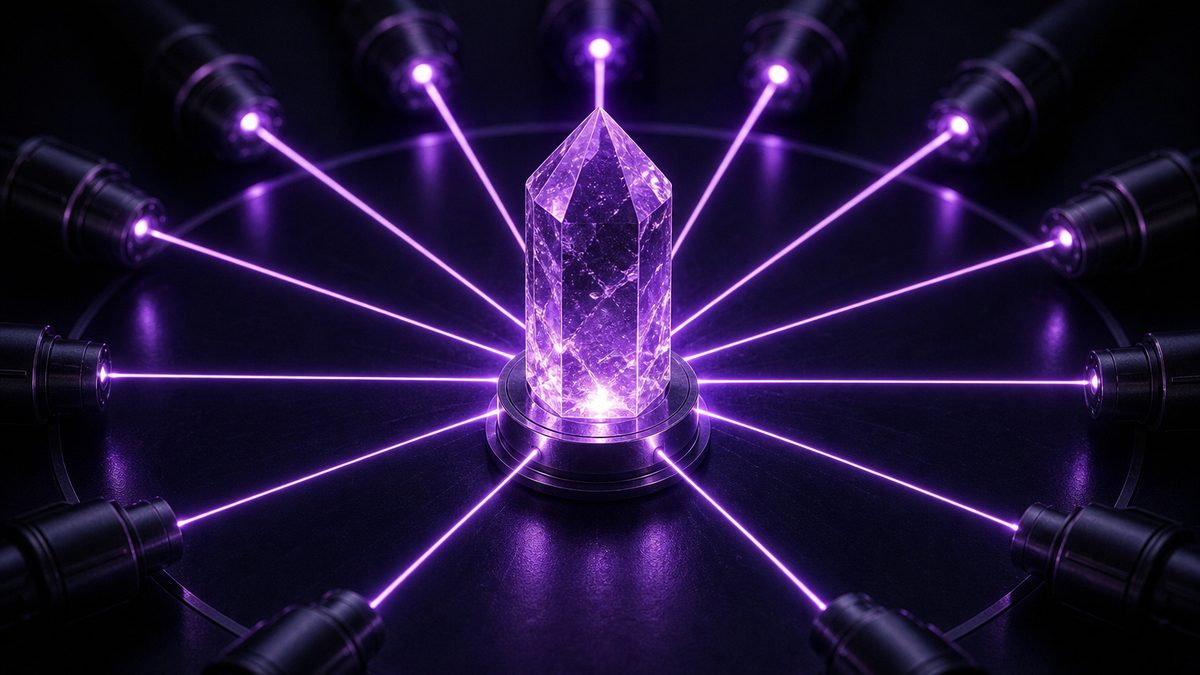
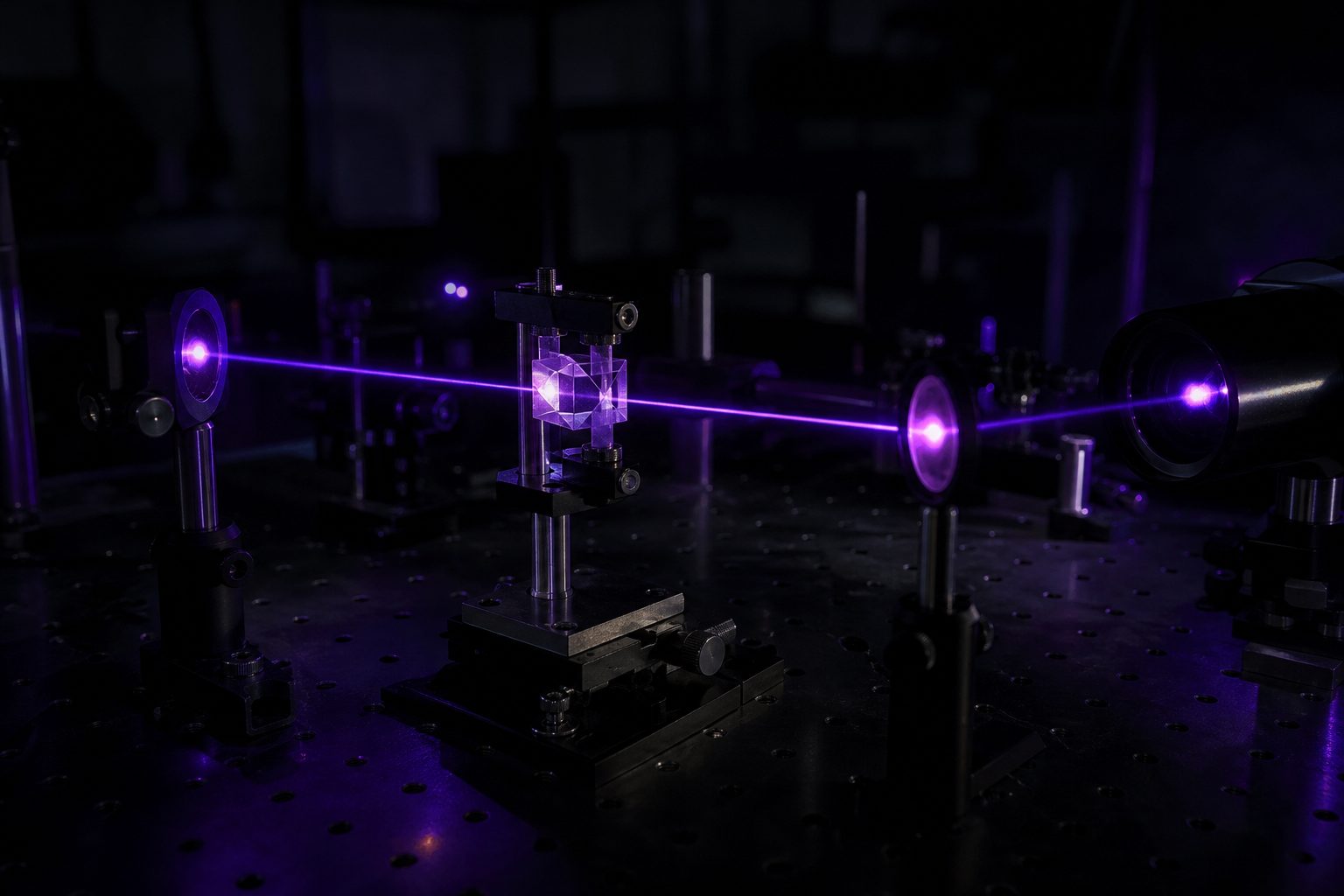
The thorium clock (Nature, 2026)A laser and a crystal A laboratory scene of the kind such clocks are built in. AI-generated still.
Thorium-229 nuclei held in a crystal
A laser tuned to a change in the nucleus
A feedback loop that keeps the laser on target
The clock, in brief
Prologue
A clock in the nucleus
ScienceDaily (10 October 2026), from TU Wien: a team led by Thorsten Schumm (TU Wien) with Ekkehard Peik (PTB, Braunschweig) reported in Nature “A thorium-229 optical nuclear clock with feedback loop”. The prototype ran steadily for more than 24 hours without intervention and reached a relative precision of about 10⁻¹⁵, roughly one second of error in 30 million years; the figure comes from one day of measurement, not a 30-million-year test. Schumm: “This is not yet at the level of the world’s best optical atomic clocks, but for a first prototype it is a fantastic result.”
The 3D clocks, atoms and satellites are simplified teaching models, not to scale.
Something that repeats, and something that counts.
Every clock has two parts: something that repeats at a steady rate, and something that counts the repeats. A sundial uses the turning Earth. A pendulum uses a swinging weight.
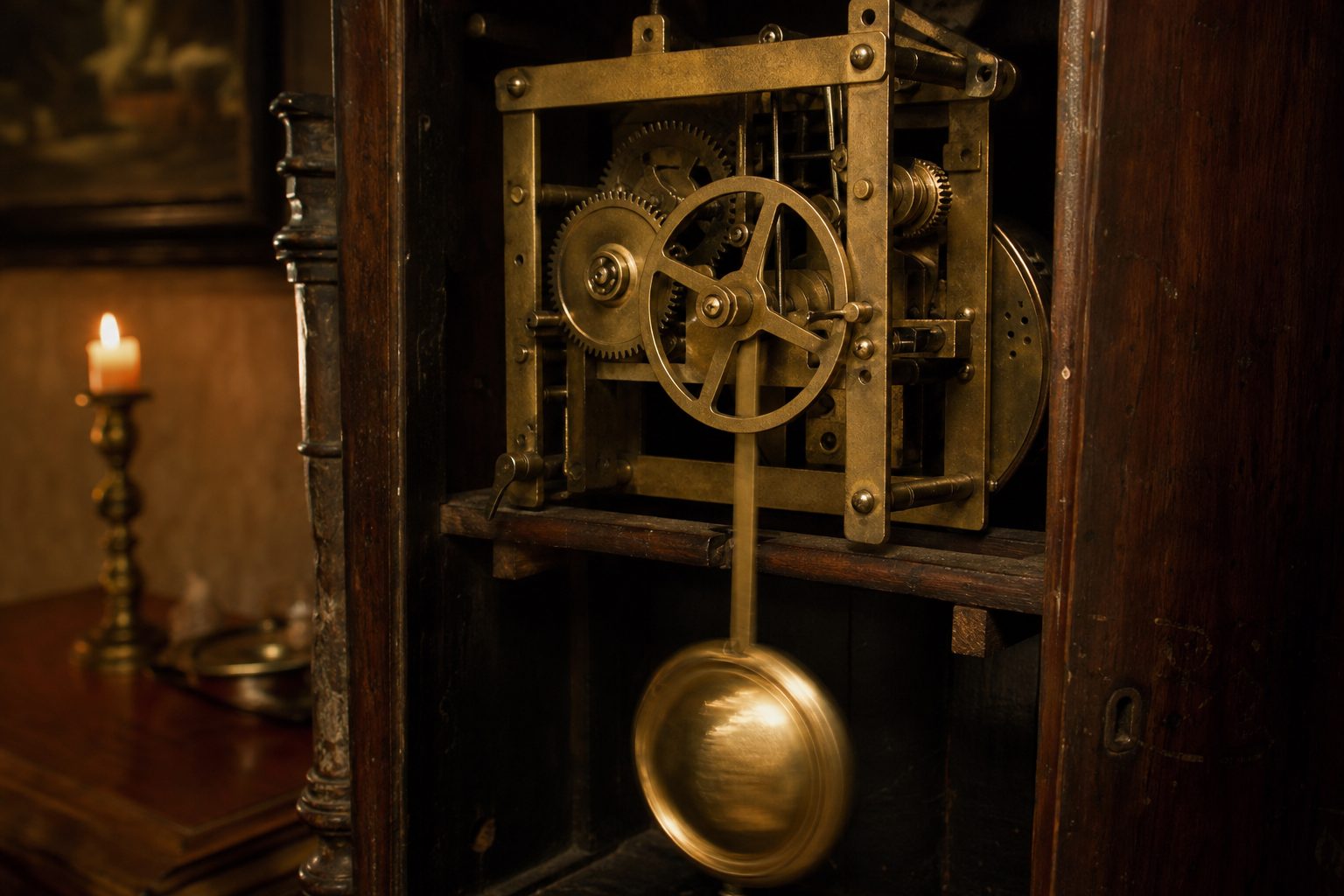
In 1656 the Dutch scientist Christiaan Huygens built the first pendulum clock. A swing of a given length always takes about the same time, so his clock drifted by less than a minute a day, and later versions by less than ten seconds.
The time of a swing depends on the length of the pendulum. Make it longer or shorter, and watch how the beat changes.
A pendulum clock A 17th-century-style movement: a weight drives gears, the pendulum sets the pace. AI-generated still.
< 1 min
error a day, first clock
< 10 s
error a day, later versions
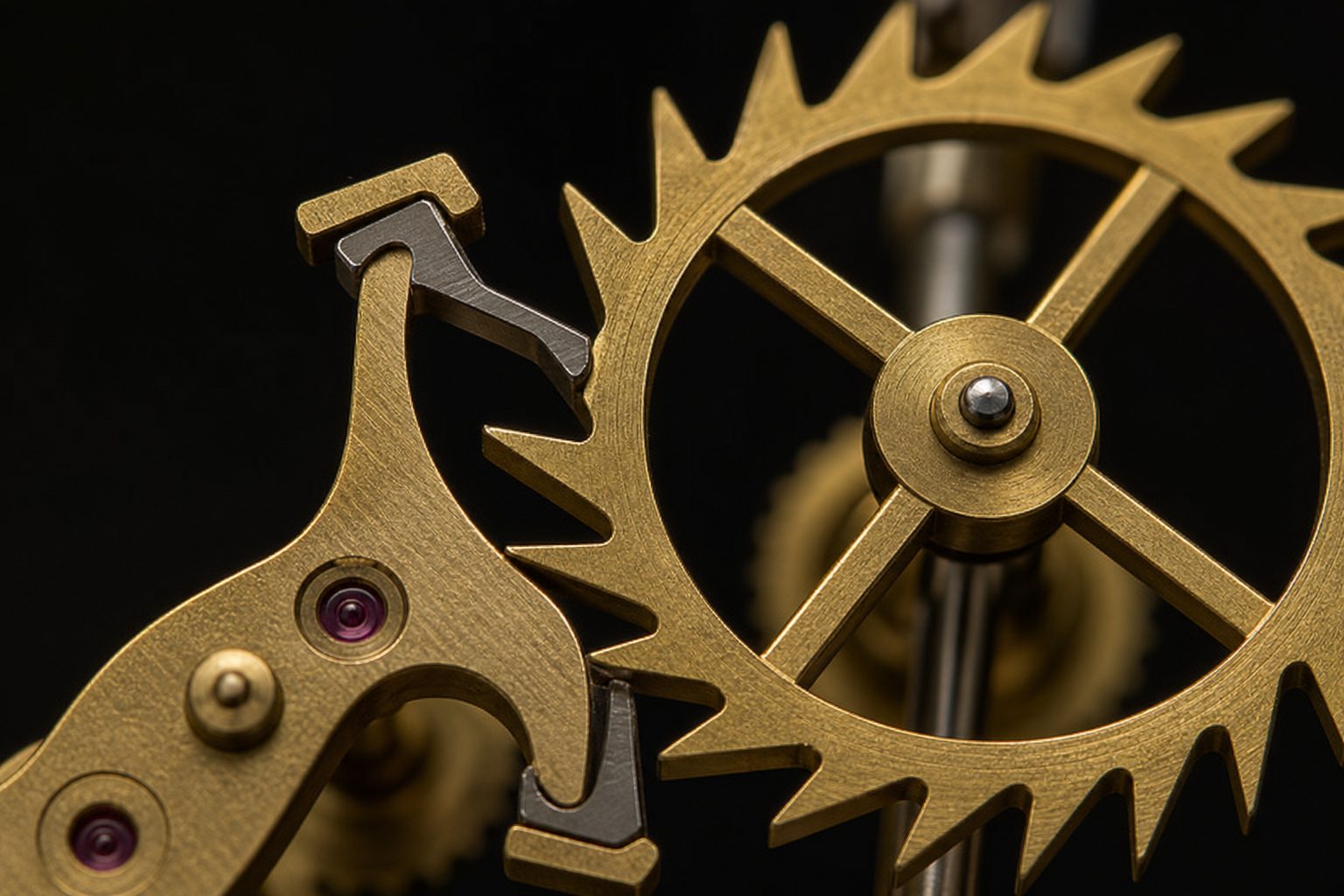
Huygens, 1656The escapement The toothed wheel is let through one tooth per swing: this is the counter. AI-generated still.T=2πL/g
L
length of the pendulum
g
the pull of gravity
Period of a simple pendulum
Chapter I · Things that swing
Huygens’s pendulum
NIST, A Walk Through Time: in 1656 Christiaan Huygens made the first pendulum clock, regulated by a mechanism with a “natural” period of oscillation. Its early version had an error of less than one minute a day; later refinements reduced the error to less than ten seconds a day.
Try it: the readout uses the textbook simple-pendulum formula; a real clock pendulum differs slightly.
The 3D clocks, atoms and satellites are simplified teaching models, not to scale.
But metal grows longer when it warms, so a pendulum clock runs slow on a hot day. In 1721 George Graham built a pendulum that cancelled this out, and his clocks kept time to about a second a day.
At sea a pendulum is useless, because the ship rolls. John Harrison built clocks for ships instead, and by 1761 one of them kept time on a rolling ship to about a fifth of a second a day.
By 1889, Siegmund Riefler's pendulum clocks reached a hundredth of a second a day. Warm the rod in the model, and watch the red hand fall behind the grey one, which keeps true time.
A warmer rod is a longer rod
A longer pendulum swings more slowly
Graham’s fix: parts that expand in opposite directions
Why heat matters
Huygens, 1656
< 60
Graham, 1721
~1
Harrison, 1761 (at sea)
~0.2
Riefler, 1889
~0.01
Error per day Figures from NIST’s A Walk Through Time.
0.01 s
a day; the standard in many observatories
Riefler, 1889
Chapter I · Things that swing
From Graham to Riefler
NIST, A Walk Through Time: in 1721 George Graham improved the pendulum clock’s accuracy to about one second a day by compensating for changes in the pendulum’s length due to temperature. John Harrison refined Graham’s compensation and reduced friction; in 1761 his marine chronometer kept time on a rolling ship to about one-fifth of a second a day. In 1889 Siegmund Riefler’s clock with a nearly free pendulum reached an accuracy of a hundredth of a second a day and became the standard in many astronomical observatories.
Try it: the model assumes a steel rod warmed by 10 °C (steel expands about 12 millionths of its length per degree), a simple estimate; the glow and the drop of the bob are exaggerated.
The 3D clocks, atoms and satellites are simplified teaching models, not to scale.
From a ringing stone to a pendulum nature makes identical.
In the 1920s a new beat arrived: quartz. Squeeze a quartz crystal and it makes a small voltage. Put a voltage across it and it bends. This is called the piezoelectric effect.
In the right circuit, the crystal pushes and pulls on itself and rings at a steady rate, like a tiny tuning fork. Electronics count those vibrations. That is how a quartz watch keeps time.
But every crystal is cut by people, and its beat depends on its exact size and shape. To do better, we need a pendulum that nature makes identical every time.
Squeeze or bend the crystal → a voltage
Apply a voltage → the crystal changes shape
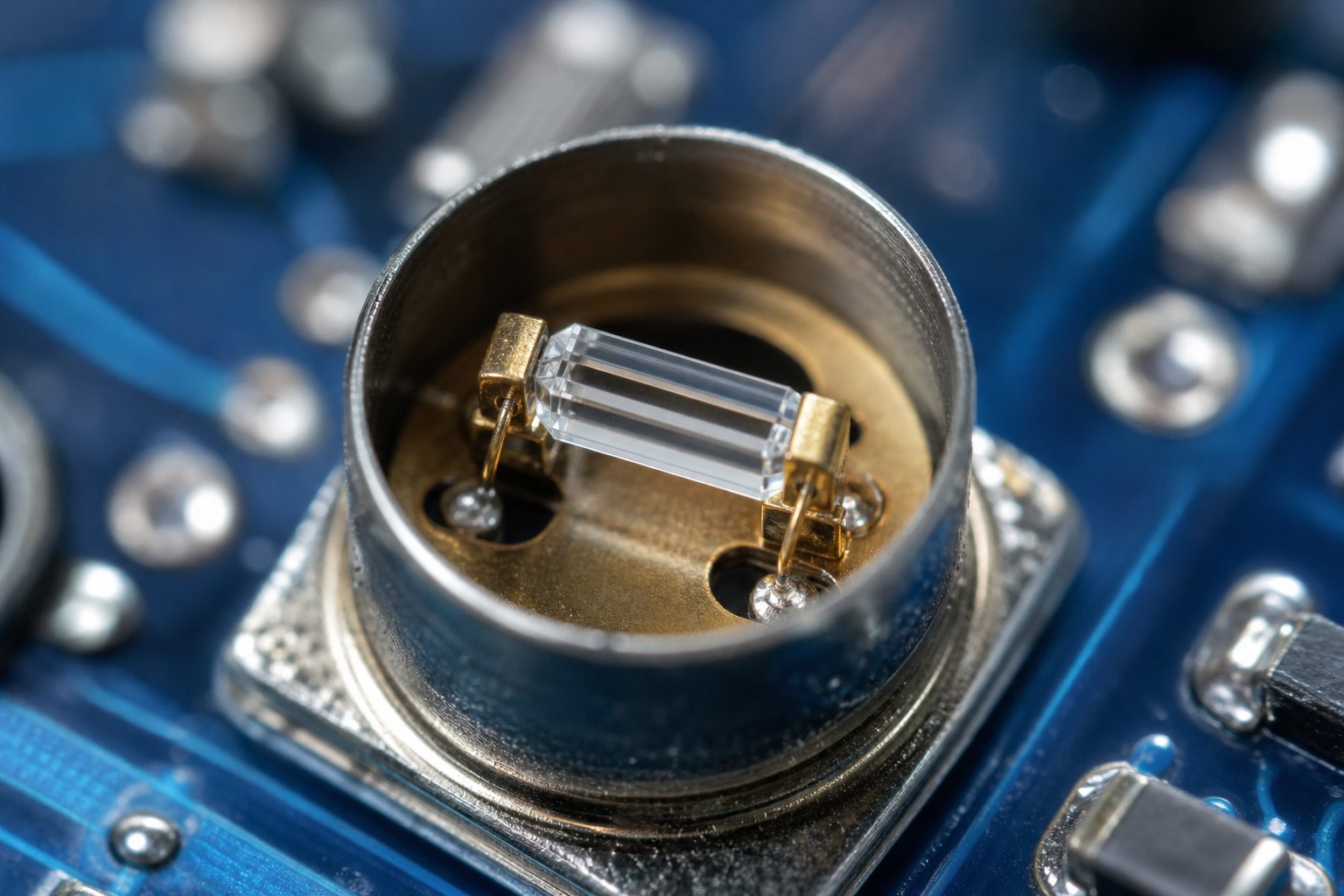
PiezoelectricityA quartz resonator A small quartz crystal in its opened metal can. AI-generated still.
atoms
far more consistent than a pendulum or a quartz crystal (Live Science)
The next step
Chapter II · Crystals and atoms
Quartz
NIST, A Walk Through Time: quartz clocks, developed from the 1920s, rely on the piezoelectric property of quartz crystals. Applying an electric field changes the crystal’s shape; squeezing or bending it generates an electric field. Placed in a suitable electronic circuit, the crystal vibrates at a fairly steady frequency, which is used to drive the clock’s display.
On screen: the crystal is drawn as a tuning-fork shape, as in many watches; the motion is greatly exaggerated.
The 3D clocks, atoms and satellites are simplified teaching models, not to scale.
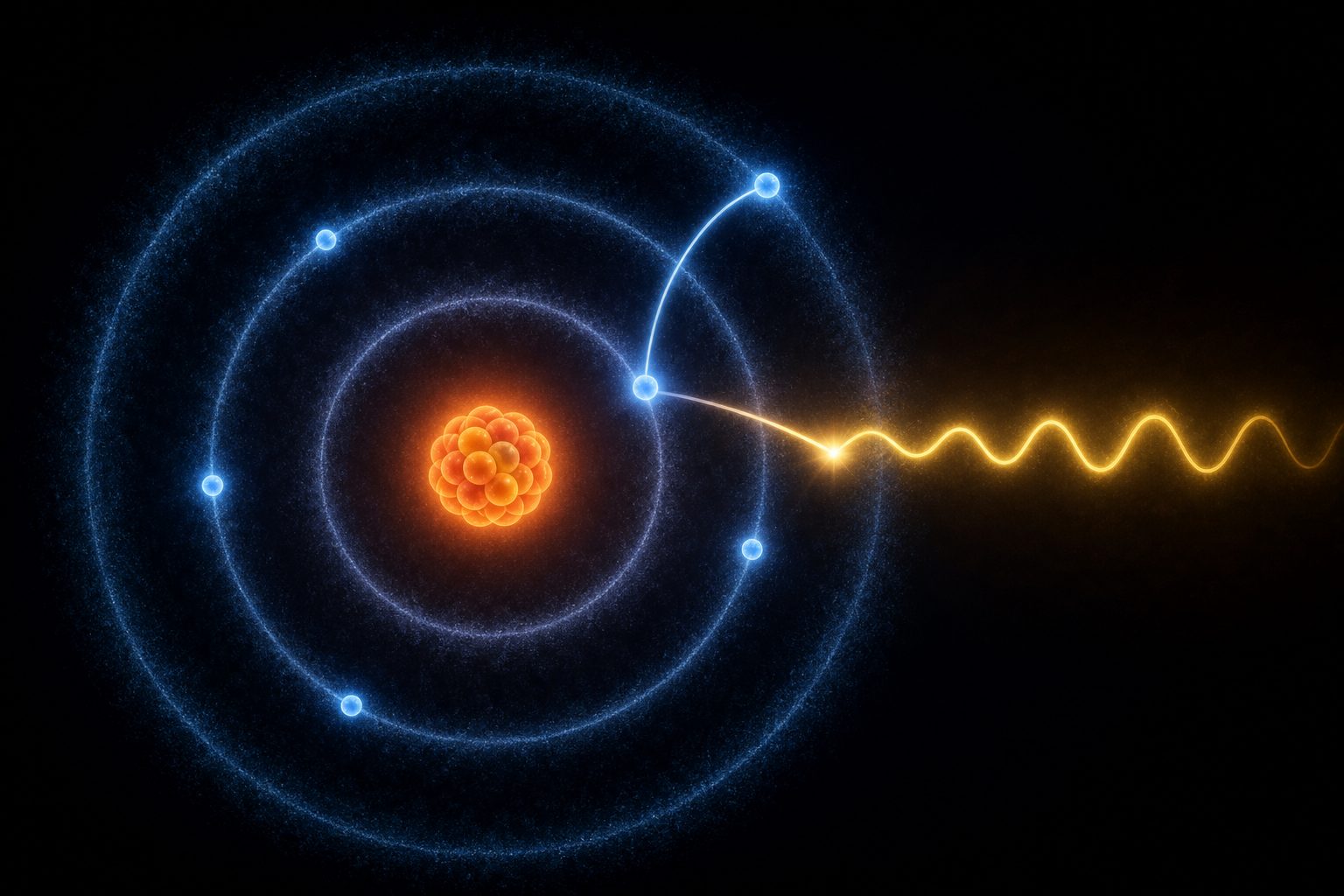
Atoms give us that. Every caesium-133 atom is identical to every other one. Think of its outermost electron as able to sit on one of two energy steps, very close together.
Send radio waves, microwaves in fact, through the atom at exactly the right frequency, and it flips from one step to the other. A little off, and far fewer atoms flip. For caesium, that frequency is about nine point two billion cycles a second. So the radio wave is the clock's pendulum, and the atoms are the referee that says when it is exactly right.
Tune the radio wave yourself. Only near the right frequency do the atoms respond.
Every caesium atom is the same
They do not wear out or need cutting
Their “beat” is set by nature
Why atoms make good pendulumsTwo energy states An electron changing energy, drawn as a jump between shells; in caesium clocks it is really a tiny flip within the same shell. AI-generated still.
9,192,631,770
cycles a second
Caesium’s frequency
The radio wave: the pendulum, counted
The atoms: the referee that checks it
Who does what
Chapter II · Crystals and atoms
Atoms as pendulums
Live Science: a caesium atomic clock counts the switching of caesium atoms, which is far more consistent than a pendulum or a quartz crystal. Radio waves at exactly the right frequency make the atoms resonate and switch energy states; the closer the radio frequency is to that target, the more atoms switch. The frequency is 9,192,631,770 cycles per second.
On screen: the two energy states and the response curve are schematic; in reality the two states are the two lowest “hyperfine” levels of caesium.
The 3D clocks, atoms and satellites are simplified teaching models, not to scale.
In 1955, Louis Essen and his colleague J. V. L. Parry, at the National Physical Laboratory in Teddington, London, built a caesium clock. It was accurate to about one second in three hundred years.
That was about thirty times better than the quartz clocks of the 1930s, and, according to the Science Museum, three hundred times better than the best pendulum clocks.
Clocks like it soon showed something surprising: the Earth itself is not a perfect clock. Its spin is slightly irregular, so time is now set by atoms, not by the sky.
A 1950s laboratory A caesium beam tube on a bench, as imagined; not the NPL clock itself. AI-generated still.
1930s quartz clocks
~30×
the best pendulum clocks
~300×
How much better was it? As stated by the Science Museum Group.
atoms
now define time, not astronomy
Earth
turns slightly irregularly
A new timekeeper
Chapter III · The caesium second
Essen and Parry’s clock
Science Museum Group collection: the caesium atomic clock made by Louis Essen and J.V.L. Parry at the National Physical Laboratory, Teddington, in 1955, was accurate to a second in 300 years: about thirty times more precise than the quartz crystal clocks of the 1930s and about 300 times more precise than the best pendulum clocks. Atomic clocks have revealed irregularities in the rotation of the Earth, and time is now defined by atomic clocks instead of astronomical observations.
On screen: bar heights show the error per day on a logarithmic scale (each step up is ten times better).
The 3D clocks, atoms and satellites are simplified teaching models, not to scale.
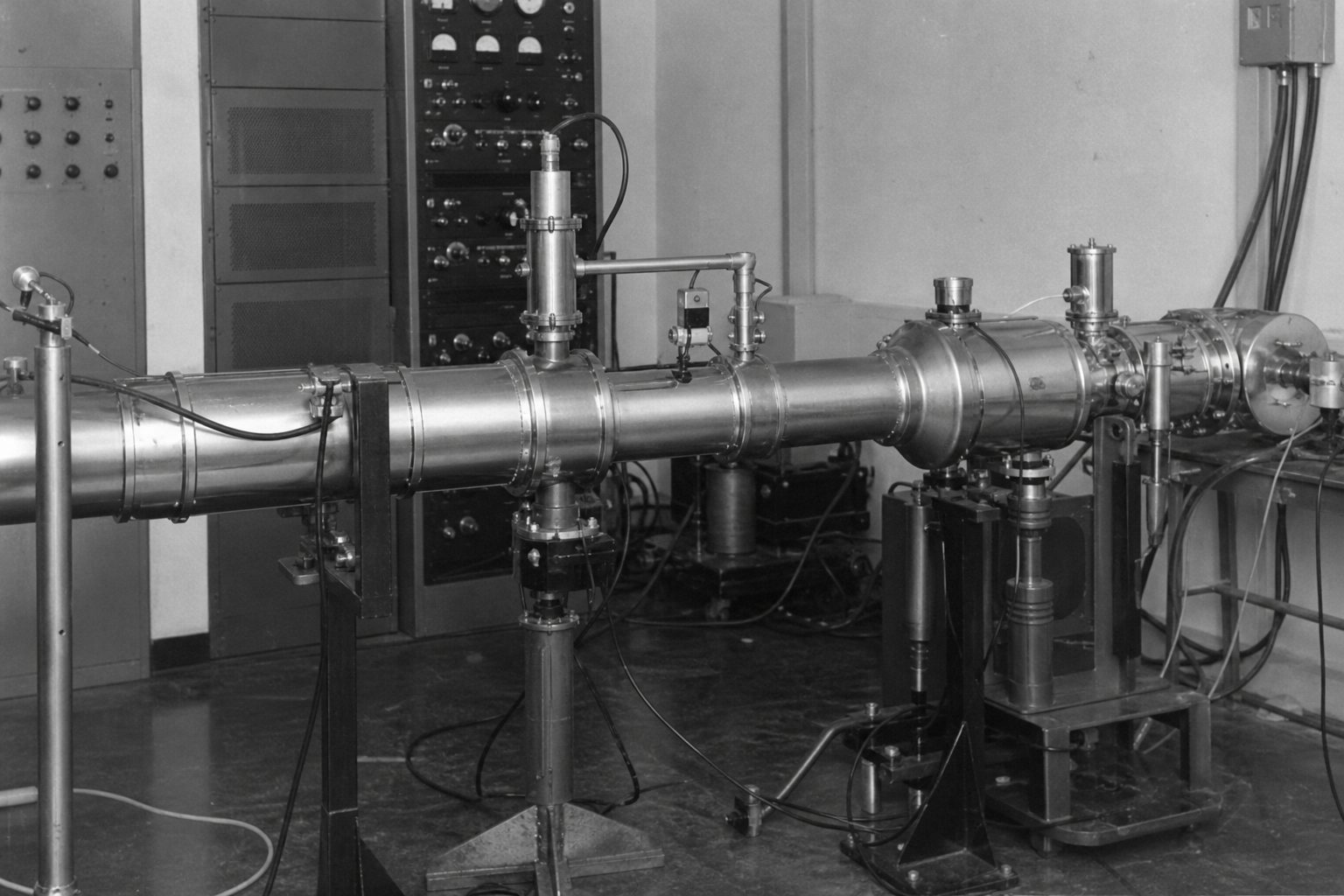
Inside a caesium clock, atoms fly down a tube and pass through radio waves. At the far end, a detector counts how many atoms have switched state.
If the count drops, the radio wave has drifted off the right frequency, so the electronics nudge it back to the frequency where the most atoms flip. This loop never stops: the atoms keep correcting the radio.
Other electronics count the cycles of that radio wave. Since 1967, one second has been defined as 9,192,631,770 of those cycles.
Push the radio wave off frequency, and watch the loop pull it back.
1 · a stream of caesium atoms
2 · radio waves they pass through
3 · a detector that counts switched atoms
The parts
Fewer atoms switch → off frequency
Nudge the radio wave
More atoms switch → back on the peak
The feedback loopA beam tube A long vacuum tube of the kind early caesium clocks used, as imagined. AI-generated still.1s=9192631770 cycles
cycles
of the radiation that makes caesium switch
The SI second, since 1967
loop on
the radio wave is pulled back
loop broken
the radio wave drifts away
Try it
Chapter III · The caesium second
Locking a radio wave to atoms
Live Science: caesium atoms are sent down a tube and pass through radio waves; at the right frequency they switch energy states. A detector at the far end counts how many atoms have switched, and this information is fed back to the radio-wave generator, which keeps its frequency synchronised with the peak. Other electronics count the cycles, and one second is marked off when the count reaches 9,192,631,770. Since 1967 the official second has been defined as 9,192,631,770 cycles of the radiation that makes caesium atoms switch.
Try it: the model shows the idea of the loop; the tube, the speed of the atoms and the size of the drift are not to scale.
The 3D clocks, atoms and satellites are simplified teaching models, not to scale.
Later caesium clocks went much further. NIST-F1, a US time standard, would lose about one second in a hundred million years.
Look at the map on your phone. Each GPS satellite carries several atomic clocks and broadcasts the time. Your phone compares when each signal was sent with when it arrived.
Light covers about thirty centimetres in a billionth of a second, so each delay gives a distance. Three distances would pin down a point, but the phone's own cheap clock is a fourth unknown, so it needs signals from at least four satellites to work out both where it is and the right time.
So a satellite clock that is a millionth of a second wrong makes its distance about three hundred metres wrong. Add that error to the satellites, and watch your computed position move.
~0.03 ns
error a day
~100 million yr
to lose one second
NIST-F1 (caesium)A position from time A phone finds itself by timing radio signals from space. AI-generated still.
east–west, north–south, height
the receiver’s own clock error
Four satellites, four unknowns
several
atomic clocks on each satellite
3 ns
timekeeping, corrected from the ground
GPS satellite clocks (NIST)
1 billionth of a second
~0.3 m
3 billionths (GPS satellite clocks)
~0.9 m
1 millionth of a second
~300 m
Clock error → distance error Computed from the speed of light, about 300,000 km per second.
Chapter IV · Time tells you where you are
Atomic time and GPS
Live Science: the NIST-F1 caesium clock errs by about 0.03 nanoseconds a day and would lose one second in about 100 million years; accurate time supports high-speed communications, electrical grids and GPS. NIST: each GPS satellite carries several atomic clocks, regularly corrected by more accurate clocks on the ground, and keeps time to within three billionths of a second; a receiver compares when signals were sent and received and, using the speed of light, estimates its distance from each satellite. NIST (Kitching): a receiver computes its three coordinates and its own clock offset from at least four satellites, and positioning to about a metre typically requires nanosecond timing.
The distances for a given clock error are simple products of time and the speed of light; real receivers combine many more corrections. Try it: in the model the shift of the fix is drawn larger than life.
The 3D clocks, atoms and satellites are simplified teaching models, not to scale.
Caesium ticks about nine billion times a second. Optical clocks use atoms that switch with light instead of radio, at frequencies tens of thousands of times higher. More ticks per second means each second can be cut more finely.
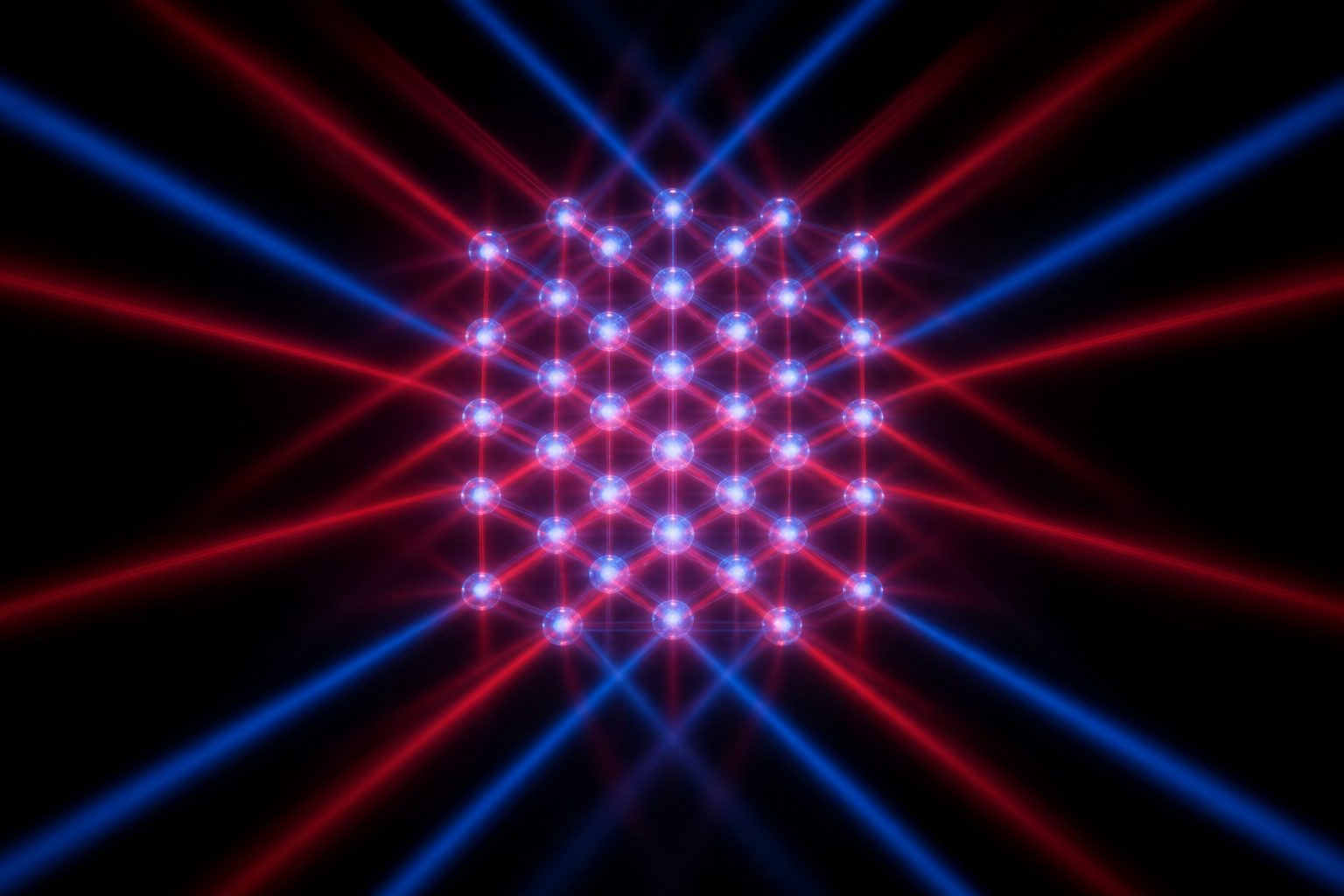
In one kind, the lattice clock, about forty thousand strontium atoms are chilled to a few hundred billionths of a degree above absolute zero and held in thousands of layers of laser light. Another laser probes them all at once.
In 2024, a team at JILA in Colorado reported such a clock whose uncertainty, how far it might be off, is about eight parts in ten billion billion: one second in roughly forty billion years, longer than the age of the universe. NIST says optical clocks are now about a hundred times more accurate than the best caesium clocks.
Compare the ticks of the two kinds of clock.
Caesium (radio)
1×
Optical clocks (light)
10⁴–10⁵ ×
How fast they tick Per NIST: optical frequencies are tens of thousands of times higher.
Atoms held by light Atoms held by laser light, as imagined; real lattice clocks stack them in layers of a standing laser wave. AI-generated still.
A few hundred billionths of a degree above absolute zero
Thousands of layers of laser light
One probe laser reads them all
Inside a lattice clock (JILA)
8.1 × 10⁻¹⁹
total systematic uncertainty
1 s / ~40 bn yr
the same figure as time to lose a second
JILA strontium clock, 2024
Caesium: radio, ~9.2 billion a second
Optical: light, tens of thousands of times faster
Two kinds of tick
Chapter V · Clocks made of light
Optical clocks
NIST: optical clocks use light at frequencies tens of thousands of times higher than the microwave frequencies of caesium clocks; today they are about 100 times more accurate than the best caesium clocks and could ultimately be about 1,000 times better. Optics & Photonics News (10 July 2024): a JILA and University of Delaware team led by Jun Ye reported a strontium lattice clock with a total systematic uncertainty of 8.1 × 10⁻¹⁹. About 40,000 strontium-87 atoms are held at a few hundred nanokelvin in a vertical optical lattice of thousands of layers formed by a standing-wave laser beam.
Try it: the two waves on screen are slowed down enormously; only the idea, many more ticks per second, is to scale in spirit.
The 3D clocks, atoms and satellites are simplified teaching models, not to scale.
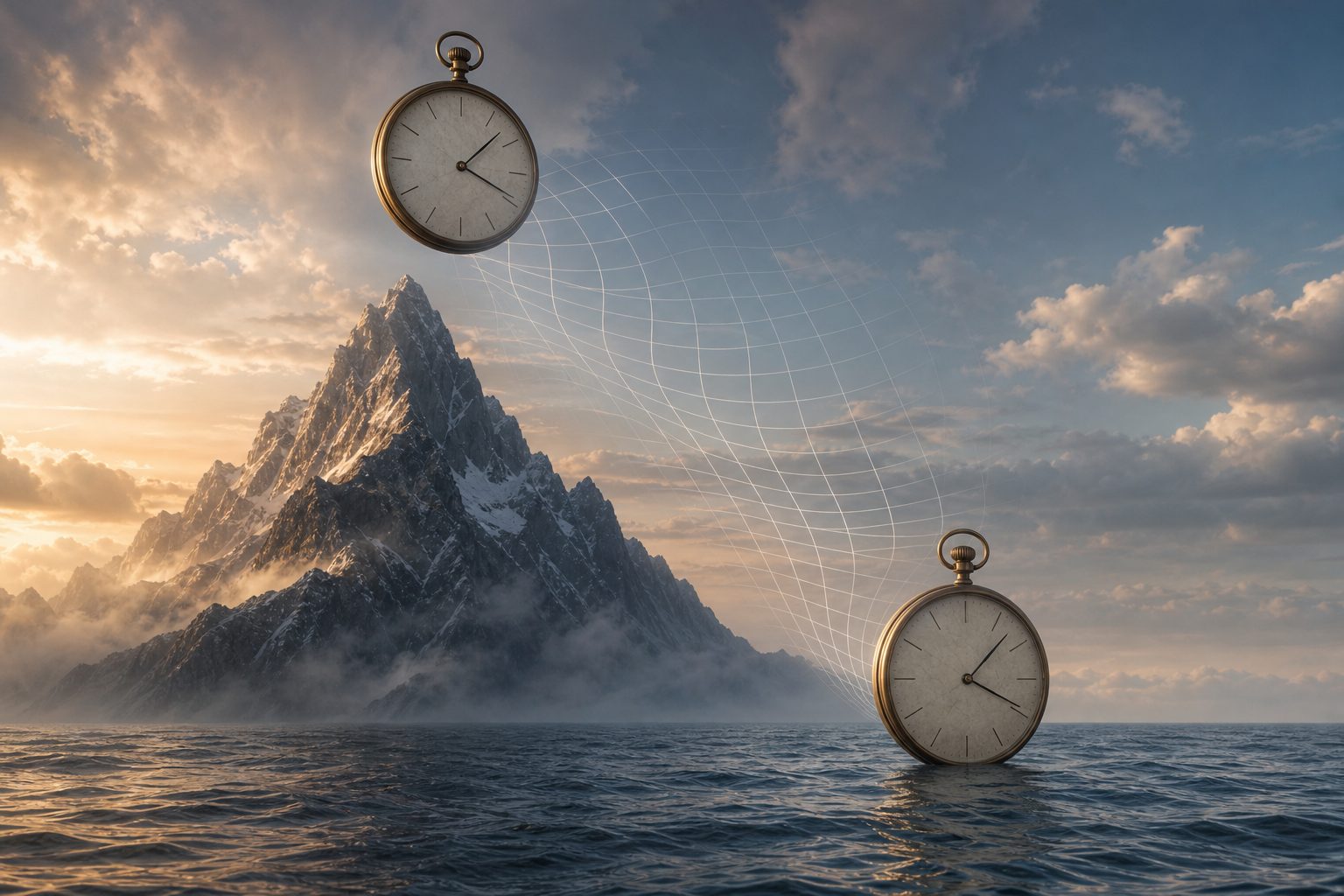
Clocks this good feel gravity. Einstein's general relativity says that time passes a little faster the higher you are, further from the Earth's pull.
In 2010, NIST compared two optical clocks, each built around a single aluminium ion, a charged atom, with one raised by just thirty-three centimetres. The higher one ran slightly faster. Over a seventy-nine-year life, that adds up to about ninety billionths of a second.
Raise the clock in the model and watch it pull ahead. Researchers hope such clocks could one day sense changes in gravity, near volcanoes and glaciers.
Higher clocks run faster An artist’s picture of curved time between a summit and the sea. AI-generated still.
33 cm
height difference
~90 ns
over a 79-year lifetime
NIST, 2010 (Science)fΔf≈c2gh
h
height difference
c
speed of light
How much faster, for a small height
Gravity sensors for volcanoes and glaciers
Mapping Earth’s shape and gravity
Tests of relativity
Possible uses (NIST)
Chapter V · Clocks made of light
Relativity on a tabletop
NIST (23 September 2010; results in Science, 24 September 2010): comparing two aluminium-ion clocks, NIST physicists raised one by about 33 centimetres and found it ran at a slightly faster rate, as general relativity predicts; over a 79-year lifetime the effect adds up to about 90 billionths of a second. The same experiment showed that a clock whose ion moved at a few metres per second ticked slightly slower. NIST’s “second, the future” page notes that clocks like these could act as sensitive gravity sensors for monitoring volcanoes and glaciers and refine measurements of Earth’s shape and gravity.
Try it: the readout uses the simple formula for small heights, a fractional rate of g × height ÷ c²; the clock hands are exaggerated by a huge factor so the difference can be seen.
The 3D clocks, atoms and satellites are simplified teaching models, not to scale.
So the definition of the second itself is set to change. In 2022, the General Conference on Weights and Measures, the international body that sets the units of measurement, voted to redefine the second using optical clocks.
The plan was to lay out the options by 2026, this year, and for countries to vote by 2030. The bar is a clock that loses less than a second in sixteen billion years. The best optical clocks already reach that on paper; what is still needed is for several laboratories to compare their clocks and agree.
Researchers writing in 2026 say these clocks have improved by more than a factor of a hundred every decade. Ten years ago they played no part in setting the world's official time. Now at least ten of them do.
1967 Second defined by caesium
2022 CGPM votes to move to optical clocks
2026 Options laid out (planned)
2030 Vote on a new definition (planned)
Redefining the second
Lose less than 1 s in 16 billion years
At least three institutes agree, to 1 s in 6 billion years
At least three optical clocks calibrate world time each month
The bar to clear (NIST)
The bar for a new definition
16
JILA strontium clock, 2024
~39
Years to lose one second JILA figure converted from its stated uncertainty of 8.1 × 10⁻¹⁹.
Optical clocks have advanced at an extraordinary rate, improving by more than a factor of 100 every decadeTara Fortier, NIST, quoted by Adelaide University, 2026
Chapter V · Clocks made of light
The second, the future
NIST: in 2022 the General Conference on Weights and Measures (CGPM) voted that the second should be redefined using optical clocks; options are to be laid out by 2026, and countries would vote on a formal redefinition by 2030 if all goes as planned. Criteria include an uncertainty equivalent to losing less than a second in 16 billion years, validation by at least three metrology institutes agreeing to within a second in 6 billion years, and International Atomic Time calibrated by at least three optical clocks each month. Adelaide University (27 January 2026), on a review in Optica by researchers from Adelaide, NIST and NPL: optical clocks have improved by more than a factor of 100 every decade; a decade ago they had no role in steering international time, and today at least ten are approved for that use.
On screen: error per day on a logarithmic scale. Optical-clock bars use the 2024 JILA uncertainty; the thorium bar uses the 2026 prototype.
The 3D clocks, atoms and satellites are simplified teaching models, not to scale.
Every atomic clock so far has used electrons, which sit on the outside of atoms and feel every stray electric and magnetic field. The nucleus is more than ten thousand times smaller, and far less disturbed.
One nucleus, thorium-229, has a low-energy state that a laser can reach. On 21 November 2023, a team from TU Wien and Germany's PTB finally switched it with a laser, and published the result in 2024.
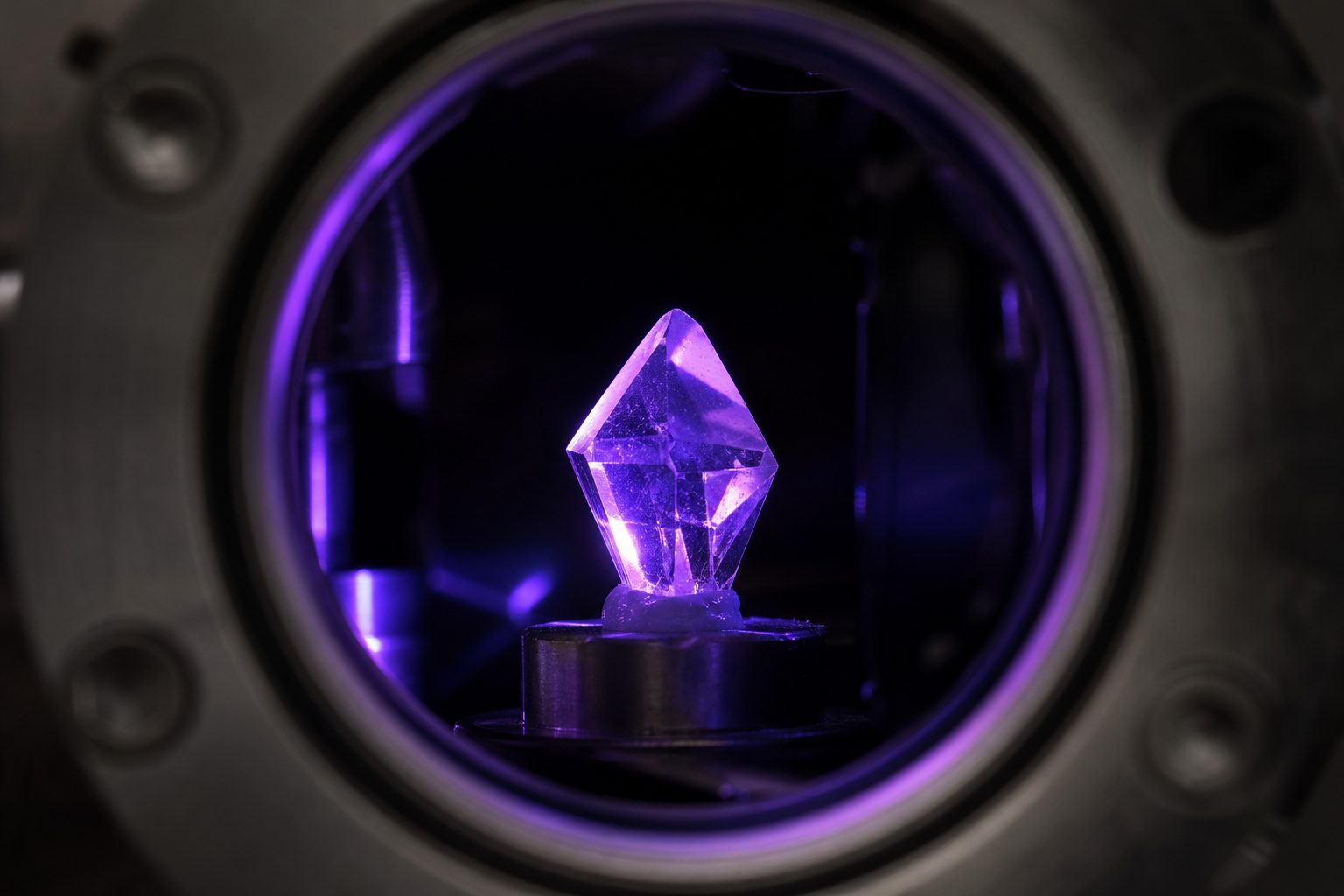
The trick was to grow crystals containing thorium, so a single laser beam could reach about a hundred million billion nuclei at once.
> 10,000×
smaller than an atom
less
disturbed by stray fields
Why the nucleus?A thorium crystal A crystal lit by ultraviolet laser light, as imagined. AI-generated still.
21 Nov 2023
a nucleus switched by laser for the first time
1970s
when the idea was first discussed
TU Wien and PTB
~10¹⁷
thorium nuclei reached at once
In one crystal
Chapter VI · Into the nucleus
The first laser-switched nucleus
TU Wien (29 April 2024, Physical Review Letters, with PTB): on 21 November 2023 the team used a laser to put thorium-229 nuclei into a higher-energy state for the first time. Speculation about this nuclear state goes back to the 1970s. The team grew thorium-containing crystals so that about 10¹⁷ thorium nuclei could be hit by the laser at once. Nuclei are much smaller than atoms and molecules and therefore much less susceptible to external disturbances. ScienceDaily (2026): atomic nuclei are more than 10,000 times smaller than atoms.
On screen: the crystal and the glowing nuclei are a schematic, not to scale.
The 3D clocks, atoms and satellites are simplified teaching models, not to scale.
Until this October, such experiments still needed an ordinary atomic clock to keep the laser on track. The new clock keeps its laser on track by itself.
The nuclei absorb the laser only at the right frequency, so when the laser drifts, the system notices and pulls it back. It is the caesium loop again, with a nucleus as the referee.
This first prototype is not yet at the level of the best optical clocks, or even the best caesium ones. But a nucleus allows higher precision in principle, and the team expects stronger lasers and better crystals to improve it.
Let the laser drift, and watch the nuclei pull it back.
What you really want is a self-stabilizing nuclear clock.Thorsten Schumm, TU Wien, 2026
Laser on frequency → nuclei absorb
Laser drifts → absorption falls
System pulls the laser back
The same loop, a new pendulum
Essen’s caesium clock, 1955
~300
Thorium prototype, 2026
~3 × 10⁷
NIST-F1 caesium
~10⁸
Years to lose one second A one-day prototype, not yet at the level of the best clocks; figures from the Science Museum, ScienceDaily and Live Science, of different kinds, so indicative only.
> 24 h
without anyone stepping in
next
stronger lasers, better crystals
The prototype (Nature, 2026)
Chapter VI · Into the nucleus
A self-stabilising nuclear clock
ScienceDaily (10 October 2026), from TU Wien: thorium nuclei absorb laser light only at the correct frequency. When the laser drifts, absorption falls; the system detects this and adjusts the laser back, so the clock stabilises itself without a conventional atomic clock. The prototype ran for more than 24 hours and reached a relative precision of about 10⁻¹⁵, roughly one second in 30 million years, measured over one day. More powerful lasers and higher-quality thorium crystals are expected to raise the precision. Published in Nature (2026).
Try it: the drift and the speed of the correction in the model are exaggerated.
The 3D clocks, atoms and satellites are simplified teaching models, not to scale.
From a swinging weight that lost up to a minute a day, to lattice clocks that, NIST says, would not have lost a second since the Big Bang, each new kind of clock has found a steadier thing to count.
Those clocks run the map on your phone, the timing of power grids and networks, and tests of Einstein's physics.
Which clock will define the second after 2030? Will a nuclear clock ever beat the best optical clocks? Could clocks help find dark matter, the unseen matter astronomers detect only through its gravity? Those questions are still open.
1656 Huygens’s pendulum clock
1920s Quartz clocks
1955 Essen and Parry’s caesium clock
1967 The second defined by caesium
2024 Thorium nucleus switched by laser; record strontium clock
2026 Self-stabilising nuclear clock
Better clocks
GPS and navigation
Electrical grids
High-speed communications
What precise time runs (Live Science)
Stills are AI-generated
3D clocks, atoms and satellites are schematic
The nuclear clock is a first prototype
About this filmA planet on atomic time Satellites, cities and networks, all keeping the same time. AI-generated still.
Epilogue · Sources
Sources
Every fact in this film comes from the sources below. NIST notes that its lattice clocks would not have gained or lost a second had they started at the Big Bang, about 13.8 billion years ago, and that better clocks could help search for new particles that might relate to dark matter. The chapter stills and pictures are AI-generated illustrations, and the 3D clocks, atoms, crystal and satellites are simplified teaching models. Distances for a given GPS clock error are computed from the speed of light; pendulum and gravity readouts use simple textbook formulas.