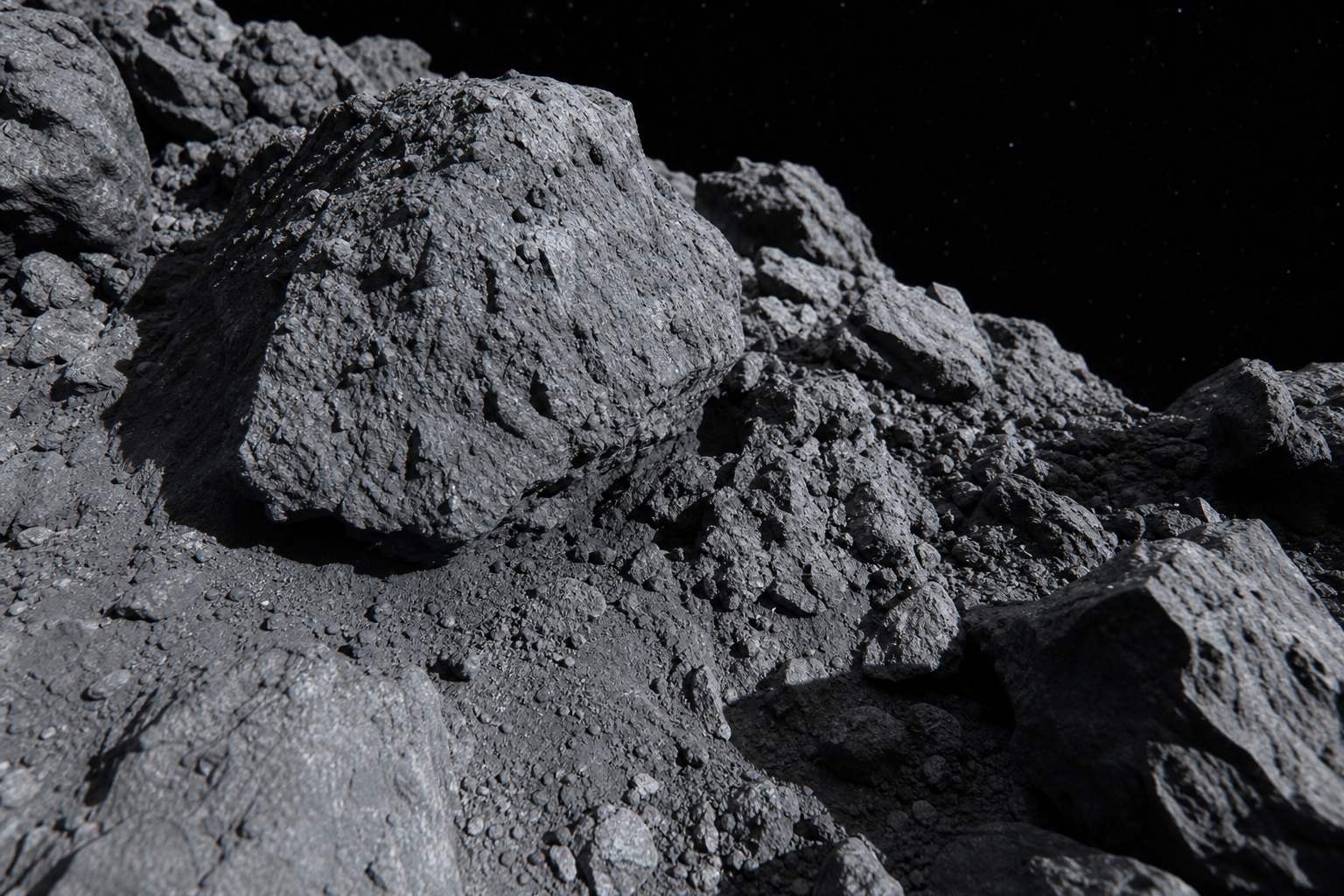
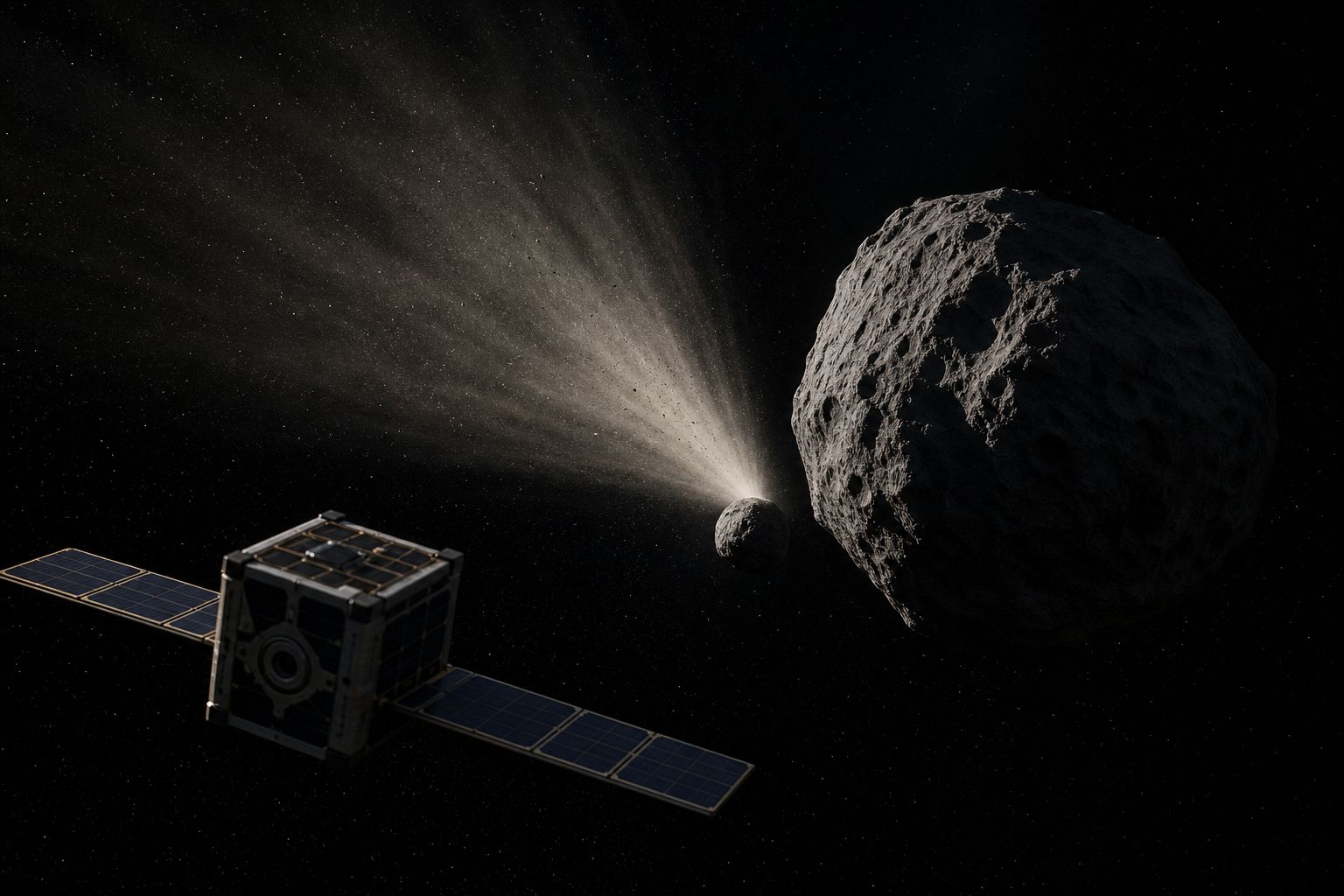
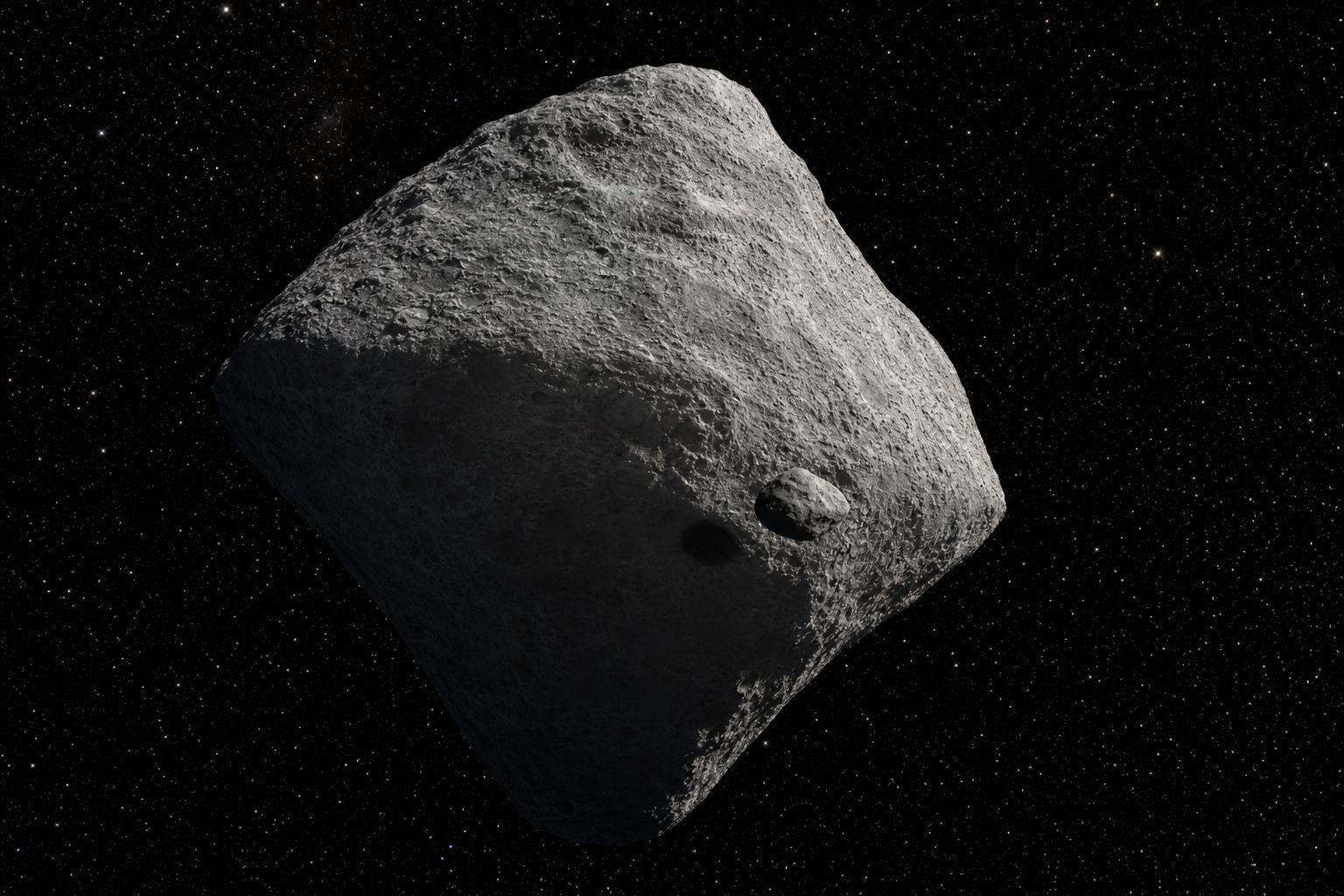
In October 2026 ESA's Hera spacecraft sent its first picture of the double asteroid Didymos and Dimorphos, the moonlet NASA's DART spacecraft hit on purpose in 2022. This film explains the established science behind planetary defence: what near-Earth objects are, what the Tunguska and Chelyabinsk airbursts showed, how often rocks of each size strike, how surveys find asteroids and turn a few sightings into an orbit and an impact probability, the Torino scale, how a kinetic impactor works through momentum and the extra push of its ejecta (the factor beta), how DART shortened Dimorphos's orbit by 33 minutes and why a binary asteroid made that measurable, what Hera will measure, the gravity tractor and nuclear options that remain proposals, and why years of warning matter most.
Interactive 3D film9 min1908 to 2027Published 3 November 2026
How we find dangerous asteroids, and how we could push one away.
In 2022, NASA crashed a spacecraft into a small asteroid on purpose. The moonlet, Dimorphos, became the first object in the Solar System whose orbit humans have measurably changed.
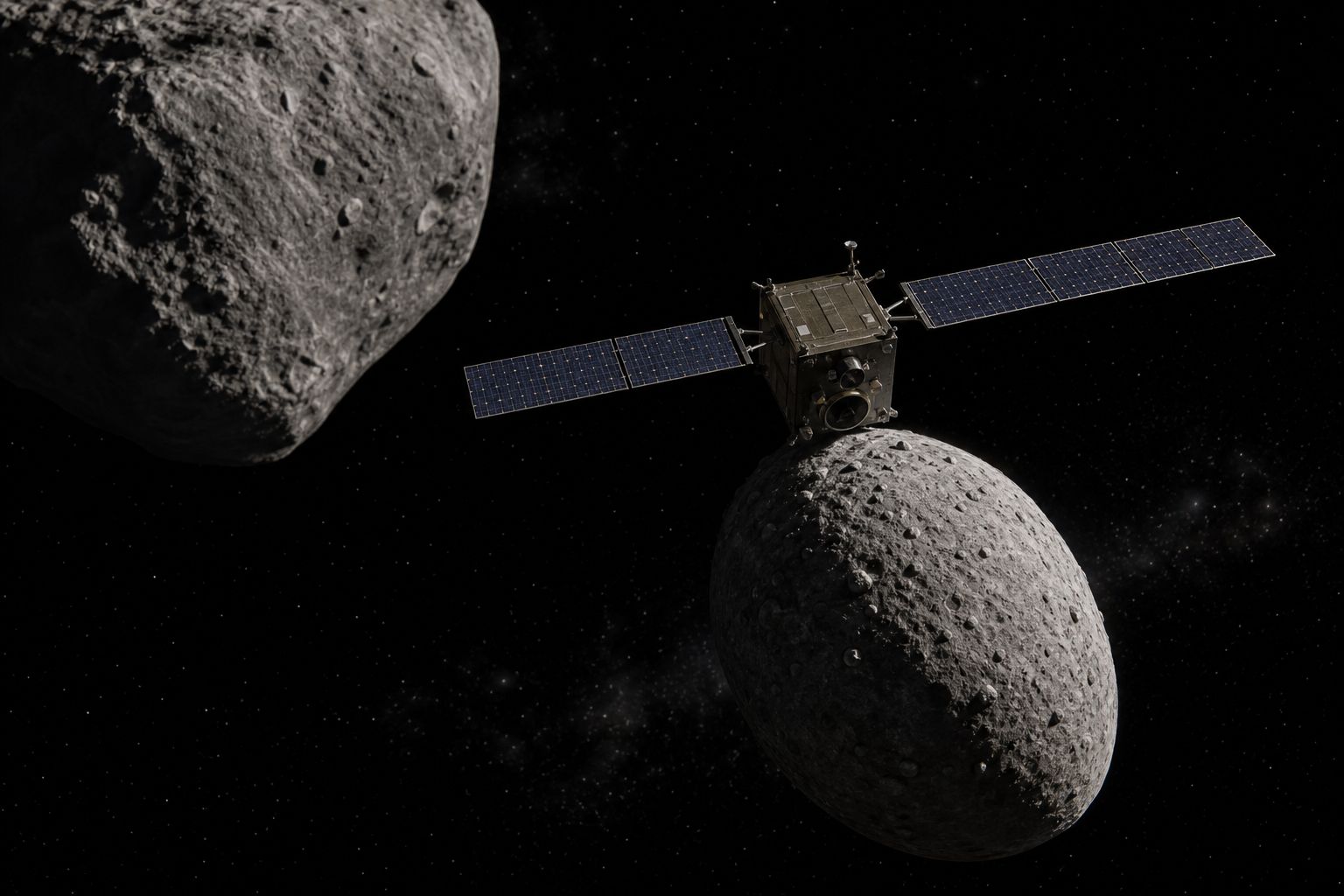
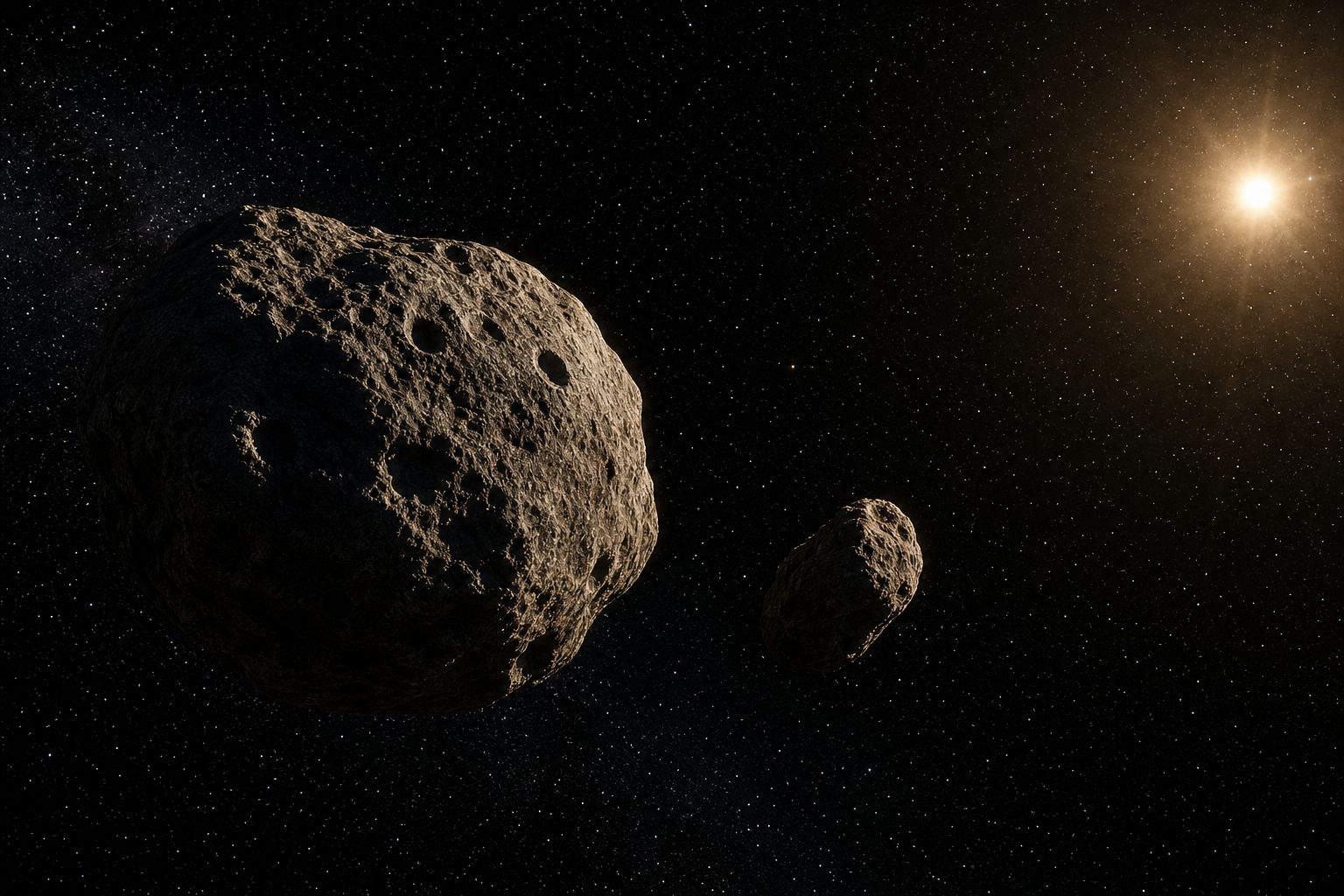
On the twenty-seventh of October 2026, the European Space Agency released the first picture from Hera, the spacecraft sent to inspect the crash. Taken from about twelve hundred and eighty kilometres away, it showed two asteroids where telescopes on Earth see only one.
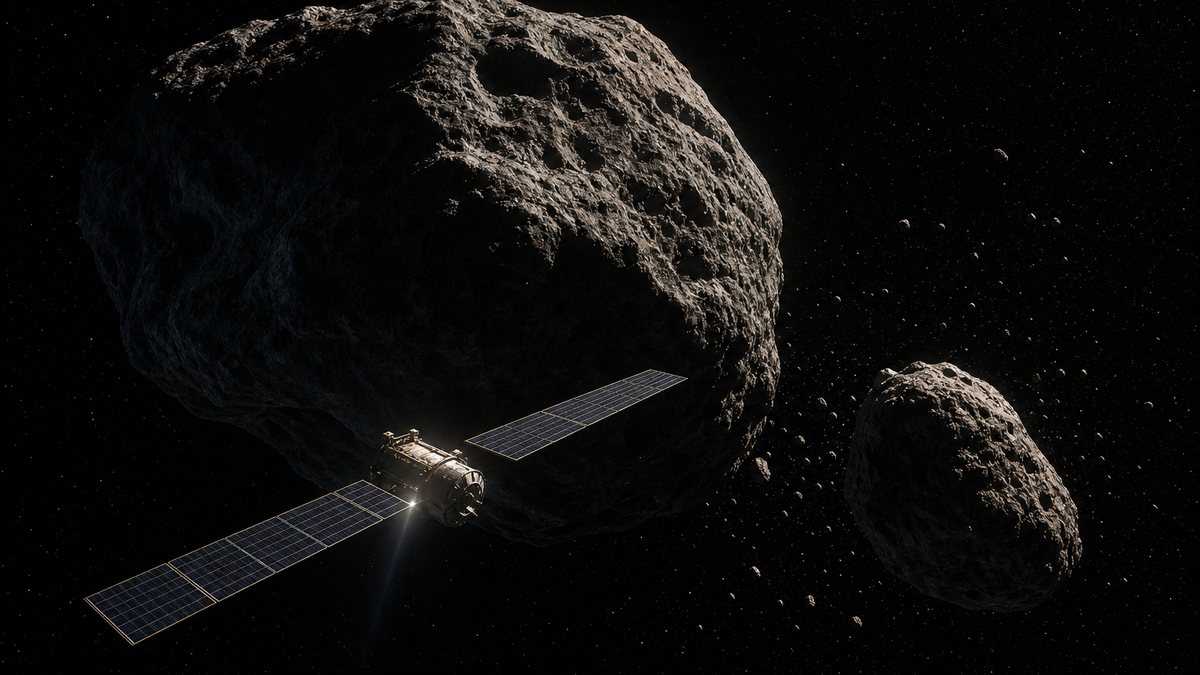
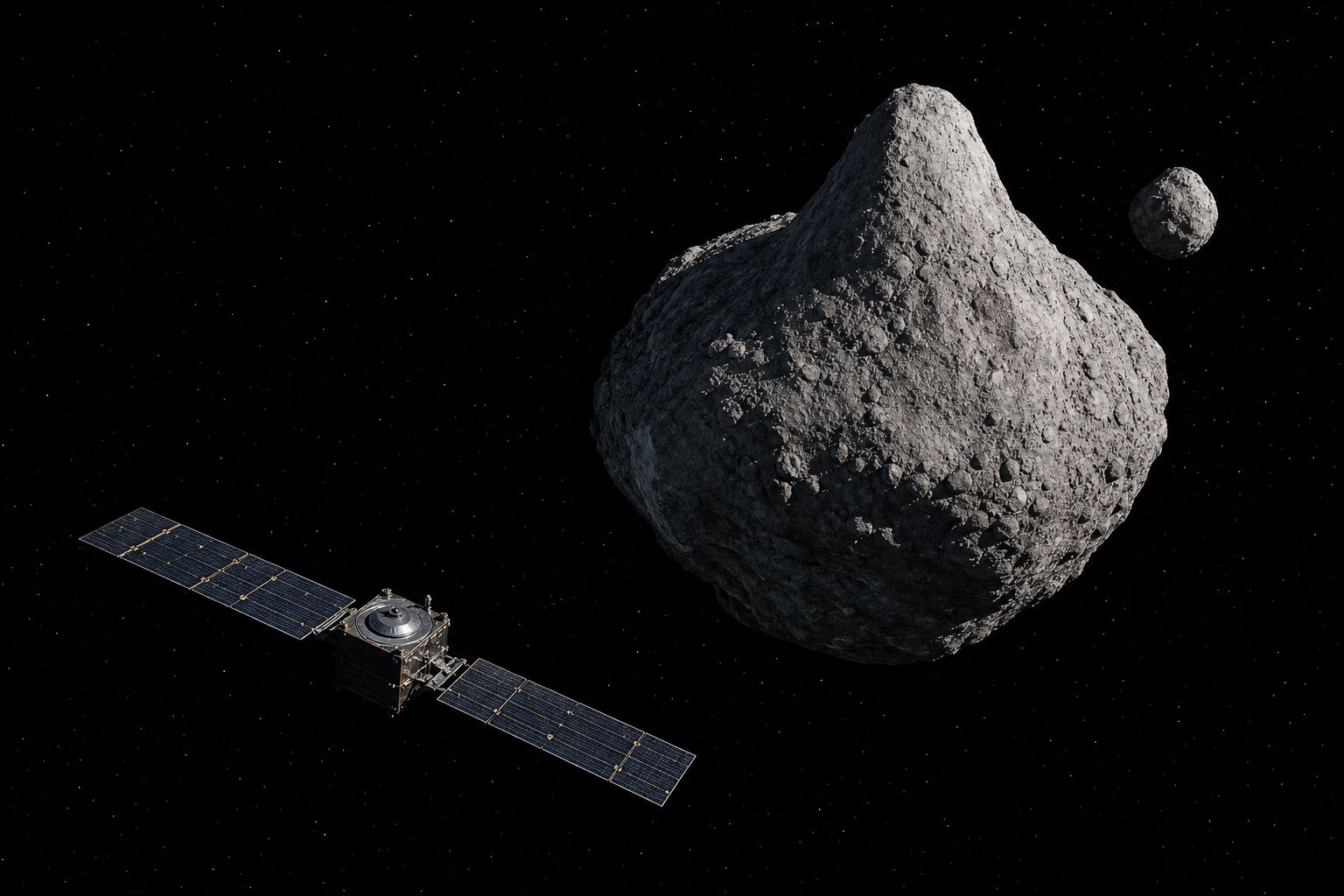
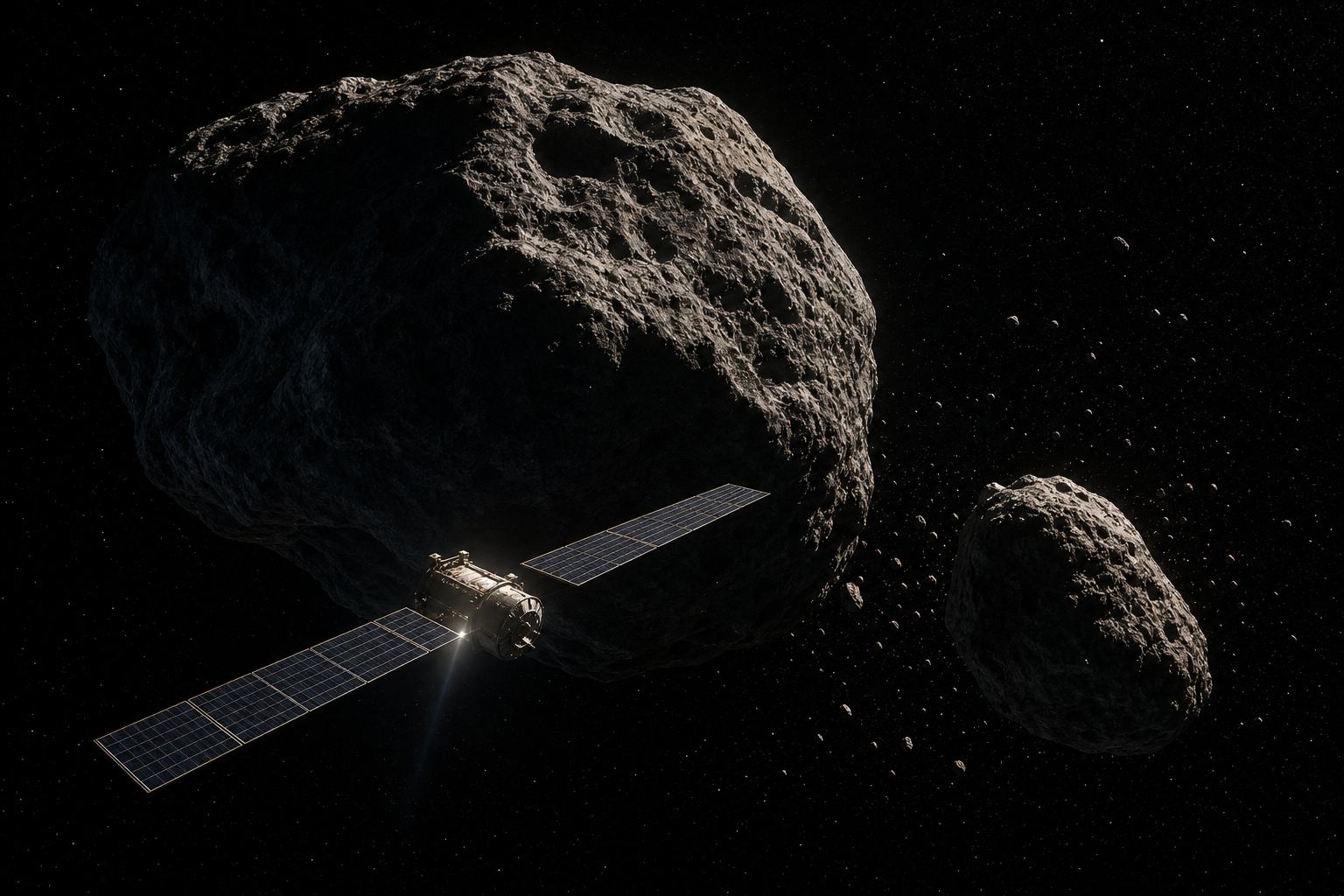
A double asteroid Dimorphos, 151 m across, circles Didymos, 780 m across, about 1.15 km away. AI-generated illustration.
18 Oct 2026
when the picture was taken
~1 pixel
how big Dimorphos looked, yet clearly apart
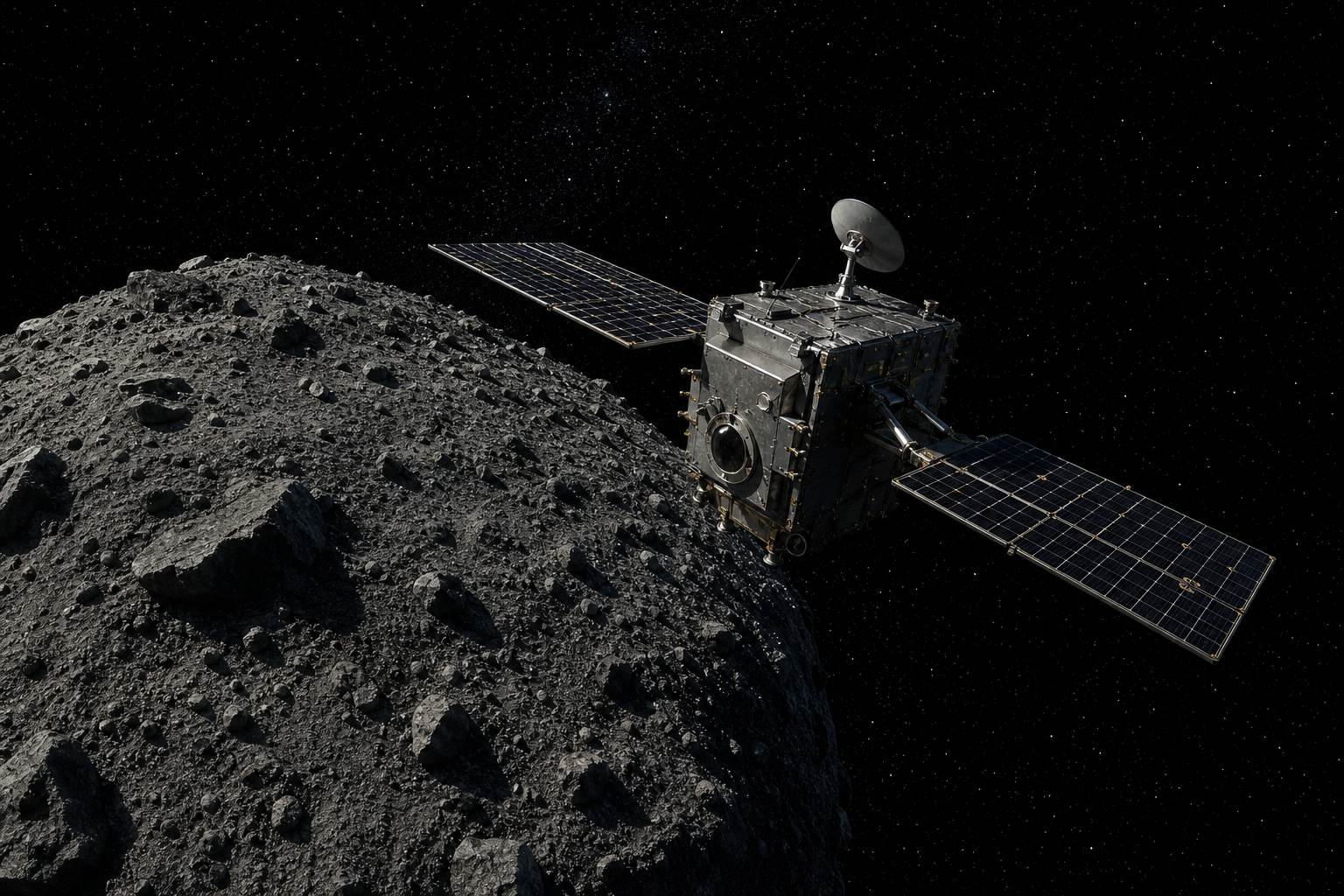
Hera’s first light (ESA)Back to the crash site Earlier in October, braking burns slowed Hera to 20 metres per second relative to the pair. AI-generated illustration.
Prologue
Two asteroids instead of one
ESA (27 October 2026): Hera imaged Didymos and Dimorphos on the evening of 18 October with its Asteroid Framing Camera, from about 1,280 km; Dimorphos covered only about one pixel but was clearly separated from its parent. Dimorphos is 151 m across, Didymos 780 m; they are on average 1.15 km apart. Braking burns earlier in October slowed Hera to 20 m/s relative to the asteroids. ESA calls Dimorphos the first object in the Solar System whose orbit was measurably changed by human action. MEDIA INAF (30 October 2026) reports the same figures.
The Hera news is the hook. The rest of the film is established science: how near-Earth objects are found, and what DART showed about deflecting one.
The 3D scenes are simplified teaching models; where something is not to scale, the scene says so.
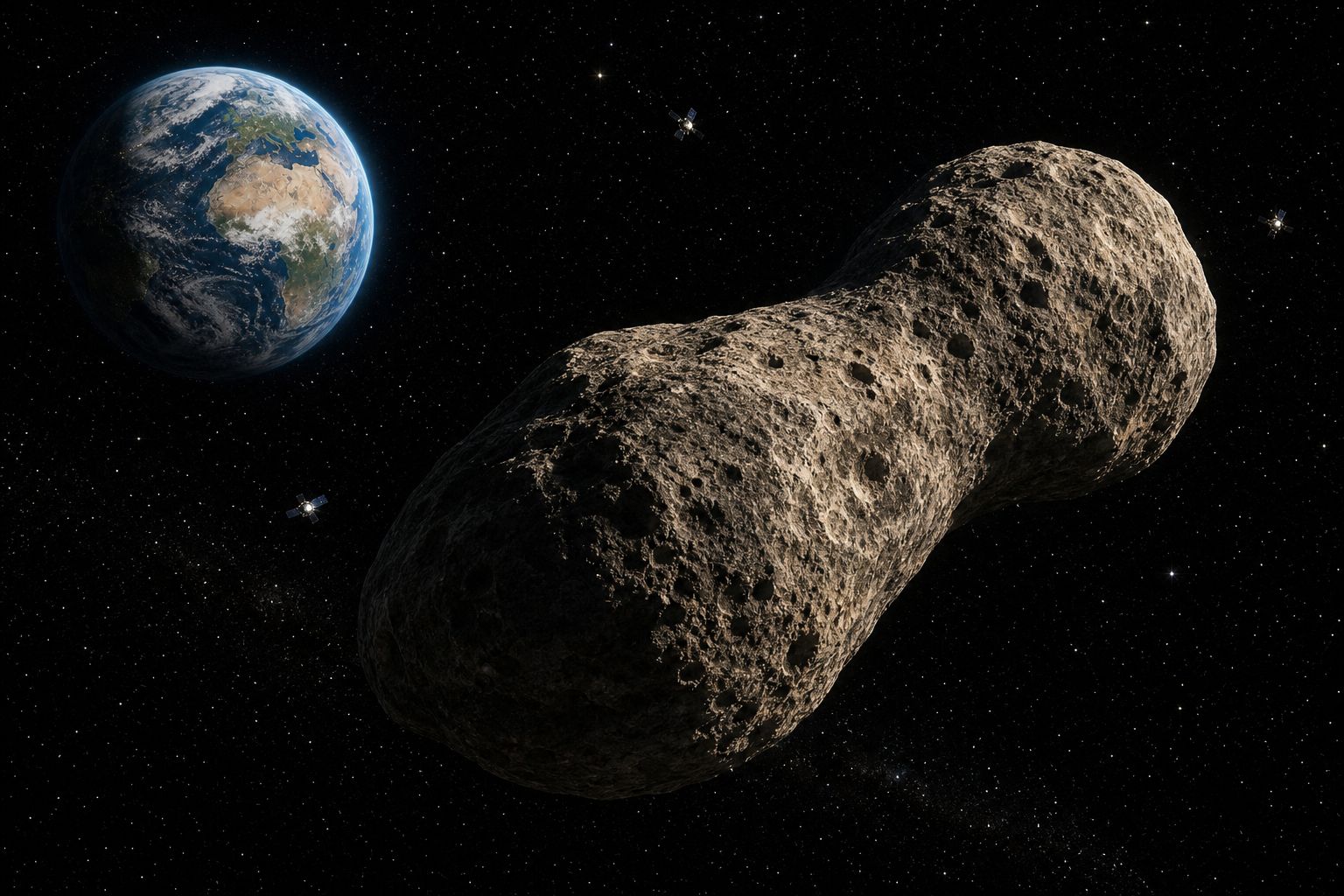
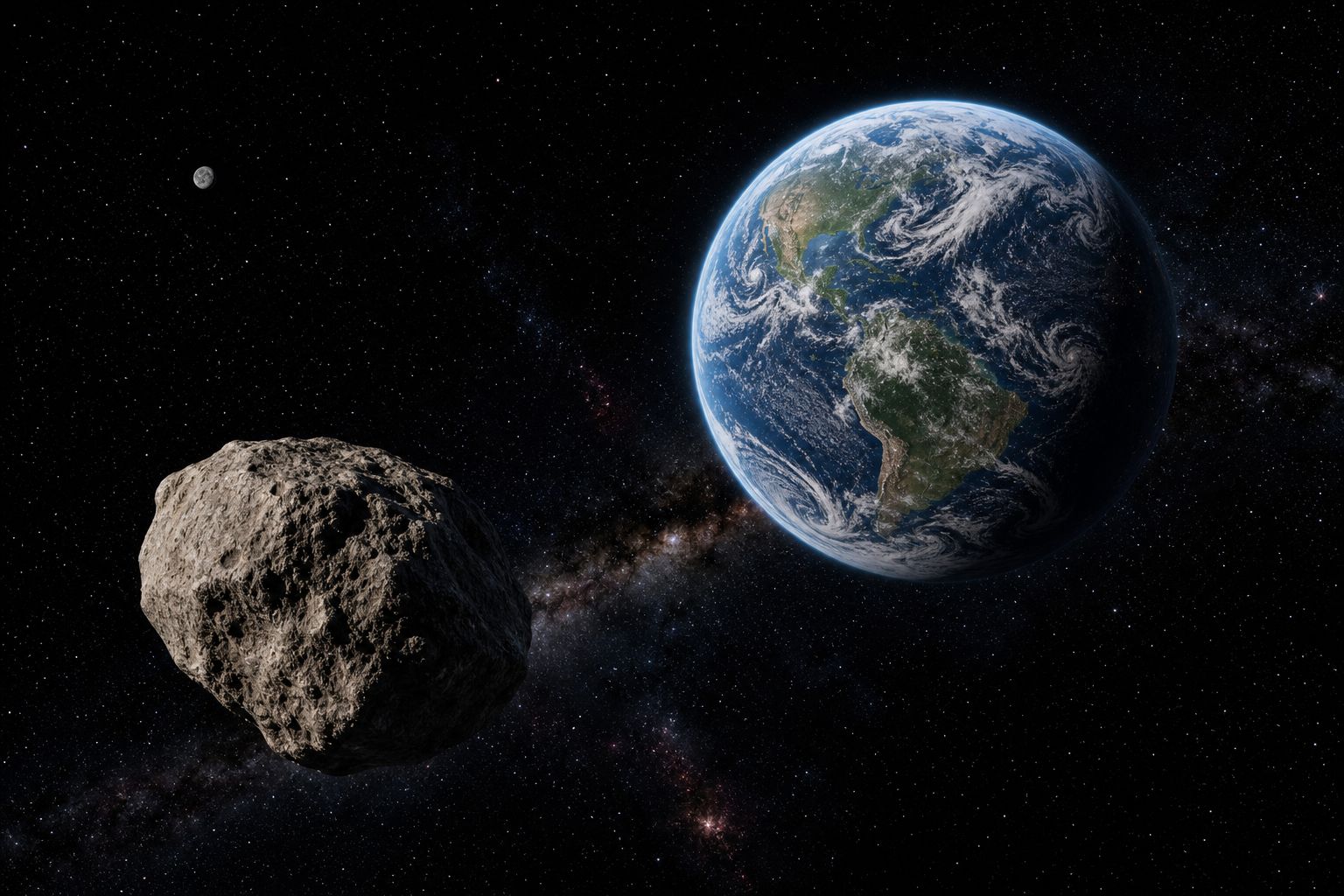
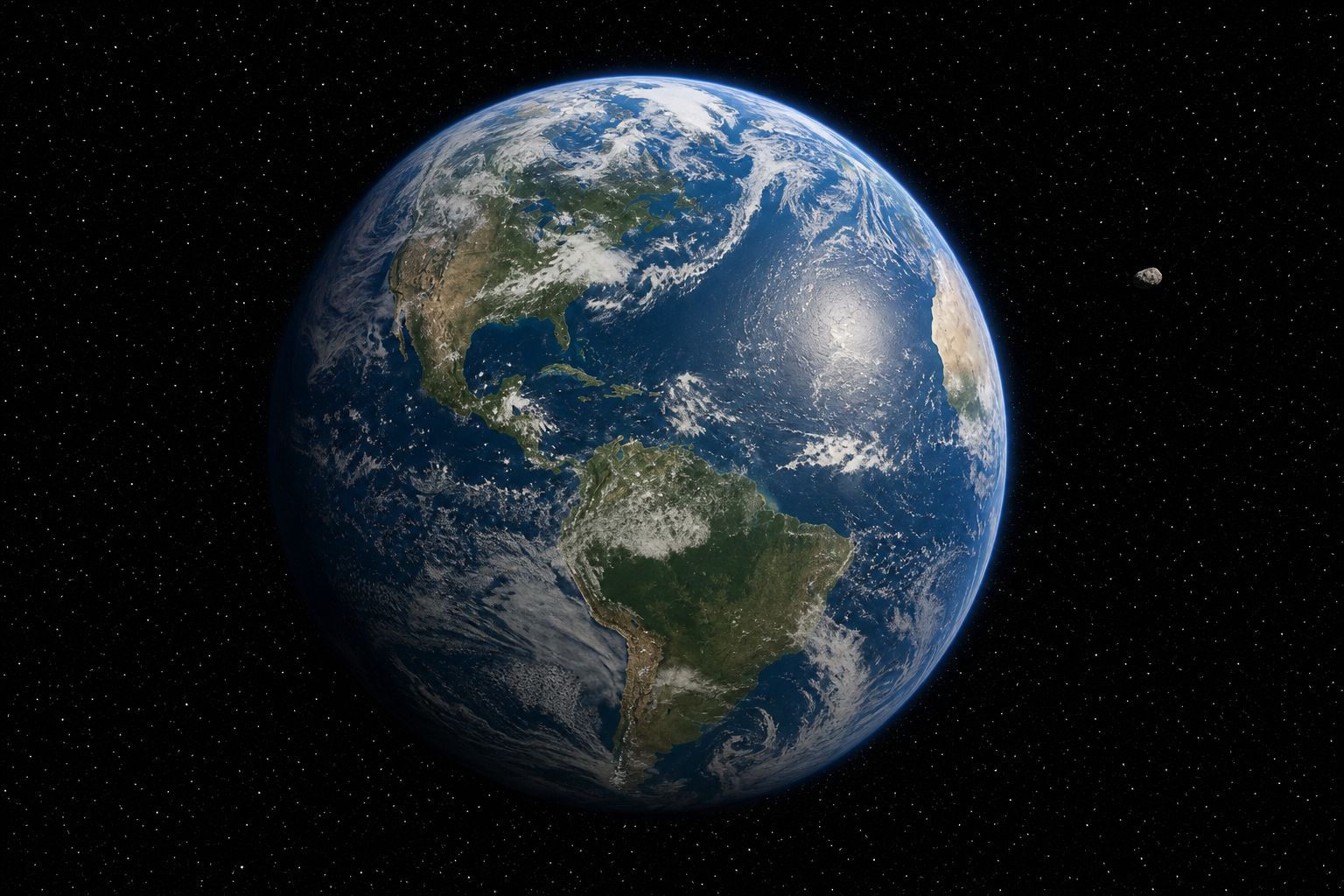
Earth shares its neighbourhood with rocks. Like Earth, they circle the Sun, so the yardstick is the Sun: an asteroid or comet that comes within 1.3 times Earth's distance from it is called a near-Earth object. Ninety-nine percent of them are asteroids.
Most are tiny. But on the thirtieth of June 1908, a stony object perhaps fifty to eighty metres across exploded above Siberia, near the Tunguska River, with an estimated four megatons of TNT, some two hundred and fifty times the Hiroshima bomb.
It left no crater, yet it flattened an estimated eighty million trees over more than two thousand square kilometres.
≤ 1.3 au
closest approach to the Sun; 1 au is Earth’s distance
99%
are asteroids, the rest comets
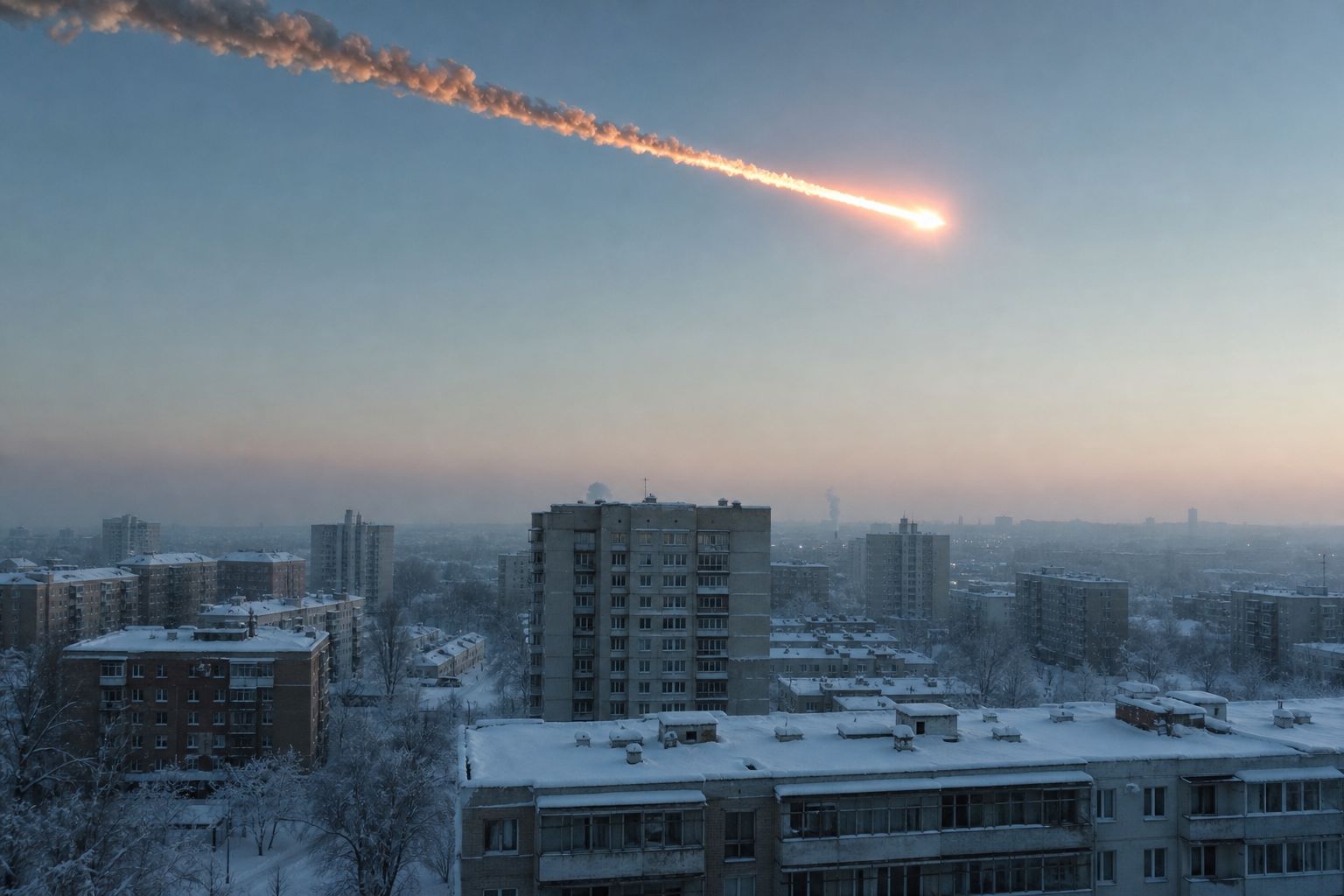
Near-Earth object (NASA CNEOS)Tunguska, 1908 The trees fell outward, pointing away from the point under the blast. AI-generated illustration.Small ones burn up Tiny rocks hit Earth every day; most burn up in the atmosphere. AI-generated illustration.
5–10 km
height of the blast
~2,150 km²
of forest flattened
Tunguska (EarthSky)
Chapter I · Rocks from the sky
Near-Earth objects and Tunguska
NASA JPL CNEOS: a near-Earth object is an asteroid or comet with a perihelion distance of 1.3 au or less; 99% of NEOs are asteroids. EarthSky: on 30 June 1908 a stony asteroid about 50–80 m across exploded 5–10 km above the forest north of the Podkamennaya Tunguska River in Siberia, flattening an estimated 80 million trees over about 2,150 km², with an energy of about 4 megatons of TNT, roughly 250 times the Hiroshima bomb; no crater was found.
1 au (astronomical unit) is the average distance from Earth to the Sun, about 150 million km. Sizes and energies of Tunguska are estimates.
The 3D scenes are simplified teaching models; where something is not to scale, the scene says so.
On the fifteenth of February 2013, a rock about twenty metres wide burst about thirty kilometres above Chelyabinsk in Russia, with about half a megaton of TNT, some thirty times the Hiroshima bomb.
About fifteen hundred people sought medical help, most hurt by glass from windows shattered by the shock wave. Nobody saw it coming: it arrived from the direction of the Sun.
The bigger the rock, the rarer the hit. Chelyabinsk-sized events come every sixty to eighty years on average, Tunguska-sized every two to three hundred, and a one-kilometre asteroid about once in five hundred thousand years.
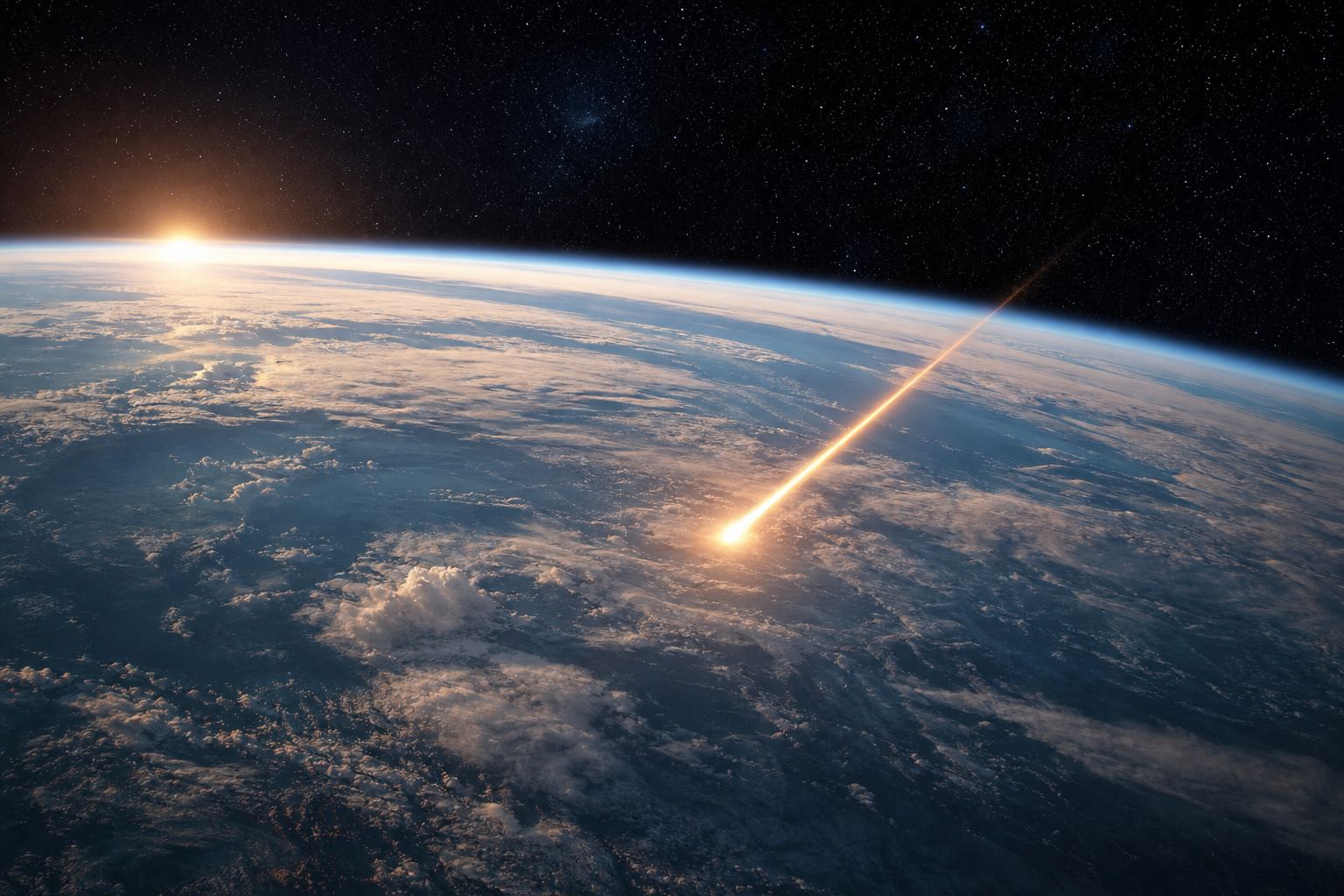
A morning fireball It came in fast, at about 19 kilometres per second, and at a shallow angle. AI-generated illustration.The shock wave About 7,200 buildings in six cities were damaged. AI-generated illustration.
~0.5 Mt
Chelyabinsk, against ~4 Mt at Tunguska
~1,500
people sought medical help
Chelyabinsk (Planetary Society)
~1 m
< 1
~19 m (Chelyabinsk)
60–80
~50 m (Tunguska)
200–300
~1 km
500,000
How often, on average (Catalina Sky Survey)
Chapter I · Rocks from the sky
Chelyabinsk, and how often rocks hit
The Planetary Society: on 15 February 2013 at 9:20 a.m. local time, an asteroid about 20 m across entered at about 19 km/s at a shallow angle and exploded about 30 km above Chelyabinsk, Russia, with about 500 kilotons of TNT, some 30 times the Hiroshima bomb. About 1,500 people went to hospitals and clinics, most hurt by glass when the shock wave shattered windows; about 7,200 buildings in six cities were damaged. It came from the direction of the Sun and nobody saw it coming. Catalina Sky Survey: objects of about 1 m hit a few times a year; about 19 m (like Chelyabinsk) every 60 to 80 years on average; about 50 m (like Tunguska) every 200 to 300 years; about 1 km every 500,000 years.
The bars use log₁₀ of the years between impacts; the 1 m bar stands for “a few a year”.
The 3D scenes are simplified teaching models; where something is not to scale, the scene says so.
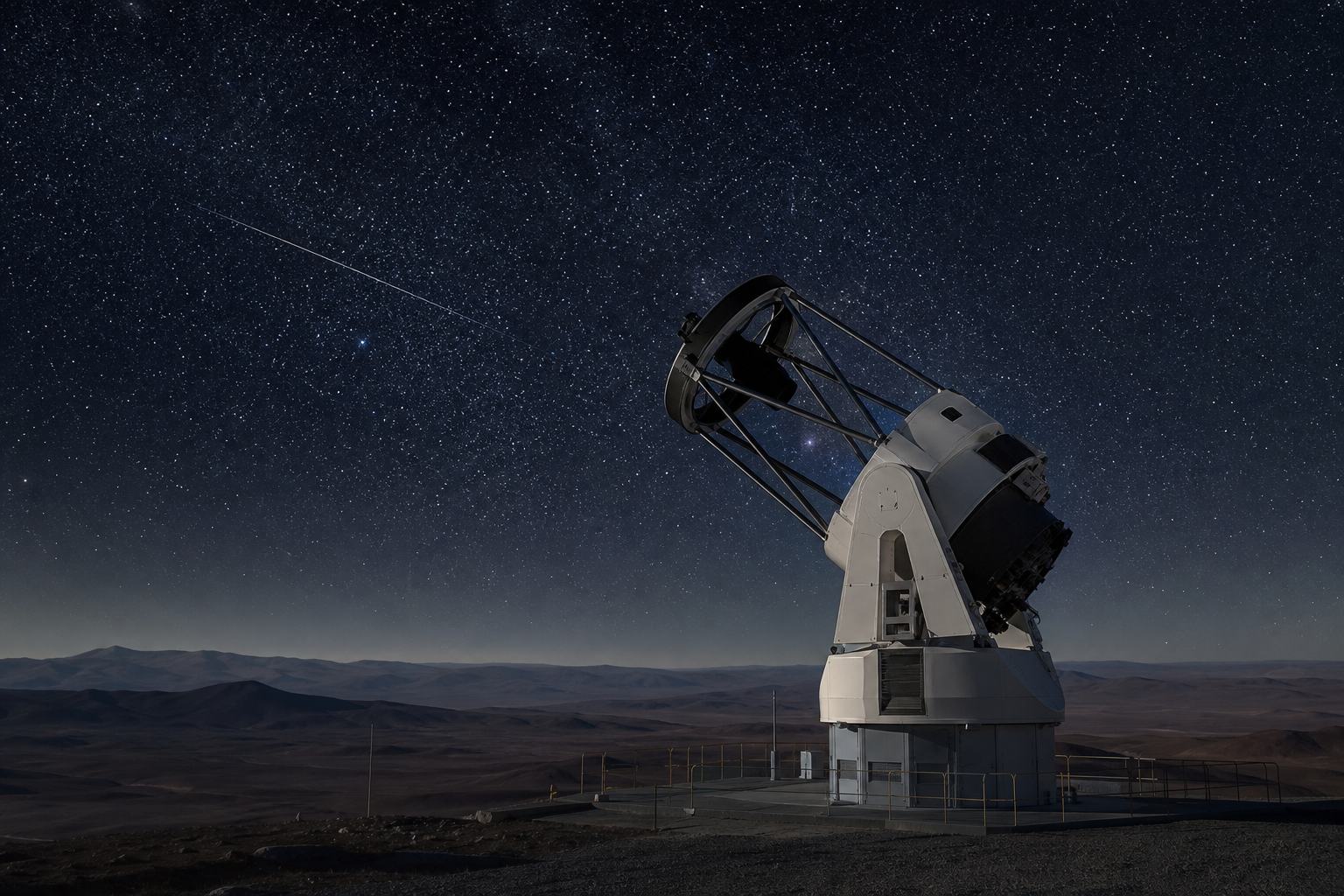
So the first job of planetary defence is to look. Survey telescopes photograph the same patch of sky at least three times, minutes apart. Stars stay put; a near-Earth asteroid is a dot that moves.
A few positions over two or three nights give a first orbit, worked out with the same law of gravity that predicts the planets. Every new sighting makes it sharper.
In 2005, the United States Congress asked NASA to find ninety percent of near-Earth objects larger than one hundred and forty metres. Fewer than half of an estimated twenty-five thousand have been found, so NASA is building NEO Surveyor, an infrared space telescope.
A dot that moves Software flags points of light that shift against the fixed stars; astronomers then rule out reflections and bad pixels. AI-generated illustration.
Positions sent to the Minor Planet Center
Confirmed in 2–3 nights
Follow-up worldwide refines the orbit
Sentry checks impact odds daily
From speck to orbit (NASA JPL)
11,343
found, about 45%
~14,000
still to find
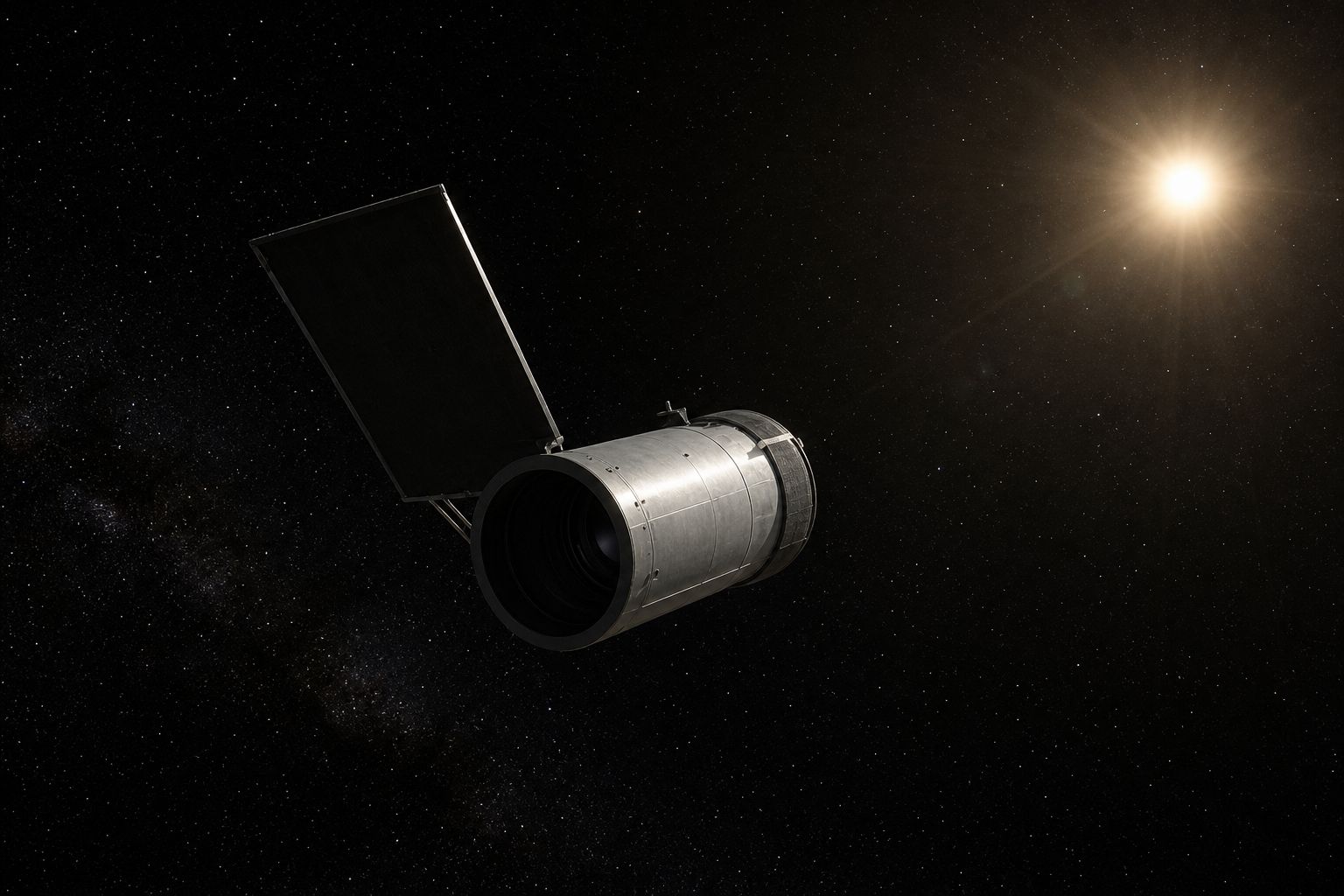
Over 140 m (NASA, Dec 2025)Seeing dark rocks by their heat Asteroids re-radiate the Sun’s heat, so an infrared telescope can find dark ones that reflect little light. AI-generated illustration.
Chapter II · Finding them
Finding near-Earth asteroids
NASA JPL: survey telescopes such as the Catalina Sky Survey and Pan-STARRS photograph the same patch of sky at least three times, several minutes apart; software flags points of light that move against the fixed stars. Positions go to the Minor Planet Center, which computes an initial orbit; confirmation usually takes two to three nights. Follow-up observations refine the orbit, and JPL’s Sentry system assesses impact probabilities daily. The Planetary Society: in 2005 Congress directed NASA to find 90% of the estimated 25,000 NEOs larger than 140 m; NASA has found about 43% of that goal. NASA (planetary defence pages, 3 December 2025): 11,343 near-Earth asteroids larger than 140 m discovered and an estimated 14,000 still to find, about 45% of the total, so fewer than half of the estimated 25,000 are known. NEO Surveyor, an infrared telescope at the Sun–Earth L1 point, is due to launch in September 2027, or by June 2028 at the latest; infrared reveals dark asteroids by their heat.
In the scene, a made-up population of dots circles the Sun; the cone is a survey field sweeping the sky.
The 3D scenes are simplified teaching models; where something is not to scale, the scene says so.
A young orbit is fuzzy. Project it years ahead, and the asteroid could be anywhere along a long, thin band of possible positions.
If Earth lies inside that band, there is an impact probability. Asteroid 2024 YR4, found in December 2024, briefly reached three point one percent for December 2032, the highest NASA had recorded for an object that size.
Then more observations shrank the band, it slid off Earth, and the odds fell to zero point zero zero four percent. Rising, then falling, is normal. Add observations and watch.
Where could it be? Astronomer Richard Binzel compares the band to a fettuccine noodle, with Earth somewhere beneath it. AI-generated illustration.
27 Dec 2024 First reported, by ATLAS in Chile
18 Feb 2025 3.1% chance for 22 Dec 2032
24 Feb 2025 0.004%: no significant threat
Asteroid 2024 YR4
~40–90 m
estimated width (130–300 feet)
Size of 2024 YR4 (Smithsonian)
Few observations: a long band
More observations: a shorter band, still over Earth
Enough observations: the band moves clear
Why the odds jump about
Chapter II · Finding them
Impact probability
Smithsonian Magazine: asteroid 2024 YR4 was first reported by the ATLAS station in Chile on 27 December 2024 and estimated at about 130 to 300 feet across. On 18 February 2025 NASA put its chance of hitting Earth on 22 December 2032 at 3.1%, the highest it had documented for an object that size or larger. Richard Binzel likens the range of possible positions to a fettuccine noodle: as observations narrow it, the probability can rise while it still covers Earth, then fall once it moves clear. NASA (24 February 2025): new observations reduced the uncertainty and the range of possible positions shifted away from Earth; the impact probability fell to 0.004%.
Try it: add observations one by one. The percentages in the readout are illustrative, not the real 2024 YR4 values. The metre figures are converted from the feet quoted.
The 3D scenes are simplified teaching models; where something is not to scale, the scene says so.
To explain such numbers to the public, astronomers use the Torino scale, adopted in 1999. It runs from zero, no hazard, to ten, a certain collision able to cause a global climatic catastrophe.
It combines how likely a hit is with how much damage the object could do, from its size and speed.
Asteroid Apophis, about three hundred and seventy-five metres across, once held the highest rating ever given. Radar measurements in March 2021 ruled out any impact for at least a hundred years.
0 · white: no hazard
1–7 · green, yellow, orange
8–10 · red: a certain collision
The five zones (MIT, 1999)
chance
of a collision
energy
from size and speed
What sets the levelApophis, 2029 On 13 April 2029 it will pass within about 32,000 km of Earth’s surface, closer than geostationary satellites. AI-generated illustration.
19 Jun 2004 Discovered at Kitt Peak, USA
later 2029 and 2036 ruled out
26 Mar 2021 Off ESA’s risk list for 100 years
Apophis (ESA)
Chapter II · Finding them
The Torino scale
MIT News: the Torino Impact Hazard Scale, created by Richard P. Binzel of MIT, was adopted at an International Astronomical Union workshop in Turin in June 1999 and endorsed on 22 July 1999 at UNISPACE III in Vienna. It runs from 0 to 10, combining an object’s chance of collision with its size and speed: 0 (white) means virtually no chance of collision, or an object that would burn up harmlessly; 1 to 7 fall in the green, yellow and orange zones; 8, 9 and 10 are red, and 10 is a certain collision able to cause a global climatic catastrophe. ESA: Apophis, about 375 m across, was discovered on 19 June 2004; its 2029 impact risk peaked at 2.7%, the highest rating ever on the Torino scale. Radar observations in March 2021 ruled out impact for at least 100 years, and it left ESA’s risk list on 26 March 2021. On 13 April 2029 it will pass within about 32,000 km of Earth’s surface.
Try it: pick a level to see its zone.
The 3D scenes are simplified teaching models; where something is not to scale, the scene says so.
Suppose we did find one on a collision course. The only answer tested so far is the simplest: hit it. A kinetic impactor is a spacecraft that rams an asteroid at high speed to change its velocity a little.
The physics is momentum, mass times velocity. A spacecraft of a few hundred kilograms hands its momentum to a rock millions of times heavier, so the rock's speed changes by only millimetres per second.
That sounds like nothing. But a small change, made early, grows with every orbit. Launch an impactor and watch.
Ramming speed No explosive is involved: the spacecraft’s own motion does the work. AI-generated illustration.MΔv≈mU
M
mass of the asteroid
Δv
its change in velocity
m
mass of the spacecraft
U
its speed relative to the asteroid
Momentum is shared
~580 kg
spacecraft at impact (APL)
~5 billion kg
Dimorphos, an estimate (Space.com)
DART against DimorphosA small change, made early A one-time change of a few millimetres per second adds up, year after year, to thousands of kilometres of distance. AI-generated illustration.
Chapter III · Hit it
The kinetic impactor
The Planetary Society: a kinetic impactor is a spacecraft crashed into an asteroid to change its path, and it is the only planetary defence technique tested on an actual asteroid. Cheng et al. (Nature, 2023) write the momentum balance of the impact as MΔv = mU + m(β − 1)(Ê·U)Ê, where M is the asteroid’s mass, Δv its change in velocity, m the spacecraft’s mass and U its velocity relative to the asteroid; without the extra term from debris (β = 1), MΔv = mU. Johns Hopkins APL: DART had a mass of roughly 580 kg at impact. Space.com: Dimorphos’s total mass is estimated at about 5 billion kg.
Try it: launch the impactor. The spacecraft flies against Dimorphos’s motion, so the hit slows it and its orbit shrinks.
The 3D scenes are simplified teaching models; where something is not to scale, the scene says so.
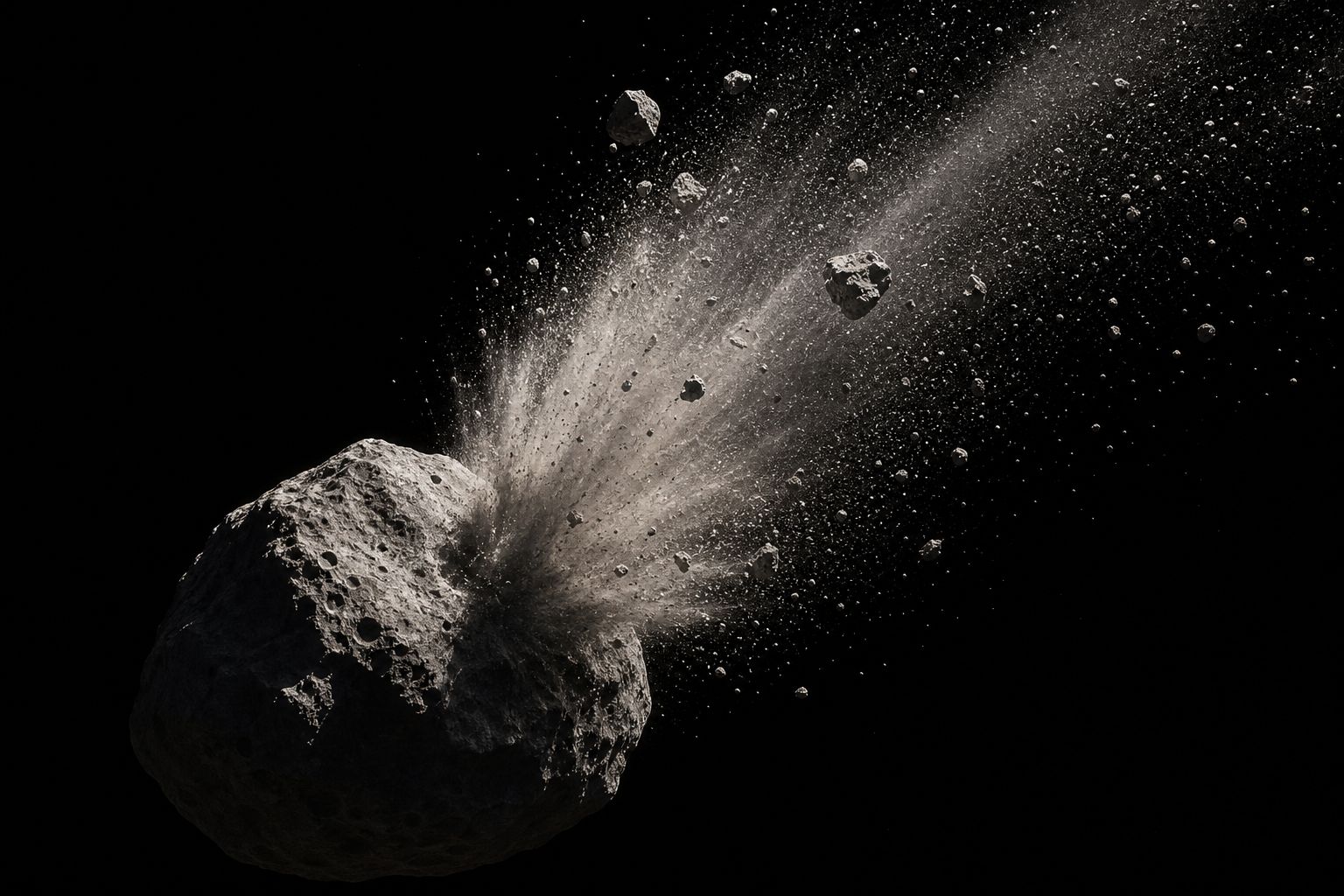
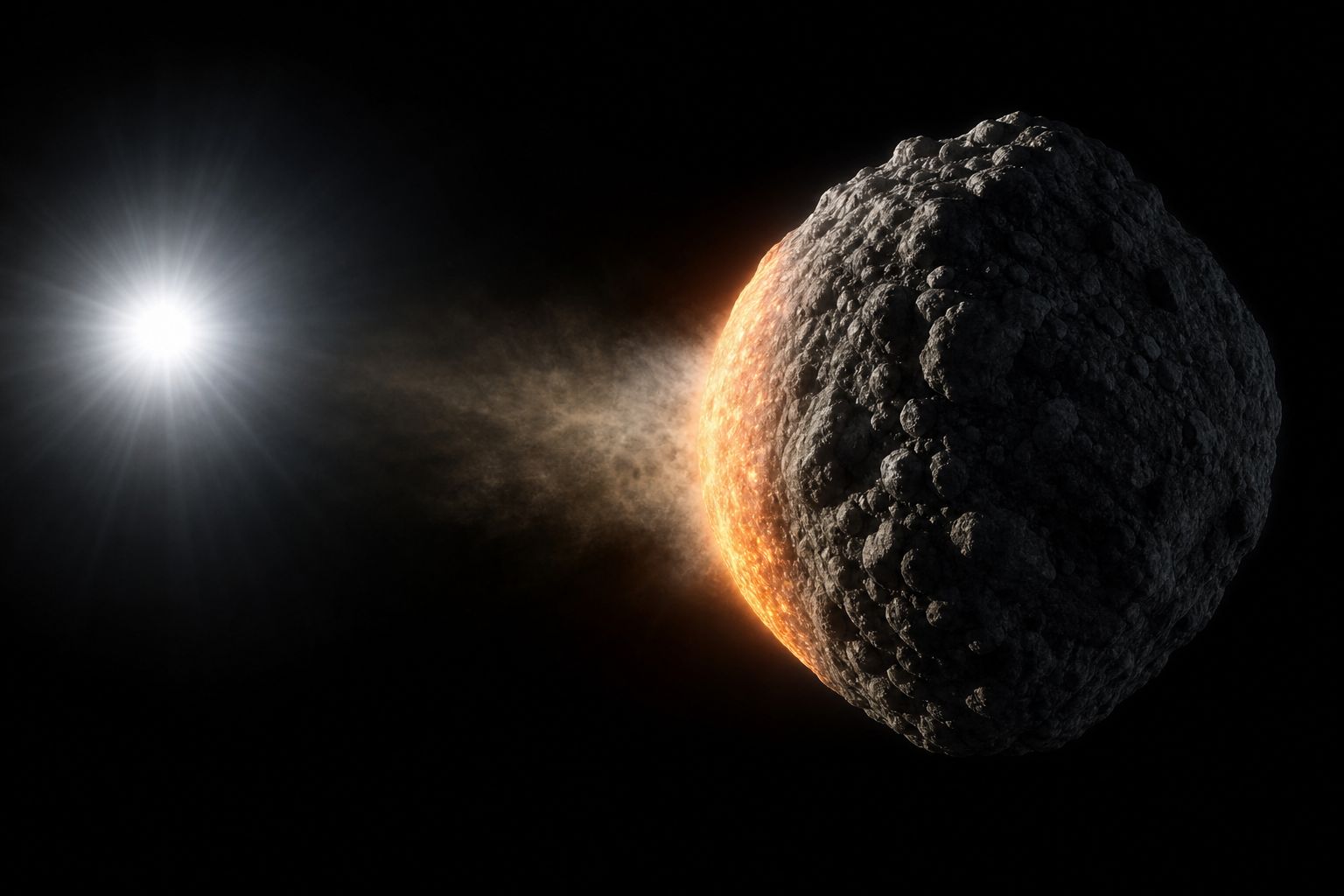
There is a bonus. The impact blasts out a plume of rock and dust. As that debris flies off one way, it pushes the asteroid the other way, like the exhaust of a rocket.
Scientists measure the bonus with a number called beta. Beta equal to one means no help from debris. Beta of two means the debris doubled the push.
Before 2022, nobody had measured beta on a real asteroid. Switch the ejecta off and on.
Push back, move forward Throw a heavy load off the back of a skateboard and the board rolls forward: the same recoil works on an asteroid. AI-generated illustration.β=momentum brought by the spacecraftmomentum given to the asteroid
β=1
no debris thrown out
β>2
debris gave more push than the spacecraft
The momentum enhancement factor (Cheng et al.)The plume More debris means more recoil, and a bigger change in the asteroid’s speed. AI-generated illustration.
Chapter III · Hit it
Ejecta and beta
Space.com (December 2022, from an AGU briefing): a β of 1 would mean a clean impact with no debris, where the asteroid picks up exactly the spacecraft’s momentum; debris ejected into space adds momentum and raises β. Cheng et al. (Nature, 2023): β is the ratio of the momentum actually given to the asteroid to the spacecraft’s incident momentum, measured along the net ejecta direction; a β above 2 means more momentum came from the escaping ejecta than from the spacecraft itself. The Planetary Society: in the DART test, escaping debris pushed harder on Dimorphos than the impact itself did.
Try it: with and without ejecta. The ring shows the orbit after the hit, drawn twice its real change.
The 3D scenes are simplified teaching models; where something is not to scale, the scene says so.
So NASA tested it. DART, the Double Asteroid Redirection Test, launched from California in November 2021.
Its target was harmless: Dimorphos, a hundred and fifty-one metres across, circling the larger Didymos. The pair's orbit never crosses Earth's.
On the twenty-sixth of September 2022, about eleven million kilometres from Earth, the roughly five hundred and eighty kilogram spacecraft hit Dimorphos at six point one kilometres per second.
An Italian CubeSat, LICIACube, released fifteen days earlier, photographed the plume.
24 Nov 2021 Launch from Vandenberg, California (06:21 UTC)
Sep 2022 LICIACube released, 15 days before impact
26 Sep 2022 Impact on Dimorphos
DARTA rubble pile A “rubble pile” is an asteroid made of loose boulders and gravel rather than one solid rock. DART’s only camera, DRACO, first saw Dimorphos as a dot about an hour before impact. AI-generated illustration.
6.1 km/s
impact speed
~11 million km
from Earth, timed for the closest approach
The impact (ESA, APL)Seen by LICIACube ESA says the debris plume stretched across 10,000 km of space. AI-generated illustration.
Chapter IV · DART
The DART test
NASASpaceflight: DART launched on a Falcon 9 from Space Launch Complex 4E at Vandenberg Space Force Base, California, on 23 November 2021 at 10:21 Pacific time (24 November, 06:21 UTC). Its single instrument, the DRACO camera, was to see Dimorphos as a tiny dot about an hour before impact. Johns Hopkins APL: the system was chosen because the orbit of Didymos never intersects Earth’s; DART had a mass of roughly 580 kg at impact; Didymos was about 11 million km from Earth on 26 September 2022, the impact being timed for the closest approach; the Italian Space Agency’s LICIACube was released 15 days before impact to photograph it. ESA: DART struck at 6.1 km/s, and the debris plume extended across 10,000 km of space.
The launch date is given in UTC; in California it was still 23 November.
The 3D scenes are simplified teaching models; where something is not to scale, the scene says so.
Why pick a pair? A push on an asteroid going around the Sun is hard to measure quickly. A push on a moon going around another asteroid shows up fast.
Seen from Earth, Dimorphos passes in front of Didymos and behind it on every orbit, so the pair's combined light dips on a regular beat. Telescopes timed those dips.
Before the impact, one orbit took eleven hours and fifty-five minutes. Afterwards, it was thirty-three minutes shorter. NASA's minimum for success had been seventy-three seconds.
An eclipsing binary When one body blocks or shadows the other, the light from the pair drops for a while. AI-generated illustration.Watching from the ground Telescopes in Chile and South Africa took part, with radar from Goldstone in California and Green Bank in West Virginia. AI-generated illustration.
NASA’s minimum for success: 73 seconds
73 s
Measured (Thomas et al., 2023)
33.0 ± 1.0 min
Change in the orbit period
Chapter IV · DART
Why a binary asteroid
Johns Hopkins APL (DART mission): the Didymos system is an eclipsing binary as seen from Earth; Dimorphos passes in front of and behind Didymos on each orbit, so the combined brightness varies on a regular cycle, and because the moonlet’s orbit is what changes, the effect can be measured from Earth. Before the impact the period was 11 hours 55 minutes. APL press release (11 October 2022): the first measurements gave a change of 32 minutes (±2), against a minimum success benchmark of 73 seconds, using telescopes in Chile and South Africa and radar from Goldstone and Green Bank. Thomas et al. (Nature, 2023), from lightcurve and radar observations: −33.0 ± 1.0 minutes (3σ).
Try it: before and after the impact. The light curve in the readout is schematic: the dips are exaggerated and one orbit is squeezed into 24 seconds.
The 3D scenes are simplified teaching models; where something is not to scale, the scene says so.
Without the debris, a clean hit would have shortened the orbit by only about seven minutes. Thirty-three minutes meant the plume did most of the work.
In 2023, the team worked out that Dimorphos slowed in its orbit by about two point seven millimetres per second, and that beta was about three point six, assuming a typical density.
And in March 2026, a study showed that the pair's orbit around the Sun had shortened too, by about a sixth of a second.
Spacecraft sticks, no ejecta
~7
Measured
33
Period change: clean hit vs measured
2.70 mm/s
slower along its orbit
3.61
β, if both bodies are 2,400 kg/m³ (range 2.2–4.9 for other densities)
Cheng et al., Nature (2023)A nudge around the Sun Volunteers timed 22 stellar occultations between 2022 and 2025: the pair’s 770-day orbit is 0.15 s shorter. AI-generated illustration.
Chapter IV · DART
Measuring beta
Thomas et al. (Nature, 2023): a perfectly inelastic collision, with no help from ejecta, would have changed the period by about 7 minutes, against the 33 measured. Cheng et al. (Nature, 2023): the period change implies an instantaneous slowing of Dimorphos’s along-track orbital velocity of 2.70 ± 0.10 mm/s; assuming Dimorphos and Didymos both have a density of 2,400 kg/m³, β = 3.61 (−0.25/+0.19); for densities of 1,500 to 3,300 kg/m³ the mean β ranges from 2.2 to 4.9. University of Illinois / NASA (9 March 2026, Science Advances): the system’s orbital period around the Sun, about 770 days, shortened by 0.15 seconds, a change in speed of about 11.7 micrometres per second, found from 22 stellar occultations recorded between October 2022 and March 2025.
“A typical density” in the narration is the 2,400 kg/m³ the authors assumed; beta is uncertain until Hera weighs Dimorphos. The 2026 study gives a momentum factor of about 2 for the whole pair’s orbit around the Sun, a different quantity.
The 3D scenes are simplified teaching models; where something is not to scale, the scene says so.
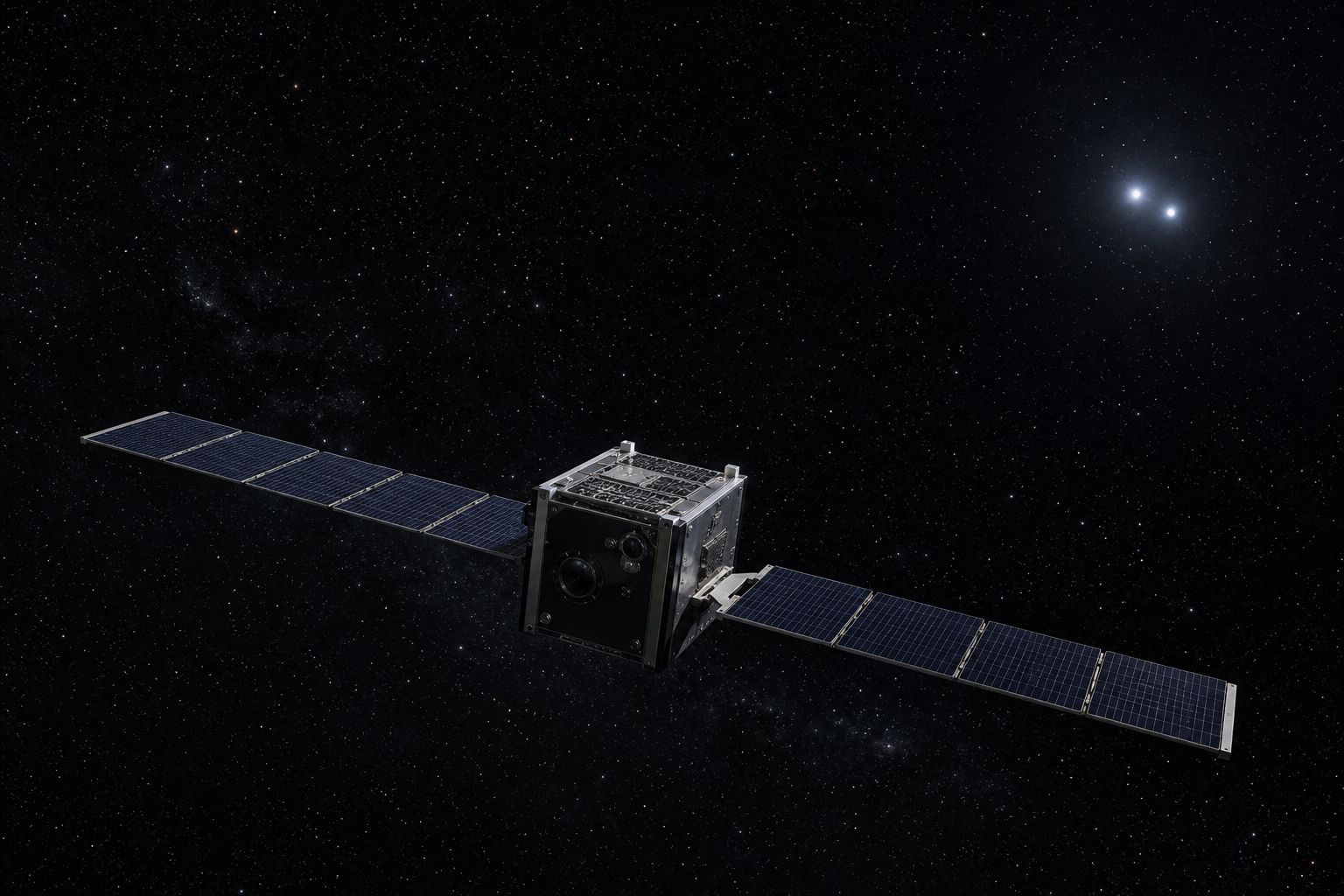
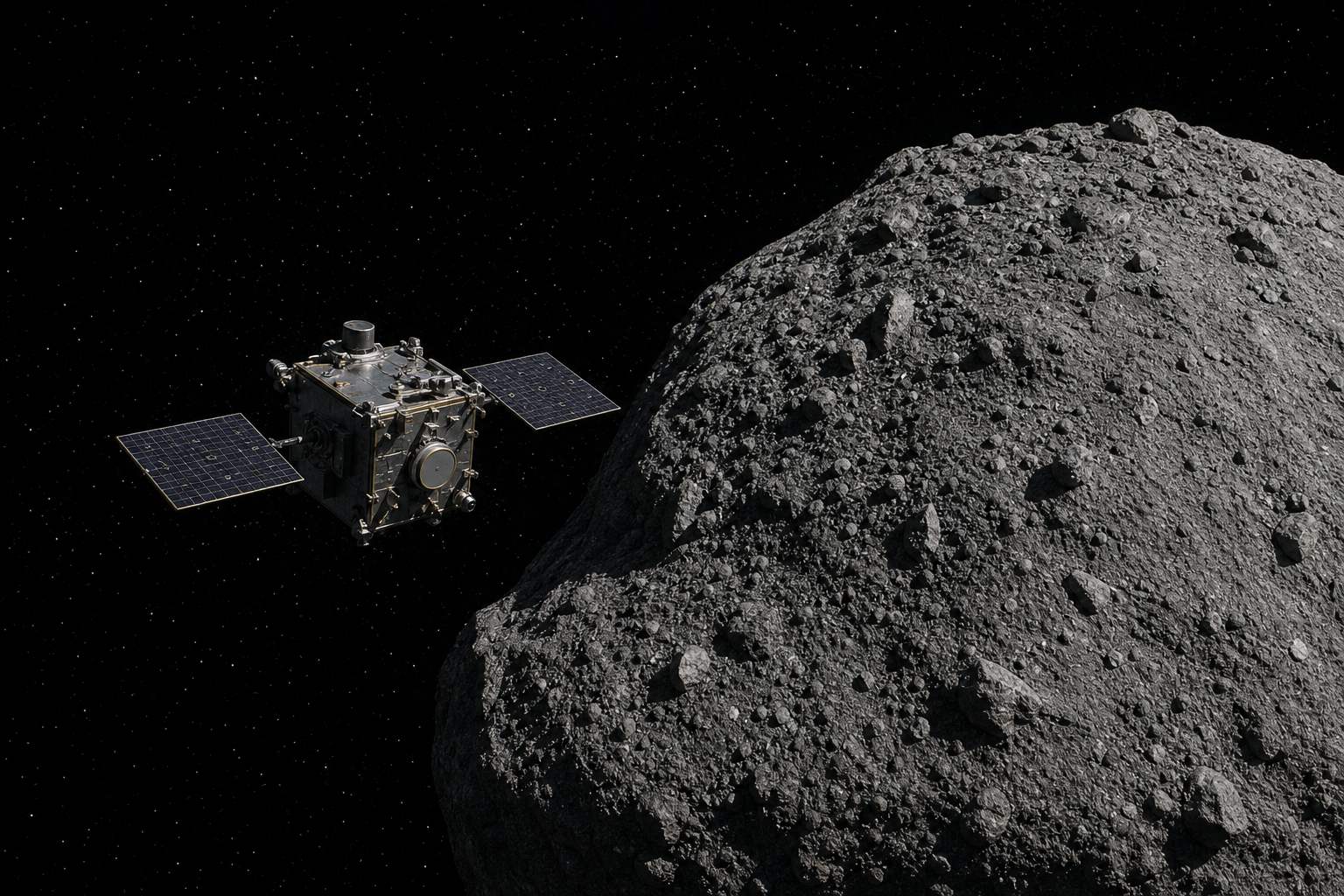
One number was missing: the mass of Dimorphos. Beta depends on it, and Earth's telescopes cannot weigh it. That is the job of Hera, launched by ESA in October 2024.
Up close, it will map both asteroids and measure DART's crater, or find out whether the impact reshaped the moon altogether.
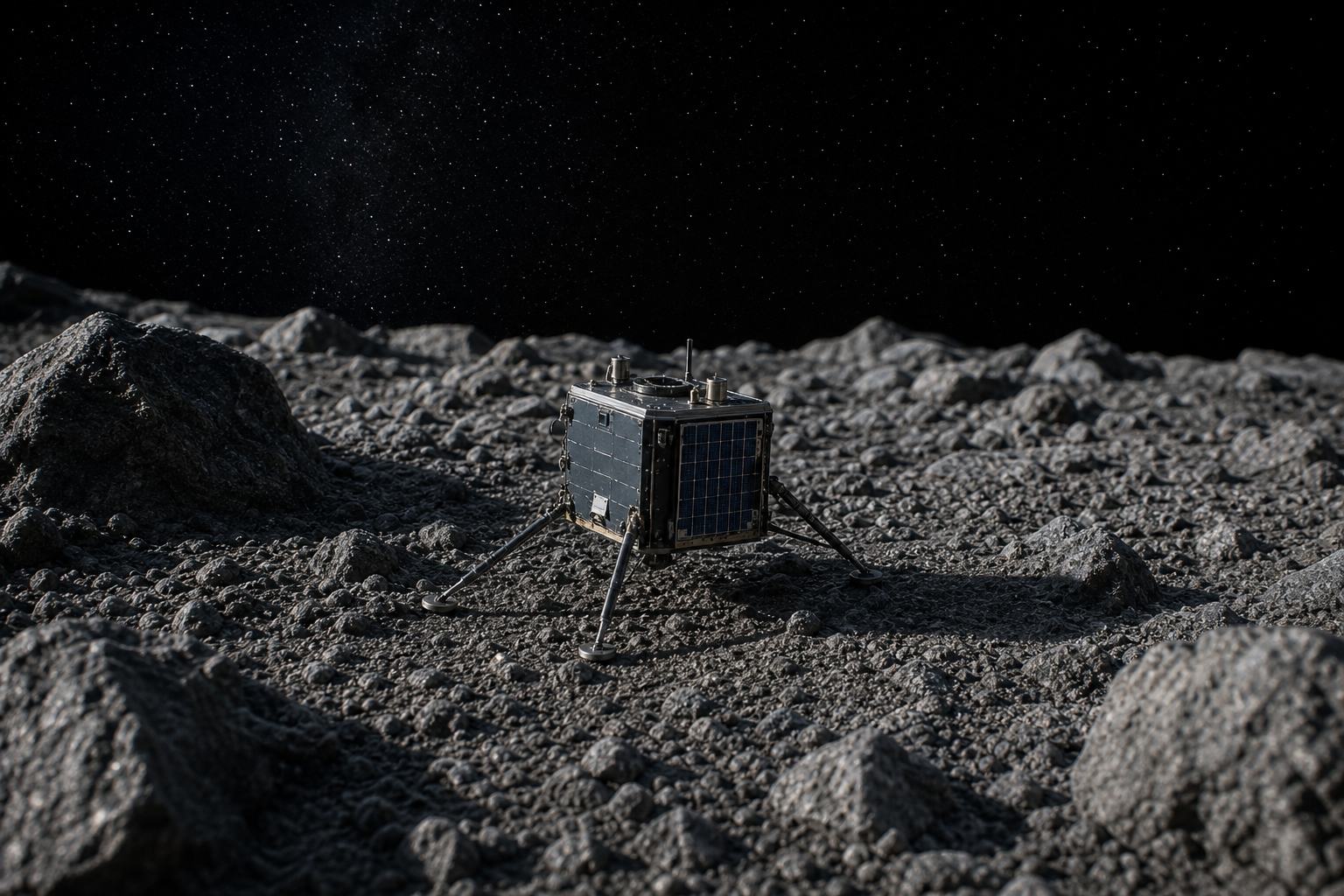
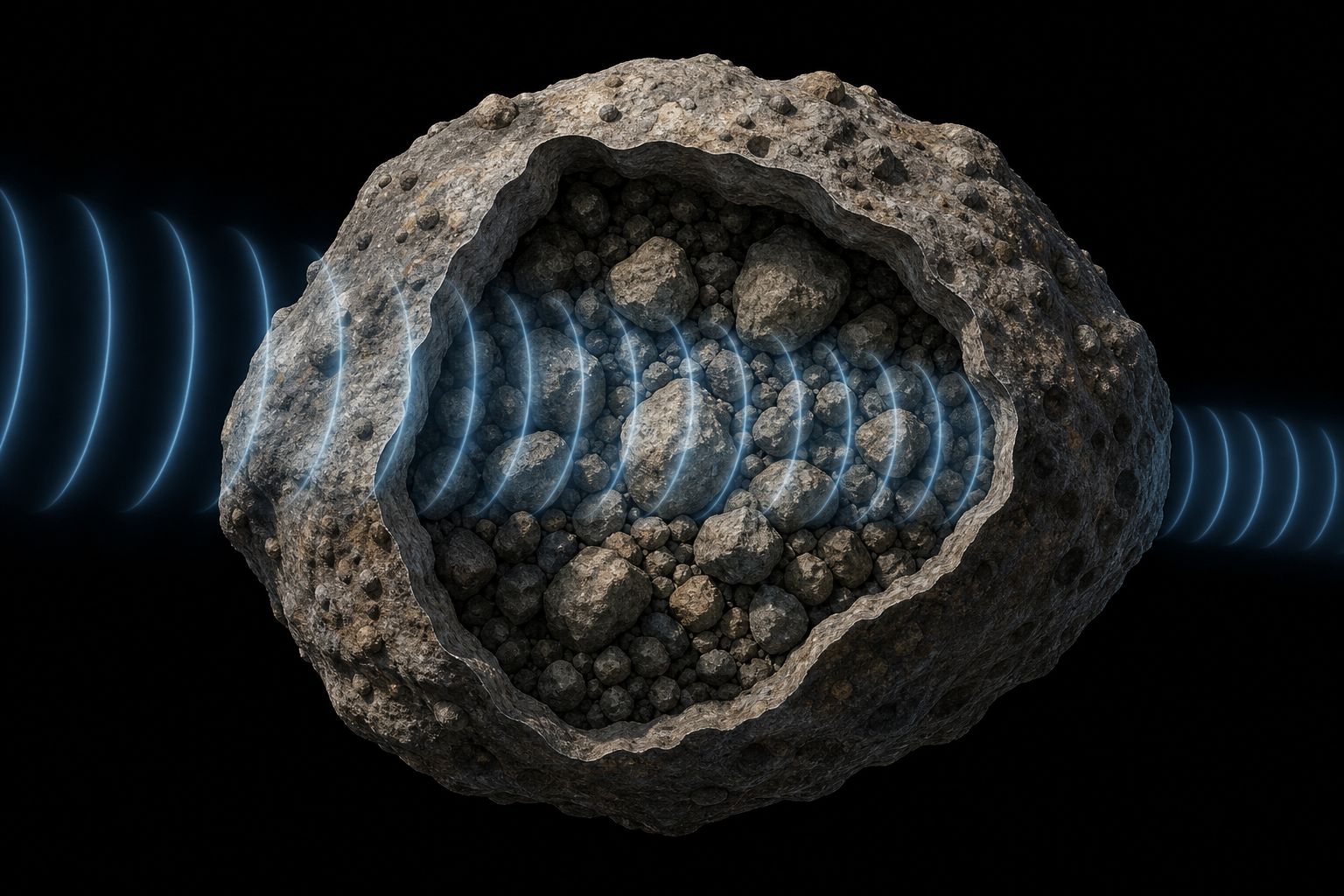
In January 2027 it is due to release two small CubeSats. Milani will study what the surface is made of; Juventas carries a radar to look inside, the first direct study of an asteroid's interior.
A loose pile of rubble and a solid rock can answer the same hit very differently, so this tells future planners what to expect.
The detective “Hera wants to be the detective, like Inspector Colombo, going back to the crash scene” (Patrick Michel, via Space.com). AI-generated illustration.
~30 km
from the pair by early November 2026
Mar 2025
a Mars flyby bent its path toward Didymos
Hera’s approach (Space.com)Crater, or a new shape? ESA says the deflection was much larger than impact simulations had predicted; Hera should show why. AI-generated illustration.Shoebox-sized The CubeSats are to end their mission by attempting to land on the asteroids. AI-generated illustration.Looking inside Radar waves pass through rock; how they come back hints at what lies inside, packed boulders or empty gaps. AI-generated illustration.
Chapter V · Hera
Hera, the crash-site investigator
ESA (7 October 2025): Hera launched on 7 October 2024 and flew past Mars in March 2025, which bent its path toward Didymos, for an arrival in November 2026. ESA (27 October 2026): braking burns a week apart in October slowed it to 20 m/s relative to the asteroids; open questions include whether DART left a crater or reshaped the asteroid, its composition, structure and mass, and why the deflection was much larger than impact simulations predicted; Hera will deploy two shoebox-sized CubeSats for a closer survey and eventually attempt a landing. Hera mission: it will measure Dimorphos’s mass to determine the momentum transfer efficiency of the DART impact, study the crater, and characterise the surface and interior, which supports scaling the momentum transfer to other asteroids. Space.com (14 October 2026): by early November Hera was to be within about 30 km; it will map both asteroids and measure the size and shape of the crater; in January 2027 it releases Milani, which will study the composition of material on and around Dimorphos, and Juventas, which will use radar to study the interior, the first direct study of a space rock’s interior; the main spacecraft runs at least through September 2027.
These are plans as reported in October 2026, not results. In the scene the asteroids are to scale; Hera and its CubeSats are drawn far larger than they are.
The 3D scenes are simplified teaching models; where something is not to scale, the scene says so.
The kinetic impactor is the only method tested on a real asteroid. The others remain proposals.
A gravity tractor would fly beside an asteroid for months or years, using its own small gravity to tug it onto a new path: gentle and precise, but probably only for asteroids smaller than about five hundred metres.
As a last resort, a nuclear device could be set off next to an asteroid. It is risky: the rock could break into several dangerous pieces. Compare the three.
Kinetic impactor: tested, DART 2022
Gravity tractor: proposal
Nuclear device: last-resort proposal
Status (Planetary Society)Pulling without touching It offers the finest control of any method, but needs months or years of lead time. AI-generated illustration.
months–years
of lead time needed
< ~500 m
asteroids it may work on
Gravity tractor (Planetary Society)A stand-off burst (schematic) The device would go off near the asteroid, not on it. The idea has never been tried on a real asteroid. AI-generated illustration.
99.9%
of a 100 m asteroid’s mass moved off course by a burst at least two months before impact
One study (Planetary Society)
Chapter VI · Time is the tool
Other ways to deflect
The Planetary Society: the kinetic impactor is the only planetary defence technique tested on an actual asteroid. A gravity tractor, a proposal, would fly alongside an asteroid and use its own gravity to pull it slowly onto a different path; it needs months or years of lead time, offers the greatest control, and may not work on asteroids larger than 500 m. An ion beam shepherd would aim an ion engine’s exhaust at the asteroid, with a second thruster to counter the recoil. A nuclear device detonated near the asteroid is a last-resort proposal: launching it is dangerous and the asteroid could break into several large pieces; one study found that a detonation next to a 100 m asteroid at least two months before impact could move 99.9% of its mass out of Earth’s path. Laser ablation is another proposal.
Try it: impactor, tractor, stand-off burst. Only the first has been tested.
The 3D scenes are simplified teaching models; where something is not to scale, the scene says so.
Every method has the same friend: time. The earlier the push, the smaller it needs to be, because a small change in speed adds up over every orbit.
A classic estimate says that a change of about one centimetre per second, made around ten years before impact, moves an asteroid by about one Earth radius: enough to turn a hit into a miss.
Wait until the last year, and the push must be many times bigger. Choose a warning time and see.
A miss is enough One Earth radius is about 6,400 km: the target is a near miss, not a far-away orbit. AI-generated illustration.
~1 cm/s
about 10 years ahead
~1 Earth radius
of deflection
Rule of thumb (Ahrens and Harris, cited by NASA Langley)Decades, ideally The B612 Foundation found deflection still possible with ten years of warning; more time means fewer resources. AI-generated illustration.
20 years ahead
~0.5
10 years
~1
5 years
~2
1 year
~10
Push needed for the same miss (simplified)
Chapter VI · Time is the tool
Why early warning matters
Park and Mazanek (NASA Langley), citing Ahrens and Harris: a velocity increment of about 1 cm/s is required to deflect an asteroid by a distance equal to one Earth radius when it is applied about a decade before impact; early application of the impulse dominates the size of the deflection effort, though the exact requirement depends on the orbit and is not a simple smooth function of warning time. B612 Foundation: the longer we wait to deflect an asteroid the harder it gets; in its study of 10,000 simulated impactors, deflection was still possible with as little as ten years of warning, aiming for a miss of one Earth radius.
The bars and the readout scale the 1 cm/s ten-year figure in simple proportion to warning time. That is a teaching simplification: real requirements depend on each orbit. The scene’s distances are on a log scale.
The 3D scenes are simplified teaching models; where something is not to scale, the scene says so.
Hera's measurements will put real numbers into the models that planners would use.
The rest depends on looking: finding the dangerous rocks decades early, while a gentle push is still enough.
1908 Tunguska airburst
1999 Torino scale adopted
2005 Congress sets the 140 m goal
2013 Chelyabinsk
2022 DART hits Dimorphos
2026 Hera arrives
Planetary defenceThe test, then the inspection Measuring the mass turns DART’s result into a number planners can scale to other asteroids. AI-generated illustration.Keep looking Fewer than half of the near-Earth objects bigger than 140 m have been found so far. AI-generated illustration.
Epilogue · Sources
Sources
Every fact in this film comes from the sources below. The chapter stills and pictures are AI-generated illustrations and show no real people, places, spacecraft designs or brands. The 3D scenes are simplified teaching models: the asteroid pair is to scale but its orbit change is drawn twice its real size, the near-Earth objects are a made-up population, and the warning-time chart scales one published estimate in simple proportion. The Hera mission news is new and its plans are given as reported in October 2026; DART’s results and the fundamentals of finding and deflecting asteroids are established.