PlanetPast
EN

Religion · History

The Day of the Dead

From Mictlan to the marigold altar

On 1 and 2 November, Mexican families build altars, decorate graves and welcome back the people they have lost; in 2026 Mexico City marks it with its tenth Grand Parade and a 32-metre Catrina in the Zócalo. This film follows the festival back through the evidence: the Mexica belief that most souls made a four-year journey through the nine levels of Mictlan, and their two twenty-day months for the dead; the Spanish conquest and the Catholic feasts of All Saints and All Souls; how the two calendars met in New Spain, and why scholars still disagree about how much of the festival is pre-Hispanic. Then the ofrenda, element by element, the nights for children and adults, regional customs from Lake Pátzcuaro to Mixquic and Oaxaca, the satirical calaveras, José Guadalupe Posada's skull in a European hat and how Diego Rivera made her the Catrina, UNESCO recognition, a parade that began after a film, and how it all differs from Halloween.

Interactive 3D film12 minc. 1500 to 2026Published 1 November 2026

Watch the interactive filmRead in ไทย

Prologue

Religion · History

The Day of the Dead

An Aztec festival, a Catholic feast, or both?

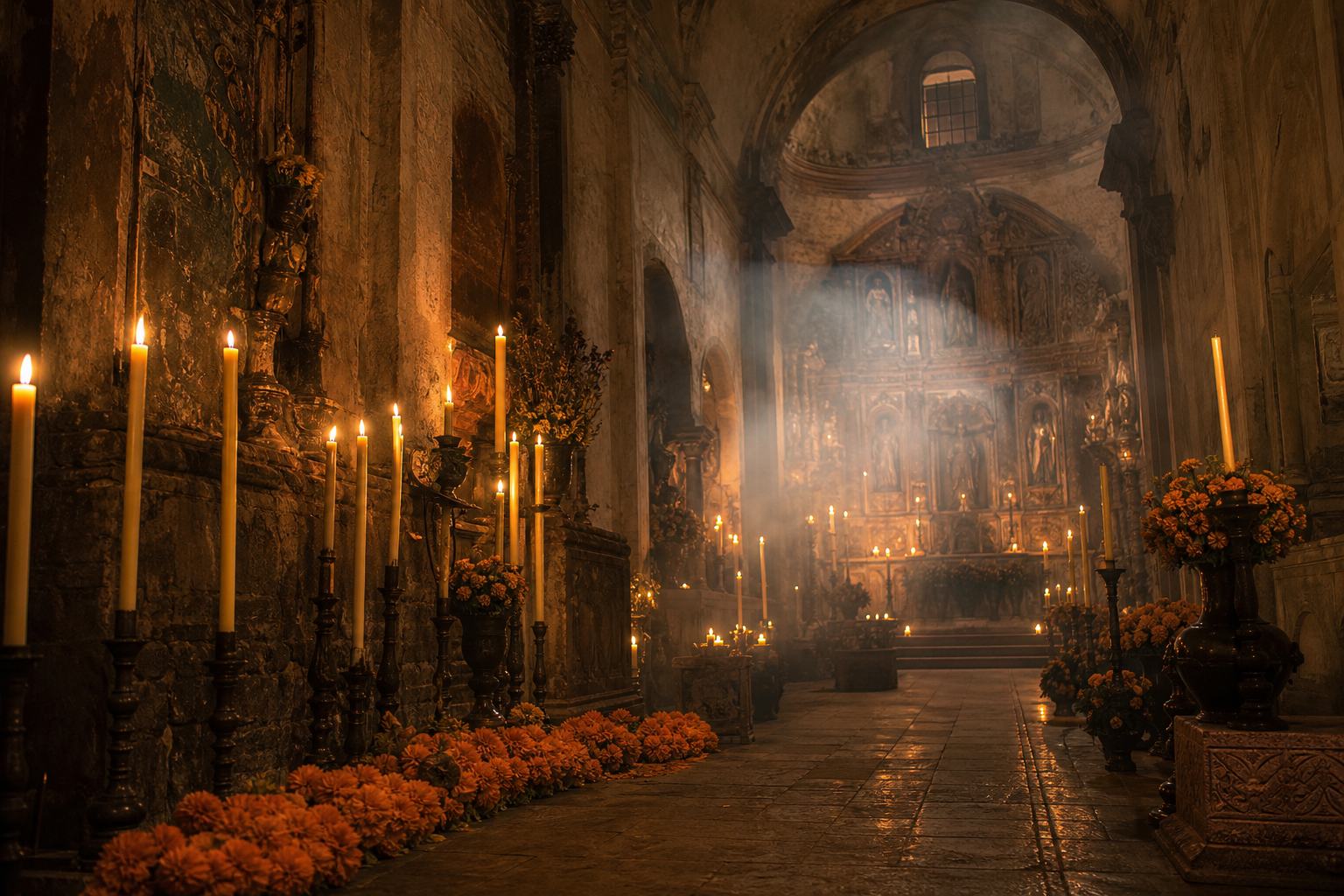
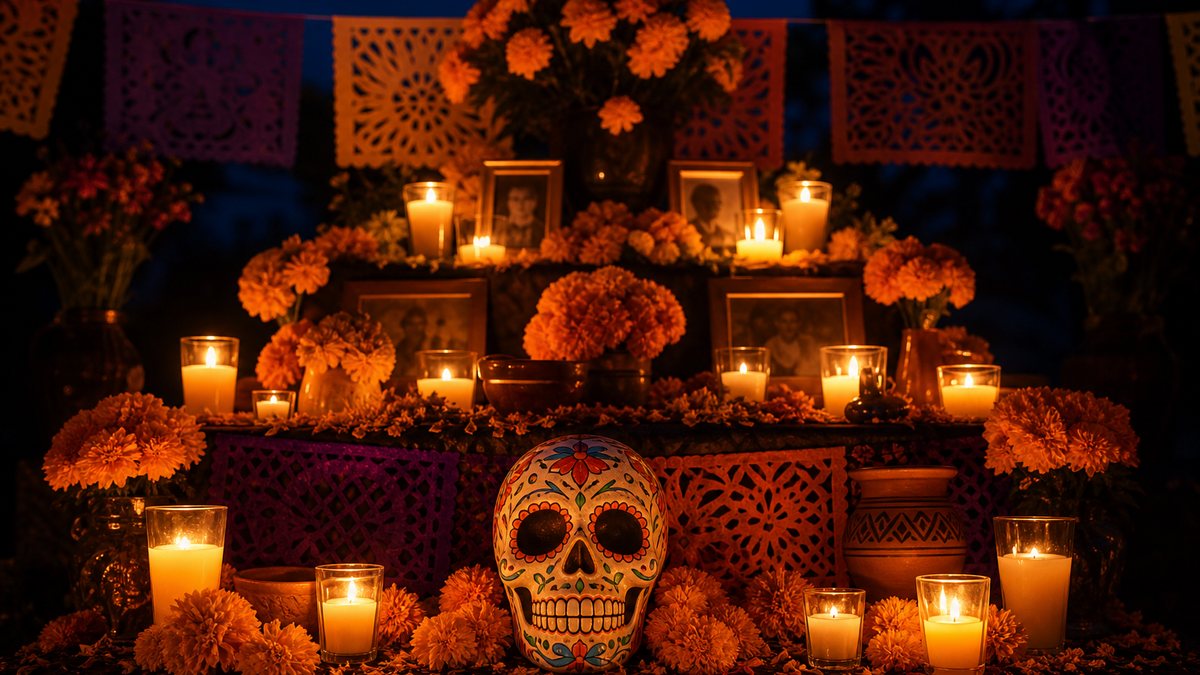
Every November, Mexican families lay a path of marigold petals to the door and set a table for the dead.

On the first and second of November, across the country, they build altars, clean graves and light candles for the people they have lost.

A festival about death, yet full of colour, food and music. Is it Aztec, or Catholic? The answer runs through Aztec temples, Spanish churches, and a long argument among historians.
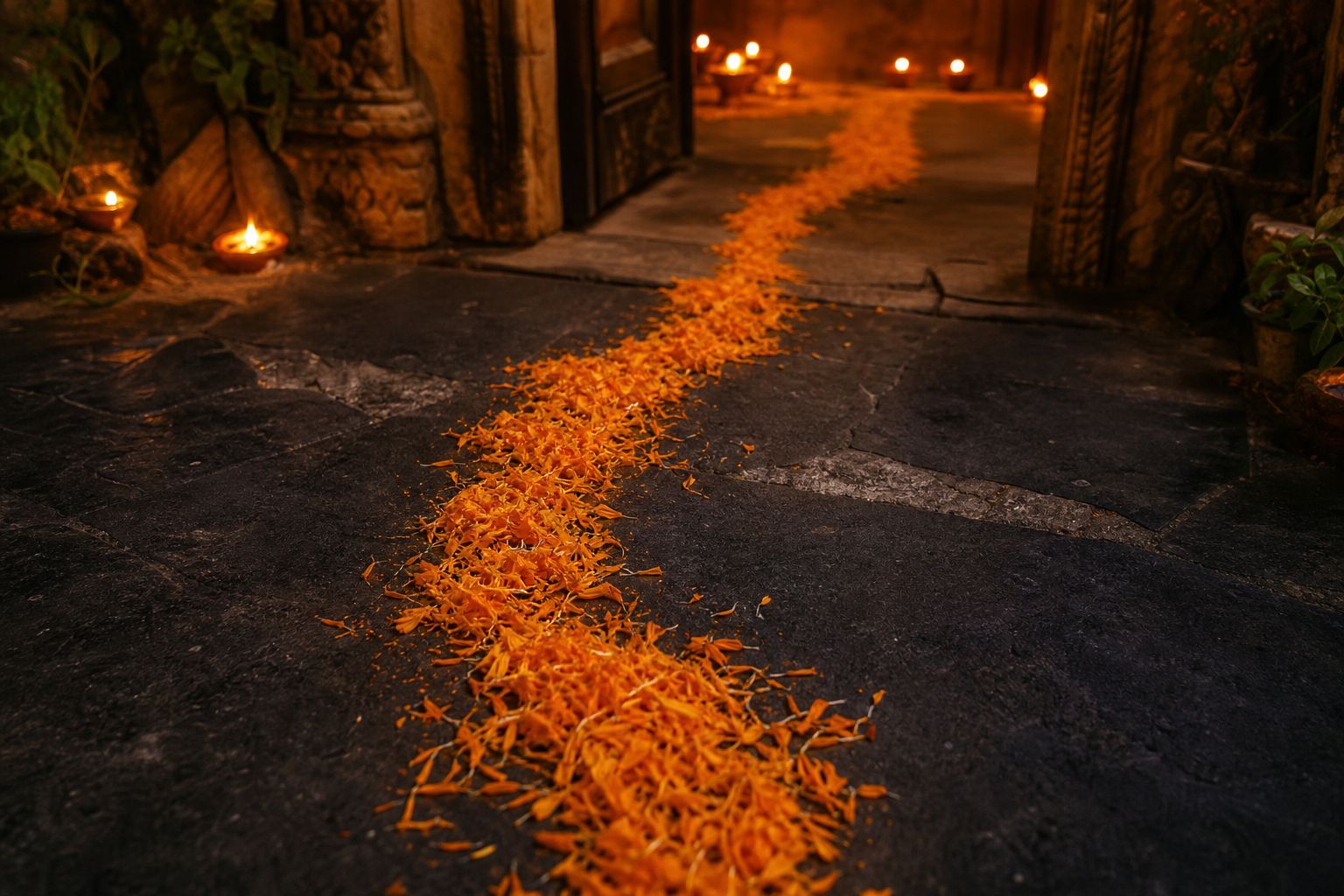
The way home The petals are cempasúchil, a marigold native to Mexico. AI-generated illustration.
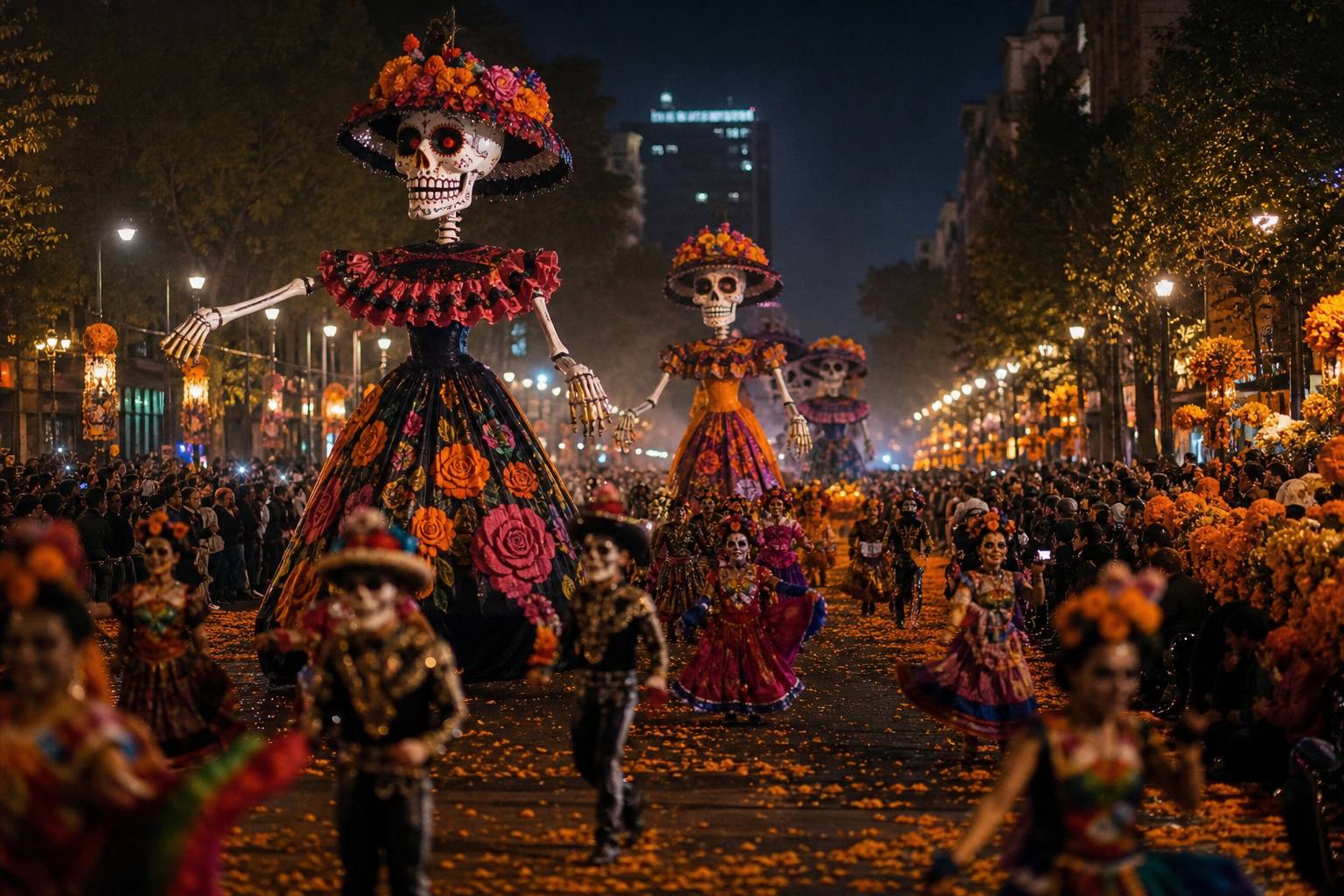
Colour, not mourning Giant papier-mâché skeletons in flowered dresses have become a fixture of the season. AI-generated illustration.
  • Mictlan, the Mexica land of the dead
  • All Saints, All Souls and the blend
  • The ofrenda, element by element
  • Calaveras, the Catrina and a parade
In this film
Prologue

This weekend in Mexico

Publimetro (21 October 2026): Mexico City’s Gran Desfile de Día de Muertos, its tenth edition, was scheduled for Saturday 31 October from 14:00, from the Diana Cazadora fountain to the Zócalo, with more than 4,000 participants, 12 floats, two giant balloons and 14 community groups. A cartonería Catrina about 32 metres tall, honouring José Guadalupe Posada, can be visited in the Zócalo from 30 October to 2 November; Guinness recognition of it as a record is still to be confirmed. Mexico City’s official visitor guide gives the same parade time and route, and lists the Zócalo’s monumental ofrenda, dedicated this year to Posada’s Catrina, from 29 October to 2 November. México Desconocido confirms the date.

Beliefs about souls and the afterlife are described as the traditions themselves hold them, not as statements of fact.

The altar, the levels of Mictlan, the calendar wheel, the scale, the map and the figures are teaching graphics, not reconstructions of real places or objects.

Sources: Mexico City Government, Visitor’s Guide: Day of the Dead 2026 in Mexico City (parade 31 October 14:00; Zócalo ofrenda 29 Oct–2 Nov; 32-metre Catrina); Publimetro (21 Oct 2026): Día de Muertos 2026 en CDMX — parade 31 October from 14:00, Diana Cazadora to the Zócalo; 32-metre Catrina; ofrendas; México Desconocido: Gran Desfile de Día de Muertos 2026 (31 October 2026; began in 2016 after the 2015 film Spectre)
Chapter I · The land of the dead

Chapter I

The land of the dead

In Mexica belief, how you died decided where you went.

Begin with the Mexica, the people often called the Aztecs, around the year fifteen hundred. In their belief, where a soul went depended on how the person died, not on how they had lived.

Warriors who died in battle or as sacrifices were thought to join the Sun as it rose in the east. Women who died in childbirth went with the setting Sun in the west.

Those who drowned, or died of causes linked to the rain god Tlaloc, went to Tlalocan, his realm.

Everyone else, which meant most people, went down to Mictlan, the land of the dead. Choose a way of dying and see where Mexica belief sent the soul.

Tenochtitlan
their island capital, today Mexico City
Who the Mexica were
  • East, with the rising Sun: warriors
  • West, with the setting Sun: women who died in childbirth
  • Tlalocan: deaths linked to water and rain
  • Mictlan: everyone else
Four destinations
storms, floods
deaths that avoided Mictlan, per World History Encyclopedia
Spared the underworld
The Aztecs reserved no special paradise for the righteous; most people shared the same destiny.World History Encyclopedia, summarising
No reward for the righteous
Chapter I · The land of the dead

Four destinations

Wikipedia, Mictlān: most of the dead went to Mictlan. Warriors who died in battle or as sacrifices accompanied the morning sun in the east; women who died in childbirth accompanied the setting sun in the west; people who drowned, or died from causes linked to the rain god Tlaloc, went to Tlalocan. Britannica: souls whose deaths did not qualify them for another paradise went to Mictlan. World History Encyclopedia: the Aztecs “did not believe in a special paradise reserved only for the righteous”; all shared the same destiny regardless of the life they had led, except those who died violently, women who died in childbirth and people killed by storms or floods.

Try it: pick a way of dying and watch where the soul’s light travels. The four destinations are drawn schematically.

Beliefs about souls and the afterlife are described as the traditions themselves hold them, not as statements of fact.

Sources: Wikipedia: Mictlān (nine levels, four-year journey, other destinations of the dead); Encyclopaedia Britannica: Mictlantecuhtli (Aztec god of the dead; nine hells; four years); World History Encyclopedia: Mictlantecuhtli (no special paradise for the righteous; who avoided the underworld)

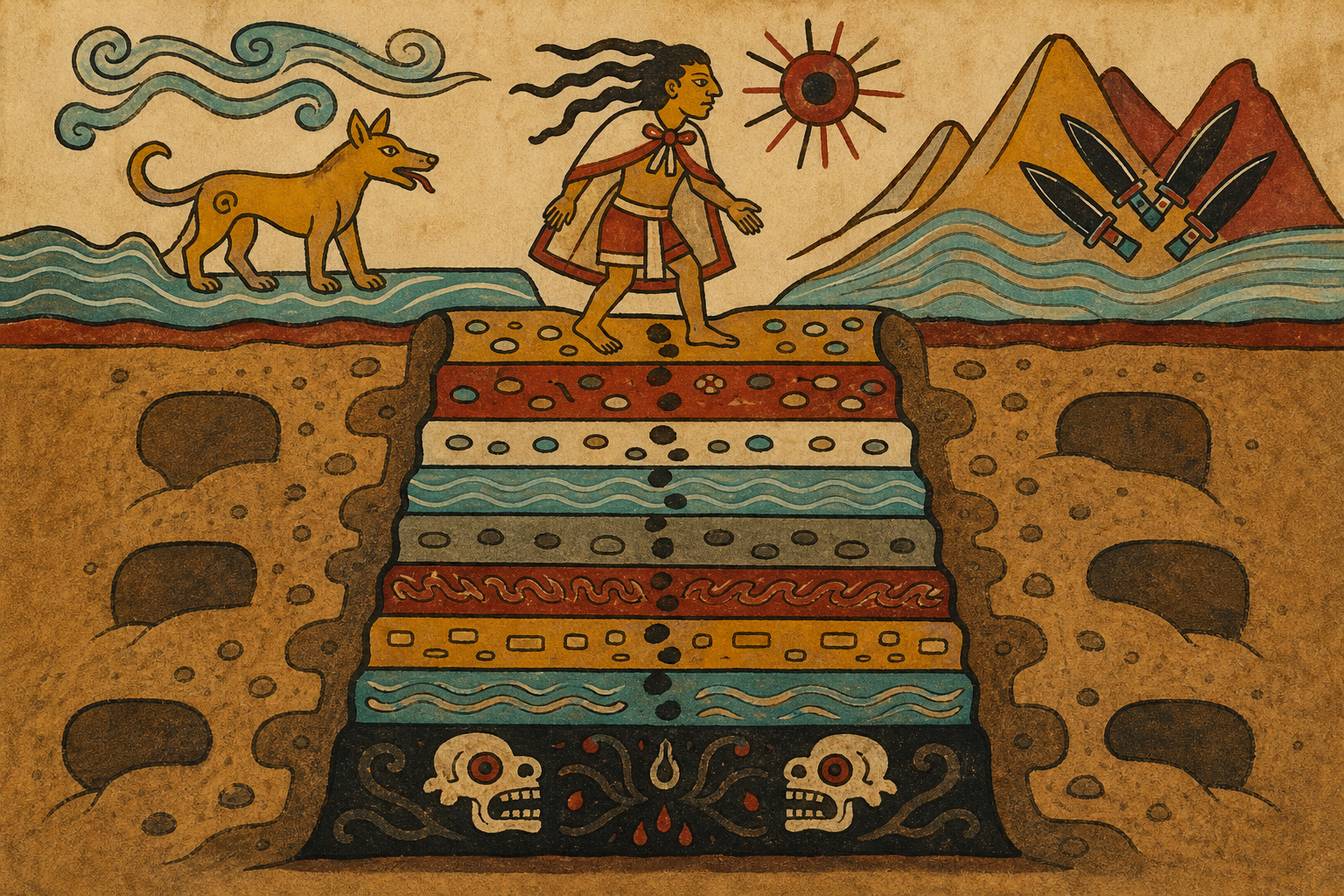
Mictlan was imagined as nine levels beneath the earth, and the journey down was believed to take four years.

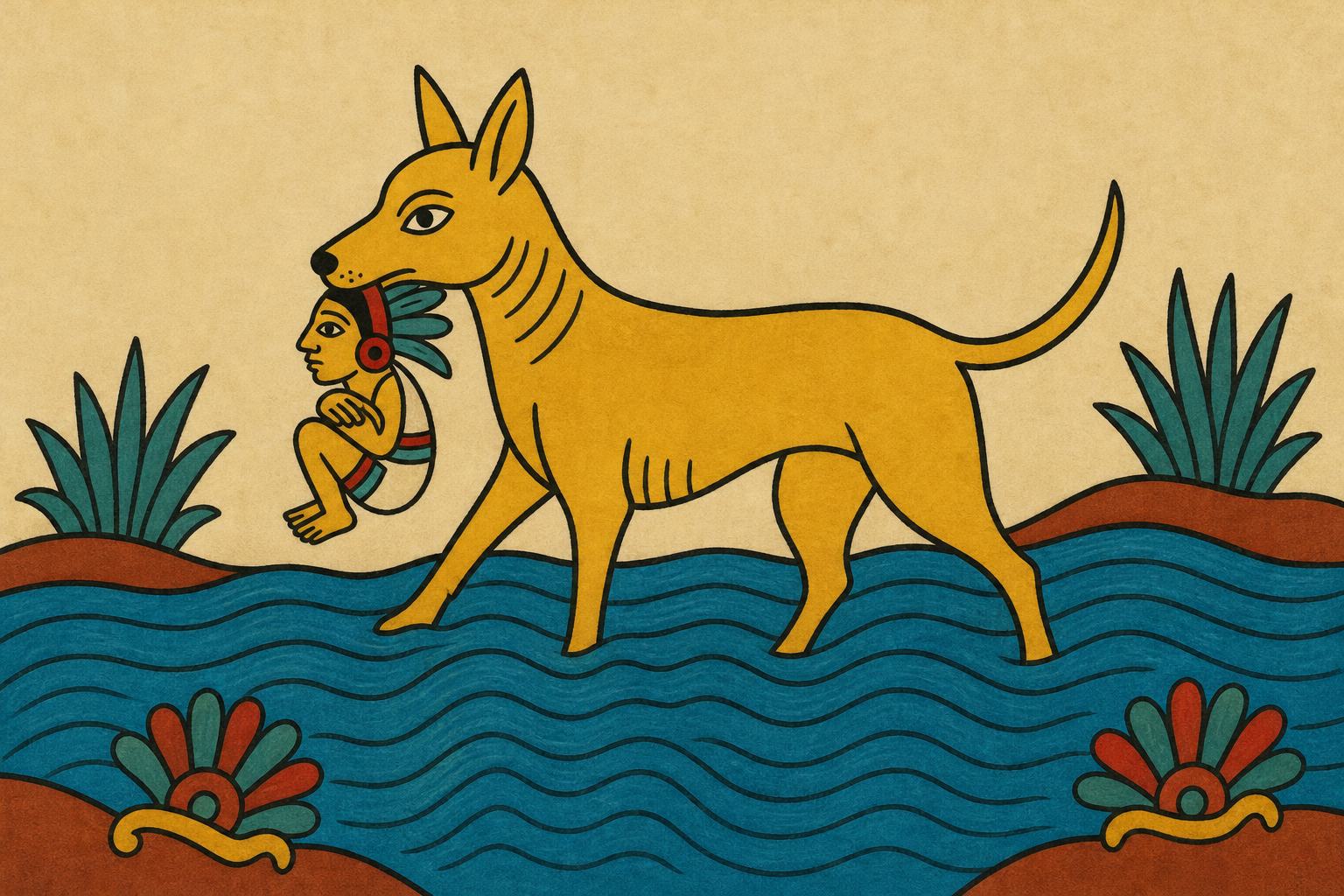
At the first level there was a river to cross. In one well-known account, a yellow dog that recognised its owner carried the soul across on its back.

Further down came the trials: mountains that crash together, and a wind full of knives. Lists of the levels differ between sources, so we show only what most accounts share.

At the ninth and deepest level waited Mictlantecuhtli, Lord of the Underworld, usually shown with a skull for a face, and his wife Mictecacihuatl, Lady of the Underworld. There, in these accounts, the soul came to rest, or faded away.

Other beliefs, as we will see, let the dead come home each November.

9
levels below the earth
4 years
from the first level to the ninth
The journey
The river crossing In the same account, white and black dogs refuse the job; only a yellow one will swim. AI-generated illustration.
  • A river, crossed with a dog
  • Mountains that crash together
  • A wind full of knives
  • A river of blood, with jaguars
Trials named in most accounts
Mictlantecuhtli
Lord of the Underworld
Mictecacihuatl
Lady of the Underworld
Rulers of Mictlan
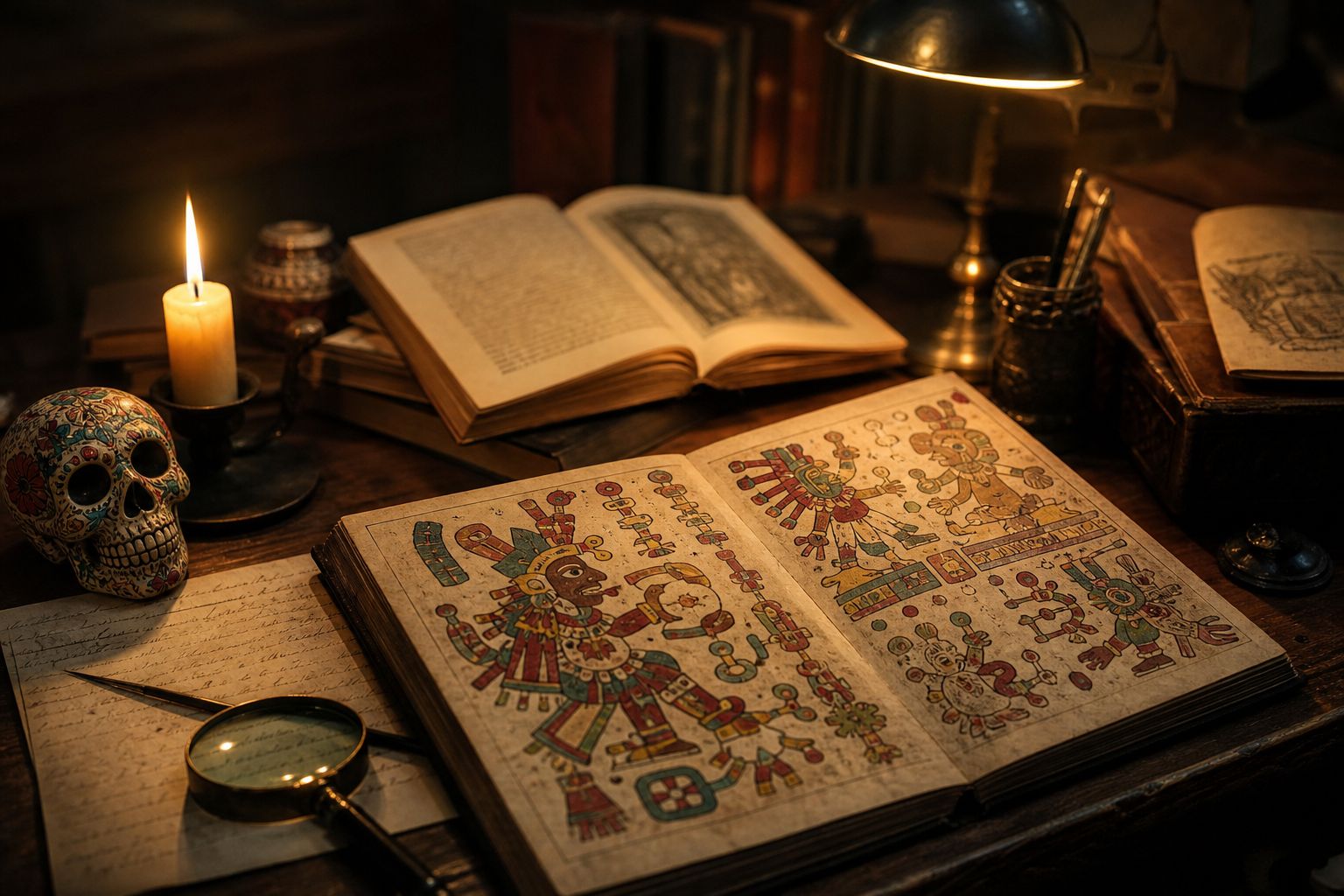
The way down An original codex-inspired image, not a copy of any real manuscript. AI-generated illustration.
Chapter I · The land of the dead

Nine levels, four years

Wikipedia, Mictlān: “Mictlan consists of nine distinct levels”; the journey from the first to the ninth “is difficult and takes four years”, with trials including a mountain range where the peaks collide, a windy field of flesh-scraping knives, and a river of blood with jaguars. Mictlantecuhtli and his wife Mictecacihuatl rule the underworld. Wikipedia, Dogs in Mesoamerican folklore: the first level was “where one crosses the river”; a dog that recognised its former owner carried the soul across, and yellow dogs would do so while white and black ones refused. Britannica: after four years souls either vanish or find rest.

The names and order of the middle levels differ between sources, so the film labels only the river, the ninth level and the trials most accounts share. Try it: press “Descend” to go down one level at a time.

Beliefs about souls and the afterlife are described as the traditions themselves hold them, not as statements of fact.

Sources: Wikipedia: Mictlān (nine levels, four-year journey, other destinations of the dead); Wikipedia: Dogs in Mesoamerican folklore and myth (the river of the first level; yellow dogs); Encyclopaedia Britannica: Mictlantecuhtli (Aztec god of the dead; nine hells; four years)

The Mexica solar year had eighteen months of twenty days, each with its own festival, plus five unlucky days at the end.

Two of those months belonged to the dead: the ninth, the Little Feast of the Dead, and the tenth, the Great Feast of the Dead.

By one common account, the first honoured children and the second adults, and they fell around August and September, not November.

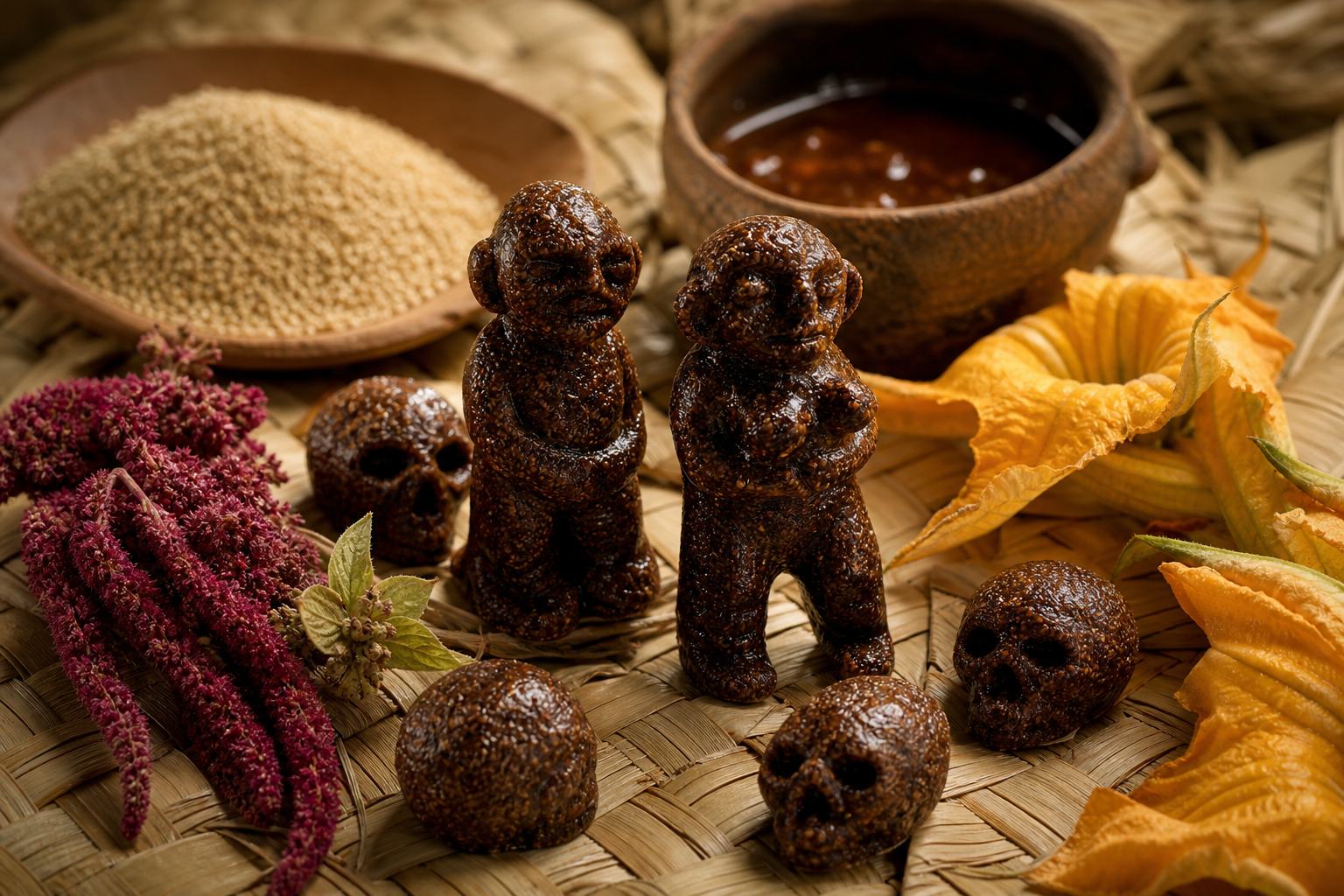
Temples were decorated with flowers, and figures shaped from amaranth dough, called tzoalli, were eaten. Spanish chronicles written after the conquest also link these feasts to sacrifice.

18 × 20
months of twenty days
+ 5
nemontemi, days when nothing important was done
365
days in all
The Mexica solar year
  1. Month 9 Tlaxochimaco, also Miccailhuitontli: “little feast of the dead”
  2. Month 10 Xocotlhuetzi, also Hueymiccailhuitl: “great feast of the dead”
Months 9 and 10
≈ Aug
Miccailhuitontli: dead children
≈ Sep
Hueymiccailhuitl: dead adults
Two feasts, by one account
Tzoalli In the chronicles, a dough figure was set on a felled tree, the xócotl, danced around, then shared and eaten. AI-generated illustration.
Chapter I · The land of the dead

Two months for the dead

World History Encyclopedia: the xiuhpohualli had 18 months of 20 days, each with its own festival, followed by five nemontemi days; the ninth and tenth months are Tlaxochimaco and Xocotlhuetzi. Wikipedia: Hueymiccaihuitl, the “Great Feast of the Dead”, is the tenth month, also called Xocotlhuetzi; Wikipedia, Day of the Dead: the Aztecs gave the ninth and tenth months to the dead. Excélsior: the first period honoured children and the second adults, in what are now August and September. Gaceta UNAM (Luis Alberto Vargas): Miccailhuitontli lasted at the end of the rainy season; temples were decorated with flowers; figures of amaranth dough (tzoalli) were eaten; 16th-century chronicles also relate it to sacrificial rituals.

Matching Mexica months to modern dates is approximate.

The altar, the levels of Mictlan, the calendar wheel, the scale, the map and the figures are teaching graphics, not reconstructions of real places or objects.

Sources: World History Encyclopedia: The Aztec Calendar (18 months of 20 days and 5 nemontemi days); Wikipedia: Hueymiccaihuitl (tenth month, also called Xocotlhuetzi; “Great Feast of the Dead”); Wikipedia: Day of the Dead (origins debate, dates, ofrenda, calaveras, the 2016 parade); Excélsior: México prehispánico, 40 días celebrando a los muertos (Elsa Malvido, INAH); Gaceta UNAM: Miccailhuitontli, fiesta mesoamericana, origen del pan de muerto (Luis Alberto Vargas, IIA-UNAM)

Chapter II · Two calendars meet

Chapter II

Two calendars meet

The Spanish brought their own days for the dead.

In 1521, Spanish forces and their Indigenous allies took Tenochtitlan, the Mexica capital. War and epidemics followed: by one estimate, central Mexico's people fell from over twenty-five million to just over one million within a century.

Missionary friars came too, and with them the Catholic calendar.

Its days for the dead were the first and second of November: All Saints' Day, for those already in heaven, and All Souls' Day, first kept at the abbey of Cluny in the eleventh century, for all the faithful departed.

Catholics believed prayers could help souls in purgatory, a state of purification before heaven, to reach it.

  1. 1519 central Mexico: over 25 million people, by one estimate
  2. 1521 Tenochtitlan falls; about 300 years of Spanish rule begin
  3. 1605 just over 1 million by the same estimate, after war and epidemics
  4. 1821 Mexico becomes independent
Conquest
1 Nov
All Saints: the saints in heaven
2 Nov
All Souls: near-universal in the West by the end of the 13th century
The Catholic days
Odilo of Cluny
abbot, died 1048/49: a day of prayer for all the dead on 2 November
Who set the date
Candles for the souls In colonial Mexico, people paid for candles, Masses and prayers for souls in purgatory. AI-generated illustration.
Chapter II · Two calendars meet

Saints and souls

World History Encyclopedia: Tenochtitlan fell on 13 August 1521 after a 93-day siege by Hernán Cortés and large numbers of Indigenous allies, notably at least 100,000 Tlaxcalans. Religion News Service (Mathew Sandoval, Arizona State University): Mexico’s roughly 300-year colonial period began in 1521; Catholic beliefs about purgatory led people to buy candles and paid prayers for souls. Britannica: All Souls’ Day, 2 November, commemorates all the faithful departed believed to be in purgatory; prayers of the faithful on earth are believed to help purify them; the day was founded as a general intercession by Odilo of Cluny and became practically universal before the end of the 13th century. Wikipedia: Odilo established it at Cluny “probably not in 998 but after 1030”. JSTOR Daily, on Stanley Brandes: the population of central Mexico fell from over 25 million in 1519 to just over 1 million in 1605, and death “was everywhere”.

See also: The Origins of Halloween.

Beliefs about souls and the afterlife are described as the traditions themselves hold them, not as statements of fact.

Sources: World History Encyclopedia: The Fall of Tenochtitlan (13 August 1521; Indigenous allies); Religion News Service (Mathew Sandoval): How commercialization over the centuries transformed the Day of the Dead; Encyclopaedia Britannica: All Souls’ Day (2 November; Odilo of Cluny); Wikipedia: Odilo of Cluny (All Souls’ Day at Cluny, probably after 1030); JSTOR Daily: What do sugar skulls mean on el Día de los Muertos? (on Stanley Brandes, Ethnohistory 1998)

In New Spain, as the colony was called, the two traditions met. One view, argued by the scholar Ruben Cordova, is that the Mexica months for the dead were compressed into the two Catholic days.

In Mexico, unlike other Latin American countries with Day of the Dead traditions, the first of November came to be dedicated to children, and the second to adults.

By the seventeen hundreds, the season brought Mexico City its largest market of the year, so crowded that the authorities called it a public disorder and began to regulate the sellers. Switch the wheel to see how the dates moved.

2 × 20 days
Mexica months for the dead
2 days
1 and 2 November
From forty days to two
  • 1 November: dead children, the angelitos
  • 2 November: dead adults
  • Toys for children; tequila, mezcal, pulque or atole for adults
Who comes when
In the 1700s the holiday produced the largest annual market in Mexico City.Mathew Sandoval, citing the anthropologist Claudio Lomnitz
A colonial market
1521–1821
three centuries of Spanish rule
New Spain
Chapter II · Two calendars meet

Two calendars become one

Wikipedia, Day of the Dead: Ruben C. Cordova argues the two Aztec months for the dead were “compressed down to two days” in the Catholic calendar; he also notes that in Mexico, “unlike other Latin American countries”, All Saints’ Day is dedicated to children and All Souls’ Day to adults; toys are brought for the dead children (angelitos), and tequila, mezcal, pulque or atole for adults. Religion News Service: in the 1700s the holiday generated the largest annual market in Mexico City; authorities called the crowds a “public disorder”, and the city later regulated vendors.

Cordova’s compression is one interpretation among several; the next chapter sets out the debate. Try it: switch the wheel between the two calendars.

The altar, the levels of Mictlan, the calendar wheel, the scale, the map and the figures are teaching graphics, not reconstructions of real places or objects.

Sources: Wikipedia: Day of the Dead (origins debate, dates, ofrenda, calaveras, the 2016 parade); Religion News Service (Mathew Sandoval): How commercialization over the centuries transformed the Day of the Dead

Chapter III · Whose tradition?

Chapter III

Whose tradition?

Scholars still argue about how much is pre-Hispanic.

So how much of today's festival is really pre-Hispanic? Scholars disagree.

The poet Octavio Paz, writing in 1950, saw it as a continuation of ancient Aztec festivals of death. The anthropologist Hugo Nutini called it syncretic: two religions fused into one.

The historian Elsa Malvido, of Mexico's national institute of anthropology and history, argued the opposite. For her the customs came from medieval Europe, and intellectuals of the nineteen thirties gave existing Catholic practices a pre-Hispanic meaning.

The anthropologist Stanley Brandes sees a blend. The Aztecs did display real skulls on racks, but he argues that much of the festival's playful skull art took shape in colonial times and after. Weigh the views yourself.

A continuation of ancient Aztec festivals of death.Octavio Paz’s view, The Labyrinth of Solitude (1950), as summarised by Wikipedia
Continuity
Syncretic: Indigenous and Catholic religion fused into one festival.Hugo Nutini’s view, as summarised by Religion News Service
Fusion
A “Cardenist invention”: Catholic customs given an Indigenous meaning in the 1930s.Elsa Malvido (1941–2011), INAH; “Cardenist” refers to Lázaro Cárdenas, president 1934–40
A European origin
Reading the evidence The argument turns on colonial chronicles, codices and church records. AI-generated illustration.
  • Continuity with Aztec festivals: Paz
  • Fused, syncretic: Nutini
  • Mostly European and Catholic: Malvido
  • A blend, with colonial skull imagery: Brandes
Where the scholars stand
Chapter III · Whose tradition?

An open debate

Wikipedia, Day of the Dead: some argue for Indigenous or ancient Aztec influences, others see a local expression of Allhallowtide, the Christian days for the dead, 31 October–2 November. Octavio Paz (The Labyrinth of Solitude, 1950) supports continuity with Aztec death festivals. Elsa Malvido (INAH) traces it to Medieval Europe, rejects a native or syncretic origin and calls it a “Cardenist invention”; Excélsior reports her view that 1930s intellectuals recast Catholic customs with a pre-Hispanic meaning. Ruben C. Cordova: archaic Spanish practices in rural areas were mistakenly taken as the “pure” Indigenous core. Religion News Service: Hugo Nutini described the holiday as syncretic. JSTOR Daily, on Stanley Brandes (Ethnohistory, 1998): Indigenous customs and beliefs combined with Spanish Catholic practices; Aztec tzompantli displayed skulls but were not decorated with them; Baroque imagery and 19th-century broadsides came later.

“Cardenist” refers to the 1930s era of President Lázaro Cárdenas. Try it: add each scholar’s weight to the scale. The scale is a teaching device, not a measurement.

The altar, the levels of Mictlan, the calendar wheel, the scale, the map and the figures are teaching graphics, not reconstructions of real places or objects.

Sources: Wikipedia: Day of the Dead (origins debate, dates, ofrenda, calaveras, the 2016 parade); Excélsior: México prehispánico, 40 días celebrando a los muertos (Elsa Malvido, INAH); Religion News Service (Mathew Sandoval): How commercialization over the centuries transformed the Day of the Dead; JSTOR Daily: What do sugar skulls mean on el Día de los Muertos? (on Stanley Brandes, Ethnohistory 1998)

Chapter IV · The ofrenda

Chapter IV

The ofrenda

A table set for particular people.

At the heart of the festival is the ofrenda, the offering: an altar built at home or on a grave, for particular people who have died.

Many are built in tiers. A guide from Mexico's national university, UNAM, reads the levels as heaven, earth and the underworld.

At the top go a photograph of the person and, often, a cross, the Catholic side of the tradition. Candles stand for the family's dead and light their way home. Build one, element by element.

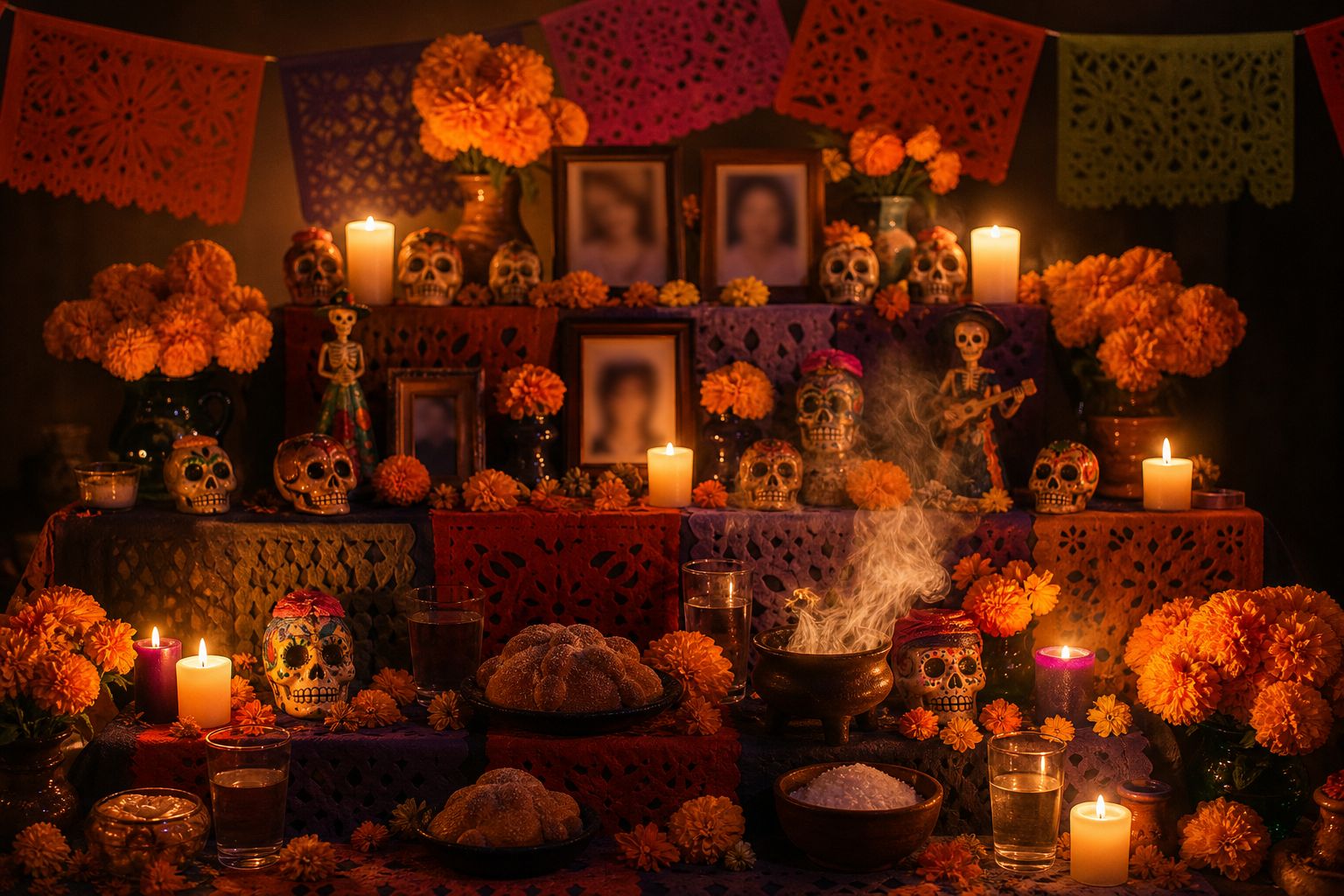
A home altar Altars stand for days; families add to them from late October. AI-generated illustration.
  • Top: heaven
  • Middle: earth
  • Bottom: the underworld
Three tiers (UNAM reading)
purple
mourning
white
purity
Candle colours
salt or ash
often what it is made of; brought by Spanish evangelisers
The cross
Chapter IV · The ofrenda

An altar for someone

UNESCO: families prepare the deceased’s favourite dishes for the home shrine and the tomb. UNAM (CENDI): the levels of the altar represent the division of heaven, earth and the underworld; candles (veladoras) represent the family’s dead; the photograph is placed with personal belongings to remember them. N+: the photo goes at the top; a cross of salt or ash, introduced by the Spanish evangelisers, is placed beside it; purple candles stand for mourning and white for purity, and candles guide the dead.

Altars vary from family to family; the number of tiers is not fixed. Try it: add the elements to the altar one at a time and read what each means.

Beliefs about souls and the afterlife are described as the traditions themselves hold them, not as statements of fact.

The altar, the levels of Mictlan, the calendar wheel, the scale, the map and the figures are teaching graphics, not reconstructions of real places or objects.

Sources: UNESCO Intangible Cultural Heritage: Indigenous festivity dedicated to the dead (proclaimed 2003, inscribed 2008); UNAM (CENDI): Día de muertos, elementos de la ofrenda; N+: Qué se pone en la ofrenda de Día de Muertos (elements and their meanings)

A glass of water quenches the thirst of souls after their long journey; salt purifies.

Marigolds, cempasúchil, take their name from a Nahuatl word for twenty flowers, and are native to Mexico. The Mexica linked their yellow to the Sun; today their petals mark a path that guides the dead.

Copal, a tree resin, is burned as incense to cleanse the space, and papel picado, cut tissue paper, stands for the air.

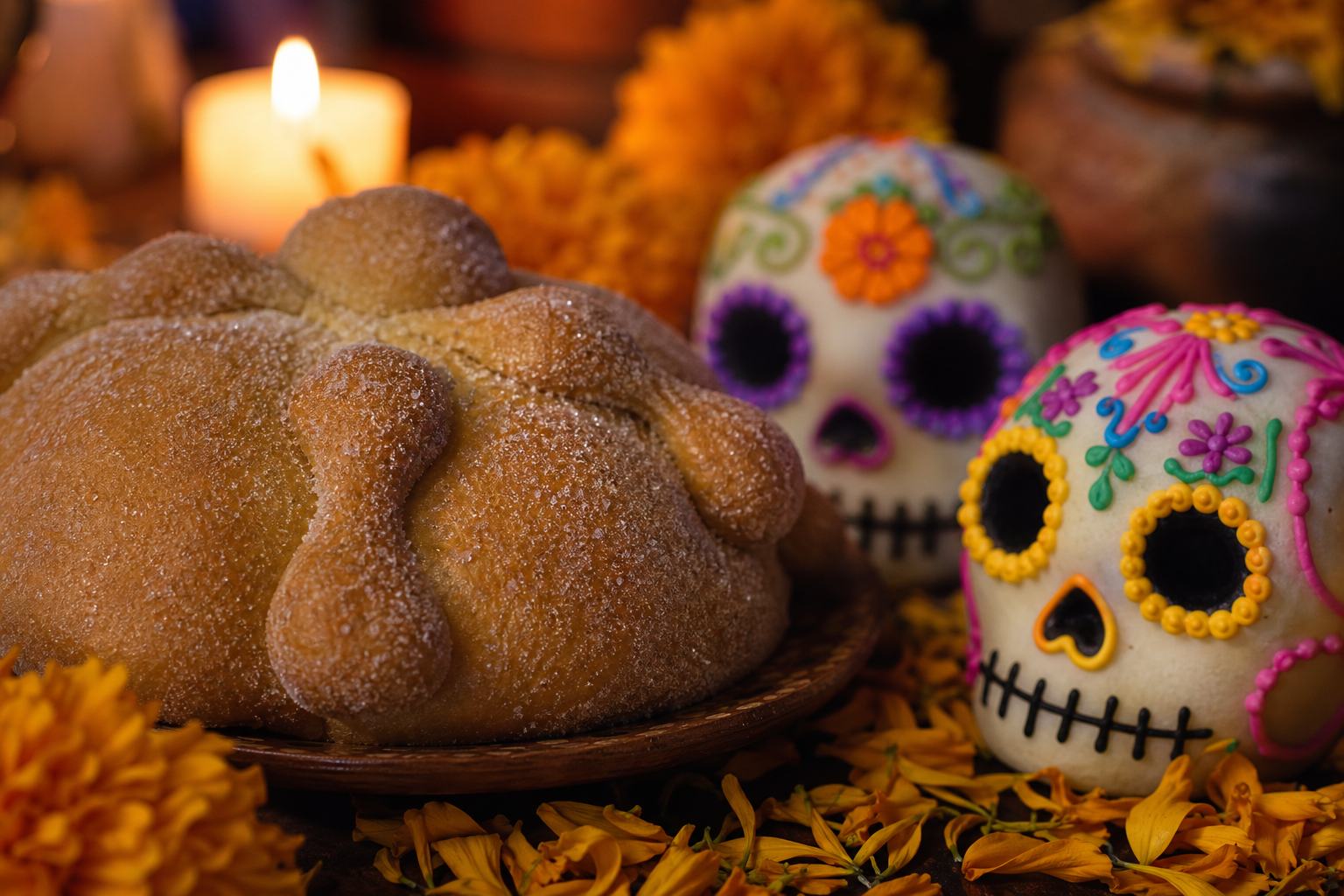
Then the favourite foods and drinks of the dead, pan de muerto, a sweet bread topped with dough bones, and sugar skulls. Some believe the dead take in the essence of the food.

In this bread, the UNAM scholar Luis Alberto Vargas sees traces of the Mexica feasts of the dead.

water
strengthens the soul for the way back
salt
keeps the soul from corruption, keeps bad spirits away
Water and salt
Tagetes erecta
scientific name; 35 Tagetes species grow in Mexico
cempohualxochitl
the Nahuatl original
Cempasúchil
medicine
pre-Hispanic healers used it for fevers and coughs
Florentine Codex
16th century: records its ceremonial use
Before the altars
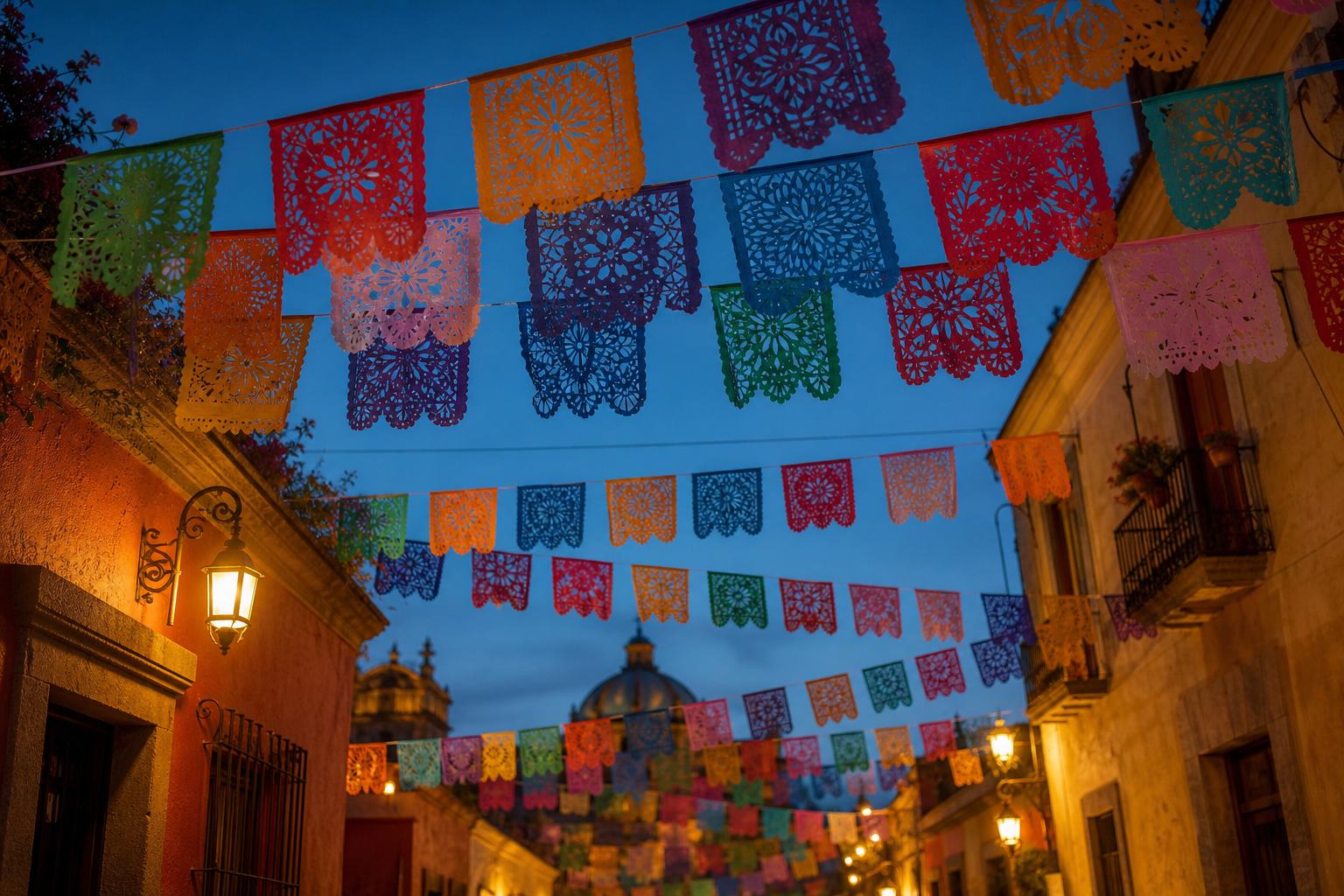
Papel picado The banners are cut from tissue paper, so they move in the slightest draught. AI-generated illustration.
Pan de muerto and sugar skulls The round bump on top of the bread is read as a skull (Gaceta UNAM). AI-generated illustration.
Chapter IV · The ofrenda

Element by element

UNM Latin American & Iberian Institute: water is placed so souls can quench their thirst after the journey; salt purifies the spirits; marigolds form “the bright and golden path”; candles guide the souls home; copal smoke rises like spirits; papel picado represents wind. UNAM (CENDI): water strengthens souls for their return; salt keeps the soul from corruption and drives away evil spirits; copal symbolises the ascent of the spirit. SEP/N+: papel picado represents the air. National Geographic en Español: cempasúchil, Tagetes erecta, from Nahuatl cempohualxochitl, is native to Mexico; the Mexica linked its yellow to the Sun and used it on altars and in burials. Gaceta UNAM: the bump on pan de muerto represents a skull, and Luis Alberto Vargas sees in the bread traces of the Mexica feast Miccailhuitontli. Wikipedia: some believe the spirits consume the food’s spiritual essence.

Meanings differ a little from source to source and family to family. Try it: add or clear the elements on the altar.

Beliefs about souls and the afterlife are described as the traditions themselves hold them, not as statements of fact.

Sources: University of New Mexico, Latin American & Iberian Institute: About Día de los Muertos (ofrenda elements, Mictlán); UNAM (CENDI): Día de muertos, elementos de la ofrenda; N+: Qué se pone en la ofrenda de Día de Muertos (elements and their meanings); National Geographic en Español: 4 datos curiosos de la flor de cempasúchil; Gaceta UNAM: Miccailhuitontli, fiesta mesoamericana, origen del pan de muerto (Luis Alberto Vargas, IIA-UNAM); Wikipedia: Day of the Dead (origins debate, dates, ofrenda, calaveras, the 2016 parade)

Chapter V · Nights and places

Chapter V

Nights and places

The same nights, kept in many local ways.

The dates, and the ways of keeping them, change from place to place.

Around Lake Pátzcuaro, Purépecha communities keep an all-night vigil, and on the first of November fishermen's torches light the water around the island of Janitzio.

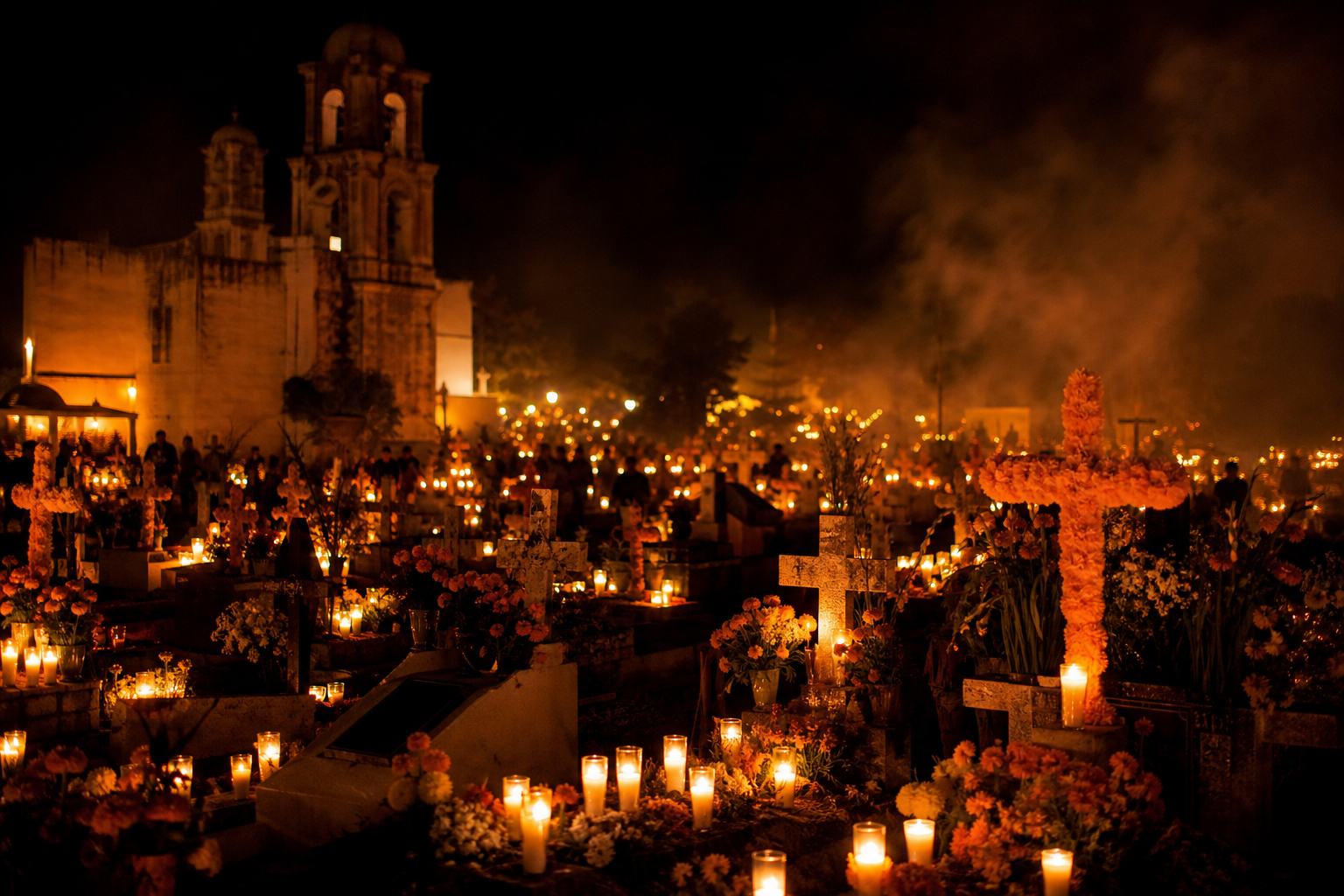
In Mixquic, on the southern edge of Mexico City, the cemetery glows on the night of the second with the alumbrada: hundreds of candles lit on the graves.

In Oaxaca, cemeteries are decorated from the thirty-first, and bands play beside candlelit graves.

In Huaquechula, in Puebla, church bells announce the arrival of the dead at two in the afternoon on the first.

And on the Yucatán Peninsula, Maya communities call the season Janal Pixán, food for the souls, and begin on the thirty-first of October. Tap a place on the map.

1 Nov, night
vigil in the Janitzio cemetery
torches
carried by fishermen in rowing boats
Lake Pátzcuaro
A night in the cemetery Preparations begin days earlier; by about 8 pm the candlelight is at its height. AI-generated illustration.
San Miguel
Oaxaca City’s cemetery, decorated 31 Oct–2 Nov
mariachi
live bands at gravesides in nearby Xoxocotlán
Oaxaca City
  • Huaquechula: “cabo de año” altars for those who died that year
  • Huasteca (Xantolo): an all-night vigil on 1 November, the offering renewed at the end of the month
More local customs
31 Oct–2 Nov
the main days, though the season spans all of November
mucbipollo
a maize dish baked in an earth oven, set on the altars
Janal Pixán
Chapter V · Nights and places

Regional customs

México Desconocido: Purépecha communities around Lake Pátzcuaro hold a ritual vigil; boats leave for Janitzio; in Tzintzuntzan events take place on the night of 1 November; in Huaquechula (Puebla) church bells announce the arrival of the dead at 2 pm on 1 November, and “cabo de año” altars honour those who died in the preceding months; in the Huasteca Potosina (Xantolo) an all-night vigil is held on 1 November and the offering is renewed on the last day of the month. AFAR: on 1 November thousands gather in the Janitzio cemetery; fishermen in rowboats light the lake with torches; in Oaxaca City the Panteón de San Miguel is decorated from 31 October to 2 November, and in Xoxocotlán there are candlelit gravesides with live mariachi bands. Time Out México: Mixquic, in Tláhuac, holds the alumbrada on 2 November, peaking around 8 pm. Wikipedia: people spend the night beside graves in Janitzio and Mixquic. Wikipedia (Spanish), Janal Pixan: the Yucatán Peninsula’s variant of the Day of the Dead, from the Maya for “food for the souls”, held from 31 October to 2 November though the season spans the whole month, with dishes such as mucbipollo set on the altars.

Try it: tap a place on the map. The map is schematic and not to scale.

The altar, the levels of Mictlan, the calendar wheel, the scale, the map and the figures are teaching graphics, not reconstructions of real places or objects.

Sources: México Desconocido: 4 destinos clásicos para vivir el Día de Muertos (Lake Pátzcuaro, Mixquic, Huaquechula, Huasteca); AFAR: Where to celebrate Day of the Dead in Mexico (Oaxaca, Janitzio); Time Out México: Guía de Mixquic (the alumbrada, 2 November); Wikipedia: Day of the Dead (origins debate, dates, ofrenda, calaveras, the 2016 parade); Wikipedia (Spanish): Janal Pixan (Maya “food for the souls”, the Yucatán Peninsula’s Day of the Dead, from 31 October)

Chapter VI · Laughing at death

Chapter VI

Laughing at death

Mocking verses, cheap prints and a skull in a hat.

The Day of the Dead also laughs at death. Calaveras literarias, literary skulls, are short rhyming verses that describe living people as if they were already dead.

The first known ones were printed in 1879 in El Socialista, a newspaper in Guadalajara. They mocked the powerful, and some were censored.

The printmaker José Guadalupe Posada filled cheap broadsheets with lively skeletons. One showed a female skull wearing nothing but an elegant European-style hat: La Calavera Garbancera.

Playful skulls like these are what Stanley Brandes had in mind when he dated the festival's skull art to colonial times and later.

A garbancera was a woman who sold chickpeas. The verse printed beside it, in a broadside from the publisher Antonio Vanegas Arroyo, was not Posada's. It mocked people who hid their roots behind European fashion. It first appeared in 1913, months after his death.

1879
first known, El Socialista, Guadalajara
panteones
their older name: “cemeteries”
Calaveras literarias
  • Diego Rivera, painter
  • Tata Nacho, composer
  • Rodolfo Gaona, bullfighter
Later targets (after the Revolution)
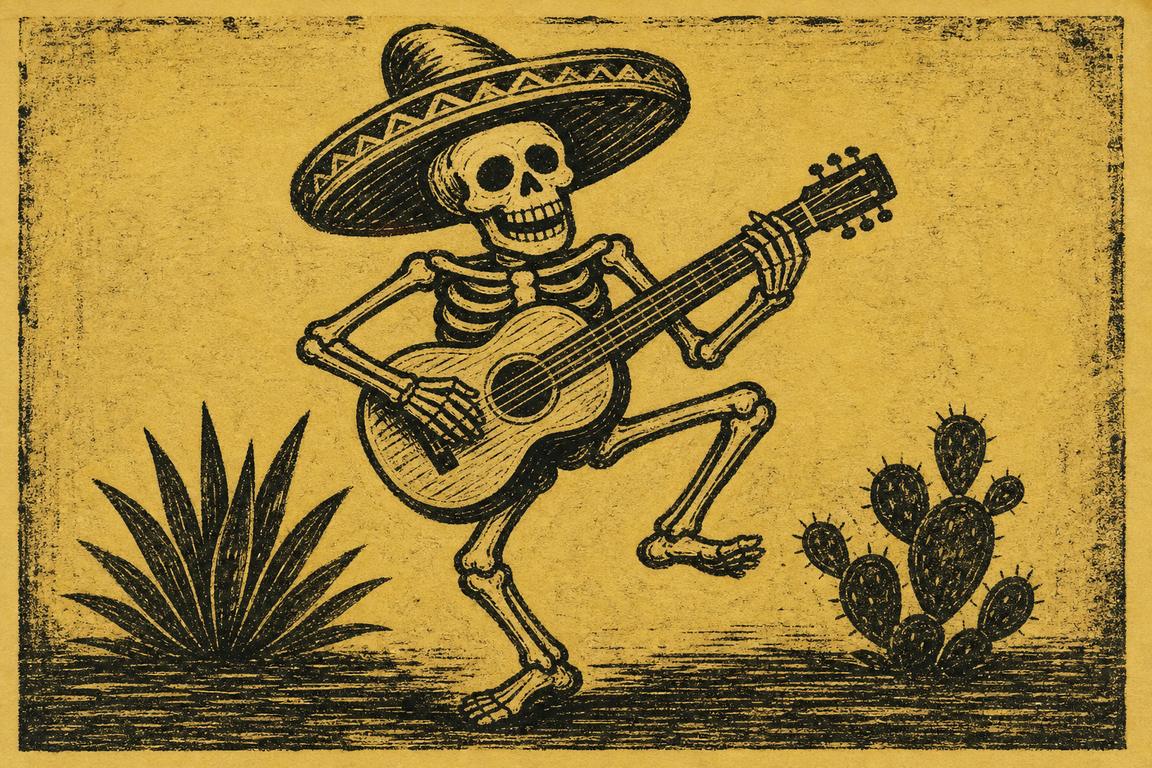
A broadside skeleton An original print in the style of the period, not a work by Posada. Broadsheets like this were printed to be thrown away. AI-generated illustration.
Aztec skull racks, tzompantli, displayed real skulls; they were not decorated with them.JSTOR Daily, on Stanley Brandes
Brandes, 1998
  1. c. 1890–1913 Posada works as an illustrator in Mexico City
  2. 1913 he dies; months later the skull is first published
  3. later Vanegas Arroyo often reuses Posada’s plates (Britannica)
Posada’s skull
Chapter VI · Laughing at death

Literary skulls

National Geographic en Español: calaveras literarias began in the 19th century; the first known examples were published in 1879 in El Socialista, a Guadalajara newspaper; they were earlier called “panteones”, and some were censored for expressing discontent; they parody people, presented as already dead, or events. Wikipedia: they are short, mocking verses or epitaphs about living people, public figures or the deceased. Britannica: Posada’s print, now called La Calavera Catrina, was first published several months after his death in a 1913 broadside; a garbancera was a woman who sold chickpeas, and the 1913 text, which Posada did not write, mocked garbanceras as having abandoned their heritage by wearing European fashions. Posada worked as an illustrator from about 1890 to 1913. WikiArt: the print is a zinc etching of about 1910–1913, showing a skull “dressed only in a hat” in early-20th-century European fashion.

The film does not reproduce Posada’s print; the figures shown are original teaching graphics.

The altar, the levels of Mictlan, the calendar wheel, the scale, the map and the figures are teaching graphics, not reconstructions of real places or objects.

Sources: National Geographic en Español: Así nacieron las calaveras literarias mexicanas; Wikipedia: Day of the Dead (origins debate, dates, ofrenda, calaveras, the 2016 parade); Encyclopaedia Britannica: Catrina (Posada’s print, the 1913 broadside, Rivera and Toor 1930, the 1947 mural); WikiArt: La Calavera Catrina (zinc etching, c. 1910–1913); JSTOR Daily: What do sugar skulls mean on el Día de los Muertos? (on Stanley Brandes, Ethnohistory 1998)

The skull got a new name in 1930, in a book by the painter Diego Rivera and the writer Frances Toor: Catrina, from catrín, a dandy.

In 1947 Rivera painted her into his mural, Dream of a Sunday Afternoon in the Alameda Central.

Today the Catrina is a national symbol: figurines on altars, painted faces and costumes, and this year, a cartonería Catrina thirty-two metres tall in the Zócalo.

  1. 1913 Posada’s skull first printed
  2. 1930 named “Catrina” by Rivera and Toor
  3. 1947 Rivera’s Alameda mural
  4. 2026 a 32 m Catrina in the Zócalo
From garbancera to Catrina
catrín
a well-dressed dandy; Catrina is its feminine form
A word
  • Figurines on altars
  • Face paint and costumes
  • Giant figures in parades
The Catrina today
Chapter VI · Laughing at death

How she became the Catrina

Britannica: in a 1930 book by Diego Rivera and Frances Toor the skull was dubbed “Catrina”, a feminised form of catrín, roughly “dandy”; Rivera featured her in his mural Sueño de una tarde dominical en la Alameda Central (1947). She has become a national symbol of modern Mexico, seen at Día de los Muertos as figurines on altars, in face paint and in costumes. Wikipedia gives the mural’s dates as 1946–47. Publimetro: the 2026 Zócalo Catrina is about 32 metres tall.

The figure in the scene is an original design, not a copy of Posada’s print or Rivera’s mural. Try it: show or hide a 1.7-metre person beside the 32-metre Catrina.

The altar, the levels of Mictlan, the calendar wheel, the scale, the map and the figures are teaching graphics, not reconstructions of real places or objects.

Sources: Encyclopaedia Britannica: Catrina (Posada’s print, the 1913 broadside, Rivera and Toor 1930, the 1947 mural); Wikipedia: Day of the Dead (origins debate, dates, ofrenda, calaveras, the 2016 parade); Publimetro (21 Oct 2026): Día de Muertos 2026 en CDMX — parade 31 October from 14:00, Diana Cazadora to the Zócalo; 32-metre Catrina; ofrendas

Chapter VII · Heritage and parade

Chapter VII

Heritage and parade

An old festival keeps changing.

In 2003, UNESCO proclaimed the Indigenous festivity dedicated to the dead part of humanity's intangible heritage, a living tradition rather than a place, and in 2008 it was inscribed on its Representative List.

UNESCO ties the festival to the end of the yearly maize cycle, and to the brief return of loved ones, welcomed along paths of petals and candles.

Some traditions are very new. In 2015, a spy film opened with a huge Day of the Dead parade through Mexico City, though no such parade existed. The next year, the city organised a real one, and about a quarter of a million people came. This year's, on the thirty-first of October, was the tenth.

An image from abroad, changing the tradition at home. Back to the scholars' scale, then: whose tradition is this? One still being made. Switch between the film and the real parade.

  1. 2003 proclaimed
  2. 2008 inscribed on the Representative List of the Intangible Cultural Heritage of Humanity: practices and knowledge, not monuments
UNESCO
The “transitory return to Earth of deceased relatives and loved ones”.UNESCO, nomination file 00054
In UNESCO’s words
2015
Spectre, a James Bond film: its opening parade was invented
2016
first real parade, on Paseo de la Reforma
A parade from a film
4,000+
participants and 12 floats planned, from the Diana fountain to the Zócalo
Mexico City, 31 October 2026
“pizza effect”
scholars’ term for a custom reshaped abroad and then taken up again at home
A name for it
Chapter VII · Heritage and parade

Heritage, and a parade

UNESCO: “Indigenous festivity dedicated to the dead”, originally proclaimed in 2003 and inscribed in 2008 on the Representative List of the Intangible Cultural Heritage of Humanity; the festivities, at the end of October and the beginning of November, mark the end of the annual maize cycle and the “transitory return to Earth of deceased relatives and loved ones”; families lay out flower petals, candles and offerings along the path from the cemetery to their homes. Wikipedia: the 2015 James Bond film Spectre opened with a Day of the Dead parade in Mexico City although no such parade existed; in 2016 the city organised a real one on Paseo de la Reforma, attended by 250,000 people, an example of the “pizza effect”. México Desconocido: the parade arose in 2016 from the impact of that film. Publimetro and Mexico City’s visitor guide: the tenth parade, on 31 October 2026 from 14:00, ran from the Diana Cazadora fountain to the Zócalo, with more than 4,000 participants and 12 floats planned.

Try it: switch between the film’s parade (2015) and the real one (2016 onward). The street is schematic.

The altar, the levels of Mictlan, the calendar wheel, the scale, the map and the figures are teaching graphics, not reconstructions of real places or objects.

Sources: UNESCO Intangible Cultural Heritage: Indigenous festivity dedicated to the dead (proclaimed 2003, inscribed 2008); Wikipedia: Day of the Dead (origins debate, dates, ofrenda, calaveras, the 2016 parade); México Desconocido: Gran Desfile de Día de Muertos 2026 (31 October 2026; began in 2016 after the 2015 film Spectre); Publimetro (21 Oct 2026): Día de Muertos 2026 en CDMX — parade 31 October from 14:00, Diana Cazadora to the Zócalo; 32-metre Catrina; ofrendas; Mexico City Government, Visitor’s Guide: Day of the Dead 2026 in Mexico City (parade 31 October 14:00; Zócalo ofrenda 29 Oct–2 Nov; 32-metre Catrina)

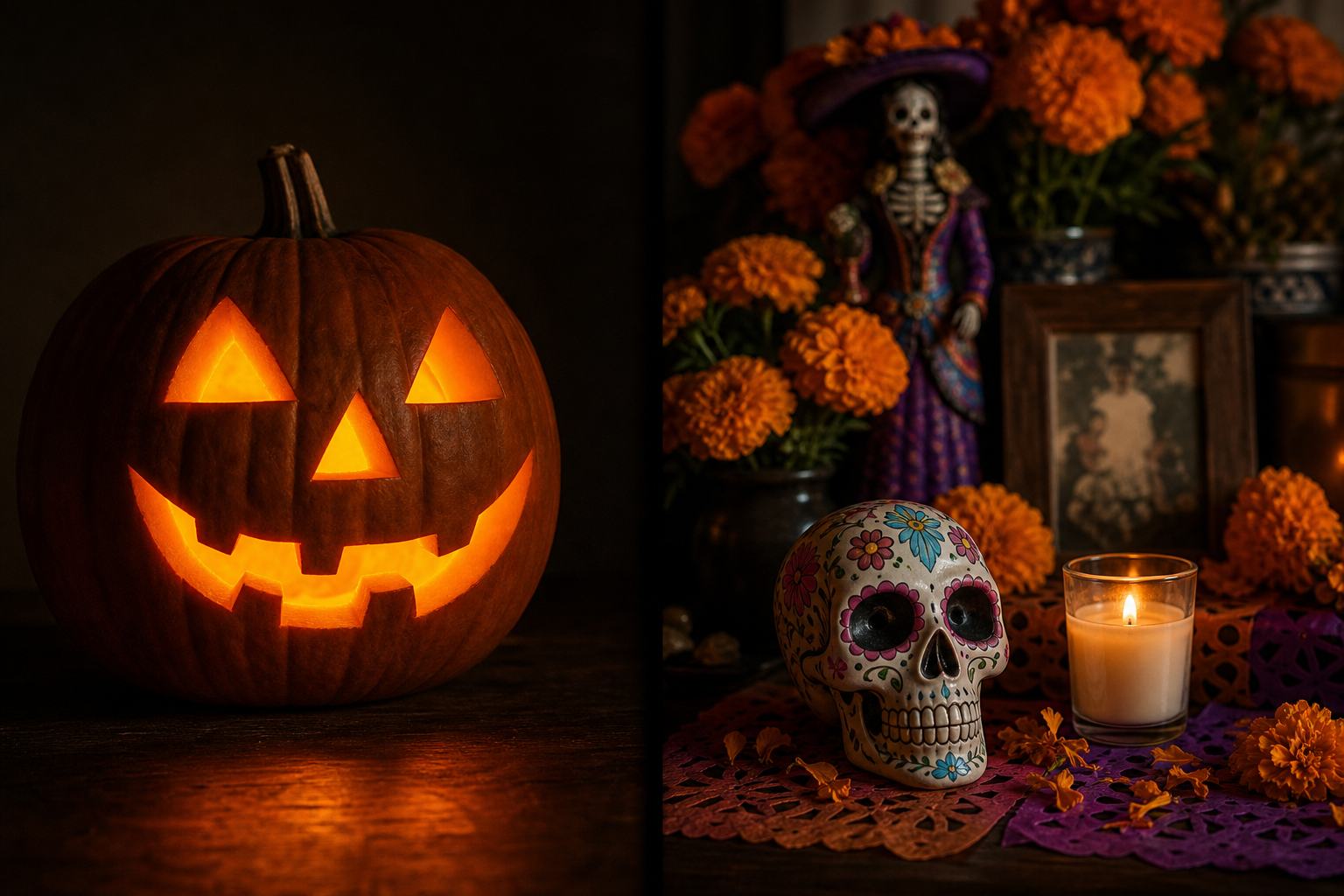
So is the Day of the Dead simply the Mexican Halloween? Both fall within Allhallowtide, the Christian days for the dead, which is why they are often confused.

But Halloween today is mostly costumes, lanterns and sweets. The Day of the Dead is about remembering particular people by name, and welcoming them home.

As Michelle Téllez of the University of Arizona puts it, they should be different things.

Two traditions Allhallowtide runs three days, 31 October to 2 November. AI-generated illustration.
  • Halloween, 31 Oct: costumes, lanterns, trick-or-treat
  • Día de Muertos, 1–2 Nov: altars, graves, family meals
  • Shared dates: the Christian days for the dead
Side by side
They “should be different things”; confusion comes mostly from both falling in autumn.Michelle Téllez, University of Arizona
A scholar’s view
Chapter VII · Heritage and parade

Not the Mexican Halloween

University of Arizona News: Michelle Téllez, associate professor of Mexican American Studies, says confusion between the two holidays comes mainly from both falling in autumn; they “should be different things”, and Halloween parties with altars, or people dressing as “Día de los Muertos”, blur them. Wikipedia: some see Día de Muertos as a local expression of Allhallowtide, the Christian days for the dead (31 October–2 November) within which Halloween also falls.

Beliefs about souls and the afterlife are described as the traditions themselves hold them, not as statements of fact.

The altar, the levels of Mictlan, the calendar wheel, the scale, the map and the figures are teaching graphics, not reconstructions of real places or objects.

Sources: University of Arizona News: Understanding the history and traditions of Día de los Muertos (Michelle Téllez); Wikipedia: Day of the Dead (origins debate, dates, ofrenda, calaveras, the 2016 parade)

Epilogue

So whose tradition is it? The scholars' scale never settled: Mexica months, Catholic feasts, a printed skull and a ten-year-old parade all went into it.

Historians still disagree about which parts are oldest. But families agree on what matters: for a few nights each year, the dead are remembered by name.

Whose name would you say?

  1. c. 1500 Mexica months for the dead; Mictlan
  2. 1521 Conquest; All Saints and All Souls arrive
  3. 1700s Mexico City’s largest annual market
  4. 1879 first known calaveras literarias
  5. 1913 Posada’s skull in a European hat printed
  6. 1947 Rivera’s Alameda mural
  7. 2008 UNESCO inscription
  8. 2016 first Mexico City parade
The road to the Day of the Dead
The way home A path of marigold petals leading to a lit doorway. AI-generated illustration.
  • The roots: still debated
  • The form: still changing, as the parade shows
  • The purpose: remembering particular people
What the evidence allows
  • Stills are AI-generated illustrations
  • 3D scenes are schematic
  • Beliefs are described, not asserted
About this film
Epilogue · Sources

Sources

Every fact in this film comes from the sources below. The origin of the Day of the Dead is debated: Octavio Paz saw continuity with Aztec festivals, Hugo Nutini a syncretic fusion, Stanley Brandes a blend whose skull imagery is largely colonial and later, and Elsa Malvido a mainly European, Catholic origin recast with pre-Hispanic meaning in the 1930s. Beliefs about souls are described as the traditions hold them. The stills are AI-generated illustrations; the 3D scenes are schematic teaching graphics.

Sources: Mexico City Government, Visitor’s Guide: Day of the Dead 2026 in Mexico City (parade 31 October 14:00; Zócalo ofrenda 29 Oct–2 Nov; 32-metre Catrina); Publimetro (21 Oct 2026): Día de Muertos 2026 en CDMX — parade 31 October from 14:00, Diana Cazadora to the Zócalo; 32-metre Catrina; ofrendas; México Desconocido: Gran Desfile de Día de Muertos 2026 (31 October 2026; began in 2016 after the 2015 film Spectre); Wikipedia: Day of the Dead (origins debate, dates, ofrenda, calaveras, the 2016 parade); Wikipedia: Mictlān (nine levels, four-year journey, other destinations of the dead); Encyclopaedia Britannica: Mictlantecuhtli (Aztec god of the dead; nine hells; four years); World History Encyclopedia: Mictlantecuhtli (no special paradise for the righteous; who avoided the underworld); Wikipedia: Dogs in Mesoamerican folklore and myth (the river of the first level; yellow dogs); World History Encyclopedia: The Aztec Calendar (18 months of 20 days and 5 nemontemi days); Wikipedia: Hueymiccaihuitl (tenth month, also called Xocotlhuetzi; “Great Feast of the Dead”); Gaceta UNAM: Miccailhuitontli, fiesta mesoamericana, origen del pan de muerto (Luis Alberto Vargas, IIA-UNAM); Excélsior: México prehispánico, 40 días celebrando a los muertos (Elsa Malvido, INAH); World History Encyclopedia: The Fall of Tenochtitlan (13 August 1521; Indigenous allies); Religion News Service (Mathew Sandoval): How commercialization over the centuries transformed the Day of the Dead; JSTOR Daily: What do sugar skulls mean on el Día de los Muertos? (on Stanley Brandes, Ethnohistory 1998); Encyclopaedia Britannica: All Souls’ Day (2 November; Odilo of Cluny); Wikipedia: Odilo of Cluny (All Souls’ Day at Cluny, probably after 1030); UNAM (CENDI): Día de muertos, elementos de la ofrenda; N+: Qué se pone en la ofrenda de Día de Muertos (elements and their meanings); University of New Mexico, Latin American & Iberian Institute: About Día de los Muertos (ofrenda elements, Mictlán); National Geographic en Español: 4 datos curiosos de la flor de cempasúchil; México Desconocido: 4 destinos clásicos para vivir el Día de Muertos (Lake Pátzcuaro, Mixquic, Huaquechula, Huasteca); AFAR: Where to celebrate Day of the Dead in Mexico (Oaxaca, Janitzio); Time Out México: Guía de Mixquic (the alumbrada, 2 November); Wikipedia (Spanish): Janal Pixan (Maya “food for the souls”, the Yucatán Peninsula’s Day of the Dead, from 31 October); National Geographic en Español: Así nacieron las calaveras literarias mexicanas; Encyclopaedia Britannica: Catrina (Posada’s print, the 1913 broadside, Rivera and Toor 1930, the 1947 mural); WikiArt: La Calavera Catrina (zinc etching, c. 1910–1913); UNESCO Intangible Cultural Heritage: Indigenous festivity dedicated to the dead (proclaimed 2003, inscribed 2008); University of Arizona News: Understanding the history and traditions of Día de los Muertos (Michelle Téllez)