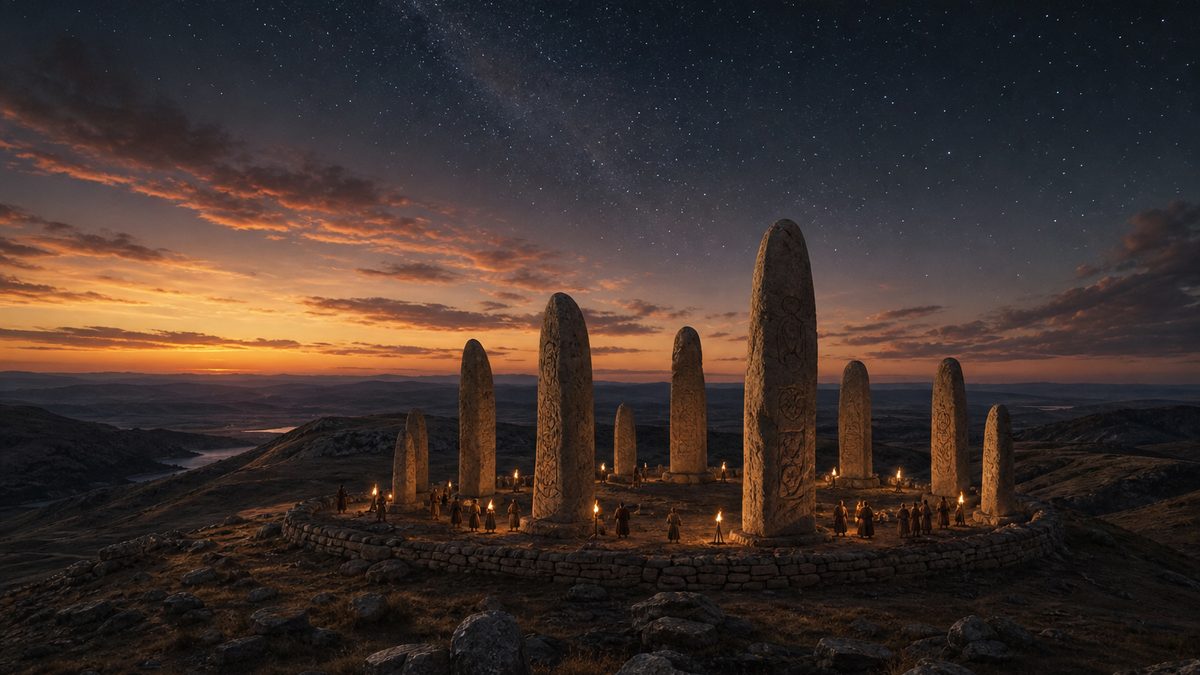
An overview of where the world's religions came from and in what order: early burials and spirit beliefs, Göbekli Tepe, the gods of Mesopotamia and Egypt, the Vedas, Zoroaster and early Judaism, the Axial Age of the Buddha, Mahavira, Confucius and the Daoists, the spread of Buddhism, Christianity and Islam, Sikhism, faith and empire, and today's religious map. Episode 00 of the Origins of Religions series.
Interactive 3D film6 minc. 100,000 BC to todayPublished 2026-10-13
Today about three in four people on Earth identify with a religion. Christians and Muslims together make up more than half of humanity, followed by Hindus and Buddhists.
Every one of these traditions was born somewhere, at a particular time, among people facing particular problems. This series goes back to those beginnings.
Prologue · Episode 00 of the Origins of Religions series
The world’s faiths today
Christians
28.8%
~2.3 billion
Muslims
25.6%
~2.0 billion
No religion
24.2%
~1.9 billion
Hindus
14.9%
~1.2 billion
Buddhists
4.1%
~320 million
Jews
0.2%
~15 million
Shares of world population in 2020.
Each episode separates what historians and archaeologists can show from what each tradition teaches about its own origins. Both are told with respect.
Religion is older than writing, farming and cities.
Around 100,000 years ago, people in the Levant were already burying their dead with care, sometimes with red ochre and animal bones. Many archaeologists see this as an early sign of ritual.
Hunter-gatherers almost everywhere believed in spirits in animals, rivers, mountains and ancestors. Many such beliefs, from Africa to Siberia to Southeast Asia, survive today.
Around 9500 BC, people at Göbekli Tepe in today’s Turkey raised huge carved stone pillars, before farming had fully begun. It may be the oldest known monumental sacred site.
Chapter I · Step 1
Spirits, ancestors and the first temples
c. 100,000 years ago Burials at Qafzeh and Skhul, Levant
c. 40,000 years ago Cave art in Europe and Southeast Asia
c. 9500 BC Göbekli Tepe
Episode 01 explores these first beliefs, including belief in spirits in Southeast Asia.
When the first cities rose in Mesopotamia and Egypt, religion grew with them. Each city had its own god, a temple at its centre, and priests who ran its land and stores.
Kings ruled in the name of the gods, or, in Egypt, as gods themselves. Writing was invented partly to keep temple accounts.
In the same centuries, Vedic hymns were being composed in northern India: the oldest roots of Hinduism.
Chapter I · Step 2
Gods of the cities
c. 3200 BC Writing in Uruk
c. 2500 BC Pyramids at Giza
c. 1500–1200 BC Rigveda composed
Episode 02: the ancient gods. Episode 03: Hinduism.
In Iran, the prophet Zarathustra taught of one wise god, Ahura Mazda, and a cosmic struggle between truth and the lie. Scholars date him anywhere from 1500 to 500 BC.
In the small hill country of Israel and Judah, worship gradually focused on one god, Yahweh. After Babylon destroyed Jerusalem in 586 BC, exiles shaped this into the Judaism of the Torah.
Meanwhile in India, the Upanishads asked about the self and ultimate reality, and in Greece, the gods of Olympus were honoured in city festivals.
Within a few centuries, across Eurasia, new teachers appeared. In India, the Buddha and Mahavira taught paths of liberation outside the Brahmin priesthood.
In China, Confucius taught ethics and good government, and Daoist writers taught harmony with the Way. In Greece, philosophers questioned the gods.
The philosopher Karl Jaspers called this the “Axial Age”. Historians still debate whether it was one global turning point or a coincidence of separate developments.
Chapter II · Step 4
The Axial Age
c. 551–479 BC Confucius
5th century BC Mahavira; the Buddha (dates debated)
c. 470–399 BC Socrates
4th century BC Daodejing takes shape
Episode 06: Buddhism and Jainism. Episode 07: Confucianism and Daoism.
Buddhism travelled along the Silk Road into Central Asia and China, carried by monks and merchants.
Around AD 30, in Roman Judea, the followers of Jesus of Nazareth began a new movement. Within three centuries it had spread across the Roman Empire, and in 380 it became the empire’s official religion.
The old gods of Greece, Rome and Egypt slowly lost their temples. Egypt’s last temple, at Philae, closed in the 530s.
Chapter III · Step 5
Faiths that travel
1st c. AD Buddhism reaches China
c. AD 30 Jesus of Nazareth
313, 380 Christianity tolerated, then official in Rome
In 610, according to Muslim tradition, Muhammad of Mecca received the first revelations of the Quran. Within a century of his death, Islam was the religion of rulers from Spain to Central Asia.
In the east, Buddhism reached Korea, Japan and Tibet. In Japan, worship of the kami was organised into what came to be called Shinto.
By 800, the great world religions of today were all in place except one.
Buddhism declined in India, its birthplace, as Hindu devotional movements grew and great monasteries like Nalanda were destroyed around 1200. It thrived instead in Sri Lanka, Southeast Asia, Tibet and East Asia.
Islam spread to northern India, West Africa and, through merchants, to the Malay world and Indonesia.
In Punjab, around 1499, Guru Nanak began teaching a path beyond the divisions of Hindu and Muslim: the beginning of Sikhism.
European empires carried Christianity to the Americas, Africa, the Philippines and Oceania. The religions of the Aztecs and Incas were suppressed, though many of their practices survived inside local Christianity.
Christianity itself split: the Protestant Reformation began in 1517.
At the same time, Islam and Buddhism kept spreading through trade, teachers and conversion, without empires behind them in many places.
Religions are born from the worries and hopes of particular societies: harvests and floods, kings and empires, death, injustice and suffering.
The episodes that follow go back to each beginning in turn. Start with the first beliefs, or jump to the tradition you want to understand.
Epilogue
Where to go next
The series
00 The Origins of Religions (overview) (this film)
01The First Beliefs
02The Ancient Gods
03Hinduism
04Zoroastrianism
05Judaism
06Buddhism and Jainism
07Confucianism and Daoism
08Shinto
09Christianity
10 Islam (coming soon)
11 Sikhism (coming soon)
12 Spirits, Brahmins and the Buddha: Southeast Asia (coming soon)
The still images on the chapter cards are AI-generated illustrations; they do not depict religious figures. Outlines are approximate and show only where a tradition was widely practised.