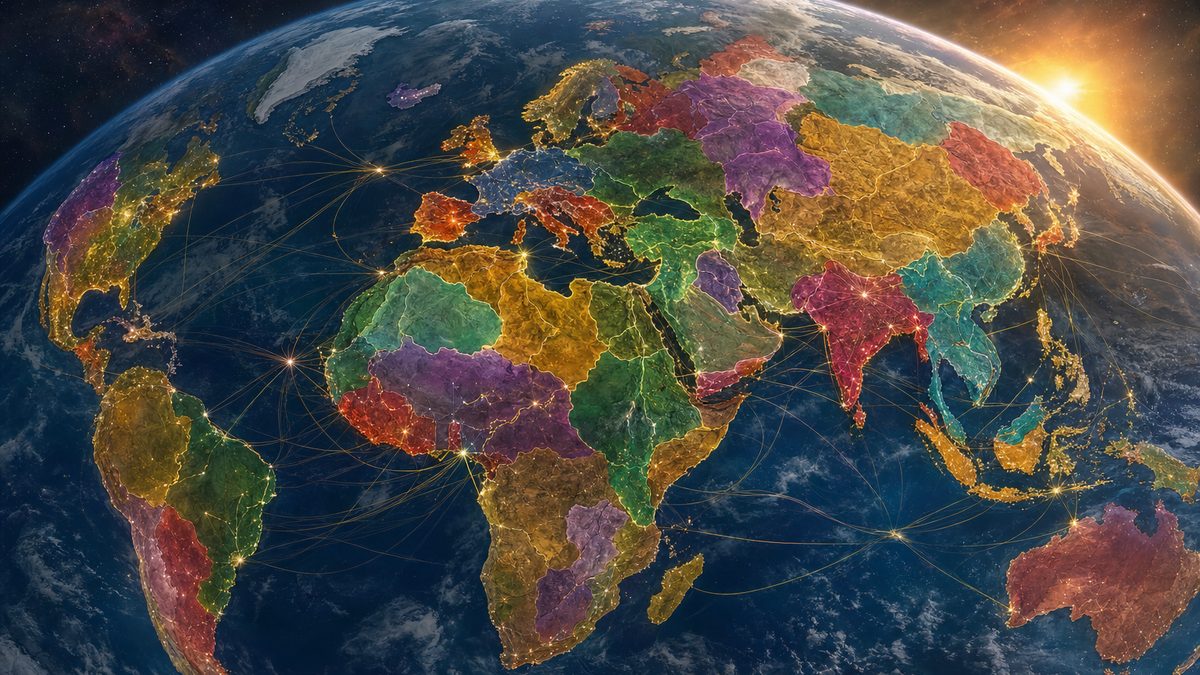
Every major empire of the last 4,500 years on one 3D globe and one timeline, from Akkad and Egypt to Rome, Han China, the caliphates, the Mongols, the Ottomans, the Incas and the British Empire. What came first, what overlapped, and what replaced what.
Interactive 3D film8 min3100 BC to todayPublished 2026-10-13
4,500 years of empires on one globe and one timeline.
What is an empire? Historians usually mean a state that rules many different peoples and lands, often won by force, from one centre of power.
Over four and a half thousand years, dozens of empires have risen and fallen. Many existed at the same time on different continents, knowing little of each other.
This film puts them on one globe and one timeline, so you can see what came first, what overlapped, and what replaced what.
The strip at the top left is that timeline. Each row is a region of the world. The white line marks where we are in time.
Prologue · Episode 00 of the World Empires series
The rise and fall of empires
An empire is usually defined as a large state in which one people, ruler or centre governs many other peoples and territories, often acquired by conquest. Below is every empire in this series on a single timeline, grouped by region. Hover or tap a bar for its dates.
Dates are conventional and many are debated. Start and end dates mark rough periods of imperial rule, not the whole history of a people or dynasty.
How to use: the strip at the top left is the timeline of every empire; each row is a region of the world and the white line is the current moment · drag the scrubber under the scene, or press “earlier / later”, to move through time · drag to turn the globe.
The first states grew up along rivers: the Tigris, the Euphrates and the Nile.
Before empires came cities. In Mesopotamia, in what is now Iraq, Sumerian city-states such as Uruk and Ur competed for land and water.
Around 3100 BC, Upper and Lower Egypt were united under one king. Egypt became one of the world’s first large territorial states.
But Egypt was then one people along one river. An empire ruling many peoples would come a few centuries later.
Chapter I · Step 1
Before empires: cities and kings
Farming villages along the great rivers of the Middle East grew into cities around 3500–3000 BC. Each Sumerian city had its own king and gods. Egypt took another path: around 3100 BC the Nile valley was unified into one kingdom.
City-state: one city and its surrounding farmland.
Kingdom: a larger territory, often one people under one ruler.
Empire: a state ruling many peoples and older states, usually by conquest.
Sargon of Akkad conquered the cities of Sumer and marched to the Mediterranean.
Around 2334 BC, by the usual dating, Sargon of Akkad conquered the Sumerian cities and campaigned up the Euphrates toward Syria.
His Akkadian Empire is often called the first empire in history: one king ruling many cities and peoples.
At its height, under his grandson Naram-Sin, it covered perhaps 800,000 square kilometres. It lasted less than two centuries.
Scholars still debate its exact dates, by up to about sixty years, and why it fell: revolts, invaders from the Zagros mountains, and possibly drought.
Chapter I · Step 2
The first empire: Akkad
Sargon (reigned c. 2334–2279 BC, Middle Chronology) united Sumer and Akkad and claimed rule from the “Lower Sea” (the Gulf) to the “Upper Sea” (the Mediterranean). His grandson Naram-Sin called himself “king of the four quarters” of the world.
Peak area
~0.8M km²
c. 2250 BC (Taagepera)
Lasted
~180 years
c. 2334–2154 BC
The city of Akkad itself has never been found. Its marker on the globe is approximate. Full story: Episode 01.
India, China and Rome: three great empires, far apart, at the same time.
In the centuries around the year 1, three giant empires existed at the same time, far apart.
In India, the Maurya Empire under Ashoka ruled most of the subcontinent in the 200s BC.
In 221 BC, Qin unified China. The Han dynasty that followed ruled roughly as many people as Rome.
In the west, Rome grew from one city into an empire around the whole Mediterranean, reaching its largest extent in AD 117.
Chapter II · Step 6
Three giants at once
c. 322 BC Maurya Empire founded by Chandragupta
221 BC Qin unifies China
202 BC Han dynasty; census of AD 2 counts 57.7 million people
27 BC Augustus becomes the first Roman emperor
AD 117 Rome at its largest, ~5M km²
Silk and other goods passed between Han China and Rome through many middlemen, but the two empires never met directly. Episodes 04, 05 and 06 go deeper.
The Ottomans take Constantinople; Europe crosses the oceans.
After the Mongols, new powers armed with gunpowder rose. In 1453 the Ottomans took Constantinople, ending the Byzantine Empire.
Ming China sent great fleets across the Indian Ocean. In the Americas, the Aztec and Inca empires rose, separately from the rest of the world.
Then, in 1492, Columbus crossed the Atlantic. Within about forty years, Spanish conquerors, helped by epidemics and Indigenous allies, brought down both American empires.
In India, the Mughals built a new empire from 1526.
Chapter IV · Step 10
Gunpowder and new worlds
1453 Ottomans take Constantinople
1428 Aztec Triple Alliance formed
c. 1438 Inca expansion under Pachacuti
1492 / 1498 Columbus reaches the Americas; da Gama reaches India
1521 / 1533 Fall of Tenochtitlan; Atahualpa executed
For the first time, empires spanned the whole globe.
From the 1600s, European sea empires spread around the globe, built on trade, settlement, conquest, and the Atlantic slave trade.
On land, Qing China and the Russian Empire reached their greatest size.
By 1920, the British Empire covered about 35.5 million square kilometres, nearly a quarter of the Earth’s land: the largest empire ever.
Siam, today’s Thailand, stayed one of the few Asian states never colonised, though it gave up territory to Britain and France.
Chapter IV · Step 11
Empires of the sea
British Empire, 1920
~35.5M km²
~24% of Earth’s land
Transatlantic slave trade
~12.5M
people embarked, 1501–1867 (Slave Voyages)
The golden line is the Manila galleon route between the Philippines and Mexico (1565–1815). Episodes 12 and 13 cover this era, including Siam’s treaties of 1855–1909.
The First World War ended four empires: Russia, Germany, Austria-Hungary and the Ottomans.
After the Second World War, Japan’s empire ended, and a wave of independence followed across Asia and Africa.
The United Nations grew from 51 members in 1945 to 193 today. In 1991 the Soviet Union, which some historians describe as an empire, broke into fifteen states.
Hong Kong returned to China in 1997, and Macau in 1999. The age of formal empires was over, though people still debate new forms of power.
Chapter V · Step 12
The end of empires
1917–1922 Russian, German, Austro-Hungarian and Ottoman empires end
1945 Japan’s empire ends; the UN is founded with 51 members
1947 India and Pakistan independent
1960 “Year of Africa”: 17 new states
1991 The USSR dissolves into 15 states
1997 / 1999 Hong Kong and Macau handed to China
Whether the Soviet Union was an empire is debated: it was legally a federation, but ruled many nations from Moscow. Episode 13 presents both views.
Most fell within a few generations. Their traces did not.
Seen side by side, the timeline shows a pattern. Empires often rose quickly, through conquest, and fell through overreach, rival heirs, revolts, disease or a changing climate.
Many lasted only a few generations. A few, like Egypt, Rome and China’s dynasties, built institutions that lasted for centuries.
Their languages, laws, religions and borders still shape the world we live in.
In the episodes that follow, we look at each empire in depth, one at a time.
Epilogue
What empires leave behind
Largest extent of each empire in this series, in million km² (estimates after Taagepera and others; ranges exist for most).
British Empire 35.5M Mongol Empire 24M Russian Empire 22.8M Soviet Union 22.4M Qing dynasty 14.7M Spanish Empire 13.7M French colonial empire 11.5M Umayyad Caliphate 11.1M Abbasid Caliphate 11.1M Empire of Japan 7.4M Han dynasty 6.5M Ming dynasty 6.5M Achaemenid Persian Empire 5.5M Portuguese Empire 5.5M Tang dynasty 5.4M Empire of Alexander 5.2M Ottoman Empire 5.2M Roman Empire 5M Mughal Empire 4M Seleucid Empire 3.9M Sasanian Empire 3.5M Maurya Empire 3.4M Parthian Empire 2.8M Eastern Roman (Byzantine) Empire 2.7M Qin dynasty 2.3M Inca Empire 2M Gupta Empire 1.7M Neo-Assyrian Empire 1.4M Mali Empire 1.1M Egypt of the pharaohs 1M Khmer Empire 1M Akkadian Empire 0.8M Neo-Babylonian Empire 0.5M Hittite Empire 0.45M Aztec Empire (Triple Alliance) 0.2M
The series
00 The Rise and Fall of Empires (overview) (this film)
01The First Empires: Mesopotamia
02Egypt of the Pharaohs
03Persia and Alexander
04The Maurya Empire of India
05China Unified: Qin and Han
06 Rome (coming soon)
07 The Islamic Caliphates (coming soon)
08 The Khmer Empire of Angkor (coming soon)
09 The Mongol Empire (coming soon)
10 The Ottoman Empire (coming soon)
11 The Aztec and Inca Empires (coming soon)
12 The Age of Sea Empires (coming soon)
13 The End of Empires (coming soon)
The still images on the chapter cards are AI-generated illustrations, not historical images. Empire outlines on the globe are rough approximations drawn for this film.