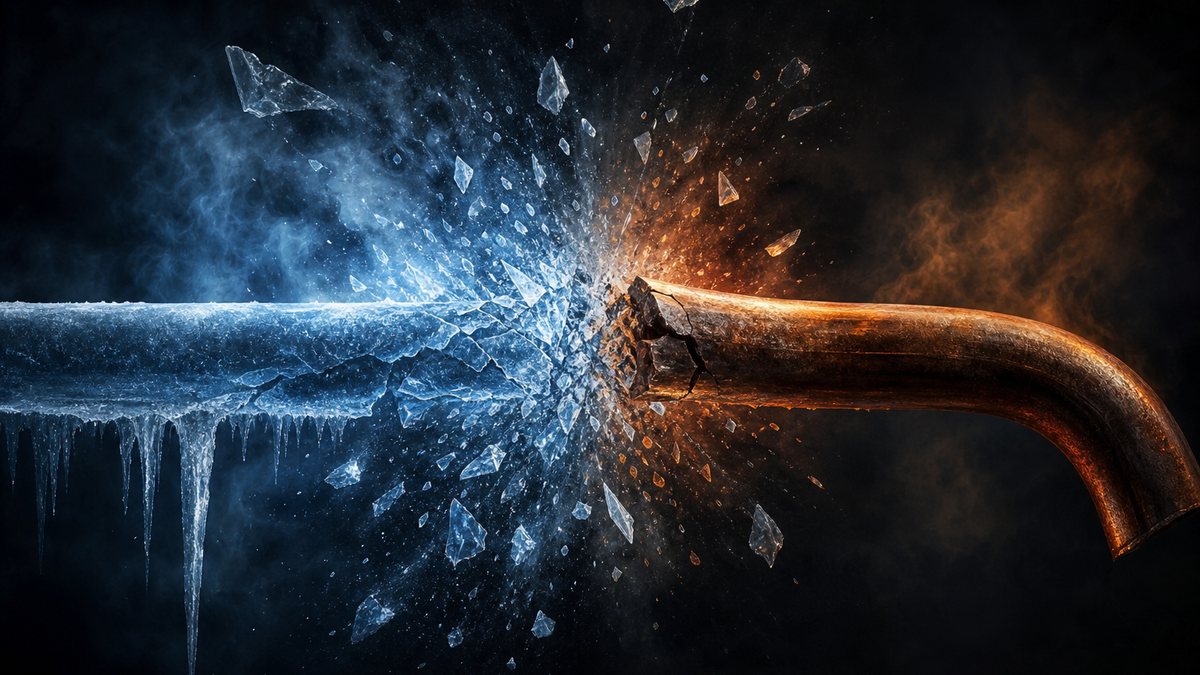
In October 2026 an international team led by UC Berkeley, Berkeley Lab and the University of Oxford reported in Nature two experimental alloys that stay tough at −253 °C, although their crystal structure is the kind that usually turns brittle. This film explains the fundamentals: ductile and brittle fracture, the FCC and BCC ways of stacking atoms, how dislocations let metals bend and why they stall in the cold, the ductile-to-brittle transition, the Charpy test of 1901, the Liberty ships that cracked in the Second World War and Constance Tipper's work, the 1944 Cleveland gas-tank disaster, and the metals chosen for liquefied gas and liquid hydrogen today.
Interactive 3D film8 min1901 to 2026Published 2 November 2026
Why cold turns some metals brittle, and what engineers do about it.
Bend a steel bar on a mild day and it sags, but holds. Cool the same bar far enough and it can snap like glass. In the Second World War, that switch broke ships in half.
On the fourteenth of October 2026, an international team led by UC Berkeley, Berkeley Lab and the University of Oxford reported in Nature two experimental metals that stay tough at minus two hundred and fifty-three degrees Celsius.
Why do some metals turn brittle in the cold, and how do engineers build things that must stay cold?
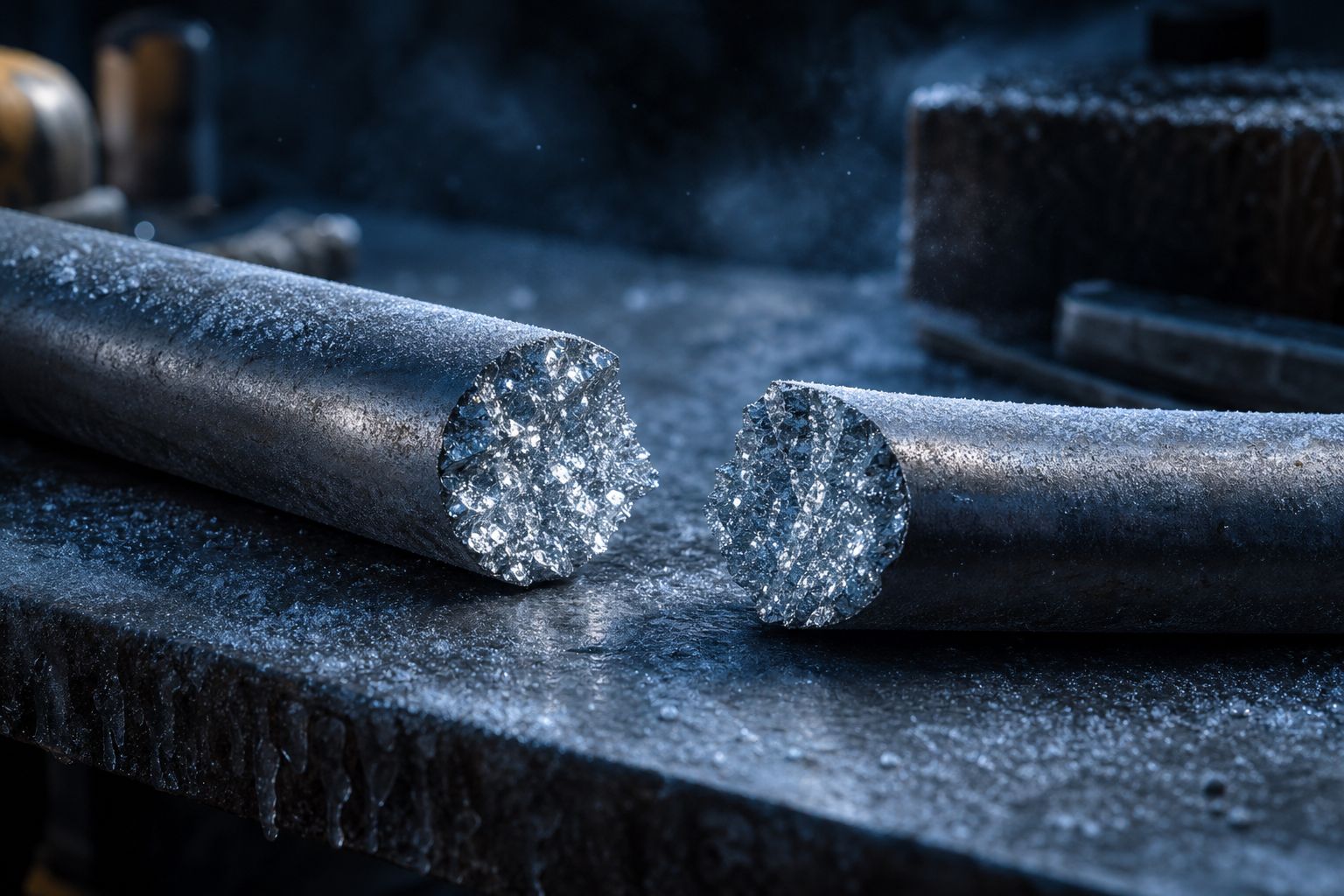
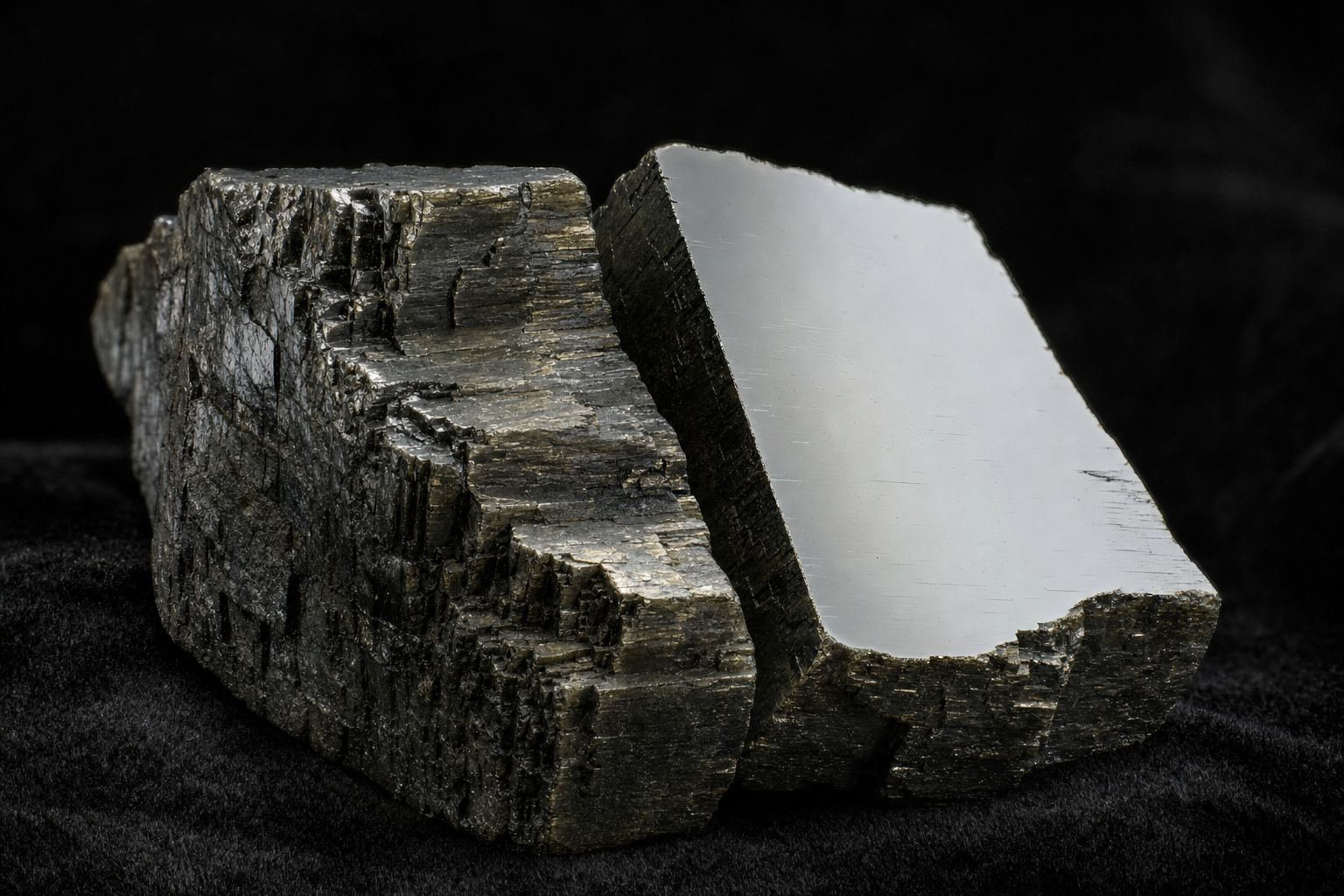
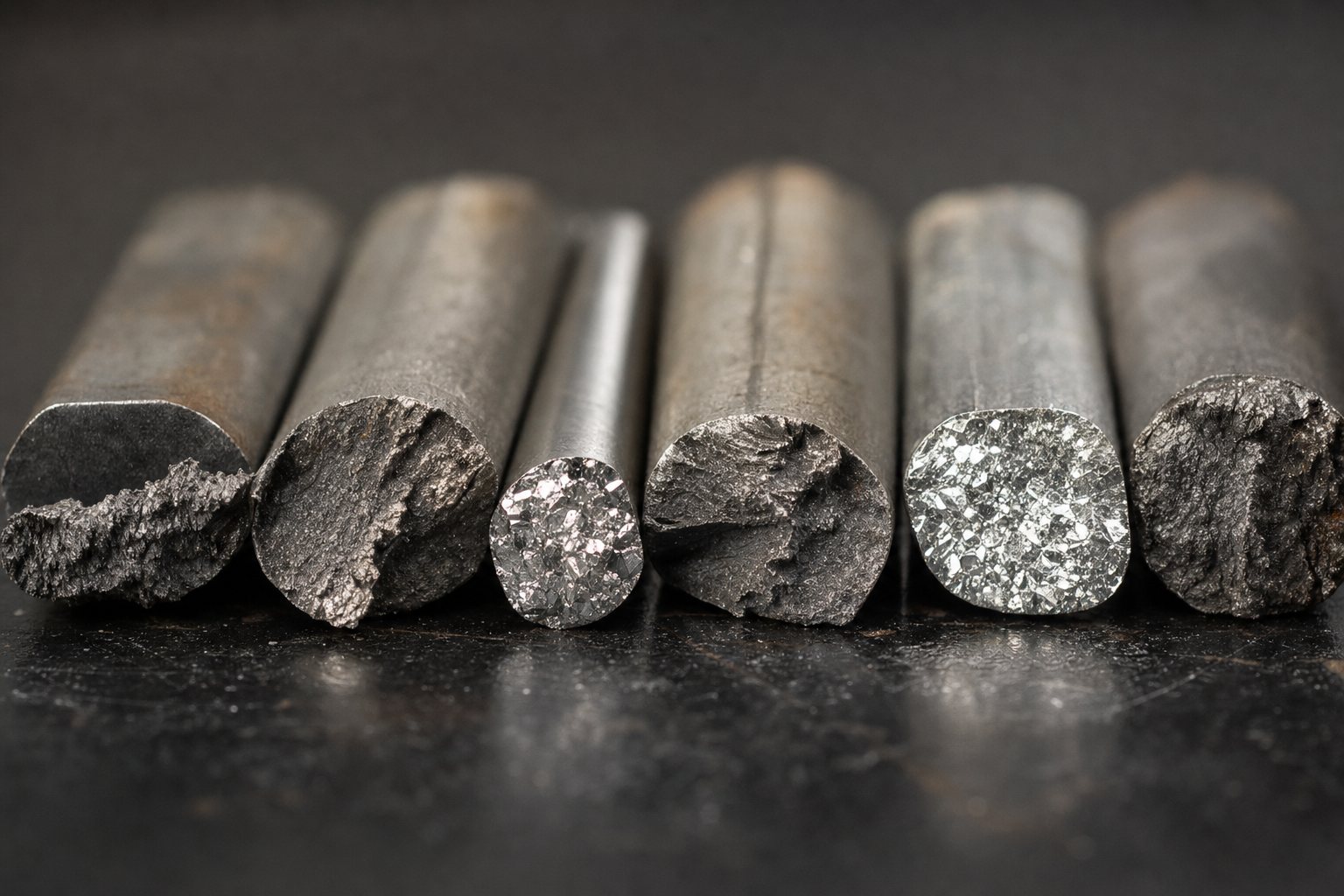
A clean break The broken face of brittle steel is flat and glitters. AI-generated still.
−253 °C
the test temperature: 20 kelvin, just 20 degrees above absolute zero
Nature, 14 October 2026
Nb–Ti
niobium and titanium based, more in chapter V
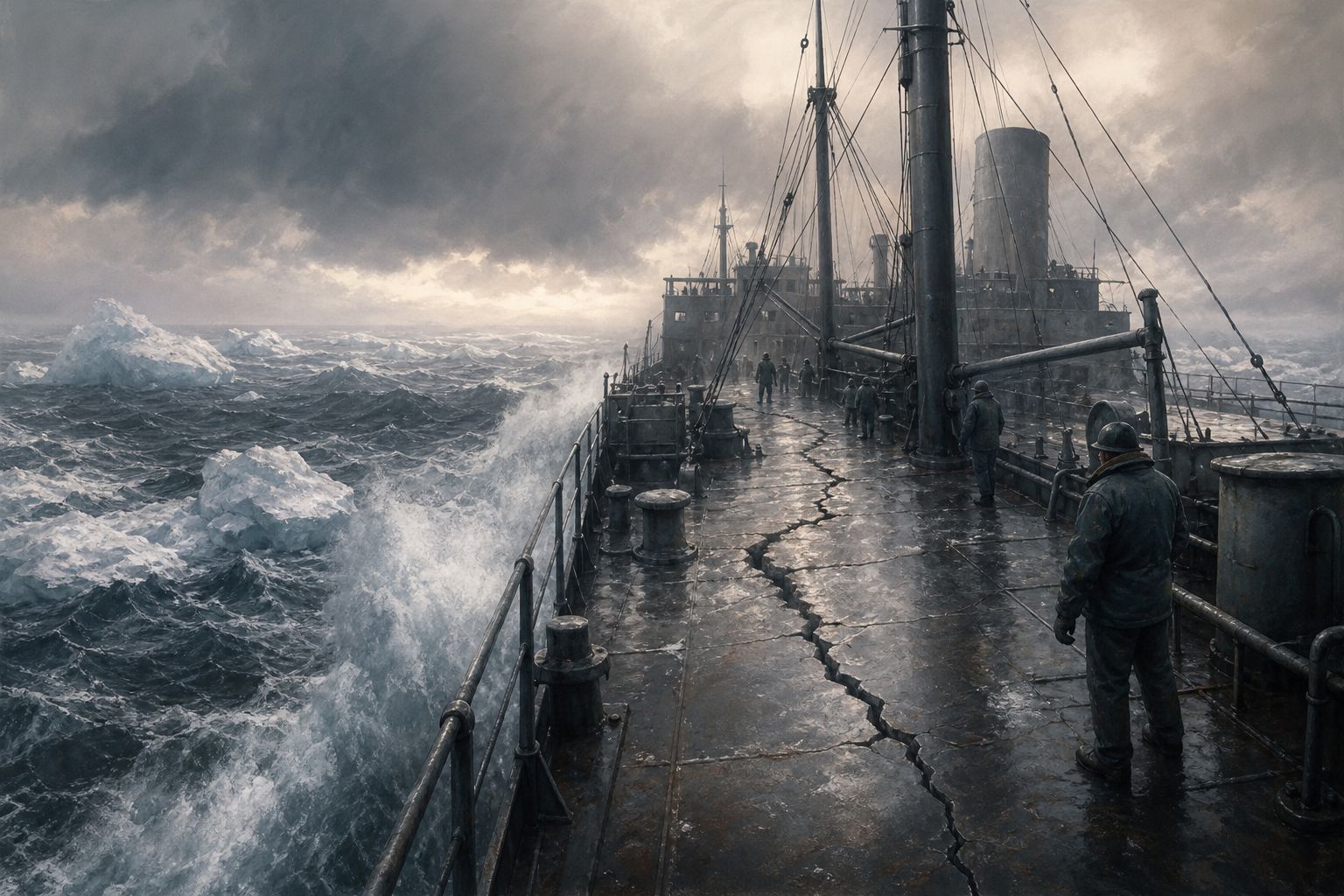
The alloysCold water, cracked steel A wartime cargo ship in an icy sea, a crack across its deck. AI-generated still.
Prologue
A metal that stays tough
EurekAlert! / University of Oxford (14 October 2026): in Nature, an international team led by UC Berkeley, Lawrence Berkeley National Laboratory and the University of Oxford, with partners including ISIS, reported two experimental niobium–titanium-based alloys with a body-centred cubic structure that, tested at 20 K (about −253 °C), showed no measurable ductile-to-brittle transition. ScienceDaily (29 October 2026) reported the same study.
This single new study is the hook; chapter V comes back to it. The rest of the film is long-established materials science and history.
The 3D scenes are simplified teaching models, not to scale.
Engineers call a material that bends and stretches before it breaks ductile. One that breaks suddenly, with almost no bending, is brittle.
A ductile failure gives warning: the metal sags, stretches and soaks up energy. A brittle fracture gives none.
Most steel is ductile on a mild day. Cool it far enough, and the same steel can become brittle. Try both temperatures.
Sharp notches, small cuts in the surface, and sudden blows push steel the same way as cold does: towards brittle.
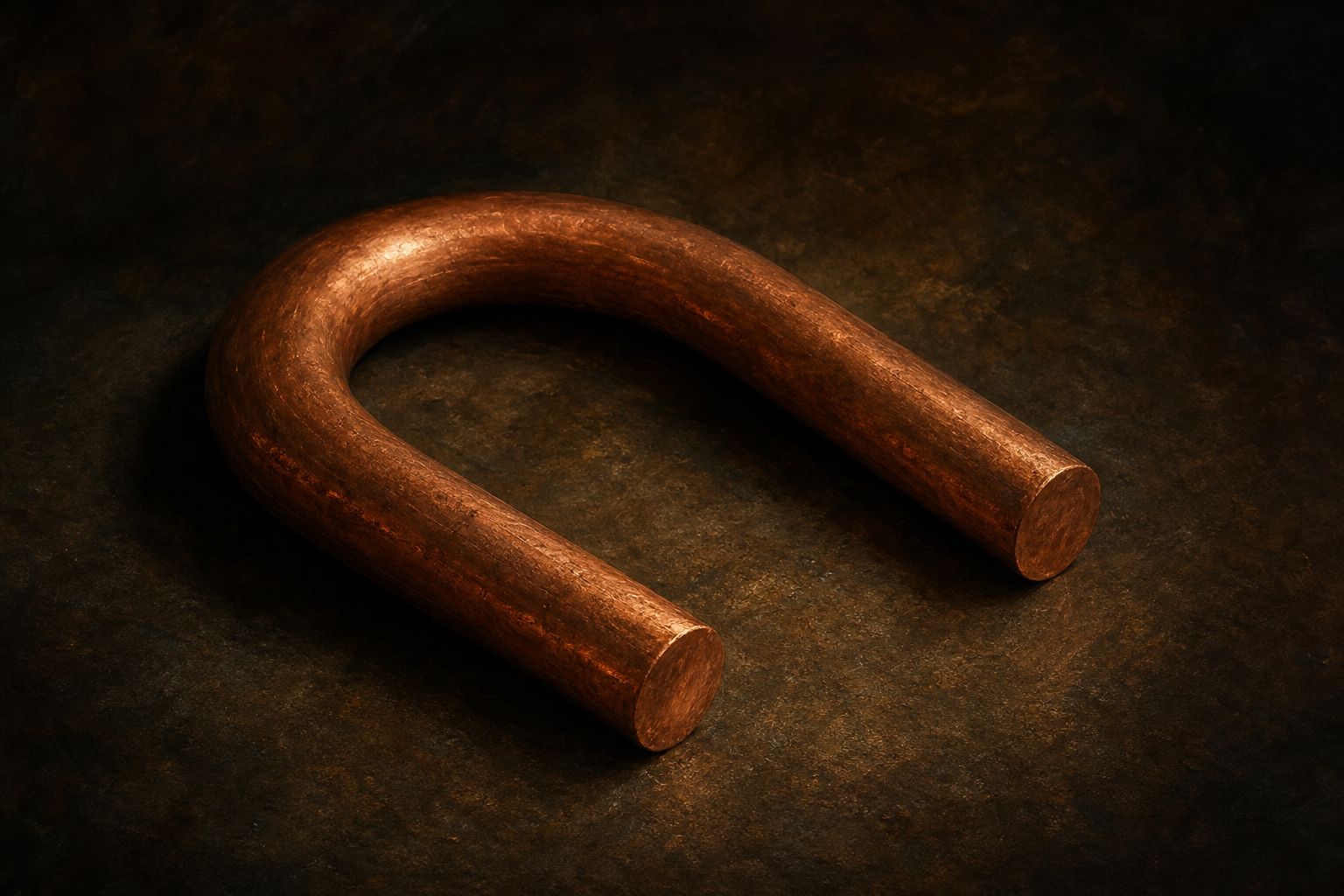
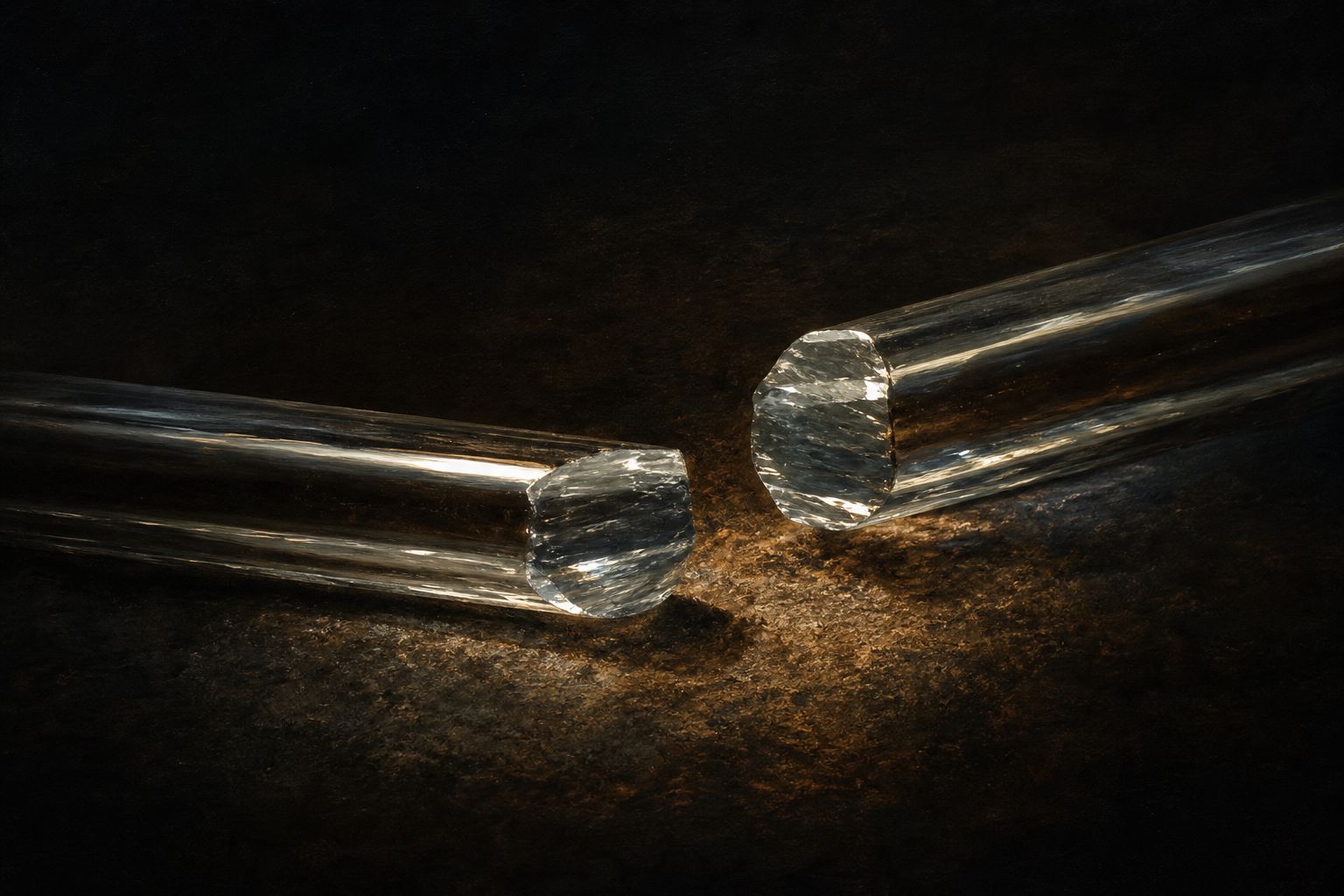
Ductile A rod bent into a U without breaking. AI-generated still.Brittle Glass breaks with sharp, clean faces. AI-generated still.
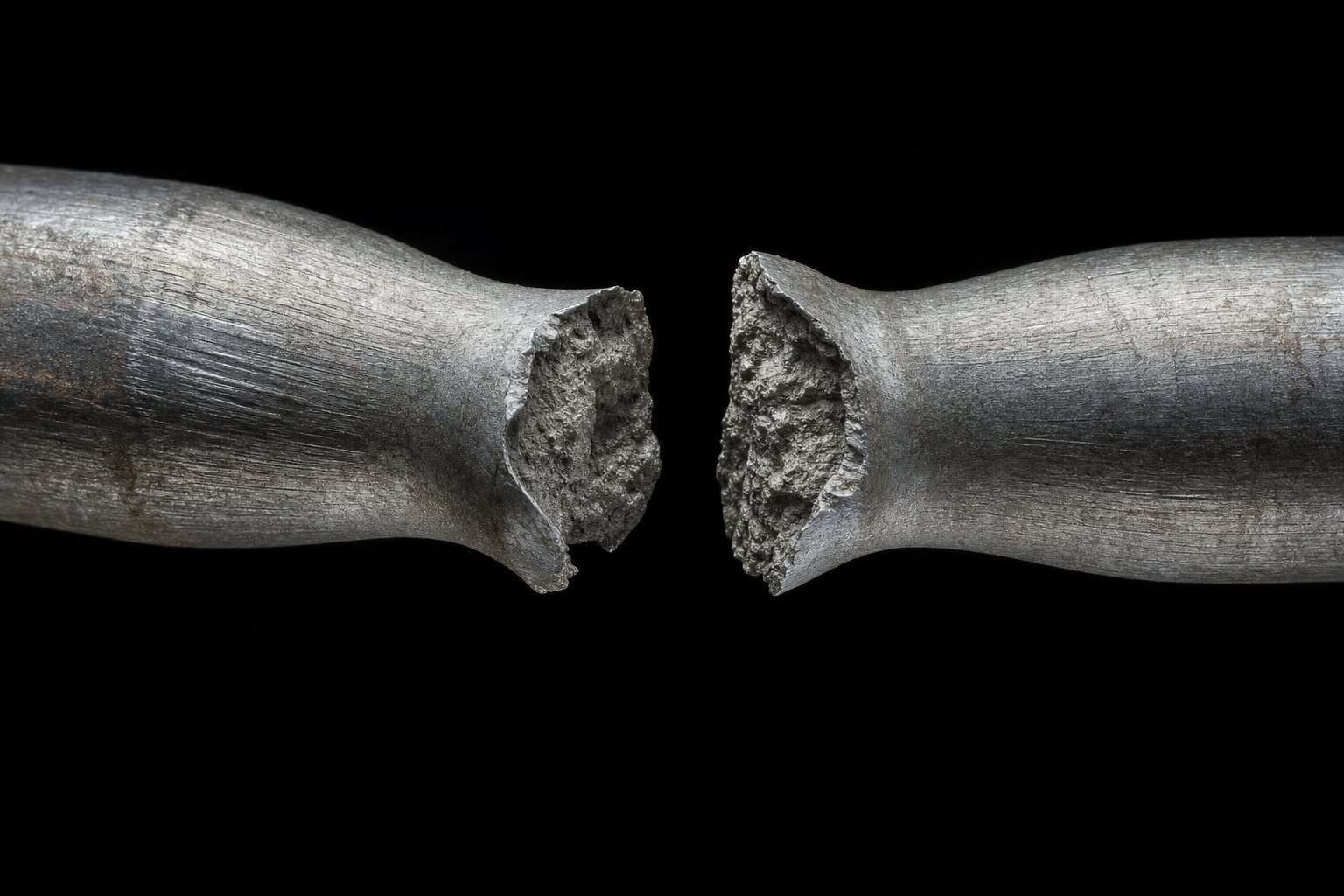
Ductile: rough surface, stretched, energy absorbed
Brittle: flat surface, clean split, little energy
Two ways to failA ductile break A tough metal thins to a waist before it parts, and the break is rough rather than flat. AI-generated still.
Chapter I · Bend or snap
Ductile and brittle
Wikipedia, Charpy impact test: ductile fracture leaves a rough surface, lateral contraction and shear lips; brittle fracture leaves a flat, smooth surface and often splits the specimen cleanly in two; brittle fracture, propagating without plastic deformation, is particularly dangerous because it gives no warning. ArcelorMittal: resistance to brittle fracture is called toughness; lower temperature, faster loading and notches all promote brittle cleavage in body-centred cubic steels.
Try it: room temperature or deep cold.
The 3D scenes are simplified teaching models, not to scale.
To see why, look at the atoms. A metal is a crystal: its atoms sit in a regular, repeating pattern.
Copper, aluminium, nickel and most stainless steel stack their atoms with one at the centre of each face of a cube. This is called face-centred cubic, or FCC.
Ordinary steel puts one atom in the middle of each cube instead. This is body-centred cubic, or BCC, and it is packed less tightly.
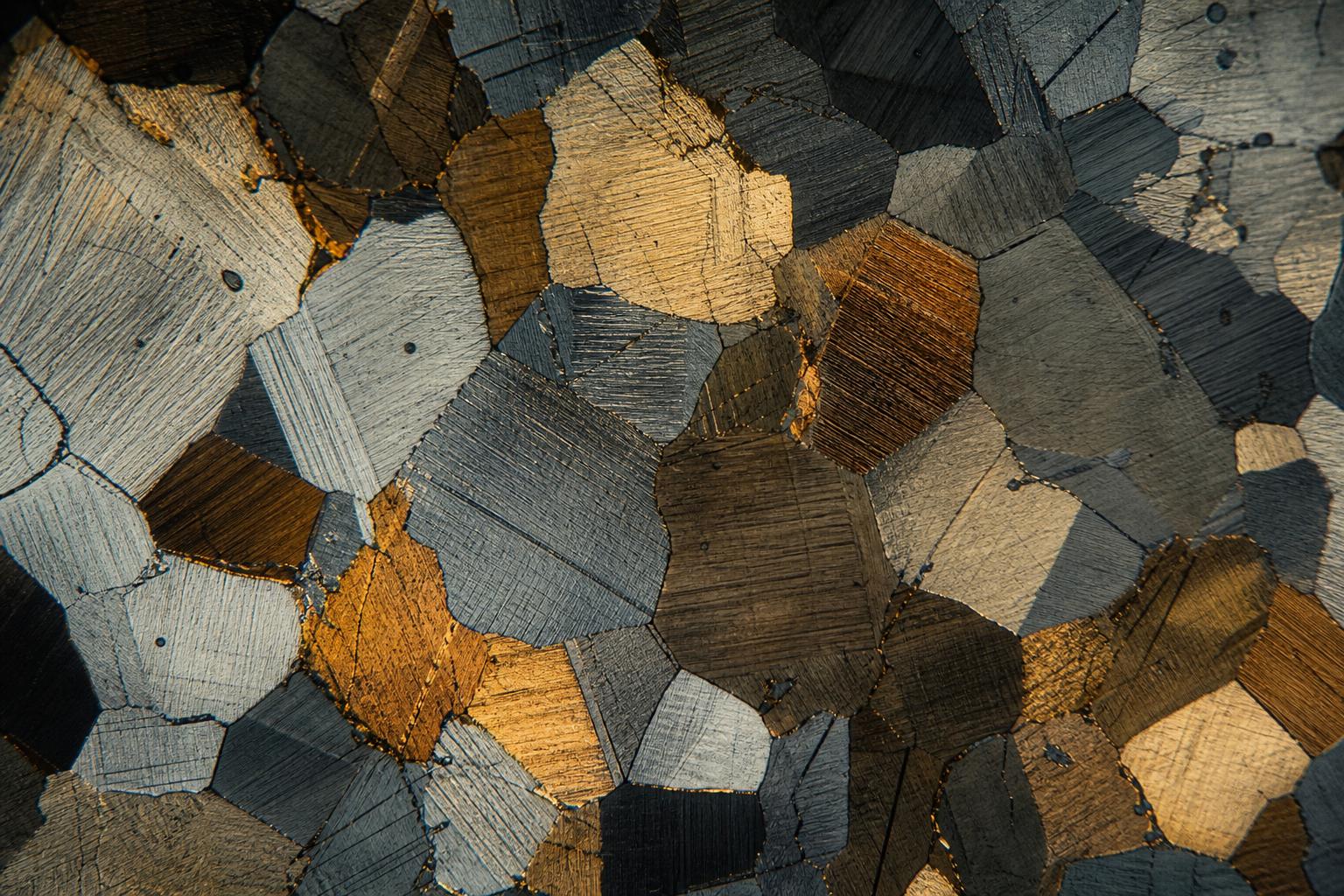
Crystal grains Under a microscope, polished steel shows many small crystals. AI-generated still.
Copper
Aluminium
Nickel
Austenitic stainless steel
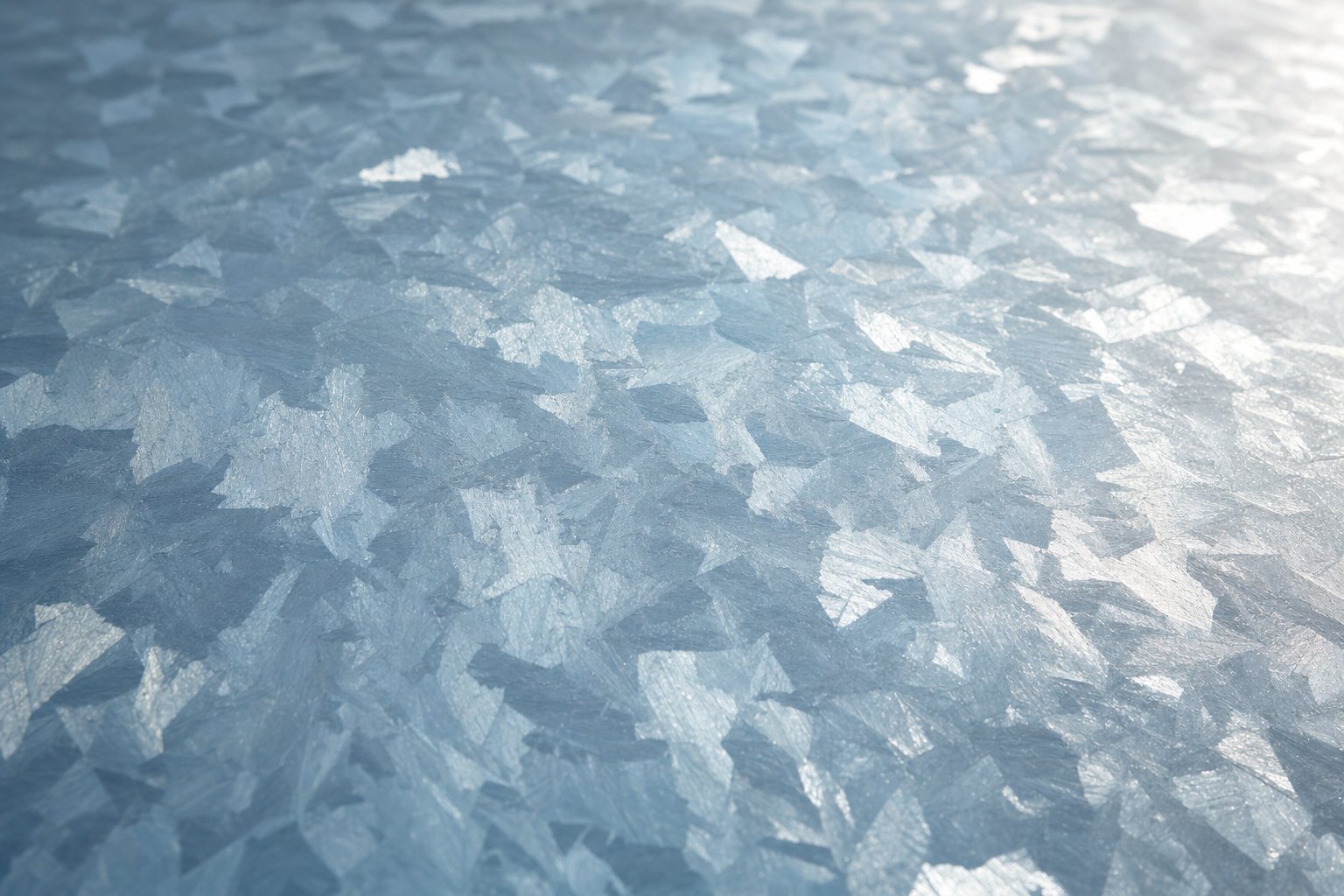
Face-centred cubic (FCC)Grains you can see Zinc grows grains big enough to see; in structural steel they are a few hundredths of a millimetre across. AI-generated still.
ferritic steel
the ordinary steel of beams, ships and pipes
Body-centred cubic (BCC)
Chapter I · Bend or snap
How atoms are stacked
Wikipedia, Charpy impact test: body-centred cubic (BCC) metals such as ferritic and martensitic steels show a ductile–brittle transition; face-centred cubic (FCC) metals such as austenitic stainless steels, copper, aluminium and nickel generally do not, with exceptions. IMT Mines Albi: the BCC structure is less compact than FCC, so a higher critical shear stress is needed to start dislocation slip, and BCC metals are generally less ductile.
Try it: switch between FCC and BCC.
The 3D scenes are simplified teaching models, not to scale.
A metal bends because planes of atoms slide past one another. They do not slide all at once. A flaw in the pattern, called a dislocation, glides through the crystal, shifting one row of atoms at a time.
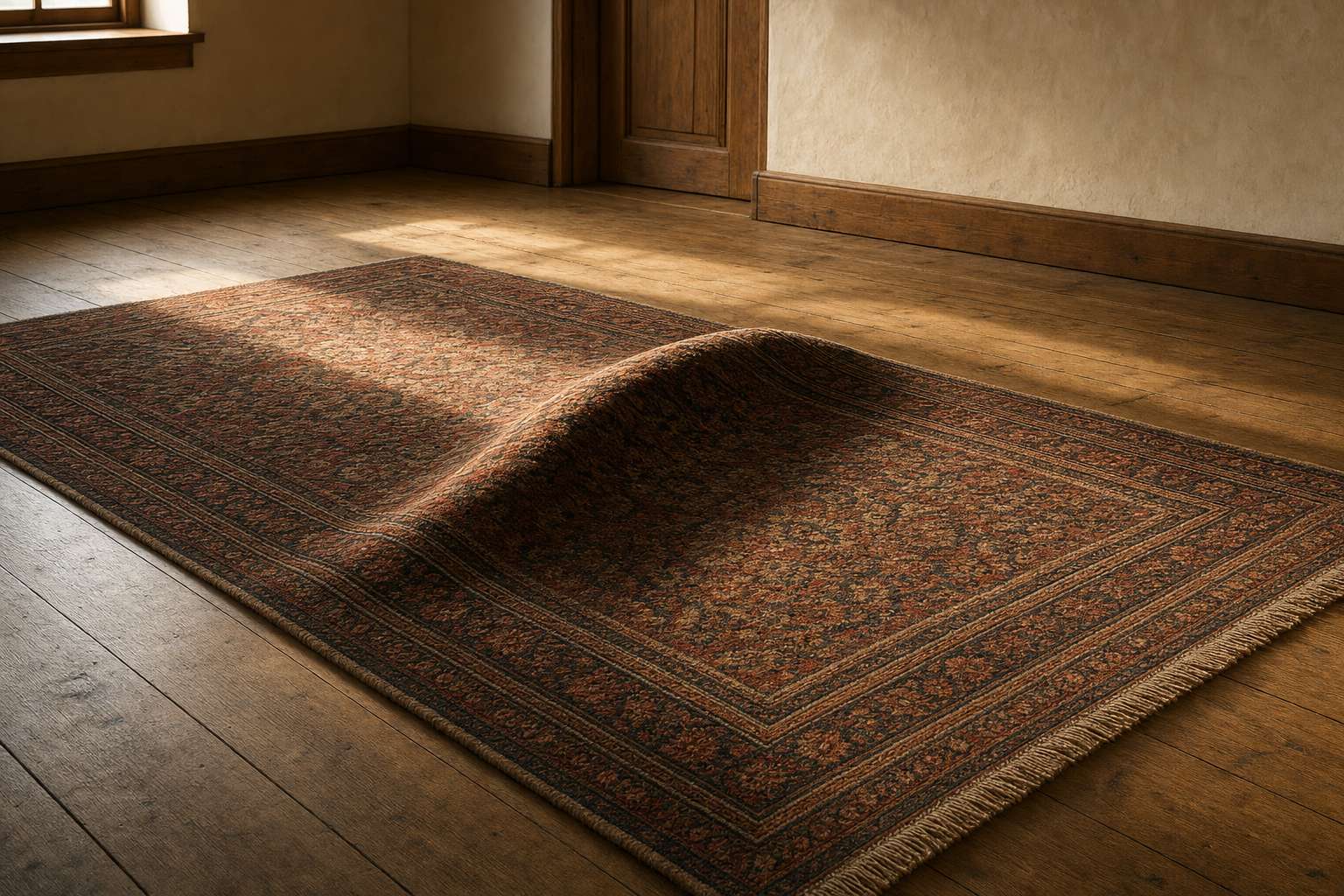
Think of moving a heavy rug by pushing a ripple along it, rather than dragging the whole thing.
The more easily dislocations move, the more a metal can bend before it breaks.
An extra half-row of atoms
It moves one spacing at a time
When it leaves, the top has shifted
Slip, step by stepPush a ripple along Moving the flaw takes a fraction of the force it would take to slide the whole plane at once. AI-generated still.
one row
the flaw moves, so the plane never has to slide in one go
Why not all at once?
Moving a rug by pushing a ripple, not dragging the whole rug.A common teaching picture of a dislocation
easy glide
more bending before fracture
Ductility (IMT Mines Albi)
Chapter I · Bend or snap
Dislocations
IMT Mines Albi: ductility, how much a metal can deform before it breaks, depends on how easily dislocations move through the crystal lattice; where dislocations are almost immobile, as in ceramics, the material is brittle. The rug picture is an analogy used in teaching, not a quoted source.
The 3D scenes are simplified teaching models, not to scale.
In BCC metals, dislocations get harder to move as the temperature falls. In deep cold, they barely move at all.
So the stress is not spent on bending. It builds up, until a crack splits the crystal cleanly along a plane of atoms. This is called cleavage.
FCC metals keep slipping even in deep cold, so they generally have no such switch. Compare the two.
That is why a cold BCC steel can break under a load it would easily survive on a warm day.
colder
dislocations harder to move
BCC in the cold (Oxford, IMT Mines Albi)
Happens in BCC steels
Flat, crystalline break
Chevron marks point back to the origin
Cleavage fracture (ArcelorMittal)A face flat enough to reflect A cleavage break follows a single plane of atoms, which is why it comes out mirror-flat. AI-generated still.
no cleavage
austenitic (FCC) stainless steel does not fail by cleavage (ArcelorMittal)
FCC in the cold
warm
bends
cold
can break
Same steel, same load
Chapter II · Why cold matters
Why cold matters
Oxford (EurekAlert!): body-centred cubic metals usually grow more brittle as they get colder, because dislocations become harder to move. IMT Mines Albi: low temperatures reduce dislocation mobility. ArcelorMittal: brittle (cleavage) fracture occurs in BCC metals such as ferritic steels when the maximum principal stress exceeds a critical cleavage stress; the surface is flat and crystalline, often with chevron marks pointing to the origin; austenitic (FCC) steels do not cleave under all conditions.
Try it: warm and cold, BCC and FCC.
The 3D scenes are simplified teaching models, not to scale.
Measure how much energy it takes to break a steel bar at different temperatures, and you get an S-shaped curve.
Warm, the steel soaks up a lot of energy. Below a certain range, the energy drops steeply. That range is the ductile-to-brittle transition.
For ordinary steels it typically lies somewhere between about minus ten and minus fifty degrees Celsius, depending on the grade. FCC metals show no such drop.
Engineers use this curve to choose steel for a bridge, a pipeline or a ship: it must stay on the warm, tough side at the coldest temperature it will ever meet.
Many identical notched bars
Each broken at a different temperature
Energy plotted against temperature
How the curve is made
a range
not a sharp point
The transition (Charpy test)
−10 to −50 °C
typical brittle threshold, by grade
Ferritic steels (IMT Mines Albi)Testing bar after bar The transition is a range, not one temperature: bars cut from the same plate can differ by tens of degrees. AI-generated still.
Find the coldest temperature in service
Pick a steel still tough there
Choosing steel
Chapter II · Why cold matters
The S-curve
Wikipedia, Charpy impact test: absorbed energy usually drops as temperature falls, over a transition region rather than at a sharp point; the transition temperature can be defined in several ways that give different results. IMT Mines Albi: BCC steels that are ductile at normal temperatures become brittle at very low temperatures, typically below about −10 °C to −50 °C depending on the grade. ArcelorMittal: practical criteria include a specified impact energy (such as 27 J), half the maximum energy, or 50% ductile fracture surface.
Try it: move along the curve. The curves are typical shapes, not one steel’s measurements.
The 3D scenes are simplified teaching models, not to scale.
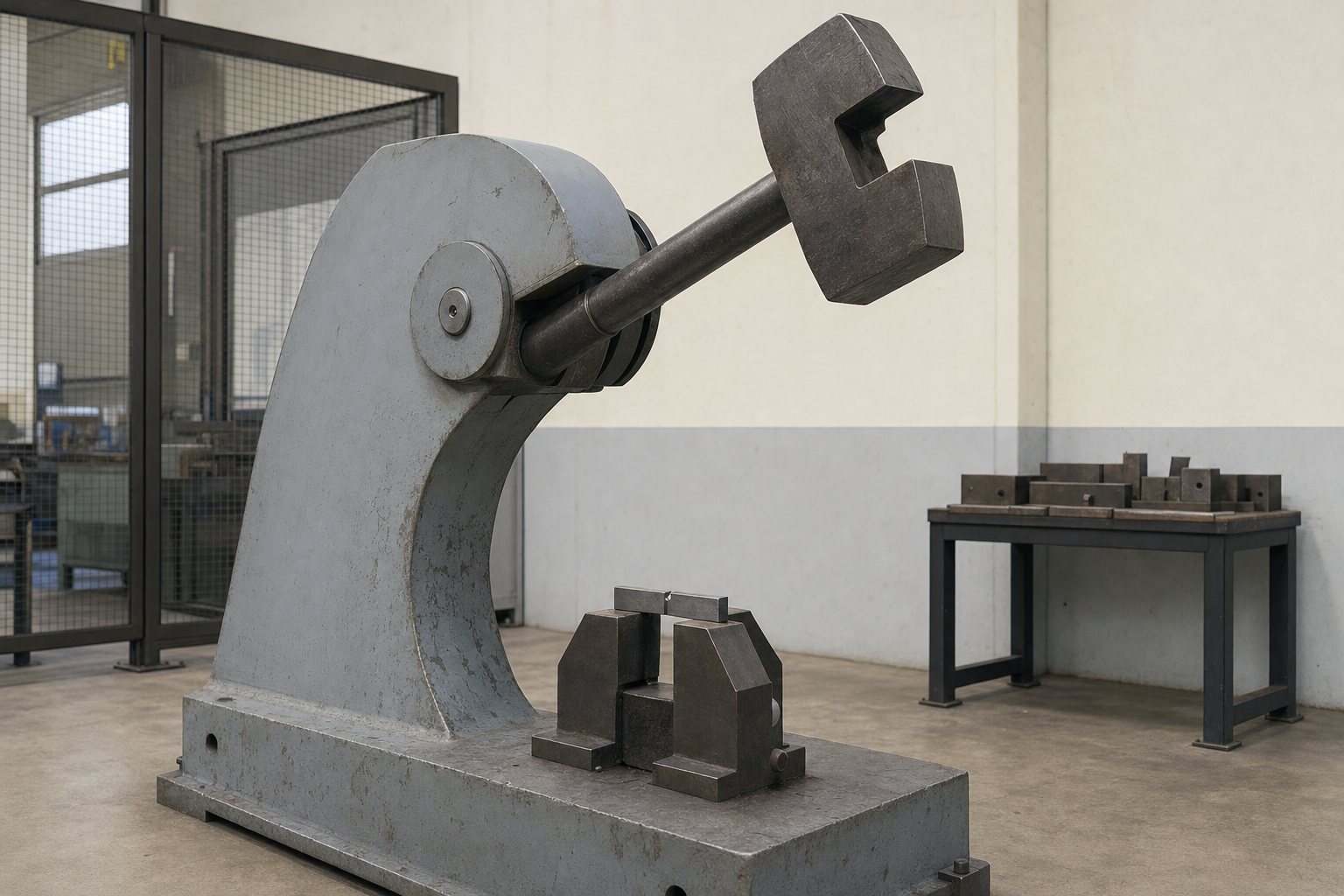
How do you measure it? In 1901 Georges Charpy proposed a standard test, and its design has barely changed since.
A heavy pendulum swings down and strikes a small bar with a notch cut in it. The higher the hammer swings up on the other side, the less energy the bar absorbed.
A tough bar bends and slows the hammer. A brittle one snaps cleanly, with a flat, glittering break. Try a warm bar and a cold one.
The test is cheap and quick, though it gives only a relative measure of toughness.
1896 S. B. Russell: a pendulum fracture test
1901 Charpy: a standard notched specimen
1905 His machine, essentially today’s
The impact test
10 × 10 × 55 mm
specimen
2 mm
V-notch depth
The standard barThe hammer and the notch The bar is ten millimetres square with a two-millimetre notch, and the standard has kept those sizes ever since. AI-generated still.E=mg(hstart−hend)
m
mass of the hammer
h
heights before and after the swing
Energy absorbed
cheap, quick
but a relative measure: good for comparing steels
The Charpy test (ArcelorMittal)
Chapter III · The hammer test
The Charpy test
Wikipedia, Charpy impact test: in 1896 S. B. Russell introduced a pendulum fracture test; in 1901 Georges Charpy proposed a standardised version with a precisely specified notched specimen, and his 1905 design is essentially the modern apparatus. A pendulum of known mass is released from a known height and strikes the notched specimen; the absorbed energy is inferred from the difference between the release height and the height reached afterwards. The standard specimen is 10 × 10 × 55 mm with a 2 mm deep V-notch.
Try it: warm and cold bars of ordinary and stainless steel. Swing heights are schematic.
The 3D scenes are simplified teaching models, not to scale.
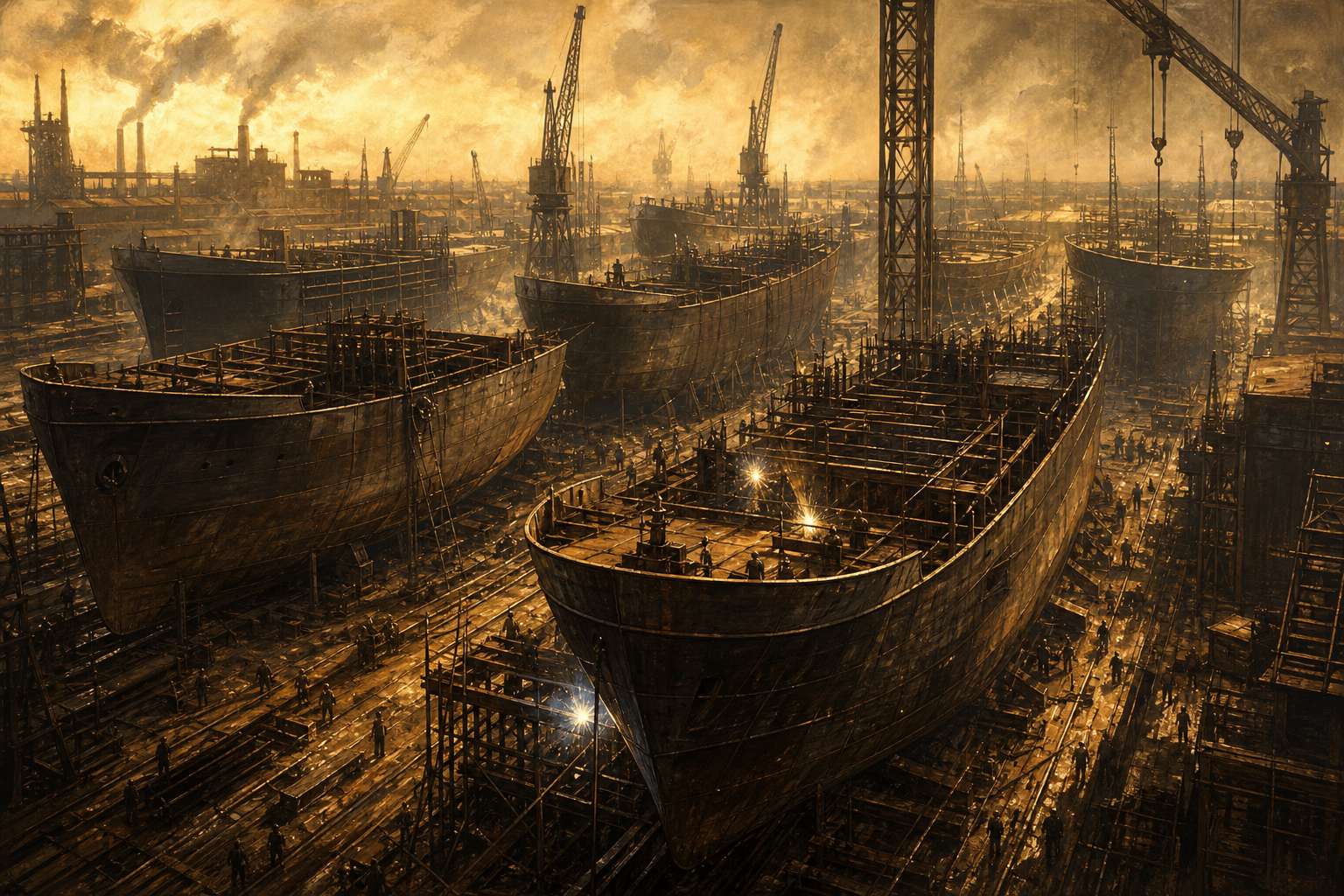
The lesson was learned the hard way in the Second World War. The United States built thousands of welded steel cargo ships, among them the Liberty ships.
A US Navy investigation later found that more than a fifth of the 4,694 welded-steel ships it studied suffered fractures. Some broke in half without warning.
Ships in the cold North Atlantic met temperatures low enough to make their steel brittle.
Ships by the thousand Welded hulls on the slipways of a wartime shipyard. AI-generated still.
4,694
welded-steel ships studied
> 20%
suffered fractures
US Navy investigation
in half
how some of the ships broke
Broken without warning
North Atlantic
cold enough to make the steel brittle
Cold water (Cambridge)
Chapter IV · Ships that broke
The Liberty ships
Wikipedia, Charpy impact test: an investigation of the 4,694 welded-steel merchant ships built from February 1942 to March 1946, including the Liberty ships, found that over 20% suffered fractures; some broke in half without warning. University of Cambridge, Department of Engineering: during the Second World War Liberty ships were breaking in two; ships in the North Atlantic faced temperatures low enough to make them susceptible to brittle failure.
The ship in the 3D scene is a generic schematic, not a model of any real vessel.
The 3D scenes are simplified teaching models, not to scale.
At Cambridge, the researcher Constance Tipper showed that steel has a critical temperature, below which its fracture changes from ductile to brittle.
Her test became the standard way of checking steel for brittleness, though its full importance was recognised only in the 1950s.
Meanwhile, changes to ship design, to welding, and toughness requirements for the steel cut the fracture rate from more than a hundred and thirty a month in 1944 to fewer than five in 1946.
critical temperature
below it, steel fractures brittle
Constance Tipper (Cambridge)
1915 Among the first women in Cambridge’s Natural Sciences Tripos
1940s Studies why Liberty ships broke
1950s Her test becomes the standard
Tipper
1944
> 130
1946, after design, welding and steel changes
< 5
Ship fractures each month (US Navy)
Two kinds of break These were the first large hulls welded rather than riveted, so a running crack had no seam to stop it. AI-generated still.
Chapter IV · Ships that broke
Constance Tipper
University of Cambridge, Department of Engineering: Constance Tipper, one of the first women to take the Natural Sciences Tripos (1915), established in the Engineering Department that steel has a critical temperature below which its fracture changes from ductile to brittle; the full implications of her work were not recognised until the 1950s, after which the “Tipper test” became the standard method for determining brittleness in steel. Wikipedia, Charpy impact test: design changes, fabrication changes and impact-energy requirements together cut the monthly fracture rate from over 130 in March 1944 to fewer than 5 by March 1946.
The 3D scenes are simplified teaching models, not to scale.
Very cold liquids raise the stakes. In 1944, in Cleveland, Ohio, a tank of liquefied natural gas built of steel with about three and a half percent nickel leaked.
The outer steel shell then failed, the gas spread into streets and sewers, and the vapour cloud ignited in a massive explosion.
Steel with nine percent nickel, researched from the early 1940s, came into use in the 1950s. Today, tanks for liquefied natural gas must stay ductile below minus a hundred and sixty-five degrees.
~3.5%
nickel in the tank steel, chosen because of wartime stainless shortages
Cleveland, 1944 (PetroSkills)
Inner tank leaks
Outer carbon-steel shell fails
Vapour cloud ignites
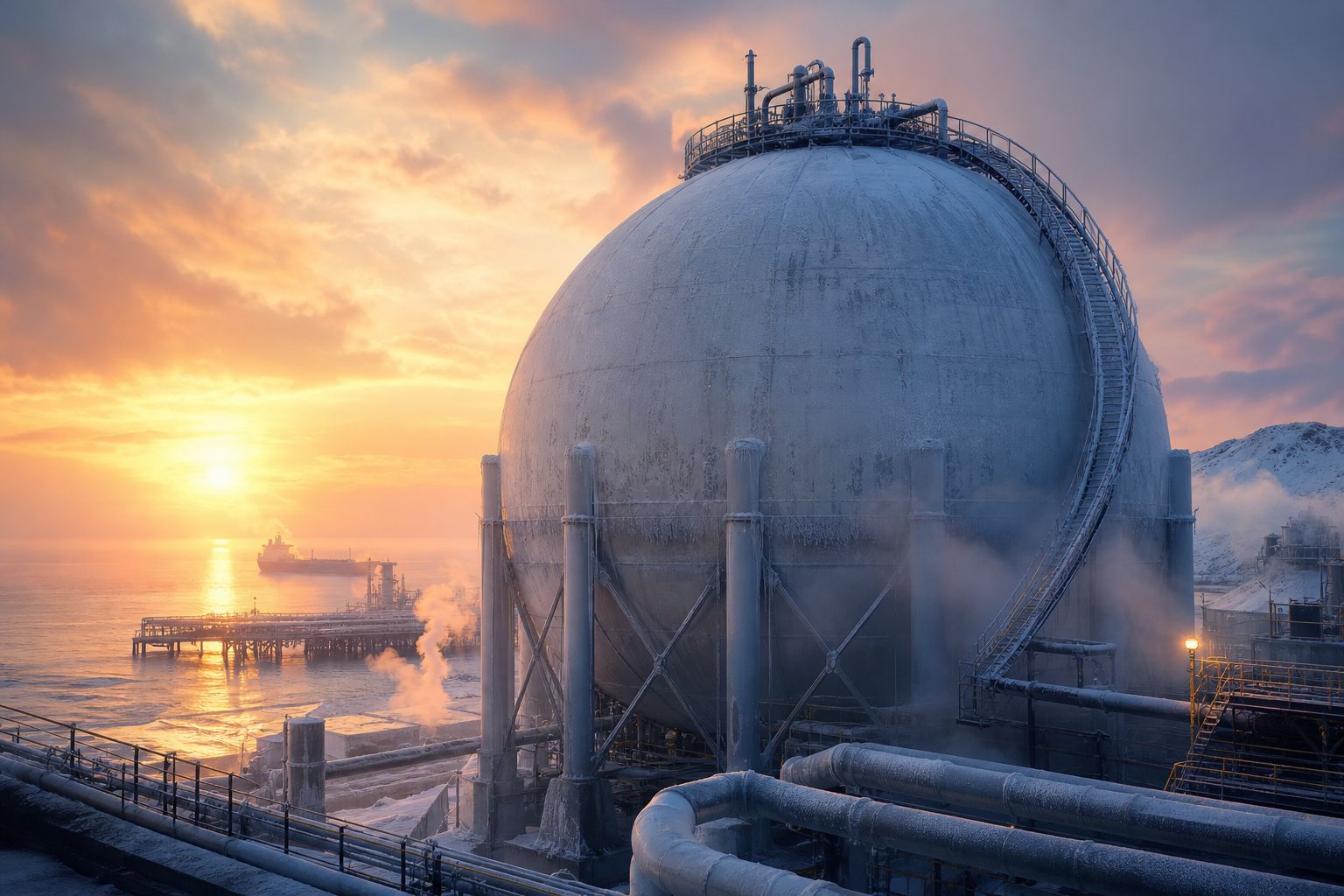
A chain of failureBuilt for the cold A frosted storage sphere at a gas terminal. AI-generated still.
Chapter V · Built for the cold
Cleveland, 1944
PetroSkills: in Cleveland in 1944 a tank built with about 3.5% nickel steel, because of wartime stainless-steel shortages, leaked; the outer carbon-steel shell then failed, releasing liquefied natural gas into the streets and sewers, and the resulting vapour cloud ignited in a massive explosion. PetroSkills dates 9% nickel steel to the early 1940s; the Nickel Institute says International Nickel researched it from the early 1940s, presented results in 1947, and it entered service in 1952. The base material of LNG tanks must stay ductile below −165 °C.
The film does not give a casualty figure, because the source used does not.
The 3D scenes are simplified teaching models, not to scale.
Nine percent nickel steel, stainless steel and aluminium have no ductile-to-brittle transition at these working temperatures, so they are the metals chosen for this work.
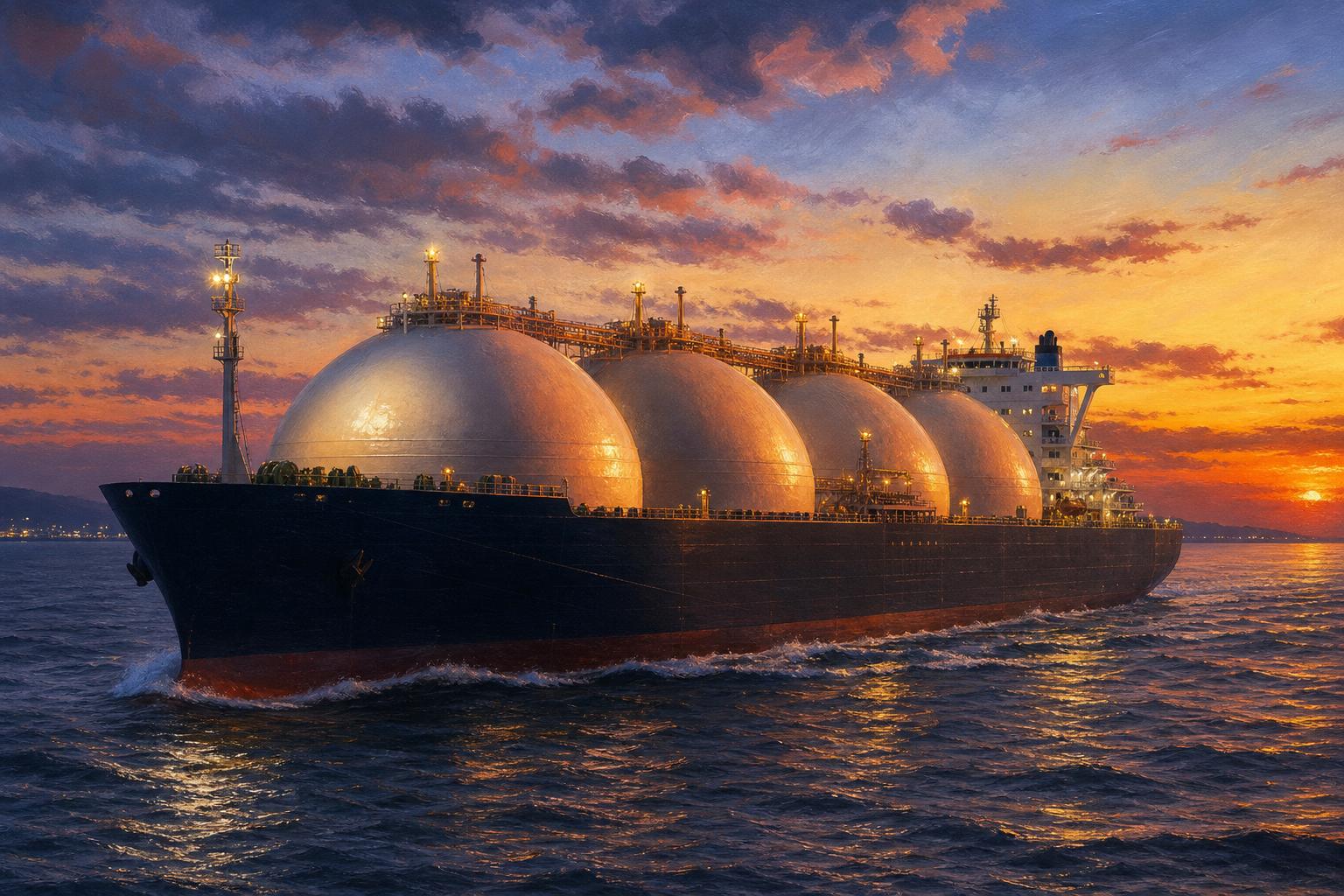
Aluminium makes the big round tanks on many gas carrier ships, because it is light. Stainless steel holds liquid hydrogen, at about minus two hundred and fifty-three degrees.
9% nickel steel: large land tanks
Stainless steel: liquid hydrogen vessels
Aluminium: spherical tanks on gas carriers
No ductile–brittle transition (PetroSkills)
−104 to −196 °C
its main working range
9% nickel steel (PetroSkills)Spheres at sea A gas carrier with round tanks on deck. AI-generated still.
LNG tank material must stay ductile below
−165
9% nickel steel, used down to
−196
Liquid hydrogen
−252.8
How cold?
Chapter V · Built for the cold
Metals for the deep cold
PetroSkills: 9% nickel steel, stainless steel and aluminium do not have a ductile/brittle transition temperature; 9% nickel steels are mainly used from −104 °C down to −196 °C and offer an attractive combination of properties at a moderate price; aluminium is used for large spherical tanks on gas tankers because of its lower weight; stainless steel is used for liquid hydrogen (−252.8 °C) vessels.
The bars show temperatures below zero, so a longer bar means colder.
The 3D scenes are simplified teaching models, not to scale.
That is why the new result caught attention. The two experimental alloys, based on niobium and titanium, are BCC, the kind expected to turn brittle.
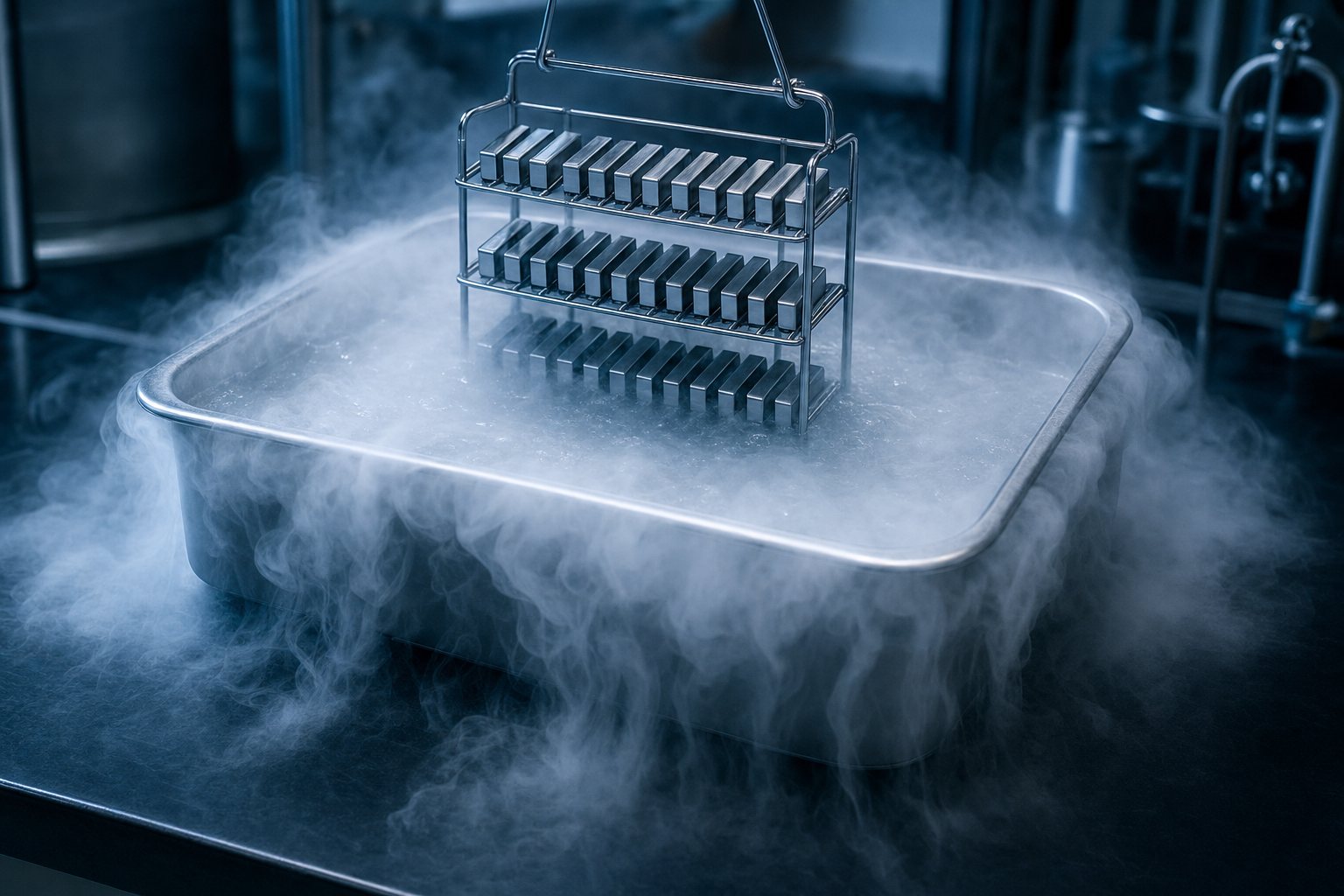
Yet stretched at minus two hundred and fifty-three degrees, they showed no measurable ductile-to-brittle transition.
Tiny regions of the crystal flipped into mirror-image copies, called twins, and changed their structure locally. That created new defects, which let the metal keep deforming instead of cracking.
The team watched this with beams of neutrons at a laboratory in Oxfordshire, which reveal how the crystal changes while the metal is being stretched.
The researchers say it should change how we think about what makes these metals brittle. It is a single study, and others will now test it.
Nb–Ti
niobium–titanium based
BCC
the structure that usually turns brittle
The new alloys (Nature, 2026)
no transition
measurable at the lowest temperature tested
At 20 kelvin (−253 °C)
Nanoscale twinning: mirror-image regions
A local change in crystal structure
New defects at grain boundaries keep it deforming
What the team saw
neutrons
pass through metal and reveal its crystal while it is pulled
How they looked (ISIS, Oxfordshire)
Our results suggest we should change how we think about what governs the transition to brittleness for these metals.David Cook, lead author (Oxford release)
Chapter V · Built for the cold
A BCC metal that does not snap
EurekAlert! / University of Oxford: the two experimental niobium–titanium-based BCC alloys, cooled with gaseous helium and pulled in tension at 20 K (Engin-X, ISIS Neutron and Muon Source), showed no measurable ductile-to-brittle transition at the lowest temperature tested; nanoscale twinning, in which small regions of the crystal reorient into mirror-image arrangements, is paired with a local change in crystal structure, creating stress concentrations at grain boundaries that trigger new defects and let the metal keep deforming. Prof. Dong Liu: “For decades, the ductile-to-brittle transition has been viewed as a fundamental limitation of body-centred cubic metals.”
This is one new study, reported as published; it has not yet been reproduced by other groups.
The 3D scenes are simplified teaching models, not to scale.
So the next time you see a frosted gas tank or a ship in icy water, remember that choosing the metal means choosing its crystal.
Atoms that can keep slipping in the cold bend. Atoms that cannot, snap.
And whether a BCC metal can be made to stay tough in the deepest cold, outside a single study, is an open question again.
1901 Charpy’s standard test
1940s Liberty ships crack
1944 Cleveland gas-tank disaster
1950s Tipper’s test becomes standard
2026 BCC alloys tough at −253 °C
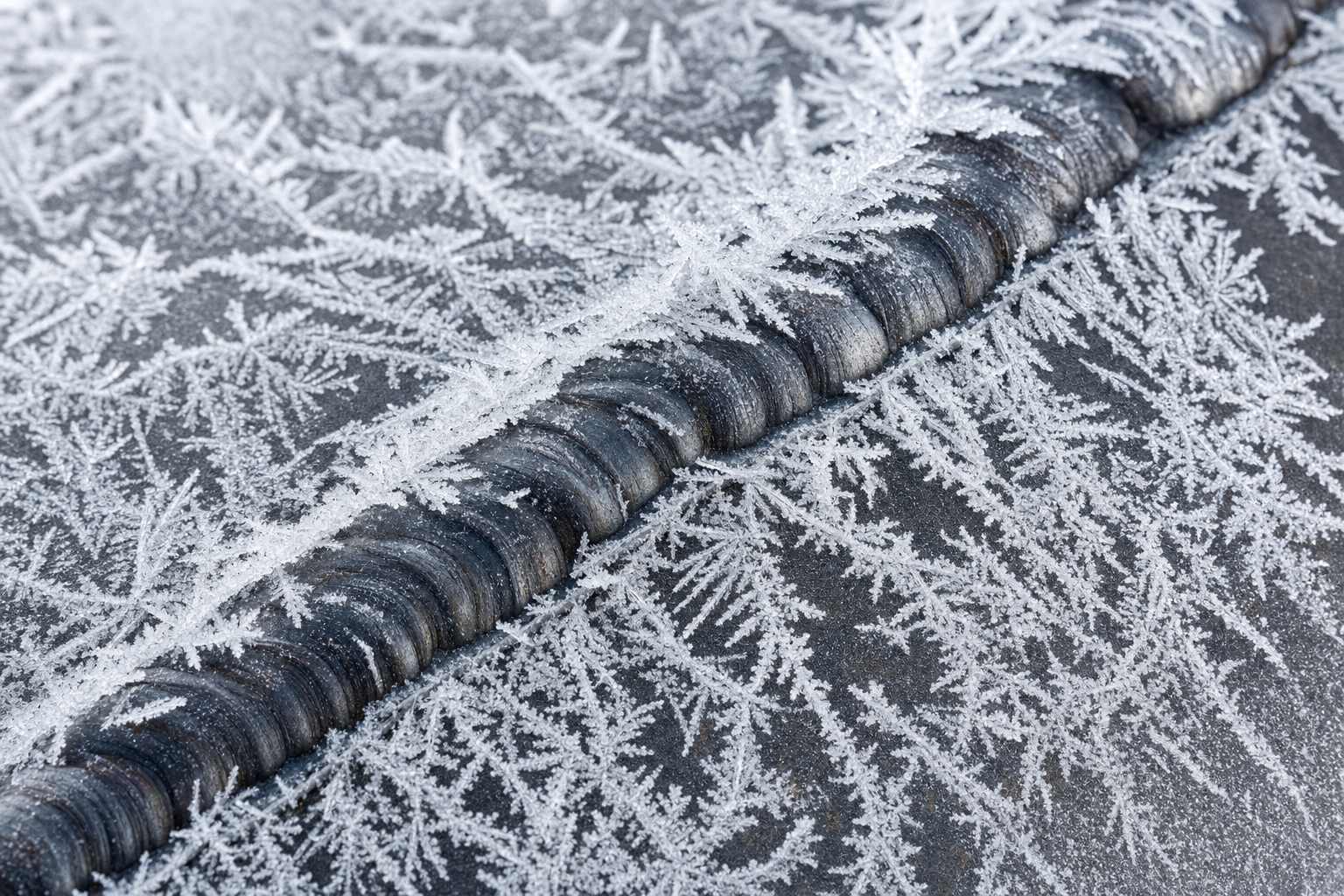
Bend or snap: a timelineFrost on a weld The weld is the hardest part to get right: the metal beside it is reheated, and its grains come out a different size. AI-generated still.
FCC: keeps bending in the cold
BCC: can snap below its transition
The rule of thumb
1
study so far: others now need to repeat it
Still open
Epilogue · Sources
Sources
Every fact in this film comes from the sources below. The chapter stills and pictures are AI-generated and show no real people, ships or brands. The bars, crystals, dislocation, curves, pendulum, ship and tank in the 3D scenes are simplified teaching models; the curves are typical shapes, not measurements of one steel. The 2026 alloy study is a single new result, presented as reported.