On 3 November 2026 CERN’s LHCb experiment reported evidence (not yet a discovery) for a B meson turning into two muons, a decay that happens about once in ten billion times, at the rate the Standard Model predicts. This film explains that theory from the ground up: the electron of 1897, the quarks inside protons and neutrons, the three generations of matter particles, the four forces and the bosons that carry three of them, the Higgs field and the boson found on 4 July 2012, how accelerators and detectors find particles, why physicists count rare decays of kaons and B mesons so carefully, what five sigma means, and the questions the Standard Model leaves open: dark matter, neutrino masses, gravity and the missing antimatter.
Interactive 3D film10 min1897 to 2026Published 12 November 2026
On 3 November 2026, physicists at CERN, near Geneva, reported catching something that happens about once in ten billion times.
In the LHCb experiment, a particle called a B⁰ meson was seen turning into two muons, about as often as theory predicts.
So what is this theory that keeps passing such tests? It is called the Standard Model.
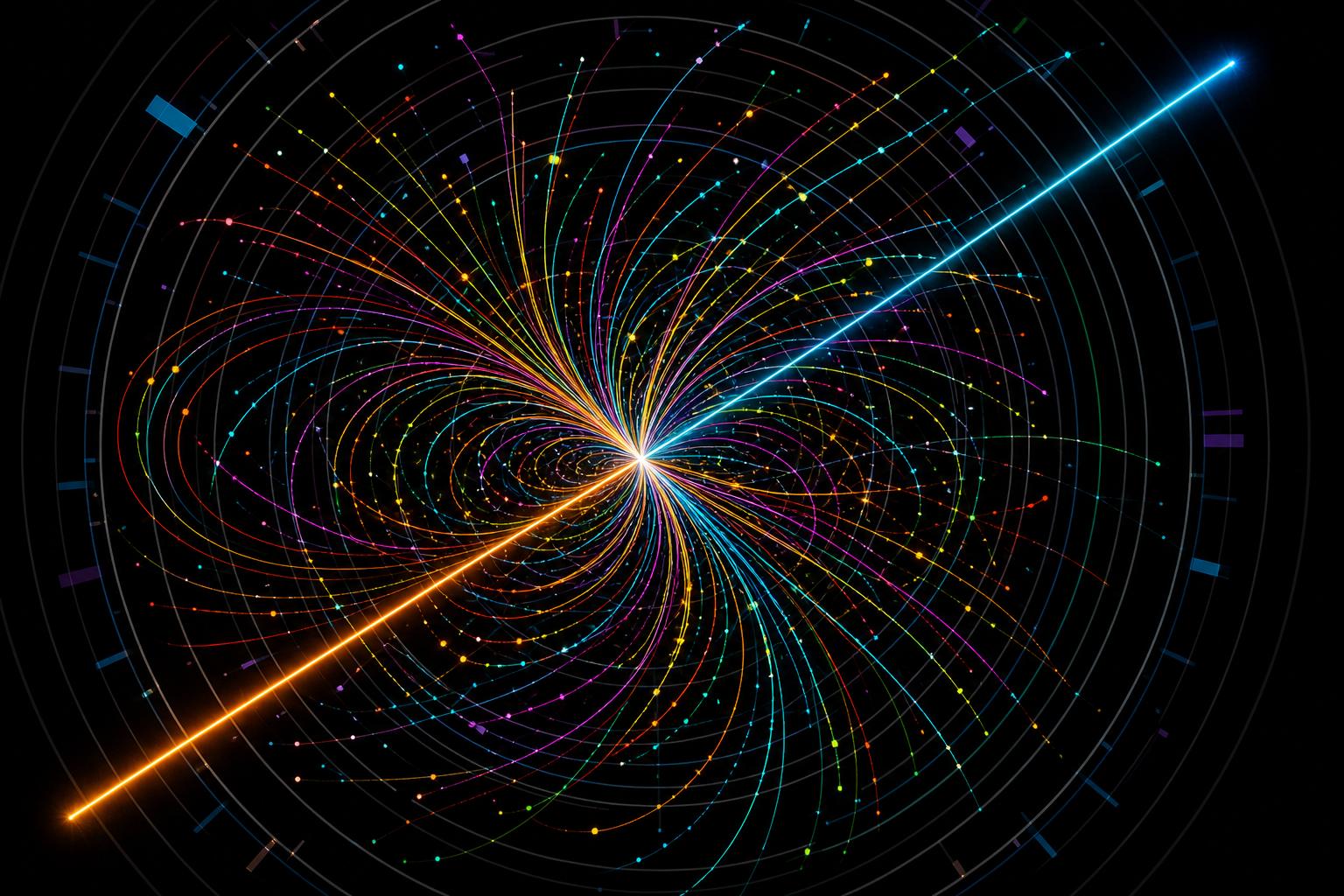
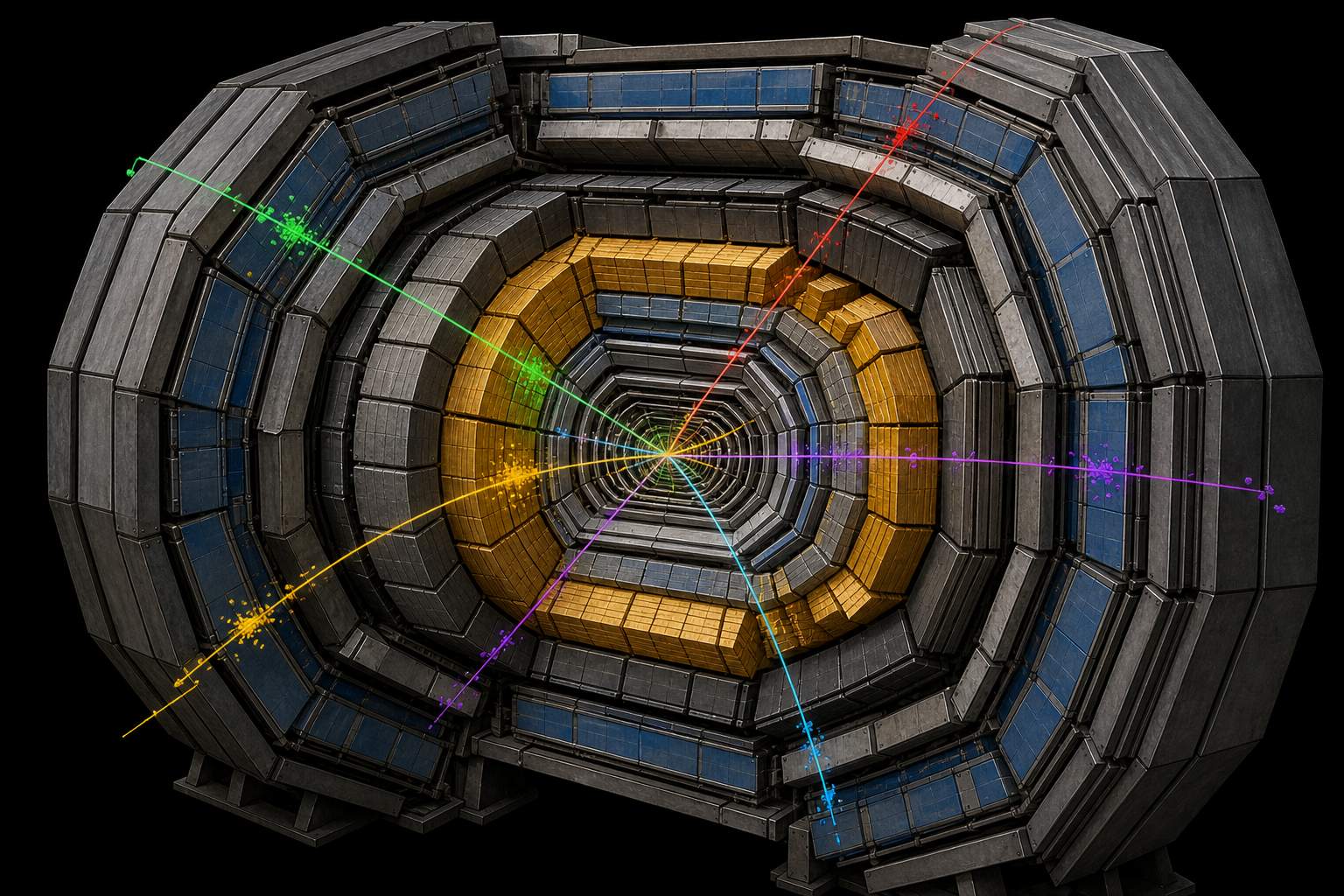
A collision, drawn Dozens of tracks fan out from one point; the two long straight ones stand for muons, which cross the whole detector. AI-generated illustration.
1 in 10,000,000,000
how often a B⁰ meson decays into two muons
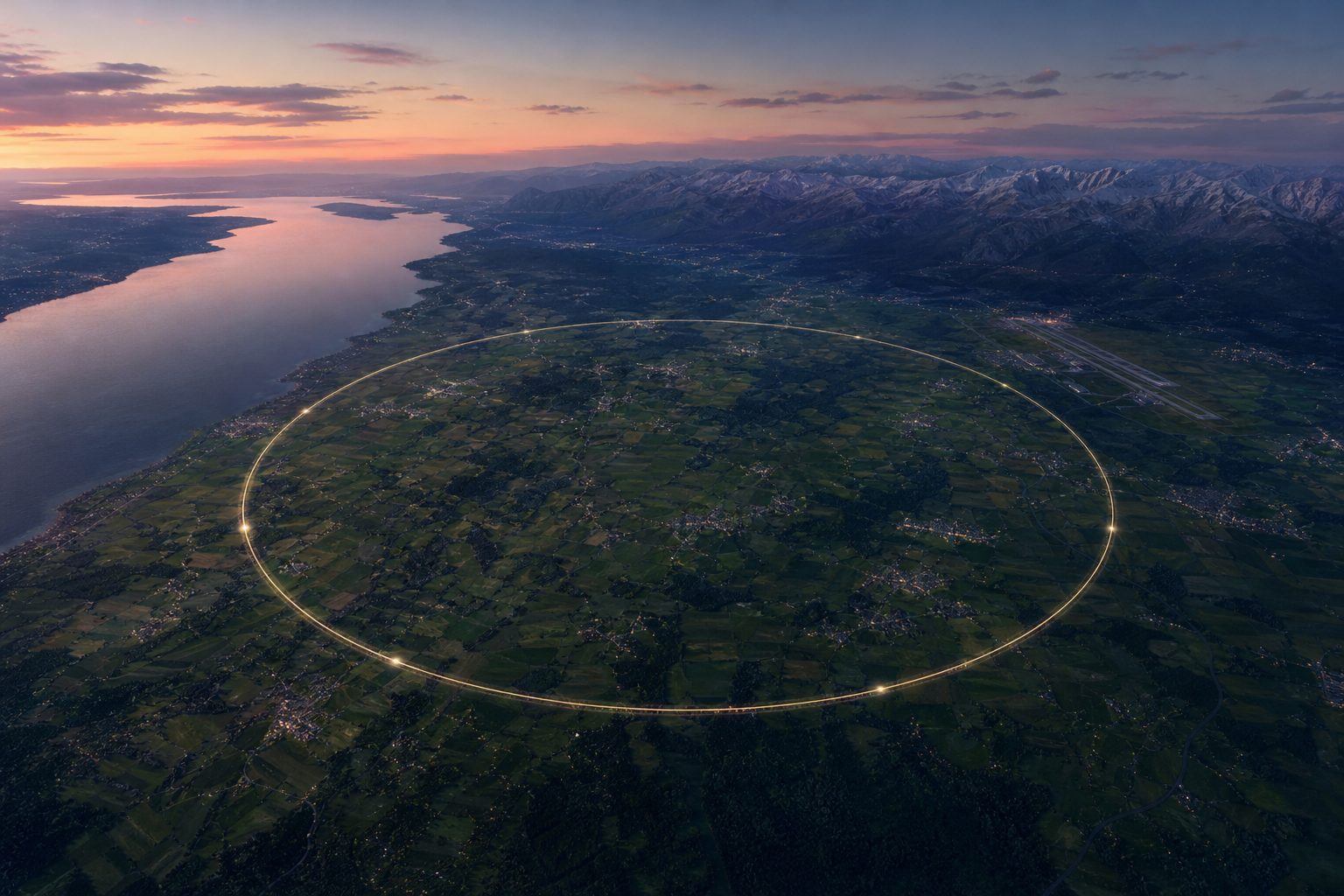
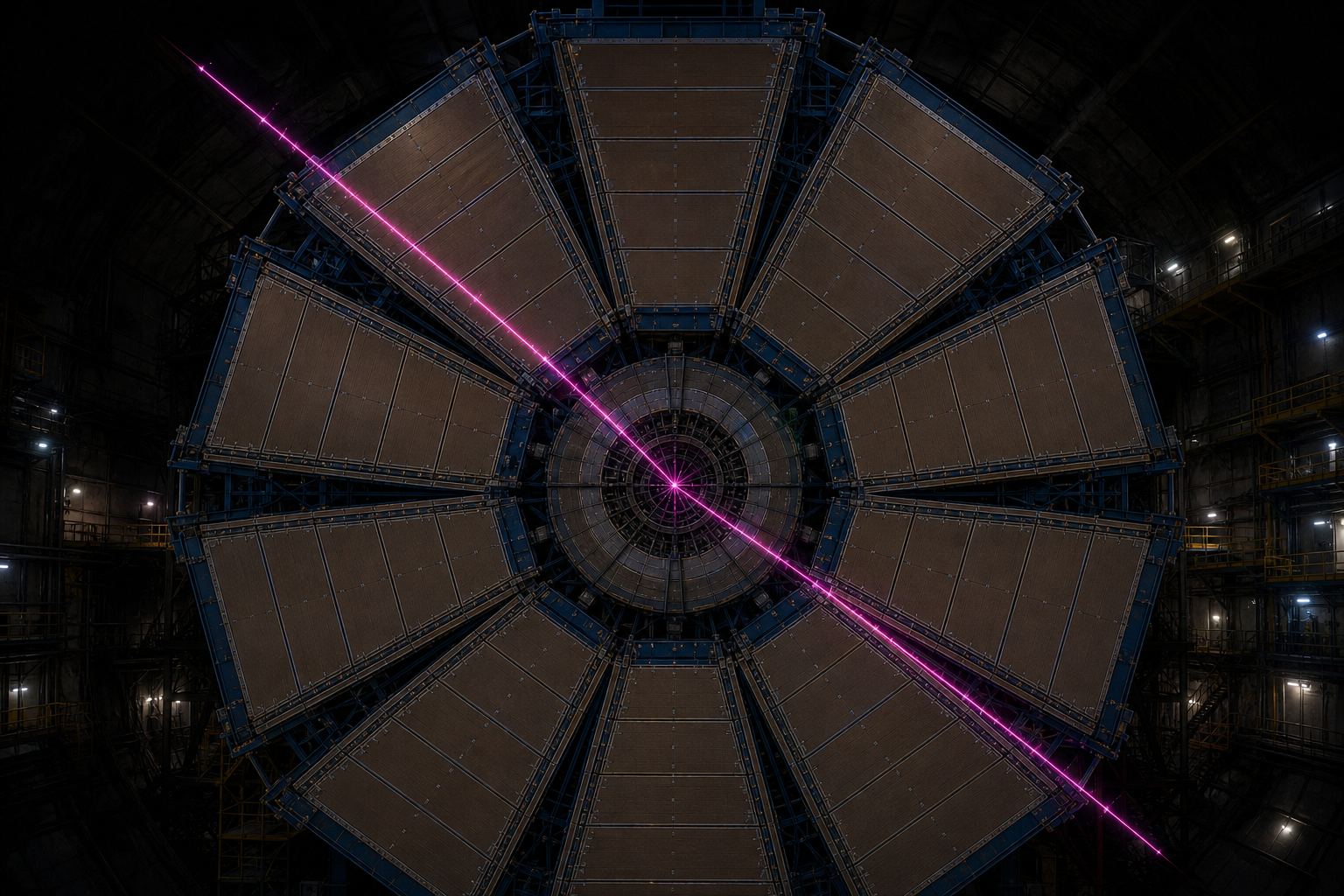
LHCb, CERN, 3 November 2026Under the fields The Large Hadron Collider runs in a ring about 27 km around, 100 metres underground; the glowing line is drawn in. AI-generated illustration.
Prologue
The news
CERN (3 November 2026): at a CERN seminar the LHCb collaboration reported evidence for the decay of a B⁰ (Bd) meson, in which a beauty quark and a down antiquark annihilate into a muon and an antimuon. Run 3 data from 2024–2025 give 3.0 standard deviations; combined with 2011–2018 data, 3.2. Five standard deviations are needed for a confirmed observation. The decay is predicted to be about thirty times rarer than Bs⁰ → μ⁺μ⁻, which occurs about three times per billion; INFN calls it a one-in-ten-billion decay and says the result is consistent with the Standard Model.
The film comes back to this result in Chapter VI, after explaining what a meson, a muon and a sigma are.
The 3D scenes are simplified teaching models, not to scale: real particles are not coloured balls, and real detectors record tracks as electrical signals.
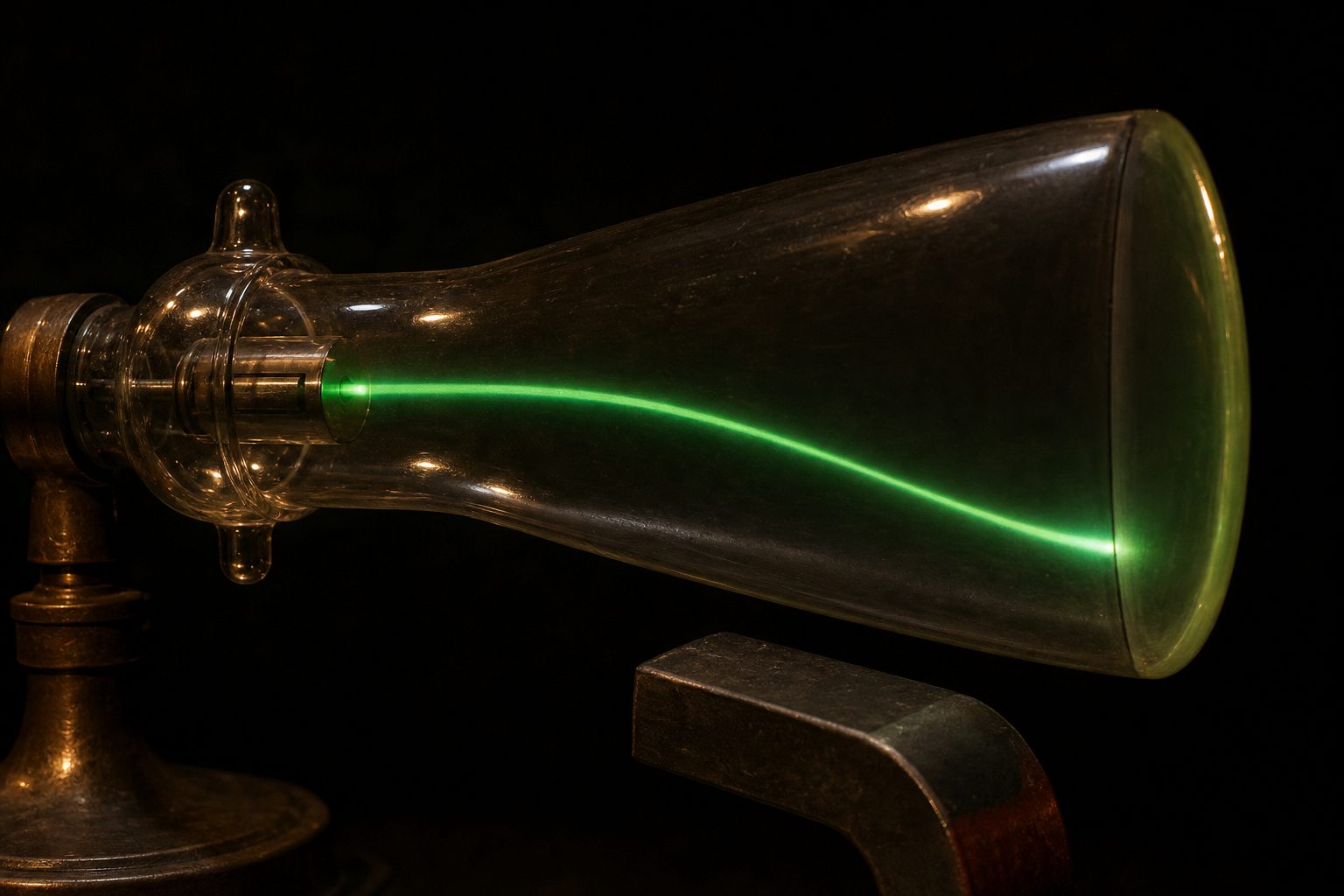
In 1897, at the Cavendish Laboratory in Cambridge, England, J.J. Thomson was studying cathode rays, a glow that crosses glass tubes carrying electricity.
On 30 April he announced that the rays were tiny particles with a negative charge, about a thousand times lighter than a hydrogen atom.
He called them corpuscles; we call them electrons, the first elementary particle ever found. As far as we can tell, an electron has no smaller parts.
A bending beam Bring a magnet close and the beam curves: it must be made of moving charges. AI-generated illustration.
1/1836
of a proton’s mass, as measured today (0.511 vs 938.3 MeV)
MeV · GeV
particle masses are given in energy units (E = mc²): a proton is about 1 GeV, a thousand MeV
How light is an electron?
1897: Thomson’s “corpuscles”
the word electron was coined by George Johnstone Stoney in 1891, for a unit of electric charge
George FitzGerald suggested the corpuscles were free electrons
Thomson kept saying corpuscle until 1913
Corpuscle to electron
Chapter I · Smaller than atoms
The electron
ChemTeam (history of chemistry): on 30 April 1897 Thomson announced that cathode rays were negatively charged particles with a mass about a thousand times smaller than a hydrogen atom; he called them corpuscles; FitzGerald suggested they were free electrons, and Thomson used “corpuscle” until 1913. Encyclopedia.com: George Johnstone Stoney introduced the word “electron” in 1891 for the fundamental unit of electric charge. Symmetry magazine lists the electron as discovered in 1897 at the Cavendish Laboratory. Today’s masses (Physics Hypertextbook): electron 0.511 MeV, proton 938.3 MeV.
The 3D scenes are simplified teaching models, not to scale: real particles are not coloured balls, and real detectors record tracks as electrical signals.
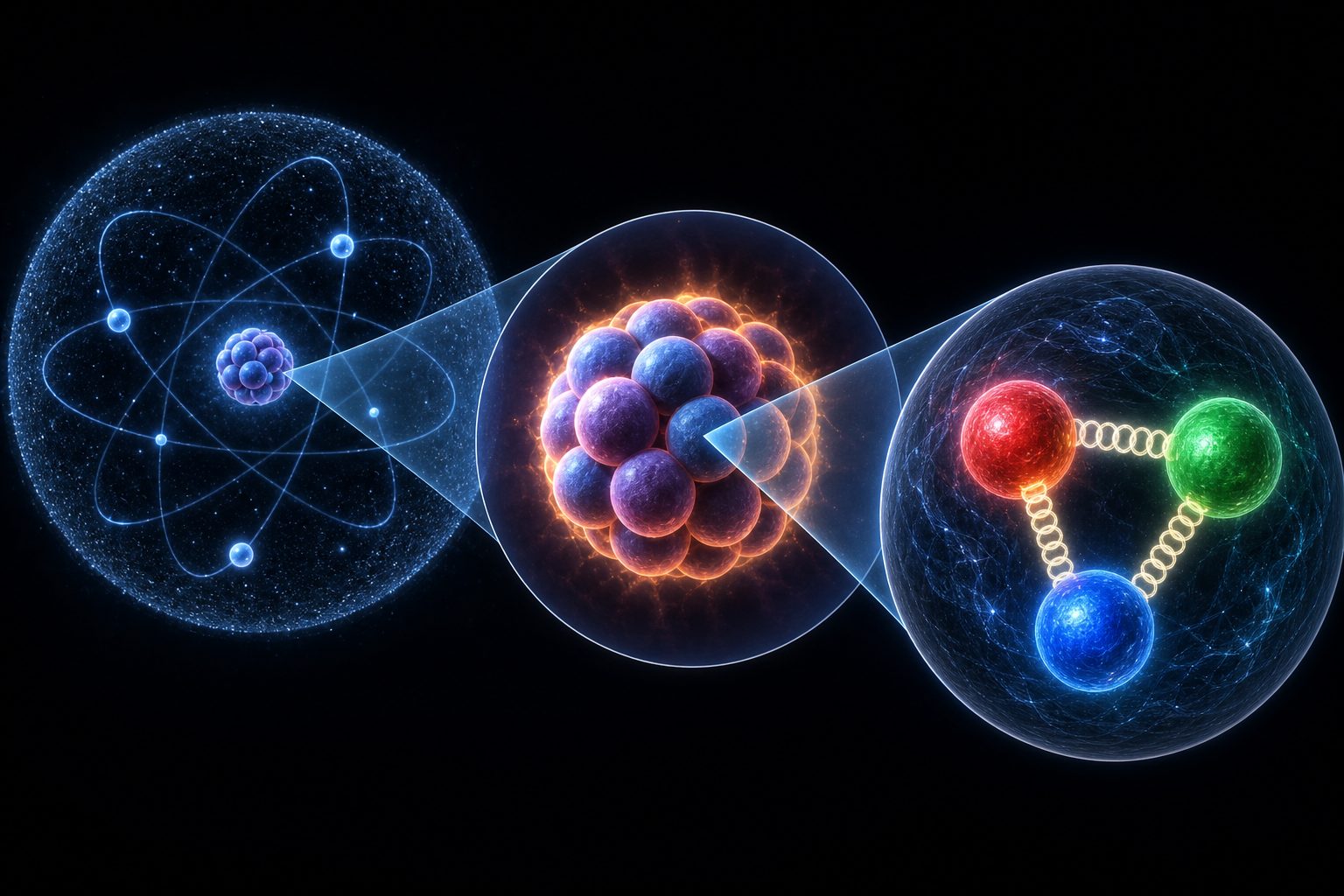
Atoms have a heavy centre, the nucleus, made of protons and neutrons. In 1964 Murray Gell-Mann, and separately George Zweig, proposed that these are made of something smaller.
Gell-Mann called them quarks. Their electric charges had to be fractions: plus two thirds, or minus one third.
A proton is two up quarks and one down quark. A neutron is one up and two down. Add up the charges and you get exactly one, and exactly zero.
From 1968, electrons fired at protons at SLAC in California bounced back far more often than expected: something small and hard was inside.
Zooming in Atom, nucleus, proton, quarks: three zooms, drawn far from scale. The quarks are tied together by the strong force. AI-generated illustration.
Three quarks for Muster Mark!James Joyce, Finnegans Wake (1939): in the novel, “quarks” are the cries of seagulls
p=uud:32+32−31=+1n=udd:32−31−31=0
u
up quark, charge +2/3
d
down quark, charge −1/3
Charges add upA straight accelerator At SLAC, electrons of 7 to 17 GeV scattered 10 to 100 times more often than a featureless proton predicts (APS). AI-generated illustration.
Chapter I · Smaller than atoms
Quarks
Science News: Gell-Mann’s paper introducing quarks appeared in Physics Letters on 1 February 1964; George Zweig, at CERN, developed similar ideas and called his particles “aces”. The name comes from “Three quarks for Muster Mark” in Joyce’s Finnegans Wake, and the model needed fractional charges never seen before. HyperPhysics: proton = uud, neutron = udd. APS Physics: SLAC experiments from 1968 by Friedman, Kendall and Taylor found inelastic scattering rates 10 to 100 times higher than a featureless proton predicts; reported in 1969, they shared the 1990 Nobel Prize.
Press Proton or Neutron in the scene to see the quarks inside.
The 3D scenes are simplified teaching models, not to scale: real particles are not coloured balls, and real detectors record tracks as electrical signals.
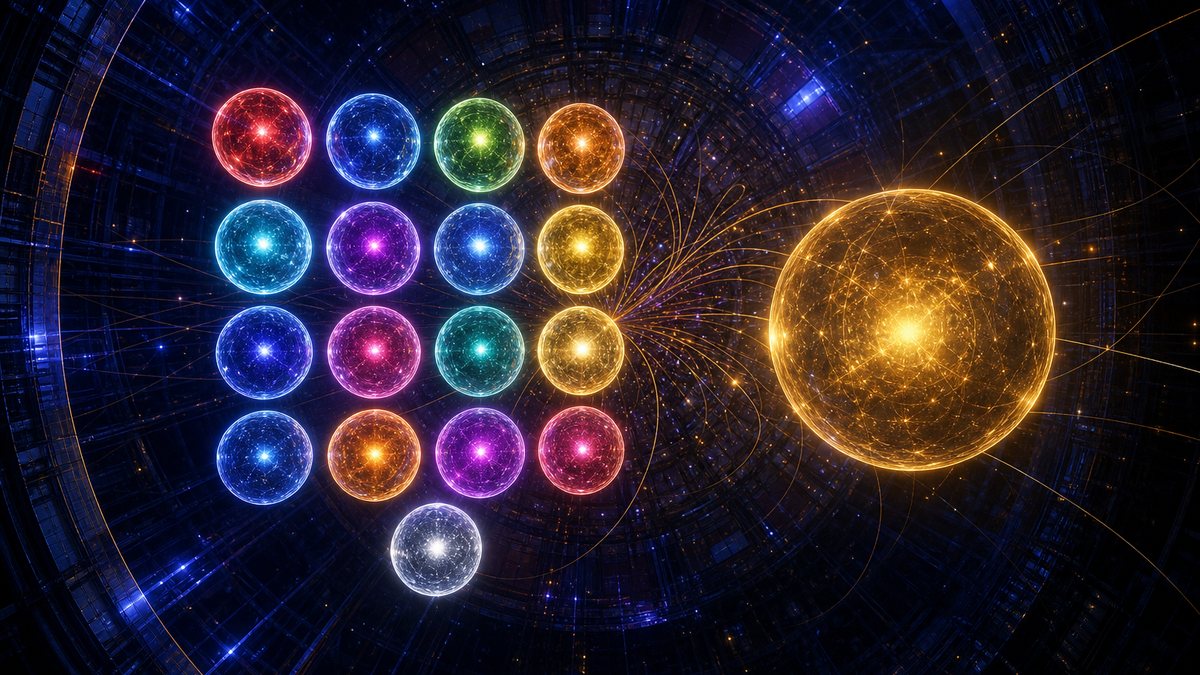
By the early 1970s these ideas had become one theory, the Standard Model of particle physics, with a short list of ingredients.
Six quarks and six leptons make up matter. The electron is a lepton, and so is the ghostly neutrino.
Four force carriers, called bosons, pass forces between them: the photon, the gluon, and the W and Z.
And one more, the Higgs boson: seventeen in all. Tap any of them in the scene.
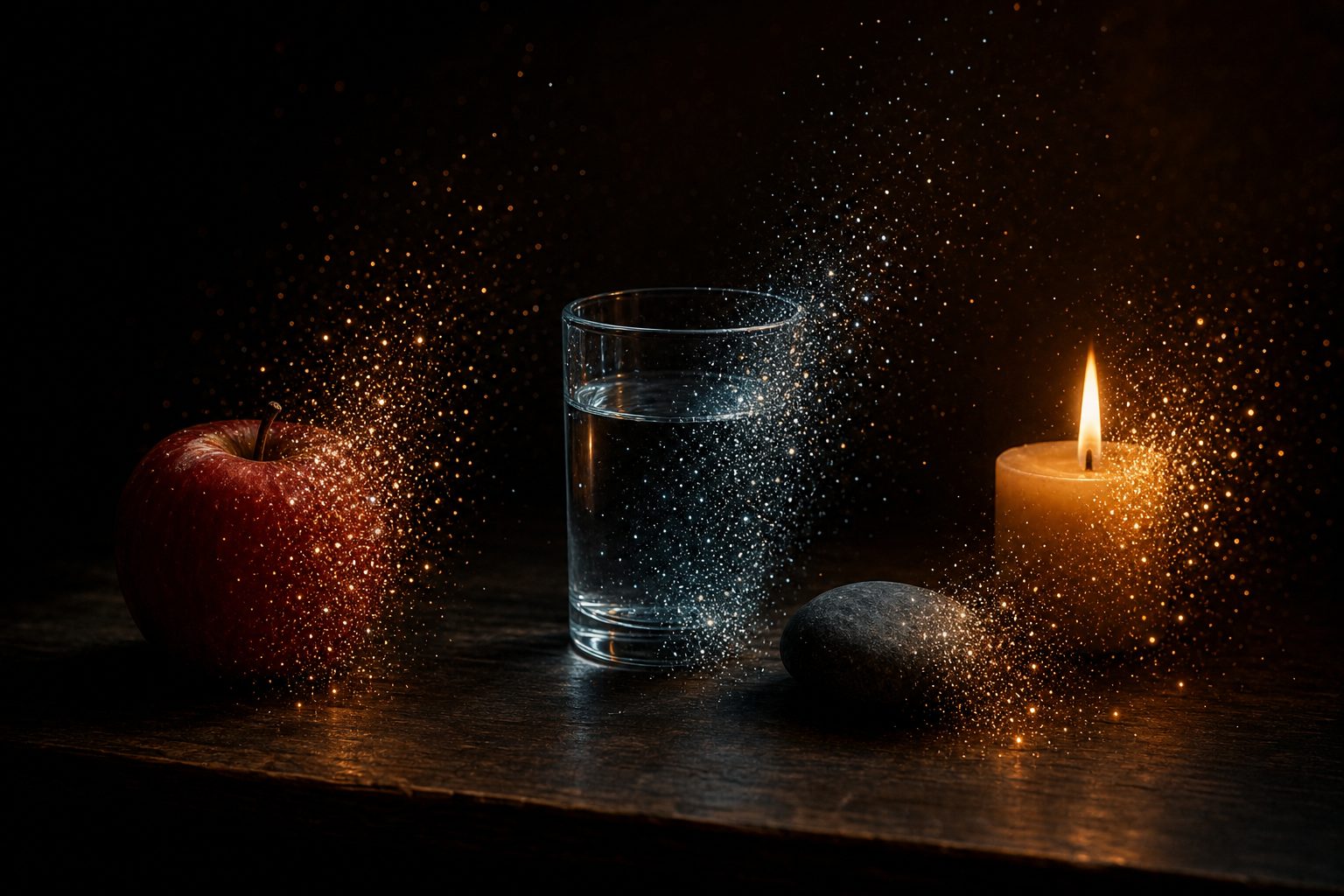
Everything around you An apple, water, stone, a flame: all of it is up quarks, down quarks and electrons, held by forces. AI-generated illustration.
6
quarks: up, down, charm, strange, top, bottom
6
leptons: electron, muon, tau and three neutrinos
Matter particles (fermions)
photon: electromagnetism
gluon: the strong force
W and Z: the weak force
gravity’s proposed carrier, the graviton, has not been found
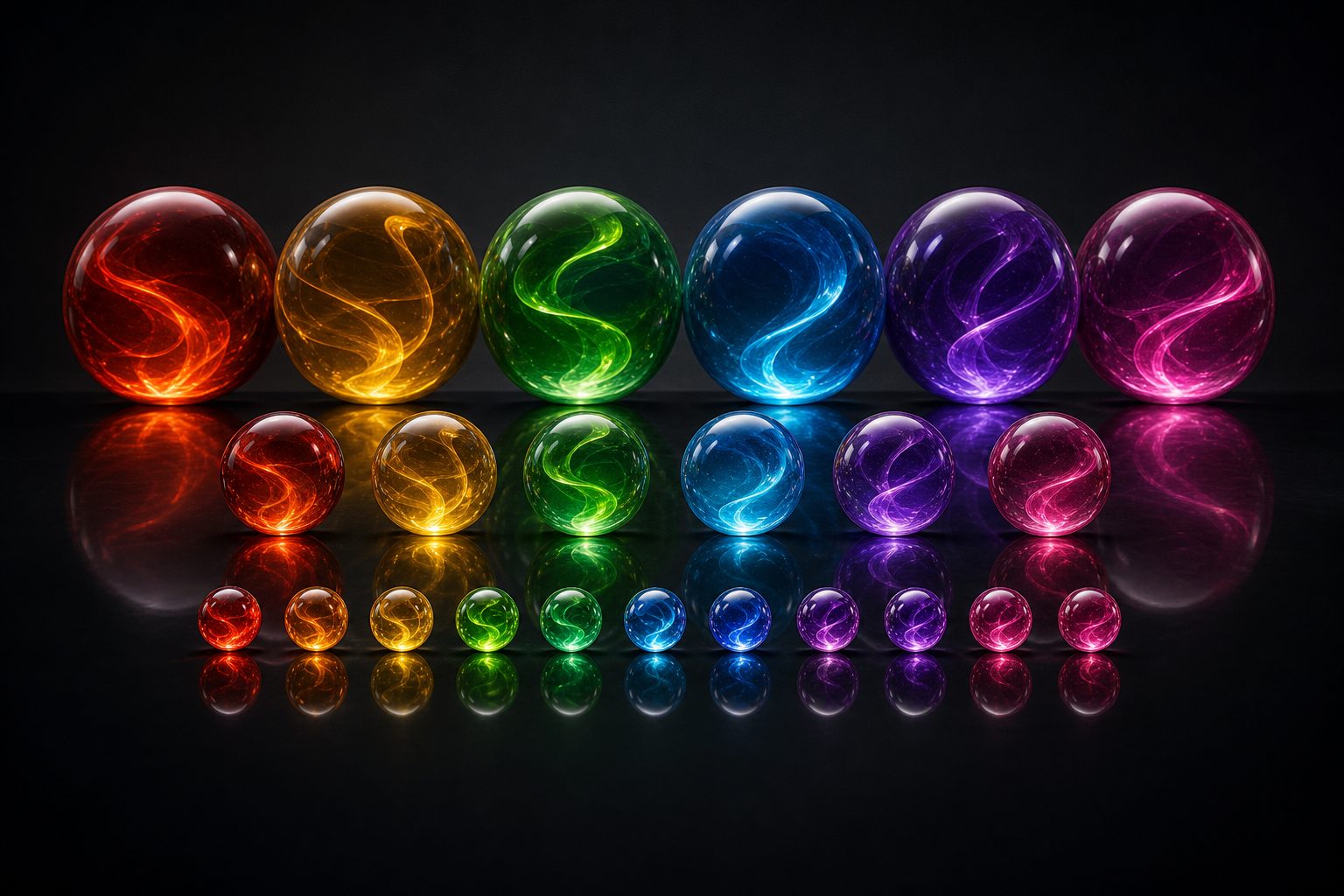
Force carriers (CERN)Same pattern, three sizes A hint of the next chapter: the matter particles repeat in heavier copies. AI-generated illustration.
Chapter II · The table
The Standard Model
CERN: the Standard Model, developed in the early 1970s, says all matter is made of quarks and leptons, six of each in three generations, and that three forces are carried by bosons: gluons (strong), photons (electromagnetic), and W and Z bosons (weak). The graviton, a proposed carrier of gravity, has not been found. Symmetry magazine lists the seventeen: six quarks, six leptons, five bosons including the Higgs.
Tap a particle, or use the buttons, to read its charge, mass and the year it was found.
The 3D scenes are simplified teaching models, not to scale: real particles are not coloured balls, and real detectors record tracks as electrical signals.
Look closer and the table repeats itself. In 1936 a particle turned up in cosmic rays that behaved like an electron but was about two hundred times heavier: the muon.
A third, the tau, followed in the 1970s, along with heavier quarks: charm in 1974, bottom in 1977, and the top, at Fermilab, in 1995.
So matter comes in three generations, each a heavier copy of the one before. Everything stable around you is built from the first.
The heavier ones decay in a fraction of a second. Why nature made three copies, nobody knows.
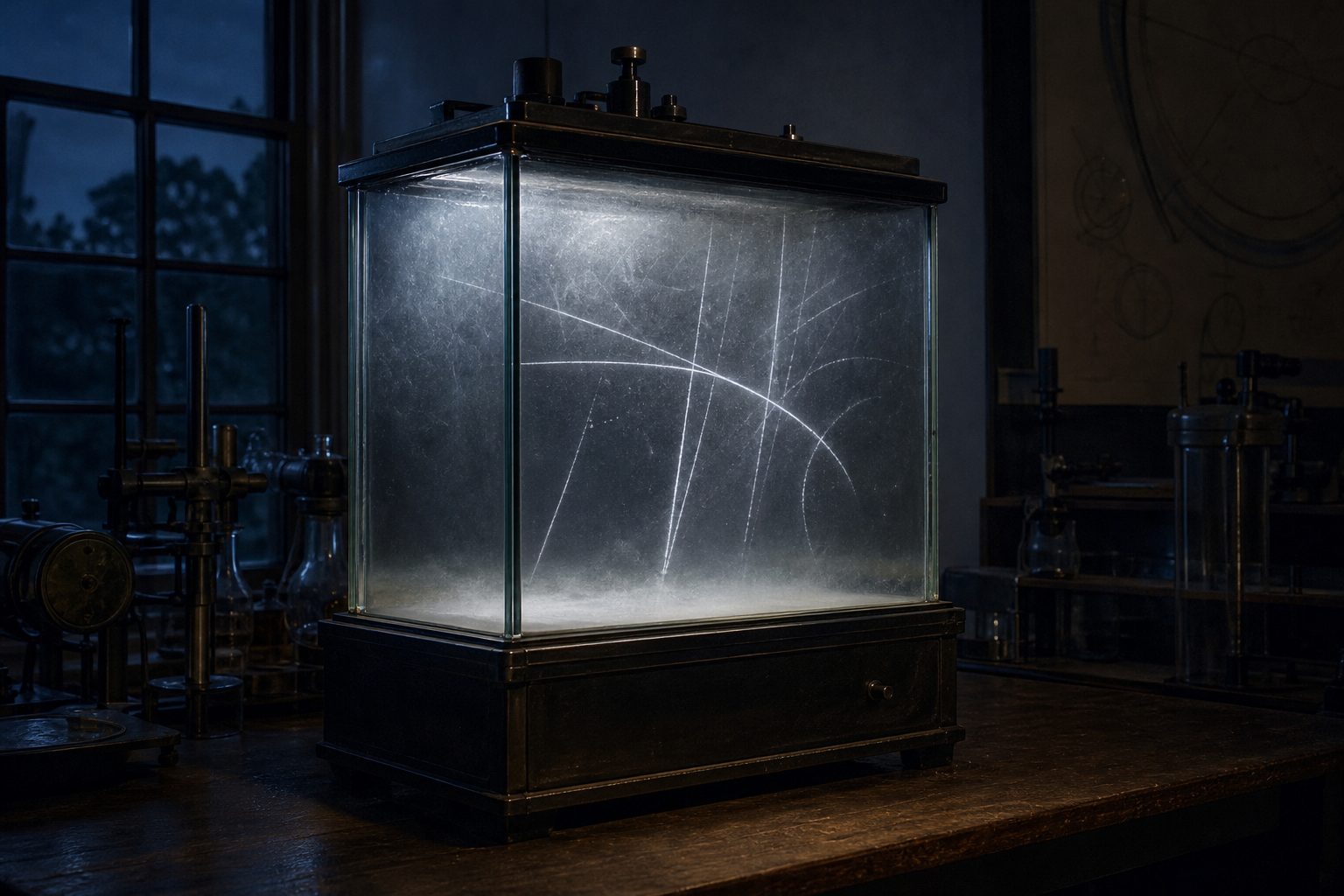
Tracks in a mist A cloud chamber: charged particles from cosmic rays leave trails of droplets. The muon was found in such trails, from a high-altitude chamber. AI-generated illustration.
electron
0.511
muon (×207)
105.7
tau (×3,477)
1,777
The charged leptons: one pattern, three masses
1897 electron
1936 muon
1974 charm quark
1975 tau
1977 bottom quark
1995 top quark
2000 tau neutrino
When each was found (Physics Hypertextbook)Where the top was found A ring accelerator on the prairie, like Fermilab’s Tevatron. The top quark weighs about 173 GeV, some 184 times a proton. AI-generated illustration.
Chapter II · The table
Three generations
Inference: Carl D. Anderson and Seth Neddermeyer, at Caltech, discovered muons in 1936 from cosmic-ray tracks. SLAC: on 11 November 1974 teams led by Burton Richter (SLAC) and Samuel Ting (at Brookhaven) announced the J/psi, a charm quark bound to its antiquark; they shared the 1976 Nobel Prize. Fermilab: the CDF and DZero collaborations announced the top quark on 2 March 1995. Physics Hypertextbook gives the years (tau 1975, bottom 1977, tau neutrino 2000) and the masses. CERN: stable matter uses only the first generation; heavier particles decay, and the theory does not explain why the generations have such different masses.
The scene highlights each generation in turn; the buttons let you pick one.
The 3D scenes are simplified teaching models, not to scale: real particles are not coloured balls, and real detectors record tracks as electrical signals.
Particles also push and pull. There are four fundamental forces: gravity, electromagnetism, and the strong and weak forces, which act only over tiny distances.
Here, forces are carried by particles. Electrons repel by trading photons, a quantum description, not a game of catch; quarks are held together by gluons, first seen in Germany in 1979.
Their strengths differ wildly. Call the strong force one: electromagnetism is about a hundred-and-thirty-seventh, the weak force a millionth, and gravity about 10⁻³⁹, so weak that the Standard Model leaves it out.
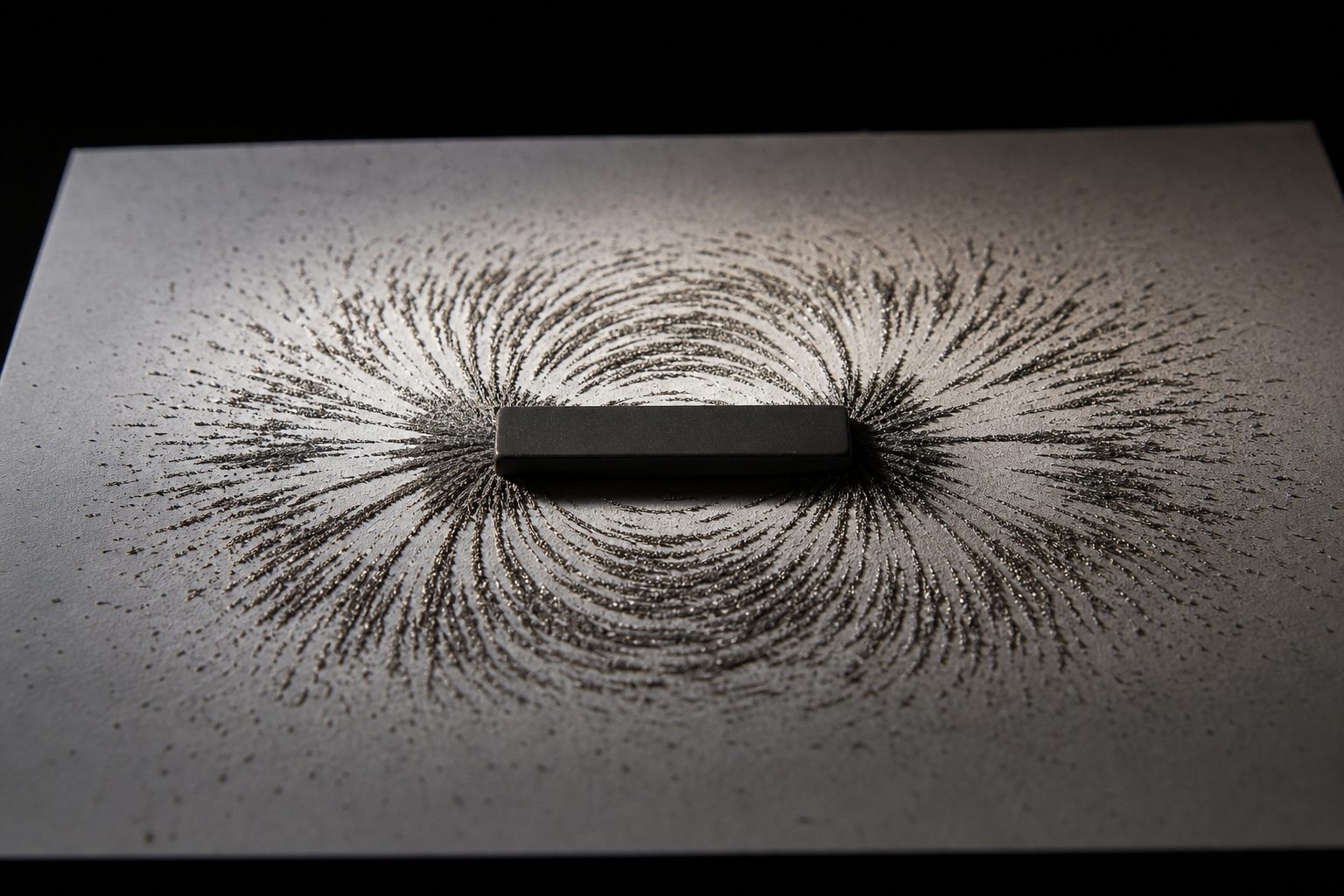
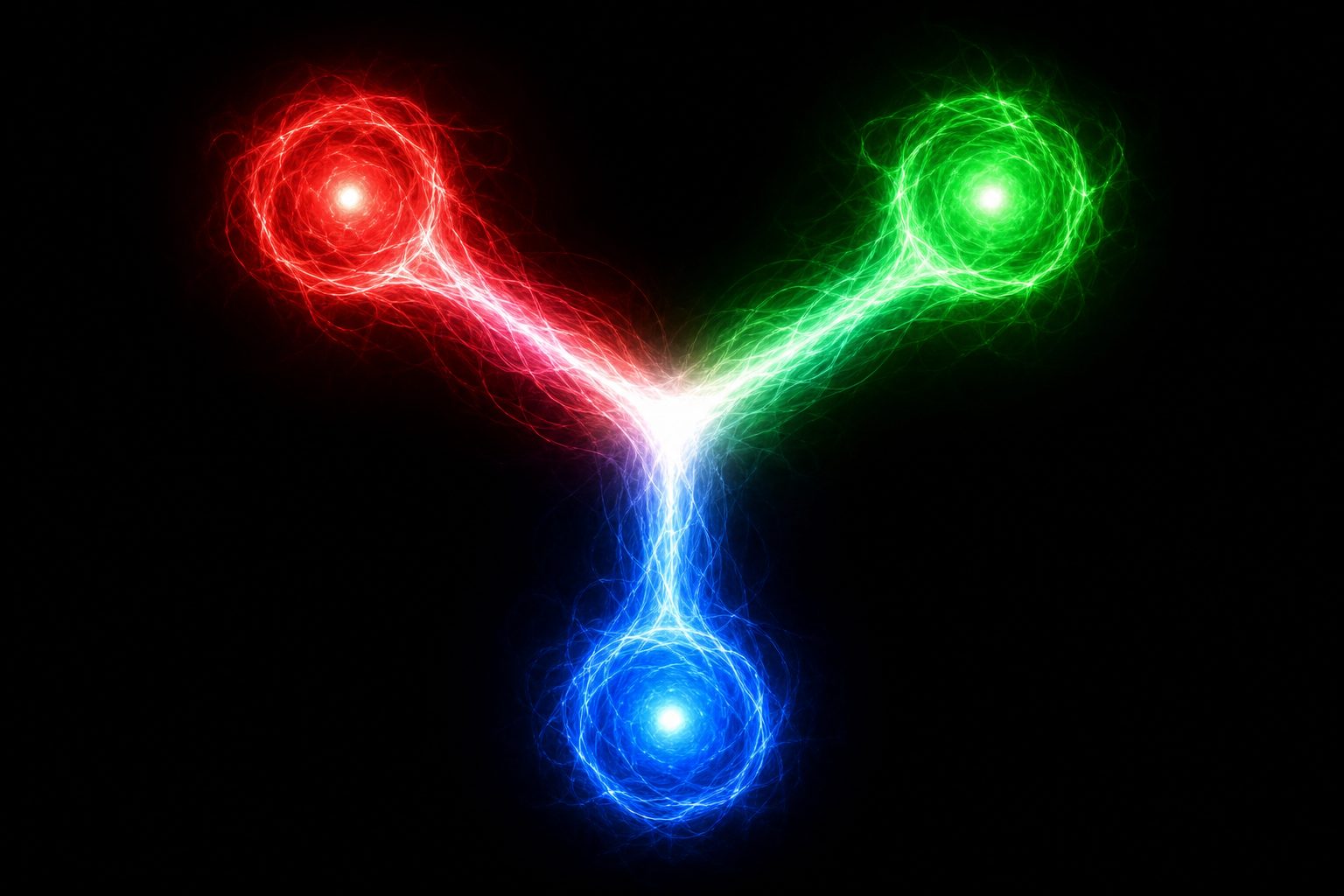
Electromagnetism Iron filings trace a magnet’s field. Electromagnetism has unlimited range and holds atoms and molecules together. AI-generated illustration.The strong force Gluons bind three quarks; colours stand for the strong force’s three kinds of charge, which physicists call colour. AI-generated illustration.
strong ≈ 1 · very short range
electromagnetic ≈ 1/137 · unlimited range
weak ≈ 10⁻⁶ · about 10⁻¹⁸ m
gravity ≈ 10⁻³⁹ · unlimited range
Relative strength (HyperPhysics coupling constants)Weakest, yet everywhere Gravity is the weakest force, but it has unlimited range and always adds up, so it rules planets and stars. AI-generated illustration.
Chapter III · Four forces
Four forces
CERN: there are four fundamental forces; gravity is the weakest but has infinite range; electromagnetism also has infinite range; the weak and strong forces act only over very short distances; the strong force is the strongest of the four. Three of them are carried by bosons, and gravity is not part of the Standard Model. HyperPhysics lists the coupling constants as roughly 1 (strong), 1/137 (electromagnetic), 10⁻⁶ (weak) and 10⁻³⁹ (gravity). DESY: the gluon was discovered at the PETRA collider in summer 1979; the TASSO team’s first three-jet event was shown on 18 June 1979.
The strength numbers are rough comparisons; they change with the energy at which particles meet.
The 3D scenes are simplified teaching models, not to scale: real particles are not coloured balls, and real detectors record tracks as electrical signals.
The weak force turns one particle into another. In a free neutron, a down quark becomes an up quark and gives off a W boson, which turns into an electron and an antineutrino, the antimatter twin of a neutrino.
The neutron has become a proton: this is beta decay. The weak force works the other way too, turning protons into neutrons inside the Sun. Without it, the Sun would not shine.
The W and Z weigh about 86 and 97 times as much as a proton, so the weak force reaches only about a thousandth of a proton’s width. CERN found both in 1983.
n(udd)→p(uud)+W−W−→e−+νˉe
W−
a negative W boson, gone in an instant
νˉe
an electron antineutrino; the bar means antimatter
Beta decay, quark by quarkPowered by the weak force In the Sun’s core, the weak force converts protons to neutrons, the step that lets hydrogen fuse at all. AI-generated illustration.
80.4 GeV
W boson, about 86 proton masses
91.2 GeV
Z boson, about 97 proton masses
Heavy carriers (Physics Hypertextbook)A 1980s detector UA1 and UA2 saw the first W and Z at CERN’s SPS, turned into a proton–antiproton collider; Carlo Rubbia and Simon van der Meer shared the 1984 Nobel Prize. AI-generated illustration.
Chapter III · Four forces
The weak force
HyperPhysics: the weak interaction was first revealed in beta decay; a free neutron decays by emitting a W⁻, producing an electron and an antineutrino, as one down quark changes to an up quark; the weak interaction converts protons to neutrons in the Sun, and “the sun would not burn without it”; because the W and Z are heavy (about 80 GeV), the range is about 10⁻¹⁸ m, roughly 0.1% of a proton’s diameter. CERN: the W and Z were first observed in 1983 by UA1 and UA2 at the SPS, converted into a proton–antiproton collider. NobelPrize.org: the SPS saw its first collisions in 1981; the 1984 prize went to Carlo Rubbia and Simon van der Meer for their decisive contributions to the project that discovered the W and Z.
Press Decay in the scene to replay the neutron’s change.
The 3D scenes are simplified teaching models, not to scale: real particles are not coloured balls, and real detectors record tracks as electrical signals.
There was a problem: the equations seemed to forbid heavy force carriers, yet the W and Z are heavy.
In 1964 three groups of physicists, in Brussels, Edinburgh and London, found a way out.
The idea: an invisible field filling the universe. Particles that couple strongly to it are heavy, those that barely couple are light, and the photon, which ignores it, has no mass.
One surprise: most of your own mass does not come from it. Protons and neutrons get almost all of theirs from the energy of the strong force binding their quarks.
If the field is real, hitting it hard enough should shake loose a particle of its own: the Higgs boson.
Brussels: Robert Brout and François Englert (submitted 26 June)
Edinburgh: Peter Higgs (submitted 27 July), who then predicted a new particle
London: Gerald Guralnik, Carl Hagen and Tom Kibble (published November)
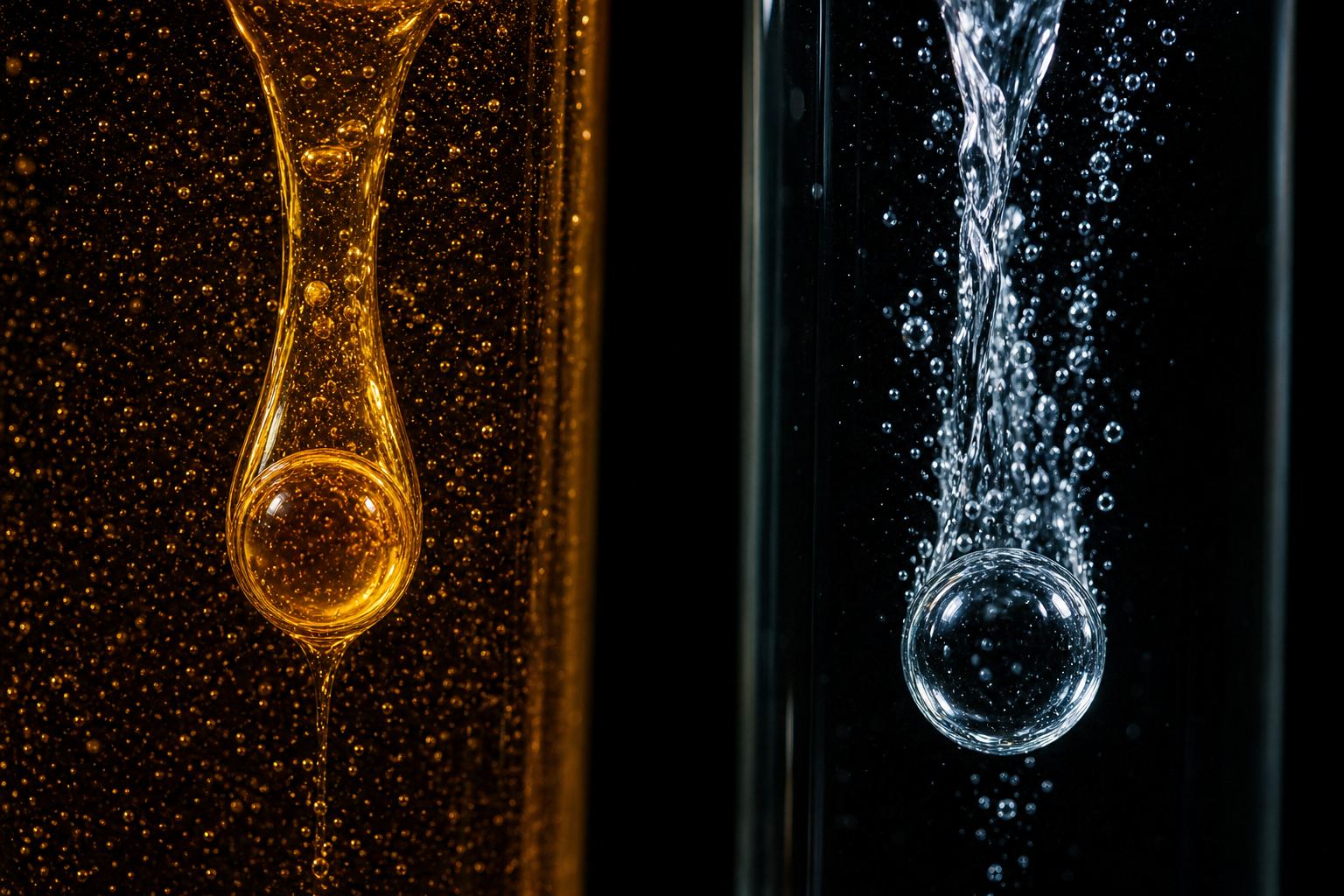
Three papers, 1964 (Physics Today)A common analogy, and its limit Honey versus water is often used to picture the Higgs field, but the field does not slow anything down. How strongly a particle couples sets its mass. AI-generated illustration.
≈ 9 MeV
the three quarks’ own masses, from the Higgs (2.2 + 2.2 + 4.7)
938 MeV
the whole proton: the rest is strong-force energy
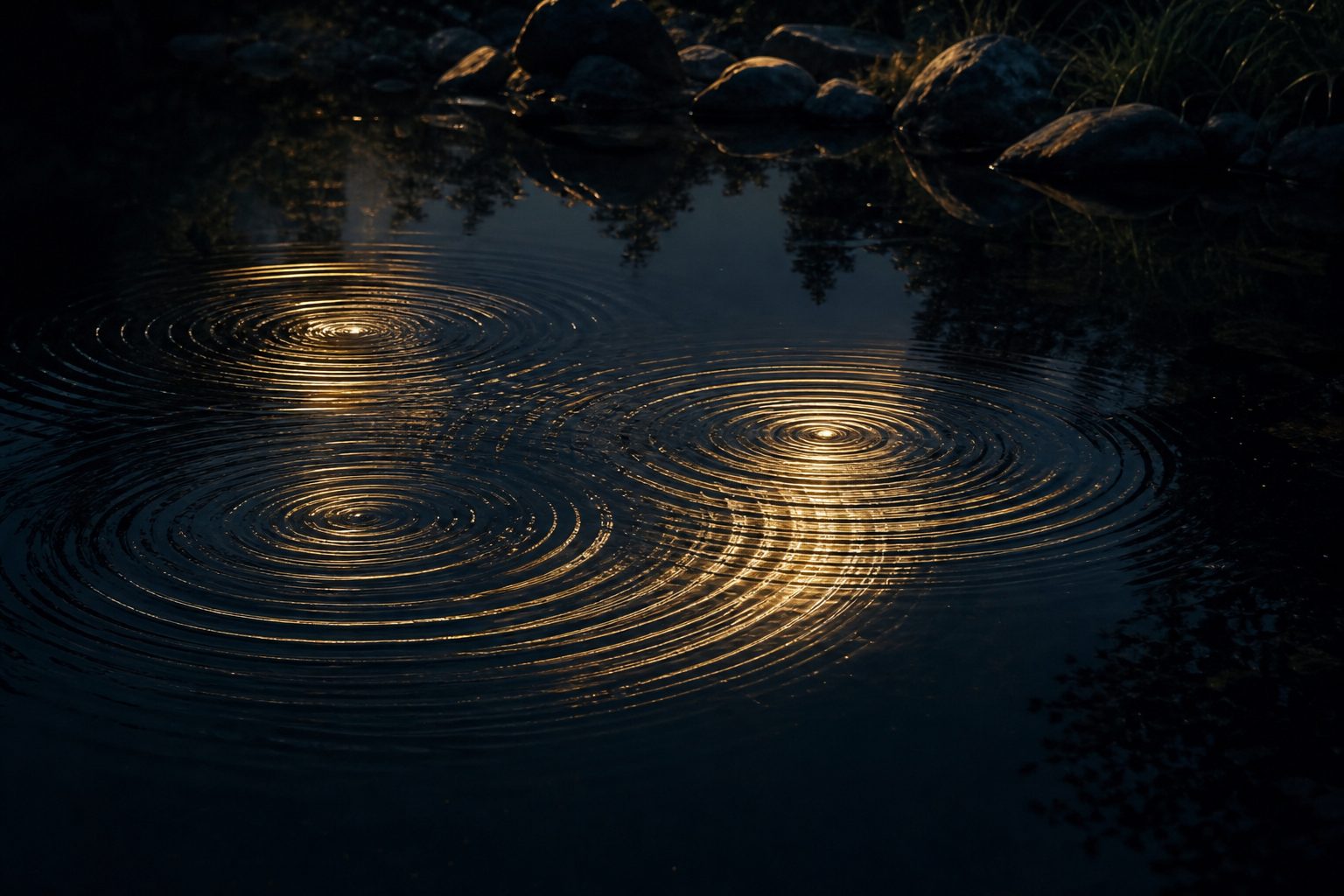
Inside a proton (Physics Hypertextbook masses)Shake the field A field has a value at every point, like a pond’s surface; strike it hard and a ripple, a particle of the field, can appear. AI-generated illustration.
Chapter IV · The Higgs
The Higgs field
Physics Today: the theory’s framework seemed to require massless force carriers, which fit electromagnetism but not the weak force. Brout and Englert submitted the first relativistic solution on 26 June 1964; Higgs submitted his first paper on 27 July 1964 and derived the mass of the new scalar particle; Guralnik, Hagen and Kibble’s paper followed (Physical Review Letters 13, 585, November 1964). Steven Weinberg used the mechanism in 1967 to unite the electromagnetic and weak forces, giving the W and Z their masses; NobelPrize.org: Sheldon Glashow, Abdus Salam and Weinberg shared the 1979 prize “for their contributions to the theory of the unified weak and electromagnetic interaction”. CERN: the Higgs field fills the entire universe and gives mass to elementary particles. Symmetry magazine: protons and neutrons get almost all their mass from the strong nuclear force.
Pick the photon, the electron or the top quark in the scene: the size of the wake stands for how strongly it couples. Nothing is slowed down; this is a picture, not a simulation.
The 3D scenes are simplified teaching models, not to scale: real particles are not coloured balls, and real detectors record tracks as electrical signals.
On 4 July 2012, the ATLAS and CMS experiments at CERN’s Large Hadron Collider each announced a new particle, at a mass of about 125 GeV.
Each reached about five sigma, the bar for a discovery: background alone would fake such a bump at most about three times in ten million.
It was the Higgs boson, the table’s last missing piece. François Englert and Peter Higgs won the 2013 Nobel Prize in Physics.
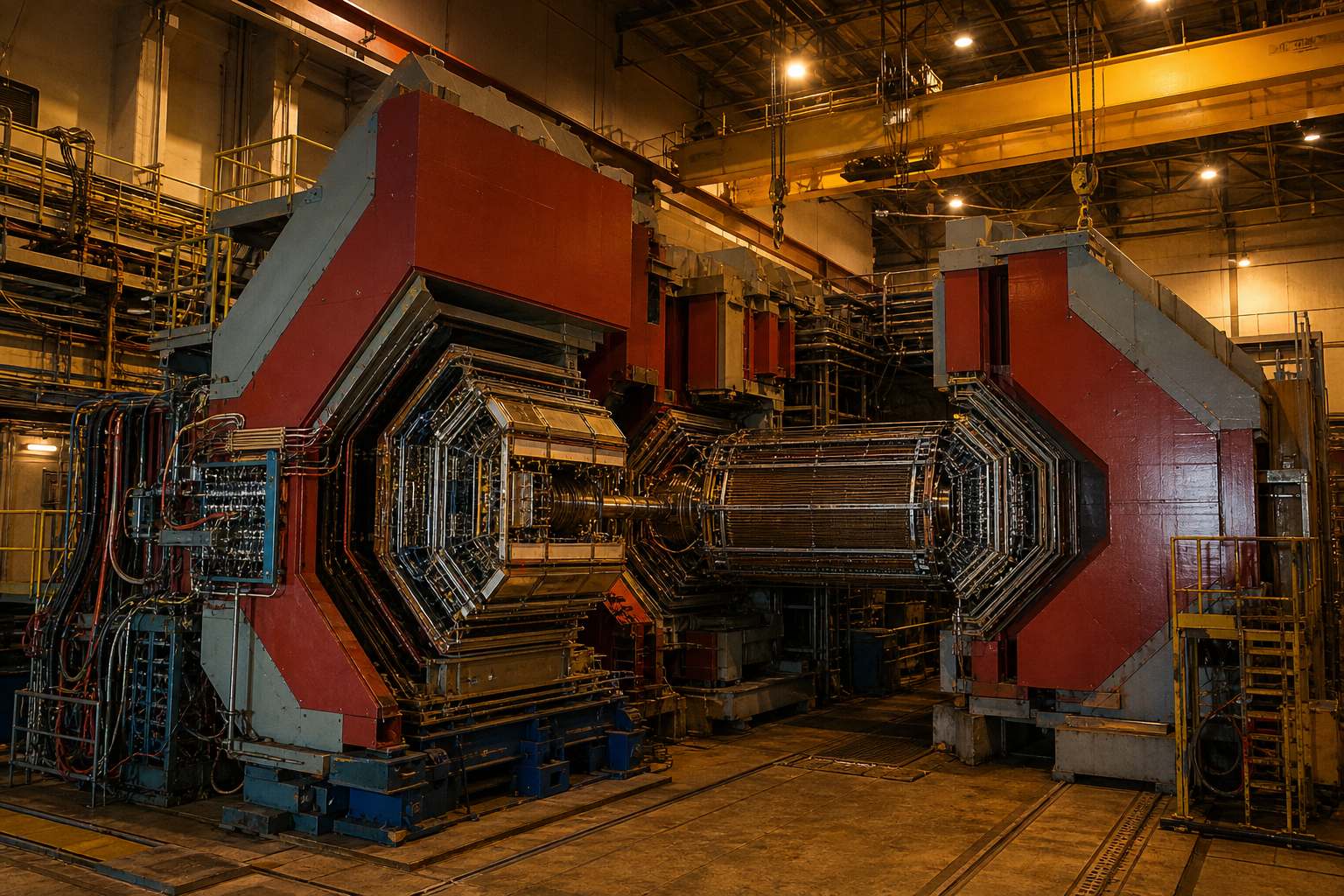
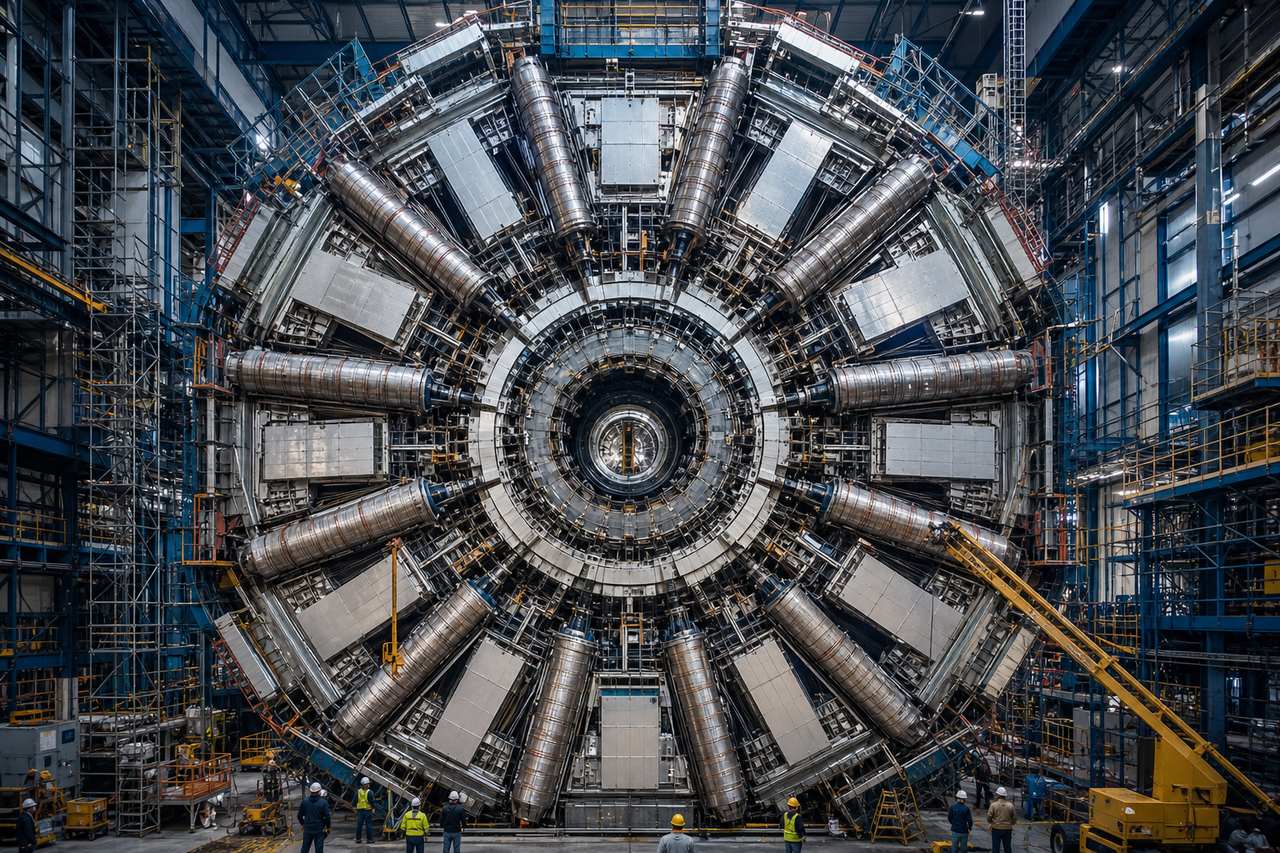
A giant camera A general-purpose detector wraps the collision point in layers; the figures on the scaffolding give the scale. AI-generated illustration.
~125 GeV
its mass, about 133 times a proton
2
independent experiments, ATLAS and CMS, saw it at the same mass
The new particle
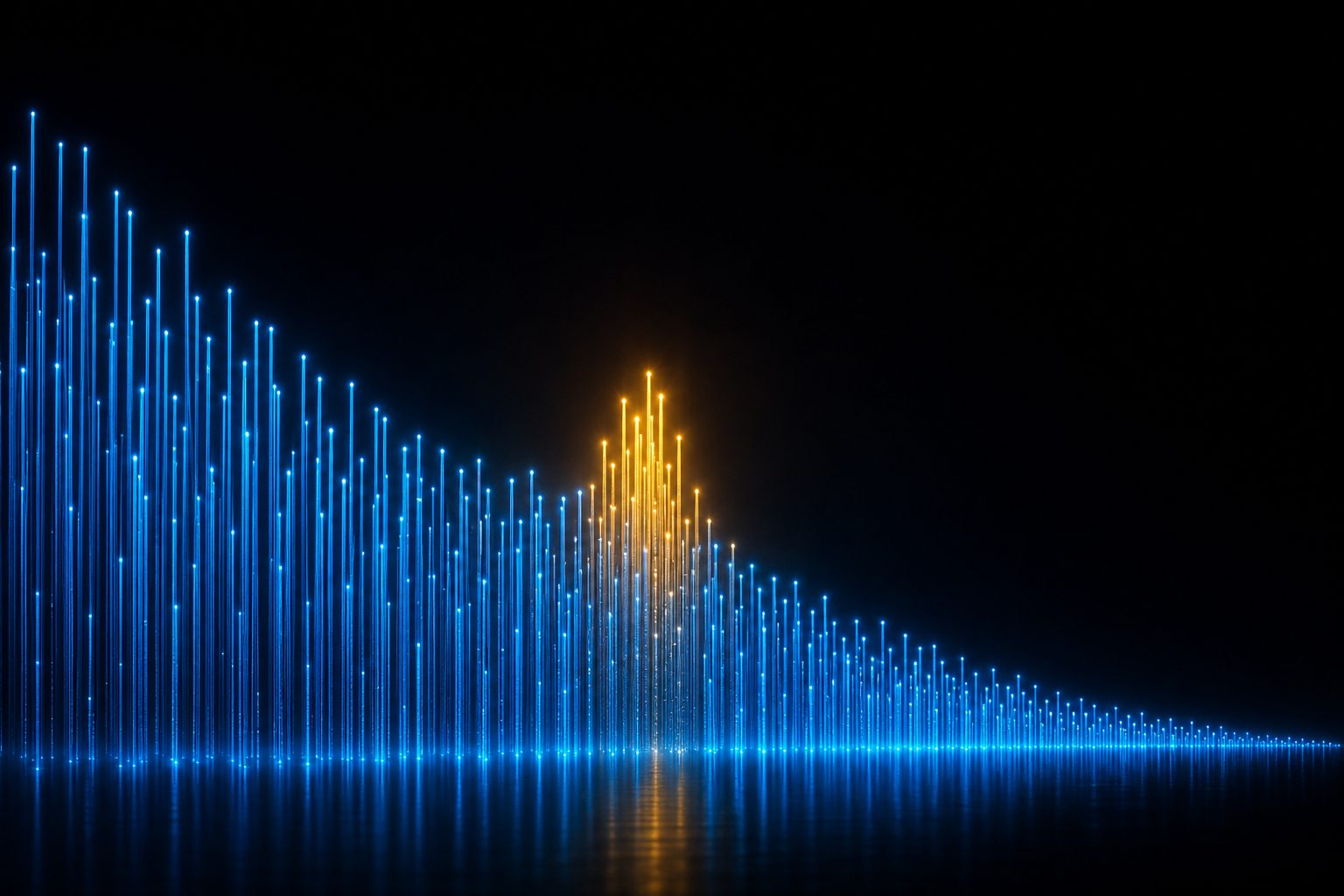
3σ: “evidence”; many such hints have faded with more data
5σ: “discovery”; a fake chance of at most 3 × 10⁻⁷ (CERN Courier)
like calling 22 coin tosses in a row
What sigma meansThe last piece With the Higgs, every particle in the table had been seen; the 2013 prize went to two of the 1964 theorists. AI-generated illustration.
Chapter IV · The Higgs
The Higgs boson
CERN: on 4 July 2012 the ATLAS and CMS experiments each announced a new particle in the mass region around 126 GeV, consistent with the Higgs boson; on 8 October 2013 the Nobel Prize in Physics went to François Englert and Peter Higgs. Physics Today: both detectors reported a peak at 125–126 GeV/c², each at about five standard deviations above background. Physics Hypertextbook gives today’s value, 125.2 GeV. CERN Courier: a 5σ effect should have a chance of at most 3 × 10⁻⁷ of being a fluctuation, like guessing 22 coin tosses correctly; many 3σ and 4σ effects have gone away with more data.
Press More data in the scene: the bump at 125 GeV rises above the smooth background as collisions pile up. The histogram is schematic.
The 3D scenes are simplified teaching models, not to scale: real particles are not coloured balls, and real detectors record tracks as electrical signals.
How do you find a particle that lives for a tiny fraction of a second? You make it, out of energy.
Einstein’s E equals m c squared works both ways: smash particles together hard enough, and the energy of the crash can turn into new, heavier particles.
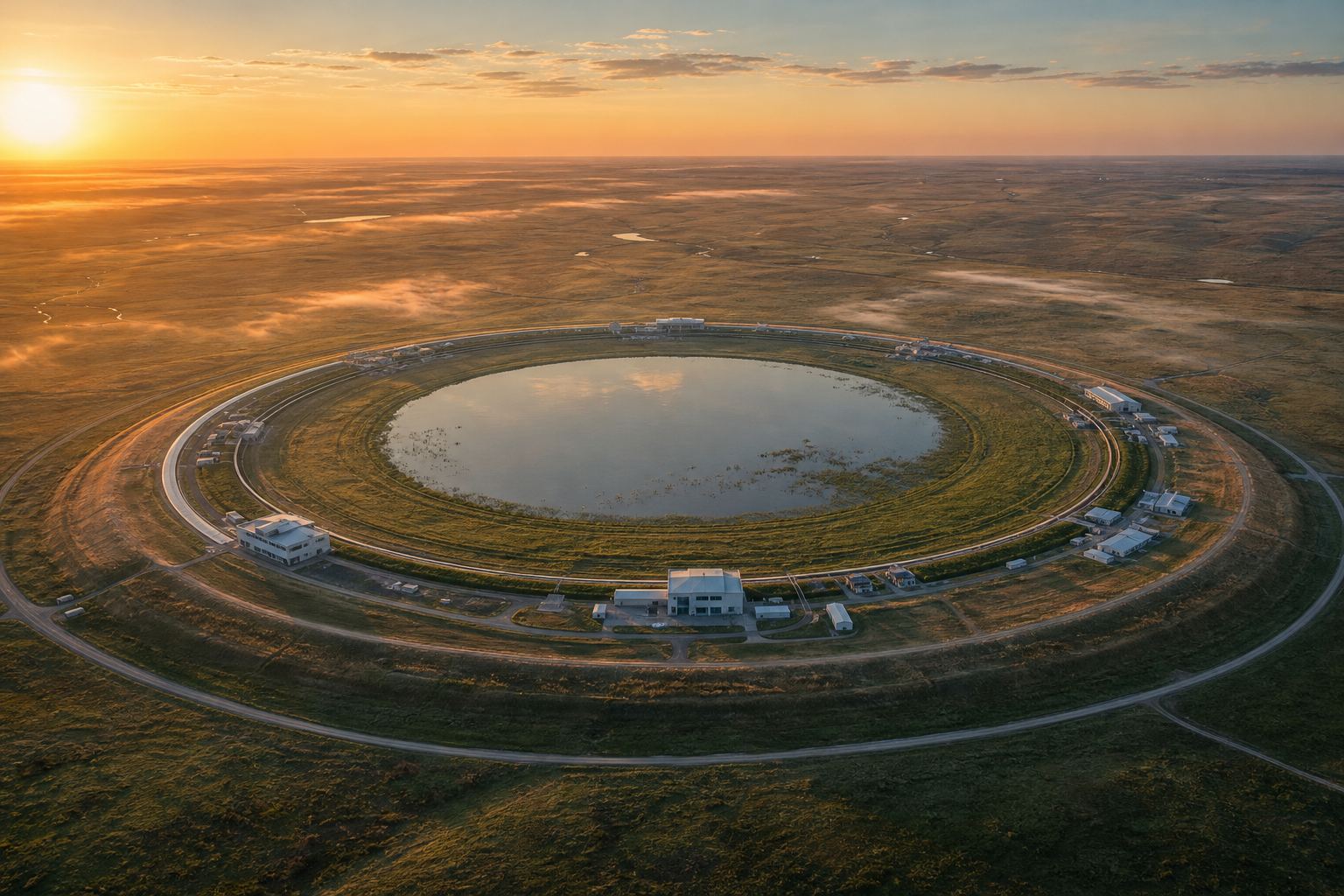
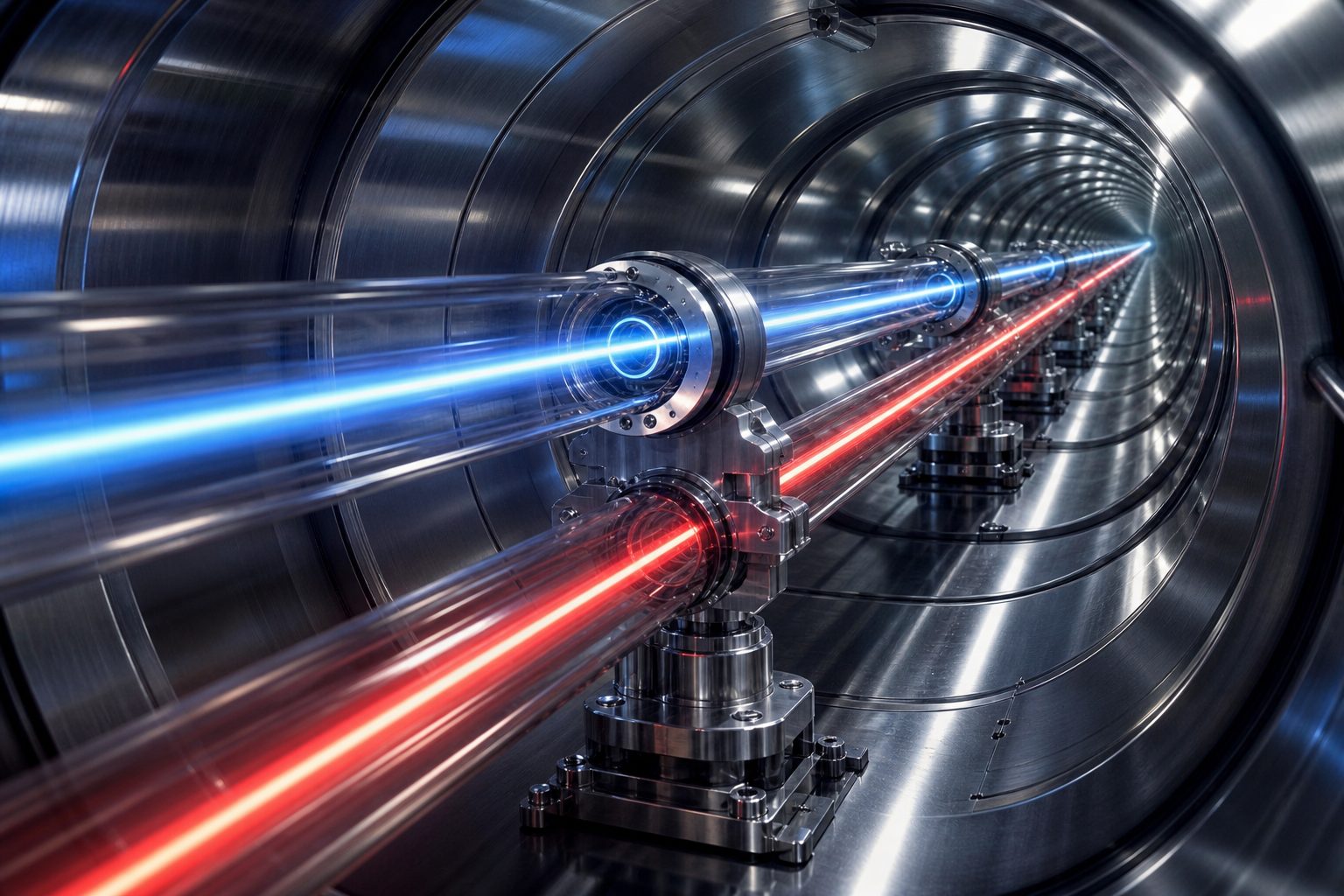
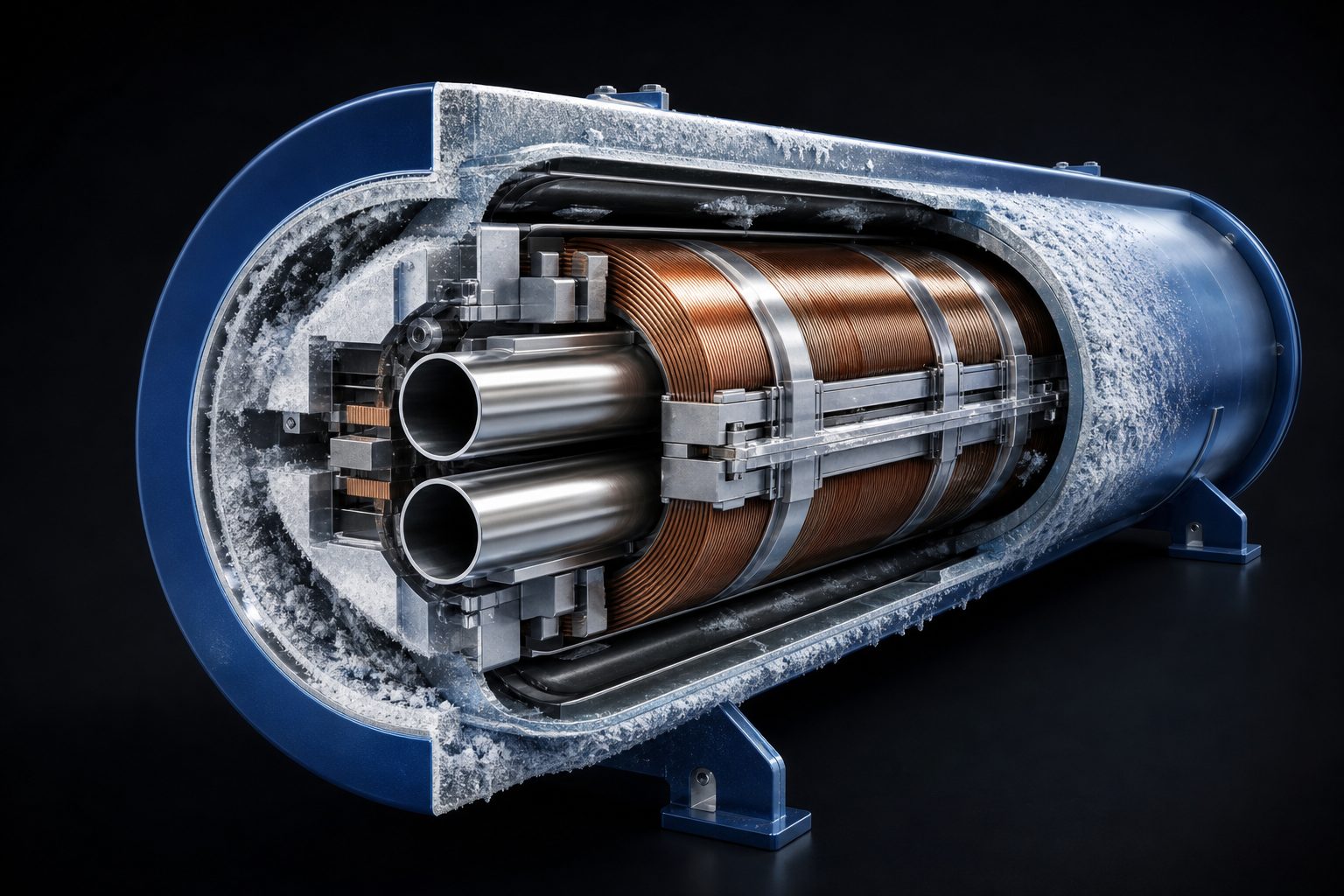
At the Large Hadron Collider, ultra-cold magnets steer two proton beams around a ring until they cross inside giant detectors, over a billion times a second.
Two beams Protons travel in two separate vacuum pipes, one for each direction, and are brought together only where the detectors stand. AI-generated illustration.E=mc2
E
energy of the collision
m
mass of the new particles
c
the speed of light
Energy into massInside a magnet Cut-away of a dipole magnet: two beam pipes side by side inside superconducting coils at 1.9 K, colder than the 2.7 K of deep space. AI-generated illustration.
26.7 km
ring, 100 m underground
~9,600
magnets (9,593)
1.9 K
−271.3 °C in the magnets
13.6 TeV
collision energy, 6.8 TeV per beam
The LHC in numbers (CERN)
Chapter V · How to find a particle
The Large Hadron Collider
CERN: the LHC first started up on 10 September 2008; its ring is 26,659 m around, about 100 metres underground; its key-figures table lists 9,593 magnets, the superconducting ones operating at 1.9 K (−271.3 °C); each proton beam reaches 6.8 TeV, for collisions at 13.6 TeV; the ATLAS and CMS experiments see about 1.5 billion collisions per second. The energy of the collision can be converted into new particles, which is why higher energies allow heavier particles to be made.
The 3D scenes are simplified teaching models, not to scale: real particles are not coloured balls, and real detectors record tracks as electrical signals.
A detector is built like an onion. Near the centre, thin sensors record where charged particles pass while a magnet bends their paths: the straighter the track, the higher the momentum.
Further out, dense calorimeters stop most particles and measure their energy. Muons punch through almost everything, so muon chambers form the outermost layer.
Neutrinos escape without a trace. Physicists infer them from the energy that goes missing when they add everything up.
Layer by layer Tracker at the centre, calorimeters around it, iron and muon chambers outside. AI-generated illustration.
tracker: charged particles leave a trail, bent by the magnet
calorimeters: electrons, photons and hadrons stop and give up their energy
muon chambers: muons only
nothing: neutrinos
Who stops where (CERN)The outermost layer Only muons reach the big chambers outside; two straight tracks here would be a pair of them. AI-generated illustration.
~1.5 billion
collisions per second seen by ATLAS and CMS
0
signals left by a neutrino in the detector
Busy centre (CERN)
Chapter V · How to find a particle
How a detector works
CERN: modern detectors consist of layers of subdetectors. Electromagnets curve the paths of charged particles, and particles with high momentum travel in almost straight lines. Tracking devices record faint electrical signals and software reconstructs the paths; most do not make tracks directly visible. Calorimeters stop most particles and measure their energy, but not muons and neutrinos; muons interact only weakly with matter, so muon chambers form the outermost layer. Neutrinos pass through undetected.
The 3D scenes are simplified teaching models, not to scale: real particles are not coloured balls, and real detectors record tracks as electrical signals.
Most of what a collider makes falls apart almost at once, and how it falls apart tests the theory.
Take the kaon, found in 1947. It is a meson, a quark bound to an antiquark: a positive kaon is an up quark and a strange antiquark. It lives about twelve billionths of a second.
Nearly two times in three it becomes a muon and a neutrino; about one time in five, two pions.
But very rarely, about once in ten billion, it turns into a pion and two neutrinos. Fire kaons in the scene and see how long you would wait.
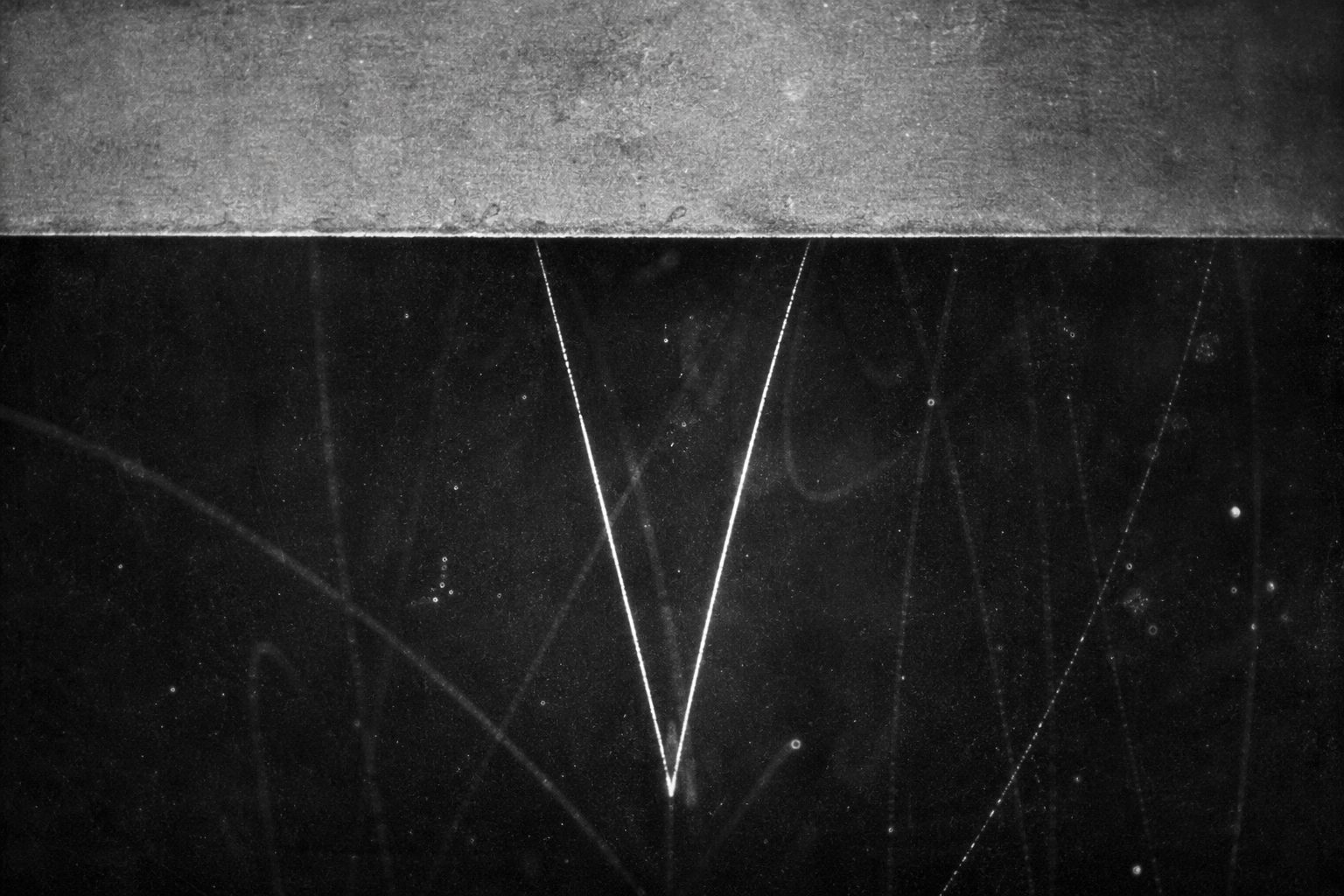
V-shaped tracks Early kaons showed up as unexpected V-shaped forks in cloud-chamber pictures: “kaons didn’t fit any picture” (Helen Quinn, in Symmetry). AI-generated illustration.
493.7 MeV
mass, about half a proton
1.238 × 10⁻⁸ s
mean life
The K⁺ (Particle Data Group 2025)
μ⁺ ν
63.6
π⁺ π⁰
20.7
π⁺ π⁺ π⁻
5.6
π⁰ e⁺ ν
5.1
π⁰ μ⁺ ν
3.4
π⁺ π⁰ π⁰
1.8
How a K⁺ decays (PDG 2025)
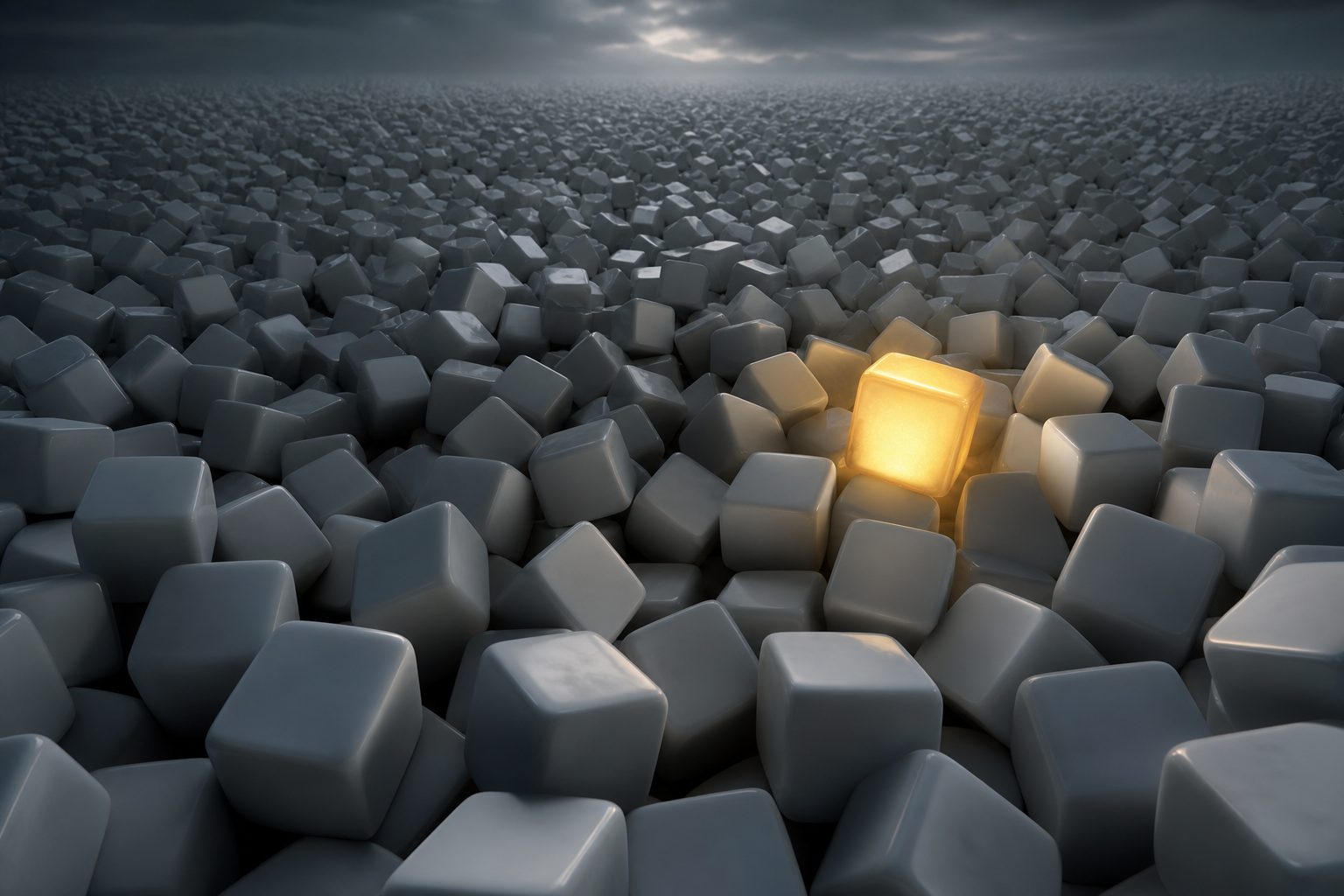
One in ten billion Picture ten billion dice with one golden one: that is roughly how often a K⁺ becomes π⁺νν̄. AI-generated illustration.
Chapter VI · Once in ten billion
The kaon
Symmetry magazine: Clifford Butler and George Rochester found kaons in cloud-chamber photographs at the University of Manchester and published them in Nature in 1947; precise Standard Model predictions make rare kaon decays a key test of the theory. HyperPhysics: K⁺ is an up quark and a strange antiquark. Particle Data Group (2025): K± mass 493.677 MeV, mean life 1.2380 × 10⁻⁸ s; decays μ⁺ν 63.56%, π⁺π⁰ 20.67%, π⁺π⁺π⁻ 5.583%, π⁰e⁺ν 5.07%, π⁰μ⁺ν 3.352%, π⁺π⁰π⁰ 1.760%. CERN: K⁺ → π⁺νν̄ has a predicted branching ratio of less than one in ten billion.
Fire one kaon, a million, or ten billion. The counter draws each decay at random with the measured shares; the rare channel uses NA62’s 2026 rate.
The 3D scenes are simplified teaching models, not to scale: real particles are not coloured balls, and real detectors record tracks as electrical signals.
Why chase something so rare? Quantum physics lets heavy particles flicker into existence inside a process, as so-called virtual particles, and vanish again.
Particles nobody has found yet, which physicists call new physics, could do the same, even ones too heavy for any collider to make, and change how often a rare decay happens.
CERN’s NA62 experiment makes kaons by firing protons into a target. It saw this decay in 2024; in March 2026 it measured 9.6 in a hundred billion, give or take about 2.
One in ten billion is 10 in a hundred billion, and the theory predicts about 8. Within that margin they agree: no sign of new physics yet, just less room for it.
A loop inside a decay A quantum loop drawn as light: inside it, particles far heavier than the kaon can take part for an instant. AI-generated illustration.
the prediction is precise, with little theory uncertainty
the rarer the decay, the more a new particle could change it
it reaches particles too heavy for the LHC to make
Why count rare decays (CERN)A beam on a target Protons from the Super Proton Synchrotron strike a fixed target, making almost a billion particles a second, about 6% of them kaons. AI-generated illustration.
13.0
2024, first observation at 5σ (2016–22 data)
9.6 +1.9/−1.8
2026, uncertainty 40% smaller (data to 2024)
~8
Standard Model prediction
K⁺ → π⁺νν̄, in units of 10⁻¹¹ (CERN)
Chapter VI · Once in ten billion
Rare decays as a test
CERN (2024): a high-intensity proton beam from the SPS strikes a stationary target, making almost a billion secondary particles per second, about 6% of them positive kaons; NA62 observed K⁺ → π⁺νν̄ at five standard deviations with 2016–2022 data, at 13.0 (+3.3 −2.9) × 10⁻¹¹. CERN EP newsletter: the Standard Model prediction is around 8 × 10⁻¹¹, and new particles in the decay’s quantum loops could cause measurable deviations; the update is “in excellent agreement” with the prediction and “narrows the room in which new physics can hide”; 2025 data are still to be analysed. CERN and the University of Birmingham (March 2026): 9.6 (+1.9 −1.8) × 10⁻¹¹ with data to 2024, the uncertainty 40% smaller than before; the rate “can be predicted theoretically with very little uncertainty”. CERN on LHCb (2026): very rare decays are more sensitive to new particles too heavy to be made directly at the LHC.
The loop in the scene is a picture of the idea, not a measured process; whether any new particle exists is an open question.
The 3D scenes are simplified teaching models, not to scale: real particles are not coloured balls, and real detectors record tracks as electrical signals.
LHCb was doing the same. A B⁰ is a meson made of a bottom quark and a down quark, one of them antimatter. Very rarely the pair annihilates into a muon and an antimuon, which fly out through the muon chambers.
LHCb reached 3.2 sigma: evidence, not yet a discovery, and the rate agrees with the Standard Model. At five sigma, CERN says, it would be the rarest decay of a beauty particle ever observed.
~1 in 10 billion
predicted rate, about 30 times rarer than Bs⁰ → μ⁺μ⁻
3.2σ
evidence; 5σ needed for a discovery
B⁰ → μ⁺μ⁻ (CERN, LHCb)Still in balance Both 2026 results, LHCb’s and NA62’s, sit where the Standard Model said they would. AI-generated illustration.
LHCb (November): B⁰ → μ⁺μ⁻, evidence at 3.2σ, agrees
next: more data from both
Two rare decays, 2026
Chapter VI · Once in ten billion
What LHCb saw
CERN (3 November 2026): in the B⁰ (Bd) decay a beauty quark and a down antiquark annihilate into a muon and its antiparticle; Run 3 data from 2024–2025 give 3.0 standard deviations, 3.2 combined with 2011–2018 data; the result is consistent with theory and limits possible new particles. “This would make it the rarest decay of a beauty particle observed to date” once it reaches five standard deviations. HyperPhysics lists B⁰ as a down quark with a bottom antiquark; conventions for which partner is the antiquark differ. LHCb outreach: the Standard Model rate of B⁰ → μ⁺μ⁻ is about 30 times smaller than that of Bs⁰ → μ⁺μ⁻.
The 3D scenes are simplified teaching models, not to scale: real particles are not coloured balls, and real detectors record tracks as electrical signals.
It leaves out gravity. It has no particle for dark matter, which CERN says is about 27 percent of the universe, against 5 percent for ordinary matter.
Its neutrinos had no mass, yet experiments honoured with the 2015 Nobel Prize showed that they do.
And it cannot say why the Big Bang left far more matter than antimatter. These are open questions, not answers.
Most of it is missing Ordinary matter is the thin bright slice; the rest is dark matter and dark energy, which no known particle explains. AI-generated illustration.
dark energy
~68
dark matter
~27
ordinary matter
~5
The universe’s content (CERN)
…the Standard Model cannot be the complete theory of the fundamental constituents of the universe.Nobel Committee, press release, 2015
Where did the antimatter go? Matter and antimatter should have been made in equal amounts; almost none of the antimatter remains. AI-generated illustration.
Chapter VII · What it cannot explain
What it leaves out
CERN: the Standard Model does not include gravity and does not explain dark matter, what happened to antimatter after the big bang, or why the three generations have such different masses. CERN (dark matter): ordinary matter is about 5% of the universe, dark matter about 27% and dark energy about 68%; dark matter is inferred from its gravitational effect. NobelPrize.org (2015): Takaaki Kajita and Arthur B. McDonald were awarded “for the discovery of neutrino oscillations, which shows that neutrinos have mass”; neutrinos had long been considered massless.
These are open research questions; the film takes no side among the proposed answers.
The 3D scenes are simplified teaching models, not to scale: real particles are not coloured balls, and real detectors record tracks as electrical signals.
From a glowing tube in 1897 to a ring under Geneva, the Standard Model has passed test after test, including both rare decays of 2026.
Every rare decay counted is another chance to catch it failing. One day, physicists hope, a count will come out wrong.
1897 Thomson: the electron
1964 quarks proposed; the Higgs mechanism
1968–79 quarks seen inside protons; charm; the gluon
1983 W and Z at CERN
1995–2000 top quark; tau neutrino
2012 the Higgs boson
2024–26 NA62 and LHCb count decays of one in ten billion
From one particle to seventeenThe next count LHCb plans an upgrade that will raise its data rate tenfold within the next decade (INFN); NA62 is still analysing its 2025 data. AI-generated illustration.
Epilogue · Sources
Sources
Every fact in this film comes from the sources below. The 2026 results are reported as CERN, INFN, the University of Birmingham and the LHCb and NA62 collaborations reported them; neither is a sign of new physics, and the LHCb result is evidence, not yet a discovery. The chapter stills and pictures are AI-generated illustrations, not photographs of real detectors, places or people. The 3D scenes are simplified teaching models, not to scale; the wakes in the Higgs field and the decay loop are pictures of ideas, and the event displays and histogram are schematic.