In October 2026 physicists published a slow-motion film of electrons jumping between energy levels in graphene. This film explains the material behind the news: how carbon builds diamond, graphite, fullerenes, nanotubes and graphene; how Andre Geim and Konstantin Novoselov isolated graphene with adhesive tape in 2004 and won the 2010 Nobel Prize; its strength, transparency, conductivity and impermeability, with the numbers; why its electrons behave as if they had no mass, and why the missing band gap keeps graphene out of computer chips; the magic-angle twisted bilayer of 2018; this year’s doorway-state and quantum-elevator experiments; how graphene is made; and what it is really used for twenty years on.
Interactive 3D film10 min1947 to 2026Published 15 November 2026
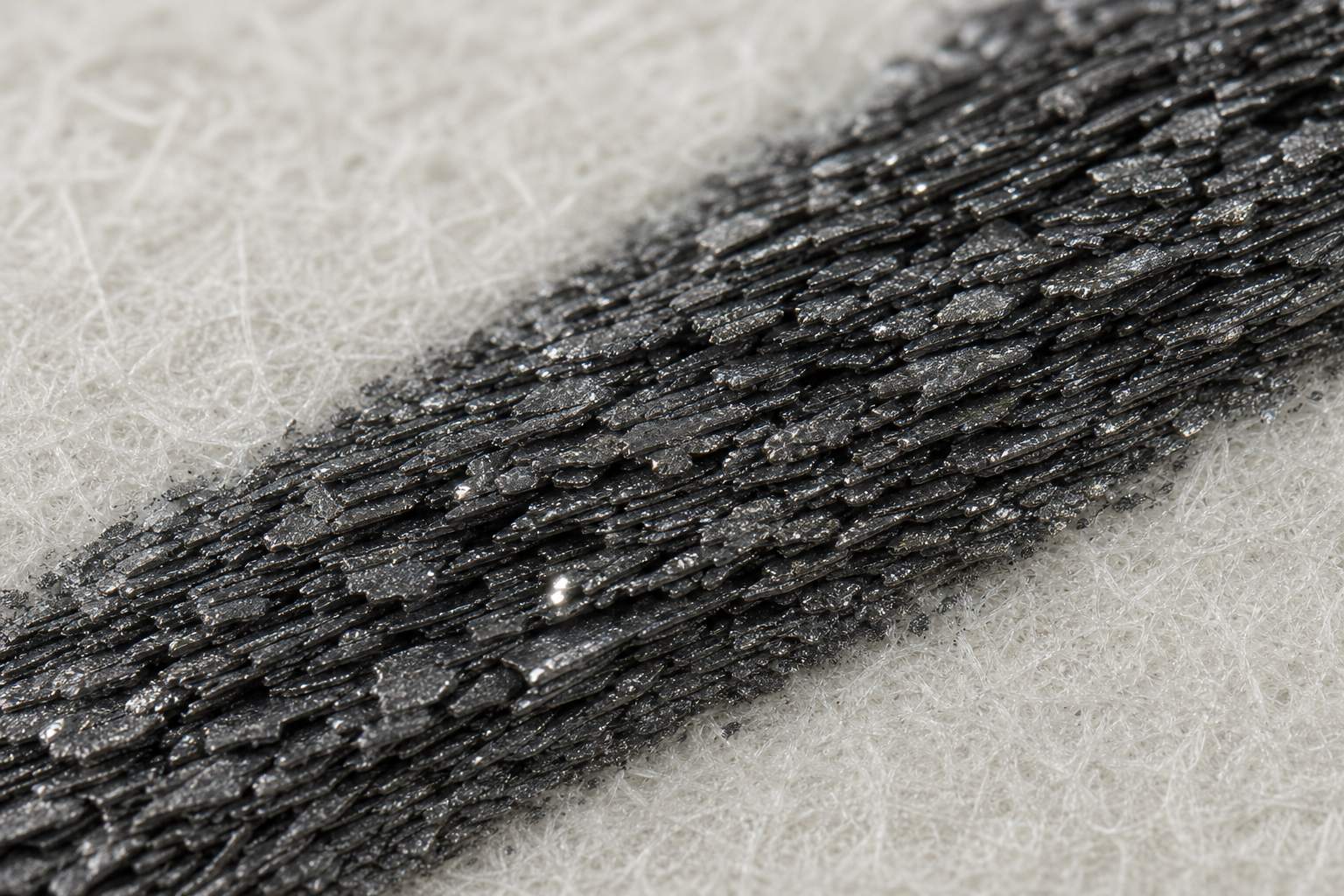
Draw a line with a pencil and you leave behind flakes of graphite. Among them may be a few pieces just one atom thick. That is graphene.
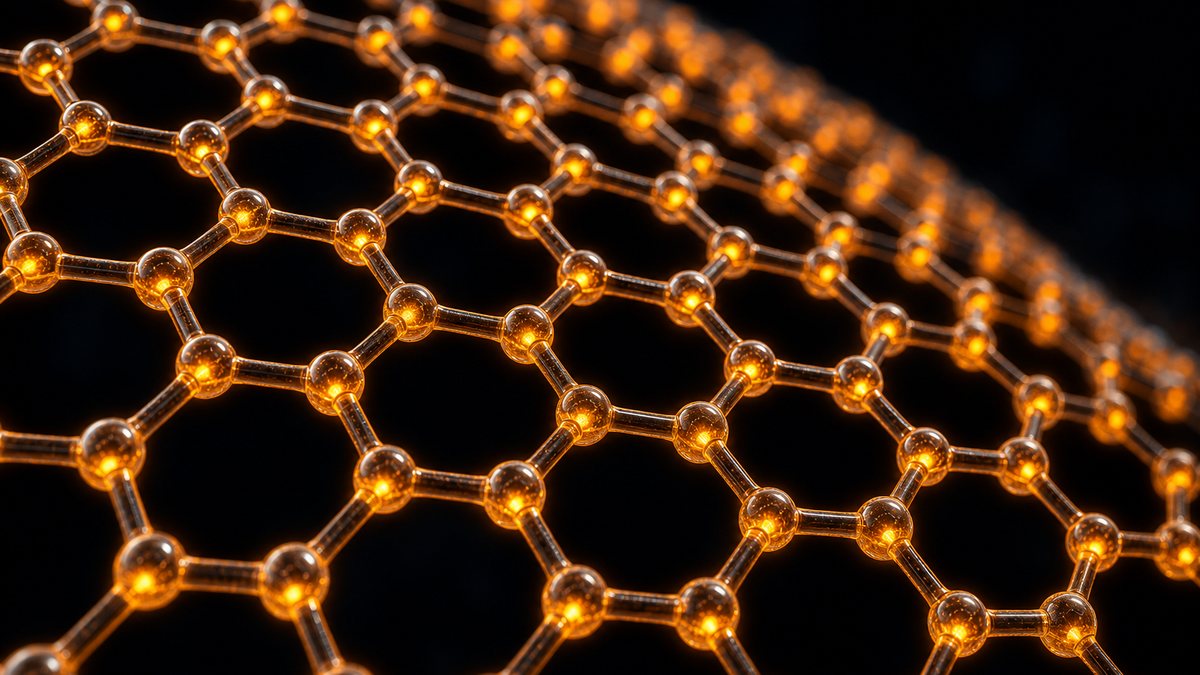
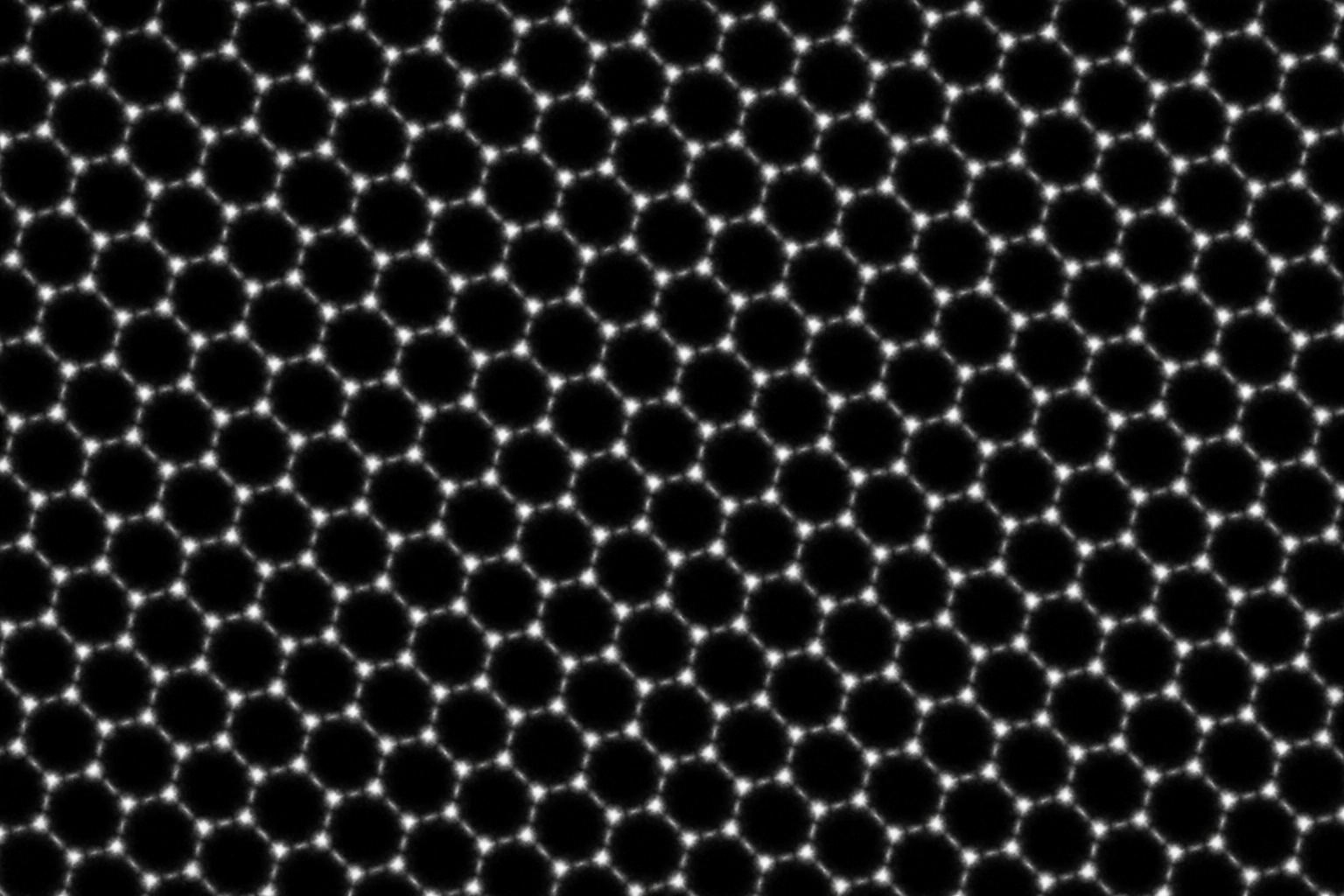
Graphene is a single sheet of carbon atoms, joined in a honeycomb of hexagons. It was first isolated in 2004, and won its discoverers a Nobel Prize six years later.
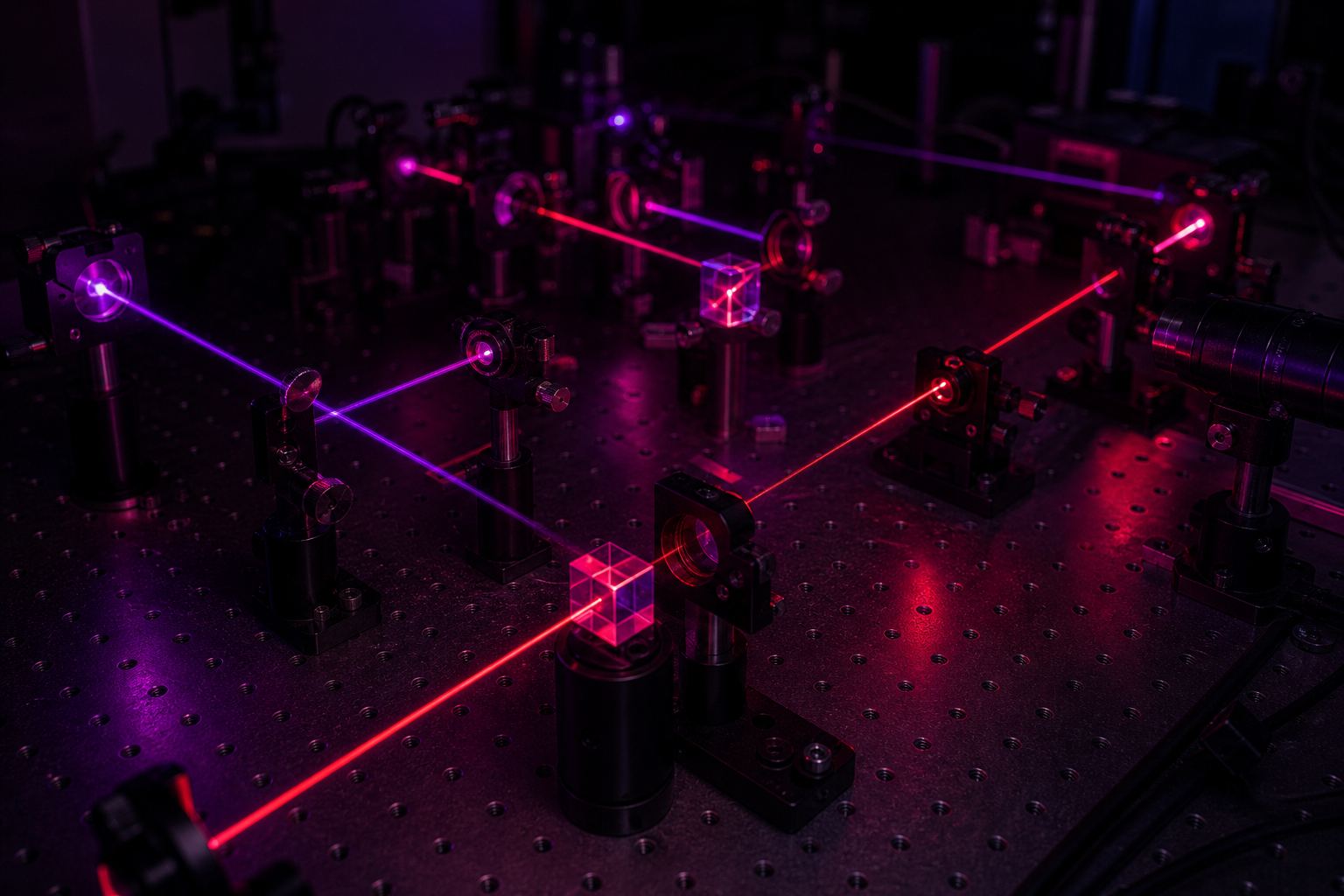
In late October it was back in the news. A team from Regensburg, Marburg and Jülich in Germany published in Nature a slow-motion film of electrons in graphene, jumping between energy levels.
So what is this material? Let us start with carbon.
A pencil line, magnified Flat, shiny flakes lie on the paper like fish scales: each is a stack of carbon sheets. AI-generated illustration.
1 atom
thick
2004
first isolated, Manchester
2010
Nobel Prize in Physics
Graphene in three numbersThe news, October 2026 An ultrafast laser table: strong, very short bursts of light push the electrons, and a microscope records where they go. AI-generated illustration.
five of carbon’s shapes
sticky tape and a Nobel Prize
strong, clear, sealed
electrons with no mass, and no chips
what it is used for today
In this film
Prologue
The news
University of Regensburg (28 October 2026): a team from Regensburg, Marburg and Jülich published “Subcycle videography of Landau–Zener–Majorana transitions in graphene” in Nature, filming electrons as they cross between energy bands. Nobel Prize in Physics 2010: awarded to Andre Geim and Konstantin Novoselov “for groundbreaking experiments regarding the two-dimensional material graphene”, isolated in 2004.
Press the button to let the sheet ripple or hold still.
The 3D scenes are simplified teaching models: atoms are drawn as balls, bonds as sticks, and nothing is to scale.
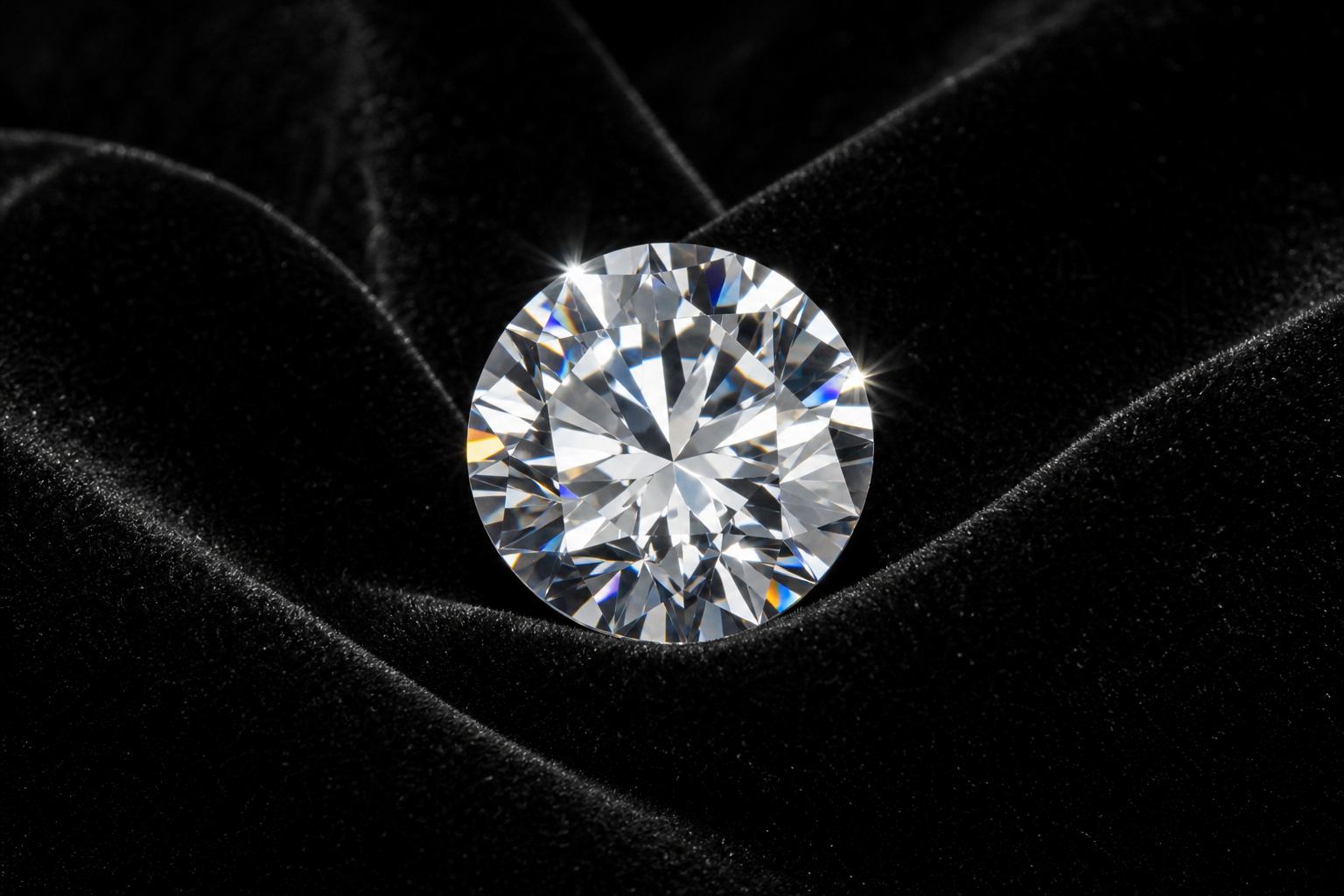
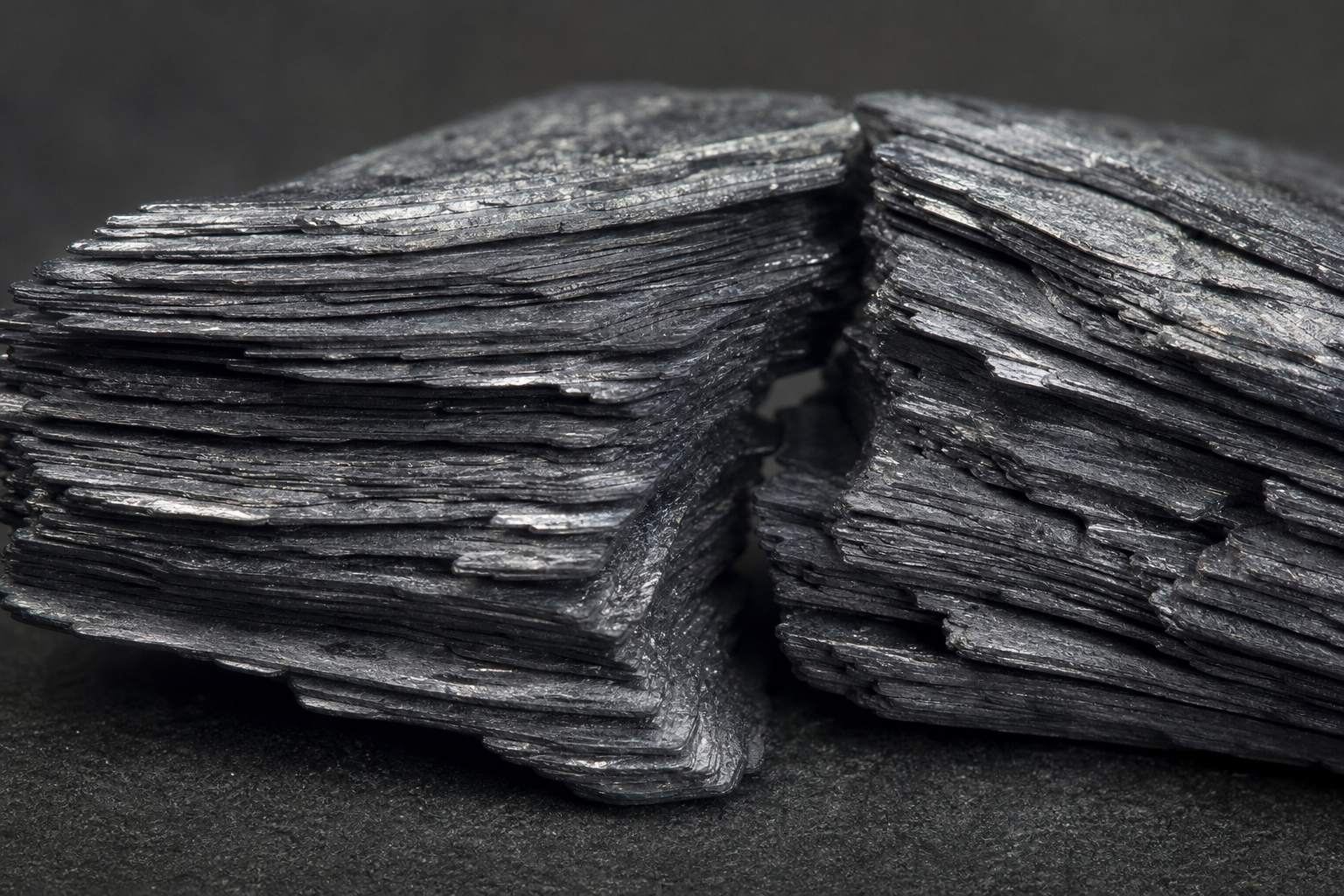
Carbon can build very different materials from the same atoms. In diamond, the atoms lock into a hard, clear crystal. In graphite, the soft grey stuff of pencils, they form flat sheets, stacked like the pages of a book.
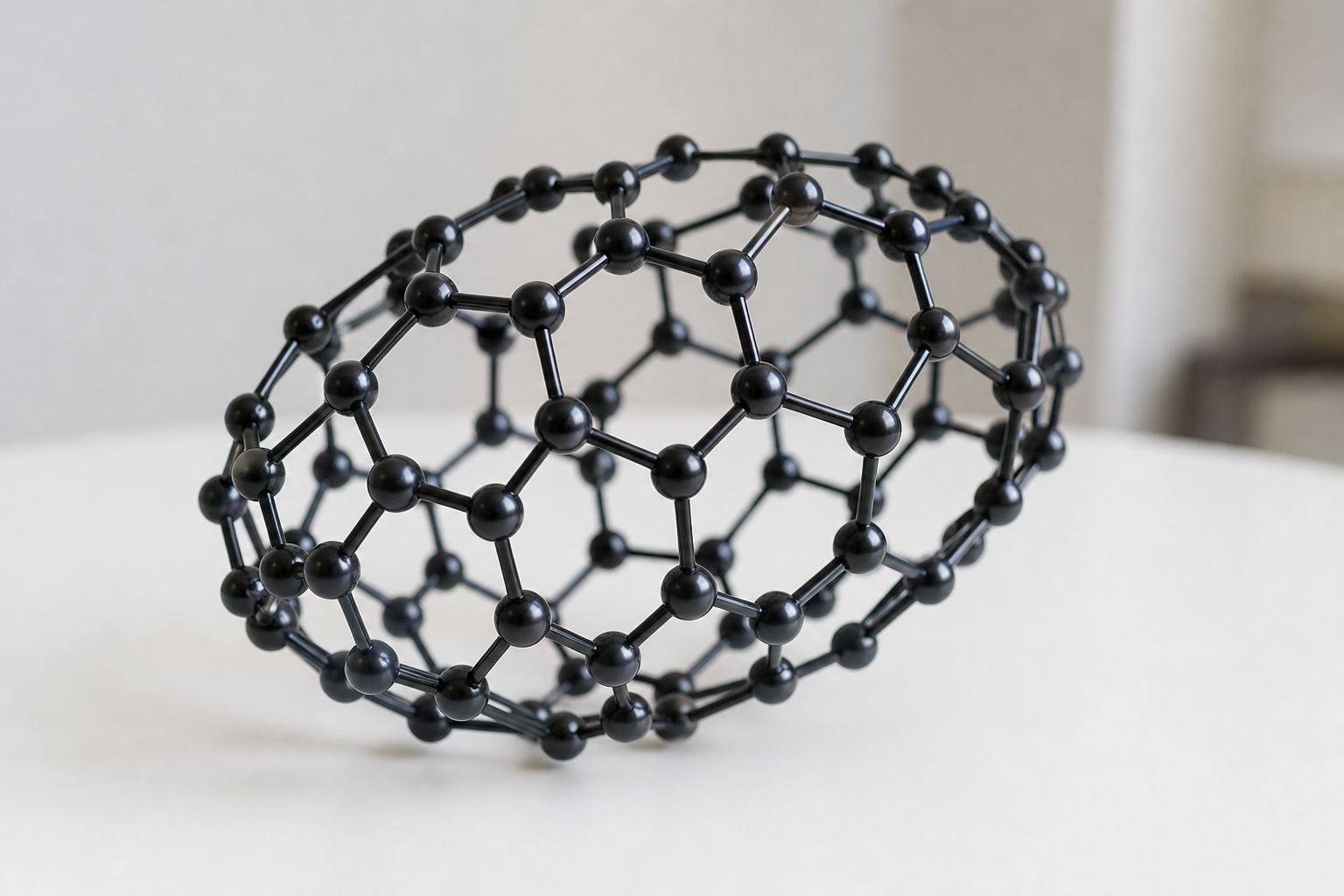
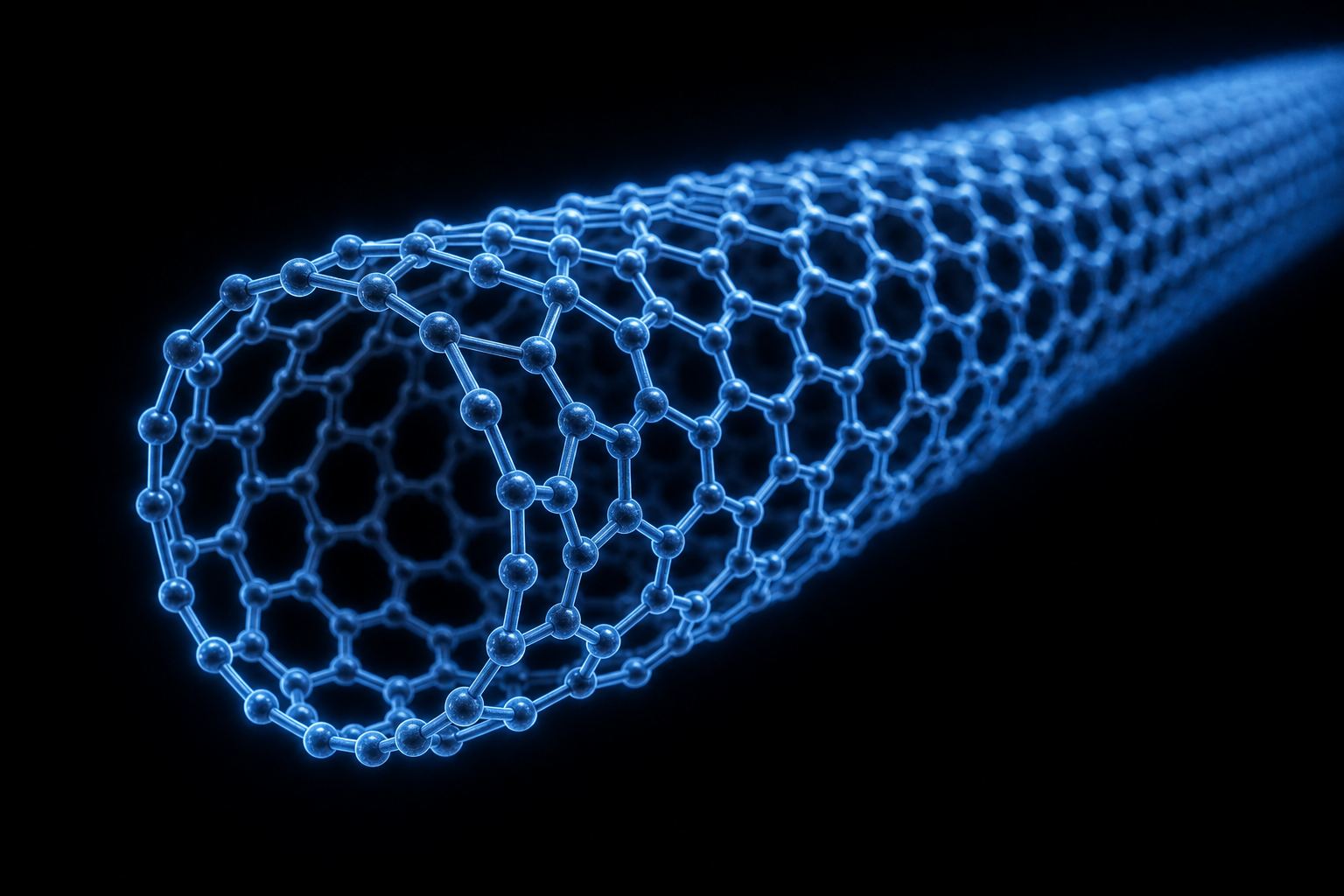
In 1985, chemists found a ball of sixty carbon atoms shaped like a football. In 1991, a paper in Nature described needle-like tubes of rolled-up carbon sheets.
Graphene is the simplest of them all: one flat sheet, on its own.
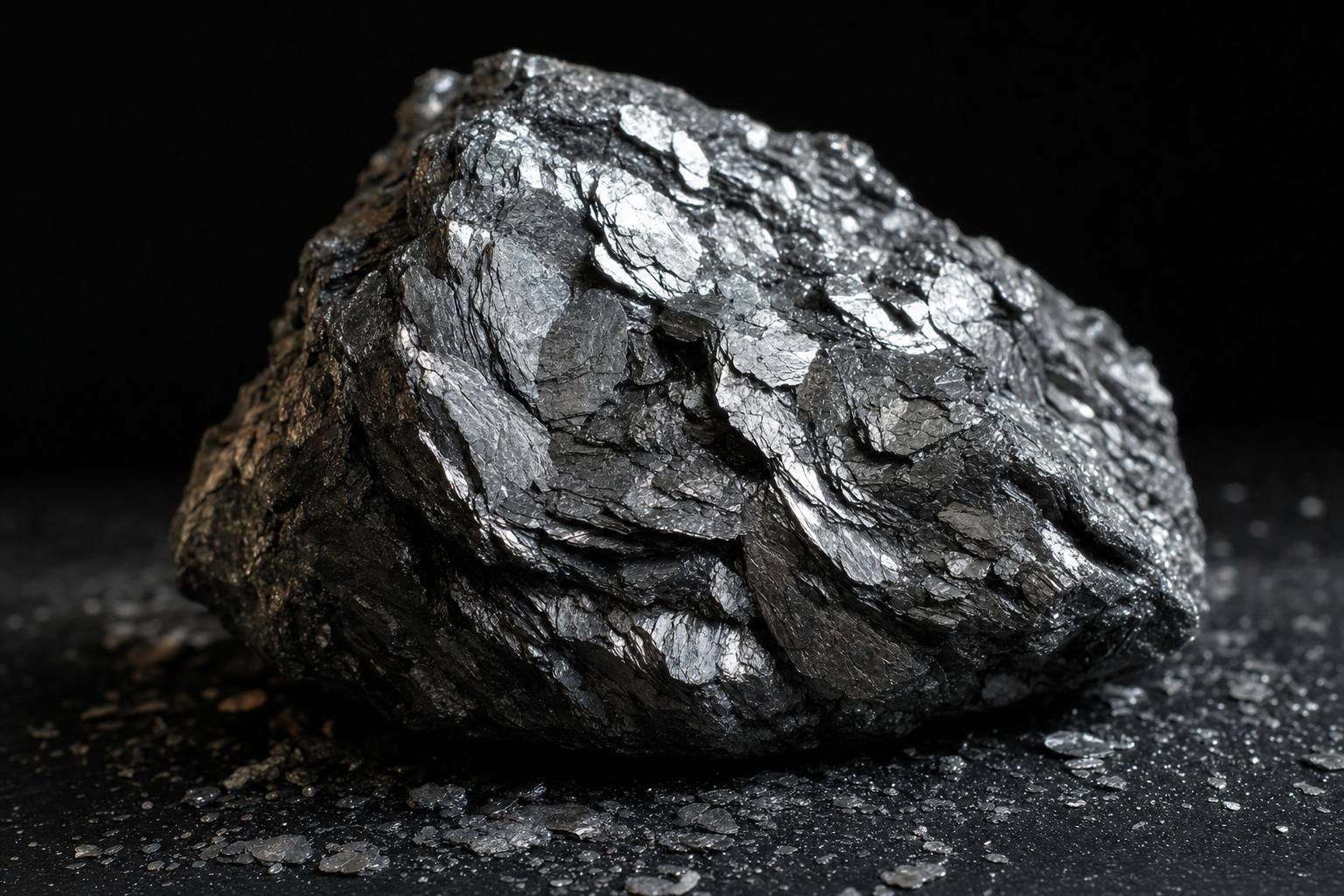
Diamond Pure carbon, cut and polished: the same element as a pencil lead. AI-generated illustration.Where it comes out of the ground Graphite was once called plumbago and taken for a lead ore; pencil lead has never contained any lead. AI-generated illustration.The football molecule C60: 20 hexagons and 12 pentagons, the pattern of a football. Its discovery won the 1996 Nobel Prize in Chemistry. AI-generated illustration.A carbon nanotube A graphene-like sheet rolled into a seamless tube a few nanometres across. AI-generated illustration.
Chapter I · Carbon’s many shapes
The forms of carbon
Nobel Prize in Chemistry 1996 (press release): before fullerenes, six crystalline forms of carbon were known — two kinds of graphite, two kinds of diamond, chaoit and carbon(VI). Robert Curl, Harold Kroto and Richard Smalley discovered fullerenes in 1985; C60 has 60 atoms in 20 hexagons and 12 pentagons, the pattern of a football; the release notes that thin tubes with closed ends have since been produced. Nature 354, 56 (November 1991), “Helical microtubules of graphitic carbon”: needle-like tubes of 2 to about 50 coaxial graphitic tubes. Nobel 2010 popular information: graphene is a single layer of carbon in a hexagonal lattice.
The buttons switch between the five forms. Diamond is drawn as its atoms’ framework, not a cut gem.
The 3D scenes are simplified teaching models: atoms are drawn as balls, bonds as sticks, and nothing is to scale.
One millimetre of graphite holds about three million of these sheets. Inside each sheet, neighbouring atoms sit just 0.142 nanometres apart, bonded to three others.
The sheets themselves are 0.335 nanometres apart: more than twice as far.
Peel off a single sheet, and you are left with a material that is, quite literally, two-dimensional: as wide as you like, and one atom thick.
Graphite, split open Thin flat layers peel apart along the grain, like the pages of an old book. AI-generated illustration.
0.142 nm
between neighbouring atoms
0.335 nm
between sheets in graphite
3 million
sheets in 1 mm of graphite
Sizes in a sheetOne layer, seen atom by atom In the style of an atomic-resolution image: every dot a carbon atom, every ring a hexagon of six. AI-generated illustration.
Chapter I · Carbon’s many shapes
Graphite and graphene
Nobel 2010 popular information: one millimetre of graphite contains three million layers of graphene. Nobel 2010 scientific background: the carbon–carbon distance in graphene is 0.142 nm and the interlayer spacing of graphite is 3.35 Å (0.335 nm). Each atom in the hexagonal lattice has three neighbours. “More than twice as far” is the film’s own comparison (0.335 ÷ 0.142 ≈ 2.4).
Press “Peel one layer” to lift the top sheet off the stack; the readout gives the thickness that remains.
The 3D scenes are simplified teaching models: atoms are drawn as balls, bonds as sticks, and nothing is to scale.
Before 2004, many physicists believed that a single layer of graphite could not be isolated in a form you could measure.
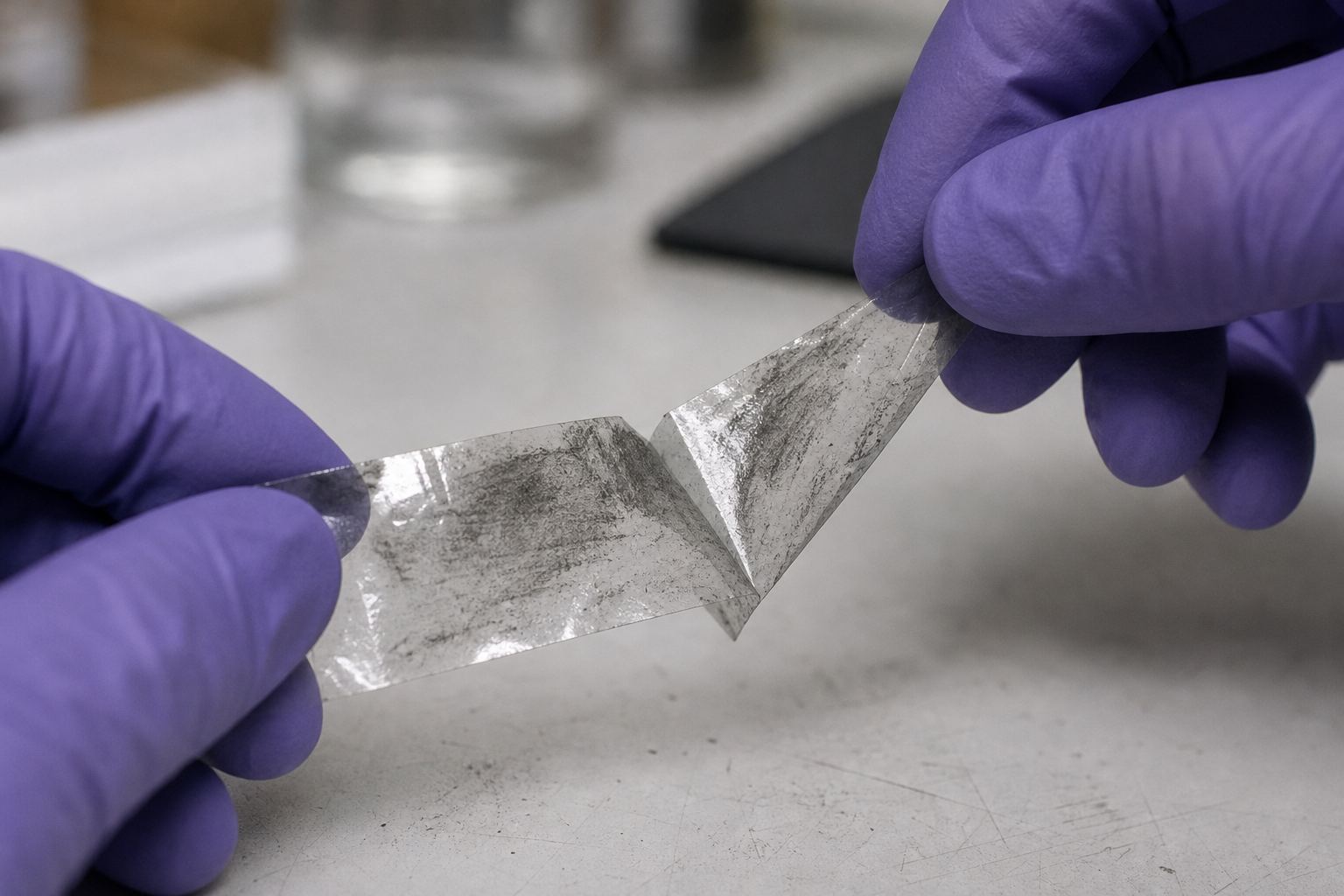
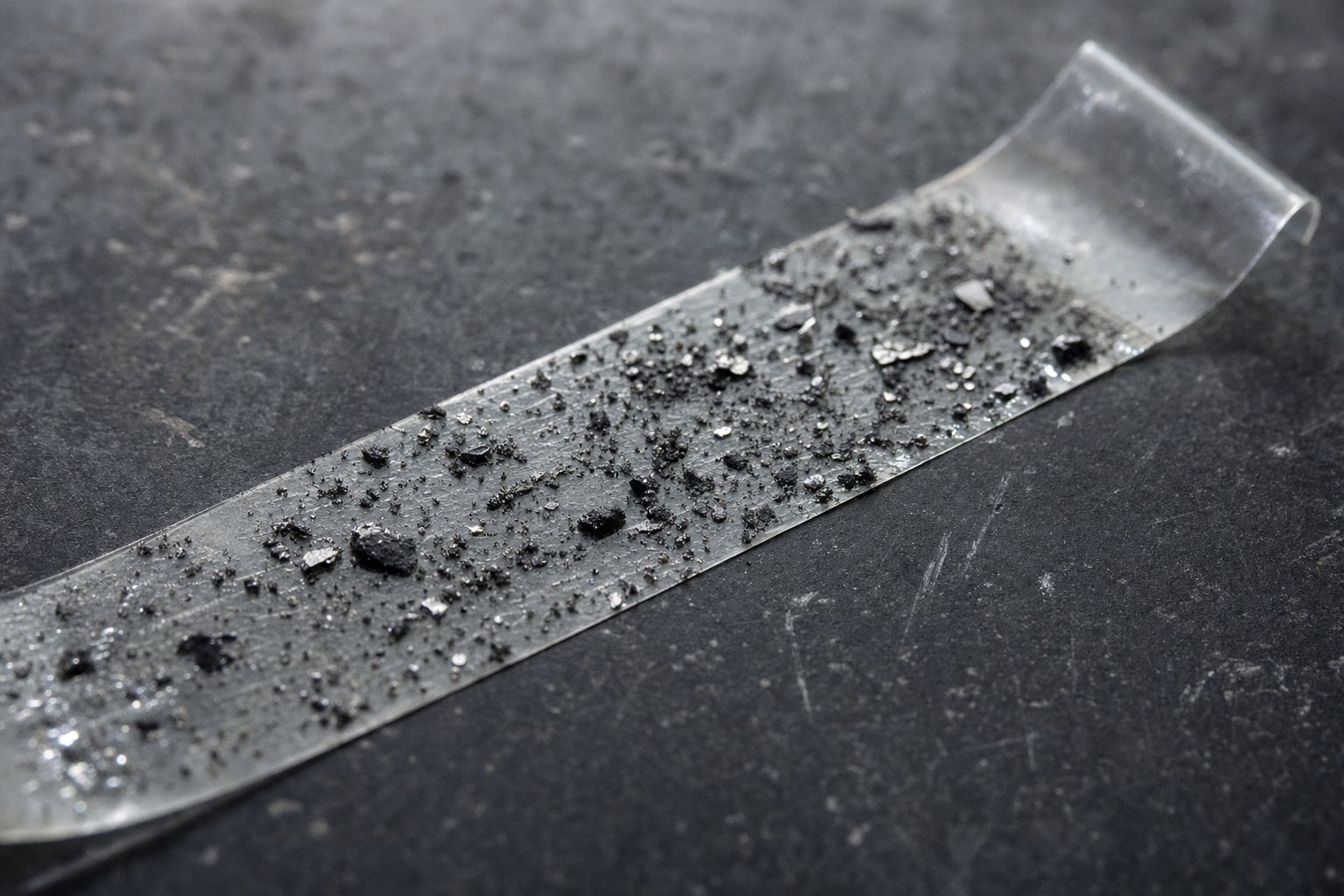
At the University of Manchester, Andre Geim and Konstantin Novoselov tried something simple. They pressed adhesive tape onto graphite and peeled it off, again and again, ten or twenty times, until the flakes were very thin.
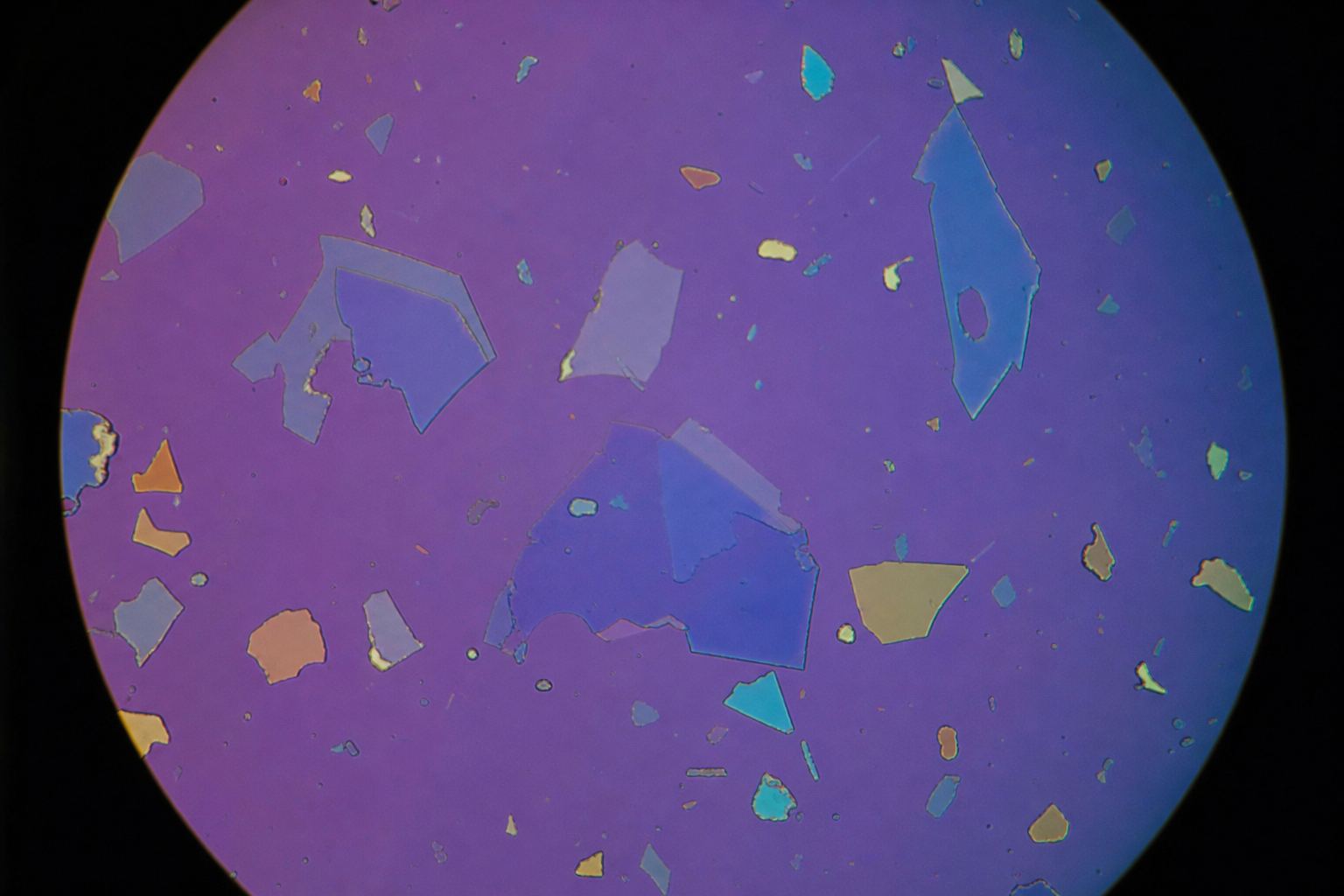
Then they pressed the flakes onto oxidised silicon. On that surface, even the thinnest flakes show up under an ordinary microscope, as faint patches of colour.
Tape and graphite Fold, press, peel, repeat: each peel splits the flakes into thinner ones. AI-generated illustration.
press tape onto graphite
peel off; repeat 10–20 times
press the flakes onto oxidised silicon
look for faint colour under a microscope
The methodWhat is left on the tape The trick has a formal name, mechanical exfoliation, and it still gives the cleanest flakes anyone can make. AI-generated illustration.Finding a flake Light reflecting from the silicon and its oxide layer makes even a one-atom flake change the colour slightly. AI-generated illustration.
Chapter II · Sticky tape
Isolating graphene
Nobel 2010 scientific background: before 2004 it was believed that a single layer of graphite could not be isolated in measurable form. Nobel 2010 popular information: Geim and Novoselov used ordinary adhesive tape to peel thin flakes from graphite, repeating the process 10 to 20 times, and placed the flakes on oxidised silicon, where thin flakes appear in colours under an ordinary microscope. The result was published in Science in October 2004.
Press “Peel with tape” to halve the flake each time; count how many peels it takes to reach one layer.
The 3D scenes are simplified teaching models: atoms are drawn as balls, bonds as sticks, and nothing is to scale.
Their paper appeared in the journal Science in October 2004. In 2010, Geim and Novoselov shared the Nobel Prize in Physics. Novoselov was thirty-six.
The theory was far older. In 1947, the physicist P. R. Wallace had worked out how electrons would move in a single sheet of graphite, as a textbook exercise. Nobody expected to hold one.
Geim, by the way, had also levitated a frog with a magnet, and won a joke prize for it, the Ig Nobel, in 2000.
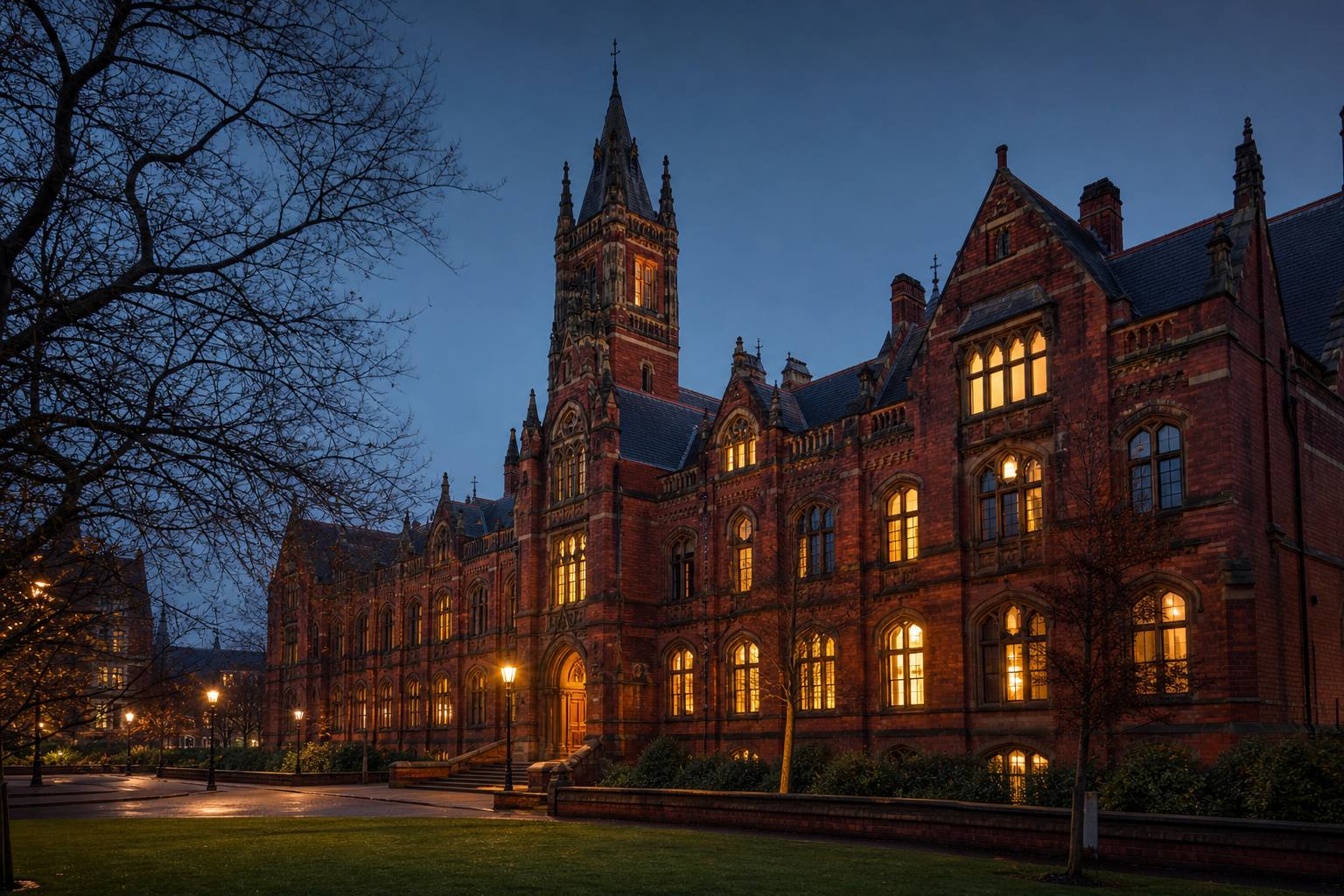
Manchester A red-brick university building of the kind that houses the Manchester physics labs. AI-generated illustration.
1947 P. R. Wallace’s theory of a single sheet
Oct 2004 graphene isolated; paper in Science
5 Oct 2010 Nobel Prize in Physics announced
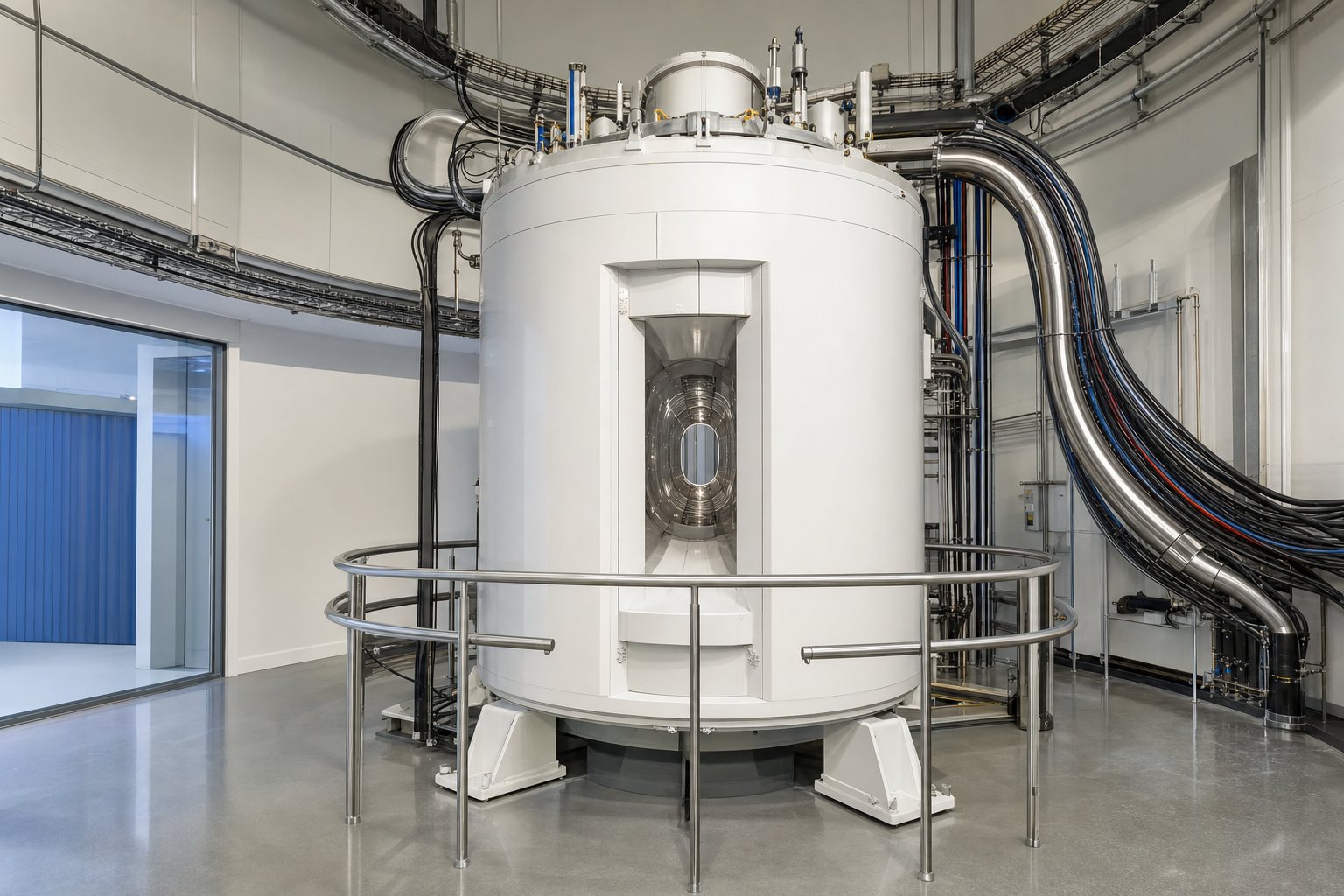
From a calculation to a prizeThe magnet in the basement A magnet like this floated a live frog in 1997, by leaning on the faint way water is pushed out of a magnetic field. AI-generated illustration.Two prizes An Ig Nobel in 2000 for the floating frog, and a Nobel ten years later for graphene. AI-generated illustration.
Chapter II · Sticky tape
The prize
Nobel Prize press release (5 October 2010): the Nobel Prize in Physics 2010 to Andre Geim (born 1958) and Konstantin Novoselov (born 1974), both at the University of Manchester, shared equally. Nobel scientific background: P. R. Wallace studied graphene theoretically in 1947 as a textbook example and worked out its electronic structure. Nobel popular information: Geim levitated a frog in 1997 and won an Ig Nobel Prize in 2000.
The 3D scenes are simplified teaching models: atoms are drawn as balls, bonds as sticks, and nothing is to scale.
Graphene is the thinnest material known, and one of the strongest. In 2008, engineers at Columbia University pressed a tiny diamond tip into a sheet stretched over a hole, until it broke.
By the Nobel committee’s reckoning, that makes it more than a hundred times stronger than the strongest steel. Their picture: a hammock of graphene one metre square, lighter than a cat’s whisker, could hold an average-sized cat.
And it can stretch by up to a fifth of its length.
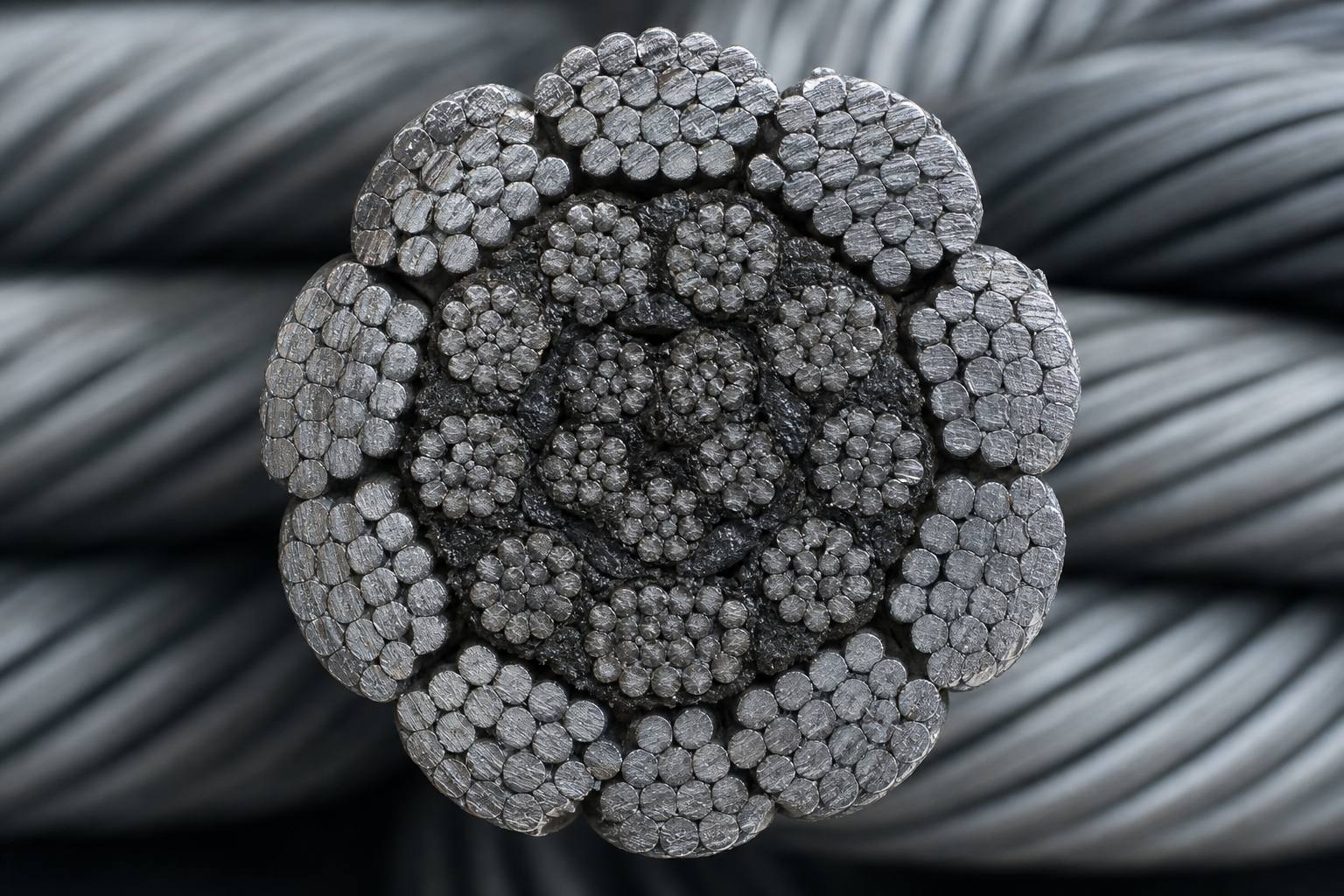
Steel, for comparison A braided steel cable: graphene’s breaking strength per sheet beats any steel of the same thickness. AI-generated illustration.
42 N/m
breaking strength of one sheet
20,000 N
a force like the weight of a 2-tonne car, to push a pencil through a cling-film-thick sheet (estimate)
Columbia University, 2008The Nobel committee’s cat An almost invisible hammock: a sheet a metre square, lighter than one of the cat’s own whiskers. AI-generated illustration.
>100×
stronger than the strongest steel
By the Nobel committee’s reckoning
20%
longer before it breaks
Stretch
Chapter III · Thin and strong
How strong?
Physics World (2008): Changgu Lee, Xiaoding Wei, Jeffrey Kysar and James Hone at Columbia University (Science 321, 385) indented graphene sheets suspended over holes with an atomic-force-microscope tip and measured a breaking strength of 42 N/m; Hone estimated that a sheet as thick as cling film would need a force of over 20,000 N — the weight of a 2,000 kg car — to be punctured with a pencil. Nobel scientific background: graphene is more than 100 times stronger than the strongest steel. Nobel illustrated information: a 1 m² hammock, no heavier than a cat’s whisker, could bear an average-sized cat. Nobel popular information: graphene can be stretched by up to 20%. (The University of Manchester gives “200 times stronger than steel”.)
Press “Add weight” to load the membrane; the sag is exaggerated for the eye.
The 3D scenes are simplified teaching models: atoms are drawn as balls, bonds as sticks, and nothing is to scale.
Graphene is nearly transparent. A single layer absorbs only 2.3 percent of the light that falls on it, so you can see straight through.
It conducts electricity as well as copper, and heat better than any other material known.
And its atoms are packed so tightly that not even helium, the smallest gas atom, can squeeze through.
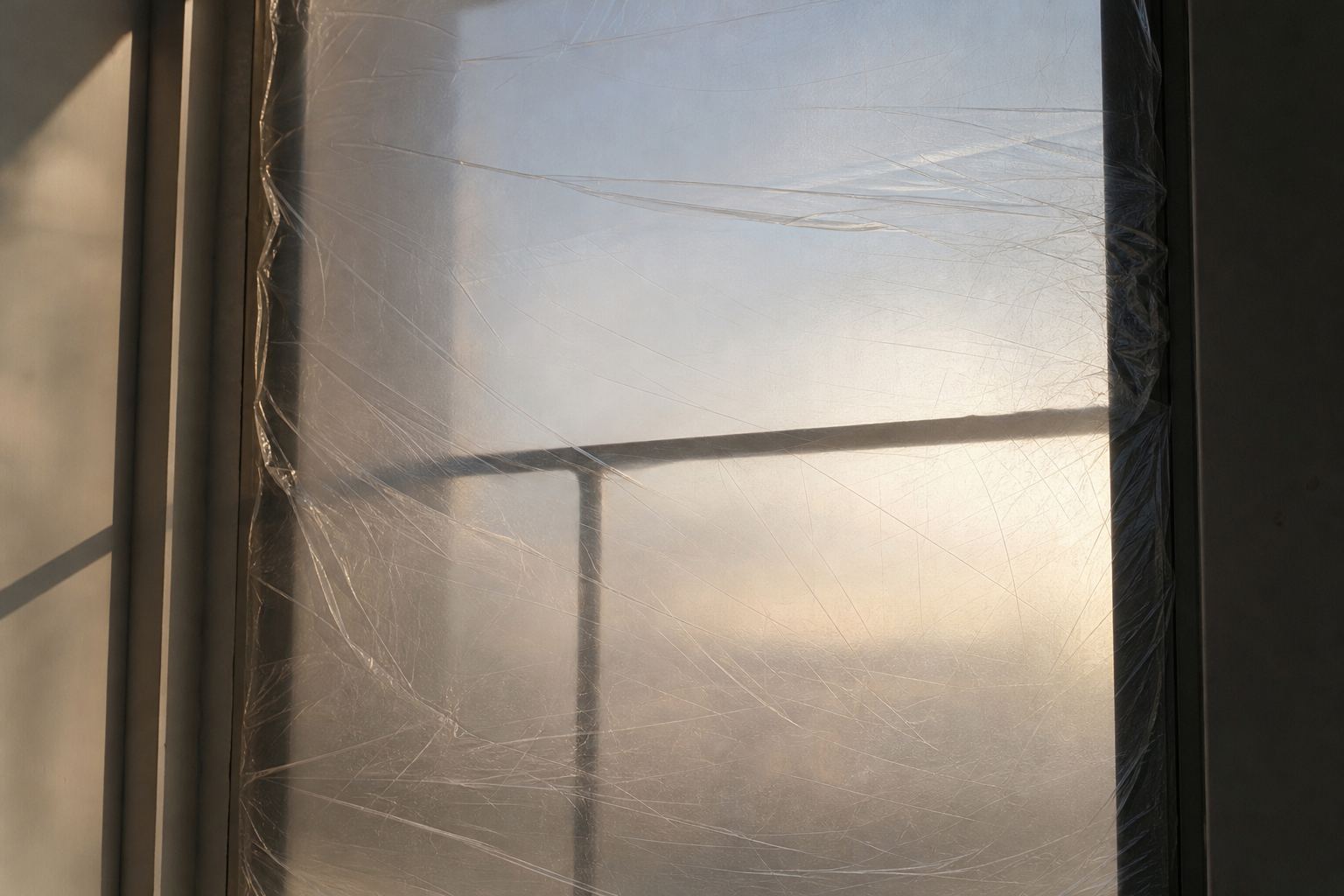
Almost invisible A single layer over a window would let through about 97.7 percent of the light. AI-generated illustration.Tn=(1−0.023)n
Tn
share of light let through by n layers
0.023
absorbed by one layer
Five layers still let through about 89 percent: the film’s own arithmetic, ignoring reflection.Thin enough to show its colours Interference colours are how a single sheet is spotted: on the right thickness of oxide it becomes visible to the eye. AI-generated illustration.Helium cannot pass Helium is the smallest gas atom; even it cannot cross a perfect graphene sheet. AI-generated illustration.
absorbs 2.3% of light
conducts electricity as well as copper
conducts heat better than silver or copper
stops even helium
One sheet of carbon
Chapter III · Thin and strong
Light, heat and gas
Nobel scientific background: graphene absorbs 2.3% of incident light (πα, where α is the fine-structure constant), independent of wavelength in the optical range. Nobel popular and press information: it conducts electricity as well as copper, conducts heat better than all other known materials, and is so dense that not even helium, the smallest gas atom, can pass through it. The transmission formula ignores reflection and is the film’s own simplification.
Choose 1, 2, 5 or 10 layers and watch how much of the beam comes out the far side.
The 3D scenes are simplified teaching models: atoms are drawn as balls, bonds as sticks, and nothing is to scale.
The strangest thing about graphene is how its electrons move. Momentum is, roughly, mass times speed. In an ordinary solid, plot an electron’s energy against its momentum and you get a curve shaped like a bowl.
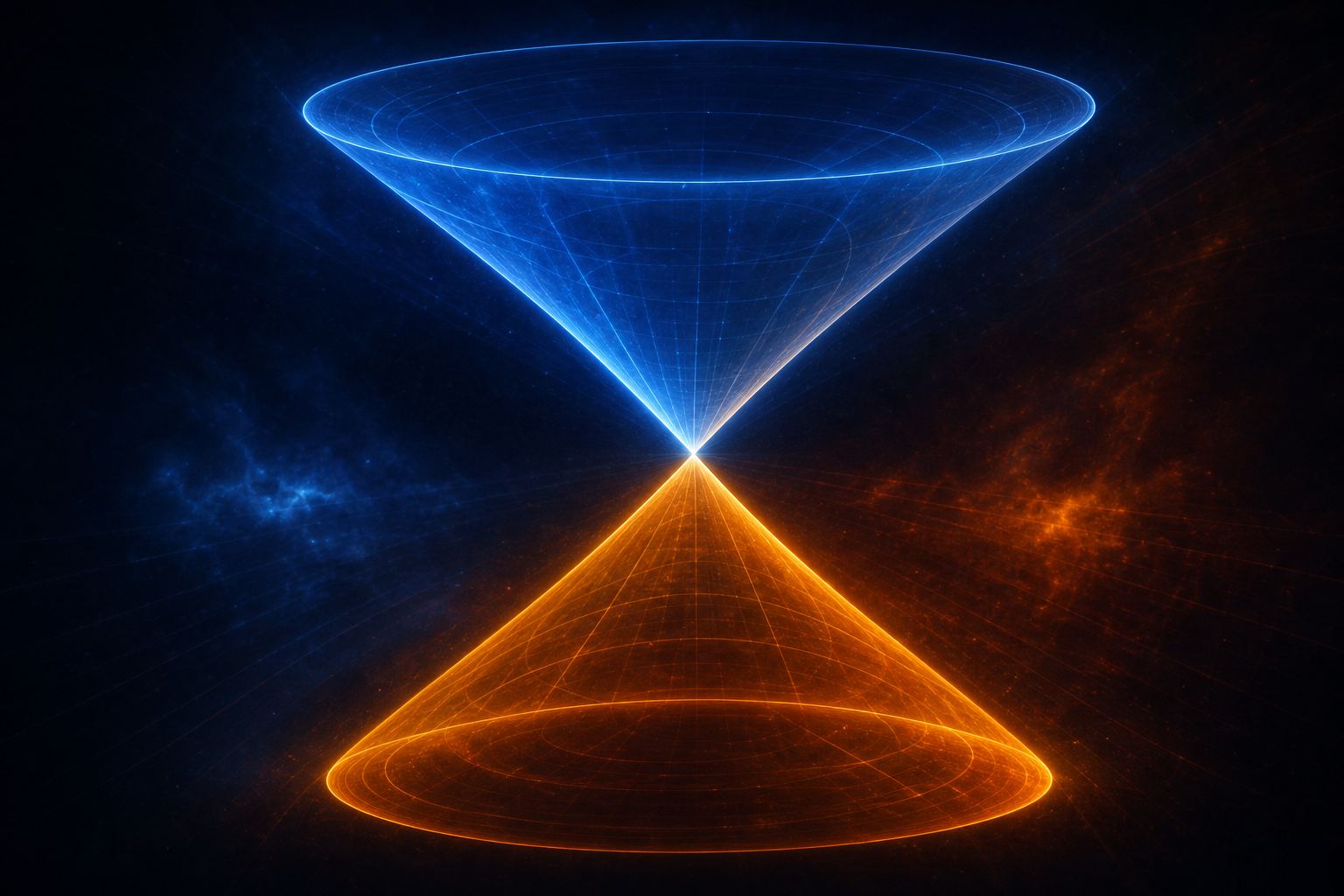
In graphene, near the energies where its electrons actually sit, the line is straight instead, as if the electron had no mass at all. Plotted in full, it makes two cones touching at their tips.
These electrons move at a steady speed of about a thousand kilometres a second: fast, but three hundred times slower than light.
E∝p2(ordinary solid)E∝∣p∣(graphene)
E
energy
p
momentum
A curve in most materials, a straight line in graphene: the straight line is what physicists call massless.Dirac cones The upper cone holds empty states, the lower one full states; they meet at the Dirac point. AI-generated illustration.
~1,000 km/s
their constant speed
1/300
of the speed of light
Electrons in grapheneAlways the same speed Massless carriers do not speed up or slow down with energy: like light, they all move at one speed. AI-generated illustration.
Chapter IV · Electrons without mass
Massless electrons
Nobel scientific background: near the Fermi level the energy of graphene’s electrons rises linearly with momentum, so their effective mass is zero; the bands form double cones meeting at Dirac points; the linear behaviour holds up to about 1 eV. Wallace noted the linear dispersion in 1947. Nobel illustrated and popular information: the electrons behave as if massless and move at a constant speed of about 1,000 km/s. The ratio of 300 is the film’s own arithmetic (300,000 ÷ 1,000). The ordinary-solid formula is the textbook free-electron picture.
Press “Send an electron” to watch one ride the cone; switch to “Ordinary solid” to see the bowl.
The 3D scenes are simplified teaching models: atoms are drawn as balls, bonds as sticks, and nothing is to scale.
Where the two cones touch, there is no gap at all between the filled states and the empty ones. That is wonderful for physics, and a problem for computers.
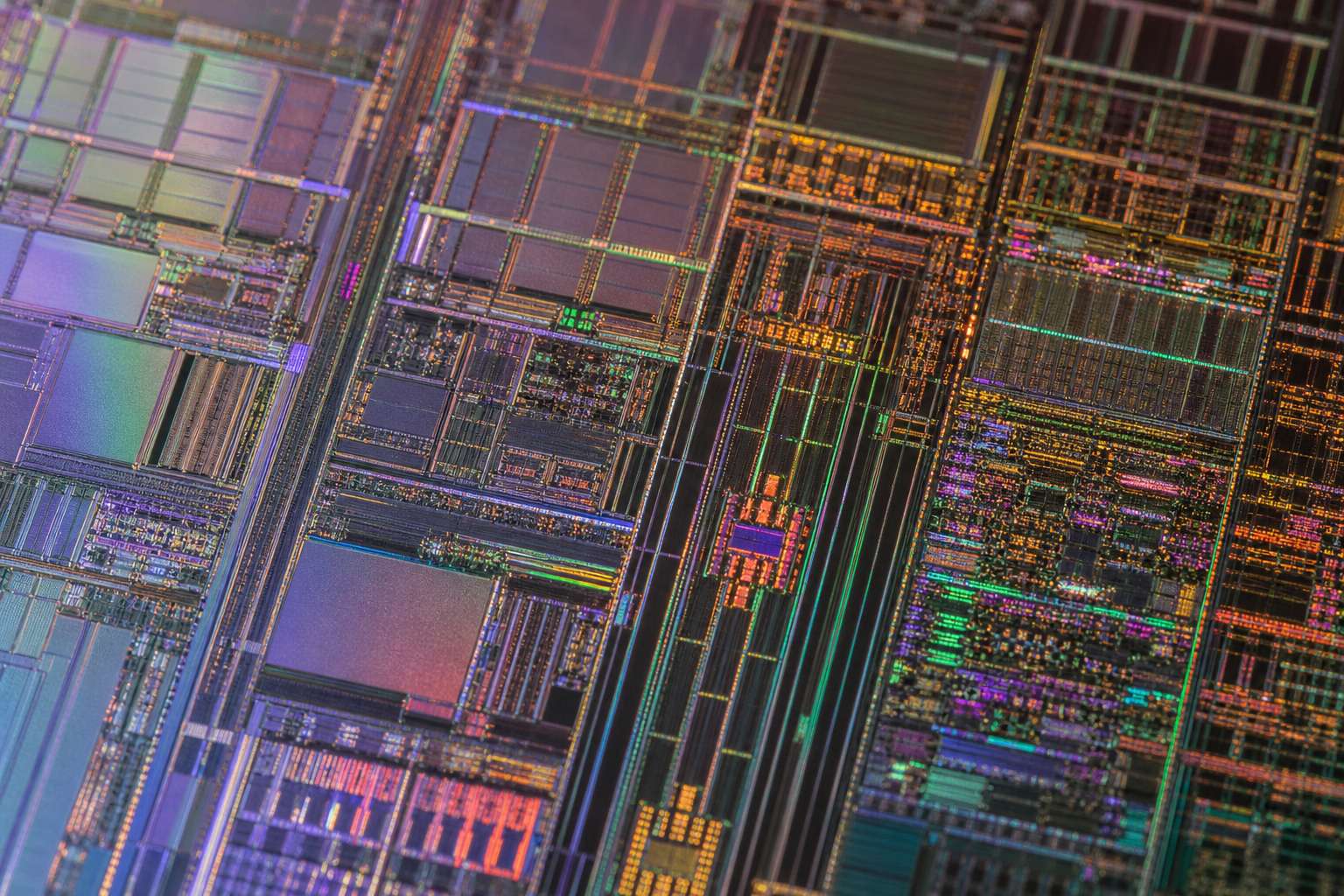
A transistor in a chip is a switch. Silicon has an energy gap, a band gap, which lets a transistor turn the current almost completely off.
Graphene has none. A gap can be engineered into it, but for digital logic, as IEEE Spectrum put it, graphene is not the path of least resistance.
Half on, half off A switch that cannot turn off keeps leaking current; a chip holds billions of switches. AI-generated illustration.Still silicon Today’s processors are silicon: its band gap is what lets each of their transistors switch off. AI-generated illustration.
silicon: a band gap, so a transistor can switch off
graphene: no gap, so current keeps flowing
a gap can be engineered, at a cost
Gap or no gap
Chapter IV · Electrons without mass
The missing gap
Nobel scientific background: in undoped graphene the Fermi level sits at the tips of the cones, where the density of states is zero — the bands touch. IEEE Spectrum (2015): graphene lacks a band gap; a band gap has been successfully engineered into graphene, but digital logic is “not the path of least resistance” for it.
Switch between silicon and graphene, then press “Switch off”: only the material with a gap stops the current.
The 3D scenes are simplified teaching models: atoms are drawn as balls, bonds as sticks, and nothing is to scale.
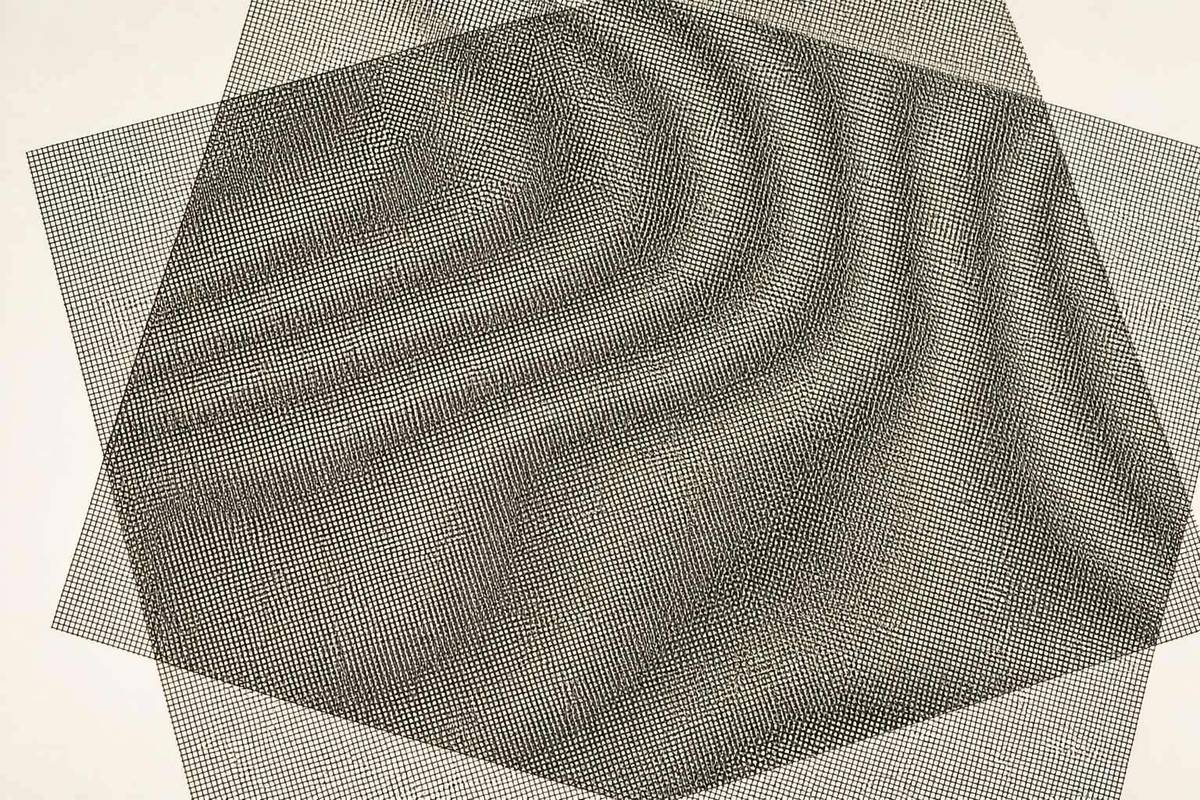
Stack two sheets of graphene and something new can appear. Twist one of them, and the two honeycombs overlap in a large repeating pattern, called a moiré.
In 2018, Pablo Jarillo-Herrero’s group at MIT reported that at a twist of 1.1 degrees, the so-called magic angle, the electrons slow almost to a crawl: their energy is nearly the same whatever their momentum.
The pair became an insulator, a material with a gap of a kind, and with a few extra electrons, a superconductor, which carries current with no resistance. Off by two tenths of a degree, he said, and all the physics is gone.
A moiré you can make at home Two fine meshes, slightly rotated: big bright and dark patches appear that are in neither mesh alone. AI-generated illustration.
1.1°
the magic angle
±0.2°
off by this much, the effect is gone
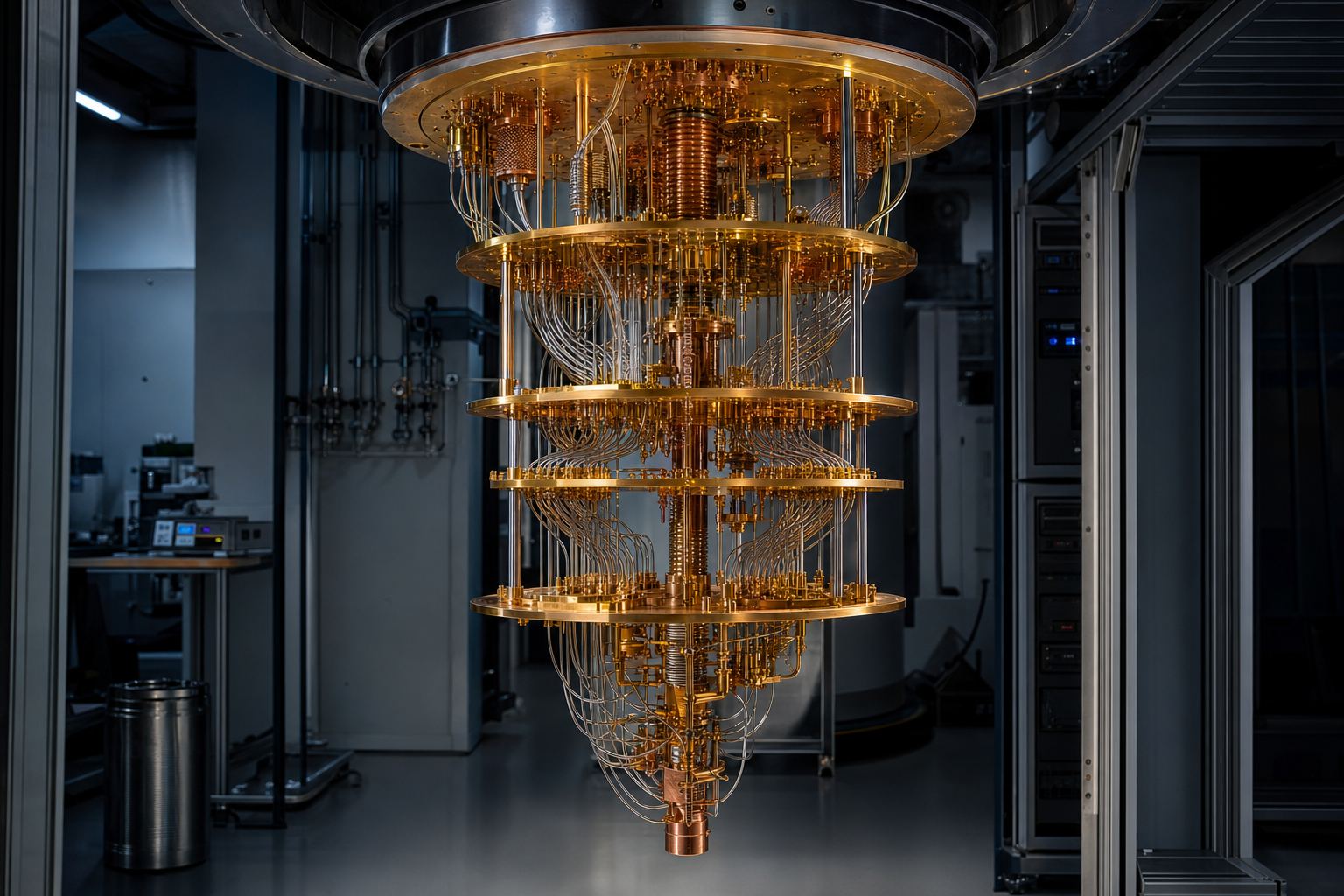
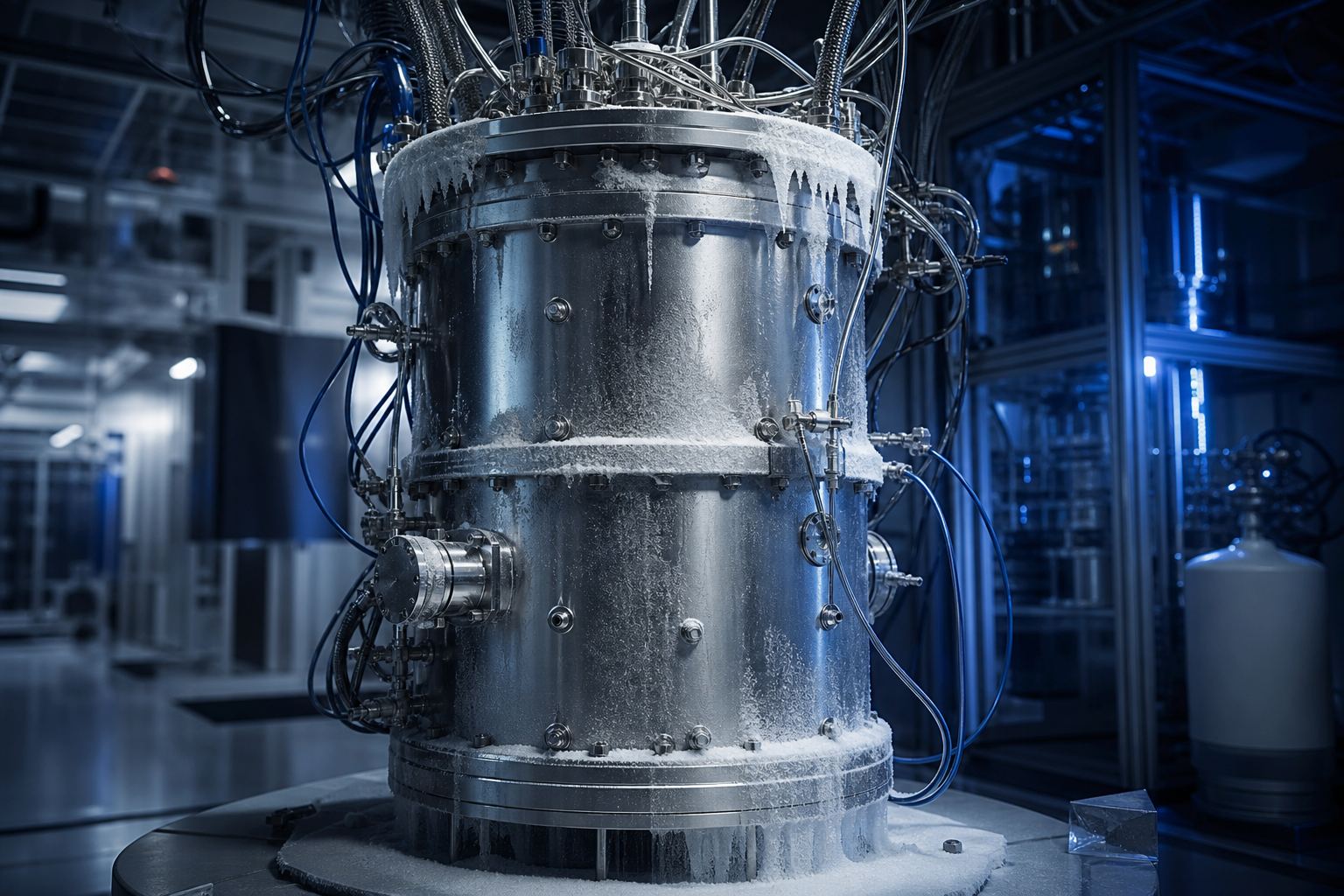
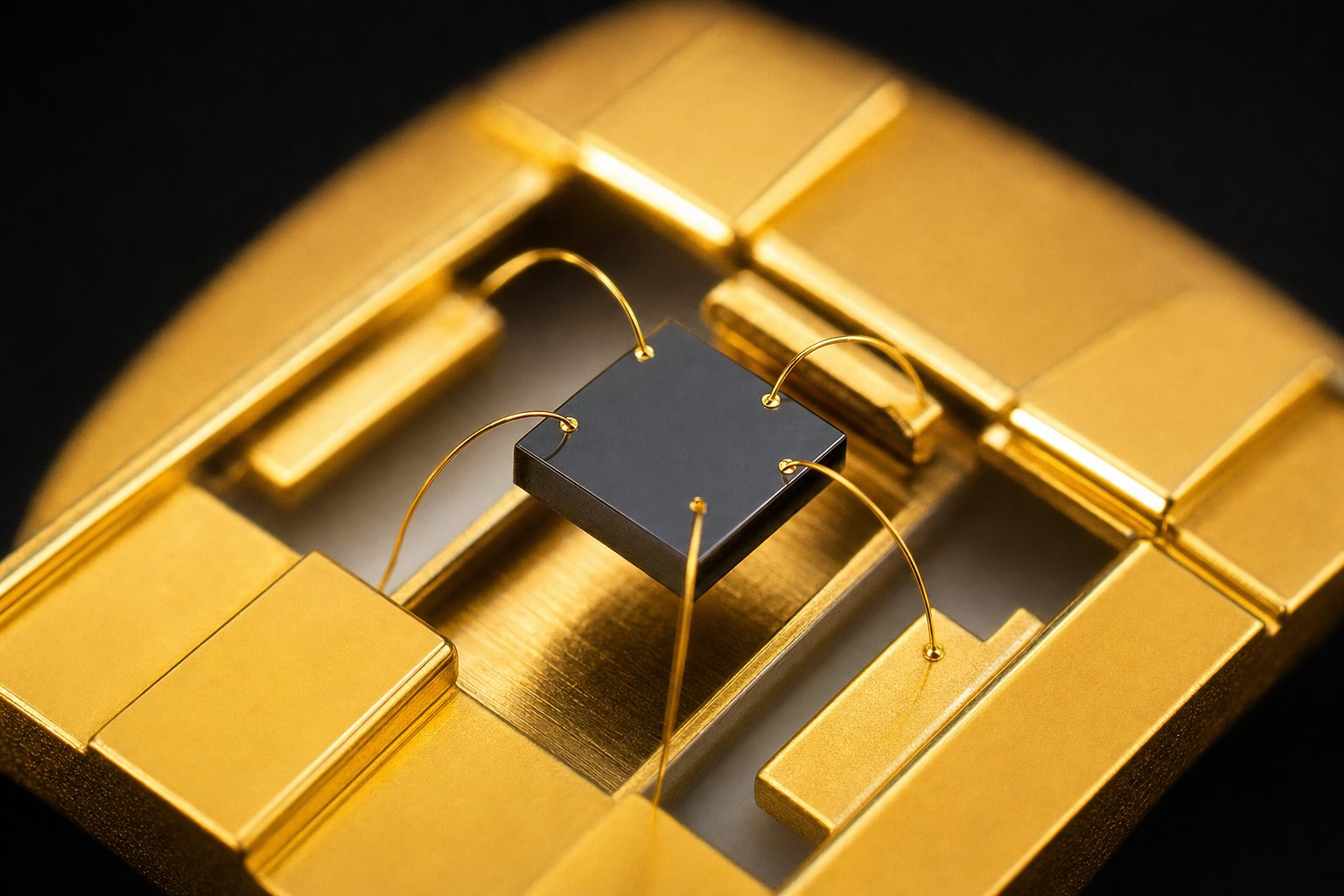
MIT, March 2018Colder than space The magic-angle result appears near 1.7 kelvin, colder than the deep space between the stars. AI-generated illustration.Very cold Superconductivity in twisted graphene appears only near absolute zero, inside a cryostat like this. AI-generated illustration.The stack, wired up A twisted stack is only a few microns across; the gold wires carry the current in and read the voltage out. AI-generated illustration.
Chapter V · Twists and jumps
Twisted bilayer graphene
MIT News (5 March 2018): Pablo Jarillo-Herrero’s group at MIT, with Harvard colleagues, reported in two Nature papers that two graphene sheets twisted to a “magic angle” of 1.1° form a moiré pattern with a flat band, in which electrons have nearly the same energy whatever their momentum; the material behaves as a Mott insulator and, with a few added electrons, as a superconductor. Jarillo-Herrero: “If you are off in your rotation angle by 0.2 degrees, all the physics is gone.” The cryostat caption describes the low temperatures such experiments need; the article does not give the temperature.
Try 0°, 1.1° and 5°: the moiré cells are huge near the magic angle and shrink as the twist grows.
The 3D scenes are simplified teaching models: atoms are drawn as balls, bonds as sticks, and nothing is to scale.
This year brought two new looks inside. At TU Wien in Vienna, a team studied how electrons escape from the surface, and reported doorway states.
To get out, an electron needs enough energy, and it must also sit in the right state. Physics World compares it to a frog, not Geim’s this time, that must jump from the right spot to get through a window.
Single-layer graphene showed none. In graphite, one appears once there are about five layers.
And in October, the Regensburg-led team looked at twisted graphene, where the bands are arranged differently. There, electrons pushed by light jumped across a gap between two bands in a single leap, with a chance of up to one hundred percent.
These are new results from single groups: exciting, but not yet textbook.
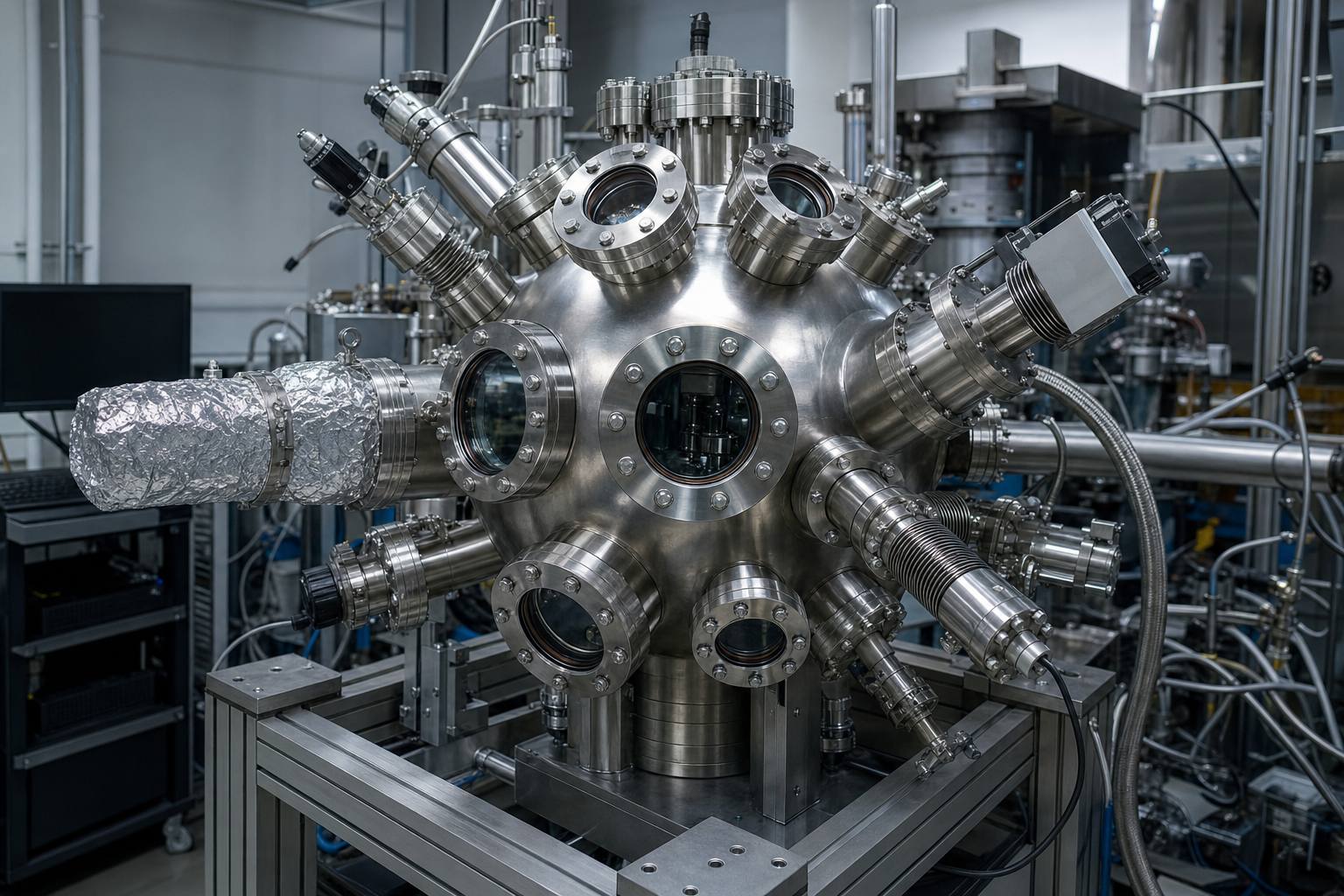
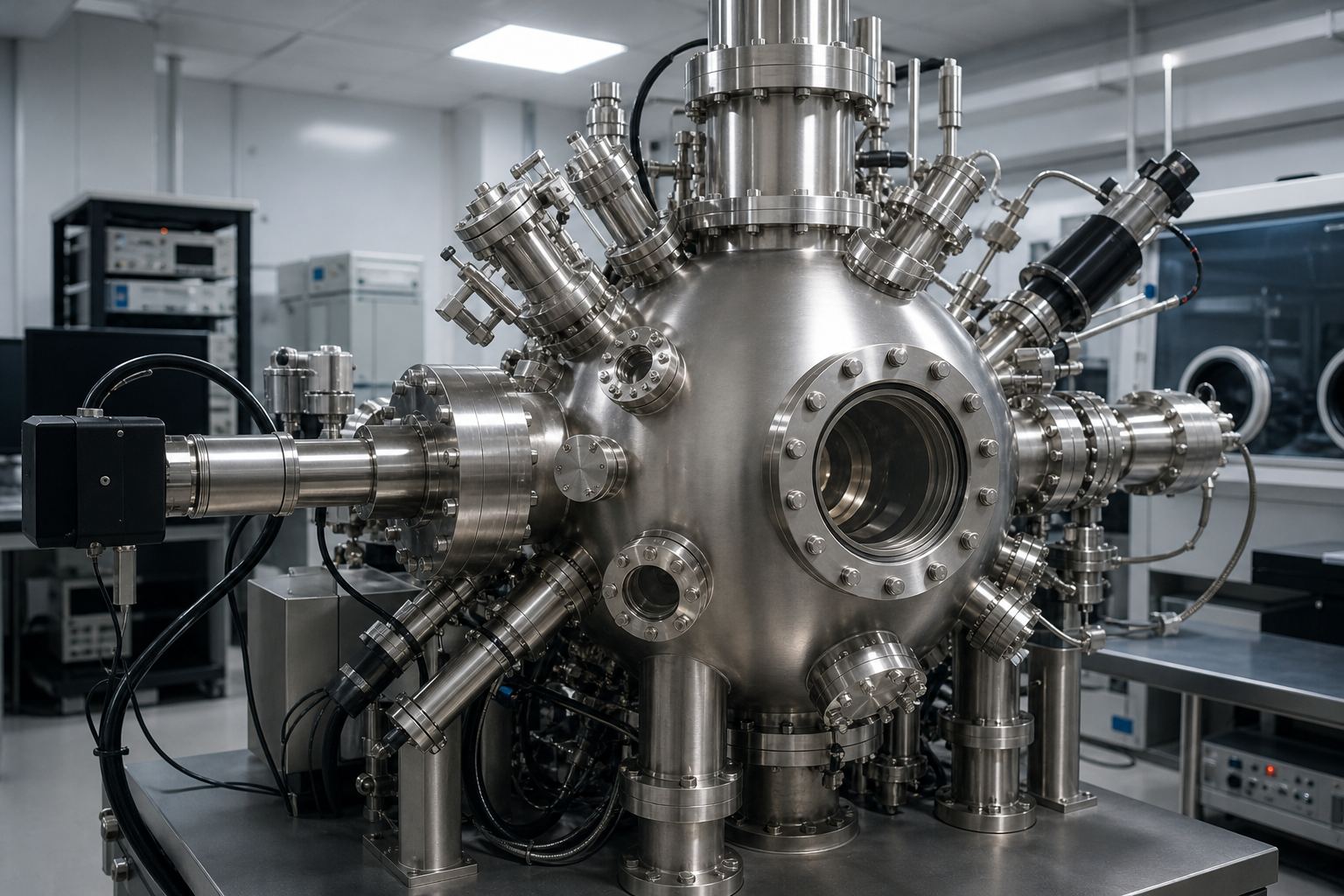
Physics World’s frog Jumping high is not enough: the frog must also leave from the right spot to make it through the window. AI-generated illustration.Nothing must land on it The chamber is pumped to about a hundred-billionth of normal air pressure, so stray atoms cannot settle during a measurement. AI-generated illustration.
1
layer: no doorway states seen
~5
layers: a doorway state emerges
TU Wien, Physical Review LettersThe quantum elevator A photoemission momentum microscope maps the energy and motion of electrons knocked out of the sample, frame by frame. AI-generated illustration.
“Now, we can track electrons moving across the entire energy landscape of a solid in real time.”Rupert Huber, University of Regensburg, October 2026
Chapter V · Twists and jumps
Two new results
Physics World (2026): a TU Wien team (Anna Niggas and colleagues, Physical Review Letters) fired a 173 eV electron beam at graphene-based samples and found that low-energy electron emission depends on “doorway states”; single-layer graphene showed none, bilayer graphene and graphite showed them at different energies, and graphite’s known X state is partly attributed to a doorway state that emerges at about five layers. University of Regensburg (28 October 2026): Regensburg, Marburg and Jülich, in Nature, used strong, fast-oscillating light fields and a photoemission momentum microscope to film Landau–Zener–Majorana transitions in very pure twisted graphene from Jülich: electrons crossed an energy gap between bands with a probability of up to 100%, depending on how fast they approached it. Both are single studies, reported here as new results.
Choose 1, 2 or 5 layers to see where an electron finds a way out; then make one jump the gap.
The 3D scenes are simplified teaching models: atoms are drawn as balls, bonds as sticks, and nothing is to scale.
Tape is fine for a lab, but, as Britannica puts it, far too expensive for mass production.
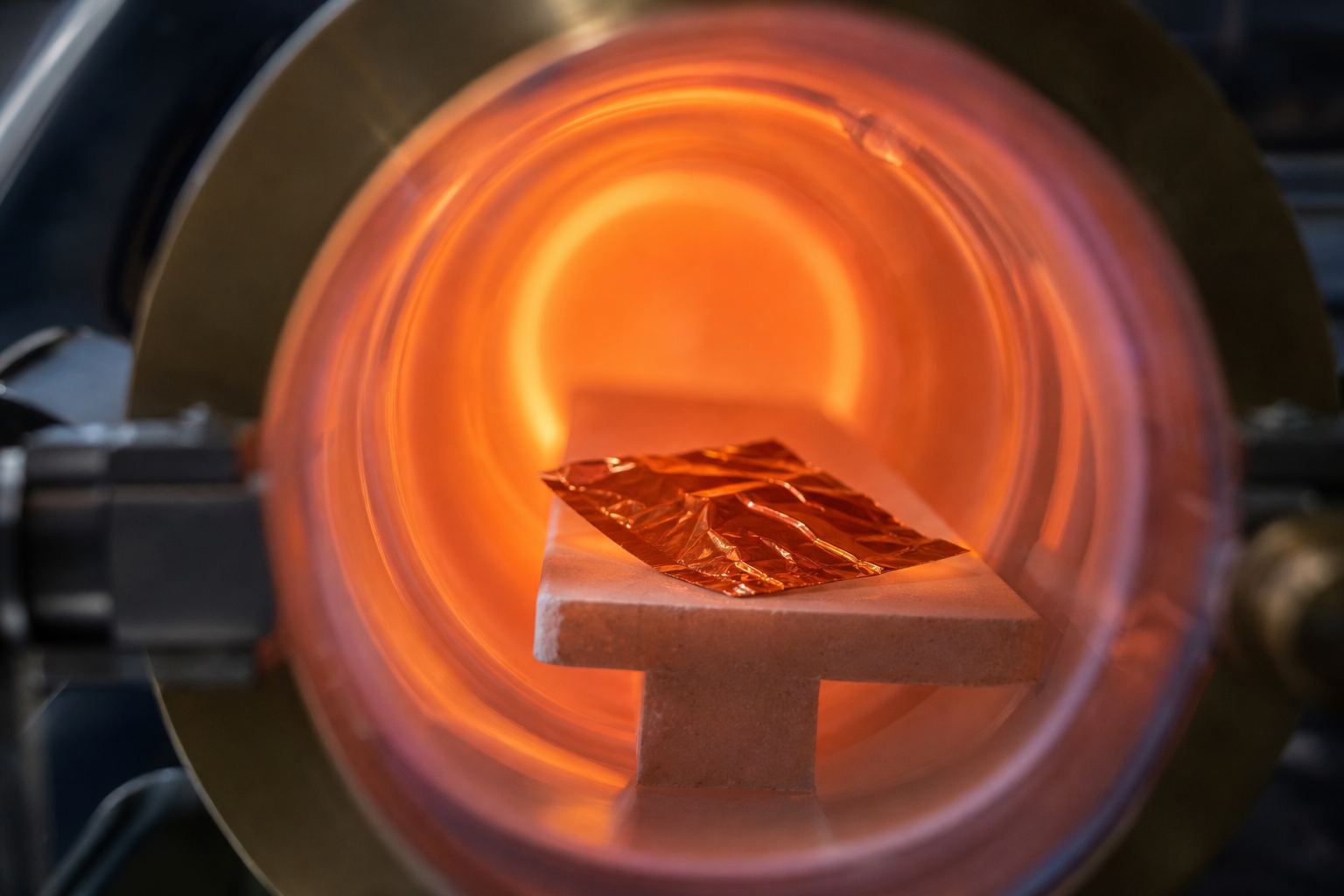
One alternative heats silicon carbide to about 1,300 degrees Celsius. Silicon leaves the surface, and a layer of carbon stays behind.
Another grows graphene from methane gas on copper foil, a method called chemical vapour deposition. Rolls seventy centimetres wide have been made this way.
There is also graphene oxide, made by oxidising graphite so that oxygen sticks to the sheet. It is an insulator, and conducts only once much of the oxygen is taken away again.
Fine for a lab Tape gives the best flakes, but one at a time, a few micrometres across. AI-generated illustration.Silicon carbide Heated in a furnace, its surface loses silicon and leaves carbon behind as graphene. AI-generated illustration.Chemical vapour deposition Methane flows over hot copper foil; carbon atoms settle on the metal and join into a honeycomb, mostly a single layer. AI-generated illustration.
tape (exfoliation): best quality, tiny flakes
heating silicon carbide to ~1,300 °C
CVD on copper: rolls up to 70 cm wide
graphene oxide: an insulator until the oxygen is removed
Four ways to make it
Chapter VI · From lab to life
How graphene is made
Britannica: obtaining graphene by exfoliation is too expensive for mass production; alternatives include heating (“burning”) silicon carbide and chemical vapour deposition of carbon on copper or nickel, giving samples up to tens of centimetres. Nobel scientific background: Walt de Heer’s group heated silicon carbide to about 1,300 °C so that silicon leaves and carbon remains; near-industrial methods have produced rolls 70 cm wide. Science (2009): methane CVD gave centimetre-scale films on copper, mostly single-layer. Merck: graphene oxide is a single layer of graphite carrying oxygen groups, made by oxidising graphite; it is an insulator, and reduced graphene oxide is moderately conductive.
Run the two furnaces: one bakes the silicon off silicon carbide, the other builds a sheet on copper atom by atom.
The 3D scenes are simplified teaching models: atoms are drawn as balls, bonds as sticks, and nothing is to scale.
When the prize was awarded, the Nobel committee pointed to future transistors, touch screens and conductive plastics.
Twenty years after the discovery, Stephen Lyth of the University of Strathclyde wrote that graphene had been held to an impossible standard, and that it is far too early to judge its impact.
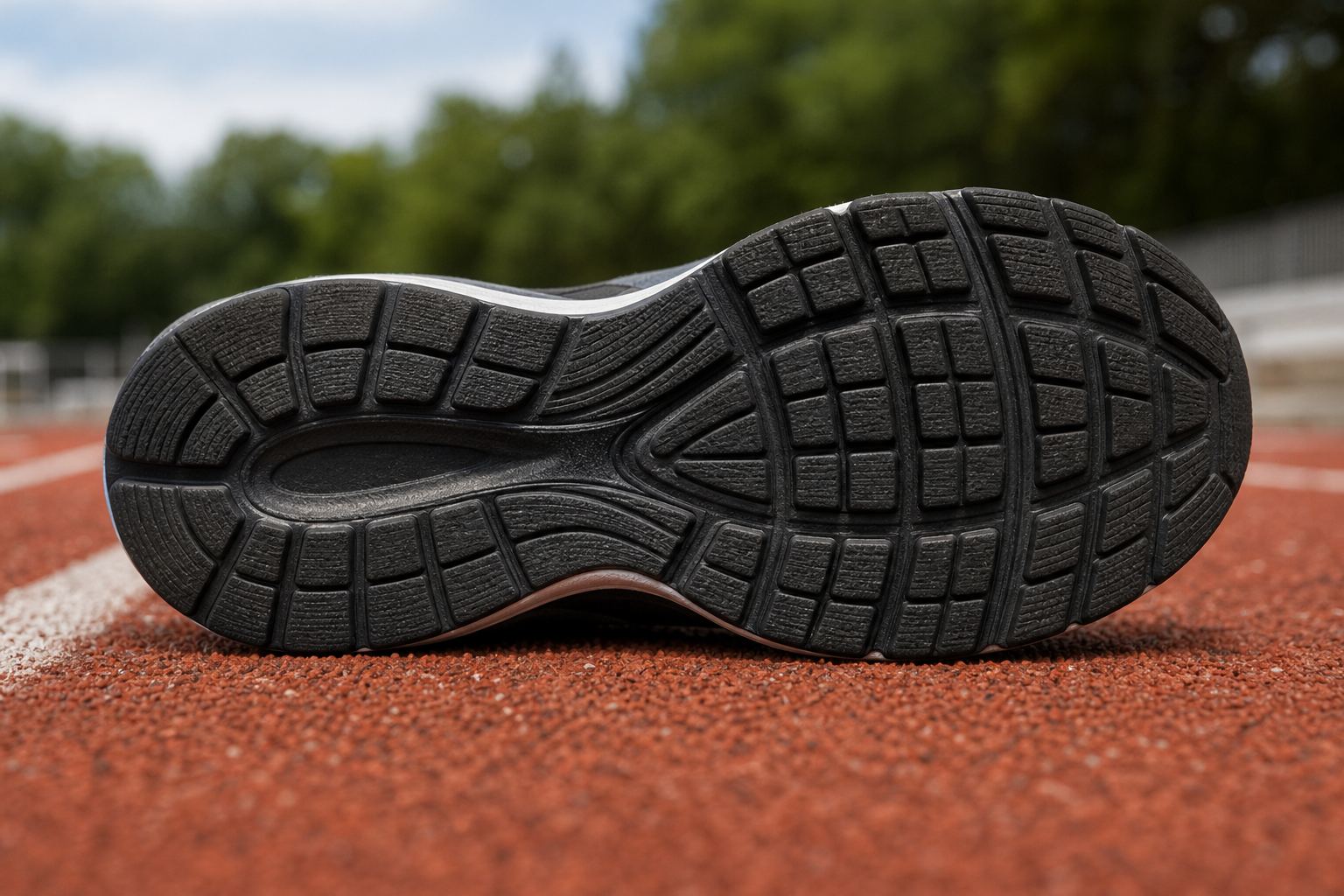
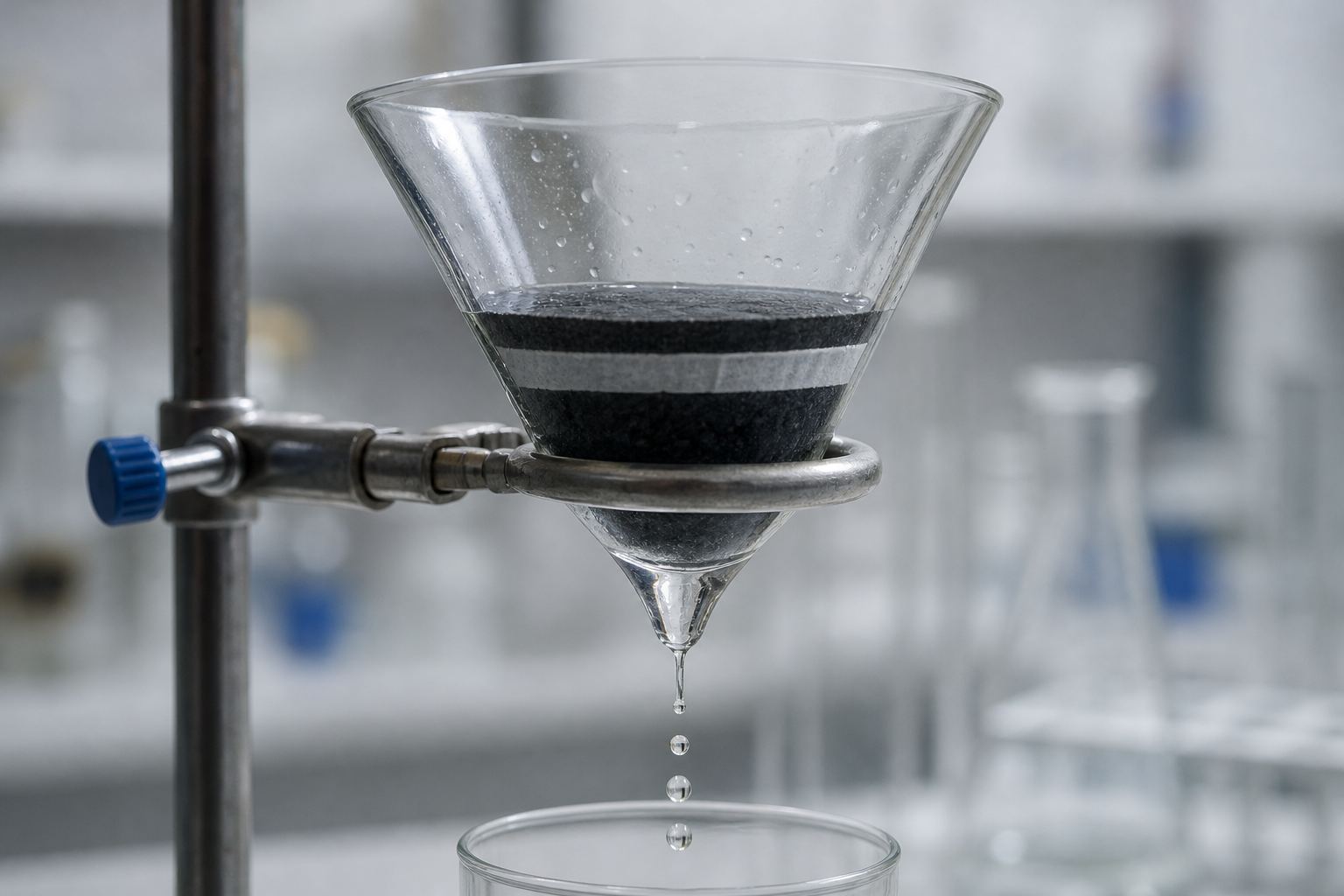
Meanwhile it is quietly turning up in sports gear, tyres, batteries, conductive inks and water filters. Europe’s Graphene Flagship has helped develop more than ninety products.
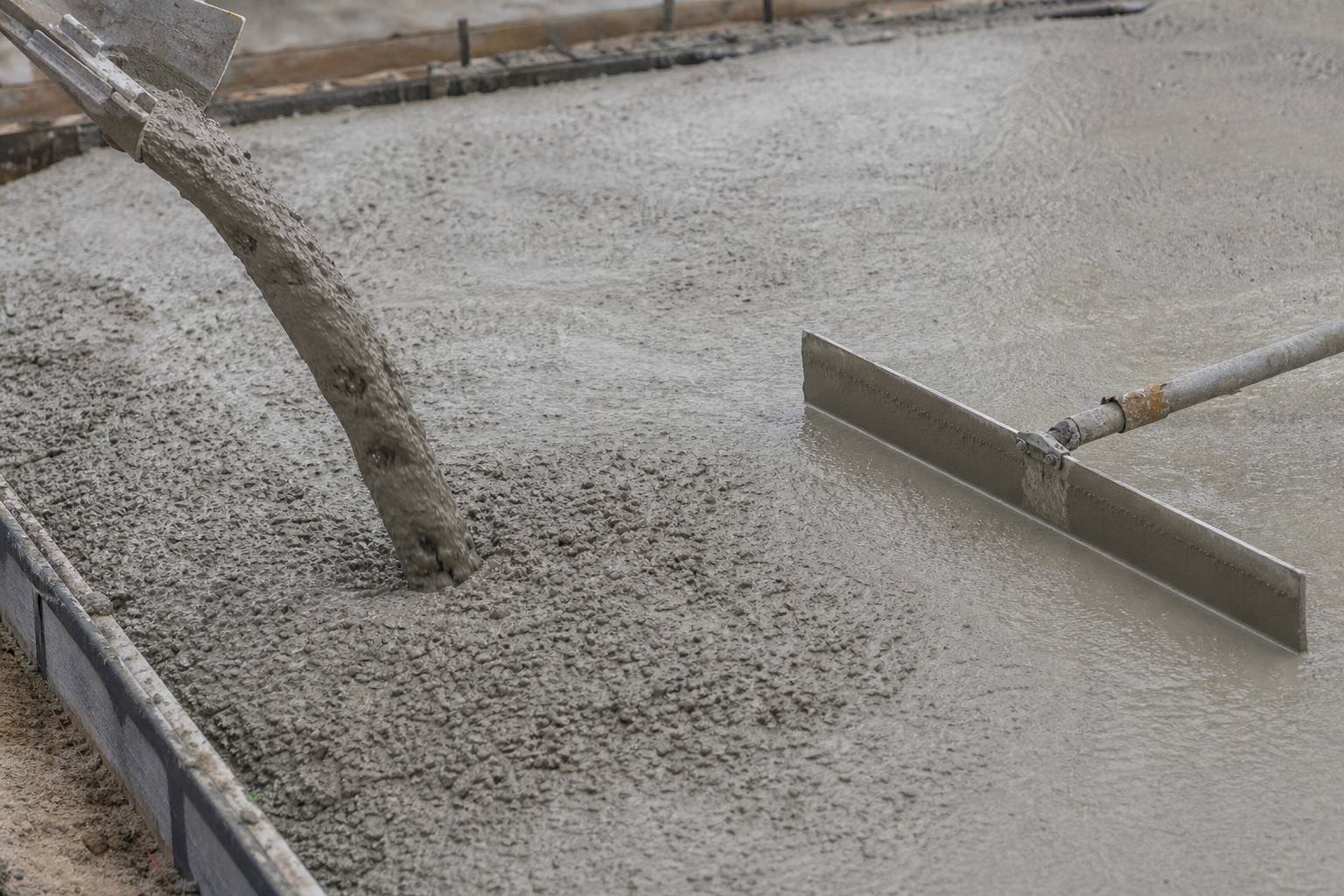
And according to Manchester’s Science and Industry Museum, concrete with up to one percent graphene is about thirty percent stronger.
transistors faster than silicon
touch screens and light panels
plastics made conductive with 1% graphene
sensors that detect a single molecule
Predicted in 2010
Graphene “has been held to an impossible standard.”Stephen Lyth, University of Strathclyde, 2024
In the shoe Graphene mixed into a rubber sole: the first sports shoes to use graphene were launched with Manchester in 2018. AI-generated illustration.In the filter Membranes of graphene oxide are being used to filter water. AI-generated illustration.In concrete A bulk use: a small dose of graphene spread through a large pour. AI-generated illustration.
Chapter VI · From lab to life
Graphene at twenty
Nobel 2010 press release and popular information (predictions at the time): graphene transistors predicted to be faster than silicon; 1% graphene making plastics conductive; touch screens, light panels, solar cells; sensors able to detect a single molecule. Stephen Lyth, University of Strathclyde (The Conversation, October 2024): graphene is used in sports gear, bicycle tyres, lubricants, batteries and supercapacitors, conductive inks and graphene-oxide water filtration; the Graphene Flagship has helped develop more than 90 products; graphene “has been held to an impossible standard” and it is “far too early to reach any conclusions about its impact”. University of Manchester (20 June 2018): graphene sports shoes. Science and Industry Museum blog (15 October 2024): concrete with up to 1% graphene is about 30% stronger.
Press the buttons to light up where graphene is used today.
The 3D scenes are simplified teaching models: atoms are drawn as balls, bonds as sticks, and nothing is to scale.
Twenty years in, graphene still has no switch of its own, and, by one scientist’s reckoning, it is far too early to judge it. Will someone give it a gap that works?
Next time you draw with a pencil, remember: the smudge is made of stacks of it.
1947 Wallace’s theory of a single sheet
1985 fullerenes discovered
2004 graphene isolated with tape
2010 Nobel Prize in Physics
2018 magic-angle superconductivity
2026 electrons filmed jumping a gap
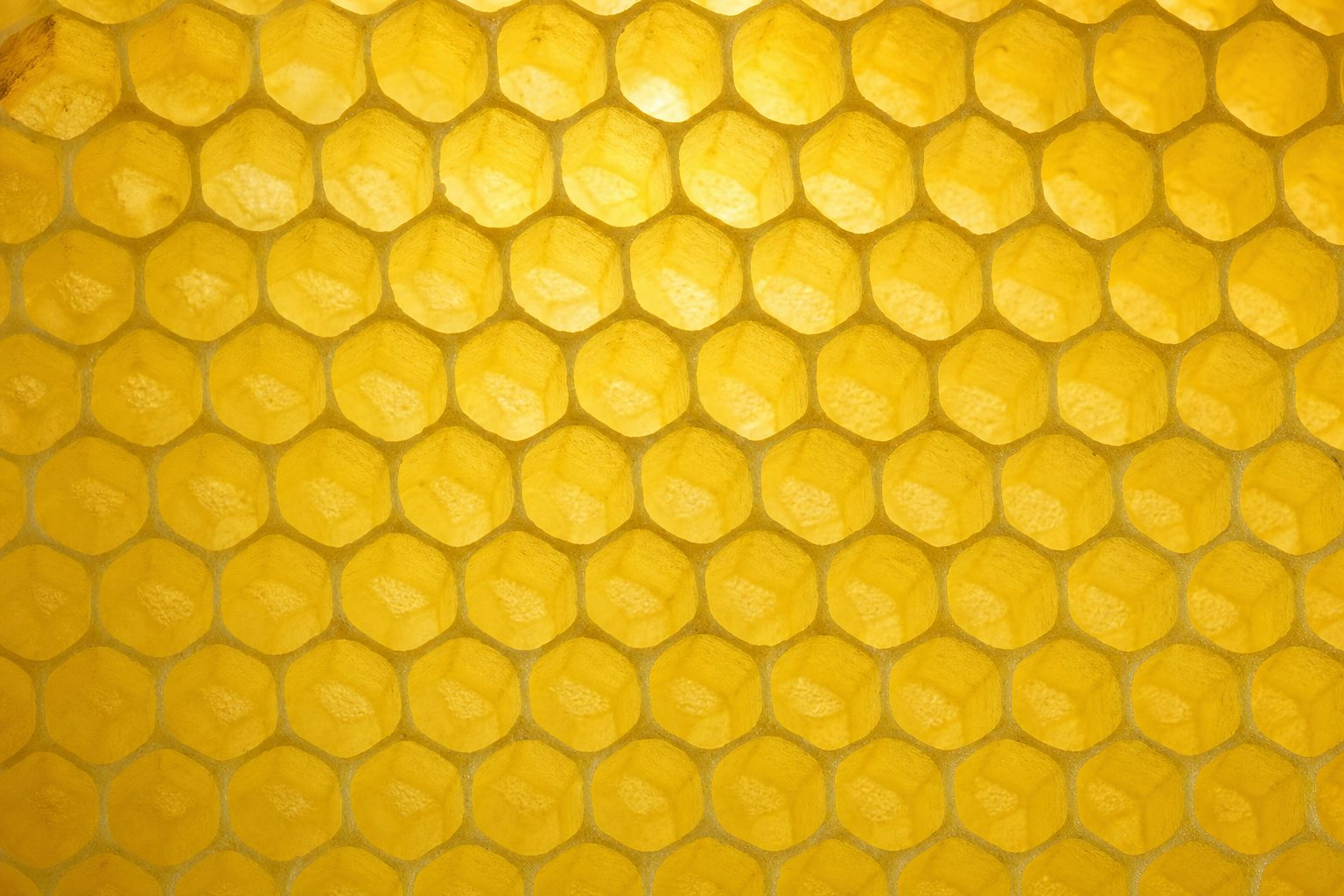
Graphene in six datesThe same shape, for the same reason Bees settle on hexagons for the reason carbon does: it tiles a plane with the least wall for the most area. AI-generated illustration.Back to the pencil Every shiny flake in a pencil line is a stack of graphene sheets. AI-generated illustration.
Epilogue · Sources
Sources
Every fact in this film comes from the sources below. Where sources give different figures (100 times or 200 times stronger than steel), the film uses the Nobel committee’s and names the other. The 2026 results come from single studies and are presented as new. Sums the film works out itself are marked as such. The 3D scenes are schematic. The chapter stills and pictures are AI-generated illustrations, not photographs of real people, places or products.