PlanetPast
EN

History · Society

The Velvet Revolution

Forty-Two Days in Prague

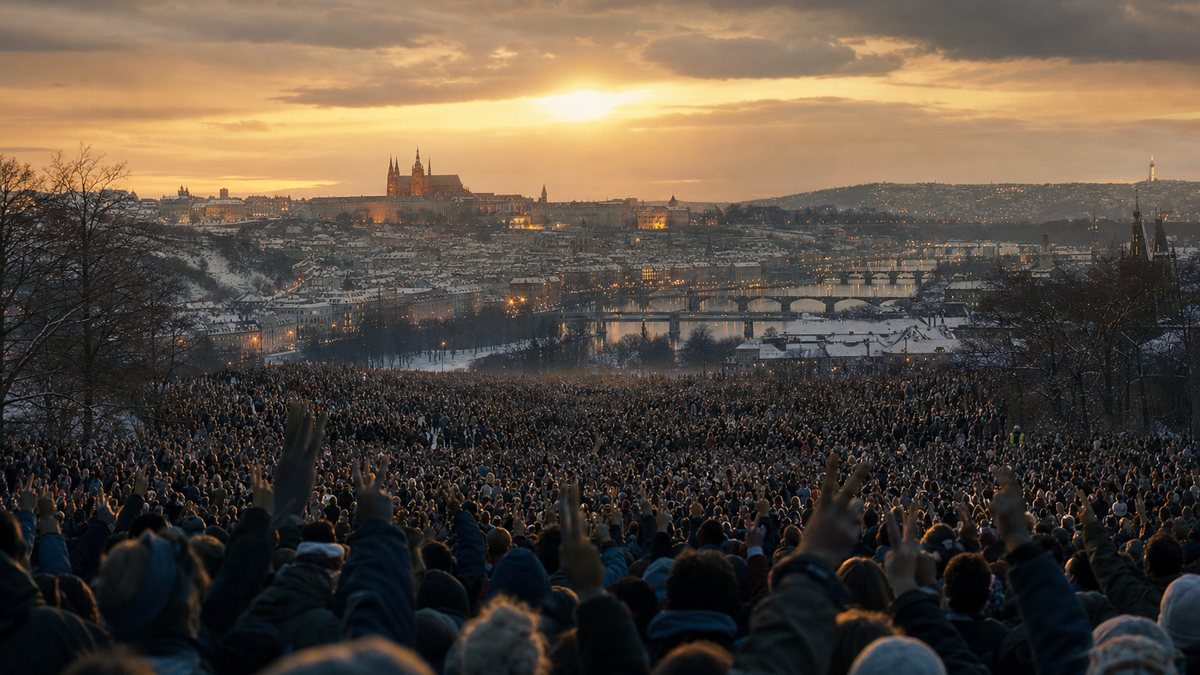
On 17 November 2026 thousands of people stood in the rain on Národní třída in Prague to mark 37 years since the Velvet Revolution. This film tells the history behind the anniversary: a country founded in 1918 and handed over piece by piece in 1938, the students of 17 November 1939, the communist takeover of 1948, the Prague Spring and the invasion of 1968, the grey years of “normalisation” and Charter 77, and then the forty-two days from a student march on 17 November 1989 to the election of Václav Havel as president on 29 December, with no one killed. It ends with the peaceful split into the Czech Republic and Slovakia in 1993, and the debates about that November that continue.

Interactive 3D film10 min1918 to 2026Published 18 November 2026

Watch the interactive filmRead in ไทย

Prologue

History · Society

The Velvet Revolution

Forty-two days in Prague.

Forty-two days. That was all it took, in 1989, to end four decades of one-party rule in Czechoslovakia. No one was killed.

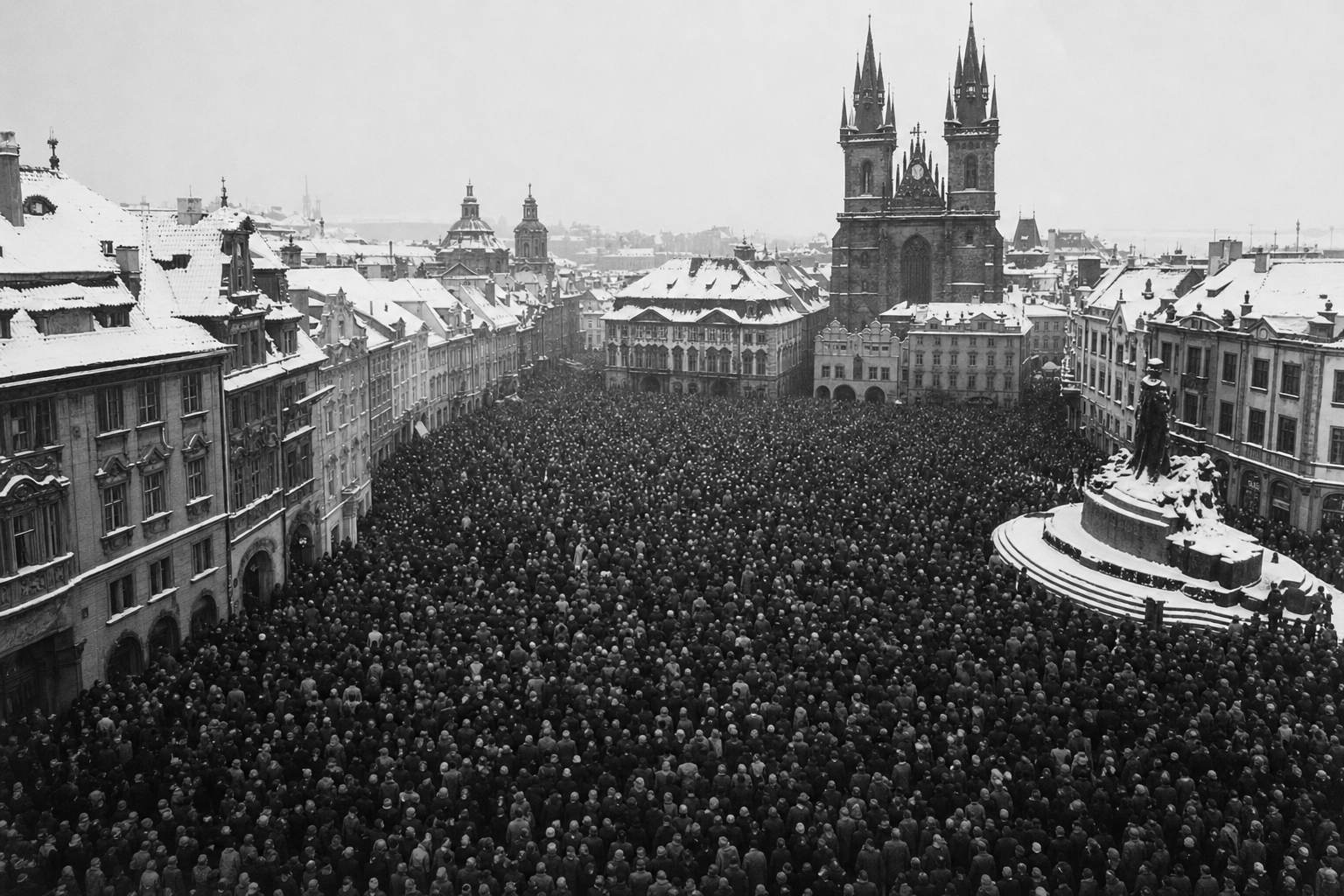
It began with a student march on the seventeenth of November. This year, in heavy rain, thousands filled Národní třída in Prague to remember it.

The same holiday remembers other students, fifty years earlier, persecuted under Nazi occupation in 1939.

How did a small country get there, and why did it end so quietly?

42 days
from a student march to a new president
1948–1989
one-party rule
17 November – 29 December 1989
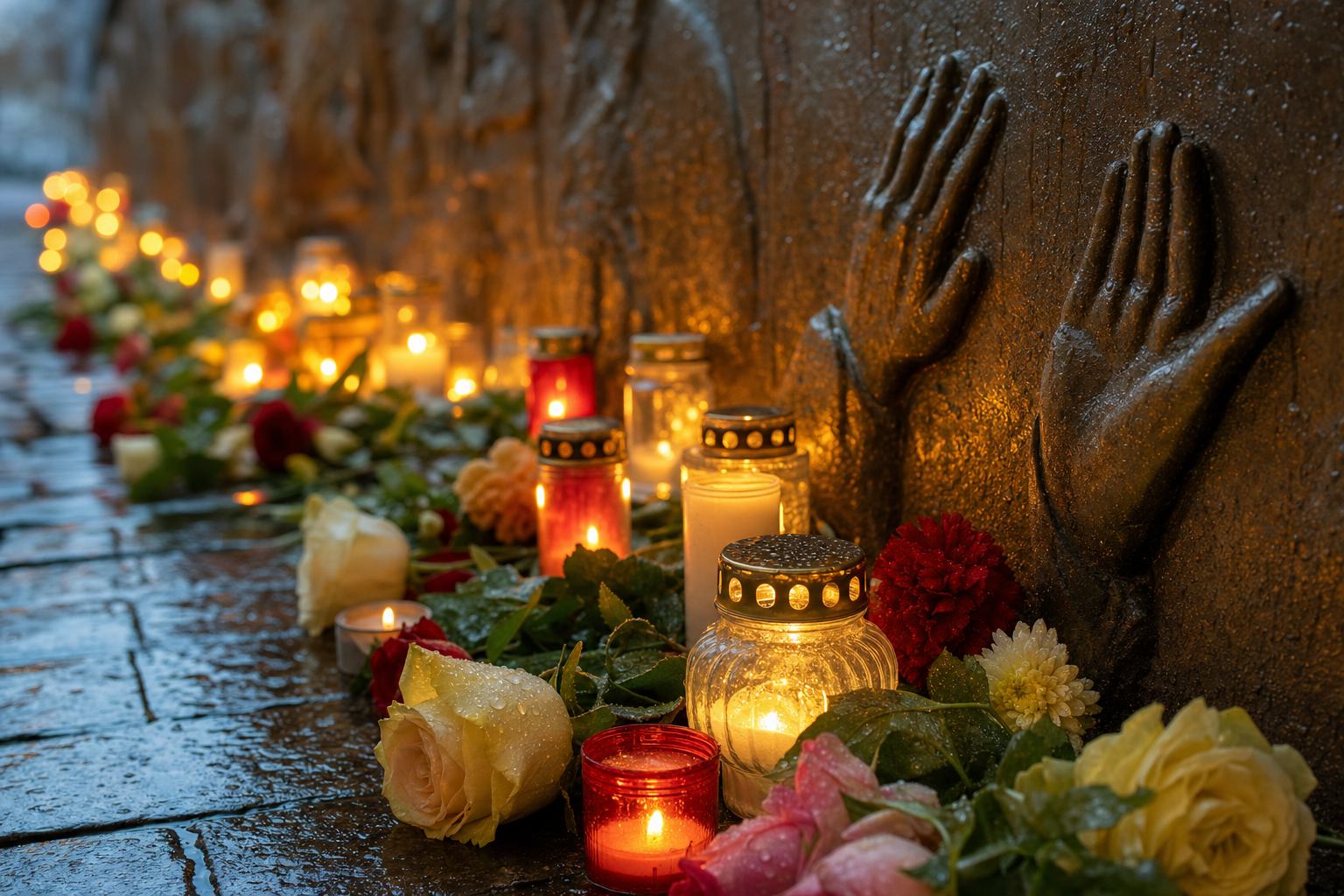
Remembering Candles and flowers left on a wet Prague pavement on a November evening. AI-generated illustration.
1939
students persecuted under Nazi occupation
1989
the march that began the revolution
One date, two anniversaries
  • a country made in 1918, cut up in 1938
  • 1948, 1968 and the grey years
  • 17 November 1989, day by day
  • why no one was killed
In this film
Prologue

The anniversary

Radio Prague (17 November 2026): the Czech Republic marked the 37th anniversary of the Velvet Revolution; the holiday also remembers the Nazi persecution of Czech students in 1939, and the main events were on Národní třída. Český rozhlas reported that the street was full of thousands of people despite heavy rain.

“No one was killed”: none of the sources used in this film reports a death in November or December 1989, and the one death reported at the time proved false (Chapter IV).

The plan of Prague is schematic: the river, squares and the route are placed approximately, the blocks of houses are random, and the dots stand for groups of people.

Sources: Radio Prague International (17 Nov 2026): Czechs marking 37th anniversary of the Velvet Revolution; Český rozhlas / Radio Prague (17 Nov 2026): Politicians stressed the value of freedom and recalled 1989 and 1939 despite heavy rain; European Network Remembrance and Solidarity: The Velvet Revolution day by day
Chapter I · A small country

Chapter I · A small country

A country between powers

Made in 1918, handed over in 1938.

Czechoslovakia was declared in October 1918, as the empire of Austria-Hungary collapsed. It joined Czechs and Slovaks in one state.

Twenty years later, at Munich, Germany, Italy, Britain and France agreed to hand its border regions, the Sudetenland, to Germany. Czechoslovakia was not a party to the deal.

In 1939 Germany occupied the rest of the Czech lands. Press the years to compare the maps.

  1. 28 Oct 1918 Czechoslovakia declared
  2. 1918–1935 Tomáš Masaryk president
  3. 29–30 Sep 1938 Munich Agreement signed without Czechoslovakia
  4. 1–10 Oct 1938 German troops occupy the Sudetenland
Twenty years
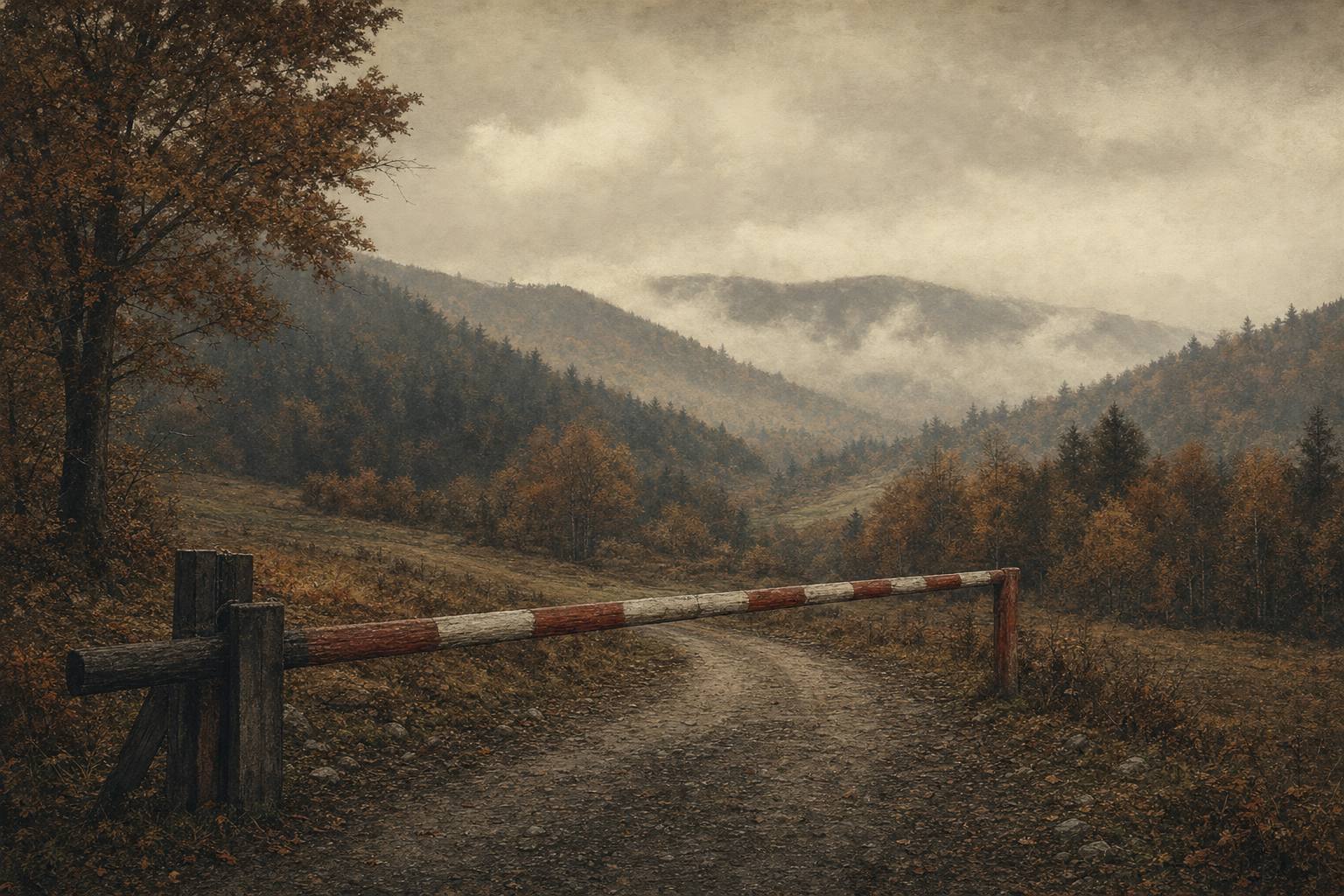
The border regions Wooded hills on the edge of Bohemia, the kind of land the Munich Agreement gave away. AI-generated illustration.
1939
Bohemia and Moravia made a German protectorate
After Munich (Britannica)
Chapter I · A small country

From 1918 to Munich

Britannica: on 28 October 1918 Masaryk, Beneš and others declared Czechoslovakia out of a collapsing Austria-Hungary; Masaryk was president from 1918 to 1935, and in 1939 Germany occupied Bohemia and Moravia as a protectorate. USHMM: Germany, Italy, Britain and France signed the Munich Agreement on 29–30 September 1938; Czechoslovakia was not a party; German troops occupied the Sudetenland from 1 to 10 October.

Press 1918, 1938 and 1939 to compare the maps.

The map is a teaching model: outlines of Czechoslovakia and its two halves are simplified, the 1938 border regions are drawn as a band and the 1968 arrows only show directions.

Sources: Britannica: Czechoslovakia; United States Holocaust Memorial Museum: Munich Agreement

Chapter I · A small country

17 November 1939

The first time the date mattered.

In the autumn of 1939, students in occupied Prague protested. A medical student, Jan Opletal, was shot, and died of his wound.

Thousands came to his funeral. The occupiers answered by closing the Czech universities.

On the seventeenth of November, nine people, most of them student leaders, were executed, and about twelve hundred students were sent to the Sachsenhausen concentration camp.

Two years later, student groups from fourteen nations made the seventeenth of November International Students' Day.

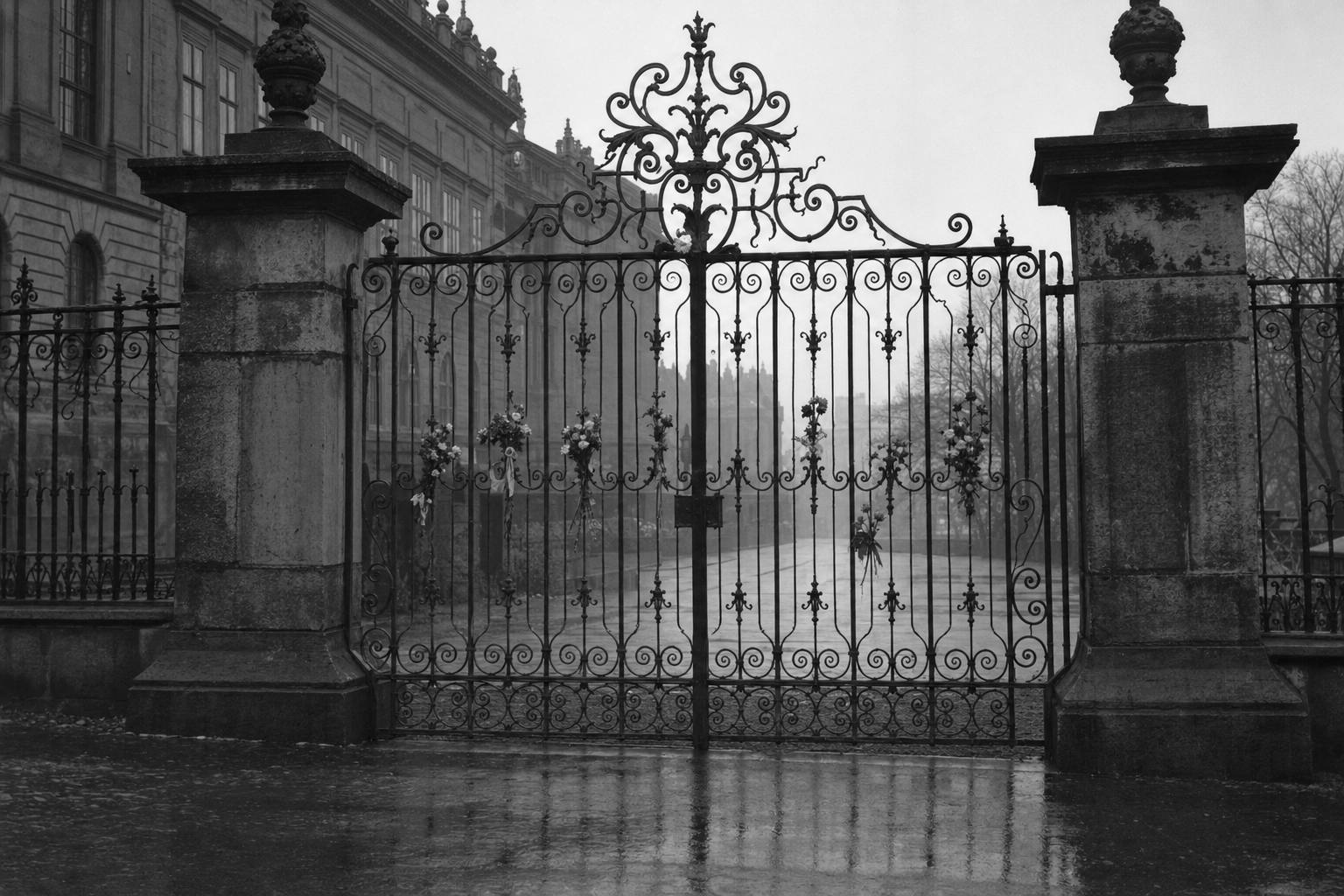
Autumn 1939 A university gate in the rain, with a few flowers pushed between the bars. AI-generated illustration.
  1. 28 Oct demonstrations; about 400 arrested; Opletal shot
  2. 11 Nov Jan Opletal dies
  3. 15 Nov 3,000+ at his funeral
  4. 16–17 Nov universities closed; raids on dormitories
Three weeks in 1939 (Czech Government)
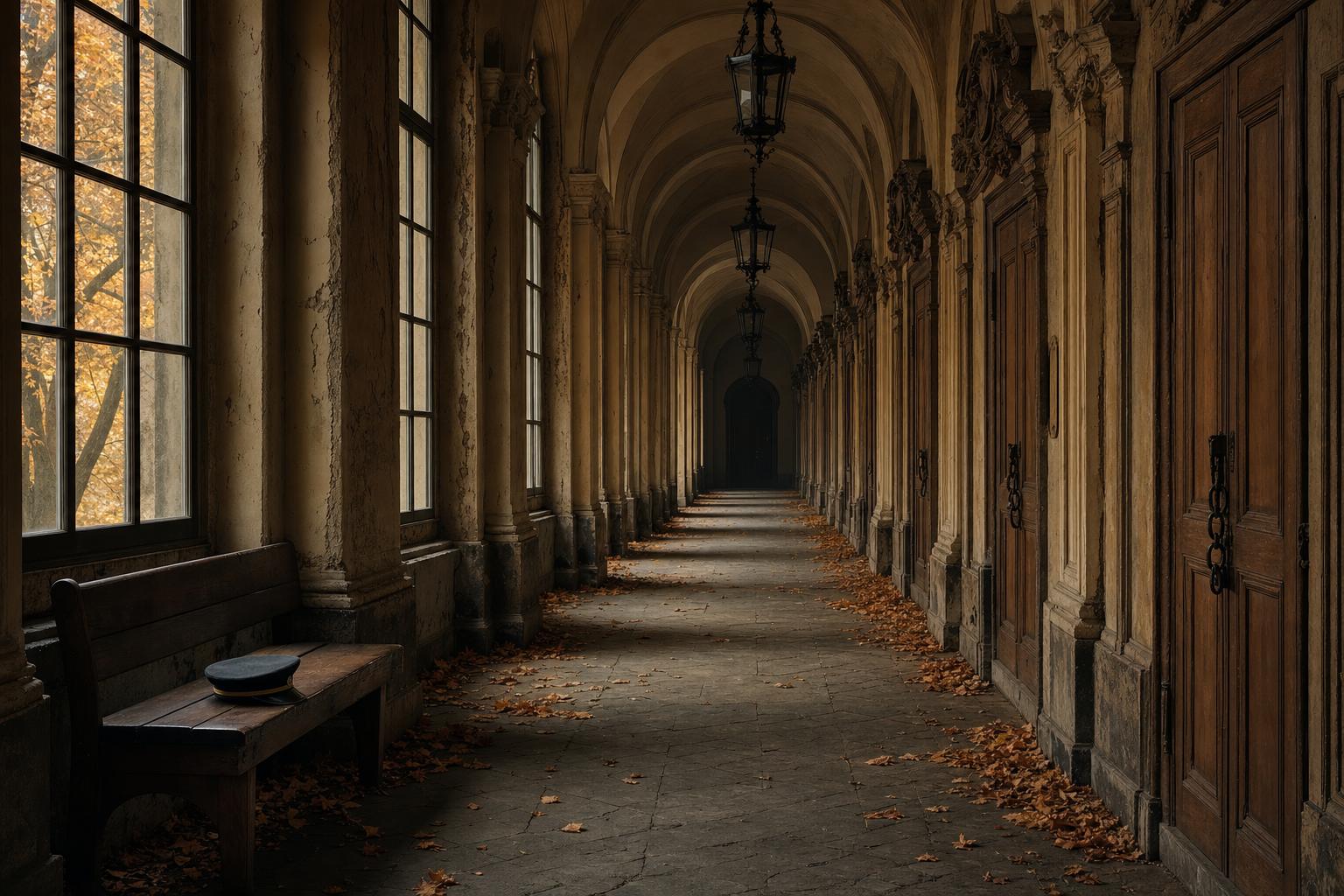
Closed for three years An empty corridor: Czech universities were closed for three years. AI-generated illustration.
9
executed at Ruzyně prison
~1,200
students sent to Sachsenhausen
15
of them died in the camps, 1940–42
ENRS; Czech Government
Chapter I · A small country

Autumn 1939

Government of the Czech Republic: on 28 October 1939 demonstrations in Prague ended with about 400 arrests; the worker Václav Sedláček was shot dead, and the medical student Jan Opletal was shot and died on 11 November. More than 3,000 students attended his funeral on 15 November; on 16 November Czech universities were closed for three years. On 17 November nine student functionaries were executed at Ruzyně, and about 1,200 students were held for transport to Sachsenhausen, where 15 died between 1940 and 1942. ENRS: the nine were eight students and Professor Josef Matoušek; about 1,200 students were sent to the camp; student groups from 14 nations declared International Students’ Day about two years later.

The plan of Prague is schematic: the river, squares and the route are placed approximately, the blocks of houses are random, and the dots stand for groups of people.

Sources: Government of the Czech Republic: Autumn 1939, student demonstrations and the closure of Czech universities; European Network Remembrance and Solidarity: 17 November, from anti-Nazi protests to International Students’ Day

Chapter II · Forty years of one party

Chapter II · Forty years of one party

A takeover, a spring, an invasion

1948 and 1968.

After the war, in February 1948, the Communist Party took full power. Non-communist ministers resigned, and President Edvard Beneš, one of the country's founders, accepted their resignations.

From then on, one party ruled. There would be no free election until 1990.

In 1968 a new party leader, Alexander Dubček, promised “socialism with a human face”. A brief season of reform began: the Prague Spring.

That August, troops from the Soviet Union and four other members of the Warsaw Pact, the Soviet-led military alliance, invaded.

Between a quarter and half a million soldiers came, by different counts, and more than a hundred Czechoslovaks were killed. Dubček was removed the next spring.

Old Town Square, 25 February 1948 Party leader Klement Gottwald announced the new order to a crowd here. AI-generated illustration.
1946
the last free election before 1990
3
parties whose ministers resigned in 1948
One party
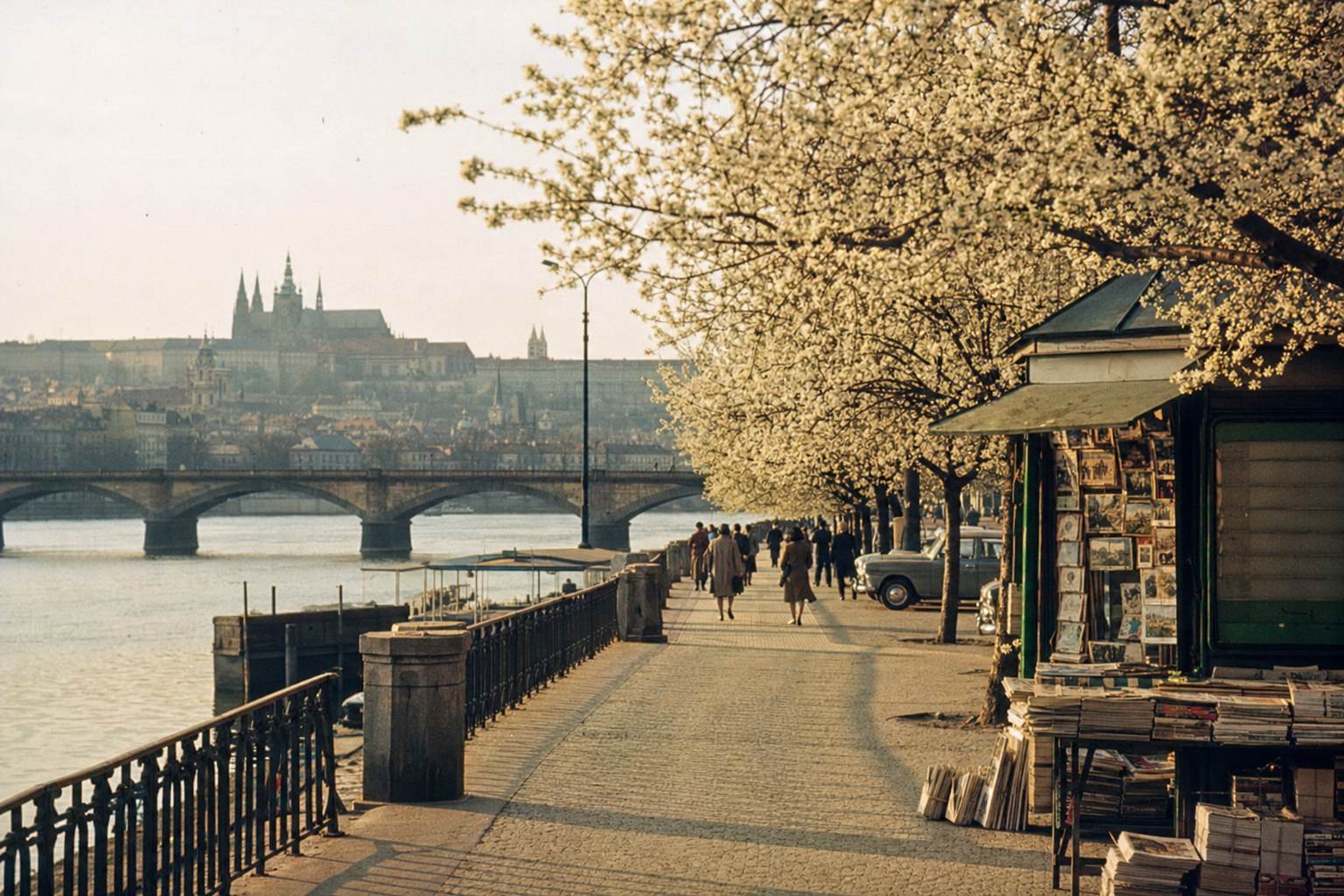
The Prague Spring Blossom by the river and newspapers at a kiosk in the spring of 1968. AI-generated illustration.
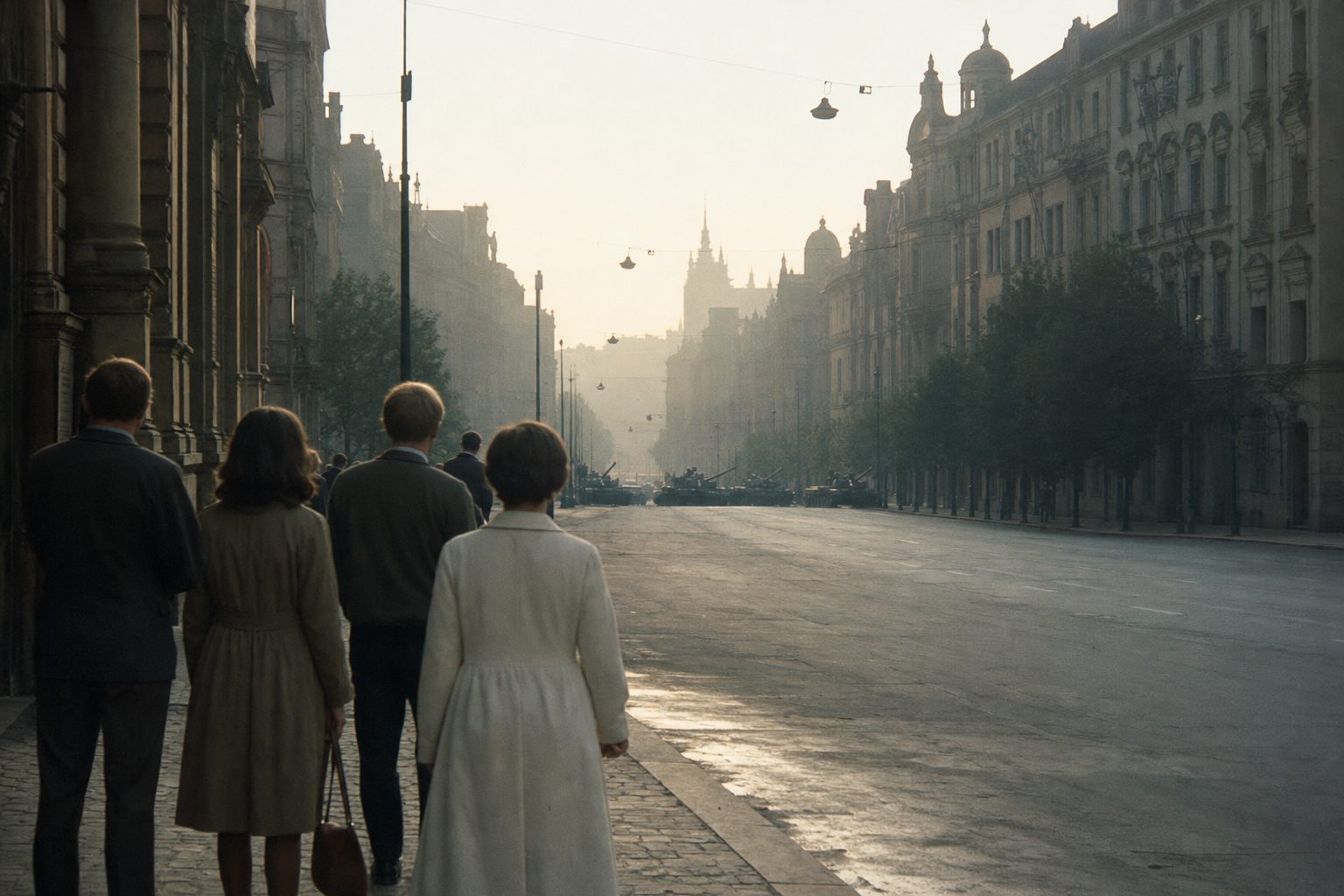
21 August 1968 Tanks at the end of a boulevard at dawn, watched from the pavement. AI-generated illustration.
Radio Prague: invasion (137 Czechoslovaks killed)~250,000
RFE/RL: invasion and occupation (108 killed)~500,000
Troops and dead, by source
Chapter II · Forty years of one party

1948 and 1968

Radio Prague: on 25 February 1948 Klement Gottwald announced in the Old Town Square that President Edvard Beneš had accepted the resignations of non-communist ministers from three parties, completing the communist takeover. Britannica: Beneš was among the founders of 1918; the next free elections, in June 1990, were the first since 1946. Britannica: Alexander Dubček became first secretary on 5 January 1968 and spoke of “socialism with a human face”; Soviet and other Warsaw Pact forces invaded on 20 August 1968; Dubček was deposed in April 1969. Radio Prague: five Warsaw Pact countries invaded just before midnight on 20 August, with an estimated quarter of a million soldiers, and about 137 Czechoslovak civilians were killed. RFE/RL gives about 500,000 troops for the invasion and occupation, and 108 Czechoslovaks killed; TIME says over half a million troops.

The Warsaw Pact was the Soviet-led military alliance of the communist states of Europe. Press 1948 and 1968 to switch the map.

The map is a teaching model: outlines of Czechoslovakia and its two halves are simplified, the 1938 border regions are drawn as a band and the 1968 arrows only show directions.

Sources: Radio Prague International: February 1948, the communist takeover; Britannica: Czechoslovakia; Britannica: Czechoslovak history, Velvet Revolution and Velvet Divorce; Britannica: Prague Spring; Radio Prague International: the Warsaw Pact invasion of August 1968; RFE/RL: Czechoslovakia, the Prague Spring and the invasion; TIME: How the Velvet Revolution brought down communism in Czechoslovakia

Chapter II · Forty years of one party

The grey years

A crackdown, and Charter 77.

What followed was called “normalisation”: in practice, a hardline crackdown that lasted two decades, under Gustáv Husák, the man who was still president in 1989.

In 1977, about two hundred and forty people, Václav Havel among them, signed Charter 77. It asked the state to respect the human rights it had promised in the Helsinki Accords, a 1975 agreement between East and West.

One of its founders, Jan Patočka, died after police questioning. Fewer than two thousand people ever signed.

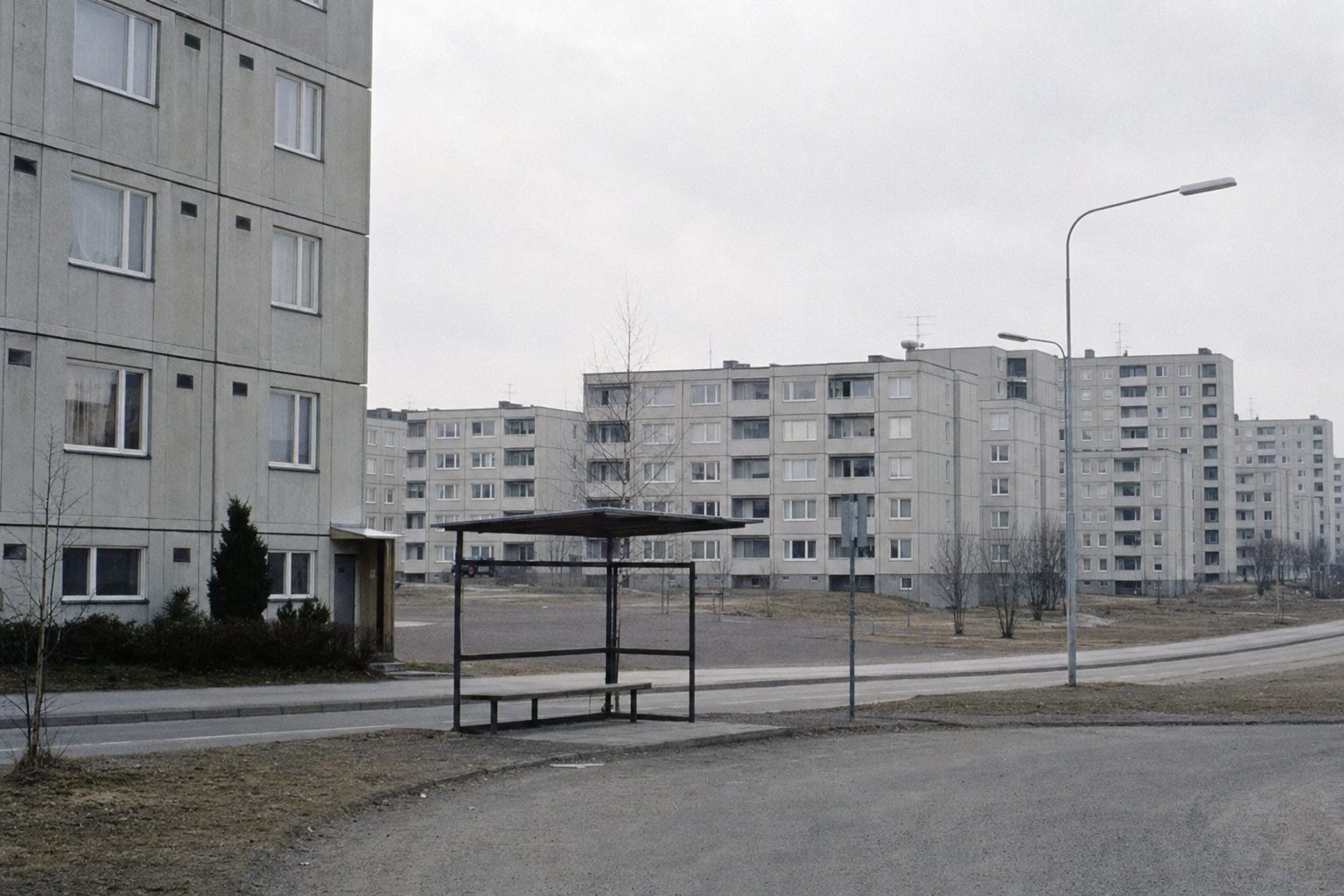
“Normalisation” Rows of concrete panel blocks under a low sky. AI-generated illustration.
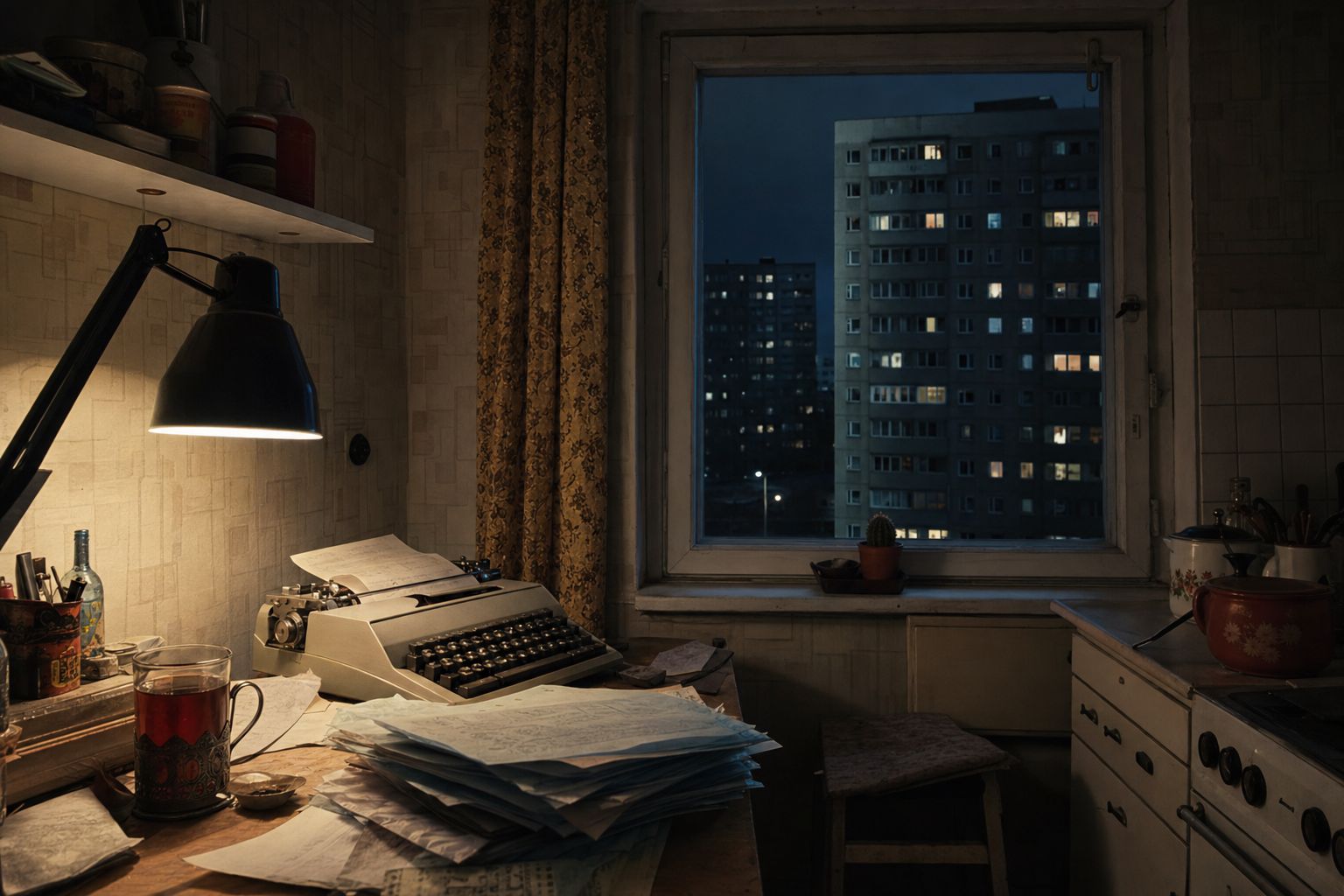
Charter 77, 6 January 1977 A typewriter and carbon copies: texts like this were passed from hand to hand. AI-generated illustration.
1975
an East–West agreement that included human rights
Helsinki Accords
~240
first signatories
<2,000
signatories in all
13 Mar 1977
Jan Patočka dies
Radio Prague
Chapter II · Forty years of one party

Normalisation and Charter 77

Radio Prague: “normalisation” names the grey years of hardline control after 1968, associated with Gustáv Husák. Charter 77 was launched on 6 January 1977 with about 240 first signatories, among them Václav Havel, Jiří Hájek and Jan Patočka; Patočka died on 13 March 1977 after police interrogations, and fewer than 2,000 people signed in all. Britannica: Charter 77 urged the government to respect the human rights it had agreed to under the 1975 Helsinki Accords. ENRS and Britannica: Husák was still president in December 1989.

The Helsinki Accords (1975) were an agreement between the countries of East and West that included human rights. The lights around Prague are schematic: one light for about ten signers.

The map is a teaching model: outlines of Czechoslovakia and its two halves are simplified, the 1938 border regions are drawn as a band and the 1968 arrows only show directions.

Sources: Radio Prague International: Charter 77; Britannica: Velvet Revolution; European Network Remembrance and Solidarity: The Velvet Revolution day by day
Chapter III · The year of change

Chapter III · The year of change

1989

The walls around them fall.

Nineteen eighty-nine began with arrests in Prague, and Havel was jailed until May. Yet a petition called “A Few Sentences” gathered more than forty thousand signatures.

Around the country, the neighbours were changing. In June, Poland's Solidarity movement won an election.

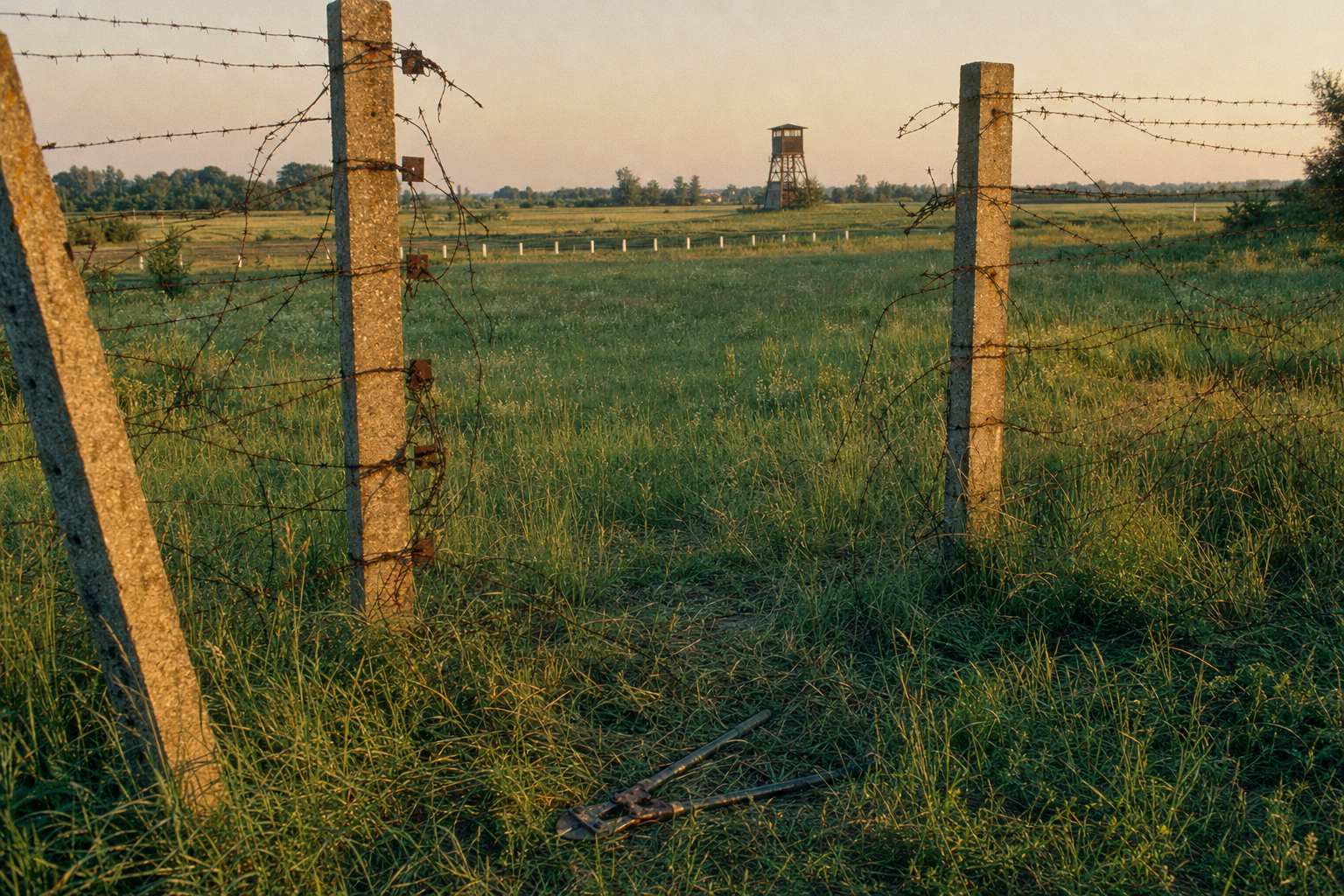
Hungary cut its border fence with Austria, and in September let East Germans leave for the West. Press the button to open the gate.

On the ninth of November, the Berlin Wall opened. Eight days later, it was Prague's turn.

117
arrested at a Prague rally in January
17 May
Havel released
40,000+
signatures on “A Few Sentences”
January–May 1989 (Radio Prague)
  1. June Solidarity wins in Poland
  2. 27 Jun Hungary and Austria cut the border wire
  3. 10–11 Sep Hungary opens its border to East Germans; ~70,000 leave
  4. 9 Nov the Berlin Wall opens
Around Czechoslovakia
Hungary, 1989 Wire cutters in the grass beside an opened border fence; about 70,000 East Germans crossed within days of September’s opening. AI-generated illustration.
9 Nov
Berlin
17 Nov
Prague
November 1989
Chapter III · The year of change

The year of change

Radio Prague: in January 1989 (“Palach Week”) a rally was surrounded by about 3,500 security forces and the party’s militia, 117 people were arrested and Havel was jailed until 17 May; the petition “A Few Sentences” gathered more than 40,000 signatures; Poland’s Solidarity won the June election; the Berlin Wall fell on 9 November. RFE/RL: Hungarian and Austrian foreign ministers cut the border wire on 27 June, and at midnight on 10 September Hungary opened its border to East Germans; about 70,000 left within days.

Press the button to open or close the Hungarian gate (schematic). The Berlin Wall has its own film on PlanetPast.

The map is a teaching model: outlines of Czechoslovakia and its two halves are simplified, the 1938 border regions are drawn as a band and the 1968 arrows only show directions.

Sources: Radio Prague International: 1989, Palach Week and the road to November; RFE/RL: How Hungary opened its border in 1989

Chapter IV · 17 November

Chapter IV · 17 November

The march

Fifty years after 1939.

The day after a peaceful march in Bratislava, between ten and fifteen thousand students, by different counts, gathered at Albertov, Prague's university quarter, for a permitted march marking fifty years since 1939.

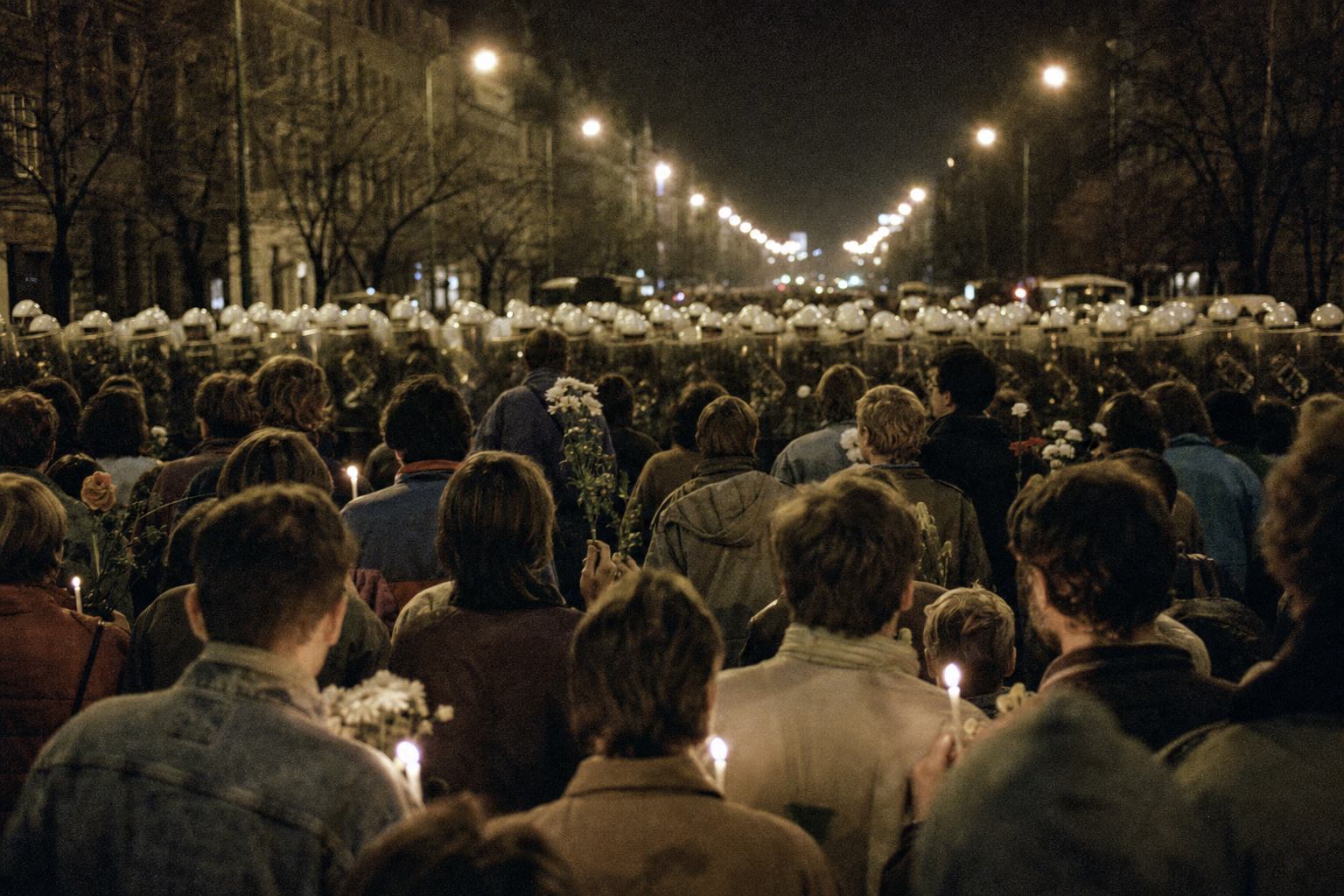
Soon the march turned into criticism of the regime. Though it was permitted, riot police trapped the marchers on Národní třída and beat them.

Press “March again” to watch the route. Hundreds were injured; one independent inquiry counted 568.

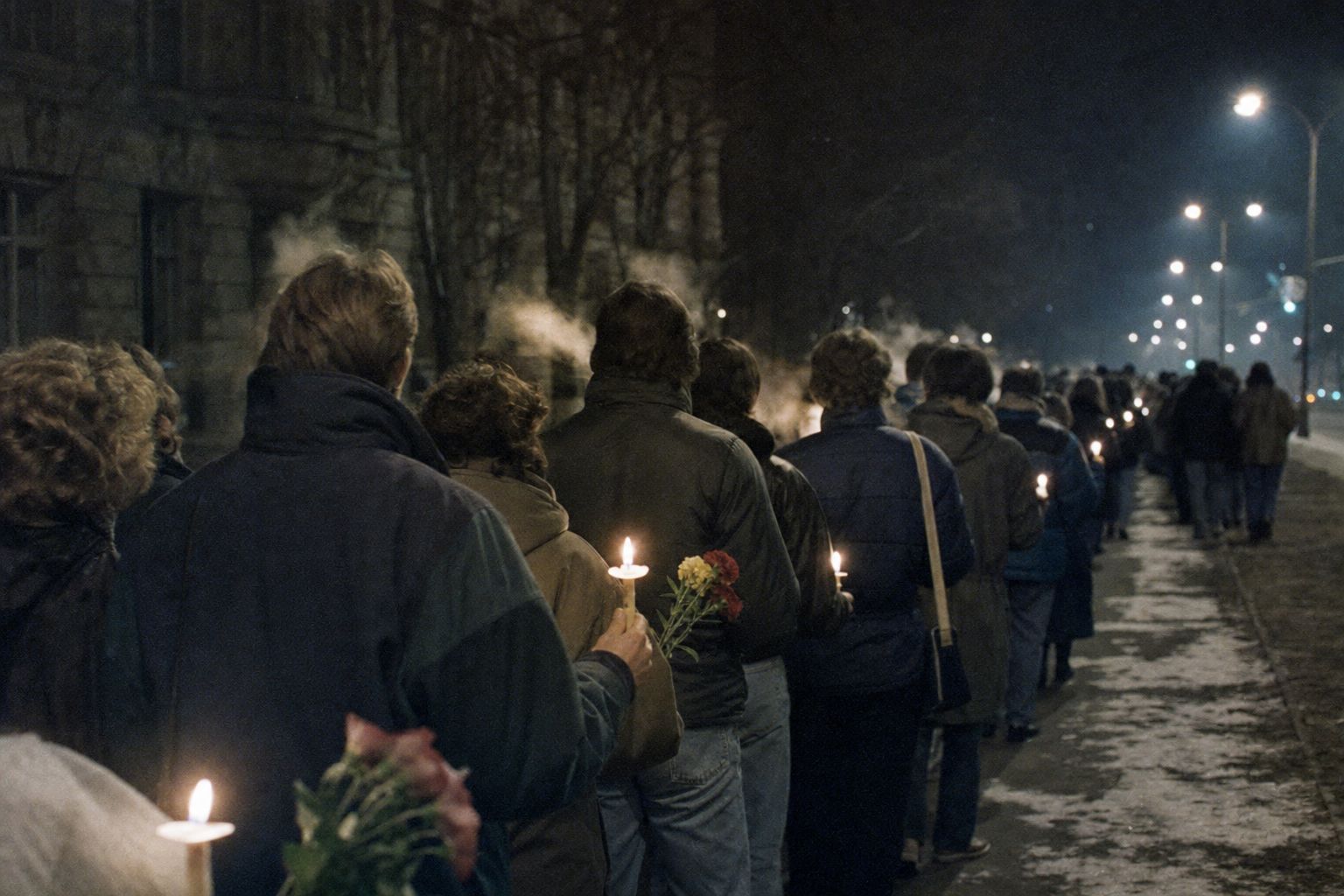
Albertov, dusk Students walking with candles on a cold November evening. AI-generated illustration.
~10,000
UPI, 1990
~15,000
ENRS
Marchers at Albertov, by source
Národní třída A line of white helmets and shields faces the front of the march. AI-generated illustration.
Inquiry, via ENRS568 people
UPI, 1990: taken to hospital561 people
UPI, 1990: seriously injured54 people
Injured, by source
Chapter IV · 17 November

17 November 1989

Britannica: on 16 November students held a peaceful demonstration in Bratislava; on 17 November an authorised student march in Prague marked the 50th anniversary of 1939, students soon criticised the regime, and “the police reacted with brutality”. ENRS: about 15,000 students gathered at Albertov; riot police trapped and beat the marchers; an independent inquiry counted 568 injured. UPI (1990): about 10,000 marchers were heading for Wenceslas Square; 54 were seriously injured and 561 taken to hospital.

Press “March again” to replay the route (schematic).

The plan of Prague is schematic: the river, squares and the route are placed approximately, the blocks of houses are random, and the dots stand for groups of people.

Sources: Britannica: Velvet Revolution; European Network Remembrance and Solidarity: 17 November, from anti-Nazi protests to International Students’ Day; European Network Remembrance and Solidarity: The Velvet Revolution day by day; UPI (15 Nov 1990): Theories abound on start of Velvet Revolution

Chapter IV · 17 November

A rumour

The student who was not dead.

That night, a report reached Radio Free Europe that a student, Martin Šmíd, had been killed. It was false.

The woman who passed it on later said she had made it up in hospital. There were real students named Martin Šmíd, and both were alive.

Historians quoted by Czech Television say the rumour angered people and brought them into the streets.

It also fed a lasting dispute. A former secret police agent says the police staged parts of that day, to replace the party's leaders. Investigations in 1990 found no such plan.

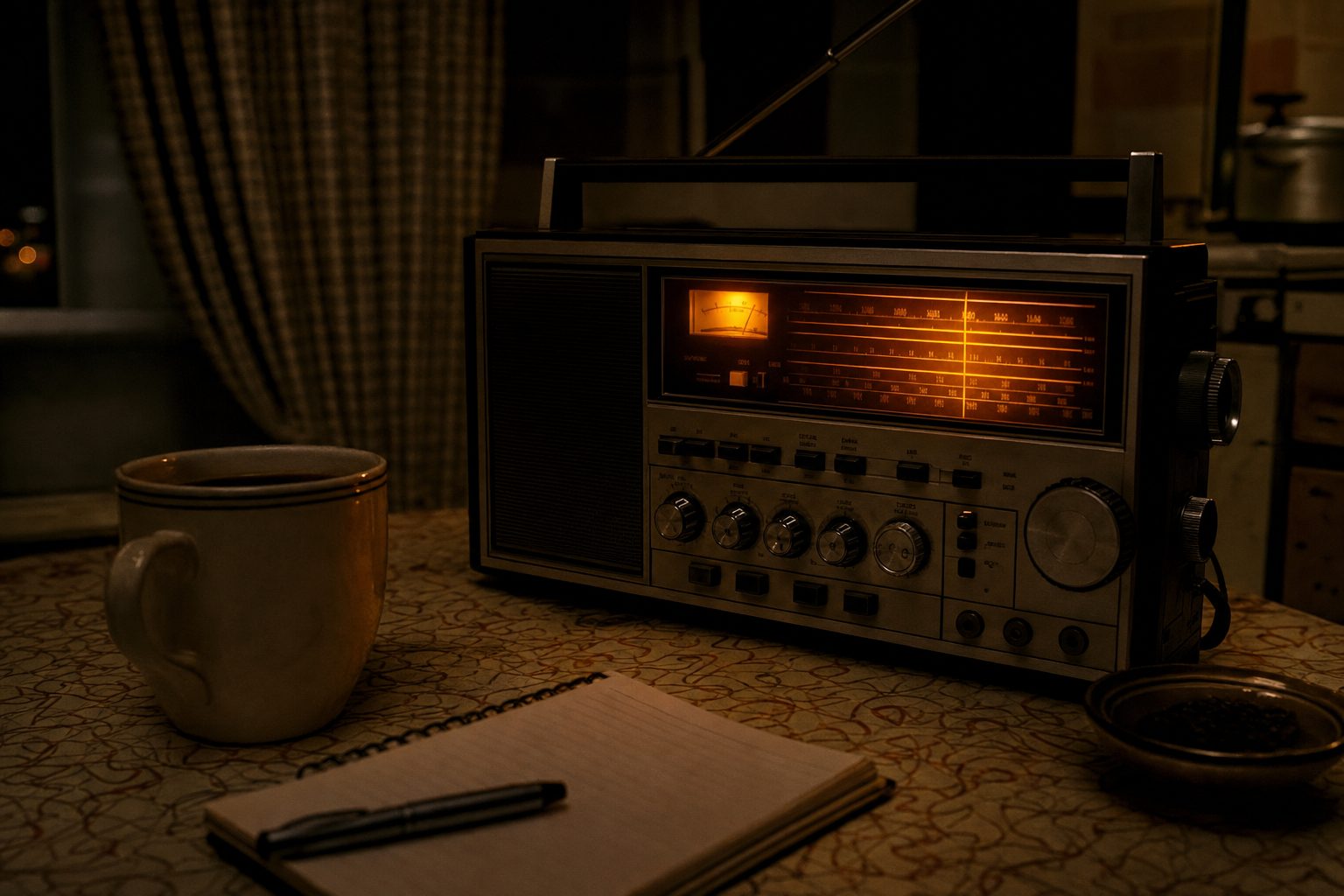
Listening at night A glowing shortwave dial: many people heard foreign stations this way. AI-generated illustration.
  • Petr Uhl passed the report to Radio Free Europe
  • its source, Drahomíra Dražská, says she invented it
  • one real Martin Šmíd had been at the march
What happened (ČT24, Radio Prague)
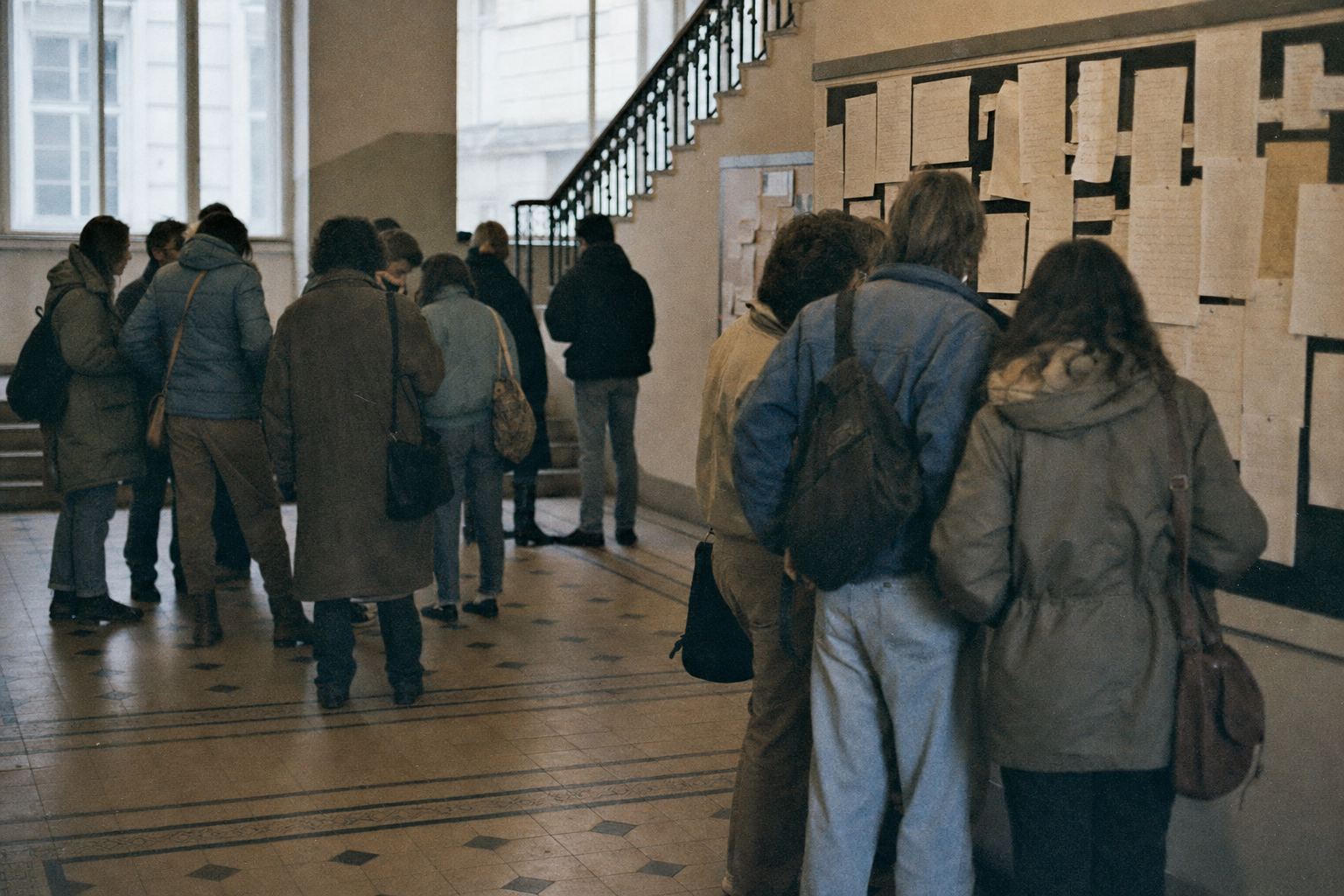
The next morning Students crowd around handwritten notices in a university hallway. AI-generated illustration.
  • ENRS: a secret policeman posing as a student played a dead protester
  • ex-StB agent Ludvík Zifčák says it was a plot to replace the party’s leaders
  • UPI, 1990: documents show no StB plan to topple the leadership
The staging dispute
Chapter IV · 17 November

The Šmíd rumour and the debate

ČT24: Petr Uhl passed to Radio Free Europe a report that the student Martin Šmíd had been killed; its source, Drahomíra Dražská, says she made it up in hospital; two real students named Martin Šmíd were alive; historians cited by ČT24 say the rumour radicalised people and brought them into the streets. Radio Prague: one of them had been at the march. ENRS states that a secret policeman posing as a student played a dead protester. The former StB agent Ludvík Zifčák says he played the “dead” student, as part of a plan to replace the party leadership; Dražská denies knowing him; Uhl does not believe she was part of a plot but does not rule out that someone steered her. UPI (1990): documents showed the StB never considered using dissidents to overthrow the leadership.

The dispute is presented with each claim attributed; this film does not settle it. The rings are schematic.

The plan of Prague is schematic: the river, squares and the route are placed approximately, the blocks of houses are random, and the dots stand for groups of people.

Sources: ČT24: Drahomíra Dražská, the source of the report of a dead Šmíd, speaks; Radio Prague International: Martin Šmíd, the student who was reported dead; European Network Remembrance and Solidarity: The Velvet Revolution day by day; UPI (15 Nov 1990): Theories abound on start of Velvet Revolution

Chapter V · The squares fill

Chapter V · The squares fill

Students, theatres, a forum

Two movements in two capitals.

On the eighteenth, university students went on strike. Theatres stopped their plays and held discussions with their audiences instead.

On the nineteenth, in a Prague theatre, dissidents founded Civic Forum, with Havel as its unofficial voice.

In Bratislava, artists and intellectuals founded its Slovak counterpart, Public Against Violence.

Now the protest had leaders, and someone who could speak to the government.

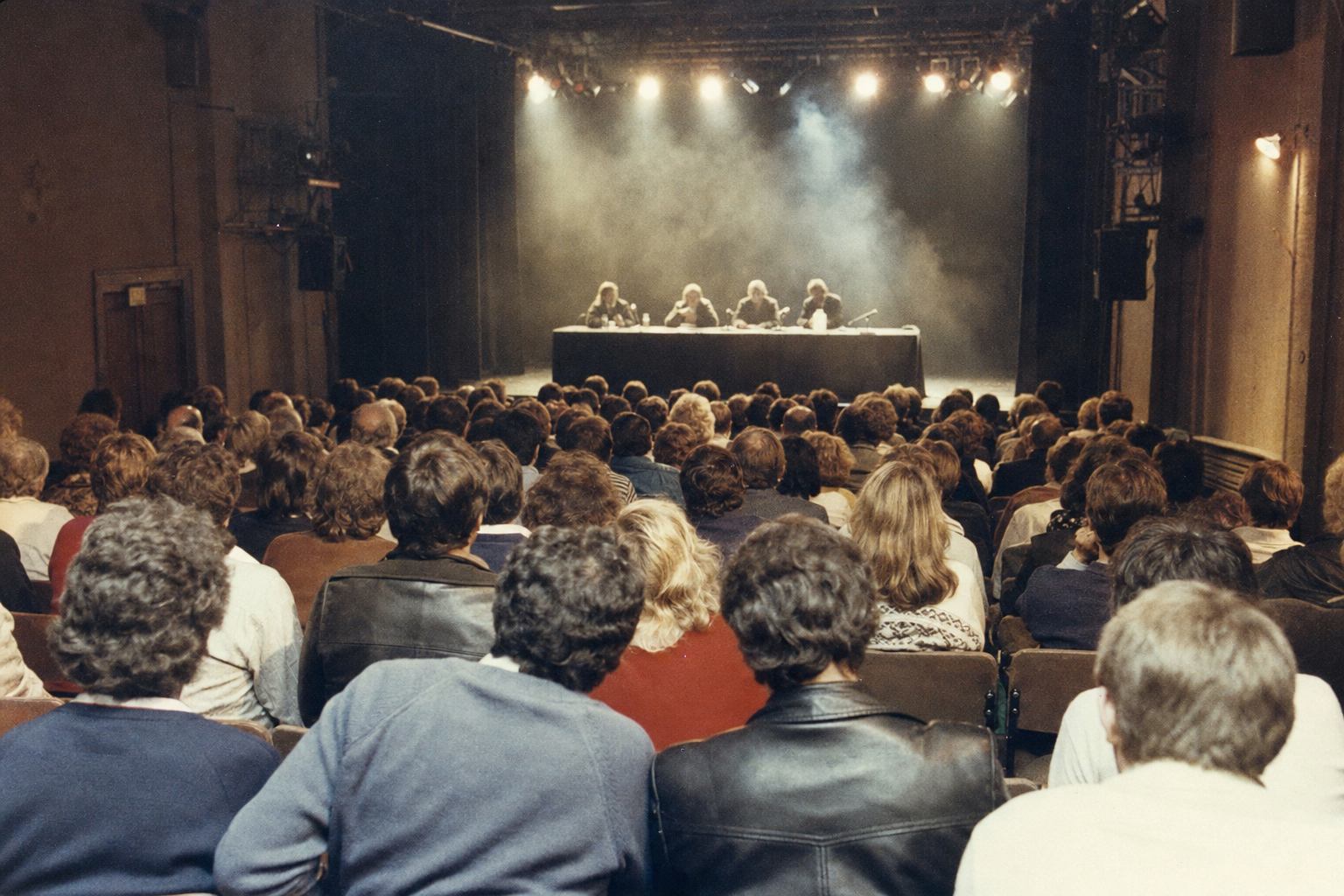
Theatres on strike A full house watching a discussion on stage instead of a play. AI-generated illustration.
19 Nov
Civic Forum, Činoherní klub theatre, Prague
19–20 Nov
Public Against Violence, Bratislava, from a meeting of ~500
Two movements
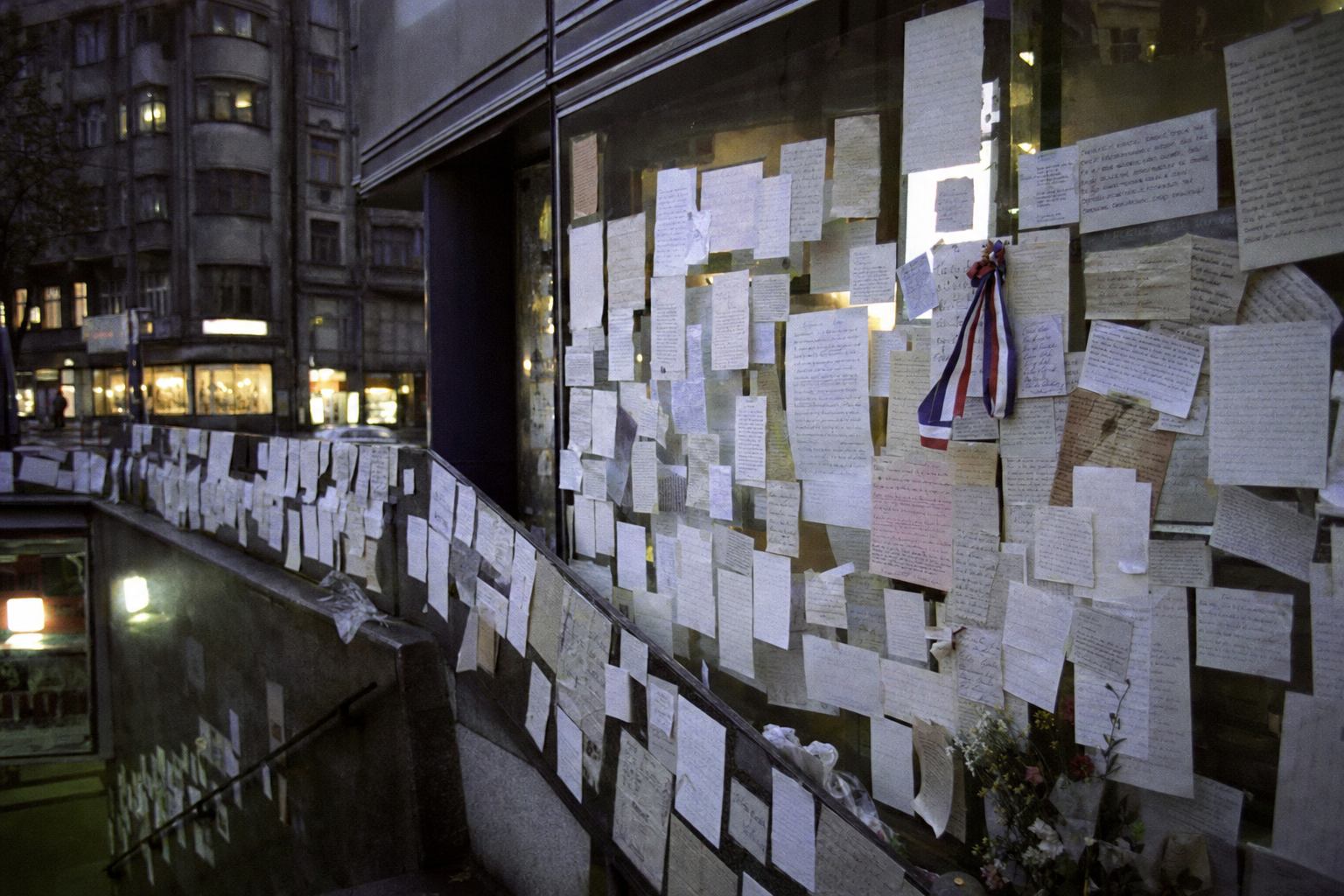
News on paper Handwritten posters on shop windows and metro entrances, with a tricolour ribbon. AI-generated illustration.
Chapter V · The squares fill

Organising the protest

ENRS: on 18 November university students went on strike and theatres stopped performing to discuss the crackdown with their audiences; on 19 November Civic Forum (Občanské fórum) was founded at the Činoherní klub theatre in Prague, with Havel as its unofficial representative. TASR: Public Against Violence (VPN) was founded in Bratislava on 19–20 November from a meeting of about 500 artists and intellectuals; its founders included Milan Kňažko, Ján Budaj and Fedor Gál.

The map is a teaching model: outlines of Czechoslovakia and its two halves are simplified, the 1938 border regions are drawn as a band and the 1968 arrows only show directions.

Sources: European Network Remembrance and Solidarity: The Velvet Revolution day by day; TASR: Public Against Violence (VPN), a profile

Chapter V · The squares fill

The squares fill

Hundreds of thousands, then a strike.

Each day the crowds grew, to hundreds of thousands in Wenceslas Square. On the twenty-fourth, Havel spoke from a balcony, and the party's leadership resigned.

The leaders had changed, but the demand had not: an end to one-party rule.

That weekend, on the Letná plain, came the biggest crowd of all, half a million people or more. Switch between the two counts with the buttons.

On the twenty-seventh, the country stopped for two hours in a general strike. Step through the days to watch the crowds grow.

  1. 22 Nov first live TV from the square
  2. 24 Nov Jakeš and the party leadership resign
  3. 25–26 Nov Letná rallies; PM Adamec booed
  4. 27 Nov two-hour general strike
A week in November (ENRS)
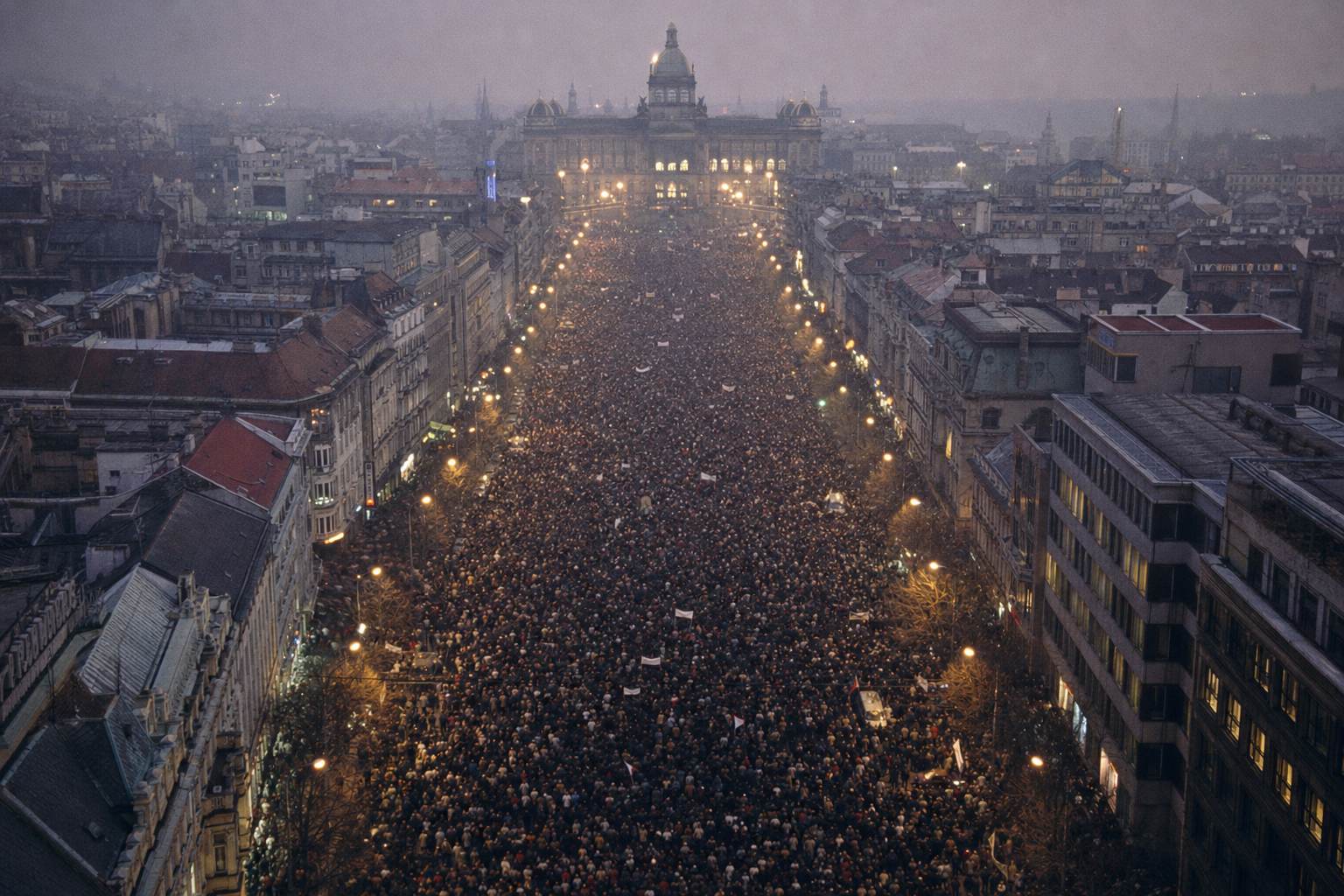
Wenceslas Square The long square full from end to end, up to the National Museum. AI-generated illustration.
21 Nov, Wenceslas (RFE/RL)200 thousand people
24 Nov, Wenceslas (RFE/RL)300 thousand people
26 Nov, Letná (RFE/RL)500 thousand people
25–26 Nov, Letná (ENRS)750 thousand people
Crowd estimates, by source
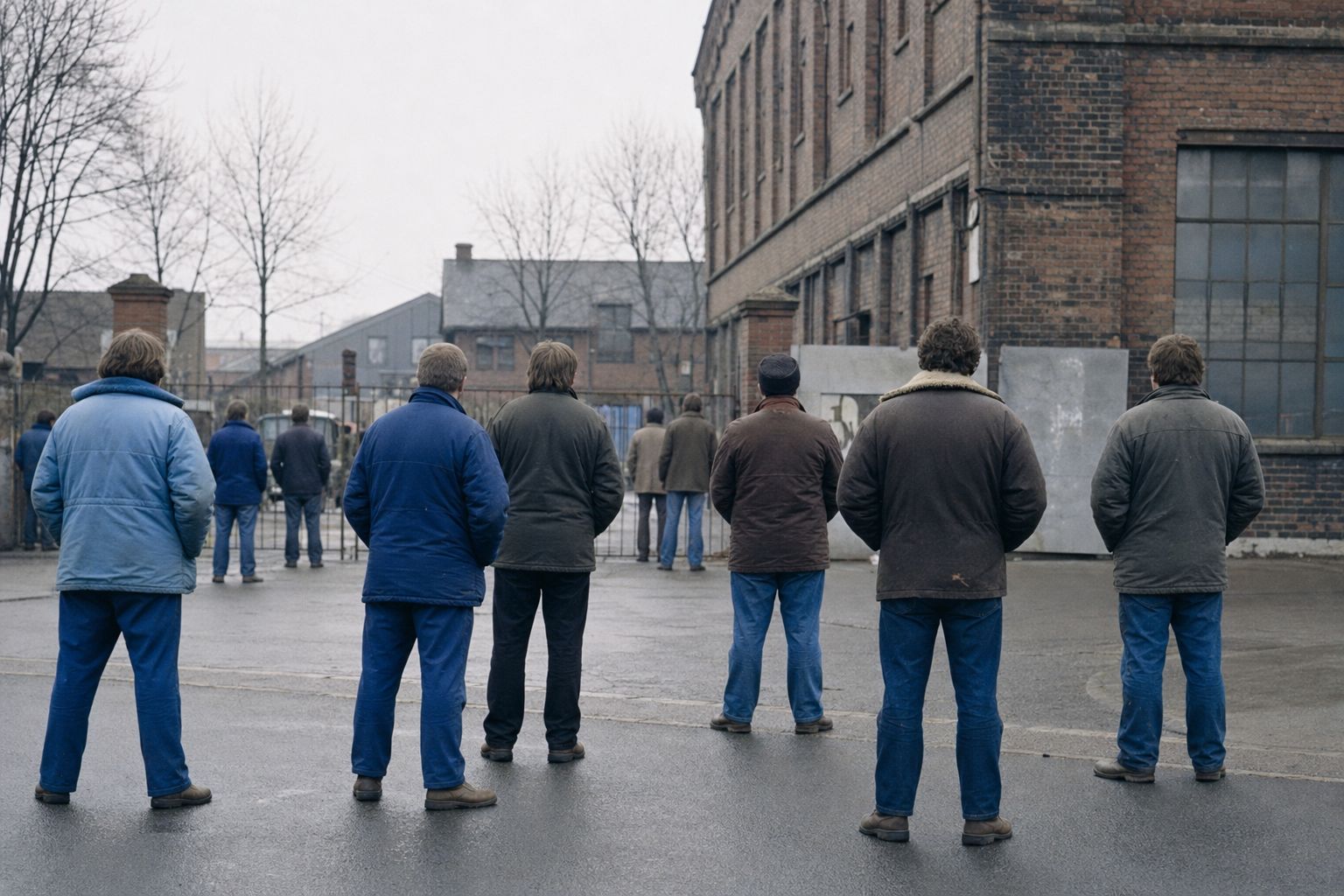
27 November, noon Workers stand outside a factory gate; the strike’s slogan was “The end of one-party rule”. AI-generated illustration.
Chapter V · The squares fill

Hundreds of thousands

RFE/RL: about 200,000 people in Wenceslas Square on 21 November and about 300,000 on 24 November, when Havel spoke from a balcony; about 500,000 at Letná on 26 November. ENRS: on 22 November Czechoslovak television broadcast speeches from the square live for the first time; on 24 November Miloš Jakeš and the party leadership resigned; about 750,000 gathered at Letná on 25–26 November, where Prime Minister Adamec was booed; on 27 November a two-hour general strike ran under the slogan “The end of one-party rule”. Britannica: strikers demanded free elections and an end to one-party rule. TIME says half a million people were on the streets by 20 November.

Use “Earlier” and “Later” to step through the days; on 26 November, switch between the two counts. One dot ≈ 1,000 people.

The plan of Prague is schematic: the river, squares and the route are placed approximately, the blocks of houses are random, and the dots stand for groups of people.

Sources: RFE/RL: The Velvet Revolution in Prague, 1989; European Network Remembrance and Solidarity: The Velvet Revolution day by day; TIME: How the Velvet Revolution brought down communism in Czechoslovakia; Britannica: Velvet Revolution

Chapter VI · Power changes hands

Chapter VI · Power changes hands

Power changes hands

No troops, a new constitution, a new president.

Why did no one open fire? A presidential commission later found that the defence minister and two other officials had planned to push for troops and tanks against the crowds. The troops were never used against the crowds.

On the twenty-ninth of November, parliament deleted the Communist Party's “leading role” from the constitution: the clause that had guaranteed its monopoly on power.

A new government, still mostly communist, angered the public and lasted four days. Then President Husák appointed one that included Civic Forum and Public Against Violence, and resigned.

Dubček, the face of 1968, became chairman of parliament. And on the twenty-ninth of December, at Prague Castle, Václav Havel was elected president.

3
officials who planned to push for troops and tanks
fired
Defence Minister Vacek, by Havel
A presidential commission (UPI, 1990)
  1. 29 Nov “leading role” deleted
  2. 3–7 Dec a mostly communist government lasts four days
  3. 4 Dec border to Austria opens
  4. 10 Dec new government; Husák resigns
  5. 28 Dec Dubček chairman of parliament
  6. 29 Dec Havel elected president; students end their strike
From the constitution to the castle (ENRS)
Civic Forum + VPN
in the federal government
Husák
announces his resignation
10 December 1989
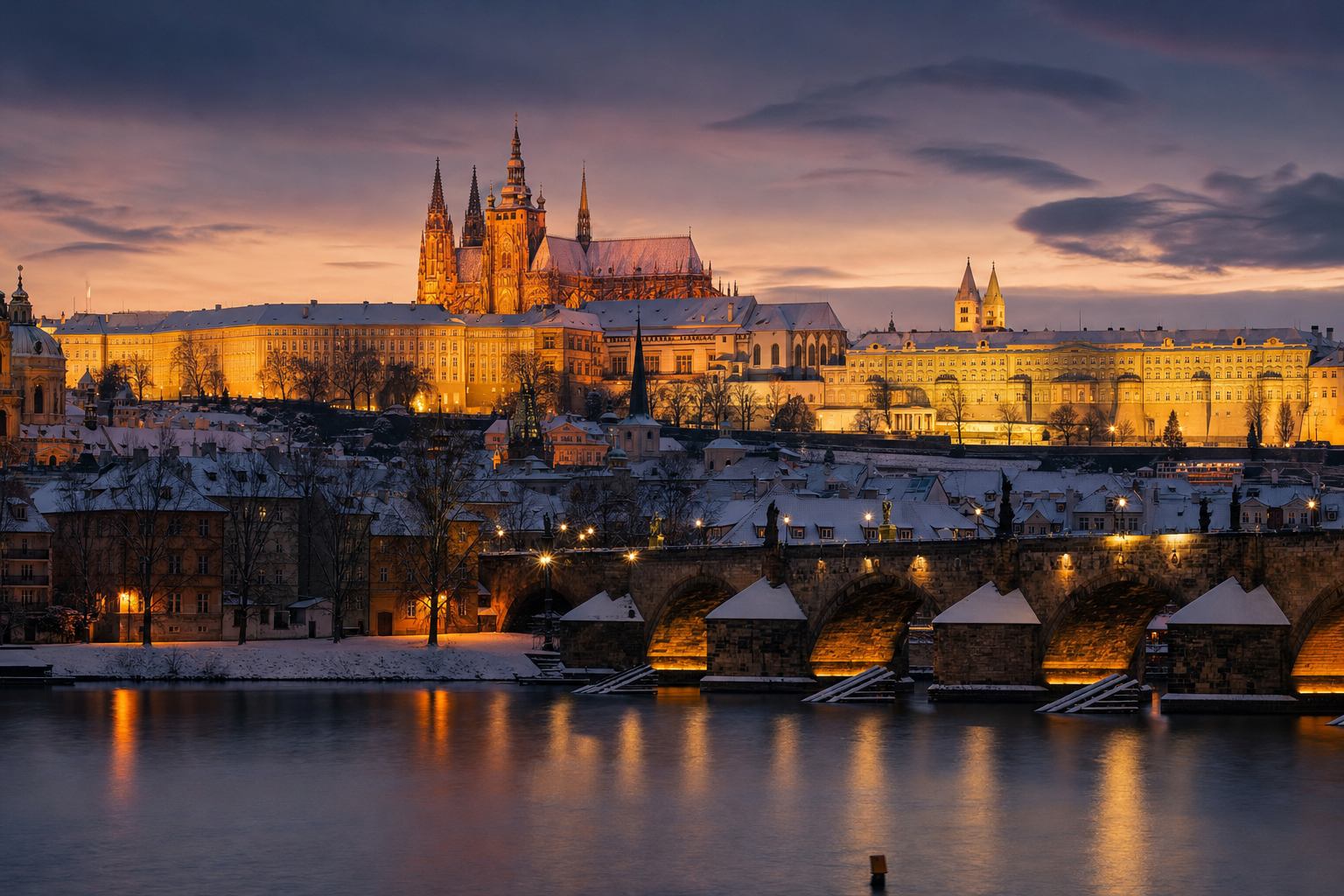
Prague Castle The castle above the river on a December evening: the first non-communist president in more than 40 years was elected here. AI-generated illustration.
Chapter VI · Power changes hands

From 29 November to 29 December

UPI (1990): a presidential commission found that Defence Minister Vacek, Chief of Staff Slimák and Deputy Interior Minister Lorenc had planned to push for troops and tanks against demonstrators; Havel fired Vacek. ENRS: on 29 November the Federal Assembly deleted the constitutional articles on the Communist Party’s leading role; on 3 December Prime Minister Adamec named a communist-dominated government, which caused public anger; on 4 December the borders opened to Austria; on 7 December the government resigned; on 10 December Husák appointed a government including members of Civic Forum and VPN and then announced his resignation; on 28 December Dubček became Chairman of the Federal Assembly; on 29 December Havel was elected president at Prague Castle and the students ended their strike. Britannica: he was Czechoslovakia’s first noncommunist president in more than 40 years.

The “leading role” was the constitution’s clause that guaranteed the Communist Party its monopoly on power. One source (a Radio Prague background article) dates Husák’s resignation to 28 November; this film follows ENRS and Britannica.

The plan of Prague is schematic: the river, squares and the route are placed approximately, the blocks of houses are random, and the dots stand for groups of people.

Sources: UPI (15 Nov 1990): Theories abound on start of Velvet Revolution; European Network Remembrance and Solidarity: The Velvet Revolution day by day; Britannica: Velvet Revolution; Britannica: Czechoslovak history, Velvet Revolution and Velvet Divorce

Chapter VII · After the velvet

Chapter VII · After the velvet

The Velvet Divorce

Elections, then two countries.

In June 1990, Czechoslovakia held its first free elections since 1946. Civic Forum and Public Against Violence won decisively.

In late 1992, the federal parliament voted Czechoslovakia out of existence.

At midnight on the thirty-first of December, after seventy-four years, it ended. On the first of January 1993, the Czech Republic and Slovakia began. This peaceful split is called the Velvet Divorce.

Press 1992 and 1993 to compare.

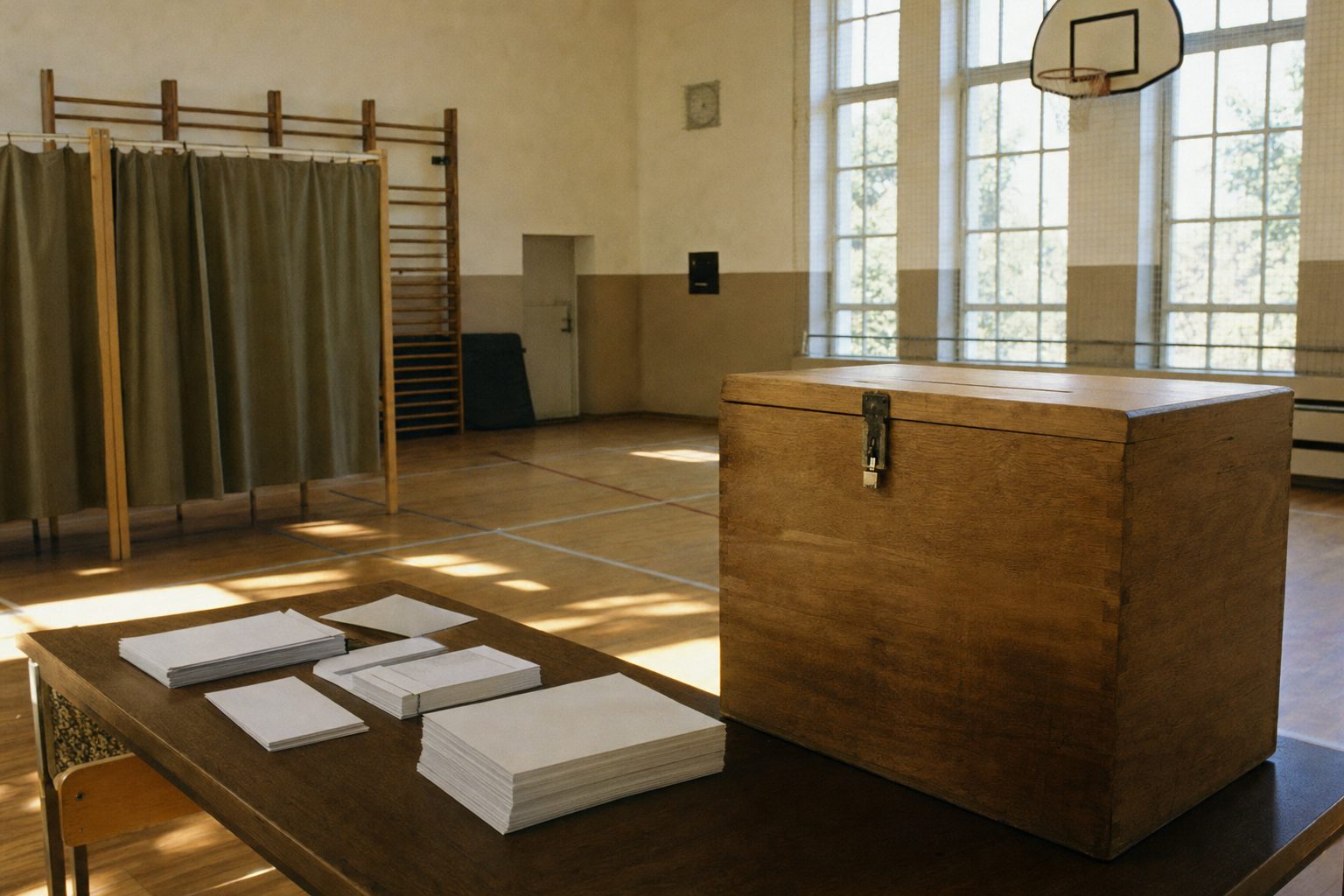
June 1990 A ballot box in a school gym; Havel was re-elected president that July. AI-generated illustration.
Federal Assembly
votes to dissolve the federation
31 Dec 1992
the last day of Czechoslovakia
Late November 1992 (Britannica)
74
years of Czechoslovakia, interrupted only by World War II
1 Jan 1993
Czech Republic and Slovakia
Britannica
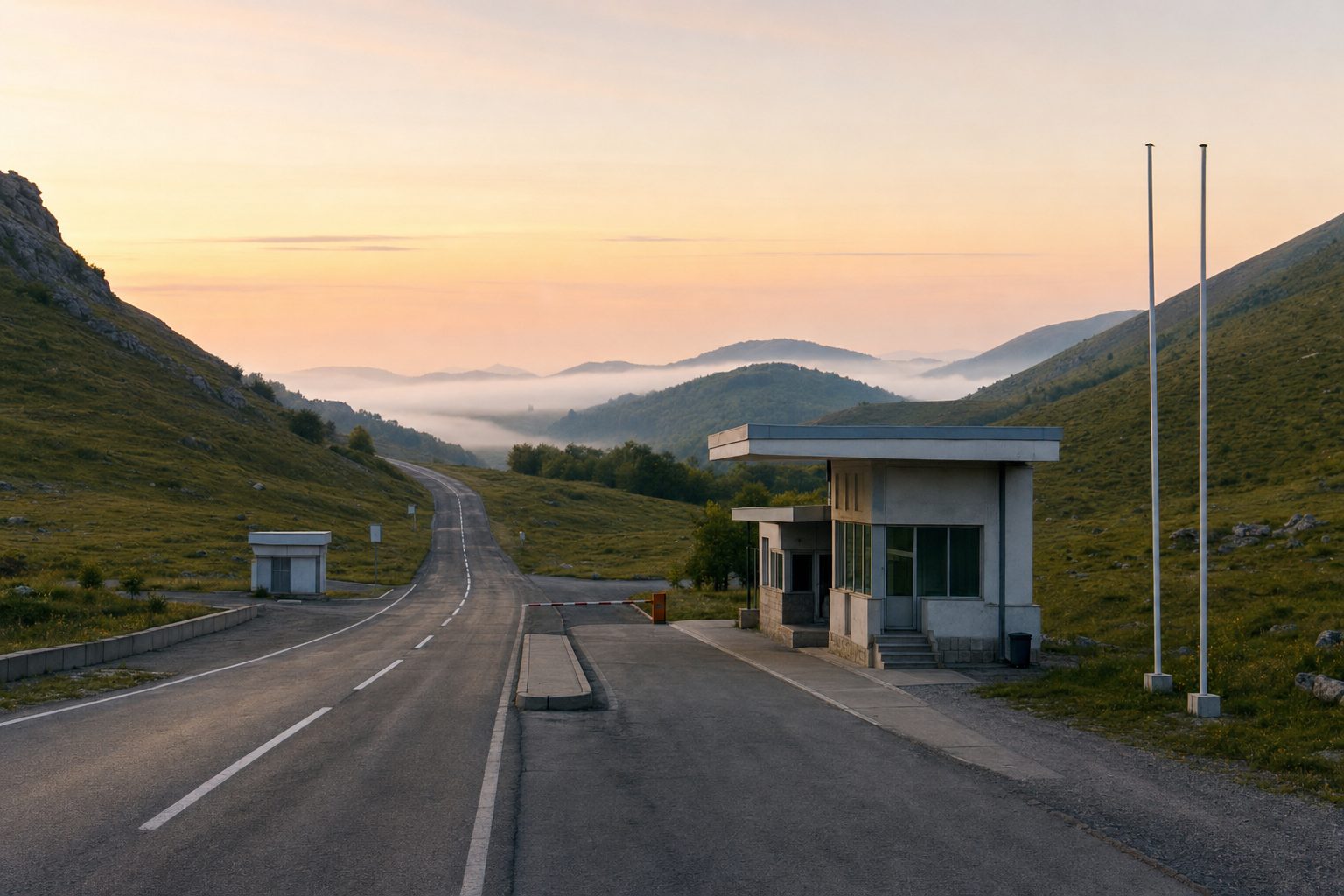
A new border A quiet road crossing between green hills, with a small border post. AI-generated illustration.
Chapter VII · After the velvet

Elections and the split

Britannica: in June 1990 Czechoslovakia held its first free elections since 1946, won decisively by Civic Forum and Public Against Violence, and Havel was re-elected in July 1990. In late November 1992 the Federal Assembly voted Czechoslovakia out of existence; it dissolved at midnight on 31 December 1992 after 74 years, interrupted only by World War II, and the Czech Republic and Slovakia came into being on 1 January 1993.

Press 1992 and 1993 to compare the maps.

The map is a teaching model: outlines of Czechoslovakia and its two halves are simplified, the 1938 border regions are drawn as a band and the 1968 arrows only show directions.

Sources: Britannica: Czechoslovak history, Velvet Revolution and Velvet Divorce

Chapter VII · After the velvet

A gentle name

What the day means now.

The Czech Republic joined NATO in 1999 and the European Union in 2004. Slovakia joined NATO in 2004.

The English name, Velvet Revolution, is credited to the dissident Rita Klímová, for how gentle it was. Slovaks call it the gentle revolution.

In Czechia the seventeenth of November is still a public holiday. Slovakia keeps the day's name, but since 2025 it is no longer a day off.

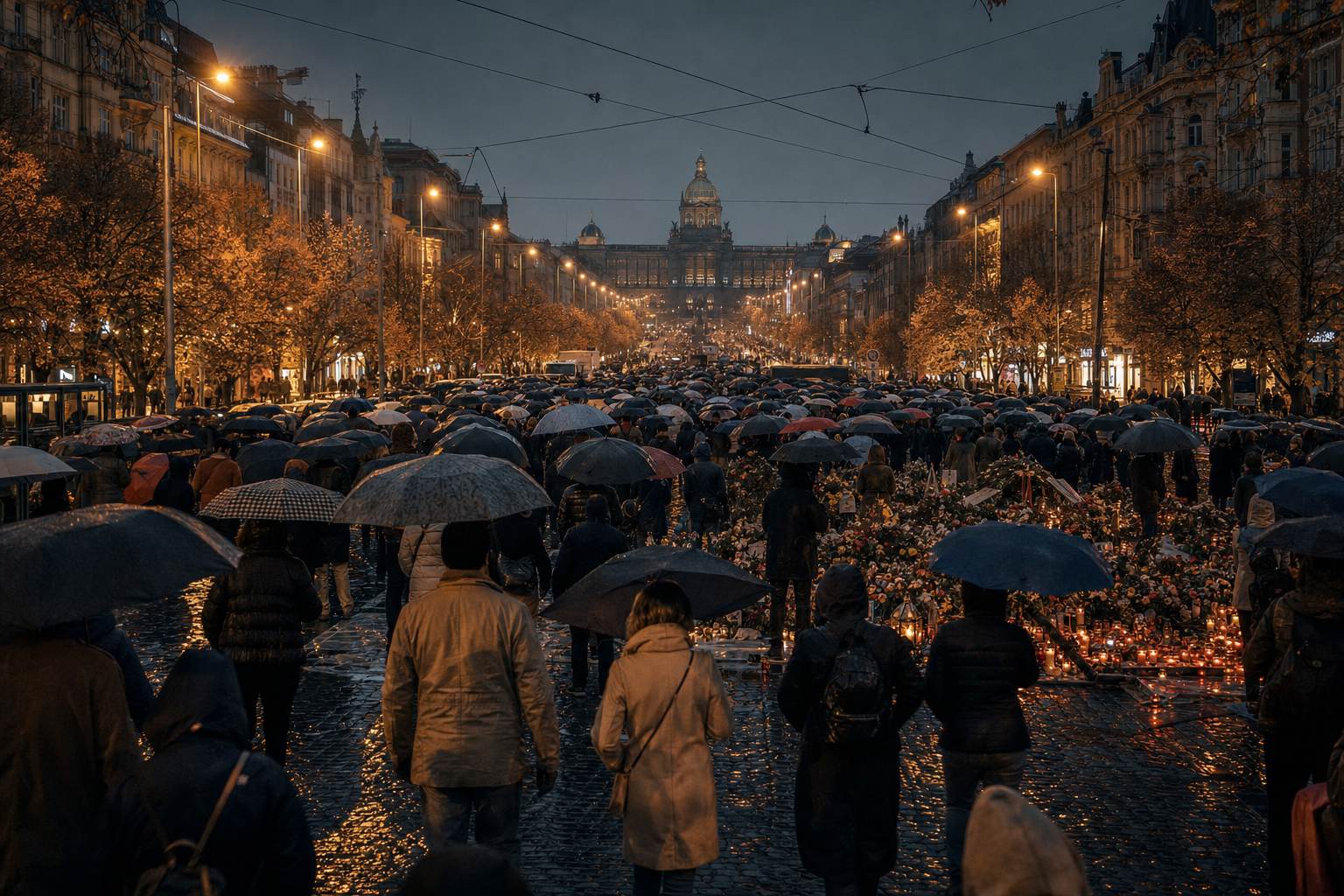
In the rain this year, President Petr Pavel told the crowd not to idealise the past: freedom and democracy, he said, carry responsibilities.

  1. 1999 Czech Republic joins NATO (12 Mar)
  2. 2004 Slovakia joins NATO (29 Mar)
  3. 2004 Czechia joins the EU (1 May)
  4. 2007 Czechia joins Schengen
After 1993
sametová revoluce
Czech: velvet revolution
nežná revolúcia
Slovak: gentle revolution
Two names for it
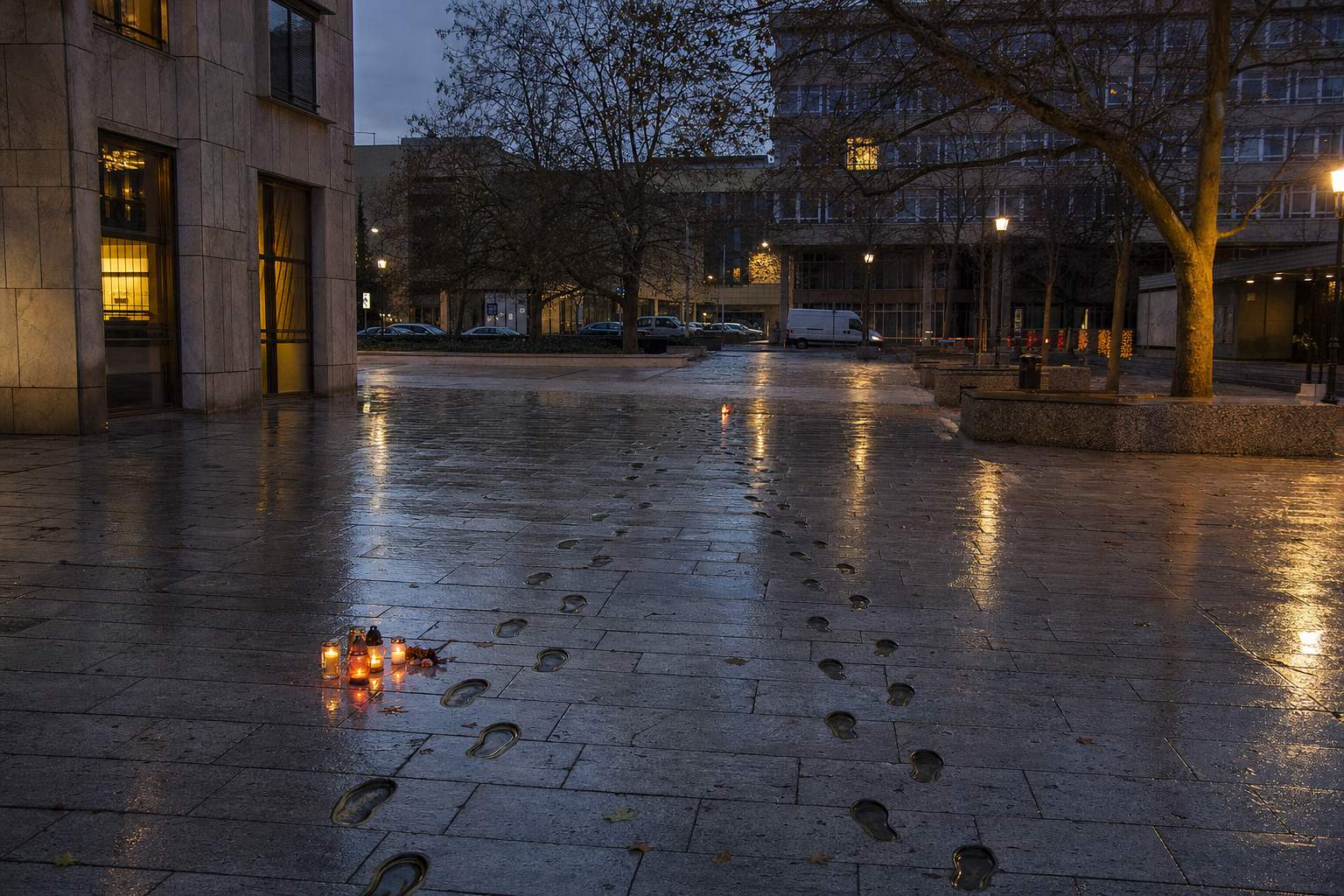
Bratislava, Freedom Square Bronze footprints set in the paving: the city’s first November 1989 memorial was unveiled in 2025. AI-generated illustration.
Prague, 17 November 2026 Umbrellas and candles on a rainy commemoration evening. AI-generated illustration.
Chapter VII · After the velvet

Since then

Czech Foreign Ministry: the Czech Republic joined NATO on 12 March 1999. TASR: Slovakia joined NATO on 29 March 2004. European Union: Czechia has been a member since 1 May 2004 and joined Schengen on 21 December 2007. TIME: the English phrase “Velvet Revolution” is credited to the dissident Rita Klímová. The Slovak Spectator: Slovakia ended 17 November as a day off from 2025, keeping its name, Day of the Struggle for Freedom and Democracy. City of Bratislava: a November 1989 memorial of bronze footprints was unveiled on Námestie slobody on 17 November 2025. Český rozhlas (17 November 2026): President Petr Pavel said on Národní třída that people should not idealise the past and that freedom and democracy carry responsibilities.

The plan of Prague is schematic: the river, squares and the route are placed approximately, the blocks of houses are random, and the dots stand for groups of people.

Sources: Ministry of Foreign Affairs of the Czech Republic: NATO; TASR: Slovakia joined NATO; European Union: Czechia; TIME: How the Velvet Revolution brought down communism in Czechoslovakia; The Slovak Spectator (3 Jun 2025): Slovakia ends November 17 public holiday; City of Bratislava (14 Nov 2025): a November 1989 memorial on Námestie slobody; Český rozhlas / Radio Prague (17 Nov 2026): Politicians stressed the value of freedom and recalled 1989 and 1939 despite heavy rain; Radio Prague International (17 Nov 2026): Senate speaker Vystrčil urges Czechs to safeguard freedom and democracy

Epilogue

Epilogue

Lit for both

A timeline, and the sources.

Forty-two days, from a student march to a new president. It ended quietly because the crowds stayed peaceful and kept coming back, and the troops some ministers wanted were never used.

And it began as a remembrance of other students, fifty years before. That is why, every seventeenth of November, the candles on Národní třída are lit for both.

The panel holds a timeline and the sources for every fact in this film.

  1. 17 Nov 1939 students executed and deported
  2. 17 Nov 1989 the march is stopped on Národní
  3. 19 Nov Civic Forum founded
  4. 27 Nov general strike
  5. 29 Nov “leading role” deleted
  6. 29 Dec Havel president
  7. June 1990 free elections
  8. 1 Jan 1993 two states
The Velvet Revolution in eight dates
0
deaths reported in Nov–Dec 1989 by this film’s sources
fired
the minister who planned to push for troops
Why it stayed quiet
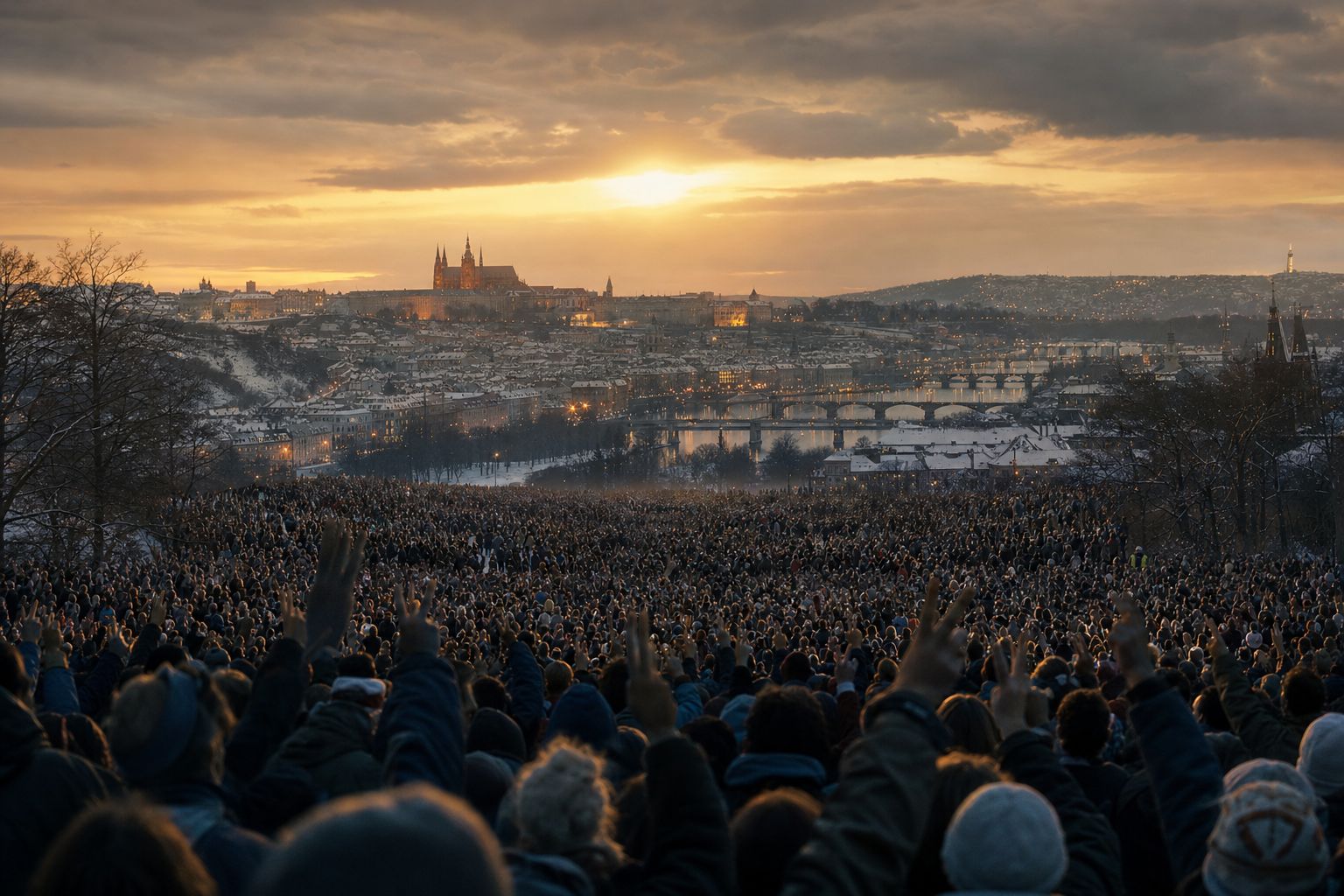
Letná, 1989 A winter crowd on the plain above the river, with the castle and spires beyond. AI-generated illustration.
  • Radio Prague, ENRS and Britannica on 1989
  • the Czech Government on 1939
  • ČT24 and UPI on the rumour and the dispute
Read more
Epilogue · Sources

Sources

Every fact in this film comes from the sources below. Where they give different figures (troops in 1968, injured on 17 November, crowd sizes), the cards and panels name who says what. The theory that the secret police staged parts of 17 November is presented as a claim, with the evidence against it. The maps and the plan of Prague are schematic teaching models. The chapter stills and pictures are AI-generated illustrations, not photographs, and show no real people.

Sources: Radio Prague International (17 Nov 2026): Czechs marking 37th anniversary of the Velvet Revolution; Český rozhlas / Radio Prague (17 Nov 2026): Politicians stressed the value of freedom and recalled 1989 and 1939 despite heavy rain; Radio Prague International (17 Nov 2026): Senate speaker Vystrčil urges Czechs to safeguard freedom and democracy; Government of the Czech Republic: Autumn 1939, student demonstrations and the closure of Czech universities; European Network Remembrance and Solidarity: 17 November, from anti-Nazi protests to International Students’ Day; Britannica: Czechoslovakia; United States Holocaust Memorial Museum: Munich Agreement; Radio Prague International: February 1948, the communist takeover; Britannica: Prague Spring; Radio Prague International: the Warsaw Pact invasion of August 1968; RFE/RL: Czechoslovakia, the Prague Spring and the invasion; Radio Prague International: Charter 77; Radio Prague International: 1989, Palach Week and the road to November; RFE/RL: How Hungary opened its border in 1989; Britannica: Velvet Revolution; European Network Remembrance and Solidarity: The Velvet Revolution day by day; UPI (15 Nov 1990): Theories abound on start of Velvet Revolution; ČT24: Drahomíra Dražská, the source of the report of a dead Šmíd, speaks; Radio Prague International: Martin Šmíd, the student who was reported dead; TASR: Public Against Violence (VPN), a profile; RFE/RL: The Velvet Revolution in Prague, 1989; TIME: How the Velvet Revolution brought down communism in Czechoslovakia; Britannica: Czechoslovak history, Velvet Revolution and Velvet Divorce; Ministry of Foreign Affairs of the Czech Republic: NATO; TASR: Slovakia joined NATO; European Union: Czechia; The Slovak Spectator (3 Jun 2025): Slovakia ends November 17 public holiday; City of Bratislava (14 Nov 2025): a November 1989 memorial on Námestie slobody