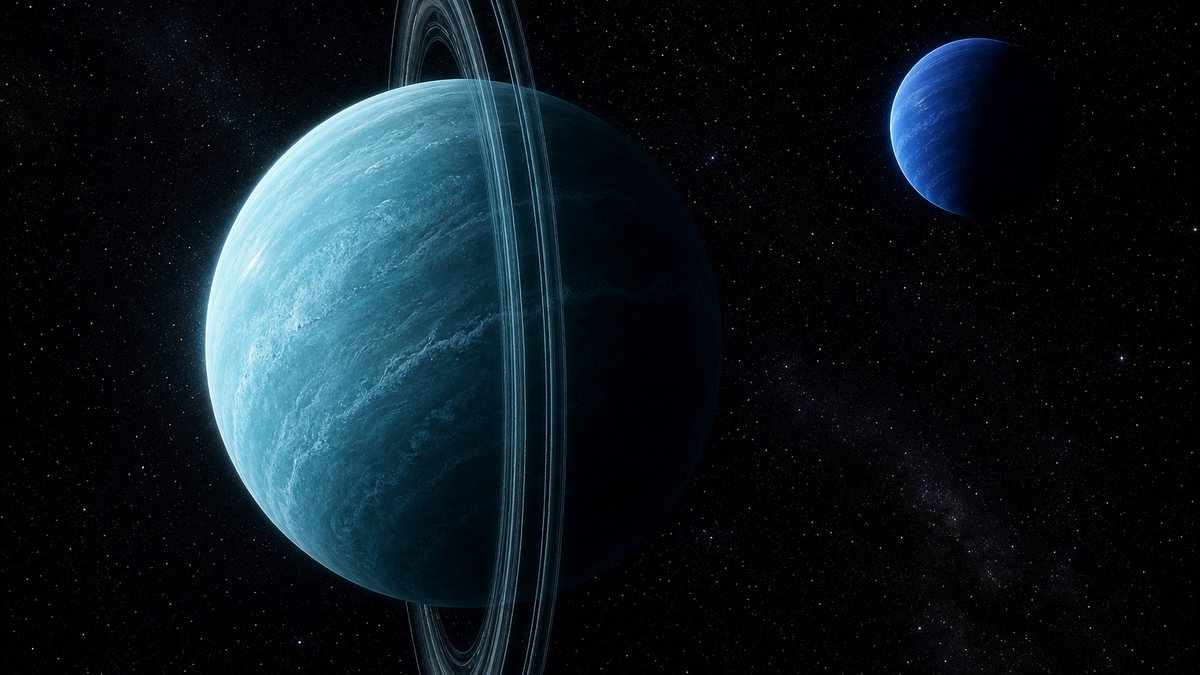
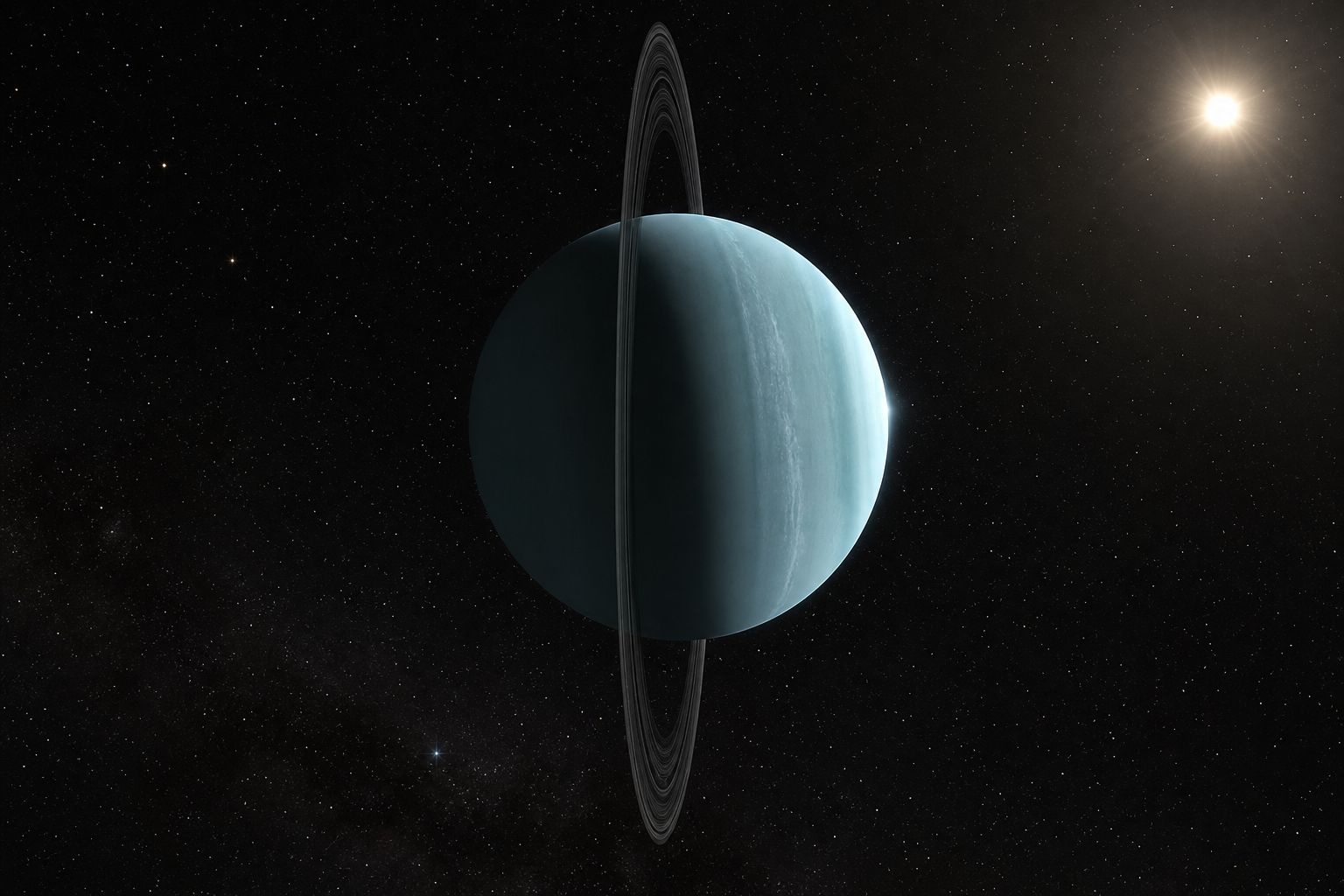
In November 2026 a team led by the University of Texas at Austin reported computer models that may explain why the magnetic fields of Uranus and Neptune are tilted and off-centre. This film explains the planets behind the headline: how Herschel found Uranus by accident in 1781 and how Neptune was found from a prediction in 1846, what makes an ice giant, why both look blue-green, how Uranus came to roll around the Sun on its side, Neptune’s supersonic winds, the one spacecraft that has ever visited, their rings and the backwards moon Triton, their strange magnetism, and why astronomers want to go back.
Interactive 3D film9 min1781 to 2026Published 18 November 2026
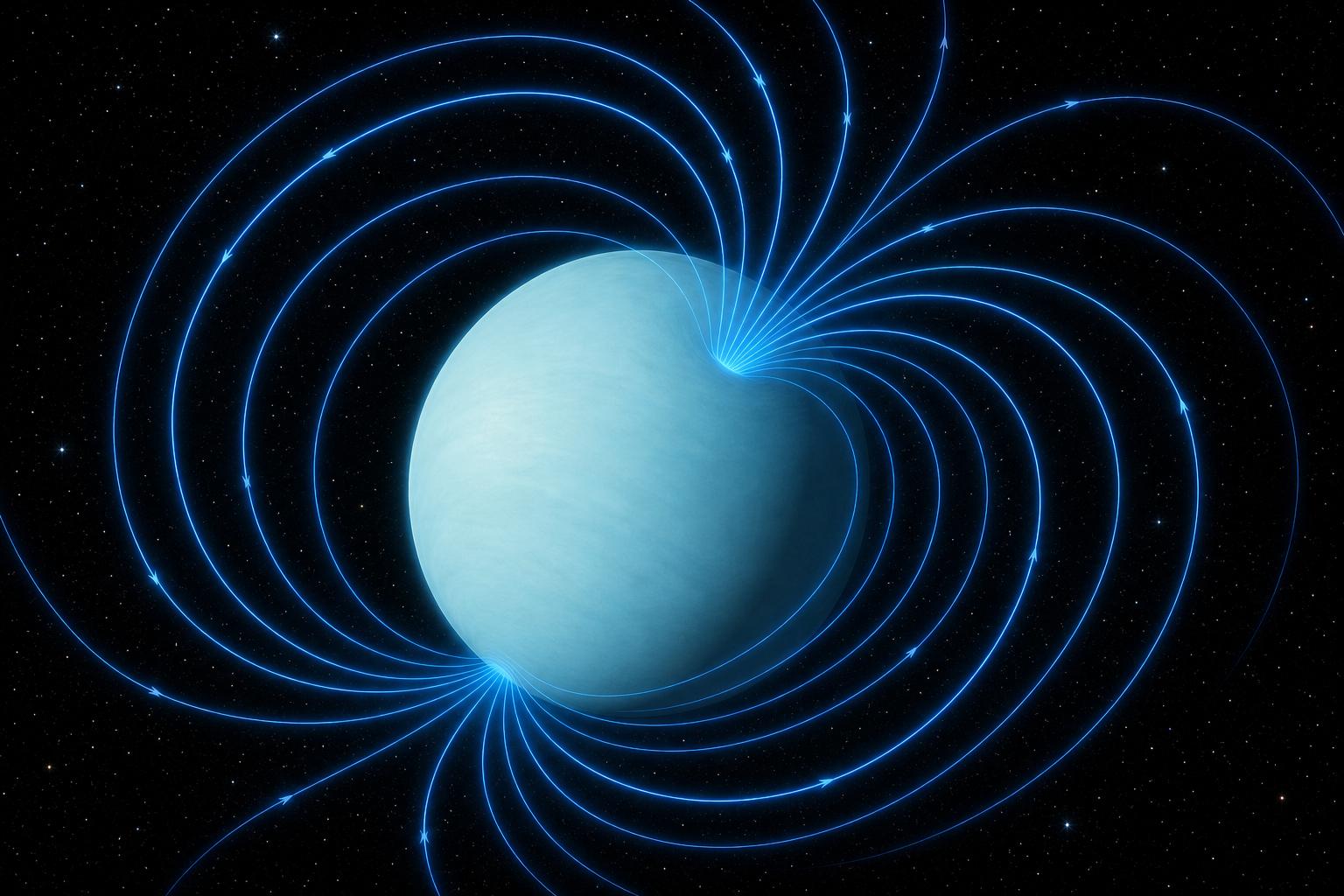
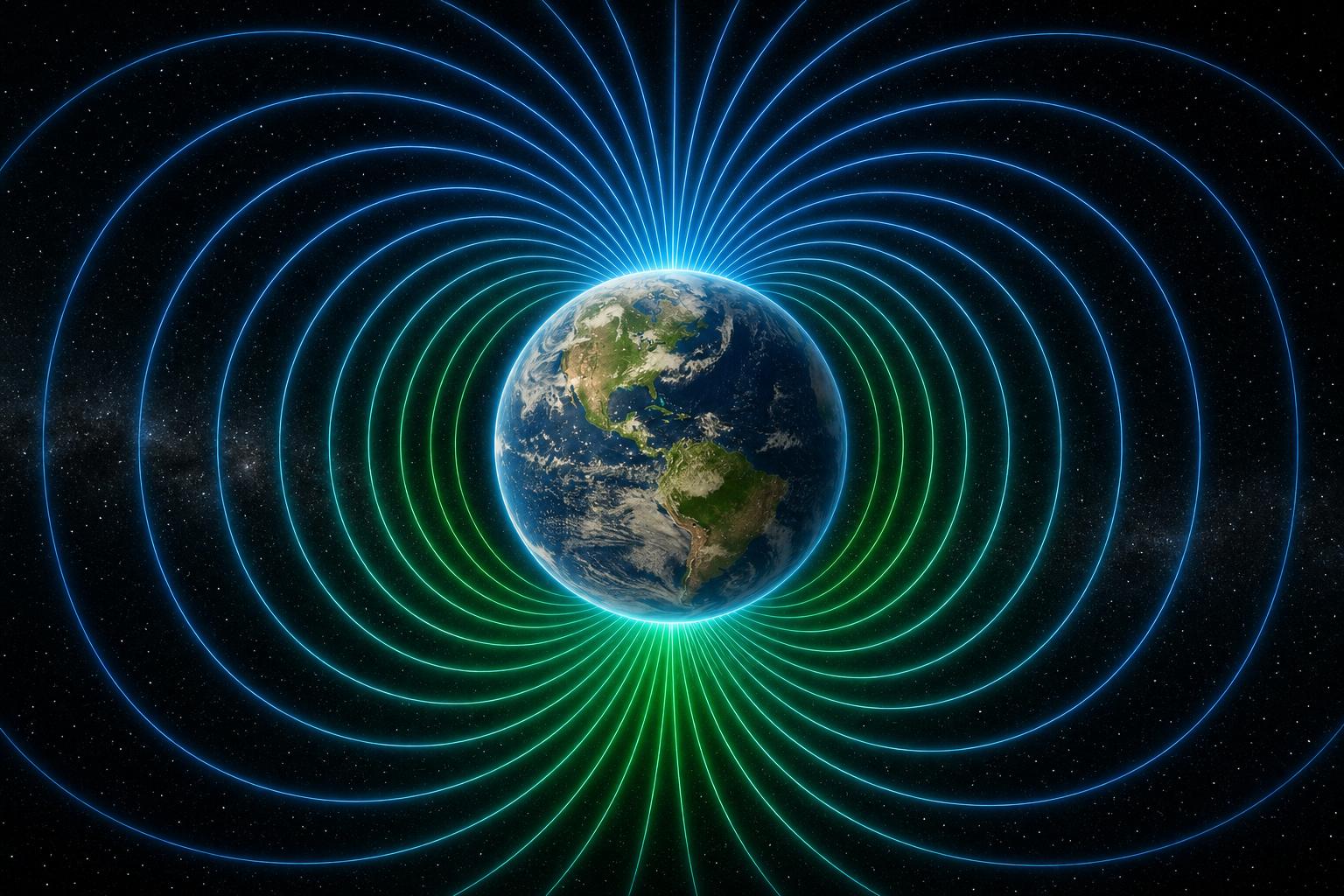
Uranus and Neptune have magnetic fields unlike Earth's: tipped far over, and pushed off-centre from the middle of the planet.
In November 2026, a team led by the University of Texas at Austin published computer models that may explain why.
To follow that answer, we first need to meet the planets themselves: the ice giants.
A crooked magnet Earth’s field leans about 11° from its spin axis; Uranus’s leans about 59°. AI-generated illustration.
Uranus and Neptune’s bizarre magnetic fields may finally be explainedHeadline, ScienceDaily, 15 November 2026
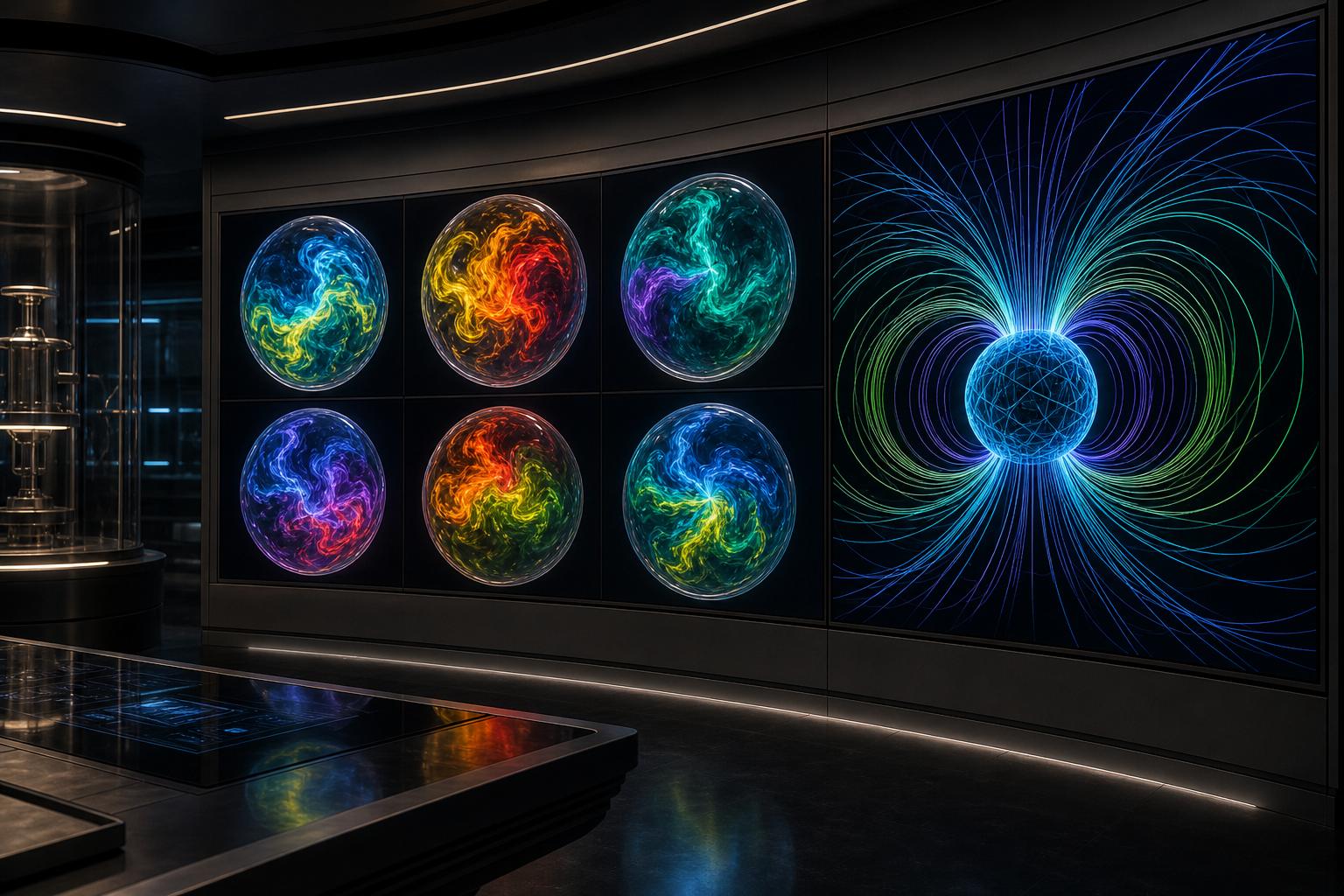
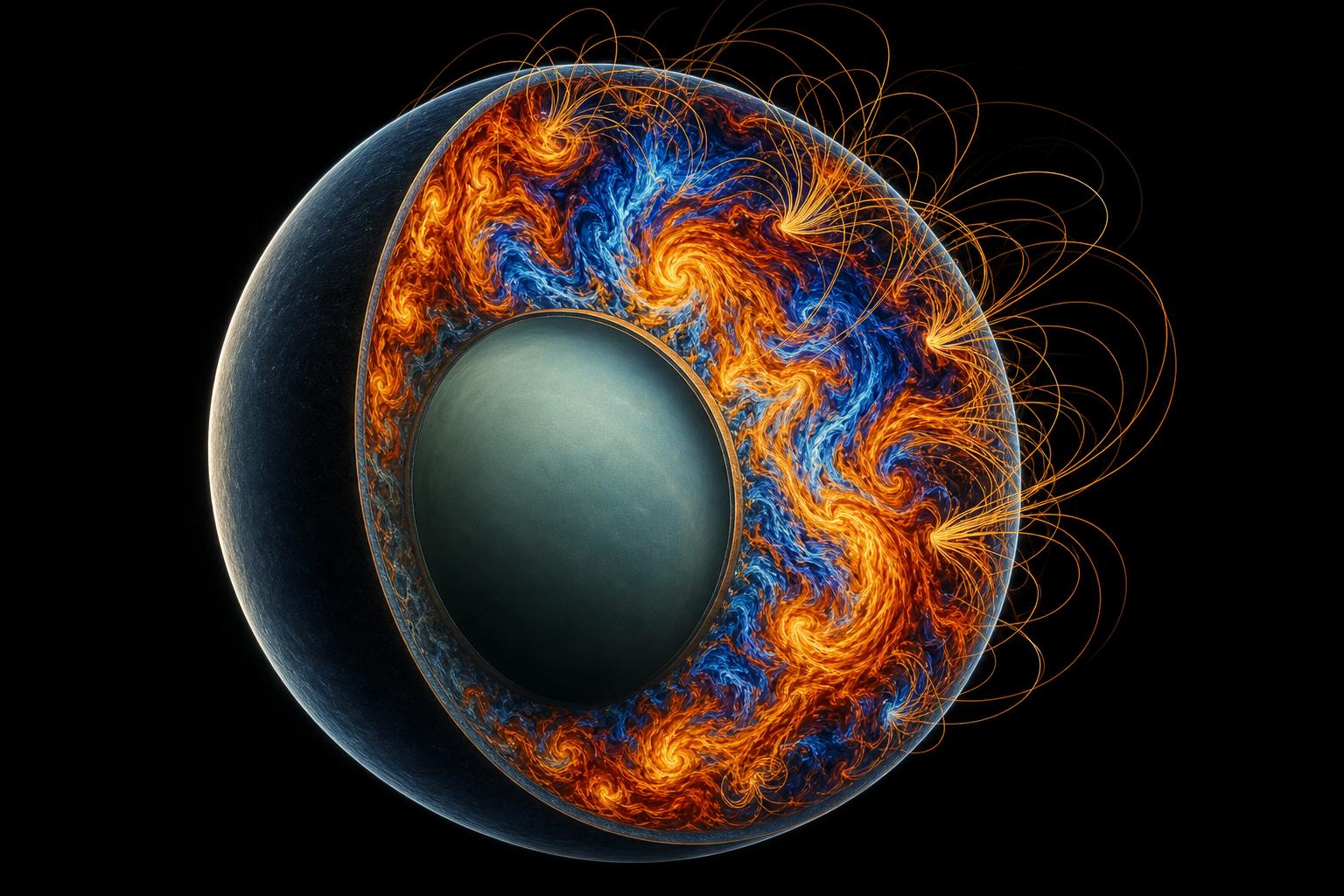
A planet inside a computer The team ran 3D simulations of the fluid deep inside and compared them with the only measurements there are, from 1986 and 1989. AI-generated illustration.
Prologue
The news
ScienceDaily (15 November 2026), Space.com (10 November 2026) and Universe Today (11 November 2026): Chi Yan and colleagues at the University of Texas at Austin, with UCLA, Imperial College London and Northumbria University, published “Electrical conductivity structure drives anomalous and potentially time-varying magnetic fields at Uranus and Neptune” in Communications Physics on 3 November 2026. It is one modelling study, not a new observation.
The 3D scenes are simplified teaching models: sizes, distances, colours and field lines are drawn schematically and not to scale.
On the 13th of March 1781, the astronomer William Herschel was studying the stars of Gemini through his telescope.
One of them was not a point of light but a small disc. At first he took it for a comet.
It was a new planet, the seventh from the Sun. Herschel called it George's Star, after his king. Astronomers abroad chose another name: Uranus.
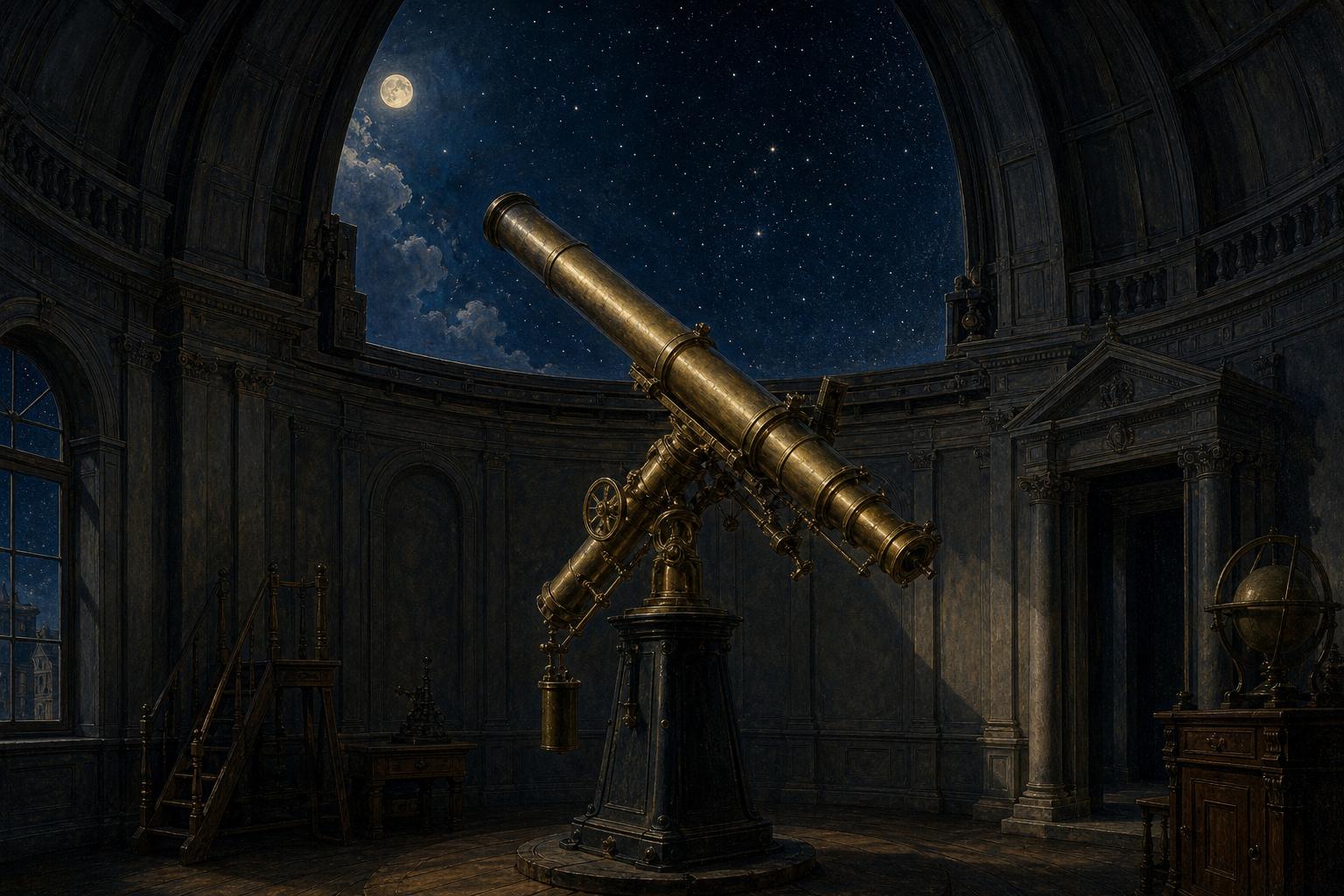
Not a star Through an eyepiece, stars stay points however much you magnify them. A planet shows a tiny disc. AI-generated illustration.A reflecting telescope An instrument in the style of the 1780s, not Herschel’s actual telescope. AI-generated illustration.
7th
planet from the Sun
Gemini
where it was spotted
Georgium Sidus
Herschel’s proposed name
13 March 1781
Chapter I · Found twice
Herschel’s planet
NASA (2021): on 13 March 1781 William Herschel identified an object in Gemini that he first thought was a comet. He proposed the name Georgium Sidus, “George’s Star”, after King George III; astronomers abroad preferred Uranus.
The 3D scenes are simplified teaching models: sizes, distances, colours and field lines are drawn schematically and not to scale.
Uranus then gave astronomers a puzzle: it did not move quite where their calculations said it should.
In France, Urbain Le Verrier worked out where an unseen planet would have to be to pull it off course. On the 23rd of September 1846, Johann Galle in Berlin received his prediction.
Galle and his colleague d'Arrest found the planet that same night. It was Neptune.
In England, John Couch Adams had worked on the same problem, and the credit was later shared between Le Verrier and Adams.
Pen and paper The prediction came from the law of gravity and the positions where Uranus had actually been seen. AI-generated illustration.
record where Uranus really is
compare with where gravity says it should be
work out the hidden mass that explains the gap
point a telescope there
Finding a planet nobody has seenBerlin, one night Galle found Neptune on his first night of searching, close to where Le Verrier had said. AI-generated illustration.
13 Mar 1781 Herschel spots Uranus
1843 Adams starts his calculations
23 Sep 1846 Galle and d’Arrest find Neptune
10 Oct 1846 Lassell finds its moon Triton
Two discoveries
Chapter I · Found twice
Neptune, predicted
Britannica: Johann Galle in Berlin received Le Verrier’s predicted position on 23 September 1846, and Galle and Heinrich d’Arrest found the planet that night. John Couch Adams had worked on the problem from 1843, but George Airy judged his results not precise enough to start a search. Credit was later shared; Britannica notes that Adams’s part now looks smaller than was once believed. NASA: Galle found Neptune on his first night of searching. The Planetary Society: William Lassell found Neptune’s moon Triton on 10 October 1846, 17 days later.
Press the button to show or hide Neptune’s pull on Uranus. The arrow is schematic; the real tug is tiny.
The 3D scenes are simplified teaching models: sizes, distances, colours and field lines are drawn schematically and not to scale.
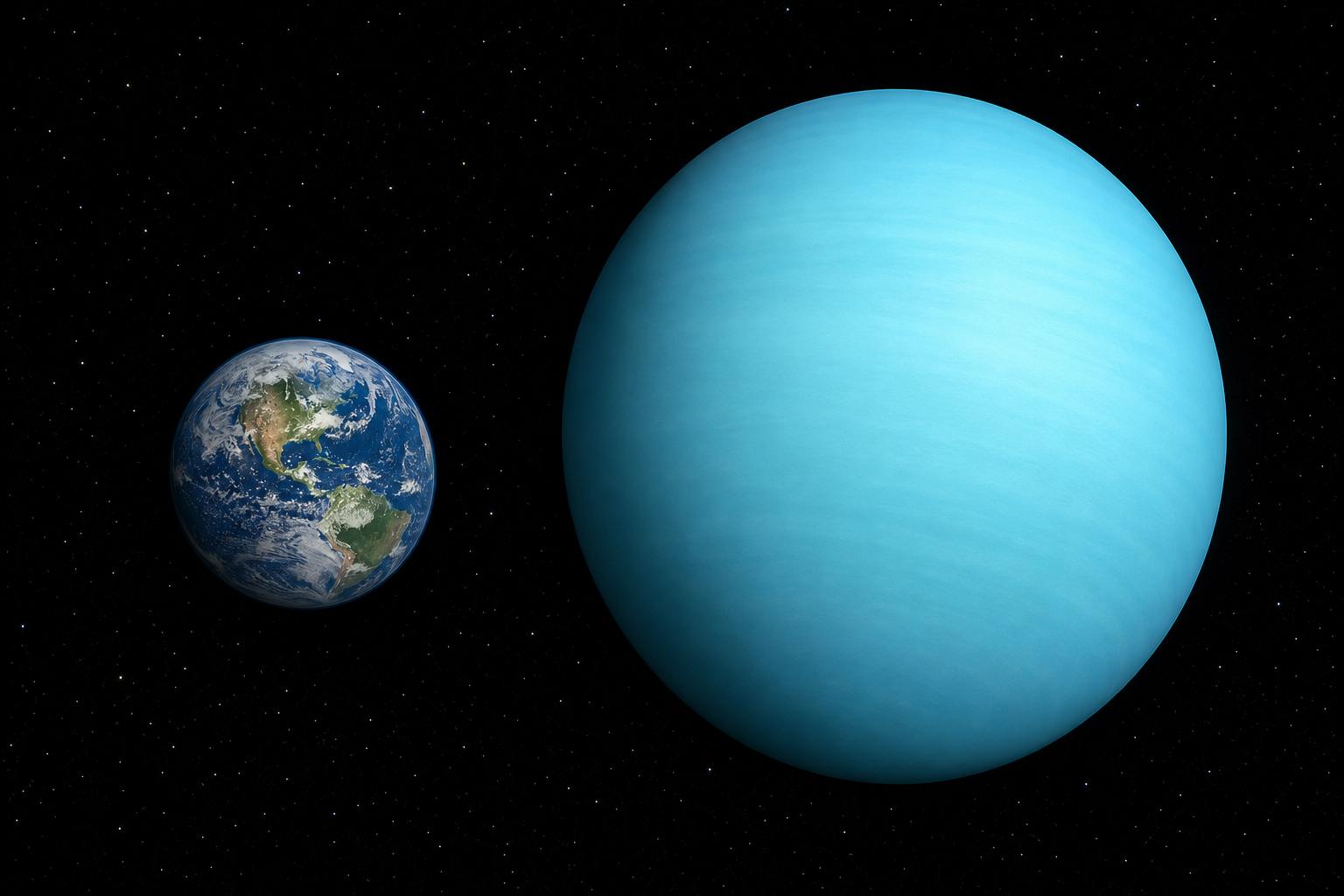
Uranus and Neptune are near twins. Each is about four times as wide as Earth: Uranus about 51,000 kilometres across, Neptune about 49,500.
Neptune is a little smaller but heavier: seventeen Earth masses, against fourteen and a half for Uranus.
Uranus is about 19 times as far from the Sun as Earth, and takes 84 years to go round once. Neptune is 30 times as far, and takes 165 years.
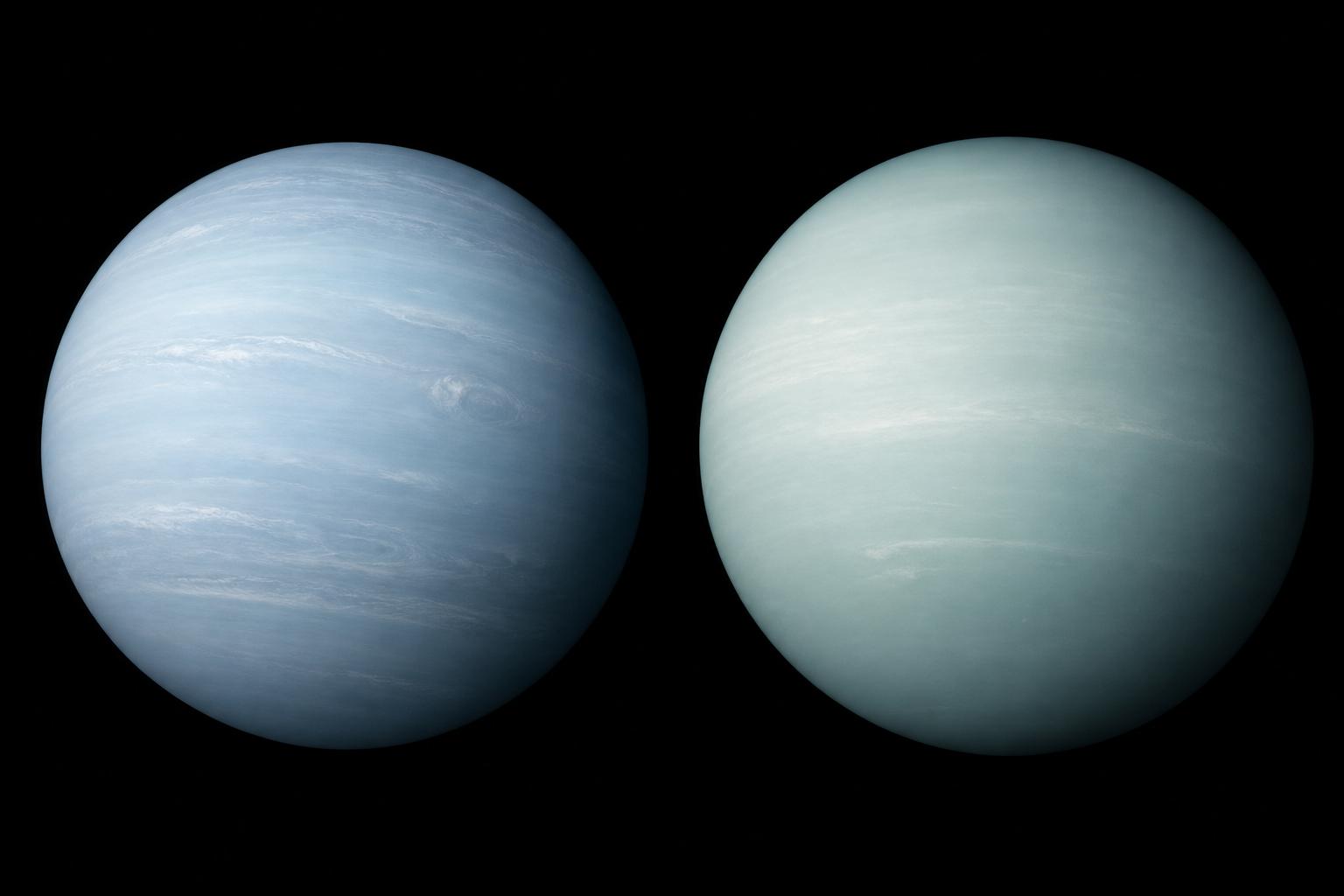
Both look blue-green, because methane absorbs red light. And in true colour, Oxford showed in 2024, the two are a similar greenish blue.
Earth for scale About four Earths would fit across either planet; by volume, dozens would fit inside. AI-generated illustration.
4.01×
Uranus, width
3.88×
Neptune, width
14.5×
Uranus, mass
17.1×
Neptune, mass
Compared with Earth
Earth
1 Earth–Sun distances (AU)
Uranus
19.2
Neptune
30.1
Distance from the Sun
True colour Neptune is only slightly bluer, because its haze is thinner. Uranus turns greener at solstice and bluer at equinox. AI-generated illustration.
Chapter II · What is an ice giant?
Near twins
NASA NSSDCA fact sheets: Uranus is 51,118 km across, 19.19 AU from the Sun, orbits in about 84 years and spins in about 17 hours; Neptune is 49,528 km across, 30.07 AU out, orbits in about 165 years and spins in about 16 hours. Relative to Earth: Uranus 14.5 times the mass and 4.01 times the diameter, Neptune 17.1 times the mass and 3.88 times the diameter. NASA: methane absorbs red light, which makes the planets look blue-green. University of Oxford (5 January 2024): Patrick Irwin’s team found that both planets are a similar greenish blue; Neptune is slightly bluer because its haze is thinner, and Voyager 2’s Neptune images had been enhanced.
Press the buttons to show Earth beside them, or to switch Neptune between the old enhanced look and its true colour. The three spheres are to scale with each other; the gap between them is not, and the colours are approximate.
The 3D scenes are simplified teaching models: sizes, distances, colours and field lines are drawn schematically and not to scale.
Astronomers call Uranus and Neptune ice giants, and the name comes from what fills them.
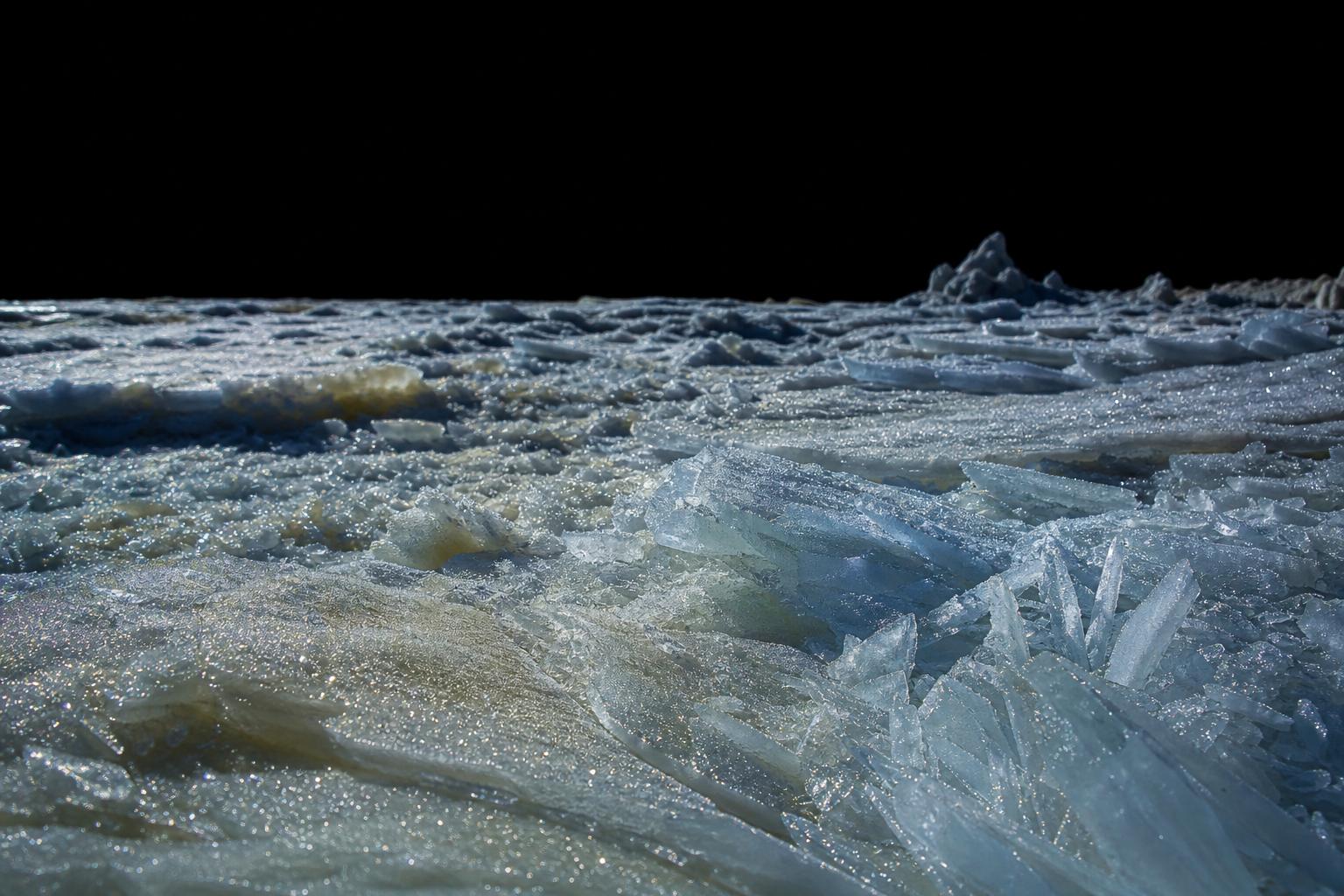
Water, methane and ammonia are frozen solid in the cold outer Solar System, so planetary scientists call them ices, even where they are not frozen.
More than 80 percent of each planet's mass is a hot, dense fluid of these ices, around a small rocky core. Only the outer layer is gas, mostly hydrogen and helium.
Near the centre of Uranus, the temperature is about 5,000 degrees Celsius.
outside: hydrogen and helium gas, a little methane
most of the mass: hot, dense water, methane, ammonia
centre: a small rocky core
Three layersWhere the name comes from On cold moons far from the Sun, these compounds can lie on the surface as frost and ice. AI-generated illustration.A fluid, not a solid Under that pressure the “ices” behave as a hot, dense fluid, not as frozen blocks. AI-generated illustration.
−224 °C
coldest air (49 K)
~4,982 °C
the core
80%+
of the mass is “ices”
Uranus, top to bottom
Chapter II · What is an ice giant?
What an ice giant is made of
NASA: more than 80% of the mass of Uranus and of Neptune is a hot, dense fluid of “icy” materials (water, methane and ammonia) above a small rocky core. The atmosphere is mostly hydrogen and helium with a small amount of methane. The core of Uranus is about 4,982 °C; its coldest atmosphere is 49 K (−224 °C).
Press the button to open or close the cut-away. The layer thicknesses are schematic.
The 3D scenes are simplified teaching models: sizes, distances, colours and field lines are drawn schematically and not to scale.
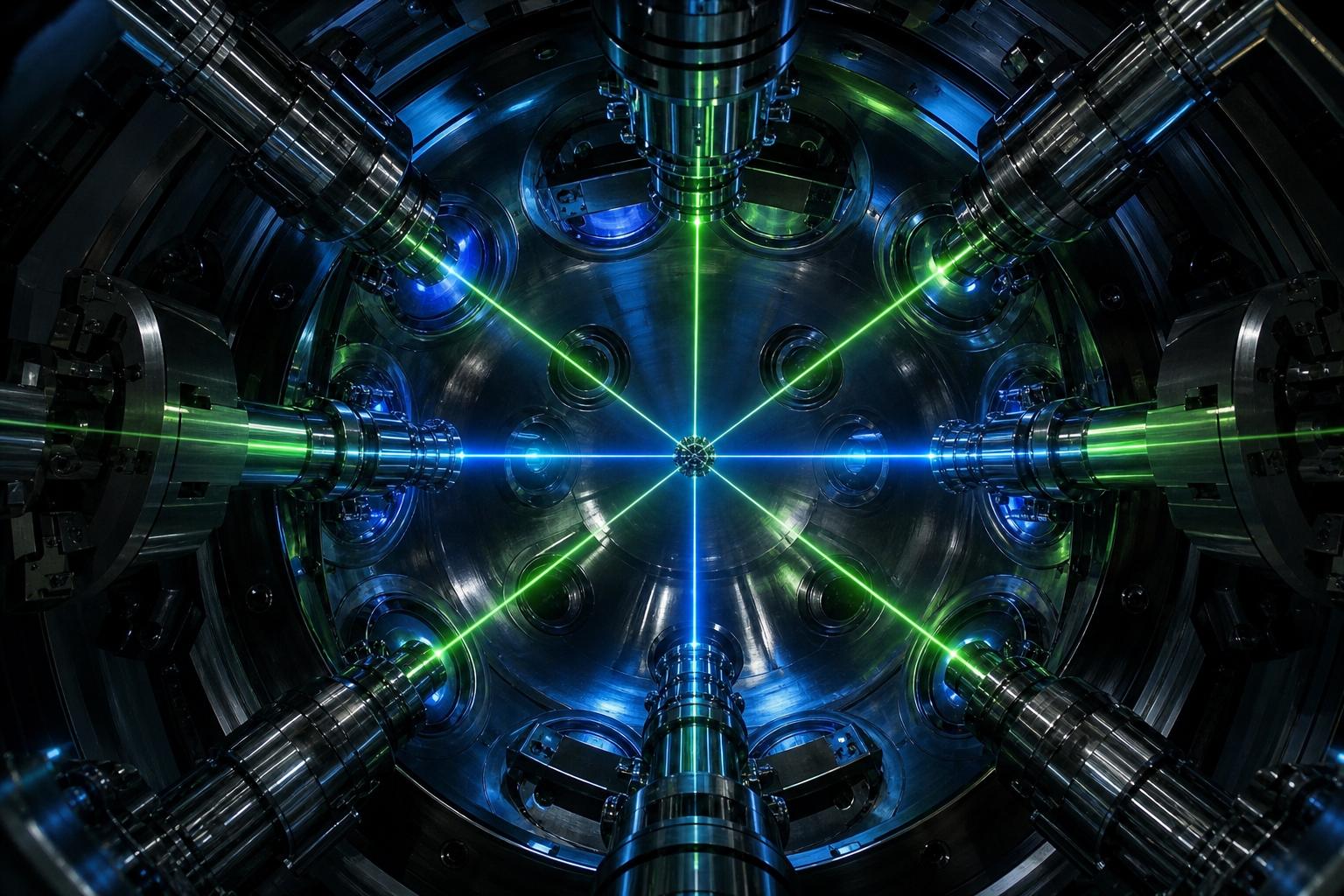
Nobody can drill into an ice giant, so scientists recreate the conditions with lasers, for a few billionths of a second.
In 2019, a team from Lawrence Livermore mapped the crystal structure of superionic ice: oxygen atoms locked in place, while hydrogen ions flow through. It conducts electricity, and could be common deep inside these planets.
Keep that in mind: material deep inside that conducts electricity will matter when we come to the magnetic fields.
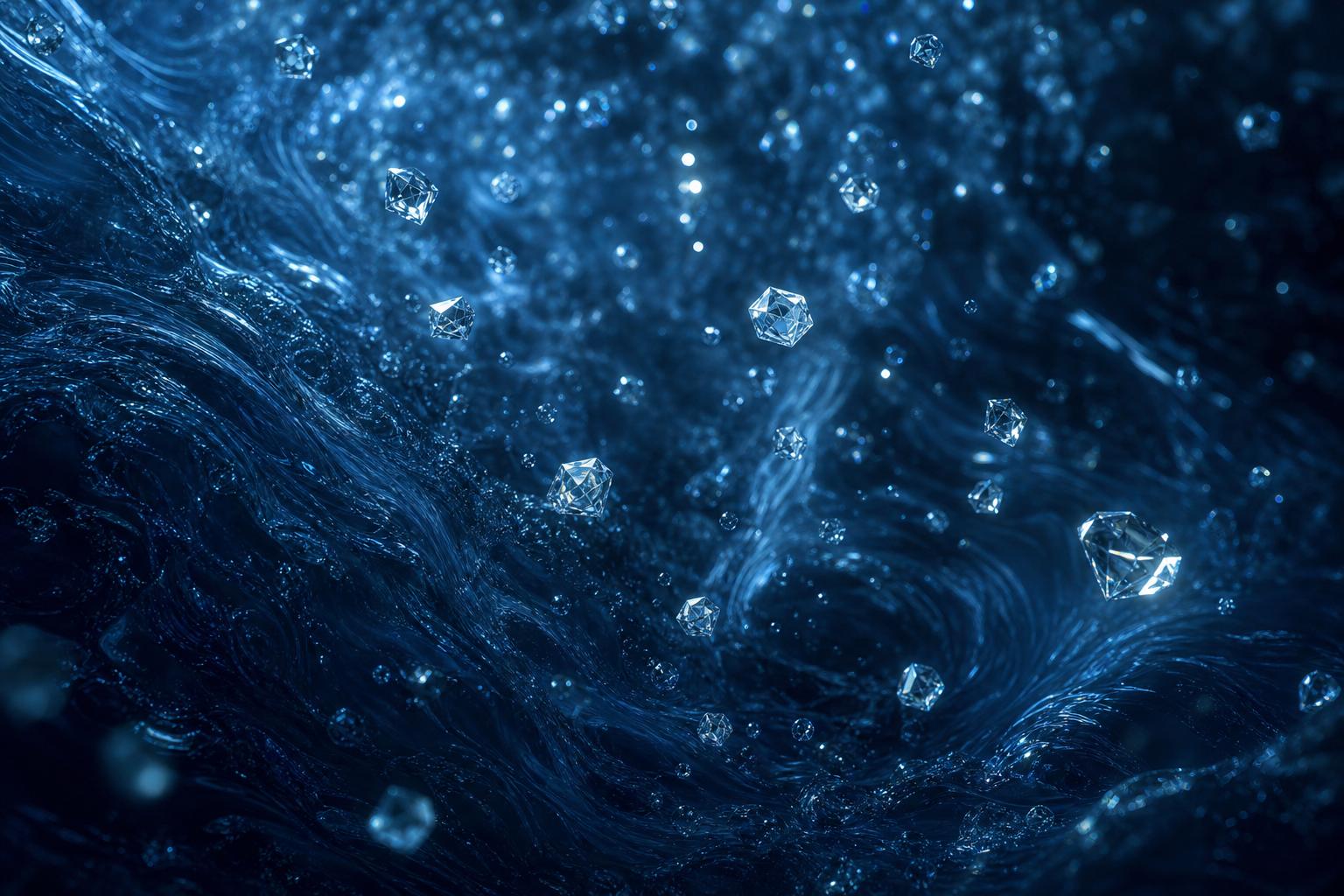
In 2017, SLAC saw tiny diamonds form in a plastic standing in for the planets' methane compounds. Diamond rain inside the planets is still only an idea.
A laser shot An illustration of a laser experiment: the real shots squeeze a tiny sample for only nanoseconds. AI-generated illustration.
100+ GPa
pressure, about a million atmospheres
2,000+ K
temperature
~100,000 S/m
electrical conductivity
Superionic ice, 2019
oxygen atoms: fixed in a crystal
hydrogen ions: flow through it
result: it conducts electricity
Inside superionic ice
measured in a lab: superionic ice, tiny diamonds
not yet observed in the planets
Know the differenceAn idea, not yet seen If diamonds do form, they would sink slowly through the dense fluid towards the core. AI-generated illustration.
Chapter II · What is an ice giant?
Laboratory clues
Physics Today (2019): Marius Millot, Federica Coppari and colleagues at Lawrence Livermore National Laboratory used laser shocks at the University of Rochester’s Omega facility, above 100 GPa and 2,000 K for nanoseconds, and determined the crystal structure of superionic “ice XVIII”: an oxygen lattice through which hydrogen ions move, with a conductivity of about 10⁵ S/m. They suggest it could be abundant in the ice giants’ mantles. SLAC (21 August 2017): Dominik Kraus and colleagues shocked polystyrene, a stand-in for the planets’ methane-based compounds, and caught nanometre-sized diamonds forming with X-ray pulses; rain inside the planets is a hypothesis.
Press the button to show or hide the diamond rain. It is drawn as an idea, not as something observed.
The 3D scenes are simplified teaching models: sizes, distances, colours and field lines are drawn schematically and not to scale.
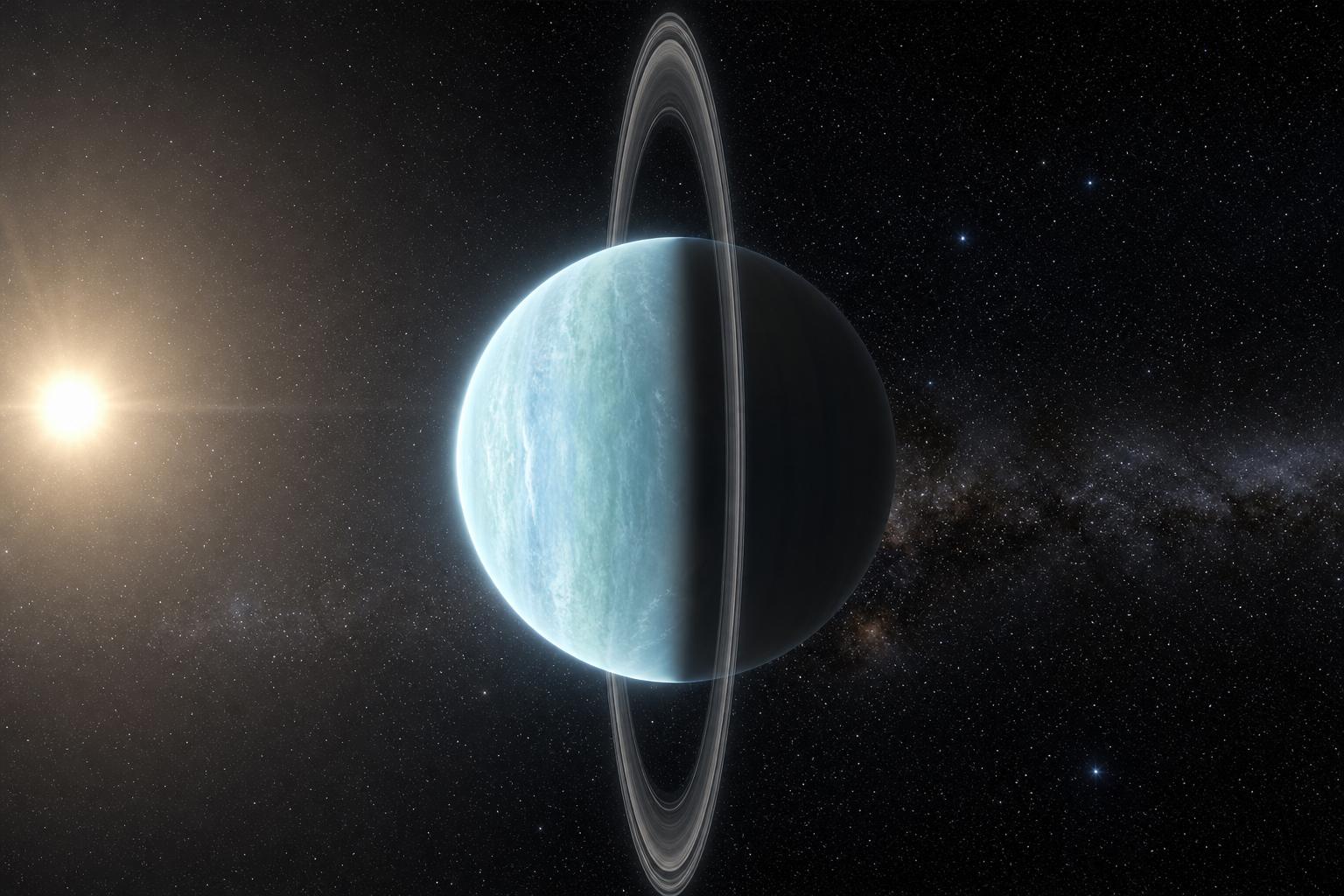
Neptune's spin axis leans by about 28 degrees. Uranus is tipped over by about 98 degrees, a little past lying on its side, so it rolls around the Sun.
Its axis keeps pointing the same way in space. So for part of its 84-year orbit, one pole faces the Sun; half an orbit later, the other one does.
Each pole gets about 42 years of continuous sunlight, and then about 42 years of darkness.
In between, at the equinoxes, the Sun shines on the equator, and day and night take turns as it spins, about every 17 hours.
97.8°
Uranus
28.3°
Neptune
Tilt of the spin axisA pole to the Sun Near a solstice, one whole hemisphere stays lit while the other sits in a night that lasts for decades. AI-generated illustration.
84 years
one orbit
~42 years
of light at each pole
~17 h
one day
A Uranus yearRings stood on end Webb’s 2023 image of Uranus showed 11 of its 13 rings and a bright cap over the pole. AI-generated illustration.
Chapter III · On its side
Seasons on its side
NASA NSSDCA: Uranus’s axis is tilted 97.77° and Neptune’s 28.32°. NASA JPL Night Sky Network: each pole of Uranus gets about 42 years of continuous sunlight, followed by 42 years of darkness. NASA’s Uranus facts page describes it as a 21-year dark winter for half the planet at a time. A Uranus day lasts about 17 hours.
Press Play to run a Uranus year, or jump to a solstice or an equinox. The orbit is drawn much smaller than it really is.
The 3D scenes are simplified teaching models: sizes, distances, colours and field lines are drawn schematically and not to scale.
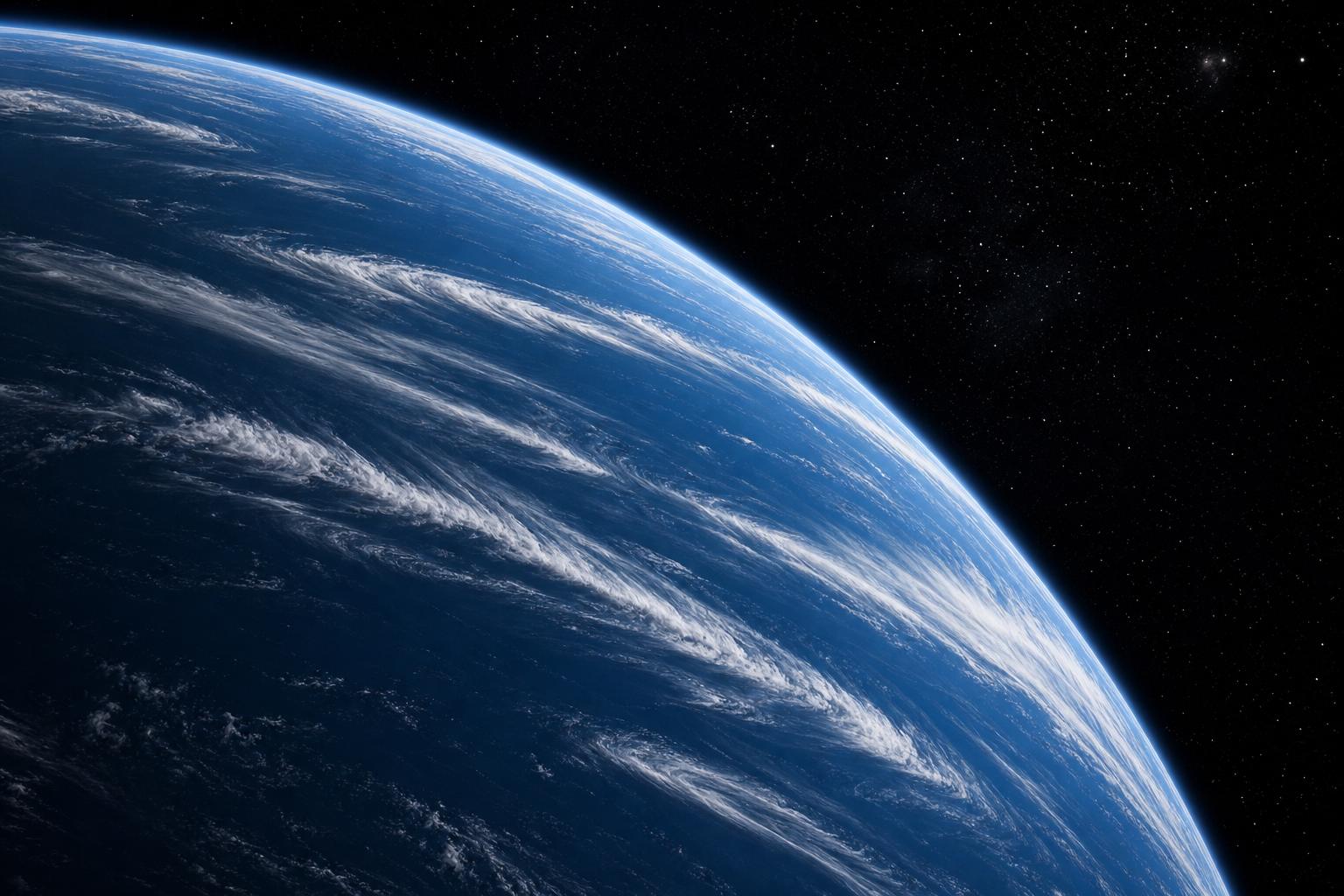
Neptune is the farthest planet from the Sun, yet its winds blow at more than 2,000 kilometres an hour, the fastest known in the Solar System.
That is about three times as fast as Jupiter's winds, and nine times as fast as Earth's.
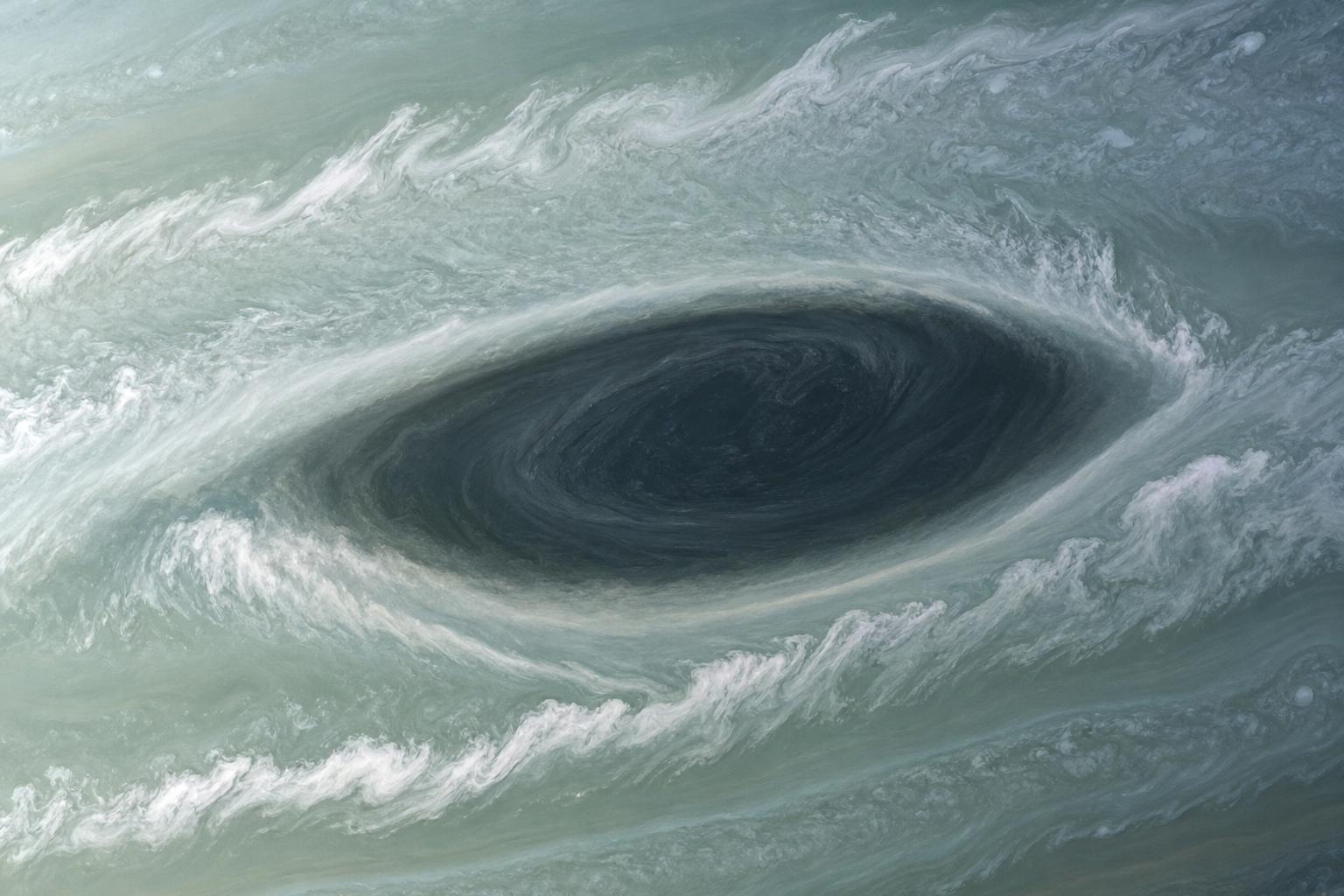
In 1989, Voyager 2 photographed a storm big enough to hold the whole Earth: the Great Dark Spot. Since then, it has vanished.
Uranus
900
Neptune
2,000+
Top wind speeds
Streaks of cloud Uranus is windy too, at up to 900 km/h, but that is less than half Neptune’s top speed. AI-generated illustration.The Great Dark Spot An illustration based on descriptions, not one of Voyager 2’s photographs. AI-generated illustration.
Chapter IV · Wild weather
Winds and storms
NASA: winds on Neptune exceed 2,000 km/h, about three times stronger than Jupiter’s and nine times stronger than Earth’s; winds on Uranus reach about 900 km/h. The Natural History Museum gives almost 2,200 km/h, the fastest in the Solar System. NASA: the Great Dark Spot, seen in 1989, was large enough to contain Earth and has since vanished.
Press the button to show or hide the dark storm. The cloud bands are drawn schematically.
The 3D scenes are simplified teaching models: sizes, distances, colours and field lines are drawn schematically and not to scale.
Neptune is about 1.6 times as far from the Sun as Uranus, so it gets less than half as much sunlight.
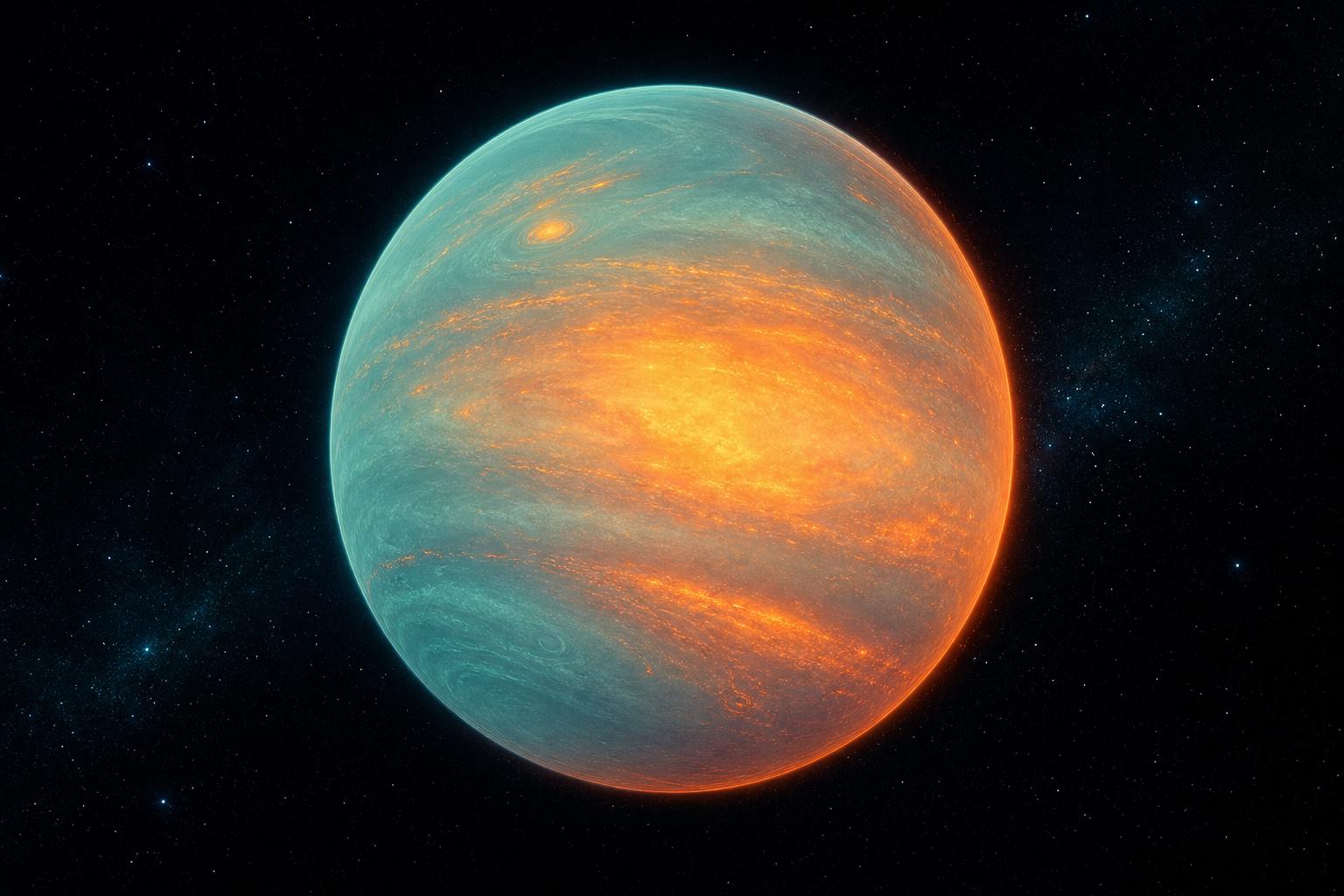
Yet both are about as warm on top, because Neptune gives off about 2.6 times the heat it gets from the Sun, while little heat escapes from inside Uranus.
Why near twins differ so much inside is still not fully understood. That hidden interior is also where their magnetic fields are made.
2.6×
Neptune
little
Uranus, inner heat escaping
Heat out, compared with sunlight inSeen by its heat A false-colour impression: warm colours stand for heat leaving the planet, not for its real colour. AI-generated illustration.
what keeps Neptune warm inside
why Uranus lets out so little heat
how the layers inside are arranged
Still unknown
Chapter IV · Wild weather
Inner heat
Natural History Museum, London: Neptune radiates 2.6 times the heat it receives from the Sun. Britannica: Neptune radiates more than twice the energy it receives, Uranus has little internal heat escaping, and yet both planets have nearly the same effective temperature, the temperature a body would need to give off the energy it radiates. NASA NSSDCA: Neptune is 30.07 AU from the Sun and Uranus 19.19 AU; sunlight weakens with the square of distance, so Neptune receives about 0.4 times as much per square metre.
Press the button to compare the heat each planet gives off with the sunlight it receives. The glow is schematic.
The 3D scenes are simplified teaching models: sizes, distances, colours and field lines are drawn schematically and not to scale.
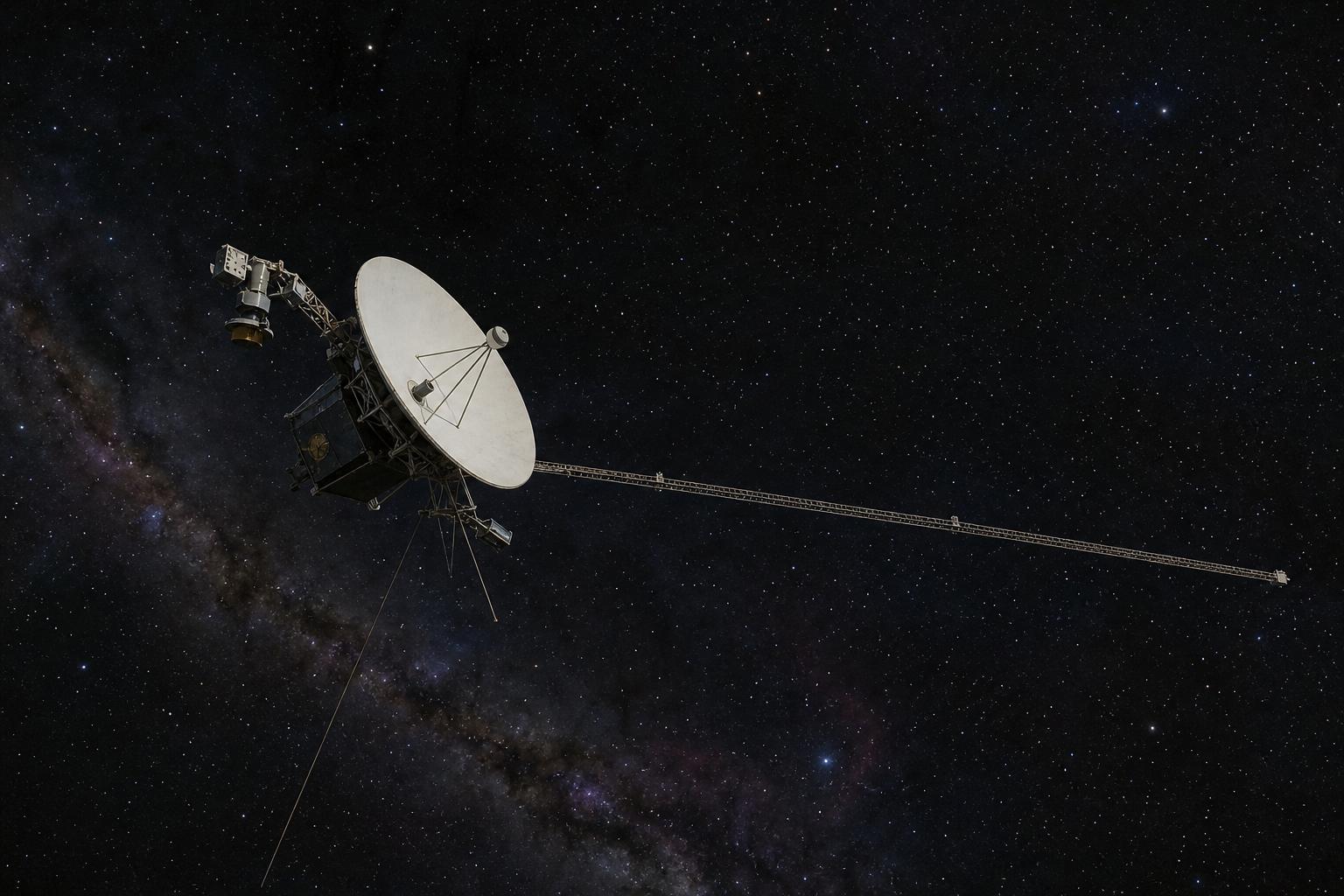
Almost everything we know from up close comes from one spacecraft: Voyager 2, launched in 1977.
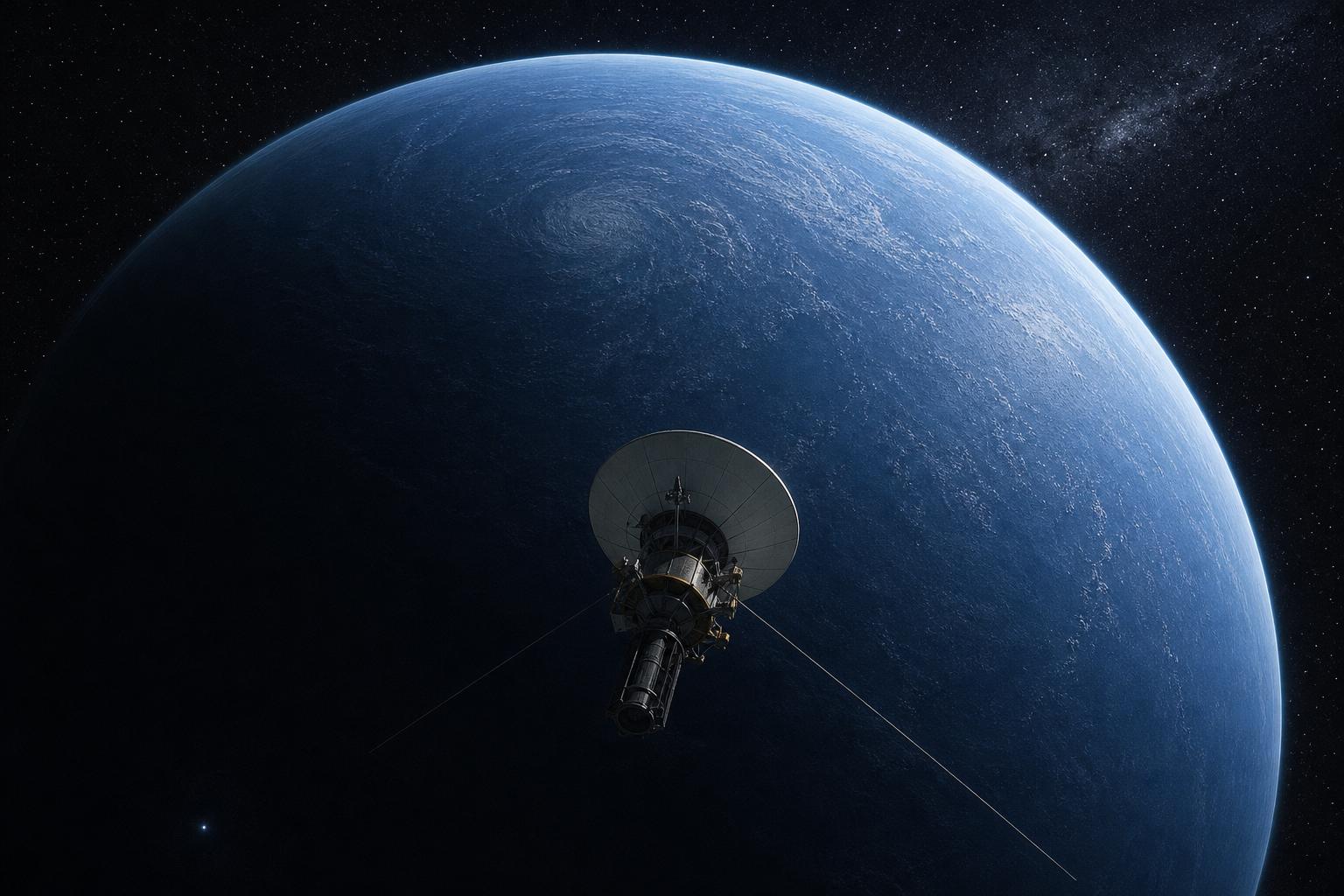
It flew past Uranus in January 1986, and past Neptune in August 1989, skimming just above Neptune's north pole.
It carried a magnetometer, and its readings are still the only close-up measurements of these planets' magnetic fields.
Launched 1977 An illustration of a 1970s probe with a long instrument boom, not an exact model of Voyager 2. AI-generated illustration.
20 Aug 1977 launch
24 Jan 1986 Uranus, closest at ~81,500 km: 11 new moons, 2 new rings
25 Aug 1989 Neptune
Voyager 2’s grand tourOver Neptune’s pole Closest approach: about 4,950 km above Neptune’s north pole, on 25 August 1989. AI-generated illustration.
Chapter V · One visit
The only visitor
NASA: Voyager 2 launched on 20 August 1977. Its closest approach to Uranus was on 24 January 1986 at about 81,500 km; it found 11 new moons and 2 new rings. Its closest approach to Neptune was on 25 August 1989, about 4,950 km above the north pole. NASA JPL: Voyager 2 is the only spacecraft to have visited Uranus and Neptune. NASA’s open data archive holds Voyager 2’s magnetometer measurements of the Uranus magnetic field.
Press the button to fly the journey again. The path, the planets’ places and their sizes are schematic.
The 3D scenes are simplified teaching models: sizes, distances, colours and field lines are drawn schematically and not to scale.
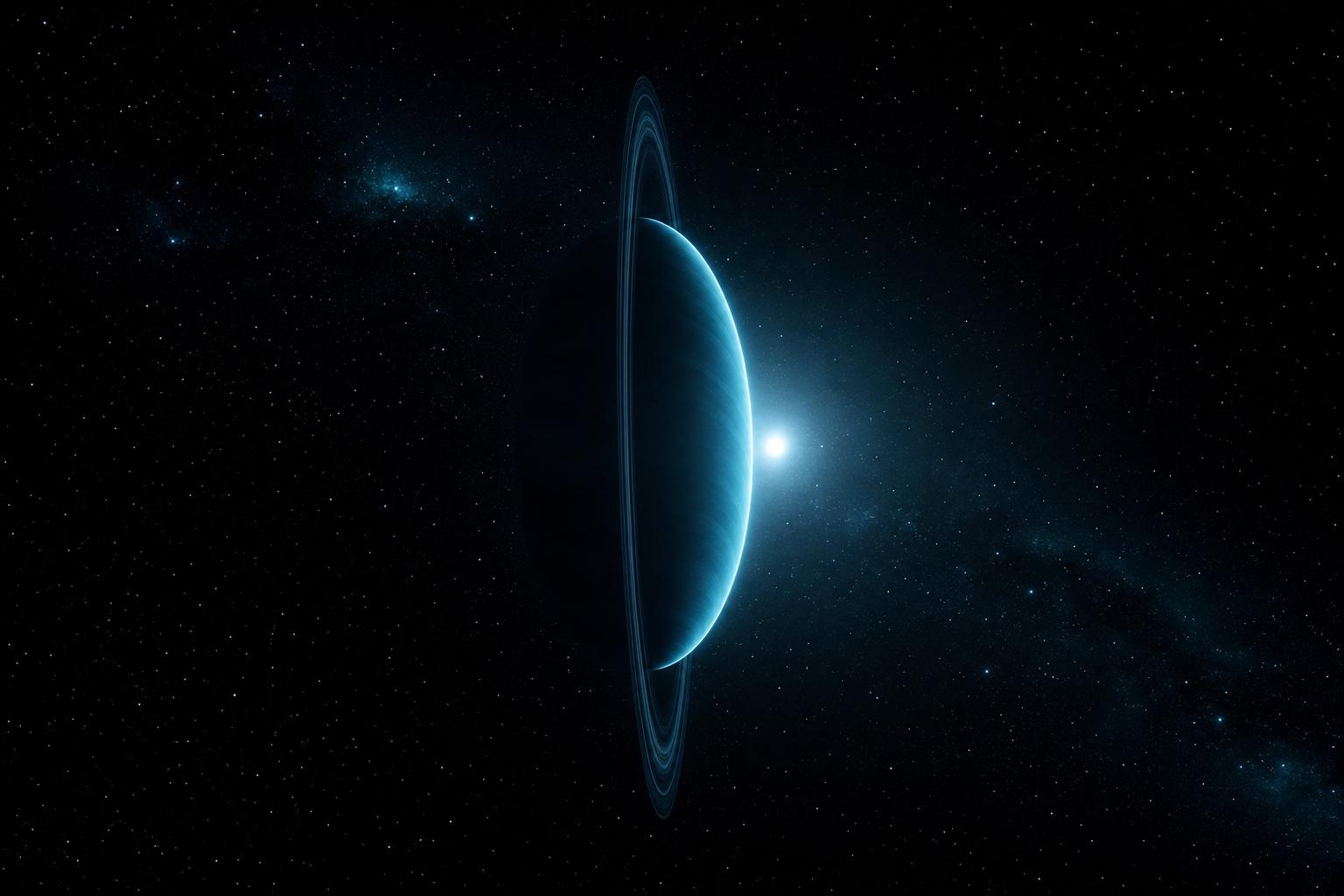
Uranus has thin, dark rings. They were found in 1977, when astronomers watched a star flicker as it passed behind them. Thirteen are known today.
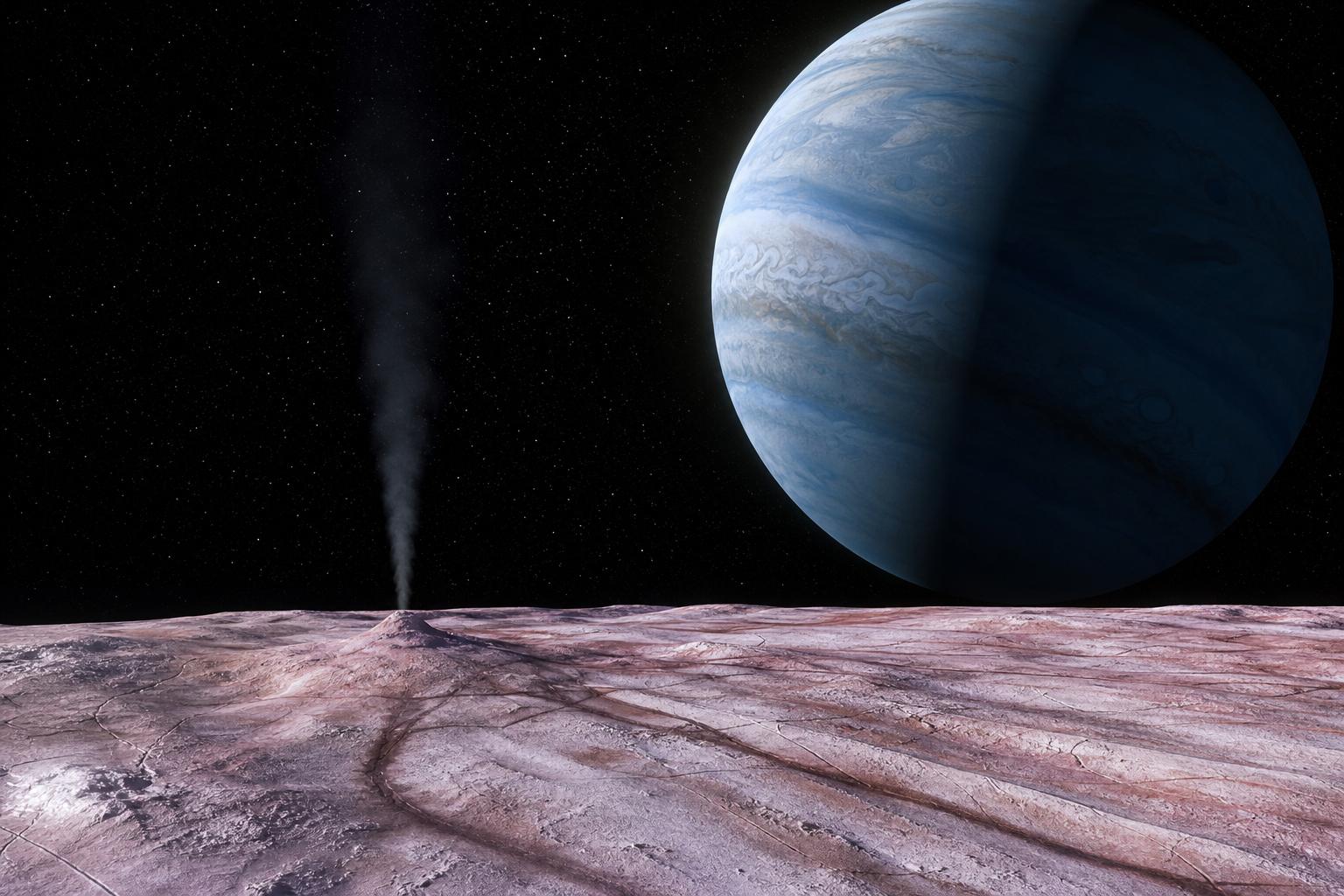
Neptune's largest moon, Triton, goes round the planet backwards, against the planet's spin. That suggests Neptune captured it, probably from the Kuiper Belt, the band of icy bodies beyond Neptune.
Voyager 2 saw dark plumes rising about eight kilometres above Triton's frozen surface. The leading idea is nitrogen ice warmed by sunlight.
Found by a flickering star Nine rings were found from an aircraft observatory in 1977; Voyager 2 added two and Hubble two more. AI-generated illustration.
29
known moons of Uranus (2025)
16
known moons of Neptune
13
rings of Uranus
Moons and ringsTriton About 2,700 km across and around −235 °C, its dark streaks stretch more than 100 km downwind. AI-generated illustration.
Chapter V · One visit
Rings and Triton
Sky at Night: the rings of Uranus were found on 10 March 1977 by James Elliot’s Cornell team aboard the Kuiper Airborne Observatory as a star passed behind the planet; 9 rings then, 2 more from Voyager 2 and 2 from Hubble, 13 in all. AURA (August 2025): a 29th moon of Uranus, S/2025 U1, was found in a Webb image; NASA lists 16 moons for Neptune. The Planetary Society: Triton orbits backwards, suggesting it was captured, probably from the Kuiper Belt; it is about 2,700 km across and about −235 °C. USGS: Voyager 2 found at least four plumes about 8 km high, with dark trails over 100 km long; the leading idea is nitrogen ice heated by sunlight.
Press the buttons to make Triton orbit the normal way or backwards, as it really does.
The 3D scenes are simplified teaching models: sizes, distances, colours and field lines are drawn schematically and not to scale.
Earth's magnetic field is like a bar magnet near its centre, tilted about 11 degrees from the spin axis.
When Voyager 2 measured Uranus, its field was tilted about 59 degrees, and its centre sat about a third of the way out from the middle of the planet.
Neptune's was much the same: tilted about 47 degrees, and shifted out by about half its radius.
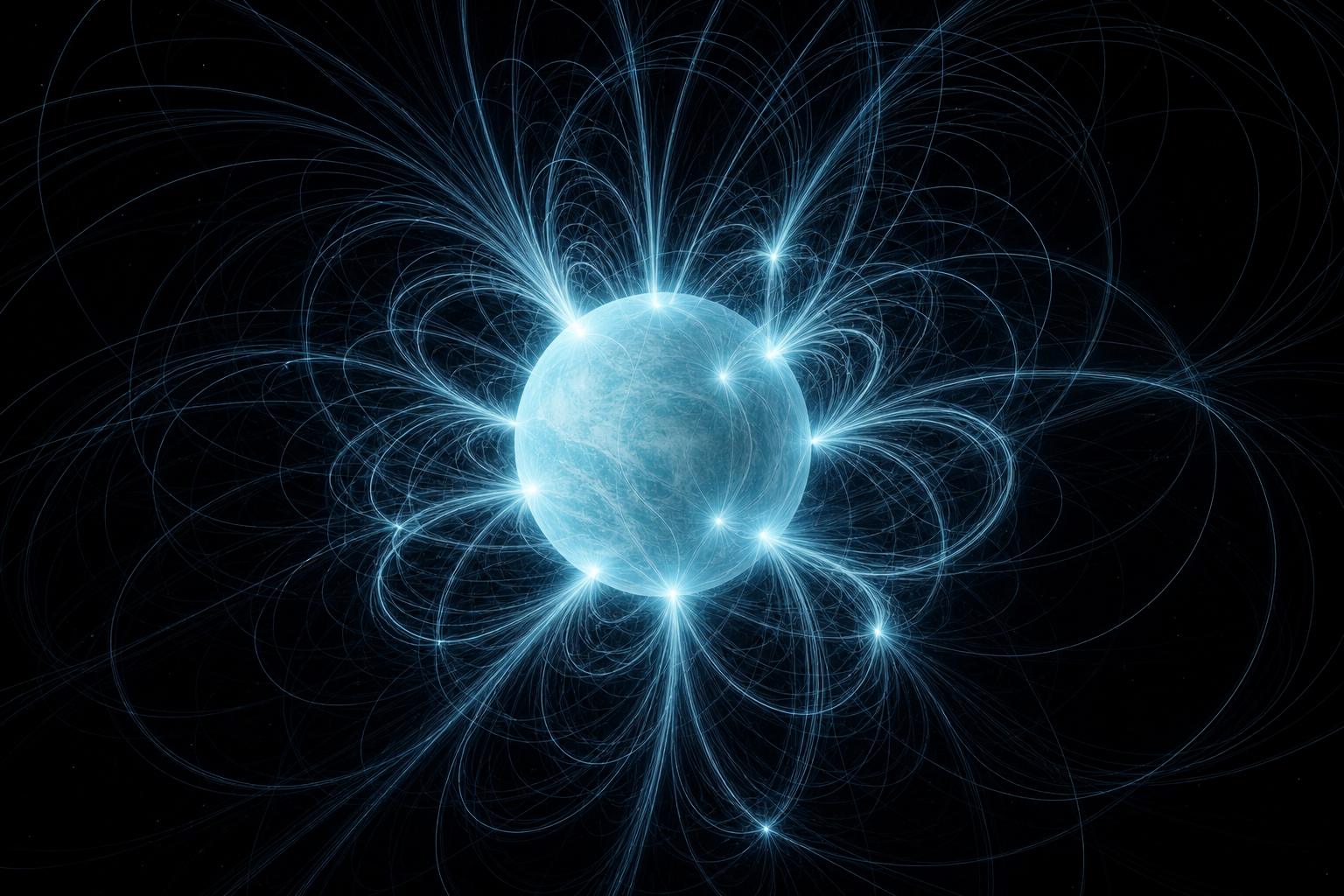
The new study says only about 12 percent of the field's surface energy sits in a simple bar magnet lined up with the spin axis. The rest is tilted, or lumpier, with several poles.
On the other planets with a magnetic field, that aligned part holds 74 to 98 percent.
A tidy magnet Earth’s field is close to a single bar magnet, which is why a compass points roughly north. AI-generated illustration.
Earth
~11°
Neptune
46.9°
Uranus
58.6°
Tilt of the magnetic field from the spin axis
0.35
of Uranus’s radius
0.49
of Neptune’s radius
27×
Neptune’s field strength vs Earth’s
Centre of the field, off-centre bySeveral poles An impression of a field with more than one north and south pole, tilted and shifted. AI-generated illustration.
~12%
Uranus and Neptune
74–98%
other planets with a field
Share in the aligned bar magnet
Chapter VI · Crooked magnets
Two strange fields
A dipole is the simplest magnetic field, the shape of a bar magnet with one north and one south pole. NASA NSSDCA: Uranus’s magnetic dipole is tilted 58.6° from the rotation axis and offset 0.352 Uranus radii from the centre; Neptune’s is tilted 46.9° and offset 0.485 Neptune radii. NASA: Neptune’s field is about 27 times as strong as Earth’s. ScienceDaily (2026): Earth’s tilt is about 11°. ingenieur.de, reporting the 2026 paper (Communications Physics 9, 336): the axial dipole, the part lined up with the spin axis, carries only about 12% of the surface magnetic energy at Uranus and Neptune, against 74–98% for the other planets with a magnetic field. NASA JPL (2024): a re-analysis found that a solar-wind event had squeezed Uranus’s magnetosphere, the bubble its magnetic field carves in the solar wind, just before the 1986 flyby, conditions found only about 4% of the time.
Press Earth, Uranus or Neptune to compare. The field lines are drawn as a simple tilted, shifted bar magnet; the real ice-giant fields are far more tangled.
The 3D scenes are simplified teaching models: sizes, distances, colours and field lines are drawn schematically and not to scale.
A planet's magnetic field is made by moving, electrically conducting material deep inside, like the conducting ices we met earlier. Scientists call this a dynamo.
In 2004, a Harvard model proposed that in the ice giants, only a thin outer shell churns, above a calm interior.
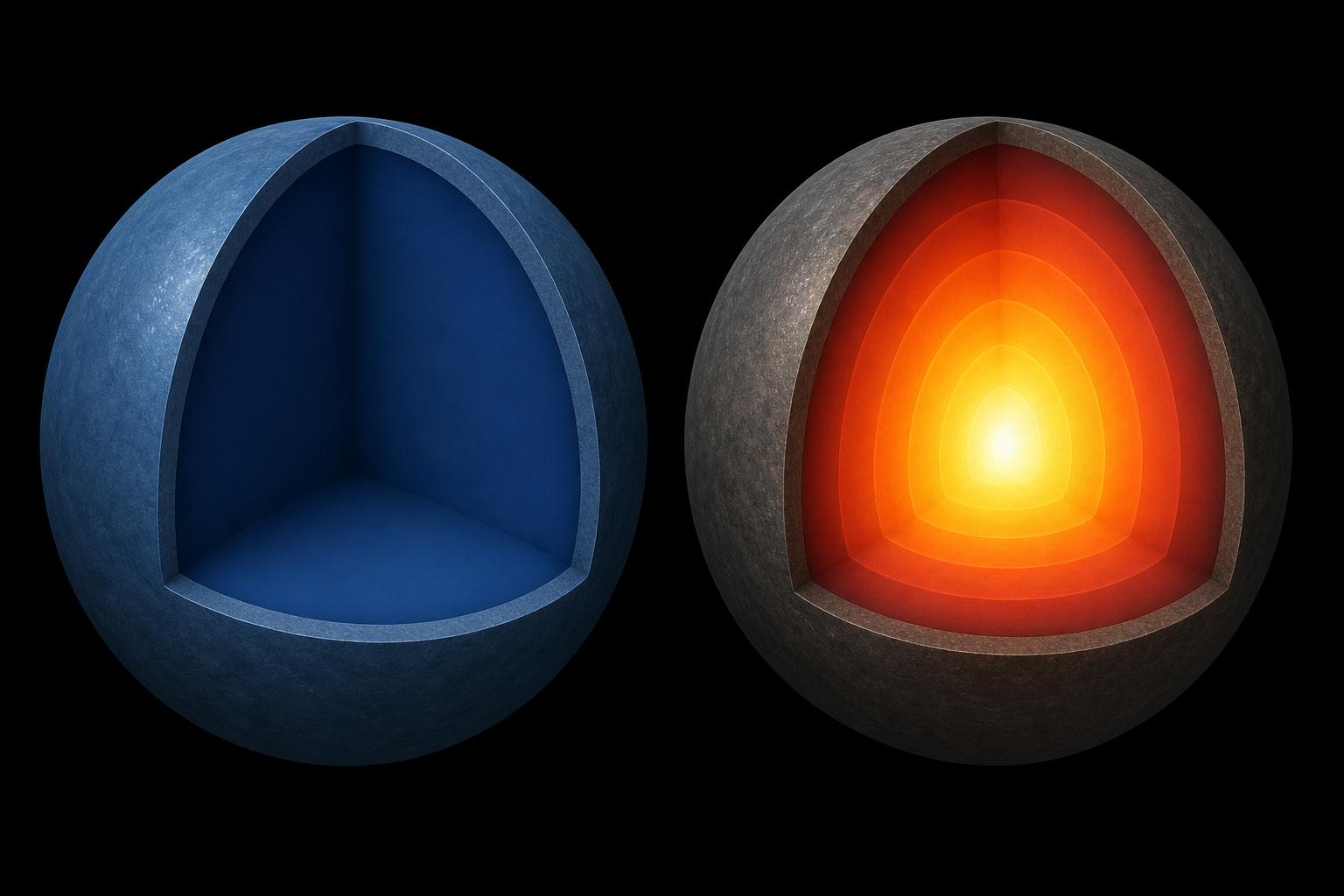
The 2026 study ran 3D simulations, and found fields like Voyager's when the material conducts electricity better with depth, and the churning layer is thin.
Their models also predict that the tilt could swing by tens of degrees within a few decades. That is a prediction. Testing it needs a new spacecraft.
A dynamo Churning, conducting material stretches and twists magnetic field lines, and keeps the field alive. AI-generated illustration.What the models changed Left: the same conductivity throughout gave a simple field, unlike Voyager’s. Right: conductivity rising with depth gave a lopsided one, like Voyager’s. AI-generated illustration.
~1° in 50 years
Earth, measured
tens of degrees
ice giants within decades, model prediction
How fast a field can wanderA hint, not proof Neptune’s southern aurora may have moved by about 30° between 1989 and 2023, seen in a Webb campaign led by Tom Stallard. AI-generated illustration.
Chapter VI · Crooked magnets
The model
Stanley and Bloxham (Nature, 2004) showed that a thin convecting shell above a stably layered fluid interior can produce fields that are neither dipolar nor symmetric about the axis. ScienceDaily (15 November 2026), the paper (Communications Physics 9, 336) and ingenieur.de: Chi Yan and colleagues ran 3D dynamo simulations matched to Voyager 2’s data. Uniform conductivity gave simple dipole fields; conductivity rising with depth in a thinner dynamo zone gave lopsided fields like the real ones. The models predict the tilt can swing by tens of degrees within a few decades, while Earth’s drifts about 1° in 50 years. Space.com: the team says the odd fields come from the interior rather than from a past collision, and a new mission is needed for a definitive test. A possible ~30° shift of Neptune’s southern auroras between 1989 and 2023, from a Webb campaign led by Tom Stallard (Northumbria University), is a hint, not a confirmation.
Press the button to play the model’s swing. The swing on screen is an illustration of the prediction, sped up, not a measurement.
The 3D scenes are simplified teaching models: sizes, distances, colours and field lines are drawn schematically and not to scale.
Planets like these may be everywhere. Around other stars, planets a little smaller than Neptune, called sub-Neptunes, are the most common kind found.
Yet our Solar System has no planet of that size, so Uranus and Neptune are our closest look at this family of worlds.
In 2022, US scientists ranked a Uranus Orbiter and Probe as the top new flagship mission. It is still only recommended, and according to Space.com, NASA now targets the early 2040s.
Common out there NASA notes that Neptune-mass planets in cold, distant orbits may be about ten times as common as Jupiter-mass ones. AI-generated illustration.
0
sub-Neptunes
2
ice giants
Our Solar SystemA probe into the clouds An artist’s idea of an entry probe, not the mission’s actual design. AI-generated illustration.
#1
new flagship priority, 2022
early 2040s
NASA’s target launch, per Space.com
Uranus Orbiter and Probe
Chapter VII · Going back
Why go back
STScI / NASA (5 May 2025): sub-Neptunes are the most common type of exoplanet. NASA: a 2016 microlensing study suggests Neptune-mass planets in cold outer orbits may be about ten times as common as Jupiter-mass ones, and our Solar System has no mini-Neptune. Phys.org (19 April 2022): the National Academies’ planetary Decadal Survey ranked a Uranus Orbiter and Probe as the top new flagship mission, recommending launch in the early 2030s. Space.com (10 November 2026): NASA now targets the early 2040s. It is a recommended mission, not yet an approved spacecraft.
The 3D scenes are simplified teaching models: sizes, distances, colours and field lines are drawn schematically and not to scale.
Almost everything in this film rests on a few hours of close-up data, gathered decades ago, and on what telescopes can see from far away.
One planet found by accident, one by arithmetic. Inside them, perhaps, deep layers of electrically conducting ice.
And a prediction that can be tested: if the new models are right, their magnetic fields could look noticeably different by the time the next spacecraft arrives.
1781 Herschel spots Uranus
1846 Neptune found from a prediction
1977 rings of Uranus found; Voyager 2 launched
1986 Voyager 2 at Uranus
1989 Voyager 2 at Neptune
2024 true colours, Oxford
2026 a model for the crooked fields
The ice giants in seven datesWatching from afar Until a spacecraft returns, telescopes on Earth and in space keep watch. AI-generated illustration.The test An artist’s impression of a future orbiter, not an actual design. AI-generated illustration.
Epilogue · Sources
Sources
Every fact in this film comes from the sources below. Where they differ, the film uses NASA’s figures (Neptune’s tilt 28.3°, not Britannica’s 29.6°; Neptune’s magnetic offset 0.485 radii). The magnetic-field explanation comes from one 2026 modelling study and is presented as a model, not a finding; superionic ice and diamonds are laboratory results, and diamond rain inside the planets is a hypothesis. The 3D scenes are schematic and not to scale. The chapter stills and pictures are AI-generated illustrations, not photographs.