On 4 November 1922 Howard Carter’s workmen found the first step of Tutankhamun’s tomb in Egypt’s Valley of the Kings; 104 years later, its more than five thousand objects are shown together at the Grand Egyptian Museum. This film explains who the boy king was and how he brought back the old gods after Akhenaten, why kings were buried in a hidden valley and why this small tomb escaped the robbers, how it was found and what lay inside its four rooms, from the nested shrines to the solid gold coffin. It shows what ancient Egyptians believed about the afterlife and how a mummy was made in about seventy days, what CT scans and DNA have found since, and why the famous curse is a myth.
Interactive 3D film8 minc. 1332 BC to AD 2026Published 6 November 2026
In Egypt’s Valley of the Kings, robbers emptied almost every royal tomb in ancient times. One tomb they missed.
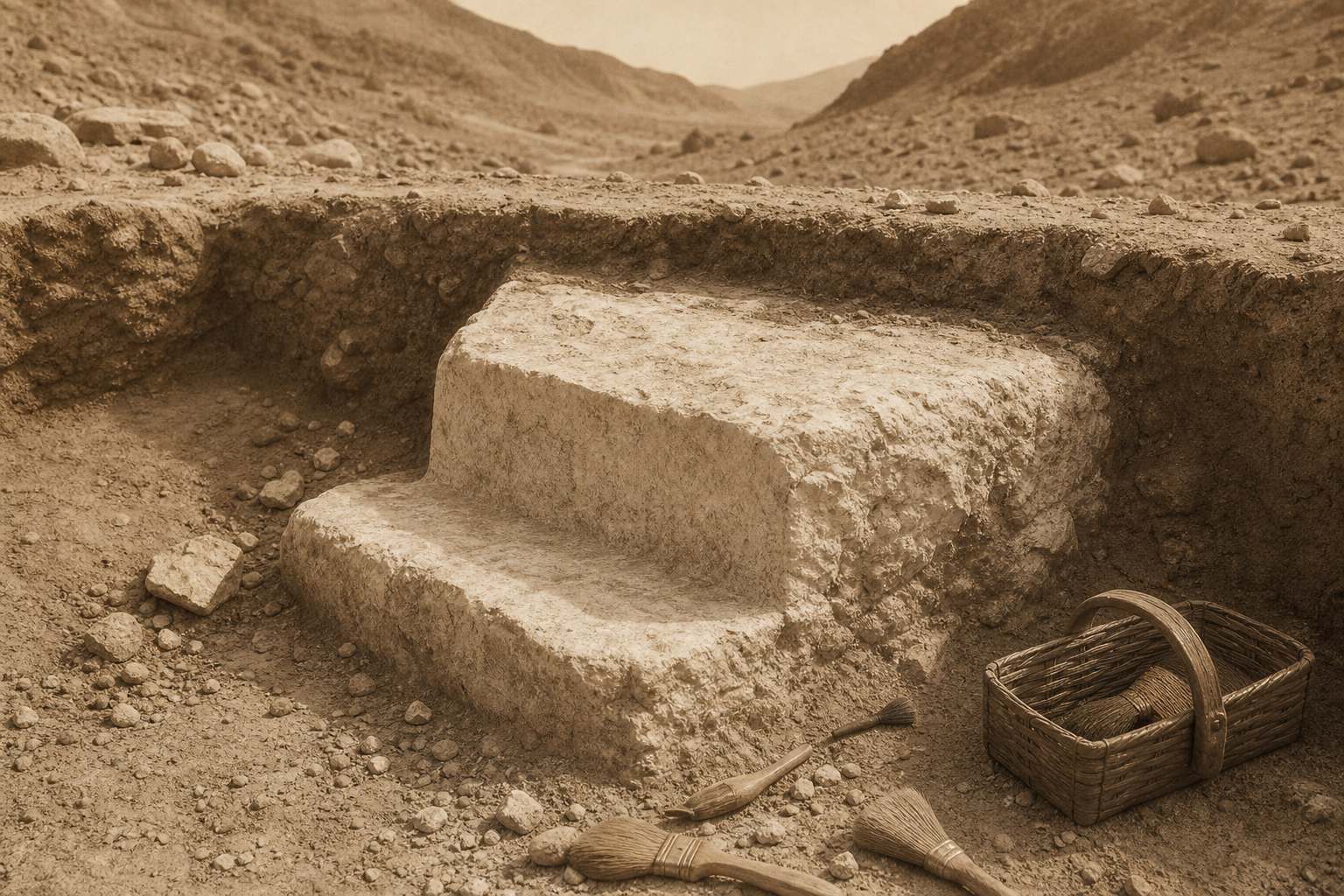
On the fourth of November 1922, workmen for the archaeologist Howard Carter uncovered a step cut into the rock. Below it lay Tutankhamun’s tomb, almost untouched.
A hundred and four years on, its more than five thousand objects are shown together at the Grand Egyptian Museum.
Who was this king, and how did his tomb survive?
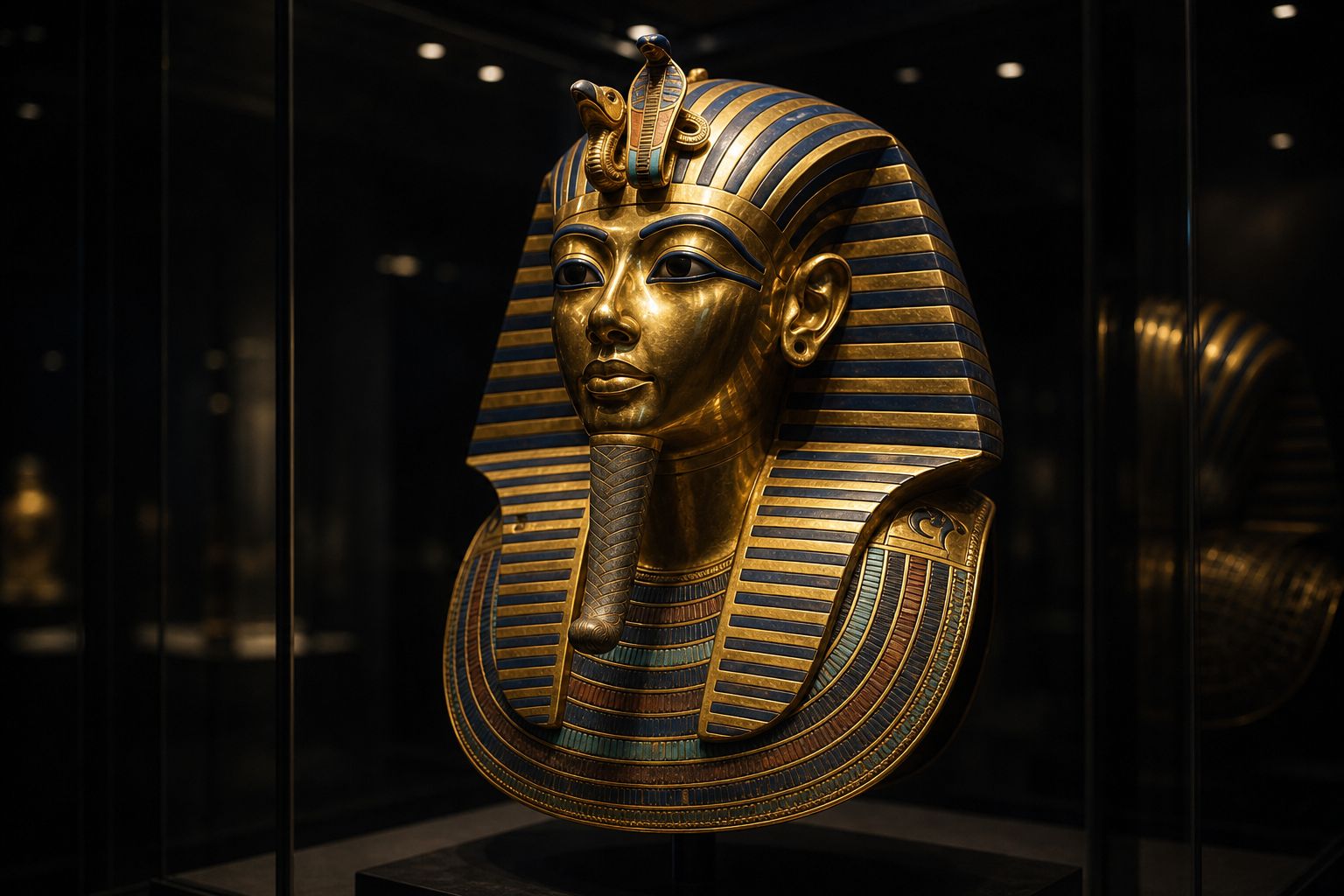
The face of the find A gold funerary mask in a dark museum case, in the style of the king’s mask. AI-generated illustration.
KV62
the tomb’s number in the valley
4 Nov 1922
the first step
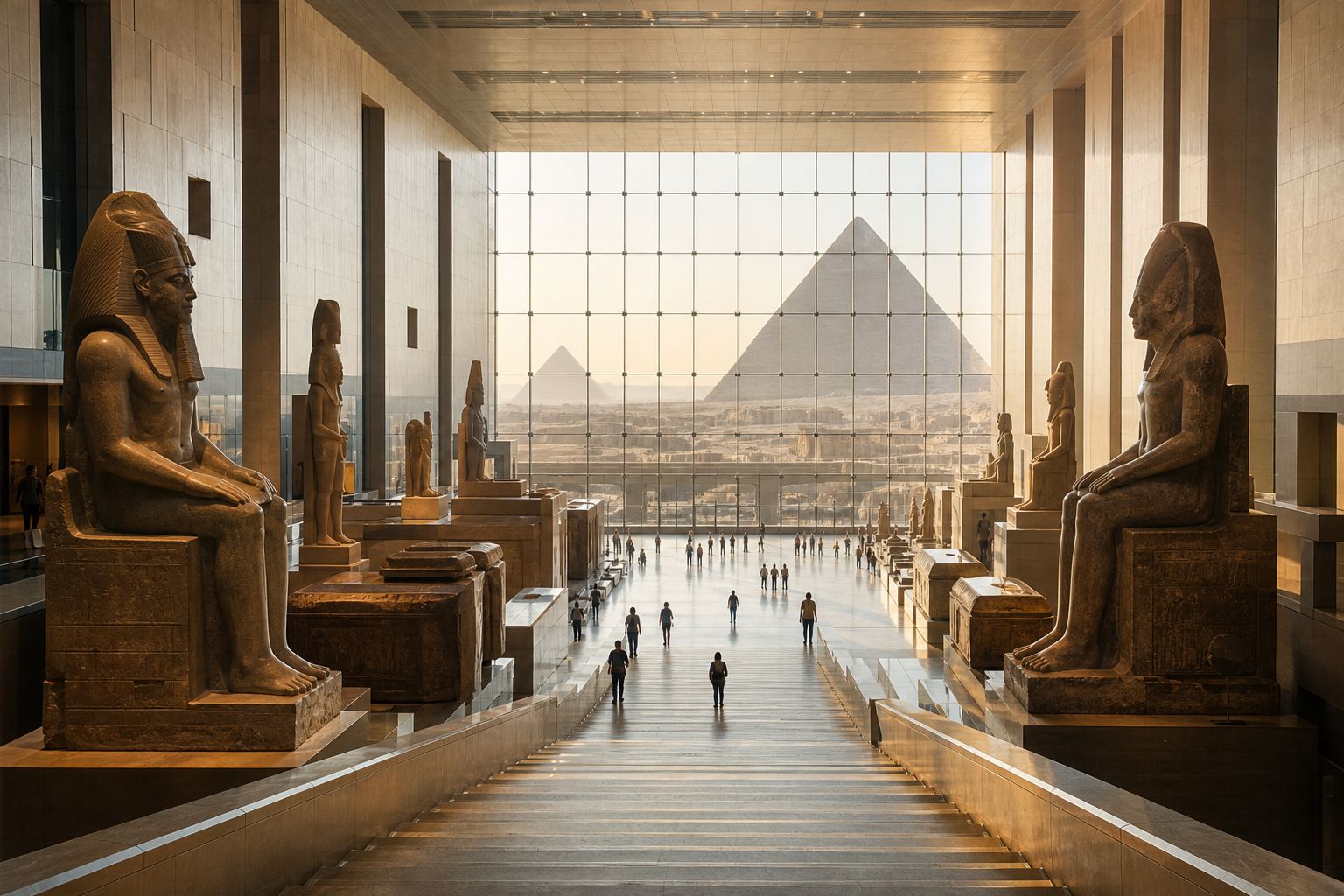
The find (Wikipedia, KV62)Grand Egyptian Museum A staircase of statues, with the pyramids beyond the glass. About 2,500 of the king’s objects had never been on show before (Egyptian Gazette). AI-generated illustration.
5,398
objects numbered by the excavators
Wikipedia (KV62)
Prologue
The anniversary
Africanews (3 November 2026) marked the 104th anniversary of the discovery on 4 November: the dig began on 4 November 1922, the tomb was almost intact while many other sites had been looted, and it held more than 5,000 objects. The Grand Egyptian Museum near Giza was inaugurated on 1 November 2025 (Geo News); its Tutankhamun galleries opened to the public on 4 November 2025, showing the whole collection under one roof for the first time since 1922, including about 2,500 objects never displayed before (Egyptian Gazette; Arab News).
Wikipedia (Tomb of Tutankhamun): the tomb is numbered KV62 and its contents are numbered at 5,398 objects.
The 3D scenes are simplified teaching models: the valley, the rooms and the objects are schematic, with room sizes rounded from published plans.
Tutankhamun ruled Egypt from about 1332 to 1323 BC, in the New Kingdom, when Egypt’s kings were buried in this valley.
He became king at eight or nine, and died in his late teens.
His father was probably the king Akhenaten, according to a DNA study of royal mummies in 2010.
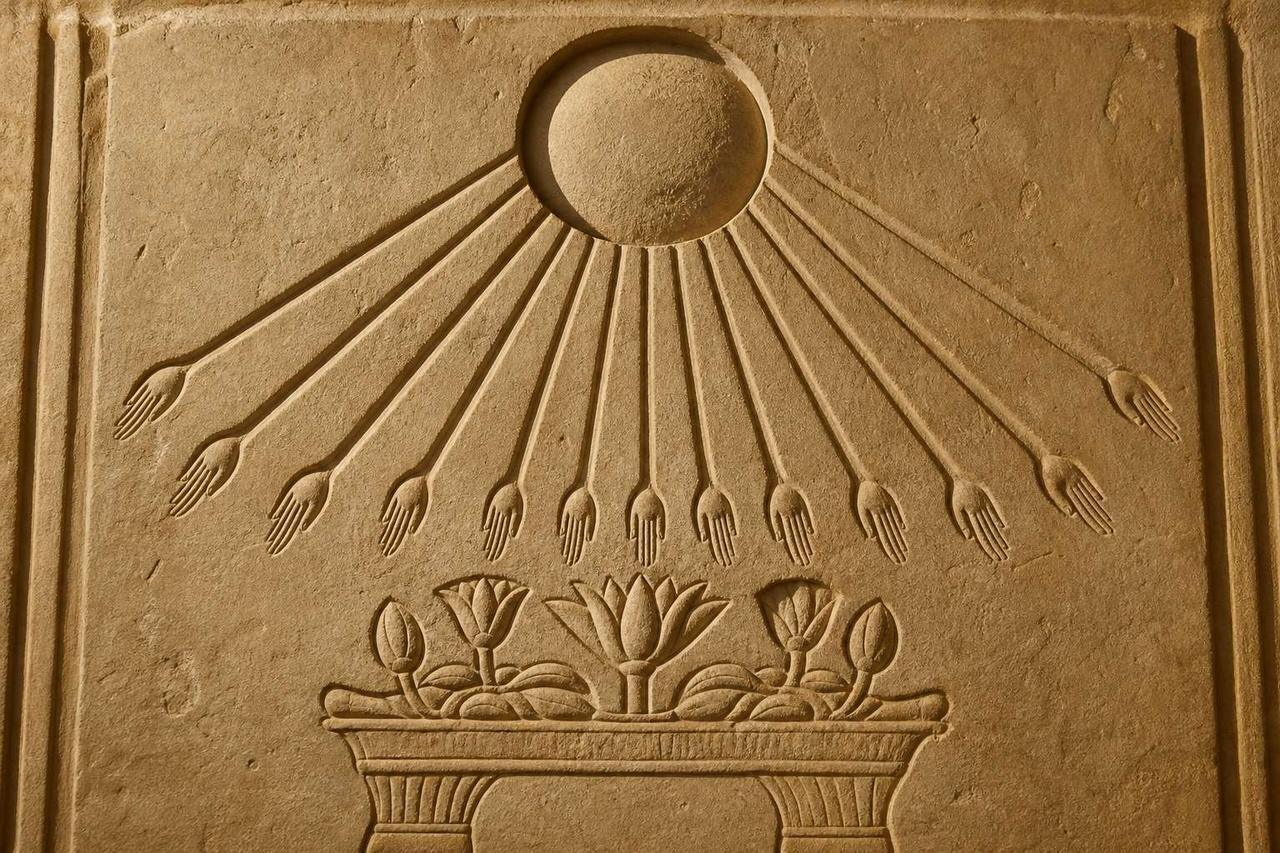
Akhenaten had put one god, the Aten, the disc of the sun, above all the others, so his son was born Tutankhaten: living image of the Aten.
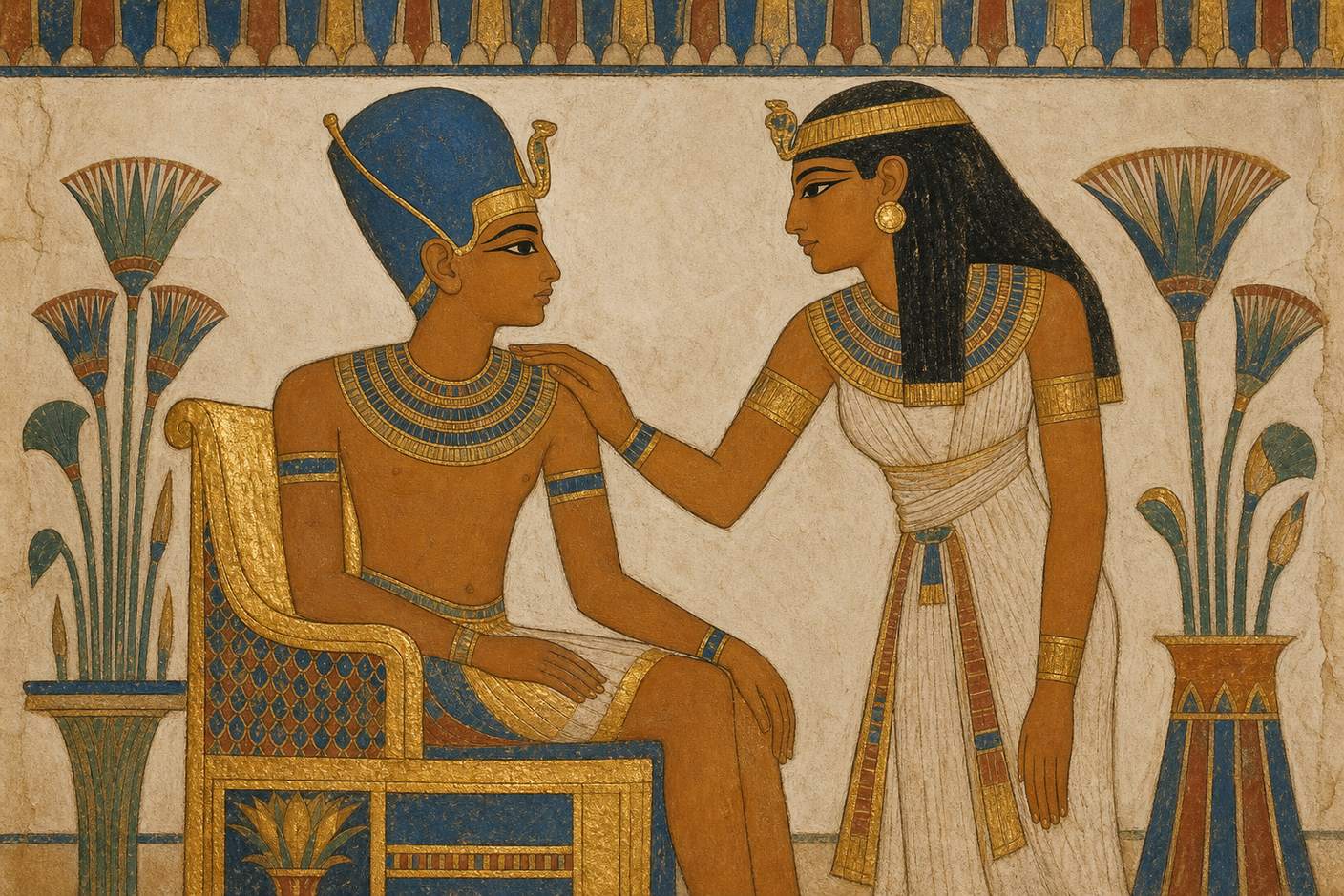
A young king In the style of a New Kingdom painting: a boy king in the blue crown, a queen at his shoulder. AI-generated illustration.
c. 1332–1323 BC
about nine years; Britannica gives c. 1333–1324
8–9
his age when he became king
His reign (Wikipedia; Britannica)
father: KV55, an unnamed royal mummy, probably Akhenaten
mother: the “Younger Lady”, another unnamed mummy
grandmother: Queen Tiye
The 2010 DNA study (JAMA)The Aten A relief in the Amarna style: the sun disc’s rays end in small hands. AI-generated illustration.
Chapter I · The boy king
Tutankhamun
Wikipedia: Tutankhamun ruled c. 1332–1323 BC as a king of the 18th Dynasty; he became king at about 8 or 9 and died at about 18. He was born Tutankhaten, “living image of Aten”, during Akhenaten’s reign, when Atenism was the state religion. Britannica gives c. 1333–1324 BC and says he died in his 19th year; the 2005 CT team estimated about 19.
JAMA (Hawass and colleagues, 17 February 2010), as reported by Phys.org: the mummy from tomb KV55 is “most probably Akhenaten”, Tutankhamun’s father; the KV35 “Younger Lady” is likely his mother. Wikipedia notes the KV55 man is thought to be either Akhenaten or Smenkhkare, and Britannica treats the parentage as uncertain.
The 3D scenes are simplified teaching models: the valley, the rooms and the objects are schematic, with room sizes rounded from published plans.
He also built a new capital in the desert, the city we call Amarna.
After Akhenaten died, the court turned back: Amarna was abandoned, and the old gods returned, led by Amun, their old king.
So the king’s name changed too, from Tutankhaten to Tutankhamun. A carved stone, the Restoration Stela, records how he repaired ruined temples.
He died young. A senior courtier, Ay, became the next king.
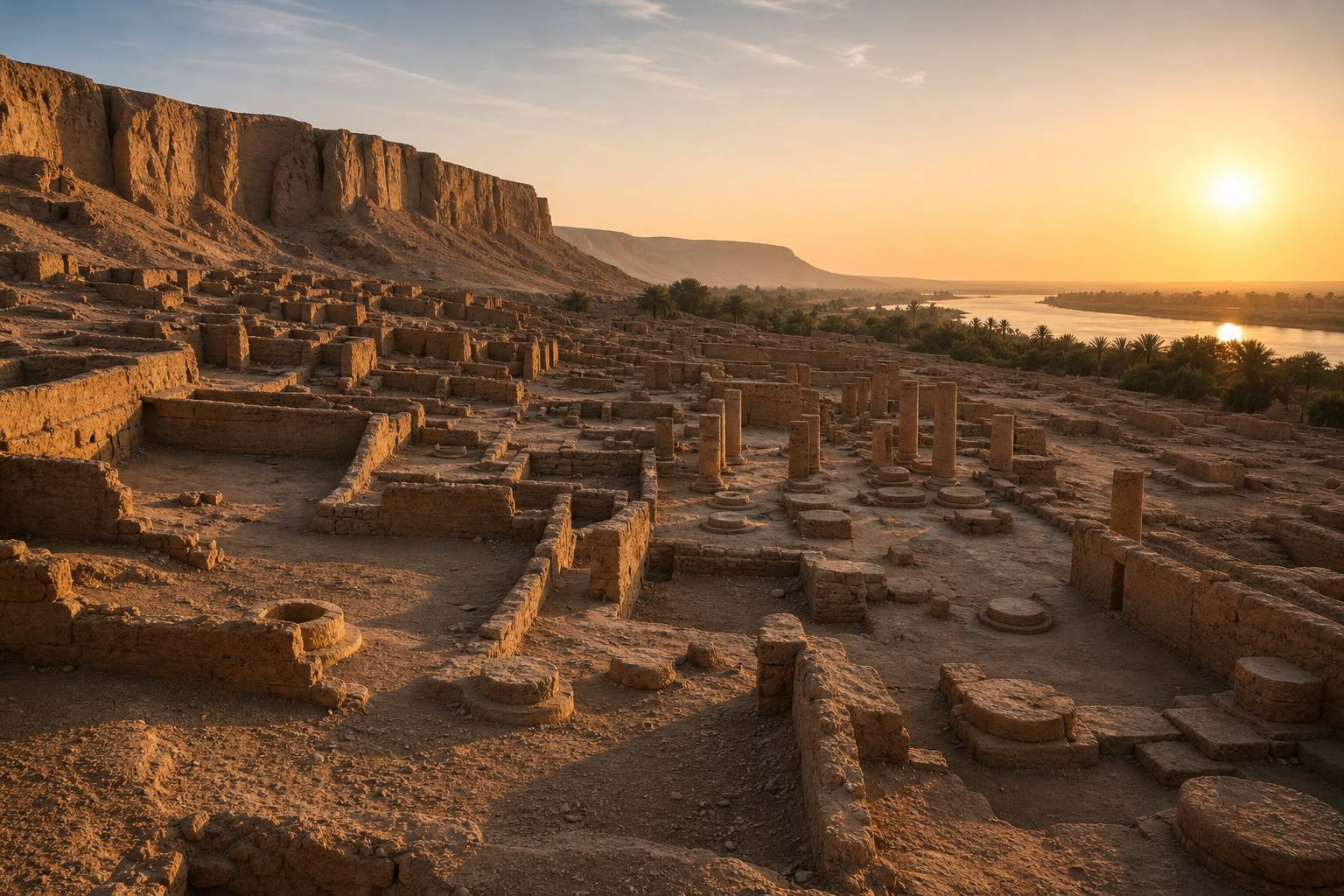
Amarna Low mud-brick walls by the Nile, like the remains of Akhenaten’s city, which he named Akhetaten. AI-generated illustration.
by year 3
of his reign, the court had left Amarna for Memphis
The move (Britannica)
birth Tutankhaten, “living image of Aten”
year 3 Aten worship ended; renamed Tutankhamun
year 4 Restoration Stela set up
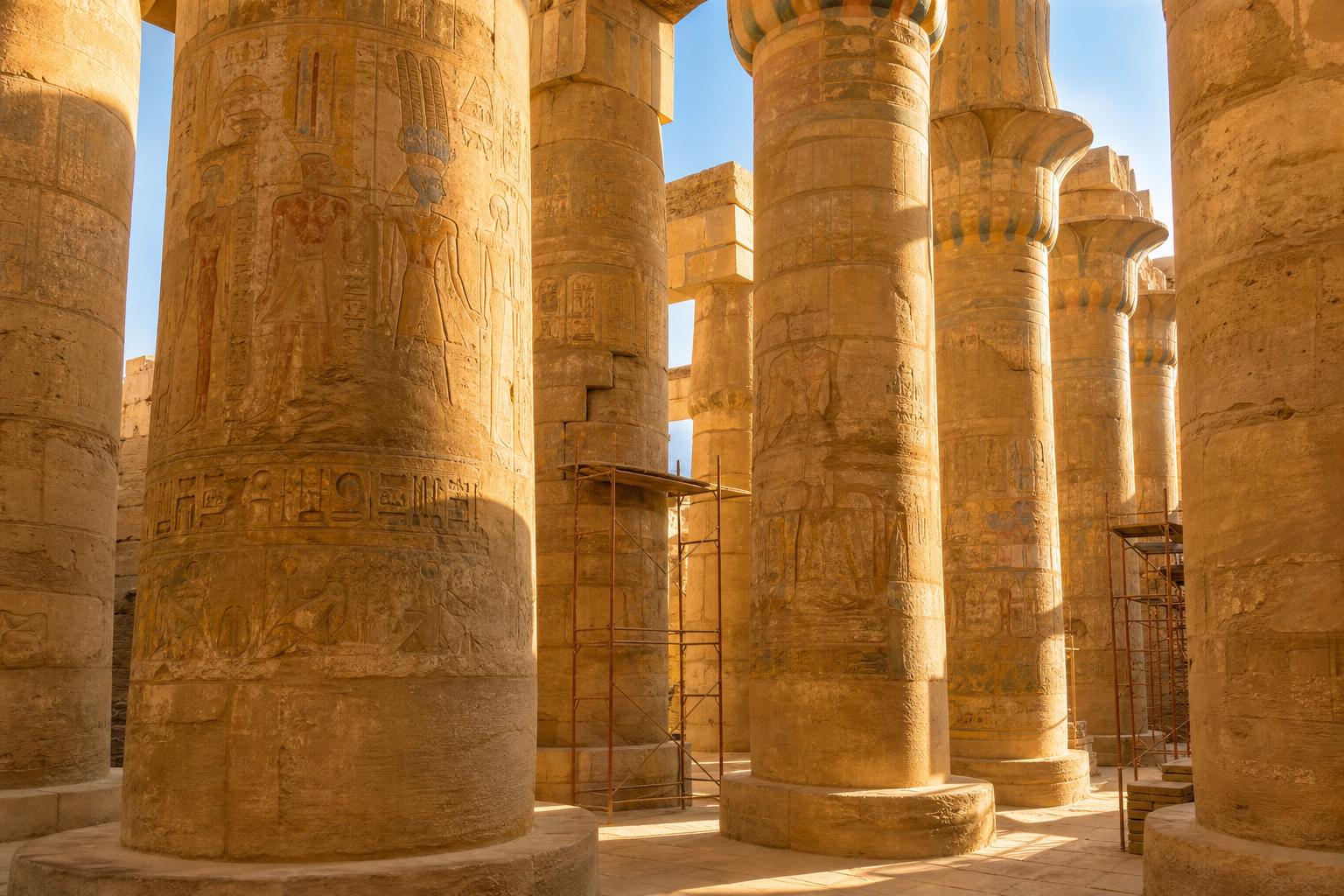
Two names (Wikipedia; Britannica)Karnak Columns of a great temple hall of Amun. The stela was found in the hypostyle hall at Karnak (Digital Karnak). AI-generated illustration.
Chapter I · The boy king
The return of Amun
Wikipedia: early in Tutankhamun’s reign the court left Amarna (Akhetaten) for Memphis and Thebes and the city was abandoned; in his third regnal year he ended Aten worship, restored Amun and changed his name; his Restoration Stela, set up in his fourth year, recorded the restorations. He was succeeded by Ay, probably his vizier (chief minister). Britannica: he decreed the restoration of the temples, images, personnel and privileges of the old gods.
Akhenaten named his new city Akhetaten; the site is now called Amarna. Between Akhenaten and Tutankhamun there may have been one or two short reigns, including Smenkhkare’s.
Digital Karnak: the stela was found in the north-east of the Hypostyle Hall at Karnak and describes how temples fell into ruin under Akhenaten and were restored. Try the two buttons on the map.
The 3D scenes are simplified teaching models: the valley, the rooms and the objects are schematic, with room sizes rounded from published plans.
He was buried in the Valley of the Kings: a wadi, or dry desert valley, across the Nile from Thebes, modern Luxor.
From about 1539 to 1075 BC, New Kingdom kings were buried here in rock-cut tombs, not under pyramids.
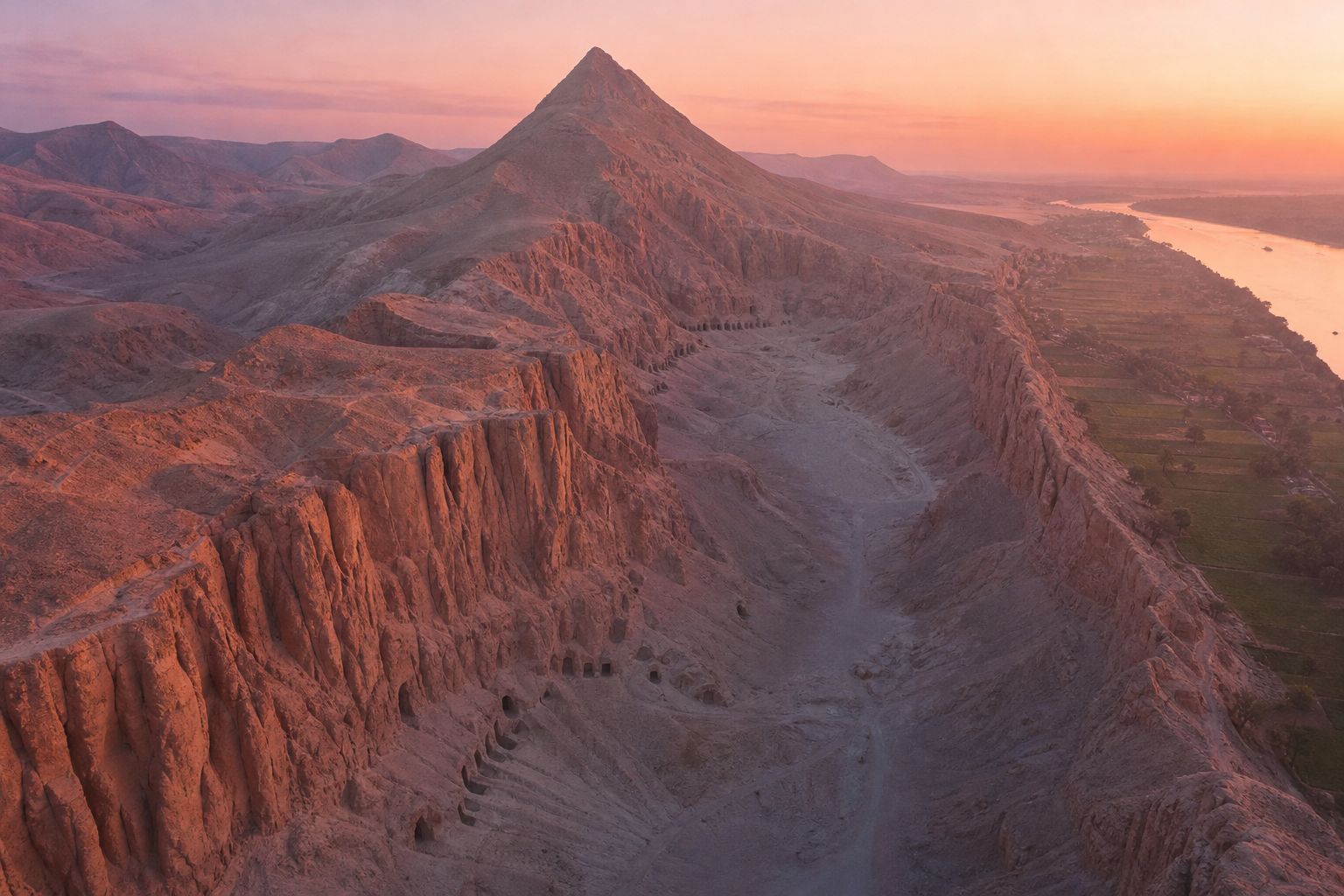
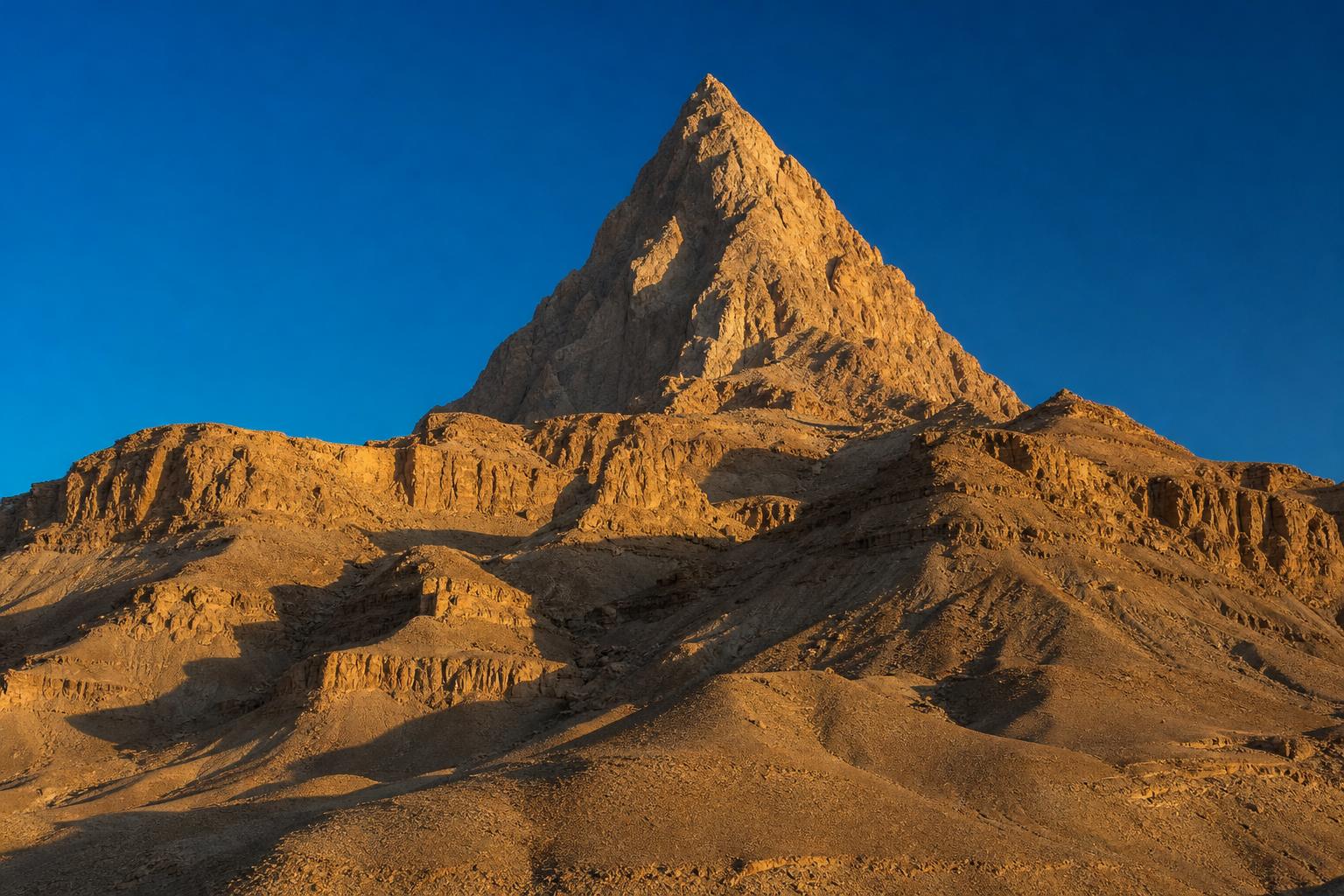
The valley was remote and guarded, under a peak shaped like a pyramid. At least sixty-three tombs are known.
Yet almost all of them were robbed in ancient times.
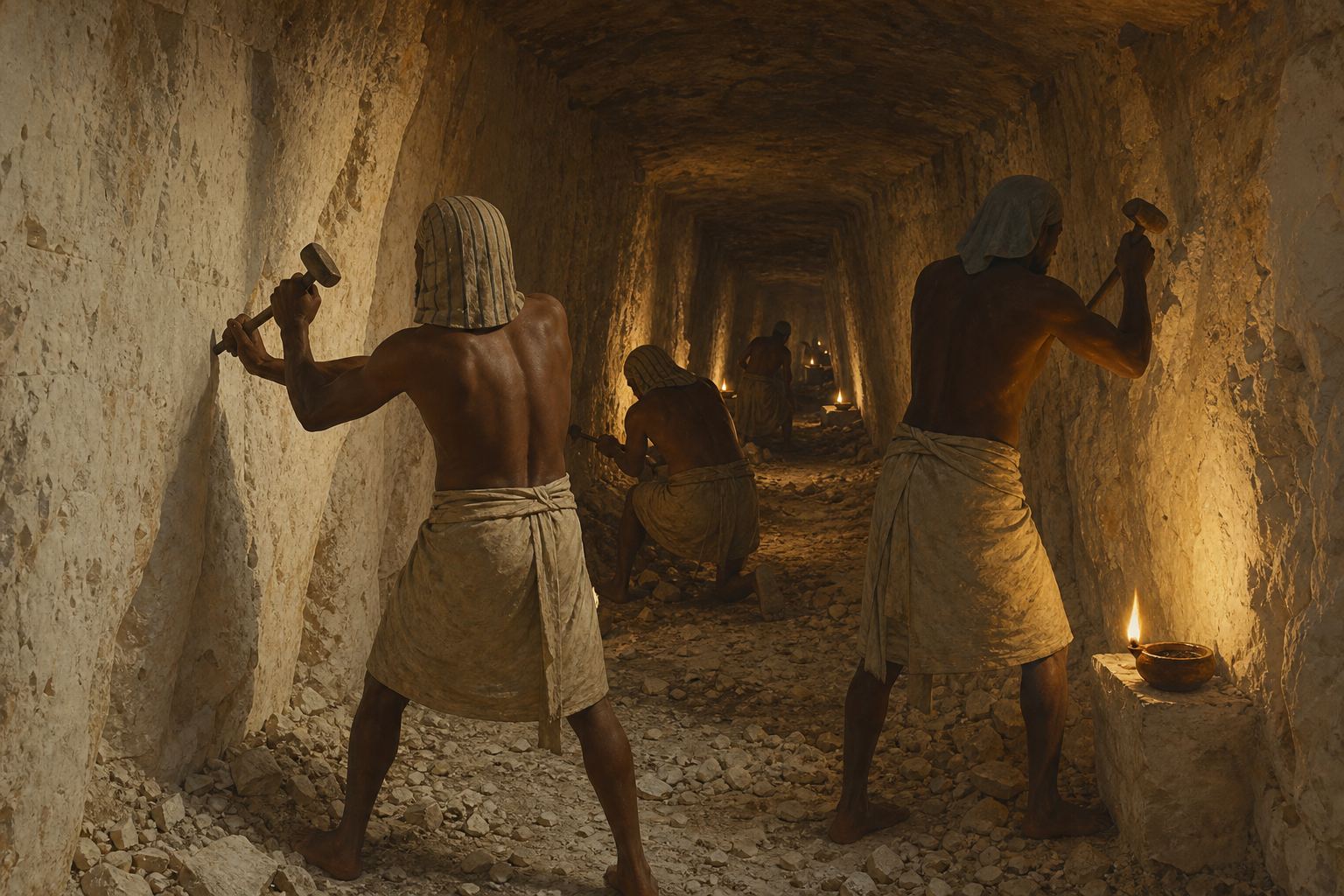
The valley at dawn Cliffs of limestone on the west bank, with the green Nile valley beyond. AI-generated illustration.Cut into the rock Tomb-cutters with copper chisels and oil lamps. They lived in a nearby village, Deir el-Medina. AI-generated illustration.al-Qurn The pyramid-shaped peak above the valley, which may have echoed the old pyramids. AI-generated illustration.
63+
tombs found
1979
UNESCO World Heritage, as Ancient Thebes with its Necropolis
Valley of the Kings (Wikipedia)
Chapter II · A hidden valley
A hidden valley
Wikipedia (Valley of the Kings): a wadi on the west bank of the Nile opposite Thebes (Luxor), used for royal burials from about 1539 to 1075 BC, the 18th to 20th Dynasties; it contains at least 63 tombs; it was remote, and guarded by the Medjay; the pyramid-shaped peak of al-Qurn may have echoed the pyramids. Almost all the tombs were opened and robbed in antiquity; papyri record trials of tomb robbers. The tombs were cut by workers from Deir el-Medina. Inscribed by UNESCO in 1979 as Ancient Thebes with its Necropolis.
The dots in the scene stand for tombs; their places are schematic.
The 3D scenes are simplified teaching models: the valley, the rooms and the objects are schematic, with room sizes rounded from published plans.
Tutankhamun was laid in a small tomb, probably first cut for someone of lower rank; Ay was later buried in a larger one.
Within a few years, thieves broke in. Officials tidied up and packed the corridor with limestone chips.
A second gang tunnelled through. This break-in was discovered too, and the tomb was put back in order and sealed again.
Then the valley hid the door: flood debris, rubble from a later king’s tomb and its workmen’s huts covered it.
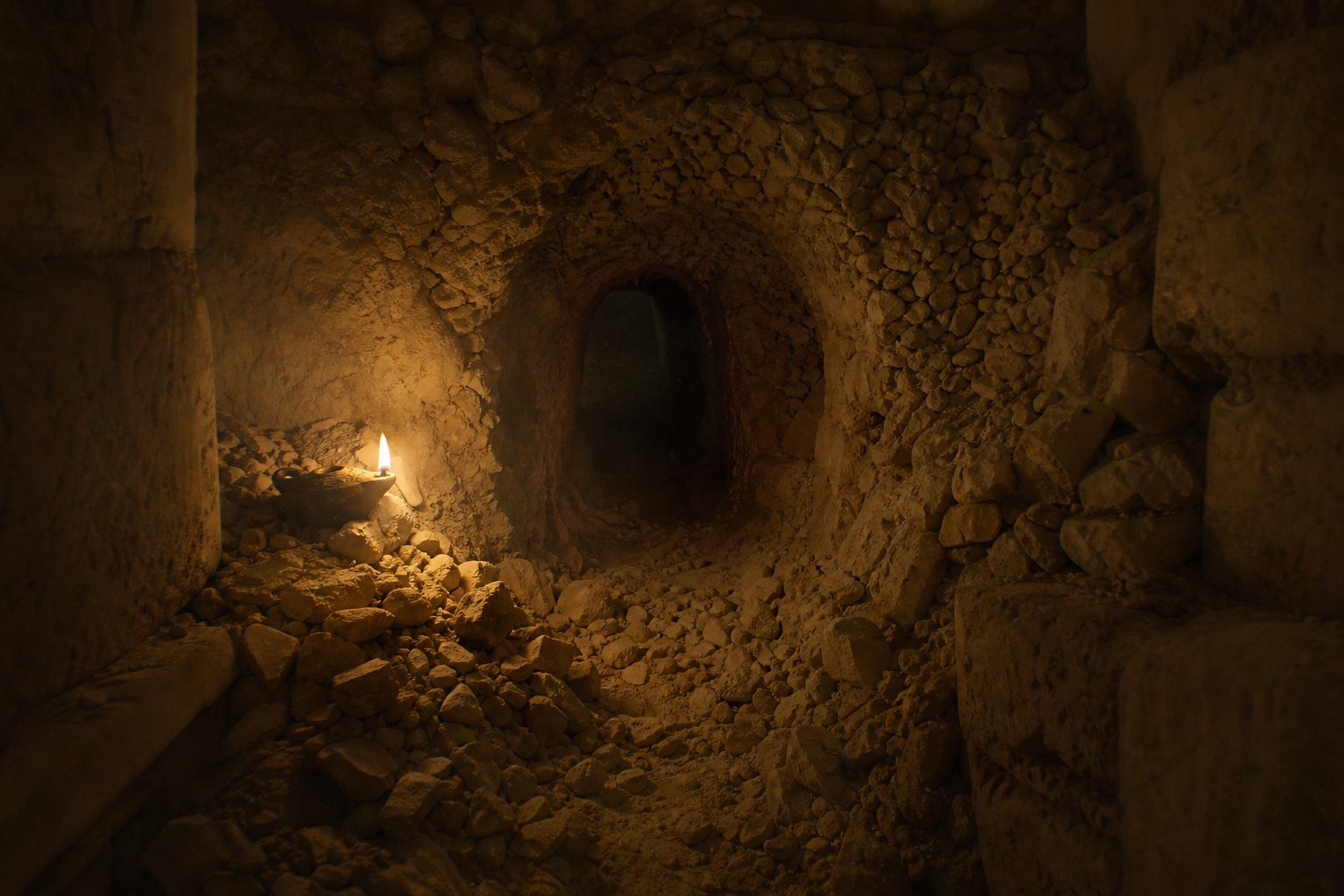
A robbers’ tunnel A narrow hole dug through packed limestone chips, lit by a lamp. AI-generated illustration.
burial c. 1323 BC
robbery 1 goods repacked; corridor filled with chips
robbery 2 tunnel through the fill; detected, resealed
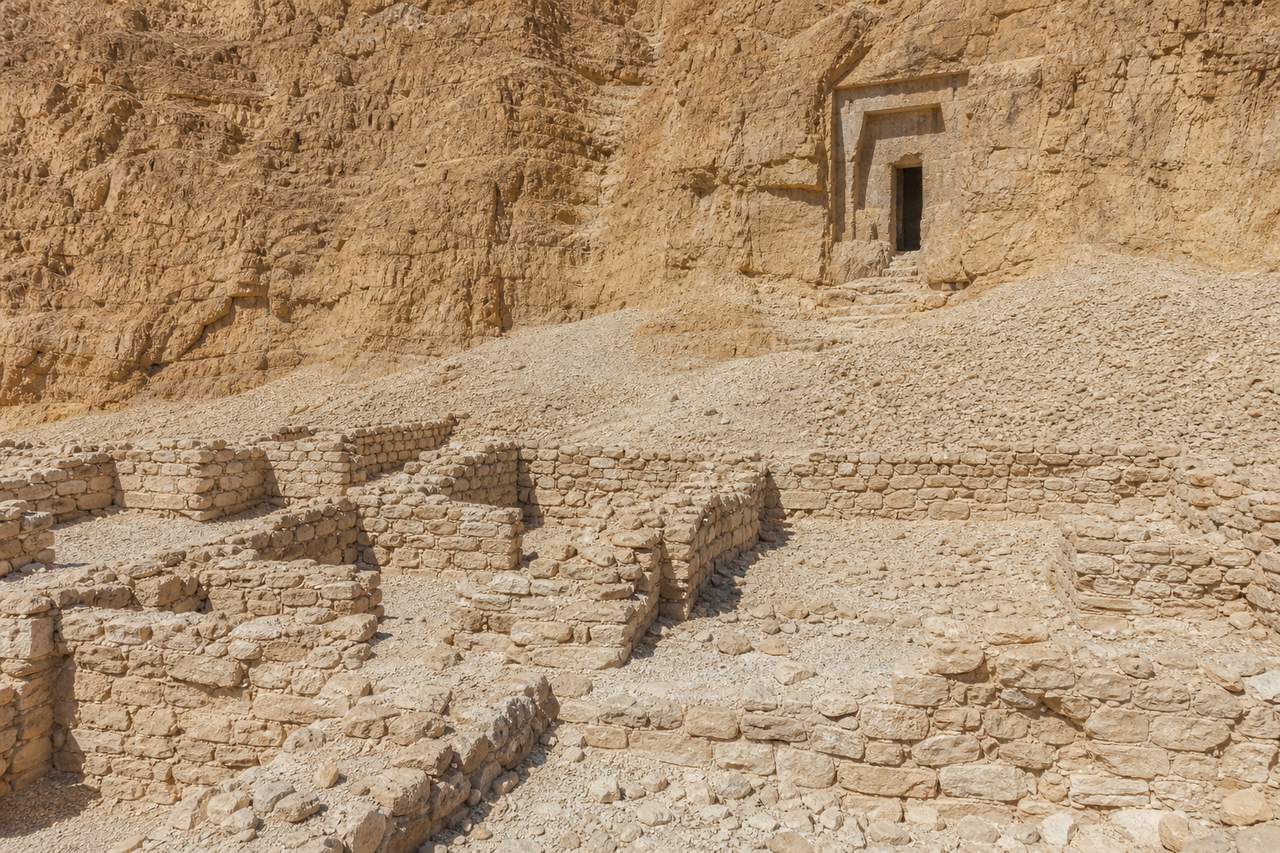
Twice robbed (Wikipedia, KV62)Workmen’s huts Stone hut walls on a slope of chippings; the later tomb above was KV9, made for Ramesses V and VI. AI-generated illustration.
Chapter II · A hidden valley
Why it survived
Wikipedia (Tomb of Tutankhamun): KV62 was probably built for a non-royal person, possibly Ay, and enlarged for Tutankhamun. Ay was buried in WV23, in the western branch of the valley; Wikipedia notes it is possible he buried his predecessor in KV62 in order to take WV23 for himself. KV62 was robbed twice within a few years of the burial: after the first robbery officials repaired and repacked goods and filled the corridor with limestone chips; a second group tunnelled through the fill, and the tomb was again restored and resealed. Its low position, flood debris and later debris from the cutting of KV9, with workers’ huts built on top, hid the entrance.
Wikipedia (Valley of the Kings): KV9, the joint tomb of Ramesses V and VI, was cut where its spoil and workers’ huts covered KV62. Carter’s own book shows the workmen’s huts found above the tomb. The buttons in the scene step through the four stages.
The 3D scenes are simplified teaching models: the valley, the rooms and the objects are schematic, with room sizes rounded from published plans.
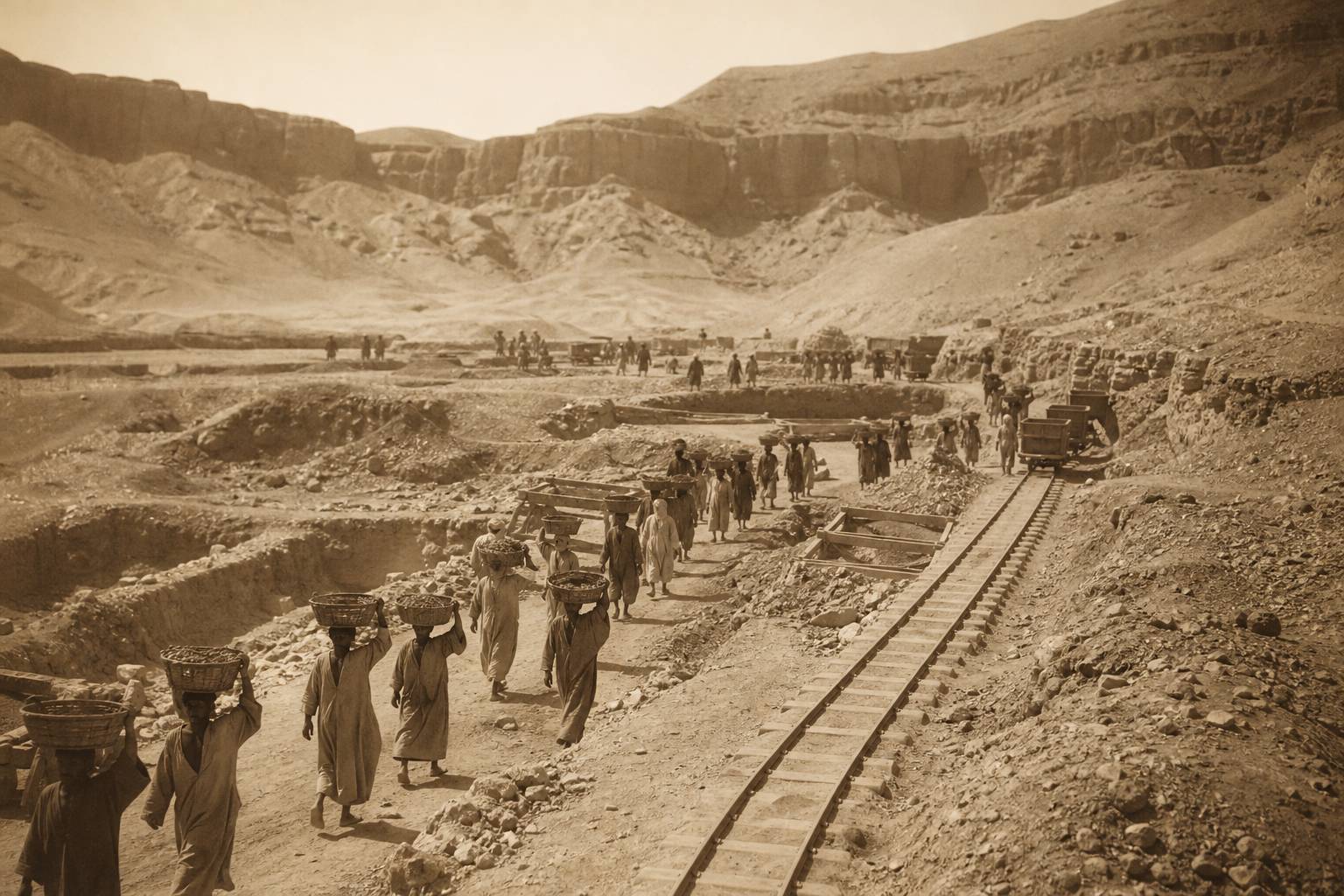
In 1907 a wealthy English aristocrat, Lord Carnarvon, hired Howard Carter. From 1914 Carnarvon held the right to dig in the valley.
After a pause for the First World War, in November 1922 Carter’s men cleared ground under the old huts and found the step.
Next day it was a staircase, down to a doorway sealed with the stamp of the royal cemetery.
Carter telegraphed Carnarvon: a magnificent tomb, with seals intact.
The dig Rows of workers carrying baskets of rubble, in the style of a 1920s photograph. AI-generated illustration.
1907 Carnarvon hires Carter
1914 right to dig the valley
1917 work resumes after a wartime pause
4 Nov 1922 the first step
The search (Wikipedia; Griffith Institute)The first step A step cut in bedrock, coming out of the rubble. AI-generated illustration.
“At last have made wonderful discovery in Valley; a magnificent tomb with seals intact.”Carter’s cable to Carnarvon, November 1922 (Griffith Institute)
Chapter III · Wonderful things
The step
Wikipedia (Howard Carter): Carnarvon hired Carter in 1907; Carnarvon obtained the concession for the Valley of the Kings in 1914, and after a pause in the First World War Carter resumed in late 1917. On 4 November 1922 a step was found; Carter’s published account credits the workmen, while other accounts credit a boy. Griffith Institute (Carter’s journal, first season): the top step of a staircase cut into the bedrock was uncovered, leading to a sealed, plastered doorway bearing the necropolis seal, and Carter cabled Carnarvon: “At last have made wonderful discovery in Valley, a magnificent tomb with seals intact.”
Press Dig in the scene to clear the rubble again.
The 3D scenes are simplified teaching models: the valley, the rooms and the objects are schematic, with room sizes rounded from published plans.
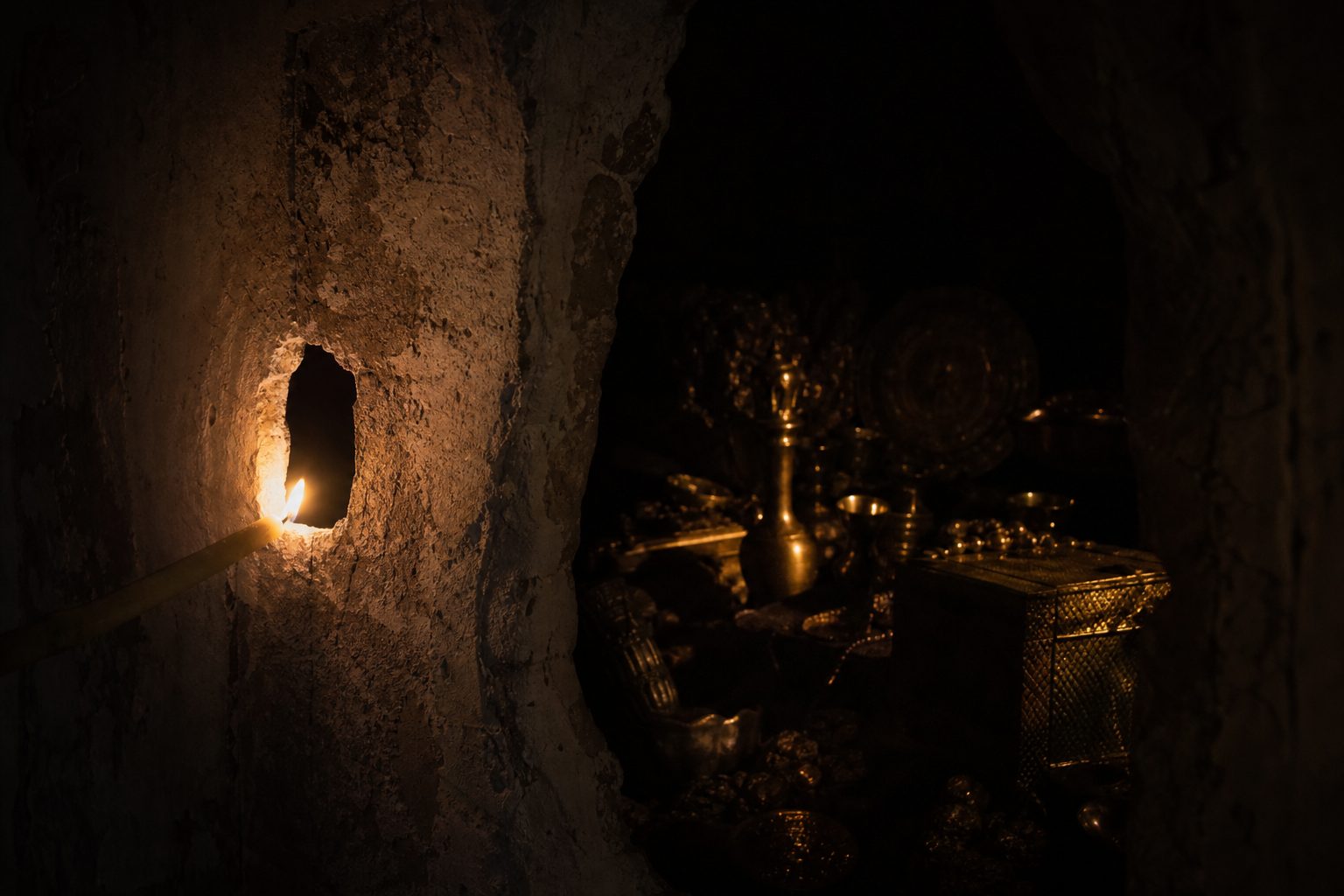
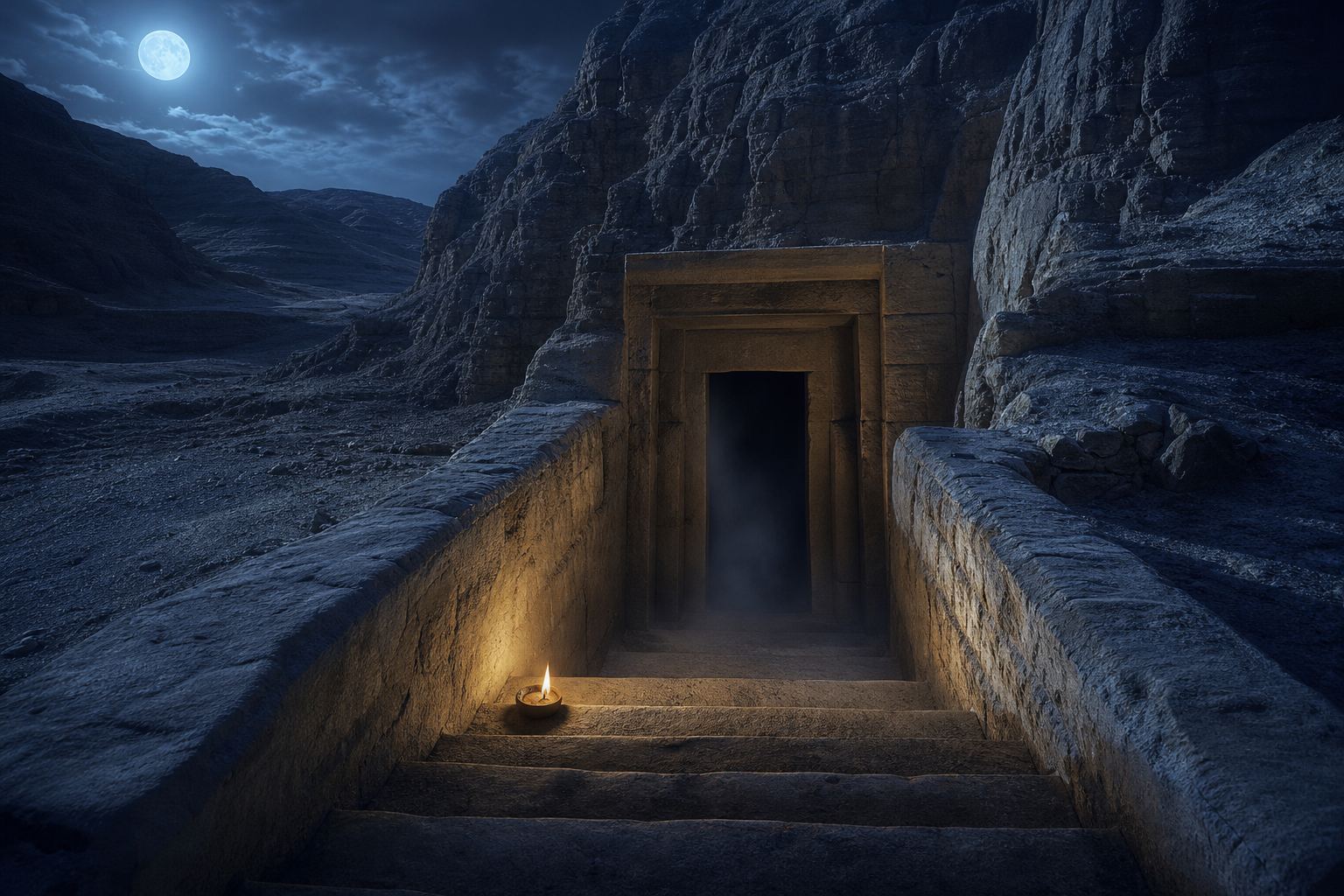
On the twenty-sixth of November, with Carnarvon beside him, Carter made a small hole in a sealed doorway and held up a candle.
In Carter’s book, Carnarvon asks if he can see anything, and Carter answers: Yes, wonderful things. His journal says simply: Yes, it is wonderful.
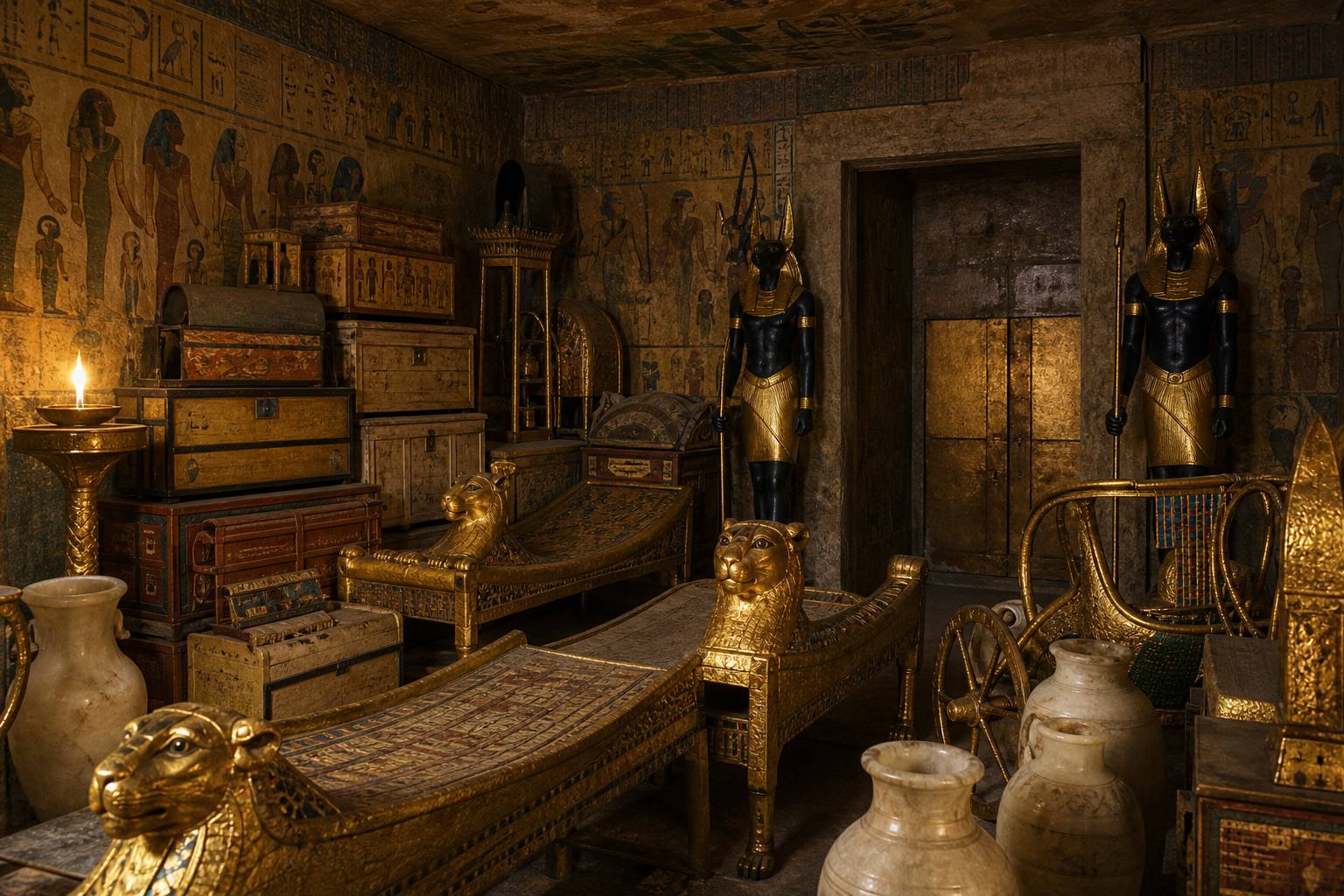
Gold shone everywhere: gilded couches, chariots, statues and chests, crammed into the first room, the antechamber.
There are four rooms: the antechamber, a side room called the annexe, the burial chamber, and a room the team called the treasury.
By candlelight A candle pushed through a small breach; beyond it, the glint of gold. AI-generated illustration.
“Yes, wonderful things.”Carter’s published account, 1923; his journal: “Yes, it is wonderful” (Wikipedia, Howard Carter)
The antechamber Animal-headed couches, painted chests and two black-and-gold guardian statues by the sealed wall. AI-generated illustration.
antechamber 7.9 × 3.6 m
~28
burial chamber 6.4 × 4 m
~26
treasury 4.8 × 3.8 m
~18
annexe 4.4 × 2.6 m
~11
Floor area of each room (Wikipedia, KV62)
Chapter III · Wonderful things
The four rooms
Griffith Institute (Carter’s journal, first season): on 26 November 1922 Carter made a small breach and looked in by candlelight at gold and ebony furniture, chariots, statues and caskets. Wikipedia (Howard Carter): in his published account Carter answers Carnarvon “Yes, wonderful things!”; his journal records “Yes, it is wonderful.”
Wikipedia (Tomb of Tutankhamun): an entrance staircase, a corridor about 8 × 1.7 m, an antechamber 7.9 × 3.6 m, an annexe 4.4 × 2.6 m, a burial chamber 4 × 6.4 m and a treasury 4.8 × 3.8 m, from 2.3 to 3.6 m high. The burial chamber is the only room with painted walls. Use the room buttons in the scene to visit each one.
The 3D scenes are simplified teaching models: the valley, the rooms and the objects are schematic, with room sizes rounded from published plans.
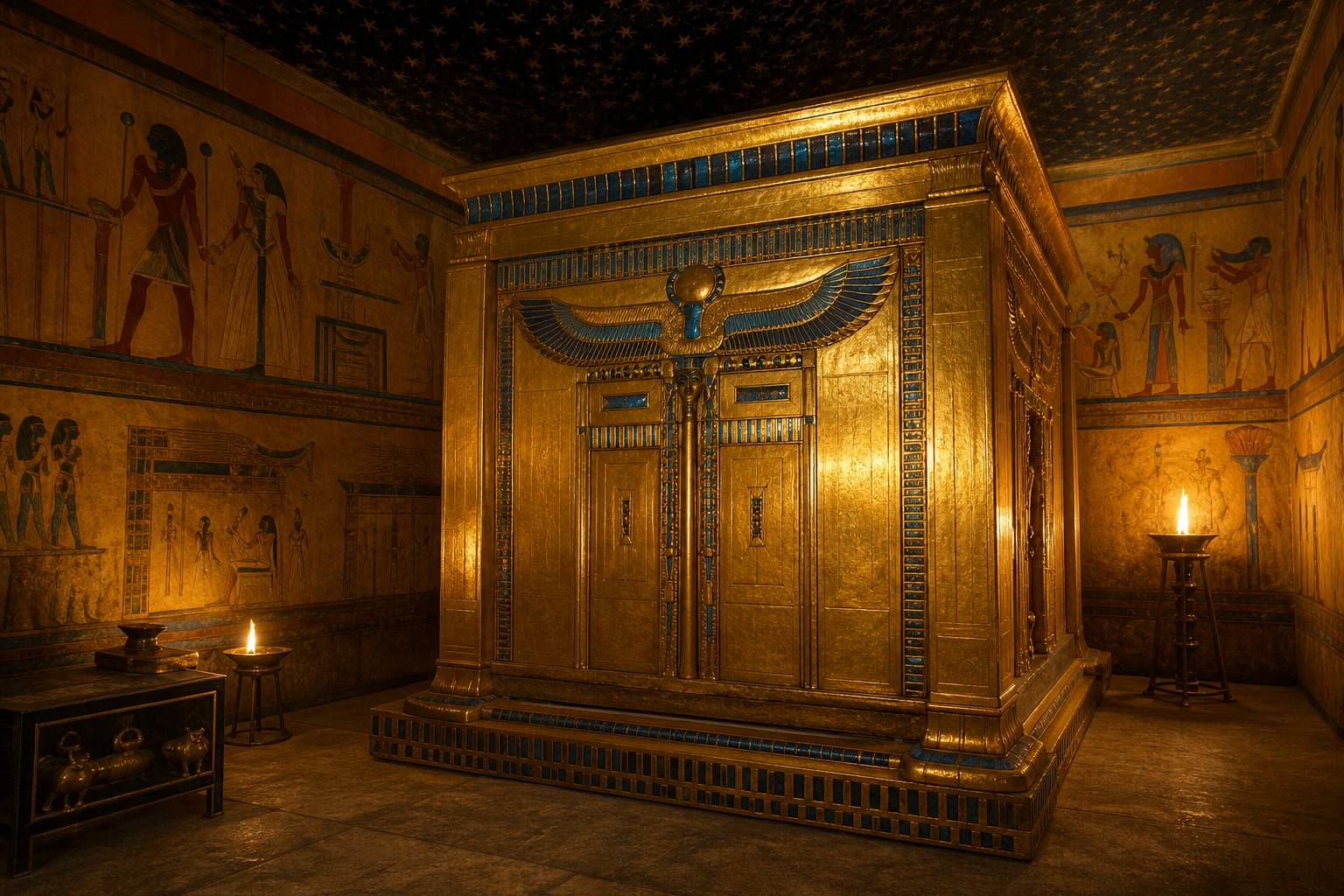
On the sixteenth of February 1923, the burial chamber was opened. Behind the wall stood a shrine, a great gilded wooden box almost filling the room.
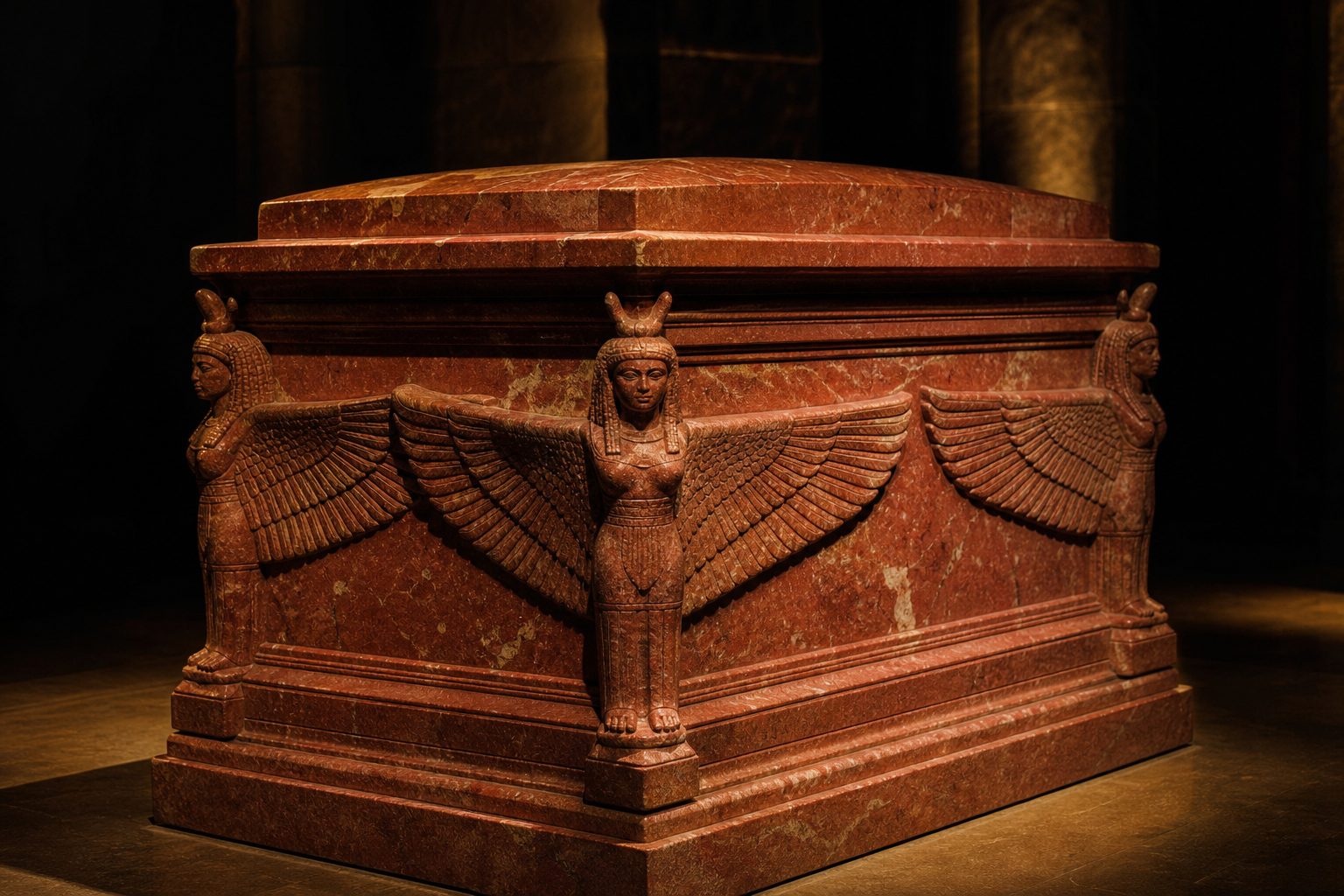
Inside it were three more shrines, and in the last, a sarcophagus: a great stone box for the coffins.
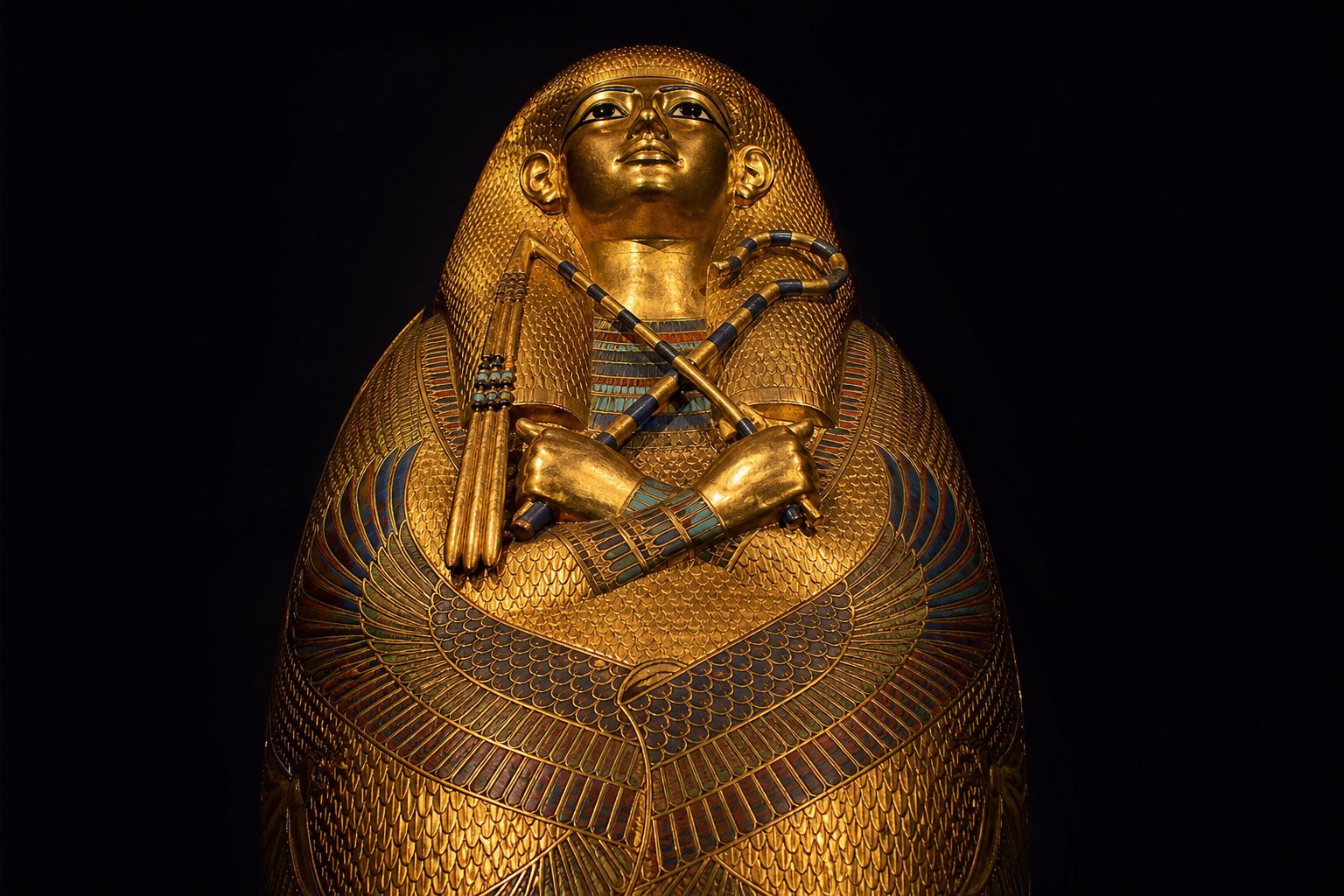
Inside lay three coffins, nested like dolls: two of gilded wood, and the innermost, opened in October 1925, of solid gold, about a hundred and ten kilograms.
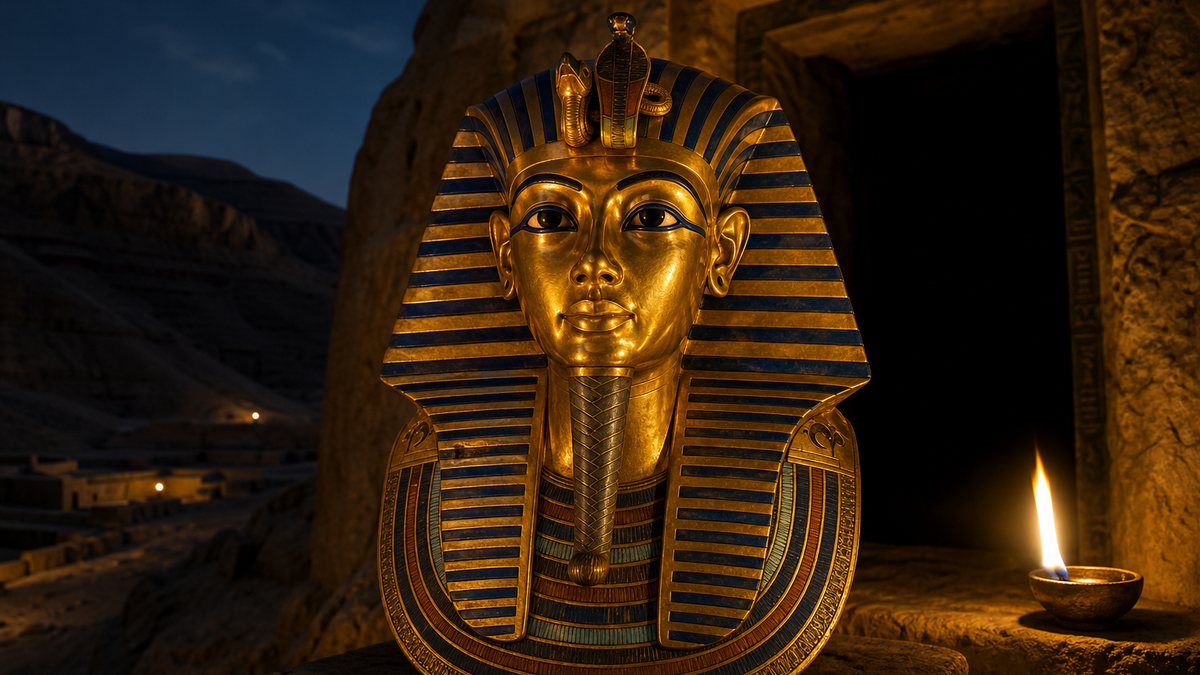
Over the king’s head lay the mask: more than ten kilograms of gold.
A wall of gold A gilded shrine almost filling a chamber with painted yellow walls. AI-generated illustration.The sarcophagus A stone sarcophagus with goddesses spreading their wings at each corner. AI-generated illustration.The innermost coffin A gold coffin with crook and flail, the symbols of royal power, held across the chest. AI-generated illustration.
110.4 kg
the solid gold inner coffin
10.23 kg
the gold in the mask, which is 54 cm tall
Gold (Wikipedia)
Chapter III · Wonderful things
Shrines and coffins
Wikipedia (Howard Carter): on 16 February 1923 Carter opened the sealed doorway and confirmed it led to a burial chamber containing the sarcophagus. Britannica: four gold-over-wood shrines surrounded a stone sarcophagus holding three nested coffins, the innermost of solid gold and the outer two of gold hammered over wood; a golden portrait mask lay on the head. Wikipedia (Tomb of Tutankhamun): the innermost coffin is of solid gold weighing 110.4 kg and was revealed in late October 1925; the shrines were dismantled in late 1923 and early 1924.
Wikipedia (Mask of Tutankhamun): the mask is 54 cm tall and its gold weighs 10.23 kg; it was found on 28 October 1925. Use Open the next layer in the scene to go inward yourself.
The 3D scenes are simplified teaching models: the valley, the rooms and the objects are schematic, with room sizes rounded from published plans.
Why all this care? Because of what ancient Egyptians believed about death.
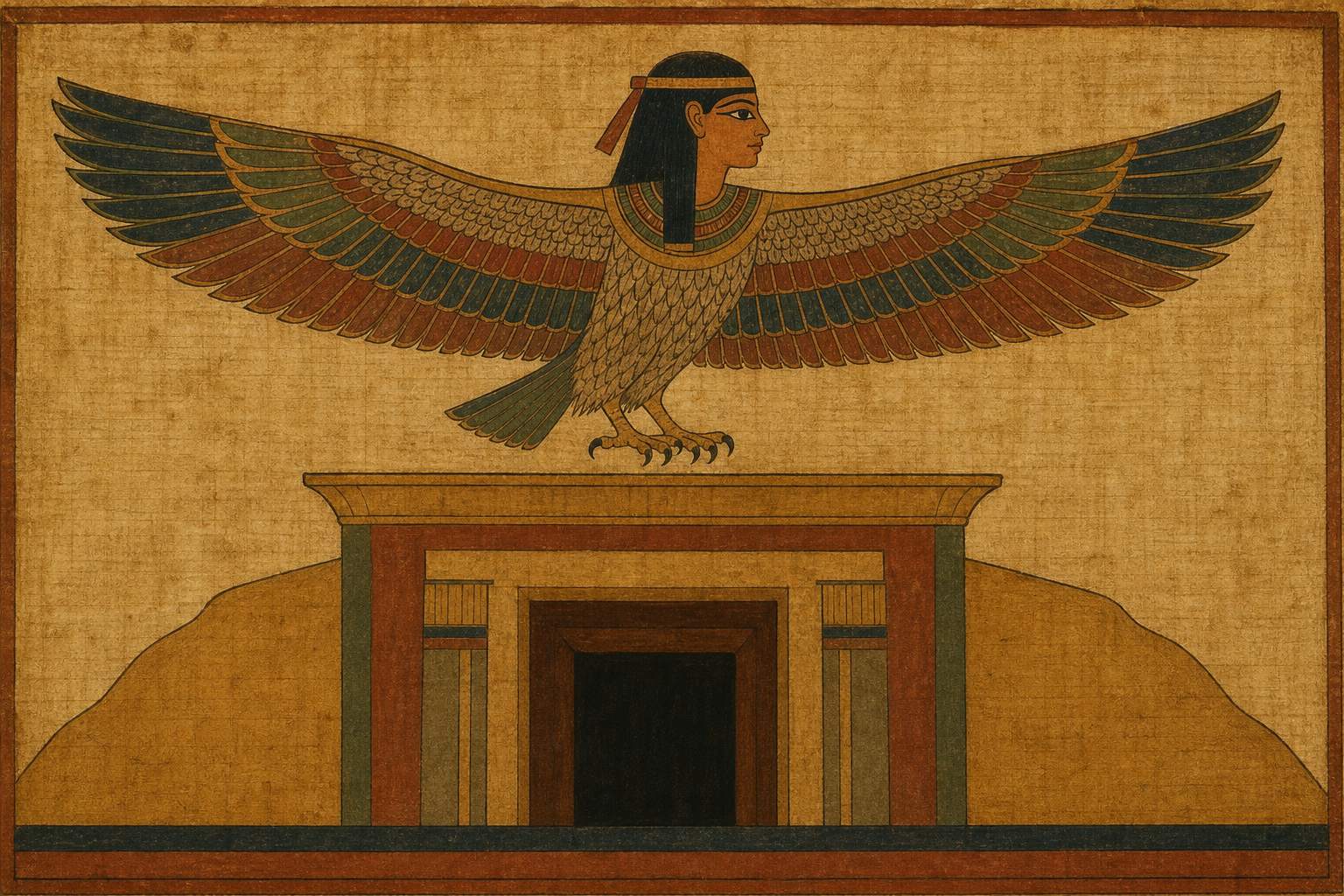
They believed the ka, a double, stayed in the tomb needing offerings, and the ba, pictured as a human-headed bird, could fly out and return.
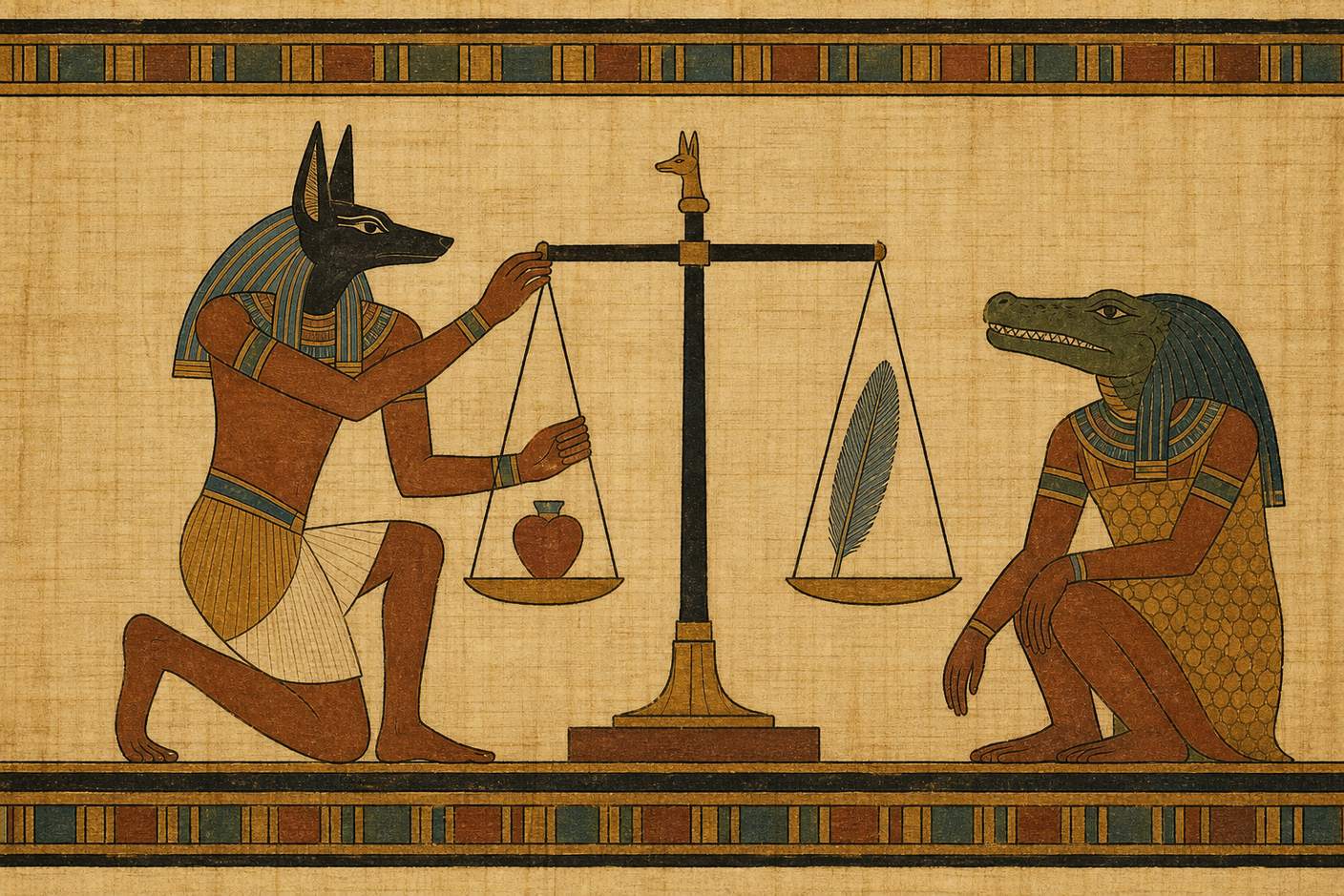
In a final test, the heart was weighed against the feather of Maat, goddess of truth. A heart that failed was eaten by the monster Ammit.
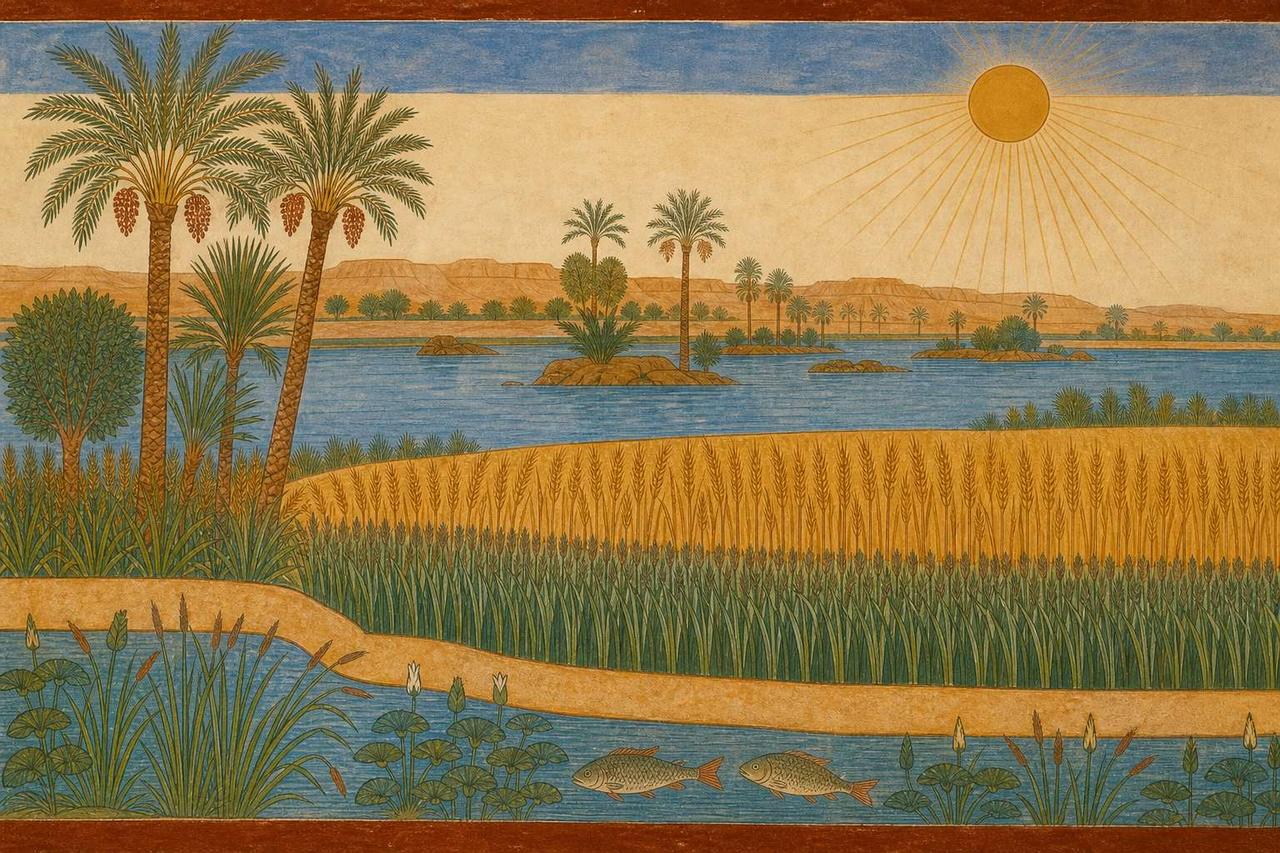
Those who passed reached the Field of Reeds, an ideal Egypt. And they believed the spirit needed its body to last.
The weighing In the style of a Book of the Dead papyrus: a jackal-headed god at the scale, a crocodile-headed creature waiting. AI-generated illustration.The ba The ba, pictured with spread wings over a tomb door. AI-generated illustration.
Anubis, the jackal-headed god, adjusts the balance
Maat’s feather: truth, justice, balance
Ammit waits for a heart that fails
Osiris, god of the dead, receives those who pass
Who is at the scale (British Museum)The Field of Reeds Fields, a clear river and a bright sun, in the style of a tomb painting. AI-generated illustration.
Chapter IV · Making a mummy
The afterlife
British Museum: the weighing of the heart against the feather of Ma’at, goddess of truth, justice and balance, decided whether the dead could meet Osiris and enter the Field of Reeds, an idealised Egypt; those who failed had their hearts eaten by Ammit. Anubis is shown adjusting the scale. The Book of the Dead was a collection of spells, often on papyrus, buried with the dead. The ka (essence) and ba (personality, shown as a human-headed bird) joined in the afterlife to form an akh.
Smithsonian: the ka, a double of the person, stayed in the tomb and needed offerings; the ba could leave the tomb and return; the mummified body was the home of the spirit, so preserving it protected the spirit.
Try Pass and Fail on the scale in the scene.
These are the beliefs of ancient Egyptians as historians describe them, told here as history.
The 3D scenes are simplified teaching models: the valley, the rooms and the objects are schematic, with room sizes rounded from published plans.
A royal mummy took about seventy days. The Greek historian Herodotus described the work around 450 BC, nearly nine centuries after Tutankhamun.
The brain was drawn out through the nose, and the organs through a cut in the side, but the heart, the centre of the person, stayed in.
Then it was covered in natron, a salt that soaks up water, which stops decay. Herodotus says seventy days in natron; museums today say about forty.
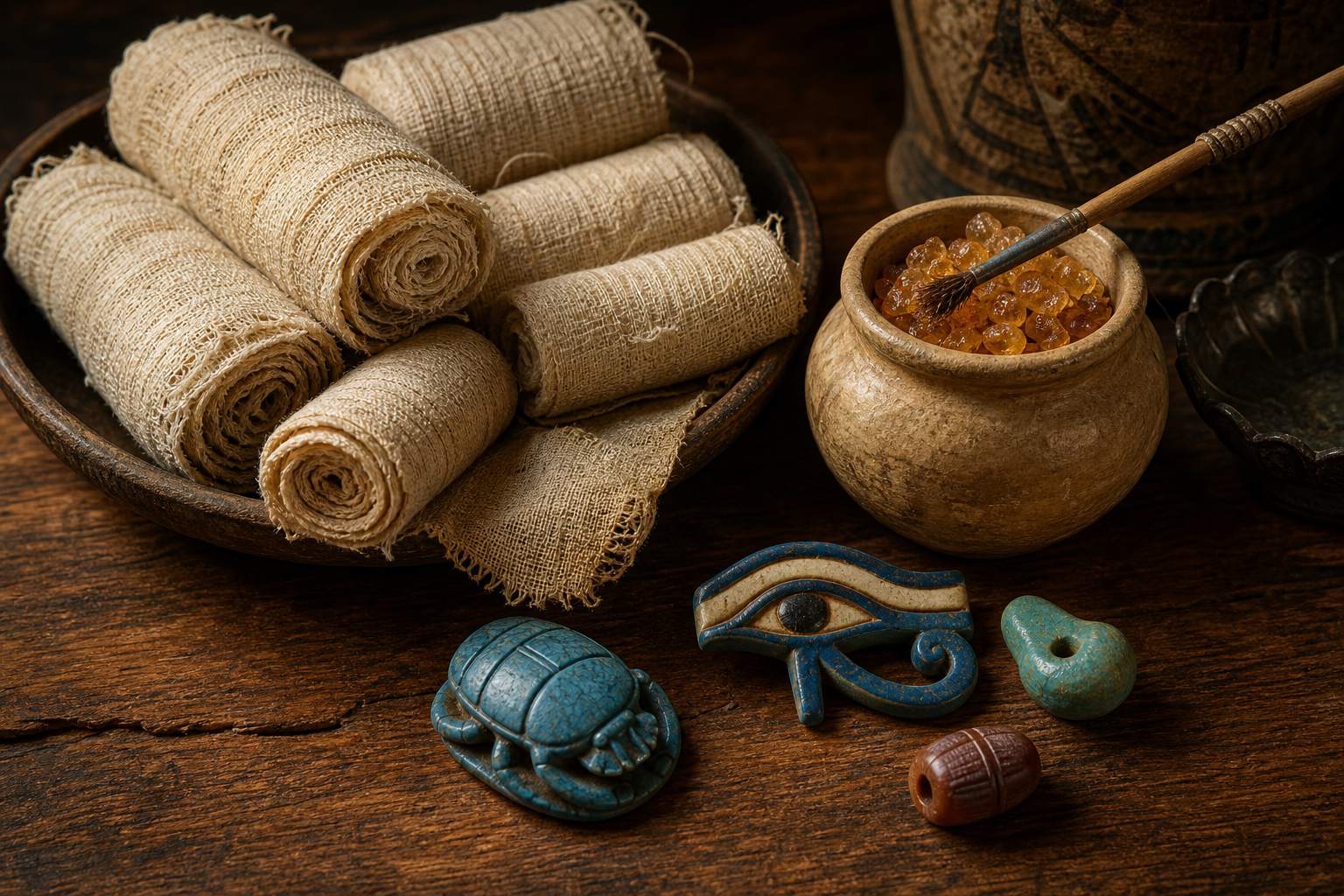
Last came resin, a sticky tree sap, and hundreds of metres of linen, with protective charms called amulets in the layers.
~70 days
the whole process (Smithsonian; Australian Museum)
70 days
in natron, says Herodotus
40 days
drying in natron (Australian Museum)
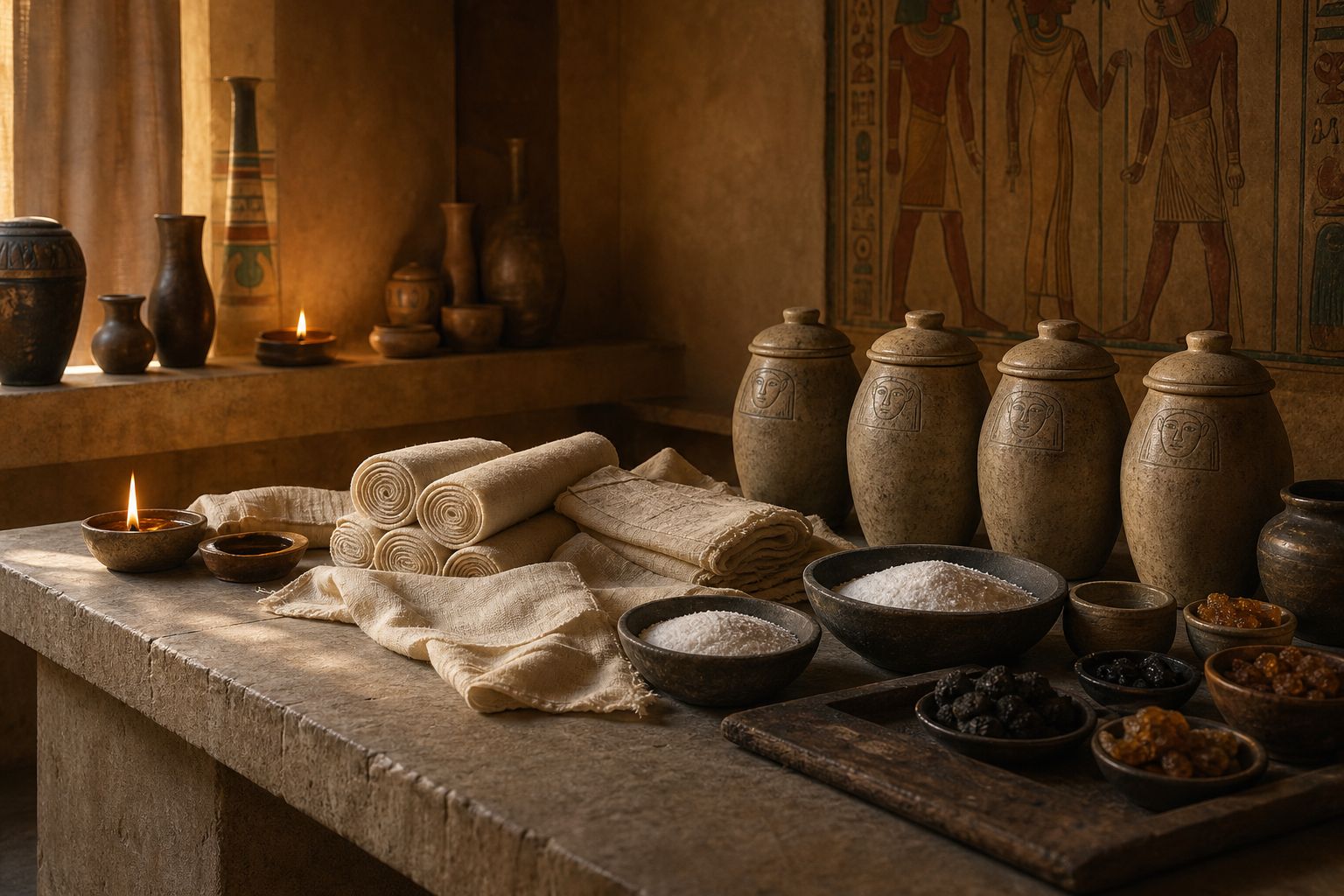
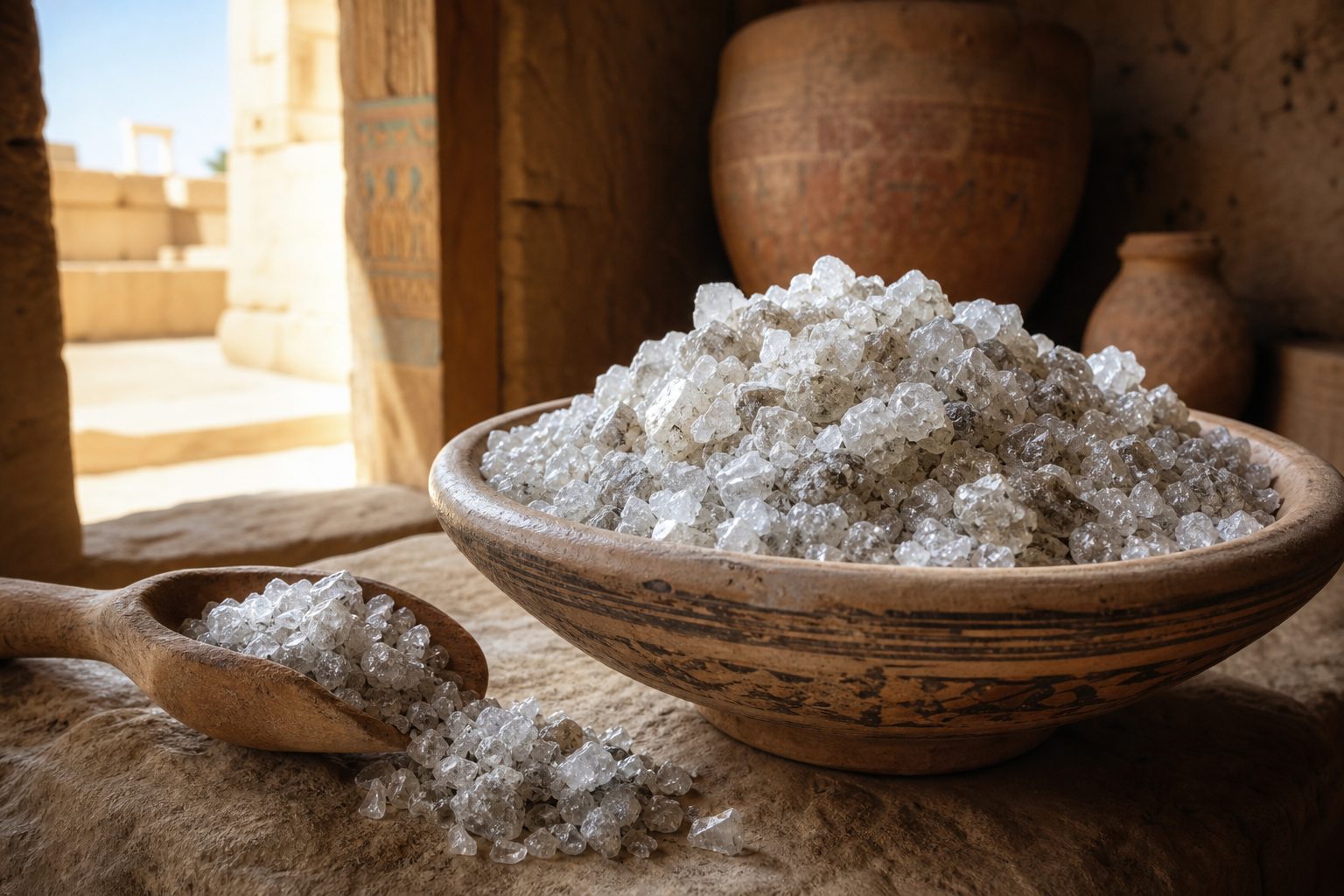
The timetableThe embalmers’ table Bowls of natron, rolls of linen, pots of resin and four stone jars for the lungs, stomach, liver and intestines. AI-generated illustration.Natron A carbonate salt from desert lake edges; it was also packed inside the body in small pouches. AI-generated illustration.Linen and amulets Rolled bandages, resin and a brush, a scarab and an eye amulet. AI-generated illustration.
Chapter IV · Making a mummy
Mummification
Smithsonian: the New Kingdom process took seventy days and was done by priest-embalmers. Brain tissue was pulled out through the nostrils with hooked tools; through an incision usually on the left side the organs were removed; the heart was left in place as the centre of a person’s being and intelligence; the stomach, liver, lungs and intestines were preserved separately in canopic jars. The body was covered and packed with natron to dry it, then padded with linen, coated with warm resin at several stages and wrapped in hundreds of yards of linen with amulets. Much of what is known comes from Herodotus, who visited Egypt around 450 BC, with modern research. Herodotus (Histories 2.86, via Livius): the brain was drawn out through the nostrils with a crooked iron, the flank cut with a sharp stone, and the body placed in natron for seventy days, then washed and wrapped in fine linen smeared with gum.
Australian Museum: natron, a carbonate salt from the edges of desert lakes, absorbed moisture to prevent decay, for 40 days; the cavities were filled with linen, natron pouches and other materials; the whole process took about 70 days. Use the stage buttons to step through it.
The scene shows a wrapped shape only, as a schematic; no real body is shown.
The 3D scenes are simplified teaching models: the valley, the rooms and the objects are schematic, with room sizes rounded from published plans.
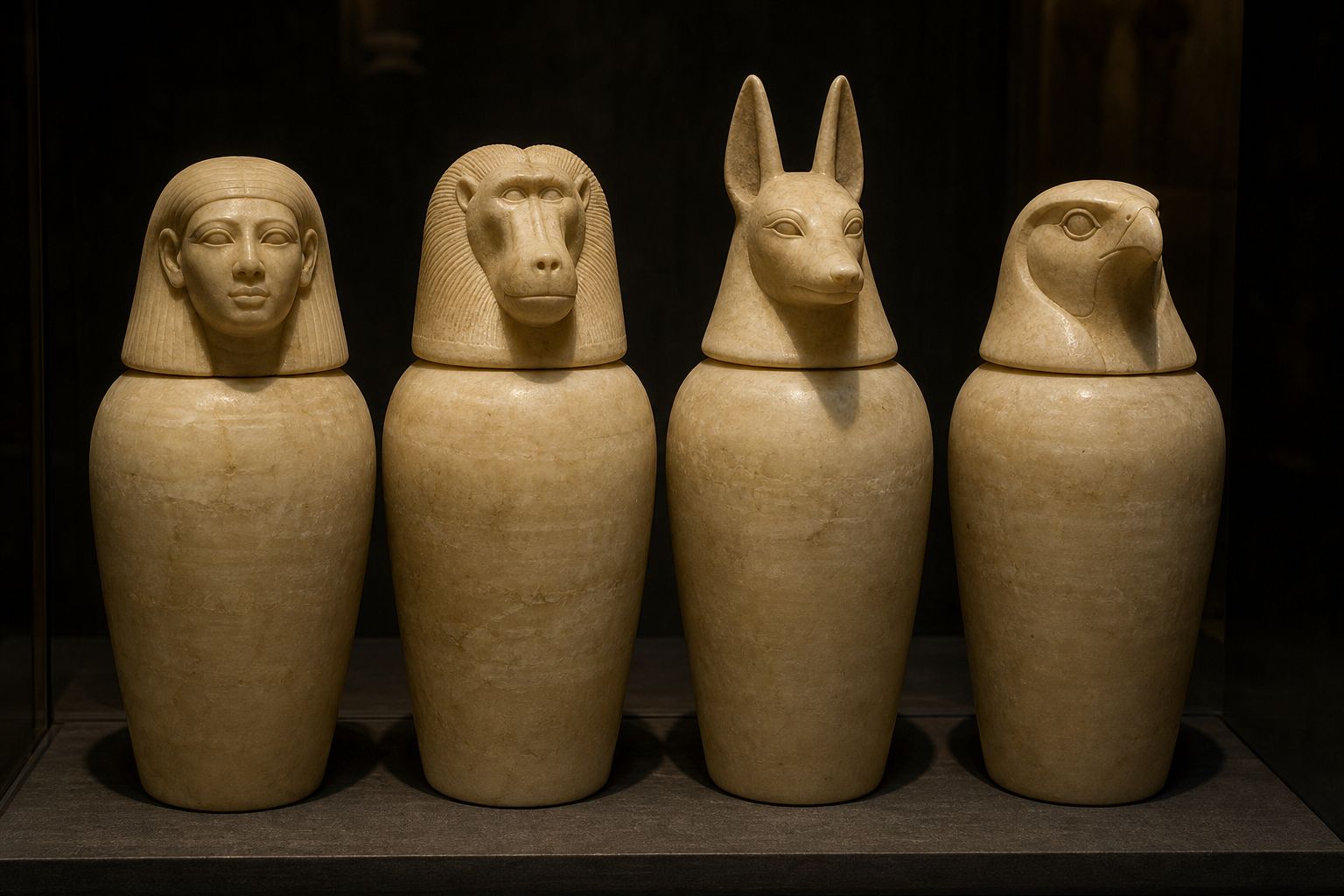
Usually the four organs went into four canopic jars, each guarded by one of four protective gods called the sons of Horus.
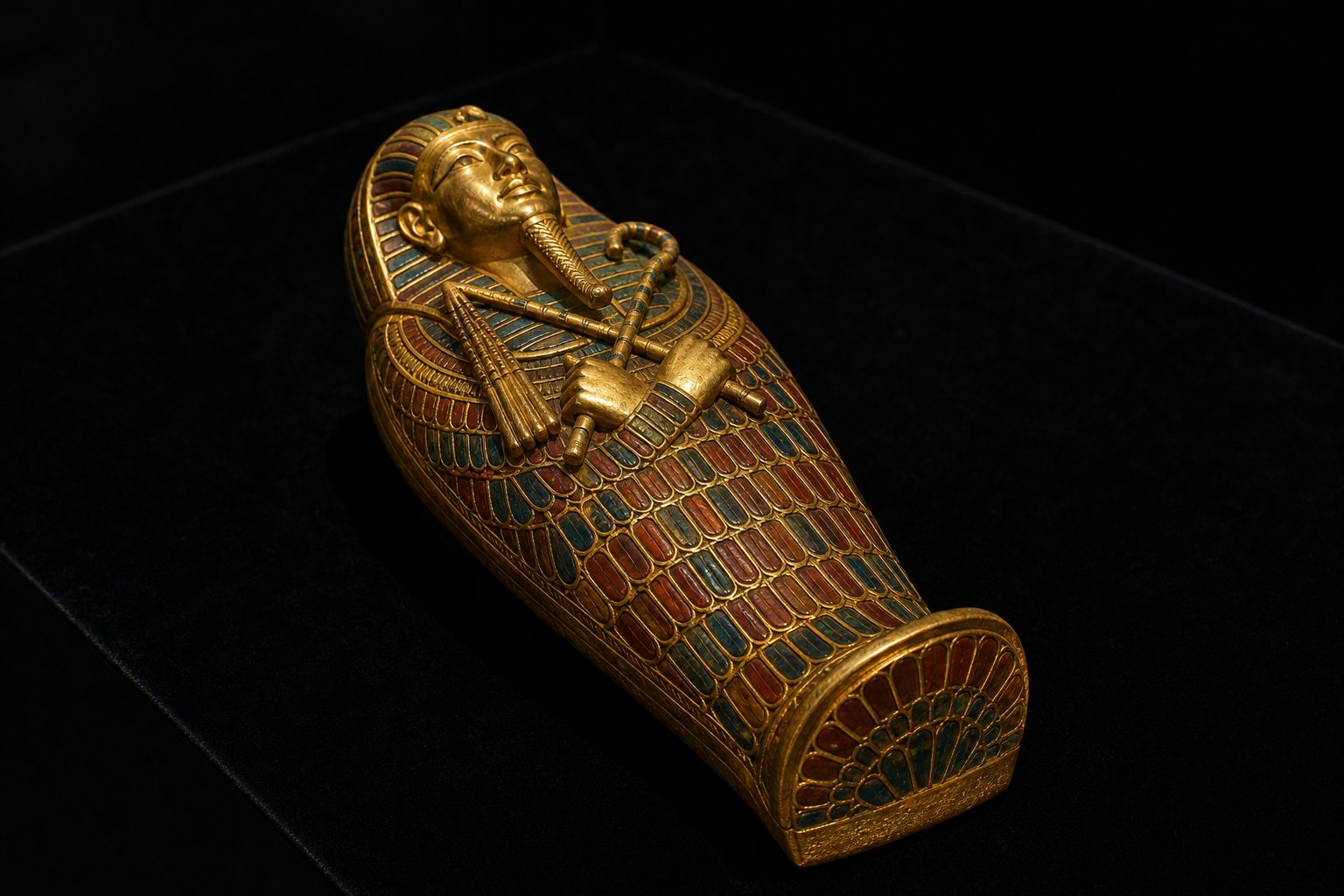
Tutankhamun’s went into four miniature coffins of beaten gold, kept in an alabaster chest in the treasury.
Their inscriptions were altered, as if they were first made for someone else.
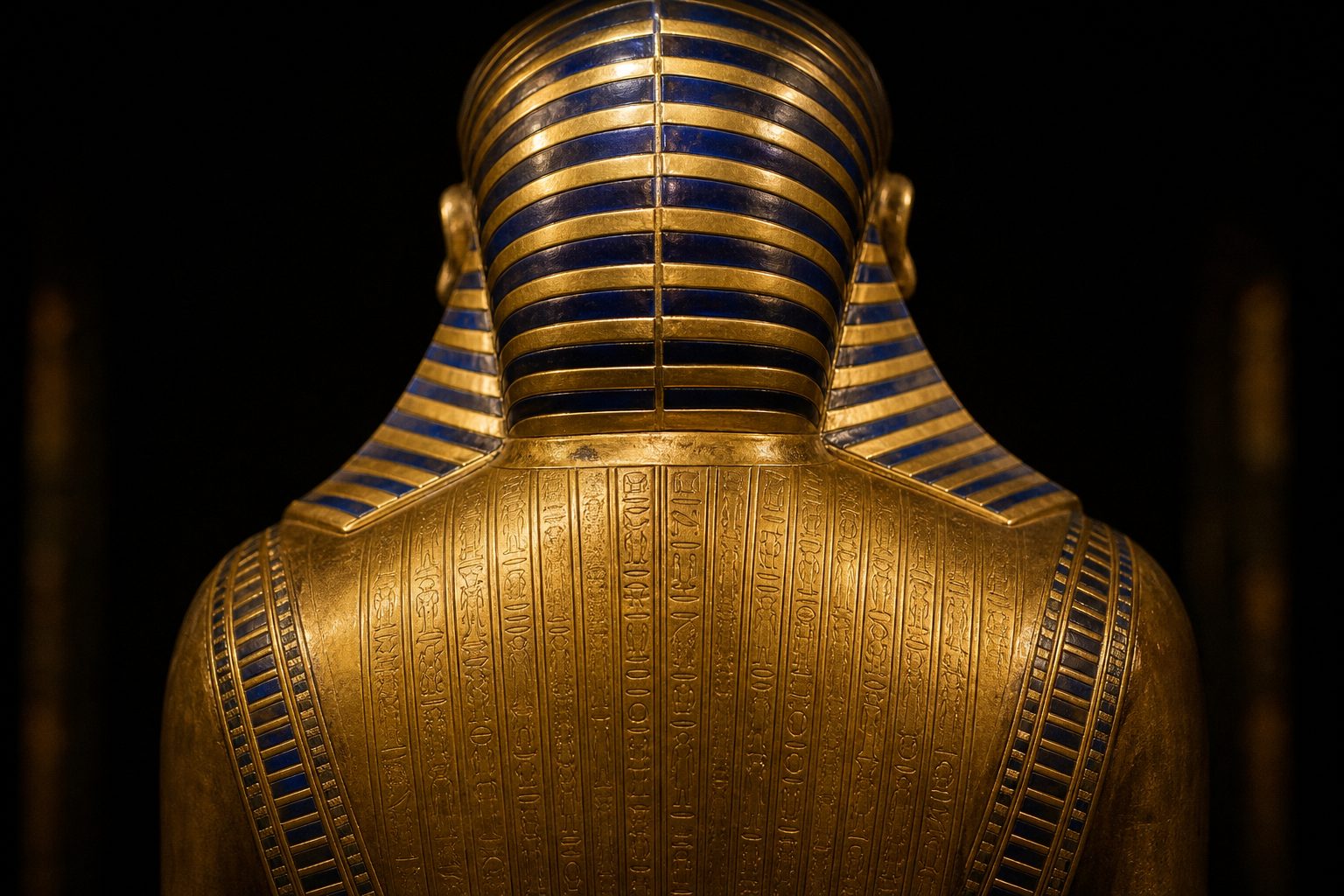
The mask had a job too: on its back is a protective spell from the Book of the Dead, spells buried with the dead to guide them.
Canopic jars Stoppers with the heads of a human, a baboon, a jackal and a falcon. AI-generated illustration.A miniature coffin Beaten gold inlaid with carnelian and coloured glass, in a feather pattern. AI-generated illustration.
altered
names on the coffinettes suggest a first owner
Reused? (The Past)The back of the mask Engraved lines on the gold. The real spell is chapter 151, and first appeared on masks some 500 years earlier. AI-generated illustration.
Chapter IV · Making a mummy
Organs and mask
Australian Museum: the lungs, stomach, liver and intestines were embalmed separately and placed in canopic jars, often decorated with one of the four sons of Horus, each protecting one organ. The Past: four miniature coffins of beaten gold, inlaid with carnelian and glass paste, each a replica of the king’s second coffin, held his mummified organs and were found in an alabaster box in the Treasury; alterations to their inscriptions suggest they were first made for someone else.
Wikipedia (Mask of Tutankhamun): a protective spell from chapter 151 of the Book of the Dead is inscribed on the back and shoulders; the spell first appeared on masks in the Middle Kingdom, about 500 years earlier. The mask is now in the Grand Egyptian Museum.
These are the beliefs of ancient Egyptians as historians describe them, told here as history.
The 3D scenes are simplified teaching models: the valley, the rooms and the objects are schematic, with room sizes rounded from published plans.
Science has looked at the king’s body again since Carter’s time.
In 2005 a CT scanner, which takes X-rays in thin slices, made about seventeen hundred images and found no sign of murder.
It did find a broken left thigh bone, broken either shortly before death or by Carter’s team; experts disagree.
In 2010 a team led by Zahi Hawass, of Egypt’s antiquities council, studied royal DNA and found a foot-bone disease and traces of malaria.
They called malaria, perhaps with the broken leg, the likeliest cause of death. Others disagree; it is still open.
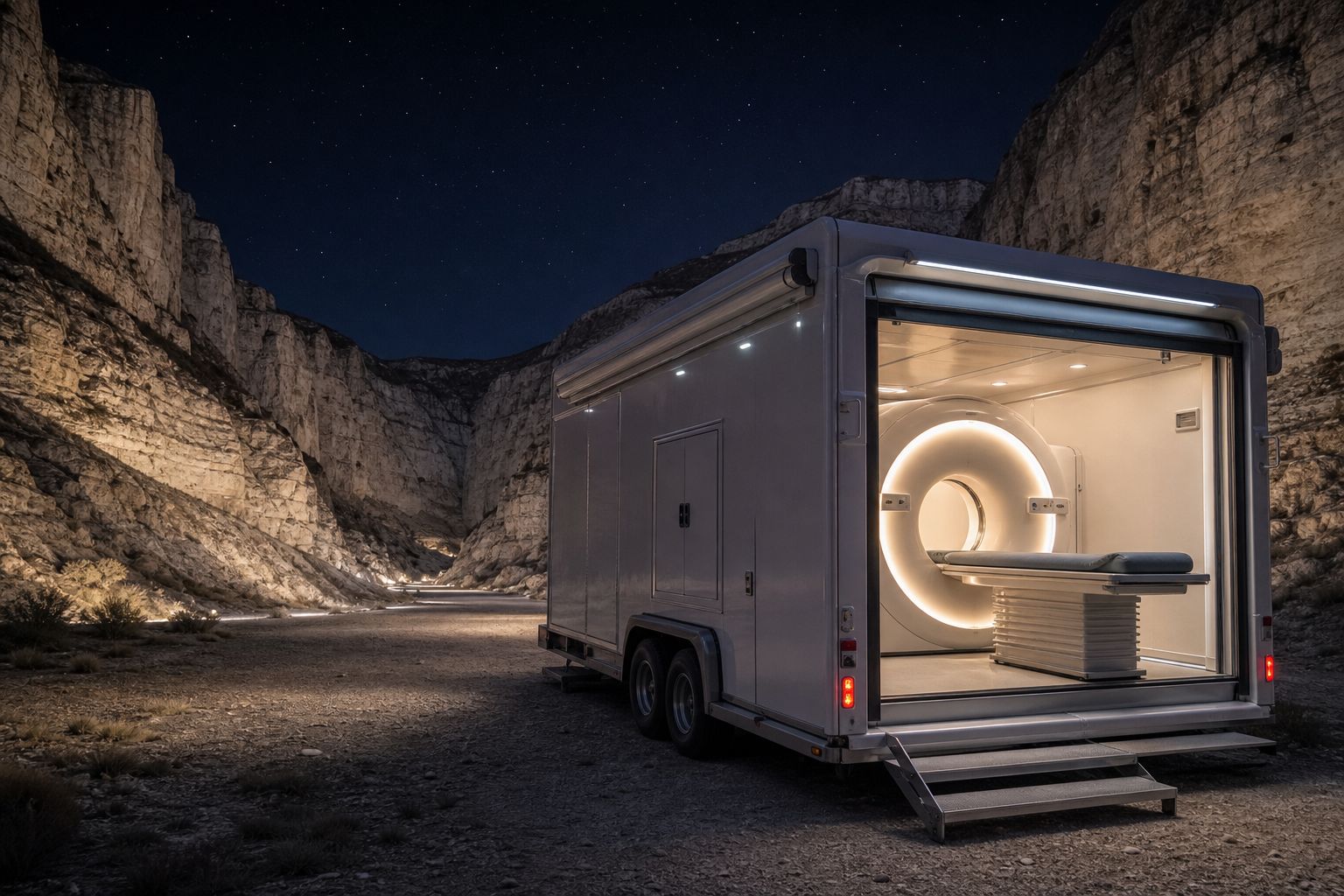
A scanner in the valley A mobile CT unit; in 2005 the king’s body was moved from the tomb to the scanner. AI-generated illustration.
~19
age at death, in years
~170 cm
height, from the shin bone
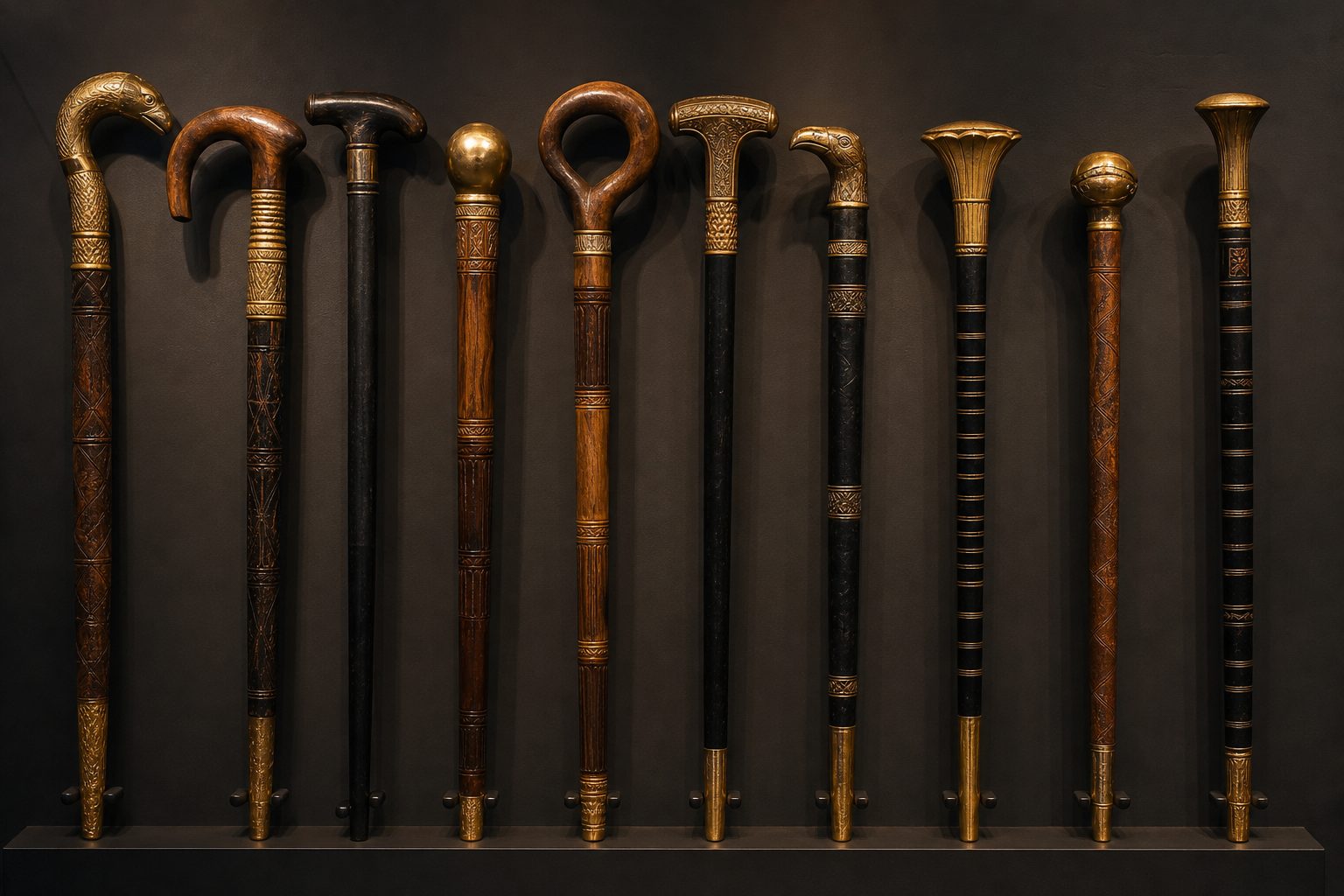
CT scan, 5 January 2005 (SCA)Ancient DNA A clean lab. The foot disease was Köhler disease II; the malaria parasite was Plasmodium falciparum (JAMA). AI-generated illustration.Walking sticks The 2010 authors pointed to the many canes in the tomb as a sign he walked with difficulty. AI-generated illustration.
Chapter V · Science and myth
What science found
Wikipedia (Tomb of Tutankhamun): the mummy was found in poor condition in November 1925. Supreme Council of Antiquities (2005): the CT scan was made on 5 January 2005 (the CT report gives over 1,700 images; the press release speaks of over 17,000 images reviewed, so the two figures conflict); age at death about 19; height about 170 cm; no evidence of murder or of a blow to the head; a fracture of the left thigh bone that part of the team thinks happened shortly before death and part thinks Carter’s team caused.
JAMA (Hawass and colleagues, 2010), via Phys.org: 11 royal mummies and 5 controls; DNA from 2 to 4 biopsies each; Tutankhamun had Kohler disease II (a bone disorder of the foot) and genetic indications of Plasmodium falciparum malaria; canes in the tomb support walking impairment; the authors judged bone necrosis with malaria, perhaps after a fracture, the most likely cause of death. Wikipedia (Tutankhamun): no records survive of how he died, and the cause is still debated.
The 3D scenes are simplified teaching models: the valley, the rooms and the objects are schematic, with room sizes rounded from published plans.
In April 1923 Lord Carnarvon died in Cairo, after an infected mosquito bite led to blood poisoning.
Newspapers blamed a pharaoh’s curse. Even Arthur Conan Doyle, creator of Sherlock Holmes, said an evil spirit might have killed him.
In 2002 a doctor, Mark Nelson, tested it on the Westerners Carter recorded: twenty-five at the openings, and eleven absent ones he could trace.
Those at the openings died at about seventy on average, the others at seventy-five: a gap that could easily be chance, with no sign the tomb shortened lives.
Carter called the curse nonsense. He died in 1939, aged sixty-four.
A bite by the Nile BMJ: the bite became infected (erysipelas), leading to septicaemia and pneumonia. AI-generated illustration.The legend spreads On 6 April 1923 the New York Times reported theories of vengeance (JSTOR Daily). AI-generated illustration.
44
Westerners in Egypt, from Carter’s records
25
counted as present at the key openings
The test (BMJ, 2002)
at the openings (25 traced)
~70
not there (11 of 19 traced)
~75
Average age at death (BMJ, 2002)
The tomb by night No curse inscription was found; the legend grew from older mummy stories. AI-generated illustration.
Chapter V · Science and myth
The curse
Wikipedia (Howard Carter): Carnarvon died in Cairo on 5 April 1923 of blood poisoning contracted in Luxor; Carter dismissed the curse as “tommy-rot”; Carter died on 2 March 1939, aged 64. BMJ (Nelson, 2002): Carnarvon’s death followed erysipelas from a mosquito bite, with septicaemia and pneumonia. Of 44 Westerners in Egypt, 25 were present at the key openings; their mean age at death was about 70, against 75 for the unexposed (P = 0.87), and the study “found no evidence” for the curse.
JSTOR Daily: scholar Philip Kuberski argues the curse had no foundation in the texts found in the tomb; the New York Times ran “Carnarvon’s Death Spreads Theories About Vengeance” on 6 April 1923; Arthur Conan Doyle said a malevolent spirit was “possible”; mummy-curse fiction already existed, such as Louisa May Alcott’s story of 1869. Try the Claim and Facts buttons in the scene.
The 3D scenes are simplified teaching models: the valley, the rooms and the objects are schematic, with room sizes rounded from published plans.
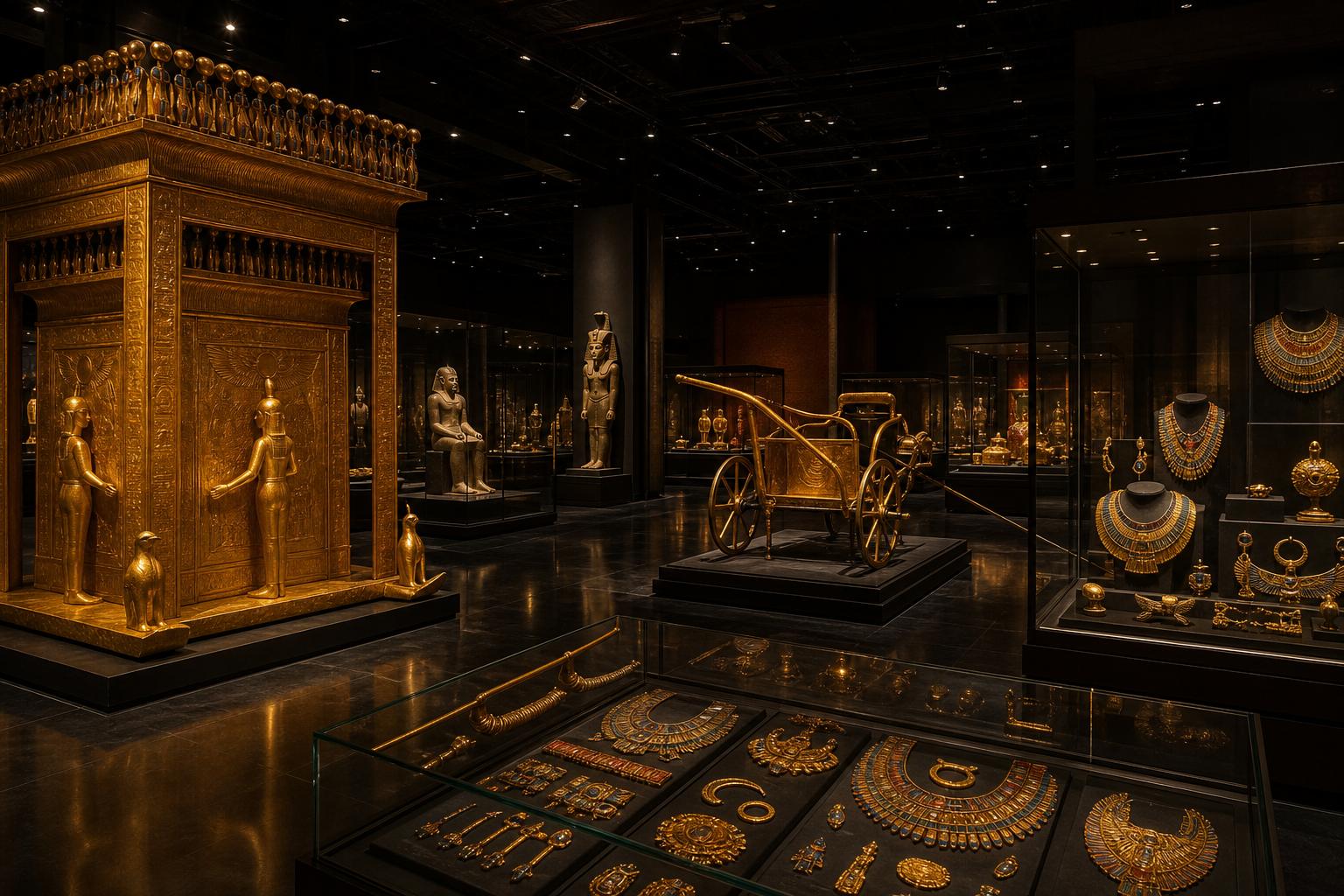
Carter’s team worked in the tomb until 1932. Its treasures are now together at the Grand Egyptian Museum.
The king himself never left. His body still lies in his tomb, in a climate-controlled glass case since 2007.
How he died is still an open question. But we know where his story came back to light: under one step in the rock.
Together again Shrines, chariots and jewellery in one gallery, the way the collection is now shown. AI-generated illustration.
2007
the body moved to a glass case in the antechamber
Still in KV62 (Wikipedia)
c. 1332 BC becomes king, aged 8 or 9
c. 1323 BC dies; buried in KV62
4 Nov 1922 the first step
16 Feb 1923 burial chamber opened
Oct 1925 gold coffin and mask
2005 · 2010 CT scan · DNA study
Nov 2025 whole collection on show
today cause of death: still open
Tutankhamun: a timeline
Epilogue · Sources
Sources
Every fact in this film comes from the sources below. Dates in the 14th century BC are approximate, and scholars give slightly different ones. The chapter stills and pictures are AI-generated illustrations and show no real people and no real bodies. The valley, the tomb, the shrines, the scale and the mummy are simplified teaching models. The ancient beliefs are described as history. Wikipedia (Tomb of Tutankhamun): the king’s mummy is still displayed in the tomb, and in 2007 it was moved to a climate-controlled glass case in the antechamber. Wikipedia (Howard Carter): clearance went on until 1929 and final work until February 1932; Wikipedia (Tomb of Tutankhamun) gives November 1930 for the end of clearance.