Eighty-six years after the raid on Coventry of 14–15 November 1940, this film explains the Blitz, the German bombing of British cities from September 1940 to May 1941: how radar helped Britain win the daylight Battle of Britain and why the Luftwaffe turned to the night; the blackout, Anderson and Morrison shelters and the Underground; why night fighters could hardly find their targets in 1940; the radio beams Knickebein and X-Gerät and the British jamming of the ‘Battle of the Beams’; the Coventry raid, its toll as given by Coventry City Council and GCHQ, and GCHQ’s account of the myth that the city was sacrificed; the civilian toll of the Blitz and, briefly, the later Allied bombing of German cities; and how Coventry’s ruined cathedral became a symbol of reconciliation.
Interactive 3D film9 min1939 to 1962Published 14 November 2026
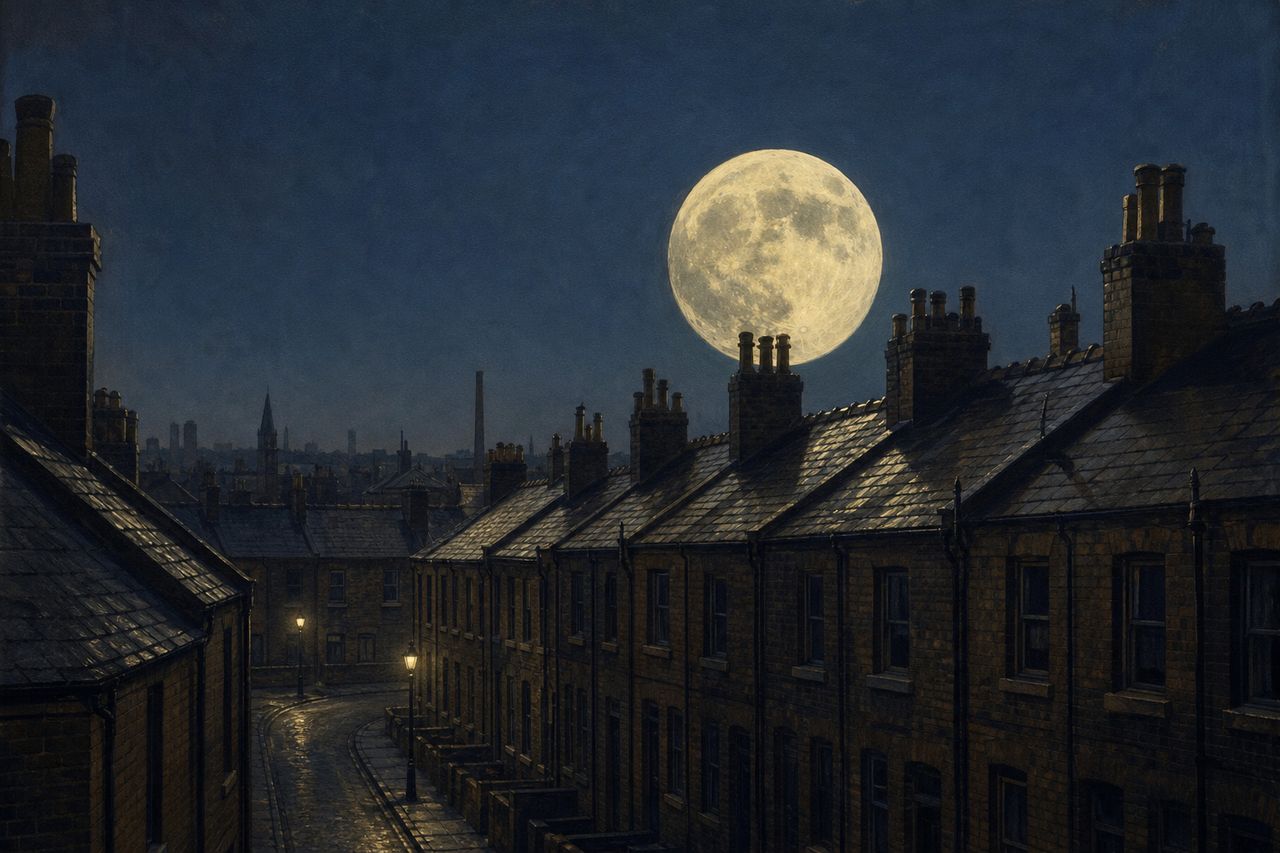
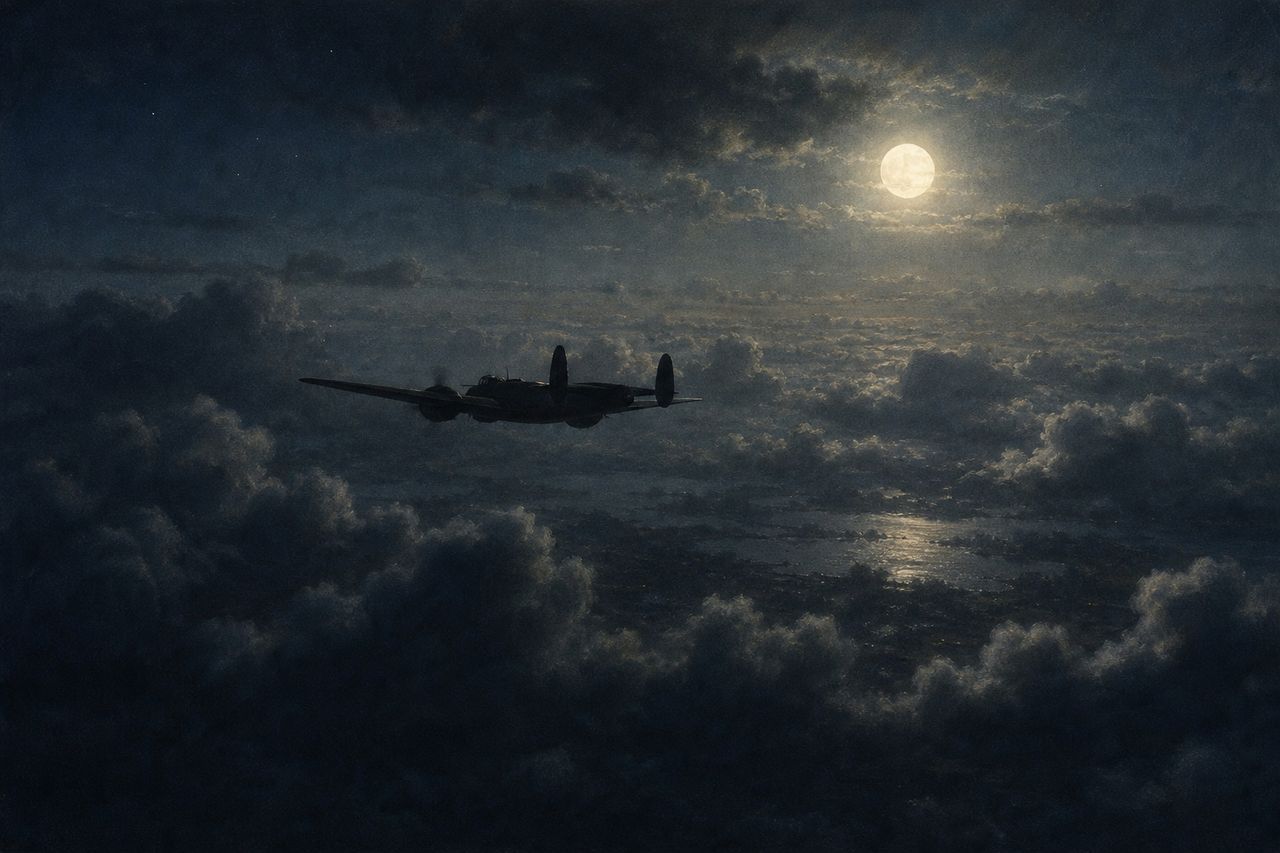
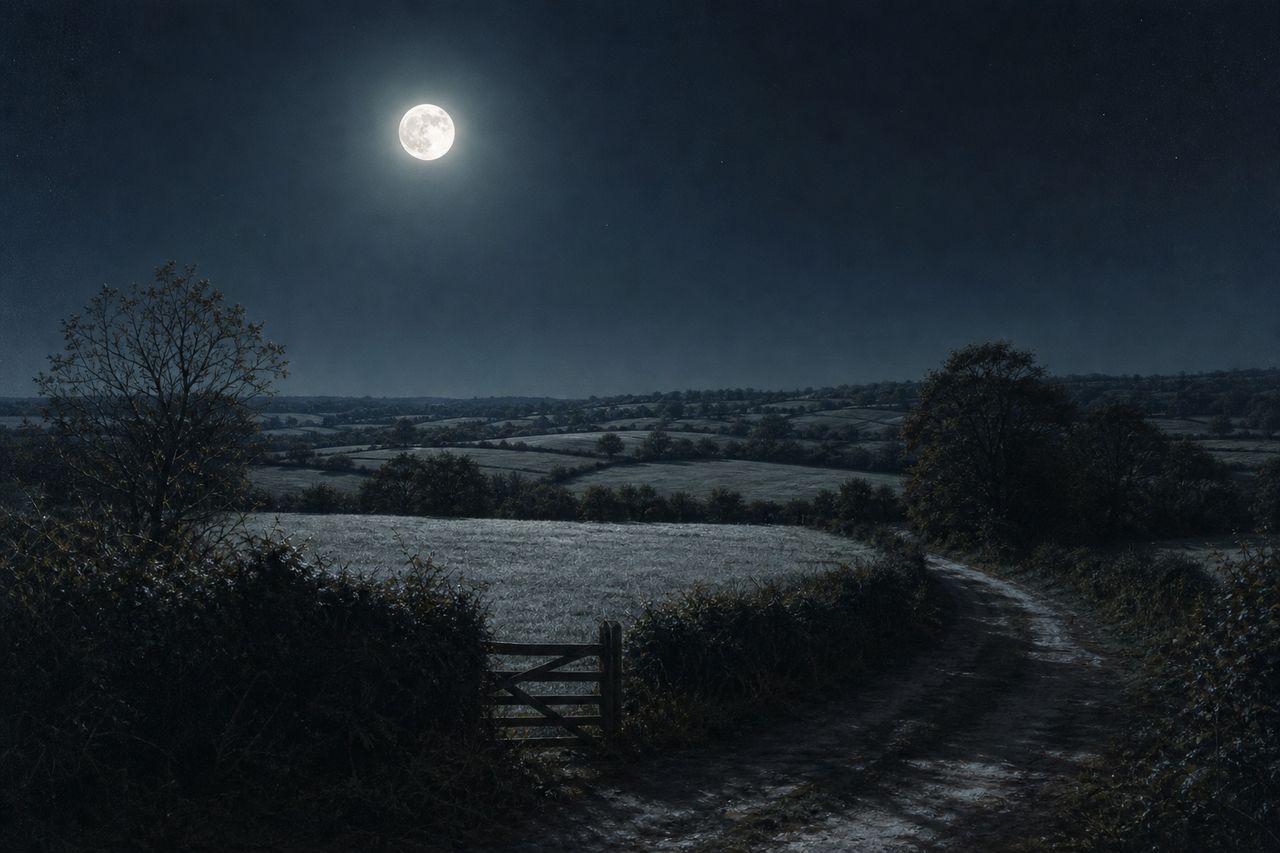
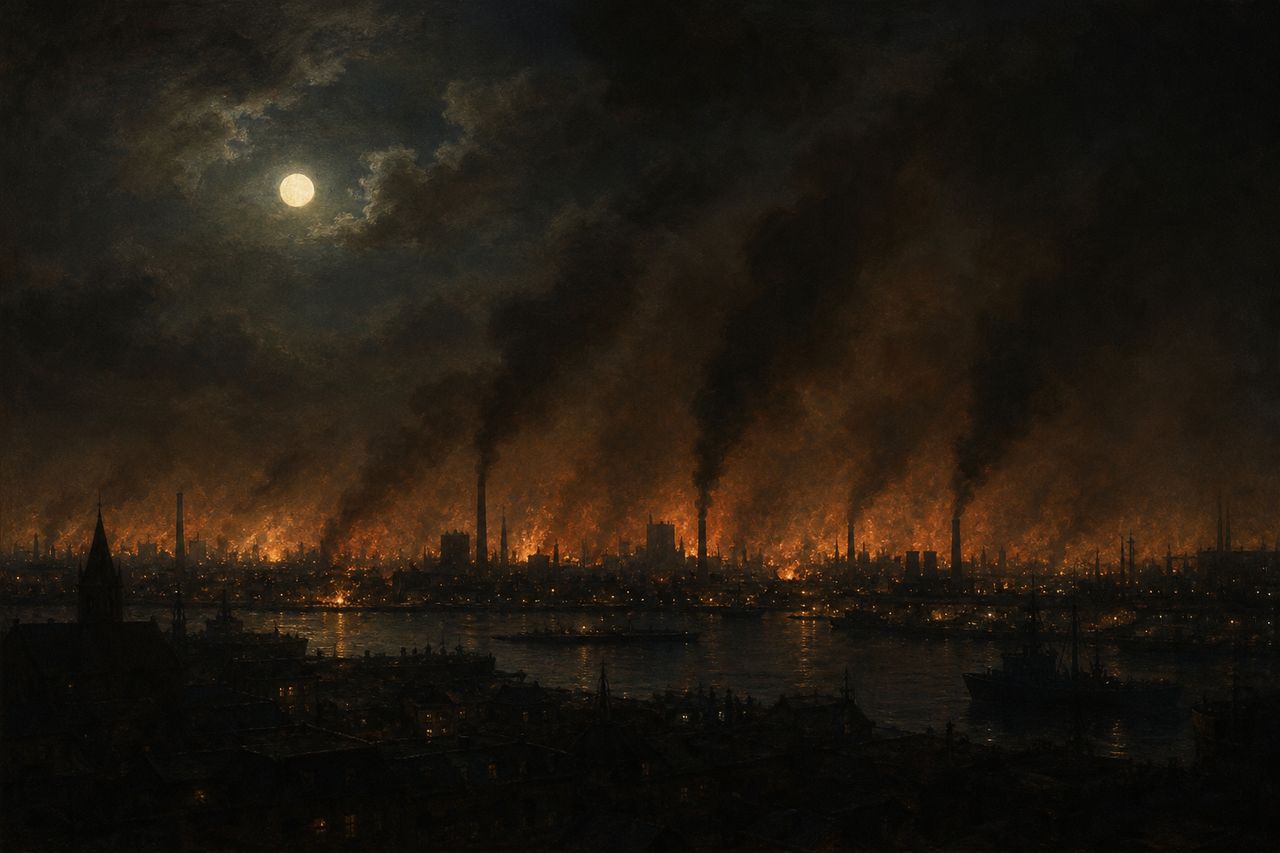
On the night of 14 November 1940, under a bright full moon, hundreds of German bombers flew to Coventry, a city of factories in the middle of England.
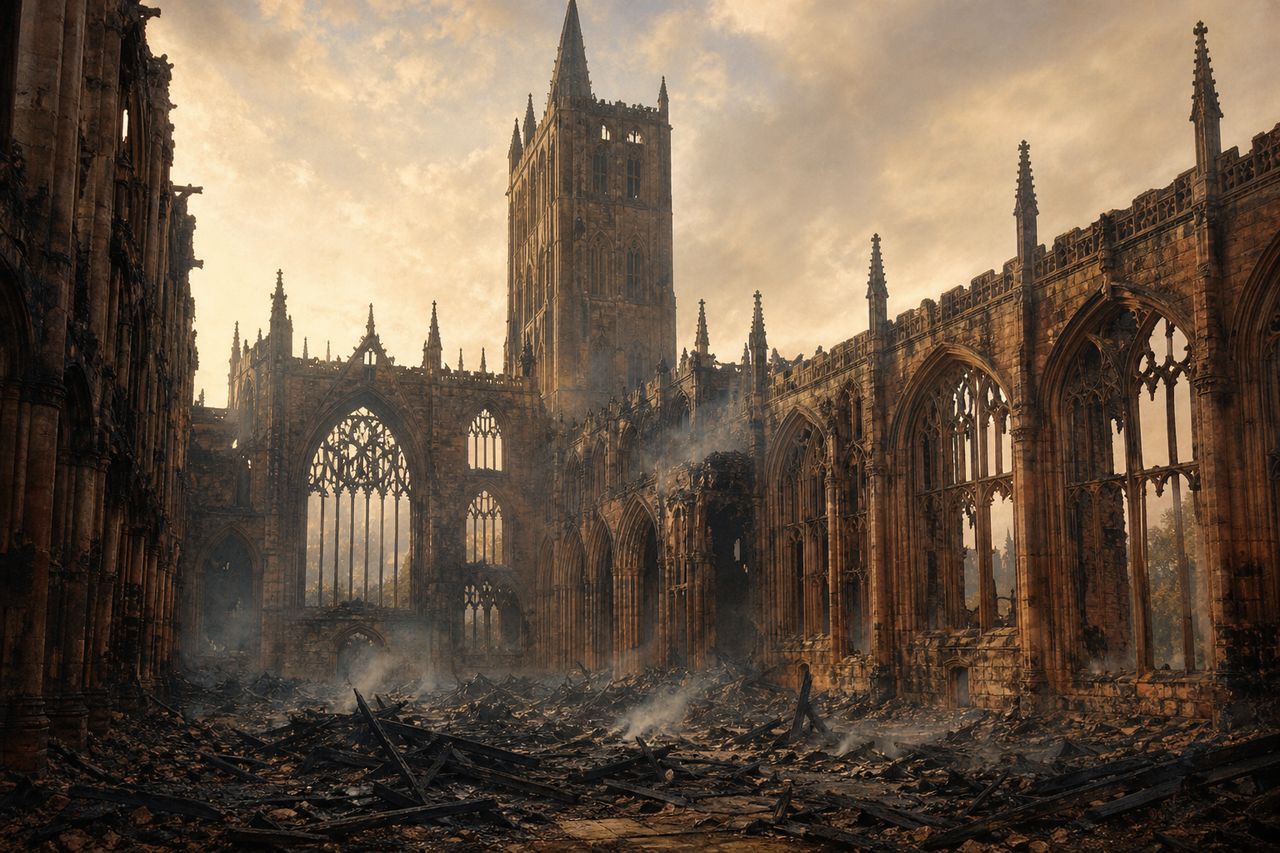
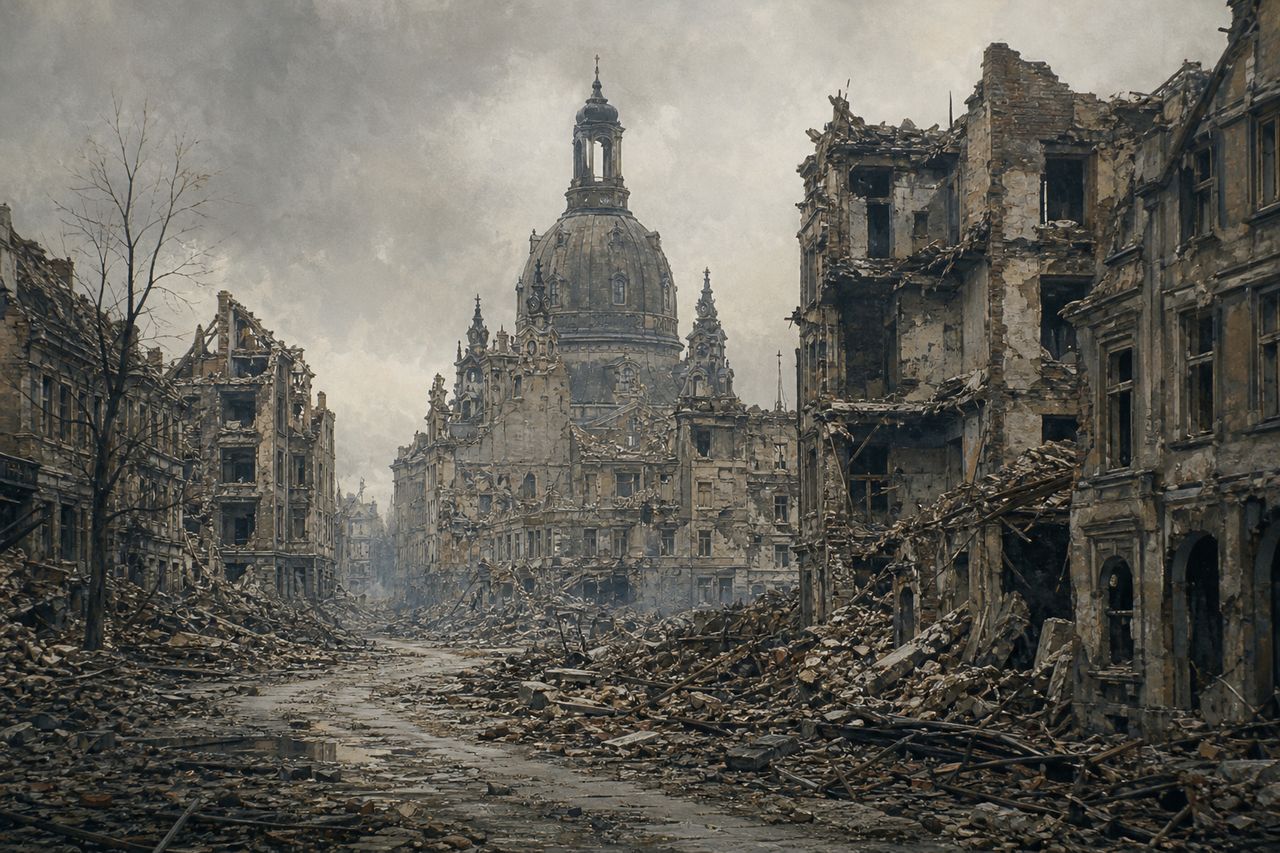
By dawn its old centre had burned, and its medieval cathedral was a shell. It was one night in the bombing campaign the British called the Blitz.
A bombers’ moon Every window dark, every roof silver: a full moon lit the ground for the crews above. AI-generated illustration.
11 hours
length of the raid, per Coventry City Council
554–568
people killed: the official toll, and the figure of GCHQ, Britain’s intelligence and cyber agency
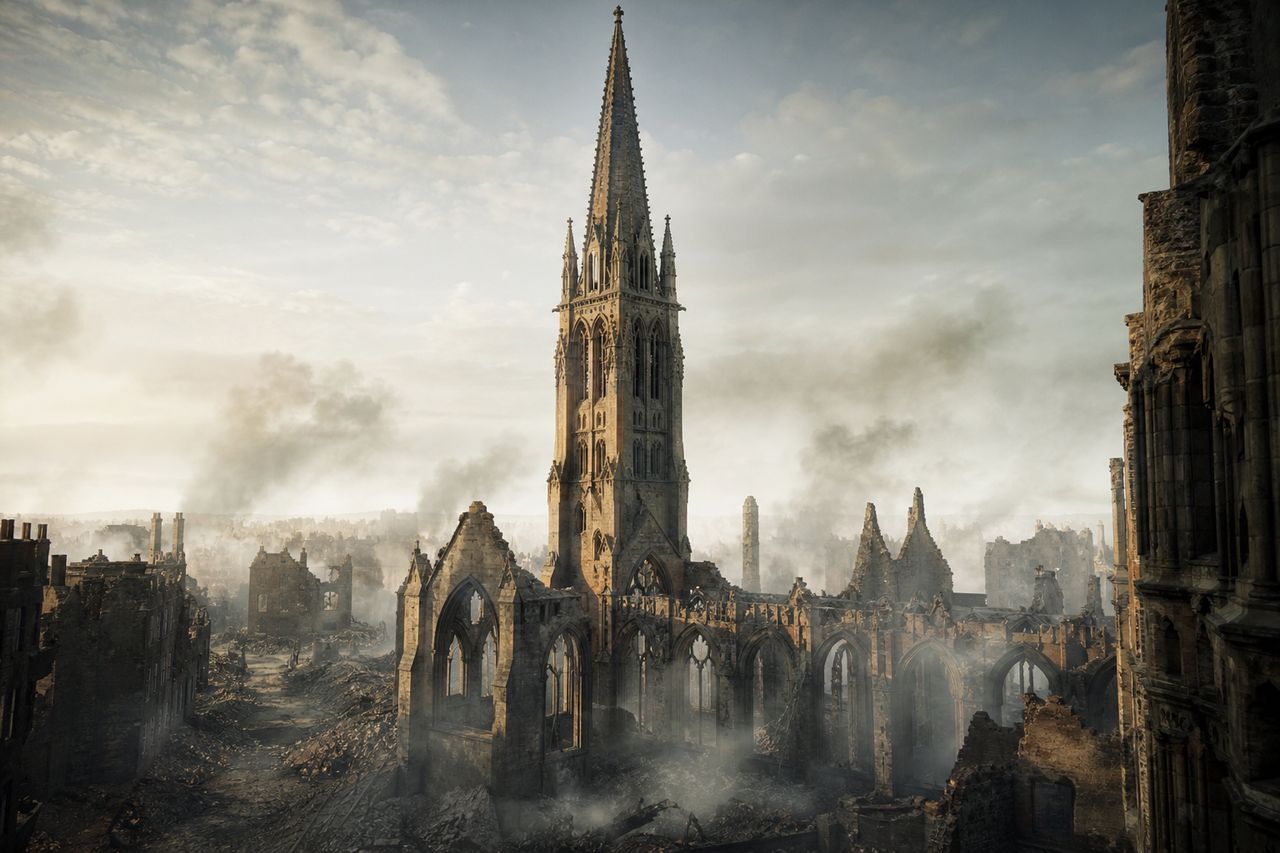
Coventry, 14–15 November 1940St Michael’s spire The cathedral’s spire, about 500 years old in 1940, survived the night; the roof below it did not. AI-generated illustration.
Prologue
The anniversary
GCHQ (2021): on 14–15 November 1940 Coventry, “an important engineering and armament production centre in the Midlands”, was attacked by a wave of Luftwaffe bombers; almost a third of the city was flattened, 568 people were killed and the medieval cathedral was hit. Coventry City Council: the raid, codenamed Moonlight Sonata, lasted 11 hours and was the most concentrated attack on a British city in the war; the official death toll was 554, though the true figure may have been higher. Imperial War Museums: the raid destroyed the 600-year-old St Michael’s Cathedral.
Figures for this raid differ between sources, so each is given with its source. The film describes events and mechanisms, not injuries.
The 3D scenes are simplified teaching models: the maps, beams, city and shelters are schematic and not to scale.
The Blitz grew out of a battle Germany lost. In summer 1940, after France fell, the Luftwaffe, Germany’s air force, tried to destroy the Royal Air Force by day, as a first step towards invasion.
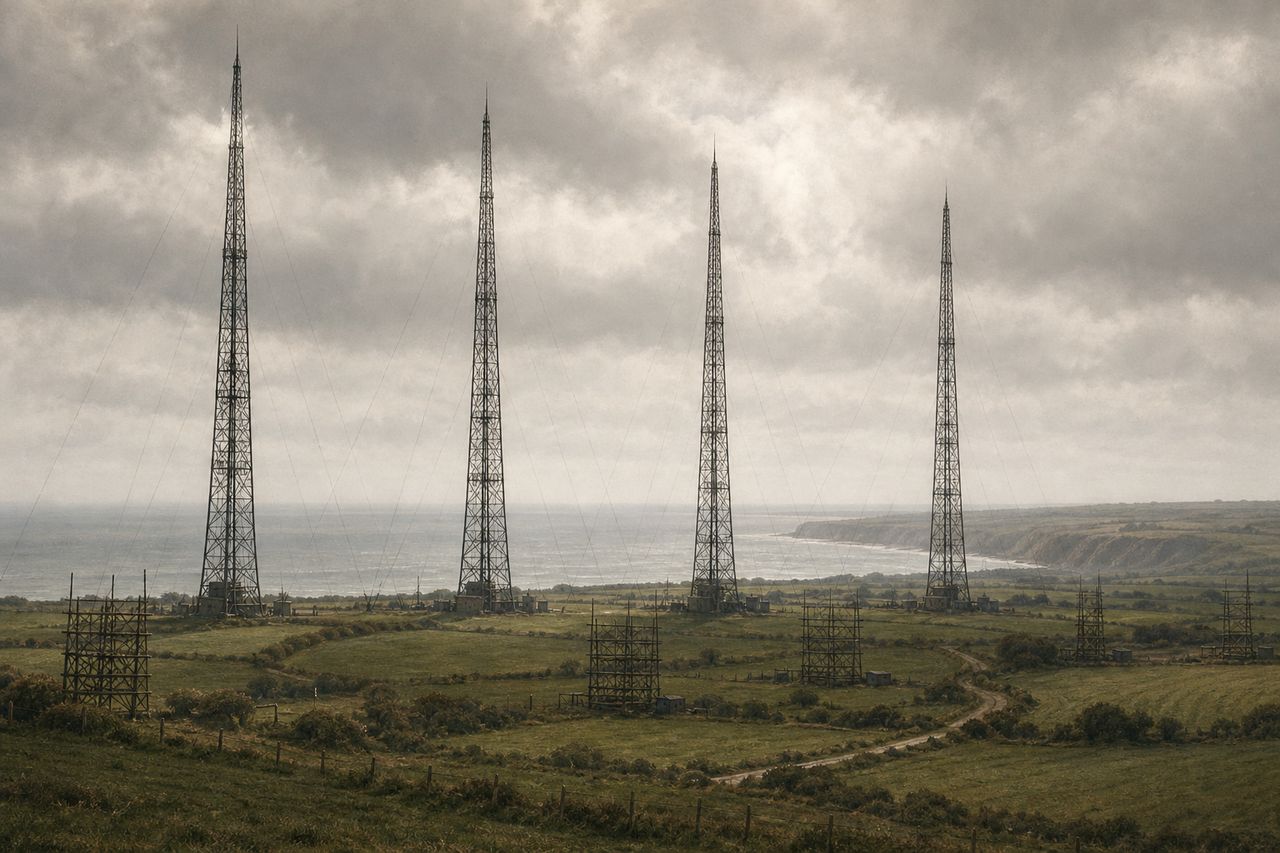
Britain had an advantage: a chain of radar stations on its coasts, called Chain Home. They sent out radio pulses and caught the echoes from aircraft up to about a hundred and thirty kilometres away.
Inland, volunteers of the Observer Corps tracked the raiders by eye and ear, and fighters were sent to meet them.
By day, the system worked. Switch to night: the radar still watches the sea, but inland the watchers are blind.
Chain Home Tall steel masts carried the transmitting aerials; shorter towers beside them held the receivers. AI-generated illustration.
~130 km
Chain Home detection range (80 miles)
20 min
for a raid to reach its target once detected
RAF figures, Battle of Britain
~30,000
volunteers watching and listening inland
The Observer Corps (RAF)The plotting table Radar and observer reports became markers on a map, pushed into place as each raid moved. AI-generated illustration.
Chapter I · From day to night
The Battle of Britain and radar
Historic England: the air battle was waged from 10 July to 31 October 1940. Britannica: Hitler ordered an invasion plan on 16 July 1940, and Göring’s directive of 2 August called for the destruction of British air power first. Royal Air Force: Chain Home radar could detect approaching aircraft up to 80 miles away; about 30,000 Observer Corps volunteers manned about 1,000 posts; a raid took about 20 minutes to reach its target after detection; at the height of the battle the RAF had 749 fighters against 2,550 Luftwaffe aircraft. RAF Benevolent Fund: Chain Home stood along the south and east coasts and fed its reports to the Filter Room at Bentley Priory.
The Day and Night buttons show where the system could and could not see. Station positions and coverage on the map are approximate.
The 3D scenes are simplified teaching models: the maps, beams, city and shelters are schematic and not to scale.
In daylight, German bombers were easy prey for Spitfires and Hurricanes. By late August Germany had lost more than six hundred aircraft, Britain about two hundred and sixty.
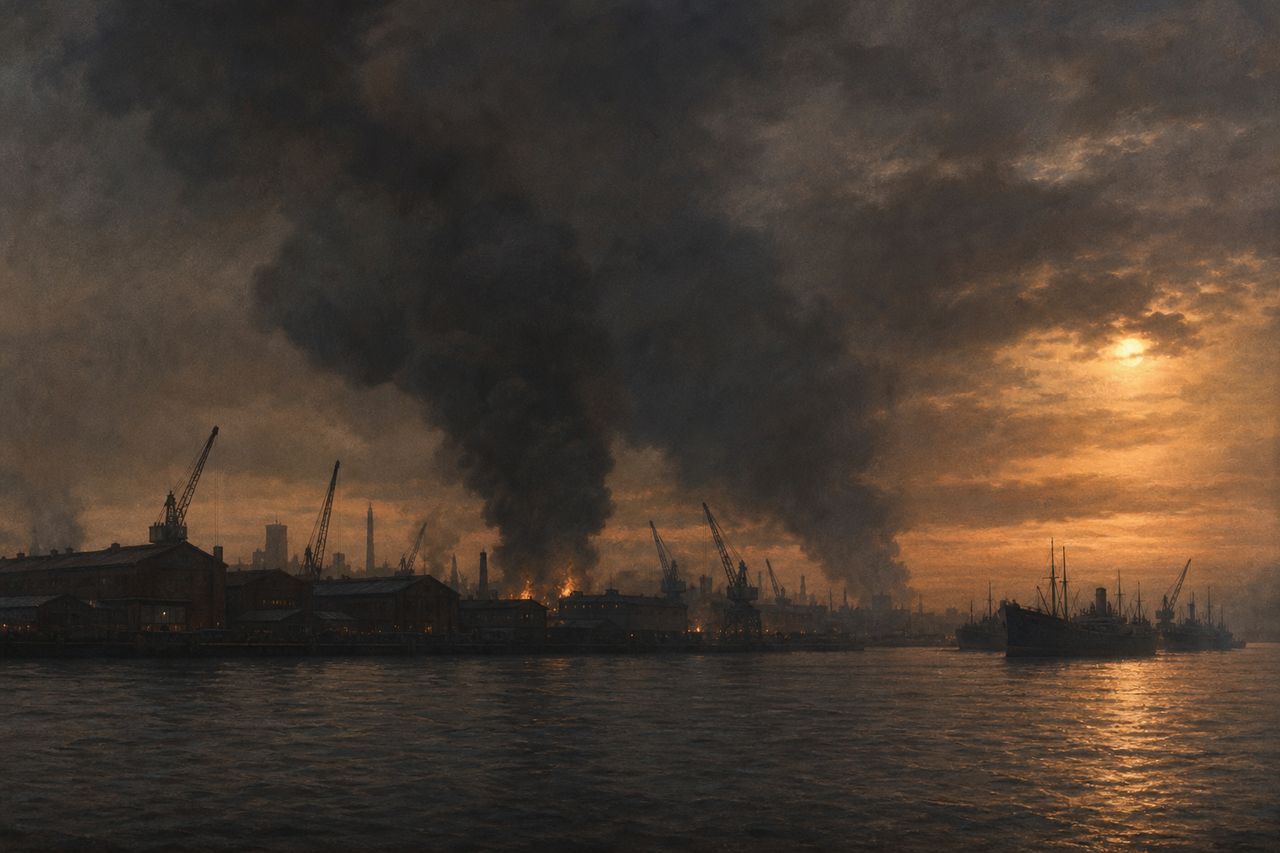
On 7 September 1940, believing the RAF nearly beaten, Germany turned its bombers on London’s docks. According to the London Museum, that raid killed 430 people, and London was then bombed for fifty-seven nights in a row.
More and more, the raids came after dark, when bombers were far harder to find.
The docks Warehouses along the river were the first target of the London Blitz; their smoke guided later waves. AI-generated illustration.
Luftwaffe
600+
RAF
260
Aircraft lost, 8 August to late August 1940
430
killed in the first raid on the docks; 1,600 injured
57
nights of bombing in a row
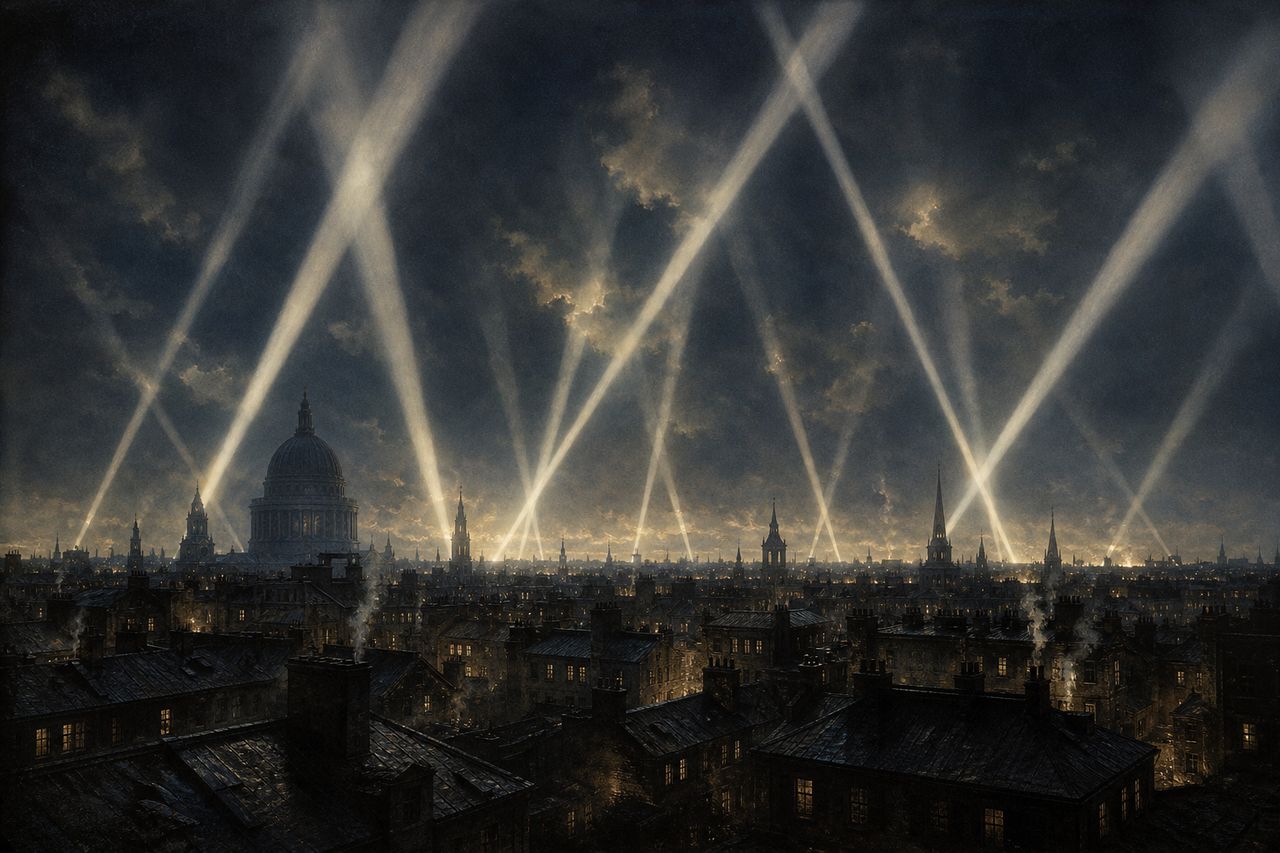
London, from 7 September 1940 (London Museum)Searching the sky Searchlights could pick out a bomber only by luck in 1940; most of the beams found empty sky. AI-generated illustration.
Chapter I · From day to night
From day to night
Britannica: German bombers proved “easily vulnerable to the Spitfires and Hurricanes”; by late August the Luftwaffe had lost more than 600 aircraft and the RAF 260; after a British raid on Berlin, Hitler ordered attacks shifted to London and other cities; daylight raids gave way to night raids, which Britain found hard to counter for lack of effective guns, searchlights and night fighters. London Museum: the raid of 7 September 1940 on the east London docks killed 430 people and injured 1,600, and London was then bombed for 57 nights in a row. Britannica dates the Blitz from 7 September 1940 to 11 May 1941. The Blitz (Wikipedia): German intelligence suggested that Fighter Command was weakening, and an attack on London was expected to force it into a final battle; Hitler and Göring ordered the new policy on 6 September 1940.
Blitz comes from the German Blitzkrieg, “lightning war”. Britannica gives 76 consecutive nights for London; the London Museum gives 57. The film uses the London Museum’s figure.
The 3D scenes are simplified teaching models: the maps, beams, city and shelters are schematic and not to scale.
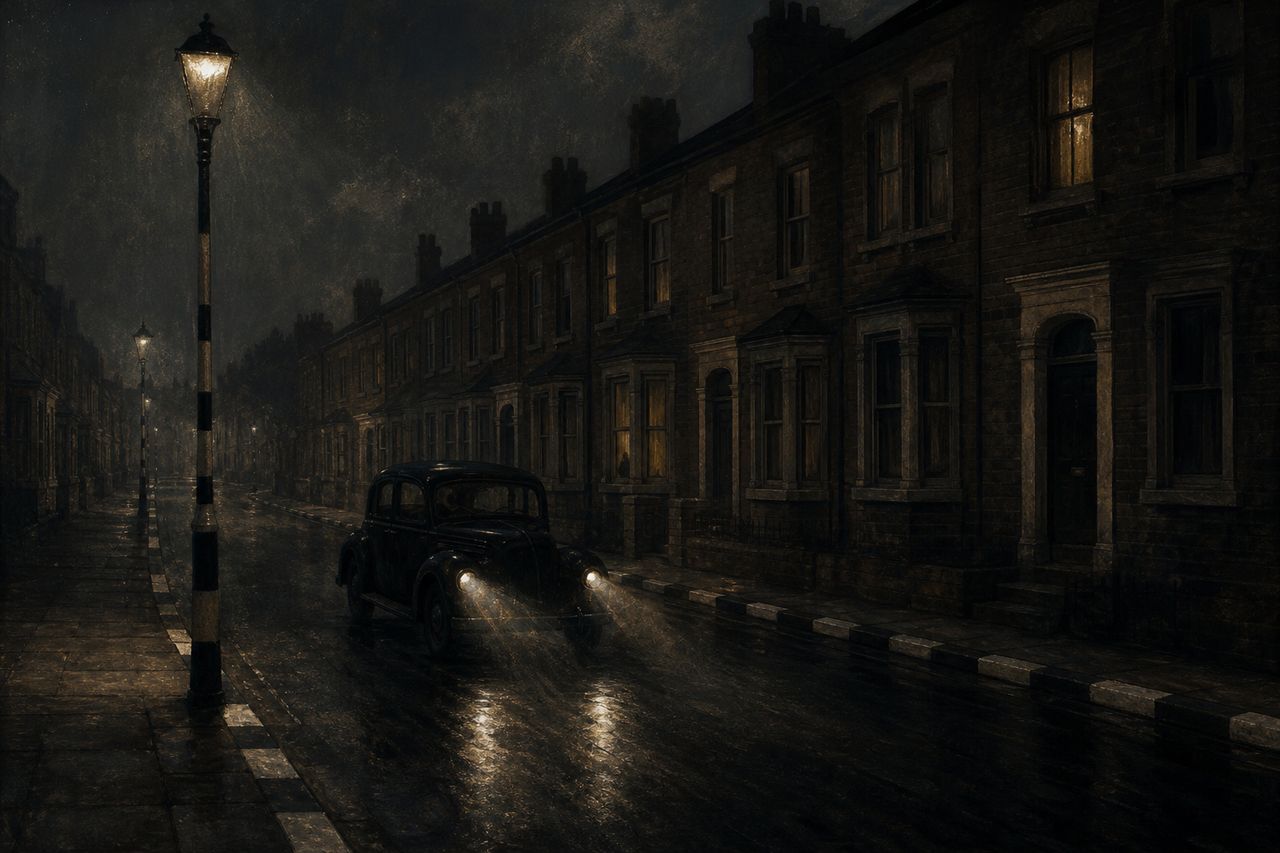
On the ground, the first defence was darkness. From 1 September 1939, the day the evacuation of city children began and two days before Britain declared war, every window had to be covered at night, and street lights were switched off or shaded.
Air Raid Precautions wardens patrolled the streets, and showing a light could bring a fine.
Darkness had a cost: 1,130 people died on Britain’s roads in September 1939, about twice as many as a year before.
Blackout curtains Heavy curtains, card or paint: whatever kept a single bulb from showing outside. AI-generated illustration.A blacked-out street White stripes on kerbs and lamp posts helped walkers and drivers in streets with no lights. AI-generated illustration.
1938
544
1939, first month of the blackout
1,130
Road deaths in Britain in September (IWM)
Chapter II · Life under the bombs
The blackout
Imperial War Museums: the blackout began on 1 September 1939, two days before war was declared; road deaths in September 1939 were 1,130, against 544 in September 1938; the blackout was relaxed into a “dim-out” in September 1944. Blackout (wartime), Wikipedia: windows and doors were covered with heavy curtains, card or paint; street lights were switched off or shaded downwards; headlights had slotted covers; Air Raid Precautions wardens enforced the rules. London Museum: blackouts were enforced so bombers could not navigate by a city’s glow, and an uncovered window could bring a fine. The National Archives: Operation Pied Piper, the evacuation of children and others from the cities, began on 1 September 1939.
Press the buttons to turn the city’s lights on and off. Against moonlight and radio beams, the blackout could not hide a city completely; it made the bombers’ work harder.
The 3D scenes are simplified teaching models: the maps, beams, city and shelters are schematic and not to scale.
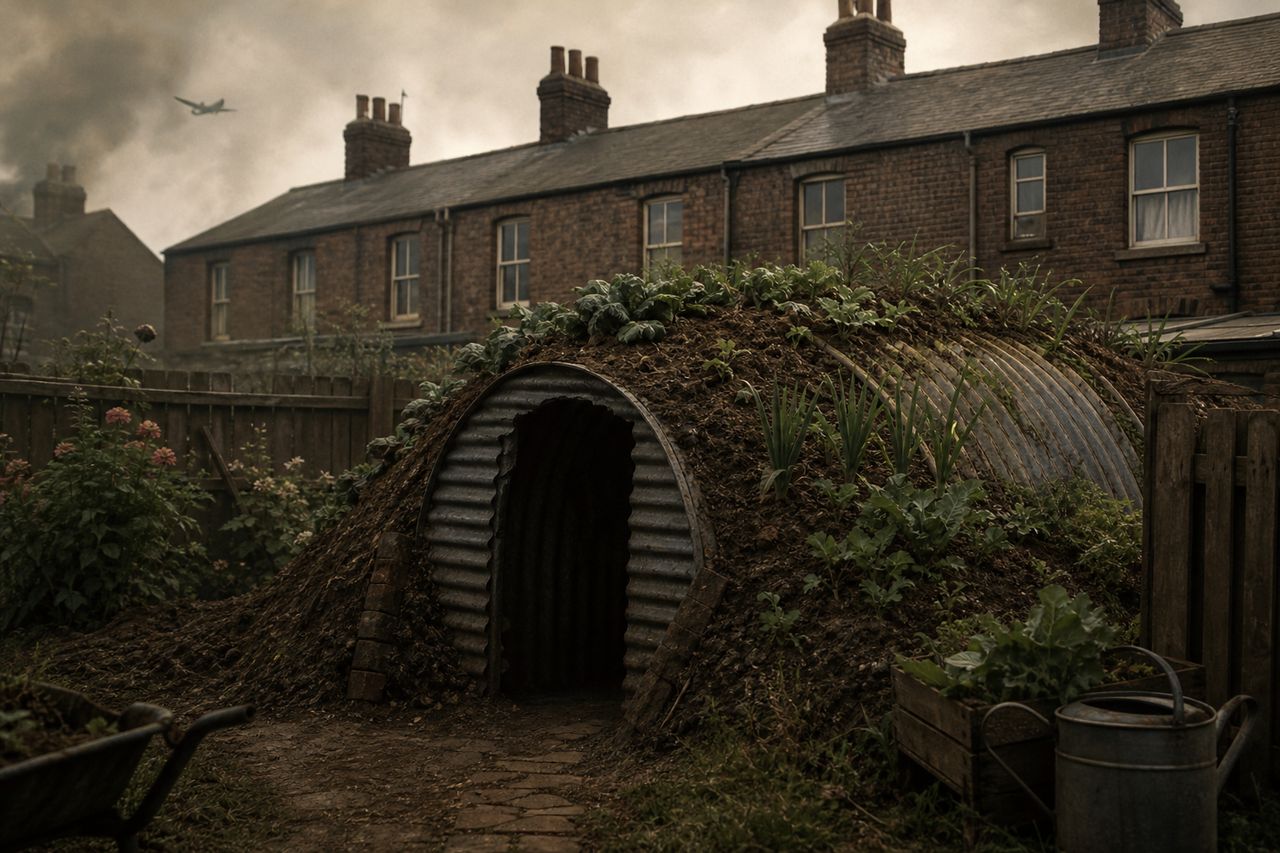
When the sirens sounded, families took shelter. In gardens stood Anderson shelters: curved sheets of corrugated steel, sunk about a metre into the ground and covered with earth, for up to six people.
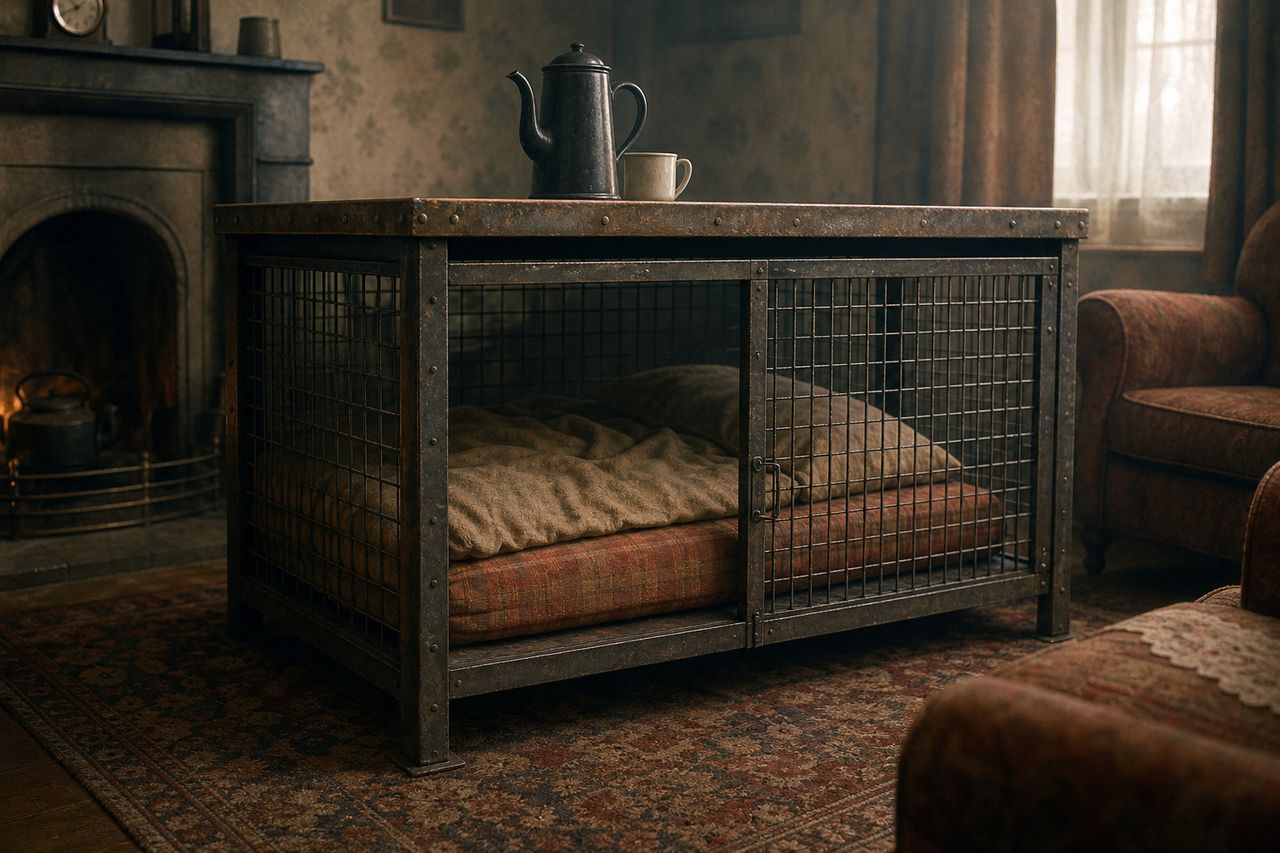
In 1941 came the Morrison shelter, a steel cage the size of a table, built to protect a family indoors if the house came down.
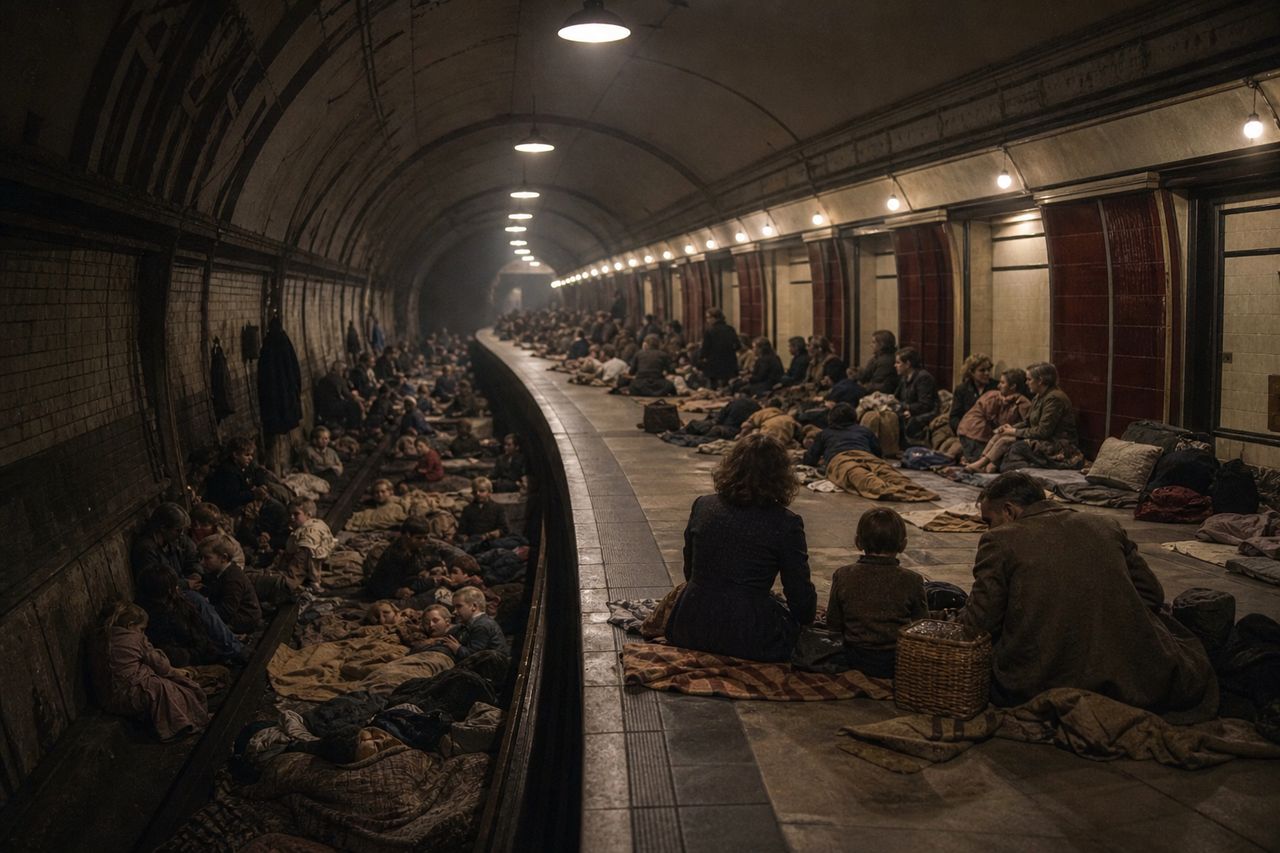
In London, people went down into the Underground. Within weeks, about a hundred and twenty thousand a night slept in the stations.
An Anderson shelter Earth piled on top absorbed blast and splinters; many families grew vegetables on it. AI-generated illustration.
6 ft 6 in × 4 ft 6 in
floor, per the National Archives
~1.5 million
built before September 1939
£7
price, or free for households earning under £250 a year
Anderson shelter, by the numbersA Morrison shelter By day it was the family table; at night the mattress went inside the steel mesh. AI-generated illustration.The Underground Most Londoners did not use the Tube: many more sheltered at home, in public shelters, basements and crypts. AI-generated illustration.
Chapter II · Life under the bombs
Shelters
The National Archives: the Anderson shelter was made of galvanised corrugated steel sheets, 6 ft 6 in long, 4 ft 6 in wide and 6 ft high, sunk about 3 ft into the ground with about 2 ft of earth on top, for four to six people. History Hit: about 1.5 million were built before the war began; they were free for households earning under £250 a year, and cost £7 for others; the indoor Morrison shelter followed in 1941. Hansard (11 February 1941): Home Secretary Herbert Morrison announced an indoor shelter for the ground floor of a house, to protect its occupants if the house came down, and raised the income limit for free Anderson shelters from £250 to £350. London Museum: within weeks of the Blitz starting, about 120,000 people a night used Tube stations; many more sheltered elsewhere. Britannica: the Underground was opened as a shelter only reluctantly.
Use the buttons to look inside each shelter.
The 3D scenes are simplified teaching models: the maps, beams, city and shelters are schematic and not to scale.
Why was the dark such a shield? Radar reports went to a plotting room and then on by telephone, and while they travelled, the bomber flew on. By the time a fighter heard, its target could be anywhere within about eight kilometres.
But at night an aircraft could be seen from only about three hundred metres. Early airborne radar sets were unreliable, and the fighters carrying them were too slow.
In September 1940 the Luftwaffe flew more than six thousand night sorties and lost only four aircraft in combat.
From the winter of 1940–41, new ground radars watched over land and guided Beaufighters that carried their own radar.
Watching by ear On a cloudy night an observer post could often only hear the engines and guess the course. AI-generated illustration.
~8 km
uncertainty in a relayed radar plot
~300 m
how far an aircraft could be seen at night
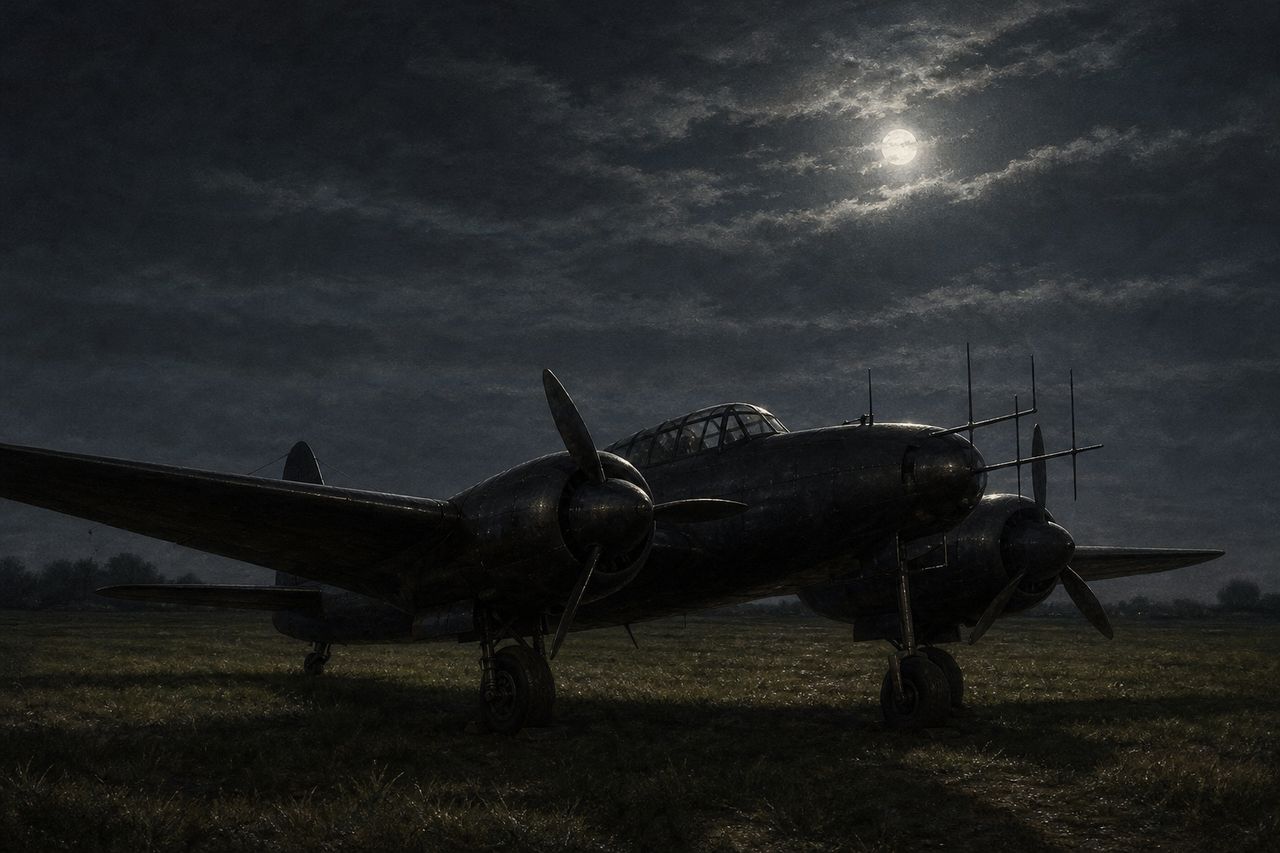
What a night fighter had to work with, 1940A radar night fighter Aerials on the nose and wings belonged to the AI radar: its operator sat behind the pilot. AI-generated illustration.
January
3 aircraft
February
4 aircraft
March
22 aircraft
April
48 aircraft
May
96 aircraft
Night raiders shot down by RAF night defences, 1941
Chapter III · The blind hunt
The night-fighter problem
AI Mark IV radar (Wikipedia, citing the official and technical histories): Chain Home was accurate to about 1 km at best, and relayed reports placed a target no better than about 5 miles (8 km); observers could see aircraft at night only to about 1,000 ft (300 m), perhaps 2,000 ft in the best moonlight; early radar sets were unreliable and the Blenheim was too slow; in September 1940 the Luftwaffe flew 6,135 night sorties and lost four aircraft in combat; interception rates rose from about 0.5% in December 1940 to 7% by May 1941 after ground-controlled interception radar arrived; reports were plotted centrally and then telephoned on, and the target moved while this took time; the first ground-controlled interception radar went operational on 1 January 1941; RAF night defences shot down 3, 4, 22, 48 and 96 aircraft from January to May 1941, and 37 of May’s kills were by radar-equipped Beaufighters or Havocs. GCHQ: on the night of the Coventry raid, 121 fighter sorties sighted 11 of 330 enemy aircraft, engaged two and damaged one.
Press Search: the fighter sweeps the circle where the bomber might be, but it can only see a few hundred metres. Press Ground radar, 1941: a controller who sees both aircraft steers it close enough for its own radar.
The 3D scenes are simplified teaching models: the maps, beams, city and shelters are schematic and not to scale.
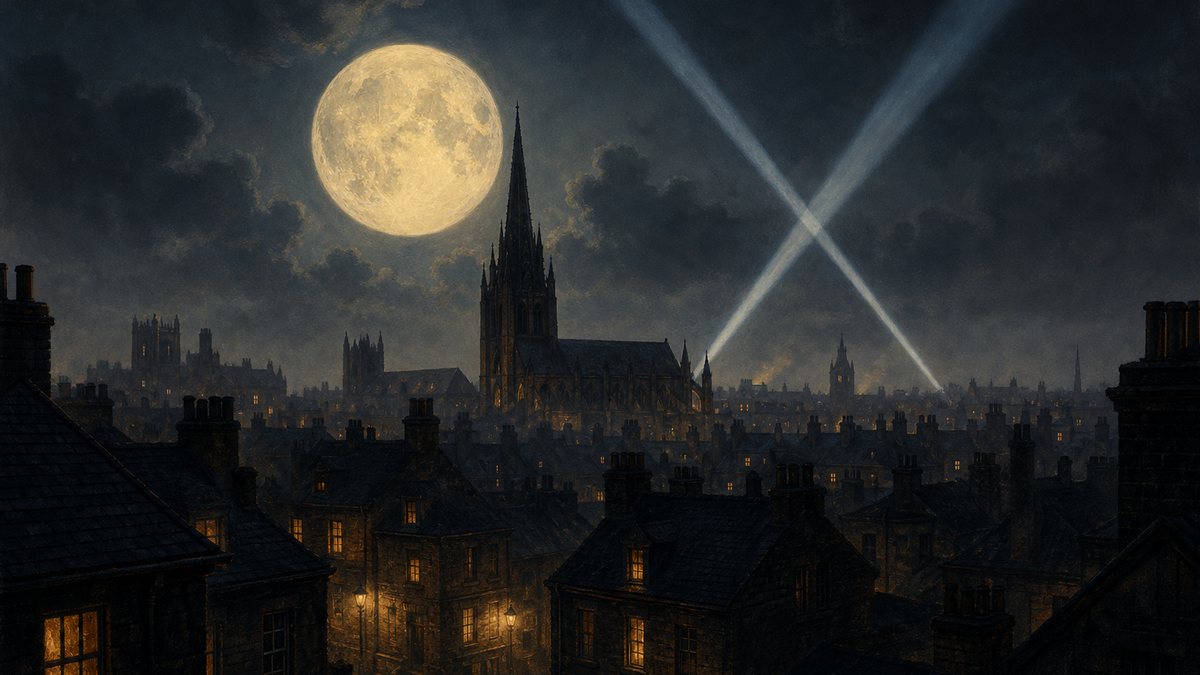
Over a blacked-out country, how could a bomber crew find a city? Germany’s answer was radio beams.
A transmitter sent two overlapping signals, dots on one side and dashes on the other. Where they met, the pilot heard one steady tone and knew he was on course. This was Knickebein.
A second beam from another station crossed the first over the target. When the crew heard it, they released their bombs.
In June 1940, after a young scientist, R. V. Jones, pieced the clues together, a British flight found two beams crossing over the Rolls-Royce factory at Derby.
Britain answered with jammers nicknamed Aspirin, which sent false dots into the beam. Try it.
Above the clouds With cloud below and the ground blacked out, a crew could fly for hours without seeing a landmark. AI-generated illustration.
dots: drifted too far to one side
dashes: drifted to the other side
a steady tone: on the beam
second tone: over the target
What the pilot heard
30–33 MHz
frequency band of the beams
~500 yd (~450 m)
width of one beam the RAF found
Knickebein, 1940Listening for the beam The British search flight used an ordinary receiver: the beam it found was on 31.5 megahertz. AI-generated illustration.
Aspirin: false signals mimicking the beam
Bromide: a stronger version
Meacons: German beacons picked up and rebroadcast
British countermeasures (HistoryNet)
Chapter IV · The Battle of the Beams
Knickebein and Aspirin
Battle of the Beams (Wikipedia): Knickebein was based on the Lorenz landing beam, with much larger aerials; two transmitters’ beams crossed over the target, and bombers flew along one and released their bombs on hearing the steady tone of the second; the Lorenz system worked on 30–33 MHz, and the beam a British flight found was on 31.5 MHz; that flight found the Kleve beam and the Stollberg cross-beam intersecting over the Rolls-Royce factory at Derby; British countermeasures, code-named Aspirin, broadcast false “dot” signals. HistoryNet: in June 1940 R. V. Jones linked a decrypted message to a German transmitter at Kleve; one beam the RAF found was about 500 yards wide; the Aspirin transmitters mimicked the beam signal, and “Meacons” rebroadcast German navigation beacons to confuse crews.
Press Jam the beam: false dots blur the steady tone, the crew can no longer hold the line, and the crossing point drifts away from the target. On the map, beam widths are exaggerated.
The 3D scenes are simplified teaching models: the maps, beams, city and shelters are schematic and not to scale.
Germany had a sharper tool, X-Gerät, flown by a specialist unit, Kampfgruppe 100. Its main beam had three cross-beams laid across it before the target.
The first cross-beam was a warning. Crossing the second started a clock, and crossing the third stopped it. From that time, the clock worked out when to drop, and released the bombs itself.
These pathfinders flew ahead and dropped incendiaries and flares, so the crews behind them could aim at the fires.
v=t2→3d2→3trelease=vd3→target
v
ground speed
d
known distance between beams
t
time measured by the clock
What the stop-clock computed Bomb fall and height were also allowed for; the formula shows only the idea.Marking the target Parachute flares hung over the target for minutes, lighting cloud tops for the following waves. AI-generated illustration.British jammers Britain’s first jammers against the beams were adapted hospital diathermy sets, used to heat body tissue. AI-generated illustration.
Chapter IV · The Battle of the Beams
X-Gerät
Battle of the Beams (Wikipedia): X-Gerät’s main Weser beam worked at about 60 MHz; the Rhine, Oder and Elbe cross-beams defined the release point; a stop-clock timed the run between two cross-beams and released the bombs automatically when it reached zero; it was flown by the pathfinders of Kampfgruppe 100, who dropped flares for other aircraft to bomb visually; the first British jammers were modified medical diathermy sets. GCHQ: on the night of the Coventry raid the pathfinders of KG100 dropped incendiaries, and the fires could be seen from hundreds of miles away.
Press Fly the run to follow one bomber along the main beam and watch the clock. The distances between the beams are drawn for clarity, not to scale.
The 3D scenes are simplified teaching models: the maps, beams, city and shelters are schematic and not to scale.
In November 1940, according to GCHQ, Britain’s intelligence and cyber agency, codebreakers read a German message about an operation called Moonlight Sonata, probably for the full moon. A prisoner spoke of a heavy raid on Coventry and Birmingham.
But other clues pointed to London, and on the day of the raid the RAF’s senior commanders, the Air Staff, still thought London the likeliest target.
On the afternoon of 14 November the X-Gerät beams switched on. By three o’clock, British aircraft had found them crossing over Coventry.
Jammers were switched on, and made no difference. One likely reason: the beam’s signal carried an audio tone, a pitch, separate from its radio frequency. The British had measured that tone at fifteen hundred hertz; it was really two thousand. Try both.
And on such a bright, cloudless night, GCHQ notes, the pathfinders hardly needed beams at all.
Reading the enemy’s messages Decrypted messages arrived as slips of paper: fragments that analysts had to piece together. AI-generated illustration.
15–20 Nov
raid window a prisoner gave: Coventry, Birmingham
London
targets on a captured map
Two clues that disagreed (GCHQ)
11 Nov Enigma (German cipher machine) decrypt names Moonlight Sonata
12 Nov prisoner: Coventry and Birmingham; a captured map: London
14 Nov, morning Air Staff (RAF senior command): targets probably in or near London
14 Nov, 15:00 beams found crossing over Coventry
The intelligence, per GCHQ
1,500 Hz
tone the British jammers sent
2,000 Hz
tone the German receivers listened for
The jamming error: an audio tone, not a radio frequency (Battle of the Beams)A cloudless night Under the full moon of 14 November, fields, roads and rivers could be seen from the air. AI-generated illustration.
Chapter V · Moonlight Sonata
What Britain knew
GCHQ: on 11 November 1940 an Enigma decrypt revealed an operation codenamed Moonlight Sonata, probably for the next full moon; on 12 November a prisoner of war spoke of a heavy raid on Coventry and Birmingham between 15 and 20 November, while a captured map suggested targets in London and the south-east; an Enigma message gave X-Gerät bearings over Wolverhampton, Birmingham and Coventry, but similar messages had often been practice runs; on 14 November the Air Staff warned the Prime Minister that the targets were probably in or near London; beam transmissions began at 13:00 and by 15:00 airborne search had established that they crossed over Coventry; jammers were switched on but made no difference, perhaps because of the wrong modulating frequency, or because the bright, cloudless night made navigation simple. Battle of the Beams (Wikipedia): the British had measured the X-Gerät modulation as 1,500 Hz; it was actually 2,000 Hz; the jammers were corrected in time to disrupt the raid on Birmingham of 19 November 1940.
Press the two jammer buttons: at 1,500 Hz the German receivers do not hear the jamming and the bomber stays on the beam; at 2,000 Hz the beam is disrupted, as at Birmingham five nights later. Beam positions are schematic.
The 3D scenes are simplified teaching models: the maps, beams, city and shelters are schematic and not to scale.
At about twenty past seven in the evening, the pathfinders began to mark the city. Wave after wave followed through the night.
Coventry City Council records about five hundred tonnes of high explosive, thirty thousand incendiary bombs and fifty parachute mines.
The two kinds worked together. Incendiaries were small fire bombs, about a kilogram each, that started fires wherever they fell. High explosive broke roofs open so the fires could spread, and burst the water mains that firefighters needed.
The raid peaked around midnight. Compare the two kinds of bomb in the model.
Seen from far away GCHQ records that the fires could be seen from hundreds of miles away. AI-generated illustration.
~500 t
high explosive
30,000
incendiary bombs
50
parachute mines
Dropped on Coventry (Coventry City Council)Against the fire bombs Sand and a jet of water could deal with one small fire bomb, if someone reached it before the fire took hold. AI-generated illustration.
Incendiaries only: many small fires, most can still be put out
Add high explosive: roofs open, water cut, the fires join up
What the model shows (schematic)
Chapter V · Moonlight Sonata
The raid
Coventry Blitz (Wikipedia): the first marker flares fell at about 19:20 on 14 November, the raid peaked around midnight and the all-clear sounded at 06:15 on 15 November; high explosive and large air-mines were meant to break roofs so that incendiaries could set buildings alight; high explosive broke the water mains, cratered roads slowed fire engines and the telephone network was crippled. Coventry City Council: the Luftwaffe dropped 500 tons of high explosive, 30,000 incendiaries and 50 landmines, and the raid lasted 11 hours. US War Department, Tactical and Technical Trends (1942): the usual German incendiary weighed 1 kilogram (2.2 lb). Sources give different totals for the bombs and the bombers; the council speaks of nearly 500 bombers.
In the model, Incendiaries only starts many small fires that can still be fought; Add high explosive opens roofs and cuts the water, and the fires join up. This is a schematic of the mechanism, not a simulation of Coventry.
The 3D scenes are simplified teaching models: the maps, beams, city and shelters are schematic and not to scale.
By the next morning, St Michael’s Cathedral had burned out; only its outer walls, its tower and its spire still stood.
Coventry City Council gives an official toll of 554 dead; GCHQ gives 568. Over half the city’s homes were damaged or destroyed.
Many factories were back at full production within months, because much war work had already been spread to shadow factories, extra plants the government had helped to set up before the war.
A story later spread that Churchill let Coventry burn to protect the codebreakers’ secret. GCHQ calls it a myth: the warnings were unclear, and the target was confirmed only hours before.
St Michael’s, the next day The cathedral’s outer walls and window tracery survived the fire; the roof and everything inside did not. AI-generated illustration.
554
killed: official toll (Coventry City Council)
568
killed: GCHQ’s figure
43,000+
homes damaged or destroyed
Coventry, 14–15 November 1940The tower still stands Demolition crews had to be stopped from pulling the tower down: it had leaned for at least a century. AI-generated illustration.
“There have been historical anecdotes (and a widely spread myth) that the city of Coventry was sacrificed to protect the Bletchley Park work on the German Enigma as a source.”GCHQ, The bombing of Coventry in WWII (2021)
Chapter V · Moonlight Sonata
The morning after
Historic England: the cathedral suffered a firestorm and was left a shell, with only the tower and spire standing. Coventry City Council: the official death toll was 554, but the true figure may have been higher because many people were unaccounted for; more than 43,000 homes, just over half the city’s housing, were damaged or destroyed; demolition crews had to be stopped from pulling down the tower, which had leaned for at least 100 years. GCHQ gives 568 killed. Coventry Blitz (Wikipedia): much war production had already moved to shadow factories, and many damaged plants were back at full production within months. Shadow factory (Wikipedia): the Shadow Scheme, devised in 1935, was a British government plan to meet the urgent need for more aircraft with the help of the motor industry, which the government funded with grants and loans; by February 1940 eight shadow factories making aircraft parts were working in or near Coventry. GCHQ: a widely spread myth holds that Coventry was sacrificed to protect Bletchley Park’s Enigma work; the intelligence pointed to several possible targets, London was judged likeliest on the morning of the raid, and the beams were found crossing over Coventry only that afternoon.
The work of the codebreakers at Bletchley Park, and Alan Turing’s part in it, is told in PlanetPast’s film on Turing.
The 3D scenes are simplified teaching models: the maps, beams, city and shelters are schematic and not to scale.
The raids went on through the winter, on ports and cities across Britain.
The worst night for London came on 10 May 1941. Soon afterwards Germany moved its bombers east to attack the Soviet Union, and the Blitz ended.
About 43,000 British civilians had been killed. Yet, Britannica concludes, the bombing had little effect on Britain’s ability to carry on the war.
Later, British and American bombers struck German cities on a far larger scale. According to historians, about forty thousand people died in a week of raids on Hamburg in 1943, and a commission set up by Dresden put its toll in February 1945 at up to twenty-five thousand.
Britannica
1,364
London Museum
~1,500
The worst night on London, 10–11 May 1941
~43,000
civilians killed (Britannica; London Museum)
~139,000
wounded (Britannica)
The Blitz, September 1940 – May 1941Germany, 1945 IWM notes that most German deaths from bombing came in the last 17 months of the war. AI-generated illustration.
Hamburg, 1943, one week (Clapson)
~40,000
Dresden, 13–15 Feb 1945 (Historians’ Commission)
≤25,000
Two German cities, attributed estimates
Chapter VI · The toll
The toll
Britannica: in 46 raids from February to May 1941, ports including Plymouth, Portsmouth, Bristol, Swansea, Merseyside, Belfast, Clydeside, Newcastle and Hull were heavily hit; the raid on London of 10 May 1941 killed 1,364 people (the London Museum gives 1,500); the Blitz effectively ended in May 1941 when the Luftwaffe moved east for the invasion of the Soviet Union; about 43,000 British civilians were killed and about 139,000 wounded; the bombing had little effect on Britain’s ability to continue the war. London Museum also gives around 43,000; IWM gives over 43,500. Later bombing of Germany: Mark Clapson, The Blitz Companion (2019), gives about 40,000 civilian deaths in the week-long Hamburg raids of 1943; the Dresden Historians’ Commission (report of 2010) gives up to 25,000 dead in the raids of 13–15 February 1945, a figure IWM also uses; IWM adds that area bombing was adopted in 1942 and that most German bombing deaths came in the last 17 months of the war.
Press the two buttons to compare the British cities bombed in 1940–41 with the German cities bombed later in the war. The map marks places, not the size of the toll.
The 3D scenes are simplified teaching models: the maps, beams, city and shelters are schematic and not to scale.
In Coventry, the cathedral answered destruction with a call for forgiveness. Its leading priest, Provost Richard Howard, had the words Father Forgive carved on the wall behind the ruined altar.
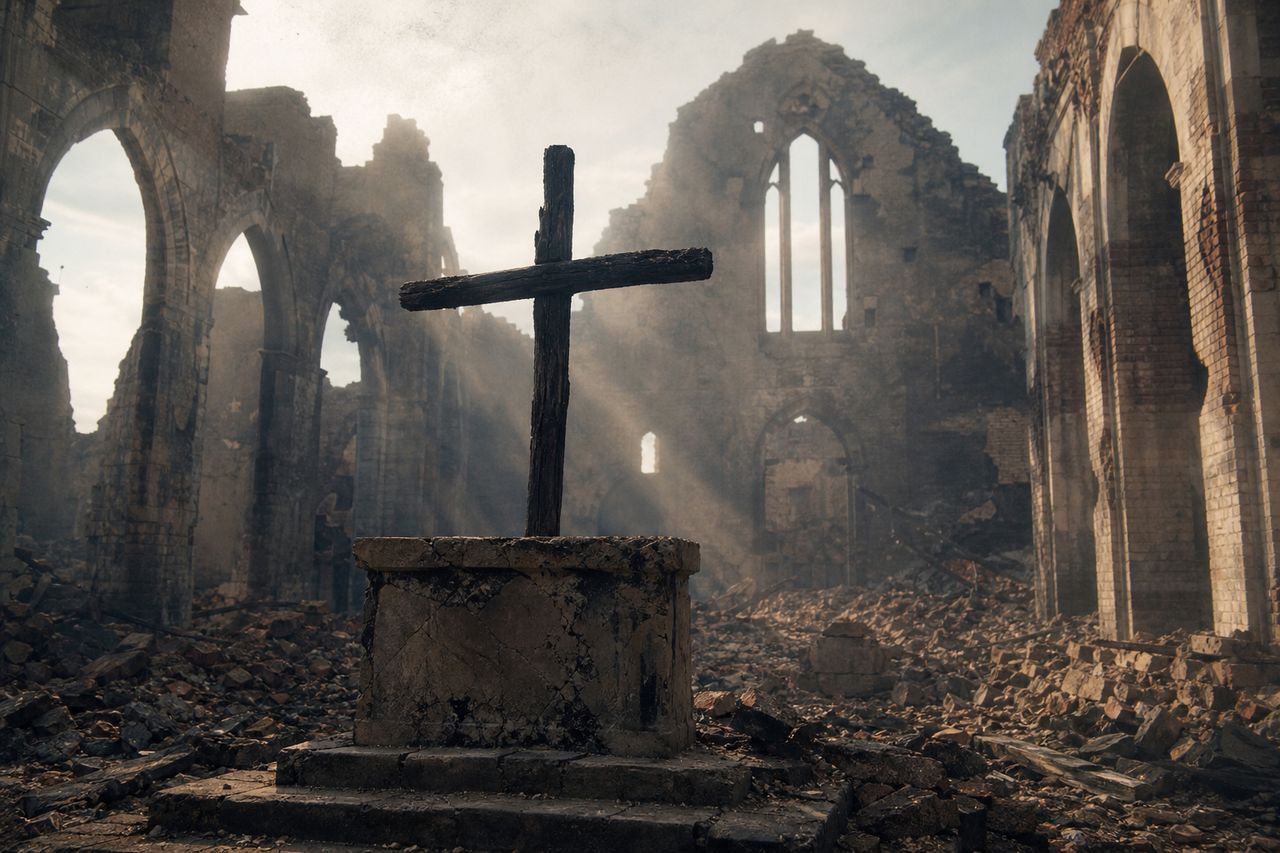
A stonemason bound two charred roof beams into a cross; a priest made another from three medieval nails found in the ashes. Crosses of nails later went to places of reconciliation worldwide.
In 1944, people in Coventry formed a friendship society with Stalingrad, often called the first city twinning. Kiel followed in 1947, and Dresden in 1956.
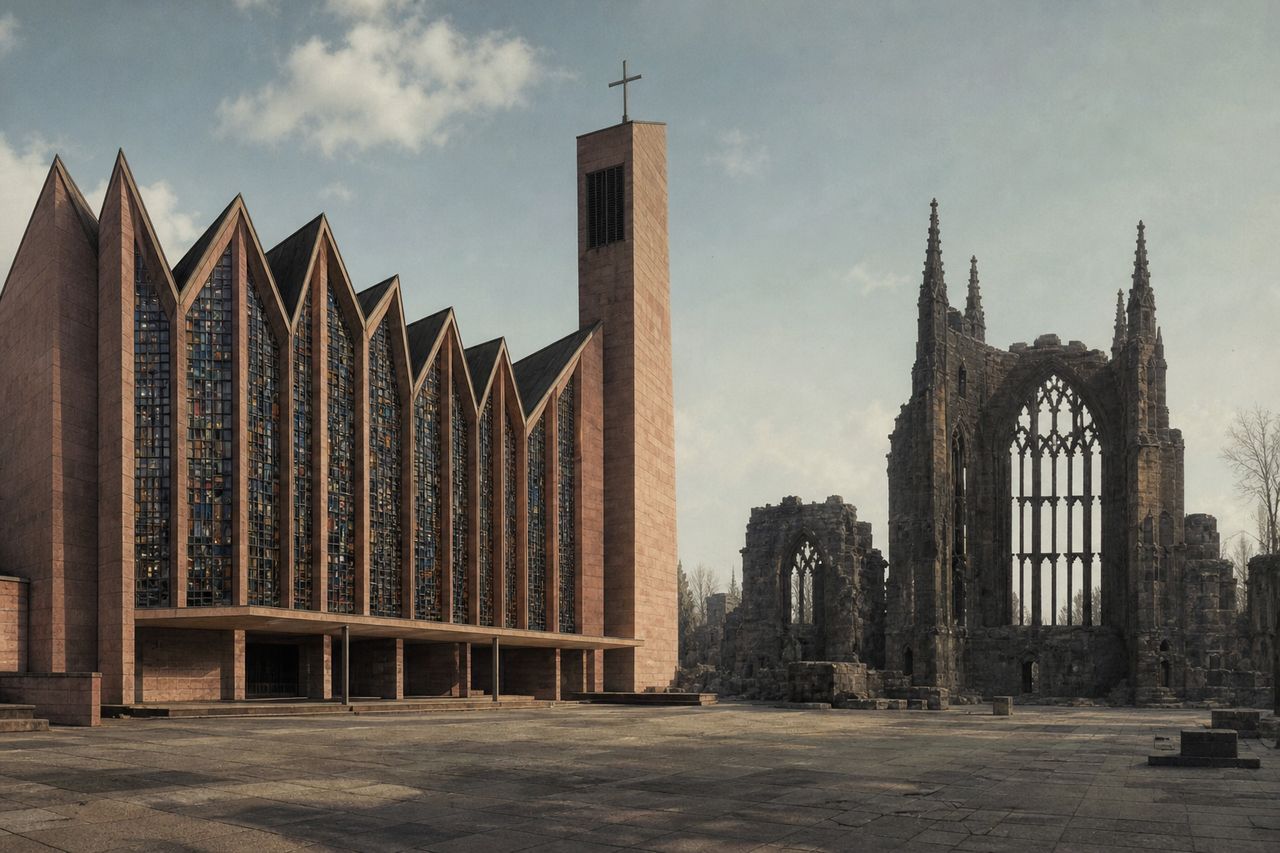
Beside the ruins, which were kept as a memorial, rose a new cathedral designed by Basil Spence. It was consecrated on 25 May 1962.
The charred cross Placed where the altar had stood; a replica replaced the original beams in 1964. AI-generated illustration.A cross of nails The Community of the Cross of Nails, formed in 1974, now links over 200 groups in 45 countries. AI-generated illustration.
1944 Stalingrad, now Volgograd (link suspended in 2022)
1947 Kiel, Germany
1956 Dresden, Germany
Coventry’s twin towns (University of Warwick)The new cathedral Spence’s design, chosen from 219 entries in 1951, keeps the ruined shell as part of one building. AI-generated illustration.
Chapter VII · Father, forgive
Reconciliation
Historic England: the decision to rebuild was taken the morning after the destruction; the cathedral stonemason found two charred roof beams that had fallen in the shape of a cross, and they were placed where the altar had stood (a replica replaced them in 1964); three medieval roof nails were formed into a cross; “Father Forgive” was inscribed on the ruined chancel wall in 1948; Basil Spence’s design was chosen from 219 entries in 1951; the Queen laid the foundation stone on 23 March 1956, and the new cathedral was consecrated on 25 May 1962. Coventry Cross of Nails (Wikipedia): Rev Arthur Wales bound three nails into a cross; Provost Richard Howard had “Father Forgive” carved behind the ruined altar; in 1947 Howard gave a cross of nails to St Nikolai’s church in Kiel; the Community of the Cross of Nails, formed in 1974, links over 200 organisations in 45 countries. University of Warwick: a Stalingrad friendship society was formed in Coventry on 6 June 1944, often taken as the first example of city twinning; during the battle of Stalingrad, 900 Coventry women had signed a tablecloth sent to the women of Stalingrad; Coventry’s twinnings with Kiel and Dresden date from 1947 and 1956; the Volgograd link was suspended after Russia’s invasion of Ukraine in 2022.
Press Raise the new cathedral to see the 1962 building go up beside the kept ruin.
The 3D scenes are simplified teaching models: the maps, beams, city and shelters are schematic and not to scale.
Eighty-six years on, Coventry’s old cathedral still stands without a roof beside the new one, open to the same sky the bombers crossed.
The city kept the ruin on purpose. Stand inside it, look up, and ask yourself: after a night like that, could you have chosen forgiveness?
Coventry today The council calls the ruined cathedral a symbol of peace and reconciliation. AI-generated illustration.
“Father Forgive”inscribed on the ruined chancel wall in 1948 (Historic England)
Epilogue · Sources
Sources
Every fact in this film comes from the sources below. Where sources disagree (the Coventry death toll, the number of bombers, how many nights London was bombed in a row, the toll of 10 May 1941), the film names the source of each figure. The account of the intelligence before the Coventry raid, and of the myth that the city was sacrificed, follows GCHQ. The later Allied bombing of German cities is given briefly, with attributed figures, so that the Blitz is seen in the context of the whole war. The chapter stills and pictures are AI-generated illustrations, not photographs of real places, people or events. The 3D scenes are simplified teaching models, not to scale.