Alan Turing answered a question about the limits of mathematical proof by describing the simplest possible machine — a tape, a head and a table of rules — and in doing so specified every computer since. Three years later he was at Bletchley Park attacking a cipher with 1.59 × 10²⁰ settings. Step his machine, press the keys of an Enigma, and run the Bombe.
Interactive 3D film8 min1912–1954Published 2026-10-13
He invented the computer while proving what computing cannot do.
In 1936 a twenty-three-year-old Cambridge mathematician answered a question about the foundations of logic, and in the process described a machine.
It has an endless paper tape, a head that reads and writes one symbol at a time, and a table of rules. That is all. Every computer you have ever used is a version of it.
Three years later he was applying the same mind to a cipher with a hundred and fifty-nine million million million possible settings.
Sixteen years after that, his own government prosecuted him for being gay.
A tape and a rule The computer was invented as a thought experiment about what proof cannot do.
1936
the machine, on paper
1.59 × 10²⁰
Enigma settings
41
years he lived
Three numbers
We can only see a short distance ahead, but we can see plenty there that needs to be done.Alan Turing, 1950
Prologue · Why he matters
The universal machine
Turing described the computer in 1936 as a device for settling a question in logic. The same person then broke Enigma, asked whether machines can think, and was destroyed by a law against who he was.
Born
London, 1912
23 June
Died
Wilmslow, 1954
7 June, aged 41
Pardoned
2013
apology 2009; the Turing law 2017
How to use: pick a chapter below or press ← → to change step · ▶ plays the step · drag to rotate · three steps have buttons you can press.
To prove there is not, you first have to define “procedure”.
In 1928 David Hilbert asked whether there is a definite procedure that could take any mathematical statement and decide whether it follows from the axioms.
It sounds like a question about mathematics. It is really a question about machinery: is there a method, a set of mechanical steps, that always terminates with the right answer?
To prove that no such method exists, you first have to say exactly what a method is. Nobody had.
Turing’s answer was to invent the simplest possible machine that could carry out any method at all, and then show that there are things it cannot do.
Hilbert, 1928: is there a procedure that decides any mathematical statement?
Feed it a statement, turn the handle, get true or false
Gödel had already shown some truths are unprovable
But could a machine at least decide which?
The decision problem
1928
Hilbert asks the question
1936
Turing and Church answer it: no
Eight years
Chapter I · Step 1
Is there a procedure for everything?
Hilbert’s Entscheidungsproblem (1928) asked for a procedure that decides any mathematical statement. Answering it required a precise definition of “procedure” — which is what Turing supplied.
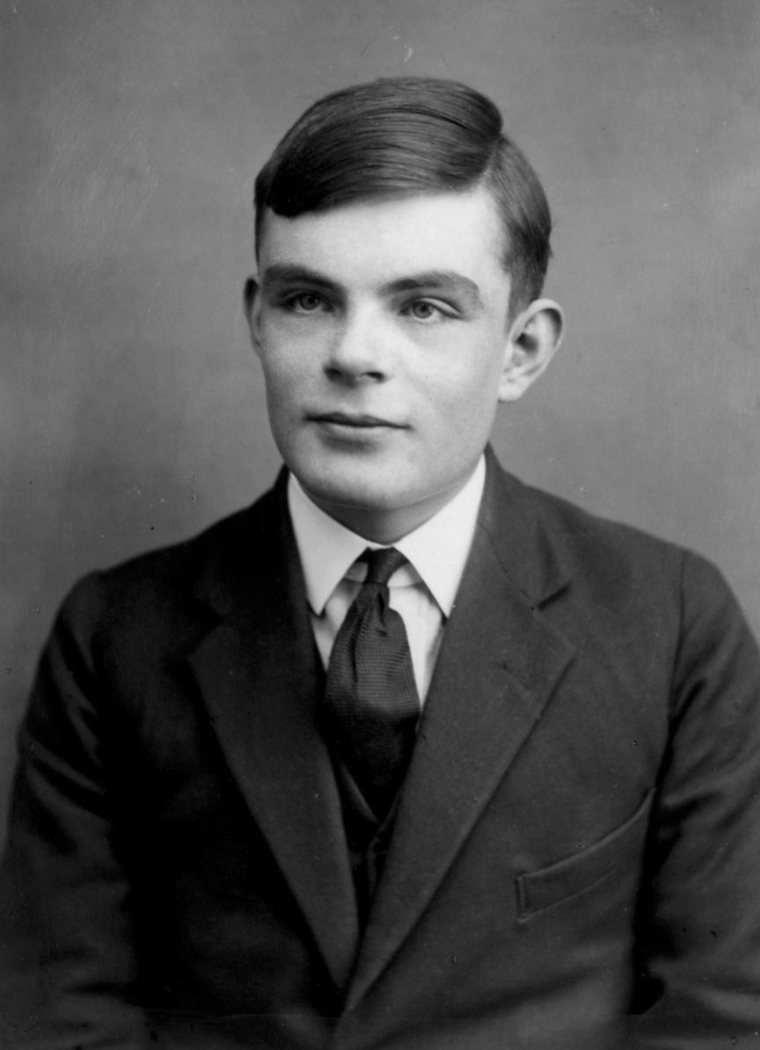
Turing was born in London in 1912 and educated at a school that disapproved of his interest in science.
He went to King’s College, Cambridge, and was elected a Fellow at twenty-two on the strength of a dissertation in probability theory.
He was a serious athlete, running marathon distances at close to Olympic standard, and used to run the sixty-odd kilometres to London for meetings rather than take the train.
He was also gay, which under British law at the time was a criminal offence punishable by imprisonment.
Turing at sixteen At school he was told he was wasting his time on science. He kept doing it.
1912 Born in London
1931 King’s College, Cambridge
1935 Fellow of King’s at 22
1938 PhD at Princeton under Alonzo Church
Before the war
A serious long-distance runner
Nearly made the 1948 Olympic marathon team
Awkward, direct, and not interested in rank
Gay, at a time when that was a crime
The person
Chapter I · Step 2
A runner who did logic
Fellow of King’s College, Cambridge at 22; PhD at Princeton under Alonzo Church; a marathon runner close to Olympic standard. And gay, which British law then made a crime.
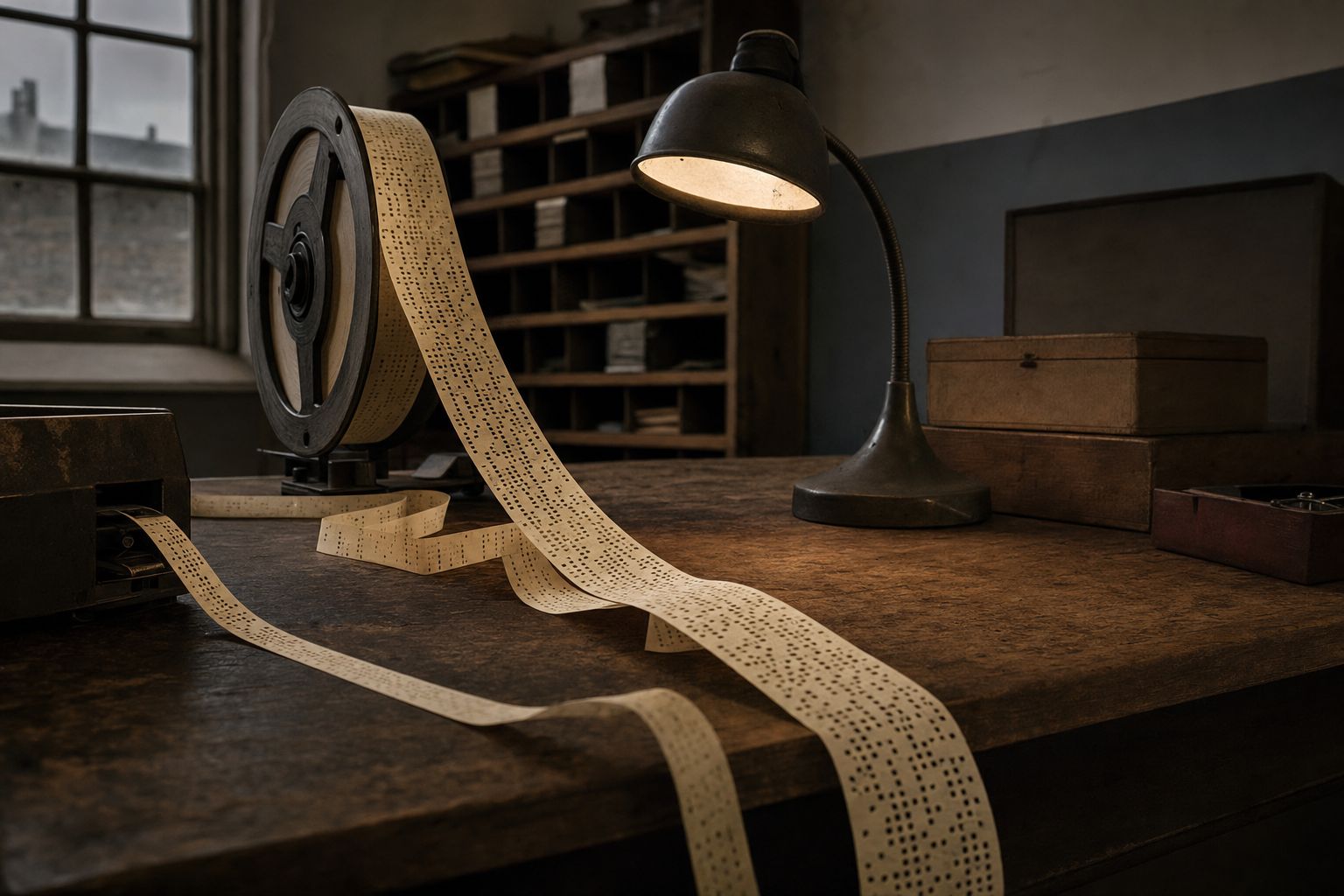
Read a symbol, write a symbol, move, change state. That is a computer.
Here is the machine. A tape divided into squares, a head sitting over one square, and a table of instructions.
At each tick the head reads the symbol under it. Depending on that symbol and the machine’s current state, it writes a symbol, moves one square left or right, and switches to a new state.
That is the whole specification. There is nothing else in it.
Turing argued that anything a human being could do by following a fixed procedure, this machine can do too. Press the buttons and run one.
An endless tape divided into squares
A head that reads and writes one symbol
A small table of rules, and a state
Read, write, move left or right, change state
The whole machine
4
things it can do
any
computation at all
The claimPaper tape The tape is infinite only in the sense that you never run out. In practice: enough.
Chapter II · Step 3 · Interactive
Four things and a tape
A tape of squares, a head, a state, and a table of rules: read, write, move, change state. Turing argued that anything doable by a fixed procedure is doable by this.
Press Step to advance one tick, or Run. The machine loaded here adds one to a binary number, then halts.
Software exists because of a proof about what cannot be proved.
Two things follow, and they are the foundations of computing.
First: you can write a machine’s rule table onto a tape as data, and build a single machine that reads that description and behaves exactly like the machine described. One machine that can be any machine. That is a computer, and the description is software.
Second: there is no machine that can look at any program and say whether it will eventually stop.
Suppose there were. Then you could build a program that asks the oracle about itself and does the opposite: halts if told it loops, loops if told it halts. It cannot exist.
And that answers Hilbert. No procedure decides every mathematical question.
Encode a machine’s rule table as symbols on a tape
Build one machine that reads that description and imitates it
That machine can be any machine
It is called universal, and it is your laptop
The universal machine
Ask: will this machine ever stop?
Assume a machine that can always answer
Build one that does the opposite of its own answer
Contradiction. No such machine exists
The halting problem
Chapter II · Step 4
One machine for all of them
A machine’s rules can be written on the tape as data — so one universal machine can imitate any other. That is software. And no machine can decide whether an arbitrary program halts, which answers Hilbert: no.
A machine designed so that the same letter never means the same thing twice.
Turing reported to Bletchley Park the day after Britain declared war.
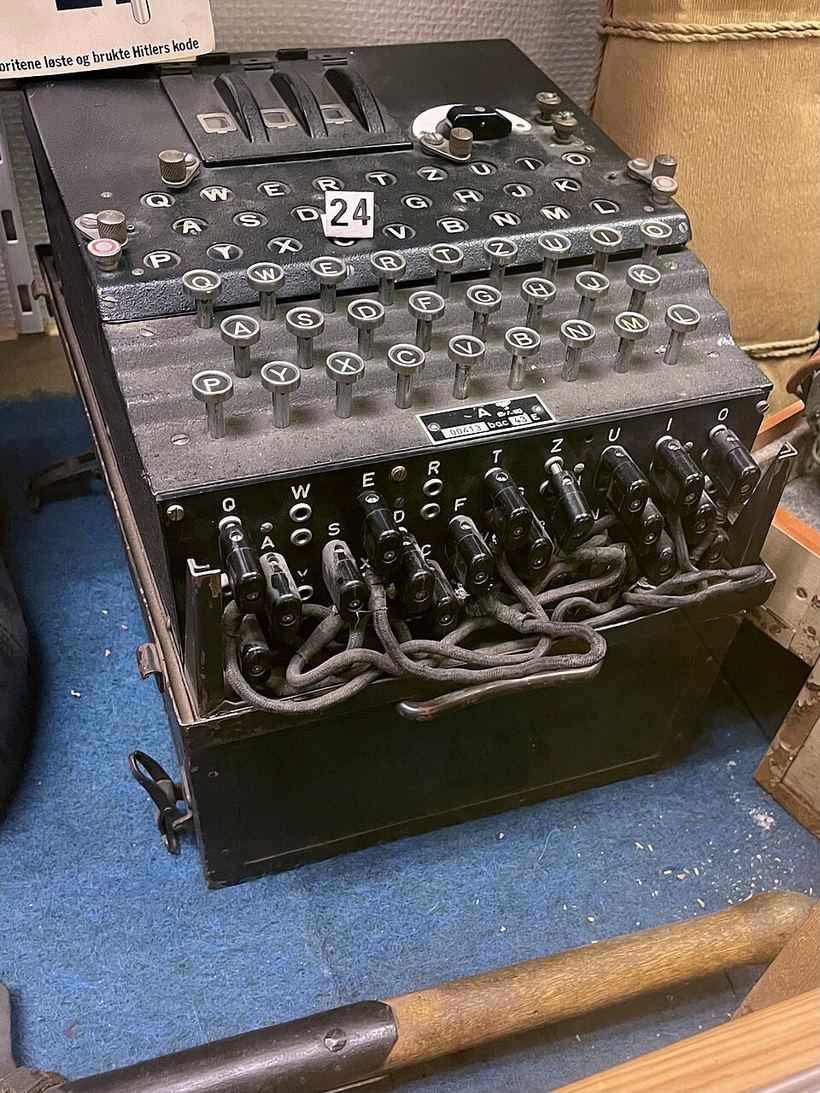
Enigma looks like a typewriter. Press a key and current runs through a plugboard, three rotating wheels and a reflector, and back out to light a lamp with a different letter.
After every single keystroke a rotor steps, so pressing the same key twice gives two different letters. That is what makes it strong.
But the reflector that makes decryption easy also guarantees that no letter is ever enciphered as itself. Press the keys and watch.
That one guarantee is the crack the whole attack goes through.
A three-rotor Enigma Press a key, current runs through the plugboard, three rotors and a reflector, and lights one lamp.
A rotor steps after every letter
So the same letter encrypts differently each time
The wiring is reciprocal: A→G means G→A
Which means no letter can ever encrypt to itself
How it behaves
0
letters that map to themselves
The flaw
Chapter III · Step 5 · Interactive
Press a key, light a lamp
Enigma’s rotors step after every keystroke, so the same letter enciphers differently each time. The reflector that makes it self-reciprocal also guarantees no letter is ever enciphered as itself.
Press letters and watch the lamp and the rotor positions. The simulation uses a simplified three-rotor wiring.
Count the settings. Three rotors chosen from five and placed in order: sixty ways. Each rotor can start at any of twenty-six positions: seventeen and a half thousand combinations.
And the plugboard, which swaps ten pairs of letters before and after the rotors, has about a hundred and fifty million million arrangements.
Multiply: roughly one and a half times ten to the twenty. Trying them all is not an option, and the settings changed every midnight.
It is also worth saying clearly that Britain did not start from nothing. Polish cryptanalysts, led by Marian Rejewski, had been breaking Enigma since 1932 and handed over everything they had in July 1939.
60
orders of three rotors chosen from five
17,576
starting positions
1.5 × 10¹⁴
plugboard wirings with ten cables
Multiply them60×17,576×150,738,274,937,250≈1.59×10²⁰About a hundred and fifty-nine million million million settings, changed every day at midnight.
Brute force was hopeless then and would be slow now
Polish cryptanalysts had broken earlier Enigma
Rejewski’s bomba came first and gave the name
In July 1939 Poland handed everything to Britain and France
Not from nothing
Chapter III · Step 6
A hundred and fifty-nine million million million
60 rotor orders × 17,576 start positions × ~1.5 × 10¹⁴ plugboard wirings ≈ 1.59 × 10²⁰ settings, changed daily. Brute force was never the answer.
Poland’s Marian Rejewski had broken earlier Enigma from 1932 and built the bomba that gave the British machine its name. Everything they had was handed over in July 1939.
The Bombe does not find the answer. It destroys the wrong ones.
The attack starts with a guess. German operators were disciplined and predictable: weather reports, formulaic greetings, the same opening words.
So you assume a stretch of known text, a crib, sits at a particular place in the message. Because no letter can encipher to itself, most alignments are instantly impossible — that alone eliminates a lot.
Then you follow the chain. If this letter maps to that one at this rotor position, then the plugboard must connect those two, which forces another connection, which forces another.
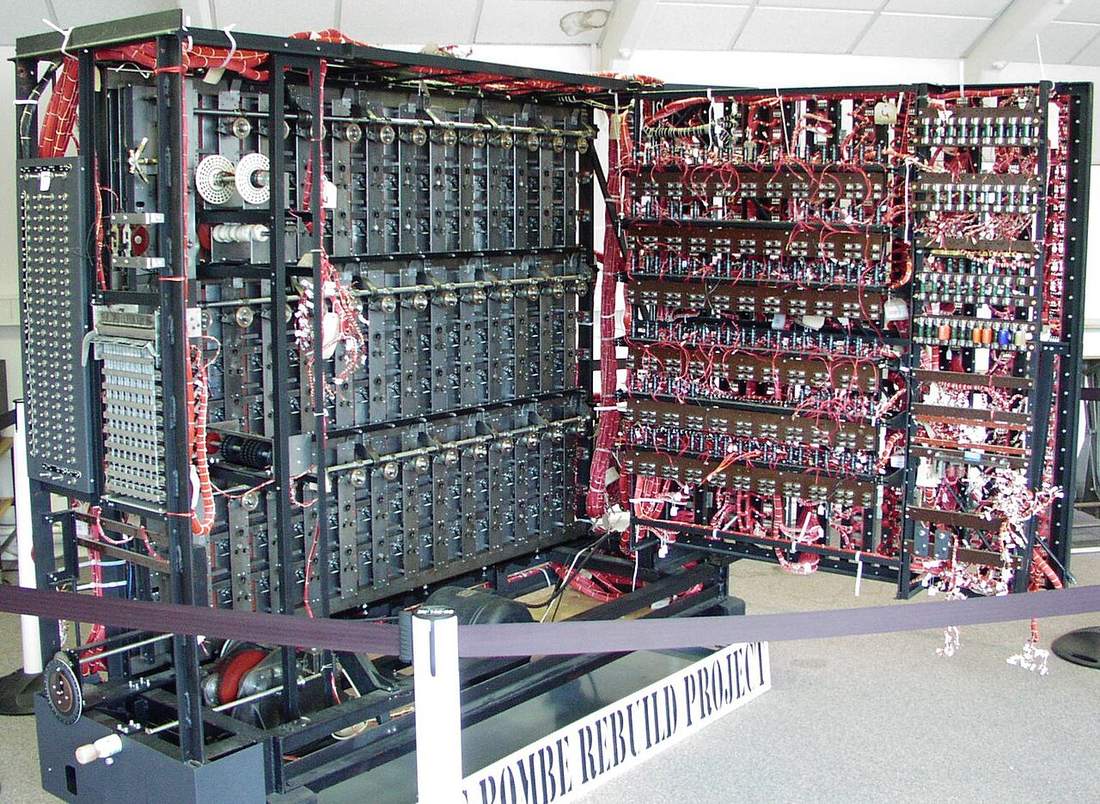
Go round a loop in the chain and you often arrive back at a contradiction. The Bombe is a machine for spinning through rotor positions and detecting those contradictions electrically — about twenty settings a second, per drum bank.
Run it and watch the possibilities collapse.
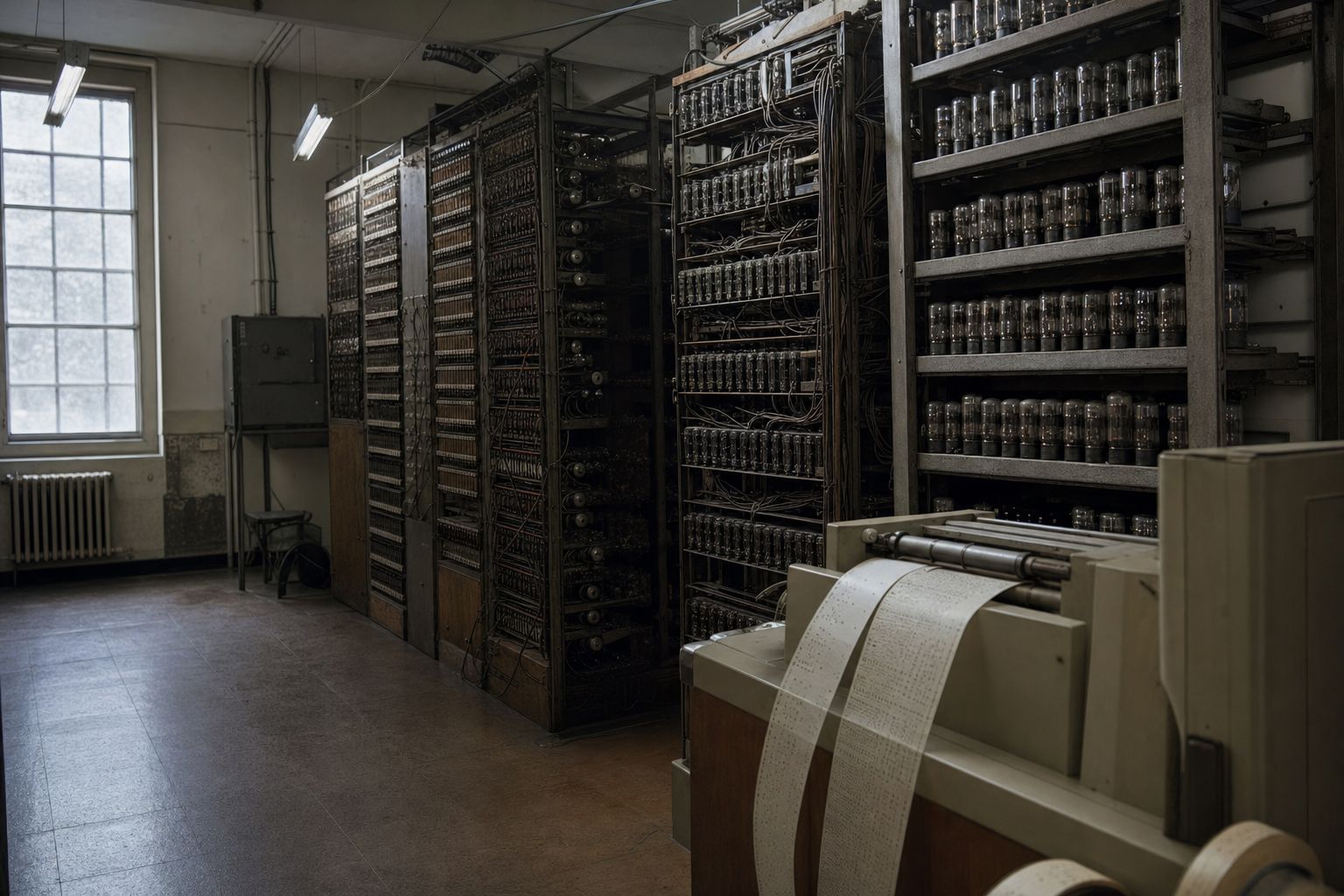
A rebuilt Bombe Not a computer. A machine for testing an assumption against itself until it contradicts.
Guess a crib: a phrase likely in the message
Weather reports always said the same things
Line the crib against the cipher text
No letter may match itself — that fixes the position
Step one: the crib
~200
Bombes running by the end of the war
The scale
Chapter IV · Step 7 · Interactive
Guess, then look for a contradiction
Assume a crib, use the no-letter-maps-to-itself rule to place it, then chase the implied plugboard connections round a loop. Most rotor settings produce a contradiction and are eliminated electrically.
Press Run the Bombe and watch the surviving settings fall. By 1945 about 200 Bombes were running day and night.
He ran the naval section, and nobody could be told.
Turing led Hut 8, the section attacking naval Enigma — the hardest variant, used by the U-boats that were sinking the convoys keeping Britain fed.
Alongside the Bombe he invented Banburismus, a statistical method for ranking which rotor orders were worth testing, which saved an enormous amount of machine time.
Thousands of people worked at Bletchley, the majority of them women operating the machines and processing the traffic, and every one of them was bound to silence.
Estimates of how much the work shortened the war vary, with two to four years commonly cited. It stayed secret until the 1970s, so Turing got no public credit while he was alive.
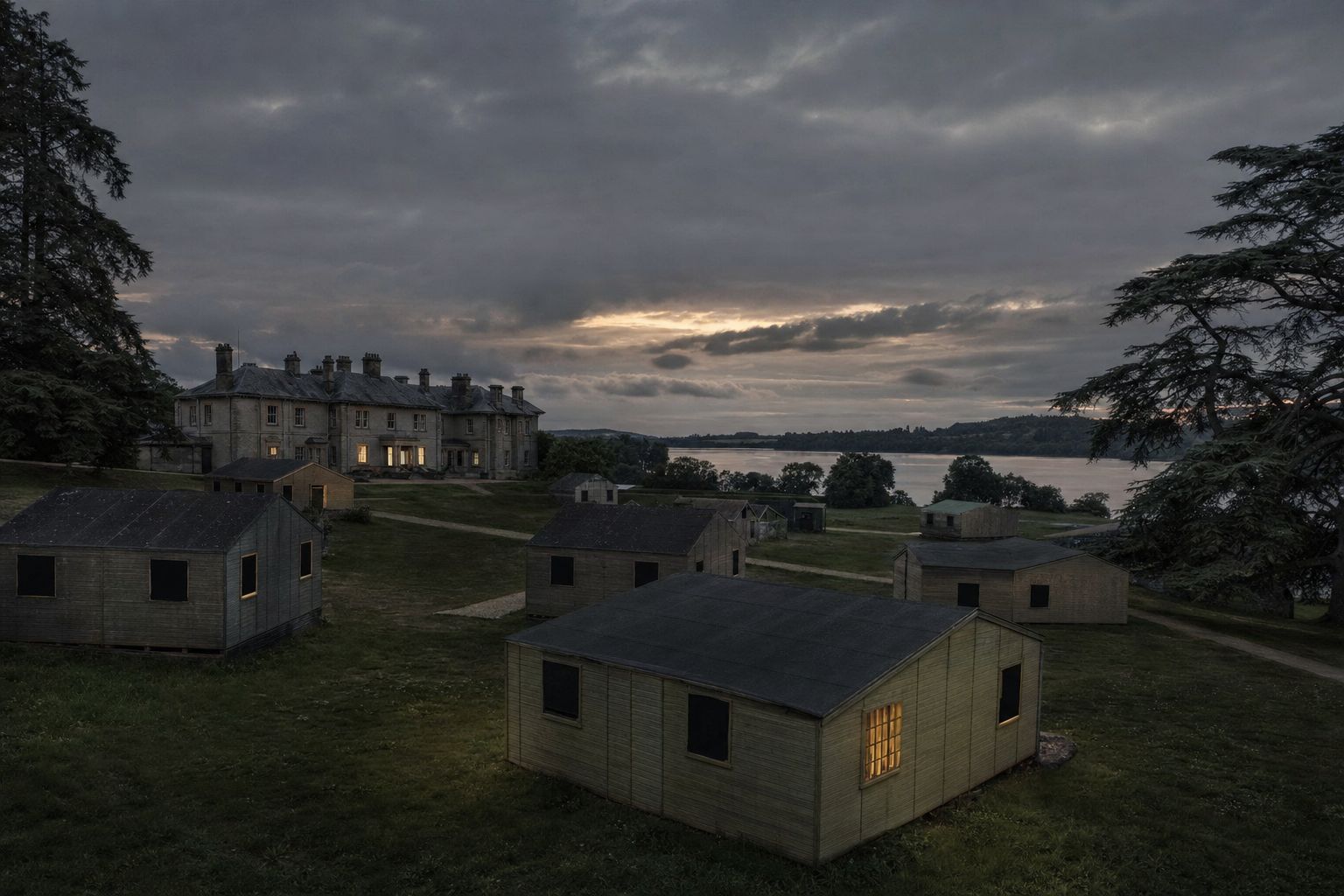
The huts Wooden huts, shift work, and nobody allowed to say what they did — for thirty years.
Turing ran Hut 8: naval Enigma
The hardest version, and the one sinking convoys
He invented Banburismus, a statistical shortcut
Thousands worked there; most were women
What he actually ran
Estimates of the war shortened by Bletchley vary
Commonly cited: two to four years
The work stayed secret until the 1970s
So he received no public credit in his lifetime
The cost of secrecy
Chapter IV · Step 8
Hut 8
Turing led the section on naval Enigma and invented Banburismus to cut the search. Thousands worked at Bletchley, most of them women; the whole operation stayed secret into the 1970s, so he was never publicly credited in his lifetime.
The machine on paper became a machine made of valves.
After the war Turing designed the Automatic Computing Engine, one of the first complete designs for a stored-program computer — the universal machine, in hardware.
The project moved slowly, and he left for Manchester, where one of the first working stored-program machines was running by 1948.
He wrote some of the earliest programs, worked on a chess-playing routine before there was a machine fast enough to run it, and started asking a question that nobody had asked carefully.
If a machine can imitate any machine, can it imitate a mind?
Real machines at last After the war he designed one of the first stored-program computers and then went to Manchester.
1945: designs the ACE at the National Physical Laboratory
Full stored-program design, ahead of its time
Progress was slow; he left for Manchester
Wrote programs and thought about chess
Building the thing
1936 → 1948
from the paper machine to a working one
Twelve years
Chapter V · Step 9
Building it for real
Turing designed the ACE in 1945, one of the first full stored-program computer designs, then moved to Manchester, where a working machine ran from 1948 and he wrote some of the first programs.
Not “can it think” but “can you tell the difference”.
In 1950 Turing published a paper asking whether machines can think, and then refused to answer it, on the grounds that the question is too vague to be useful.
He replaced it with a game. A judge holds a typed conversation with two hidden participants, one human and one machine, and has to say which is which. If the machine is not reliably identified, then arguing about whether it really thinks is a matter of definition.
He also predicted that by the end of the century people would casually talk about machines thinking without expecting to be contradicted.
He was right about that, and the paper is still where the argument starts.
“Can machines think?” is too vague to answer
Replace it with a test you can actually run
A judge types to a human and a machine
If the judge cannot tell, the question has been answered in practice
The move he made
I believe that at the end of the century the use of words and general educated opinion will have altered so much that one will be able to speak of machines thinking without expecting to be contradicted.Alan Turing, Computing Machinery and Intelligence, 1950
He predicted objections and answered them in advance
Including the theological one, and the one from consciousness
The paper is still the starting point for the argument
Why it lasted
Chapter V · Step 10
Change the question
Computing Machinery and Intelligence (1950) replaced “can machines think?” with a test: a judge types to a hidden human and a hidden machine and tries to tell them apart. Seventy-five years on, the paper is still where the argument starts.
He reported a burglary, and that is how it started.
In January 1952 Turing’s house was burgled. He reported it, and in the course of the investigation told the police, straightforwardly, that he had been in a relationship with a man.
He was charged with gross indecency under an 1885 statute, convicted, and given a choice between prison and hormone treatment designed to suppress libido. He took the treatment.
He lost his security clearance and his consultancy with the government, and was barred from the United States.
In the same year he published a paper showing how two reacting, diffusing chemicals can spontaneously generate spots and stripes — a founding document of mathematical biology.
On the eighth of June 1954 he was found dead at home. The inquest recorded suicide by cyanide poisoning. He was forty-one.
Jan 1952 Reports a burglary; the police learn he is gay
Mar 1952 Convicted of gross indecency
1952–53 Hormone treatment as a condition of probation
Jun 1954 Found dead at home, aged 41
Twenty-eight months
He reported a burglary and told the police the truth
He was prosecuted under an 1885 law
Chose hormone treatment over prison
Lost his security clearance and his consultancy
What happened
1952
he also published the morphogenesis paper
The same year On how chemical reactions can generate spots and stripes. It founded a field.
Chapter VI · Step 11
The state destroys him
Convicted of gross indecency in March 1952, Turing chose hormone treatment over prison, lost his clearance, and died on 7 June 1954; the inquest recorded suicide. In the same year he published The Chemical Basis of Morphogenesis, which founded mathematical biology.
Almost everything in the 1936 paper is still load-bearing.
Your phone is a universal machine. The apps are machine descriptions written as data. The halting problem is why no tool can perfectly tell you whether your program will hang, and it generalises to a wide class of questions about software that cannot be answered in general.
His last paper, on how reacting chemicals generate patterns, is now used to explain the spots on a leopard and the spacing of fingers.
In 2009 the British government apologised. In 2013 he received a royal pardon. In 2017 the law that pardoned tens of thousands of other men was named after him.
Every computer is a universal Turing machine
Software is a machine written as data
Some problems are provably undecidable
Chemistry alone can make a leopard’s spots
Still standing
2009
government apology
2013
royal pardon
2017
the Alan Turing law
AfterwardsThe machine now Everything in a data centre is still doing what the tape machine does, faster.
Epilogue · Step 12
What is still true
Phones are universal machines; apps are machine descriptions stored as data; the halting problem is why no tool can decide in general whether a program hangs; and his morphogenesis paper explains animal patterns. Apology 2009, pardon 2013, the Alan Turing law 2017.
He was not allowed to say what he had done, and then punished for who he was.
Turing worked for about eighteen years and changed the shape of the twentieth century twice: once in logic, once in a wooden hut nobody could talk about.
The secrecy meant he could not be publicly credited for the war work. The law meant that the same state he had served prosecuted him for his private life, and the treatment he accepted to avoid prison was a chemical punishment.
He died at forty-one.
The chapter stills in this film are AI-generated. The photograph of Turing, the Enigma machine and the rebuilt Bombe are real. Sources are listed below.
1936 the universal machine and the halting problem
1939–45 Bletchley Park and the Bombe
1950 the imitation game
1952 convicted; morphogenesis published
1954 dies at 41
Forty-one years
He answered a question about the limits of proof
And accidentally specified every computer since
The country he had served prosecuted him
It took fifty-nine years to apologise
The shape of it
Epilogue · Step 13
Forty-one years
Eighteen working years, two transformations of the century, no public credit for either at the time — and a prosecution by the state he had served.
1936 the universal machine; the halting problem
1939–45 Hut 8 and the Bombe
1950 the imitation game
1952–54 convicted; morphogenesis; dead at 41
Chapter stills in this film are AI-generated illustrations. The 1928 photograph of Turing, the Enigma machine and the rebuilt Bombe at Bletchley Park are real, credited where they appear.