Srinivasa Ramanujan taught himself mathematics from one book of results with the proofs stripped out, failed college twice, and in 1913 sent nine pages of theorems to G. H. Hardy. Count partitions against the Hardy-Ramanujan formula, add terms to his series for pi and watch the digits lock in, and sweep the cubes to find 1729. Episode 10 of the Great Scientists series.
Interactive 3D film8 min1887 to 1920Published 2026-10-13
He had no proofs, no degree, and results nobody could have guessed.
In January 1913 a twenty-five-year-old accounting clerk in Madras posted nine pages of mathematics to a professor at Cambridge he had never met.
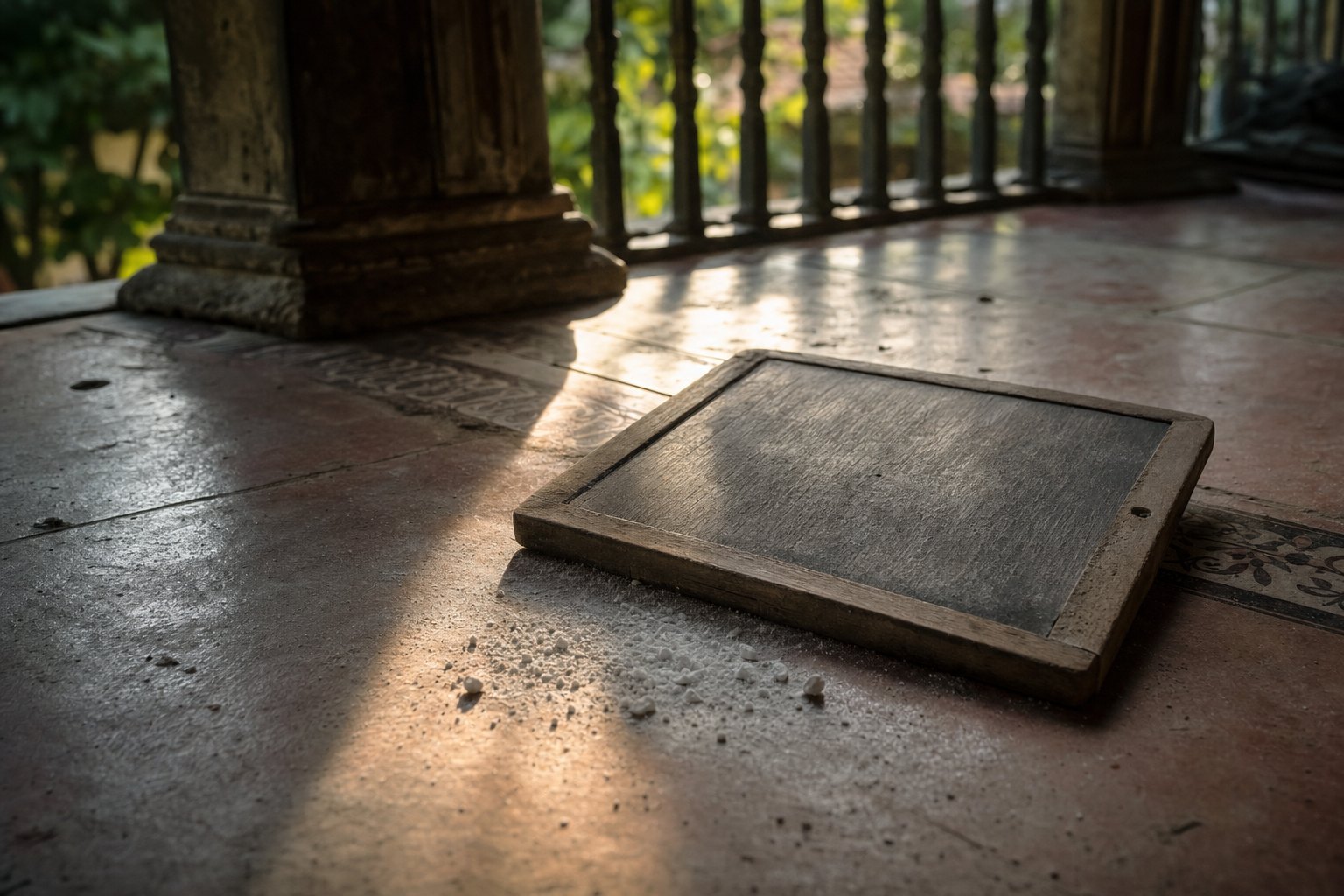
He had no degree. He had failed college twice. He was earning about thirty rupees a month and doing mathematics on a slate because paper cost too much.
The pages contained about a hundred and twenty results, almost none of them proved. Some were already known. A few were wrong. And some were so strange that Hardy concluded nobody could have invented them.
They were true.
A slate and chalk Paper was expensive. He worked on slate and copied only the results into notebooks.
120
theorems in the first letter
0
degrees he held
32
years he lived
The facts
They must be true, because, if they were not true, no one would have had the imagination to invent them.G. H. Hardy, on Ramanujan’s first letter
Prologue · Why he matters
A letter from Madras
A clerk with no degree sent 120 unproved theorems to Cambridge in 1913. Hardy’s test for whether to take them seriously was that they were too strange to be invented — and they were correct.
Born
Erode, 1887
22 December
Died
Madras, 1920
26 April, aged 32
Royal Society
1918
at 31, one of the youngest ever elected
How to use: pick a chapter below or press ← → to change step · ▶ plays the step · drag to rotate · three steps have buttons you can press.
A list of five thousand results, with the proofs left out.
At about fifteen he got hold of a book by George Shoobridge Carr, a cramming manual for Cambridge examinations.
It is a list of roughly five thousand results in algebra, trigonometry, calculus and analysis, with the proofs compressed to almost nothing or omitted entirely.
For most students that would be useless. Ramanujan treated every line as a puzzle, worked out his own proof, and then kept going.
It also shaped him permanently. He learned mathematics as a set of results to be found, not arguments to be written down — which is exactly what made him so hard for professionals to deal with later.
The house A small house in a temple town, a mother who took in lodgers, and no mathematics teacher anywhere near.
Carr’s Synopsis: about five thousand results
Almost no proofs, just statements
So he reconstructed each one himself
And kept going past the end of the book
How he learned
~5,000
theorems in the book he worked from
The whole curriculum
Chapter I · Step 1
One borrowed book
Carr’s Synopsis — about 5,000 results with the proofs stripped out — was effectively his entire mathematical education. He reconstructed the proofs himself, then went past the end of the book.
It left him with a habit that caused trouble for the rest of his life: he produced results, not proofs.
A scholarship, lost twice, for refusing to study anything but mathematics.
He won a scholarship and lost it, twice, because he would not study anything except mathematics.
Without a degree there was no job in mathematics and no library. He spent years poor, often ill, doing original work in notebooks and showing them to anyone who would look.
In 1912 a sympathetic official got him a clerk’s job at the Madras Port Trust. His supervisor and a few local engineers recognised that something unusual was going on and encouraged him to write to England.
Two professors in England ignored the letters. The third did not.
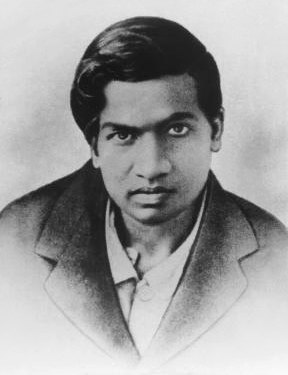
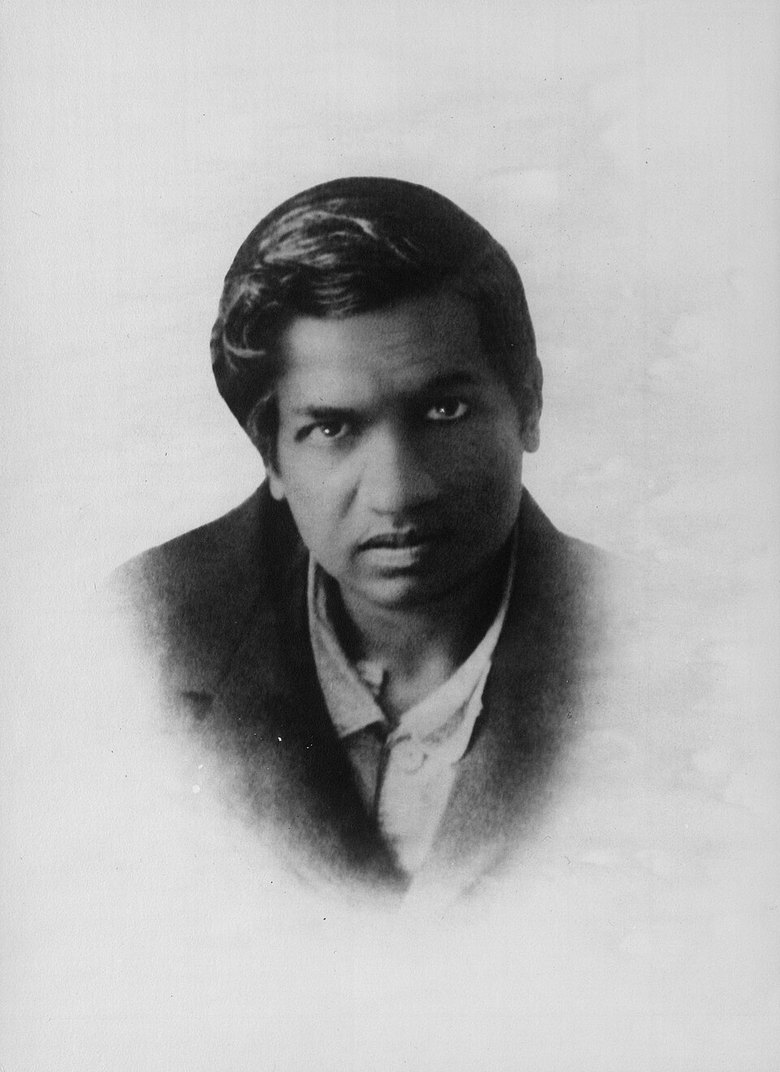
Srinivasa Ramanujan The only well-known photograph, taken for his passport in 1919.
1904 Wins a scholarship
1905–07 Loses it; fails the examinations twice
1909 Marries; looks for work for three years
1912 Clerk at the Madras Port Trust, 30 rupees a month
Eight years of nothing
He failed because he would only study mathematics
English, physiology and the rest went unlearned
Without a degree there was no academic post
He filled notebooks while working as a clerk
The trap
Chapter I · Step 2
He failed everything else
A scholarship lost twice for studying nothing but mathematics, then years of poverty and a clerk’s job at the Madras Port Trust on 30 rupees a month, filling notebooks after hours.
Two Cambridge professors ignored it. The third stayed up all night.
The letter opens with an apology for being a clerk, and then simply starts listing theorems.
Hardy read it, decided it was probably from a crank, and put it aside. Then he could not stop thinking about a few of the formulas, and in the evening he fetched Littlewood.
They worked through it. Some results were known. Some were false. And some were, in Hardy’s words, scarcely possible to believe — and if they were not true, nobody would have had the imagination to invent them.
He wrote back within days. Getting Ramanujan to England took another fifteen months of letters, money and religious objection from his family.
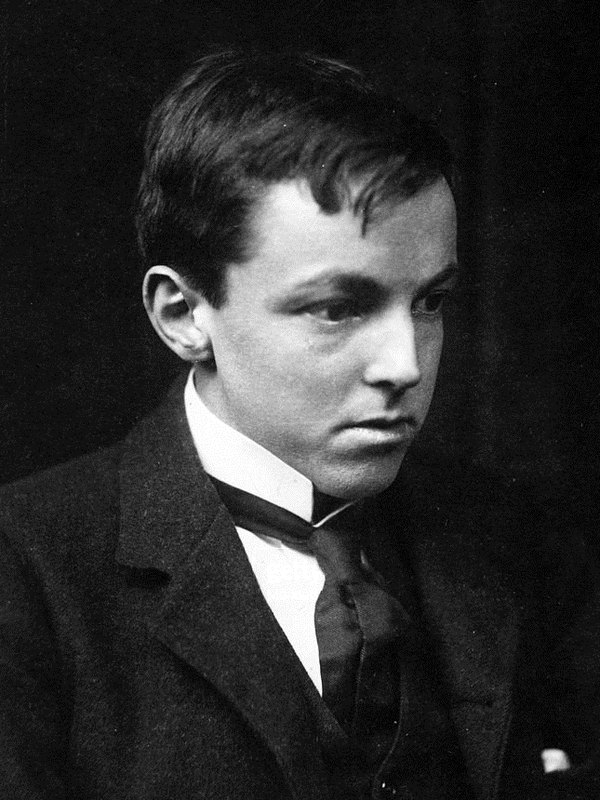
A page of the notebooks Results, stacked, with no working shown. This is how the letter looked too.G. H. Hardy A professional’s professional, and an atheist who called the letter the one romantic incident of his life.
Hardy’s first reaction was that it might be a hoax
He and Littlewood spent the evening on it
Some results they already knew
Some they could not prove at all
One evening in Trinity
Chapter II · Step 3
Nine pages, no proofs
The letter of 16 January 1913 listed about 120 results with no working. Two other professors ignored similar letters; Hardy and Littlewood sat up over it and concluded the strangest formulas were too strange to be fake.
He arrived six weeks before the First World War started.
Ramanujan reached London in April 1914. The war began in August.
He was a strict vegetarian in a country introducing rationing, cooking for himself in a college room, in a climate he had never experienced.
The work was extraordinary anyway. Hardy spent those years doing two things at once: collaborating with him, and teaching him to write proofs that other mathematicians could check — without, as Hardy put it, destroying his confidence or breaking the spell.
In 1918 he was elected a Fellow of the Royal Society at thirty-one, and then a Fellow of Trinity. By then he was seriously ill.
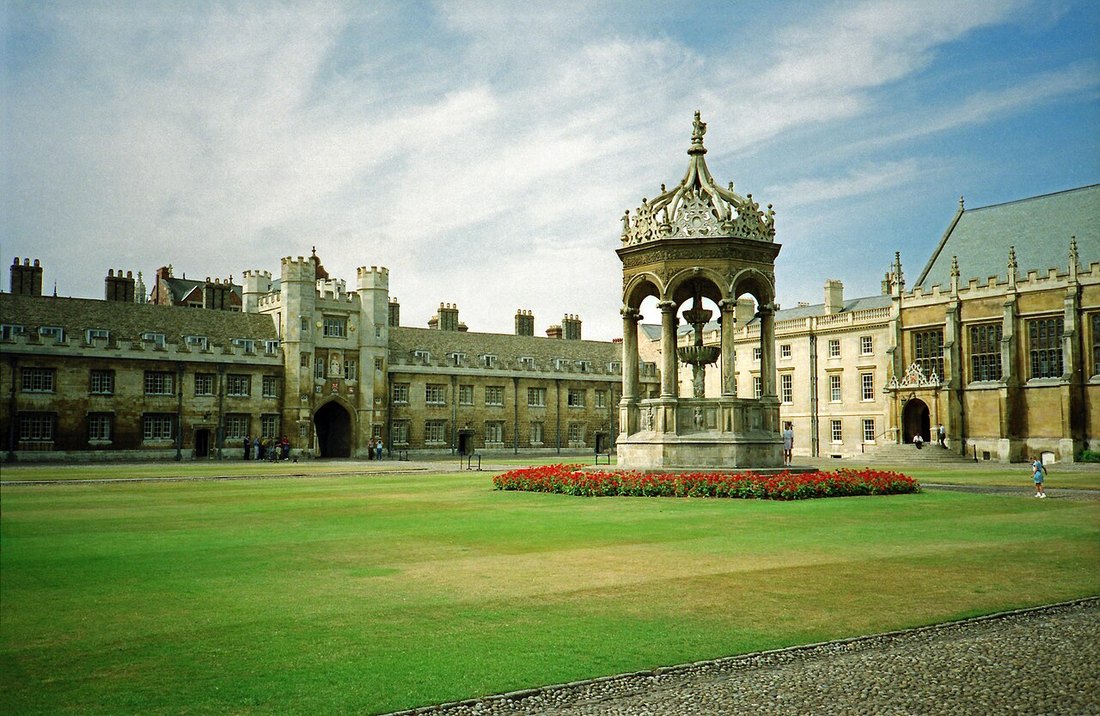
Trinity College Where he worked for five years, mostly in wartime, often ill and mostly alone.
A strict vegetarian in wartime rationing
Cooking for himself in a college room
English winters after a life in the tropics
Hardy taught him to write proofs; it was not easy
Five hard years
1918
Royal Society, and Fellow of Trinity
The recognition
Chapter II · Step 4
Five years and a war
He arrived in April 1914, six weeks before the war. Five years of collaboration, illness, wartime rationing and English winters produced the partition work — and election to the Royal Society in 1918, aged 31.
Five ways for 4. A hundred and ninety million for 100.
Here is a question a child can ask. In how many ways can you write a number as a sum of whole numbers?
Four can be written five ways: four; three plus one; two plus two; two plus one plus one; and one four times.
Ten has forty-two ways. One hundred has one hundred and ninety million, five hundred and sixty-nine thousand, two hundred and ninety-two.
There was no formula. You counted, and the counting became impossible almost immediately. Slide the number and watch it explode.
p(4)=5
p(n)
ways of writing n as a sum of positive whole numbers
4, 3+1, 2+2, 2+1+1, 1+1+1+1.
5
ways to split 4
42
ways to split 10
190,569,292
ways to split 100
It explodes
Easy to define, brutal to count
No simple formula was known
Hardy and Ramanujan found a near-exact one
Their full series rounds to the exact p(n)
The problem
Chapter III · Step 5 · Interactive
How many ways to split a number
The partition function p(n): p(4) = 5, p(10) = 42, p(100) = 190,569,292. Easy to state, and before 1918 there was no way to compute it except by counting.
Press the buttons to change n. The exact value is computed here; the formula comes next.
A formula that gets the right answer if you round it.
In 1918 Hardy and Ramanujan produced a formula. It is not exact — it is an approximation that gets better as the number grows.
The leading term alone is a few per cent high at a hundred. Add the correction terms they derived and the total comes out at one hundred and ninety million, five hundred and sixty-nine thousand, two hundred and ninety-one point nine nine six.
Getting there required inventing a technique, now called the circle method, which is still a standard tool in number theory.
Ramanujan also noticed something nobody else had: the values are not random. Every fifth one is divisible by five, every seventh of another family by seven, and so on. Press the formula button and compare.
p(n);∼;4n31eπ2n/3
n
the number being split
p(n)
how many ways
The leading term alone. It is a few per cent high at n = 100; their full series is accurate enough to round.
The method they invented is now called the circle method
It is used across analytic number theory
Rademacher later made it exact
Ramanujan also found congruences: p(5k+4) is divisible by 5
What came out of it
Chapter III · Step 6 · Interactive
Close enough to round
The Hardy–Ramanujan series gives 190,569,291.996 for n = 100 — round it and you have the exact count. The leading term shown here, on its own, is a few per cent high; the circle method they invented to get the rest is still standard in number theory.
Press Show the formula to compare the estimate with the exact value at each n.
One term gives six digits. Each extra term gives eight more.
In 1914 Ramanujan published a handful of formulas for pi. One of them is this.
Take one term and you get pi correct to six decimal places. Take two and you have about fourteen. Each additional term buys roughly eight more digits.
He gave no derivation. The numbers one thousand one hundred and three and twenty-six thousand three hundred and ninety are not arbitrary — they come from the theory of modular equations — but he simply stated the result.
It was not proved until 1987, seventy-three years later, and in the 1980s it was used to set world records for computing pi.
Add the terms and watch the digits lock in.
π1=980122k=0∑∞(k!)43964k(4k)!(1103+26390k)One of several series he produced for π, with no explanation of where it came from.
1
term gives six correct digits
~8
more digits per extra term
The rate
Published in 1914 with no derivation
Nobody proved it until 1987
Used for record π computations in the 1980s
Where 1103 and 26390 come from is deep modular theory
The strangeness
Chapter IV · Step 7 · Interactive
A series nobody could explain
Ramanujan’s 1914 series gives six correct digits of π from one term and about eight more per term after that. He supplied no proof; one was not found until 1987, and the series was used for record computations in the 1980s.
Press Add a term and watch the correct digits turn bright.
He said a goddess gave him the formulas. Then people checked them.
Asked where his results came from, Ramanujan said that the family goddess Namagiri revealed them to him, often in dreams.
Hardy, who was a famously combative atheist, did not argue with him about it and did not use it against him either.
That is the right response. Science does not care where an idea comes from. It cares whether it survives checking.
His notebooks contain around three thousand nine hundred results. Mathematicians spent most of the twentieth century going through them, and nearly all of them are correct.
An equation for me has no meaning unless it expresses a thought of God.Attributed to Ramanujan
He said the goddess Namagiri revealed formulas in dreams
Hardy was a committed atheist and did not argue
What matters is that the results check out
Where an idea comes from is not how it is judged
The question of method
~3,900
results in his notebooks
nearly all
of them correct
The scoreboard
Chapter IV · Step 8
Dreams and verification
Ramanujan attributed his formulas to the goddess Namagiri. Hardy, a famous atheist, neither argued nor held it against him — because the test of a result is whether it checks out. Of roughly 3,900 results in his notebooks, nearly all are correct.
The most famous anecdote in mathematics, and it is true.
In 1919 Hardy went to see Ramanujan, who was ill in a nursing home in Putney, and could not think of anything to say.
So he mentioned that he had arrived in taxi number one thousand seven hundred and twenty-nine, which seemed a rather dull number.
Ramanujan replied at once that it is not dull at all: it is the smallest number expressible as the sum of two cubes in two different ways.
One cubed plus twelve cubed. Nine cubed plus ten cubed. Both give one thousand seven hundred and twenty-nine. Search the cubes yourself and find it.
1729
= 1³ + 12³ = 9³ + 10³
The taxi number
Hardy visited him in a nursing home
He said the taxi number, 1729, seemed dull
Ramanujan answered immediately
It is the smallest number that is a sum of two cubes in two ways
The exchange
Such numbers are now called taxicab numbers
The next one is 87,539,319
Only six are known
After 1729
Chapter V · Step 9 · Interactive
1729
Hardy mentioned his taxi number as a dull one. Ramanujan answered instantly: 1729 = 1³ + 12³ = 9³ + 10³, the smallest number that is a sum of two cubes in two ways.
Press Search to sweep pairs of cubes and watch the first collision appear.
Dying, he invented a kind of function nobody could classify for eighty years.
Ramanujan was seriously ill from 1917 onwards, in and out of English sanatoria, and sailed home in 1919.
In January 1920, three months before he died, he wrote to Hardy describing what he called mock theta functions: seventeen examples of a new kind of object, with properties but no definition.
Nobody could say what they actually were. They sat as a curiosity for eighty years, until in 2002 Sander Zwegers showed they are the visible part of a larger structure, now called mock modular forms.
Those objects now turn up in the mathematics of black hole entropy. He died on the twenty-sixth of April 1920, aged thirty-two, of an illness that would be curable today.
Home, and then not well He sailed for India in 1919 and died the following April.
1917 Seriously ill; sanatoria in England
1919 Returns to India
Jan 1920 Last letter to Hardy: mock theta functions
26 Apr 1920 Dies, aged 32
The last year
Probably hepatic amoebiasis, treatable today
He worked in bed until the last weeks
The last letter describes functions nobody understood
They were understood in 2002
The end, and after
Chapter VI · Step 10
The last letter
Three months before his death Ramanujan described mock theta functions — seventeen examples with properties but no definition. What they were was not settled until 2002, and they now appear in work on black hole entropy.
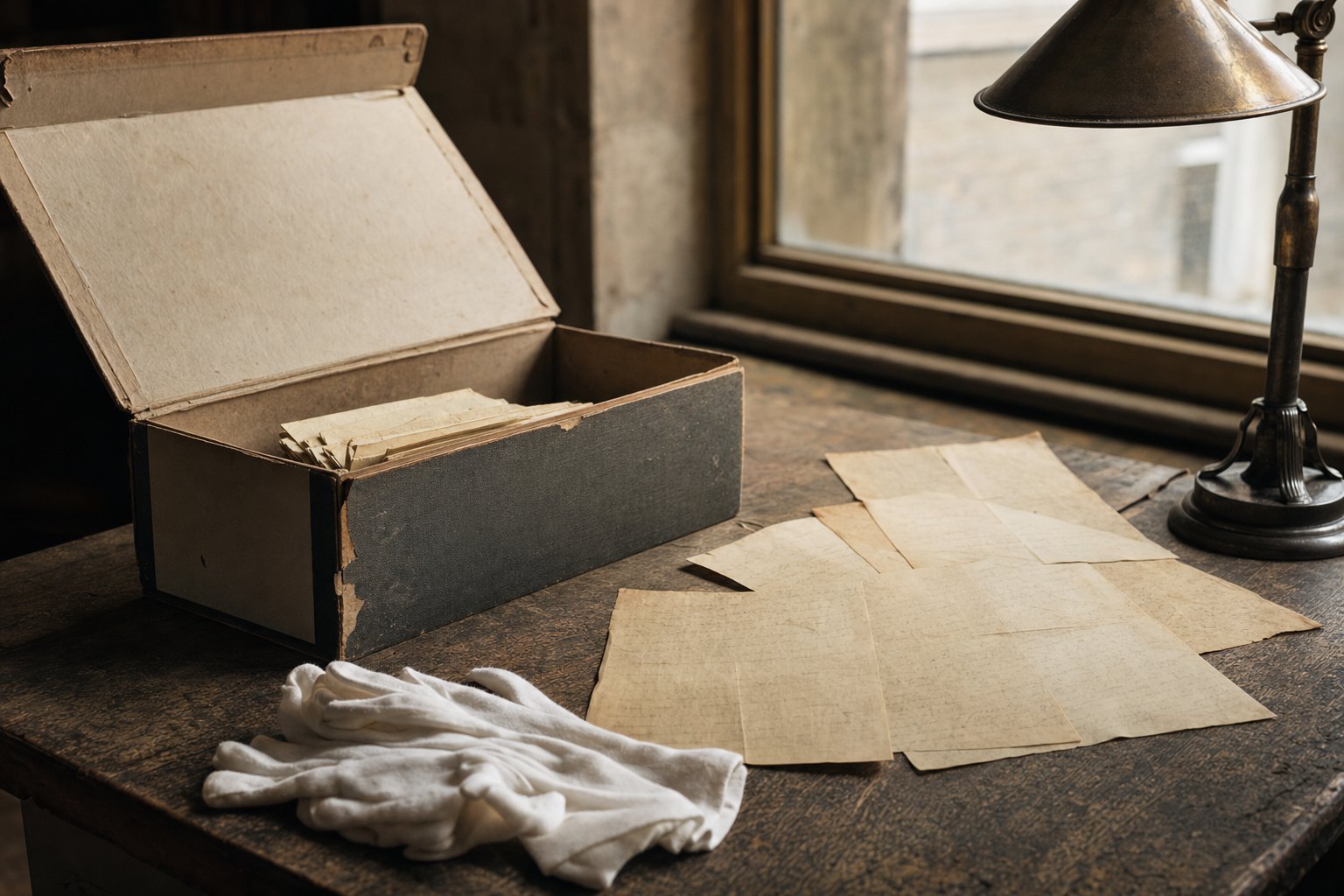
Fifty-six years later, the last year of his work turned up in a filing box.
In 1976 the mathematician George Andrews was going through a box of papers at Trinity College, left by another mathematician who had died in 1965.
Inside were eighty-seven loose sheets in Ramanujan’s handwriting, containing around six hundred formulas from the last year of his life.
They had been sitting in the library for over half a century, catalogued under somebody else’s name.
It is now called the lost notebook, and mathematicians are still working through it.
The lost notebook Eighty-seven sheets in a box of papers at Trinity, unexamined for fifty-five years.
87
sheets, found in 1976
~600
formulas on them
What was in the box
Written in his last year in India
Filed with another mathematician’s papers
Found by George Andrews
Described as the mathematical find of the century
How it surfaced
Chapter VI · Step 11
A box in a library
In 1976 George Andrews found 87 sheets in Ramanujan’s hand, with around 600 formulas from his last year, filed at Trinity under another mathematician’s papers. Work on the lost notebook continues.
A hundred years later his notebooks are an active research programme.
Most mathematicians are read, used and absorbed. Ramanujan is still being decoded.
His partition congruences started a field. His tau function led to one of the deepest conjectures in number theory. His series for pi are in the software that computes it. His mock theta functions turned out to describe black hole entropy.
The results came without proofs, and finding the proofs has occupied very good mathematicians for a century.
He had five years of professional support, in the middle of a war, while ill. That is the whole of his career.
Partition congruences and the circle method
Ramanujan’s series inside modern π computations
The tau function, which led to deep conjectures
Mock modular forms in black hole physics
Where his results ended up
2002
mock theta functions finally explained
still
open problems from his notebooks
A century on
Epilogue · Step 12
Still being read
Partition congruences, the circle method, the tau function, the π series, mock modular forms in black hole physics: the notebooks are still an active research programme a century later — produced in about five working years.
Two people ignored the letter. The whole story depends on the third.
The part worth remembering is how close it came to not happening at all.
Ramanujan sent similar letters to two other British mathematicians. Both ignored them. If Hardy had done the same, the notebooks would have stayed in a drawer in Madras.
Talent of that kind is presumably not rare. Having someone open the envelope is.
The chapter stills in this film are AI-generated. The photograph of Ramanujan, the notebook page, the photograph of Hardy and Trinity Great Court are real. Sources are listed below.
1903 finds Carr’s book
1913 writes to Hardy
1918 Royal Society at 31
1920 dies at 32
1976 the lost notebook is found
2002 mock theta functions explained
Ninety-nine years
Talent is not the scarce thing
Access is
Two professors binned the same letter
One answered it
The lesson
Epilogue · Step 13
What nearly did not happen
Ramanujan wrote to three British mathematicians. Two ignored him. The notebooks, the partition formula and the mock theta functions all depend on the third one opening the envelope.
1913 the letter to Hardy
1918 partition formula; Royal Society
1920 dies at 32
1976 · 2002 the lost notebook; mock theta functions explained
Chapter stills in this film are AI-generated illustrations. The 1919 photograph of Ramanujan, a page of his notebooks, the photograph of Hardy and Trinity Great Court are real, credited where they appear.