In the winter of 1609 a mathematics professor in Padua ground his own lenses, found mountains on the Moon and four moons circling Jupiter, and measured how things fall by rolling a ball down a grooved plank. Run all three experiments yourself, and follow the trial that ended with him under house arrest for life. Episode 01 of the Great Scientists series.
Interactive 3D film8 min1564 to 1642Published 2026-10-13
For two thousand years the sky was a finished thing: perfect spheres turning around a motionless Earth.
Then in the winter of 1609 a forty-five-year-old professor in Padua, short of money, ground his own lenses and pointed a tube at it.
In three months he found mountains on the Moon, four moons circling Jupiter, and more stars than anyone could count. He also found the end of his freedom.
Italy, 1609 A sky everyone had already explained.
1609
the glass is built
20×
his best lens that winter
4
new worlds beside Jupiter
One winter
I give infinite thanks to God, who has been pleased to make me the first observer of marvellous things.Galileo, letter of 1610 (translated)
Prologue · Why he matters
Four lights beside Jupiter
In the winter of 1609–10 Galileo turned a homemade telescope on the sky and broke a two-thousand-year-old picture of the universe in about three months. It cost him the rest of his life in confinement.
Born
Pisa, 1564
15 February
Died
Arcetri, 1642
8 January, under house arrest
Best telescope
about 30×
he started at 8–9×
How to use: pick a chapter below or press ← → to change step · ▶ plays the step · drag to rotate, scroll or pinch to zoom · three steps have buttons you can press.
Everything above the Moon was perfect, and nothing up there ever changed.
Aristotle taught that everything above the Moon is perfect: smooth spheres of unchanging substance, carrying the lights around us.
Ptolemy turned that into working mathematics, good enough to keep calendars and ships in order for fourteen centuries.
Copernicus suggested in 1543 that the Sun might be at the centre. It was treated as a calculating trick. There was no evidence either way.
The model everyone learned Nested spheres carrying the planets around a motionless Earth.
The Earth does not move, and sits at the centre
The heavens are perfect, smooth and unchanging
Everything up there turns around us
Heavy things fall faster than light ones
What an educated person knew in 1600
4th c. BC Aristotle: perfect, unchanging heavens
2nd c. AD Ptolemy: the mathematics of an Earth-centred sky
1543 Copernicus: what if the Sun is the centre?
Before the telescope
Chapter I · Step 1
A finished sky
In 1600 the heavens were perfect and unchanging, and the Earth sat still at the centre. Copernicus had offered a Sun-centred alternative in 1543, but with no evidence to decide between them.
Aristotle the heavens are smooth, perfect, unchanging
Ptolemy mathematics that predicted the planets for 1,400 years
Copernicus 1543 a Sun-centred model, taken as a calculating device
The spheres you see here are a schematic of the inherited model, not a historical diagram.
No degree, three children, and a workshop in the house.
Galileo was born in Pisa in 1564, the son of a musician who argued that the rules of music should answer to experiment, not to authority.
He left medical school without a degree, taught himself geometry, and talked his way into mathematics chairs at Pisa and then Padua in 1592.
Professors were paid badly. He had three children and a workshop in the house. Then, in 1608, news came from Holland of a tube that made distant things look near.
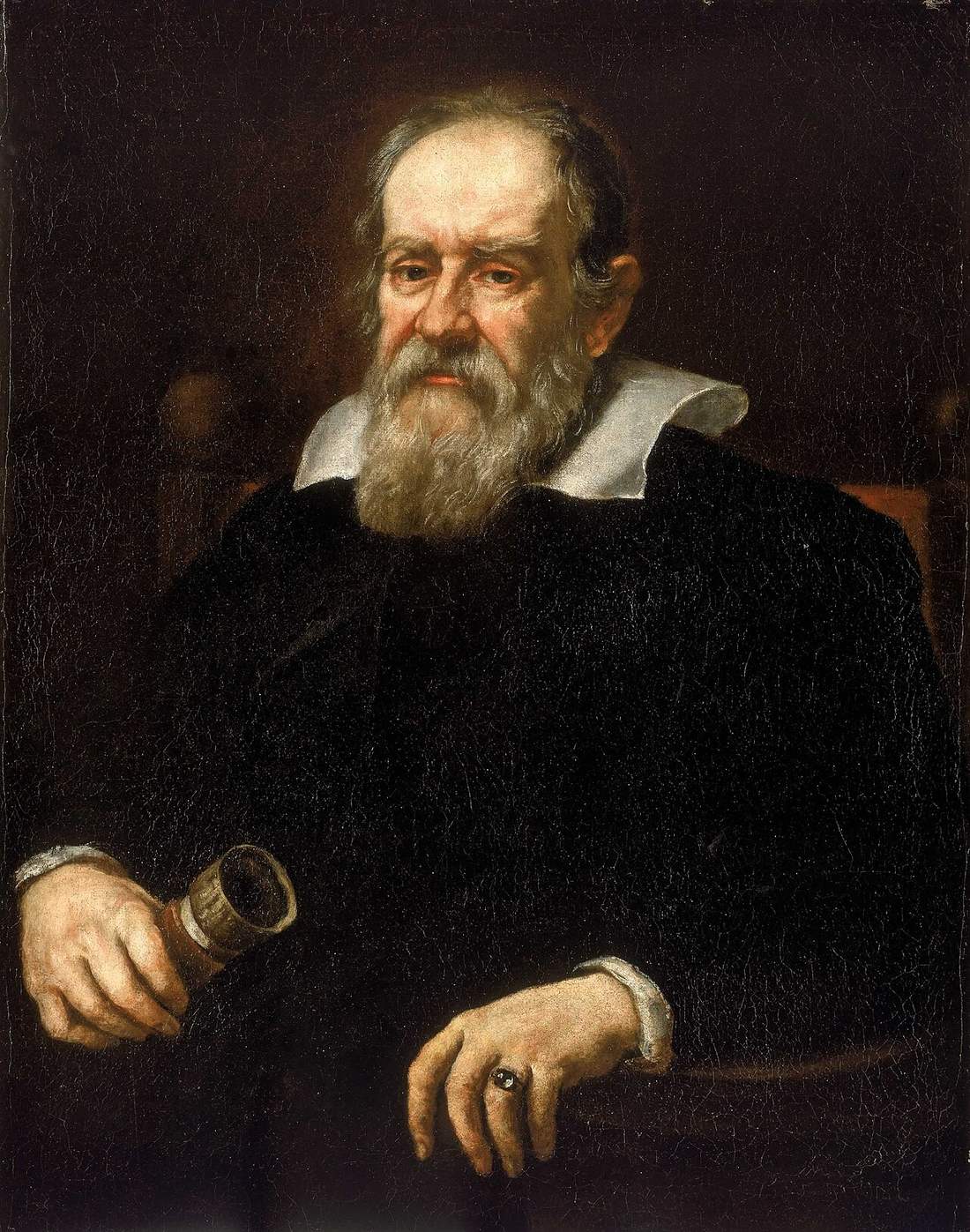
Galileo at 72 Painted by Justus Sustermans in 1636, three years into house arrest.
1564 Born in Pisa, son of a musician
1585 Leaves medical studies without a degree
1589 Teaches mathematics at Pisa
1592 Moves to Padua — eighteen years there
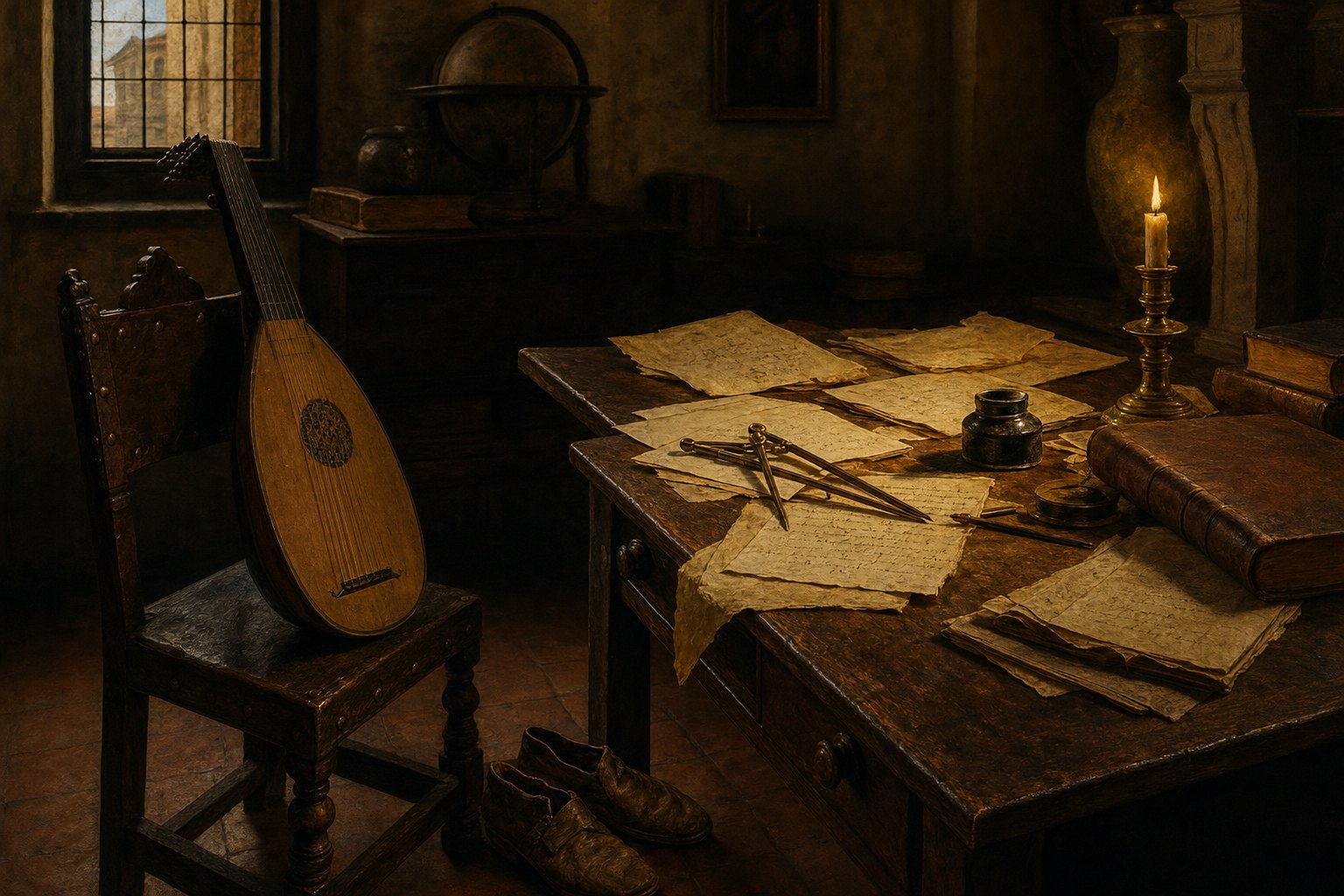
Before he was famousA working life Lute, compasses, lecture notes: he taught, tutored and sold instruments to make the rent.
Chapter I · Step 2
A mathematician who needed money
Born in Pisa, 1564. Left medicine without a degree, taught mathematics at Pisa and then Padua from 1592, supported three children, and made instruments on the side.
The instrument was not his. A spectacle maker in the Netherlands applied for a patent in 1608, and the rumour reached Venice the next summer.
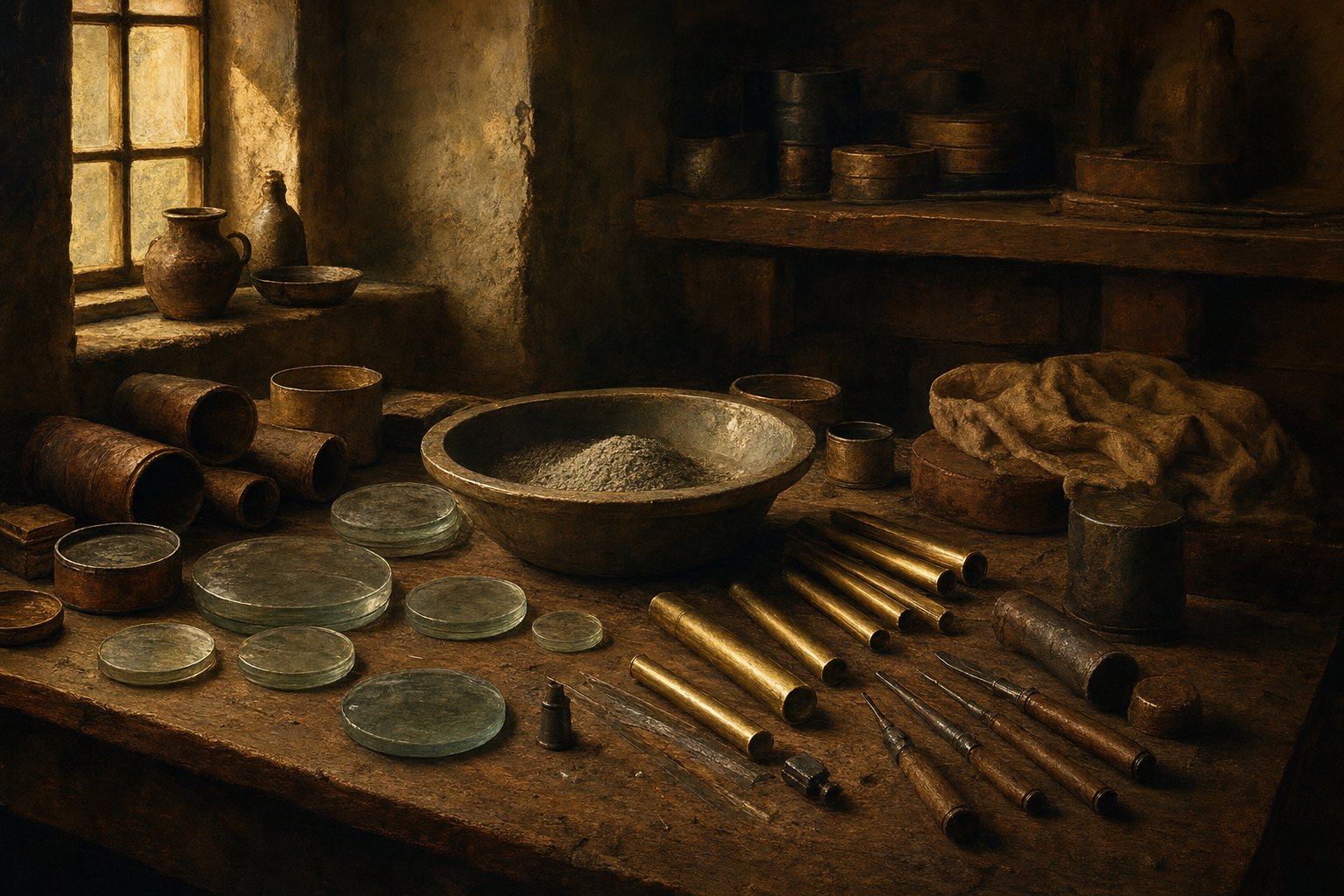
Galileo worked out what the arrangement had to be and started grinding glass. Within weeks he had better than the Dutch toys sold in the street.
On the twenty-fifth of August 1609 he showed the Venetian Senate ships two hours before the eye could see them. They doubled his salary.
By that winter he had reached twenty times. Press the buttons and see what each glass shows you.
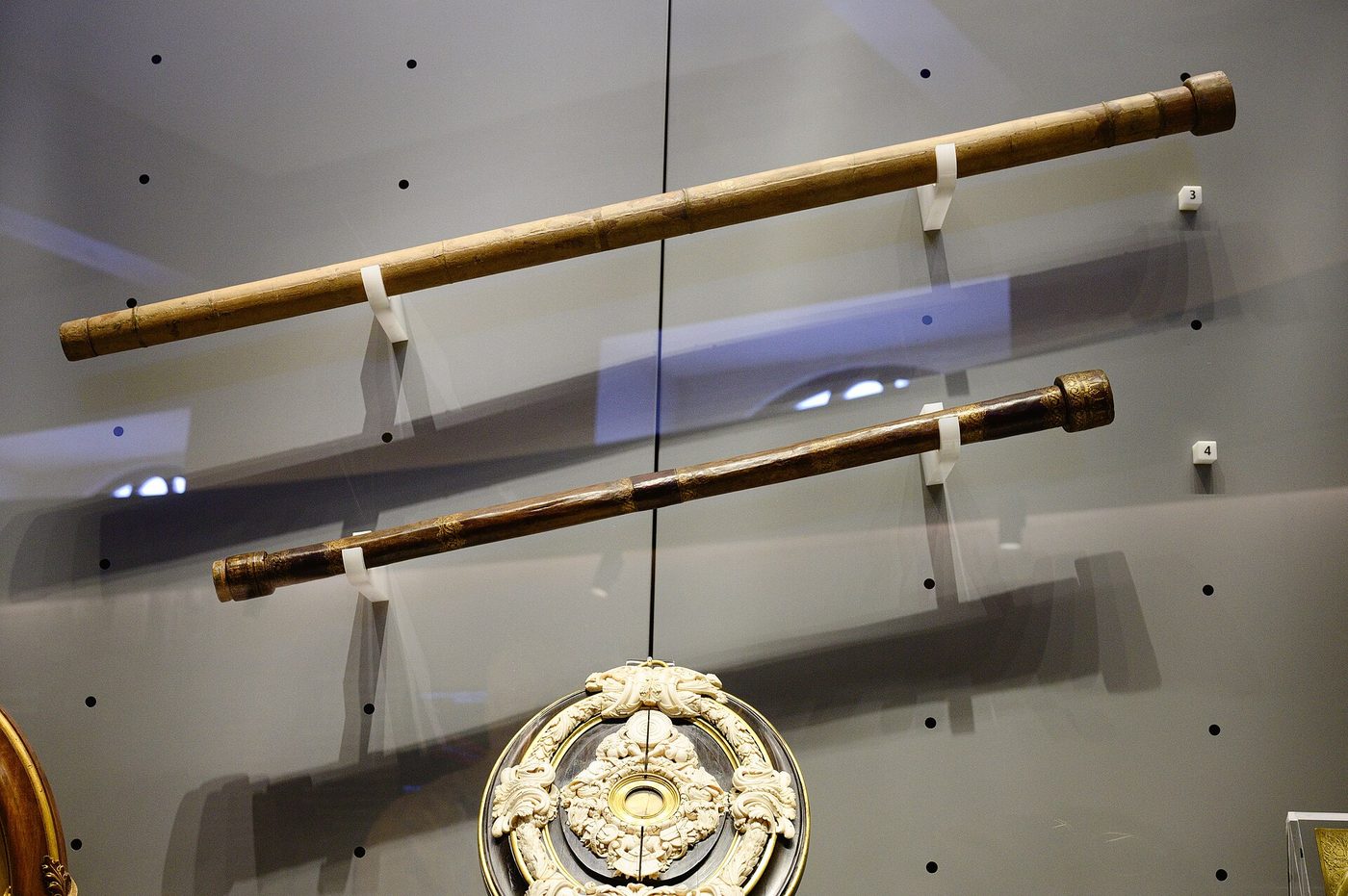
Grinding his own lenses He bought blank glass, ground and polished the curves himself, and sorted the good lenses from the bad.Two that survive Galileo’s own telescopes, kept in Florence. Wood, paper and leather tubes with a lens at each end.
8–9×
shown to the Venetian Senate, 25 Aug 1609
20×
the instrument of that winter
~30×
the best he ever reached
How strong a glass
Chapter II · Step 3 · Interactive
He grinds his own
The telescope was Dutch; a patent was applied for in 1608. Galileo worked out the design from the rumour, ground his own lenses, and in four months went from nothing to 20× — later about 30×.
25 Aug 1609 demonstrates an 8–9× glass to the Venetian Senate
Reward his salary at Padua is raised and his post made permanent
That winter a 20× instrument — the one he turns on the sky
Use the buttons on the scene to change the magnification. The view is a modern photographic map of the Moon, not Galileo’s own optics: his field of view was tiny, about a quarter of the Moon at a time, and the image shook.
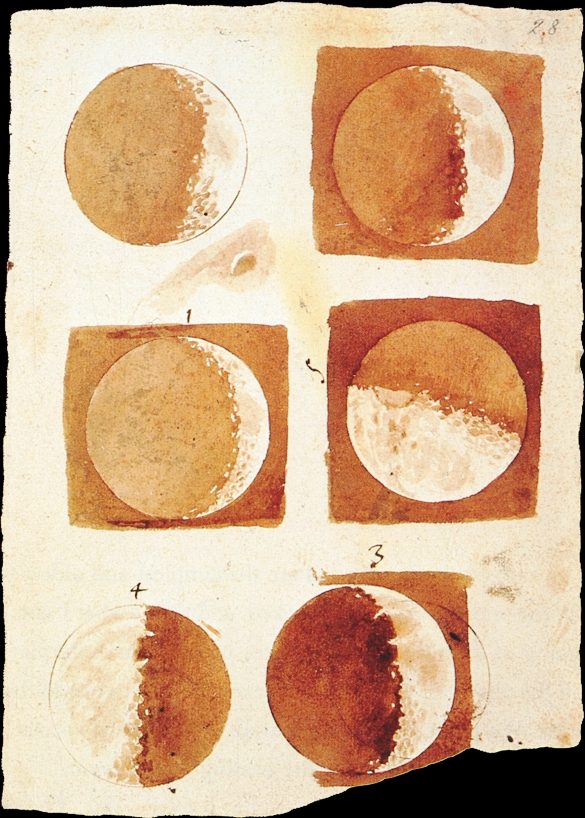
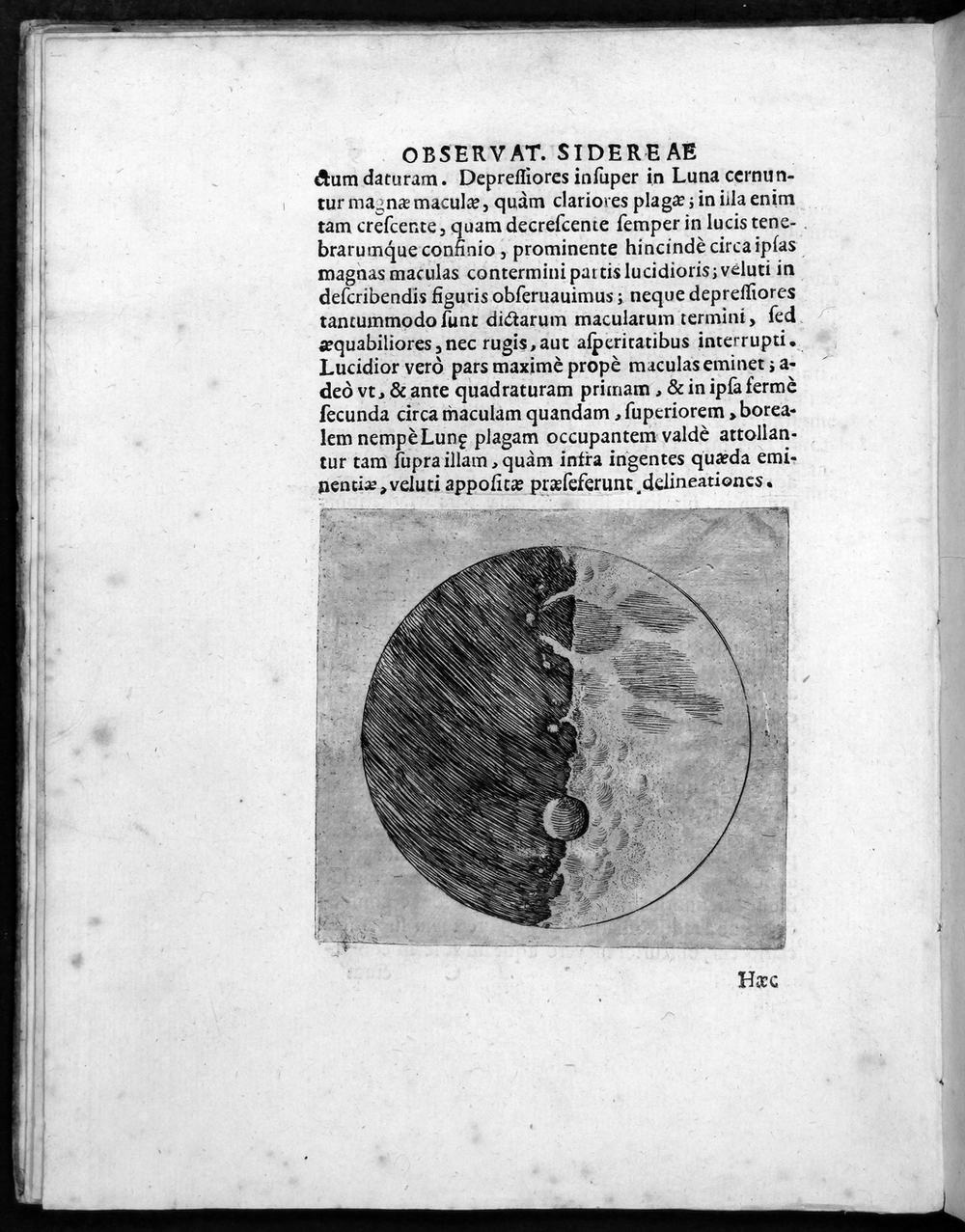
From the thirtieth of November to the eighteenth of December 1609 he drew the Moon, night after night.
The line between day and night was not the clean curve a smooth ball would give. It was ragged, bitten into.
Beyond it, single points of light appeared in the darkness and joined the lit side as the Sun rose on them. On Earth, that is what mountain tops do at dawn.
From how far those points stood from the line he worked out a height: at least four miles. The heavens were supposed to be perfect. He had just drawn their flaws.
His own hand, 1609 Galileo’s wash drawings of the Moon at six phases — the first drawings made through a telescope.h≈2Rd2
d
distance of the lit point from the day–night line
R
radius of the Moon
h
height of the peak catching the light
A lit point beyond the terminator must be a peak high enough to catch the Sun. Galileo measured d and got at least four miles.Printed, March 1610 The engraving as it appeared in Sidereus Nuncius: a ragged terminator and a crater on the day–night line.
Chapter II · Step 4
Mountains where there should be none
Drawing the Moon from 30 November to 18 December 1609, Galileo saw a ragged terminator and isolated lit points in the dark — sunlit peaks. He estimated lunar mountains at at least four miles high.
Nights of drawing
19
30 Nov – 18 Dec 1609
His estimate
≥ 4 miles
about 6 km
He was close. The Moon’s highest ground stands roughly 10 km above the mean surface, and the mountains near the terminator he measured are a few kilometres high.
On the seventh of January 1610 he turned the glass on Jupiter and saw three small bright points in a line beside it.
Fixed stars, he assumed. He wrote down where they were, which is the whole of the discovery.
The next night all three were on the same side. Stars do not do that. Press the buttons and run the nights yourself.
The seventh of January A notebook, an inkwell, and a very bright planet low in the east.
Three little stars, small but very bright, were near the planet.Sidereus Nuncius, 1610 (translated)
7 Jan 1610
three “stars” in a line
8 Jan
all three had moved to the other side
Two nights
Chapter III · Step 5 · Interactive
Three little stars
On 7 January 1610 Galileo recorded three bright points in a line beside Jupiter. On the 8th they had all moved to the other side. The discovery was in the writing down.
Press Next night to advance one night, or Run 30 nights to let them circle. The simulation uses the moons’ real orbital periods, seen edge-on as they are from Earth.
He watched every clear night. The points swung from one side of Jupiter to the other and never strayed far.
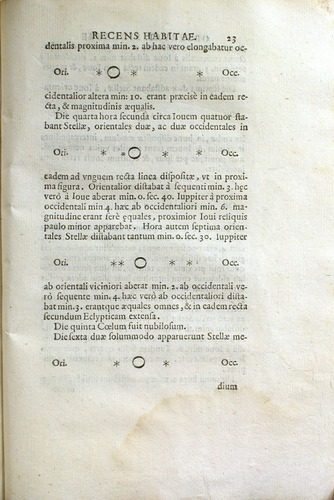
On the thirteenth of January a fourth appeared. His drawings are rows: a circle for Jupiter, little stars for the lights, one row per night.
What makes the pattern is four orbits of different lengths, from a day and three quarters for the innermost to nearly seventeen days for the outermost.
How he wrote it down Each line is one night: a circle for Jupiter, stars for the moons, east and west marked.
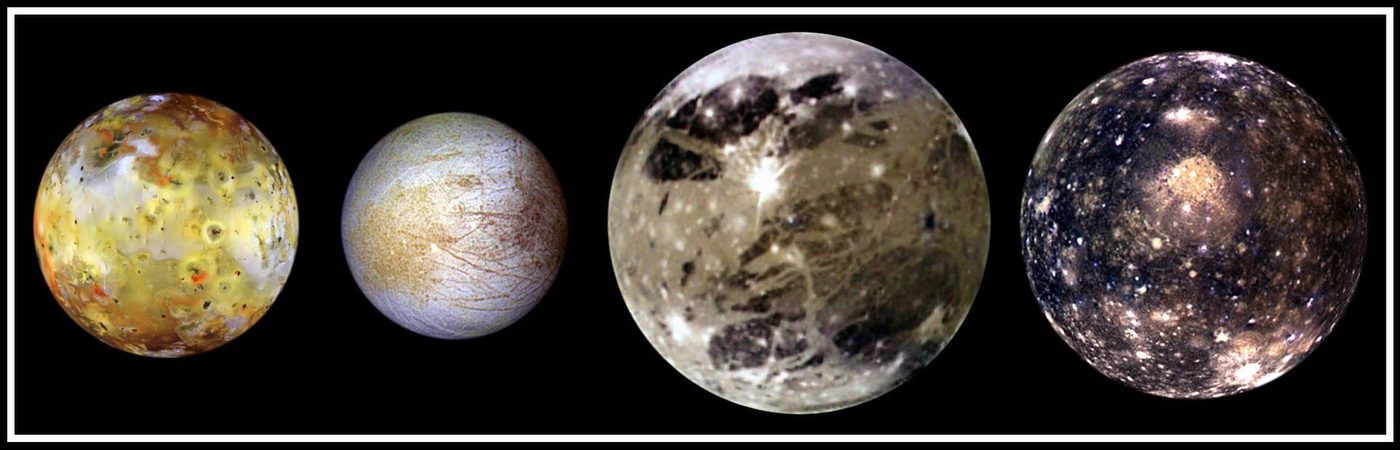
1.77 days Io, the fastest
3.55 days Europa
7.15 days Ganymede, larger than Mercury
16.69 days Callisto, the slowest
What sets the pattern
4
moons, by 13 January
~2 months
of nightly observations
The record
Chapter III · Step 6
A fourth appears
By 13 January 1610 there were four. Each night Galileo drew one row — Jupiter as a circle, the moons as little stars — and the rows read as a motion.
Io 1.77 days
Europa 3.55 days
Ganymede 7.15 days — the largest moon in the Solar System
The conclusion is short. The lights never leave Jupiter and they swing from side to side. Therefore they go around Jupiter.
So the Earth is not the one centre that everything turns about. There is at least one more.
That did not prove the Earth moves. It removed the strongest objection, that a moving Earth would leave its own Moon behind. Here was a moving planet keeping four.
They never leave Jupiter
They swing to one side, then the other
So they go around it
So not everything goes around the Earth
The argument, in four lines
1
centre of motion, said the old picture
2
centres, said the notebook
What changed
Chapter III · Step 7
Not everything circles us
Four bodies orbiting Jupiter meant the Earth was not the only centre of motion. It did not prove the Earth moves — but it destroyed the objection that a moving planet must lose its moons.
The moons were named the Medicean Stars after Cosimo II de’ Medici. The dedication won Galileo the post of philosopher and mathematician to the Grand Duke of Tuscany, and the freedom to stop teaching.
Sidereus Nuncius, the starry messenger, went on sale in Venice in March 1610: twenty-four pages, about five hundred and fifty copies, gone almost at once.
Wherever he pointed the glass there were more stars. Six in the Pleiades became thirty-five. Nine around the belt of Orion became eighty.
The Milky Way came apart into separate stars.
Then, from September 1610, Venus showed phases like the Moon, from a small full disc to a large crescent. In the old Earth-centred arrangement that is impossible.
Printed in weeks Sidereus Nuncius — The Starry Messenger — twenty-four pages, 550 copies, sold out almost at once.
Pleiades, by eye
6
Pleiades, through the glass
35
Orion’s belt and sword, by eye
9
Orion, through the glass
80
How many stars are there?
The Milky Way resolves into separate stars
Venus shows phases, full to crescent
So Venus must circle the Sun, not the Earth
And then, later in 1610
Chapter IV · Step 8
The little book
Sidereus Nuncius, published in Venice on 13 March 1610: twenty-four pages, about 550 copies, sold out immediately and reprinted. Europe could check every claim for the price of a lens.
Pleiades
6 → 35
naked eye → telescope
Orion
9 → 80
Venus
full → crescent
from September 1610
The phases of Venus ruled out Ptolemy’s arrangement for good. They did not prove Copernicus: Tycho Brahe’s hybrid model, with the planets circling the Sun and the Sun circling the Earth, fitted them too.
Twenty years before the telescope he had been working on how things fall.
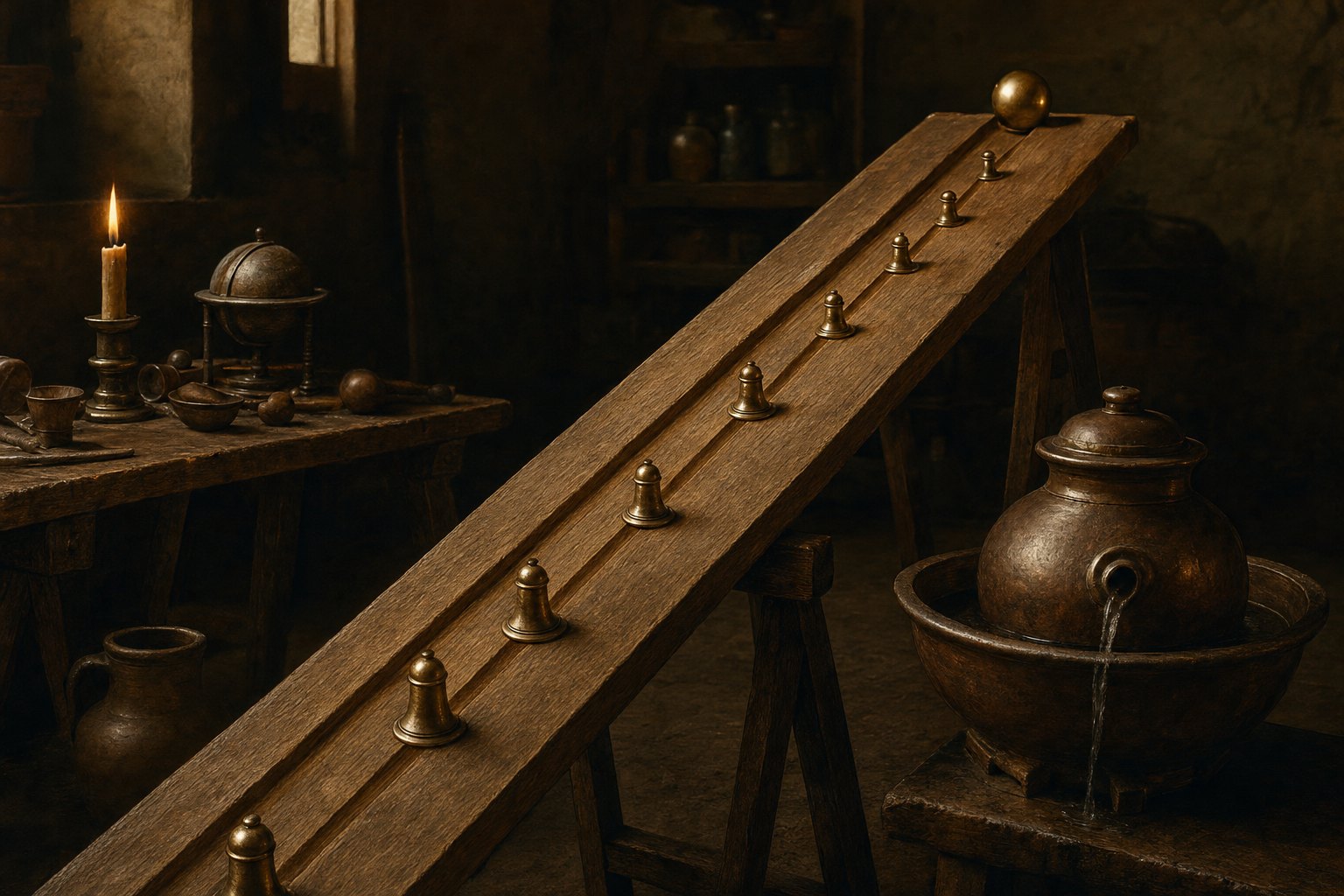
Falling is too fast to time with a pulse, so he diluted gravity: a straight groove in a long plank, one end raised a little, a bronze ball rolling down.
For a clock he used water. A vessel with a thin spout poured while the ball rolled, and he weighed the water afterwards. Equal weights meant equal times.
The distances went one, four, nine, sixteen: the squares. The gaps between them went one, three, five, seven: the odd numbers. Set the slope and release the ball.
The grooved ramp A straight channel, a bronze ball, and a vessel of water to measure time by weight.d=21at2
d
distance rolled
t
time since release
a
steady acceleration
Distance grows as the square of the time: 1, 4, 9, 16.
1 : 3 : 5 : 7
distances covered in equal ticks
1 : 4 : 9 : 16
total distance after each tick
The odd numbers
Chapter V · Step 9 · Interactive
Slow the fall down
A ball rolling down a gentle groove falls in slow motion. Galileo timed it with a water clock and found that distance grows as the square of the time: 1, 4, 9, 16 — gaps of 1, 3, 5, 7.
Press a slope, then Release. The bells mark 1, 4, 9 and 16 units of distance; the ball should ring them at evenly spaced ticks. Published in Two New Sciences (1638); the apparatus here is schematic.
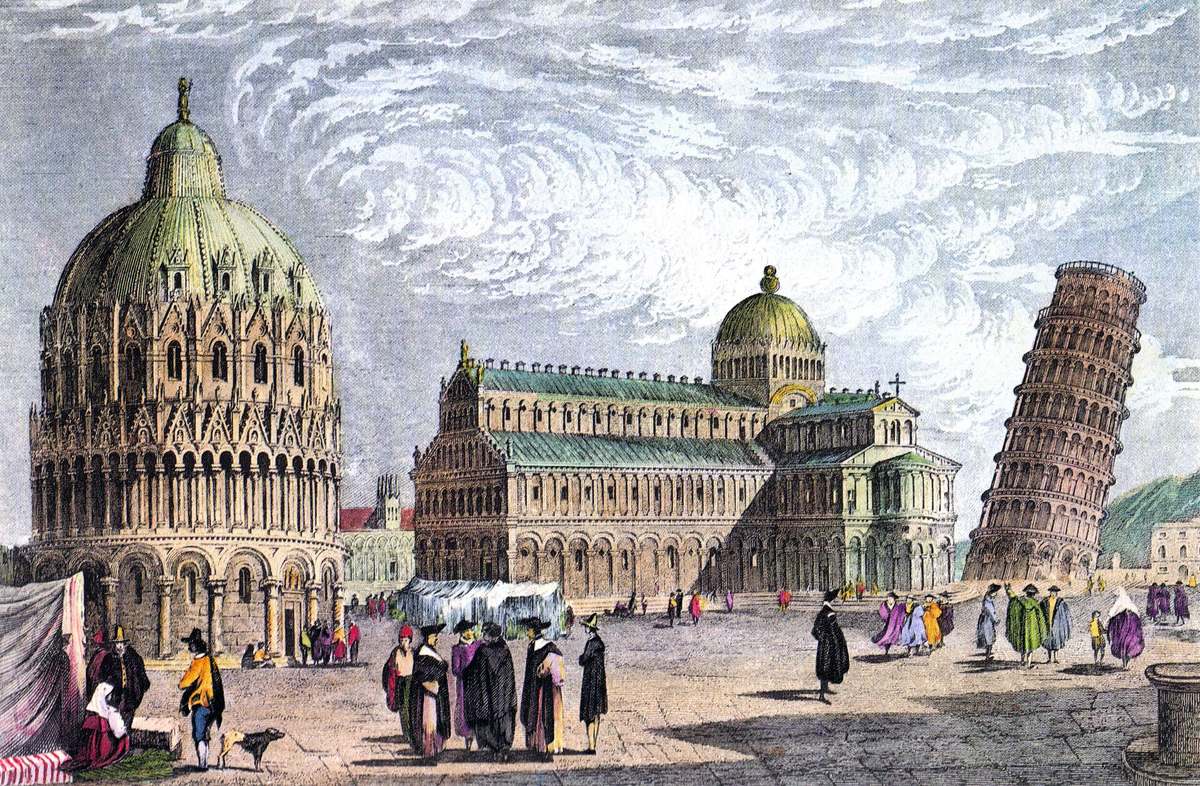
Everyone knows the story: two balls dropped from the Leaning Tower of Pisa, landing together.
It comes from a biography by his pupil Viviani, written decades later. Galileo never describes doing it. The careful work is the ramp, repeated.
And he was honest about the air. In a hundred-cubit fall, he wrote, a gold ball would beat a copper one by perhaps four fingers, not by the lengths Aristotle required.
The tower story Pisa in a 19th-century print. The tower drop is told by Galileo’s pupil Viviani, long after; Galileo never described doing it.
Heavier does not mean faster
Air resistance explains most of what people saw
Motion keeps itself unless something stops it
What he actually argued
The variation of speed in air between balls of gold, lead, copper and other heavy materials is so slight that in a fall of 100 cubits a ball of gold would surely not outstrip one of copper by as much as four fingers.Two New Sciences, 1638 (translated)
Chapter V · Step 10
The tower he may never have climbed
The Leaning Tower demonstration comes from Viviani’s biography, written decades later. There is no account by Galileo. The real evidence is the ramp, repeated.
His claim was not that a feather falls like a stone in air — he said plainly that it does not. It was that the difference comes from the air, and that in its absence all bodies fall alike.
The trouble was not the moons. It was what he said they meant.
In February 1616 Cardinal Bellarmine ordered him to abandon the opinion that the Earth moves: not to hold it, not to defend it, not to teach it.
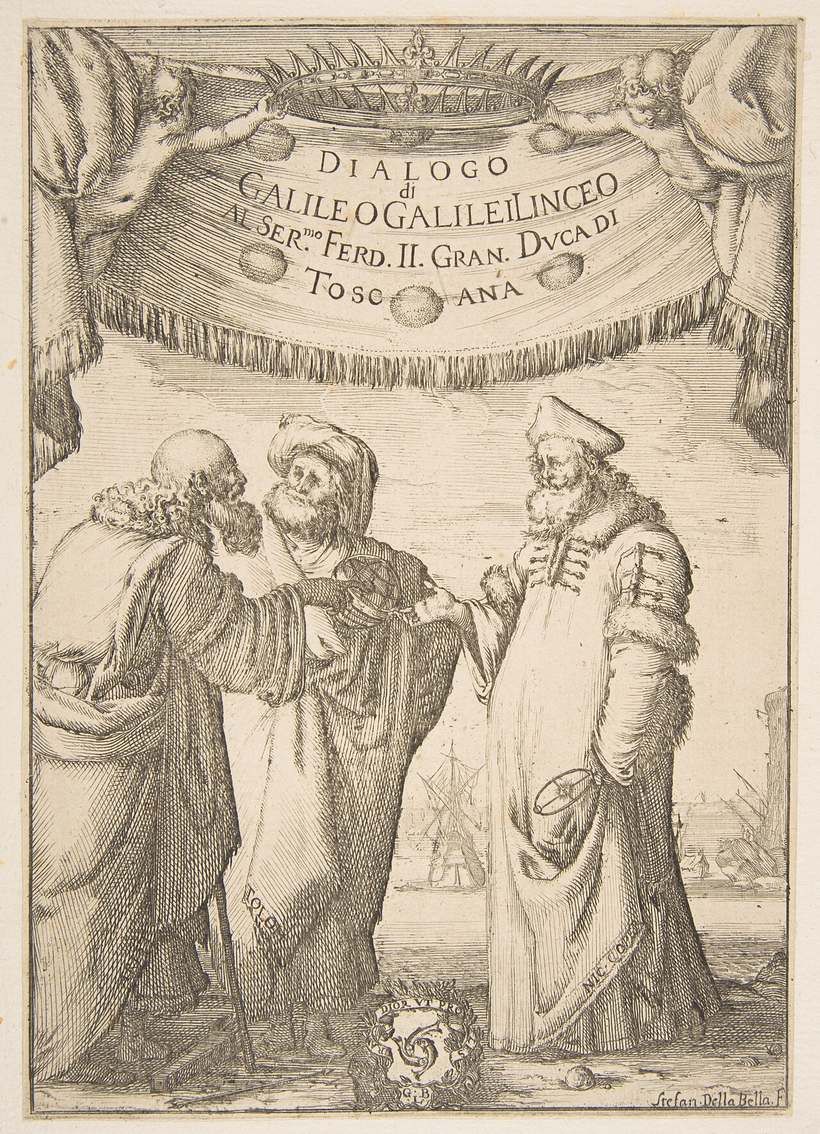
In 1632, with a licence from the censors, he published a dialogue on the two systems of the world. The defender of the old order gets the weakest arguments and the name Simplicio.
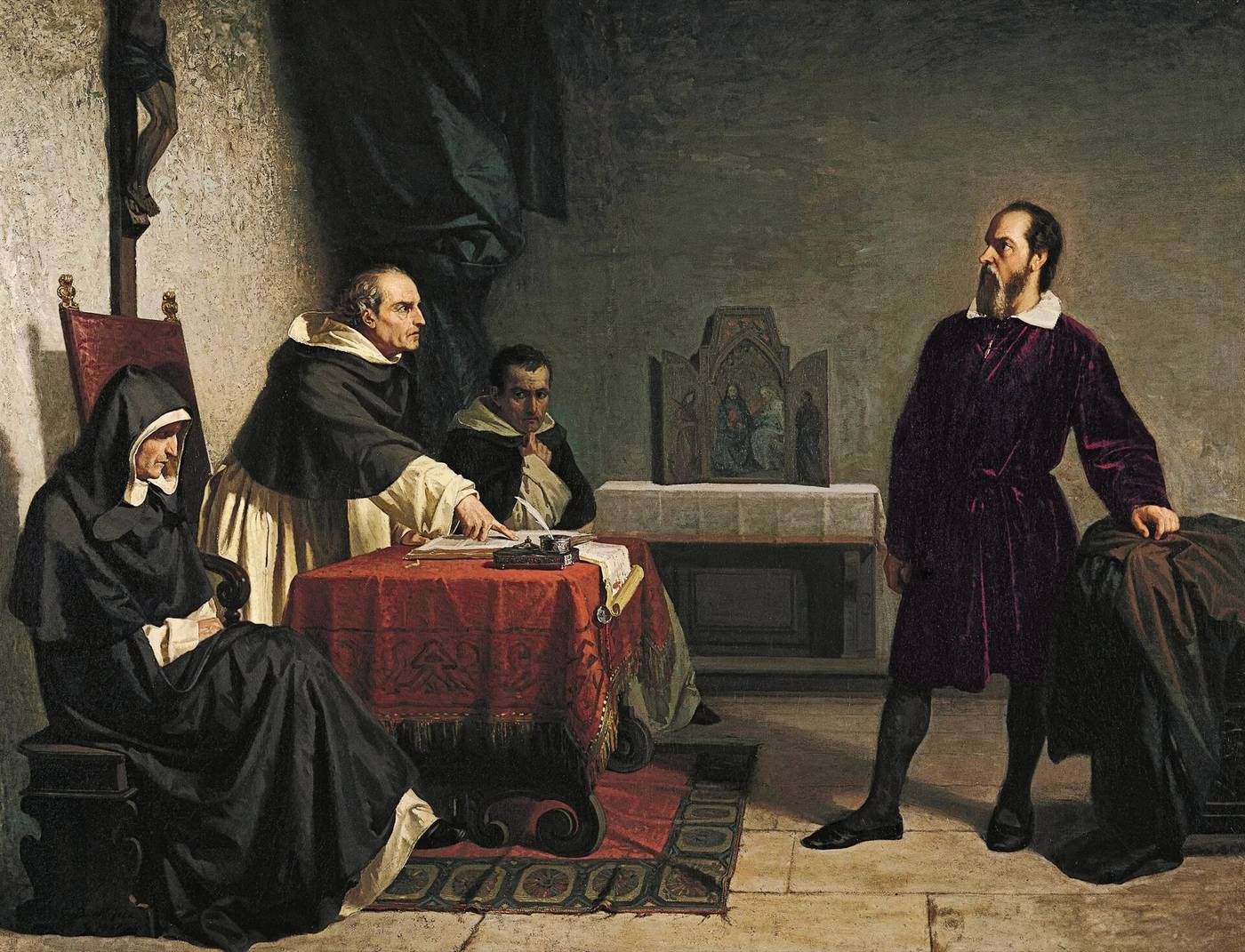
In June 1633, at sixty-nine, he was tried, found vehemently suspect of heresy, and knelt to abjure. Prison became house arrest the next day.
The line everyone quotes, and yet it moves, first appears about a century after his death.
The book that did it Dialogue Concerning the Two Chief World Systems, 1632: three speakers argue, and the defender of the old system loses every round.
26 Feb 1616 Ordered not to hold or defend the Earth’s motion
1632 Publishes the Dialogue, with a licence
22 Jun 1633 Sentenced: “vehemently suspect of heresy”
23 Jun 1633 Prison commuted to house arrest
Seventeen yearsImagined, two centuries later Cristiano Banti painted this scene in 1857. No eyewitness picture of the trial exists.
Chapter VI · Step 11
Told to stop
26 February 1616: ordered not to hold, defend or teach that the Earth moves. 1632: publishes the Dialogue anyway, with a licence. 22 June 1633: sentenced as “vehemently suspect of heresy”, imprisonment commuted the next day to house arrest.
“Eppur si muove” — and yet it moves — is first recorded roughly a century after his death. There is no evidence that he said it.
He spent the rest of his life in a villa at Arcetri, forbidden to publish and watched.
And there he wrote the book physicists still read. Two New Sciences is the work of a lifetime on materials and motion: the ramps, the squares of the time, the beginnings of inertia.
It could not be printed in Italy. The manuscript went north and was published in Leiden in 1638. By then he was blind. He died at Arcetri on the eighth of January 1642, still a prisoner.
The last nine years House arrest in a villa outside Florence, visitors controlled, publication forbidden.
1633 Confined to the villa at Arcetri
1638 Two New Sciences smuggled out, printed in Leiden
1638 Blind in both eyes
8 Jan 1642 Dies at Arcetri, aged 77
After the sentence
1638
the book he wrote while silenced
Leiden
printed where the Inquisition could not reach
Two New Sciences
Chapter VI · Step 12
The best book he ever wrote
Confined at Arcetri, Galileo wrote Two New Sciences — materials and motion — and had it smuggled out and printed in Leiden in 1638. He was blind by then, and died on 8 January 1642.
That book, not the Dialogue, is the one that fed the next century: uniform acceleration, the times-squared law, and the idea that motion persists by itself.
The moons turned out to be useful. Their eclipses behind Jupiter are a clock in the sky, and Galileo spent years trying to sell it as a way of finding longitude at sea.
In 1676 Ole Rømer noticed that the clock ran late when Earth was far from Jupiter, and realised the delay was the travel time of light. It was the first sign that light has a speed at all.
Newton took the law of fall and built the law of gravity on top of it. In 1992 the Vatican closed its review of the case and acknowledged that the theologians had been wrong.
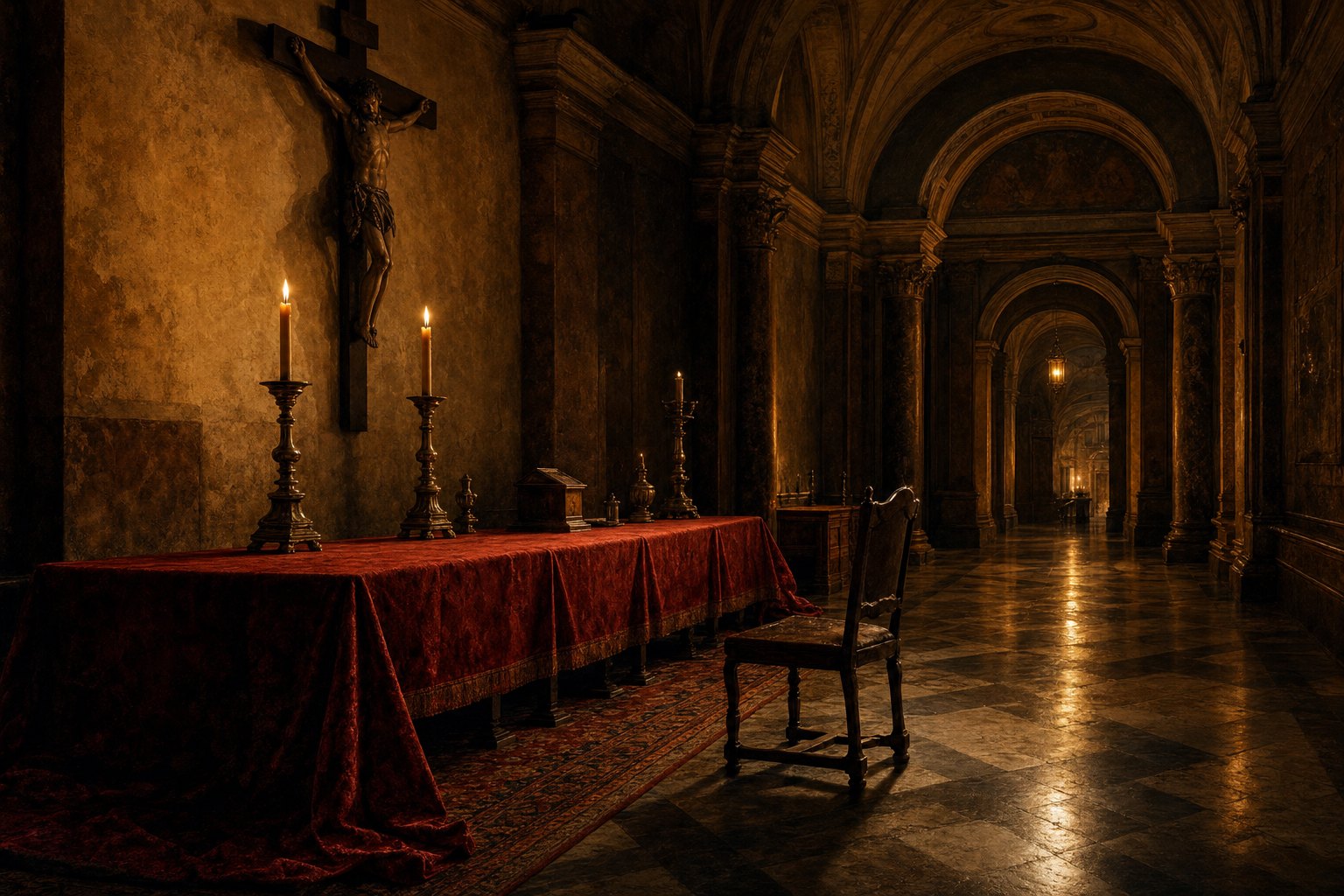
Two spacecraft are on their way to those four lights now. The chapter stills in this film are AI-generated; the drawings, printed pages, paintings and photographs are real. Sources are listed below.
The four, photographed Io, Europa, Ganymede and Callisto at their true relative sizes, imaged by NASA’s Galileo spacecraft.
1676 Rømer times Io’s eclipses and finds light is not instant
1687 Newton builds on Galileo’s law of fall
1992 The Vatican closes its review of the case
2023–24 Juice and Europa Clipper launch for those moons
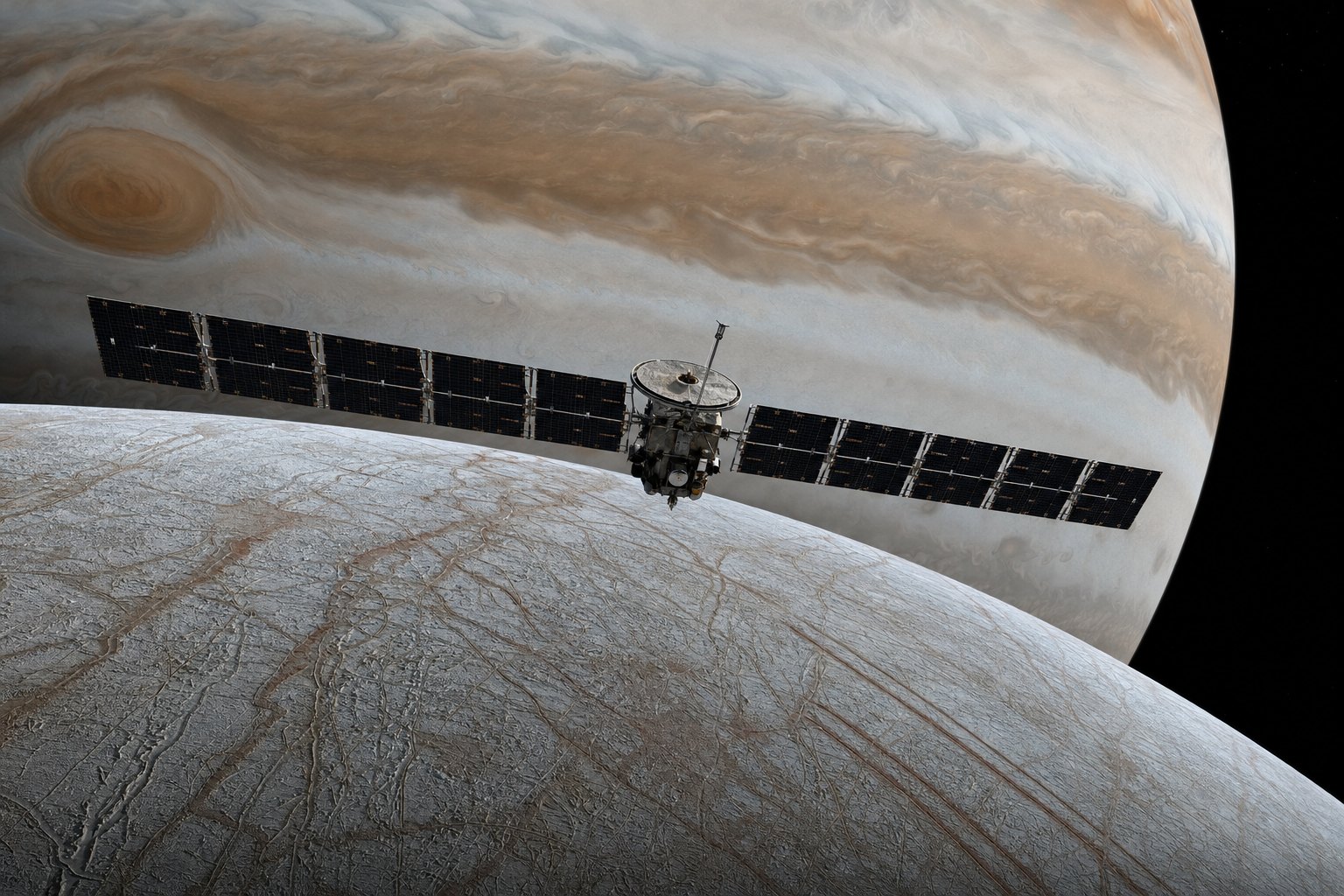
What the four lights becameGoing there Two spacecraft are now on their way to the moons Galileo found in a notebook.
Epilogue
What the four lights became
Galileo’s moons became a clock, and the clock gave the first measurement of the speed of light (Rømer, 1676). His law of fall became the foundation under Newton. Two spacecraft are flying to those moons now.
1676 Rømer: light takes about 22 minutes to cross the Earth’s orbit
1687 Newton’s Principia builds on uniform acceleration
Nov 1992 John Paul II closes the Church’s review of the case
2023 / 2024 ESA’s Juice and NASA’s Europa Clipper launch for the Galilean moons
Chapter stills in this film are AI-generated illustrations. Galileo’s Moon drawings, the pages of Sidereus Nuncius, the 1632 frontispiece, the 1636 portrait, the 1857 painting of the trial and the spacecraft photograph of the four moons are real historical images, credited where they appear.