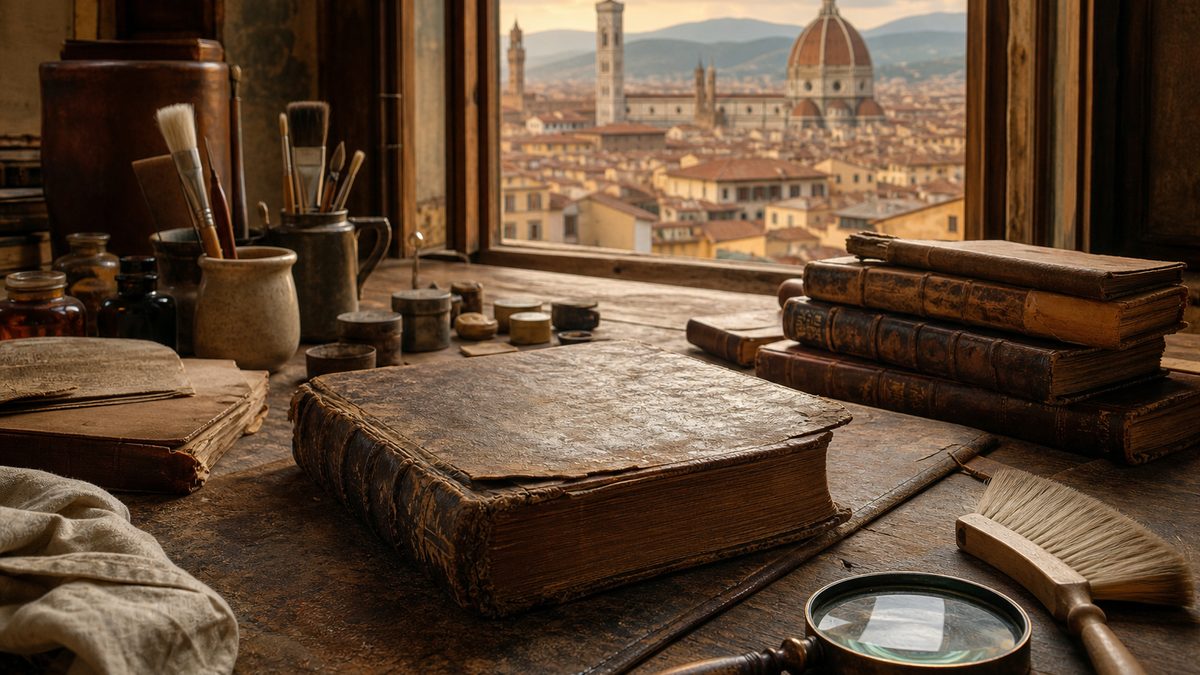
On 4 November 2026 Florence marked sixty years since the Arno flood of 1966. This film explains what happened that night, why mud and heating oil made it so damaging, and the science that rescuers used and invented: drying wooden panels slowly under paper, detaching frescoes, racing mould in a million wet library books, freezing and freeze-drying, and the idea of phased preservation that the flood gave the world’s libraries and museums.
Interactive 3D film10 min1966 to 2026Published 5 November 2026
How Florence’s flood changed the way the world saves art.
On the fourth of November 2026, Florence gathered at the Palazzo Vecchio to remember a night sixty years earlier.
In 1966, the river Arno burst its banks and filled one of the world’s great cities of art with water, mud and oil.
Saving what it soaked took decades, and it changed the science of looking after paintings and books everywhere.
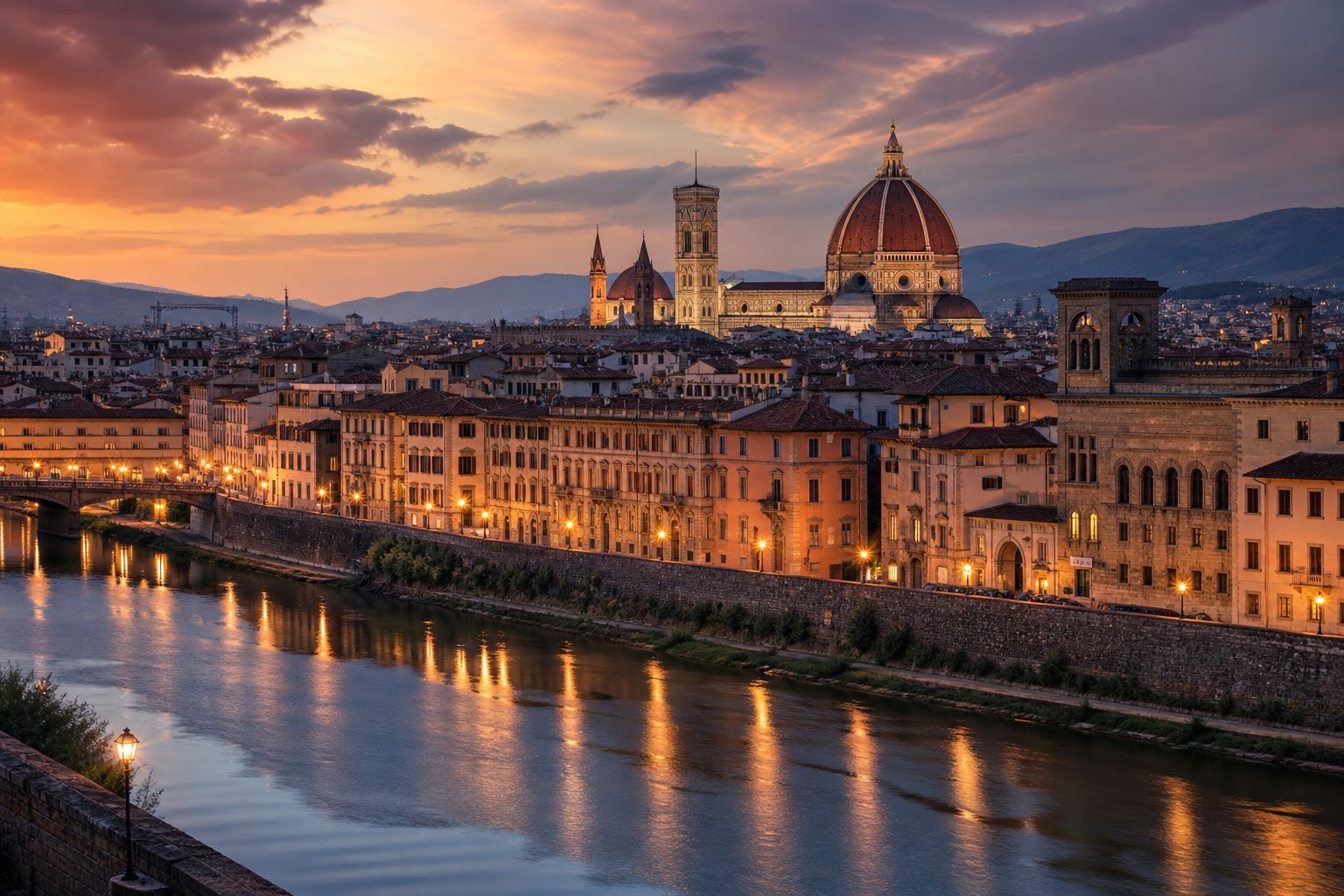
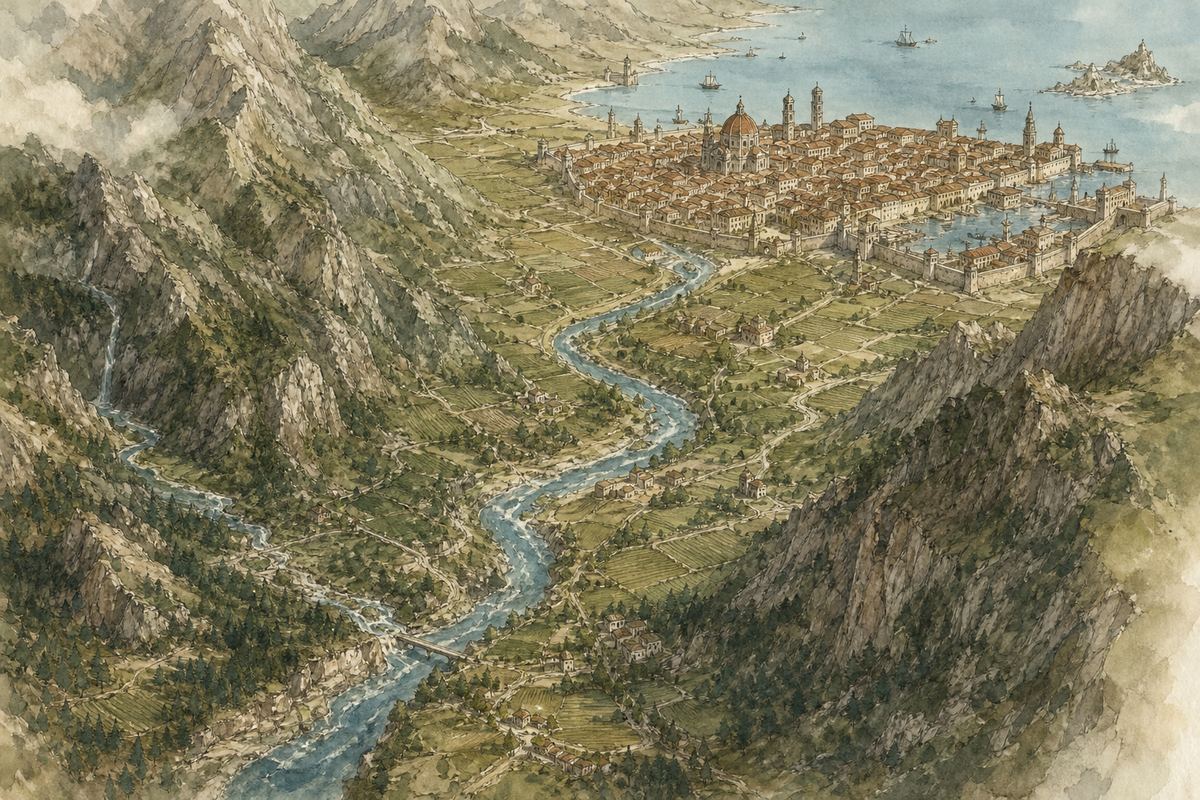
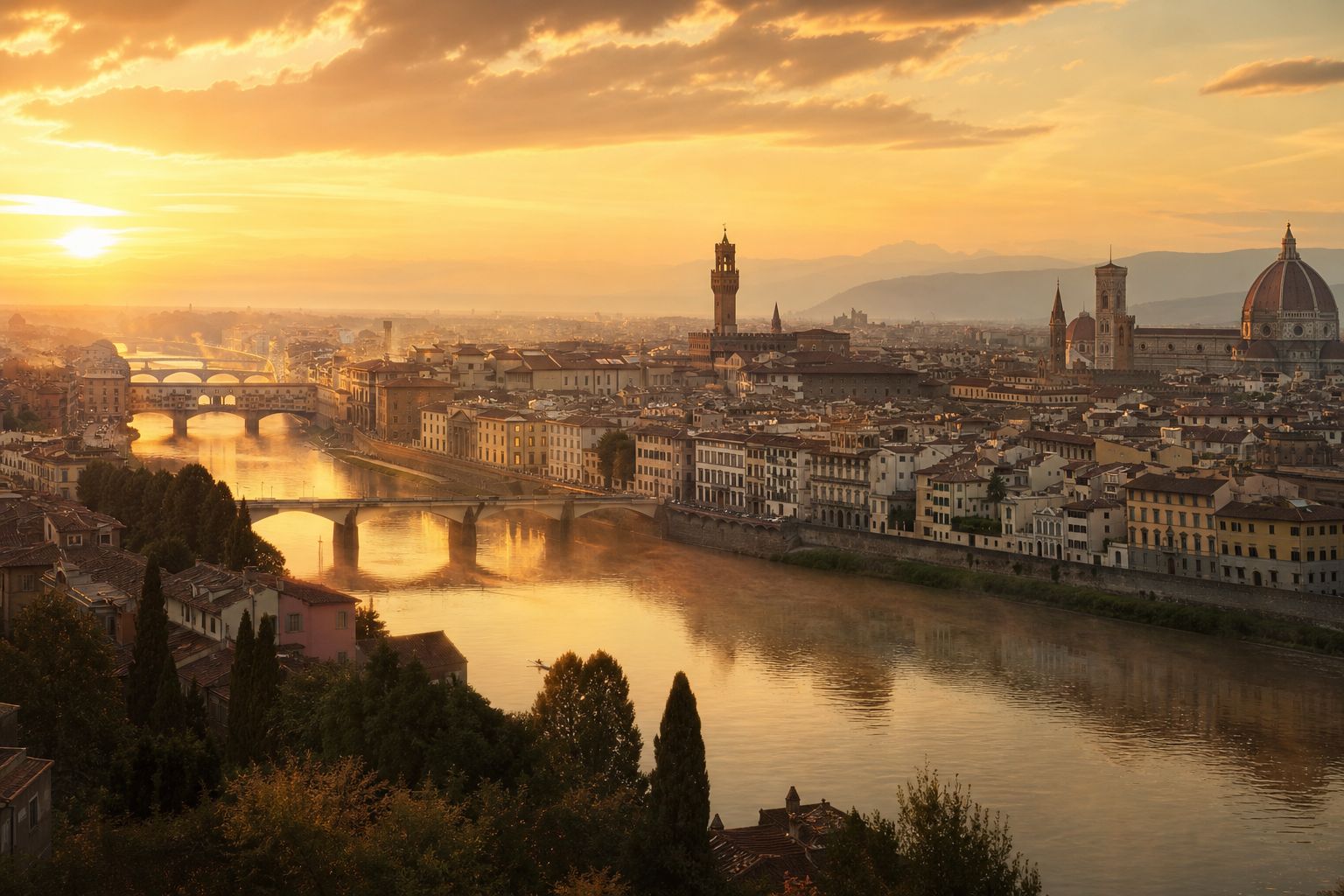
Florence on the Arno The city and its river at dusk. AI-generated illustration, not a photograph of the real work or place.
60
years since 4 November 1966
70
countries the volunteers came from
The anniversary (UniFi, The Florentine)
the night of the flood
saving the paintings
a million wet books
what the world learned
Coming up
Prologue
The 60th anniversary
The Florentine (10 July 2026): the city of Florence, the Region of Tuscany, the University of Florence and the Metropolitan City signed a memorandum for the 60th anniversary; the official commemoration is on 4 November 2026 at Palazzo Vecchio, with an exhibition in the Sala d’Arme. University of Florence: volunteers came from 70 countries to help after the flood.
The 3D scenes are simplified teaching models, not to scale; the panel and books are generic, not real works.
The last ten days of October 1966 had already been very wet. The ground and the rivers were full.
Then a stationary weather front stalled over the Apennine mountains. In forty-eight hours, one station in the upper Arno valley measured four hundred and thirty-seven millimetres of rain.
Steep valleys carried it all quickly into the Arno. By the early hours of the fourth of November, the river was carrying around four thousand cubic metres of water every second.
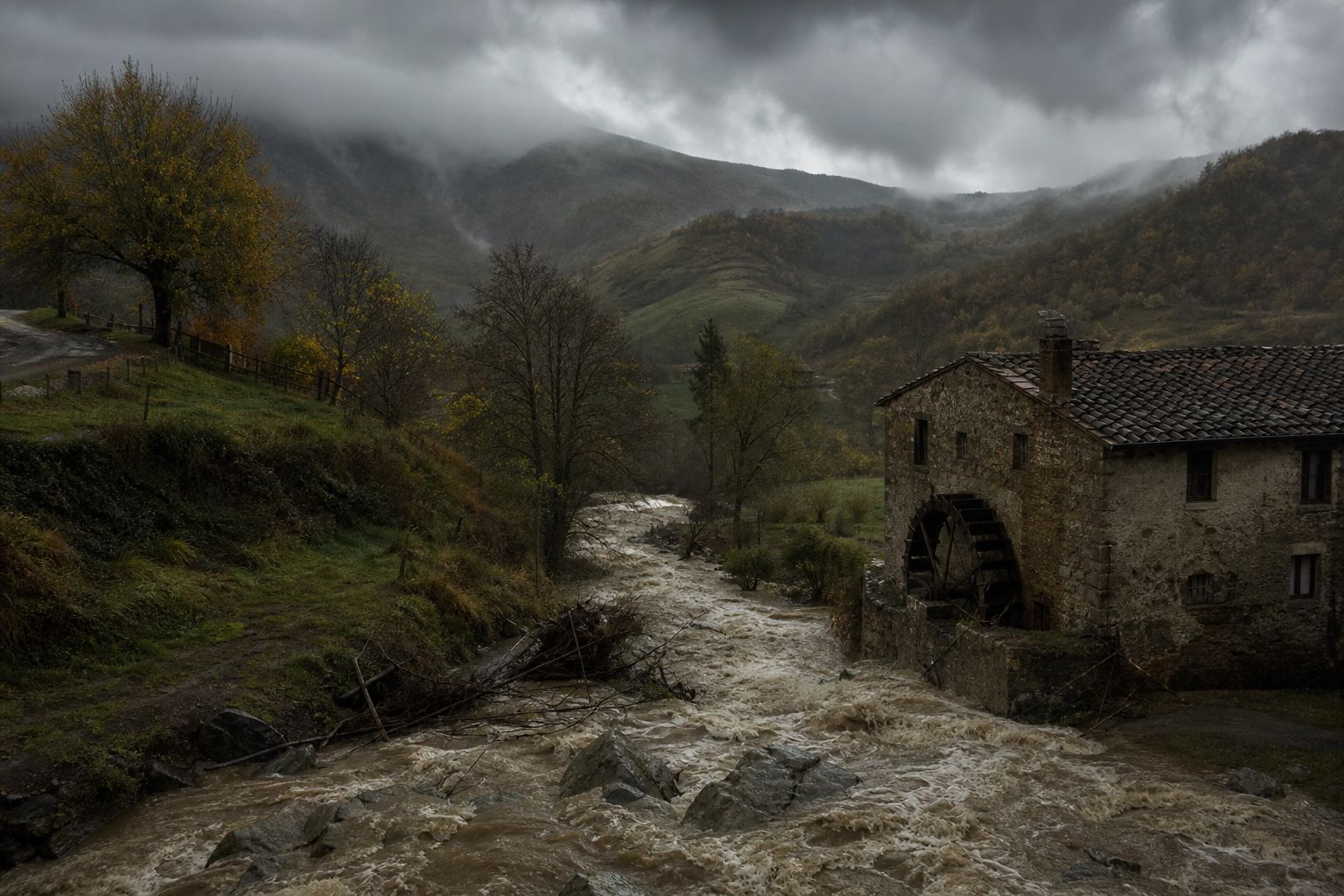
The Apennines Autumn rain over steep Tuscan hills. AI-generated illustration, not a photograph of the real work or place.
437 mm
in 48 hours at Badia Agnano
+188%
above normal, last ten days of October
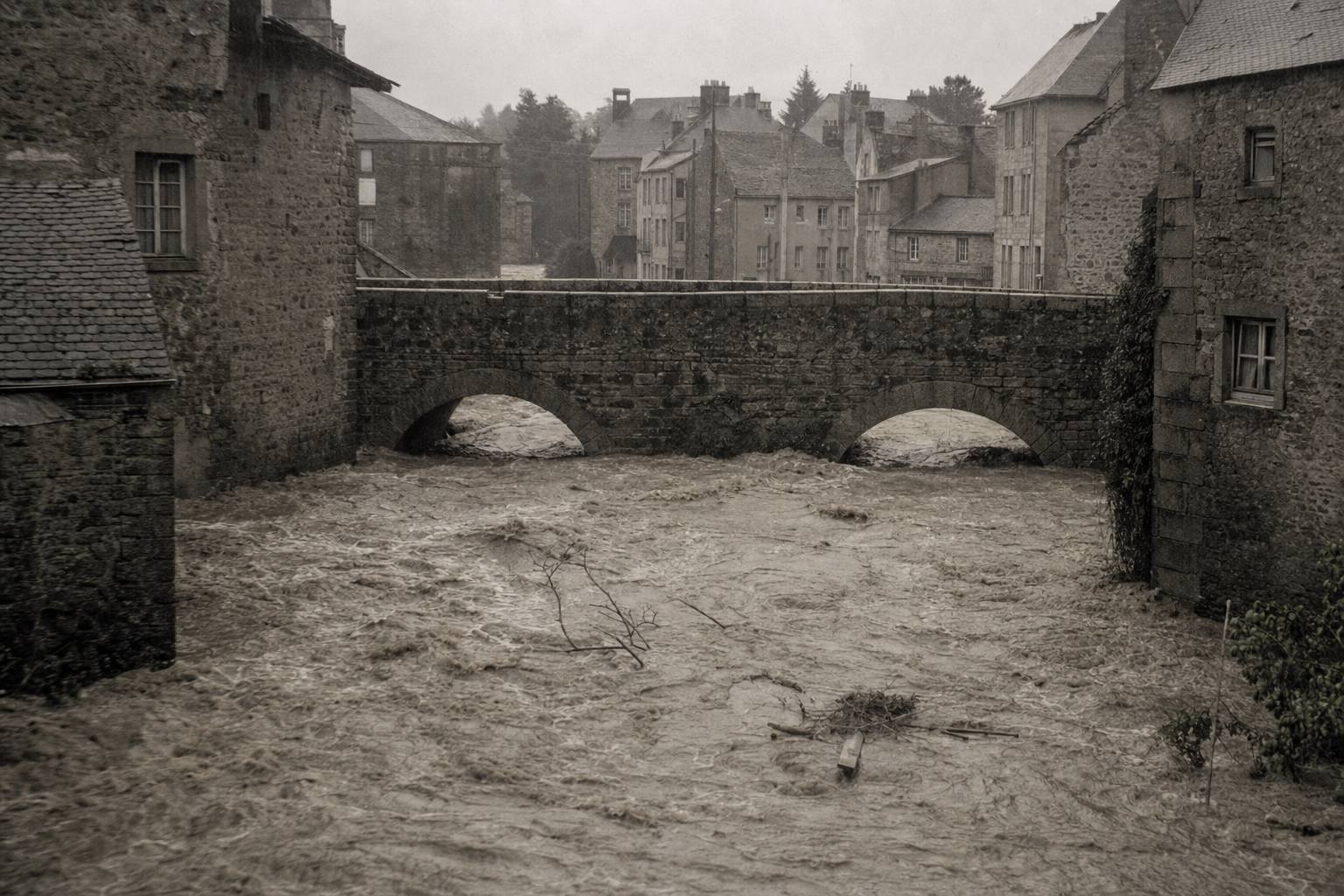
Rain, 1966 (Geopop)The river in spate The Arno is reckoned to have carried some six hundred thousand tonnes of mud into the city. AI-generated illustration, not a photograph of the real work or place.A fast river The Arno runs 240 km from Monte Falterona to the sea. AI-generated illustration, not a photograph of the real work or place.
~4,000 m³/s
around 3 a.m., 4 November
Peak flow (Geopop)
Chapter I · The flood
The rain
Geopop (meteorological analysis): rain in the last ten days of October 1966 was 188% above normal, leaving soils and basins saturated; a stationary cold front pushed moist air up the Apennines; Badia Agnano in the upper Valdarno recorded 437.2 mm in 48 hours (338.7 mm in 24 hours); Florence itself had about 180–200 mm; the Arno peaked at about 4,000 m³/s around 3 a.m. on 4 November. Britannica: the Arno is about 240 km long, rising on Monte Falterona, with a basin of 8,247 km².
The 3D scenes are simplified teaching models, not to scale; the panel and books are generic, not real works.
At about two thirty in the morning, the Arno broke its banks on the edge of the city. There was no flood-warning network, so most people had no warning.
By morning, the Uffizi says, the water was more than five metres deep in the Gavinana district. In the centre, in the Santa Croce quarter, the highest flood plaque marks four point nine two metres.
The water drained away on the sixth of November. About thirty-five people died in Florence and its area, according to Italy’s civil protection department, and many thousands lost their homes.
~2:30 a.m. Arno breaks its banks at Nave a Rovezzano (Uffizi)
morning districts under 3–5 m of water
6 Nov the water drains away
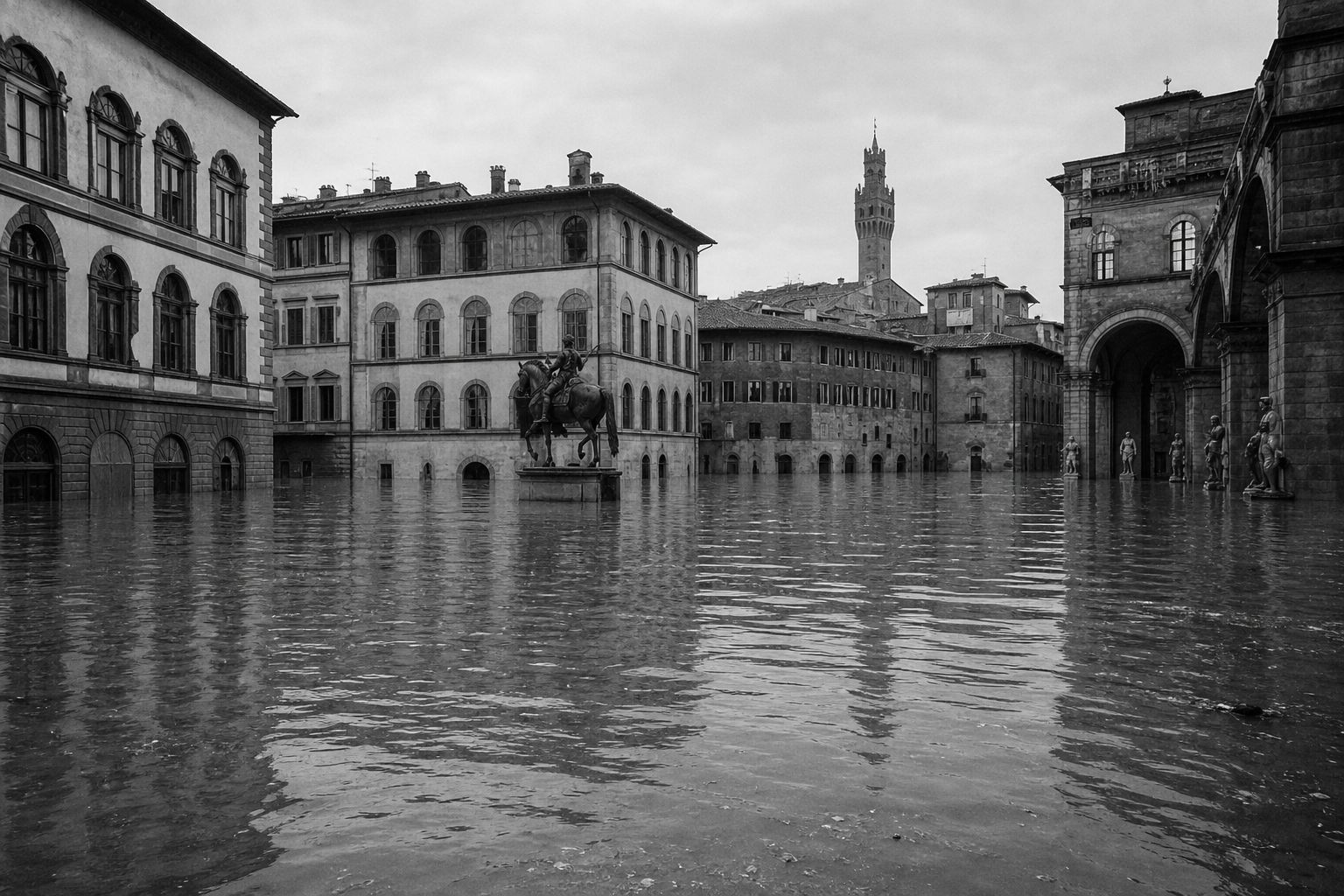
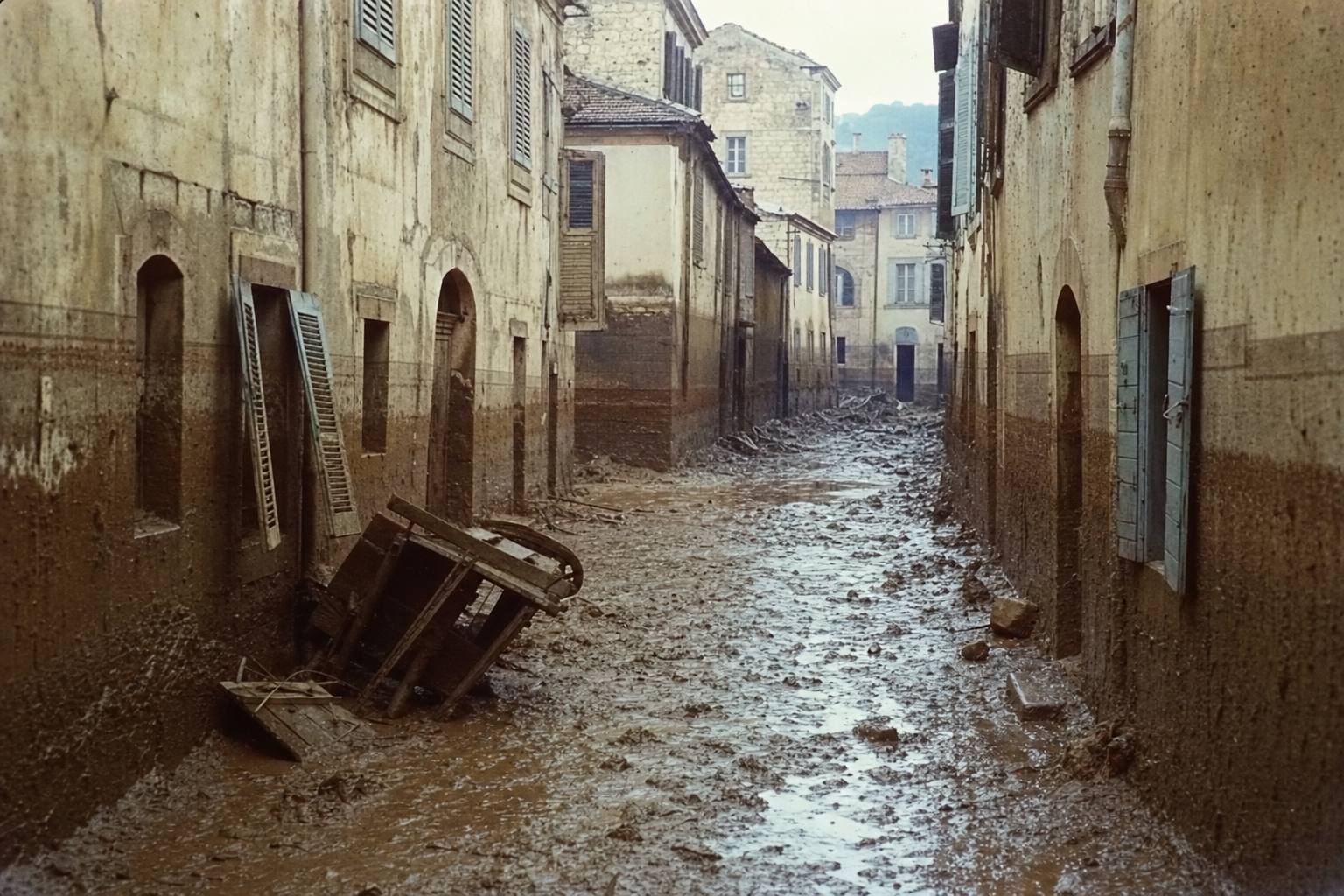
4 November 1966A drowned square Muddy water up to the first-floor windows. AI-generated illustration, not a photograph of the real work or place.After the water fell In the lowest districts the water stood more than six metres deep. AI-generated illustration, not a photograph of the real work or place.
~35
deaths in Florence and its area
47
deaths in Tuscany, by La Nazione’s count
The toll (Civil Protection; La Nazione)Homeless About 20,000 people lost their homes, History.com reports. AI-generated illustration, not a photograph of the real work or place.
Chapter I · The flood
The flood night
Uffizi: the Arno broke its banks at about 2:30 a.m. on 4 November at Nave a Rovezzano; the Gavinana district was under more than 5 m of water and the area around the cathedral under about 3 m. Italian Civil Protection: there was no monitoring network and so no warning; the water receded on 6 November; 35 people died in the Florence area; the flood led to Italy’s 1970 civil-protection law. The highest plaque, in via dei Neri in the Santa Croce quarter, marks 4.92 m. Death tolls differ by source and area: La Nazione gives 17 in the city and 47 in Tuscany. History.com: about 20,000 people were left homeless.
Use Rain, Flood and Normal river in the scene.
The 3D scenes are simplified teaching models, not to scale; the panel and books are generic, not real works.
Floodwater alone is bad for art. This water was worse.
It carried some six hundred thousand tonnes of mud. And as it flooded basements, it burst the oil tanks that fed buildings’ central heating, and the oil spread across the surface.
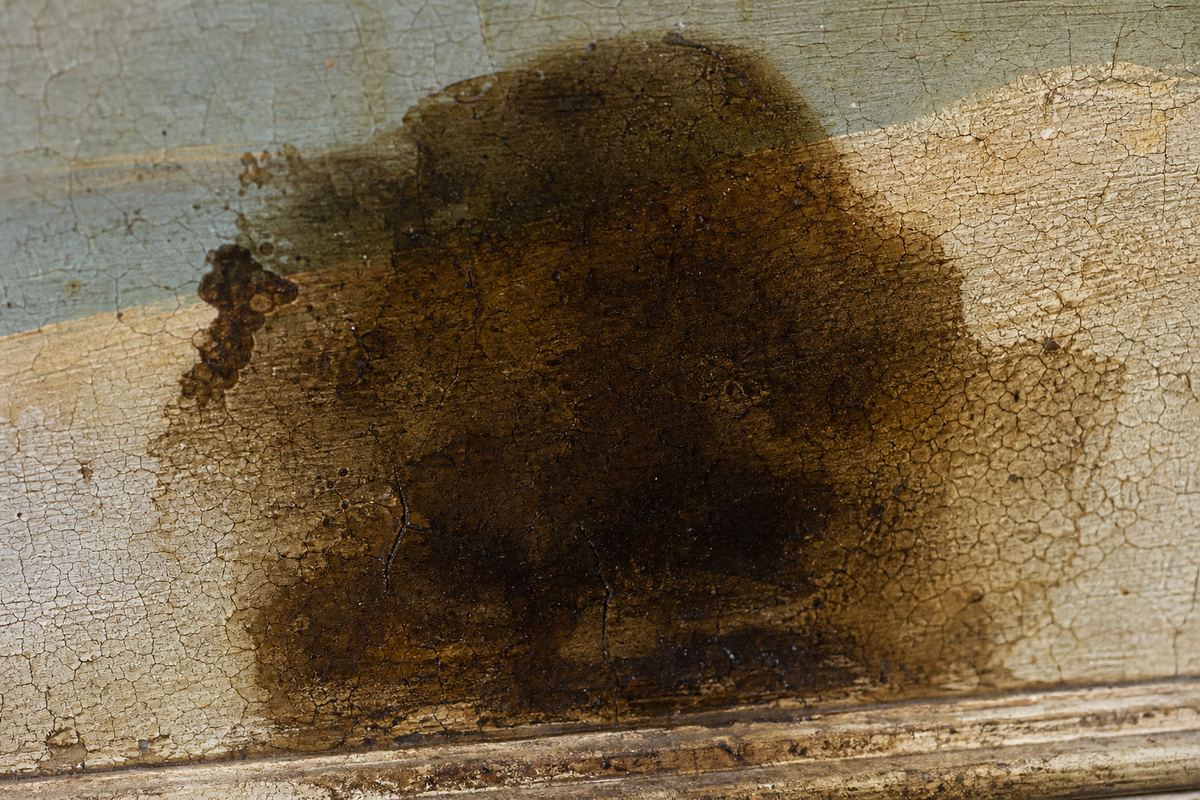
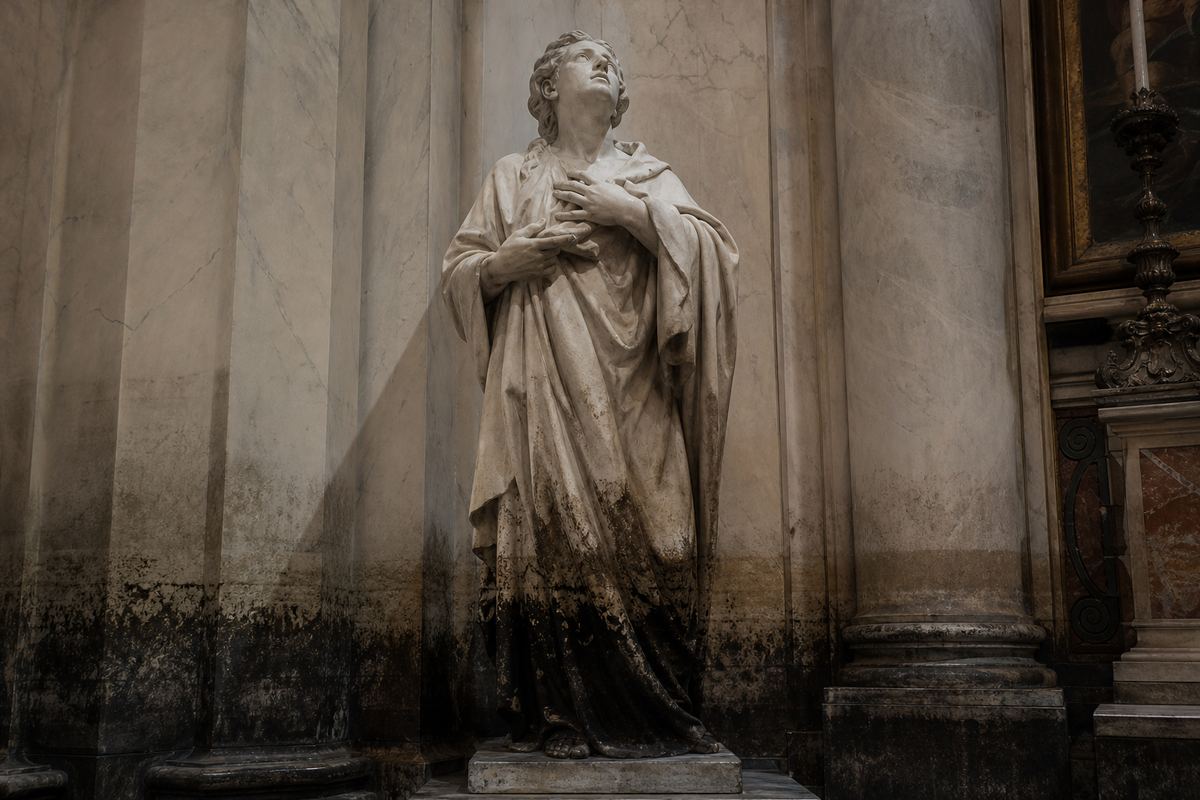
When the water dropped, the oil was left clinging to everything it had touched, as a dark line on walls, paintings and statues.
Wet wood swells. On a painted panel, that pushes the paint and its chalky base layer loose.
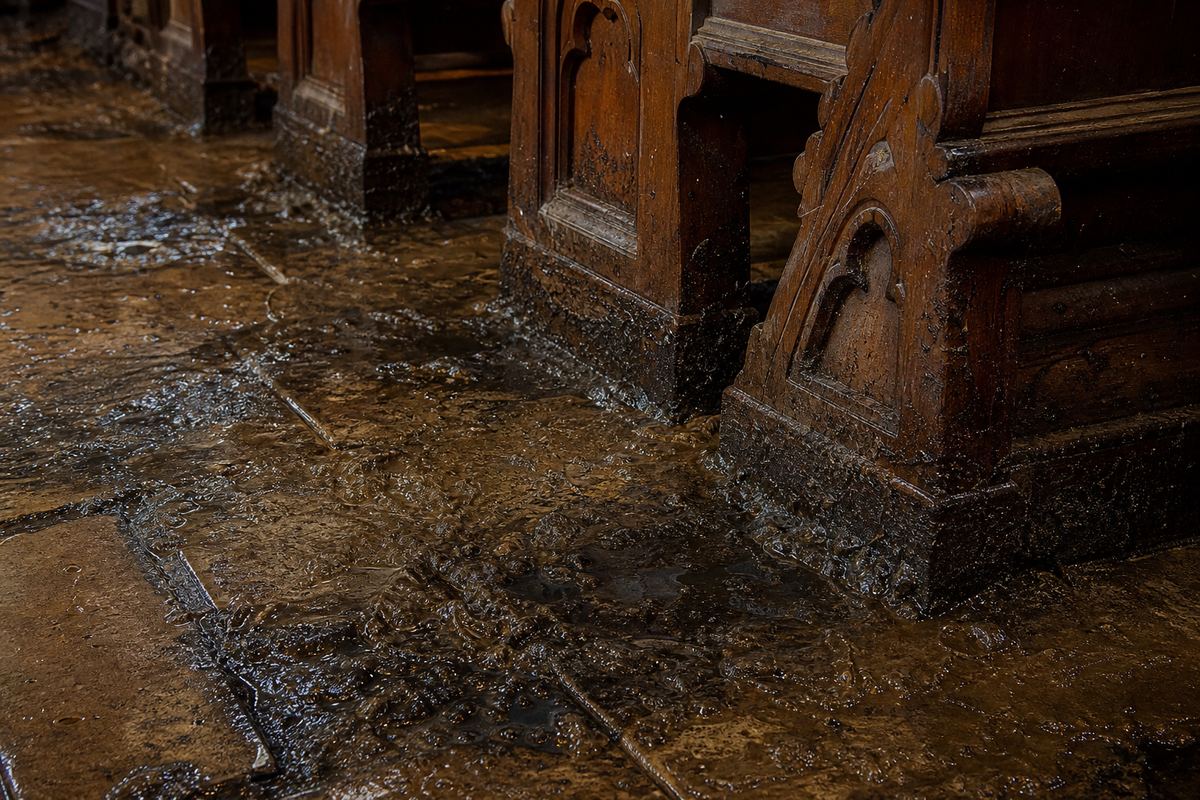
Mud with an oily sheen Mud and heating oil on a church floor. AI-generated illustration, not a photograph of the real work or place.
~600,000 t
of mud
~230 million m³
of water into the city
Left behind (Geopop)A dark line Oil stains spreading across an old painted surface. AI-generated illustration, not a photograph of the real work or place.
paint
gesso: a chalky white base
wood, which swells when wet
A panel painting, layer by layer
Chapter I · The flood
Water, mud and oil
History.com, Britannica and Lafayette College: ruptured heating-oil tanks spilled fuel into the floodwater. Uffizi: Cimabue’s Crucifix was soaked in “water, naphtha and mud”. Geopop: about 230 million m³ of water entered the city and about 600,000 tonnes of mud were left behind. Lafayette College: the water was contaminated with salts and nitrates.
In the scene, Flood it shows how wet wood lifts the paint in a simplified panel.
The 3D scenes are simplified teaching models, not to scale; the panel and books are generic, not real works.
Across Florence, hundreds of works of art were damaged: by one count, about one hundred and twenty frescoes, three hundred paintings on wooden panels, five hundred sculptures and eight hundred canvases.
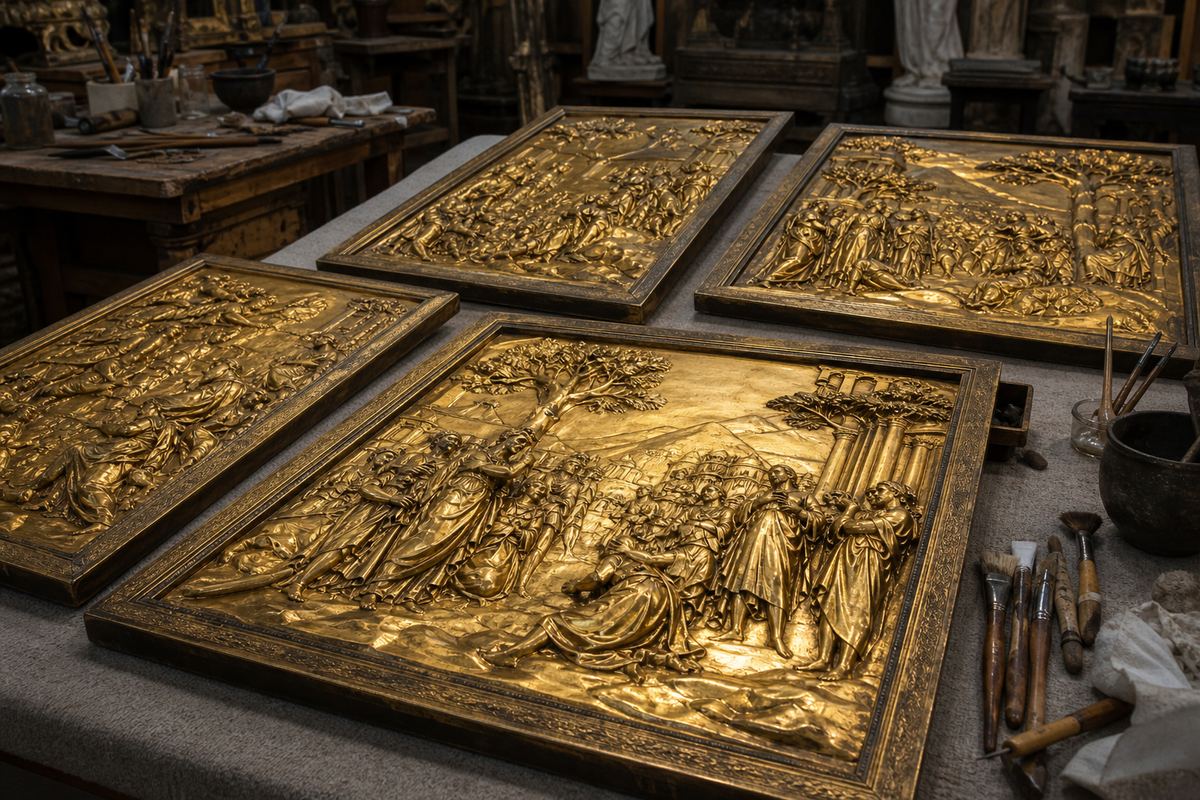
The water even forced open the bronze doors of the Baptistery known as the Gates of Paradise, and knocked several gilded panels out of their frames.
In the Uffizi’s photographic archive, more than twenty thousand negatives went under water.
canvases
800 works
sculptures
500 works
panel paintings
300 works
frescoes
120 works
Works damaged (The Art Newspaper)
A tide line Oil left a dark band on stone at the height the water reached. AI-generated illustration, not a photograph of the real work or place.Gilded bronze Relief panels laid out in a workshop. AI-generated illustration, not a photograph of the real work or place.
>20,000
photographic negatives under water
Uffizi
Chapter II · Saving the paintings
Damage to art
The Art Newspaper (2016): 120 frescoes, 300 panel paintings, 500 sculptures and 800 canvases were damaged. Opera di Santa Maria del Fiore: the flood forced open Ghiberti’s Gates of Paradise and six panels came off (the Uffizi says five); the doors took 27 years to make, a copy has hung on the Baptistery since 1990, and the restoration of the originals ended in 2012. Uffizi: more than 20,000 negatives in its photographic archive went under water.
The 3D scenes are simplified teaching models, not to scale; the panel and books are generic, not real works.
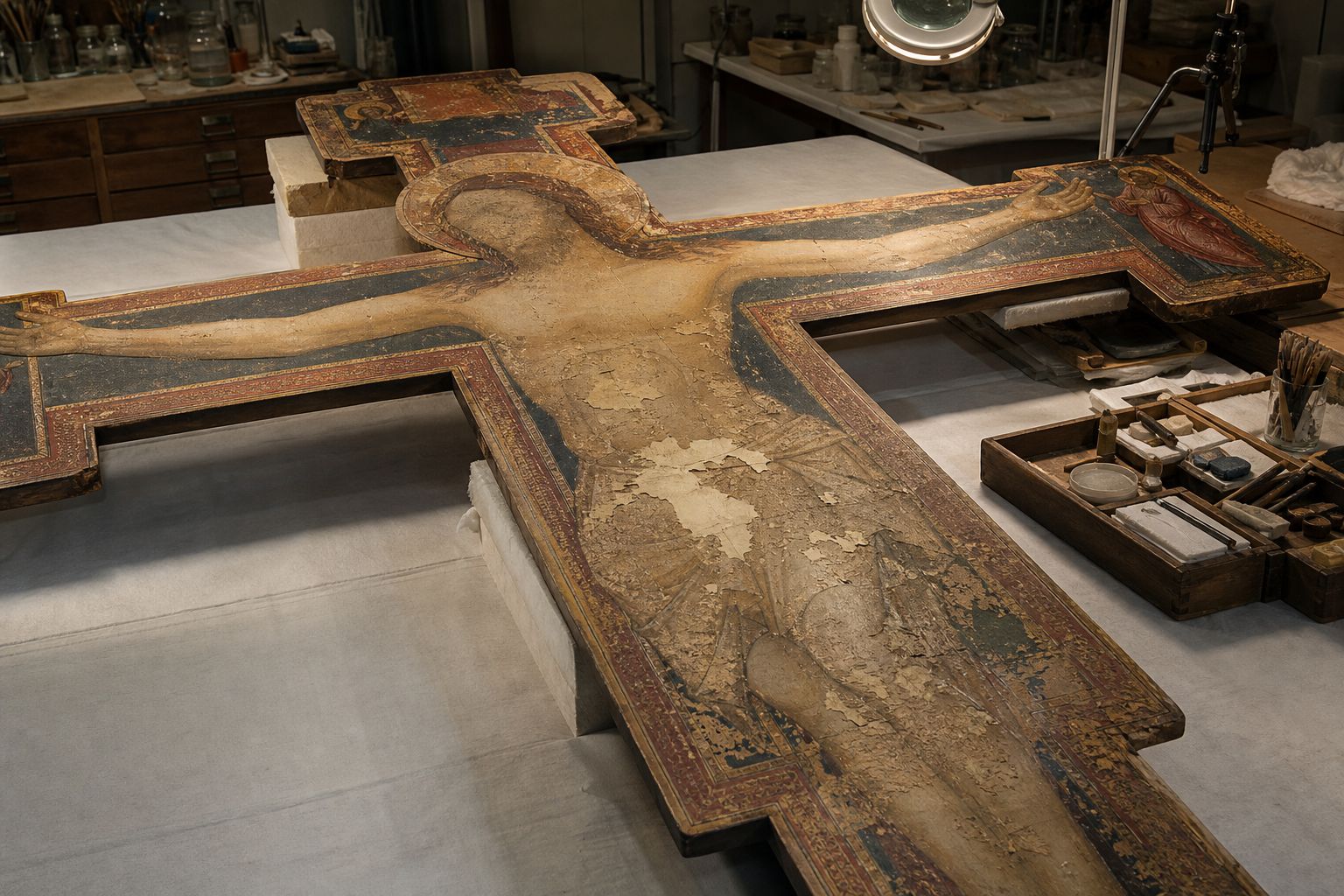
In the basilica of Santa Croce hung a huge painted crucifix by the artist Cimabue, made before 1288 in tempera and gold on wood, more than four metres tall.
The water reached its halo. About sixty percent of the paint was lost.
The first aid for a wet panel is to stop the paint falling off: rescuers covered the surface with sheets of paper. Then the wood must dry slowly, in steady air, or it warps and cracks.
Conservators spent about a decade on the Crucifix. Since 2013 it has hung in the sacristy, out of reach of the next flood.
In the laboratory An impression of a great painted cross laid flat for treatment; not the real work. AI-generated illustration, not a photograph of the real work or place.
433 × 390 cm
tempera and gold on wood, before 1288
~60%
of the paint lost
The Crucifix (Opera di Santa Croce)Paper on paint Thin tissue laid on a painted surface to hold flakes in place. AI-generated illustration, not a photograph of the real work or place.
1966 to the Limonaia in Boboli, then the Opificio lab
later tours Europe and America
2013 hung in the sacristy
Its journey (Opera di Santa Croce)
Chapter II · Saving the paintings
The Crucifix
Opera di Santa Croce: Cimabue’s Crucifix, before 1288, tempera and gold on wood, 433 × 390 cm, lost about 60% of its paint; it was taken first to the Limonaia in the Boboli Gardens, used as an emergency room for panels, and then to the Opificio’s laboratory in the Fortezza da Basso; it later toured Europe and America, and since 2013 has hung in the sacristy to keep it safe from floods. The Art Newspaper: the water reached Christ’s halo. History.com: conservators spent about a decade on it. Getty: wet panels were faced with paper and dried slowly and under control to prevent warping and mould.
Try Flood it, Face with paper and Dry slowly in the scene.
The 3D scenes are simplified teaching models, not to scale; the panel and books are generic, not real works.
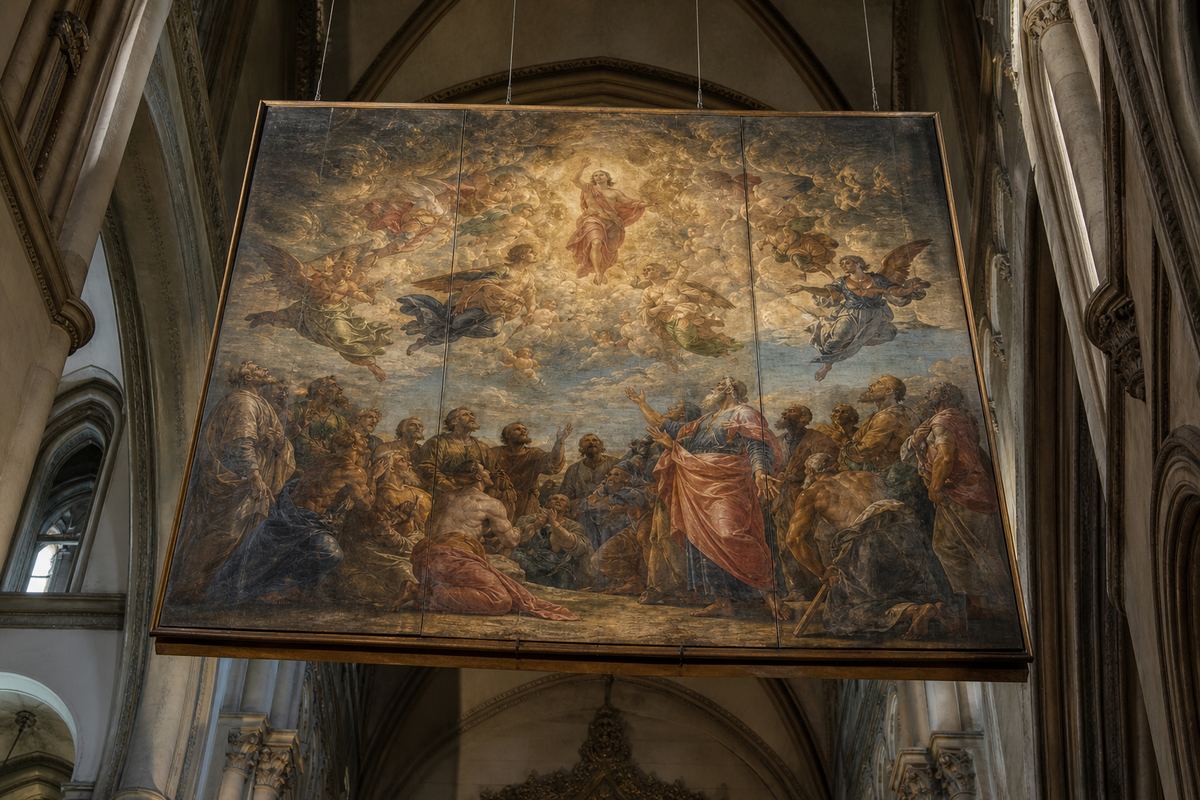
Some rescues took far longer. Giorgio Vasari’s Last Supper, painted in 1546 on five poplar panels, sat in mud and heating oil for more than twelve hours.
Its paint slid downward as the wood swelled. Only in 2013, after new methods and a grant from the Getty, were its panels joined again, and it returned to Santa Croce on the fourth of November 2016.
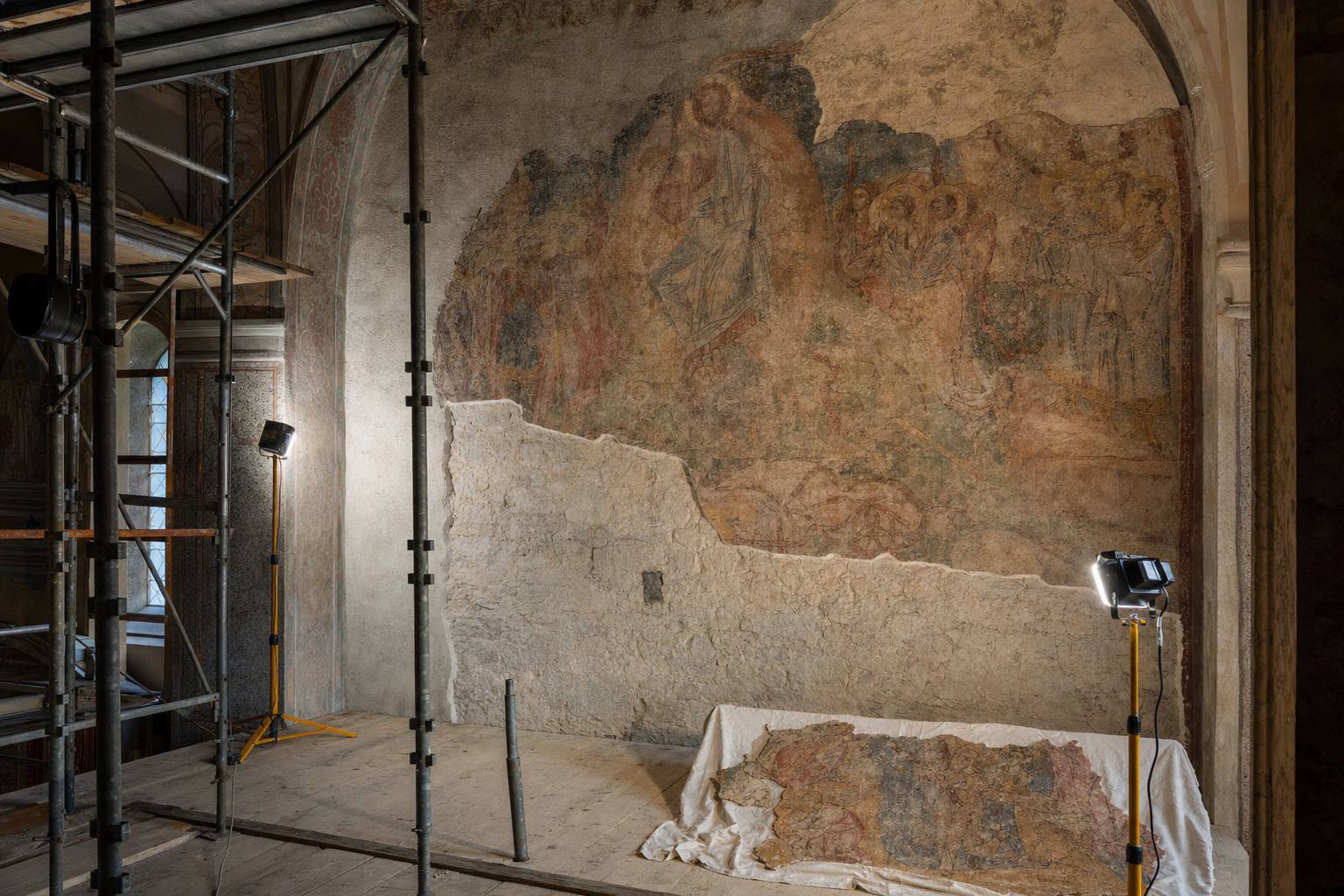
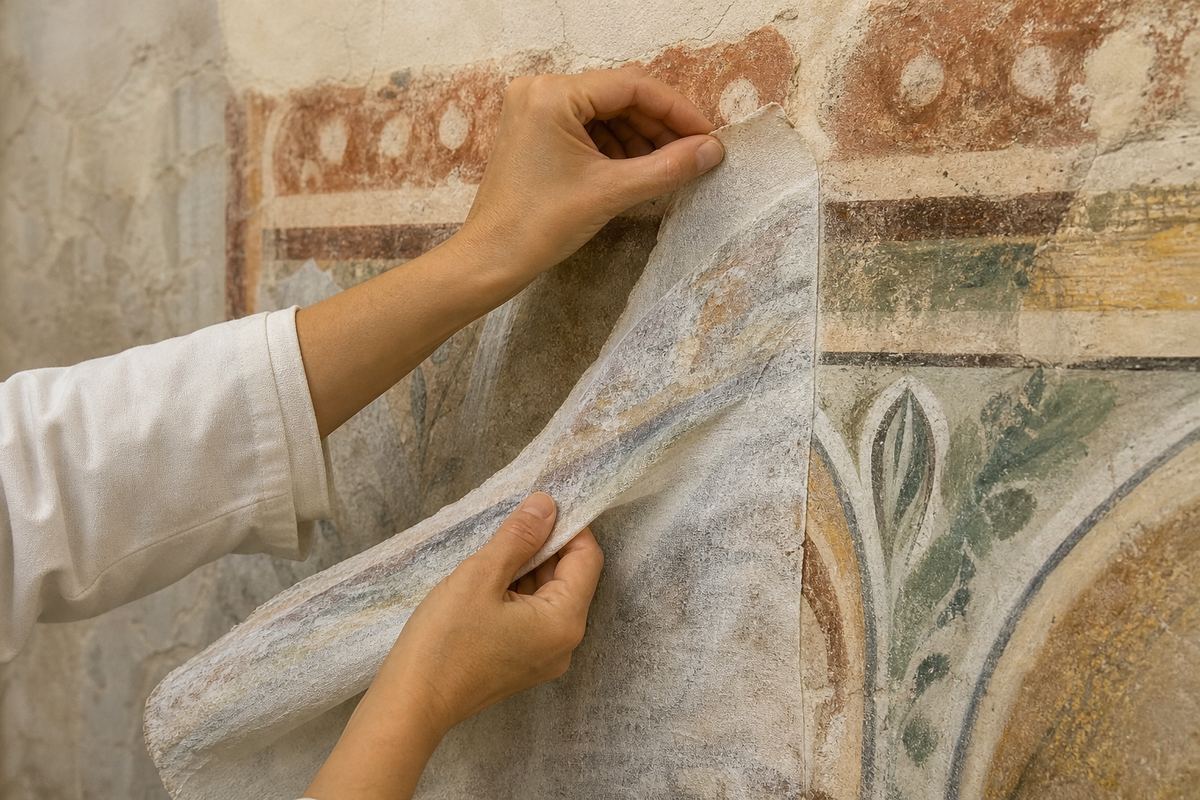
Frescoes, painted into wet plaster, were soaked with salty water. Some were detached from their walls and moved onto new supports. Today the Last Supper hangs on winches that can lift it towards the ceiling if the water comes again.
1546
painted on five poplar panels
>12 h
under mud and heating oil
The Last Supper (Getty)
1966 soaked; paint and gesso slide down
2010 Getty grant to the Opificio
2013 panels rejoined, first time in 47 years
4 Nov 2016 back in Santa Croce
A long rescue (Getty)Taking the skin off the wall Lifted this way, a fresco comes away as its painted skin alone; the plaster it was painted on stays behind. AI-generated illustration, not a photograph of the real work or place.Peeling a fresco A painted layer lifted from a wall on cloth. AI-generated illustration, not a photograph of the real work or place.Ready for the next one A large panel painting hung high in a church. AI-generated illustration, not a photograph of the real work or place.
Chapter II · Saving the paintings
Vasari’s Last Supper and the frescoes
Getty (2016): Vasari’s Last Supper (1546), five poplar panels over 8 × 21 ft, was under water, mud and heating oil for more than 12 hours, and its paint and gesso slid downward; its face was covered with conservation paper, then any tissue at hand, and it was dried slowly to avoid warping and mould; a Getty grant to the Opificio in 2010 led to the panels being rejoined in 2013 for the first time in 47 years, and the painting returned to Santa Croce on 4 November 2016; a winch can now hoist it toward the ceiling if a flood threatens. Lafayette College: water carrying salts soaked the frescoes; some were detached and remounted on new supports, others treated in place over years.
The 3D scenes are simplified teaching models, not to scale; the panel and books are generic, not real works.
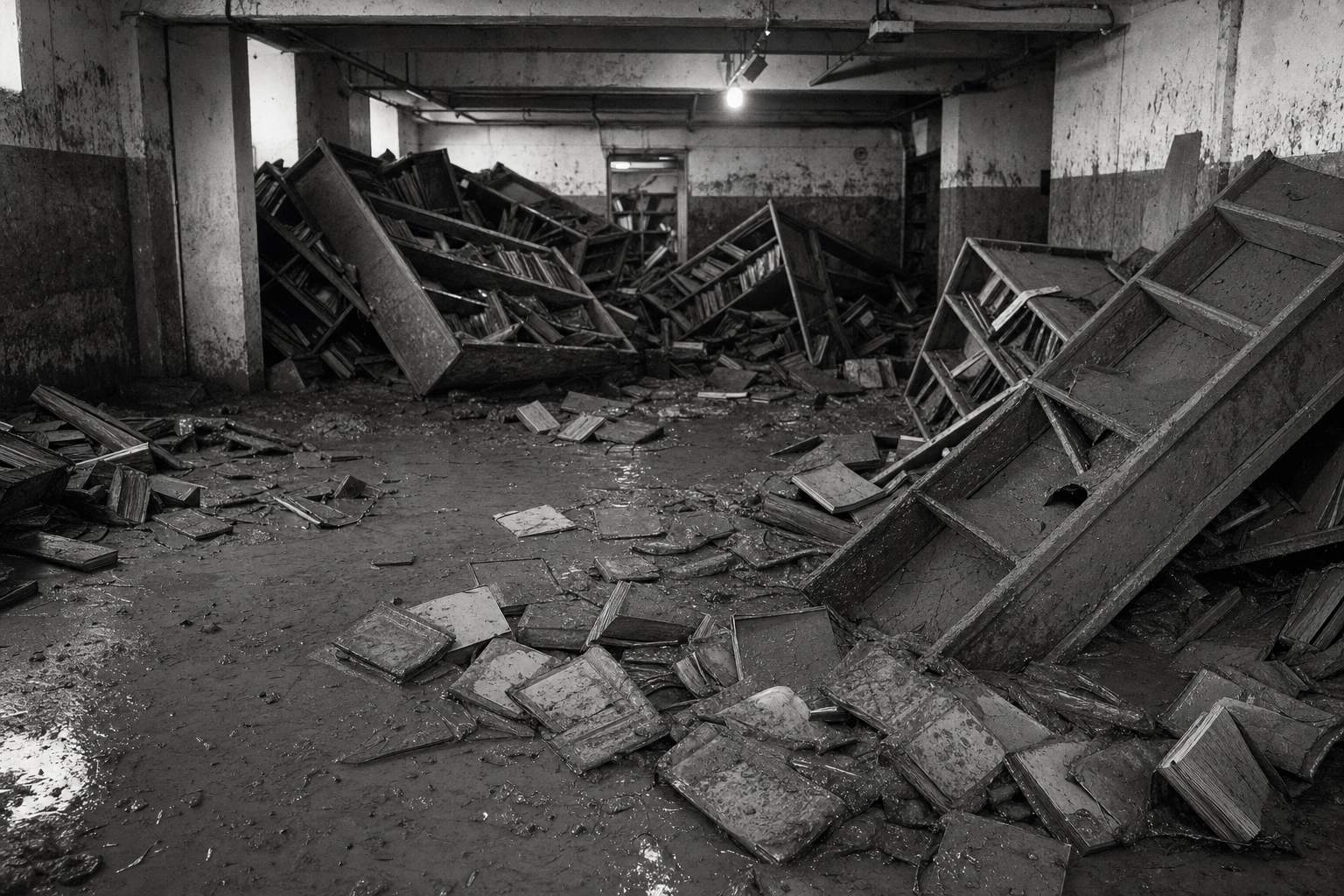
The worst hit of all were the books. At the National Central Library, by the river, about one point three million items were damaged, roughly a third of its holdings.
Thousands of volunteers came to help, many of them young and untrained, from about seventy countries. Florentines called them the angeli del fango, the Mud Angels.
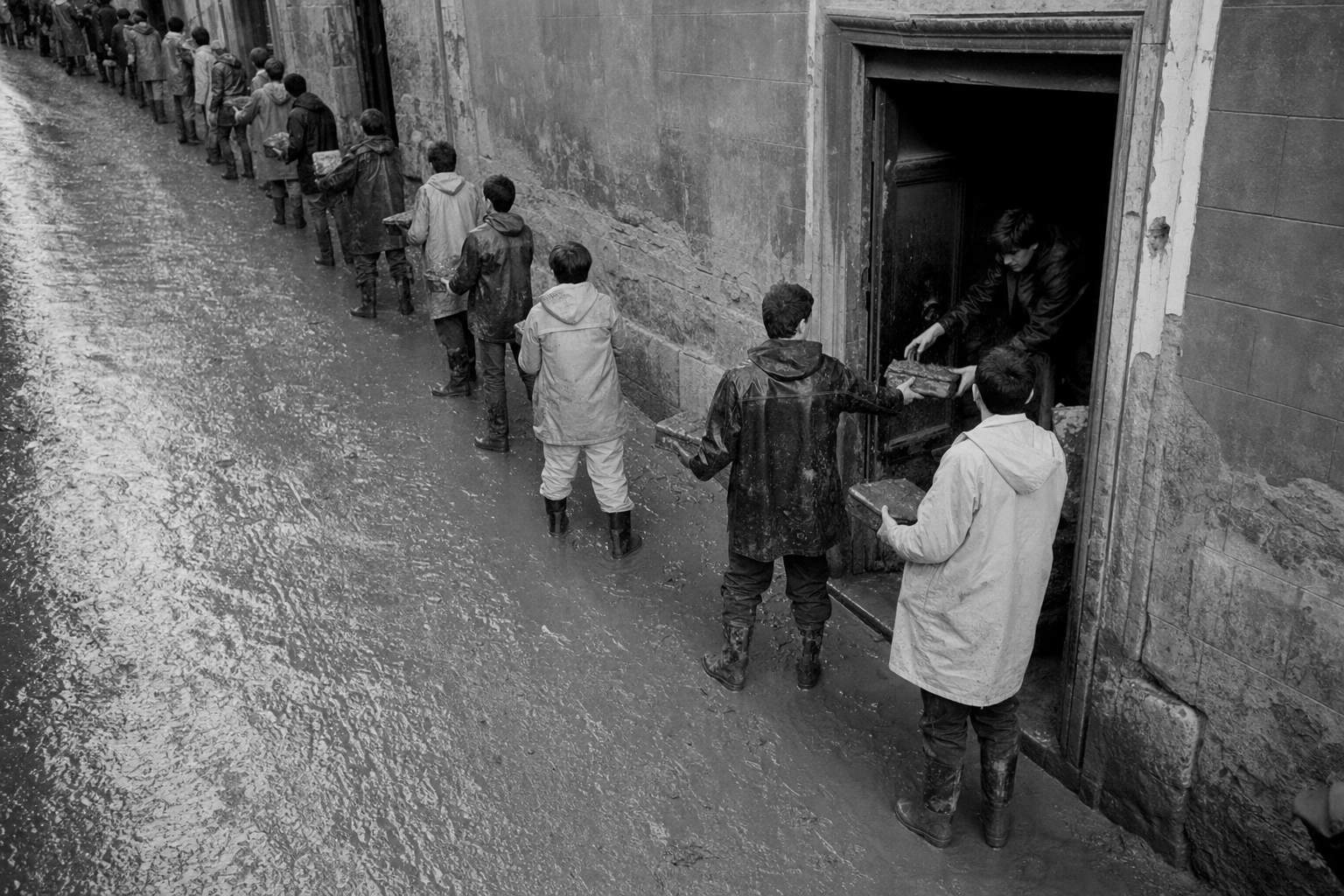
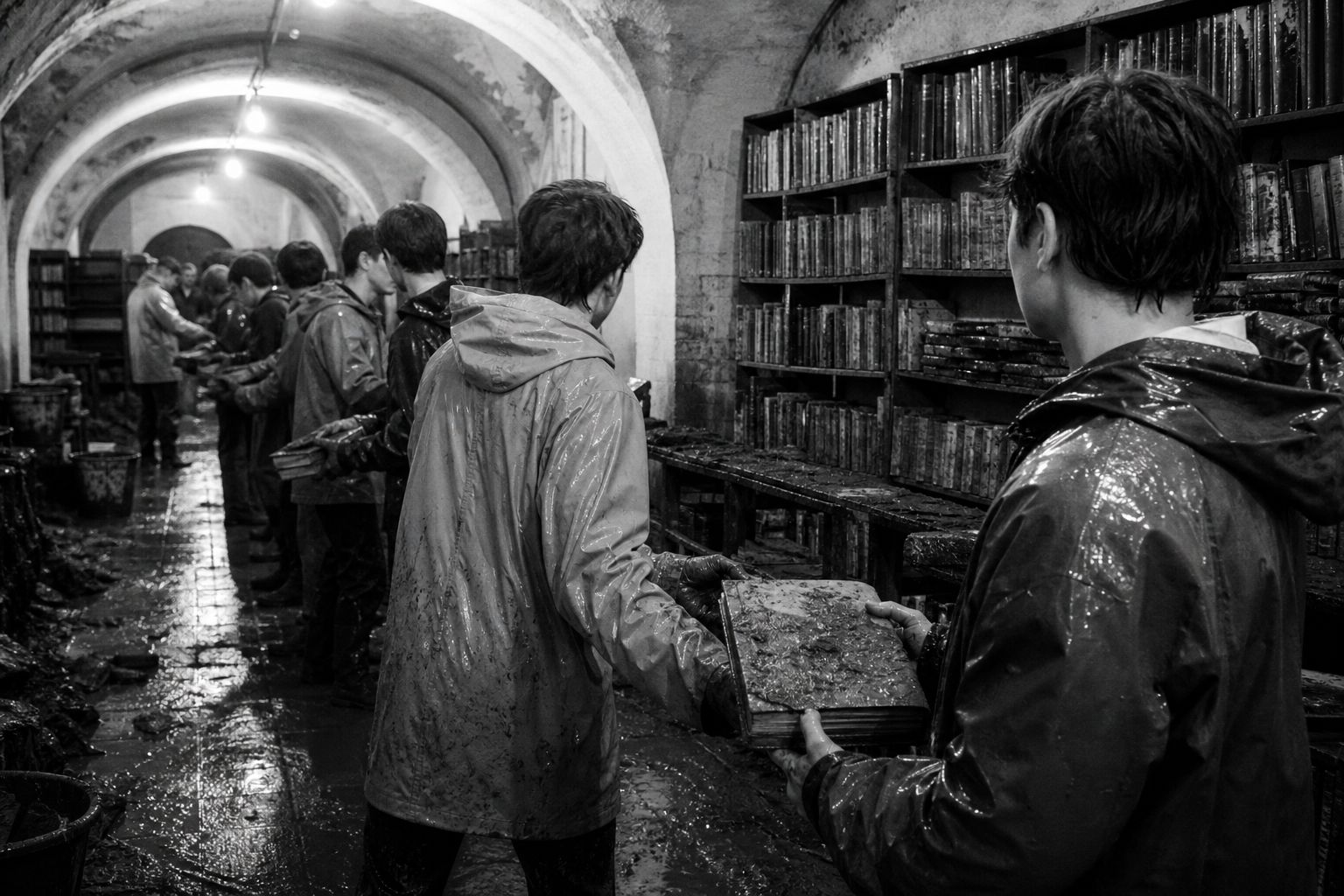
They passed muddy books from hand to hand, out of flooded basements, in long human chains.
~1.3 million
items damaged
~1/3
of the collection
National Central Library (Craig Lab, Wikipedia)Hand to hand They worked with the city's power and water cut off, for days after the river went down. AI-generated illustration, not a photograph of the real work or place.
Gabinetto Vieusseux: 250,000 volumes
Opera del Duomo archive: 6,000 volumes
Other collections hitThe stores below ground The national library's worst losses were in its basement stacks, the part nearest the river. AI-generated illustration, not a photograph of the real work or place.A human chain Volunteers in raincoats passing books along a line. AI-generated illustration, not a photograph of the real work or place.
Chapter III · Saving the books
The books and the volunteers
Indiana University Craig Lab, Wikipedia and The Art Newspaper: about 1,300,000 items, roughly a third of the holdings of the Biblioteca Nazionale Centrale, were damaged (other sources say more than a million); the Gabinetto Vieusseux lost the use of 250,000 volumes and the Opera del Duomo archive 6,000. University of Florence: volunteers came from 70 countries. History.com: they were mostly young and untrained. The Florentine: they became known as the “Mud Angels”.
The 3D scenes are simplified teaching models, not to scale; the panel and books are generic, not real works.
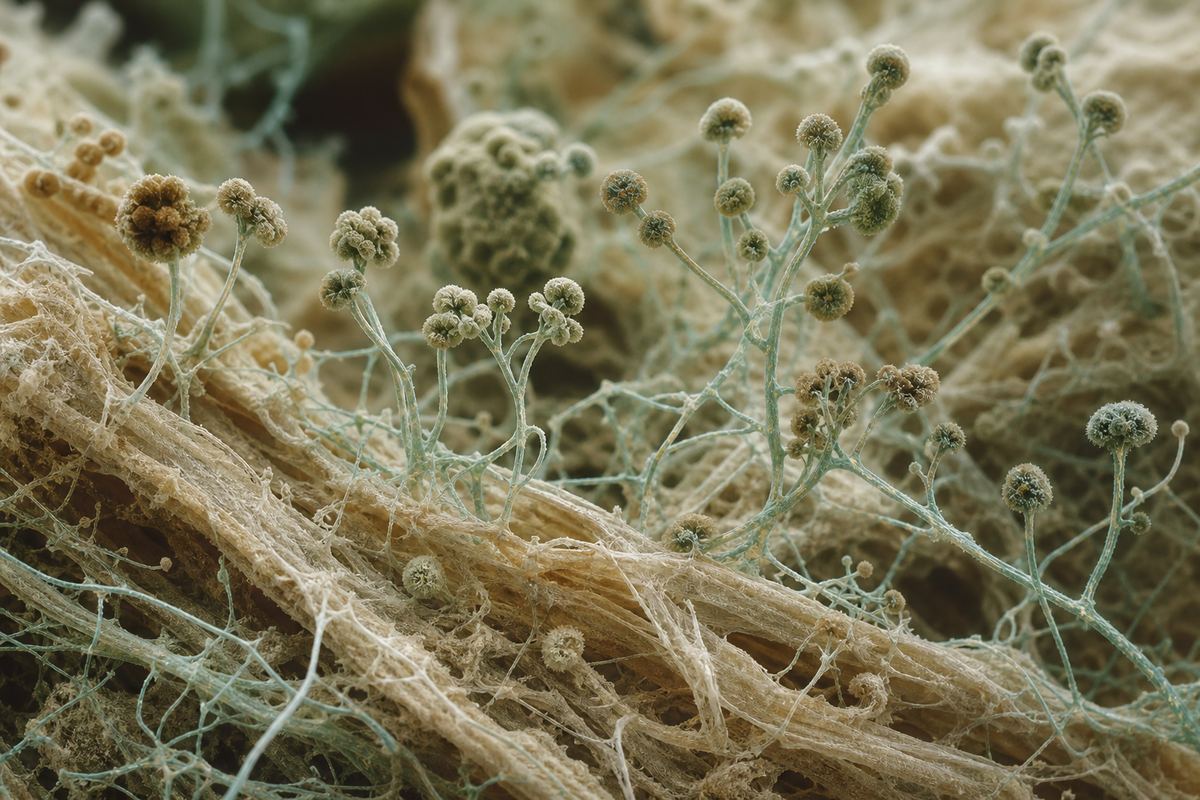
Wet paper is a feast for mould. According to the conservator Peter Waters, mould can appear within forty-eight hours.
Above about twenty-one degrees and sixty percent humidity, without good air movement, heavy mould growth is likely.
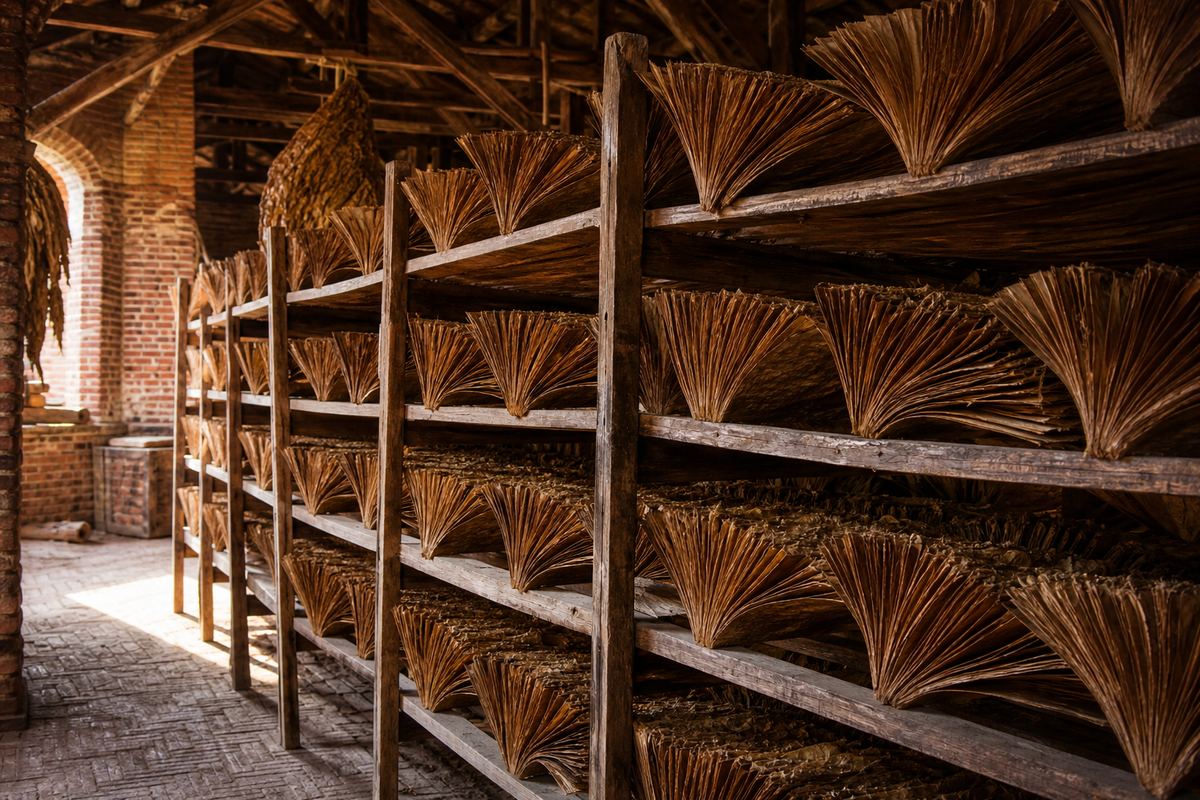
In Florence there was no plan for this. Books were dried wherever space could be found: in tobacco-drying barns, brick kilns and textile mills, which could scorch and buckle them.
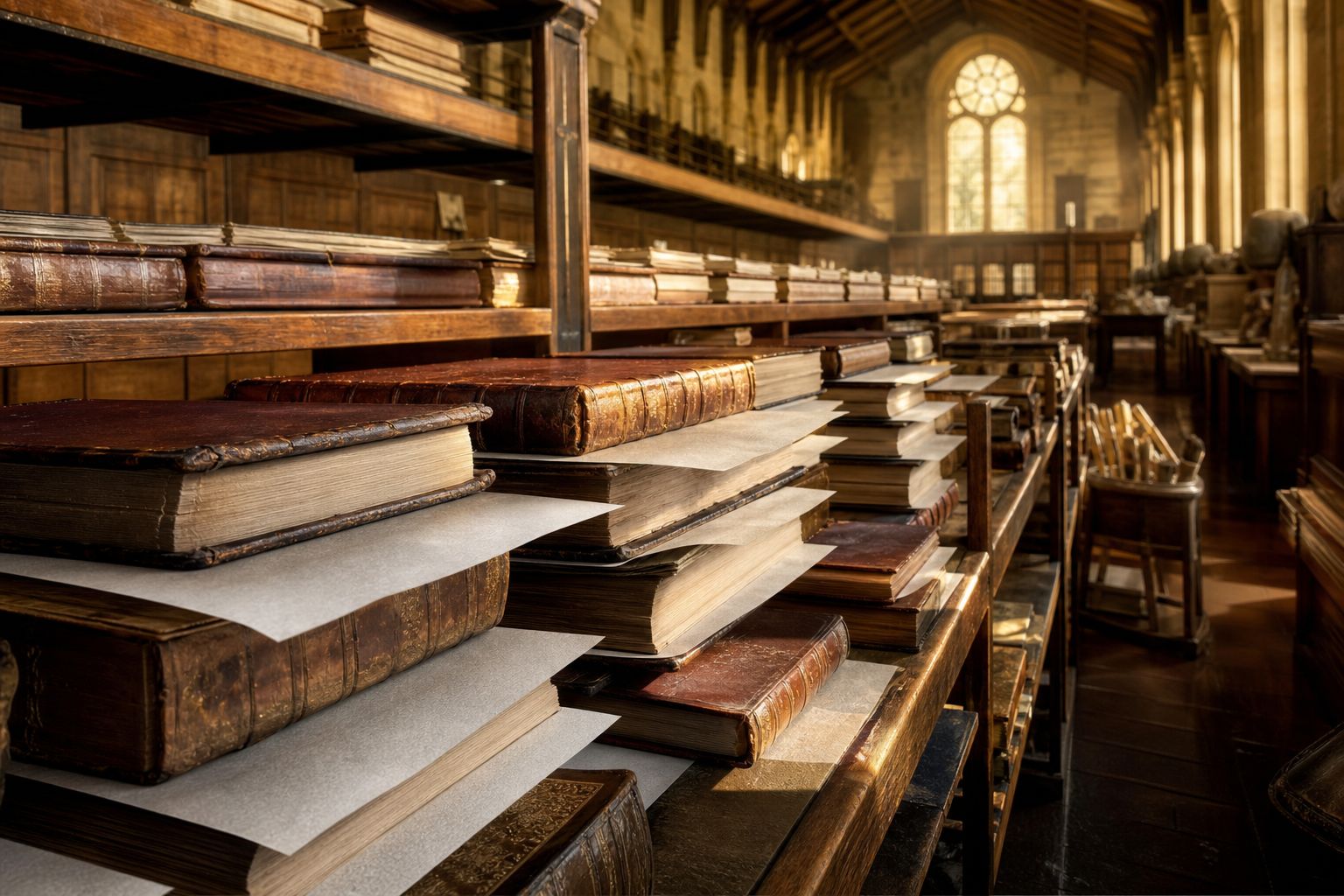
Volunteers also slipped sheets of absorbent paper between the pages, again and again.
Mould on paper An illustration of mould threads spreading through paper fibres. AI-generated illustration, not a photograph of the real work or place.
48 h
for mould to appear
21 °C · 60%
above this, heavy growth is likely
Waters (Library of Congress)Improvised drying Books fanned open on racks in a tobacco barn. AI-generated illustration, not a photograph of the real work or place.Interleaving Books drying with blotting paper between their pages. AI-generated illustration, not a photograph of the real work or place.
Chapter III · Saving the books
Mould and drying
Peter Waters, Procedures for Salvage of Water-Damaged Library Materials (Library of Congress, revised 1993): mould can appear within 48 hours; above 70 °F (21 °C) and 60% relative humidity without good air circulation, heavy mould growth is likely; interleave with plain white blotter or towels, changed often. Craig Lab: in Florence, books were dried in tobacco barns, brick furnaces and textile mills, which singed and cockled them. The Art Newspaper: volunteers set up an assembly line for interleaving.
In the scene, compare a warm room, cool dry air and freezing.
The 3D scenes are simplified teaching models, not to scale; the panel and books are generic, not real works.
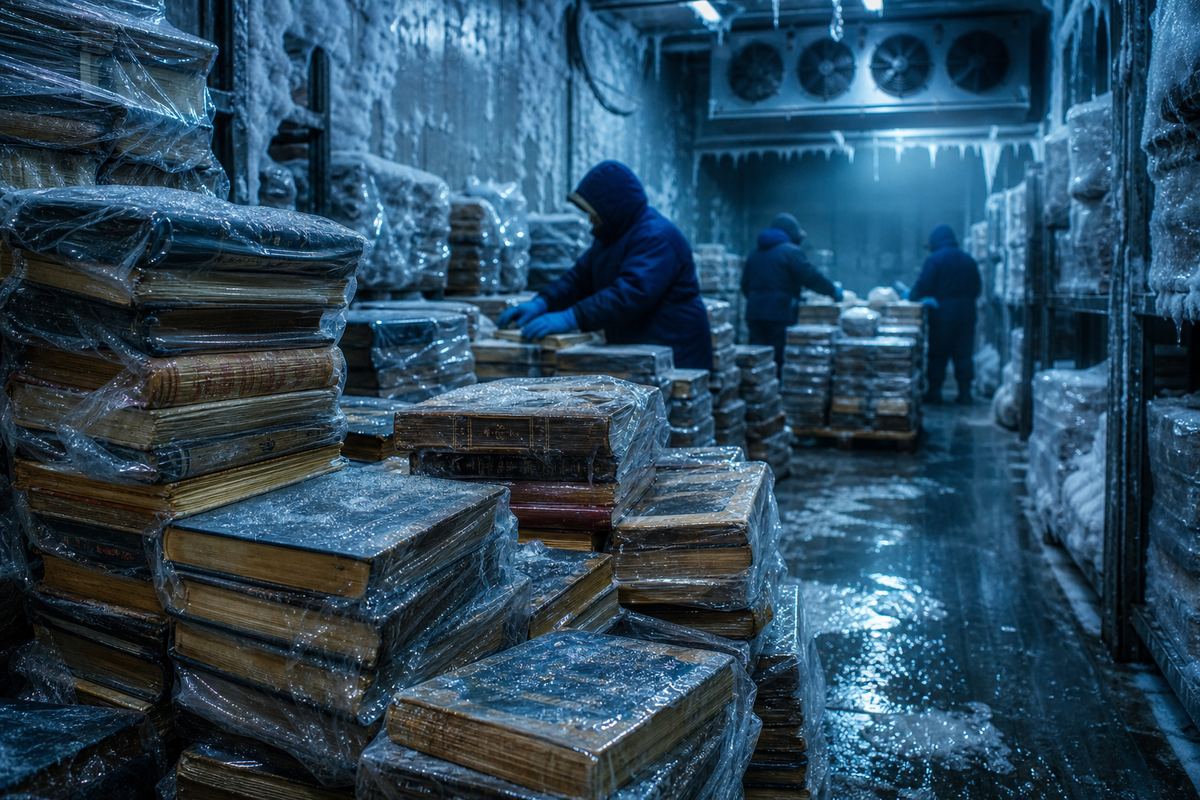
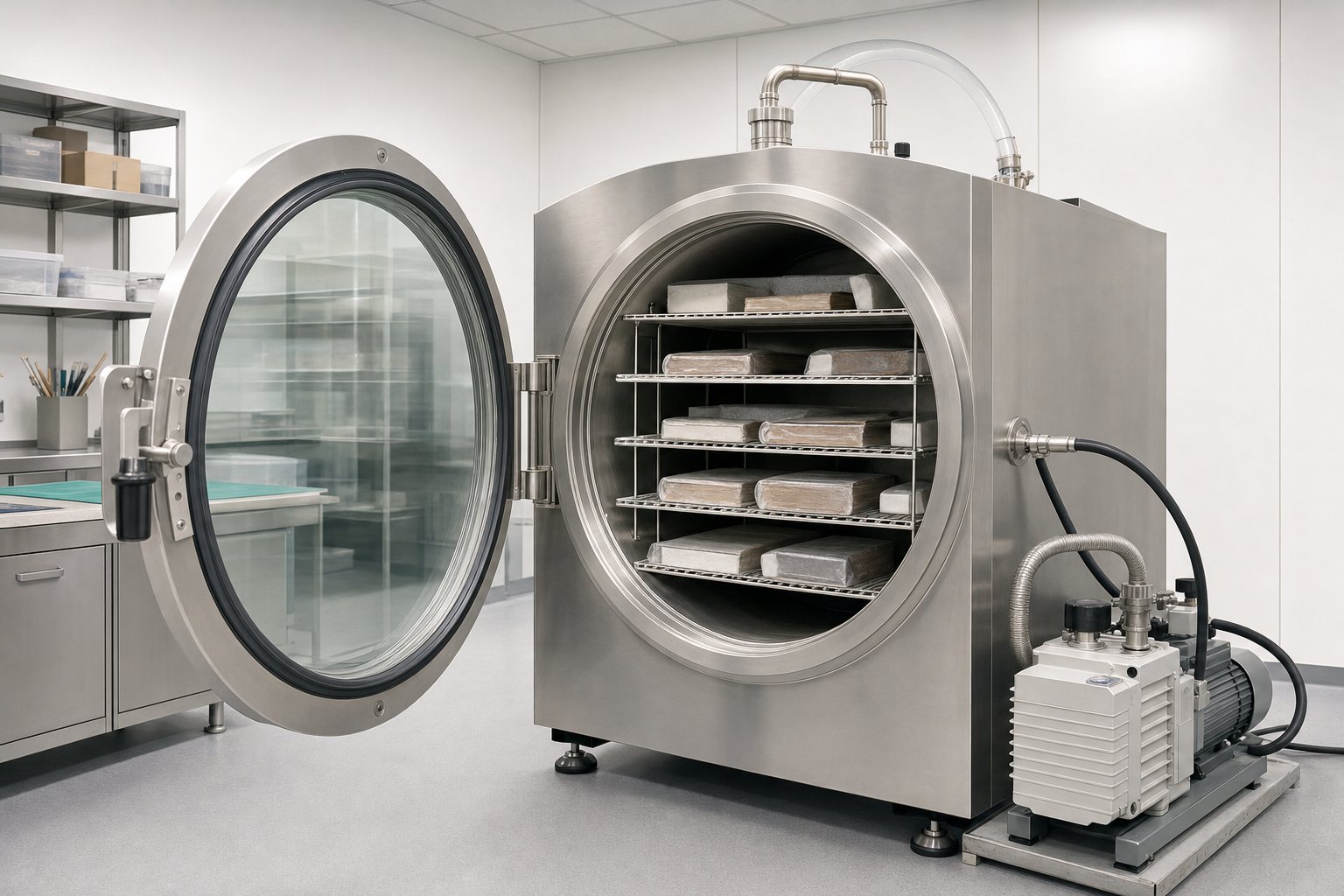
The lesson that came out of Florence was simple: freeze first. At about minus eighteen degrees, wet books are stable and mould stops growing.
Freezing does not dry a book, and it does not kill the spores. But it buys time to treat each one properly.
Then comes freeze-drying: in a vacuum, the ice turns straight into vapour without melting, which is called sublimation, so inks do not run.
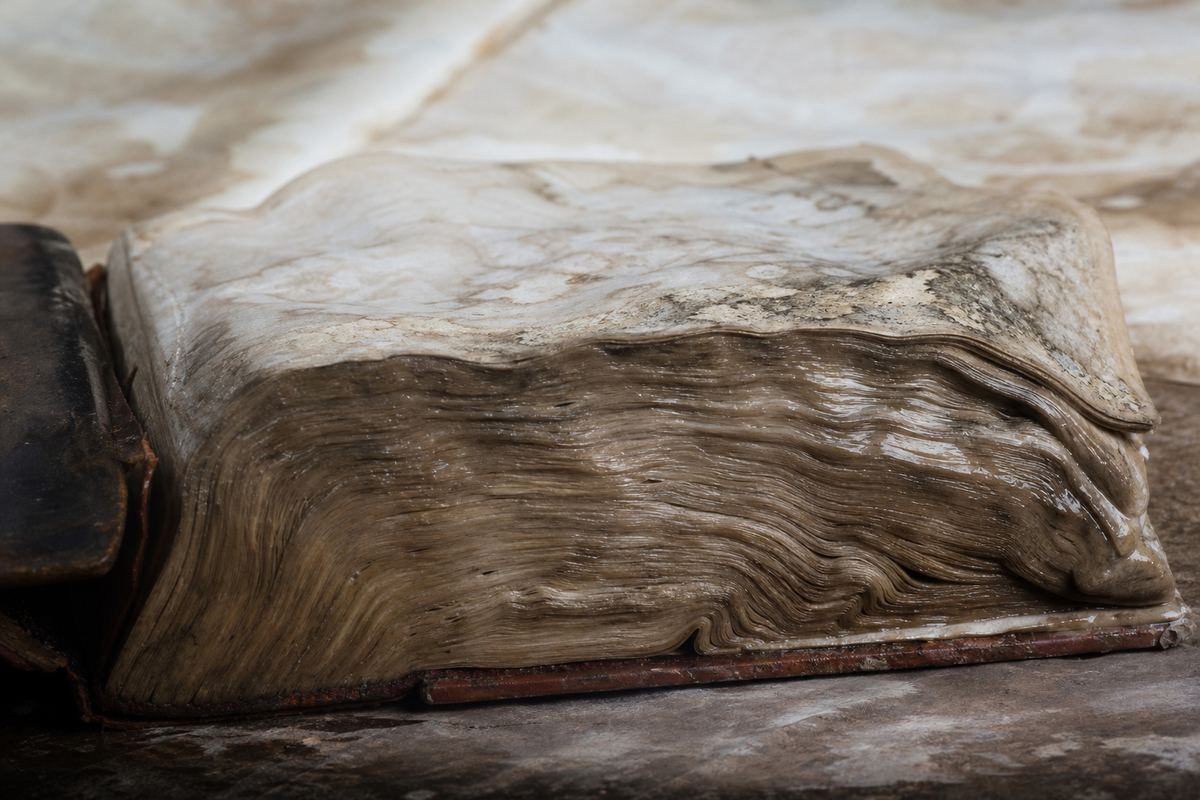
Waters wrote that freezing could have saved many Florentine books printed on coated paper, whose pages stuck together for good.
Freeze first Wrapped wet books stacked in a freezer. AI-generated illustration, not a photograph of the real work or place.
stabilises wet books at about −18 °C
makes mould spores dormant
is not a drying method
Freezing (Waters)
ice → vapour
sublimation, with the book still frozen
<7%
water left in a properly dried book
Freeze-dryingCoated paper Glossy pages fused into a block after drying out slowly. AI-generated illustration, not a photograph of the real work or place.
Chapter III · Saving the books
Freezing and freeze-drying
Waters (Library of Congress): freezing at about −18 °C (0 °F) stabilises wet materials and makes mould spores dormant, but it is not a drying method and does not kill spores; freeze-drying removes water by sublimation while the book stays frozen, so inks do not run; a dried book should hold under 7% water by weight; in Florence the worst losses were books on coated paper whose pages stuck together, much of which freezing could have prevented. Library of Congress: Waters’s manual was first published in 1975 and revised in 1993.
The 3D scenes are simplified teaching models, not to scale; the panel and books are generic, not real works.
The paintings went to Florence’s restoration laboratory, which moved after the flood into a fortress, the Fortezza da Basso, to make room for them. It is still there.
In 1975 it merged with the Opificio delle Pietre Dure, a workshop founded by the Medici in 1588, to form today’s institute.
The flood gave it a new mission and closer ties to science. Smithsonian Magazine called it part hospital for threatened treasures.
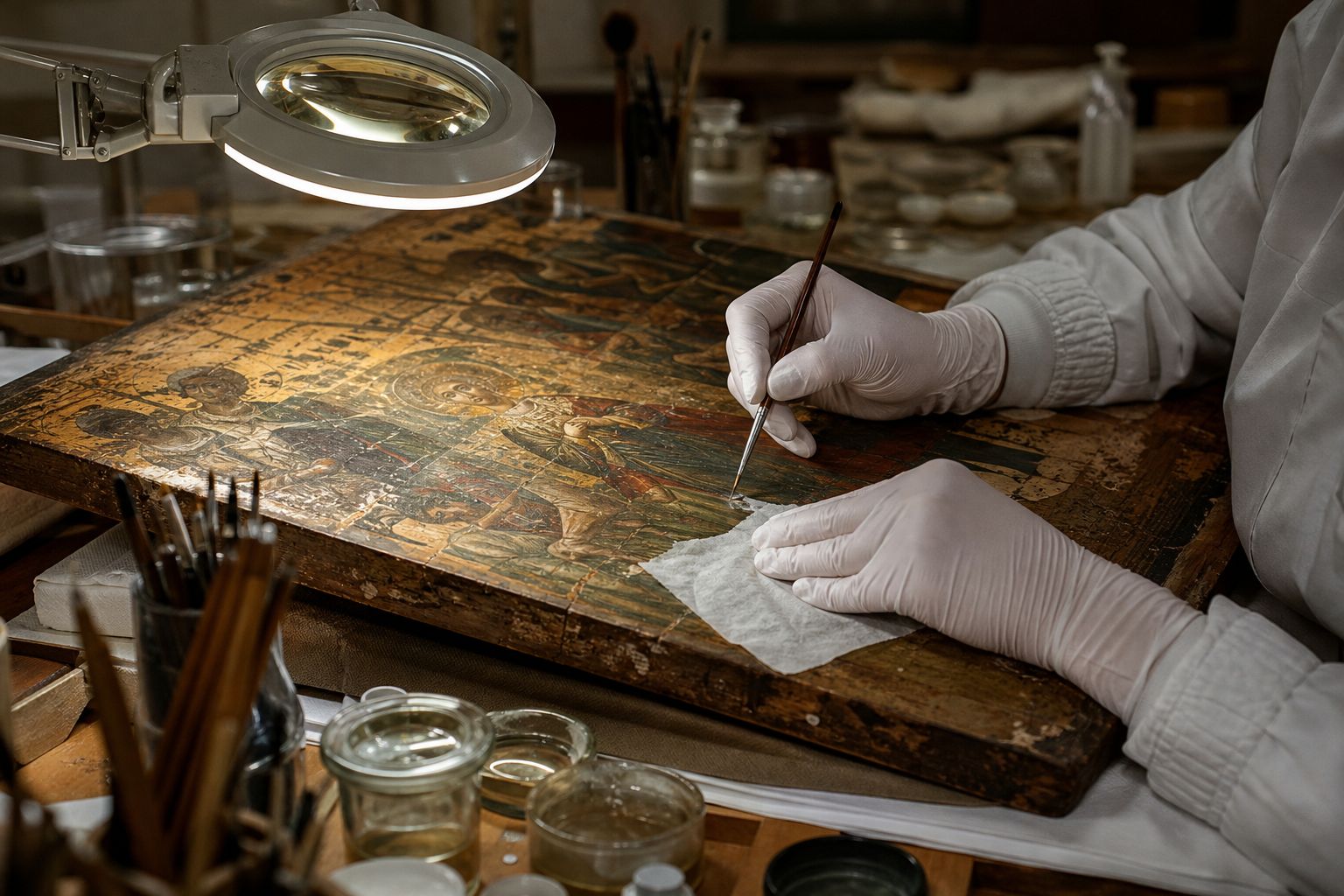
At the bench A restorer’s gloved hands at work on an old panel. AI-generated illustration, not a photograph of the real work or place.
1588 founded by Ferdinando I de’ Medici
1932 Ugo Procacci founds the Gabinetto Restauri
1966 lab moves to the Fortezza da Basso
1975 merged into today’s institute
The Opificio (OPD)
…part museum, part workshop, part hospital for threatened treasures.Smithsonian Magazine, on the Opificio
Smithsonian Magazine
Chapter IV · What the flood left
The Opificio delle Pietre Dure
Opificio delle Pietre Dure: founded in 1588 by Ferdinando I de’ Medici; Ugo Procacci founded the Gabinetto Restauri in 1932; in 1966 the Gabinetto moved to the Fortezza da Basso to house flood-damaged works, including the Cimabue, and that is still its largest site; in 1975 the two merged into today’s institute, with 11 departments and 3 sites. Smithsonian: the flood gave the Opificio a new mission and a closer tie to science; it describes the institute as “part museum, part workshop, part hospital for threatened treasures”.
The 3D scenes are simplified teaching models, not to scale; the panel and books are generic, not real works.
Among the experts who came was a British bookbinder, Peter Waters. For two years he led the book rescue at the National Central Library, training more than a hundred and twenty volunteers.
In 1971 he went to the Library of Congress in Washington, and turned what he had learned into a way of thinking called phased preservation.
Instead of perfecting one book while thousands wait, act first where it helps the whole collection most: surveys, disaster plans, stable climate, protective boxes.
>120
volunteers he trained in Florence
2 years
leading the library rescue
Peter Waters (1930–2003)A whole collection Rows of books drying together, not one at a time. AI-generated illustration, not a photograph of the real work or place.
survey the collection
plan for disasters
keep the climate stable
box what is fragile
Phased preservationIce straight to vapour Freeze-drying turns the ice to vapour without melting it, so the page never goes through a wet stage twice. AI-generated illustration, not a photograph of the real work or place.
Chapter IV · What the flood left
Peter Waters
Wikipedia (Peter Waters): Waters (1930–2003), a British bookbinder, led the book rescue at the Biblioteca Nazionale Centrale, devising a multi-phase clean, dry and rebind project, and trained and managed more than 120 volunteers; “phased preservation” means acting first where it helps the whole collection most, through surveys, disaster plans, climate control and boxing. Craig Lab: he spent two years in Florence. Library of Congress: he headed its Conservation Division from 1971.
The 3D scenes are simplified teaching models, not to scale; the panel and books are generic, not real works.
Florence has flooded before: marks on its walls record floods in 1177, 1333, 1557 and 1740.
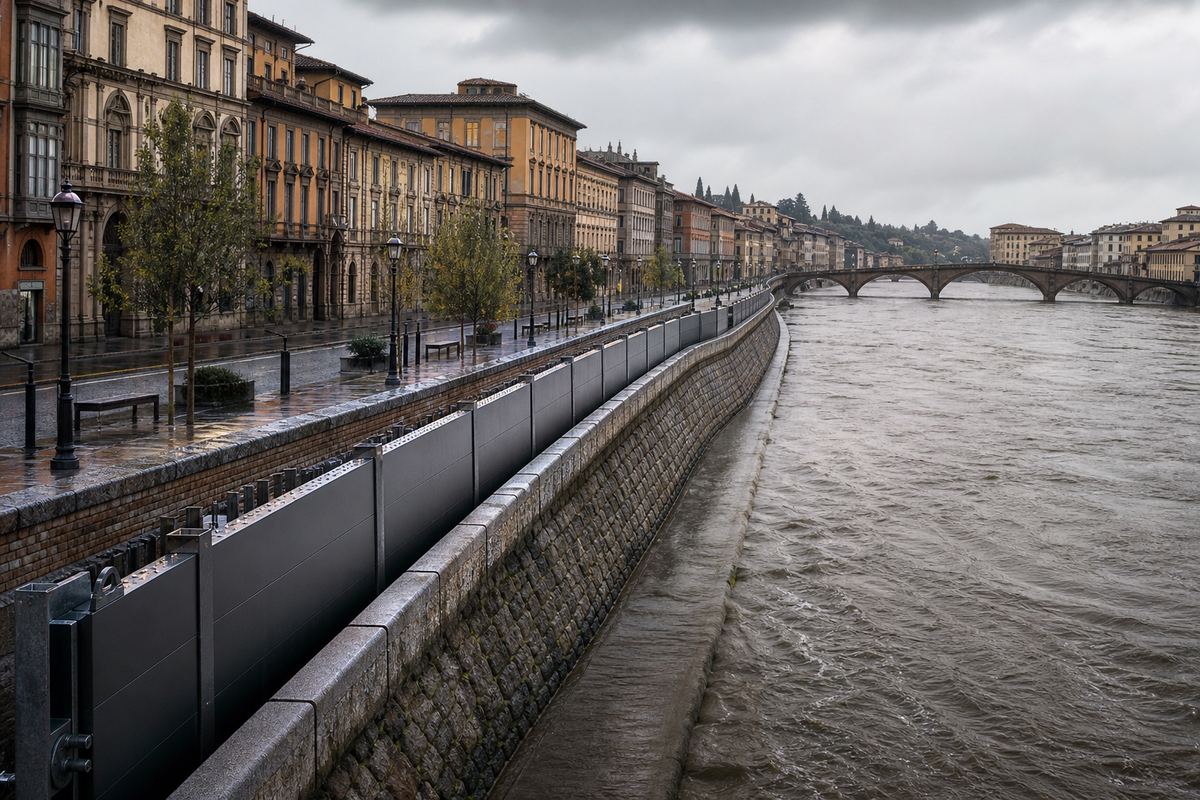
Since 1966, a new dam, storage basins upstream, stronger banks, mobile barriers and real-time monitoring have been added along the Arno.
The flood also led to an Italian law on civil protection, in 1970. And museums and libraries everywhere now keep something Florence did not have: a written plan for the day the water comes.
1177 flood
1333 flood
1557 flood
1740 flood
1966 the great flood
Floods of the Arno (History.com)Defences A reinforced river embankment and flood barrier. AI-generated illustration, not a photograph of the real work or place.
Bilancino dam; Figline storage basins
mobile barriers, weather alerts, real-time monitoring
Law 996 of 1970 on civil protection
Since 1966 (La Nazione; Civil Protection)
Chapter IV · What the flood left
Since 1966
History.com: marks on Florence’s walls record earlier floods in 1177, 1333, 1557 and 1740. La Nazione (2026): since 1966, the Figline expansion basins, the Bilancino dam, reinforced banks, mobile barriers, weather alerts and real-time monitoring have been added. Italian Civil Protection: the flood led to Law 996 of 1970 on civil protection. Library of Congress: Waters’s salvage manual, first published in 1975, is one of the written disaster procedures that followed.
The 3D scenes are simplified teaching models, not to scale; the panel and books are generic, not real works.
Sixty years on, some of Florence’s flooded books are still waiting to be catalogued and repaired.
But the night the Arno rose taught the world how to save what water touches: freeze, dry slowly, protect the paint, and plan before it happens.
And it showed what thousands of strangers with buckets can do.
4 Nov 1966 the Arno floods Florence
1970 Italy’s civil protection law
1975 Opificio merged; Waters’s manual
2013 Cimabue to the sacristy
2016 Vasari’s Last Supper returns
4 Nov 2026 60th anniversary
Florence, 1966 to 2026The river, calm again Florence and the Arno at golden hour. AI-generated illustration, not a photograph of the real work or place.
~30,000
miscellaneous items still being catalogued
Still in storage (L’Espresso, 2026)
Epilogue · Sources
Sources
Every fact in this film comes from the sources below. Figures such as the death toll and the water depth differ between sources; the film gives each with its source. The chapter stills and pictures are AI-generated illustrations, not photographs of the real works, buildings or people, and no real artwork is reproduced. The valley, the panel and the books in the 3D scenes are simplified teaching models. L’Espresso (2026) reports that about 30,000 miscellaneous items from the library are still in off-site storage, with cataloguing continuing.