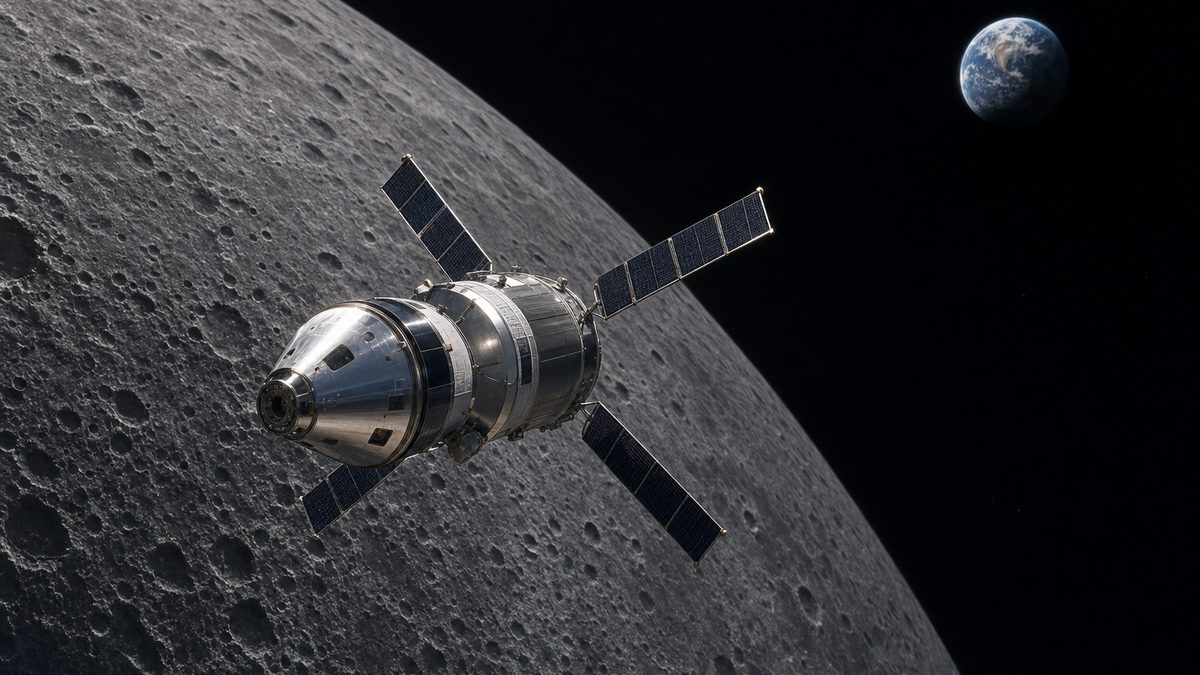
How we get to the Moon: why orbit is falling and missing, how rockets and staging work, the Space Race and Apollo, and how Artemis II carried people around the Moon again in 2026, with an interactive Newton’s cannonball, a rocket-equation calculator and a 3D free-return trajectory.
Interactive 3D film7 min1957 to 2026Published 2026-10-13
For the first time in more than half a century, people have flown around the Moon.
In April 2026, four astronauts swung around the far side of the Moon, about six and a half thousand kilometres above its surface.
Artemis II was the first crewed flight to the Moon since Apollo 17 in 1972. Its crew travelled farther from Earth than any people before them.
On the seventh of October, NASA released what they recorded: more than eleven thousand images and videos, and hours of the crew describing what they saw.
But how do you get to the Moon at all? It starts with a strange idea: orbiting is a kind of falling.
Prologue · Why the news matters
Return to the Moon
On 7 October 2026 NASA published the full lunar science dataset from Artemis II: more than 11,000 full-resolution images and videos, 8.5 hours of the crew’s spoken observations and more than 800 GB of data, with a preliminary science report. NASA calls it the first planetary science dataset captured mainly by humans in more than half a century. To see what it took to gather it, this story follows the physics and the history of getting to the Moon.
Artemis II flight
1–10 Apr 2026
about 9 days; splashdown off San Diego
Closest to the Moon
~6,545 km
above the far side, 6 April 2026
Farthest from Earth
406,771 km, a new record for people
beating Apollo 13’s 1970 record
The 3D Moon uses NASA’s Lunar Reconnaissance Orbiter colour map. The camera follows roughly the view a crew passing the far side would have, with Earth beyond the limb.
How to use: pick a chapter below the scene or press ← → to change step · ▶ plays the step · drag to rotate, scroll or pinch to zoom · several steps have controls in the panel on the scene · “Play the film” runs every step full-screen.
A thought experiment from three centuries ago still explains every satellite.
Isaac Newton imagined a cannon on a mountain so tall that it reaches above the air.
Fire the ball slowly and it curves down to the ground. Fire it faster and it lands farther away.
But the Earth is round. Its surface curves away beneath the falling ball.
At about seven point eight kilometres per second, the ground curves away exactly as fast as the ball falls. It never lands. That is an orbit.
Chapter I · Step 1 · Newton’s cannonball
Orbit is falling and missing
In A Treatise of the System of the World (published 1728, a draft of Book III of his Principia), Newton pictured a projectile fired horizontally from a very high mountain, ignoring air. Slow shots fall back. At the right speed the projectile falls all the way around the Earth and returns to the mountain: it is in orbit. An astronaut on the International Space Station is not beyond gravity. She is falling, all the time, and missing the ground.
Low-orbit speed
~7.8 km/s
about 28,000 km/h; 7.79 km/s at 200 km altitude
One lap
~90 min
low orbits take 128 minutes or less
Space Station altitude
about 400–420 km
there, gravity is still about 90% as strong as on the ground
Try it: use the slider on the scene to choose a speed and press Fire. Earlier shots stay as faint lines. The path is computed step by step from Newton’s law of gravity (no air, Earth not rotating). The mountain is 200 km high, far higher than any real one.
Go faster than circular speed and the ball swings out on a longer, stretched loop: an ellipse.
At about eleven kilometres per second it never comes back. That is escape velocity.
The Moon is almost at the edge of Earth’s pull, so getting there needs nearly that speed. Try it yourself with the slider.
Chapter I · Step 2 · Orbits and escape
Ellipses, and the speed of no return
Above circular speed the orbit stretches into an ellipse whose far point climbs higher the faster you go. At escape velocity the path opens into a curve that never closes. Escape speed is always √2, about 1.41 times, the circular speed at the same height.
Escape from the surface
11.19 km/s
ignoring air
Escape from 200 km up
~11.0 km/s
= √2 × 7.78 km/s
To reach the Moon
Apollo: about 10.4 km/s when its Moon-bound burn ended
just under escape speed: an ellipse so long that its far end reaches the Moon’s distance, 384,400 km away
The readout shows the exact two-body answer for each speed (falls back, ellipse, circle or escape); the drawn path is integrated numerically and agrees with it.
A rocket needs nothing to push against. It pushes against its own exhaust.
A rocket does not push against the air or the ground. It throws mass out of its back end, very fast.
Push gas backwards and the gas pushes you forwards: Newton’s third law. That is why rockets work in the vacuum of space.
In 1903 Konstantin Tsiolkovsky published the rule that governs every rocket. The speed you can gain depends on how fast the exhaust leaves, and on how much of the rocket is fuel.
The catch is the logarithm: doubling the fuel does not double the speed. To reach orbit, almost all of a rocket must be propellant.
Chapter II · Step 3 · The rocket equation
Action, reaction, and a logarithm
Burning propellant makes hot gas at high pressure. The nozzle lets it out at one end only, so the pressure on the chamber is unbalanced and the rocket is pushed the other way. Because it carries its own reaction mass, a rocket works in a vacuum.
Tsiolkovsky’s rocket equation gives the change in speed, Δv (“delta-v”):
Δv = ve × ln( mfull / mempty )
Kerosene + oxygen
~3.0 km/s
exhaust speed in vacuum (Saturn V F-1: 2.98)
Hydrogen + oxygen
~4.4–4.6 km/s
RS-25: 4.44 · RL10: 4.57
Needed to reach low orbit
about 9.4 km/s of Δv, not just 7.8
the extra 1.5–2 km/s is lost fighting gravity and air on the way up
Try it: change the mass ratio (full ÷ empty) and the fuel in the panel on the scene. With kerosene you need a mass ratio near 23 to reach 9.4 km/s: about 96% of the rocket would have to be propellant, leaving almost nothing for tanks, engines and payload.
William Moore had derived the same relation in 1810–1813; Robert Goddard (1912) and Hermann Oberth (about 1920) reached it independently. Tsiolkovsky was the first to apply it to spaceflight.
Stack rockets on rockets, and drop each one when it runs dry.
So engineers cheat. Instead of one huge rocket, they stack several, one on top of another.
When a stage runs dry it is thrown away, so the engines no longer have to push empty tanks.
Each new stage starts already moving fast, with a lighter rocket to push. The speeds add up.
In the panel, compare one, two and three stages with the same fuel and the same payload. Press launch to watch them separate.
Chapter II · Step 4 · Staging
Why rockets come in pieces
Apply the rocket equation to each stage in turn. The first stage burns and drops away; the second starts with a smaller total mass, so the same propellant buys more speed. In the textbook example where every stage is 10% structure and 90% propellant, three stages leave 0.1% of the launch mass as payload, while a single stage would have to be 88% propellant just to reach orbit with nothing left over.
Saturn V
3 stages
to send Apollo to the Moon
SLS (Artemis)
2 stages + 2 boosters
the boosters burn out and drop away first
Earth surface → Moon’s path
~9.4 km/s to orbit + ~3.2 km/s to head for the Moon
about 12.6 km/s in total before the coast to the Moon
Calculator: payload fraction is payload ÷ launch mass; structure is the share of each stage that is tanks and engines rather than propellant. The model assumes identical stages and ignores air and gravity during the burn; real rockets differ, but the lesson holds.
The first artificial moon: a metal ball the size of a beach ball, going round every 96 minutes.
On the fourth of October 1957, the Soviet Union put the first artificial satellite into orbit: Sputnik 1.
It was a polished metal ball fifty-eight centimetres wide, circling the Earth every ninety-six minutes and beeping on two radio frequencies.
Radio listeners around the world could hear it. In the United States it caused alarm. Within a year America had its own satellite in orbit, and had created NASA.
Chapter III · Step 5 · 1957
Sputnik 1
Sputnik 1 was launched by a modified R-7 missile from Baikonur, in today’s Kazakhstan. Its elliptical orbit dipped to about 215 km and rose to about 939 km. It transmitted for 22 days until its batteries ran out, and burned up in the atmosphere on 4 January 1958.
Mass · size
83.6 kg · 58 cm
four long antennas
Orbit period
96.2 min
peak speed about 8 km/s
Radio
20.005 and 40.002 MHz
until 26 Oct 1957
Orbit tilt
65.1°
to the equator
The race begins
31 Jan 1958 Explorer 1, the first US satellite
29 Jul 1958 The law creating NASA is signed
14 Sep 1959 Soviet Luna 2 is the first craft to hit the Moon
7 Oct 1959 Luna 3 photographs the Moon’s far side
The orbit is drawn with its real shape, height and tilt; the timing is sped up about 600 times.
Yuri Gagarin went once around the world in 108 minutes.
On the twelfth of April 1961, Yuri Gagarin became the first person in space.
His Vostok capsule went once around the Earth, between about one hundred and eighty and three hundred and thirty kilometres up.
While he flew, the Earth turned beneath him. He came down near the town of Engels, far west of Baikonur. He ejected from the capsule about seven kilometres up and landed by parachute.
Six weeks later, President Kennedy asked Congress to commit the United States to landing a man on the Moon before the decade was out.
Chapter III · Step 6 · 1961
Yuri Gagarin and Vostok 1
Vostok 1 lifted off from Baikonur at 06:07 UTC. Gagarin made a single orbit and left the capsule at about 7 km altitude to parachute down separately, landing about 26 km south-west of Engels in the Saratov region. The flight lasted about 108 minutes.
Orbit
181 × 327 km
tilted 64.95°
Orbit period
89.1 min
one orbit flown
Firsts that followed
5 May 1961 Alan Shepard, first American in space (suborbital)
25 May 1961 Kennedy sets the goal of a Moon landing “before this decade is out”
20 Feb 1962 John Glenn, first American in orbit
18 Mar 1965 Alexei Leonov makes the first spacewalk
3 Feb 1966 Soviet Luna 9 makes the first soft landing on the Moon
In the scene the Earth turns at its real rate during the flight, which is why the landing point (green) lies west of the launch site (orange). The final descent is drawn schematically.
Kennedy’s challenge needed an enormous new rocket: the Saturn V.
It stood one hundred and eleven metres tall. Its first stage alone had five huge F-1 engines burning kerosene and liquid oxygen.
Three stages, each thrown away in turn, could send about forty-three tonnes towards the Moon.
Between 1967 and 1973 it flew thirteen times. Press launch in the panel to watch it lift off.
Chapter IV · Step 7 · The Moon rocket
Saturn V
The first stage (S-IC) burned kerosene with liquid oxygen in five F-1 engines. The second (S-II, five J-2 engines) and third (S-IVB, one J-2) burned liquid hydrogen, which gives a faster exhaust. The third stage fired twice: once to reach Earth orbit, and again to send the spacecraft towards the Moon.
Height
111 m
10 m wide at the base
Mass at launch
~2,900 t
2.82–2.97 million kg, mostly propellant
Thrust at liftoff
34.5 MN
five F-1s, each about 6.8 MN at sea level
Payload
~140 t to low orbit · ~43.5 t to the Moon
still the record for low-orbit payload
Record
13 launches, 1967–1973
12 successes; one partial failure (Apollo 6, uncrewed). The last carried the Skylab station.
Only a small lander needs to go down and come back up.
How do you land on the Moon and come back? Carrying everything down to the surface and back up would need a gigantic rocket.
Engineer John Houbolt argued for a cleverer plan: lunar orbit rendezvous. In July 1962, NASA adopted it.
The main spaceship stays in orbit around the Moon. A small, light lander goes down with two astronauts.
Afterwards its top half climbs back, docks with the mothership, and is left behind. Only the mothership flies home.
Chapter IV · Step 8 · 1962
Lunar orbit rendezvous
The alternatives were to fly one giant ship straight down and back (“direct ascent”, which needed a rocket even bigger than Saturn V) or to assemble a ship in Earth orbit. Lunar orbit rendezvous saved mass: the fuel for the trip home never had to be carried down to the surface and lifted again, and every kilogram saved also saved the fuel needed to carry it.
Command and service module (3 crew) and lunar module enter lunar orbit together
Two astronauts take the lunar module down; one stays in orbit
The lunar module’s upper half lifts off, using its lower half as a launch pad
It docks with the command module, the crew moves across, and it is cast off
Houbolt wrote a nine-page letter to NASA’s associate administrator in November 1961, protesting that the idea was being ignored. NASA announced its choice on 11 July 1962. In the scene, the orbit height is exaggerated about ten times.
The first people to leave Earth orbit, and see their own planet rise over the Moon.
In December 1968, Apollo 8 carried three astronauts out of Earth orbit for the first time.
A burn of about six minutes added roughly three kilometres per second. That was enough to coast all the way to the Moon, about three days away.
The path was chosen so that if the engine failed, the Moon’s gravity would swing the ship around and send it home. This is a free-return trajectory.
Seen from a view that turns with the Moon, the path is a stretched figure of eight. Apollo 8 fired its engine to stay for ten orbits, and on the fourth the crew photographed the Earth rising over the lunar horizon.
Chapter IV · Step 9 · 1968
Apollo 8 and the free return
Frank Borman, Jim Lovell and William Anders launched on 21 December 1968 and entered lunar orbit on 24 December. They made ten orbits and splashed down on 27 December. The “trans-lunar injection” burn by Saturn V’s third stage lasted about 350 seconds and added 3.05–3.25 km/s, leaving the spacecraft at about 10.4 km/s relative to Earth.
Leave low orbit
+3.2 km/s
trans-lunar injection
Enter lunar orbit
~0.9 km/s
a braking burn behind the Moon
Lunar orbit → surface
~1.9 km/s
and the same to climb back
Trip time
~3 days
each way
The path in the scene is computed, not drawn by hand: a spacecraft leaves a 185 km parking orbit at 10.94 km/s and coasts under the gravity of the Earth and the Moon (a simplified model with a circular lunar orbit). Its outbound leg is orange, the return blue. Distances are to scale; the glows around Earth and Moon are enlarged so you can see them. The camera turns with the Moon, which is why the Moon stays still.
Six landings in three and a half years. Then nobody went back.
On the twentieth of July 1969, the lunar module Eagle landed in the Sea of Tranquility.
Neil Armstrong and Buzz Aldrin walked on the surface for about two and a half hours, while Michael Collins circled overhead.
Five more landings followed. Between 1969 and 1972, twelve people walked on the Moon and brought back about three hundred and eighty kilograms of rock and soil.
Then it stopped. Budgets shrank, the space shuttle needed funding, and the last planned missions were cancelled. Nobody has been back since December 1972.
Chapter IV · Step 10 · 1969–1972
Six landings
Apollo 11 touched down at 20:17 UTC on 20 July 1969, and its crew returned 21.5 kg of samples. Apollo 13 (1970) never landed: after an explosion it swung around the Moon on a free-return path and got home. Apollo 17’s crew stayed about 75 hours and lifted off on 14 December 1972, the last time anyone left the Moon.
Apollo 11 Jul 1969 · Armstrong, Aldrin
Apollo 12 Nov 1969 · Conrad, Bean
Apollo 14 Feb 1971 · Shepard, Mitchell
Apollo 15 Jul 1971 · Scott, Irwin
Apollo 16 Apr 1972 · Young, Duke
Apollo 17 Dec 1972 · Cernan, Schmitt
Samples returned
~382 kg
rock and soil, all six landings
Programme cost
US$25.4 bn
NASA’s 1973 figure
Why did it end? After the first landing NASA’s budget shrank and money was needed for the Space Shuttle. A Saturn V meant for Apollo 20 launched the Skylab station instead, and Apollos 18 and 19 were cancelled. Markers show the real landing sites, all near the equator on the side facing Earth.
At the Moon’s south pole, some crater floors never see the Sun.
Every Apollo landing was near the Moon’s equator, on the side facing Earth. The next landings are aimed at the south pole.
There the Sun always stays low on the horizon. The floors of some deep craters never see sunlight, and stay colder than about minus one hundred and seventy degrees Celsius.
In 2009 a NASA probe crashed into one of these craters and found water in the plume it threw up. Ice probably lies mixed into the soil of such cold traps.
Water means drinking water, oxygen to breathe, and hydrogen and oxygen for rocket fuel. India landed near the south pole in 2023, and China plans a crewed landing by 2030.
Chapter V · Step 11 · Why go back?
Water at the south pole
The Moon’s axis is tilted only about 1.5° to its path around the Sun, so near the poles sunlight always skims the horizon. Some crater floors are in permanent shadow and never warm above about 100 K (−173 °C). Some crater rims nearby, such as peaks on the rim of Shackleton crater, are in sunlight 80–90% of the time: good places for solar power.
LCROSS impact, 2009
~5.6% water
by mass in the plume from Cabeus crater (±2.9%)
Ice mapped, 2018
within 20° of both poles
from India’s Chandrayaan-1 orbiter data
Shackleton crater
21 km wide
4.2 km deep; floor in perpetual shadow
Why water matters
water, air, fuel
shipping it from Earth is extremely expensive
Robots that went first
Jan 2019 China’s Chang’e 4: first soft landing on the far side
Dec 2020 Chang’e 5 returns 1,731 g of samples
Aug 2023 India’s Chandrayaan-3: first landing near the south pole (~69°S)
Jun 2024 Chang’e 6 returns the first samples from the far side
The ice is most likely small grains mixed into the soil, not thick sheets. The blue glints in the scene mark the polar cold-trap region schematically; they are not mapped deposits. Besides resources, scientists want polar samples, and NASA presents the Moon as practice for Mars.
Built from space shuttle parts, and more powerful at liftoff than the Saturn V.
NASA’s Artemis programme is the return. Its rocket is the Space Launch System, SLS.
It reuses engines from the space shuttle: four RS-25s under an orange core stage, plus two solid rocket boosters.
At liftoff it pushes harder than the Saturn V, but it is shorter and sends less mass towards the Moon: about twenty-seven tonnes, against forty-three.
Its capsule, Orion, carries four people instead of three. The first SLS flew without a crew in November 2022, on Artemis I.
Chapter VI · Step 12 · Artemis
SLS and Orion
The Artemis programme was set up in 2017 and named in 2019. Artemis I launched on 16 November 2022 and sent an uncrewed Orion around the Moon for 25 days, reaching 432,210 km from Earth. Inspectors later found unexpected chunks missing from its heat shield, which shaped how Artemis II flew home.
Apollo
Artemis
Rocket
Saturn V, 111 m
SLS Block 1, 98 m
Liftoff thrust
34.5 MN
39 MN
To the Moon (TLI)
~43.5 t
~27 t
Capsule
Command module, 3 crew, 3.9 m wide
Orion, 4 crew, 5.0 m wide
Service module
US-built
European (ESA, built by Airbus)
Lander
Lunar module (NASA)
Commercial: Starship HLS or Blue Moon
Landing region
Near the equator, near side
Near the south pole
Use the panel on the scene to switch the comparison and to launch either rocket.
Four astronauts, a free-return path, and a new distance record.
On the first of April 2026, Artemis II launched with Reid Wiseman, Victor Glover, Christina Koch and the Canadian astronaut Jeremy Hansen.
After a day checking the spacecraft in a high orbit, Orion fired its engine and set off on a free-return path, like Apollo 8, but without stopping in lunar orbit.
On the sixth of April it swung behind the Moon, about six thousand five hundred kilometres above the far side. At their farthest, the crew were more than four hundred and six thousand kilometres from Earth: a new record.
The Moon’s gravity turned it back for home. On the tenth of April the capsule splashed down in the Pacific off San Diego.
Chapter VI · Step 13 · April 2026
Artemis II: a figure of eight
Artemis II launched at 22:35 UTC on 1 April 2026 from Kennedy Space Center. After about a day in a high Earth orbit, Orion’s European Service Module fired for 5 minutes 49 seconds to head for the Moon. Only one of three planned course corrections was needed. Glover, Koch and Hansen became the first person of colour, the first woman and the first non-American to travel around the Moon.
Closest approach
6 Apr · ~6,545 km
above the far side
Farthest from Earth
406,771 km
Apollo 13 reached about 400,000 km
Distance flown
~1.12 million km
695,081 miles
Splashdown
10 Apr 2026
17:07 Pacific time (00:07 UTC, 11 Apr)
To protect the heat shield, Orion used a steeper, direct re-entry instead of the “skip” planned earlier. A small helium leak in the service module led to some tests being cancelled. The scene shows the computed free-return path from Chapter IV (same physics, simplified), not Artemis II’s exact track. Switch the view in the panel: turning with the Moon (figure of eight) or fixed to the stars (a long loop while the Moon moves).
Test flights first. Then, if all goes to plan, boots on the south pole.
The plan has changed more than once. In February 2026 NASA turned Artemis III into a test flight in Earth orbit, planned for 2027.
Its crew will practise docking Orion with test versions of two commercial landers: SpaceX’s Starship and Blue Origin’s Blue Moon.
The first landing is now planned for Artemis IV in 2028, near the south pole. NASA also dropped its planned lunar space station, the Gateway, in favour of a base on the surface.
China is preparing too, with a new rocket, a crew capsule and a lander for a landing by 2030. Dates in spaceflight often slip: these are plans, not promises.
Chapter VI · Step 14 · What comes next
Artemis III, IV, and a base
Late 2027 Artemis III (planned): two weeks in low Earth orbit, about 430 km up. Crew named 9 June 2026: Randy Bresnik, Luca Parmitano (ESA), Frank Rubio, Andre Douglas. Docking tests with Blue Moon and Starship test vehicles.
Early 2028 Artemis IV (planned): the first crewed landing since 1972, two astronauts to the surface, using whichever lander is ready.
By 2030 China (planned): two Long March 10 rockets, the Mengzhou crew ship and the Lanyue lander, meeting in lunar orbit, an echo of Apollo’s plan.
Gateway station
Cancelled, Mar 2026
parts to be reused for a US$20 bn surface base over seven years
Artemis Accords
76 nations
as of September 2026; Thailand joined in Dec 2024
Landers
Starship HLS (chosen 2021) · Blue Moon (chosen 2023)
Starship must be refuelled in orbit by several tanker flights; that transfer had not yet been demonstrated by September 2026
China’s Chang’e 7 robot, bound for the rim of Shackleton crater with a hopper to probe shadowed craters, was due to launch in August 2026; bad weather forced a delay, possibly to 2027. In the scene, the ring marks the proposed Artemis Base Camp area near Shackleton crater; its exact site is not decided.
From Newton’s cannonball to the far side of the Moon, the physics has not changed.
Go fast enough sideways and you fall around the Earth. Throw mass backwards and you speed up. Let the Moon’s gravity bend your path, and it can bring you home.
What has changed is who is going, and why: not just to visit, but to stay.
Epilogue
Falling, throwing, swinging
1728 Newton’s cannonball explains orbit
1903 Tsiolkovsky’s rocket equation
1957 Sputnik 1, the first satellite
1961 Yuri Gagarin, the first person in space
1968 Apollo 8, the first people around the Moon
1969–72 Six landings, twelve moonwalkers
2022 Artemis I, uncrewed
2026 Artemis II flies four people around the Moon
2027–28 Artemis III test; Artemis IV landing planned
Here the free-return path is shown against the fixed stars: the Moon moves along its orbit while the spacecraft travels out and back. All full-screen stills are AI-generated to help the imagination; they are not photographs and do not show real spacecraft or people. The globe uses NASA Blue Marble imagery; the Moon uses NASA’s LRO colour map and elevation data from the CGI Moon Kit.