PlanetPast

Origins of Religions · Episode 12 · 1000 BC – today

Spirits, Brahmins and the Buddha: Southeast Asia

How religion took shape in Southeast Asia and Thailand: rice farmers and the spirits of land and ancestors at Ban Chiang and Dong Son, phi and khwan, Indian traders and Brahmins in Funan, Dvaravati, Borobudur and Prambanan, Angkor's god-kings, Theravada from Sri Lanka to Bagan and Sukhothai, Ayutthaya's Buddhist kings and Brahmin court rites, the Ramakien, Bangkok's city pillar and Devasathan, Mongkut's reform, the region's many layers, and everyday religion in Thailand today. Episode 12 and finale of the Origins of Religions series.

Interactive 3D film8 min1000 BC to todayPublished 2026-10-13

Watch the interactive filmอ่านภาษาไทย

Prologue

Origins of Religions · Episode 12

Spirits, Brahmins and the Buddha

Religion in Southeast Asia and Thailand.

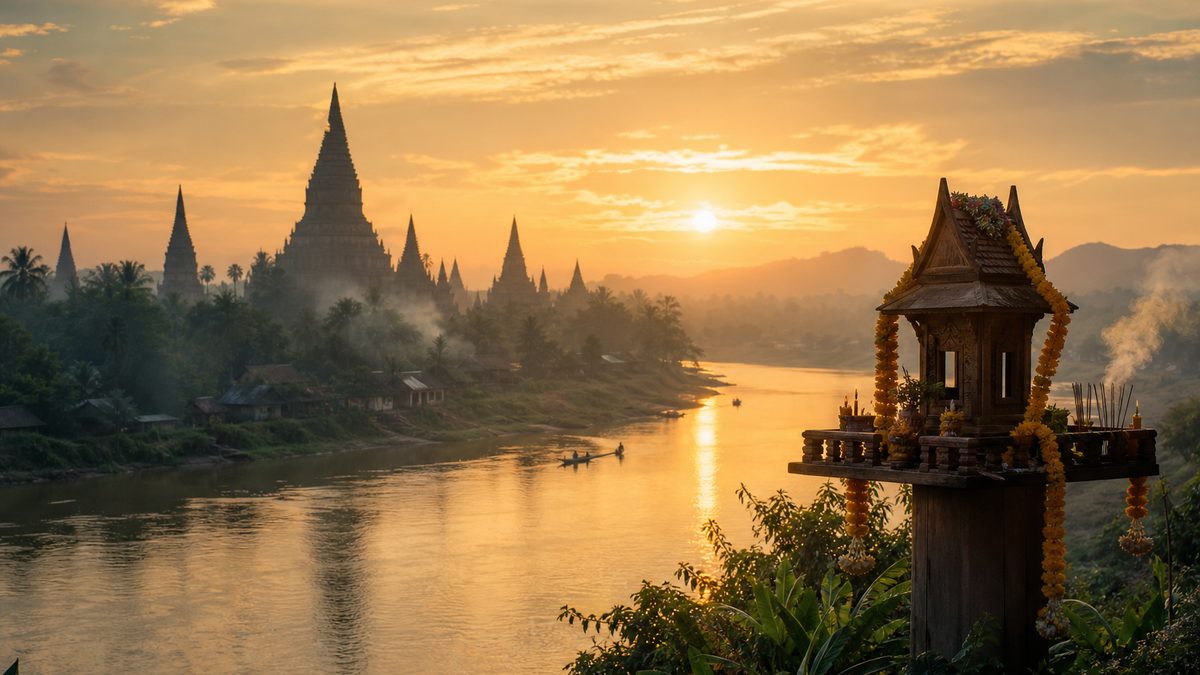
This last episode comes home, to Southeast Asia and Thailand. Here, almost every house has a small spirit house in front of it.

A new building may be blessed by a Brahmin who calls on Hindu gods, and monks will chant Buddhist verses for it. At a wedding, elders tie white threads around the couple’s wrists to call their khwan, their life spirit.

These are not three separate religions competing, but layers laid down over three thousand years: the spirits of the land, the gods of India, and the teaching of the Buddha.

Prologue · Episode 12 of the Origins of Religions series

Spirits, Brahmins and the Buddha

Thailand, Buddhist
~93%
national survey, 2018
Muslim · Christian
~5% · ~1%

This film does not depict the Buddha, Hindu gods or spirits themselves. The images are AI-generated landscapes and architecture.

Sources: Wikipedia: Religion in Thailand (National Statistical Office data); Tambiah, Buddhism and the Spirit Cults in North-east Thailand (1970)

Chapter I · Spirits

Chapter I · c. 1000 BC – AD 1

Rice and spirits

The oldest layer.

Long before any written religion arrived, the people of Southeast Asia grew rice in river valleys and lived in houses raised on stilts. At Ban Chiang in northeast Thailand, they buried their dead with painted pots and bronze ornaments, about three thousand years ago.

In northern Vietnam, the Dong Son culture cast great bronze drums decorated with boats, birds and dancers. They were used in ceremonies, perhaps to call the rain, and were traded across the islands.

Rice farmers depended on rain, soil and rivers, and they believed these were alive with powers: spirits of the land, the water, the forest, and the ancestors, who had to be respected and fed.

Chapter I · Step 1

Rice and spirits

  • Ban Chiang burials with pots and bronze, c. 1000 BC
  • Dong Son bronze drums, c. 600 BC – AD 200
  • Beliefs spirits of land, water and ancestors
Sources: UNESCO: Ban Chiang Archaeological Site; Wikipedia: Dong Son drum

Chapter I · teaching

Phi and khwan

A world full of spirits.

In Tai belief, the world is full of phi, spirits. There are spirits of the house and of the village, guardian spirits of the land, spirits of the ancestors, and dangerous wandering spirits. A village may have a shrine to its guardian spirit, and a city has its pillar, the lak mueang.

People ask the spirits’ permission before building on land, offer them food and flowers, and keep them content. The spirit house in front of a home gives the guardian of the land a place to live.

Each person also has khwan, a life spirit; tradition counts thirty-two of them. A fright can make the khwan flee, so at turning points like birth, marriage, ordination or a long journey, a khwan ceremony calls it back.

In the northeast, the rocket festival, Bun Bang Fai, sends home-made rockets into the sky at the start of the rains, to remind the sky to send water to the rice.

Chapter I · Step 2

Phi and khwan

  • Phi spirits of house, land, village and ancestors
  • Lak mueang the city pillar
  • Khwan the life spirit; 32 in tradition
  • Su khwan calling the khwan home
  • Bun Bang Fai rocket festival for rain
Sources: Wikipedia: Phi (spirit); Wikipedia: Khwan; Wikipedia: Bun Bang Fai (rocket festival)

Chapter II · Brahmins

Chapter II · AD 1–900

Gods from India

Traders, Brahmins and kings.

From about the first century AD, ships crossing the Bay of Bengal brought Indian traders to Southeast Asia, and with them Brahmin priests, Buddhist monks, the Sanskrit language and Indian ideas of kingship.

Local rulers adopted them by choice: a king who was consecrated by Brahmins and linked with Shiva or Vishnu gained great prestige. At Oc Eo in the Mekong delta, the port of Funan, archaeologists have found Indian, Persian and even Roman goods.

In central Thailand, the Mon kingdom of Dvaravati embraced Buddhism. In Java, around 800, the Sailendra kings built Borobudur, the largest Buddhist monument in the world, and soon after, the Hindu temples of Prambanan rose nearby.

Chapter II · Step 3

Gods from India

  • 1st–6th c. Funan, port of Oc Eo
  • 6th–11th c. Dvaravati, Mon Buddhism
  • c. 800 Borobudur, Java
  • c. 850 Prambanan, Java
Sources: Wikipedia: Indianised kingdoms of Southeast Asia; UNESCO: Borobudur Temple Compounds

Chapter II · 802–1220

Angkor

A god-king and a temple-mountain.

In 802, the Khmer king Jayavarman the Second was consecrated by a Brahmin as a universal ruler. For four centuries his successors ruled from Angkor, the largest city of its age in Southeast Asia.

In the early 1100s, Suryavarman the Second built Angkor Wat, dedicated to Vishnu. Its towers represent Mount Meru, the centre of the universe in Hindu and Buddhist cosmology.

Around 1200, Jayavarman the Seventh made Mahayana Buddhism the state religion and built the Bayon. Through these centuries, Brahmin court rituals, Khmer words and Khmer art flowed into the lands that would become Thailand.

Chapter II · Step 4

Angkor

  • 802 Jayavarman II consecrated
  • early 1100s Angkor Wat, for Vishnu
  • c. 1200 Jayavarman VII, the Bayon
Sources: UNESCO: Angkor

Chapter III · The Buddha’s way

Chapter III · 1050–1350

The way of the elders

Theravada from Sri Lanka.

From the eleventh century, a reformed Theravada Buddhism, the “way of the elders”, spread from Sri Lanka. Tradition says King Anawrahta of Bagan in Burma embraced it around 1056.

Monks from Sri Lanka and from Nakhon Si Thammarat in the south brought it to the Tai kingdom of Sukhothai. The famous Ram Khamhaeng inscription, dated 1292, describes a city where people kept the Buddhist precepts, though some scholars question when it was written.

Theravada teaches that suffering comes from craving, and can end by following the Buddha’s path of ethics, meditation and wisdom. For lay people, it is a life of making merit: giving to monks, keeping precepts, and supporting the temple.

Around 1345, a Sukhothai king wrote the Traiphum, the “Three Worlds”, a Buddhist picture of the cosmos that found room for gods, spirits and humans alike.

Chapter III · Step 5

The way of the elders

  • c. 1056 Bagan embraces Theravada
  • 1292 Ram Khamhaeng inscription (date debated)
  • c. 1345 Traiphum Phra Ruang
  • 1300s Theravada in Lan Na, Lan Xang, Cambodia
Sources: Britannica: Theravada; UNESCO: Historic Town of Sukhothai; Wikipedia: Ram Khamhaeng inscription

Chapter III · 1351–1767

Ayutthaya

A Buddhist king with Brahmin rites.

From 1351, Ayutthaya grew into a great trading capital. Its kings were patrons of Theravada Buddhism, building temples and supporting the monks.

But the court also kept Brahmin priests and rituals inherited from Angkor: coronation rites, oaths of loyalty, and the Royal Ploughing Ceremony that opens the rice-planting season, still held in Bangkok every May.

The story of Rama, the Ramayana, became a Thai epic, the Ramakien, told in dance, painting and puppet theatre. And in the villages, people kept honouring the spirits of land and ancestors, as they always had.

Chapter III · Step 6

Ayutthaya

  • 1351 Ayutthaya founded
  • Court Brahmin coronation and oath rites
  • Every May Royal Ploughing Ceremony
  • Ramakien the Thai Ramayana
  • 1767 Ayutthaya falls
Sources: UNESCO: Historic City of Ayutthaya; Wikipedia: Royal Ploughing Ceremony

Chapter IV · Layers

Chapter IV · 1782–1902

Bangkok

Three layers in one city.

When Bangkok was founded in 1782, its first act was to raise the city pillar, the home of the city’s guardian spirit. Two years later the Brahmin temple, Devasathan, was built near the palace.

King Rama the First had the Ramakien written down in full, and painted along the walls of the Temple of the Emerald Buddha.

In the 1830s, Prince Mongkut, then a monk and later King Rama the Fourth, founded the stricter Thammayut order and sought to separate the Buddha’s teaching from magic and myth. In 1902 a law organised the monks into a national Sangha.

Chapter IV · Step 7

Bangkok

  • 1782 The city pillar raised
  • 1784 Devasathan Brahmin temple
  • 1797 Rama I’s Ramakien
  • 1830s Mongkut founds the Thammayut
  • 1902 Sangha Act
Sources: Wikipedia: Bangkok City Pillar Shrine; Wikipedia: Devasathan; Wikipedia: Ramakien; Wikipedia: Dhammayuttika Nikaya

Chapter IV · today

A region of many layers

Not only in Thailand.

The same layering is found across the region. In Myanmar, devout Buddhists also honour the nats, the spirits of Mount Popa. In Laos and Cambodia, Theravada lives alongside spirit cults much as in Thailand.

In Vietnam, the “Three Teachings” of Buddhism, Confucianism and Daoism blend with the worship of ancestors at a family altar. On Bali, Hinduism survives as the faith of the island, mixed with older local rituals.

Islam became the faith of Indonesia, Malaysia and Brunei, and Christianity of the Philippines and East Timor; yet even there, older customs and local saints often live on.

Chapter IV · Step 8

A region of many layers

  • Myanmar Buddhism and the nats
  • Vietnam Three Teachings and ancestors
  • Bali Balinese Hinduism
  • Indonesia, Malaysia Islam
  • Philippines, Timor-Leste Christianity
Sources: Wikipedia: Burmese folk religion (nats); Wikipedia: Balinese Hinduism

Chapter IV · today

Thailand today

Everyday religion.

In Thailand today, about 93 percent of people are Buddhists, about 5 percent Muslims and about 1 percent Christians. Many young men still ordain as monks for a short time, and people give alms to monks at dawn.

The same people may light incense at a shrine to Brahma on a busy Bangkok corner, place garlands at a spirit house, and visit a fortune-teller before a big decision.

Anthropologists such as Stanley Tambiah described Thai village religion as one system, not many: the Buddha’s teaching at the top, Brahmin rites for life’s ceremonies, and the spirits for the problems of the everyday world.

Chapter IV · teaching

How the layers fit

Merit, ritual and protection.

In Buddhist teaching, spirits and gods are real beings, but they too are caught in the cycle of birth and death. They can help or harm in this life, but only the Buddha’s path leads beyond suffering.

So the layers do different jobs. Monks and merit look to the next life and to liberation. Brahmin rites mark beginnings and protect kings and houses. The spirits watch over land, family and health here and now.

Some Buddhist reformers have criticised spirit worship and magic, and debates continue. But for most people, these layers sit together, much as the spirit house sits in front of the home.

Chapter IV · Step 10

How the layers fit

  • Buddhism merit, the next life, liberation
  • Brahmin rites beginnings, kingship, protection
  • Phi and khwan land, family and health, here and now
Sources: Tambiah, Buddhism and the Spirit Cults in North-east Thailand (1970); Wikipedia: Phi (spirit)

Epilogue

Epilogue

Every religion began somewhere

The end of the series.

Every religion in this series began in a particular place and time, among people facing particular problems: rain and harvests, kings and empires, injustice and death.

Each answered with its own teaching, and those teachings travelled, met and mixed. In Southeast Asia, they did not replace one another, but settled in layers.

Thank you for following the Origins of Religions series. You can return to the overview to see all the faiths on one timeline.

Epilogue

Every religion began somewhere

  • c. 1000 BC Rice and spirits
  • AD 1–900 Gods from India
  • 802 Angkor
  • 1292 Sukhothai
  • 1782 Bangkok’s city pillar
The series
  1. 00The Origins of Religions (overview)
  2. 01The First Beliefs
  3. 02The Ancient Gods
  4. 03Hinduism
  5. 04Zoroastrianism
  6. 05Judaism
  7. 06Buddhism and Jainism
  8. 07Confucianism and Daoism
  9. 08Shinto
  10. 09Christianity
  11. 10Islam
  12. 11Sikhism
  13. 12 Spirits, Brahmins and the Buddha: Southeast Asia (this film)

The still images on the chapter cards are AI-generated landscapes and buildings; they do not depict the Buddha, gods, spirits or other figures. Outlines are approximate.

Sources: Tambiah, Buddhism and the Spirit Cults in North-east Thailand (1970); Wikipedia: Indianised kingdoms of Southeast Asia