PlanetPast

Origins of Religions · Episode 11 · 1469 – today

Sikhism

How Sikhism began and spread: Punjab between the Lodi sultans and the Mughals, Bhakti poets and Sufis, Guru Nanak and the experience at the Bein river, Kartarpur and the teaching of one God, honest work and sharing, the langar, the ten Gurus, Amritsar and the Harmandir Sahib, the Adi Granth, Guru Arjan and Guru Tegh Bahadur, the Khalsa of 1699 and the five Ks, the Guru Granth Sahib as eternal Guru, Ranjit Singh's kingdom, Partition, 1984, the diaspora and Sikhs in Thailand. Episode 11 of the Origins of Religions series.

Interactive 3D film7 min1469 to todayPublished 2026-10-13

Watch the interactive filmอ่านภาษาไทย

Prologue

Origins of Religions · Episode 11

Sikhism

The way of the disciple.

About 25 to 30 million people are Sikhs. The word Sikh means “disciple” or “learner”: a disciple of the Guru, the teacher who leads from darkness to light.

Sikhs believe in one God, Ik Onkar, beyond form and gender, who can be known through devotion, honest living and service to others. They follow the teachings of ten human Gurus, and today of the scripture they call the Guru Granth Sahib.

Sikhism is the youngest of the major world religions, just over five hundred years old. Its heartland is the Punjab, a region now divided between India and Pakistan.

Prologue · Episode 11 of the Origins of Religions series

The way of the disciple

Sikhs
~25–30 million
most in Indian Punjab
Founded
c. 1500
Guru Nanak, 1469–1539

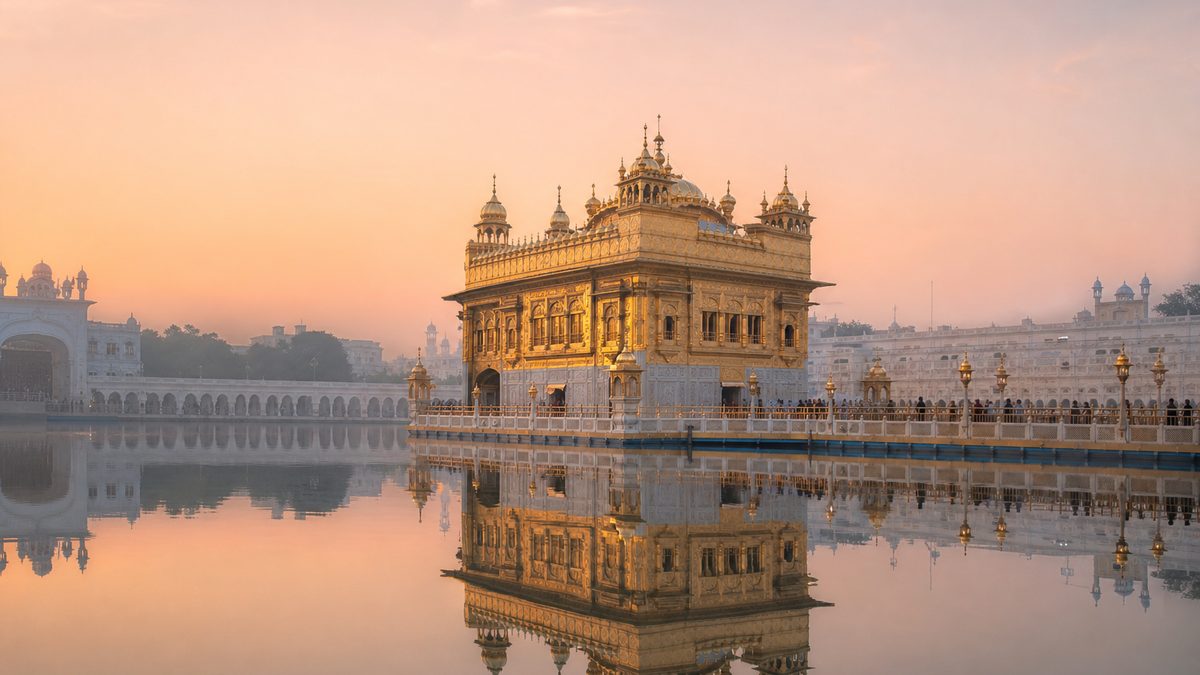
Out of respect for Sikh tradition, this film does not depict the Gurus. The images are AI-generated landscapes and architecture.

Sources: Britannica: Sikhism

Chapter I · Guru Nanak

Chapter I · c. 1450–1500

Where two worlds met

The land of five rivers.

In the late 1400s, Punjab, the land of five rivers, was a rich farming region on the road between Central Asia and India. Armies and traders came through it, and it was ruled from Delhi by the Muslim Lodi sultans.

Most Punjabis were Hindus, many others Muslims. Society was divided by caste, and religious life was full of rituals, pilgrimages and priests.

But new voices were questioning all this. Bhakti poets like Kabir in Benares sang of a loving devotion to one God beyond Hindu and Muslim forms, and Sufi mystics like Baba Farid, who had lived in Punjab, taught love of God in the local language.

Chapter I · Step 1

Where two worlds met

  • 1451–1526 Lodi sultans of Delhi
  • Bhakti loving devotion: Kabir, Ravidas, Namdev
  • Sufis Baba Farid of Punjab (d. 1266)
  • 1526 Babur founds the Mughal Empire
Sources: Britannica: Sikhism

Chapter I · 1469–1499

No Hindu, no Muslim

A storekeeper by the river.

Nanak was born in 1469 in the village of Talwandi, now Nankana Sahib in Pakistan, into a Hindu family of the Khatri caste. Stories tell of a thoughtful boy who questioned empty rituals.

As a young man he worked as a storekeeper for a Muslim official at Sultanpur. Each morning he bathed in the Bein river.

According to Sikh tradition, around 1499 he disappeared into the river for three days. When he came out, he said: “There is no Hindu, there is no Muslim.” Sikhs understand this as his call: before God, all people are one, and the path is the same for all.

Chapter I · Step 2

No Hindu, no Muslim

  • 1469 Born at Talwandi
  • c. 1499 The experience at the Bein river, Sultanpur

Most stories of Nanak’s life come from the janamsakhis, collections written down from the 1600s onwards; historians use them with care.

Sources: Britannica: Guru Nanak

Chapter I · 1500–1539

Kartarpur

One God, honest work, sharing.

Tradition says Nanak spent years travelling with a Muslim companion, the musician Mardana, singing his hymns as far as Benares and Assam, Sri Lanka, and Mecca and Baghdad.

He saw the misery of Babur’s invasion in 1526 and wrote of it in his hymns. Around 1520 he settled at Kartarpur on the Ravi river and founded a community of farmers.

His teaching was simple: remember God’s name, earn an honest living, and share with others. He rejected caste and idol worship, and taught that a householder’s ordinary life, not withdrawal from the world, is the way to God.

In the communal kitchen, the langar, everyone sat together on the floor, whatever their caste or religion, and ate the same food. Langar is still served free at every gurdwara today.

Chapter I · Step 3

Kartarpur

  • Ik Onkar there is one God
  • Naam japna remembering God’s name
  • Kirat karni honest work
  • Vand chakna sharing with others
  • Langar a free kitchen open to all
Sources: Britannica: Guru Nanak; Wikipedia: Langar

Chapter II · The ten Gurus

Chapter II · 1539–1606

The Gurus and the Book

A script, a city and a scripture.

Before he died in 1539, Nanak chose a disciple, not his son, to succeed him as Guru. Guru Angad developed the Gurmukhi script for writing Punjabi; Guru Amar Das organised the community and asked all visitors to eat in the langar first.

Guru Ram Das founded the town of Amritsar around its sacred pool. His son, Guru Arjan, built the Harmandir Sahib in the middle of the pool, with four doors open to all four directions.

In 1604 Guru Arjan compiled the Adi Granth, the first Sikh scripture. Alongside the hymns of the Gurus, it includes poems by Hindu and Muslim saints such as Kabir, Ravidas, Namdev and Baba Farid.

In 1606 Guru Arjan died in Mughal custody in Lahore, on the orders of the emperor Jahangir. Sikhs remember him as their first martyr.

Chapter II · Step 4

The Gurus and the Book

  • 1539–1552 Guru Angad: Gurmukhi script
  • 1552–1574 Guru Amar Das: langar for all
  • c. 1577 Guru Ram Das: Amritsar
  • 1604 Guru Arjan: the Adi Granth
  • 1606 Guru Arjan dies in Lahore
Sources: Wikipedia: Sikh gurus; Britannica: Adi Granth (Guru Granth Sahib)

Chapter II · 1606–1708

The Khalsa

Saint and soldier.

Guru Hargobind wore two swords, for spiritual and worldly authority, and built the Akal Takht facing the Harmandir. In 1675 the ninth Guru, Tegh Bahadur, was executed in Delhi under the emperor Aurangzeb; Sikhs remember that he gave his life for others’ freedom to practise their faith.

At the spring festival of Vaisakhi in 1699, at Anandpur, the tenth Guru, Gobind Singh, created the Khalsa, a community of initiated Sikhs. Tradition tells that five men from different castes answered his call, the Panj Pyare, the “Five Beloved”.

Khalsa Sikhs keep the five Ks, among them uncut hair, kesh, and a steel bangle, kara. Men take the name Singh, “lion”, and women Kaur, “princess”, erasing caste names.

Before his death at Nanded in 1708, Guru Gobind Singh declared that there would be no more human Gurus. From then on, the scripture itself, the Guru Granth Sahib, would be the eternal Guru.

Chapter II · Step 5

The Khalsa

  • 1606 Guru Hargobind: the Akal Takht
  • 1675 Guru Tegh Bahadur dies in Delhi
  • 1699 Guru Gobind Singh creates the Khalsa
  • 1708 The Guru Granth Sahib becomes the eternal Guru

The five Ks: kesh (uncut hair), kangha (a comb), kara (a steel bangle), kachera (cotton undergarment), kirpan (a small sword).

Sources: Britannica: Khalsa; Wikipedia: Sikh gurus

Chapter III · Kingdom and Partition

Chapter III · 1716–1849

A Sikh kingdom

From hunted bands to Maharaja.

In the 1700s, as Mughal power collapsed, Sikh bands called misls fought Mughal governors and Afghan invaders, and gradually took control of much of Punjab.

In 1799 Ranjit Singh took Lahore and built a kingdom from the Sutlej river to Peshawar and Kashmir. His court included Hindus, Muslims and Europeans, and he covered the Harmandir Sahib in gilded copper; from then on it was known as the Golden Temple.

Ten years after his death, in 1849, after two wars, the British annexed Punjab. Many Sikhs then served in the British Indian Army, and some began to travel to other parts of the empire.

Chapter III · Step 6

A Sikh kingdom

  • 1700s Sikh misls
  • 1799 Ranjit Singh takes Lahore
  • 1801 Maharaja of Punjab
  • 1849 British annexation
Sources: Britannica: Ranjit Singh

Chapter III · 1947–1984

Partition and pain

A homeland divided.

When British India was divided in 1947, the new border ran straight through Punjab. Lahore and Nankana Sahib, Guru Nanak’s birthplace, went to Pakistan.

Across India and Pakistan, about 15 million people were uprooted, and hundreds of thousands, perhaps a million or more, were killed in communal violence. Almost all Sikhs in west Punjab left for India.

In June 1984 the Indian army stormed the Golden Temple complex to remove armed separatists. In October, Prime Minister Indira Gandhi was assassinated by two of her Sikh bodyguards, and thousands of Sikhs were then killed in riots in Delhi and other cities.

These events remain deeply painful. Since 2019, a corridor across the border has allowed Indian pilgrims to visit Guru Nanak’s Kartarpur without a visa.

Chapter III · Step 7

Partition and pain

  • 1947 Partition divides Punjab
  • 1966 Punjabi-speaking state of Punjab, India
  • 1984 Operation Blue Star; anti-Sikh violence
  • 2019 Kartarpur Corridor opens
Sources: Britannica: Partition of India; Wikipedia: Operation Blue Star; Wikipedia: 1984 anti-Sikh riots; Wikipedia: Kartarpur Corridor

Chapter IV · Worldwide

Chapter IV · 1884–today

A worldwide community

Including Thailand.

From the late 1800s, Sikh soldiers, farmers and traders settled across the British Empire and beyond: in Malaya and Singapore, East Africa, Canada and California, and later in Britain and Australia.

Today about 770,000 Sikhs live in Canada and over half a million in England and Wales. Sikh turbans have become a familiar sight from Vancouver to London.

In Thailand, the first recorded Sikh arrival was in 1884, in the reign of King Chulalongkorn; many who followed became cloth traders. Since 1913, Bangkok’s Gurdwara Siri Guru Singh Sabha has stood at Phahurat, rebuilt in 1981, and serves langar to anyone who comes. Thailand has an estimated 70,000 or more Sikhs.

Chapter IV · Step 8

A worldwide community

Canada, 2021
~770,000
England and Wales, 2021
~524,000
  • 1884 First recorded Sikh in Siam
  • 1913 Gurdwara Siri Guru Singh Sabha, Phahurat, Bangkok
  • Thailand ~70,000+ Sikhs
Sources: Wikipedia: Sikh diaspora; Wikipedia: Sikhism in Thailand

Chapter IV · today

Living the faith

Prayer, work and service.

Sikhs gather in the gurdwara, the “door of the Guru”, where the Guru Granth Sahib is placed under a canopy and its hymns are sung. Anyone may enter, with head covered and shoes removed.

Sewa, selfless service, is central. At the Golden Temple, volunteers serve free meals to tens of thousands of people every day, whatever their religion.

Sikhs are taught to live as householders in the world, earning honestly, sharing, and remembering God, while standing up for justice and the equality of all people, women and men alike.

Chapter IV · Step 9

Living the faith

  • Gurdwara “door of the Guru”
  • Sewa selfless service
  • Langar free meals for all
  • Vaisakhi spring festival, birth of the Khalsa
Sources: Britannica: Sikhism; Wikipedia: Langar

Epilogue

Epilogue

One God, one humanity

The youngest of the great world religions.

Sikhism grew in a land where Hindu and Muslim worlds met, from a teacher who said that before God there is no Hindu and no Muslim, only people.

Next, the final episode: Southeast Asia and Thailand, where spirits, Brahmin rites and Buddhism live side by side.

Epilogue

One God, one humanity

  • 1469 Guru Nanak born
  • 1604 The Adi Granth
  • 1699 The Khalsa
  • 1708 The Guru Granth Sahib as Guru
  • 1947 Partition of Punjab
The series
  1. 00The Origins of Religions (overview)
  2. 01The First Beliefs
  3. 02The Ancient Gods
  4. 03Hinduism
  5. 04Zoroastrianism
  6. 05Judaism
  7. 06Buddhism and Jainism
  8. 07Confucianism and Daoism
  9. 08Shinto
  10. 09Christianity
  11. 10Islam
  12. 11 Sikhism (this film)
  13. 12 Spirits, Brahmins and the Buddha: Southeast Asia (coming soon)

The still images on the chapter cards are AI-generated landscapes and buildings; they do not depict the Gurus or other figures. Outlines are approximate.

Sources: Britannica: Sikhism; Wikipedia: Sikh gurus