Origins of Religions · Episode 08 · prehistory – today
Shinto
How Shinto grew from the worship of kami among Japan's rice farmers: Yayoi harvest rites and the shaman queen Himiko, sacred mountains, purity and the Yamato kings, the arrival of Buddhism and the rebuilding of Ise every twenty years, the Kojiki and Nihon Shoki myths of Amaterasu, the fusion of kami and buddhas, Meiji State Shinto and Yasukuni, the Shinto Directive of 1945, and shrine festivals and New Year visits today. Episode 08 of the Origins of Religions series.
Interactive 3D film6 minprehistory to todayPublished 2026-10-13
Japan has around 80,000 Shinto shrines, from the great shrine of Ise to small roadside altars. They are homes for kami: gods, spirits of nature and places, and honoured ancestors.
The word Shinto, “way of the kami”, was borrowed from Chinese, partly to tell native traditions apart from Buddhism. Many Japanese take part in both, and few would call themselves followers of one religion.
Prologue · Episode 08 of the Origins of Religions series
For thousands of years, Jomon hunter-gatherers lived in Japan, making clay figurines that may have been used in ritual.
From around the first millennium BC, people from the Korean peninsula brought rice farming to Kyushu: the Yayoi culture. Rice farming brought seasonal rites for planting and harvest, which remain at the heart of Shinto.
Chinese records of the 3rd century AD describe a queen named Himiko, who ruled through her powers as a shaman and “served the spirits”.
Chapter I · Step 1
Rice, rites and a shaman queen
Jomon Hunter-gatherers; clay dogu figurines
Yayoi Rice farming from the continent (start dated c. 900–300 BC)
Kings of Yamato, around today’s Nara and Osaka, built huge keyhole-shaped burial mounds, kofun, and slowly united much of Japan.
Mountains, rocks, waterfalls and great trees were sacred. At Mount Miwa, the mountain itself is the kami, and the shrine has no main hall.
Purity was central: impurity, kegare, from death or blood had to be cleansed by water and purification rites, misogi and harae. That idea still shapes shrine visits today.
In 538 or 552, a Korean king sent a Buddhist image and scriptures to the Yamato court. Rival clans fought over whether to honour the foreign god; the pro-Buddhist Soga won.
Faced with Buddhism’s temples, monks and texts, the court began to organise the worship of the native kami into a system of state rituals.
Around 690 the Ise Grand Shrine, dedicated to the sun goddess Amaterasu, was rebuilt for the first time in a ritual repeated about every twenty years ever since. The 62nd rebuilding took place in 2013.
In 712 and 720 the court completed two chronicles, the Kojiki and the Nihon Shoki. They tell how the gods Izanagi and Izanami created the islands of Japan, and how the sun goddess Amaterasu was born.
According to these myths, Amaterasu’s grandson descended to rule Japan, and the first emperor was his descendant. The chronicles thus tied the ruling dynasty to the gods.
Historians read the chronicles as a mix of older myths and political history written to support the Yamato court. A register of 927 lists 2,861 shrines receiving state offerings.
For over a thousand years, Shinto and Buddhism were woven together. Buddhist teachers explained that kami were local manifestations of buddhas and bodhisattvas.
Shrines had Buddhist temples in their grounds, and monks performed rites for kami. Most people saw no contradiction.
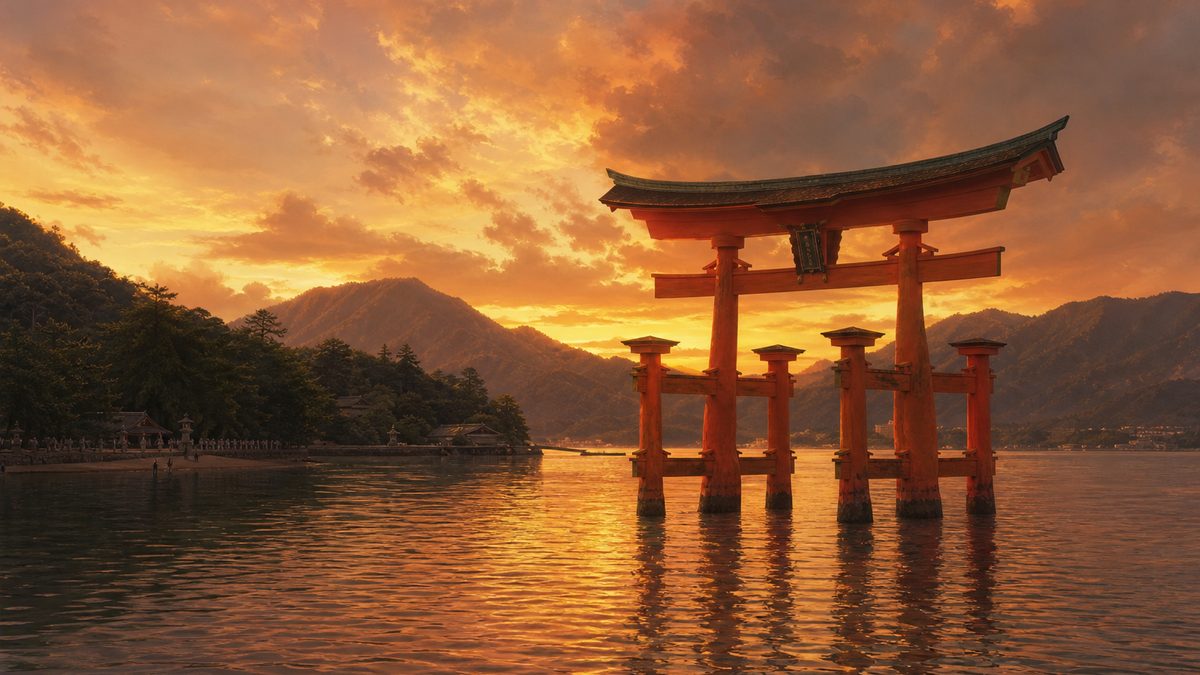
The shrine of Itsukushima, with its gate standing in the sea, was rebuilt in its present form in the 12th century and is a UNESCO World Heritage site.
The Meiji government, modernising Japan after 1868, ordered shrines and Buddhist temples separated. In a wave of anti-Buddhist feeling, many temples and images were destroyed.
The state declared shrine Shinto to be a civic duty rather than a religion, and taught that the emperor descended from Amaterasu. Schoolchildren bowed to his portrait.
Yasukuni Shrine, founded in 1869, honoured those who died for the emperor. State Shinto became closely tied to nationalism, militarism and Japan’s wars of expansion (World Empires, Episode 13).
After Japan’s defeat, the Allied occupation’s Shinto Directive of December 1945 ended state support for Shinto.
On 1 January 1946, the emperor issued a statement rejecting the idea that he was a living god.
The 1947 constitution separated religion and state. Visits by politicians to Yasukuni Shrine, which also honours convicted war criminals, remain controversial in Japan and across East Asia.
At New Year, tens of millions of people visit shrines to pray for the year ahead. Babies are presented at shrines, and many weddings are performed in Shinto style.
Local matsuri festivals carry the kami through the streets in portable shrines, linking neighbourhoods to their land and history.
A common saying is that Japanese are “born Shinto and die Buddhist”: shrines for life and celebration, temples for funerals and the dead.
Chapter III · Step 8
Seasons and life events
Hatsumōde First shrine visit of the New Year
Matsuri Local shrine festivals
Shichi-go-san Shrine visits for children aged 3, 5 and 7