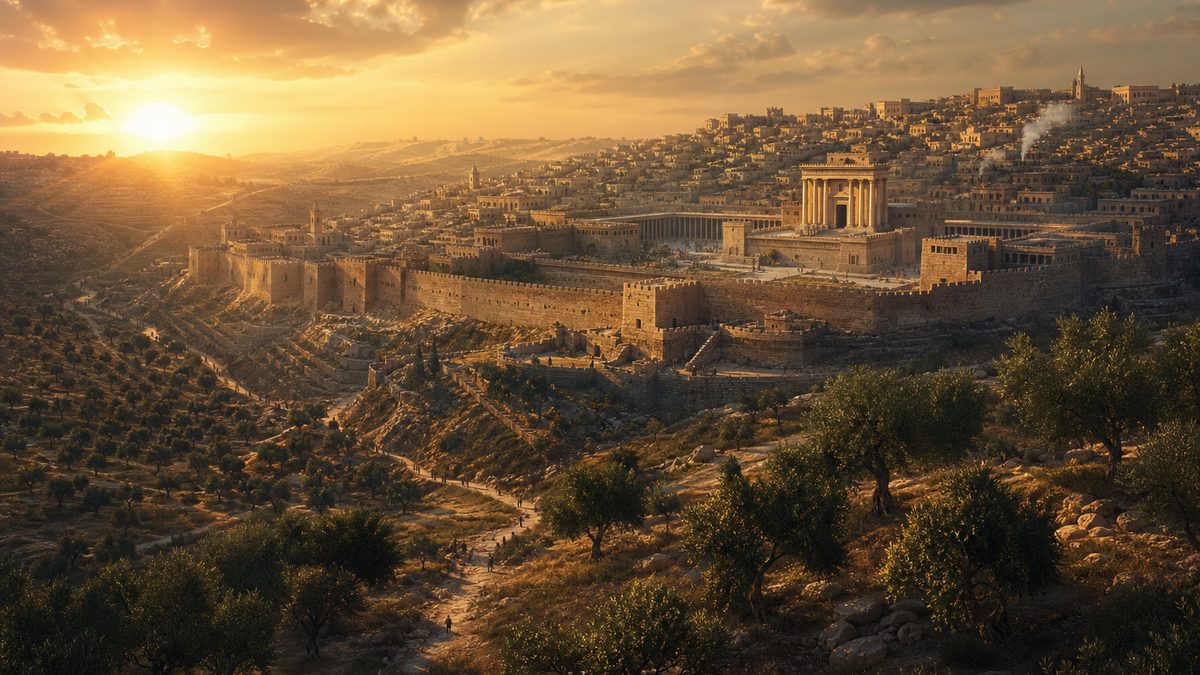
Origins of Religions · Episode 05 · c. 1200 BC – today
Judaism
How Judaism took shape: the Merneptah stela and the highland villages of Canaan, the kingdoms of Israel and Judah and the prophets' call to worship Yahweh alone, the Babylonian exile and explicit monotheism, the return under Cyrus and the Torah, Maccabees and the Dead Sea Scrolls, the destruction of the Second Temple and rabbinic Judaism, Sephardi and Ashkenazi life, emancipation, Zionism, the Holocaust and 1948, and Judaism today, with the traditional account and the historical evidence side by side. Episode 05 of the Origins of Religions series.
Interactive 3D film6 minc. 1200 BC to todayPublished 2026-10-13
Jewish tradition tells that God made a covenant with Abraham, that Moses led the Israelites out of slavery in Egypt, and that at Mount Sinai they received the Torah, God’s teaching.
Historians and archaeologists, working from inscriptions and excavations, tell a more gradual story of how Israel’s faith in one God took shape.
This episode gives both: what the tradition teaches, and what the evidence suggests.
Prologue · Episode 05 of the Origins of Religions series
The tradition and the evidence
Jews today
~15 million
2020
Torah
the five books of Moses
The Hebrew Bible (Tanakh) is also the Old Testament of Christians. Its stories are sacred history to believers; scholars read them as texts written and edited over many centuries.
Around 1200 BC, the great Bronze Age kingdoms of the eastern Mediterranean collapsed. In the highlands of Canaan, hundreds of small new villages appeared.
An Egyptian victory stela of pharaoh Merneptah, around 1208 BC, names a people called “Israel” in Canaan, the first known mention.
Most archaeologists think the early Israelites emerged largely from the people of Canaan themselves. There is no direct archaeological evidence for the Exodus as told in the Bible; many scholars think memories of some group’s escape from Egypt may lie behind it.
Chapter I · Step 1
A people in the hills
c. 1208 BC Merneptah stela names “Israel”
12th–11th c. BC Highland villages of Canaan
For traditional believers, the Exodus and Sinai are foundational historical events; this is a point where faith and archaeology read the past differently.
Two kingdoms arose: Israel in the north, with its capital at Samaria, and Judah in the south, around Jerusalem. A stela from Tel Dan, from the 9th century BC, mentions the “House of David”.
Inscriptions show that many people worshipped Yahweh alongside other gods; one from about 800 BC mentions “Yahweh and his Asherah”, a goddess.
Prophets like Amos, Hosea and Isaiah demanded that Israel worship Yahweh alone, and do justice to the poor.
Assyria destroyed the northern kingdom in 722 BC. In Judah, around 622 BC, King Josiah centralised worship in Jerusalem, a reform linked to the book of Deuteronomy.
Chapter I · Step 2
Kings, prophets and one God
9th c. BC Tel Dan stela: “House of David”
c. 800 BC Kuntillet Ajrud: “Yahweh and his Asherah”
In 586 BC the Babylonians destroyed Jerusalem and Solomon’s Temple, and took much of Judah’s elite into exile in Babylon.
Without land, king or Temple, the exiles asked how they could still be God’s people. Their answer reshaped their religion.
Prophets proclaimed that Yahweh was not only Israel’s god but the only God of all the world. Practices that could be kept anywhere, the Sabbath, circumcision and food laws, became marks of identity.
Many scholars think much of the Hebrew Bible was written down or edited in this period and the century after.
In 538 BC the Persian king Cyrus allowed exiles to return. A Second Temple was completed in Jerusalem around 516 BC.
The scribe Ezra is remembered for reading the Torah aloud to the people. By around 400 BC, most scholars think, the five books of the Torah had reached roughly their present form.
Many Jews stayed in Babylon, beginning a diaspora, a scattering, that would become central to Jewish history.
Chapter II · Step 4
Return and the Torah
538 BC Edict of Cyrus
c. 516 BC Second Temple completed
5th c. BC Ezra and Nehemiah
c. 400 BC Torah close to final form (scholarly view)
After Alexander, Greek culture spread across the region. In 167 BC, when the Seleucid king banned Jewish practice, the Maccabees revolted and rededicated the Temple, remembered at Hanukkah.
Judaism was diverse: Sadducees ran the Temple, Pharisees taught the oral law, and the Essenes formed separate communities. In Alexandria, Jews translated the scriptures into Greek.
The Dead Sea Scrolls, found in caves at Qumran from 1947, preserve texts from this world, including the oldest known manuscripts of the Hebrew Bible. Jesus of Nazareth lived and taught as a Jew in it (Episode 09).
Chapter III · Step 5
Many Judaisms
167–160 BC Maccabean revolt
3rd–2nd c. BC Septuagint, Greek translation
c. 250 BC – AD 68 Dead Sea Scrolls (found 1947 on)
In AD 70, during a Jewish revolt, Roman armies destroyed Jerusalem and the Second Temple. After another revolt in 132 to 135, Jews were barred from the city.
Sacrifice ended for good. In its place, rabbis made prayer, study of the Torah and good deeds the centre of religious life. The synagogue became the community’s heart.
Around 200 the rabbis compiled the Mishnah, the oral law. Discussions on it grew into the Talmud; the Babylonian Talmud, completed around 500 to 600, is still studied every day.
Jews lived as minorities in Christian Europe and the Islamic world. In Muslim Spain, a golden age of Jewish culture produced poets and philosophers like Maimonides, born in Córdoba in 1138.
But persecution was common. Jews were expelled from England in 1290, from France in the 14th century, and from Spain in 1492.
Sephardic Jews from Spain settled around the Mediterranean and in the Ottoman Empire. Ashkenazi Jews moved east into Poland and Lithuania, which became the largest centre of Jewish life in the world.
From the late 18th century, Jews in western Europe gained equal rights. New movements arose: Reform, Orthodox and Conservative Judaism. Millions emigrated to America.
In response to rising antisemitism, Theodor Herzl called in 1896 for a Jewish state; the Zionist movement began at Basel in 1897.
Between 1941 and 1945, Nazi Germany and its collaborators murdered about six million Jews, two out of three Jews in Europe. This genocide is the Holocaust, or Shoah.
In 1948 the State of Israel was founded. The war that followed also displaced some 700,000 Palestinian Arabs, and the conflict over the land continues today.
Judaism was shaped by catastrophe: exile in Babylon, the loss of two Temples, expulsions and genocide. Each time, it adapted and endured.
Its belief in one God, its scriptures and its prophets became the foundation of two later world religions. Next: Buddhism and Jainism, born far to the east in the same centuries as the Jewish exile.
Epilogue
A faith that survived its losses
c. 1208 BC “Israel” first named
586 BC Babylonian exile
AD 70 Second Temple destroyed
c. 200–600 Mishnah and Talmud
1948 State of Israel
The series
00The Origins of Religions (overview)
01The First Beliefs
02The Ancient Gods
03Hinduism
04Zoroastrianism
05 Judaism (this film)
06Buddhism and Jainism
07Confucianism and Daoism
08Shinto
09Christianity
10 Islam (coming soon)
11 Sikhism (coming soon)
12 Spirits, Brahmins and the Buddha: Southeast Asia (coming soon)
The still images on the chapter cards are AI-generated illustrations. Outlines are approximate.