Origins of Religions · Episode 10 · AD 610 – today
Islam
How Islam began and spread: tribal Arabia between the Byzantine and Sasanian empires, Mecca and the Kaaba, the Prophet Muhammad and the first revelation in 610, the message of one God and care for the poor, the Hijra to Medina in 622, the Quran and the Five Pillars, the caliphs and the Sunni–Shia divide after Karbala, hadith, sharia and the Sufis, Islam's spread by caravan and sea to West Africa, India, Southeast Asia and Thailand, reform and revival in the modern world, and two billion Muslims today. Episode 10 of the Origins of Religions series.
Interactive 3D film7 minAD 610 to todayPublished 2026-10-13
About two billion people, a quarter of the world, are Muslims. Islam means “submission” to God; a Muslim is “one who submits”.
Muslims believe that the Quran is the word of God, revealed in Arabic to the Prophet Muhammad through the angel Gabriel, and that Muhammad is the last of a line of prophets that includes Abraham, Moses and Jesus.
Historians study Islam’s origins from the Quran, later biographies and traditions, and a few outside sources. This episode tells the story as Muslim tradition records it, and notes where historians debate.
Prologue · Episode 10 of the Origins of Religions series
Submission to God
Muslims
~2.0 billion
25.6% of the world, 2020
Growth 2010–2020
+347 million
fastest of the major groups
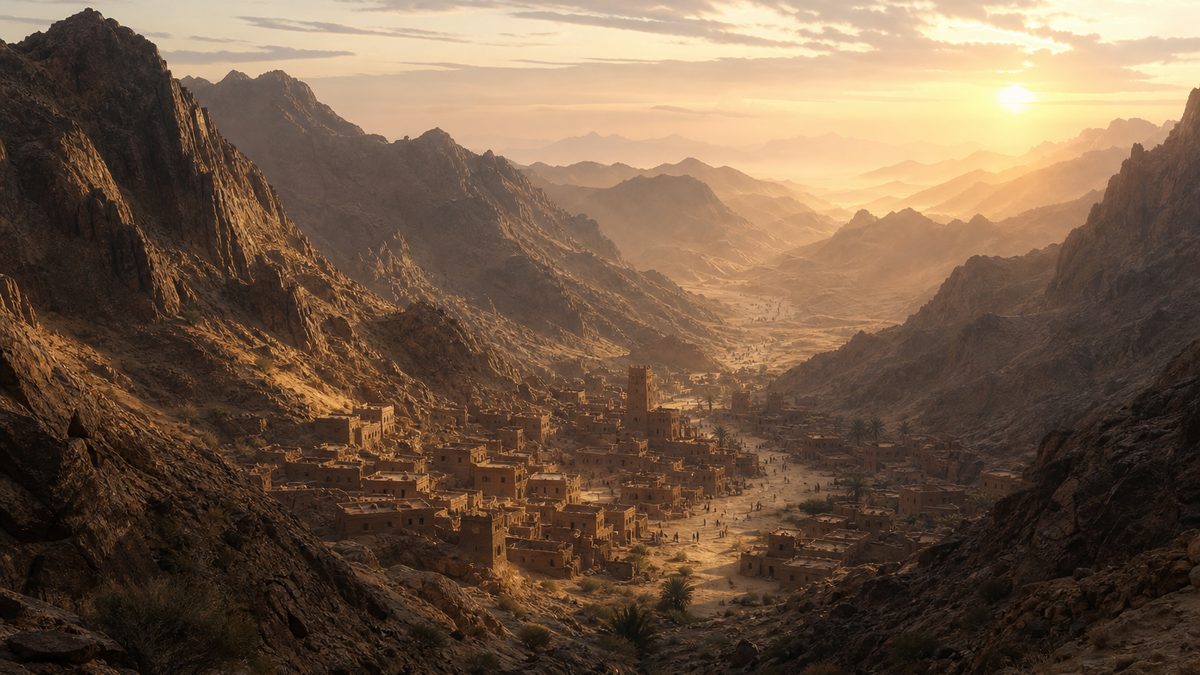
Out of respect for Islamic tradition, this film does not depict the Prophet. The images are AI-generated landscapes and architecture.
Around 570, Arabia was a land of tribes, oases and caravan towns, between the warring Byzantine and Sasanian empires. Loyalty was to clan and tribe; feuds were common, and the poor, orphans and widows had little protection.
Mecca was a trading town of the Quraysh tribe. At its centre stood the Kaaba, which by tradition was built by Abraham and Ishmael; by then it housed images of many tribal gods, and pilgrims came every year.
Jewish tribes lived in Yathrib and other oases, Christians in Najran and Abyssinia across the Red Sea. Some Arabs, called hanifs, already sought the one God of Abraham.
Chapter I · Step 1
Arabia before Islam
Mecca Quraysh traders; the Kaaba and its pilgrimage
According to Muslim tradition, Muhammad was born in Mecca around 570 into the clan of Hashim. Orphaned young, he was raised by his grandfather and his uncle Abu Talib.
He worked in the caravan trade and became known as al-Amin, “the trustworthy”. He married Khadija, a widowed merchant, who became his great supporter.
He often withdrew to meditate in a cave on Mount Hira. There, in 610, Muslims believe, the angel Gabriel appeared to him with the first words of the Quran: “Recite, in the name of your Lord who created.”
Chapter I · Step 2
The orphan of Mecca
c. 570 Birth in Mecca
c. 595 Marriage to Khadija
610 First revelation on Mount Hira
The earliest surviving biography, by Ibn Ishaq, was written over a century after the Prophet’s death; historians weigh such sources carefully.
The message was tawhid, the oneness of God: there is no god but God. All people would face judgement for their deeds.
The early revelations called for prayer, honesty, and care for the poor, orphans and the weak, a challenge to the wealthy clans of Mecca and to the idols that drew pilgrims.
The first believers included Khadija, his cousin Ali, his friend Abu Bakr, and slaves and poor people. Many were persecuted.
Around 615, a group of Muslims took refuge across the Red Sea with the Christian king of Abyssinia, who protected them.
In 622, as pressure in Mecca grew, Muhammad and his followers migrated to Yathrib, later called Medina, “the city”. This Hijra marks year one of the Islamic calendar.
In Medina he became leader of a community, the umma, bound by faith rather than tribe. An early agreement, the Constitution of Medina, set out rights and duties among Muslims, Jews and other groups.
Years of conflict with Mecca followed, at Badr in 624, Uhud in 625 and the Trench in 627. Relations with Medina’s Jewish tribes broke down, and some were expelled or killed, a painful history that historians still examine.
In 630 the Muslims entered Mecca almost without fighting, and the idols of the Kaaba were removed. When the Prophet died in 632, most of Arabia had accepted Islam.
The revelations had been memorised and written on parchment, bone and palm leaves. Under the third caliph, Uthman, around 650, an official written text of the Quran was compiled and copies sent to the main cities.
Fragments of a Quran manuscript in Birmingham have been radiocarbon-dated to between 568 and 645, showing how early the text was written down.
Muslim practice rests on five pillars: the declaration of faith, the five daily prayers, almsgiving, fasting in Ramadan, and the pilgrimage to Mecca, the hajj, once in a lifetime for those able.
After the Prophet’s death, the community chose Abu Bakr as caliph, his successor. A minority believed that the Prophet’s cousin and son-in-law Ali was the rightful leader; Ali became the fourth caliph in 656, amid civil war.
In 680, Ali’s son Husayn, the Prophet’s grandson, was killed with his small band at Karbala by an army of the Umayyad caliph.
His death is mourned by Shia Muslims every year at Ashura. Sunni Muslims, about 85 to 90 percent of all Muslims, and Shia Muslims share the Quran and the pillars, but differ on leadership and some practices.
Scholars collected the hadith, reports of the Prophet’s words and deeds. Al-Bukhari, who died in 870, compiled the most respected Sunni collection.
From Quran and hadith, jurists built the sharia, a whole way of life, through schools of law: the Hanafi, Maliki, Shafi’i and Hanbali for Sunnis, and the Ja’fari for most Shia.
Sufis sought the inner, mystical path of love for God. The poet Rumi, who died at Konya in 1273, is still read around the world.
Muslim scholars also advanced science, medicine and philosophy, the story told in World Empires, Episode 07.
Islam in Africa, India and Southeast Asia, including Thailand.
Beyond the caliphates, Islam spread mainly through merchants, teachers and Sufis. Across the Sahara it reached West Africa, where Timbuktu became a city of mosques and manuscripts.
In India, Muslim sultanates ruled from Delhi. By sea, Islam reached Sumatra, the Malay peninsula and Java.
In the Pattani region of today’s southern Thailand, a Malay sultanate became Muslim, traditionally in the 15th or 16th century. In Ayutthaya, the Persian merchant Sheikh Ahmad Qomi became the first Chularatchamontri, head of Thailand’s Muslims, in the early 17th century.
Today about five percent of Thais are Muslim, most in the far south and in Bangkok.
Chapter III · Step 8
By caravan and by sea
14th c. Timbuktu’s mosques
1206 Delhi Sultanate
late 13th c. Samudera Pasai, Sumatra
early 17th c. Sheikh Ahmad Qomi, first Chularatchamontri
From the 18th century, reformers called Muslims back to the Quran and the example of the Prophet; some, like the movement of Ibn Abd al-Wahhab in Arabia from 1744, were strictly puritan.
Most Muslim lands came under European colonial rule. The Ottoman caliphate was abolished in 1924. Modernists, nationalists and Islamist movements offered different answers to the challenge.
In 1979 a revolution in Iran created an Islamic Republic. Violent extremist groups have claimed to speak for Islam; the great majority of Muslims and their scholars reject them.
Most Muslims today live in Asia. The largest Muslim populations are in Indonesia, Pakistan, India and Bangladesh. Only about one in five Muslims lives in the Middle East and North Africa.
Islam was the fastest-growing major religion between 2010 and 2020, mostly because of young populations and high birth rates.
Every year about two million pilgrims gather in Mecca for the hajj, from every continent.
Islam grew from a call to worship one God and care for the weak, in a tribal society between two exhausted empires.
Next: Sikhism, born in Punjab nine centuries later, where Hindu and Muslim worlds met.
Epilogue
From a cave to every continent
610 First revelation
622 Hijra
632 Death of the Prophet
c. 650 Quran compiled
680 Karbala
The series
00The Origins of Religions (overview)
01The First Beliefs
02The Ancient Gods
03Hinduism
04Zoroastrianism
05Judaism
06Buddhism and Jainism
07Confucianism and Daoism
08Shinto
09Christianity
10 Islam (this film)
11Sikhism
12 Spirits, Brahmins and the Buddha: Southeast Asia (coming soon)
The still images on the chapter cards are AI-generated landscapes and buildings; they do not depict the Prophet or other figures. Outlines are approximate.