Origins of Religions · Episode 01 · 100,000 BC – today
The First Beliefs
Archaeology's oldest clues to religion: burials at Qafzeh and Panga ya Saidi, narrative cave art in Sulawesi and the Lion-man figurine, animism and Siberian shamans, Göbekli Tepe, plastered ancestor skulls and Çatalhöyük, Stonehenge's solar alignment, Ban Chiang, the Plain of Jars and Đông Sơn drums, theories of why humans have religion, and folk religions today. Episode 01 of the Origins of Religions series.
Interactive 3D film6 minc. 100,000 years ago to todayPublished 2026-10-13
Our species, Homo sapiens, appeared in Africa around 300,000 years ago. Every human society anthropologists have studied has had some form of religion: beliefs and rituals about powers beyond the everyday world.
But beliefs leave no bones. To find the first religion, archaeologists look for its traces: careful burials, symbols, art and places built for gatherings.
Prologue · Episode 01 of the Origins of Religions series
Looking for the first religion
There is no single agreed definition of religion. Most scholars include beliefs about spirits, gods or sacred powers, and the rituals, rules and communities built around them.
Dates in deep prehistory are given as “years ago”. They come from scientific dating and have error margins.
At Qafzeh and Skhul caves in today’s Israel, people were buried around 100,000 years ago. One child was laid with deer antlers on its chest; red ochre was found nearby.
In Kenya, at Panga ya Saidi, a small child was buried about 78,000 years ago, curled up, with its head apparently resting on a pillow.
Did these people believe in an afterlife? We cannot know. But they treated death as something special, and that is where many scholars begin the story of religion.
Chapter I · Step 1
Caring for the dead
~100,000 years ago Qafzeh and Skhul, Levant
~78,000 years ago Panga ya Saidi, Kenya: oldest known burial in Africa
Some Neanderthal burials are also claimed; how intentional they were is still debated.
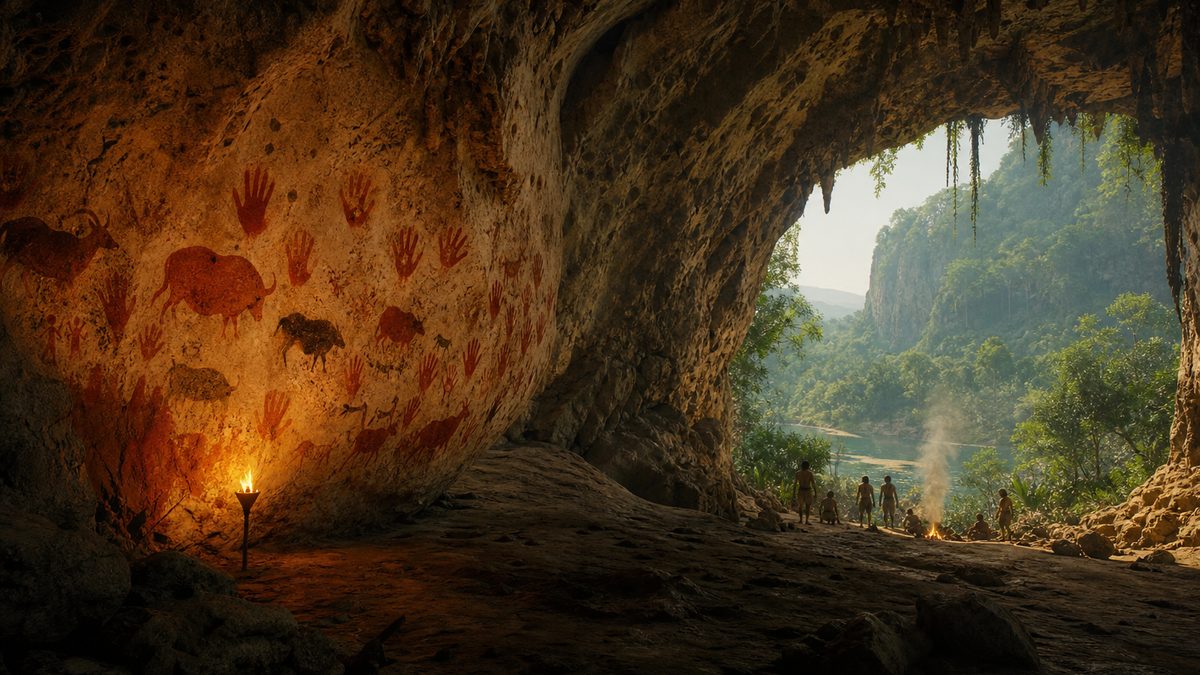
As modern humans spread out of Africa, symbolic art appears. On the island of Sulawesi, in Indonesia, a cave painting of people and a pig is at least 51,200 years old, one of the oldest known scenes in the world.
In Germany, the Lion-man of Hohlenstein-Stadel, carved from mammoth ivory about 40,000 years ago, has a human body and a lion’s head.
A creature that exists only in the mind is one of the first signs that people imagined beings beyond the visible world.
Chapter I · Step 2
Imagination on the walls
≥51,200 years ago Narrative cave painting, Sulawesi
~40,000 years ago Lion-man figurine, Germany
~36,000 years ago Chauvet Cave paintings, France
Whether cave art was religious, magical, storytelling or all of these is debated.
Among hunter-gatherers studied in modern times, from the Arctic to the Amazon to Southeast Asia, a common idea is that animals, plants, rivers and mountains have spirits, and that the dead stay close as ancestors.
In 1871 the anthropologist Edward Tylor called this “animism”. Today many scholars prefer to describe it as a world of relationships between people and other beings.
In Siberia, ritual specialists who travelled to the spirit world in trance were called shamans, a word from the Evenki language. Similar roles exist on every continent.
Chapter II · Step 3
A world full of spirits
“Animism”
1871
Edward Tylor, Primitive Culture
“Shaman”
from Evenki, Siberia
Modern hunter-gatherers are not “living fossils”: they have their own long histories. They give clues, not proof, about prehistoric beliefs.
On a hilltop in south-eastern Turkey, people raised circles of T-shaped stone pillars up to five metres tall, carved with foxes, snakes, vultures and arms and hands.
They did this around 9500 BC, at the very end of the Ice Age, when people in the region were only beginning to farm.
Its excavator Klaus Schmidt called it “the first temple”, suggesting that gathering for ritual helped drive the move to farming. Newer research shows people also lived there, and the debate continues.
In the first farming villages, the dead stayed at home. At Çatalhöyük, in Turkey, people were buried beneath the floors of houses whose walls were painted and decorated with bulls’ horns.
At Jericho and other sites in the Levant, skulls of ancestors were removed, plastered and given new faces with shells for eyes.
Many archaeologists link these practices with ancestor veneration: the dead as protectors of the family and of its land.
In mainland Southeast Asia, people buried their dead with pottery, bronze and beads, as at Ban Chiang in north-east Thailand, a UNESCO World Heritage site.
In the hills of Laos, hundreds of huge stone jars on the Plain of Jars were used in funeral rites. In northern Vietnam, great bronze drums of the Đông Sơn culture were used in ceremonies.
Belief in spirits of places, rice, water and ancestors, called phi in Thai and Lao, is far older than Buddhism or Brahmanism in the region, and still lives on. Episode 12 tells that story.
Chapter IV · Step 7
Spirits of Southeast Asia
Ban Chiang Burials from at least the 2nd millennium BC; UNESCO 1992
Plain of Jars Stone jars, c. 500 BC – AD 500; UNESCO 2019
Scholars have proposed many answers. The sociologist Émile Durkheim argued in 1912 that shared rituals bind a society together.
Cognitive scientists suggest that human minds are quick to see intention and agency everywhere, a useful instinct that also makes spirits and gods feel natural.
Others argue that belief in moral, watching gods helped strangers trust each other as societies grew larger. Each theory has critics.
For believers, these explanations do not settle the question of whether religious claims are true: that is a matter of faith and philosophy, not archaeology.
Hundreds of millions of people still follow folk and indigenous traditions, from African traditional religions to Chinese folk religion to the spirit traditions of the Americas and Siberia.
And many followers of the world religions also keep older practices: offerings to spirits of the land, ancestor rites, and festivals of the harvest and the year.