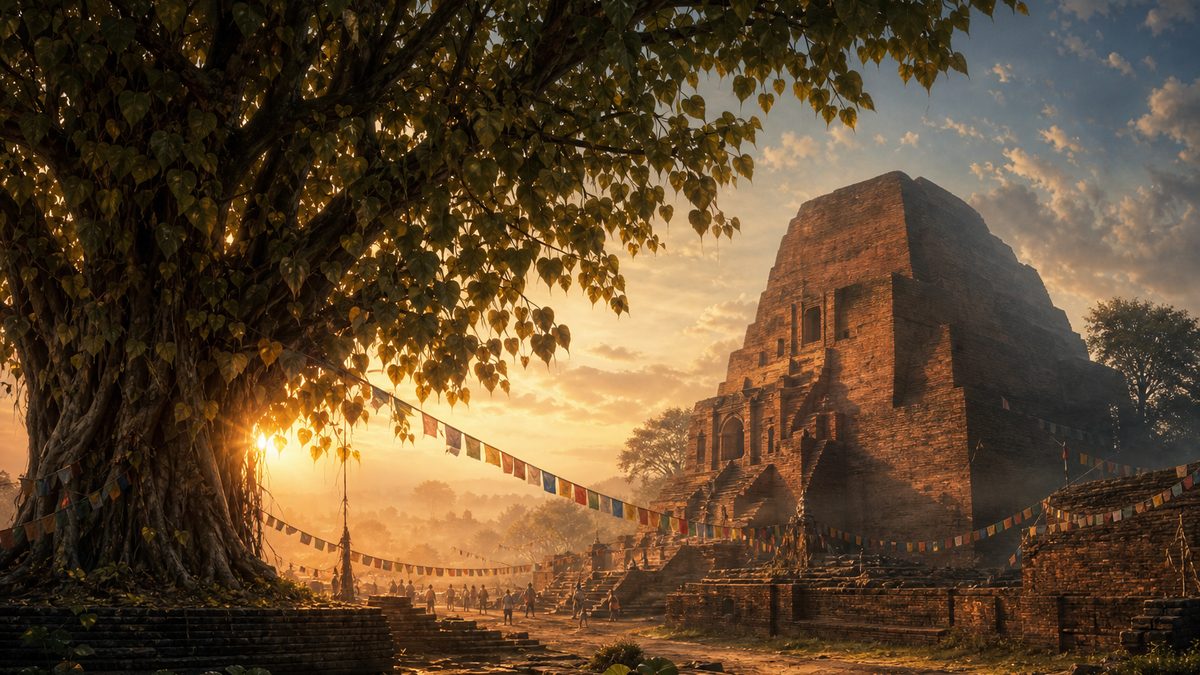
Origins of Religions · Episode 06 · 5th century BC – today
Buddhism and Jainism
How Buddhism and Jainism grew from the shramana movements of the Ganges plain: Mahavira and the Jain ideals of ahimsa, aparigraha and anekantavada; the life of Siddhartha Gautama in tradition and in historians' dating, the Four Noble Truths and the Eightfold Path, the Sangha and the Pali Canon; Ashoka's missions, Mahayana and Vajrayana along the Silk Road to China, Korea, Japan and Tibet, the decline of Buddhism in India and Ambedkar's revival, and Theravada from Pagan and Sukhothai to Thailand today. Episode 06 of the Origins of Religions series.
Interactive 3D film7 min5th century BC to todayPublished 2026-10-13
About 320 million people today are Buddhists. In Thailand, more than nine in ten people are Buddhist, and the Thai calendar counts years from the Buddha’s passing: 2026 is the year 2569.
Jainism is much smaller, with perhaps four to six million followers, mostly in India. But it grew from the same society, at the same time, and asks many of the same questions.
Prologue · Episode 06 of the Origins of Religions series
Two paths
Buddhists
~320 million
2020
Jains
~4–6 million
Thai Buddhist Era
2026 = 2569 BE
counted from 543 BC
For Buddhists and Jains, their teachers rediscovered timeless truths. Historians study when and how these teachings arose. Both are given below.
By the 6th and 5th centuries BC, the Ganges plain was changing fast. Sixteen great kingdoms and republics competed; Magadha and Kosala were the strongest. Cities, trade and coins spread.
Brahmin priests performed costly Vedic sacrifices and taught a society divided by birth into varnas. Merchants and kings, newly rich, did not always fit.
A movement of shramanas, “strivers”, rejected the authority of the Vedas. They left home to wander, beg and meditate, seeking release from the cycle of rebirth.
Many groups competed: Jains, Ajivikas, sceptics and materialists, and, among them, a young man who would be called the Buddha.
Chapter I · Step 1
A new urban world
Kingdoms Magadha, Kosala, Vatsa, Avanti
Republics Vajji (Licchavi), Shakya, Malla
Shramanas Jains, Ajivikas, Buddhists, sceptics
The shared ideas of karma and rebirth appear in the Upanishads (Episode 03) and in these movements at about the same time.
Vardhamana, called Mahavira, “great hero”, was born to a ruling family near Vaishali. Jain tradition dates him 599 to 527 BC; many historians place him a little later, in the 5th century BC.
Jains see him not as a founder but as the 24th Tirthankara, a “ford-maker” across the river of rebirth. His predecessor Parshva may also have been a historical teacher.
He taught ahimsa, non-violence towards every living being, even insects; aparigraha, non-possession; and anekantavada, the many-sidedness of truth.
Karma, in Jain thought, is fine matter that sticks to the soul. Strict ascetic practice burns it away until the soul rises, free, to the top of the universe.
Jain tradition says that Chandragupta, founder of the Maurya Empire, became a Jain monk and died at Shravanabelagola in the south. Jain communities spread west and south.
The community divided into Digambaras, whose monks go naked, and Svetambaras, whose monks wear white.
Lay Jains, strictly vegetarian and avoiding trades that harm life, often became merchants and bankers. They built magnificent marble temples, like those on the holy hill of Palitana. Mahatma Gandhi’s idea of non-violence owed much to Jain influence in his home state of Gujarat.
Buddhist tradition tells that Siddhartha Gautama was born a prince of the Shakya clan at Lumbini, in today’s Nepal. Seeing old age, sickness and death, he left his palace at 29 to seek freedom from suffering.
For six years he practised extreme austerity, and nearly died. Then he chose a middle way between indulgence and self-torment.
Meditating beneath a pipal tree at Bodh Gaya, at the age of 35, he attained awakening, bodhi. From then on he was the Buddha, the Awakened One.
Thai tradition dates his life to 623 to 543 BC. Many historians now place his death around 400 BC, within a range of 480 to 370. An inscription of Ashoka at Lumbini, around 249 BC, honours it as his birthplace.
Chapter II · Step 4
Siddhartha Gautama
Thai tradition
623–543 BC
Many historians
c. 480–400 BC
death between c. 480 and 370
Lumbini and Bodh Gaya are UNESCO World Heritage sites.
In the deer park at Sarnath, near Varanasi, the Buddha gave his first sermon to five companions. He taught the Four Noble Truths: life involves suffering, dukkha; suffering arises from craving; it can end; and there is a path to its end.
That path is the Noble Eightfold Path: right view, intention, speech, action, livelihood, effort, mindfulness and concentration.
He taught that all things are impermanent and arise from causes, and that there is no unchanging self. Nibbana is the blowing out of craving.
He founded the Sangha, a community of monks and later nuns, open to people of any caste. For about 45 years he walked the cities of the Ganges plain, teaching.
At 80, the Buddha passed away at Kushinagar: his parinibbana. His relics were divided and enshrined in stupas.
According to tradition, his disciples met at Rajagriha to recite his teachings and the monastic rules. For centuries they were passed on by memory, in chanting.
Disputes over rules and doctrine split the Sangha into schools. In Sri Lanka, around the 1st century BC, monks wrote down the teachings in Pali: the Pali Canon, the scripture of Theravada Buddhism and of Thailand.
After his bloody conquest of Kalinga, the Maurya emperor Ashoka turned to the Buddha’s teaching and carved messages of dhamma across India (World Empires, Episode 04).
Sri Lankan chronicles say his son Mahinda brought Buddhism to Sri Lanka, which became the great centre of Theravada Buddhism.
They also tell of monks sent to Suvarnabhumi, the “Golden Land”, a tradition that both Thailand and Myanmar claim.
From around the 1st century BC, new scriptures taught the Mahayana, the “Great Vehicle”, whose ideal is the bodhisattva who delays final nirvana to help all beings.
In Gandhara, in today’s Pakistan, artists made some of the first images of the Buddha in human form. Monks and merchants carried Buddhism along the Silk Road to China by the 1st century AD.
From China it reached Korea in 372 and Japan in the 6th century. In the 7th and 8th centuries it entered Tibet, where Vajrayana, the “Diamond Vehicle”, flourished.
Chapter III · Step 8
Mahayana and the Silk Road
1st c. AD Buddhism in China
372 Korea
538 or 552 Japan
7th–8th c. Tibet; Vajrayana
Theravada (“way of the elders”) remains the main school of Sri Lanka and mainland Southeast Asia; Mahayana of East Asia; Vajrayana of Tibet and Mongolia.
By about 1000, Buddhism in India depended on great monastic universities like Nalanda, supported by kings.
Hindu devotional movements absorbed many Buddhist ideas, and some Hindu texts made the Buddha an avatar of Vishnu. Royal support shifted away.
Around 1200, Turkic armies destroyed Nalanda and other monasteries. Historians weigh these causes differently, but by the 13th century Buddhism had almost disappeared from India.
In 1956, the Dalit leader B. R. Ambedkar converted to Buddhism at Nagpur, with hundreds of thousands of followers, as a rejection of caste.
Buddhism of many kinds had reached Southeast Asia by the early centuries AD, alongside Hindu traditions. From the 11th century, Theravada from Sri Lanka gained ground.
King Anawrahta of Pagan, in Burma, adopted Theravada around 1056. In the 13th century, Sukhothai invited Sri Lankan-trained monks, and Theravada became the religion of Thai kings and people.
Ayutthaya and Bangkok continued as Theravada kingdoms, with the king as protector of the Sangha. The faith mixed with older spirit beliefs and Brahmin rites, as Episode 12 explores.
Today Thailand, Myanmar, Sri Lanka, Cambodia and Laos are the heartlands of Theravada Buddhism.
Jainism stayed small and close to its Indian home, but kept its path of non-violence for 2,500 years. Buddhism left its homeland and became a religion of all Asia.
Next: China, where in the same centuries Confucius and the Daoists asked how to live in harmony with society and with nature.
Epilogue
A middle way across Asia
5th c. BC Mahavira; the Buddha
c. 250 BC Ashoka
1st c. BC Pali Canon written; Mahayana
c. 1200 Decline in India
13th c. Theravada in Sukhothai
The series
00The Origins of Religions (overview)
01The First Beliefs
02The Ancient Gods
03Hinduism
04Zoroastrianism
05Judaism
06 Buddhism and Jainism (this film)
07Confucianism and Daoism
08Shinto
09Christianity
10 Islam (coming soon)
11 Sikhism (coming soon)
12 Spirits, Brahmins and the Buddha: Southeast Asia (coming soon)
The still images on the chapter cards are AI-generated illustrations; they do not depict the Buddha or other religious figures. Outlines are approximate.