Origins of Religions · Episode 02 · 3500 BC – AD 550
The Ancient Gods
How the religions of the first civilisations began and ended: Sumerian city gods and Enheduanna, Babylonian myths of creation and the flood, Egyptian ma'at, the Pyramid Texts and the weighing of the heart, Akhenaten's Aten, the gods of Olympus and Delphi, Roman state religion and the cults of Isis and Mithras, the closing of the temples from 391 to 537, and their legacy in our weekdays. Episode 02 of the Origins of Religions series.
Interactive 3D film6 min3500 BC to AD 550Published 2026-10-13
When farming villages grew into cities, around 3500 BC, the spirits and ancestors of village life were joined by great gods, with their own houses, servants and lands.
These religions had no founder and no single holy book. They grew slowly out of local traditions, and they were bound up with cities, kings and the land.
Prologue · Episode 02 of the Origins of Religions series
Gods of the first civilisations
Nobody follows these religions as their ancestors did any more. That makes them a rare case: we can see a whole religious tradition from beginning to end.
Episode 01 told the story before cities. Grey outlines show other traditions of the time when switched on.
In Sumer, in southern Mesopotamia, each city belonged to a god. Inanna, goddess of love and war, lived at Uruk; the moon god Nanna at Ur; Enlil, lord of the air, at Nippur.
The temple was literally the god’s house. It owned fields and herds, employed thousands, and its records were among the first uses of writing.
Around 2300 BC, Enheduanna, daughter of king Sargon of Akkad and high priestess at Ur, wrote hymns to Inanna. She is the earliest author in history known by name.
Mesopotamian myths taught that humans were made to do the work of the gods: to feed them through offerings and house them in temples.
The Epic of Atrahasis and the Epic of Gilgamesh tell of a great flood sent by the gods, survived by one man in a boat, a story with clear parallels to the later biblical flood.
When Babylon became the leading power, its god Marduk was raised to king of the gods, as told in the creation epic Enuma Elish. Religion followed politics.
Chapter I · Step 2
Humans as servants of the gods
Atrahasis Creation and flood, c. 18th c. BC copy
Gilgamesh XI The flood tablet, 7th c. BC copy
Enuma Elish Marduk becomes king of the gods
Mesopotamian priests read the future in sheep livers and in the stars; their sky-watching laid foundations for later astronomy and astrology.
In Egypt, the central idea was ma’at: truth, justice and cosmic order. Each year the Nile flooded and life returned; chaos always threatened to break in.
The pharaoh was the son of the sun god Ra and the living Horus. His duty was to keep ma’at by serving the gods in their temples.
Hundreds of gods were worshipped, often as animals or with animal heads. The temple of Amun at Karnak was enlarged by pharaoh after pharaoh for about two thousand years.
Chapter II · Step 3
Ma’at and the pharaoh
Ra The sun god, centred at Heliopolis
Amun God of Thebes; later Amun-Ra, king of the gods
Egyptians believed a person could live forever if the body was preserved and the right rites performed. The Pyramid Texts, carved around 2400 BC, are among the oldest religious writings in the world.
At first only kings could hope for eternal life. Over time, ordinary people could too, if they could afford a tomb and a copy of the Book of the Dead.
In the judgement scene, the heart of the dead was weighed against the feather of ma’at before Osiris, god of the underworld. A heavy heart was devoured.
The pharaoh Akhenaten closed the temples of Amun and promoted the worship of a single god, the Aten, the disc of the sun. He built a new capital at Amarna.
Some scholars call this the first monotheism in history; others see it as worship of one god above all others, centred on the king himself.
After his death it was undone. Tutankhamun, probably his son, restored the old gods, and later kings tried to erase Akhenaten’s name.
Chapter II · Step 5
Akhenaten’s revolution
Reign
c. 1353–1336 BC
Capital
Akhetaten (Amarna)
Whether Atenism influenced later monotheism, such as Judaism, is speculative; most historians doubt a direct link.
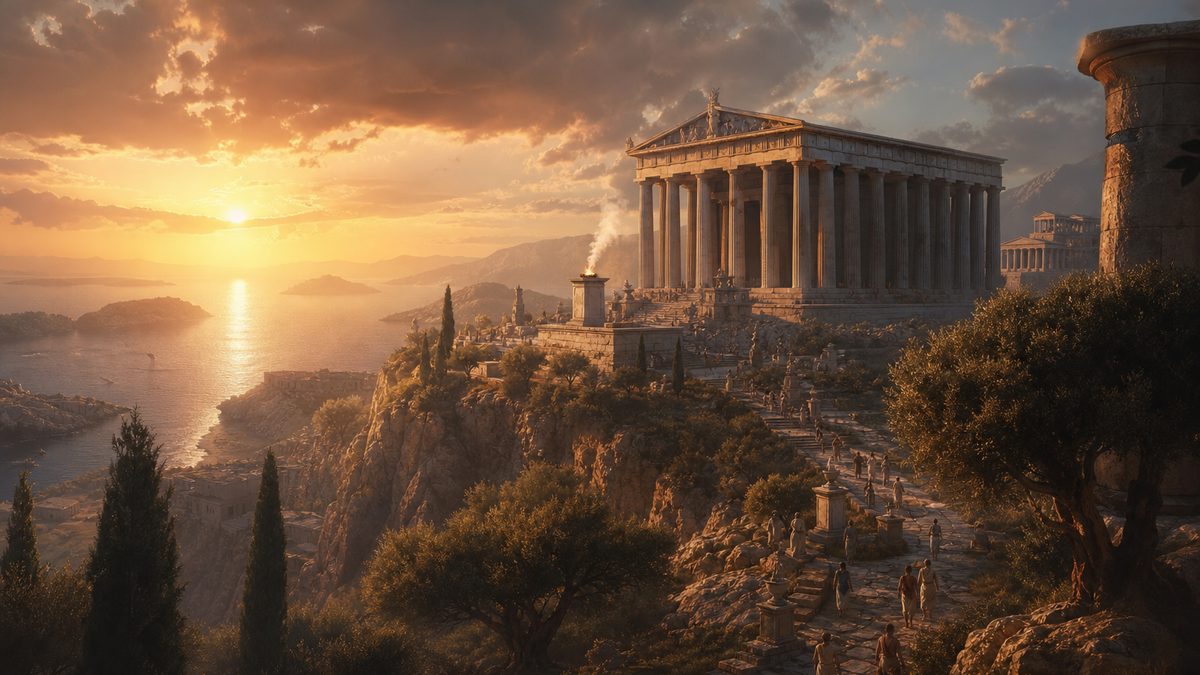
The Greek gods, Zeus, Hera, Athena, Apollo and the rest, were like a powerful, quarrelsome family. Homer and Hesiod, around 700 BC, told their stories.
Religion was about doing, not believing: sacrifices at altars, processions, games such as the Olympics held for Zeus, and questions put to the oracle of Apollo at Delphi.
There was no church and no creed. For deeper hope, some joined mystery cults, like the Mysteries of Eleusis, which promised a better fate after death.
For Romans, religion meant keeping the pax deorum, the peace of the gods, through exact rituals carried out by state priests. Jupiter, Juno and Minerva protected the city.
Rome welcomed foreign gods: the Egyptian goddess Isis, the Persian-styled Mithras, the mother goddess Cybele. Emperors were made gods after death.
Rome tolerated many religions, but expected everyone to honour the gods of the state. Groups that refused, like the early Christians, could be persecuted.
Chapter III · Step 7
Rome: gods of the state
c. AD 113–125 Pantheon rebuilt
Isis Egyptian goddess worshipped across the empire
The last known cuneiform tablets, astronomical records from Babylonia, date to around AD 75. The old gods of Mesopotamia faded with the knowledge of their writing.
After Christianity became Rome’s religion, Emperor Theodosius banned sacrifice and closed temples in 391 and 392. The last known hieroglyphic inscription was carved at Philae in 394.
Philae’s temple of Isis was closed around 537. Historians point to many causes: imperial laws, Christian preaching, the decline of the cities and states these religions were tied to, and the appeal of faiths offering personal salvation to everyone.
The ancient gods live on in words. In English, Saturday is Saturn’s day; the planets carry the names of Roman gods.
The seven-day planetary week took shape in the Greek-speaking world, drawing on Babylonian astronomy, and travelled to India. Thai weekday names come from the Sanskrit names of the same seven heavenly bodies, from the sun of Sunday to the Saturn of Saturday.
Stories of the flood, the dying and rising god and the judgement of the dead were retold, transformed, in later religions.