In October 2026 Brookhaven's STAR experiment reported signs of quark–gluon plasma in collisions of small oxygen nuclei, after similar results from CMS and ALICE at CERN. This film explains the fundamentals: quarks and gluons inside protons, why a quark is never seen alone, how heat melts protons into a plasma that filled the early universe, how colliders make it by smashing nuclei at nearly the speed of light, the 'perfect liquid' found at RHIC, temperatures of trillions of degrees, the two signatures, flow and jet quenching, and why a drop made from oxygen is still being debated.
Interactive 3D film8 min1986 to 2026Published 2 November 2026
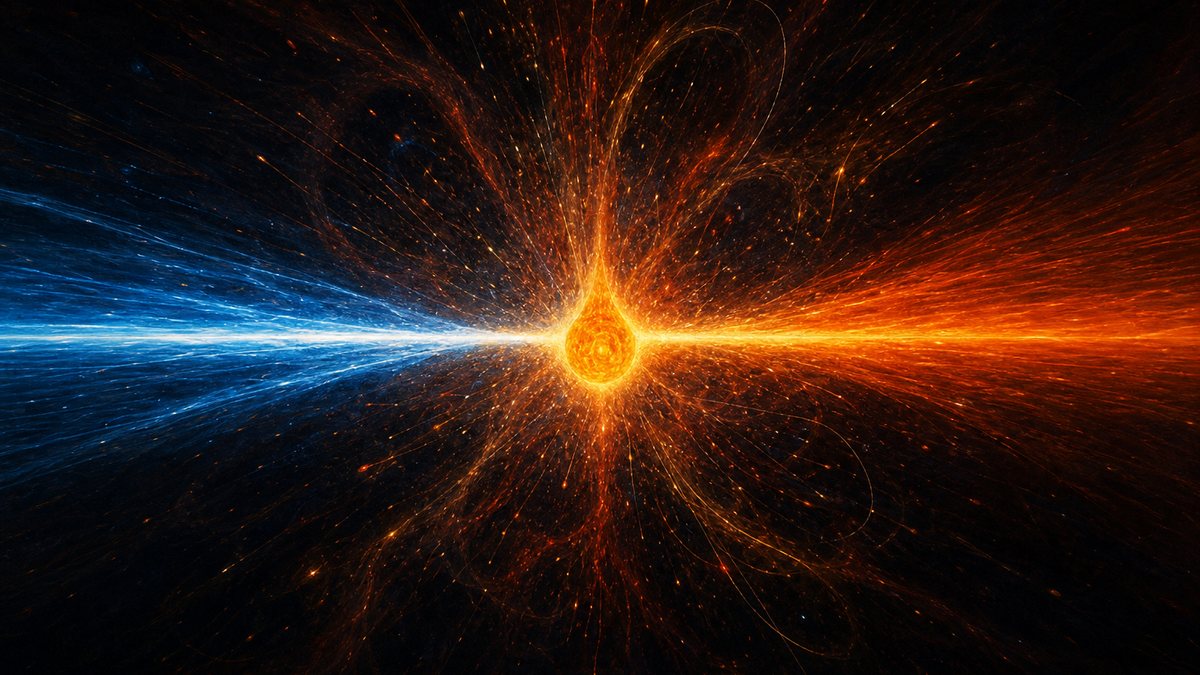
In the first millionths of a second after the Big Bang, the whole universe was a searing liquid of quarks and gluons, called a quark–gluon plasma. Today, physicists make tiny drops of it by smashing atomic nuclei together.
On the thirtieth of October 2026, Brookhaven National Laboratory in New York reported signs of it from collisions of small oxygen nuclei: about twenty percent fewer high-energy particles than expected.
Experiments at CERN in Europe reported similar signs earlier this year. What is this plasma, and why would missing particles point to it?
The first microseconds An artist’s impression of a universe filled with a searing fluid. AI-generated still.
< 10 µs
after the Big Bang
The plasma era (CERN)
~20%
fewer high-energy particles in oxygen–oxygen collisions
STAR at RHIC (Physical Review Letters, 2026)
May CMS (LHC, CERN): suppression up to ~30%
July ALICE (LHC, CERN): evidence of energy loss
October STAR (RHIC, Brookhaven): about 20% suppression
Oxygen results in 2026
Prologue
Oxygen, smashed
ScienceDaily, from Brookhaven National Laboratory (30 October 2026): the STAR experiment at the Relativistic Heavy Ion Collider (RHIC) found strong evidence of quark–gluon plasma in collisions of oxygen nuclei at nearly the speed of light, measuring a 20% suppression of high-energy particles in 2021 data at 200 GeV (Physical Review Letters, 2026). Physics World (27 May 2026): CMS at the LHC saw energetic particles suppressed by up to about 30% in oxygen collisions recorded in 2025. ALICE (27 July 2026): evidence, at 4.9 sigma, of parton energy loss in oxygen–oxygen collisions, presented on 21 July 2026.
These oxygen results are the hook and are new; chapter V says how sure they are. The rest of the film is the established physics of the quark–gluon plasma.
The 3D scenes are simplified teaching models: sizes, speeds and numbers of particles are not to scale.
Everything around you is made of atoms, and at the heart of every atom is a tiny nucleus, a cluster of protons and neutrons.
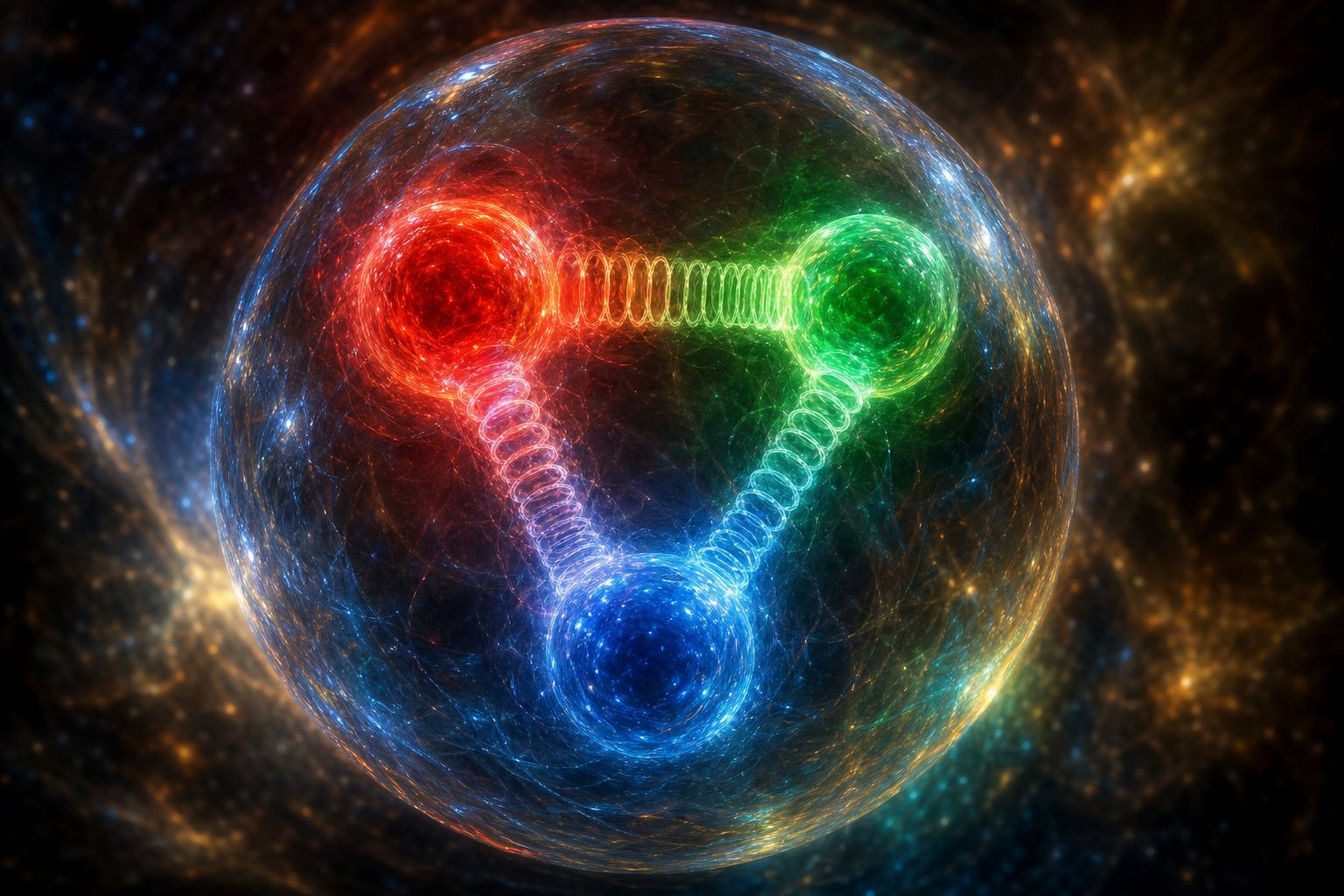
Look inside a proton and you find three smaller particles, called quarks.
They are held together by gluons, the carriers of the strong force. The quarks constantly swap gluons, and those gluons make the field that binds them.
Each quark also carries a kind of charge that physicists call colour. It has nothing to do with real colour; it is just a name, and there are three kinds.
Atom
Nucleus: protons and neutrons
Proton: three quarks
Zooming inThree quarks, bound An artist’s picture: three quarks joined by tubes of energy. AI-generated still.
gluons
its carriers, constantly swapped
The strong force
3 colours
just a name for a kind of charge
Colour charge
Chapter I · Inside a proton
Quarks and gluons
The Particle Adventure (Particle Data Group): quarks carry colour charge and are found only in colour-neutral composites called hadrons; baryons, the family that includes the proton and neutron, contain three (main) quarks of three different colours, and mesons a quark and an antiquark. Quarks within a hadron constantly exchange gluons, which form the colour-force field that binds them. CERN: once the early universe cooled, quarks and gluons bonded into protons and neutrons.
“Colour” here is only a name for a kind of charge; quarks have no colour in the everyday sense.
The 3D scenes are simplified teaching models: sizes, speeds and numbers of particles are not to scale.
That binding has a strange rule. No one has ever seen a quark on its own. Physicists call this confinement.
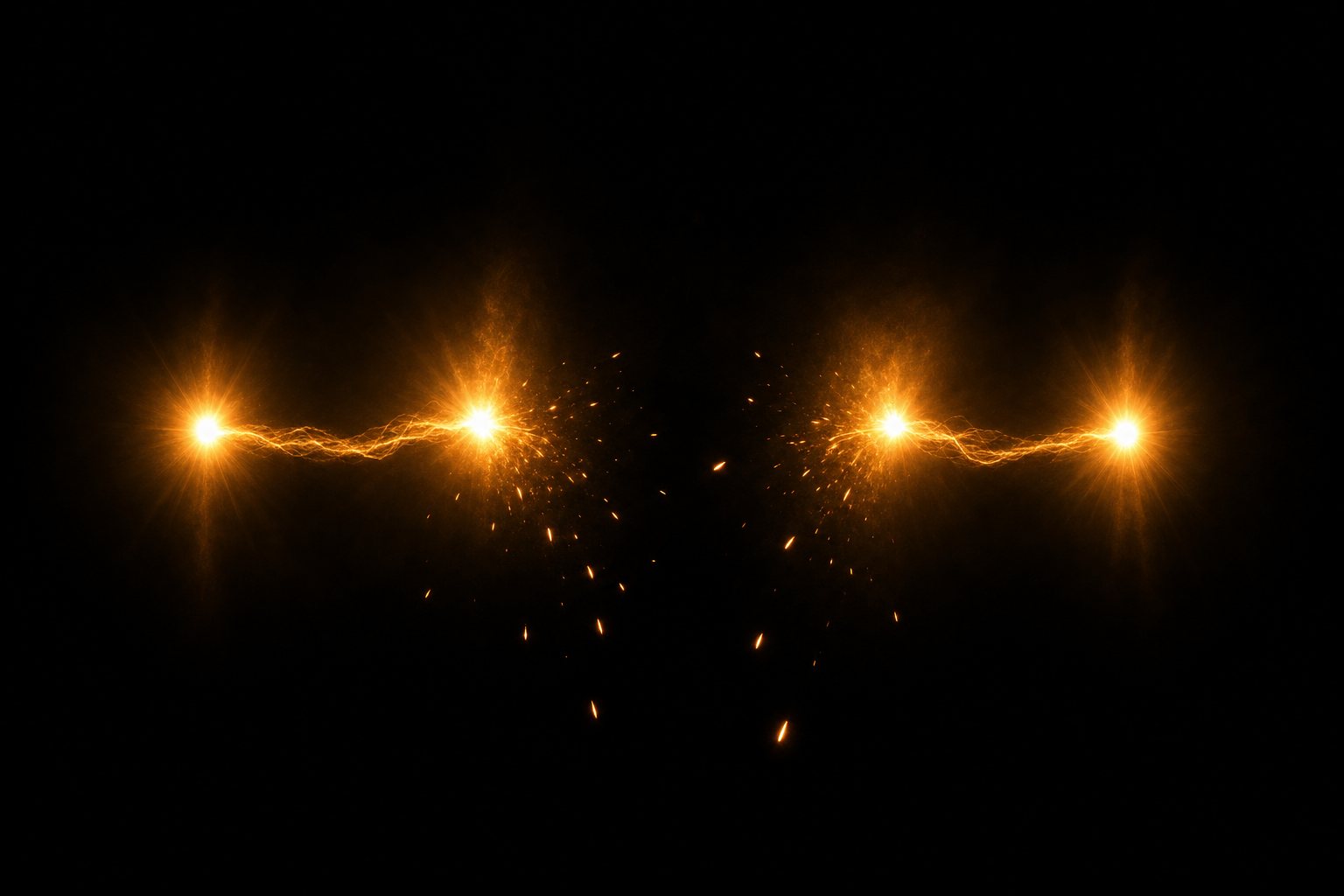
Try to pull a quark away from its partner, and the field between them stretches like a string, storing more and more energy.
In the end it is cheaper for that energy to make a brand-new quark and antiquark, its mirror-image partner. The string snaps, and you are left with two pairs, never a lone quark.
Quarks cannot exist individually because the color force increases as they are pulled apart.The Particle Adventure, Particle Data Group
The string snaps Making a new pair costs less energy than stretching the string further, so it always snaps before a quark gets free. AI-generated still.
Farther apart: more energy stored
Unlike gravity or magnets, it does not fade
Stretching the fieldE=mc2
E
energy stored in the stretched field
m
mass of the new quark and antiquark
Energy becomes matter
0
lone quarks ever observed
2 pairs
after the string snaps
The result
Chapter I · Inside a proton
Confinement
The Particle Adventure: colour-charged particles cannot be found individually. Separating a quark from its neighbours stretches the colour-force field and adds energy; eventually it becomes energetically cheaper for the field to create a new quark–antiquark pair, converting that energy into the new quarks’ mass, and the field relaxes. Quarks cannot exist individually because the colour force increases as they are pulled apart.
Try it: pull the pair apart, then let go.
The 3D scenes are simplified teaching models: sizes, speeds and numbers of particles are not to scale.
But theory says there is a way to set quarks free: heat. At high enough temperature and density, protons and neutrons should melt. By the 1980s, physicists thought smashing heavy nuclei together could do it.
Their quarks and gluons spill out into one shared soup, a quark–gluon plasma, moving freely through the whole drop.
Physicists think the whole universe was like this for less than ten millionths of a second after the Big Bang. As it cooled, the quarks bound into the protons and neutrons of the atoms around us.
Pulling: fails, makes new pairs
Heating and squeezing: melts the proton
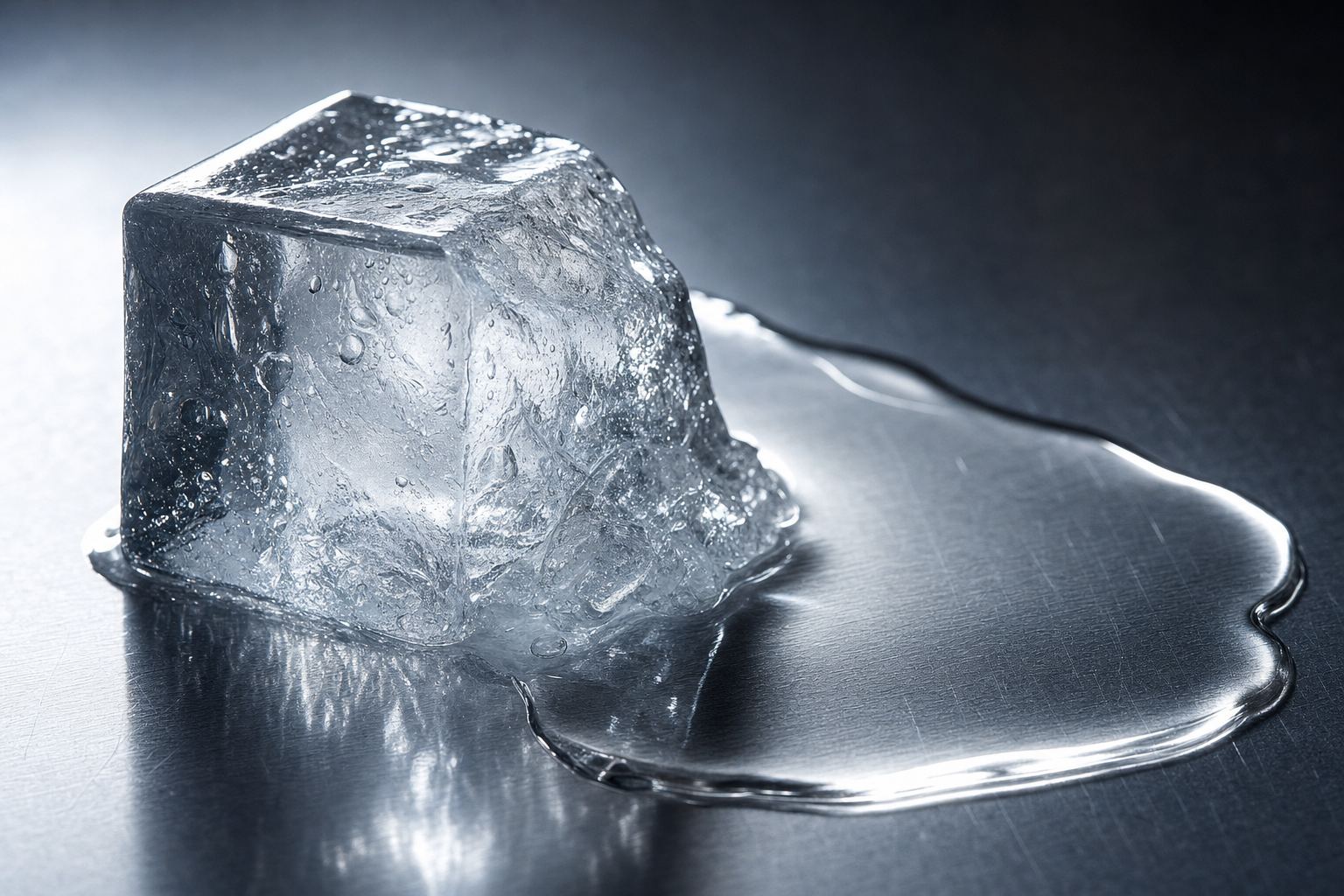
Two ways to free a quark?Not quite melting Unlike ice, this change has no sharp melting point: it is a smooth crossover spread over a range. AI-generated still.One soup No walls between protons any more: one hot fluid. AI-generated still.
0 Big Bang
< 10 µs Quark–gluon plasma everywhere
then Cooling: quarks bind into protons and neutrons
The first moments (CERN)
3 quarks
locked into each proton and neutron, for good
As it cooled
Chapter II · Melting matter
Melting protons
CERN (CERN70): in the 1980s, theory suggested that high-energy collisions of heavy ions could recreate the quark–gluon plasma, the state of matter thought to have existed less than 10 millionths of a second after the Big Bang, when quarks and gluons moved freely instead of being bound into protons and neutrons. Brookhaven: the temperatures reached at RHIC are well above the point at which protons and neutrons break down into their quarks and gluons.
Try it: heat the box and cool it again. The colours stand for the three quark colour charges.
The 3D scenes are simplified teaching models: sizes, speeds and numbers of particles are not to scale.
To make it in a laboratory, you take heavy nuclei and smash them together at nearly the speed of light.
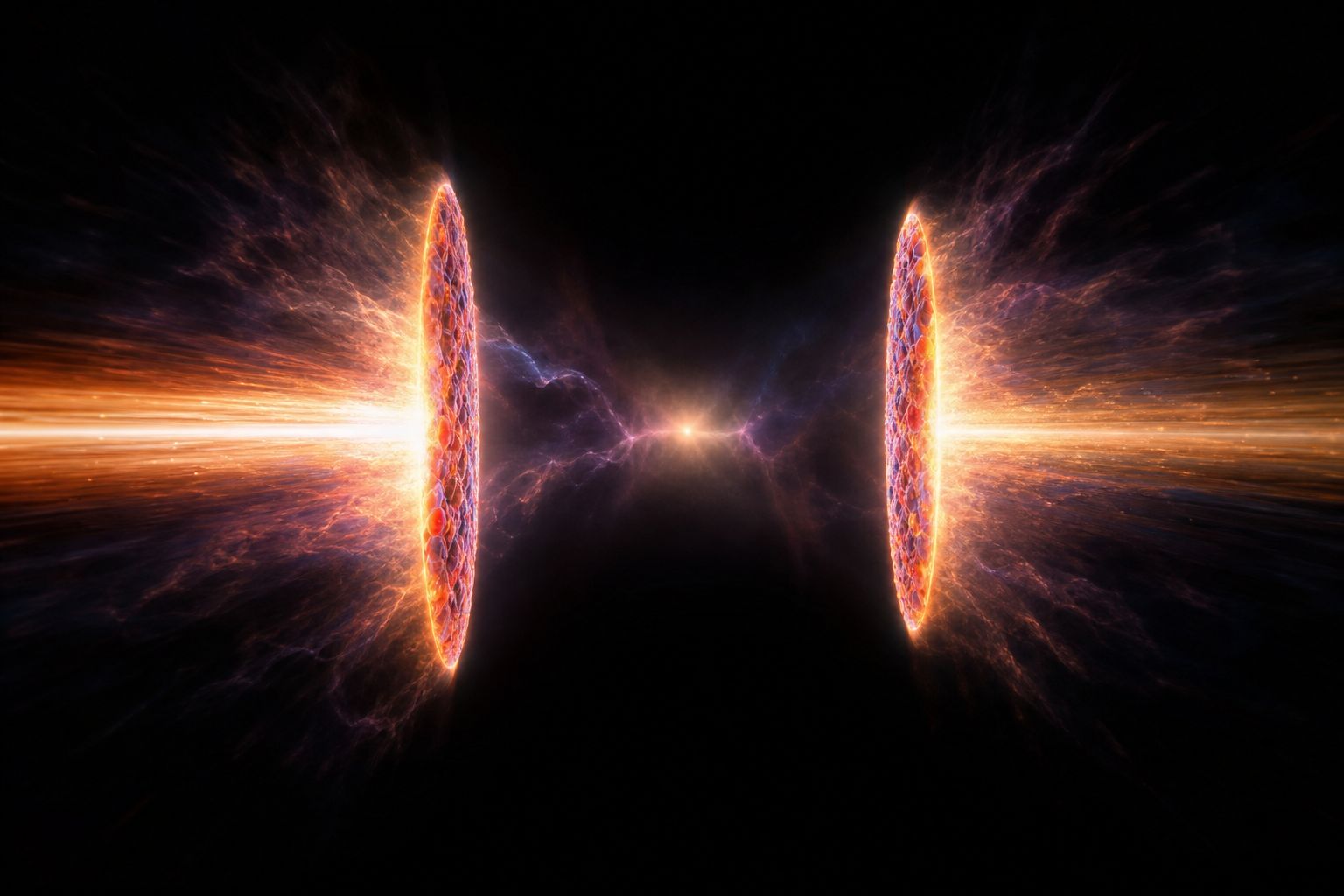
At those speeds, each nucleus is squashed flat along its direction of travel, like a pancake. Where they meet, for a moment, matter is far hotter than the centre of any star.
CERN began such experiments in 1986, firing oxygen and sulphur nuclei at heavy targets. In February 2000 it announced evidence for a new state of matter.
The drop of plasma that forms is smaller than an atomic nucleus, and it lasts less than a billionth of a billionth of a second before it flies apart.
Squashed by speed Moving nuclei contract along their direction of travel. AI-generated still.
trillions °C
for a tiny instant
In the collision zone
1986 Oxygen and sulphur on fixed targets (SPS)
1994 Lead beams, seven experiments
Feb 2000 Evidence for a “new state of matter”
Heavy ions at CERN
< nucleus
in size
< 10⁻¹⁸ s
how long it lasts
The drop (Brookhaven)
Chapter II · Melting matter
Making a little bang
Science News: nuclei accelerated to nearly the speed of light flatten, because matter contracts along its direction of motion. CERN (CERN70): CERN’s first heavy-ion experiments, in 1986, fired oxygen and sulphur nuclei at heavier targets at the SPS, giving clues but no proof; a lead-beam programme with seven experiments began in 1994; in February 2000 CERN announced evidence for a “new state of matter”. ScienceDaily / Brookhaven: the plasma is smaller than an atomic nucleus and lasts less than a billionth of a billionth of a second.
“Far hotter than the centre of any star” is the film’s plain reading of temperatures of trillions of degrees (chapter III), against about 15 million degrees at the Sun’s core.
The 3D scenes are simplified teaching models: sizes, speeds and numbers of particles are not to scale.
In 2000, Brookhaven switched on the Relativistic Heavy Ion Collider, RHIC, a ring almost four kilometres around, to collide nuclei of gold.
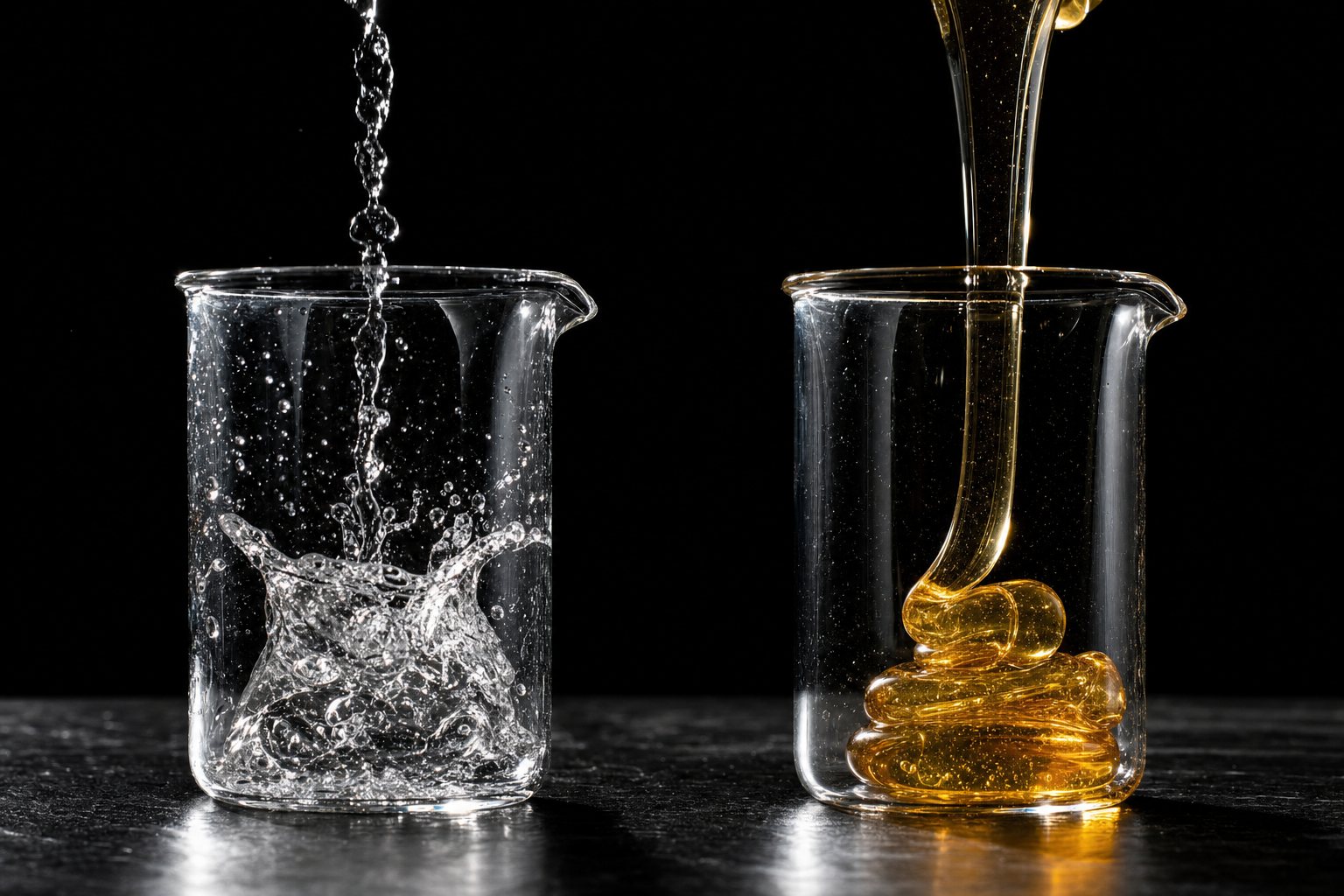
Physicists expected a gas of free quarks and gluons. Instead, the matter flowed together, like a liquid with almost no viscosity.
In 2005 they described it as a nearly perfect liquid, more fluid even than superfluid helium.
2.4 miles
around the ring (about 3.9 km)
~200
protons and neutrons in a gold nucleus (ALICE)
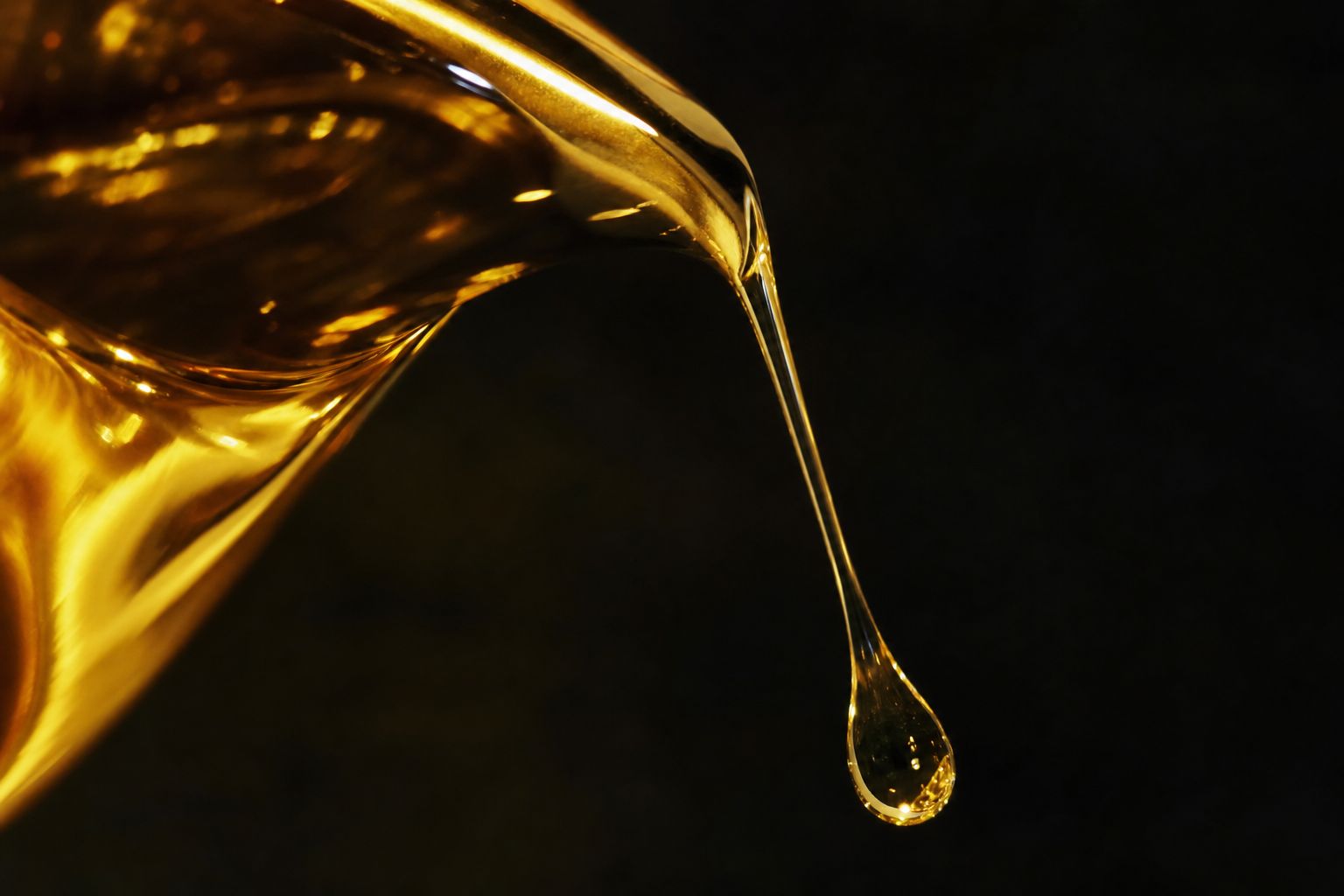
RHIC, Brookhaven (2000–2026)Thick and thin Measured against its own density, this plasma flows more freely than any other fluid known. AI-generated still.
Expected: a gas, particles flying apart freely
Found: collective flow, moving together
Viscosity: almost none
Gas or liquid?A perfect liquid An everyday picture of a flowing liquid; the real one is trillions of degrees. AI-generated still.
Chapter III · The perfect liquid
The perfect liquid
Brookhaven: RHIC is a 2.4-mile-circumference collider; physicists had predicted the plasma would behave like a gas, but data from its first three years, presented in April 2005, showed a nearly perfect liquid with almost no viscosity whose particles interact strongly; it shows coordinated collective motion, or flow. CERN (CERN70): RHIC started in summer 2000; in 2005 Brookhaven reported a “strongly interacting perfect liquid” with practically no viscosity, more fluid than superfluid helium. ScienceDaily / Brookhaven: RHIC operated from 2000 until 2026.
Try it: the gas physicists expected, then the liquid they found.
The 3D scenes are simplified teaching models: sizes, speeds and numbers of particles are not to scale.
How hot is it? In 2010 Brookhaven reported about four trillion degrees Celsius, at the time the hottest matter ever made in a laboratory.
That is about two hundred and fifty thousand times the temperature at the centre of the Sun, and well above the point where protons and neutrons melt.
Even so, the drop lives far too briefly to be looked at directly. Physicists read it from the particles that fly out, and two patterns give it away.
~4 trillion °C
in gold–gold collisions
RHIC, 2010 (Brookhaven)Four trillion degrees Temperature is energy per particle; with only a few thousand particles in the drop, the total energy is still minute. AI-generated still.
Sun’s centre
1×
RHIC gold collisions, 2010
250,000×
How many times hotter than the Sun’s centre?
Flow: how the particles spray out
Jets: how much energy they lose
Two clues the drop leaves behind
Chapter III · The perfect liquid
A temperature record
Brookhaven: gold-ion collisions at RHIC reached about 4 trillion °C, the hottest temperature ever created in a laboratory at the time and roughly 250,000 times hotter than the Sun’s centre, well above the level needed to melt protons and neutrons into quarks and gluons. ALICE: in LHC heavy-ion collisions, temperatures exceed one hundred thousand times the temperature at the centre of the Sun.
The bars use log₁₀ of “times hotter than the Sun’s centre”. Later LHC collisions are reported to have run hotter still.
The 3D scenes are simplified teaching models: sizes, speeds and numbers of particles are not to scale.
The liquid gives itself away by how it flows. When two nuclei hit slightly off-centre, the region where they overlap is shaped like an almond.
In a plasma, the pressure inside that almond pushes outward unevenly, harder in some directions than in others.
The particles that fly out keep the imprint of that uneven push. This pattern, called flow, is a signature of the plasma. Compare a head-on and an off-centre collision.
Physicists compare the pattern with computer models of fluids, and it matches a liquid that flows with almost no friction.
Head-on: a round drop
Off-centre: an almond-shaped drop
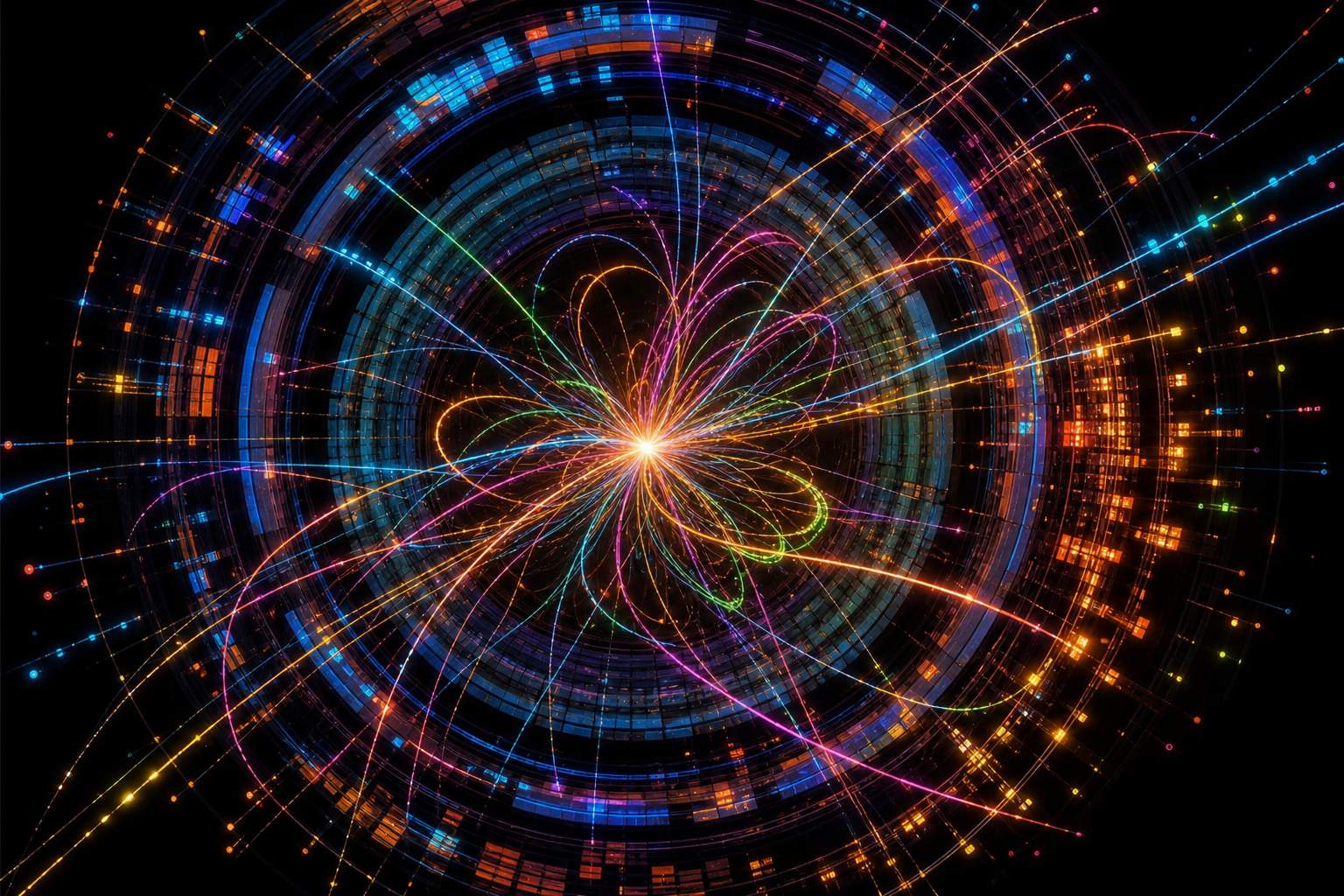
Head-on versus off-centreReading the spray Detectors record thousands of tracks from each collision. AI-generated still.
Head-on: no favoured direction
Off-centre: some directions favoured
What the detectors see
uneven
more particles in some directions
liquid
the pattern matches a near-frictionless fluid
Flow
Chapter III · The perfect liquid
Flow
Institute for Nuclear Theory: in an off-centre collision of two heavy ions, the nuclear overlap is shaped like an almond; if a quark–gluon plasma forms there, the asymmetric shape makes the pressure gradients differ with direction, producing an asymmetry in the emitted particles, “a signature of plasma formation” (the same page argues that some correlations from early particle production also contribute). Brookhaven: the matter at RHIC shows coordinated collective motion, or flow, matching hydrodynamics for a fluid with virtually no viscosity.
Try it: head-on, then off-centre, and watch the spray from above. The strength of the pattern is exaggerated.
The 3D scenes are simplified teaching models: sizes, speeds and numbers of particles are not to scale.
The other signature is the jet. Sometimes two quarks or gluons in the collision scatter hard, in opposite directions, and each becomes a narrow spray of particles.
If one of them has to cross more of the hot plasma, it loses energy, and it may not escape at all. This is called jet quenching.
In 2003, the experiments at RHIC, including STAR, revealed it. Switch the plasma off and on.
Back to back Two tight sprays leave in opposite directions; one is weaker. AI-generated still.
Longer path through plasma: more energy lost
Strong enough: the jet never escapes
Measured as fewer high-energy particles
Jet quenching
We observed something predicted but never before seen in jet physics.Peter Jacobs, Berkeley Lab, on STAR’s jet results (2008 article)
Chapter IV · Jets
Jet quenching
Berkeley Lab (2008): when quarks or gluons inside colliding particles scatter in opposite directions, each breaks into a jet, a spray of particles such as pions and kaons; in the hot, dense fireball of colliding heavy nuclei, a jet that must travel farther through the matter loses more energy, and may not escape at all. In 2003 STAR and the other RHIC experiments revealed jet quenching. CERN (CERN70): ALICE studies jet quenching, the energy loss of quarks and gluons in the plasma.
Try it: with plasma one jet fades; without plasma both escape. Lengths are schematic.
The 3D scenes are simplified teaching models: sizes, speeds and numbers of particles are not to scale.
On the seventh of November 2010, the Large Hadron Collider at CERN collided nuclei of lead for the first time, each with two hundred and eight protons and neutrons.
Its ALICE experiment was designed for exactly this. For well over a decade it has measured how the plasma flows and how jets lose energy inside it.
There too, the temperatures reached exceed a hundred thousand times the heat at the centre of the Sun.
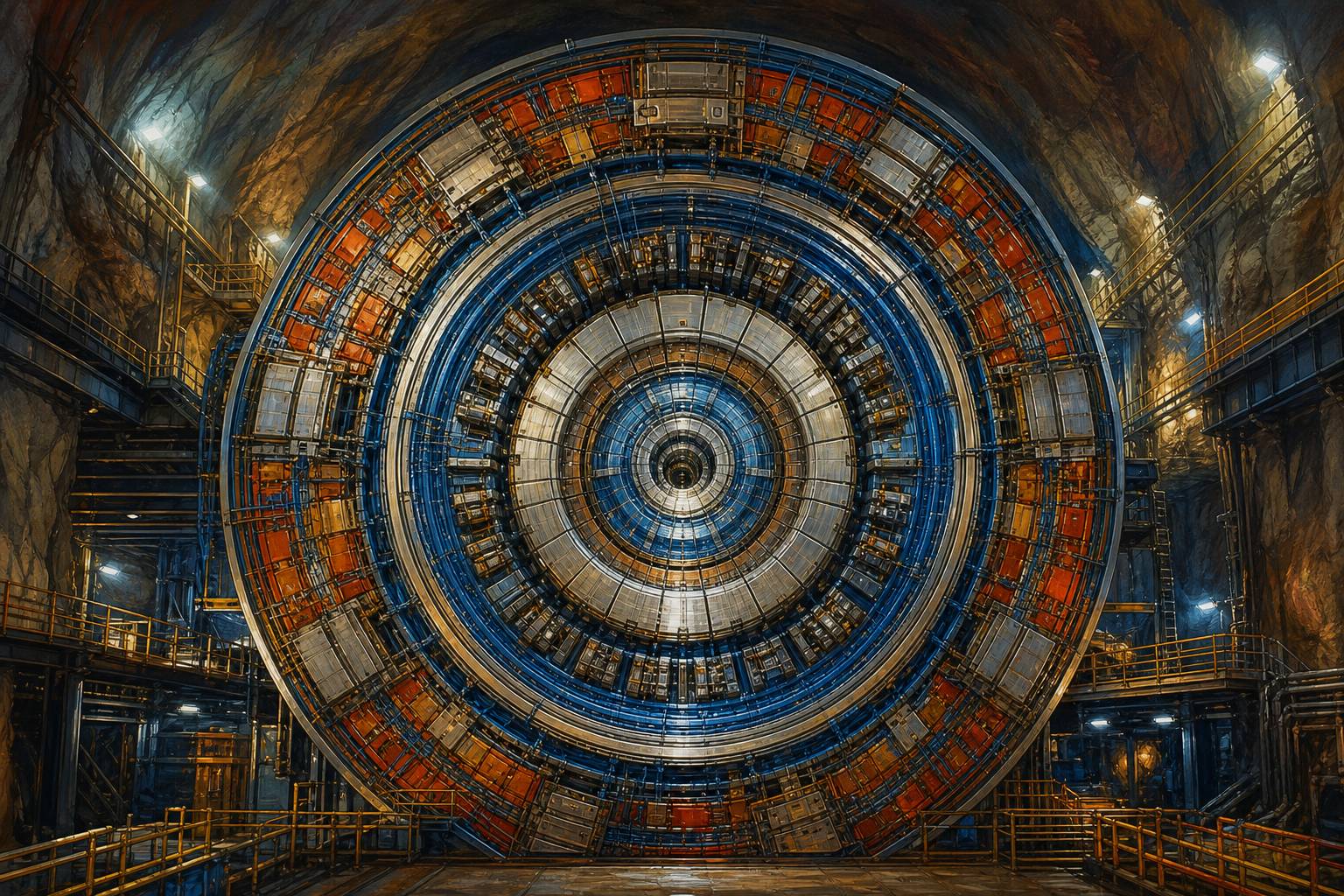
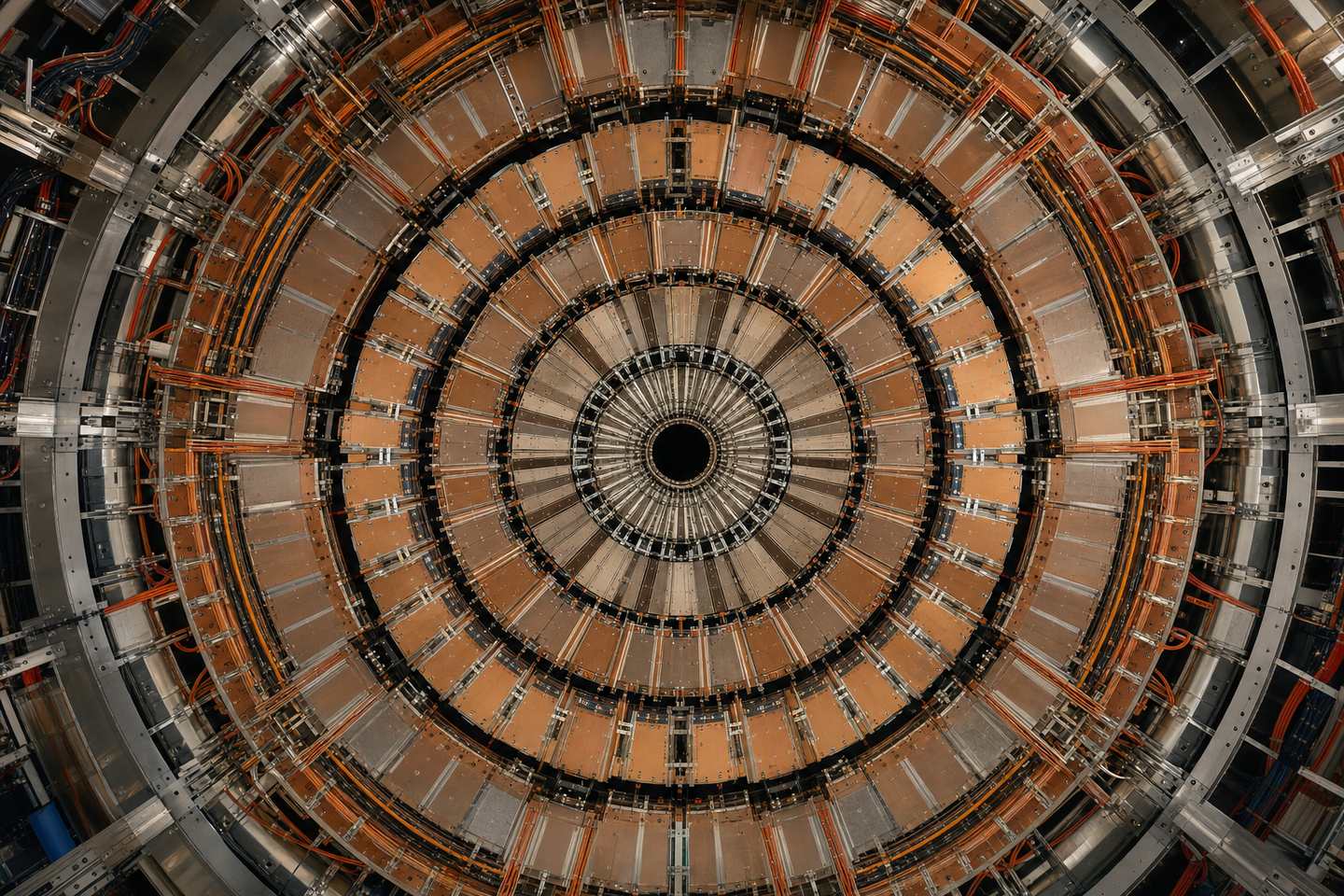
A detector the size of a building Layer upon layer of instruments around the collision point. AI-generated still.
1993 ALICE proposed
Nov 2009 First LHC proton collisions
7 Nov 2010 First lead–lead collisions
since Flow and jet quenching measured
ALICE (CERN)
> 100,000×
the temperature at the centre of the Sun
Lead at the LHC (ALICE)
Chapter IV · Jets
The LHC joins in
CERN (CERN70): ALICE (A Large Ion Collider Experiment) was proposed in 1993 to identify the many particles produced in heavy-ion collisions; the LHC saw its first proton–proton collisions in November 2009, and lead nuclei collided in the LHC for the first time on 7 November 2010; over its years of operation ALICE has studied the flow of the plasma and jet quenching. ALICE: physicists have traditionally studied the plasma with lead or gold nuclei of about 200 protons and neutrons.
The 3D scenes are simplified teaching models: sizes, speeds and numbers of particles are not to scale.
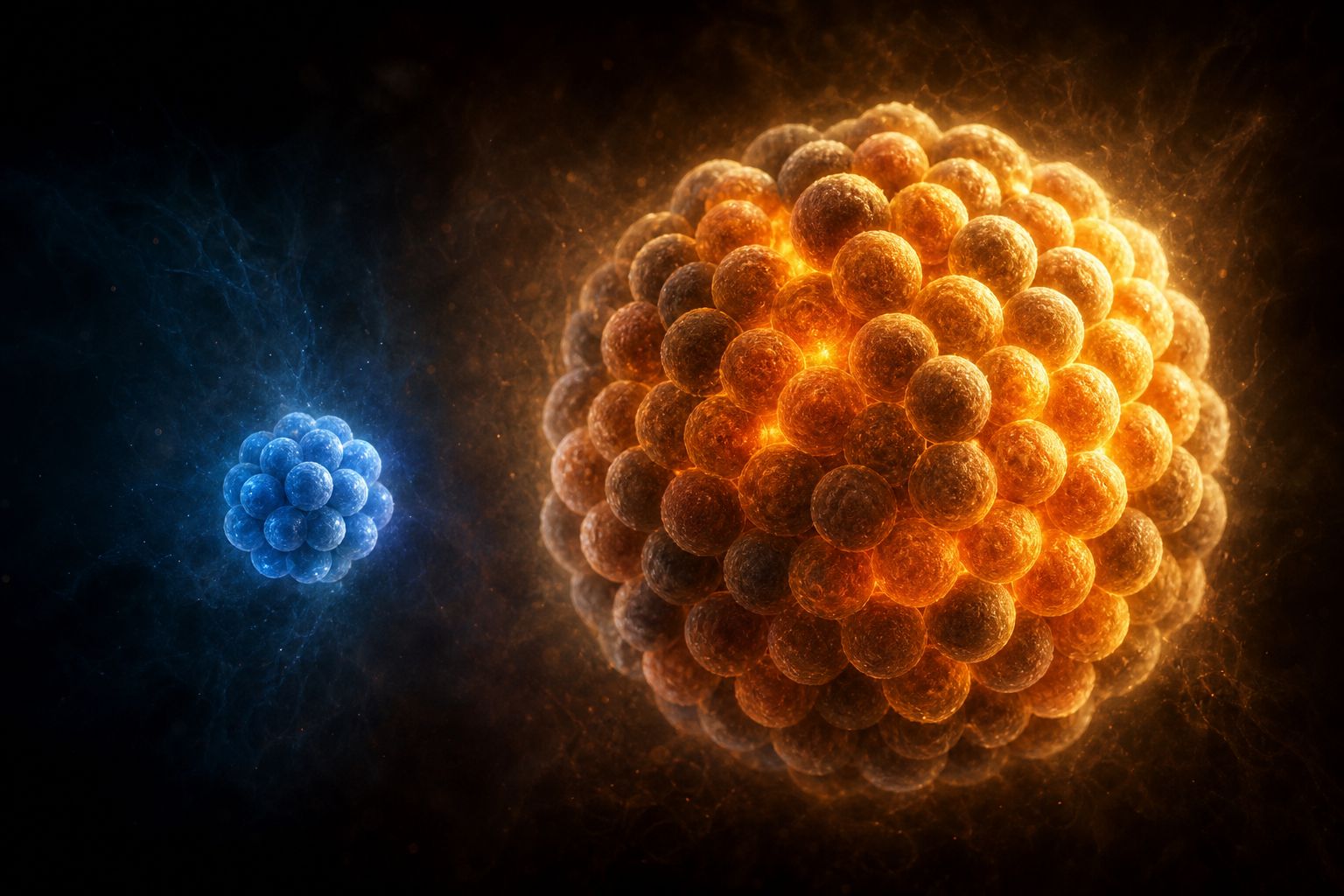
Which brings us back to oxygen. An oxygen nucleus has just sixteen protons and neutrons, against two hundred and eight in lead. Can something that small make a drop of plasma?
The LHC first collided oxygen nuclei in 2025. CMS then reported energetic particles suppressed by up to about thirty percent, and ALICE reported evidence of energy loss, which its physics coordinator put at about a one-in-two-million chance of being an accident.
STAR found its twenty percent suppression in oxygen collisions recorded at RHIC in 2021, at much lower energy.
Small and large Sixteen nucleons beside a cluster of hundreds. AI-generated still.
Lead-208
208
Oxygen-16
16
Protons and neutrons per nucleus
up to ~30%
suppression seen by CMS
Oxygen at the LHC, 2026
1 in 2 million
chance of a fluke, as its physics coordinator put it (4.9 sigma)
ALICE, July 2026
~20%
suppression, in data recorded in 2021 at lower energy
Oxygen at RHIC (STAR)
Chapter V · How small a drop?
A drop from oxygen
Physics World: oxygen-16 has 16 nucleons against 208 in lead; the CMS collaboration analysed oxygen collisions from 2025 at about 5 TeV and saw energetic particles suppressed by up to about 30% compared with proton–proton collisions (Physical Review Letters). ALICE: the LHC first collided oxygen nuclei a year before July 2026; ALICE compared oxygen–oxygen with proton–oxygen collisions and found evidence of energy loss at 4.9 sigma, which its physics coordinator called “a 1 in 2 million chance of being an accident”. ScienceDaily / Brookhaven: STAR measured a 20% suppression in 2021 oxygen data at 200 GeV, setting a new lower energy boundary for producing the plasma in a small collision system.
Try it: lead, then oxygen. The particle counts on screen are illustrative.
The 3D scenes are simplified teaching models: sizes, speeds and numbers of particles are not to scale.
These are new results, and physicists are careful. One not involved in the CMS study points out that uncertainty about the inner make-up of the oxygen nucleus could, on its own, explain about half of that suppression.
And a Brookhaven physicist says the signal in such small systems is still under debate.
RHIC itself has now retired. After twenty-six years, its final run ended with oxygen collisions, recorded on the sixth of February 2026.
Small systems: weaker signals
Nuclear structure is uncertain
Different energies, different experiments
Why caution?
~half
of the CMS suppression could come from the nucleus’s make-up alone
One caveat (Physics World)
We haven’t seen any unambiguous signal, so it’s still kind of under debate in these small systems.Rongrong Ma, Brookhaven National Laboratory
26
years of collisions
6 Feb 2026
last oxygen collisions recorded
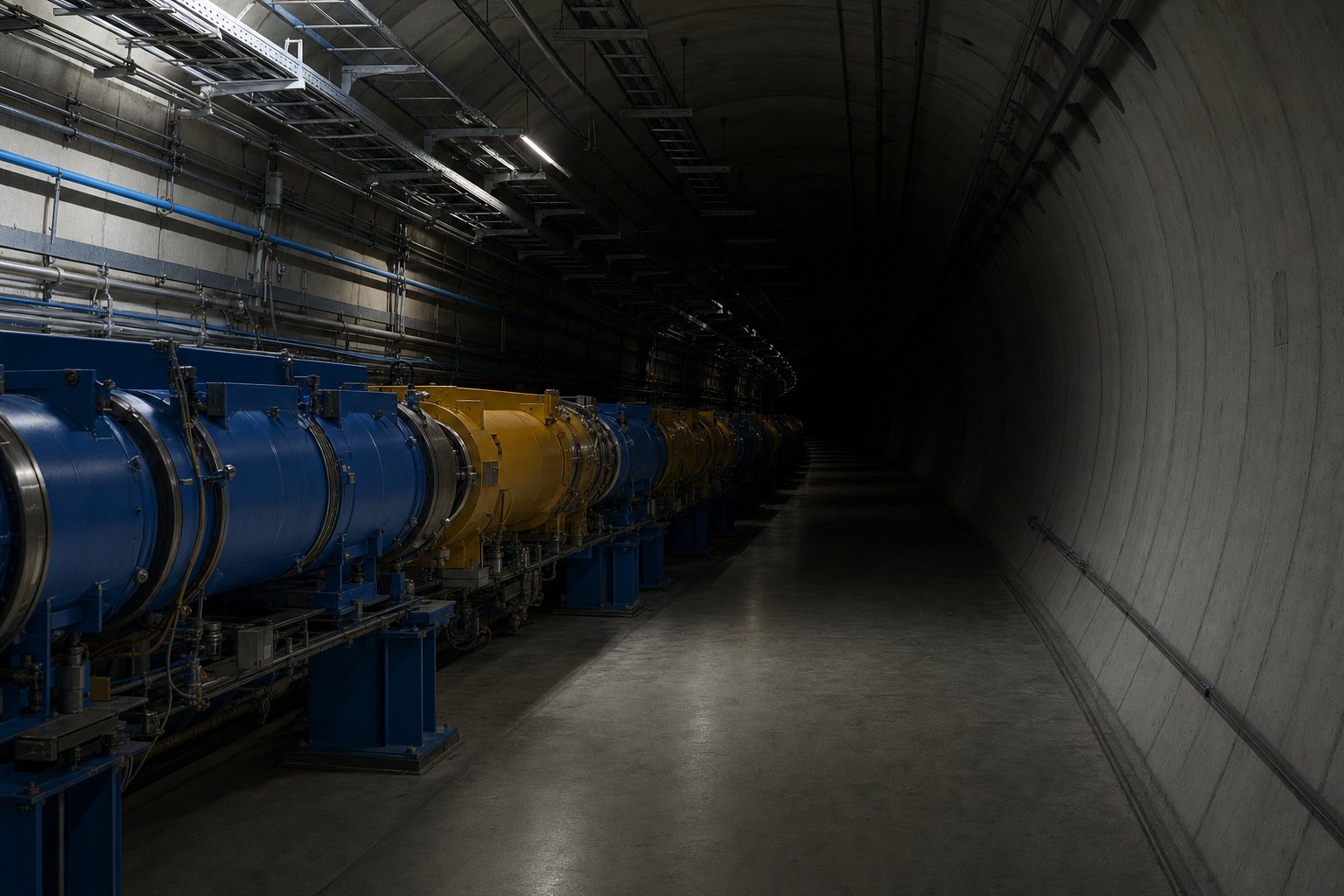
RHIC, 2000–2026The ring after RHIC The tunnel is not being abandoned: the same ring is being rebuilt as an electron-ion collider. AI-generated still.
Chapter V · How small a drop?
How sure are we?
Physics World: Jiangyong Jia (Stony Brook University, not involved in the study) noted that uncertainties in nuclear parton distribution functions, how quarks and gluons are spread inside the nucleus, could account for roughly half of the suppression CMS sees on their own; he also said plasma formation “can occur in collisions of nuclei as light as oxygen”. ScienceDaily / Brookhaven: Rongrong Ma said, “We haven’t seen any unambiguous signal, so it’s still kind of under debate in these small systems”; RHIC operated from 2000 until 2026, and its final run ended with oxygen collisions recorded on 6 February 2026.
The oxygen results are presented as reported, not as settled.
The 3D scenes are simplified teaching models: sizes, speeds and numbers of particles are not to scale.
What is settled is the big picture. Under extreme heat, protons and neutrons melt into a liquid of quarks and gluons, and in the universe's first microseconds, that liquid was everything.
Every proton and neutron in your body came out of it, as the universe cooled.
How small a drop can be and still count is the question the oxygen results are now trying to settle.
1980s Theory: collisions could make the plasma
1986 CERN’s first heavy-ion experiments
2000 CERN: a new state of matter; RHIC starts
2005 A nearly perfect liquid
2010 4 trillion °C; LHC lead collisions
2026 Oxygen results; RHIC retires
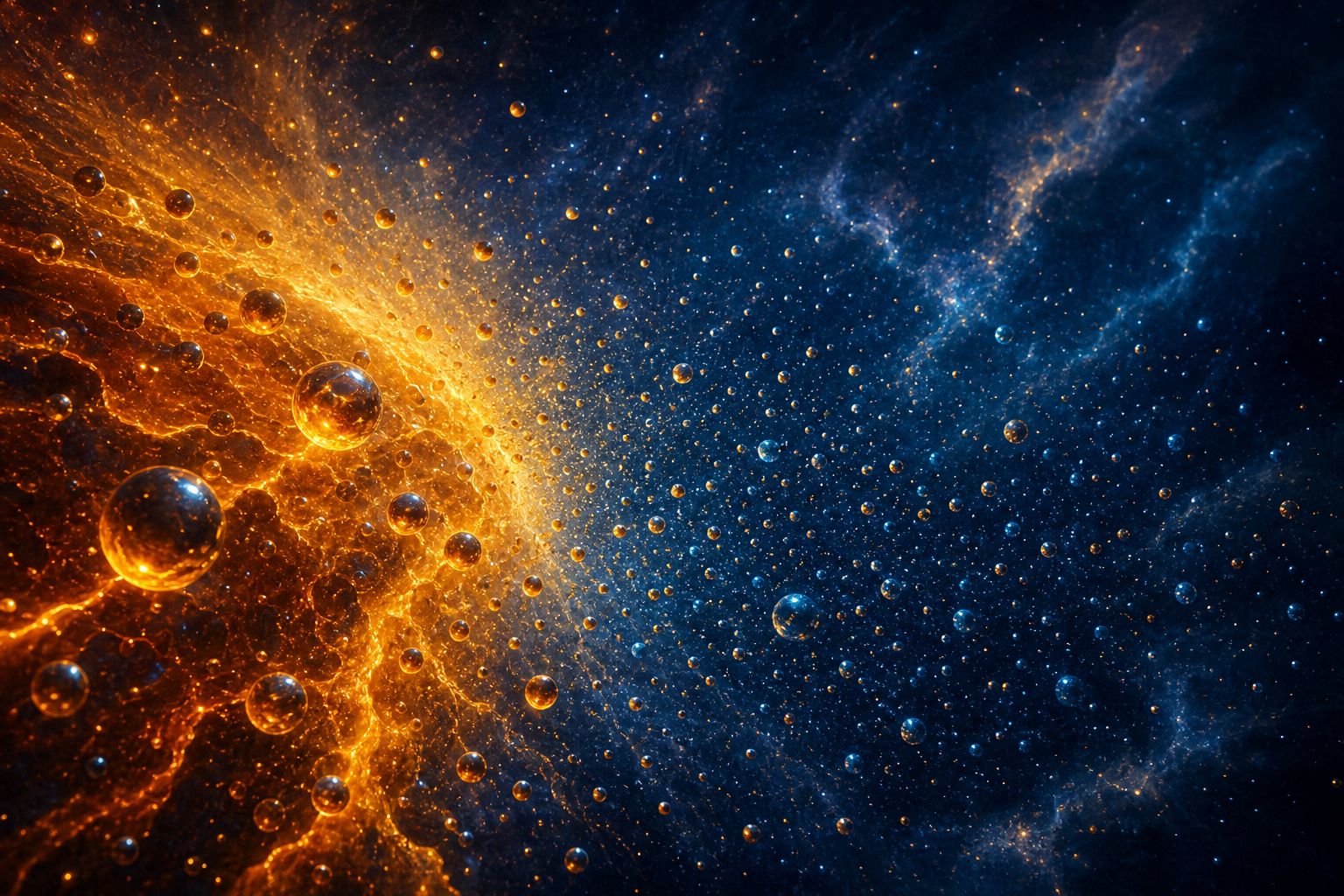
Melting the protonRing inside ring Each layer answers a different question: how sharply a particle curved, how much energy it carried, and whether it got through at all. AI-generated still.Condensing into matter An artist’s impression of the plasma breaking into particles. AI-generated still.
16?
protons and neutrons: enough for a drop of plasma?
The open question
Epilogue · Sources
Sources
Every fact in this film comes from the sources below. The chapter stills and pictures are AI-generated artists’ impressions and show no real people, places or brands. The atom, quarks, strings, nuclei, fireballs, flow and jets in the 3D scenes are simplified teaching models, not to scale and enormously slowed. The oxygen results of 2026 are new and are presented as reported, with the researchers’ own caveats; the established part is the existence of the quark–gluon plasma in heavy-ion collisions and its role in the early universe.