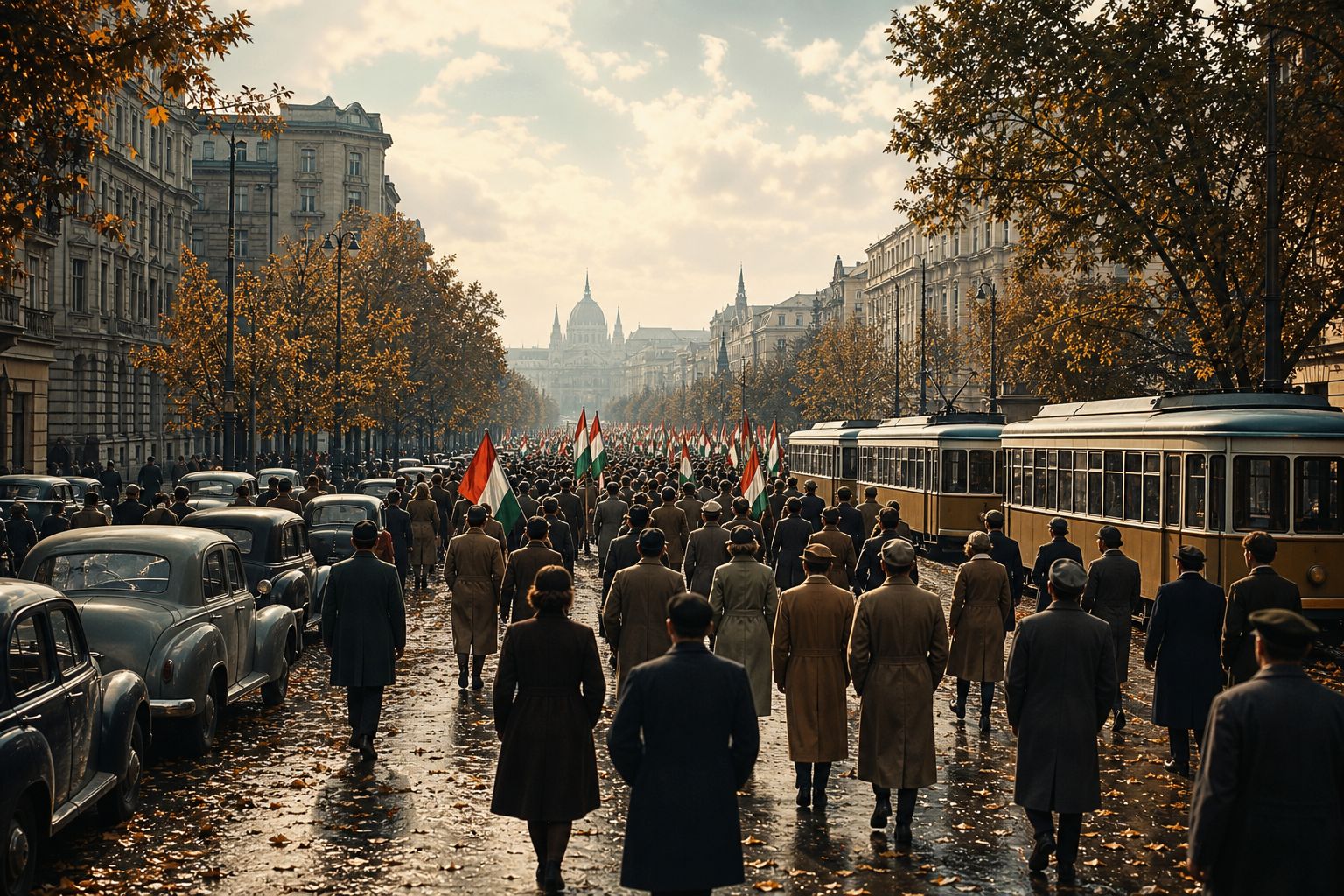
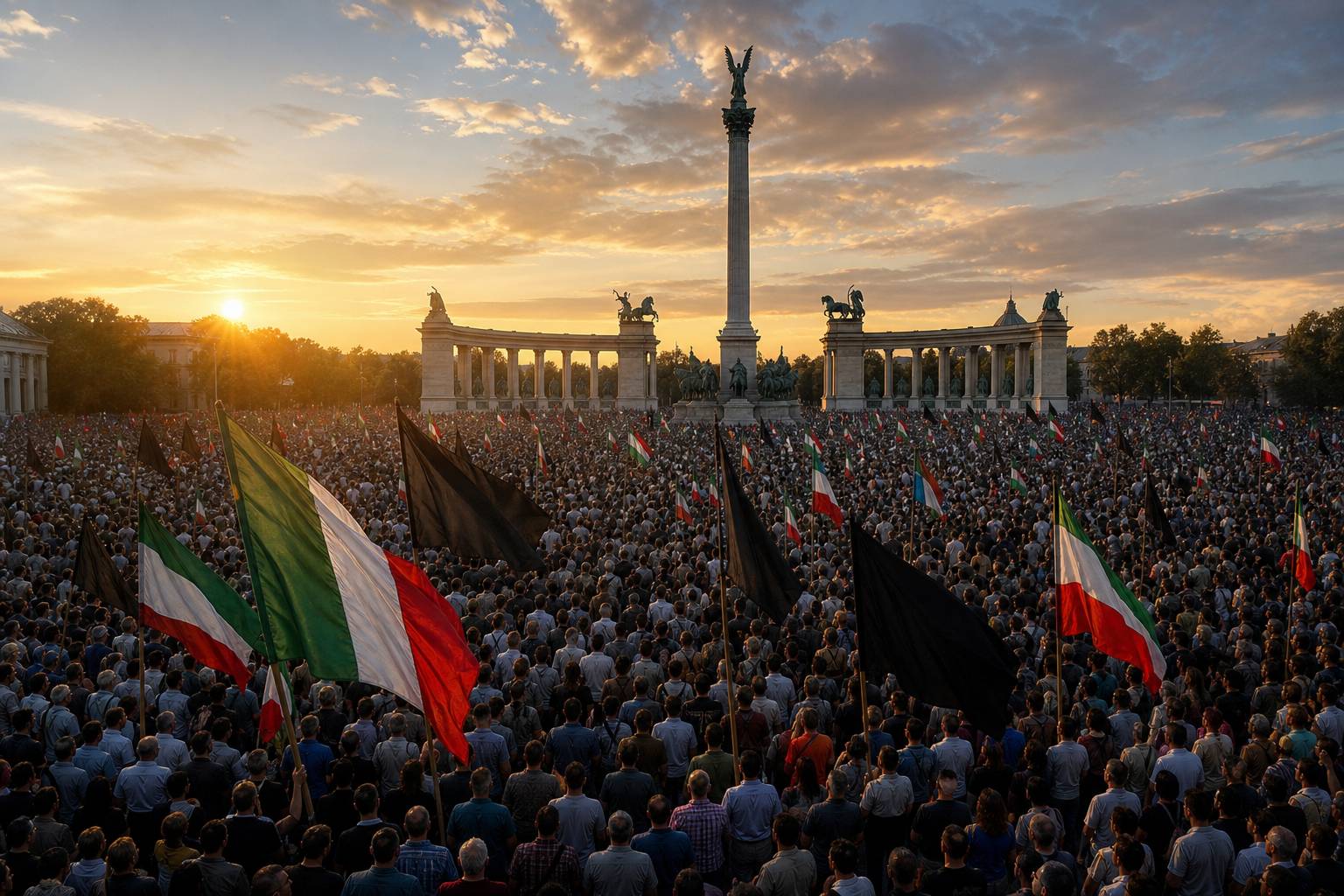
On 23 October 2026 Hungary marks seventy years since the revolution of 1956. This film tells what happened: how Hungary came under a Soviet-backed dictatorship after the Second World War, how Stalin's death and Khrushchev's secret speech opened a crack, how students wrote sixteen demands and marched, why shots at the radio building turned a protest into an armed uprising, how Imre Nagy's government declared neutrality, and how a second Soviet intervention on 4 November crushed it while the world watched Suez. It gives each side's account in its own words, the casualty estimates historians use, the 200,000 refugees, and why the same October was called a counter-revolution until 1989. Follow the march across a map of Budapest, step through the twelve days, and trace the refugees' routes.
Interactive 3D film10 min1945 to 2026Published 18 October 2026
On the twenty-third of October 2026, Hungary marks seventy years since the revolution of 1956. It is a national holiday, with a state ceremony in front of the Parliament in Budapest.
In 1956 a peaceful student march in that city became a nationwide uprising against a government backed by the Soviet Union. Twelve days later, the Soviet army crushed it.
How did a list of student demands turn into a revolution? And why do people still describe it in such different words?
70 years
a national holiday in Hungary
16:00
state ceremony at Kossuth Square
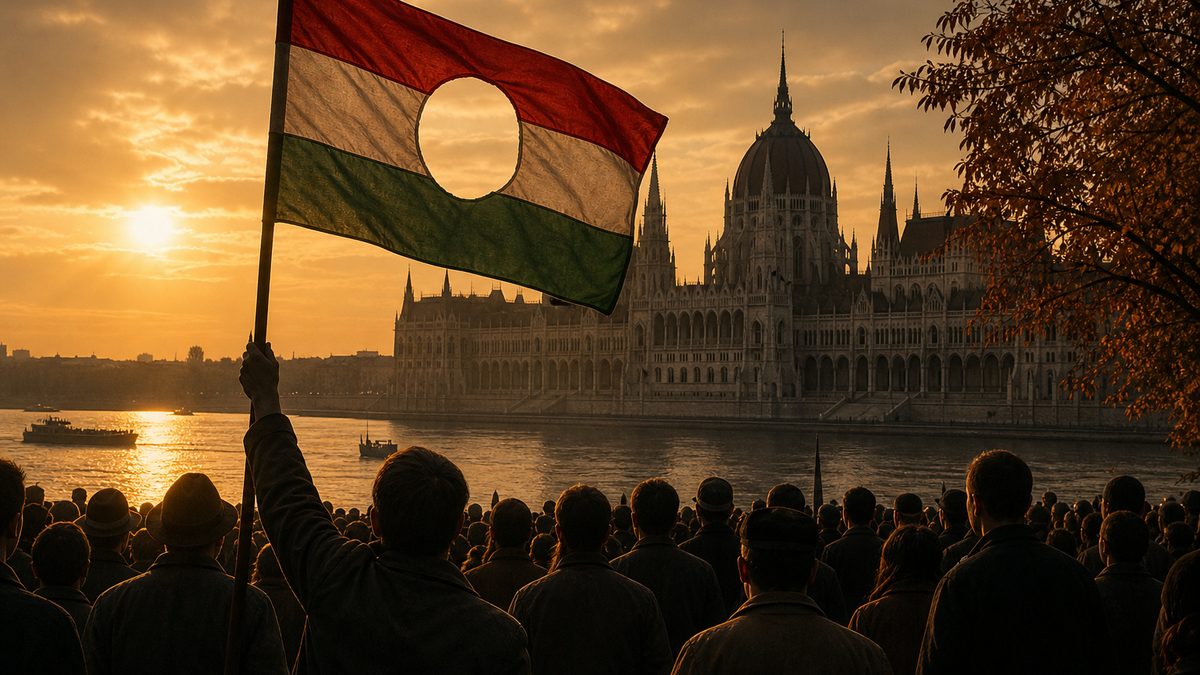
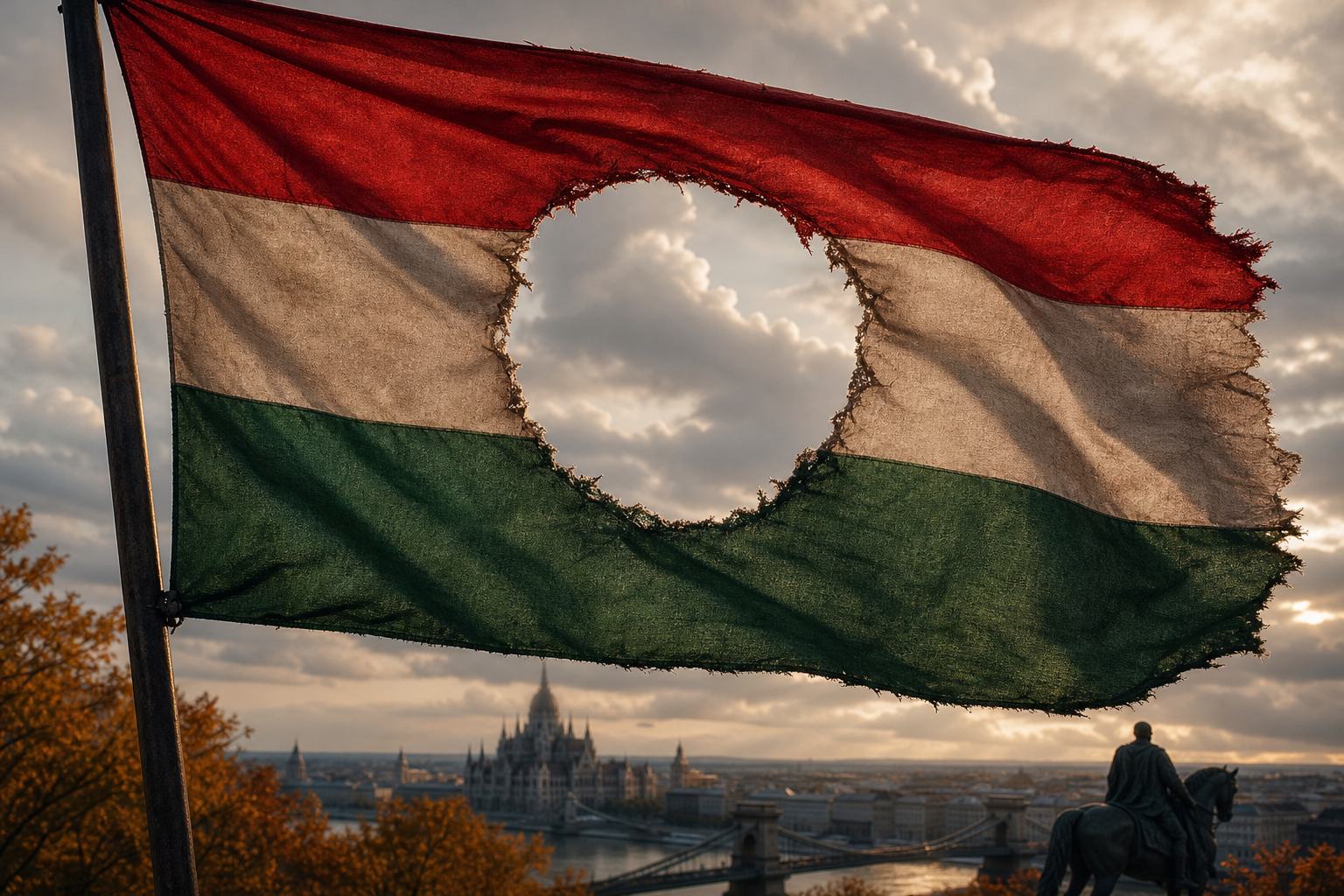
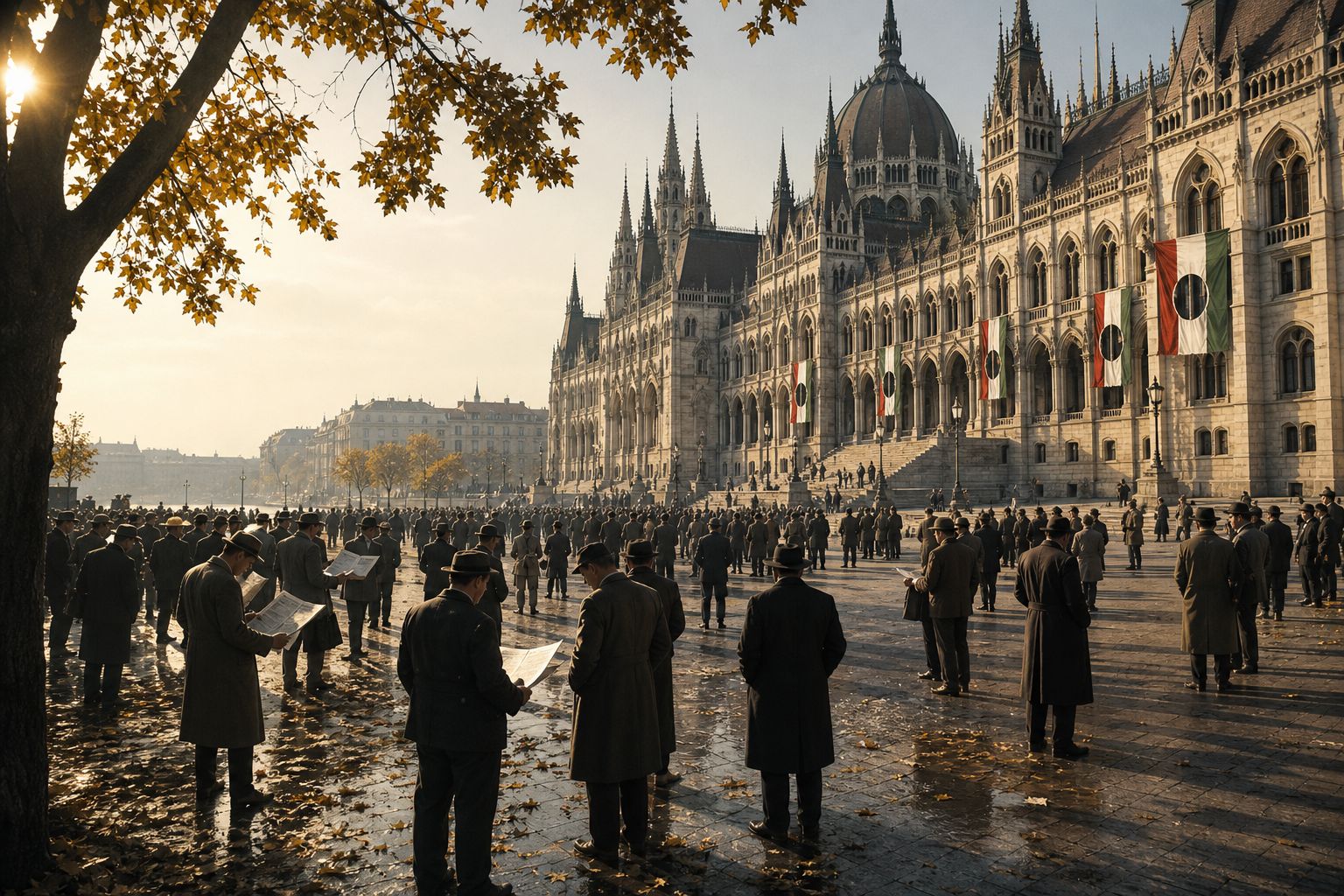
23 October 2026The flag with a hole In 1956 protesters cut the communist coat of arms out of the national flag; the holed flag became the revolution’s symbol. AI-generated still.
“revolution”: the name used in Hungary today
“counter-revolution”: the official name from December 1956 until 1989
One October, two names
Prologue · The anniversary
Seventy years on
Hungary Unlocked (updated 14 October 2026): 23 October 2026 is a national holiday; the state commemoration is at Kossuth Square in front of Parliament from 16:00, and museums offer free exhibitions. The date has two meanings: the uprising began on 23 October 1956, and Hungary was proclaimed a republic on 23 October 1989.
European Network Remembrance and Solidarity: protesters cut the communist coat of arms out of the flag, and the holed flag became the revolution’s symbol.
After the Second World War, Hungary fell under Soviet influence. With the help of Soviet occupation forces, its democratic institutions were abolished and replaced by a dictatorship under the communist leader Mátyás Rákosi. Under Moscow's direction, he held near-total power.
Europe was split by what Westerners called the Iron Curtain: a guarded line between the communist East and the West. Hungary lay on the eastern side, next to neutral Austria and to Yugoslavia, a communist country that had broken with Moscow.
In 1955 Hungary joined the Warsaw Pact, the Soviet-led military alliance.
one-party rule directed from Moscow
forced heavy industry
peasants pushed into collective farms
political prisoners and internment camps
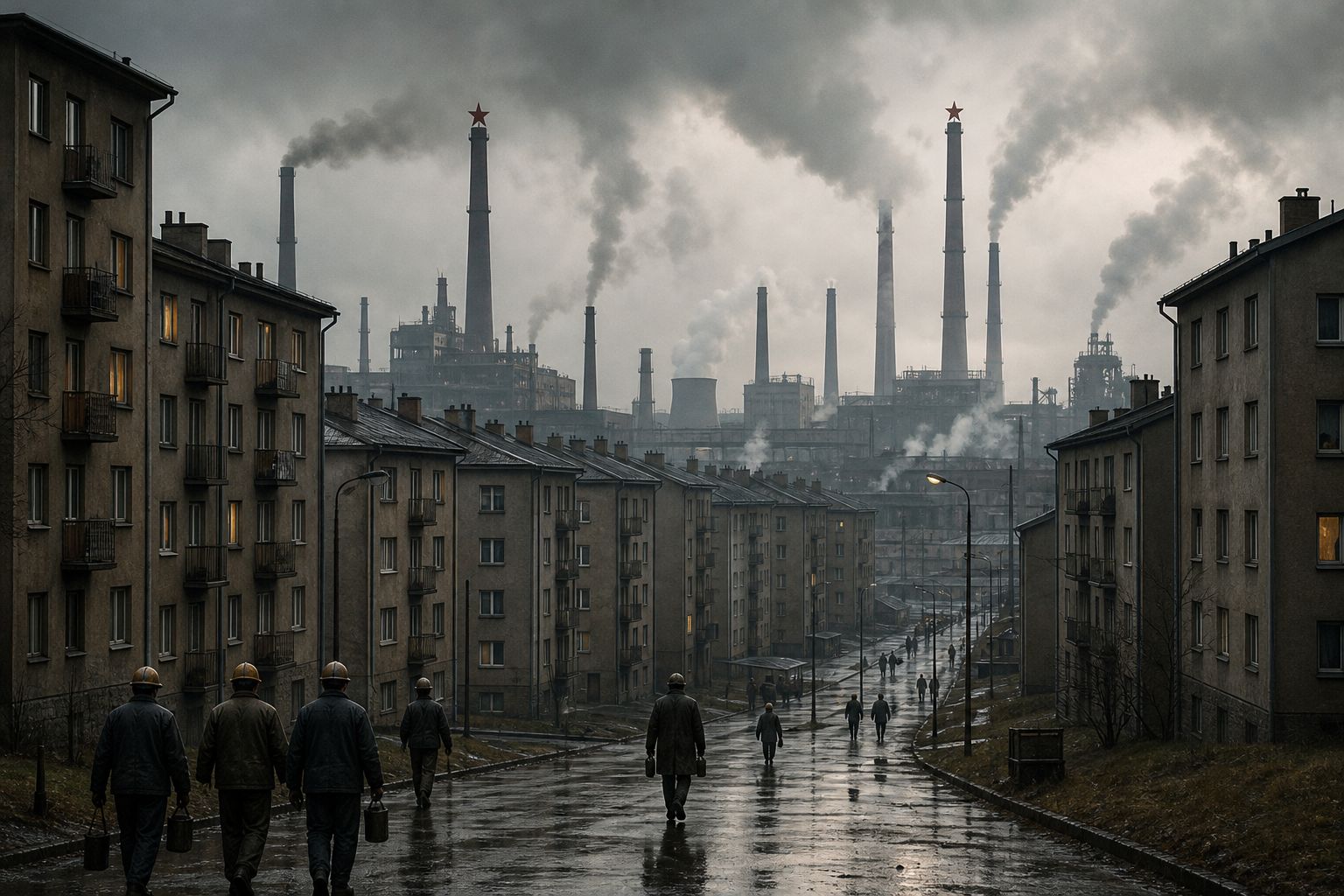
Under RákosiA planned economy Under Moscow’s direction Rákosi held near-total power until Stalin died in 1953. AI-generated still.
PM + party
he holds both the premiership and the party leadership (Britannica)
Rákosi, 1952
1955
Hungary joins the Soviet-led alliance
Warsaw Pact
Chapter I · Behind the curtain
The Rákosi years
European Network Remembrance and Solidarity: after the Second World War Hungary fell under Soviet influence, and with the help of Soviet occupation forces democratic institutions were abolished and replaced by a dictatorship under Mátyás Rákosi. Britannica: Rákosi took the premiership as well as the party leadership in 1952 and, under Moscow’s direction, held near-total power until Stalin died in 1953. Hungary joined the Warsaw Pact in 1955.
The list on screen summarises the policies Nagy later promised to undo (Britannica). The border line on the globe is approximate.
Stalin dies, and Moscow lets Hungary try something softer.
Then, in 1953, Stalin died. Moscow removed Rákosi as prime minister and replaced him with Imre Nagy, a communist who, unusually, was not unpopular in the country.
Nagy promised a new course: more consumer goods, an end to forcing peasants into collective farms, and the release of political prisoners. He carried out some of it, but Moscow hesitated to back him.
But in the spring of 1955 he was dismissed and expelled from the party, and Rákosi returned to the old line.
1953 Stalin dies; Nagy replaces Rákosi as prime minister
1953–55 the “new course”
1955 Nagy dismissed and expelled; Rákosi back
Rise and fall of a reformer (Britannica)
slow down forced heavy industry
more consumer goods
close internment camps
Nagy’s new course
expelled
Nagy loses his post and his party membership
Spring 1955
Chapter I · Behind the curtain
Nagy’s new course
Britannica: in July 1953 Rákosi was removed as prime minister and replaced by Imre Nagy, a “Muscovite” who was not unpopular in the country. Nagy promised to end forced heavy industrialisation, produce more consumer goods, stop forcing peasants into collectives, release political prisoners and close internment camps. He carried out some of these reforms, but Moscow hesitated to back him; in spring 1955 he was dismissed and expelled from the party, and Rákosi returned the country to its previous course.
Khrushchev attacks Stalin, and Poland pushes back.
In February 1956, the new Soviet leader Nikita Khrushchev gave a secret speech denouncing Stalin's cult of personality. Word of it spread, and with it came a new freedom of debate and criticism.
In Poland, workers in Poznań went on strike in June. In July, Moscow sacrificed Rákosi; his deputy Ernő Gerő took over and promised no concessions.
Then, in October, Moscow accepted the reformer Władysław Gomułka as Poland's new leader. Next door, a 1955 treaty had already made Austria neutral. Many Hungarians asked: why not here?
The new freedom of debate and criticismBritannica, on what followed Khrushchev’s speech
Feb Khrushchev’s secret speech, 20th Party Congress
Jun strikes in Poznań, Poland
Jul Rákosi dismissed; Gerő in charge
Oct Moscow accepts reformers in Poland
1956 in the Soviet bloc
Gomułka
a reformer Moscow had to accept
Poland’s October
1955
a treaty makes Austria neutral, raising hopes in Hungary
Next door
Chapter I · Behind the curtain
Catalysts
Britannica: Khrushchev’s “secret speech” at the 20th Congress of the Soviet Communist Party in February 1956 denounced Stalin’s cult of personality, and the uprising was encouraged by “the new freedom of debate and criticism” that followed. In July 1956 Rákosi was dismissed from all posts, partly to placate Yugoslavia’s Tito; Ernő Gerő took over and announced no concessions to Nagy’s group. The Polish challenge to Soviet authority also emboldened Hungarians.
ADST oral history: the 1955 treaty that made Austria neutral raised hopes in Hungary for a similar arrangement; in October 1956 the USSR accommodated reformist demands in Poland. ENRS: the Poznań strikes of June 1956 were early resistance in the Soviet bloc.
In October 1956, students at the Technological University of Budapest drew up a list of sixteen demands. The list was linked to MEFESZ, a new student federation independent of the party.
They asked for the immediate withdrawal of all Soviet troops, a new government led by Imre Nagy, free elections with all parties taking part, and freedom of the press and radio.
They also wanted the giant statue of Stalin in Budapest taken down. On the map, the places of the coming night are marked.
Drafting the demands The demands also called for 15 March, the anniversary of the 1848 revolution, to be a national holiday. AI-generated still.
Soviet troops out, under the peace treaty
a government under Imre Nagy
secret-ballot elections, all parties
free press and radio
Among the sixteen points
The statue of Stalin … should be removedStudents’ demands, October 1956
Chapter II · The first night
The students’ demands
The students of the Technological University of Budapest, linked to MEFESZ (the Hungarian federation of university and college students’ associations), drew up sixteen demands. Among them: “the immediate evacuation of all Soviet troops, in conformity with the provisions of the Peace Treaty”; a new government “under the direction of Imre Nagy”; general elections by universal, secret ballot with all parties; freedom of opinion, the press and radio; and the removal of the Stalin statue, to be replaced by a monument to the freedom fighters of 1848–49.
The map of Budapest in the 3D scenes is a simplified sketch: places are in roughly the right relation to each other and the Danube, not to scale. The globe’s border line is approximate.
From a statue of a Polish general to the Parliament.
On the afternoon of the twenty-third of October, students gathered at the statue of József Bem, a Polish-born general who fought for Hungary in 1848, to show support for the reformers in Poland. Crowds joined them.
Then the crowd crossed the Danube to the Parliament, to hear Imre Nagy. People cut the communist coat of arms out of their flags.
That evening Gerő gave a harsh speech on the radio. Watch the march cross the river.
Poland + Hungary
a Polish hero of Hungary’s 1848 revolution: a symbol of both nations
Why BemCrossing to Pest ADST oral history: several thousand protesters marched to the Parliament building. AI-generated still.
the march began peacefully
Britannica: Gerő’s speech was harsh
crowds moved on to the radio building
Why that evening mattered
Chapter II · The first night
23 October
ENRS: students held a demonstration at the József Bem statue in Budapest in support of Polish workers and Władysław Gomułka’s reforms; the crowd marched to Parliament to hear Imre Nagy speak, and demonstrators cut the communist coat of arms out of the flag. Britannica: students staged a procession to present a petition of grievances; crowds joined them; Gerő gave a harsh speech.
The map of Budapest in the 3D scenes is a simplified sketch: places are in roughly the right relation to each other and the Danube, not to scale. The globe’s border line is approximate.
Several thousand people gathered at the Radio Budapest building, demanding that their demands be broadcast. A student delegation went inside and was detained.
Then, according to European and American accounts, the state security police, the ÁVH, fired on the unarmed crowd. Armed fighting followed. Britannica writes that this turned a peaceful demonstration into a revolution.
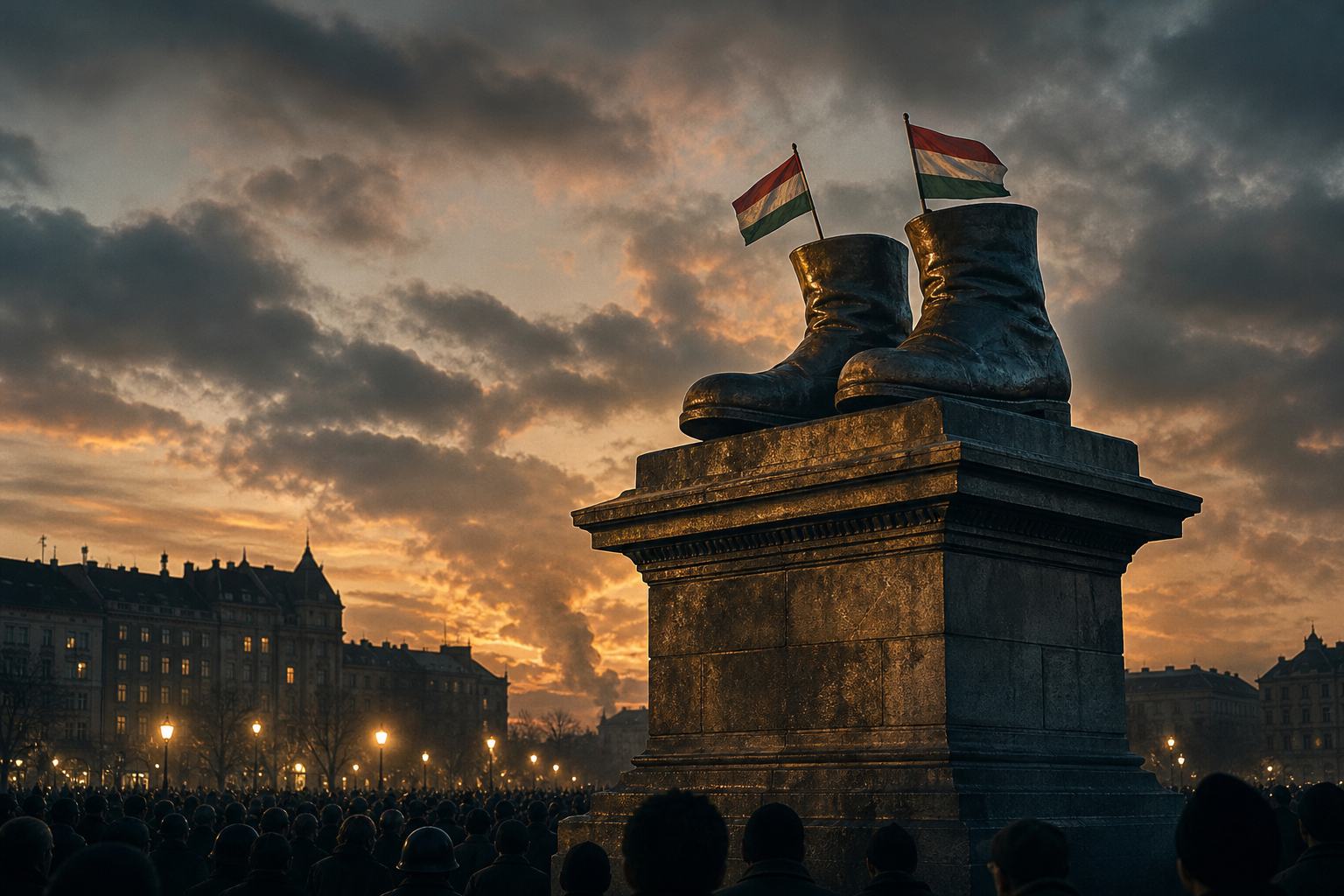
The same night, across the city, a crowd pulled down the Stalin statue and left only its boots. Press Topple the statue.
Radio Budapest Radio was how a government spoke to the whole country; the crowd wanted the demands read on air. AI-generated still.
the State Protection Authority, the political police
feared for arrests under Rákosi
disbanded by the new government days later
What the ÁVH wasOnly the boots ADST: demonstrators placed Hungarian flags in the statue’s boots. AI-generated still.
Chapter II · The first night
The radio building
ENRS: several thousand people gathered at the Radio Budapest building to demand a broadcast; state security fired on the unarmed crowd and armed conflict followed. The same day demonstrators toppled the Stalin statue. ADST: a student delegation sent into the radio building was detained; when protesters demanded its release, the State Security Police (ÁVH) fired on them. Britannica: police fired into the crowds, turning a peaceful demonstration into a revolution.
ADST: the new government disbanded the ÁVH. The toppling in the scene is schematic.
Soviet tanks enter the city, and the country rises.
The next day, Soviet tanks entered Budapest. Revolutionaries, many of them young workers and students, halted the tanks at several points.
Much of the Hungarian army sided with the revolutionaries, and weapons were handed out. Across the country, local councils formed, prisoners were freed and peasants took back confiscated land. Cardinal József Mindszenty, head of the Catholic Church in Hungary, was escorted back to his residence.
Within days, Nagy was back as prime minister, pushed step by step into bigger concessions.
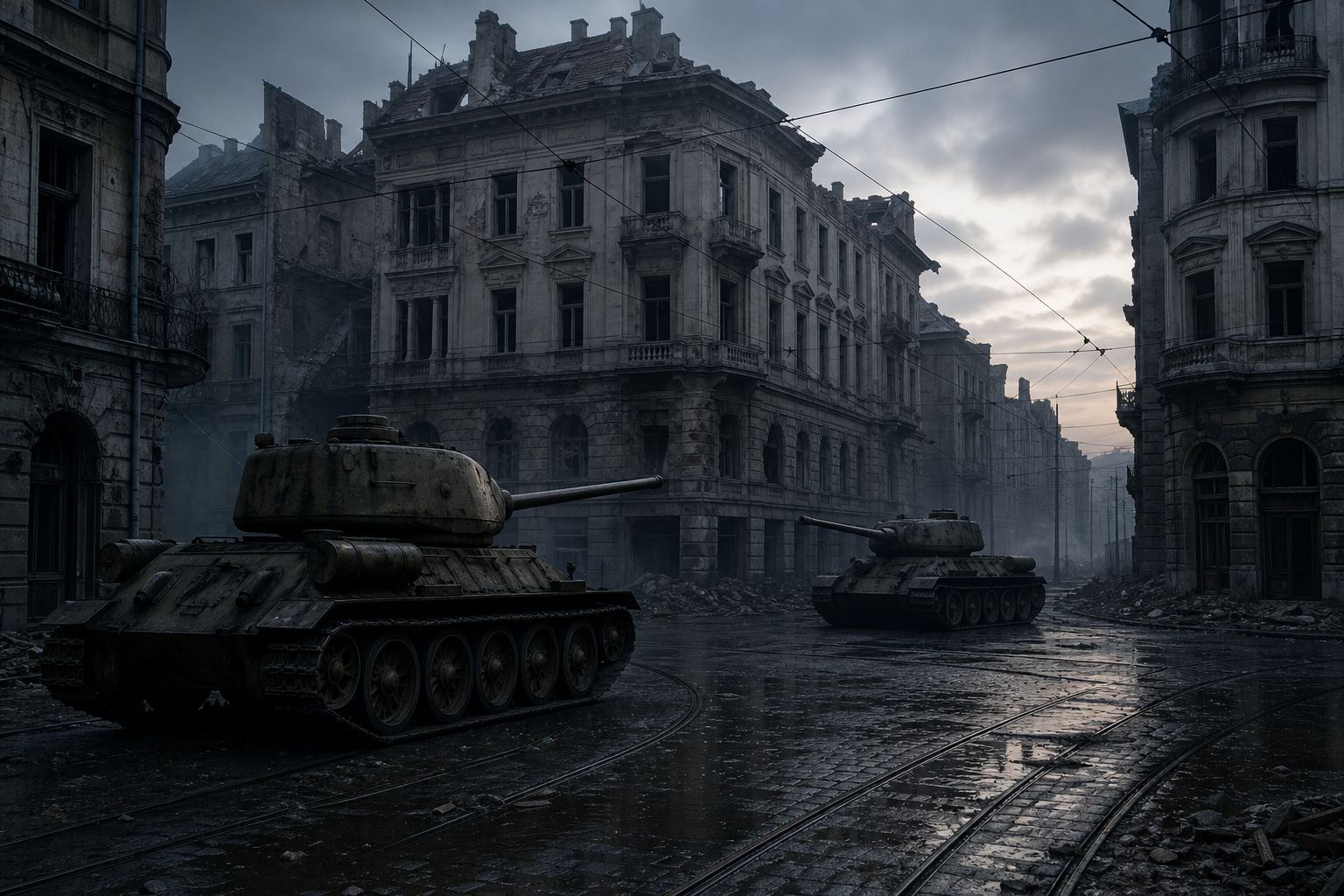
Tanks in the streets Hungary Unlocked: on 25 October gunfire from rooftops killed an unarmed crowd in front of Parliament. AI-generated still.
the army sides with the revolutionaries
local councils form
prisoners freed
weapons handed out from depots and factories
A country in revolt (Britannica)
PM again
Britannica dates his return to power to 25 October
Imre Nagy
Chapter II · The first night
The first Soviet intervention
ENRS: the next day Soviet tanks entered Budapest, but revolutionaries halted their advance at several points; security snipers fired from rooftops on Kossuth Square and from party headquarters on Köztársaság Square. Britannica: the army sided with the revolutionaries and arms were distributed from depots and factories; local councils formed across the country, peasants reclaimed confiscated land and prisoners were freed; Cardinal Mindszenty was escorted back to the primate’s palace. On 25 October Nagy returned to power, but was pushed into successive concessions.
The map of Budapest in the 3D scenes is a simplified sketch: places are in roughly the right relation to each other and the Danube, not to scale. The globe’s border line is approximate.
For a few days it looked as if the revolution had won.
By the end of October the fighting had largely stopped, and Soviet units withdrew from Budapest. The new government disbanded the ÁVH, freed political prisoners and brought back a multi-party system.
On the thirtieth of October, Moscow published a statement. It said it was ready to withdraw its troops from Budapest and to negotiate. It also said the movement had been joined by forces of black reaction and counter-revolution, the communist term for an attempt to overthrow socialism.
But on the thirty-first, Soviet leaders changed course. Khrushchev warned that pulling out would look like weakness to the West. Press the arrows to step through the days.
ÁVH disbanded
amnesty for political prisoners
several parties allowed again
preparations to leave the Warsaw Pact
A week of change
Joined by forces of black reaction and counterrevolutionStatement of the Soviet Government, 30 October 1956
Newspapers and flags The same Soviet statement warned that Soviet troops staying in Hungary could make things worse. AI-generated still.
They will perceive it as weakness on our part and will go onto the offensive.Khrushchev, Soviet leadership meeting, 31 October 1956
Chapter III · A week of freedom
The Soviet statement
ENRS: after several days Soviet divisions withdrew from Budapest; the government introduced a multi-party system, declared an amnesty for political prisoners and began preparing to leave the Warsaw Pact. ADST: by late October fighting had largely stopped; the new government disbanded the ÁVH. The Soviet government’s statement of 30 October 1956 said the movement was “joined by forces of black reaction and counterrevolution”, warned that “the further presence of Soviet Army units in Hungary can serve as a cause for even greater deterioration”, said troops would leave Budapest “as soon as this is recognized as necessary by the Hungarian Government”, and offered negotiations with Hungary and the other Warsaw Treaty members.
Alpha History, quoting the record of the Soviet leadership meeting of 31 October 1956: the decision to suppress the uprising was taken that day; Khrushchev argued that the Western powers “will perceive it as weakness on our part and will go onto the offensive”, and that “our party will not accept it” if Soviet forces withdrew.
Hungary tries to leave the Soviet alliance, as war breaks out at Suez.
On the first of November, Nagy announced that Hungary would leave the Warsaw Pact. He asked the United Nations to recognise the country as neutral, like Austria next door.
That same day, János Kádár, a minister in Nagy's own government, left Budapest. He would come back from Moscow with the Soviets. On the third of November, Nagy formed a new coalition government that included several parties.
Meanwhile the world looked elsewhere. On the twenty-ninth of October Israel had invaded Egypt's Sinai peninsula, and Britain and France attacked Egypt over the Suez Canal. For American leaders, Suez quickly overshadowed Hungary, and Washington offered only statements of sympathy, which, according to History UK, angered many Hungarians.
neutral
Nagy asks the UN to recognise Hungary’s neutrality
1 November 1956News by radio Western broadcasts such as Voice of America had spoken of the “liberation” of “captive peoples”. AI-generated still.
coalition
Nagy’s new government includes several parties (Britannica)
3 November
29 Oct Israel invades the Sinai
30 Oct Anglo-French ultimatum
31 Oct Britain bombs Egypt’s air force
6 Nov Anglo-French landing at Port Said
Suez, the same week (US Office of the Historian)
sympathy
public statements, no military help (History UK)
Washington’s reply
Chapter III · A week of freedom
Neutrality and Suez
Britannica: on 1 November Nagy announced Hungary’s withdrawal from the Warsaw Pact and asked the UN to recognise Hungary as neutral; the same day János Kádár left Budapest after defecting from Nagy’s government. On 3 November Nagy headed a new coalition government including several parties. US Office of the Historian (FRUS): Israel invaded the Sinai on 29 October; Britain and France, who had colluded with Israel, issued an ultimatum on 30 October and Britain bombed the Egyptian air force on 31 October; the crisis “quickly overshadowed the Hungarian rebellion” as the main focus of US leaders.
History (UK): Voice of America broadcasts and speeches by President Eisenhower and Secretary of State Dulles had suggested US support for the “liberation” of “captive peoples”; during the Soviet attack the US issued only public statements of sympathy, which angered many Hungarians.
Early on the fourth of November, Soviet forces entered Budapest. At twenty past five, Nagy announced the attack in a radio broadcast thirty-five seconds long.
On another wavelength, Kádár declared Nagy's government illegitimate and announced a new government, with himself as prime minister. Moscow had secretly flown him to Szolnok, a town south-east of the capital.
Nagy took refuge in the Yugoslav embassy. The defence minister, General Pál Maléter, was captured after negotiating with Soviet commanders. Armed resistance ended around the tenth of November, but strikes went on for weeks.
05:20
the time
35 s
its length
Nagy’s last broadcast
Nagy’s government declared illegitimate
a “revolutionary workers’ and peasants’ government” formed
Kádár had himself been jailed under Rákosi
Kádár’s accountNovember Cardinal Mindszenty fled to the US legation that morning and, by one diplomat’s account, stayed about fifteen years. AI-generated still.
Chapter IV · The second intervention
4 November
History (UK): at 5:20 a.m. on 4 November Nagy announced the invasion in a 35-second broadcast; Kádár had been secretly flown from Moscow to Szolnok, 60 miles south-east of the capital. Britannica: Soviet forces entered Budapest on 4 November; Nagy sought refuge in the Yugoslav embassy and Mindszenty in the US legation; Kádár broadcast a declaration that Nagy’s government was illegitimate and formed a “Hungarian revolutionary workers’ and peasants’ government”; major fighting ended within about two weeks, with sporadic clashes into January 1957 and a general strike for weeks. ADST: Hungarian resistance ended on 10 November.
CPSU Presidium notes from the same day (Wilson Center) record the aim to “reinforce the military victory through political means” and to keep Hungary from going “the route of Yugoslavia”.
The map of Budapest in the 3D scenes is a simplified sketch: places are in roughly the right relation to each other and the Danube, not to scale. The globe’s border line is approximate.
Historians' estimates, as given by Britannica: about twenty thousand Hungarian casualties, including roughly two thousand five hundred dead. On the Soviet side, more than six hundred and fifty dead and about twelve hundred and fifty wounded.
Mass arrests continued for months, and many people were seized and deported to the Soviet Union. Nagy left his refuge under a promise of safe conduct, was seized, and after a secret trial was hanged in June 1958, together with Pál Maléter.
Hungarians
~2,500
Soviet soldiers
650+
Deaths, historians’ estimates (Britannica)
ENRS: over 2,000 killed, more than 10,000 wounded
ADST: over 2,500 Hungarians, about 700 Soviet troops killed
a Kádár-era historian in 1986 claimed over 2,700 were killed by “mobs”
Other estimates
130–500
rebels hanged, range reported by the Christian Science Monitor in 1986
16 Jun 1958
Nagy hanged
Executions 1956–58A secret trial Britannica: after leaving the Yugoslav embassy, Nagy was abducted to Romania before his trial. AI-generated still.
Chapter IV · The second intervention
Casualties and reprisals
Britannica (historians’ estimates): about 20,000 Hungarian casualties, including roughly 2,500 deaths; Soviet losses about 1,250 wounded and more than 650 dead. Nagy was abducted after leaving his refuge under safe conduct and taken to Romania; after a secret trial he, Maléter and several associates were executed in 1958. Euronews: Nagy was hanged on 16 June 1958. History (UK): sporadic armed resistance, strikes and mass arrests continued for months.
Casualty figures are historians’ estimates and vary between sources; the film gives each figure with the source that reports it.
Christian Science Monitor (1986): between 130 and 500 rebels, including Nagy, were hanged from 1956 to 1958; the director of a party history institute then claimed “more than 2,700” people were killed by the mobs, his assertion.
As the revolution was crushed, about two hundred thousand people fled: around one hundred and eighty thousand into Austria, and about twenty thousand into Yugoslavia.
Thirty-seven countries took them in. Austria appealed for international help on the fifth of November. Within weeks, tens of thousands had been moved on from Austria.
About thirty-eight thousand went on to North America. Many were young and educated, a heavy loss for Hungary. Watch the routes on the map.
Austria
~180,000
Yugoslavia
~20,000
Where they fled (Forced Migration Review)
37
countries took refugees
92,950
moved out of Austria by 31 Dec 1956
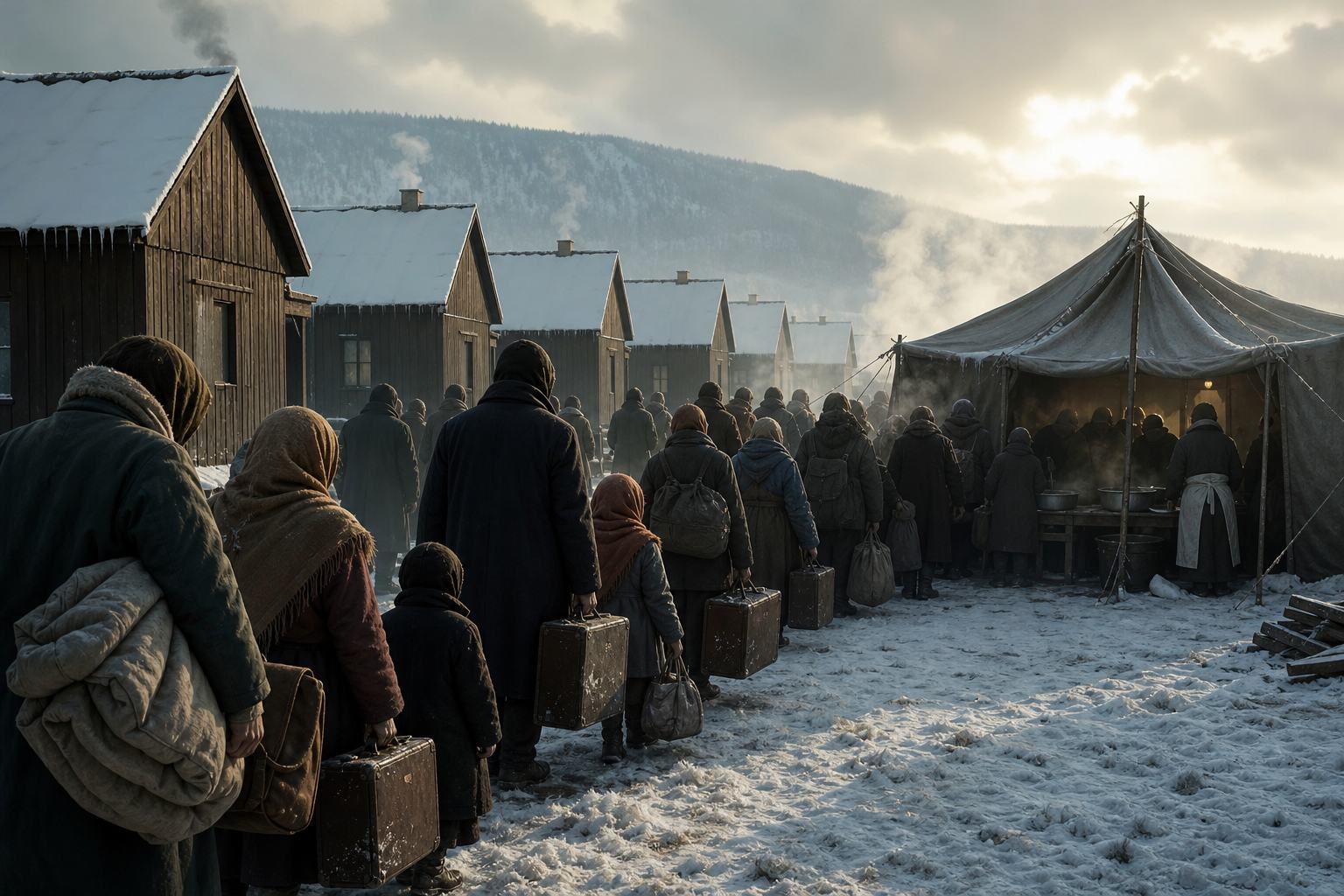
ResettlementA reception camp Forced Migration Review: Sweden began resettling refugees from Austria within days; the first trains to Switzerland left on 8 November. AI-generated still.
Chapter IV · The second intervention
The refugees
Forced Migration Review (Amanda Cellini, PRIO): about 180,000 Hungarians fled to Austria and about 20,000 to Yugoslavia; 37 countries resettled refugees, nearly 180,000 in all; by 28 November nine European countries had resettled 21,669, and by 31 December 92,950 had been moved out of Austria. Britannica: about 200,000 fled to the West, about 38,000 of them to North America in 1956–57; the exodus removed many young, educated Hungarians.
The routes on the globe are schematic arrows, not exact paths.
In December 1956, Kádár's government officially declared that a counter-revolution had taken place. For decades, public discussion was limited. Kádár promised reforms and distanced himself from the old Rákosi and Gerő leadership, and, in Britannica's words, Hungary later became probably the most liberal of the Soviet satellite states, the countries Moscow controlled.
In January 1989, the reformer Imre Pozsgay said on the radio that 1956 was a popular uprising. In June, Nagy was reburied before about two hundred thousand people in Heroes' Square.
The regrettable events of OctoberOfficial phrase of the Kádár era, as recalled by Hungary’s National Committee of Remembrance
Probably the most liberal of the Soviet satellite statesBritannica, on Hungary under Kádár
A popular uprising, a revolt against an oligarchic form of ruleParty reform committee, announced by Imre Pozsgay, January 1989
16 June 1989 A British diplomat there recalled calls for Soviet forces to leave and for democratic elections. AI-generated still.
Chapter V · Two names for one October
Counter-revolution or uprising
Hungary’s National Committee of Remembrance: in December 1956 the government declared that a counter-revolution had taken place in October; at best the events were called the “regrettable events of October”, and public discussion was limited for decades. On 27 January 1989 Imre Pozsgay told Kossuth Radio that a party committee “views the events of 1956 as a popular uprising, a revolt against an oligarchic form of rule”; broadcast the next day, it opened the way to Nagy’s reburial. GOV.UK: about 200,000 people attended the reburial in Heroes’ Square on 16 June 1989. Britannica: Hungary later became “probably the most liberal of the Soviet satellite states.”
Hungary Unlocked: Hungary was proclaimed a republic on 23 October 1989. ENRS: 23 October has been a national holiday since 1989.
On the twenty-third of October 1989, thirty-three years to the day after the students marched, Hungary was proclaimed a republic. That is why the date now carries both meanings.
Every twenty-third of October, Hungarians gather again in front of the Parliament where that march ended. What would you have written on your list of demands?
23 Oct 1956 march, shots at the radio
1 Nov 1956 neutrality declared
4 Nov 1956 second Soviet intervention
16 Jun 1958 Nagy executed
23 Oct 1989 republic proclaimed
Milestones
a thaw in Moscow opened space for demands
one volley at the radio turned protest into revolt
the name of an event can be a political choice
Three ideas
Epilogue
Sources
Every date, number and quotation in this film comes from the sources below. Where sources differ, the film says which one it follows.
Casualty figures are historians’ estimates and vary between sources; the film gives each figure with the source that reports it.
Stills are AI-generated illustrations, not photographs. They show no real people.
The map of Budapest in the 3D scenes is a simplified sketch: places are in roughly the right relation to each other and the Danube, not to scale. The globe’s border line is approximate.