A first study of coast redwoods in heat, reported in October 2026, found that photosynthesis in young trees’ needles roughly halved between 30 and 40 °C, and that in heat waves the trees close the pores on their needles. This film explains why that matters: how a tree lifts water a hundred metres with no pump. A suction pump stops at about ten metres; trees instead pull water up from the top, as evaporation from leaf pores tugs on unbroken threads of water held together by hydrogen bonds inside dead, hollow wood cells. We follow the idea from Dixon and Joly in 1895, see why the threads can snap into air bubbles, why redwoods may top out near 120 to 130 metres, and why fog and heat matter to the tallest trees on Earth. Raise a pump, open and close a leaf’s pores, pull a water thread until it breaks, and grow a tree to its limit.
Interactive 3D film9 min1895 to 2026Published 19 October 2026
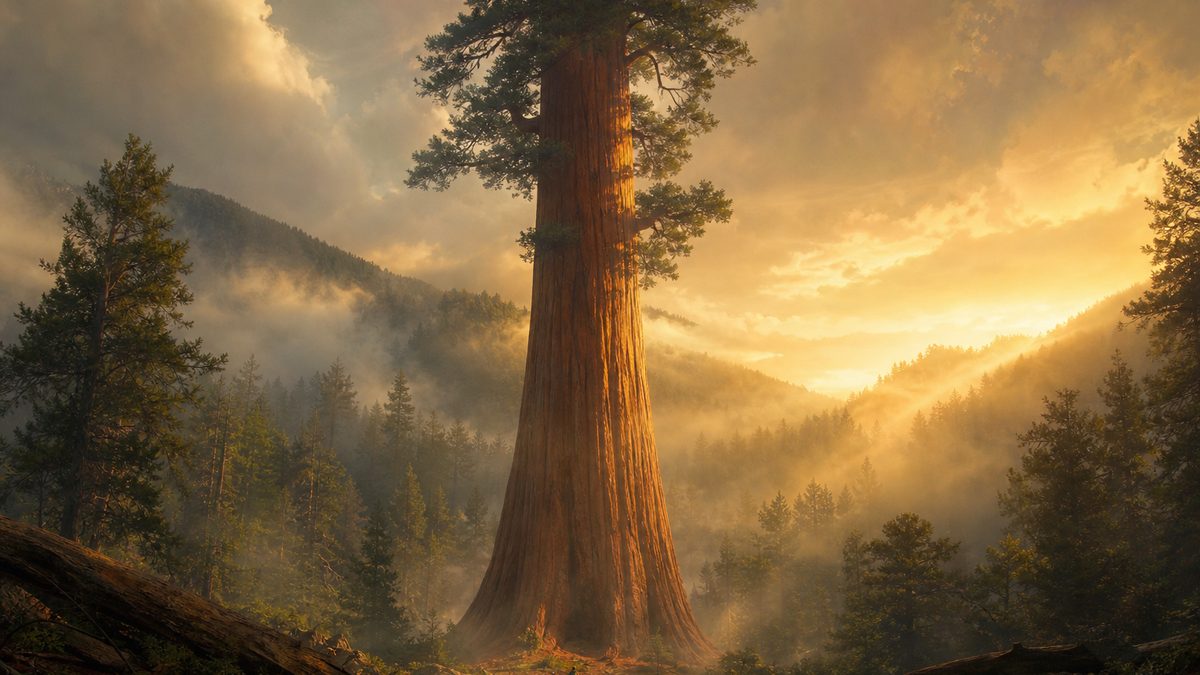
The tallest tree known is a coast redwood a hundred and sixteen metres high. Every day it lifts water from the soil to its top needles, with no heart and no pump. How?
That system is now in the news. In a study reported this autumn, scientists at UC Davis found that photosynthesis in young redwoods' needles, the way they make food from sunlight, roughly halved between thirty and forty degrees Celsius.
In heat waves, the trees shut the tiny pores on their needles to save water, and that has a cost. To see why, start with a puzzle about pumps.
116.07 m
Hyperion, a coast redwood (Guinness)
The tallest tree known
at 30 °C
100%
at 40 °C
≈ 50%
Needle photosynthesis in the lab (Science News) Young trees in Mendocino County, California; old giants over 100 m tall were not sampled.
2
heat waves measured in the forest
first
study of how coast redwoods respond to heat
The study, 2022–2024
Prologue · The news
Redwoods in the heat
Science News (12 Oct 2026): L. Klinek, T. Magney and colleagues report in the Journal of Geophysical Research: Biogeosciences that photosynthesis in needles from younger coast redwoods roughly halved as temperature rose from 30 °C to 40 °C. Field sampling in Mendocino County, California, from July 2022 to October 2024 covered two heat waves; under extreme heat some needles were up to 10 °C warmer than the air, suggesting their stomata were at least partly closed. Troy Magney calls it the first study of how coast redwoods respond to heat.
A single first study on young trees; its authors say the threshold for lasting damage is still unknown. How to use: pick a chapter or press ← →; drag to rotate. Most steps have buttons.
The 3D scenes are schematic: sizes, speeds and molecules are not to scale.
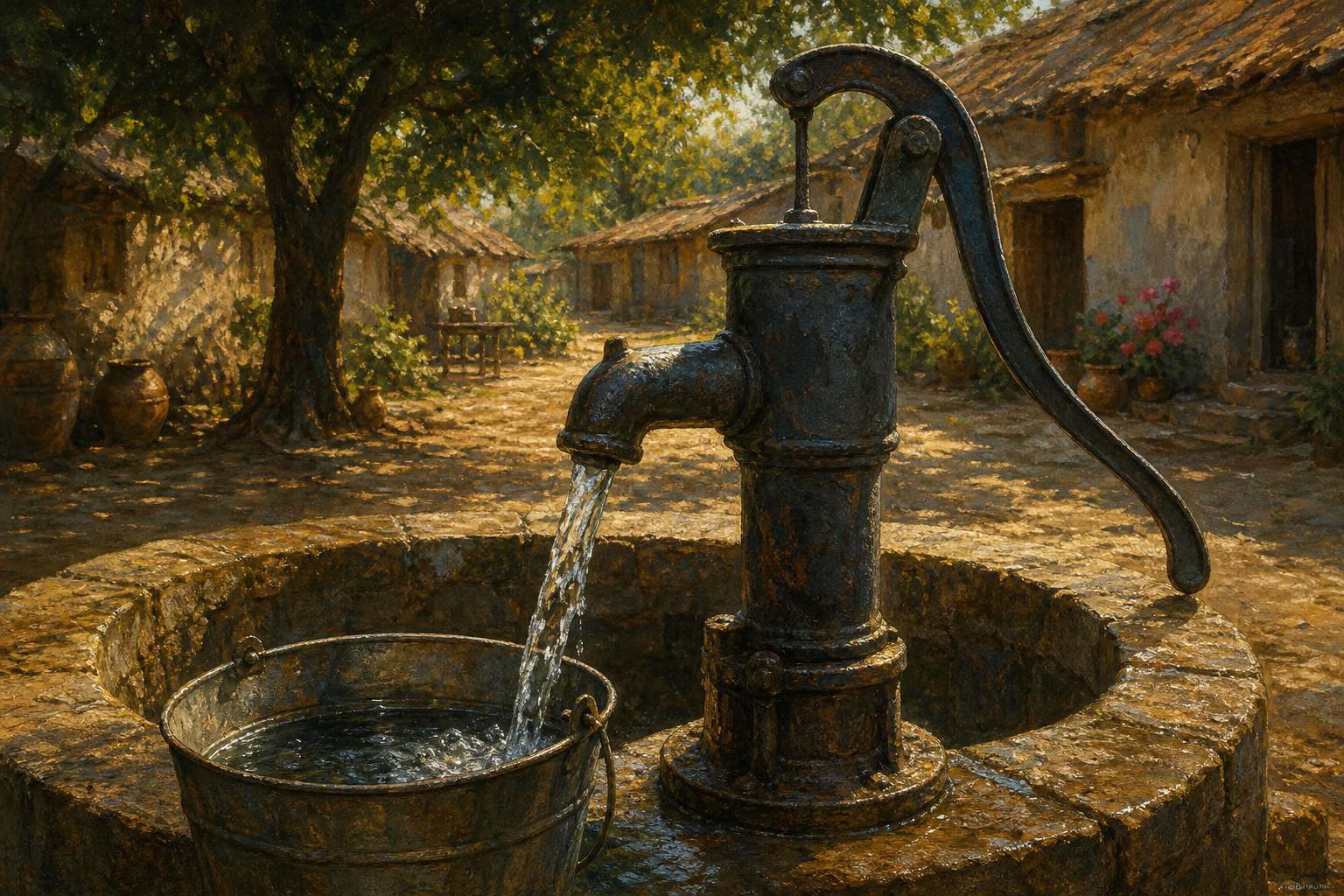
Try lifting water with a suction pump. Pumping takes the air out of the pipe, and the weight of the atmosphere, pressing on the water outside, pushes it up the pipe.
But the air can only push so hard. Even with a perfect vacuum in the pipe, water stops rising at about ten point four metres. Above that, the pump just sucks on empty space.
As the pipe keeps growing, the water stays put. A redwood lifts water more than ten times higher than this, with no pump at all. Something other than suction must be at work.
A hand pump A pump like this works only while the water lies within about 10 m of it. AI-generated still.hmax=ρgpair≈1000×9.8101000≈10.3m
pair
air pressure at sea level, pascals
ρ
density of water
g
gravity
Textbooks quote about 10.4 m; the exact figure depends on the day’s air pressure.
best suction pump
≈ 10.4 m
Hyperion, tallest tree
116.07 m
How high water must go
Chapter I · The puzzle
Pushed by the air
LibreTexts: even the best vacuum pump can pull water up to only about 10.4 m (34 ft), because the weight of a column that tall just balances the pressure of the atmosphere, about 0.1 MPa (one atmosphere). A “suction” pump does not really pull: it removes air, and the atmosphere pushes the water up.
Pipe and tank are drawn to scale with each other, not with a tree.
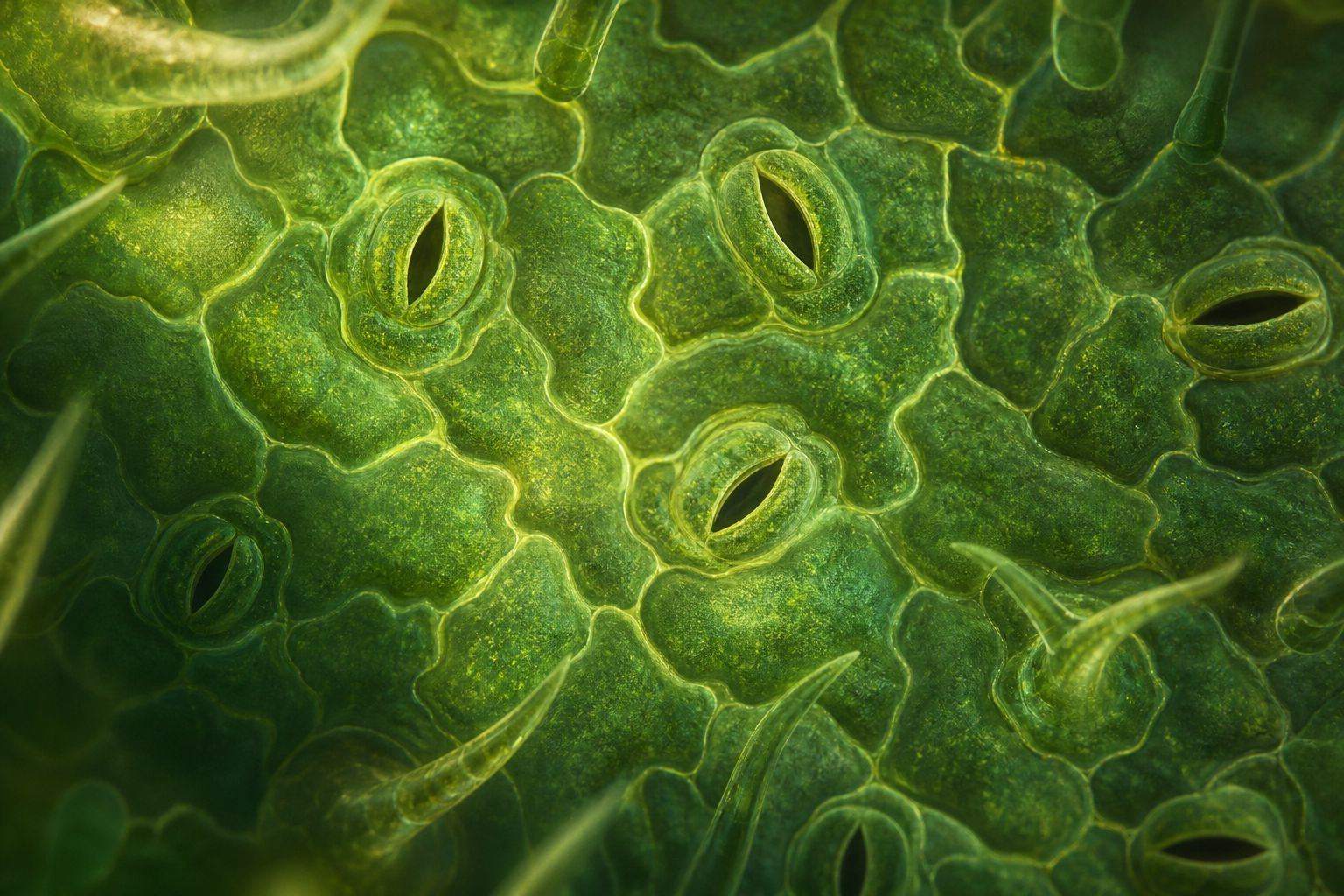
The answer starts in the leaves. Their surfaces are dotted with tiny pores called stomata. They open to let in carbon dioxide, which the leaf needs to make sugar.
But every open pore also lets water vapour out. Losing water this way is called transpiration, and it adds up. A large oak can give off about forty thousand gallons, some hundred and fifty thousand litres, of water in a year.
Close the pores and the water stays in, but carbon dioxide cannot get in either. Every plant has to balance food against water, all day long.
Pores on a leaf Each pore is framed by two guard cells that swell to open it and go slack to close it. AI-generated still.A thirsty oak USGS: trees give off more water when it is hot, windy and dry, and less when the air is humid. AI-generated still.
up to 90%
of water taken up by roots may be lost by transpiration
≈ 10%
of the moisture in the air comes from plants (USGS)
Where the water goes
Chapter I · The puzzle
Transpiration
USGS: transpiration is the release of water vapour from plants, mostly through stomata on the leaves; it supplies about 10% of the moisture in the atmosphere. A large oak can transpire about 40,000 US gallons a year, an acre of corn 3,000–4,000 gallons a day, and the rate rises with temperature and wind and falls with humidity. Raven Biology (LibreTexts): up to 90% of the water a plant’s roots absorb may be lost this way.
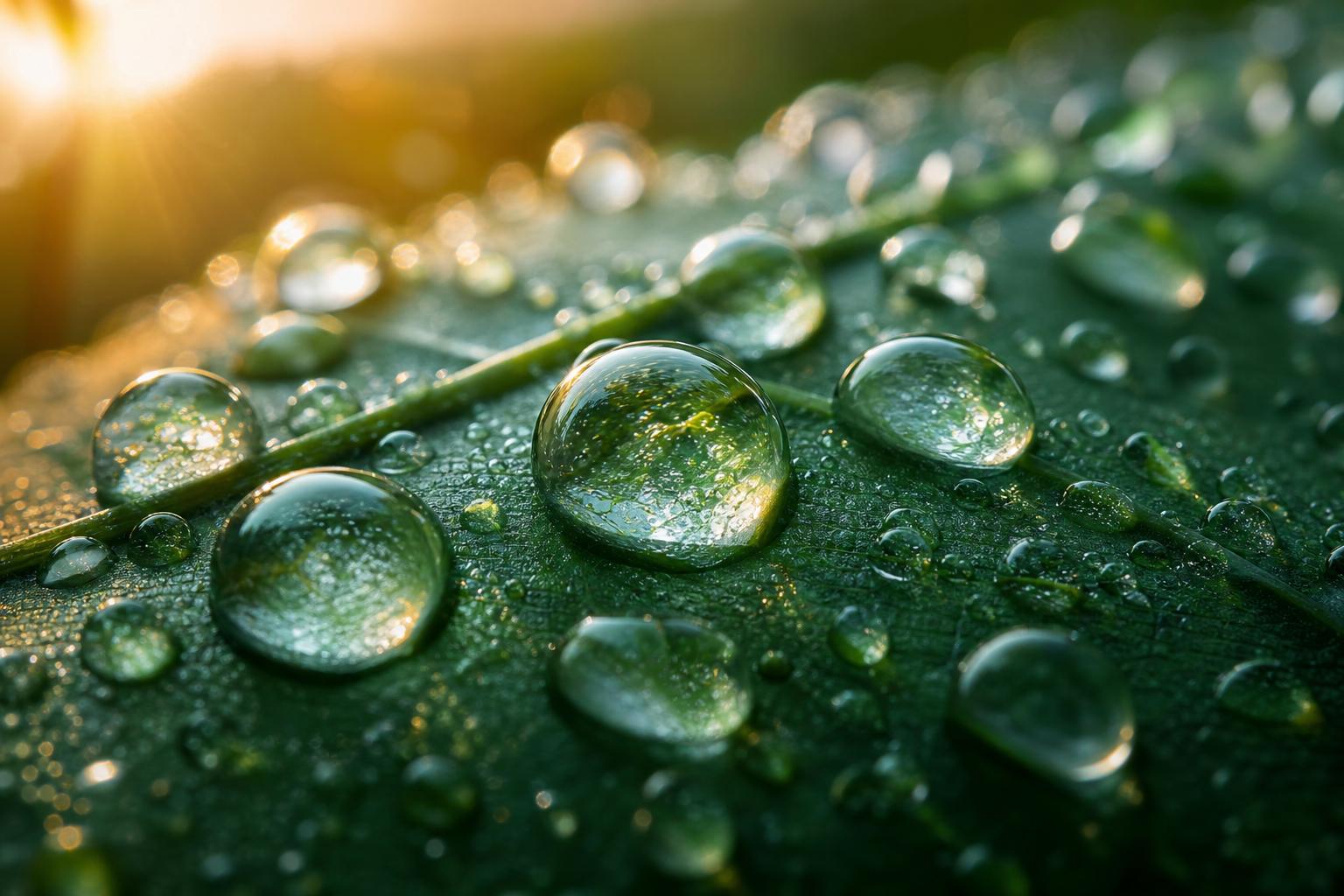
Water molecules are sticky. Each one forms weak links, called hydrogen bonds, with its neighbours, so water holds together as a continuous thread. That is cohesion.
Water also clings to the walls of the narrow tubes it travels through. That is adhesion. Together they let a thin column of water behave a little like a rope.
When a molecule evaporates from a leaf, it tugs the next one up behind it, and that one tugs the next, all the way down to the roots. Watch the thread move as the top evaporates.
Beads of water The same pull between molecules is what makes water bead into round drops. AI-generated still.
cohesion: water to water
adhesion: water to the tube walls
Two kinds of stickiness
≈ 200 ×
the atmosphere’s push: the pull reported to break a column of water
How strong the thread is (LibreTexts)
Chapter II · Pulled from the top
Cohesion and adhesion
LibreTexts: cohesion is the property of water molecules to cling to each other through the hydrogen bonds they form; adhesion is the attraction of water to the walls of the xylem. Measurements suggest tensions as great as 21 MPa would be needed to break a column of water. Atmospheric pressure at sea level is about 0.1 MPa, so 21 MPa is about 200 times larger.
MPa: megapascal, a million pascals. Molecules drawn hugely enlarged; the bonds are shown as dashed lines.
So the water in a tree is not pushed up from below. It is pulled from the top, and it is under tension, a pressure below zero, like a stretched rubber band.
Botanists track it with a quantity called water potential, measured in megapascals; one megapascal is about ten times the push of the air. In one textbook example, it is about minus zero point two in the roots, minus zero point six in the stem, and minus one point five in a leaf at the top.
Dry air is far lower still, around minus one hundred: not its pressure, but how hard it draws water in. Water always moves toward the lower value, so it flows from soil to root to leaf to sky, driven by the sun's energy, not the tree's.
a pump pushes: pressure above zero
a tree pulls: pressure below zero
Push or pull?
root
−0.2
stem
−0.6
leaf at the top
−1.5
Water potential, textbook example A longer bar means a more negative value and a stronger pull. The air, at about −100, would need a bar 66 times the leaf’s.
the Sun
supplies the energy that evaporates the water
≈ −2 MPa
tension transpiration can create at the leaf surface (a separate measure)
The engine
soil → root: −0.2
root → stem → leaf: −0.6 → −1.5
leaf → dry air: ≈ −100
Downhill all the way
Chapter II · Pulled from the top
Water potential
LibreTexts: transpiration creates a negative pressure (tension) of about −2 MPa at the leaf surface. In its example, water potential falls from about −0.2 MPa in root cells to −0.6 MPa in the stem, −1.5 MPa in a leaf at the tip of the tree and about −100 MPa in the atmosphere; water moves from higher to lower water potential.
Real values vary with species, time of day and how wet the soil is.
This idea is called the cohesion-tension theory. Two Irish scientists, the botanist Henry Dixon and the physicist John Joly, published it in 1895.
In one experiment, they sealed a leafy maple branch inside a thick glass tube, with its cut end reaching down into water. The branch kept drawing water up against three times normal air pressure. So the leaves pulled harder than three atmospheres could push back, far beyond what suction can do.
They argued that the tree spends no effort of its own lifting water. Botanists were divided then, but cohesion-tension is now the textbook explanation.
A lab of the 1890s Joly was already known as a physicist; Dixon was a young botanist at the time. AI-generated still.
3 ×
normal air pressure, inside the tube
The maple test
Tensile properties of water enable trees to lift the fluid without exerting any effort whatsoever.The Scientist, summing up Dixon and Joly’s claim
Chapter II · Pulled from the top
The cohesion-tension theory
The Scientist: in 1895 the Irish physicist John Joly and the young botanist Henry Dixon published their paper in Philosophical Transactions of the Royal Society B (vol. 186). They enclosed a maple branch in a thick glass tube, its cut end protruding into a vial of water, and watched it move water against triple normal atmospheric pressure. Botanists were then divided over whether trees spend energy to lift water; Dixon and Joly argued the tensile properties of water do it without effort.
The apparatus in the scene is a simplified sketch, not a copy of theirs.
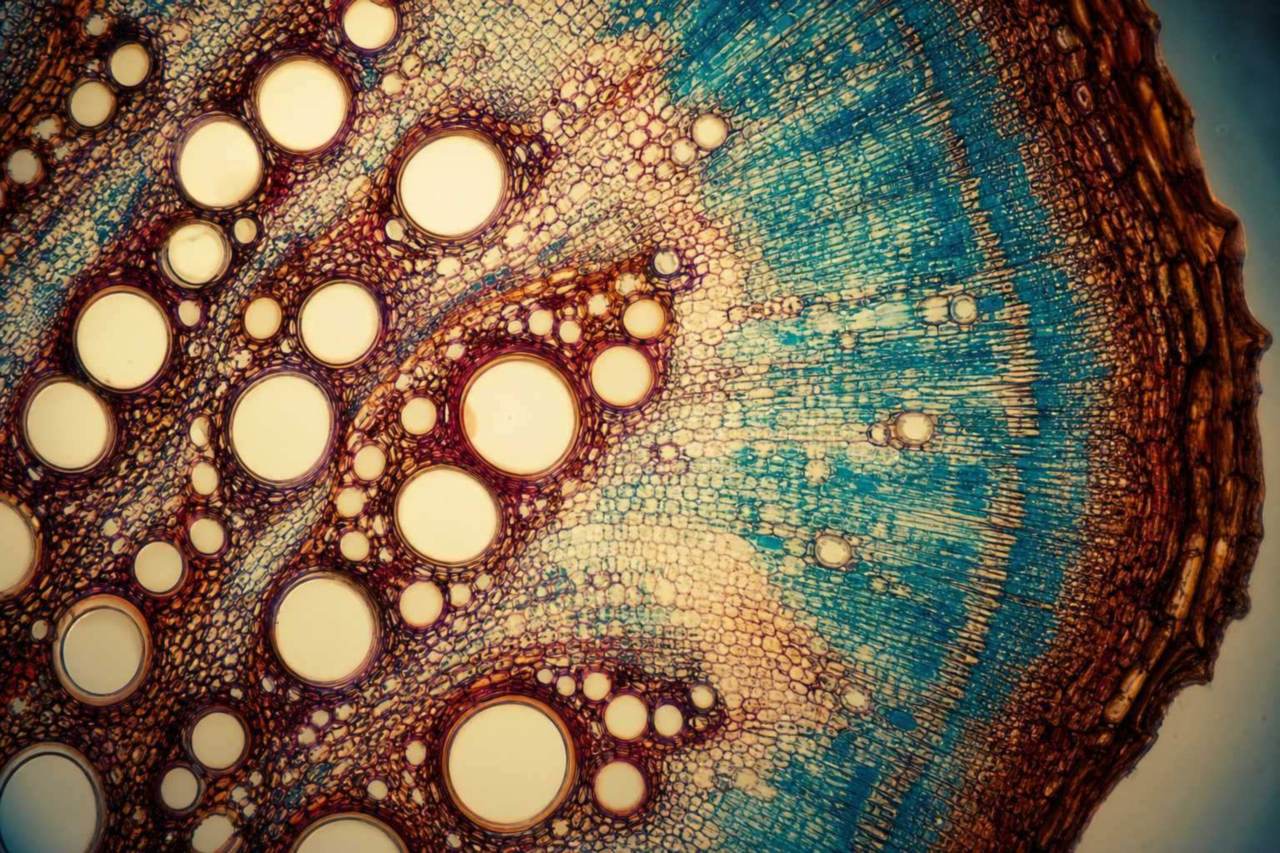
The water travels through wood, in a tissue called xylem. Its pipes are made of cells that die when they mature, leaving hollow tubes with walls stiffened by lignin, the tough substance that makes wood hard.
Stiff walls matter, because the pull would squeeze soft pipes flat, like a straw when you suck too hard. In conifers such as redwoods, the pipes are narrow cells called tracheids, joined through tiny openings called pits.
Watch water climbing from cell to cell. In a tall tree, these threads of water stretch more than a hundred metres, and must stay unbroken.
Wood under a microscope Flowering trees add wide “vessels” made of cells open at both ends; conifers have none. AI-generated still.
tracheids: narrow, linked through pits; the only kind in conifers
vessel elements: wide, joined end to end; not in conifers
Two kinds of xylem pipe
dead
the cells, once mature: only walls remain
> 100 m
a continuous water column in the tallest trees
Inside the pipes
Chapter III · Fragile threads
Xylem
Vessel elements and tracheids lose their living contents at maturity and work as dead, hollow cells with strongly lignified walls; side walls carry pits that connect neighbouring cells. Vessel elements, open at both ends, are absent in conifers, which rely on tracheids alone. Raven Biology (LibreTexts): xylem vessels and tracheids are structurally adapted to cope with large changes in pressure.
The cells in the scene are drawn far larger than real tracheids.
Pull too hard on a water thread, though, and it can snap. A tiny bubble of gas appears, the water springs away from it, and the pipe fills with air and vapour. This is cavitation.
The bubble that blocks the pipe is called an embolism, and that pipe can no longer carry water. The harder the leaves pull, the more likely this becomes, which is one reason very tall trees live close to their limit.
A trunk holds a great many pipes side by side, so losing a few does not stop the flow. Watch a thread break, and the water carry on through the others.
≈ 21 MPa
tension reported to break a water column
> 1.6 MPa
xylem water still unbroken beyond this, in a spinning test
How much pull water can take (LibreTexts)
cavitation: the thread snaps and a bubble forms
embolism: the bubble then blocks that pipe
Two words, one problem
1 pipe
blocked: water keeps flowing in its neighbours
≈ 1.9 MPa
pull estimated for a 113 m tree, see Chapter IV
Plenty of spares
Chapter III · Fragile threads
Cavitation
LibreTexts: gas bubbles can form in the xylem by cavitation, interrupting the continuous stream of water and causing a break termed an embolism; in a centrifuge experiment xylem water avoided cavitation at negative pressures beyond about 1.6 MPa. Raven Biology (LibreTexts) adds that, in flowering trees, small perforations between vessel elements reduce the number and size of gas bubbles; redwoods, as conifers, have no vessel elements.
Every extra metre of height adds to the pull the top leaves need, because the water must be held up against gravity and dragged through narrow pipes.
In 2004, a team led by George Koch climbed the tallest redwoods in California. Near the top, the needles were smaller and more crowded, living in near-constant drought even though the soil below was moist.
From those measurements, they calculated a maximum height for coast redwoods of about one hundred and twenty-two to one hundred and thirty metres. Watch the tree grow, and its top dry out.
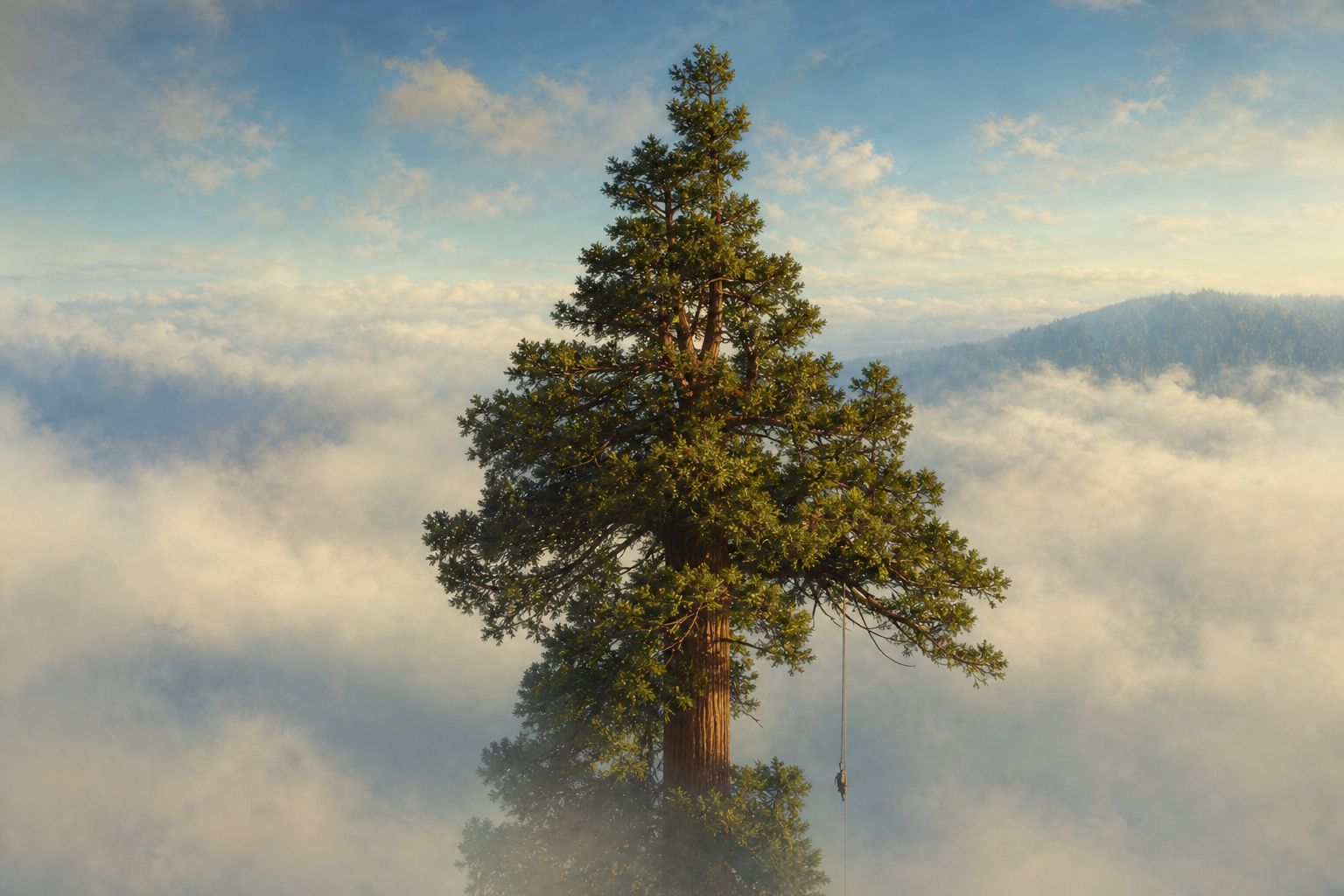
Above the fog Wind damage and lightning can also stop a tree long before the water limit. AI-generated still.Δpgravity=ρgh≈0.01MPa/m
h
height of the water column
Gravity alone; friction in the narrow pipes adds more on top.
112.7 m
tallest tree then measured
122–130 m
predicted maximum
Koch and colleagues, Nature 2004
Chapter IV · The tallest trees
The limits to tree height
Nature News (19 Apr 2004): George Koch of Northern Arizona University, with S. C. Sillett, G. M. Jennings and S. D. Davis, climbed the tallest redwoods in Humboldt Redwoods State Park. Gravity and friction limit how high water can be pulled; leaves at the top live in effectively constant drought and are small and crowded. They calculated a maximum of about 122–130 m for coast redwoods. Koch: “We are not saying they will grow that tall; we are saying they can.”
ρgh with ρ = 1000 kg/m³ and g = 9.8 m/s² gives 0.0098 MPa per metre. The tree in the scene is drawn to its height scale only.
The tallest tree known today is a coast redwood named Hyperion, in Redwood National Park in California. It was found in 2006 and measured at one hundred and sixteen metres in 2019.
That is still below the predicted limit. Lifting water that high takes a pull of about two megapascals, roughly twenty times the push of the atmosphere on a suction pump.
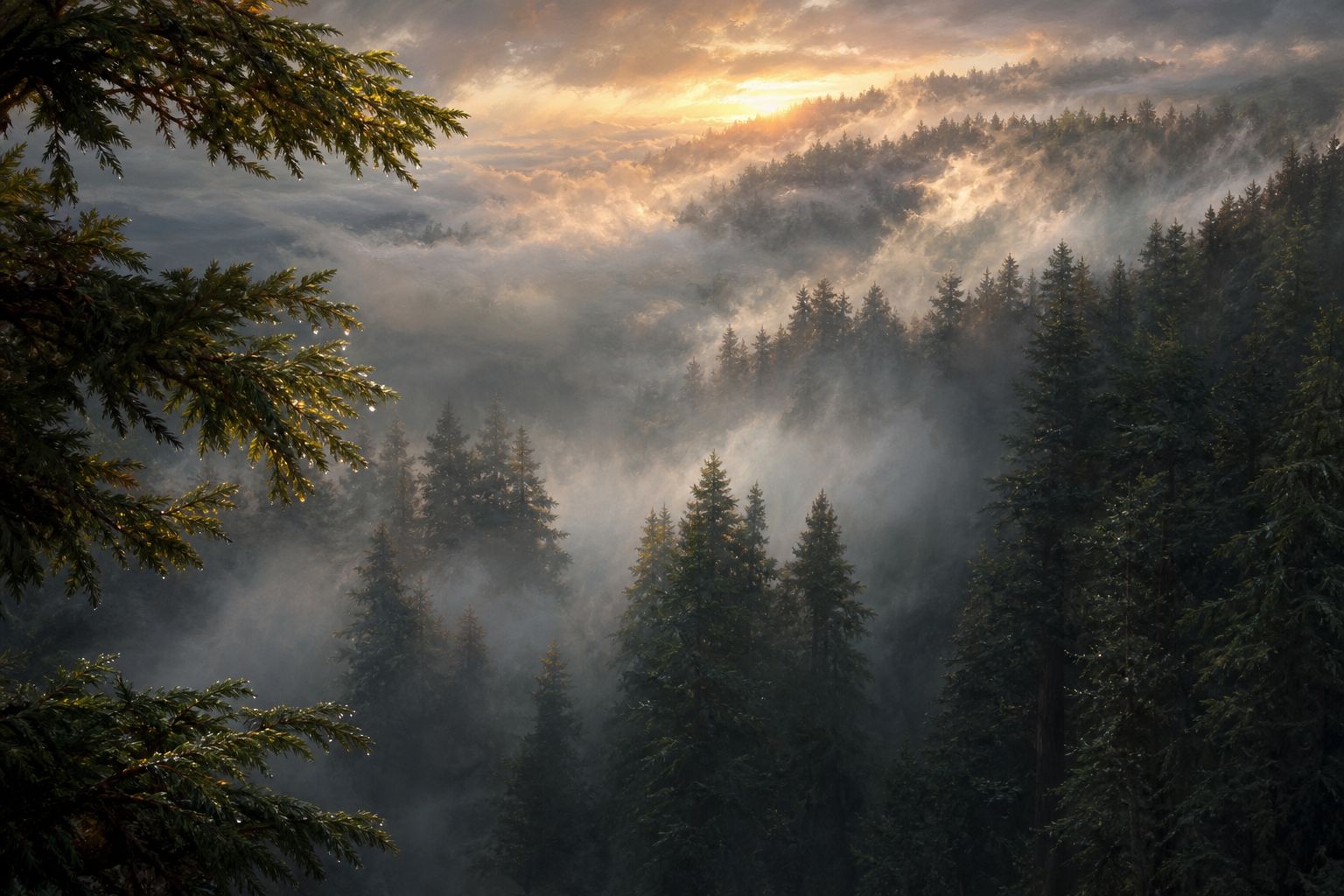
Redwoods have help. Their tops reach into the coastal fog, where they can take up water straight from the air, and the fog keeps the forest cool and shaded.
116.07 m
measured in 2019
25 Aug 2006
found by Chris Atkins and Michael Taylor
Hyperion (Guinness World Records)
atmosphere at sea level
≈ 0.1 MPa
a 113 m redwood (LibreTexts)
≈ 1.9 MPa
Pull needed vs the air’s push
Fog in the canopy Coast redwoods grow only in a narrow coastal strip, from central California to southern Oregon. AI-generated still.
Chapter IV · The tallest trees
Hyperion and fog
Guinness World Records: the tallest living tree is Hyperion, a coast redwood (Sequoia sempervirens) in Redwood National Park, California, measured at 116.07 m in 2019 and discovered on 25 August 2006 by Chris Atkins and Michael Taylor. LibreTexts: a pull of at least about 1.9 MPa is probably needed to lift water to the top of a 113 m tree. Vox: redwood canopies reach into fog layers, where they can absorb water directly from the air, and the fog shades and cools the forest.
1.9 MPa ÷ 0.1 MPa ≈ 19, rounded to “about twenty”. Hyperion’s exact location is kept secret to protect it.
Now back to the news. Todd Dawson of UC Berkeley, who was not part of the study, says coast redwoods are adapted to a narrow band of temperatures, roughly eight to twenty-seven degrees, and that fog has declined by thirty to forty percent.
In the study's heat waves, the young trees in Mendocino County kept their stomata closed to save water. That also kept carbon dioxide out, and without evaporation to cool them, some needles ran up to ten degrees hotter than the air.
In the lab, photosynthesis fell even when branches stood in water with their pores open, so heat itself slows the needles. They recovered after the heat passed, but where lasting harm begins is not yet known.
Needles in harsh sun UC Davis notes that heat also burns off the coastal fog the trees rely on. AI-generated still.
saves water
stops carbon dioxide getting in
loses the cooling from evaporation
Closing the pores: the trade-offMeasuring in the forest Needles were sampled about 5 m up; on trees over 100 m tall, even the lowest branches are hard to reach. AI-generated still.
Chapter IV · The tallest trees
The heat study
Vox: UC Davis researchers led by PhD student Lily Klinek measured leaves twice a month over two years in Mendocino County; in extreme heat the leaves kept their stomata closed, stopping carbon uptake, and regained their capacity after the heat passed. Todd Dawson (UC Berkeley, not involved in the study) puts the trees’ adapted range at about 8–27 °C and says fog has declined 30–40%. Science News: in the lab, photosynthesis still fell in branches kept in water with stomata open. Klinek says the threshold for irreversible damage is unknown.
One study of young trees at one site. The leaf in the scene is schematic; its temperatures follow the study’s reported range.
So a tree is not a pump: the sun pulls water up unbroken threads, from the leaves all the way down to the roots.
But it has limits: threads that can snap, a height where the top goes dry, and pores that must close when water runs short.
Hotter summers and thinner fog press on all of them at once, and no one yet knows how the oldest giants, like Hyperion, will cope.
evaporation at the leaf pulls the water
cohesion keeps the thread whole
stiff, dead xylem cells carry it
Three ideas
1895 Dixon and Joly propose cohesion-tension
2004 height limit of 122–130 m predicted
2006 Hyperion found
2026 first redwood heat study
Milestones
?
the heat at which redwood needles are harmed for good
?
how old giants respond, untested so far
Still unknown
Epilogue
Sources
Every figure in this film comes from the sources below. The 2026 heat findings come from a single first study of young trees, reported in the news; the physics of water transport is standard textbook science.
Stills are AI-generated illustrations, not photographs.
The 3D scenes are schematic: sizes, speeds and molecules are not to scale.