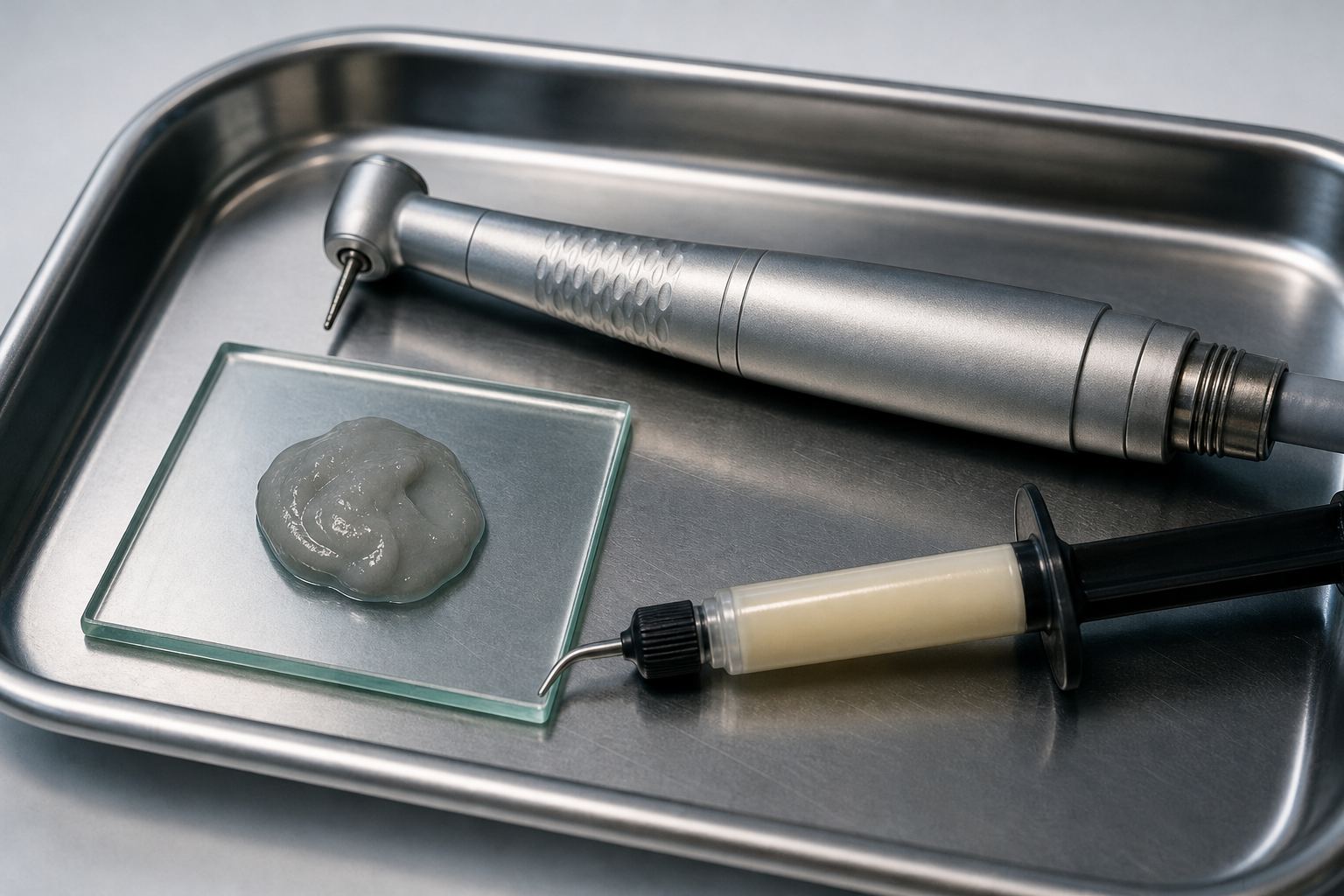
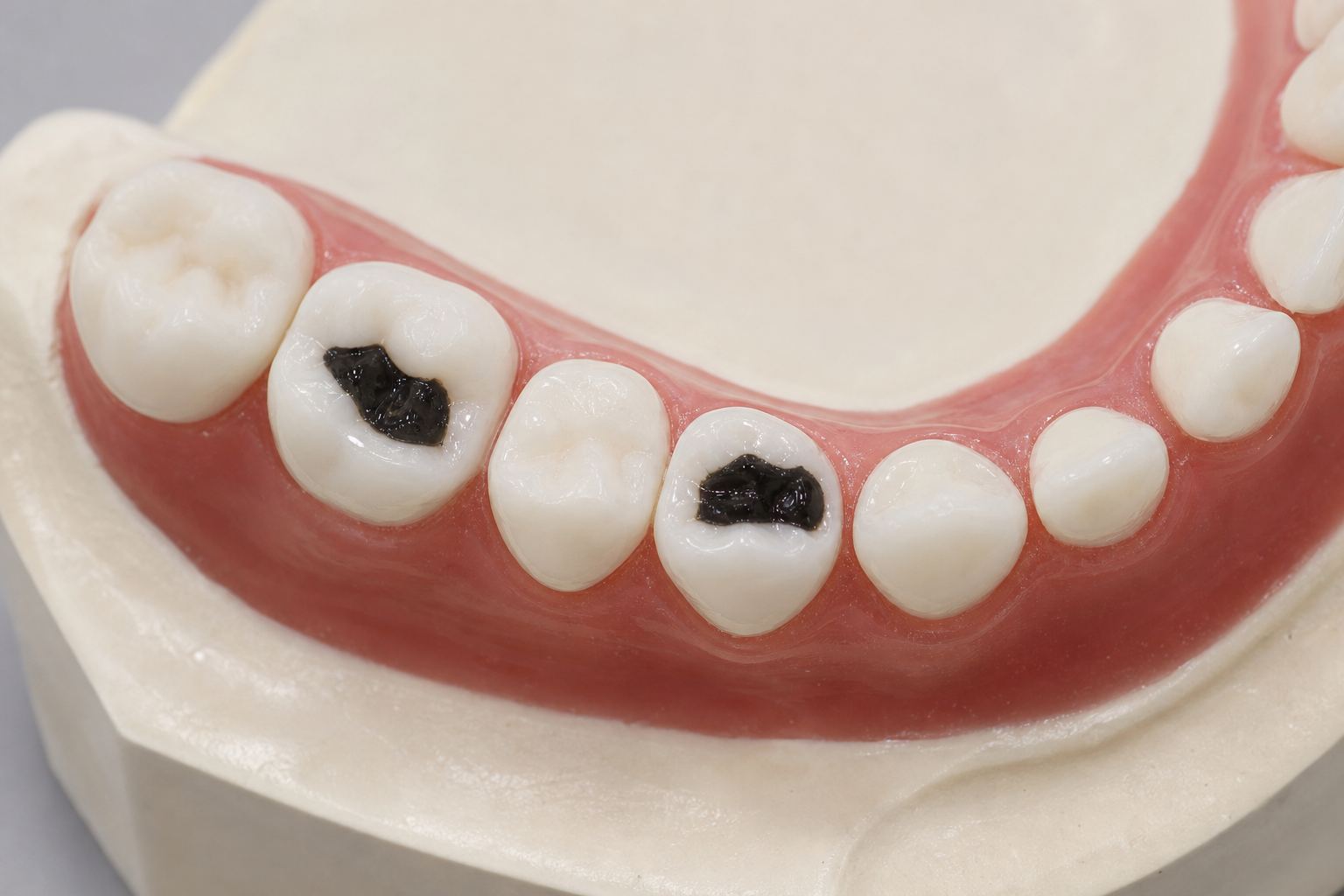
In 2026 a phase III trial of 830 young children, published in JAMA Pediatrics and widely reported in October, found that silver diamine fluoride, a liquid brushed onto cavities without drilling, arrested 54% of treated lesions against 22.5% for a placebo. This film explains the fundamentals behind that result: how a tooth is built from enamel, dentin and pulp; why enamel is almost pure mineral and cannot grow back; how plaque bacteria such as Streptococcus mutans turn sugar into acid; why a pH of about 5.5 is the line where enamel dissolves; how saliva repairs it and why sugar frequency matters; how a white spot becomes a cavity and reaches the nerve; how fluoride makes tougher crystals, from Grand Rapids in 1945 to toothpaste today; and how fillings and silver diamine fluoride stop decay.
Interactive 3D film10 min1890 to 2026Published 27 October 2026
Enamel is the hardest material in the human body. Yet bacteria too small to see can dissolve it, a little at a time, until there is a hole.
In 2026, a trial of 830 children under six tested a liquid called silver diamine fluoride. Painted onto cavities in baby teeth, with no drilling, it stopped more than half of them from growing within six months, far more than a dummy liquid did.
To see why a brush of liquid can do that, we need to know what a cavity really is.
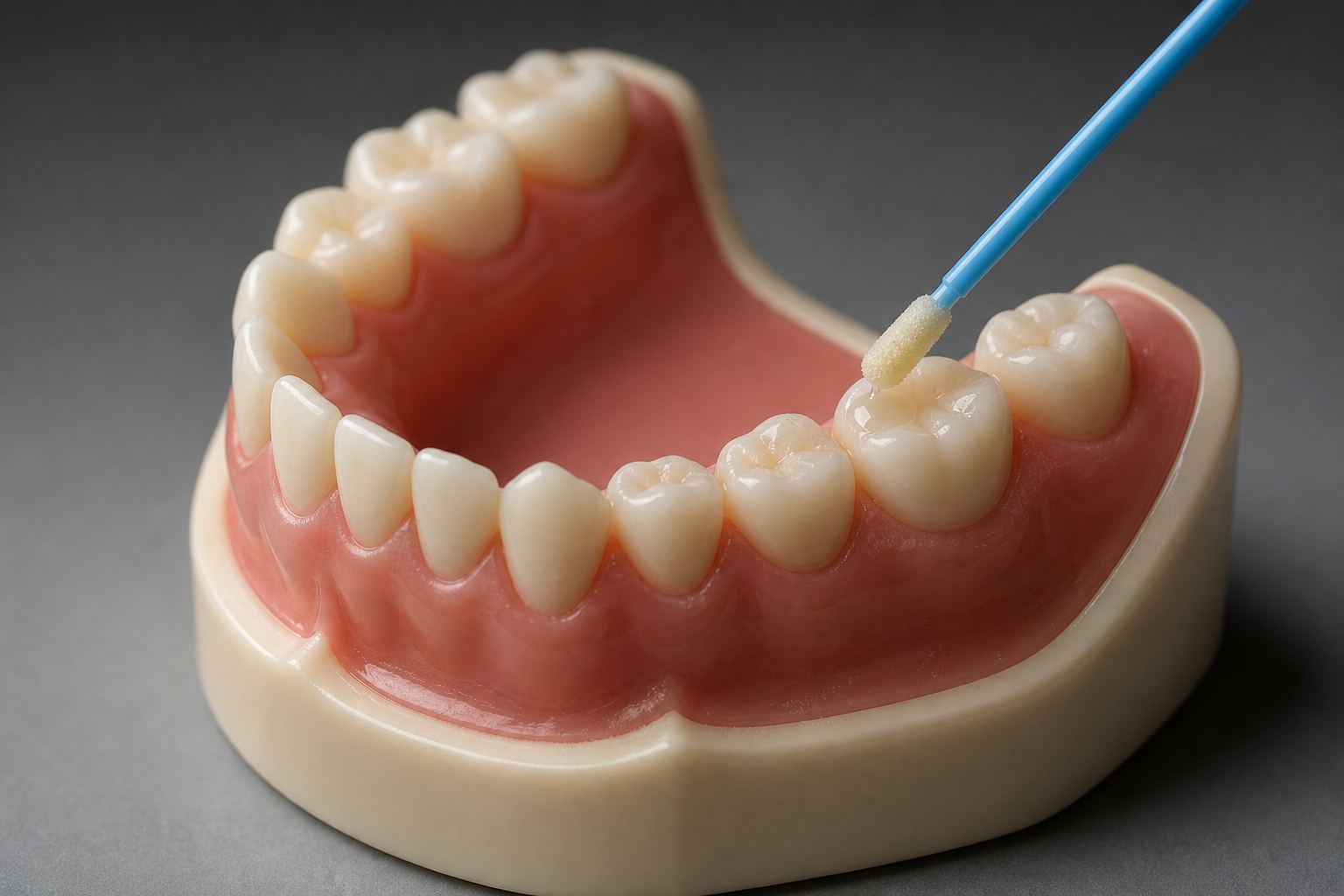
No drill, no needle A thin sponge-tipped brush applies the liquid to a baby tooth on a training model; each tooth takes seconds. AI-generated illustration.
Stopped
the hole stays, but stops growing
6 months
after one application
“Arrested” is not “healed”
830
children aged 1 to 5 with severe decay
3
US states: Michigan, New York, Iowa
Who took part
How a tooth is built
Bacteria, sugar and acid
From white spot to toothache
Fluoride, fillings and a silver liquid
In this film
Prologue
A brush instead of a drill
JAMA Pediatrics (Fontana et al., 2026): a phase III, multisite, randomised, blinded, placebo-controlled trial enrolled 830 children aged 12 to 71 months with severe early childhood caries in Michigan, New York and Iowa. One application of 38% silver diamine fluoride (SDF) arrested 54.0% of active cavitated lesions at six months, against 22.5% with a placebo of deionised water and blue dye; treatment was repeated at six months.
University of Michigan announced the result on 27 July 2026; ScienceDaily reported it again on 25 October 2026. The trial began in 2018 and was funded with more than $12 million by the US National Institute of Dental and Craniofacial Research.
This film is general education, not dental or medical advice. For pain, swelling or a child’s teeth, see a dentist.
The 3D tooth, crystals and pH curve are teaching models, not to scale; colours and shapes are schematic unless a number is given with a source.
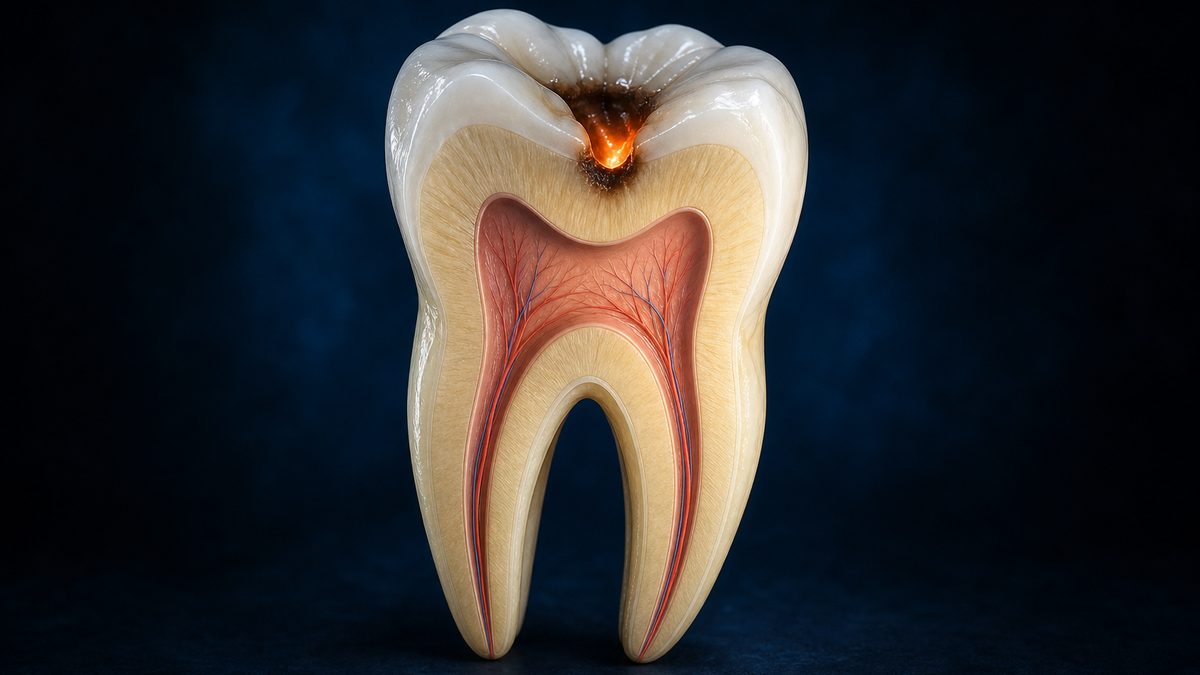
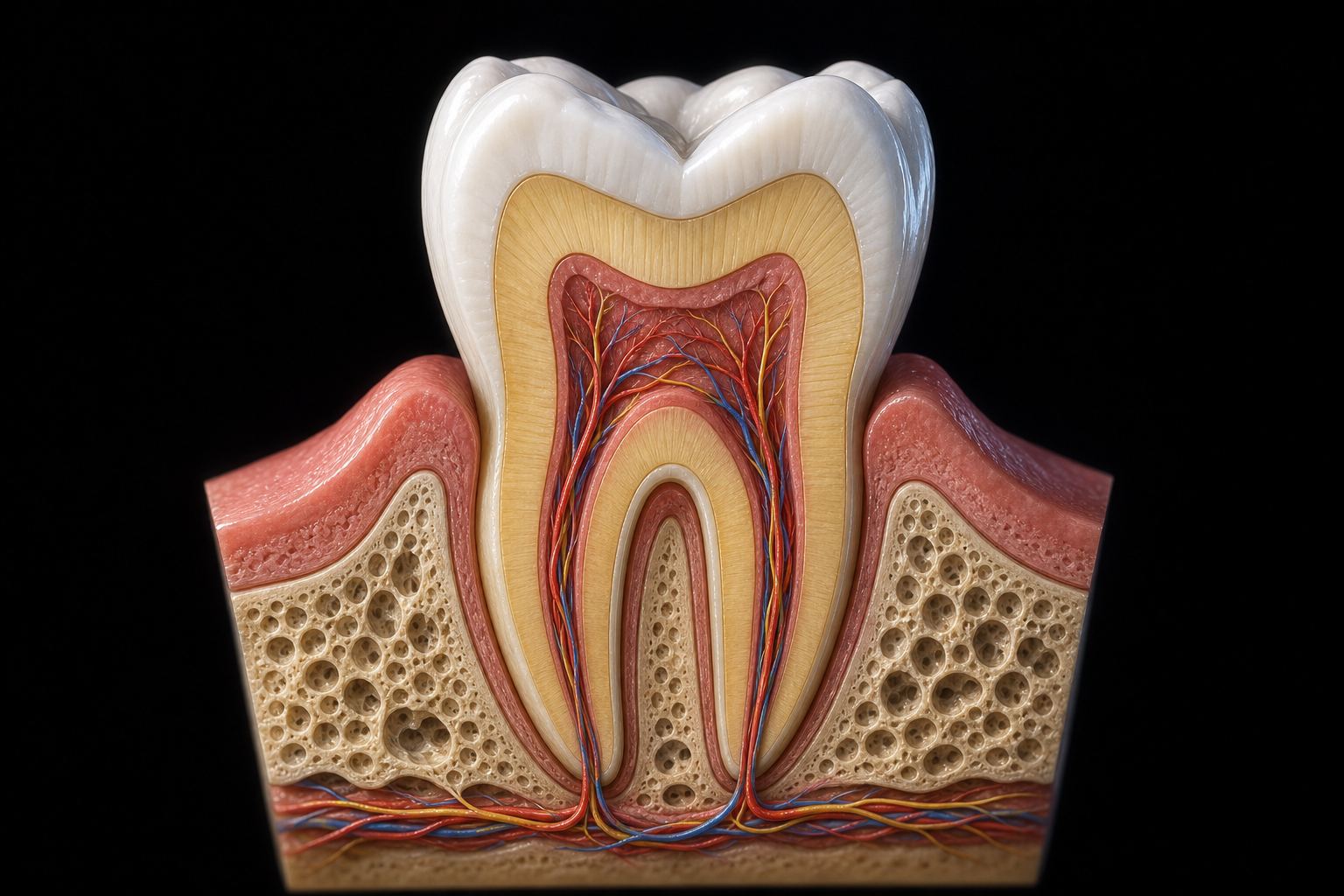
Cut a molar in half and you find three layers. On the outside is enamel, a hard, glassy shell over the crown.
Under it is dentin, softer and yellowish, which makes up most of the tooth.
And in the middle is the pulp: living tissue with nerves and blood vessels, which runs down through the roots into the jaw. This is the part that hurts.
Enamel itself has no nerves, so decay that stays in the enamel usually does not hurt at all.
Enamel: almost pure mineral, no cells
Dentin: mineral with living fibres, full of tiny tubes
Pulp: nerves and blood vessels
Three layers
Enamel
no nerves: early decay is painless
Dentin, pulp
sensitivity, then toothache
Where it hurtsA molar in cross-section Enamel covers only the crown, the part above the gum; the roots below have none. AI-generated illustration.
Chapter I · A tooth up close
Enamel, dentin, pulp
Royal Veterinary College dental anatomy: enamel covers only the exterior of the crown and is the body’s hardest material. Colgate’s guide to cavities: dentin, the layer beneath enamel, is made of microscopic tubules, and the pulp at the centre contains nerves, blood vessels and connective tissue.
Try it: open the tooth to see its layers, or close it again.
The 3D tooth, crystals and pH curve are teaching models, not to scale; colours and shapes are schematic unless a number is given with a source.
Enamel is about 96 percent mineral. Its crystals are hydroxyapatite: calcium and phosphate, with a hydroxide group locked in, packed into long rods.
The cells that built it are gone by the time a tooth comes through the gum. So enamel cannot grow back. It can only lose minerals, or regain them from the mouth.
Ca10(PO4)6(OH)2
Ca
calcium
PO4
phosphate
OH
hydroxide: where fluoride can swap in
Hydroxyapatite The rest of enamel, about 4%, is water and organic material.
0
living cells in erupted enamel
Ameloblasts
the cells that made it, before the tooth erupted
A material that cannot heal itself
Losing minerals: demineralisation
Regaining minerals: remineralisation
Two directions
Chapter I · A tooth up close
Almost pure mineral
Royal Veterinary College: about 96% of enamel is inorganic, mostly hydroxyapatite crystals arranged as hexagonal rods or prisms bound by an organic matrix; the remaining ~4% is water and fibrous organic material. Enamel is produced by ameloblasts inside the tooth bud before eruption, and after eruption it has only a very limited capacity to repair itself.
The hydroxyapatite formula is Ca₁₀(PO₄)₆(OH)₂; StatPearls describes fluorapatite, Ca₁₀(PO₄)₆F₂, forming when fluoride replaces its OH. The crystal model in the scene is schematic: real enamel crystals are far too small to see and are bundled by the thousand into each rod.
The 3D tooth, crystals and pH curve are teaching models, not to scale; colours and shapes are schematic unless a number is given with a source.
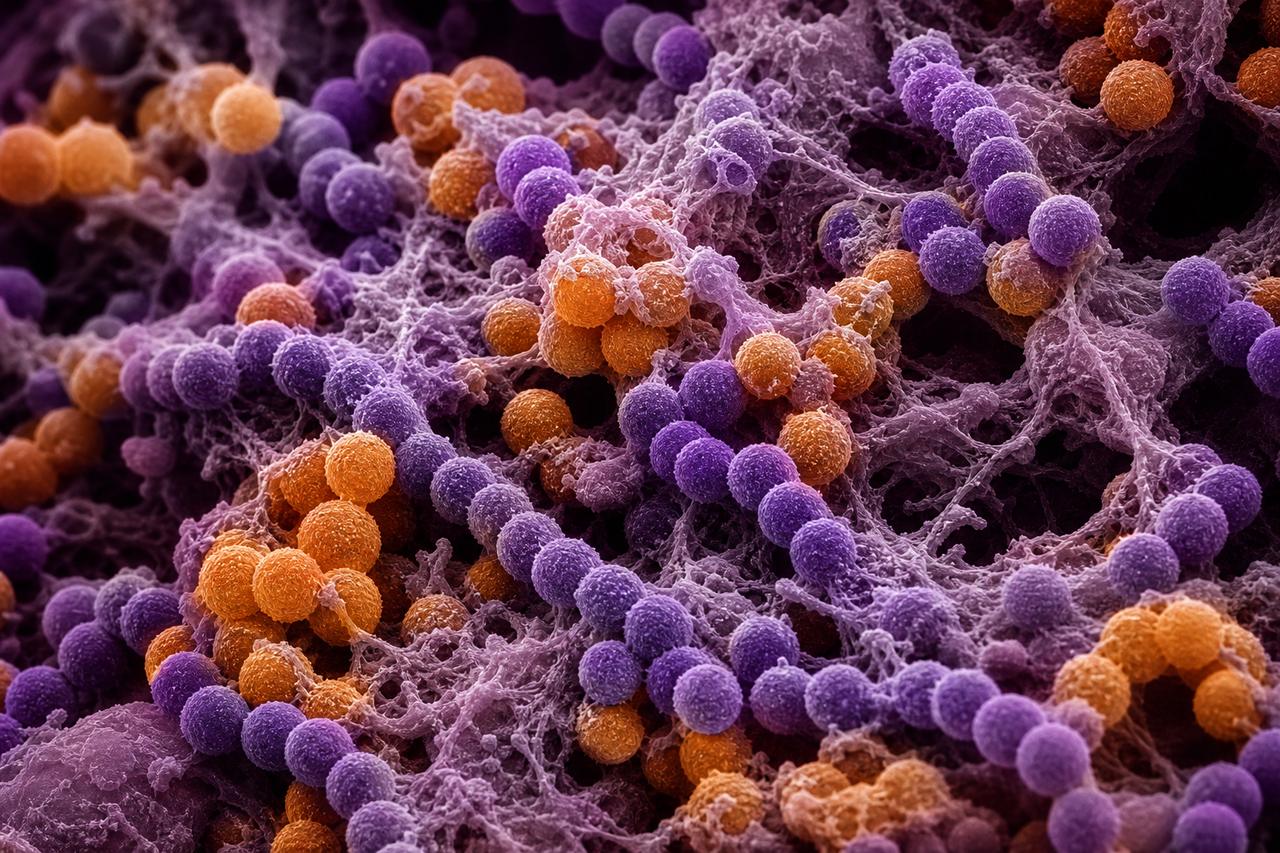
Teeth are never clean for long. A sticky film keeps growing on them: plaque, a biofilm, a crowded community of bacteria glued to the surface.
One of its best-known members is Streptococcus mutans, first described in 1924. It turns table sugar into a sticky glue that helps it cling to the tooth.
And it ferments sugars into lactic acid, while thriving in the acid it makes. Feed the film some sugar and watch.
These bacteria are usually picked up early in life, most often from a mother, for example when she tastes from the baby's bottle first.
Plaque under the microscope Chains of round bacteria held together by the sticky matrix they secrete. AI-generated illustration.
Sucrose → sticky glucans: anchors the film
Sugars → lactic acid
Tolerates acid, so it takes over acidic plaque
Often passed from parent to child
Streptococcus mutansC6H12O6→2CH3CH(OH)COOH
C6H12O6
glucose, from sugars in food
CH3CH(OH)COOH
lactic acid
Fermentation, in short
Carers
mostly the mother; usually after the first teeth erupt
Where it comes from
Chapter II · The sticky film
A biofilm that eats sugar
Wikipedia, Streptococcus mutans: first described by J. Kilian Clarke in 1924. It uses glucosyltransferase enzymes to turn sucrose into sticky, dextran-like polysaccharides that help it attach and form plaque; sucrose is the only sugar it can use for this. It also ferments glucose, fructose and lactose to lactic acid, and it tolerates acid well, which lets it dominate acidic plaque. It is usually acquired after teeth erupt, most often from the mother, for example when she tastes from the baby’s bottle or cleans a dummy in her own mouth.
S. mutans is one of many acid-making species in plaque; it is the best known, not the only one. Try it: drop sugar on the plaque and watch acid form. The bacteria and particles are schematic.
The 3D tooth, crystals and pH curve are teaching models, not to scale; colours and shapes are schematic unless a number is given with a source.
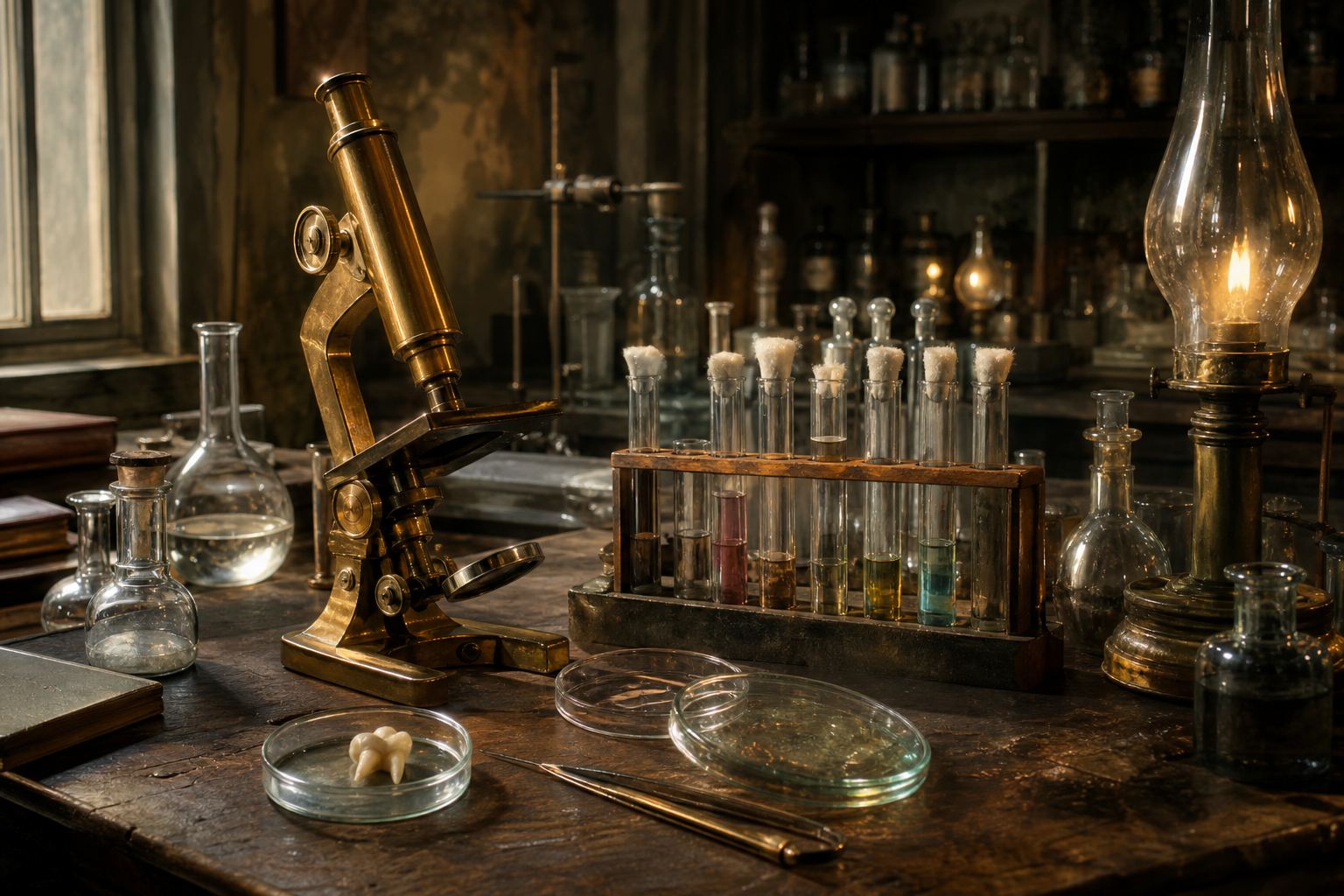
This idea is old. In 1890, Willoughby Miller, an American dentist working in Robert Koch's laboratory in Berlin, proposed that cavities are made by acid from mouth bacteria fermenting sugars.
It is still the core of the modern picture: bacteria, sugar and a tooth surface, given time. Take away any one, and decay stalls.
A bacteriology bench of the 1890s Glassware, a microscope and an extracted tooth: the tools of early mouth microbiology. AI-generated illustration.
1890
the “chemo-parasitic” theory: bacteria + sugar → acid
Miller’s idea
Acid-making bacteria
Sugars to ferment
A tooth surface
Time
Four things decay needs
Chapter II · The sticky film
Miller’s acid theory
Wikipedia, Willoughby D. Miller: working in the microbiological laboratory of Robert Koch in Berlin, Miller formulated the chemo-parasitic theory of caries in 1890, which holds that caries is caused by acids produced by oral bacteria when they ferment sugars.
The WHO fact sheet describes the same process today: caries develops when plaque on the tooth converts sugars into acids that destroy the tooth over time. The four-part list is a common teaching summary, not a formal definition.
The 3D tooth, crystals and pH curve are teaching models, not to scale; colours and shapes are schematic unless a number is given with a source.
Acid is measured by pH. Seven is neutral; every step down means ten times more acid. A resting mouth sits near neutral.
Eat something sugary and the bacteria get to work. The pH in the plaque drops. Below about 5.5, enamel crystals start to dissolve, releasing calcium and phosphate.
Dentin is weaker: it starts to dissolve at a milder acidity, around 6.2. Then saliva washes the acid away and buffers it, and the pH slowly climbs back. This dip is called the Stephan curve.
Acidic drinks, such as fruit juice and diet soft drinks, can lower the pH on their own, even without sugar.
7
neutral
×10
more acid for each step down
The pH scale
≈ 5.5
enamel
≈ 6.2
dentin
Critical pH: where minerals start to dissolve
Washes away sugar and acid
Buffers acid back toward neutral
Carries calcium and phosphate to rebuild enamel
Flows less during sleep
What saliva does
Fruit juice
Diet soft drinks
Acid without sugar
Chapter III · The acid attack
Below the critical line
Dental Health Services Victoria: when the pH drops below the critical threshold of 5.5, enamel begins to demineralise; once it rises above 5.5 again, remineralisation can begin. Dentalcare.com: the critical pH is about 5.5 for enamel and 6.2 for dentin.
The Stephan curve plots plaque pH over time after eating or drinking; pH gradually returns to normal as acid is cleared by saliva or buffered (Dentalcare.com). Saliva flow drops during sleep, which is why decay risk is higher at night (DHSV). The curve in the scene is schematic: its depth and timing differ from person to person and food to food.
Try it: take a sip of something sugary and watch the curve.
The 3D tooth, crystals and pH curve are teaching models, not to scale; colours and shapes are schematic unless a number is given with a source.
Above the line, the process runs in reverse. Saliva is loaded with calcium and phosphate, and it pushes minerals back into the weakened enamel.
So decay is a tug of war, lost and won many times a day. What tips it is not only how much sugar, but how often.
Compare three meals with sipping a sweet drink all day. Each sip starts a new dip, and the tooth never gets the time to rebuild.
Saliva also slows down during sleep, which is why a sweet drink at bedtime is especially hard on teeth.
Demineralisation: acid pulls minerals out
Remineralisation: saliva puts them back
Decay wins when losses outrun repairs
The tug of war
3 dips
three meals
14 dips
sipping all day, in the scene
Every dip countsFree sugars WHO’s “free sugars”: sugar added to food and drink, plus the sugar in honey, syrups and fruit juice. AI-generated illustration.
Less saliva
slower clearing of acid during sleep
Water only
for children after brushing at night (DHSV)
At night
Chapter III · The acid attack
How often, not just how much
Dental Health Services Victoria: saliva supplies minerals for remineralisation and buffers acids; in a healthy mouth remineralisation generally balances demineralisation. Frequent snacking or sipping sugary drinks prolongs acid exposure and keeps the mouth in a demineralising state, while spacing out fermentable carbohydrates gives the mouth time to recover.
WHO: continued high intake of free sugars is a major driver of caries; free sugars are sugars added to foods and drinks plus those naturally present in honey, syrups and fruit juices. Try it: compare three meals with all-day sipping. Both curves are schematic.
The 3D tooth, crystals and pH curve are teaching models, not to scale; colours and shapes are schematic unless a number is given with a source.
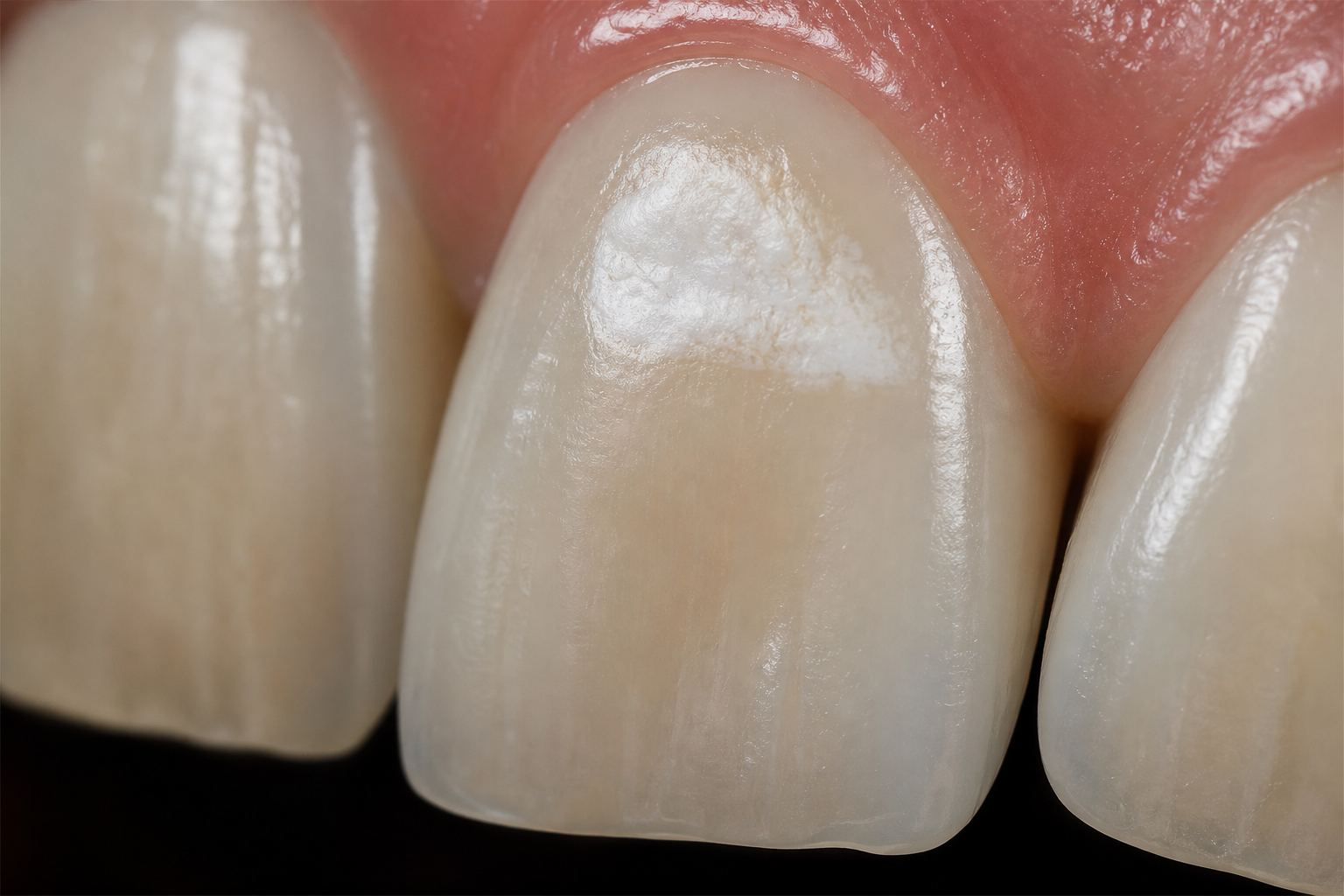
When losses win for weeks and months, minerals leave from just under the surface. The enamel turns chalky: a white spot.
At this stage the surface is still whole, and with less sugar, saliva and fluoride, a white spot can harden again.
But once the weakened surface caves in, there is a hole. Now plaque sits inside it, out of reach of a brush, and decay speeds up.
A white spot Chalky, opaque enamel near the gum: mineral lost from beneath an intact surface. AI-generated illustration.
Saliva
brings calcium and phosphate
Fluoride
speeds the rebuilding
A white spot can harden again
1 White spot: reversible
2 Enamel breaks: a cavity
3 Dentin: sensitivity
4 Pulp: toothache, infection
5 Abscess at the root
Stages of decay
Chapter IV · From spot to hole
White spot, then a cavity
Colgate: in the first stage, acid draws calcium and phosphate out of the enamel, leaving chalky white spots; continued erosion lets decay break through the surface and a true cavity forms, often without symptoms. Dentalcare.com: caries begins as a subsurface process. DHSV: in a healthy mouth remineralisation generally balances demineralisation, and fluoride drives remineralisation after an acid attack.
Try it: push the lesion deeper, or let it heal while it is still a white spot.
This film is general education, not dental or medical advice. For pain, swelling or a child’s teeth, see a dentist.
The 3D tooth, crystals and pH curve are teaching models, not to scale; colours and shapes are schematic unless a number is given with a source.
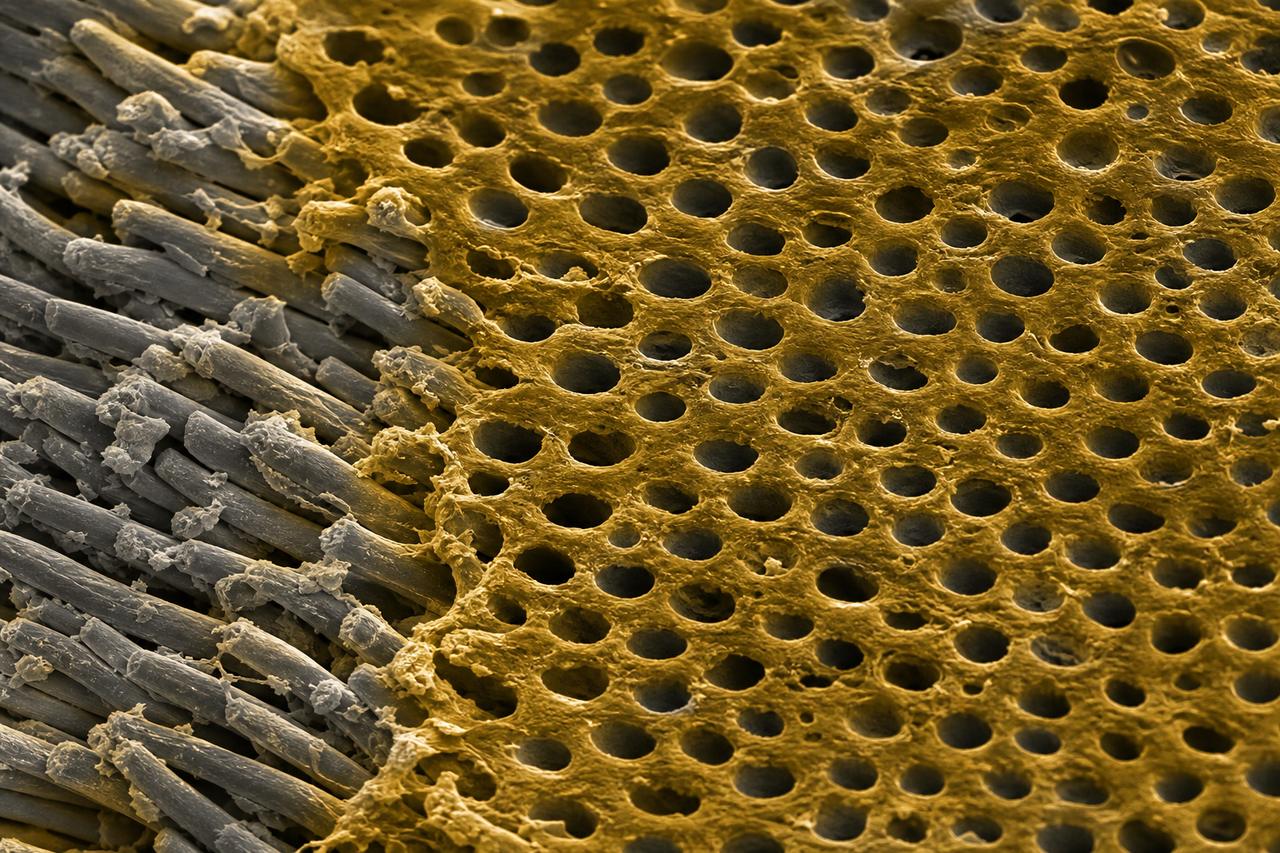
Dentin is threaded with thousands of microscopic tubes that lead toward the pulp. When decay reaches it, cold, heat and sweets start to sting.
Dentin is softer and dissolves more easily, so the decay spreads out beneath the enamel, often bigger inside than the hole looks.
When bacteria reach the pulp, it becomes inflamed and infected: real toothache. Infection can then collect as an abscess at the root, and can spread.
pH 6.2
dentin starts to dissolve (enamel: 5.5)
Why decay spreads in dentinDentin, magnified The round openings are dentinal tubules: channels through which stimuli reach the nerve. AI-generated illustration.
Pain when biting, or with sweet, hot or cold
Toothache that lingers
Swelling of the face or gum, fever
Signs a dentist should see
Chapter IV · From spot to hole
Dentin, pulp, abscess
Colgate: if untreated, acid and bacteria move into dentin, which is made of microscopic tubules that let hot, cold, acidic and sticky foods reach the nerves; decay that continues reaches the pulp, and infection can form an abscess beneath the root, with facial swelling, pain and fever, and may spread to the bone. Pain usually appears once decay reaches dentin or pulp. Dentalcare.com: the critical pH of dentin is about 6.2.
The wider spread under the enamel is a general teaching description; real lesions vary in shape.
This film is general education, not dental or medical advice. For pain, swelling or a child’s teeth, see a dentist.
The 3D tooth, crystals and pH curve are teaching models, not to scale; colours and shapes are schematic unless a number is given with a source.
Fluoride works in the crystals themselves. When enamel rebuilds with fluoride around, a fluoride ion can take the place of the hydroxide.
The result, fluorapatite, is much harder for acid to dissolve. Fluoride also helps minerals return faster, and it slows the bacteria's acid-making.
It works mostly at the tooth's surface, which is why a little, often, from toothpaste matters most.
WHO recommends brushing twice a day with a toothpaste that contains 1,000 to 1,500 parts per million of fluoride.
Ca10(PO4)6(OH)2↓F−Ca10(PO4)6F2Fluorapatite The swap happens as the surface remineralises; the crystal’s calcium and phosphate stay.
Less dissolving in acid
Faster rebuilding
Slows bacterial acid-making
Fluoride’s three jobs
1,000–1,500 ppm
fluoride, brushing twice a day; 1,500 ppm is not advised under age 6 (StatPearls)
Toothpaste (WHO)
Chapter V · Fluoride
A tougher crystal
StatPearls: fluoride acts topically in three ways: it inhibits demineralisation, promotes remineralisation and inhibits plaque bacteria; systemic supplements have minimal caries-protective effect. Fluorapatite, Ca₁₀(PO₄)₆F₂, forms when fluoride replaces the OH ion in hydroxyapatite and is much more resistant to acid dissolution. Fluoride attracts calcium onto partly dissolved crystals, forming a less soluble surface. At low pH fluoride enters bacteria as HF, acidifies their interior and inhibits the enzyme enolase.
WHO recommends brushing twice daily with toothpaste containing 1,000 to 1,500 ppm fluoride. StatPearls notes that 1,500 ppm is not advised under age six because children swallow toothpaste. Try it: switch the crystal between hydroxyapatite and fluorapatite and watch how it stands up to acid (schematic).
This film is general education, not dental or medical advice. For pain, swelling or a child’s teeth, see a dentist.
The 3D tooth, crystals and pH curve are teaching models, not to scale; colours and shapes are schematic unless a number is given with a source.
By the 1940s, researchers had noticed that people whose water naturally contained more fluoride had fewer cavities.
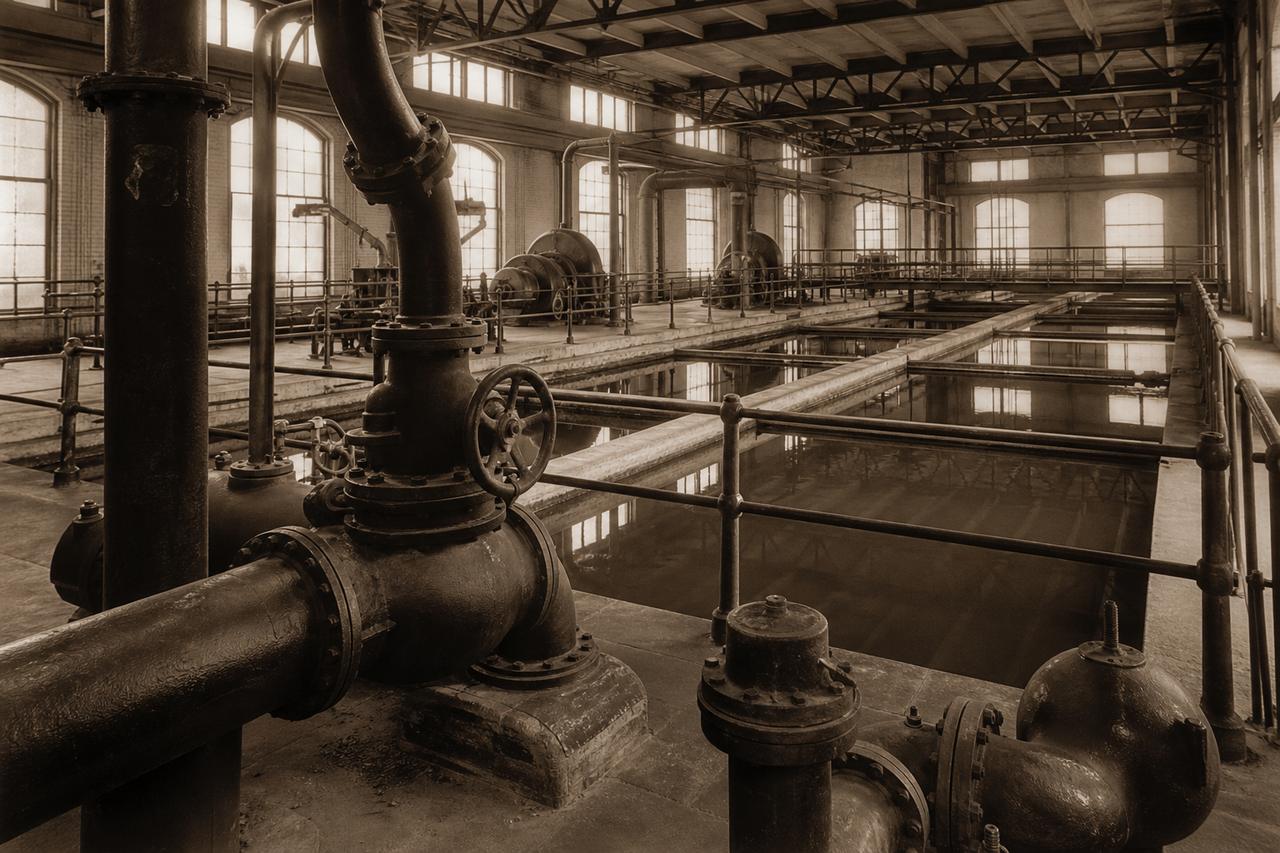
In 1945, Grand Rapids in Michigan became the first city to add fluoride to its water. Over about ten years, decay among its schoolchildren fell by more than 60 percent.
The US Public Health Service began recommending fluoride in drinking water in 1962, and the CDC later called it one of the great public health achievements of the twentieth century.
Today the recommended US level is 0.7 milligrams per litre. Fluoride toothpaste, used around the world, puts it right on the tooth.
A city waterworks, 1940s Grand Rapids’ study followed nearly 30,000 schoolchildren. AI-generated illustration.
>60%
less tooth decay in children
1945
first city to fluoridate its water
Grand Rapids, after about 10 years
1940s Natural fluoride linked to fewer cavities
1945 Grand Rapids adds fluoride
~1955 Children’s decay down by more than 60%
1962 US Public Health Service recommends it
Fluoride in the water
0.7 mg/L
recommended level
~63%
of people on fluoridated water
United States today (NIDCR)
Chapter V · Fluoride
A city experiment
NIDCR: in the 1940s it became clear that people whose water naturally contained more fluoride had fewer cavities. In 1945 Grand Rapids, Michigan, became the first city to add fluoride to its public water; after about ten years, tooth decay among its children had dropped by more than 60%, in a study of nearly 30,000 schoolchildren. In 1962 the US Public Health Service began recommending fluoride in drinking water; about 63% of the US population now receives fluoridated water, at 0.7 mg/L. The CDC named water fluoridation one of the ten great public health achievements of the 20th century.
NIDCR also notes a 2024 US National Toxicology Program report that found a possible link between routinely drinking water above 1.5 mg/L and lower IQ in children; it did not study US children and does not claim that 0.7 mg/L affects IQ. Policies on water fluoridation differ between countries and are debated; this film does not take a side on them.
Untreated decay in permanent teeth is the most common health condition on Earth, according to the Global Burden of Disease study.
WHO estimates that about 3.7 billion people have oral diseases, and that around 514 million children have untreated decay in their baby teeth.
In Thailand's 2017 national survey, more than half of three-year-olds already had decay. That is why a quick, cheap treatment for small children draws so much attention.
WHO names a diet high in free sugars, and too little fluoride, among the main drivers.
#1
untreated decay of permanent teeth, among all health conditions
~3.7 bn
people with oral diseases
Global burden (WHO)
~514 m
with untreated decay in baby teeth
Children (WHO report, 2022)
3-year-olds
52.9%
5-year-olds
75.6%
Thailand, 8th national oral health survey (2017)
High intake of free sugars
Too little fluoride
Limited access to dental care
Main drivers (WHO)
Chapter VI · A world of cavities
Common, costly, preventable
WHO fact sheet (2025): about 3.7 billion people are affected by oral diseases, and untreated caries in permanent teeth is the most common health condition according to the Global Burden of Disease 2021. WHO’s Global Oral Health Status Report (2022), as summarised by the Oral Health Foundation: around 514 million children have untreated decay in primary teeth. WHO news release (18 Nov 2022): untreated dental caries is the most common condition globally, affecting an estimated 2.5 billion people.
Frontiers in Public Health (2021), citing Thailand’s 8th National Oral Health Survey (2017): caries prevalence was 52.9% in 3-year-olds (mean 2.8 decayed, missing or filled teeth) and 75.6% in 5-year-olds (mean 4.5). Later surveys may differ.
A cavity cannot grow back, so the usual repair is a filling. The dentist drills away the decayed part and seals the hole with a hard material.
Silver diamine fluoride takes another route. Its silver kills bacteria and blocks enzymes that break down dentin, and its fluoride helps the lesion harden.
The decay is arrested, not removed. The price is cosmetic: the treated spot turns permanently black.
It takes seconds per tooth, with no injection and no sedation, which matters a great deal for very young children.
The usual repair Conventional treatment removes part of the tooth, often with an injection of local anaesthetic, before the filling goes in. AI-generated illustration.
Silver: antibacterial
Fluoride: remineralisation
Ammonia: keeps the solution stable
Inside 38% SDF
Stays
the decayed tissue, now hardened
Black
the treated spot, permanently
The trade-off
Seconds
per tooth, with a tiny brush
0
injections, drilling or sedation
For a small child
Chapter VII · Stopping decay
Drill and fill, or paint and arrest
American Dental Association: SDF is a liquid of silver, fluoride and ammonia. Silver acts as an antimicrobial, fluoride supports remineralisation, ammonia stabilises the solution, and SDF also inhibits enzymes that break down exposed dentin. It arrests or slows caries without removing sound tooth tissue. Its main adverse effect is a striking dark stain of the treated lesion; mature sound enamel is not stained. Single applications are not enough, so it is reapplied.
Try it: compare a filling with SDF on the same lesion (schematic).
This film is general education, not dental or medical advice. For pain, swelling or a child’s teeth, see a dentist.
The 3D tooth, crystals and pH curve are teaching models, not to scale; colours and shapes are schematic unless a number is given with a source.
Dentists have used it on cavities for years, but in the United States only off-label, meaning for a use the regulator had not approved: it was cleared as a treatment for sensitive teeth.
The 2026 trial was designed to settle the question. In a blinded trial, children were randomly given either the real liquid or a placebo of dyed water.
Fifty-four percent against twenty-two and a half. Its authors say the data could support an application to the US regulator, the FDA, to approve it for arresting cavities in young children.
Note what was measured: whether the decay stopped, not how the teeth looked. The arrested spots stay dark.
Cleared
as a device for tooth sensitivity
Off-label
for arresting cavities
US status before the trial (ADA)
830 children aged 1 to 5, with severe decay
Randomised: SDF or placebo
Blinded and placebo-controlled
Applied at the start and at six months
How the trial was run
SDF
54.0%
Placebo
22.5%
Difference
31.5 pts
Lesions arrested at six months
Arrested, and stained Silver compounds stain the decayed area; healthy, sound enamel is not stained. AI-generated illustration.
Chapter VII · Stopping decay
Evidence for a cheap fix
American Dental Association: the FDA classified SDF as a Class II medical device cleared for treating tooth sensitivity; using it to arrest caries is off-label. ADA and American Academy of Pediatric Dentistry guidelines already recommended it for some lesions. University of Michigan: SDF has been used off-label in the US since 2014, and the trial gives the manufacturer the data needed for a caries drug application; co-investigator Amr Moursi (NYU) said the results support FDA approval.
JAMA Pediatrics: risk difference 31.5 percentage points (99.9% CI 21.5–41.6), P < .001, in children aged 12 to 71 months. The trial measured whether lesions stopped progressing, not whether teeth looked normal: arrested lesions stay dark. As of this film, no FDA decision on a caries indication had been reported.
This film is general education, not dental or medical advice. For pain, swelling or a child’s teeth, see a dentist.
Bacteria, sugar, acid and time make a cavity. Saliva, fluoride and fewer sugary snacks push back.
A filling replaces what was lost. A brush of silver liquid can stop decay where it sits.
Neither grows enamel back. That is the one thing a tooth cannot do, which is why the battle is won best before the hole.
For millions of small children, the question now is whether a dark stain is a fair price for no drill at all.
1890 Miller: acid from mouth bacteria
1924 Streptococcus mutans described
1945 Grand Rapids fluoridates its water
1962 US recommends water fluoridation
2014 FDA clears SDF for sensitivity; off-label use on cavities begins
2026 Trial: 54% of cavities arrested
Understanding tooth decay
Stills are AI-generated
3D tooth, crystals and curves are schematic
Education, not dental advice
About this film
A diet low in free sugars
Brushing twice a day with fluoride toothpaste
Access to dental care
What WHO recommends
No drill
seconds per tooth
Black spot
for as long as the tooth lasts
The choice ahead
Epilogue · Sources
Sources
Every fact in this film comes from the sources below. The chapter stills and pictures are AI-generated illustrations. The 3D tooth, the crystal models and the pH curves are schematic teaching models, not to scale. This film is general education, not dental or medical advice: for pain, swelling, or questions about a child’s teeth, see a dentist.