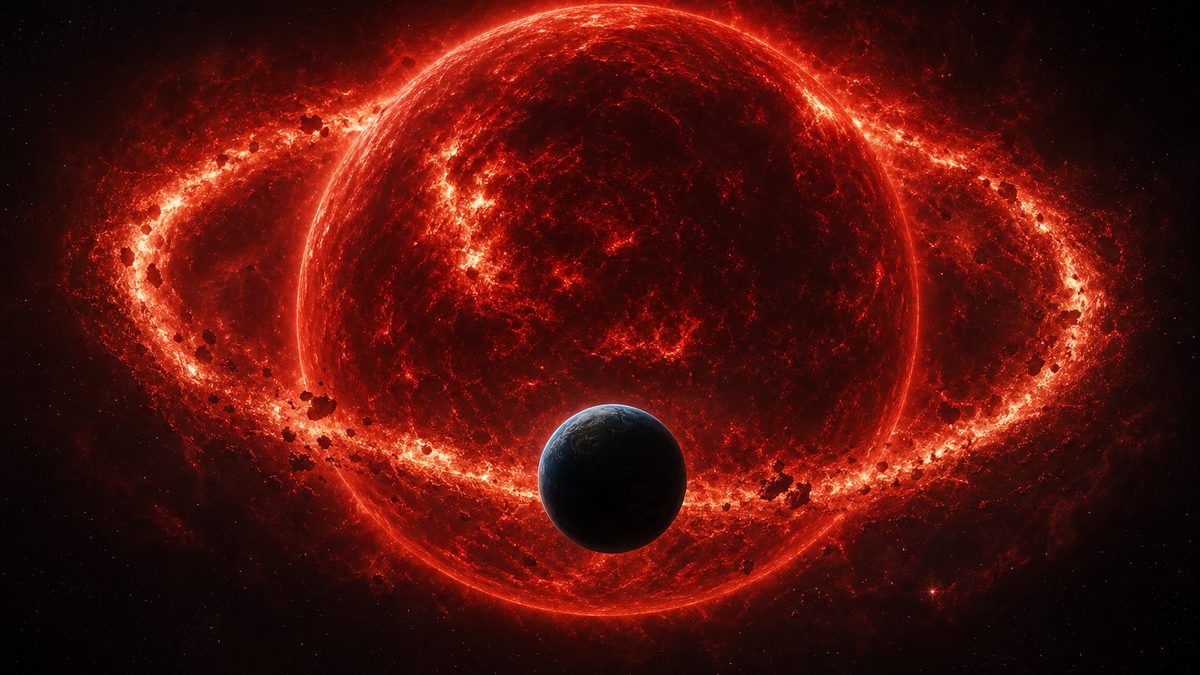
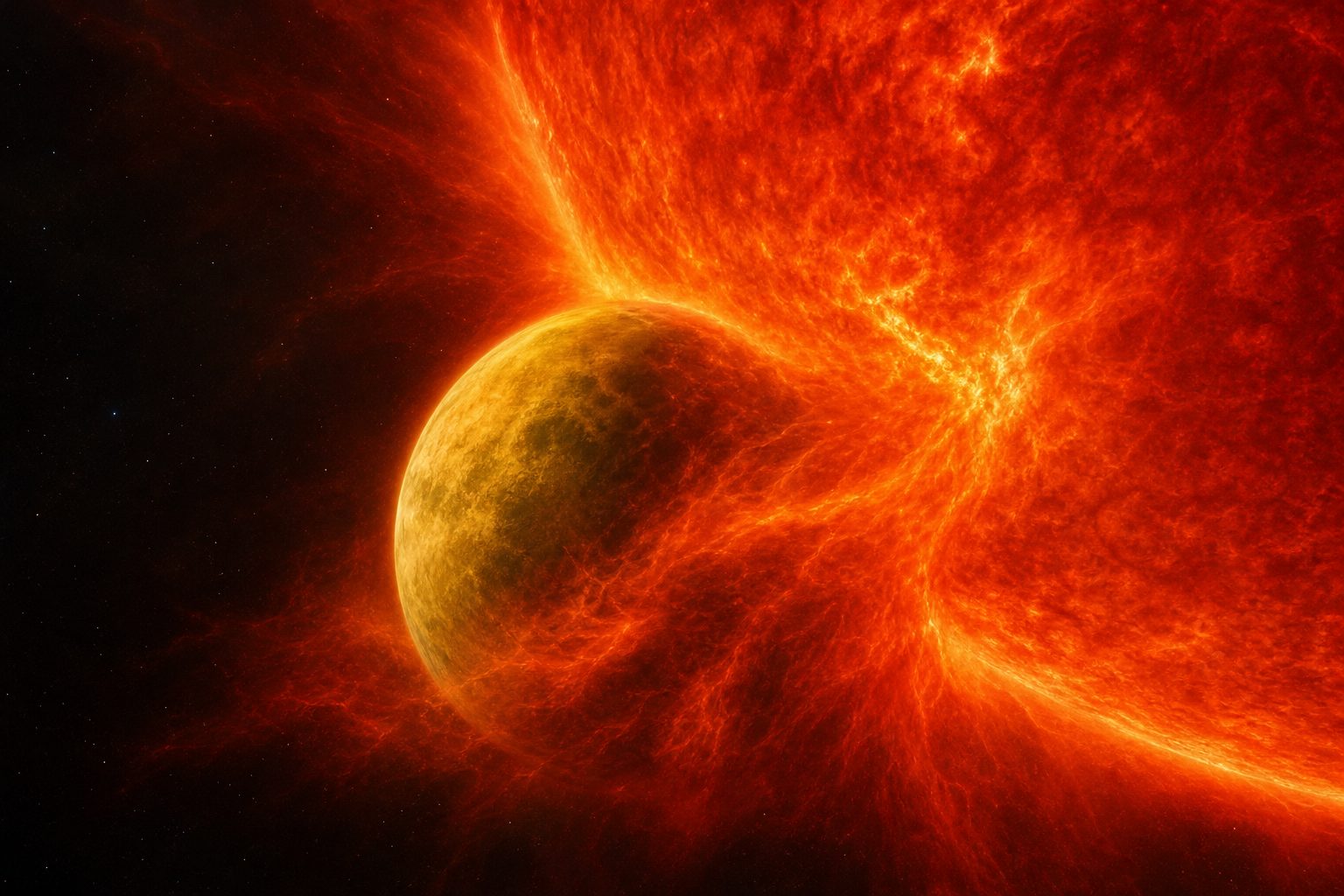
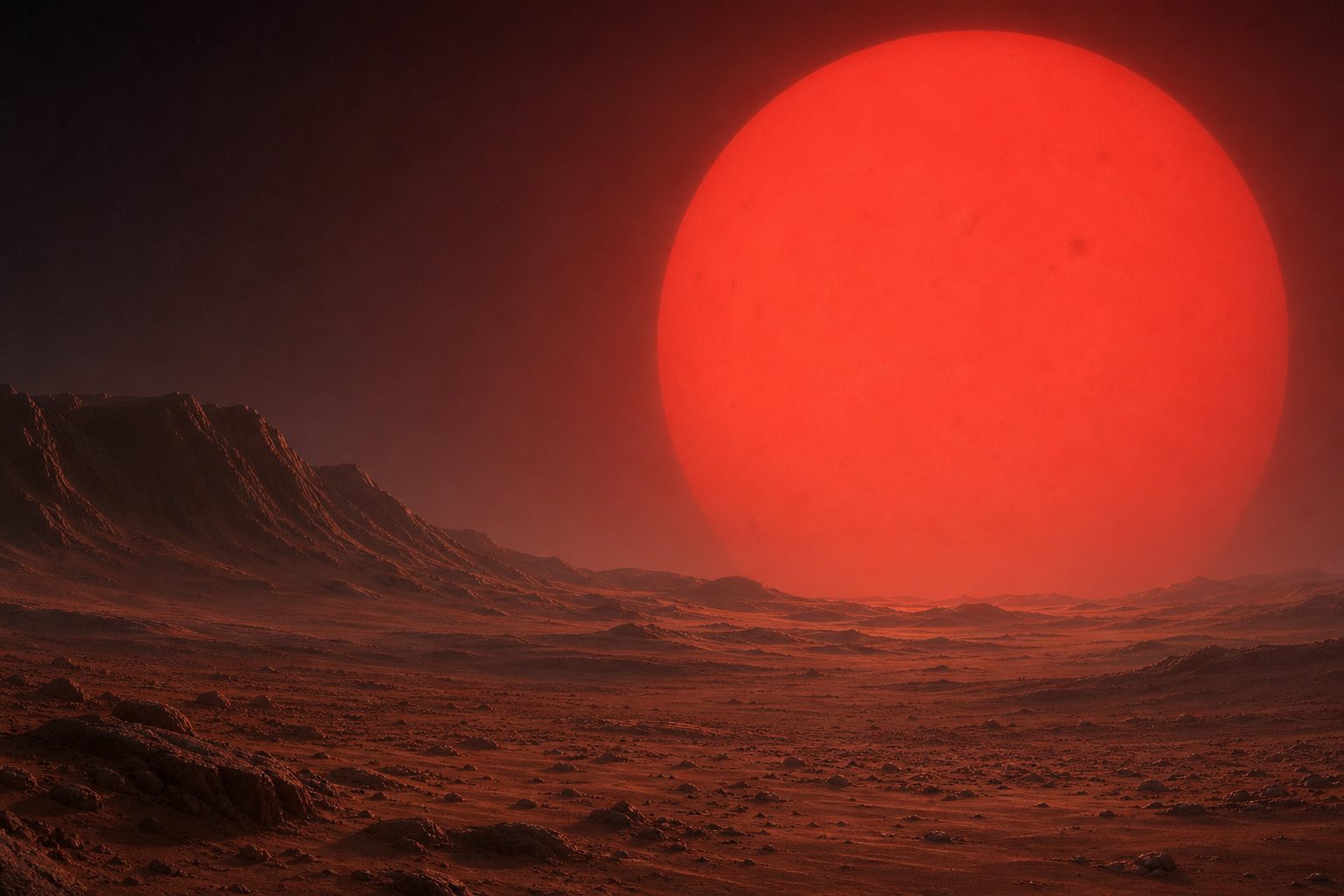
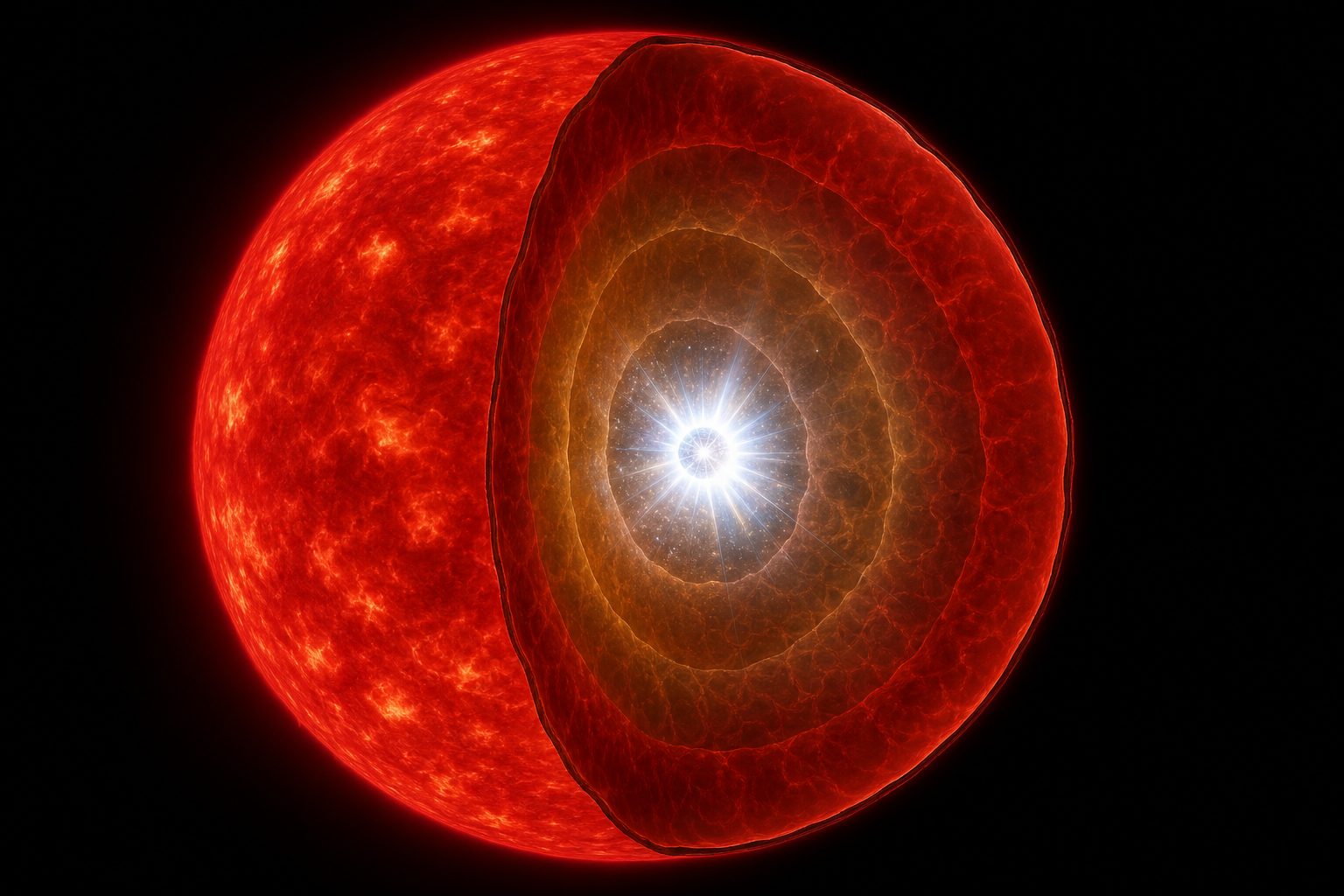
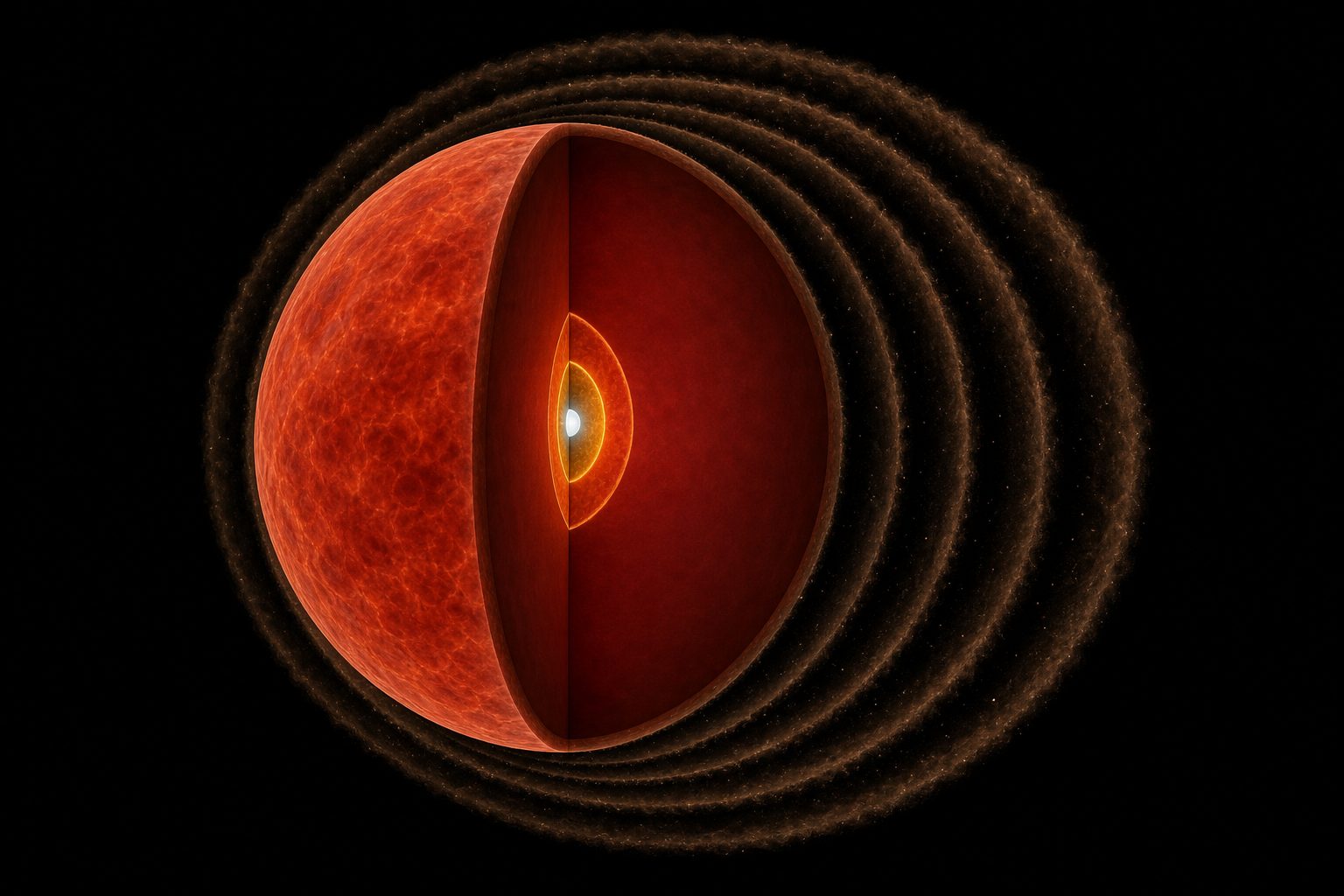
In October 2026 astronomers led by Nicola Gentile Fusillo reported in Nature Astronomy two separate rings of gas and debris around the white dwarf WD J1328−1450, which they think are kept stirred by two surviving bodies. This film explains the established science of how a star like the Sun dies: fusion and hydrostatic balance today, the slow brightening that will end Earth’s oceans in about a billion years, the end of core hydrogen, the red giant that swallows Mercury and Venus and may or may not take Earth, the helium flash, the second giant and its thermal pulses, the planetary nebula, the Earth-sized white dwarf held up by electrons and the Chandrasekhar limit that rules out a supernova, its cooling over trillions of years, and the polluted white dwarfs that show planetary systems partly survive.
Interactive 3D film10 minPublished 10 November 2026
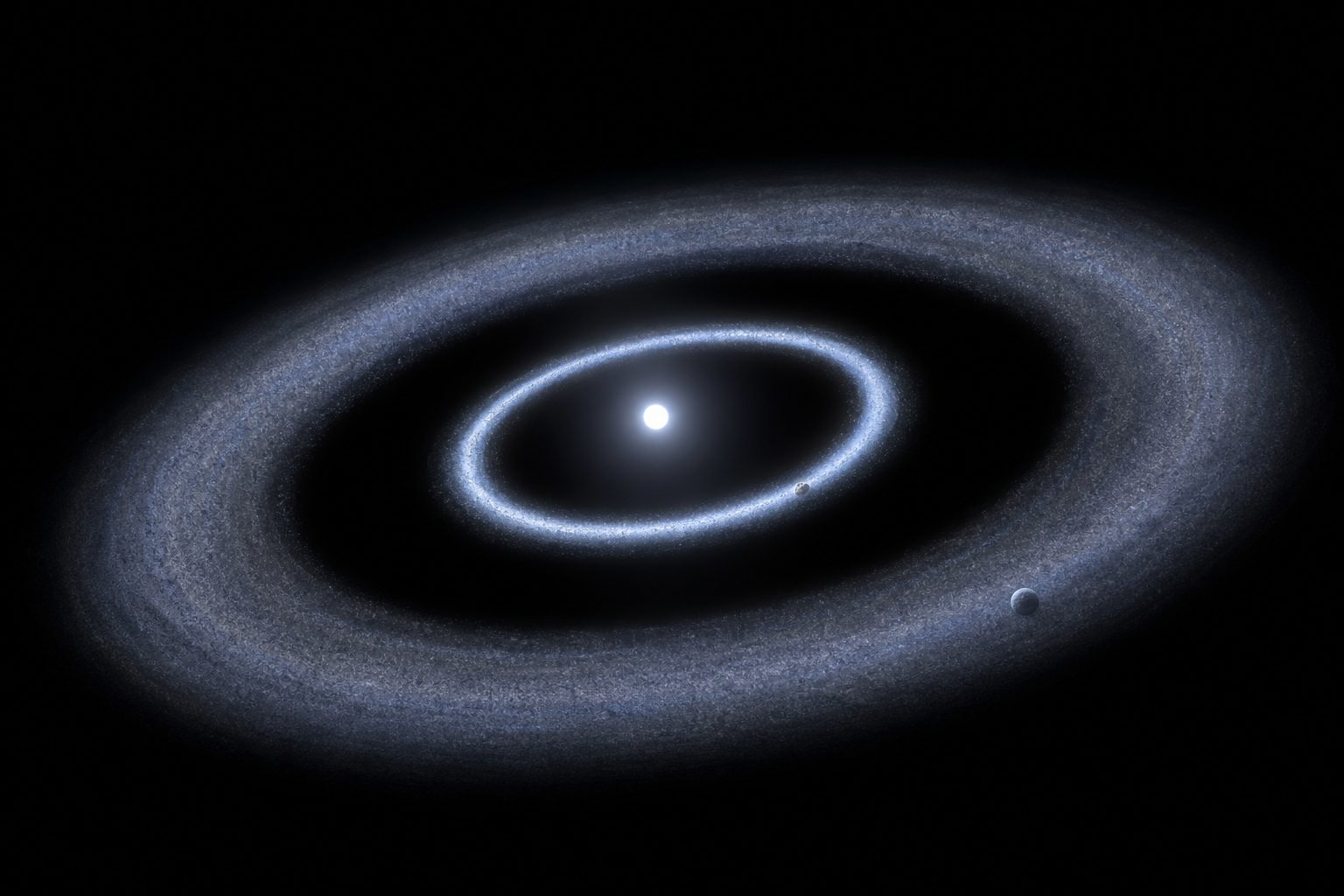
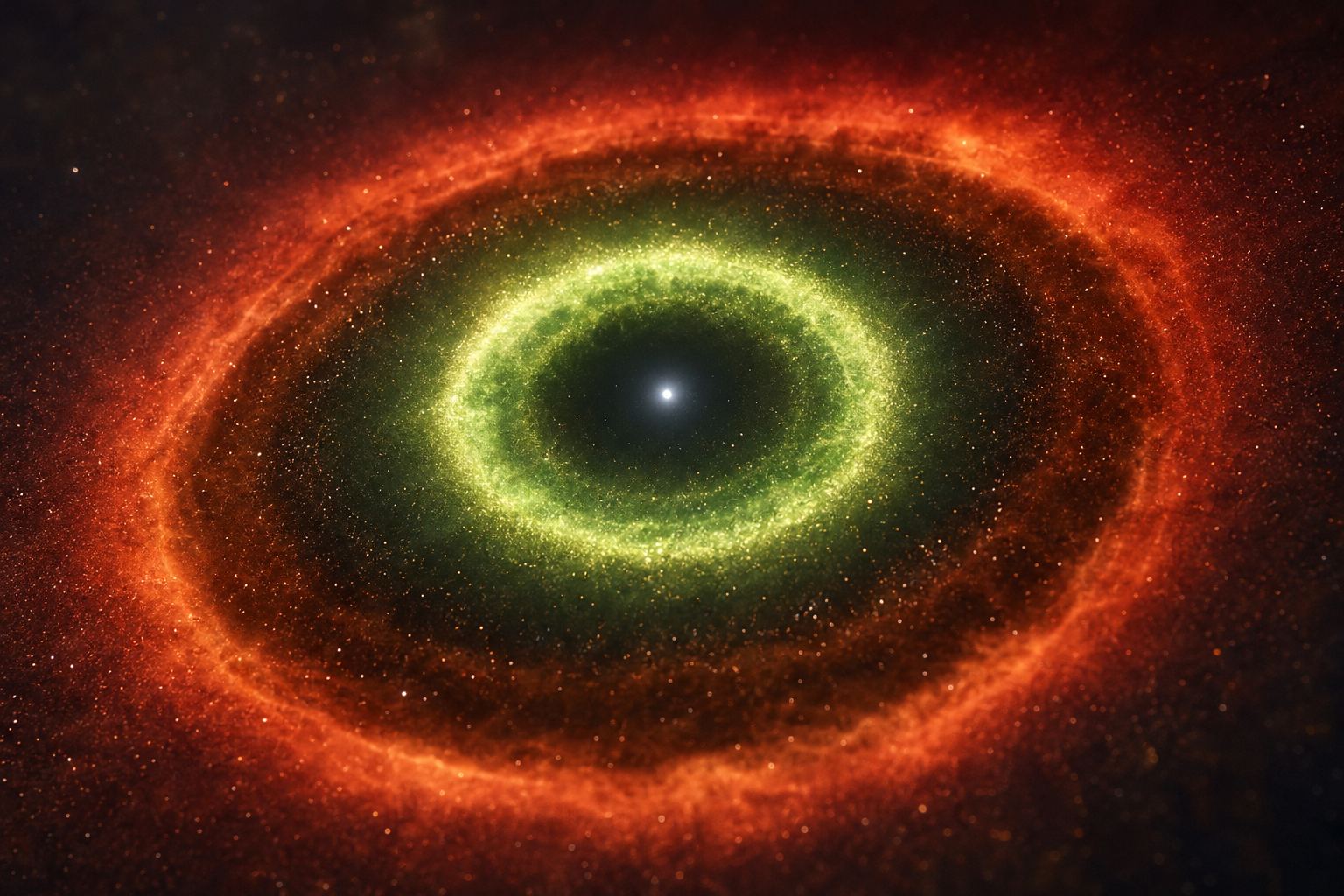
About 1,600 light-years away, a dead star is circled by two rings of glowing gas, one inside the other, with a gap between them.
Astronomers reported it last month in the journal Nature Astronomy.
They think two surviving bodies, one small, one perhaps as big as Pluto, keep the rings stirred.
The star is a white dwarf, the burnt-out core of a star like ours. So how does a star like the Sun die?
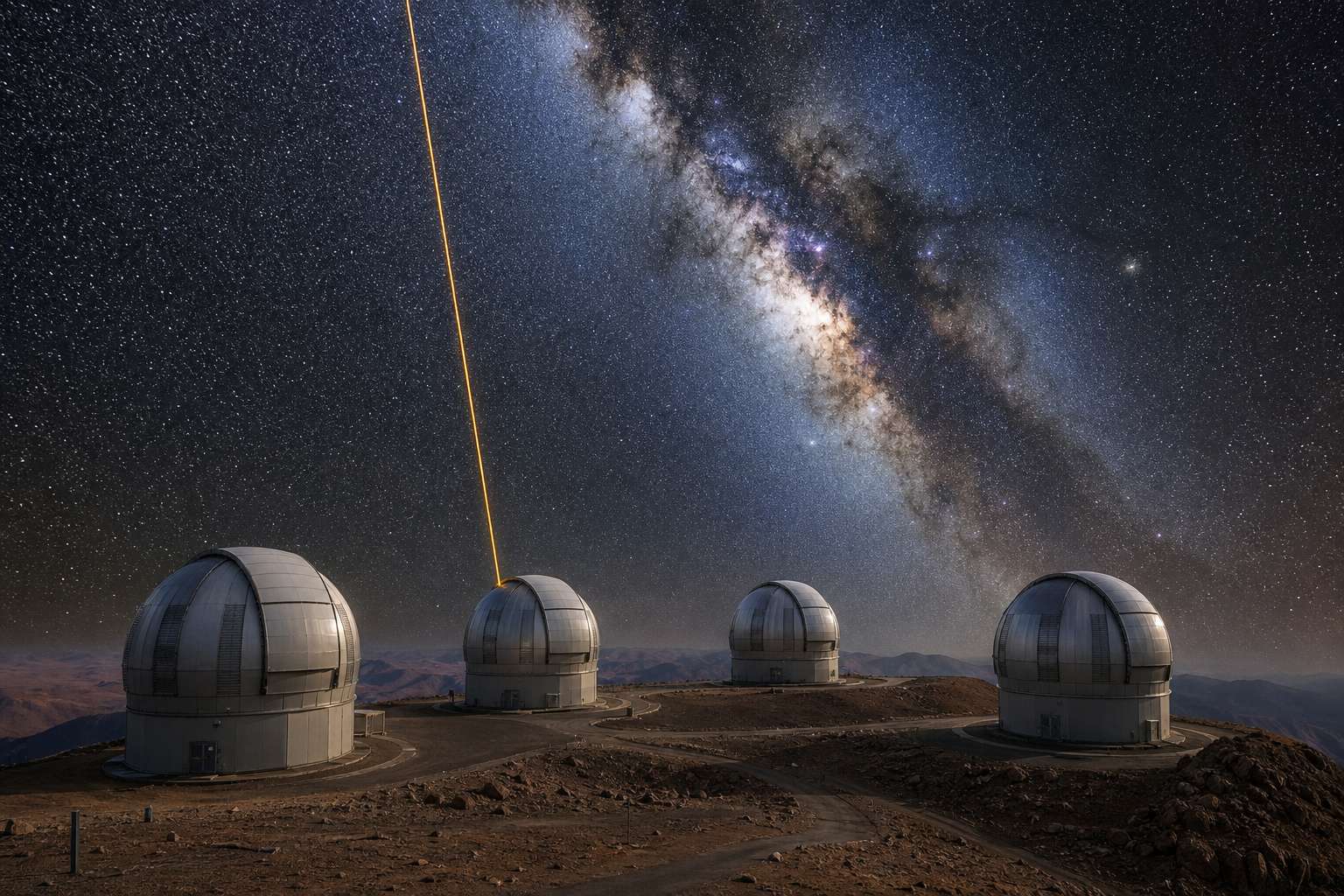
How it was seen The light was split by the X-shooter spectrograph on ESO’s Very Large Telescope in Chile, in observations from 2021 to 2023. AI-generated illustration.
~1,600 ly
ly = light-years · distance given by the University of Warwick
2
rings of gas, seen in four-peaked spectral lines
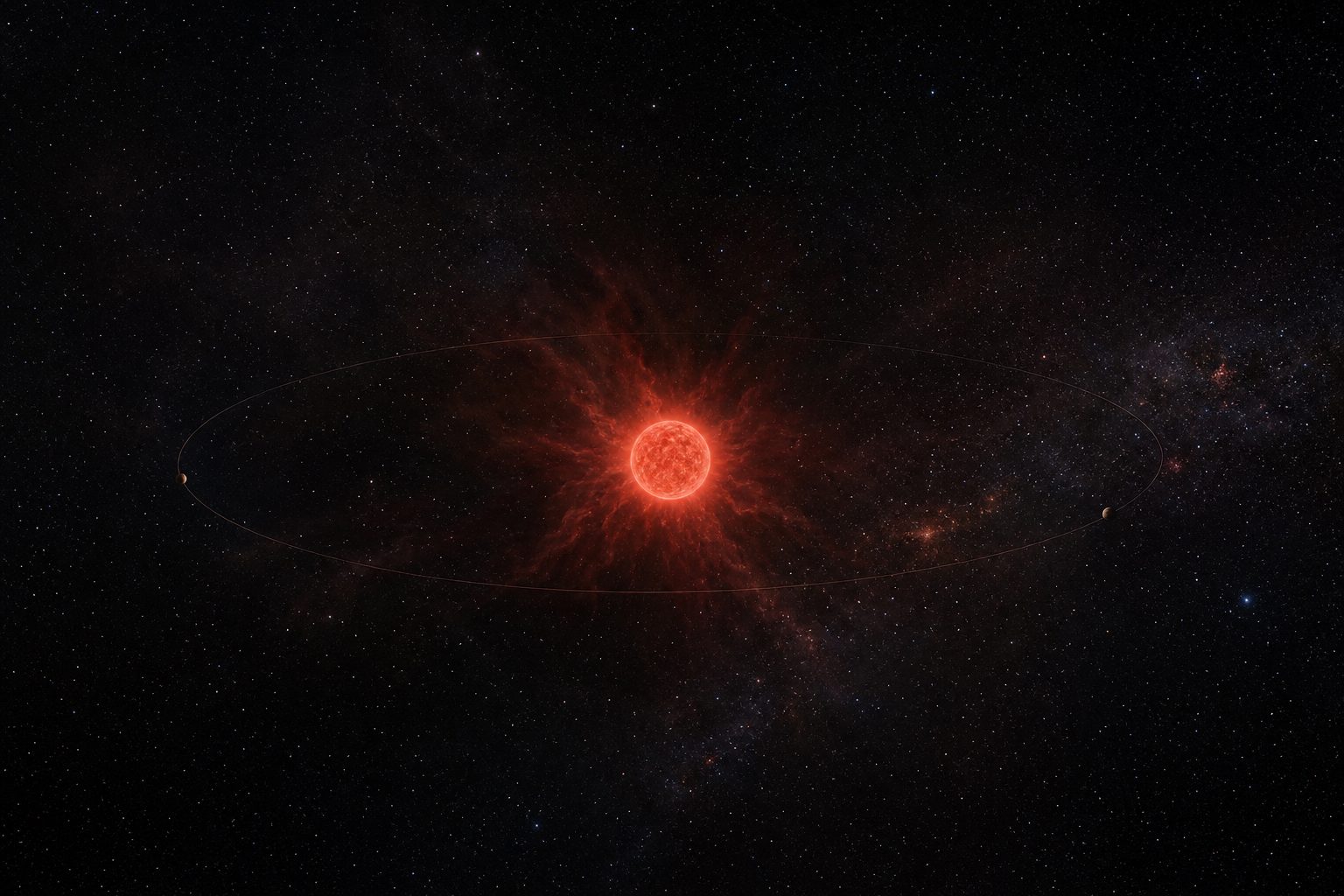
WD J1328−1450The team’s picture An artist’s view of the proposed layout: a small body inside the inner ring, a larger one inside the outer ring. Neither body has been seen directly. AI-generated illustration.
The Sun today, and why it is steady
A slow brightening, then a red giant
A helium flash and a last puff of gas
The white dwarf, and what survives around it
In this film
Prologue
The news
University of Warwick (press release, 27 October 2026): a double ring of planetary debris around the white dwarf WD J1328−1450, about 1,600 light-years away, observed with X-shooter on ESO’s Very Large Telescope; reported in Nature Astronomy (“A double debris disc around a white dwarf sculpted by two planetary bodies”), lead author Nicola Pietro Gentile Fusillo (University of Trieste and INAF). The 21 comparable gas discs known show double-peaked lines; this one shows four peaks, read as two concentric rings with a gap. The structure was stable from 2021 to 2023. The gas contains calcium, oxygen, magnesium and iron.
The two bodies are inferred from a model, not observed: Nautilus calls them the “most likely” explanation, and Universe Today notes that the rings could instead come from different layers of one planet.
The 3D scenes are simplified teaching models, not to scale; sizes in between the quoted values are drawn schematically.
Hydrogen in, helium out, sunlight as the difference.
Start with the Sun as it is now: about 4.6 billion years old, and roughly three quarters hydrogen by mass.
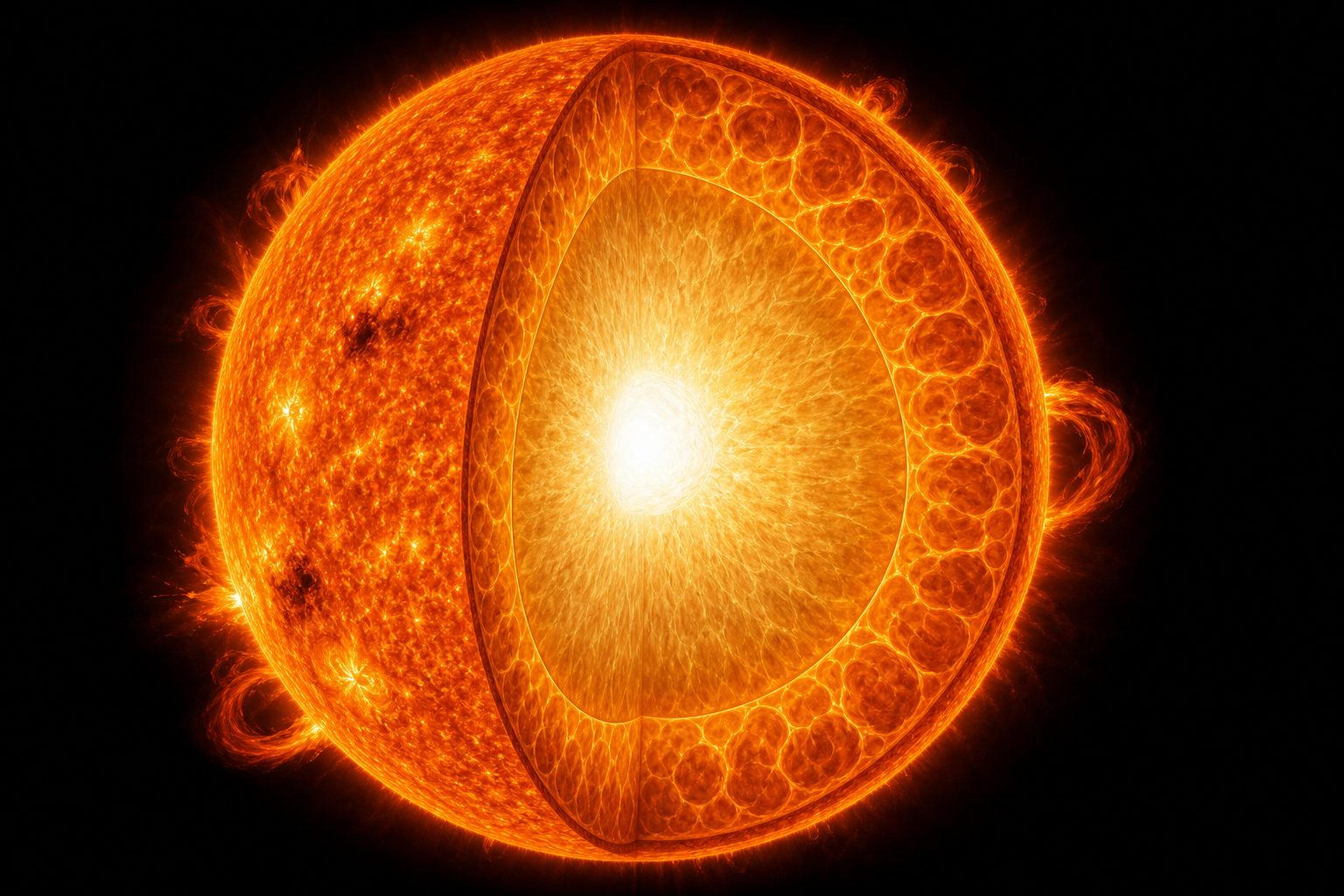
Deep in the core, at about fifteen million degrees, hydrogen nuclei collide and fuse into helium, mostly through a sequence called the proton–proton chain.
Four hydrogen nuclei go in, one helium nucleus comes out, a little lighter than the four. The missing mass becomes energy, and in the end, sunlight.
Almost all of that energy is made within the inner quarter of the Sun’s radius.
Layers of the Sun From the centre out: the core, the radiative zone where light diffuses slowly, and the churning convective zone below the surface. AI-generated illustration.41H→4He+energyE=Δmc2
1H
a hydrogen nucleus (a proton)
Δm
the mass lost, about 0.7% of the hydrogen
c
the speed of light
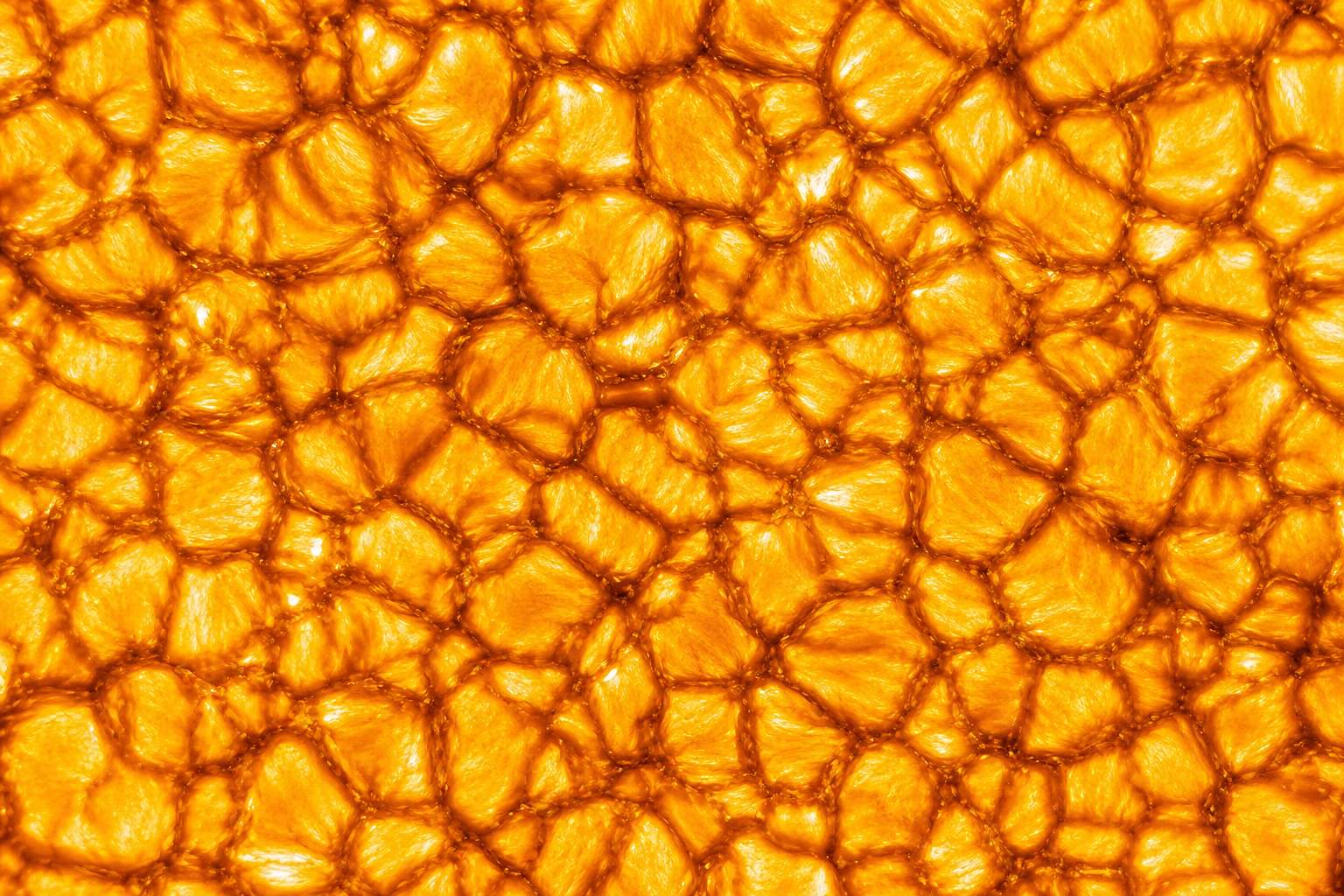
Hydrogen to helium, mass to energyThe surface Each bright granule is a cell of hot gas welling up at the top of the convective zone, carrying the core’s energy out as light. AI-generated illustration.
Chapter I · A star in balance
The Sun today
Wikipedia (Sun): age about 4.6 billion years; mass about 333,000 Earths; equatorial radius about 695,500 km, 109 Earth radii; core temperature about 15.7 million K; by mass the photosphere is about 73–75% hydrogen and 24–25% helium. The proton–proton chain dominates the Sun’s fusion (the CNO cycle supplies about 0.8%), and about 99% of the power comes from within the innermost 24% of the radius.
The 0.7% is the standard textbook value for the mass lost when four protons become one helium nucleus.
The 3D scenes are simplified teaching models, not to scale; sizes in between the quoted values are drawn schematically.
Why doesn’t the Sun collapse under its own enormous weight, or blow itself apart?
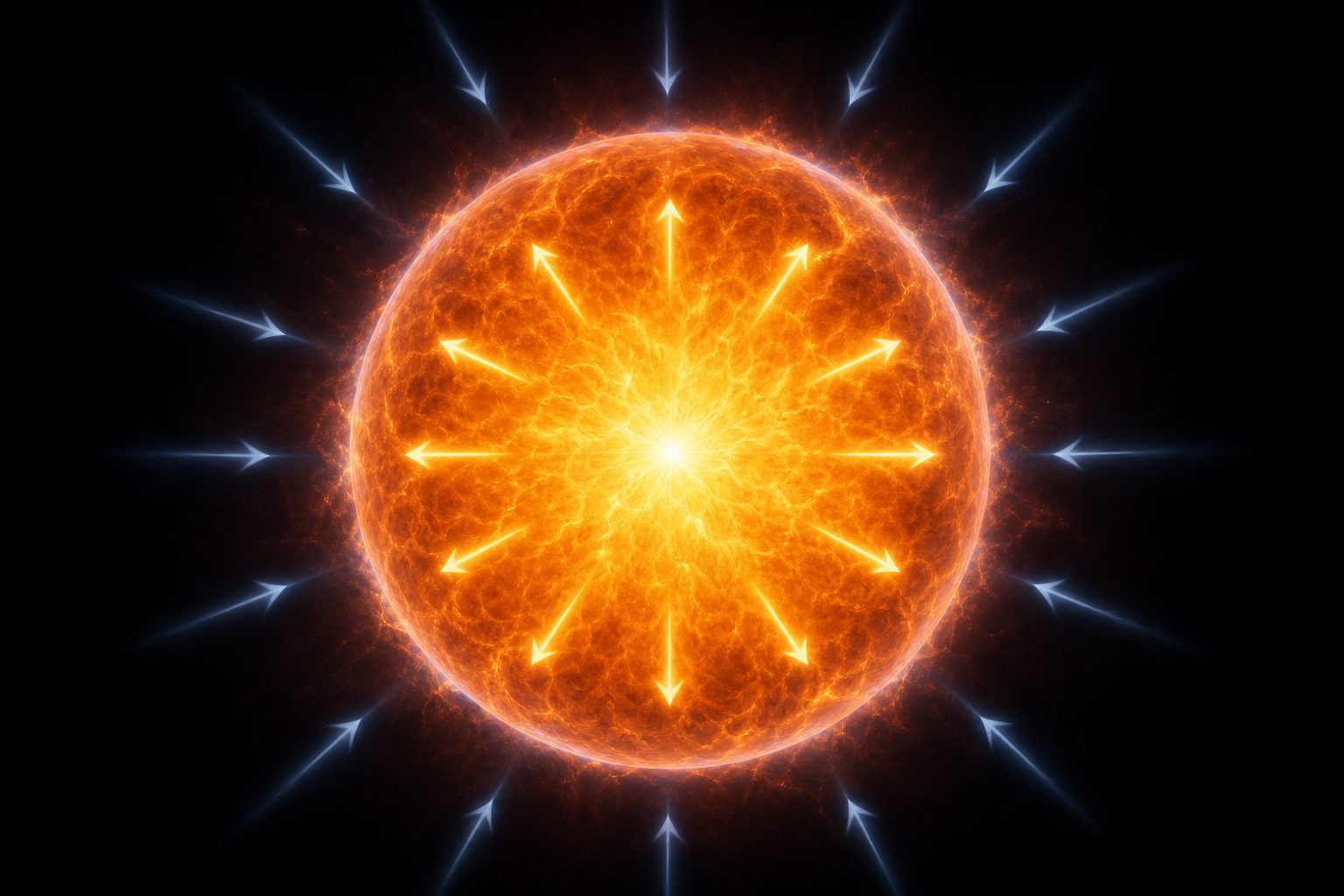
Because two pushes are matched. Gravity pulls every layer inward; the pressure of hot gas, heated from the core, pushes outward.
Astronomers call this hydrostatic equilibrium, and it works a little like a thermostat.
If the core made too much energy, the star would swell, cool and slow its fusion. Too little, and it would shrink, heat up and speed up again.
This self-correcting balance keeps the Sun steady for billions of years.
Two forces Inward arrows stand for gravity, outward ones for gas pressure; at every depth they cancel. AI-generated illustration.drdP=−r2GM(r)ρ(r)
P
gas pressure
M(r)
mass inside radius r
ρ
density
G
the gravitational constant
Hydrostatic equilibrium
more energy → expand → cool → fusion slows
less energy → contract → heat → fusion speeds up
result: a steady star
The stellar thermostatBillions of steady years Life on Earth has had a fairly steady Sun for most of its history; the brightening is slow enough to take hundreds of millions of years to notice. AI-generated illustration.
Chapter I · A star in balance
Hydrostatic equilibrium
In a star, the outward push of gas pressure balances the inward pull of gravity at every depth: hydrostatic equilibrium. Wikipedia (Sun) describes the Sun leaving this balance only in the future, when core hydrogen fusion declines and the core contracts and heats. The self-regulation described here (expansion cools the core and slows fusion; contraction heats it and speeds fusion) is standard textbook stellar physics.
Press More fusion or Less fusion in the scene; the swelling is exaggerated.
The 3D scenes are simplified teaching models, not to scale; sizes in between the quoted values are drawn schematically.
But steady does not mean unchanging. As helium builds up, the core slowly contracts and heats, and the Sun grows brighter.
When it was young it gave out only about two thirds of today’s light. Now it brightens by roughly one percent every hundred million years.
In a 2008 study, Klaus-Peter Schröder and Robert Smith estimated that in about a billion years, some ten percent more sunlight would make Earth too hot to stay habitable.
Other models differ, but Earth’s oceans will likely be gone long before the Sun begins to die.
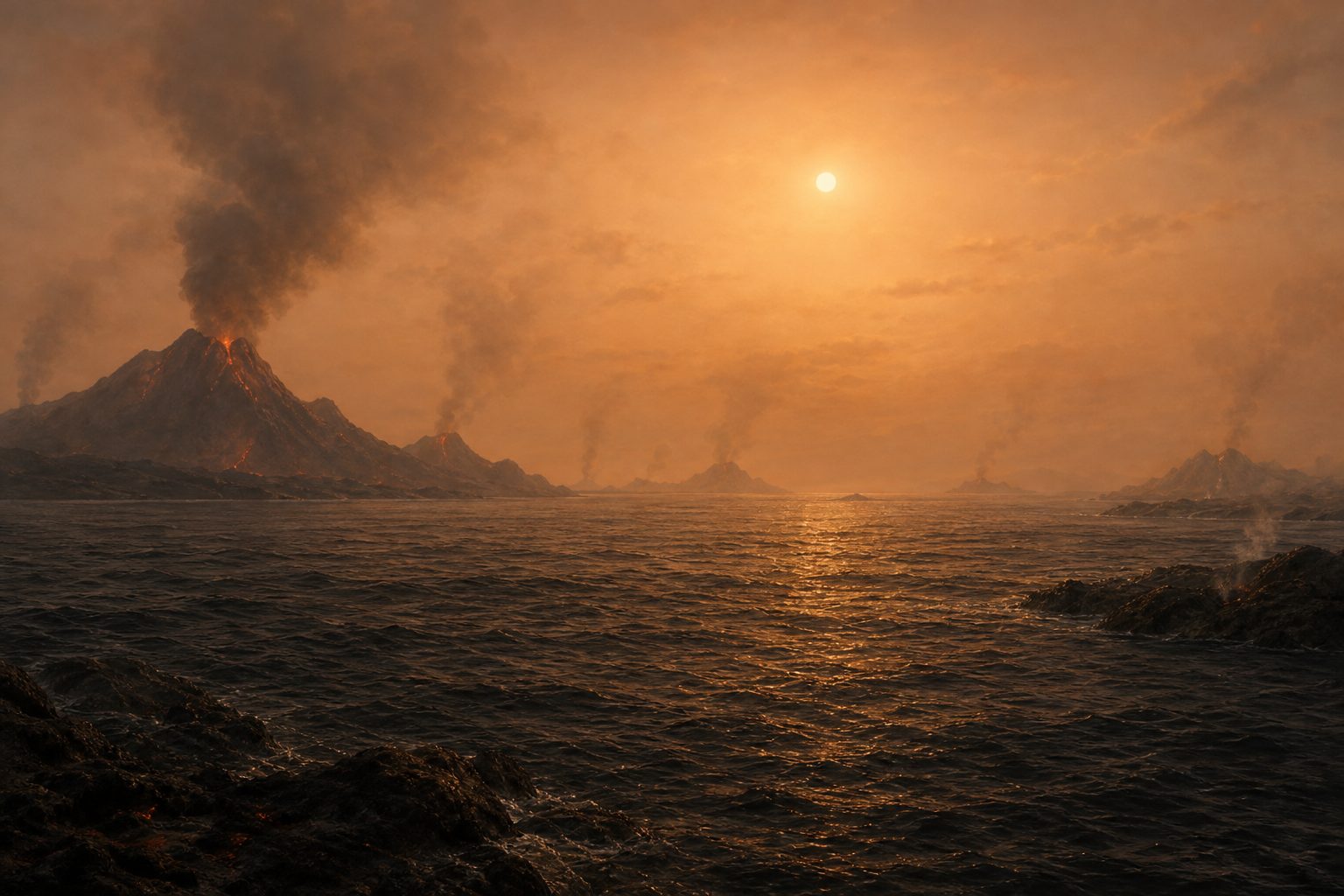
The faint young Sun Early Earth under a dimmer Sun: about 0.68 of today’s brightness when the Sun began fusing hydrogen (Wikipedia). AI-generated illustration.
start of hydrogen fusion
0.68
today
1.0
in ~1 billion years
~1.1
end of core hydrogen, ~5 bn years
1.84
The Sun’s brightness, today = 1
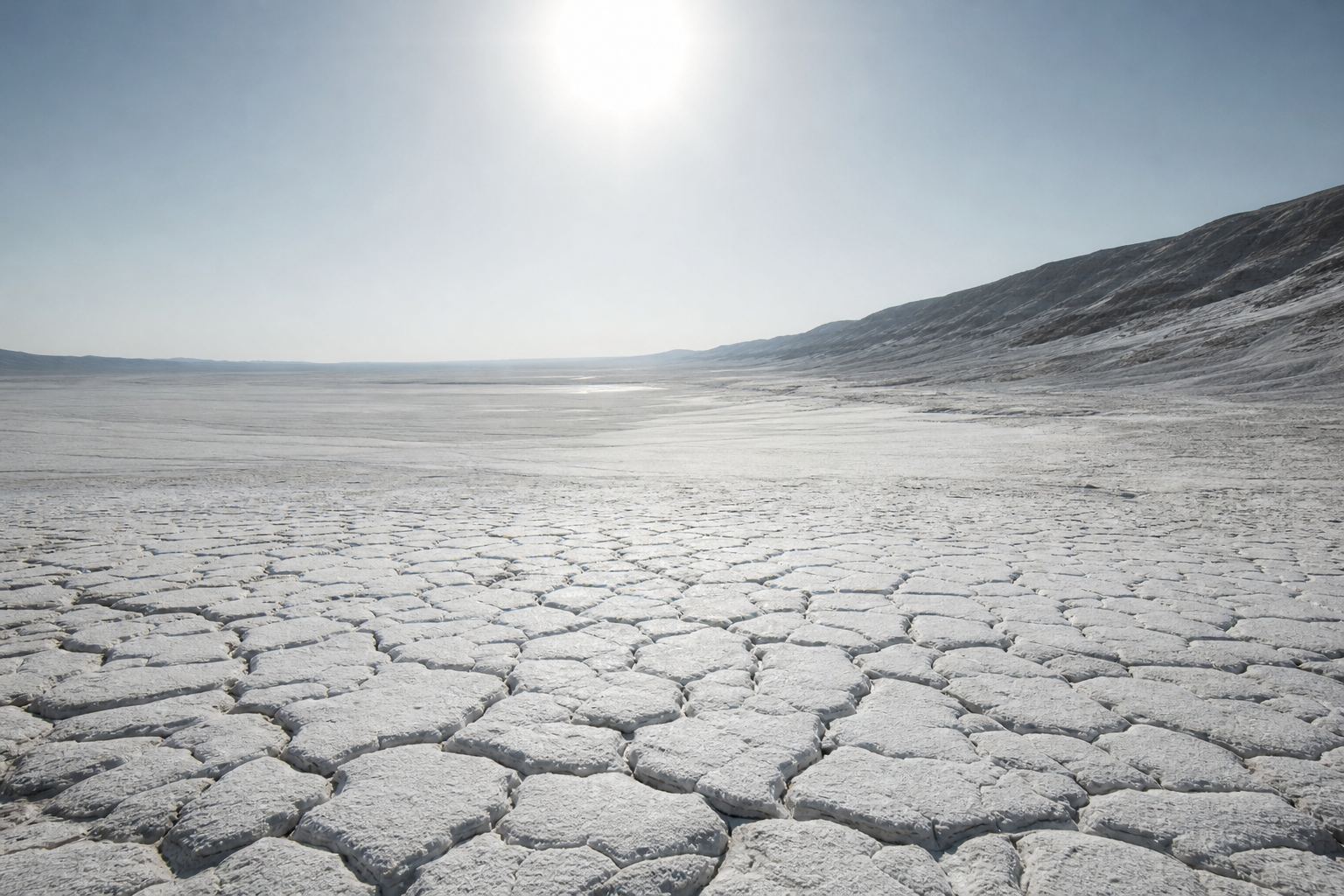
A drier world Where seas once lay: models differ on the timing, from under to over a billion years (Scudder, The Conversation). AI-generated illustration.
Chapter II · Slowly brighter
A slowly brightening Sun
Wikipedia (Sun): the Sun’s luminosity has risen from about 0.677 to 1.0 of today’s value since it began fusing hydrogen, and it currently increases by about 1% every 100 million years. Schröder & Smith (2008) estimate “about one billion years of time before the solar flux has increased by the critical 10%”; their table gives 1.84 times today’s luminosity when the Sun leaves the main sequence at an age of about 10 billion years. Jillian Scudder (Space.com/The Conversation, 2015) also gives about 10% per billion years and notes that models disagree on how long Earth stays habitable.
Press Today or +1 billion years in the scene. The readout gives the extra sunlight on Earth.
The 3D scenes are simplified teaching models, not to scale; sizes in between the quoted values are drawn schematically.
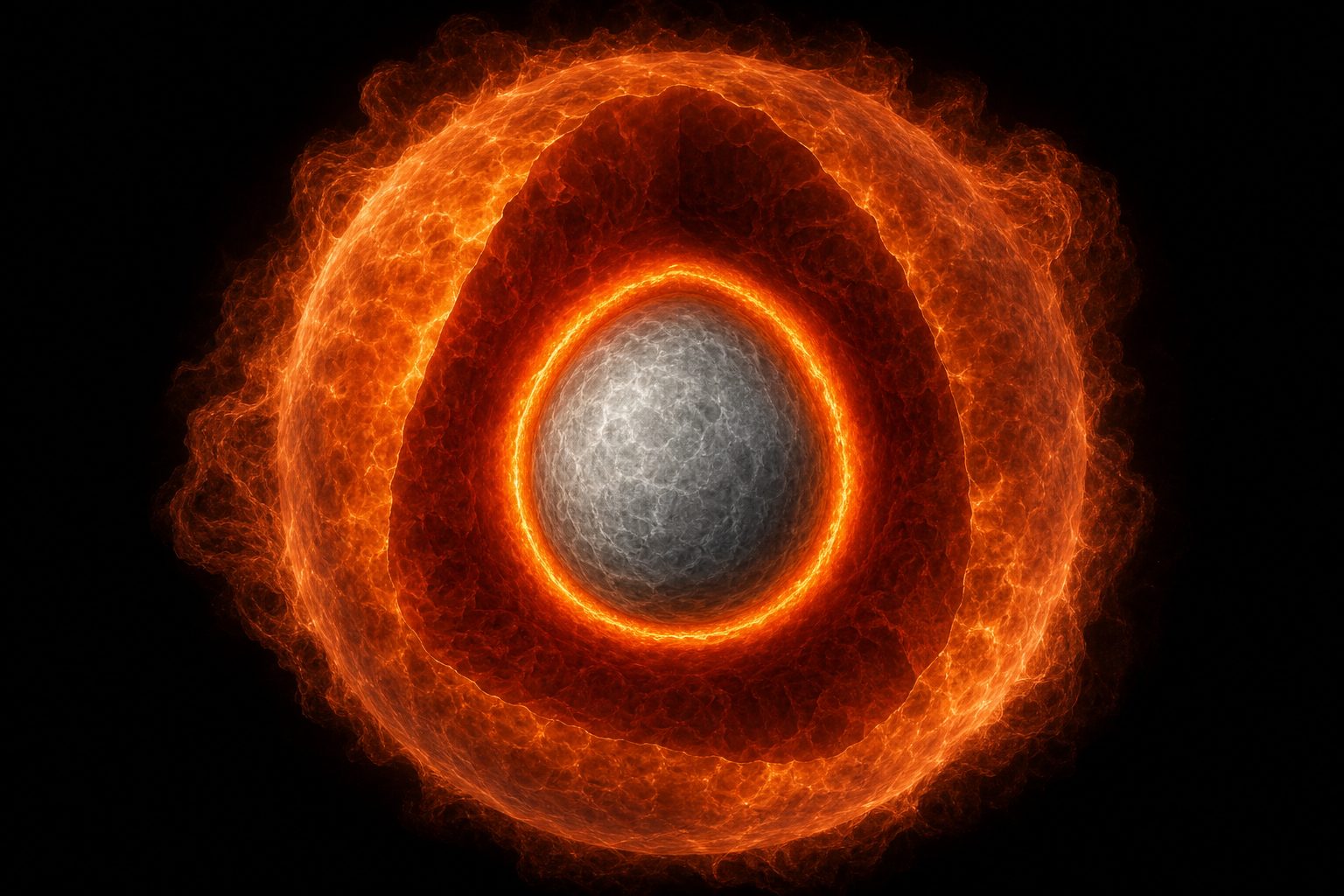
In about five billion years, the core’s hydrogen runs out. Fusion stops there, but not everywhere.
With no fusion left in it, the helium core is squeezed by gravity, and the squeezing heats it. Hydrogen keeps fusing in a thin shell around it, faster than before.
The extra energy pushes the outer layers outward. A bigger surface spreads the heat thinner, so the star cools on the outside while growing brighter overall: a subgiant.
The Sun will be about ten billion years old. Its main sequence, the long, steady hydrogen-burning stage of a star’s life, is over.
~5 bn yr
from now until core hydrogen runs out (Wikipedia)
~10 bn yr
main-sequence lifetime, 10–11 billion years
The end of the main sequenceShell burning The grey sphere is helium “ash”; the glowing ring is where hydrogen still fuses, eating its way outward. AI-generated illustration.A subgiant Larger, cooler and more orange: the first step away from the main sequence. AI-generated illustration.
core: helium, contracting, heating
shell: hydrogen fusion, brighter than before
envelope: swelling, cooling, reddening
subgiant phase: about a billion years
What changes
Chapter III · The red giant
Leaving the main sequence
Wikipedia (Sun): the Sun’s main-sequence lifetime is about 10 to 11 billion years, and core hydrogen will run out in about 5 billion years, followed by a subgiant phase of about a billion years before the red giant branch. Schröder & Smith (2008) place the turnoff from the main sequence at an age of about 10 billion years. University of Oregon (AST 122): once the core is helium, a hydrogen-burning shell “eats its way outward leaving behind more helium ash”, while the core grows more massive, contracts and heats.
Scrub the timeline to watch the shell form.
The 3D scenes are simplified teaching models, not to scale; sizes in between the quoted values are drawn schematically.
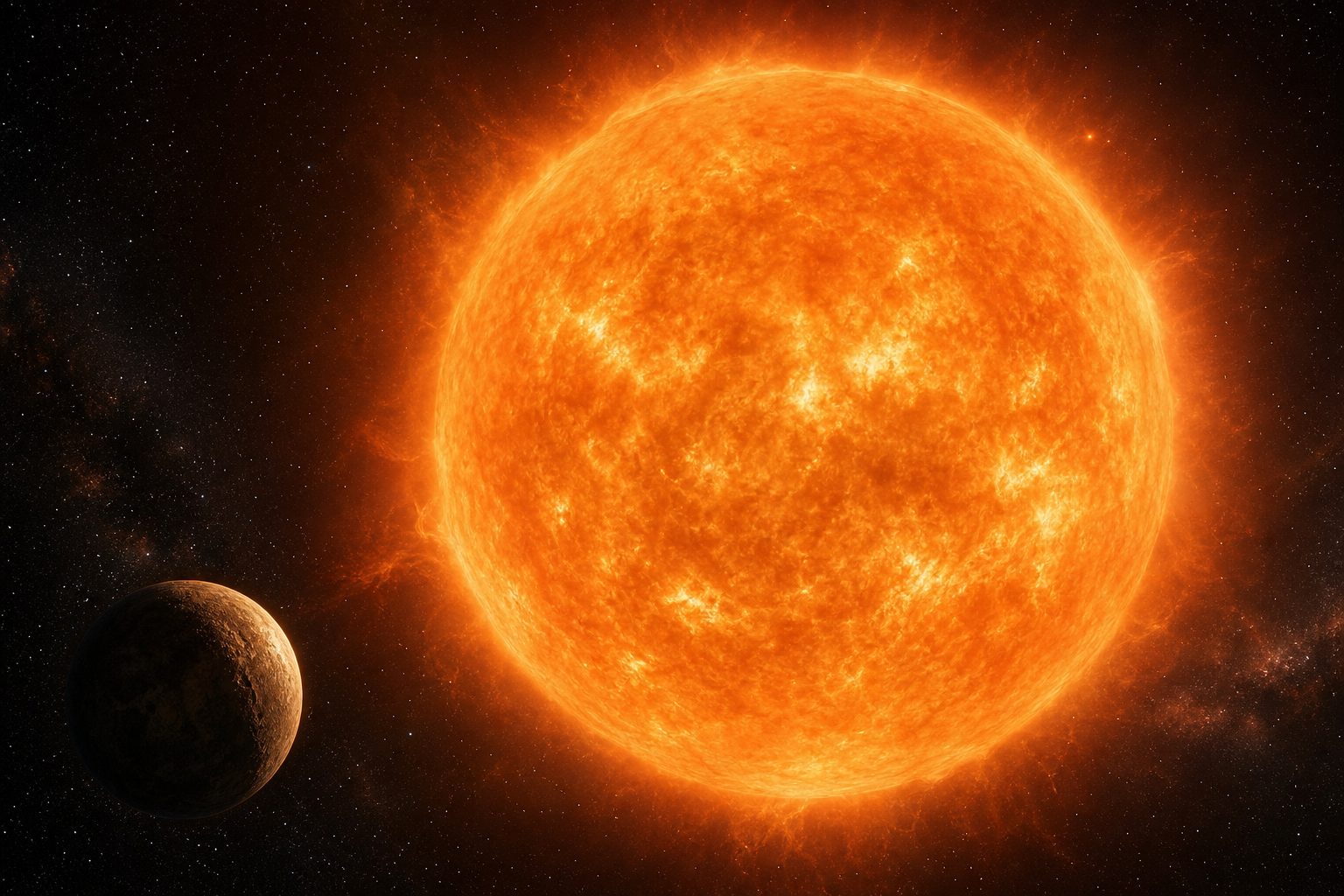
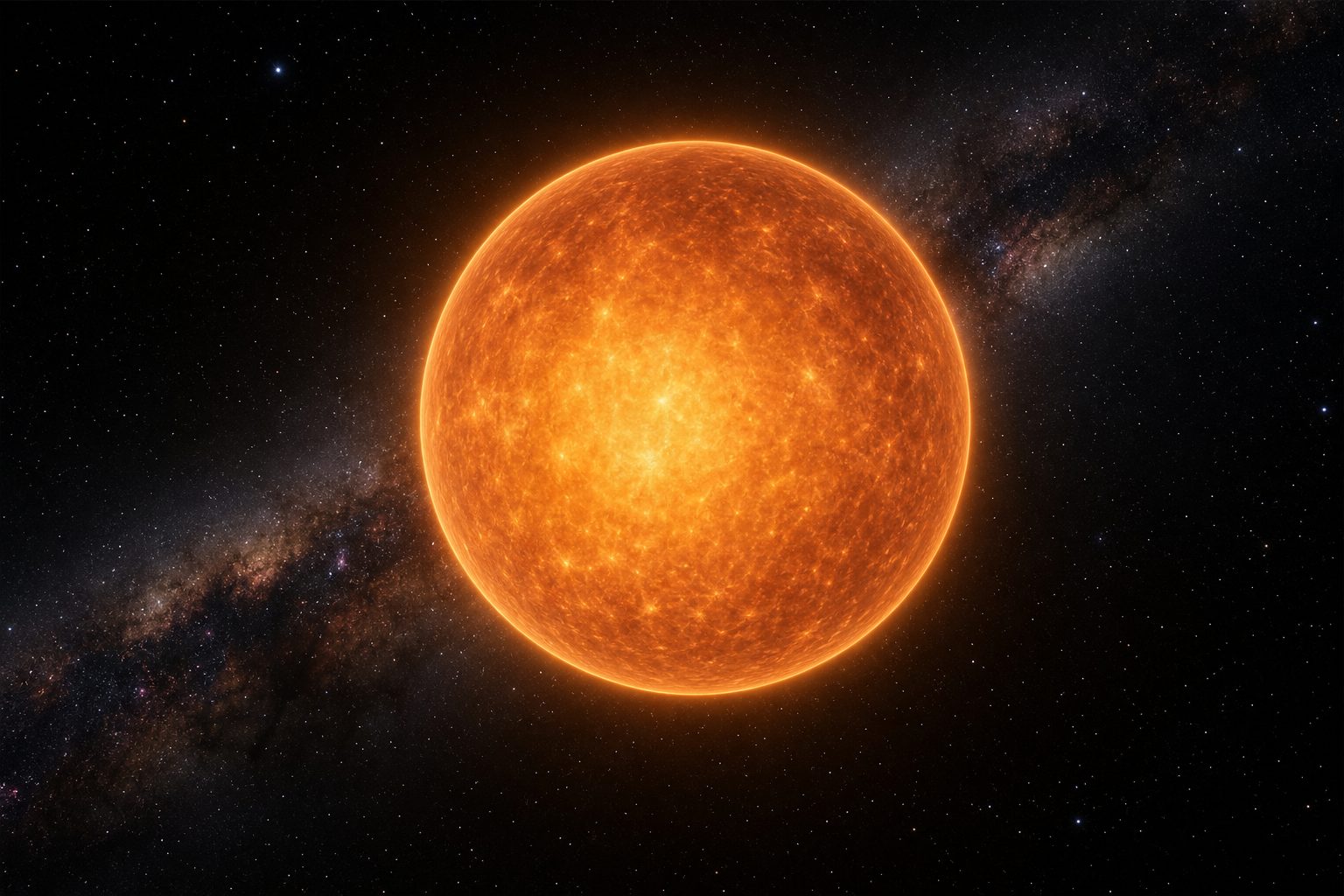
Over the next two and a half billion years or so, the Sun swells into a red giant.
At the peak, about 7.6 billion years from now in Schröder and Smith’s model, its radius is about 256 times today’s, past Earth’s present orbit.
Its surface cools to about 2,600 kelvin, so it glows red, yet it is so large that it shines about 2,700 times brighter than today.
And a strong stellar wind, a steady outflow of gas from its surface, carries the outer layers away. By the peak it has lost about a third of its mass.
A red giant A cool, swollen star whose surface is mottled by convection cells the size of planets’ orbits. AI-generated illustration.
256 R☉
R☉ = today’s solar radius
1.2 AU
AU = Earth–Sun distance
2,730 L☉
times today’s luminosity
0.668 M☉
mass left of today’s
At the tip of the red giant branch (Schröder & Smith 2008)L=4πR2σT4
L
luminosity, total light given out
R
radius: 256× gives 65,000× the surface area
T
surface temperature, ~2,600 K vs ~5,800 K today
σ
the Stefan–Boltzmann constant
Big beats coolMass loss Seen from far away, gas drifts off the swollen star into space; in the model it loses 0.332 solar masses by the peak. AI-generated illustration.
Chapter III · The red giant
The red giant branch
Schröder & Smith (2008, MNRAS 386, 155), full text and table 1: at the tip of the red giant branch, 7.59 ± 0.05 billion years from now (age 12.17 billion years), the Sun reaches R = 256 R☉ = 1.2 AU, luminosity 2,730 L☉ and effective temperature 2,602 K, with 0.668 M☉ left after losing 0.332 M☉ on the red giant branch. Wikipedia (Sun) gives the same tip radius, 1.19 AU, and says the Sun loses about a third of its mass on this branch.
In the scene, the Sun before the red giant phase is drawn far larger than scale so that it can be seen.
The 3D scenes are simplified teaching models, not to scale; sizes in between the quoted values are drawn schematically.
What happens to the planets? As the Sun loses mass, its grip weakens, and every orbit widens.
Even so, Mercury and Venus are swallowed. Earth’s orbit moves out too, but the giant’s tidal pull, and drag from its thin outer gas, may slow Earth and pull it back in.
Schröder and Smith concluded Earth would be engulfed; other studies are less sure, so Earth’s fate is still debated.
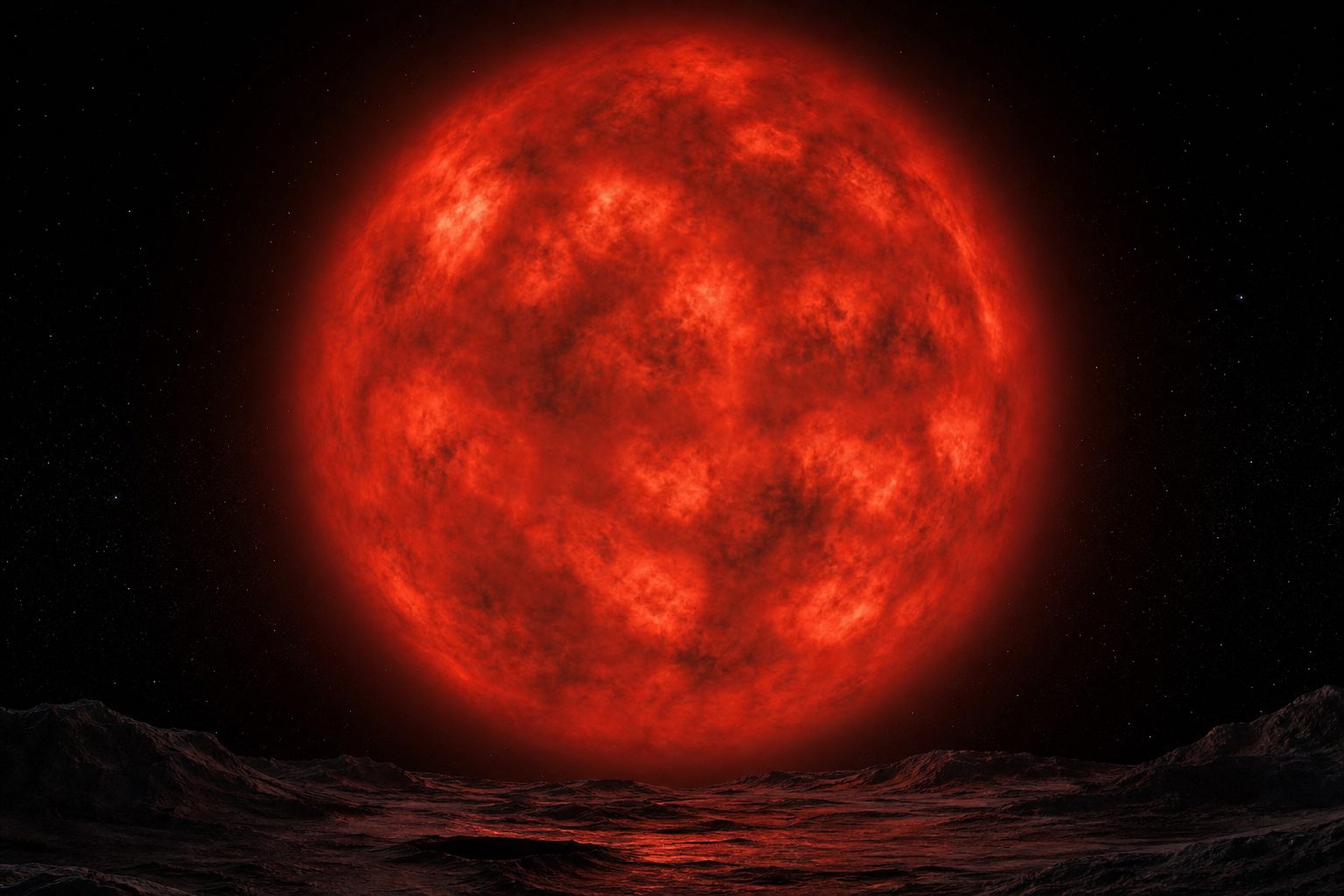
Mars, farther out, should survive beside a vast red Sun.
Engulfed In the model, Mercury goes about 3.8 million years and Venus about 1 million years before Earth does. AI-generated illustration.
≥ 1.15 AU
today’s orbit a planet needs to survive the red giant tip
1.0 AU
Earth today
The survival line (Schröder & Smith 2008)From Mars Mars orbits at 1.52 AU today; as the Sun loses mass, that orbit widens further. AI-generated illustration.
Chapter III · The red giant
The fate of the planets
Schröder & Smith (2008): mass loss expands planetary orbits in inverse proportion to the Sun’s remaining mass, but tidal interaction and drag in the lower chromosphere mean that Earth “will not escape” engulfment near the red giant tip; a planet would need a present-day orbit of at least about 1.15 AU to survive. Mercury and Venus are engulfed about 3.8 and 1.0 million years before Earth in their model. Wikipedia (Sun) states that Mercury and Venus will be engulfed, and that Earth may be engulfed or may survive: the outcome is uncertain.
Press the age buttons in the scene. In the model shown, orbits widen as 1 ÷ the Sun’s mass; the drawing does not include tidal drag, which is why Earth is marked with a question.
The 3D scenes are simplified teaching models, not to scale; sizes in between the quoted values are drawn schematically.
Minutes of runaway burning, and almost nothing shows outside.
Meanwhile the core keeps shrinking and heating. It becomes degenerate: packed so tightly that its electrons resist any further squeezing.
At around a hundred million degrees, helium starts to fuse into carbon. In a degenerate core it ignites as a runaway: the helium flash.
Within minutes, about six percent of the core turns to carbon. But the energy goes into loosening the packed core, and almost none reaches the surface.
Afterwards the Sun shrinks, to about eleven times today’s size, and calmly fuses helium in its core for around a hundred million years.
34He→12C+γ
4He
helium nucleus (an “alpha particle”)
12C
carbon
γ
energy, as a gamma ray
The triple-alpha processA hidden flash The flash happens deep inside; the vast red envelope above it hardly changes. AI-generated illustration.
11.2 R☉
radius when helium burning starts (Schröder & Smith)
~100 Myr
Myr = million years · core helium burning (Wikipedia)
Burning helium (the horizontal branch)
Chapter IV · Burning helium
Helium ignites
University of Oregon (AST 122): in stars of 1–2 solar masses the helium core becomes degenerate; helium fuses to carbon by the triple-alpha process at about 100 million degrees, and in a degenerate core it ignites as a flash lasting a few minutes, whose energy goes into lifting the degeneracy rather than reaching the surface (the lecture puts the flash itself near 300 million degrees). Wikipedia (Sun): the degenerate core ignites in a helium flash, converting about 6% of the core into carbon within minutes, then the Sun spends about 100 million years fusing helium on the horizontal branch. Schröder & Smith (2008, table 1): at the start of core helium burning the Sun has R = 11.2 R☉ and L = 53.7 L☉, and their helium-burning phase lasts about 130 million years, so models give roughly 100–130 million years.
Press Ignite helium in the scene.
The 3D scenes are simplified teaching models, not to scale; sizes in between the quoted values are drawn schematically.
When the core’s helium runs out too, the Sun swells a second time, onto what astronomers call the asymptotic giant branch.
Now it has a dead core of carbon and oxygen, wrapped in two burning shells: helium inside, hydrogen outside.
For about twenty million years it grows steadily. Then the helium shell turns unstable and flares in bursts called thermal pulses, each lasting a few hundred years.
Models predict four pulses, about a hundred thousand years apart, at times up to five thousand times today’s brightness, while the wind strips away more of the envelope.
core: carbon and oxygen, no fusion
inner shell: helium → carbon, in bursts
outer shell: hydrogen → helium
envelope: huge, cool, losing mass
Inside the second giantShells of dust A schematic cut-away: the core and two shells inside, rings of shed dust outside. Each episode of strong wind can leave such a shell; the wind blows off roughly 10⁻⁴ solar masses a year at this stage (University of Oregon). AI-generated illustration.
~20 Myr
early AGB, before the pulses
4
thermal pulses, ~100,000 yr apart
179 R☉
largest radius, 0.83 AU
The Sun on the AGB (Wikipedia)
Chapter IV · Burning helium
The asymptotic giant branch
University of Oregon (AST 122): when core helium is exhausted, a helium-burning shell forms beneath the hydrogen shell; helium ash builds up and ignites in periodic thermal pulses; a stellar wind of roughly 10⁻⁴ solar masses per year blows the outer layers away, and dust forms in it. Wikipedia (Sun): after about 20 million years on the early asymptotic giant branch the Sun becomes unstable; thermal pulses increase its size and luminosity for a few hundred years every 100,000 years or so, the later ones pushing the luminosity to as much as 5,000 times today’s; four pulses are predicted before it loses its envelope; the maximum radius is 179 R☉ (0.832 AU). Schröder & Smith (2008) find the Sun’s size on the AGB stays below its red giant tip size.
Press Thermal pulse in the scene.
The 3D scenes are simplified teaching models, not to scale; sizes in between the quoted values are drawn schematically.
At the end, the rest of the envelope drifts away. Counting the red giant’s wind, the Sun loses nearly half its mass, keeping about 54 percent.
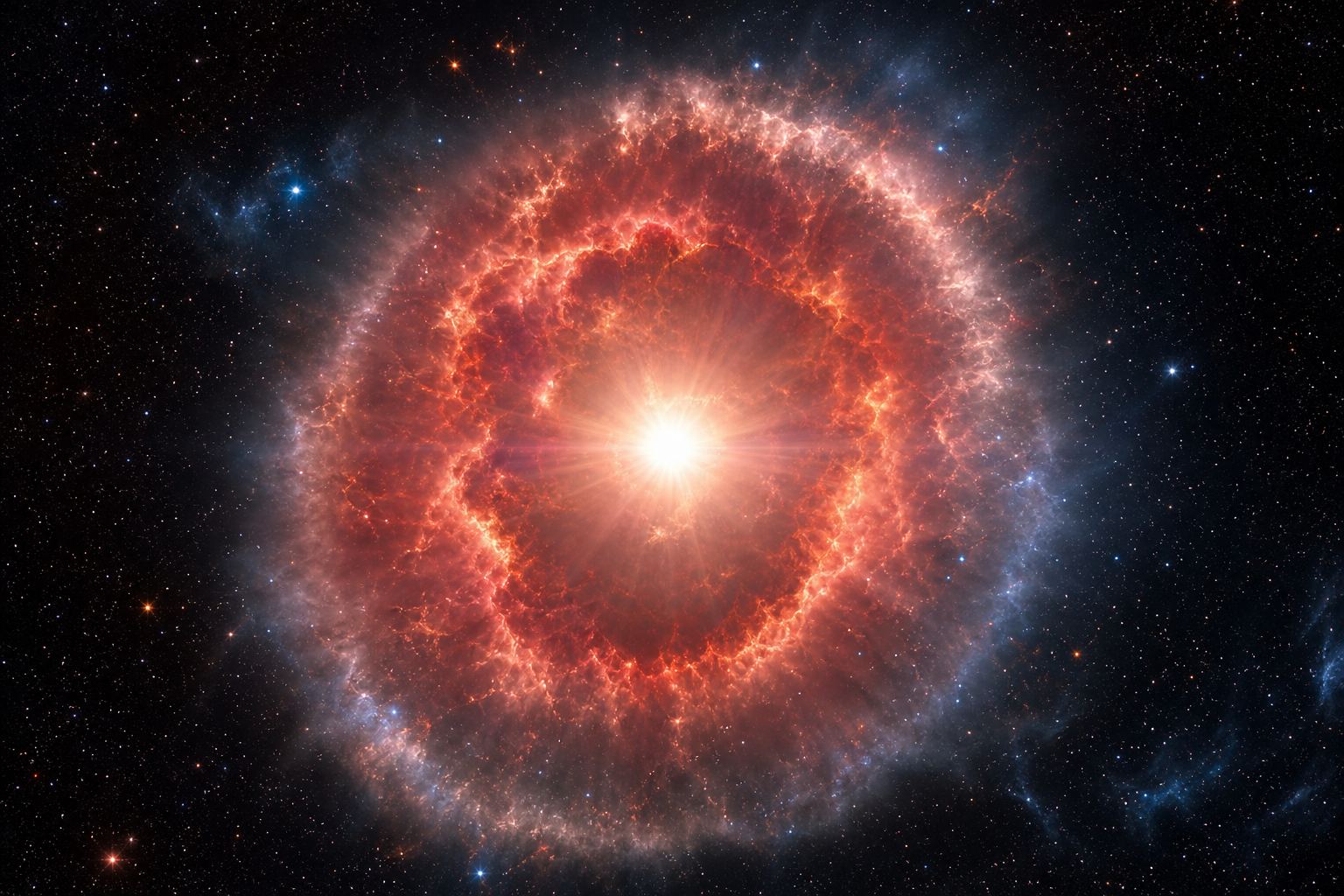
What remains is the bare core, hotter than a hundred thousand degrees. Its ultraviolet light makes the departing gas glow: a planetary nebula.
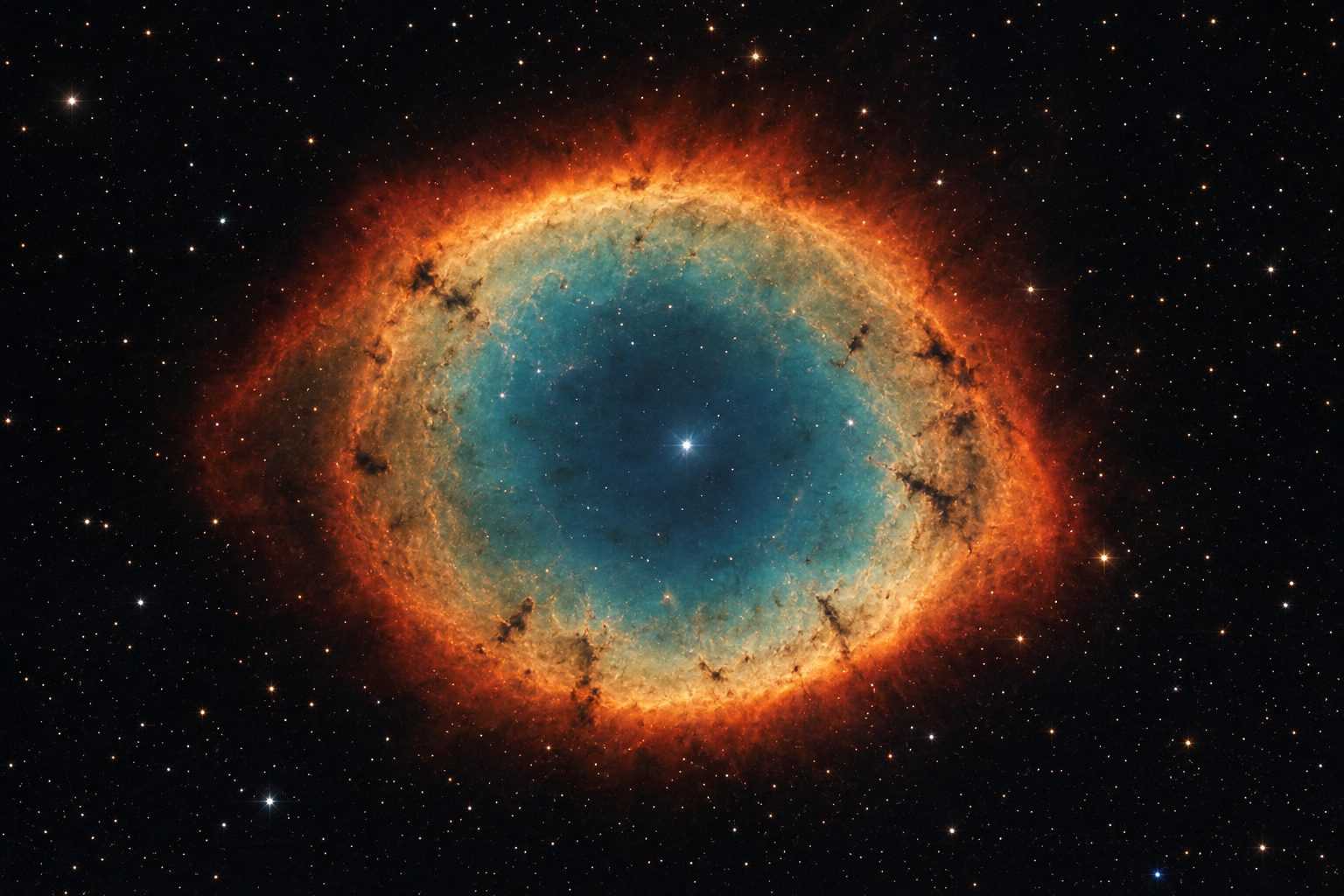
The name is historical: through small telescopes, some looked like the disc of a planet. The Ring Nebula in Lyra, 2,500 light-years away, is one.
It glows for only about ten thousand years. Would the Sun’s even be visible? The 2008 model said no.
But in 2018, new models by Krzysztof Gesicki, Albert Zijlstra and a colleague found the core heats up faster, so the Sun should make a faint one.
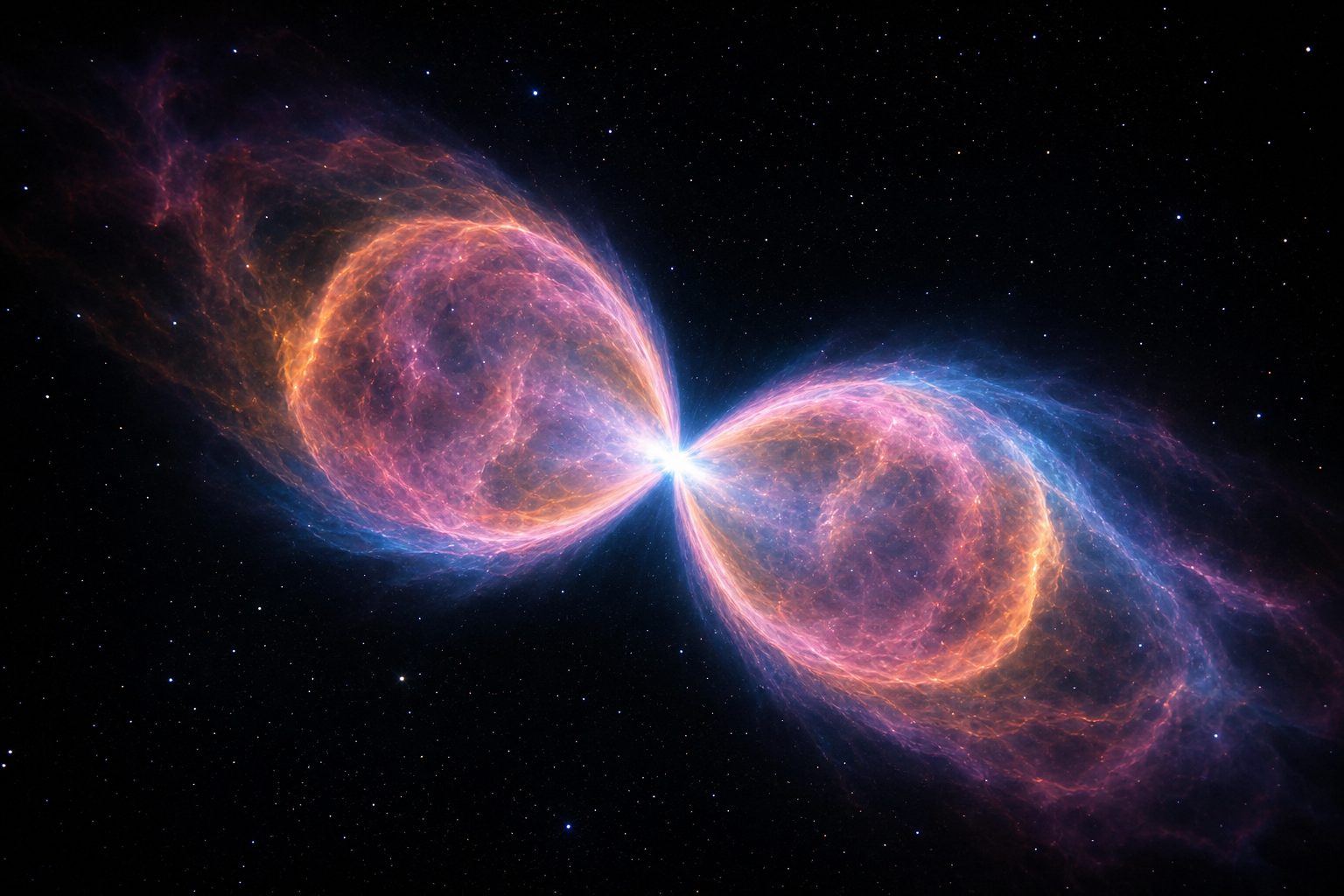
A ring-shaped nebula An illustration in the style of a ring nebula, not the Webb photograph: hot inner gas glows blue-green, cooler outer gas red. AI-generated illustration.Many shapes Planetary nebulae are not all rings: some blow out in two lobes, like an hourglass. AI-generated illustration.
~10,000 yr
how long the envelope glows (University of Manchester)
~3×
faster heating after the envelope is lost, in the 2018 models
A brief glow
Problem solved, after 25 years!Albert Zijlstra, University of Manchester, 2018, on ending a 25-year mismatch between models and the brightness of observed nebulae
Chapter V · The last breath
The planetary nebula
University of Manchester (7 May 2018): a dying star ejects an envelope of gas and dust that “can be as much as half the star’s mass”, exposing the hot core, which makes the envelope glow for around 10,000 years. For about 25 years models had suggested that stars below about twice the Sun’s mass could make only nebulae too faint to see; new models by Gesicki, Zijlstra and Miller Bertolami (Nature Astronomy, 2018) show the remnant heats about three times faster, so the Sun is almost exactly the lowest-mass star that still makes a visible, though faint, nebula. Schröder & Smith (2008) had concluded that no regular planetary nebula would form. Wikipedia (Sun): the ejected half of the Sun’s mass becomes a planetary nebula, leaving a white dwarf with about 54% of today’s mass. Chandra X-ray Observatory: William Herschel named them because through a small telescope some looked like giant planets such as Uranus; the name is historical and misleading. ESA/Webb (21 August 2023): the Ring Nebula, about 2,500 light-years away in Lyra, was formed by a star throwing off its outer layers. Wikipedia (Sun): the white dwarf starts at over 100,000 K.
Press Puff off the envelope in the scene. The pictures are illustrations, not the Webb images.
The 3D scenes are simplified teaching models, not to scale; sizes in between the quoted values are drawn schematically.
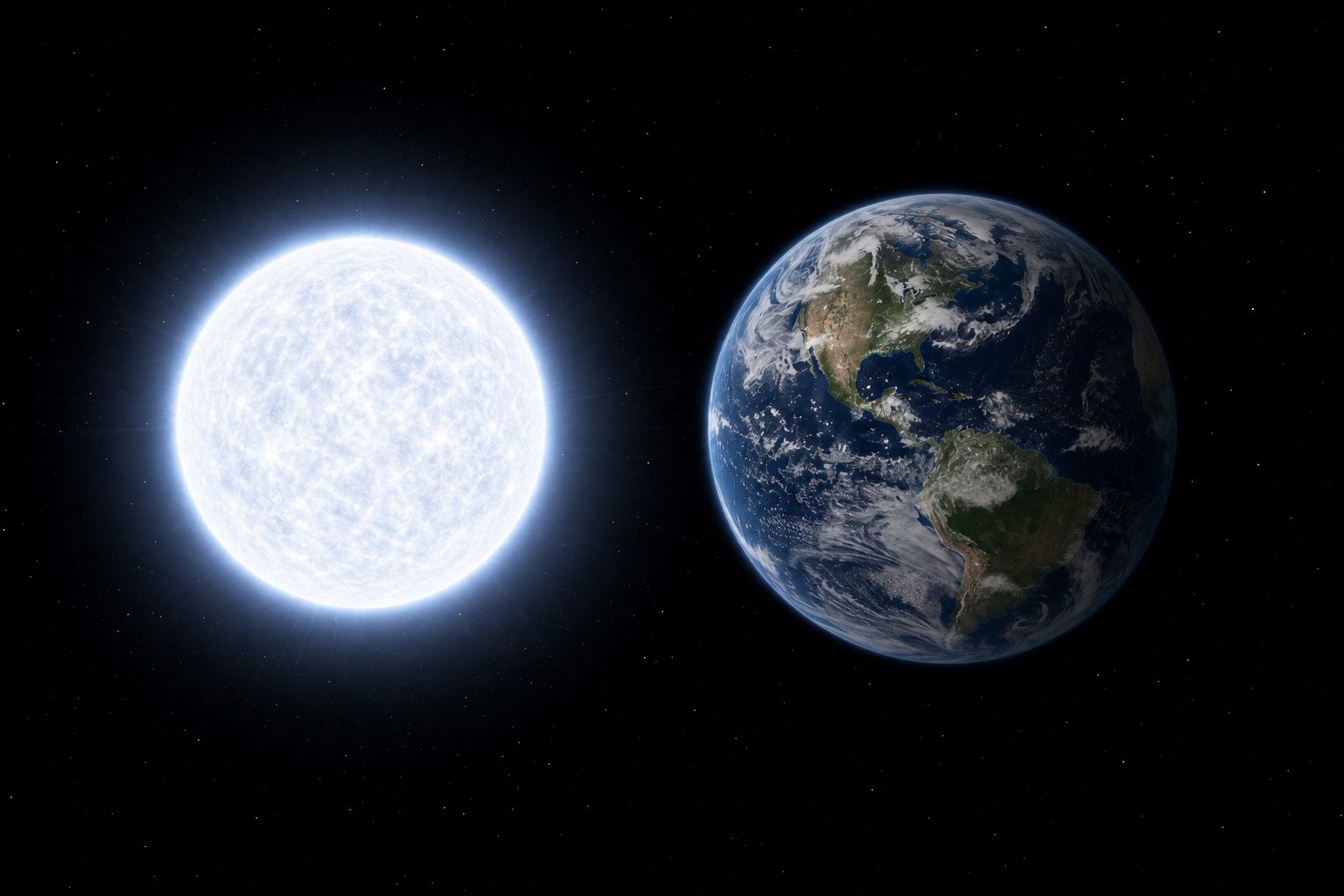
The core left behind is a white dwarf: about 54 percent of the Sun’s present mass, in a ball roughly the size of Earth.
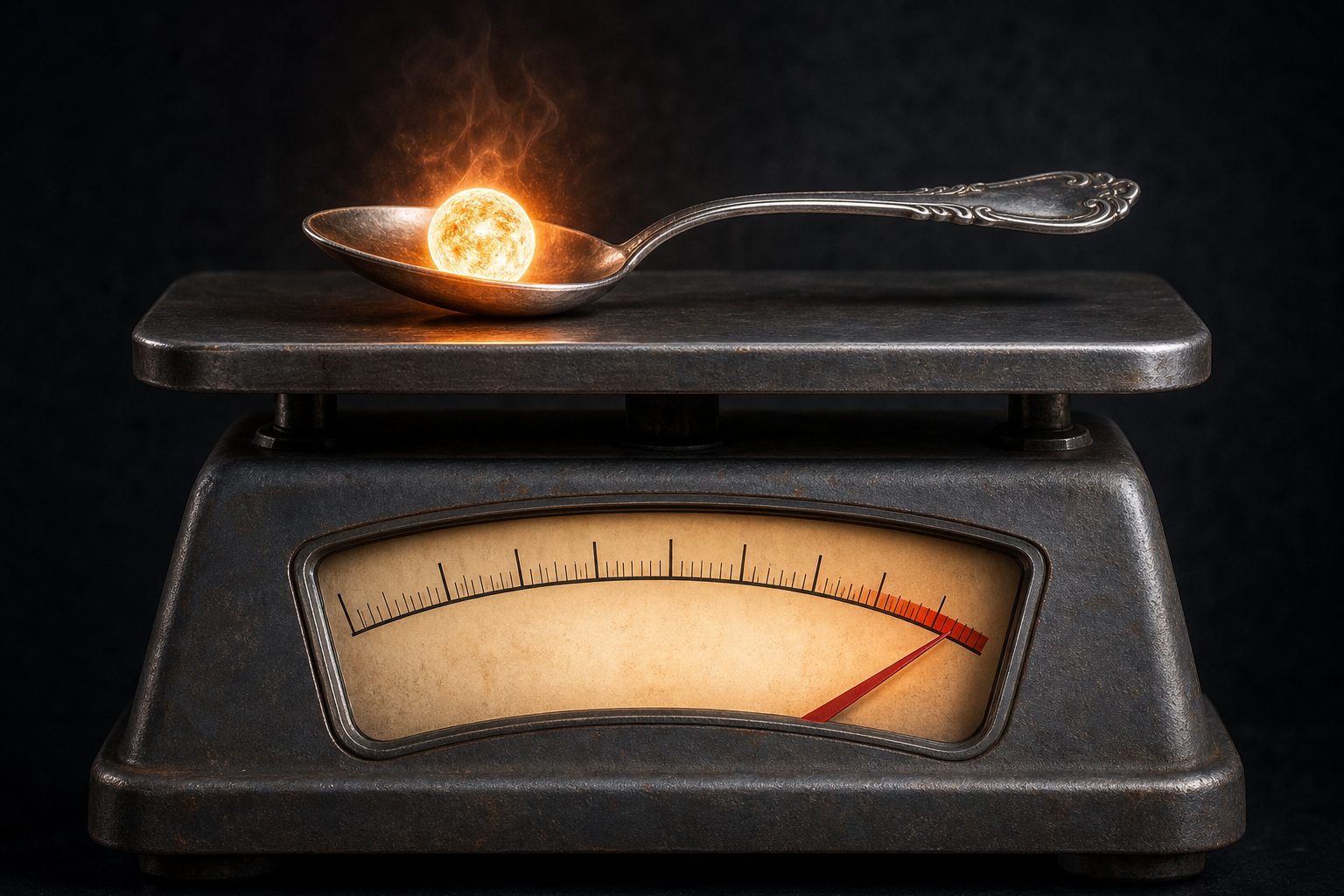
A teaspoon of it would weigh several tonnes. No fusion holds it up, but electron degeneracy pressure: no two electrons can share the same state, so they resist being packed closer.
There is a limit. Above about 1.4 solar masses, the Chandrasekhar limit, that pressure fails. The Sun’s remnant is far below it.
So the Sun will never explode as a supernova; that is the fate of far heavier stars, like the red supergiant Betelgeuse.
About Earth-sized Sirius B, one of the first white dwarfs studied (first seen in 1862), packs about the Sun’s mass into a radius of about 5,600 km, smaller than Earth’s 6,371 km (Joyce et al. 2018). AI-generated illustration.Dense Around 10⁹ kg per cubic metre, against about 5×10³ for Earth (Swinburne University). AI-generated illustration.
~1.4 M☉
Chandrasekhar limit (1.44 in HyperPhysics)
0.54 M☉
the Sun’s future white dwarf (Schröder & Smith)
~1.3 M☉
the most massive known (Wikipedia)
White dwarf masses (Swinburne University)Not for the Sun A supernova is the end of stars far more massive than the Sun, whose cores collapse instead of settling as white dwarfs. AI-generated illustration.
Chapter VI · The white dwarf
The white dwarf
Schröder & Smith (2008): final white dwarf mass 0.5405 M☉. Swinburne University (COSMOS): white dwarfs are roughly the size of Earth, and the more massive one is, the smaller it is; densities are around 10⁹ kg/m³, so a teaspoon would weigh several tonnes; when the core can no longer fuse, it contracts until quantum-mechanical electron pressure stops gravity; above the Chandrasekhar limit of about 1.4 solar masses that pressure cannot support the star; the lightest observed is about 0.15 solar masses. HyperPhysics (Georgia State University): electron degeneracy follows from the Pauli exclusion principle; the limit is about 1.44 solar masses; Sirius B was first seen in 1862. Joyce et al. (2018): Sirius B has 1.017 solar masses and a radius of 0.00803 R☉, about 5,600 km. Wikipedia (White dwarf): 40 Eridani B, recognised in 1910, was the first white dwarf identified; most white dwarfs have 0.5–0.7 solar masses, and the most massive known reach about 1.33.
Press 0.6, 1.0 or 1.4 solar masses in the scene. The radius curve is a simplified textbook approximation.
The 3D scenes are simplified teaching models, not to scale; sizes in between the quoted values are drawn schematically.
A white dwarf starts out hotter than a hundred thousand degrees, and then it simply cools, like an ember, shining on stored heat.
Its surface is so small that the heat leaks away slowly. Even the oldest white dwarfs in our galaxy are still a few thousand degrees.
Over trillions of years, the Sun’s white dwarf will fade toward a cold, dark body called a black dwarf.
None exists yet: the universe is still too young.
newborn (Wikipedia, Swinburne)
>100,000
Sirius B (HyperPhysics)
~26,000
the oldest known (Swinburne)
a few thousand
White dwarf surface temperatures
Toward a black dwarf An imagined white dwarf after billions of years, cooled to an orange glow. The black dwarf after it is hypothetical. AI-generated illustration.
~13.7 bn yr
age of the universe given by Swinburne University
0
black dwarfs known
Too young for black dwarfs
Chapter VI · The white dwarf
Cooling forever
Swinburne University (COSMOS): young white dwarfs start above 100,000 K and shine only by residual heat; with no energy source they cool over hundreds of billions of years, slowly because their surface area is small; the universe is about 13.7 billion years old, so even the oldest white dwarfs are still a few thousand K; black dwarfs remain hypothetical. Wikipedia (Sun): the Sun’s white dwarf will fade over trillions of years toward a hypothetical black dwarf. HyperPhysics: Sirius B’s spectrum corresponds to about 26,000 K.
Press Fast-forward in the scene. The colours and pace are illustrative.
The 3D scenes are simplified teaching models, not to scale; sizes in between the quoted values are drawn schematically.
Do planets survive any of this? White dwarfs hold a clue. Their gravity is so strong that elements heavier than helium, like iron, should quickly sink out of sight.
Yet a quarter to a half of white dwarfs show such elements on their surfaces. The best explanation is rocky material falling in.
In 2015, Andrew Vanderburg’s team caught it happening: debris crossing WD 1145+017 every four and a half hours, blocking up to 40 percent of its light.
And in 2026, Korth’s team reported debris still circling another, WD 1054-226, in a steady pattern after six years.
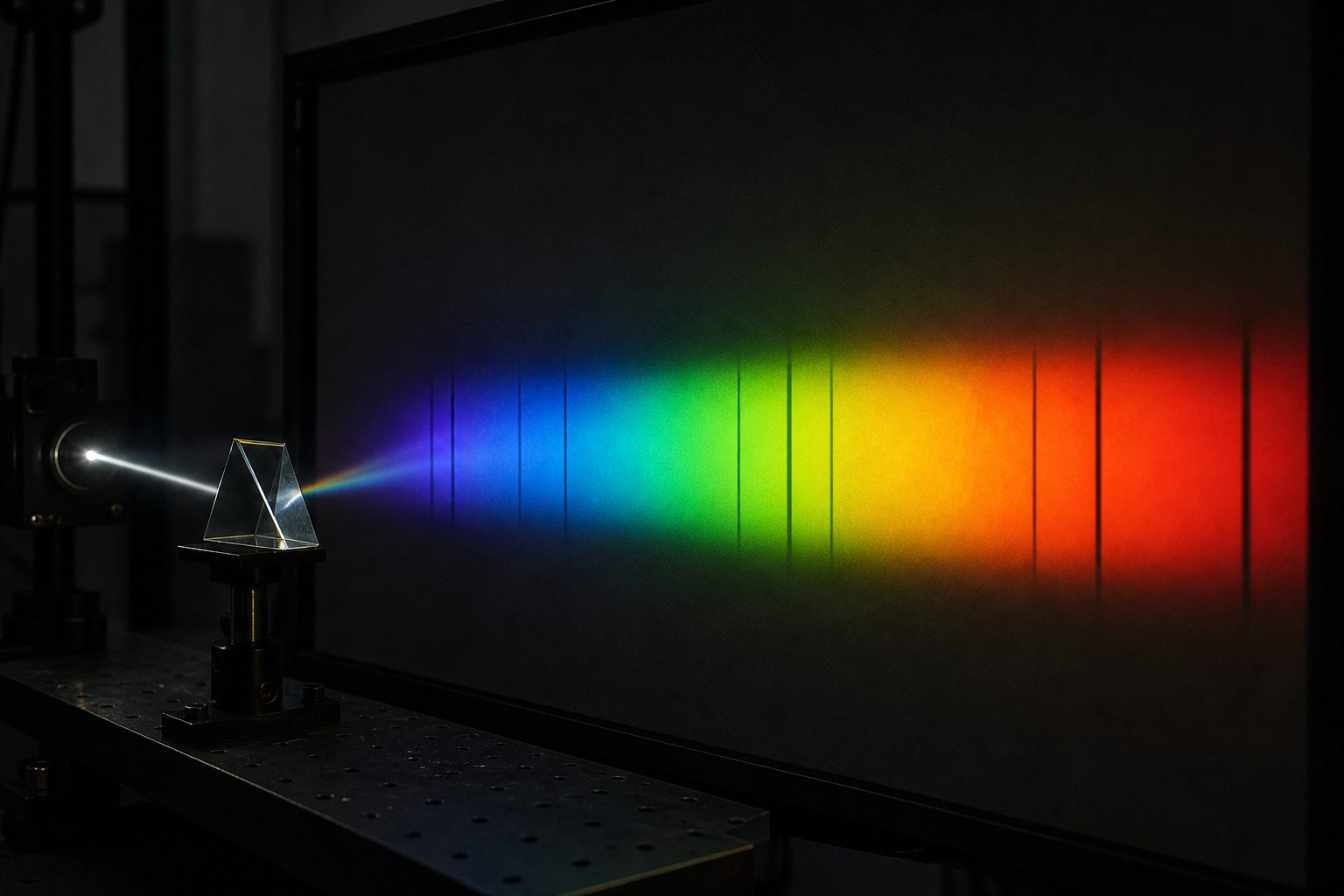
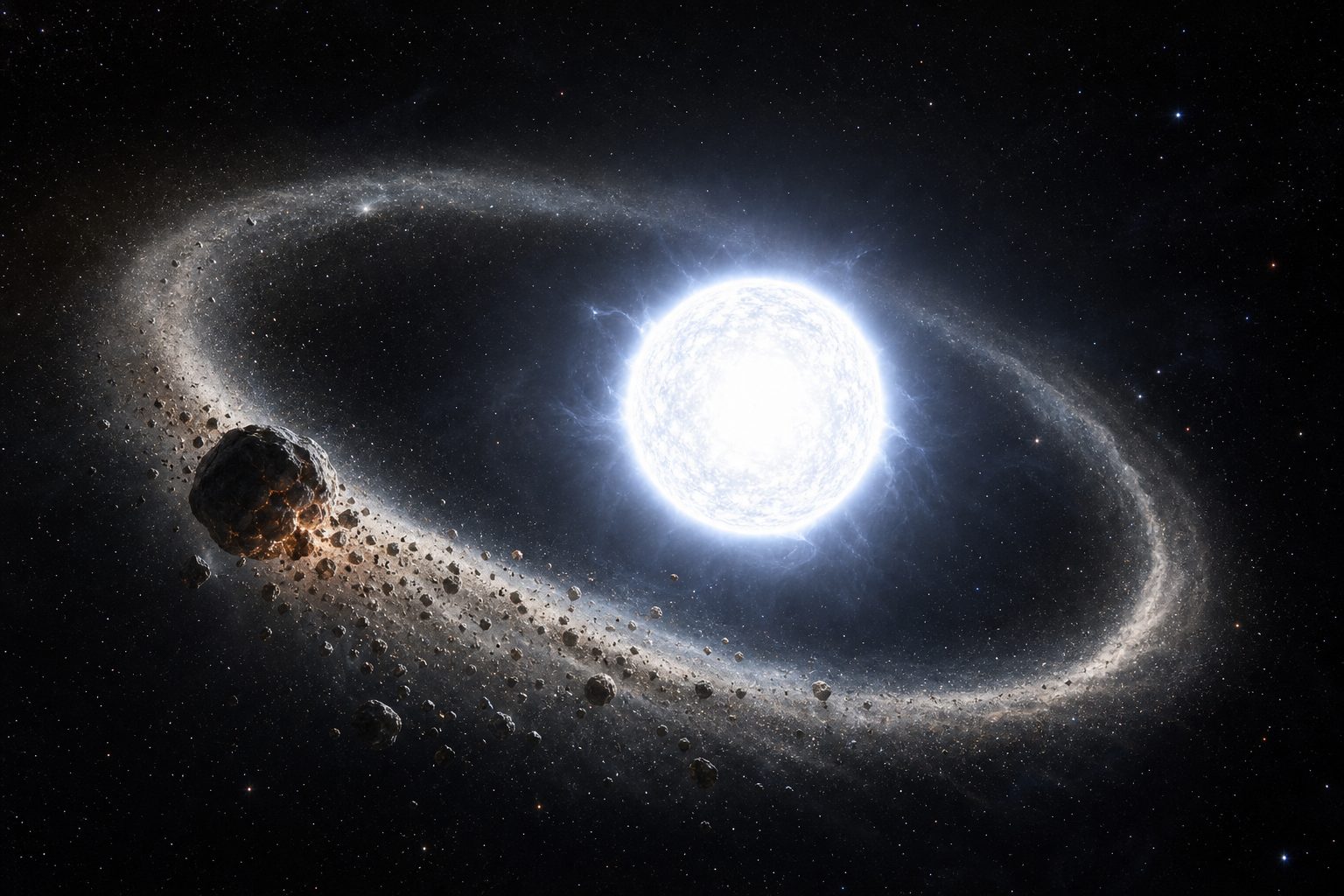
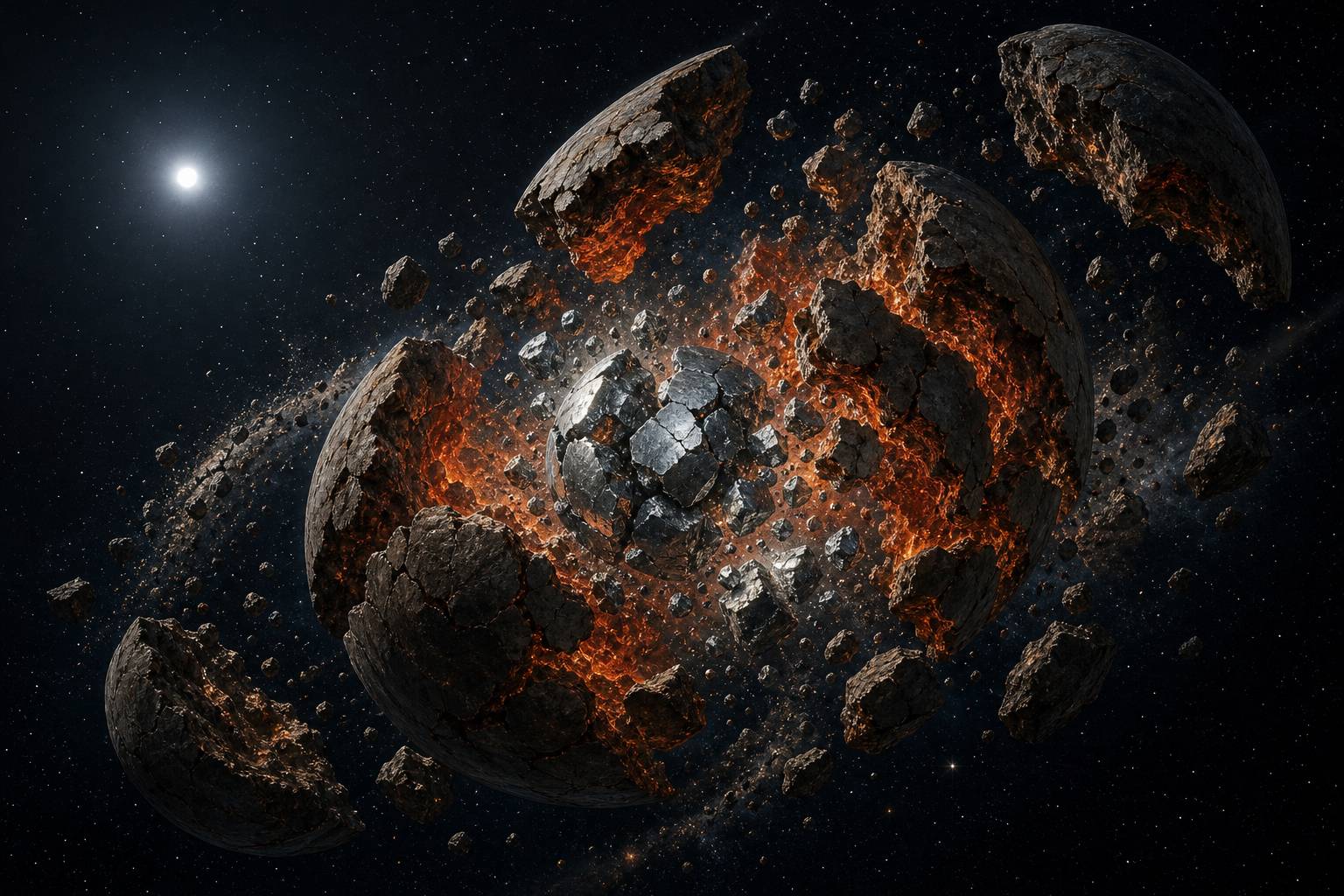
Reading the surface Dark lines in a spectrum betray elements; in WD 1145+017 they include magnesium, aluminium, silicon, calcium, iron and nickel. AI-generated illustration.A rock coming apart Close to a white dwarf, tides can pull a rocky body apart into a trail of dust, like a comet’s tail. AI-generated illustration.
4.5 h
strongest transits repeat every ~4.5 hours
≤40%
of the starlight blocked
WD 1145+017 (Nature, 2015)
25.01 h
main dimming period
~6 yr
stable over the whole baseline
WD 1054-226 (A&A, 2026)
Chapter VII · What survives
Polluted white dwarfs
Vanderburg et al. (Nature 526, 546, October 2015): at least one, probably several, disintegrating planetesimals transit WD 1145+017 with periods of about 4.5 to 4.9 hours, blocking up to 40% of the light, with asymmetric, comet-like profiles; the star’s spectrum shows magnesium, aluminium, silicon, calcium, iron and nickel, and a dusty disc surrounds it; roughly a quarter to a half of white dwarfs show elements heavier than helium even though these should sink quickly. Korth et al. (Astronomy & Astrophysics 709, A27, 2026): the 25.01-hour and 23.1-minute signals of WD 1054-226 persist over a six-year baseline, consistent with an opaque, edge-on debris ring.
Press Send in a rock in the scene.
The 3D scenes are simplified teaching models, not to scale; sizes in between the quoted values are drawn schematically.
Back to WD J1328−1450. Twenty-one other white dwarfs have known gas discs that look like single rings. This one shows two.
The inner ring runs from about 100,000 to 240,000 kilometres from the star; the outer from 375,000 to over 1.3 million. For scale, the Sun’s radius is about 700,000.
The inner ring is rich in magnesium; the outer has far less. The team’s explanation is two surviving bodies, each stirring its own ring.
But the bodies have not been seen, and the rings might instead come from different layers of one shattered world.
Two rings of gas Each ring orbits at its own speed; together they split each spectral line into four peaks instead of two. AI-generated illustration.
0.1–0.24 M km
inner ring, from the star (M km = million km)
0.375–1.3+ M km
outer ring
Ring sizes (University of Warwick)
seen: two gas rings, stable over two years
seen: more magnesium in the inner ring
inferred: a small inner body and a Pluto-to-Moon-sized outer one
open: two worlds, or two layers of one
Reported, and not yet knownOne world or two? A broken planet has a metal-rich core and a rocky crust; debris from different layers could differ in magnesium. AI-generated illustration.
Chapter VII · What survives
A double ring
University of Warwick (27 October 2026): inner ring about 100,000 to 240,000 km from the star, outer ring about 375,000 km to more than 1.3 million km; observations from 2021 to 2023 show the structure stable for more than two years; the inner ring is rich in magnesium and the outer has far less; the proposed cause is two surviving bodies, the inner no larger than a typical asteroid (a few km in the text, “a few tens of kilometres” in an image caption) and the outer possibly as large as Pluto or even the Moon. Universe Today: 21 other gas-disc white dwarfs show double-peaked lines; the inner body would need internal strength to avoid being torn apart; it is “far from proven” that two different planets are involved, since the rings could come from the core and crust of one. Nautilus: the two-body explanation is the “most likely”, not confirmed.
Press Inner ring, Outer ring or Both in the scene. Bodies and ring thickness are drawn schematically.
The 3D scenes are simplified teaching models, not to scale; sizes in between the quoted values are drawn schematically.
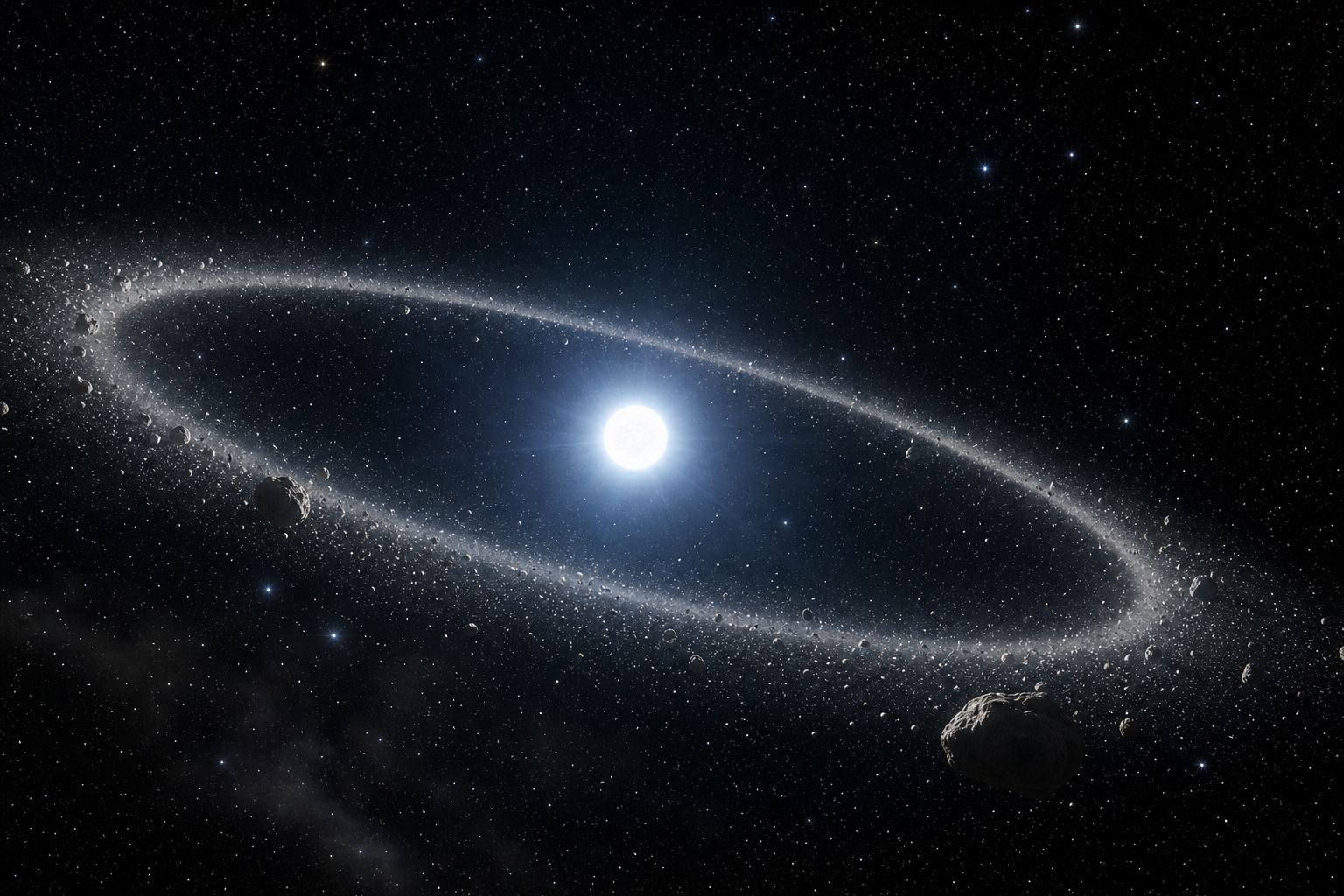
Around dead stars like this one, the remains of planets may still circle, in rocks, rings and dust: a record of how planetary systems end.
For the Sun, the models agree on the outline: a red giant, a flash, a last puff of gas, then a white dwarf cooling for ever.
Earth’s own fate is still open, and billions of years away; long before then, the brightening Sun will have changed our planet.
What remains A white dwarf with a ring of rocky debris, the kind of system seen around WD 1145+017 and WD J1328−1450. AI-generated illustration.
in ~1 bn yr about 10% brighter; Earth too hot (Schröder & Smith)
in ~5 bn yr core hydrogen runs out
in ~7.6 bn yr red giant peak, then the helium flash
lasts ~100 Myr calm helium burning
lasts ~20 Myr second giant grows, then four thermal pulses
glows ~10,000 yr a planetary nebula
over trillions of yr the white dwarf fades
The Sun’s future (models): when it starts, and how long it lasts
settled: red giant, then white dwarf, no supernova
debated: whether Earth is engulfed
debated: how visible the Sun’s nebula will be
new: two rings round WD J1328−1450, still being tested
What is settled, and what is not
Epilogue · Sources
Sources
Every fact in this film comes from the sources below. Times and sizes for the Sun’s future come from stellar-evolution models, chiefly Schröder & Smith (2008), and differ somewhat between models; Earth’s fate and the brightness of the Sun’s future planetary nebula are debated, and both sides are given. The WD J1328−1450 result is a single new study; the two bodies are the authors’ interpretation. The chapter stills and pictures are AI-generated illustrations, not photographs of real objects, and the nebula pictures are not the Webb images. The 3D scenes are simplified teaching models, not to scale.