About 4.6 billion years ago a cold cloud of gas and dust collapsed, spun up into a flat disk and built the Sun and its planets. This film follows the idea from Kant and Laplace to ALMA's image of HL Tauri, shows how uranium–lead dating gives the oldest solids an age of 4,567 million years, explains the snow line, how dust became planetesimals, how Jupiter and Saturn grabbed their gas before it was cleared, how the giants may have migrated (the Grand Tack and Nice models), where the asteroid and Kuiper belts came from, the giant impact that most likely made the Moon, and what meteorites and the Ryugu and Bennu samples reveal.
Interactive 3D film10 min4.6 billion years agoPublished 25 October 2026
Half a gram of dust from asteroid Bennu, brought home by NASA's OSIRIS-REx, holds material from two places that should never have met: near the young Sun, and far out in the cold.
Its isotopes, atoms of one element with slightly different weights, act as a chemical fingerprint of where material formed. A 2026 study says Bennu's do not clearly match either region.
To see why that matters, we need the whole story: how a cold cloud became the Sun, eight planets and the rubble in between.
Bennu is a hybrid: the material does not clearly match either the inner or the outer Solar System.Maria Schönbächler, ETH Zurich, lead author (Sep 2026)
Same element, slightly different weights
The mix differs with birthplace
So it works like a fingerprint
Isotopes, simply
½ g
of Bennu sample analysed
Fe · Ti · Cr
iron, titanium and chromium isotopes; the Jupiter-mixing idea is a proposal
One new study (Science Advances, Sep 2026)
A cloud collapses and spins into a disk
Dating the oldest solids
Rock, ice and the giant planets
The Moon, the belts and the samples
In this film
Prologue
A hybrid asteroid
ETH Zurich via Astrobiology.com (24 Sep 2026): a team led by Maria Schönbächler measured iron, titanium and chromium isotopes in about half a gram of Bennu sample (Science Advances, “Nucleosynthetic constraints on the origin of Bennu and CI-like asteroids”). They conclude that the most likely birthplace of Bennu, Ryugu and the CI meteorites was close to the water-ice line, and they propose that Jupiter’s gravity may have mixed fine dust from the inner and outer Solar System there. An earlier study (Nature Astronomy, August 2025) had concluded that Bennu’s parent asteroid likely formed in the outer Solar System, possibly beyond Saturn, while holding high-temperature material from near the Sun; the new study challenges that outer origin.
This is a single new result, and the Jupiter-mixing idea is the authors’ proposal. The film treats it as news, not as established fact.
The 3D scene is a schematic teaching model: distances are compressed (drawn on a square-root scale), planets and particles are enlarged, and motions are speeded up.
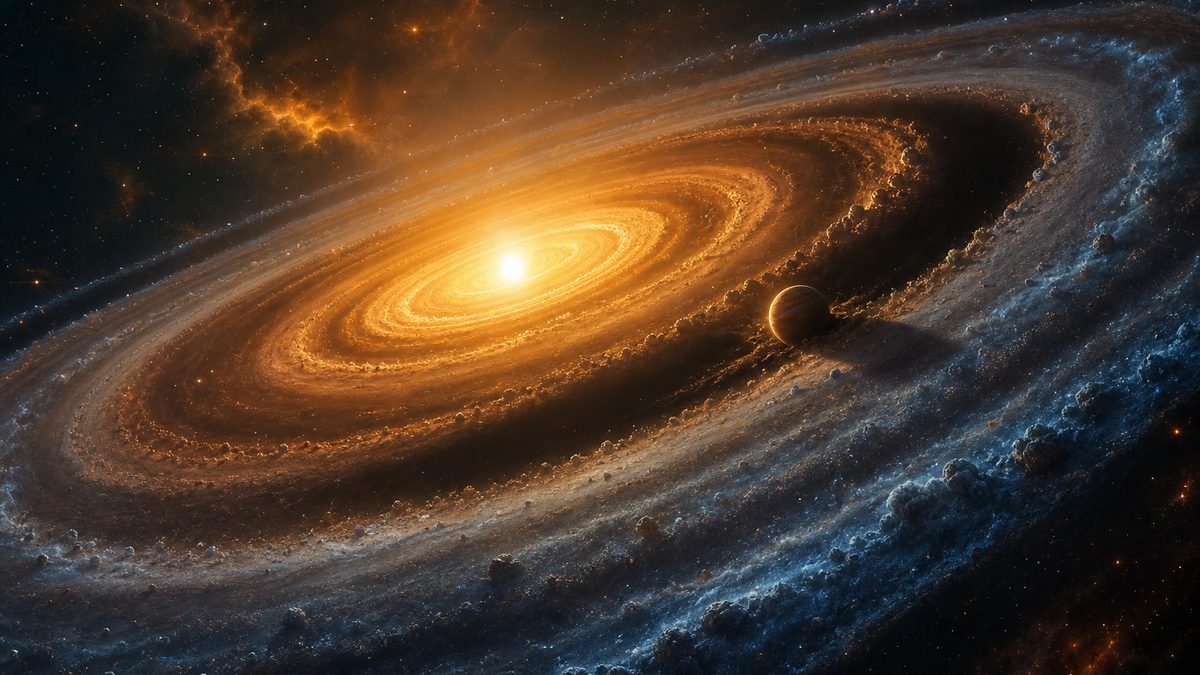
The basic idea is more than 250 years old. In 1755 the philosopher Immanuel Kant proposed that the Sun and planets grew from a spinning cloud of gas and dust that flattened into a disk.
In 1796 Pierre-Simon Laplace published a similar picture. Both were explaining a striking pattern: every planet circles the Sun in the same direction, in nearly the same flat plane.
This nebular hypothesis, from nebula, a cloud, was long doubted. Disks around young stars brought it back.
Theory before evidence Kant worked from Newton’s gravity and the planets’ orbits, with no picture of a real disk. AI-generated illustration.
1755 Kant: a spinning cloud flattens into a disk
1796 Laplace: a slowly rotating cloud contracts
1980s → Disks seen around young stars
An old idea
All planets orbit the same way
Orbits lie in nearly one plane
Rocky worlds inside, giants outside
What the model must explain
Chapter I · The cloud
The nebular hypothesis
StarDate (University of Texas): soon after finishing his studies in 1755, Kant described in Universal Natural History and Theory of the Heavens a spinning cloud of gas and particles that flattened into a disk in which material clumped into planets. NCAR HAO: Laplace published his version in 1796 in Exposition du système du monde, the contraction of a large, slowly rotating cloud of gas. Freedman et al., Universe: both were struck that the planets orbit in the same direction and nearly the same plane. Wikipedia (formation of the Solar System): the model was long criticised, largely because it could not explain why the Sun has so little of the system’s spin, and it returned after disks around young stars were studied from the early 1980s.
The 3D scene is a schematic teaching model: distances are compressed (drawn on a square-root scale), planets and particles are enlarged, and motions are speeded up.
Picture a cold cloud of gas and dust between the stars, about 4.6 billion years ago. By mass it was roughly 98 percent hydrogen and helium; heavier elements, including the dust, made up the rest.
Something made one dense patch collapse under its own gravity, possibly the shock wave of a nearby exploding star, though nobody knows for sure.
Falling gas heated up and piled into the centre. That hot, dense core became the young Sun, which ended up with more than 99.8 percent of all the mass.
Hydrogen and helium
≈ 98%
Everything heavier, incl. dust
≈ 2%
What the cloud was made of (by mass)
Gravity wins once a patch is dense and cold enough
A nearby supernova may have given the push
The trigger is not known for certain
Why it collapsed
> 99.8%
in the Sun
< 0.2%
planets, moons, asteroids, comets
Where the mass went
Chapter I · The cloud
The collapse
Wikipedia (formation of the Solar System): the region that became the Sun had just over one solar mass and was about 98% hydrogen and helium by mass, 2% heavier elements. NASA Space Place: the cloud collapsed about 4.6 billion years ago, “possibly” because of the shock wave from a nearby exploding star, and the young Sun took up more than 99% of the material. HyperPhysics: the Sun holds over 99.8% of the known Solar System’s mass. Universe (Freedman et al.): infalling material sped up and its energy turned into heat at the centre, forming a protosun.
The 3D scene is a schematic teaching model: distances are compressed (drawn on a square-root scale), planets and particles are enlarged, and motions are speeded up.
The cloud was turning very slowly. As it shrank, it spun faster, the way a figure skater speeds up by pulling in her arms. Physicists call this conservation of angular momentum.
Spin resists collapse perpendicular to the spin axis, but not along it. So within about a hundred thousand years the cloud flattened into a disk around the young Sun.
That is why the planets orbit one way, in one plane. Switch the spin off, and the same cloud simply falls into a ball.
L=mvr=constant
L
angular momentum
v
speed around the axis
r
distance from the axis
Halve the distance and the speed must double.
≈ 100,000 yr
to flatten into a disk
≈ 200 AU
across the young disk (1 AU = Earth–Sun distance)
Collapse to disk
No spin: everything falls to the centre
Spin: a flat, turning disk forms
Try it
Chapter I · The cloud
Why a disk?
Universe (Freedman et al.): the nebula had a slight overall rotation that increased as it contracted, like a figure skater pulling in her arms. The spin resisted contraction perpendicular to the rotation axis but not along it, and after roughly 100,000 years left a flattened, rotating protoplanetary disk, which explains why the planets orbit in the same direction and nearly the same plane. Wikipedia: the collapse took about 100,000 years and produced a disk roughly 200 AU across.
Try it: the buttons replay the collapse with and without rotation. The particle motion is schematic.
The 3D scene is a schematic teaching model: distances are compressed (drawn on a square-root scale), planets and particles are enlarged, and motions are speeded up.
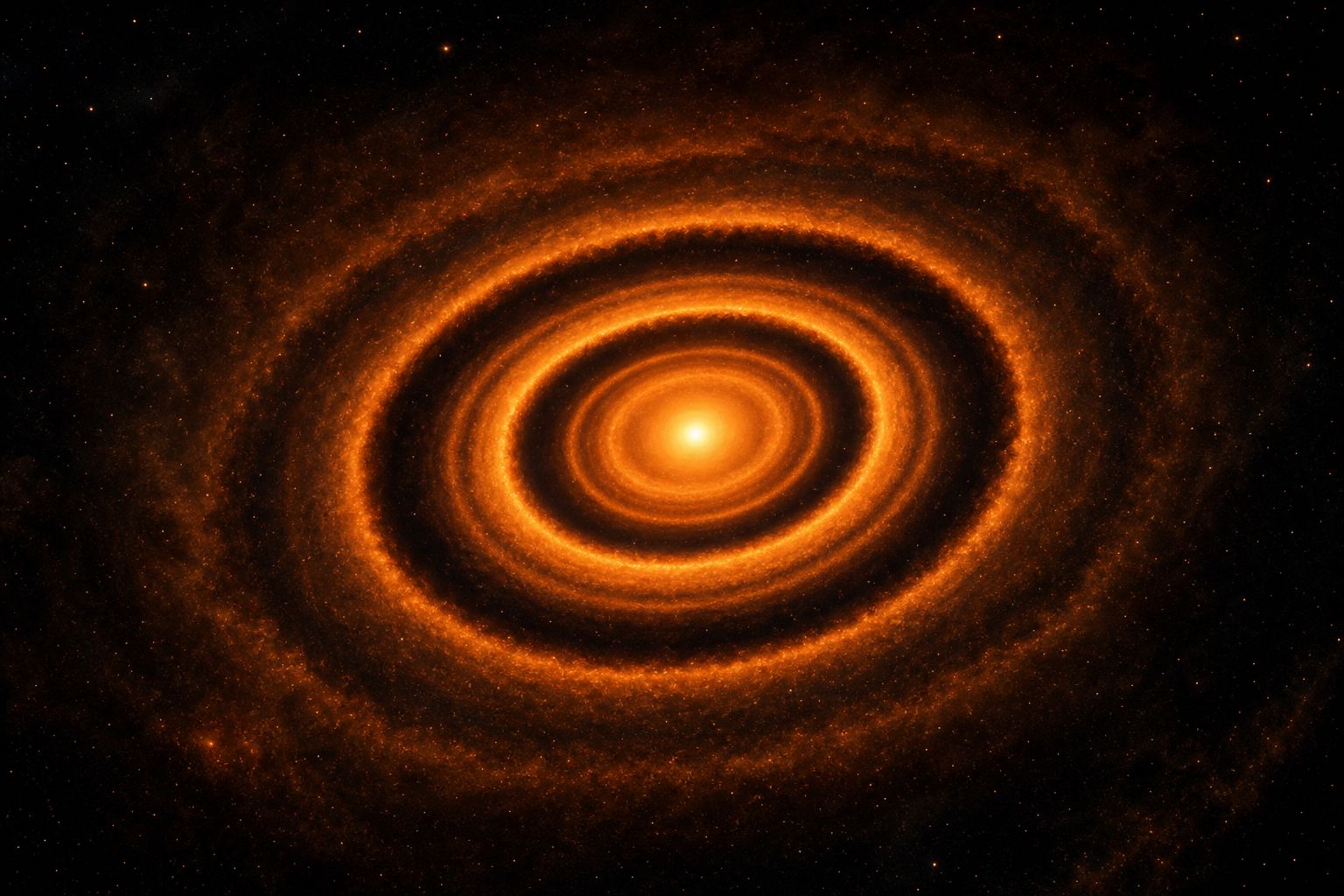
For a long time this was theory. Then, in November 2014, the ALMA radio telescope array released a sharp image of the disk around a young star, HL Tauri, about 450 light-years away.
The star is no more than a million years old, yet its disk shows bright rings separated by dark gaps.
Astronomers say the gaps are almost certainly being carved by young planet-like bodies: a living view of the stage our own Solar System passed through.
≈ 450 ly
distance from Earth
≤ 1 Myr
age of the star
15 km
between the farthest ALMA antennas used
HL TauriRings and gaps An artist’s impression of a ringed disk like HL Tauri’s, not the ALMA image itself. AI-generated illustration.
These features are almost certainly the result of young planet-like bodies that are being formed in the disc.Stuartt Corder, ALMA Deputy Director, 2014
Chapter II · Disks and clocks
HL Tauri
ESO release eso1436 (6 November 2014): ALMA imaged the planet-forming disc around HL Tauri, about 450 light-years away and no more than a million years old, showing several bright rings separated by gaps. The observations used antennas up to 15 km apart and reached about 35 milliarcseconds, better than Hubble routinely achieves. ALMA’s Stuartt Corder: the features are “almost certainly the result of young planet-like bodies that are being formed in the disc.”
The rings in the 3D scene are drawn to suggest HL Tauri’s pattern; they are not a map of it.
The 3D scene is a schematic teaching model: distances are compressed (drawn on a square-root scale), planets and particles are enlarged, and motions are speeded up.
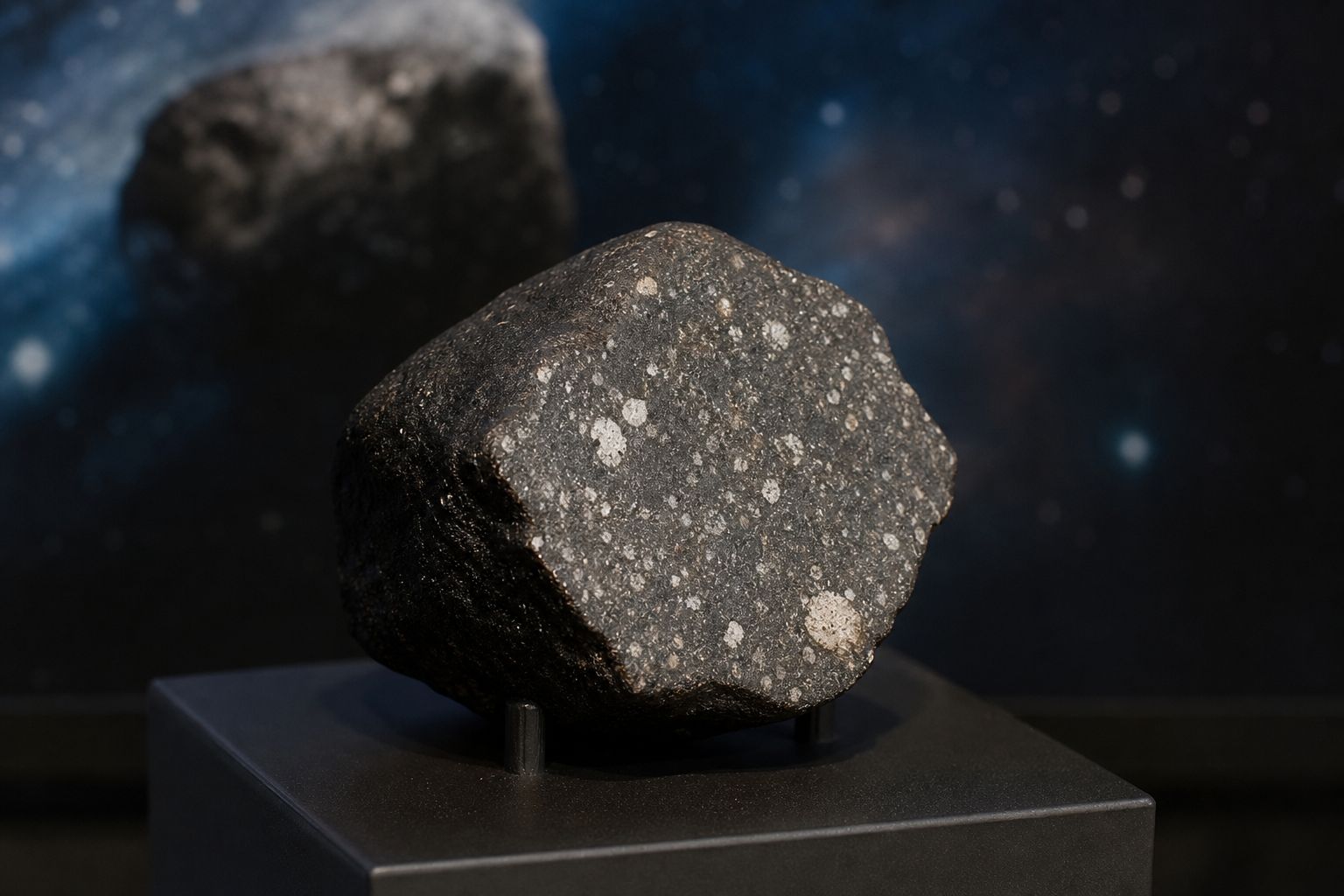
When did our own disk form? The oldest solids we have are small white grains inside some meteorites, called CAIs. They formed in gas hotter than about a thousand degrees Celsius.
Their clock is uranium. It decays into lead at a steady rate: every 4.5 billion years, half of the uranium-238 is gone. Measuring the lead that built up gives an age.
Lead dating of these grains gives about 4,567 million years: the Solar System's starting point. Press the half-life button to watch the clock run.
CAIs in a meteorite Pale, irregular inclusions from under a millimetre to a few centimetres across, set in dark rock. AI-generated illustration.N=N0(21)t/t1/2
N
uranium atoms left
t1/2
half-life: 4.5 billion years for U-238, 0.70 billion for U-235
4,567.3 Myr
Myr = million years; ± 0.16 Myr (four CAIs)
4.53–4.58 Gyr
Gyr = billion years; over 70 dated meteorites (USGS)
Oldest solids, by lead–lead dating
Chapter II · Disks and clocks
Dating the beginning
Wikipedia (CAI): calcium–aluminium-rich inclusions, from under a millimetre to a few centimetres across, are found in carbonaceous chondrite meteorites and condensed from gas hotter than about 1,300 K; lead–lead dating of four of them gives 4,567.30 ± 0.16 million years (Amelin et al. 2010; Connelly et al. 2012), often taken as the start of the Solar System; some later work suggests slightly older, about 4,568 million. Wikipedia (lead–lead dating): uranium-238 decays to lead-206 with a half-life of about 4.5 billion years, uranium-235 to lead-207 with about 0.70 billion. USGS: more than 70 dated meteorites formed between 4.53 and 4.58 billion years ago.
Try it: each press of the button lets one half-life (4.5 billion years for U-238) pass. Atoms decay at random, but half of them are gone after each half-life on average. The grid is an illustration: the Solar System has existed for only about one U-238 half-life.
The 3D scene is a schematic teaching model: distances are compressed (drawn on a square-root scale), planets and particles are enlarged, and motions are speeded up.
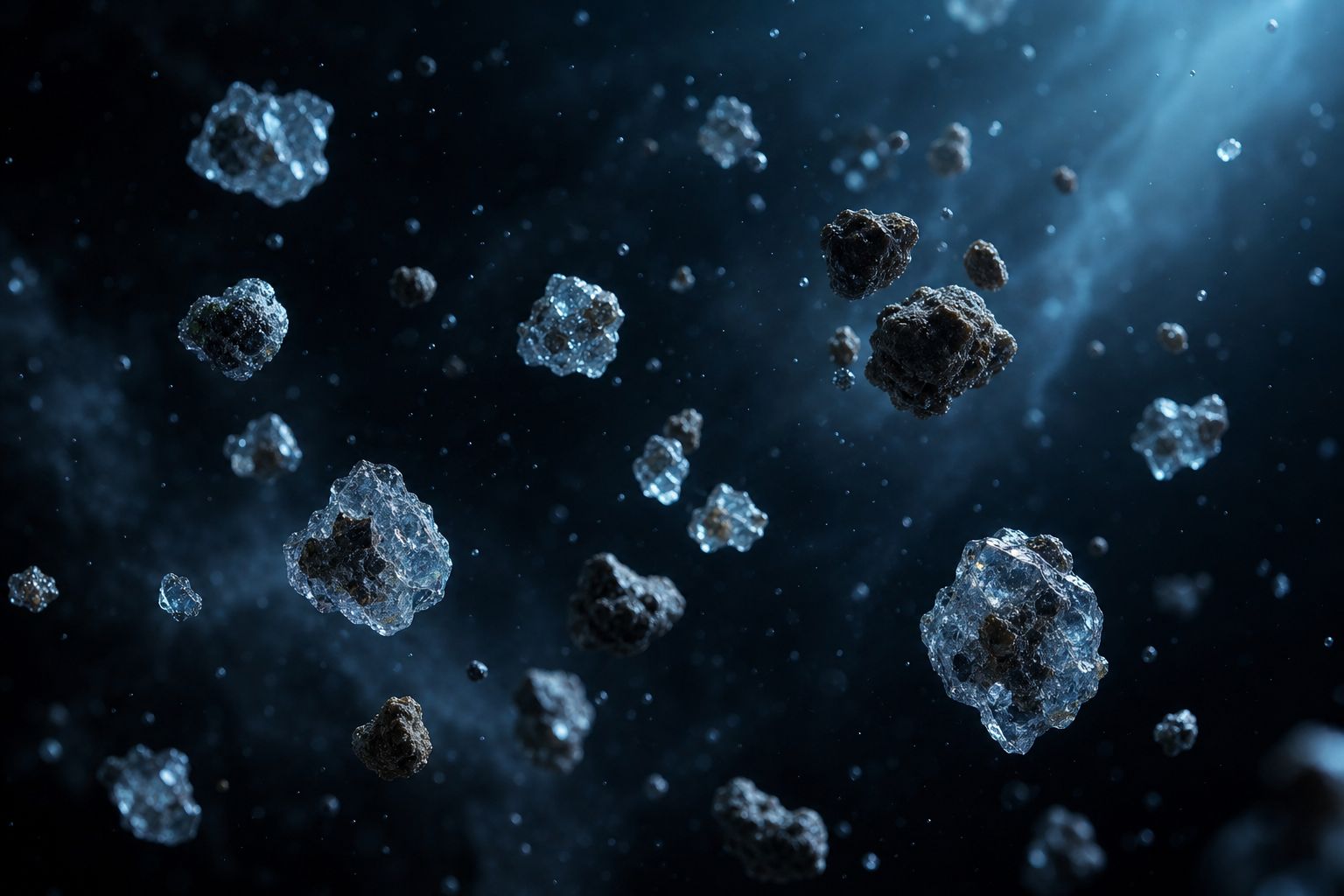
Near the young Sun the disk was hot; far out it was freezing. Somewhere between lay the snow line, beyond which water could freeze into ice grains.
Inside it, only rock and metal stayed solid, so the inner planets were built of stone. Outside, ice joined the dust, and there was far more solid material to build with.
Icy outer asteroids and dry inner ones put the line at about 2.7 times Earth's distance from the Sun when the first building blocks formed. The 2026 team places Bennu's birthplace near this line.
Dust with a coat of ice Beyond the line, grains wear water ice; inside it they stay bare rock. AI-generated illustration.
Hayashi 1981
170 K
Podolak & Zucker 2004
143–150 K
Water freezes out at (estimates differ)
≈ 2.7 AU
from the Sun when the first building blocks (planetesimals) formed; it moved over time
1.5 · 5.2 AU
Mars · Jupiter today
The snow line, inferred from asteroids
Chapter III · Rock and ice
The snow line
Wikipedia (frost line, astrophysics): estimates of the temperature at which water ice condenses in the disk vary with the model, for example 170 K at 2.7 AU (Hayashi 1981) or 143–150 K at about 3 AU (Podolak and Zucker 2004). Martin and Livio (2012) infer from the asteroid belt, with icy outer asteroids and a largely waterless inner region, that the line was at about 2.7 AU when planetesimals formed. Beyond it, “many more solid grains” are available for planets. NASA Space Place: rocky planets formed near the Sun where it was too hot for ices; gas and ice collected farther out into the giants. NASA fact sheet: Mars orbits at 1.52 AU, Jupiter at 5.20 AU.
Try it: switch between a temperature view and a view of rocky and icy grains. Colours are schematic.
The 3D scene is a schematic teaching model: distances are compressed (drawn on a square-root scale), planets and particles are enlarged, and motions are speeded up.
Planets were built from dust. Microscopic grains collided and stuck, growing into fluffy clumps and then pebbles a few millimetres to centimetres across.
Pebbles drift and break easily, so the next step is still being worked out. A leading idea: crowded pebbles collapsed under their own gravity into planetesimals, up to hundreds of kilometres wide.
Then gravity took over: the biggest bodies swept up the rest and became protoplanets. Press collide and watch small bodies merge into fewer, larger ones.
Dust: thousandths of a millimetre
Pebbles: millimetres to centimetres
Planetesimals: ~100 m to hundreds of km
Protoplanets: the few biggest, which sweep up the rest
Growing up, step by step
The streaming instability, in which crowded pebbles bunch up until gravity takes over, is the current working hypothesis for planetesimal formation.Philip Armitage, planet formation review (paraphrased)
A bigger body pulls harder
So it grows faster than its neighbours
Small differences become huge ones
Runaway growth
Chapter IV · Building worlds
Sticking together
Armitage, planet formation theory overview: micron-sized grains collide and stick to form pebbles, usually limited to the millimetre–centimetre range because faster collisions break them; radial drift and fragmentation make further growth by sticking hard (the “metre-size barrier”). The streaming instability, which gathers pebbles into clumps dense enough to collapse under gravity, is described as “the current working hypothesis” for forming planetesimals of about 100 m to a few hundred km. In runaway growth, “growth amplifies any initially small mass differences.” Wikipedia: inner embryos reached about 0.05 Earth masses.
Try it: each press merges the bodies that meet; total mass is kept. Sizes, speeds and numbers are schematic.
The 3D scene is a schematic teaching model: distances are compressed (drawn on a square-root scale), planets and particles are enlarged, and motions are speeded up.
Beyond the snow line, cores grew big fast. A 2017 study of iron meteorites suggests Jupiter's core reached about twenty Earth masses within roughly a million years, fast enough to act like a wall across the disk.
A core of five to ten Earth masses can pull in gas faster and faster. Jupiter reached 318 Earth masses, mostly hydrogen and helium; Saturn did the same on a smaller scale.
But there was a deadline. Within a few million years, the young Sun's wind is thought to have cleared the leftover gas. Whatever had not grabbed its gas by then never would.
≈ 1 Myr core ≈ 20 Earth masses
≈ 3–4 Myr ≈ 50 Earth masses
Today 318 Earth masses
Jupiter’s growth (Kruijer et al., 2017)
Jupiter
318
Saturn
95
Neptune
17
Uranus
14.5
Earth
1
Mass, in Earth masses
≈ 3 Myr
typical lifetime of a gas disk
> 10 Myr
stars this old have little or no gas left
The gas deadline
Chapter IV · Building worlds
The giant planets
Phys.org on Kruijer et al. (PNAS, June 2017): tungsten and molybdenum isotopes in iron meteorites point to two reservoirs kept apart from about 1 to 3–4 million years, which the authors explain by Jupiter’s core reaching about 20 Earth masses within about 1 million years and about 50 by 3–4 million. Armitage: once a core passes roughly 5–10 Earth masses, its gas envelope can grow in runaway fashion; typical disk lifetimes are around 3 million years. Wikipedia: the solar wind cleared the gas after roughly 3–10 million years; stars older than 10 million years have little to no gas. NASA fact sheet: masses of Jupiter, Saturn, Uranus and Neptune are 318, 95, 14.5 and 17 Earth masses.
Try it: blow the gas away early and see how much the giant planet keeps. Growth and clearing are schematic.
The 3D scene is a schematic teaching model: distances are compressed (drawn on a square-root scale), planets and particles are enlarged, and motions are speeded up.
Closer in, things went more slowly. Rocky embryos, or protoplanets, each around a twentieth of Earth's mass, crossed paths for tens of millions of years.
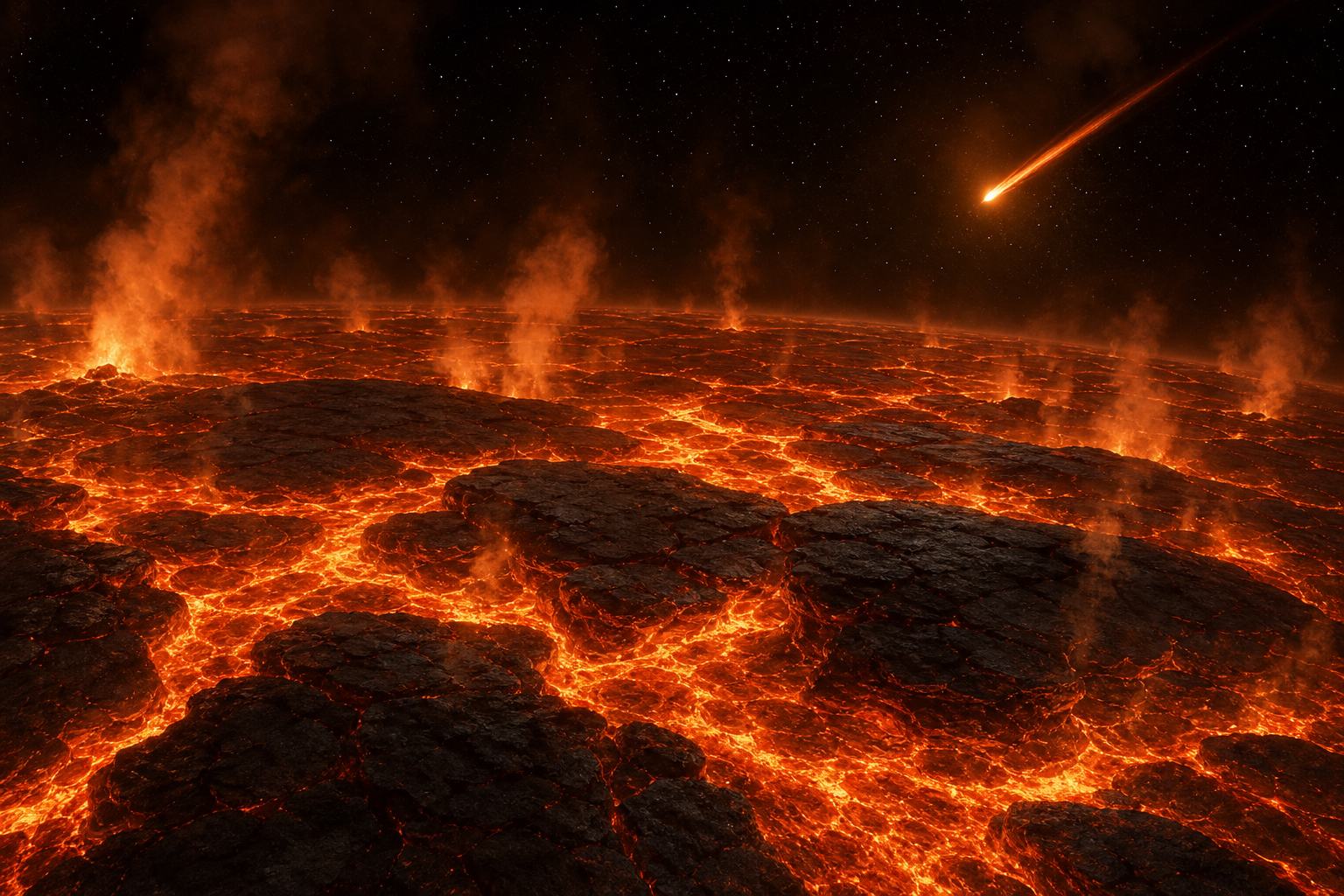
Their collisions were giant impacts. Mercury, Venus, Earth and Mars were assembled this way over roughly ten to a hundred million years.
So Earth was finished tens of millions of years after the first solids. Its oldest rocks are gone, recycled by plate tectonics, so its age, about 4.54 billion years, comes from meteorites.
≈ 0.05
Earth masses each, early on
10–100 Myr
to finish the rocky planets
Rocky embryosA battered young world Each giant impact could melt the surface again. AI-generated illustration.
4.54 Gyr
uncertainty under 1 percent
Earth’s age (USGS)
Chapter IV · Building worlds
The rocky planets
Wikipedia (formation of the Solar System): terrestrial embryos grew to about 0.05 Earth masses, then the terrestrial planets were assembled by collisions over 10–100 million years. USGS: plate tectonics has recycled Earth’s oldest rocks, so Earth’s age, 4.54 billion years with an uncertainty under 1 percent, is found by assuming Earth and meteorites formed together. NASA fact sheet: distances and sizes of the rocky planets.
The 3D scene is a schematic teaching model: distances are compressed (drawn on a square-root scale), planets and particles are enlarged, and motions are speeded up.
Planets may not have stayed where they formed. Computer models show that giant planets can migrate, pushed by gas and by the small bodies they scatter.
One model, the Grand Tack from 2011, has Jupiter drifting in to about one and a half times Earth's distance, then turning back once Saturn caught up, like a boat tacking. That could explain a small Mars, but recent work makes it look less likely.
Another, the Nice model from 2005, named after the French city, has the giants start closer together. Their orbits then turned unstable, tugging each other into new paths, and Uranus and Neptune were pushed outward.
Gravity exchanges with the gas disk
Flinging small bodies in or out
Tugs between the giants themselves
What moves a giant planet
In Jupiter drifts in to ≈ 1.5 AU
Tack Saturn catches up; both turn
Out Jupiter heads out towards 5.2 AU
Result Material near Mars cut off; belt mixed
Grand Tack (Walsh et al., Nature, 2011)
0.11 ×
Mars’s mass compared with Earth’s
1.5 AU
where Jupiter turns in the model, close to Mars’s orbit
Why Mars matters here
The giants start closer together
Unstable: they tug each other into new orbits
Uranus and Neptune end up farther out
Nice model (2005)
Migration itself is widely accepted
Grand Tack: recent work makes it look less likely
Nice model: instability now placed early, within ~100 Myr
How sure are we?
Chapter V · Wandering giants
Migrating giants
ScienceDaily (June 2011) on Walsh et al. in Nature: in the Grand Tack model Jupiter migrated in to about 1.5 AU, then turned outward after Saturn formed, which cuts off material near 1 AU and starves Mars, and mixes the asteroid belt. Wikipedia (formation of the Solar System): current estimates make the Grand Tack appear unlikely. NASA fact sheet: Mars has 0.642 × 10²⁴ kg, about 0.11 Earth masses, and orbits at 1.52 AU. Crida (arXiv): in the Nice model (2005) the giants start in a compact configuration; when Jupiter and Saturn cross a 2:1 resonance the system becomes unstable and Saturn, Uranus and Neptune move outward. Raymond (2022): the instability could not have happened later than about 100 million years after formation began, and may have come within a few million years.
Try it: the “Run the model” button plays the Grand Tack as a schematic sketch of a model, not a record of what happened. Distances and timing are not to scale.
The 3D scene is a schematic teaching model: distances are compressed (drawn on a square-root scale), planets and particles are enlarged, and motions are speeded up.
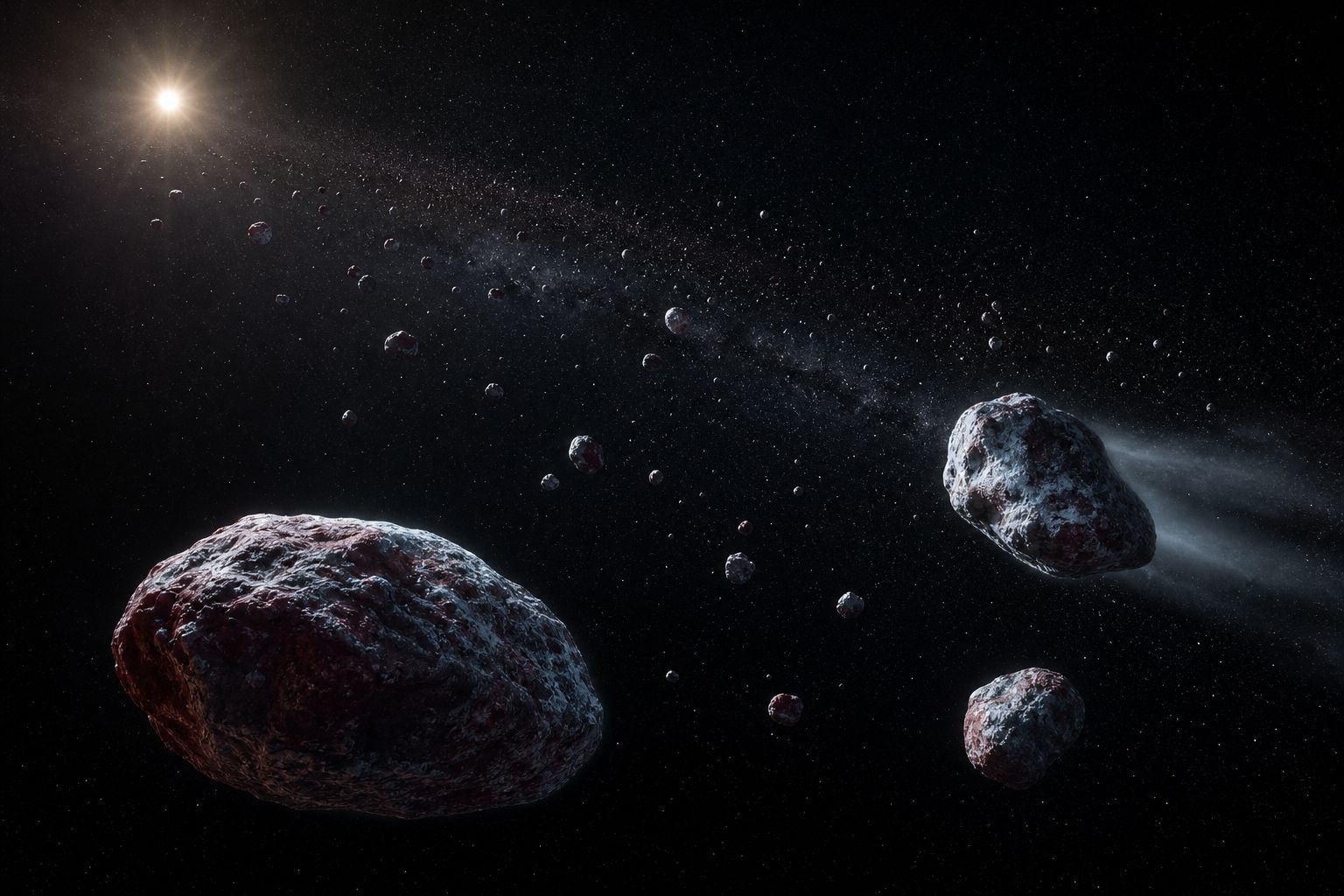
Not everything became a planet. Between Mars and Jupiter, the giant's gravity kept the rubble from coming together. All the asteroids combined have less mass than our Moon.
Beyond Neptune, from about 30 times Earth's distance, lies the Kuiper Belt: icy leftovers, including Pluto, stirred by Neptune.
< 1 Moon
total mass of all asteroids
4.6 Gyr
leftovers from the formation
Asteroid beltKuiper Belt Icy bodies 30 to about 50 AU from the Sun; Arrokoth, visited in 2019, is the most distant and primitive object a spacecraft has explored. AI-generated illustration.
Jupiter
11.2
Saturn
9.4
Uranus
4.0
Neptune
3.9
Earth
1
Venus
0.95
Mars
0.53
Mercury
0.38
Diameter (Earth = 1)
Chapter V · Wandering giants
Belts and leftovers
NASA asteroid facts: asteroids are rocky remnants from the formation of the Solar System about 4.6 billion years ago; the gravity of newly formed Jupiter ended planet formation in the belt, and the total mass of all asteroids is less than the Moon’s. NASA Kuiper Belt facts: the belt begins at Neptune’s orbit, about 30 AU, its main part ends around 50 AU; its icy objects are thought to be remnants of the Solar System’s formation, stirred by Neptune’s gravity; Pluto was the first Kuiper Belt object found; Arrokoth (New Horizons, 2019) is the most distant and most primitive object explored by a spacecraft. NASA fact sheet: diameters of Jupiter 142,984 km and Earth 12,756 km, a ratio of 11.2.
Try it: “Sizes” lines the planets up at their true relative diameters; “Orbits” puts them back on compressed orbits with enlarged planets.
The 3D scene is a schematic teaching model: distances are compressed (drawn on a square-root scale), planets and particles are enlarged, and motions are speeded up.
One impact probably gave Earth its companion. The leading explanation, the giant impact hypothesis, says a Mars-sized body, called Theia, struck the young Earth.
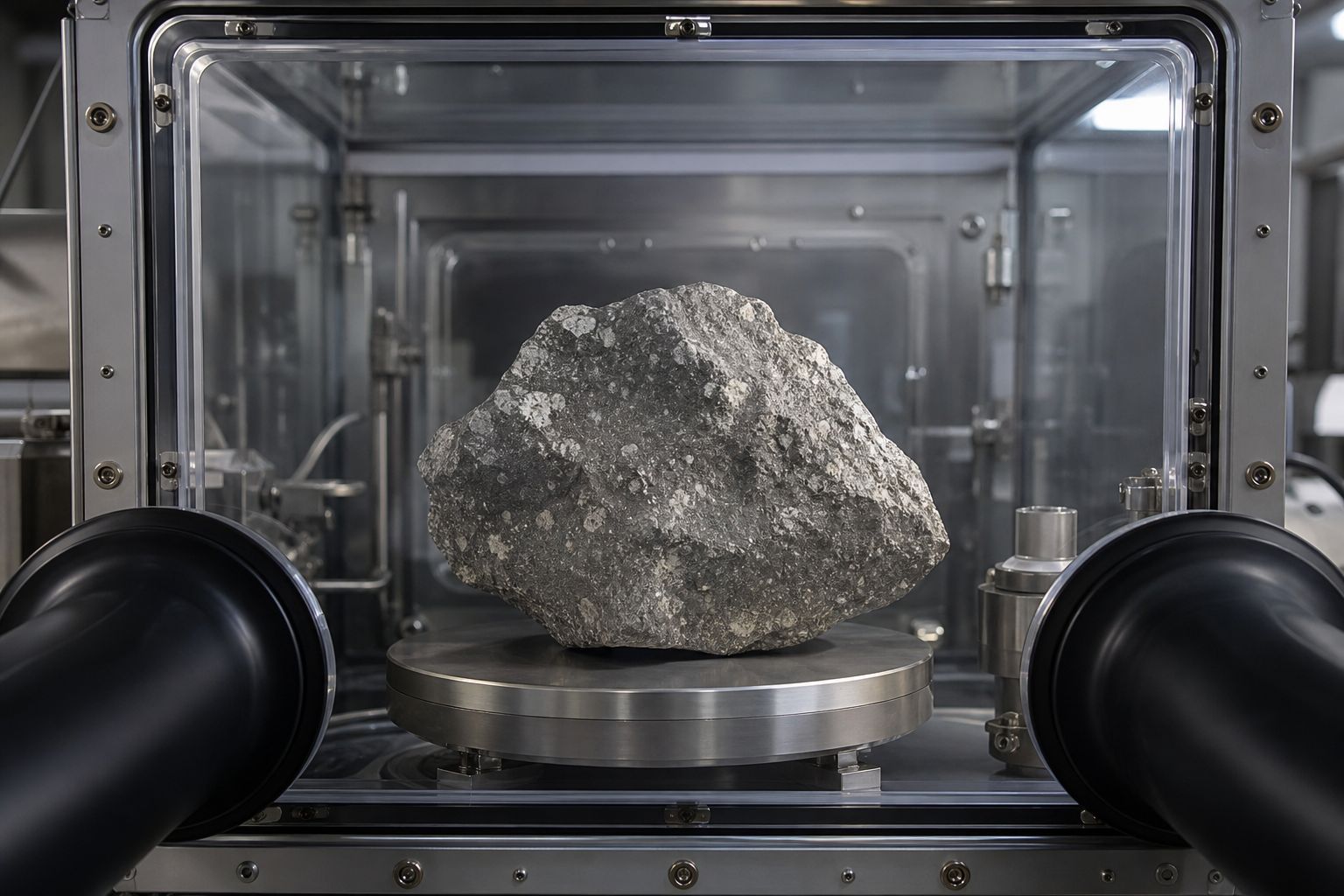
Debris thrown into orbit gathered into the Moon. Moon rocks brought back by Apollo and Luna missions are up to 4.4 to 4.5 billion years old, so the Moon is at least that old.
NASA calls it the current theory, and says future lunar missions could still change the picture.
≈ Mars-size
about half Earth’s diameter
0.27 ×
Moon’s diameter compared with Earth’s
Theia (hypothesis)
Capture: a passing body was caught
Fission: a fast-spinning Earth threw it off
Giant impact: today’s leading explanation
Ideas before this oneMoon rocks Lunar samples are stored in nitrogen-filled cabinets so they stay unaltered by Earth’s air. AI-generated illustration.
Chapter VI · The Moon
The giant impact hypothesis
NASA (2022): the “giant impactor theory” is NASA’s current theory of the Moon’s formation: during the late stages of planet formation, Earth collided with Theia, a Mars-size planetoid, and debris from the impact came together as the Moon. Earlier ideas were capture and fission. NASA notes future lunar missions could lead to a new theory. USGS: the oldest dated Moon rocks, returned by the Apollo and Luna missions, are 4.4 to 4.5 billion years old, a minimum age for the Moon. Wikipedia: the Moon-forming impact came near the end of the 10–100 million year giant-impact period. NASA fact sheet: diameters of Mars 6,792 km, Moon 3,475 km, Earth 12,756 km.
The impact animation is a schematic sketch of a hypothesis; sizes are roughly right, but the debris and timing are simplified.
The 3D scene is a schematic teaching model: distances are compressed (drawn on a square-root scale), planets and particles are enlarged, and motions are speeded up.
Meteorites are leftover building blocks, and their isotopes split them into two families, named in 2011: carbon-poor and carbon-rich.
The two probably formed on either side of Jupiter and stayed apart for the first few million years. Jupiter's fast growth may be the wall that kept them separate.
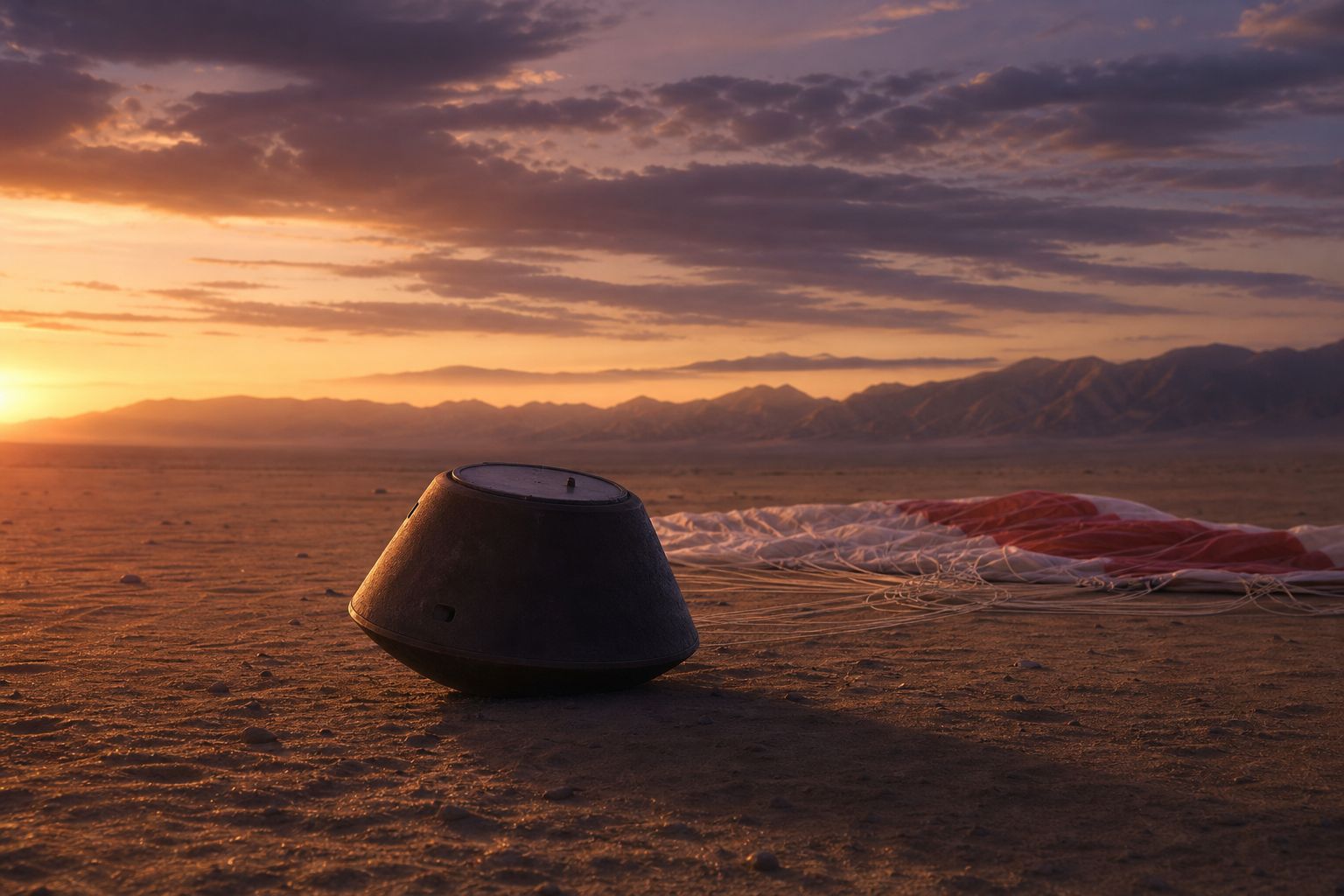
Missions now fetch pristine samples. Japan's Hayabusa2 returned about five grams from asteroid Ryugu in December 2020. OSIRIS-REx landed 121.6 grams from Bennu in the Utah desert in September 2023.
A 2025 study concluded Bennu's parent body likely formed far out, possibly beyond Saturn. The 2026 study instead places it near the snow line, as a hybrid. Tap the families to see where each was born.
NC, carbon-poor: likely formed inside Jupiter
CC, carbon-rich: likely formed outside Jupiter
Seen in Ti, Cr, Ni, Mo (and W) isotopes
Two isotope families
The two reservoirs remained isolated from each other for the first few million years of the Solar System.Kleine et al., Space Science Reviews, 2020 (paraphrased)
Sample return Bennu’s capsule came down by parachute on 24 Sep 2023; the sample had been grabbed on 20 Oct 2020. AI-generated illustration.
≈ 5 g
Ryugu · Hayabusa2 · Dec 2020
121.6 g
Bennu · OSIRIS-REx · Sep 2023 (≈ 2× the 60 g goal)
Returned samples
Chapter VII · Time capsules
Time capsules
Kleine et al. (2020): meteorites show an isotopic dichotomy between non-carbonaceous (NC) and carbonaceous (CC) groups, seen in titanium, chromium, nickel, molybdenum and oxygen; Warren (2011) established the two clusters and coined the names. Their parent bodies presumably formed inside (NC) and outside (CC) Jupiter’s orbit and “remained isolated from each other for the first few million years,” with Jupiter’s formation preventing exchange; some researchers instead propose a pressure barrier in the disk. DLR and JAXA: Hayabusa2’s capsule, with about five grams from Ryugu, was recovered at Woomera, Australia, in December 2020. Spaceflight Now: OSIRIS-REx collected its sample on 20 October 2020 and its capsule landed in Utah on 24 September 2023. NASA: the sample totals 121.6 grams, about twice the 60 grams required. Natural History Museum (2025): Bennu’s parent asteroid likely formed in the outer Solar System, possibly beyond Saturn, yet contains high-temperature material from near the Sun. ETH Zurich (2026) instead concludes that Bennu is a “hybrid” that most likely formed near the water-ice line, challenging the outer-origin view. Phys.org on Kruijer et al. (2017): tungsten (W) and molybdenum isotopes in iron meteorites show the same two reservoirs.
Try it: highlight each family’s likely birthplace, then Bennu’s proposed one. The regions are schematic; the exact boundary is not known.
The 3D scene is a schematic teaching model: distances are compressed (drawn on a square-root scale), planets and particles are enlarged, and motions are speeded up.
So the Solar System grew from one collapsing, spinning cloud.
Its age and the snow line are settled. How far Jupiter wandered, and how asteroids like Bennu got their mix, are still open questions.
The next answers may come from a few grams of dust.
0 CAIs form: 4,567 Myr ago
≈ 1 Myr Jupiter’s core ≈ 20 Earth masses
≈ 3–10 Myr Gas cleared from the disk
10–100 Myr Rocky planets; Moon-forming impact
2020 · 2023 Ryugu and Bennu samples reach Earth
From cloud to planets
Settled: the age, the disk, the snow line, dust growing into planets
Open: how pebbles became planetesimals
Open: how far the giants migrated, and when
Open: how Bennu-like asteroids got their mix
Settled · open
Stills and pictures are AI-generated
The 3D scenes are schematic models
Distances are compressed, motions sped up
About this film
Epilogue · Sources
Sources
Every fact in this film comes from the sources below. The chapter stills and pictures are AI-generated illustrations, not photographs or telescope images. The 3D scenes are schematic teaching models: distances are drawn on a compressed (square-root) scale, planets are enlarged except in the size comparison, and the collapse, accretion, migration and impact animations are simplified sketches of the processes and models described, not simulations.