PlanetPast
EN

Space · Astronomy

How the Milky Way Works

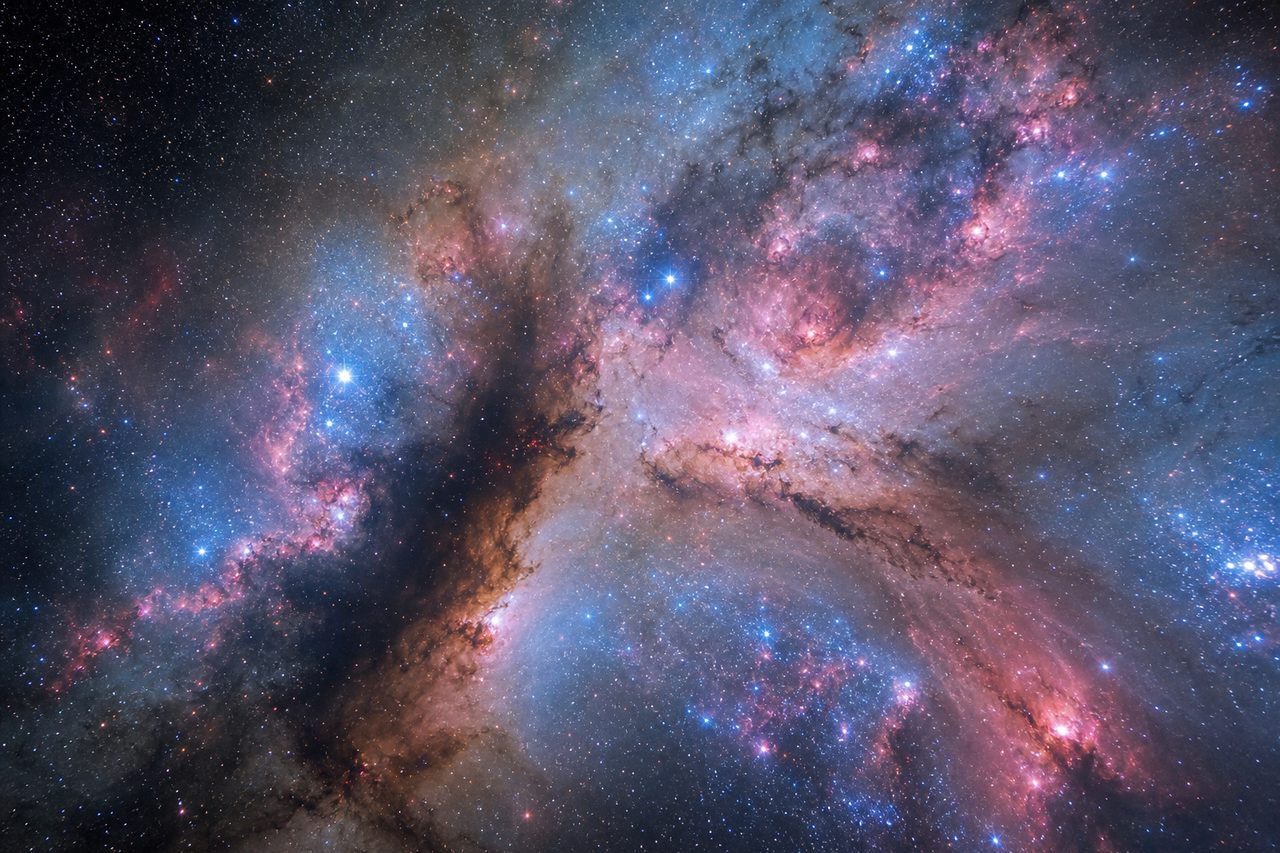
In late 2026 the new Vera C. Rubin Observatory reported two hidden companions of the Milky Way in its first months of data. This film explains the established astronomy behind that news: why the Milky Way looks like a band across the sky, how astronomers from the Herschels to Shapley and Hubble worked out where we are, the shape of our barred spiral galaxy and the Sun's 230-million-year orbit, the black hole at its centre, why its spin points to dark matter, and the small galaxies and star clusters that circle it and are slowly swallowed.

Interactive 3D film8 min1785 to 2026Published 8 November 2026

Watch the interactive filmRead in ไทย

Prologue

Space · Astronomy

Hidden companions

A new telescope finds two more things hidden in and around our galaxy.

Something has been circling our galaxy unseen. At the end of October 2026, astronomers using the new Vera C. Rubin Observatory in Chile reported two hidden companions.

Aquarius IV, about 355,000 light-years away, is probably a tiny galaxy of its own. Rubin-GC1 is a star cluster, about nine billion years old, behind the dust on the galaxy's far side.

Some astronomers think hundreds more remain hidden. To see why that matters, start with the galaxy itself.
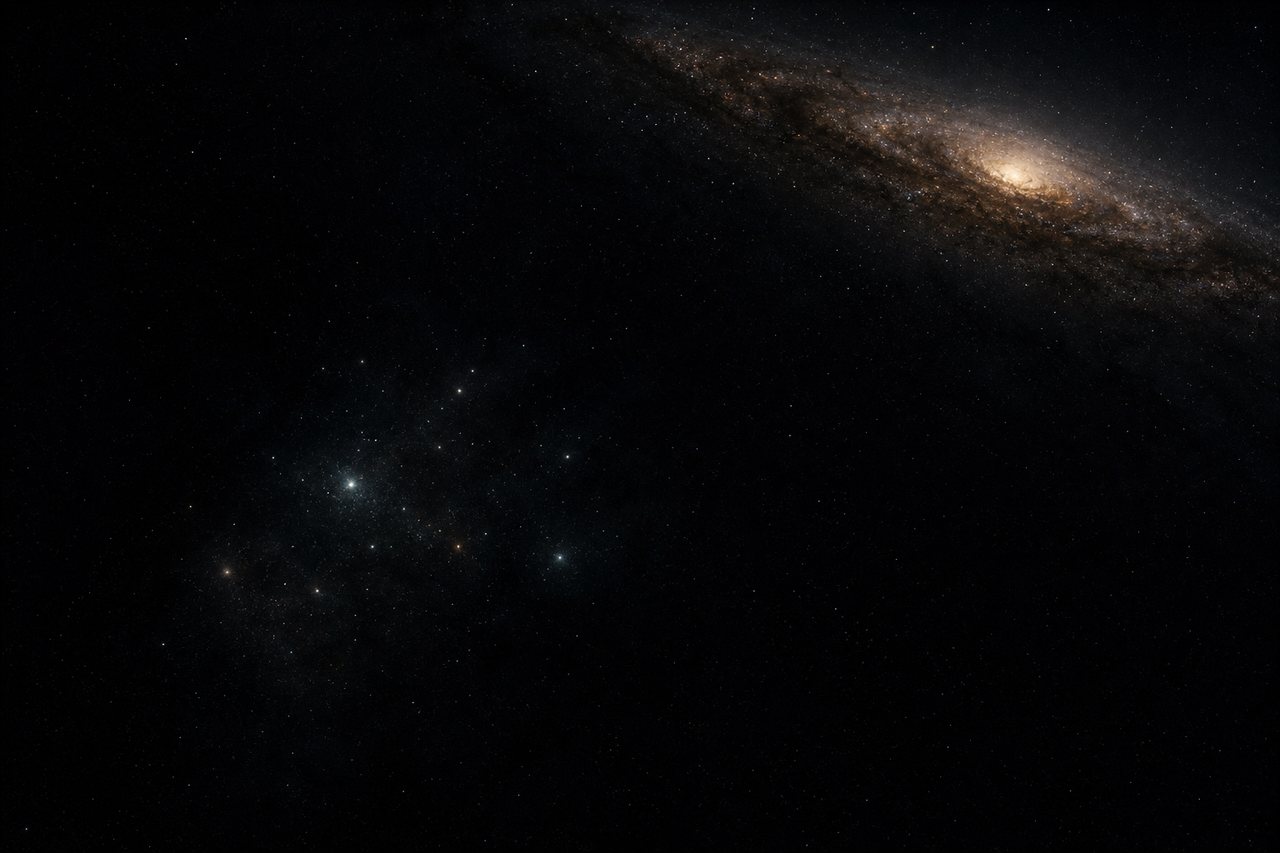
Out in the dark A sparse knot of dim stars far from the bright disk of a galaxy. AI-generated illustration.
~355,000 ly
Aquarius IV: likely a dwarf galaxy, not yet confirmed
~9.2 bn yrs
age of the cluster Rubin-GC1
Rubin, 2026 (Cerny et al.; Universe Today)
~65
known before
hundreds?
may still be undetected
Milky Way companions (Yale News)
Prologue

The news

University of Washington and Yale (28 October to 5 November 2026): in preview data from the Vera C. Rubin Observatory, taken between April 2025 and January 2026 and covering about 7% of the sky, astronomers found Aquarius IV, an ultra-faint satellite about 355,000 light-years from Earth, and Rubin-GC1, a star cluster on the far side of the galaxy in a dusty region. About 65 Milky Way satellites were known; hundreds more may be undetected.

The Aquarius IV paper calls its figures preliminary: it is tentatively a dwarf galaxy, spectroscopy is still needed, and a globular cluster is not ruled out.

The 3D galaxy is a simplified teaching model built from published sizes; arm positions, satellite directions and star numbers are schematic.

Sources: University of Washington News (5 Nov 2026): Rubin Observatory reveals two hidden companions of the Milky Way; Yale News (28 Oct 2026): Historic new observatory reveals two hidden companions of the Milky Way; ScienceDaily (Nov 2026): Rubin Observatory discovers two hidden companions of the Milky Way; Cerny et al. (2026): Discovery of the distant, ultra-faint Milky Way satellite Aquarius IV (arXiv); Universe Today: The Vera Rubin has found two more of the Milky Way’s dim satellites
Chapter I · A river of light

Chapter I · A river of light

Seen from inside

Why our galaxy looks like a band across the sky.

On a dark night, far from city lights, a pale band of light stretches across the sky.

Through a telescope it breaks into countless faint stars. It is the Milky Way, our own galaxy, and it looks like a band because we live inside a flat disk of stars.

Look along the disk, and the stars pile up into a river of light. Look up, out of it, and there are far fewer.

But because of light pollution, a 2016 study found that one person in three can no longer see it.

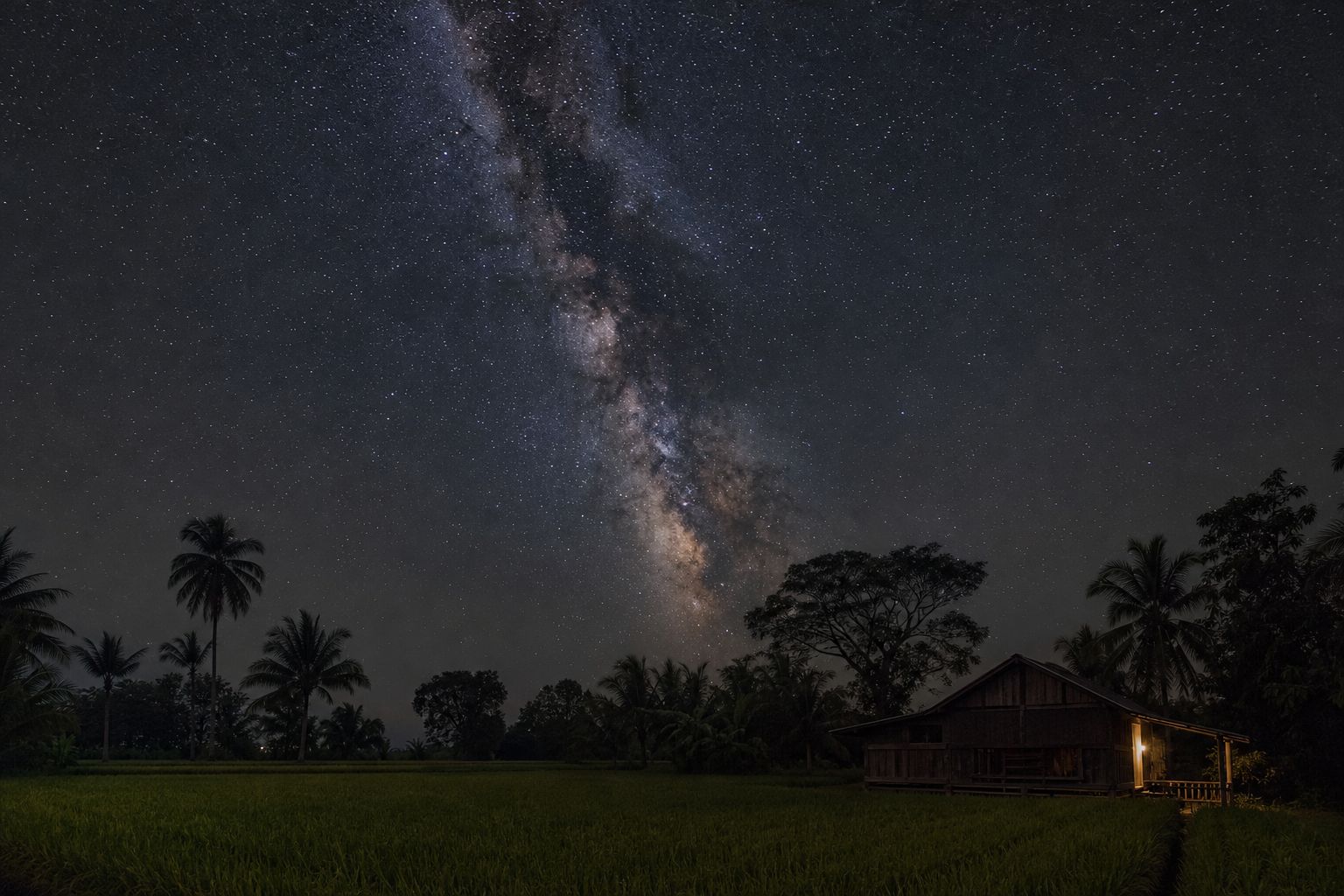
A dark-sky night The Milky Way rising over a rural field, far from street lights. AI-generated illustration.
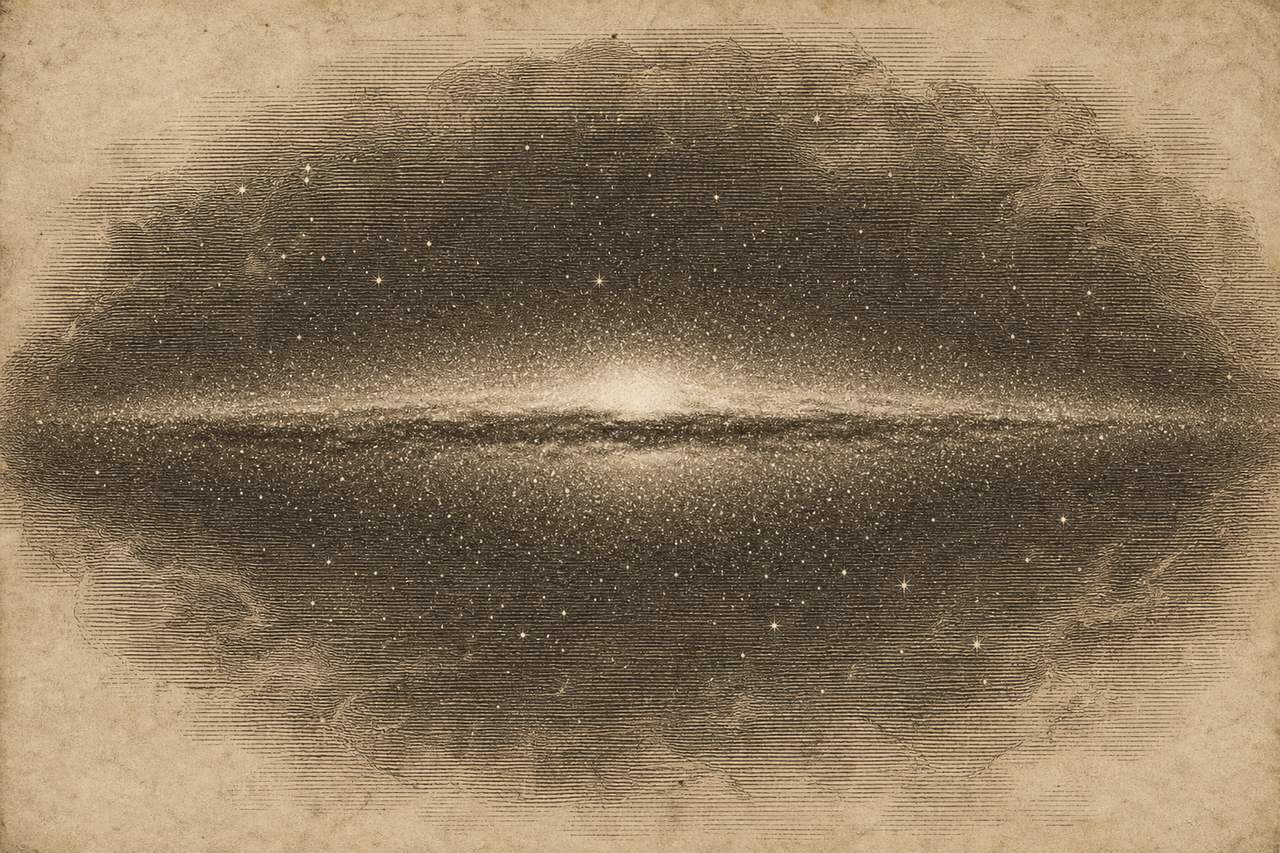
A flat disk Seen from the side, a galaxy like ours is a thin lens of stars. AI-generated illustration.
~100,000 ly
disk width: the long way through
~1,000 ly
disk thickness near the Sun (at the arms)
Along versus up (RMG, NASA)
>80%
of people live under light-polluted skies
99%
in the US and Europe
Falchi et al., Science Advances 2016
Chapter I · A river of light

Why a band

OpenStax Astronomy: the Milky Way appears as a band because we see the galaxy from inside its flattened disk. AAAS (2016), reporting Falchi et al. in Science Advances: one third of humanity cannot see the Milky Way, and more than 80% of the world lives under light-polluted skies (99% in the US and Europe).

The name Milky Way comes from the Greek galaxias, milky (RMG).

The 3D galaxy is a simplified teaching model built from published sizes; arm positions, satellite directions and star numbers are schematic.

Sources: OpenStax Astronomy (LibreTexts): Observing our galaxy; AAAS (2016): One third of people cannot see the Milky Way; Royal Museums Greenwich: A guide to the Milky Way, our home galaxy

Chapter II · Finding our place

Chapter II · Finding our place

Off centre

How star counts and star clusters found our place.

In 1785, William Herschel and his sister Caroline counted stars in different directions across the sky.

More stars meant the system stretched further that way. They found a flattened disk, the right shape. But dust hid everything beyond about six thousand light-years, so they put the Sun near the middle.

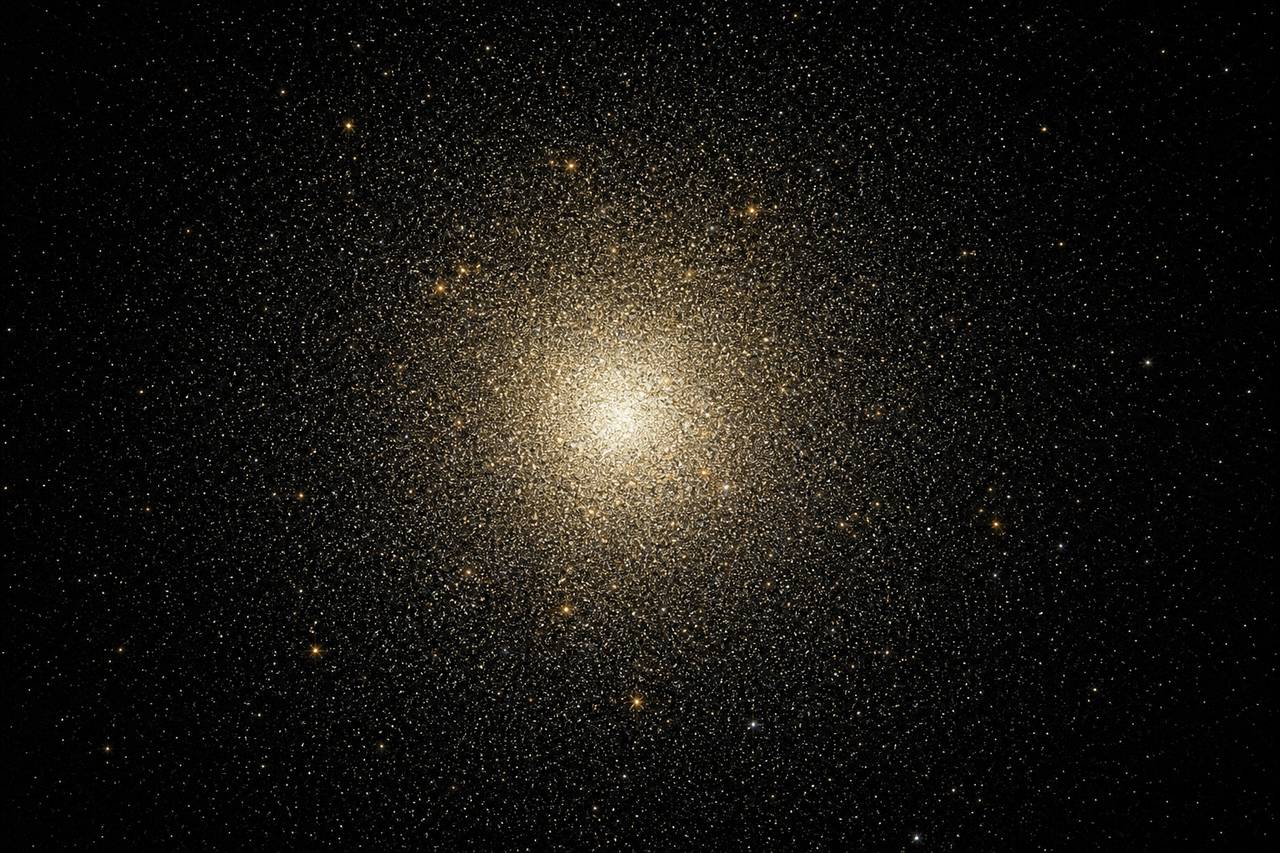
The fix came from globular clusters: huge, tight balls of old stars in the halo, a vast round region around the disk.

In 1917 Harlow Shapley measured how far away they are, using pulsating stars of known true brightness: the dimmer such a star looks, the farther away it is.

The clusters swarmed around a centre far away, towards Sagittarius. Today's estimate puts the Sun about twenty-six thousand light-years out.

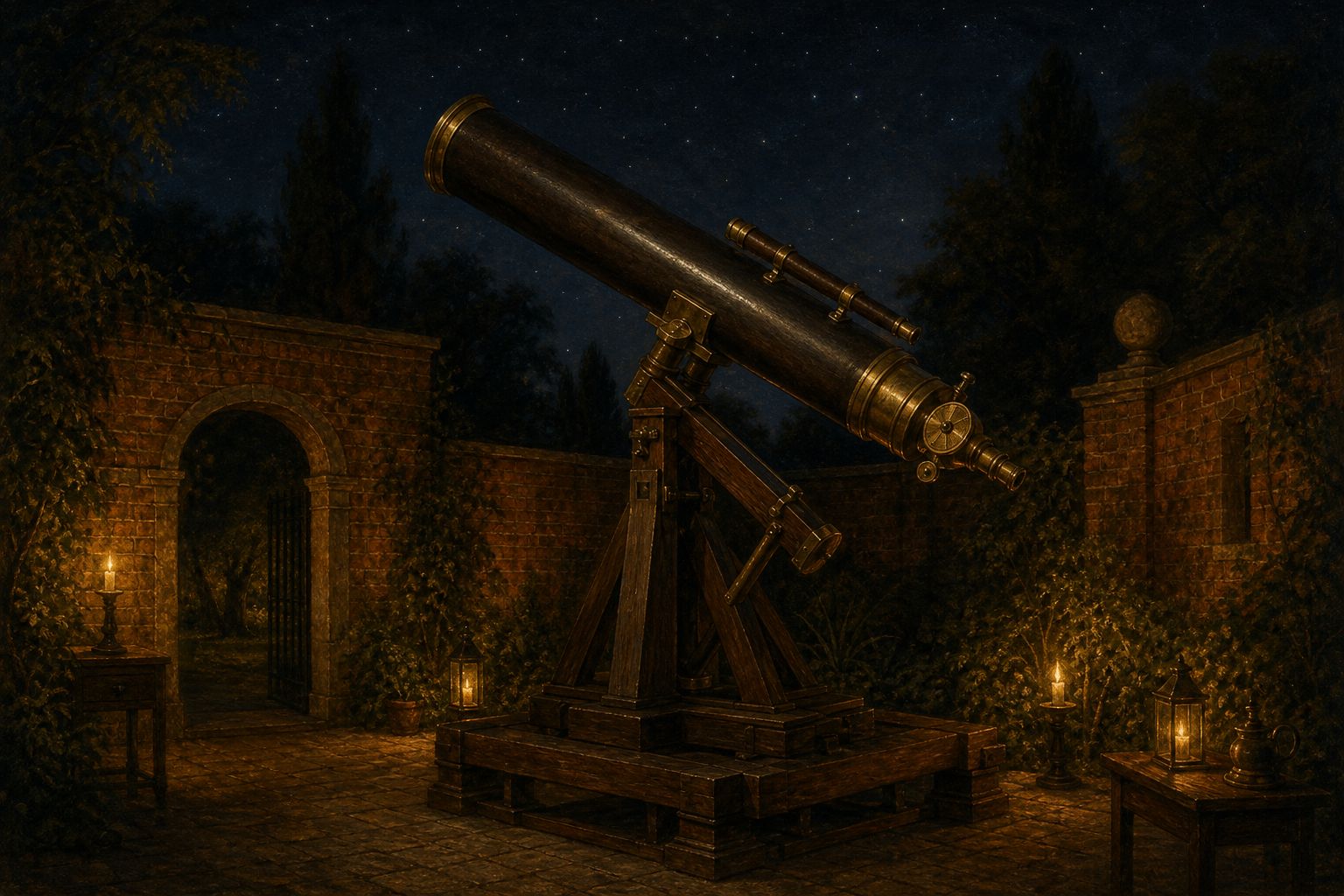
A home-built giant A large reflecting telescope of the late 1700s on its wooden frame. AI-generated illustration.
~6,000 ly
how far dust let them see; the disk is about 100,000 ly wide
Why the map misled (OpenStax)
A globular cluster Some of the galaxy’s oldest stars, packed into one sphere; about 160 are known. AI-generated illustration.
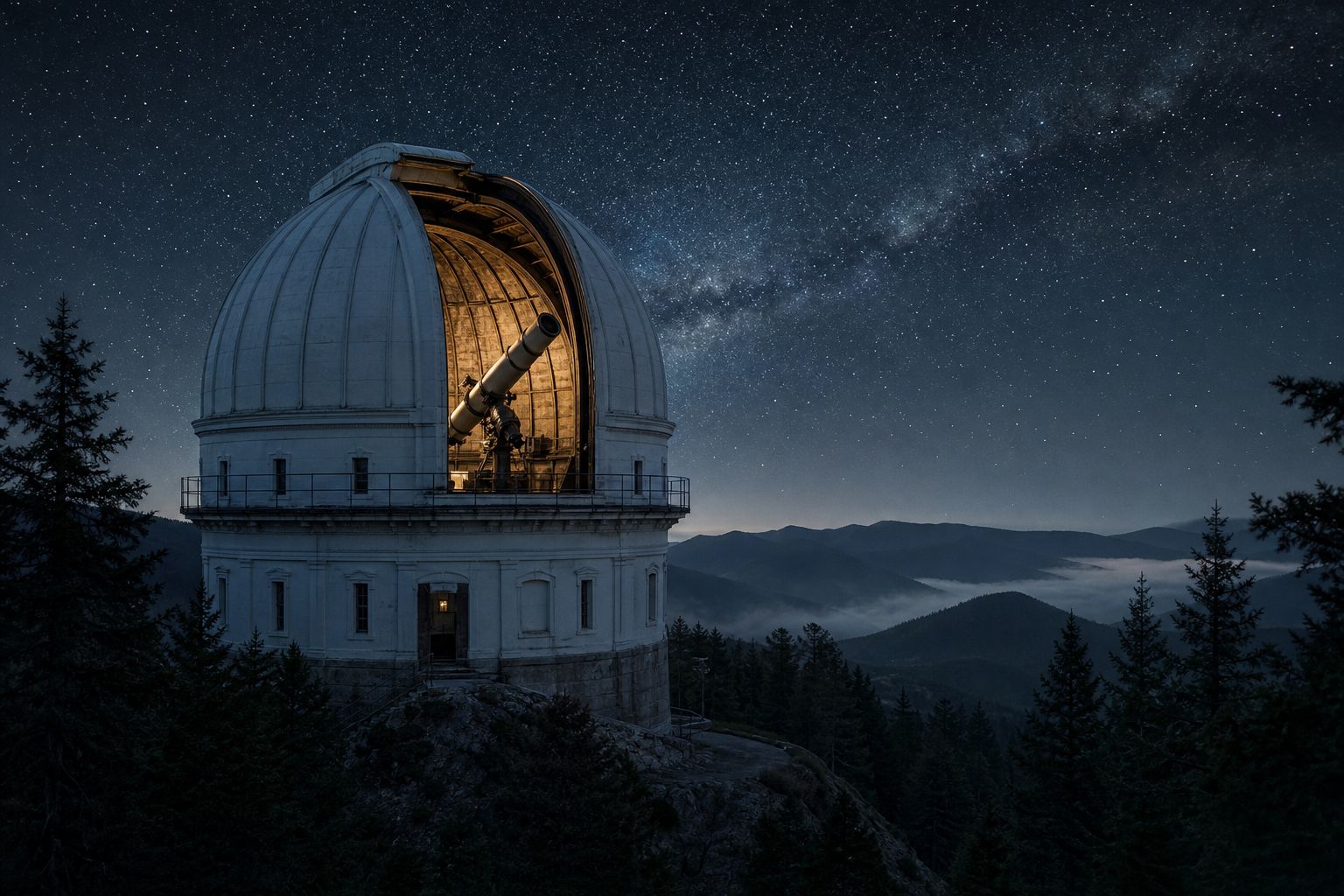
Mount Wilson An observatory dome on a mountaintop; Shapley used a 60-inch telescope. AI-generated illustration.
  1. 1785 Herschels: near the centre
  2. 1917–18 Shapley: 50,000 ly out
  3. later Shapley revises: ~30,000 ly
  4. today ~26,000 ly
Where is the Sun? (Britannica, RMG)
Chapter II · Finding our place

The Herschels and Shapley

OpenStax Astronomy: in 1785 William and Caroline Herschel counted stars and concluded that our system is a disk; interstellar dust limited them to about 6,000 light-years, so they placed the Sun wrongly, near the centre. Britannica: Harlow Shapley used RR Lyrae variable stars to find the distances of globular clusters with the 60-inch telescope at Mount Wilson, publishing in 1917–1918. The clusters were centred towards Sagittarius, so the Sun is not at the centre; he first put it 50,000 light-years out, later revised to about 30,000. Royal Museums Greenwich gives about 26,000 light-years today.

Royal Museums Greenwich: the stellar halo holds about 160 known globular clusters.

The 3D galaxy is a simplified teaching model built from published sizes; arm positions, satellite directions and star numbers are schematic.

Sources: OpenStax Astronomy (LibreTexts): Observing our galaxy; Britannica: Harlow Shapley; Royal Museums Greenwich: A guide to the Milky Way, our home galaxy

Chapter II · Finding our place

One galaxy among many

The night the universe grew.

Shapley thought the Milky Way was the whole universe. In October 1923, Edwin Hubble found a pulsating star in the Andromeda nebula, and showed that it lies far beyond our galaxy.

The Milky Way became one galaxy among many. Shapley said Hubble's letter had destroyed his universe.

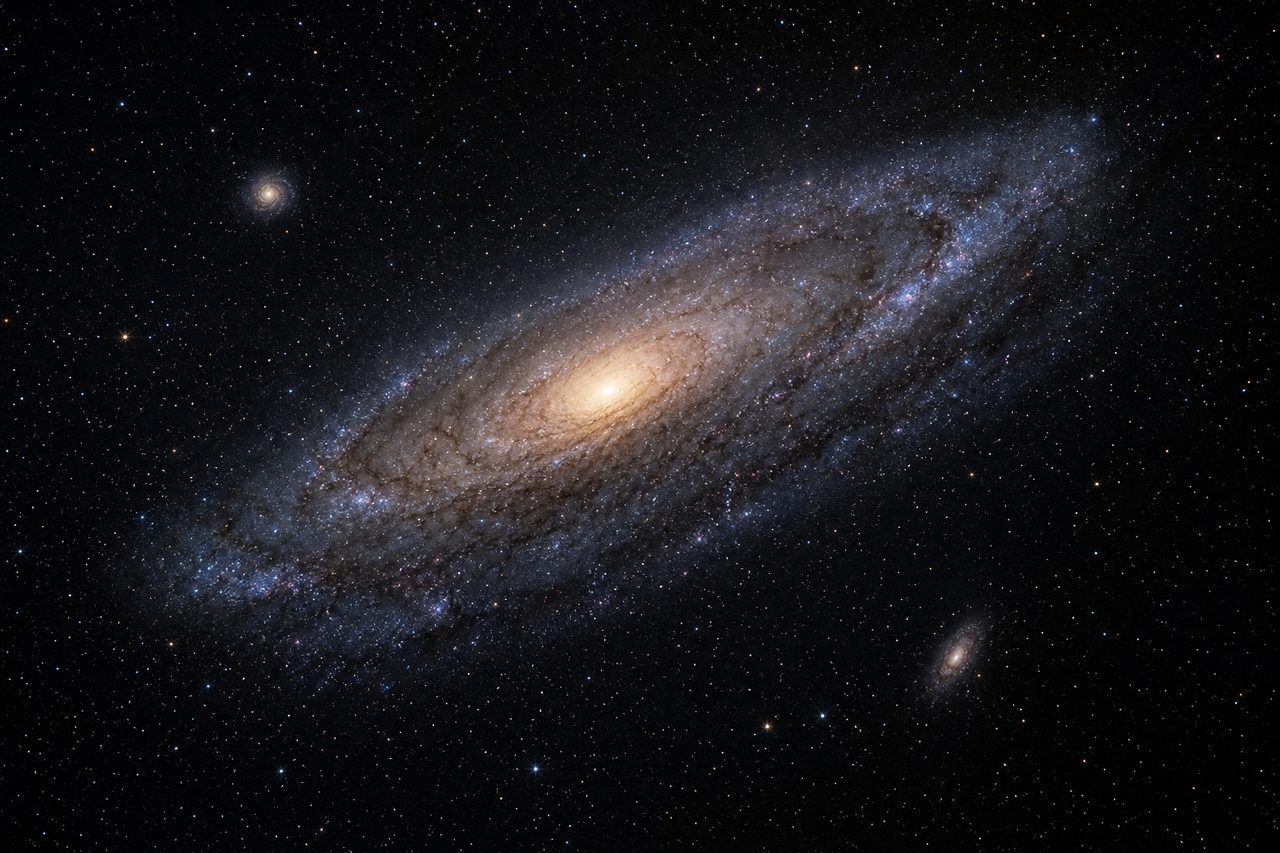
A spiral nebula A large spiral with two small companions, like Andromeda; today’s distance is about 2.5 million light-years. AI-generated illustration.
Here is the letter that has destroyed my universe.Harlow Shapley, on Hubble’s result (AAVSO)
Chapter II · Finding our place

Hubble and Andromeda

Britannica: in the Great Debate of 26 April 1920 at the National Academy of Sciences in Washington, Heber Curtis argued that spiral nebulae are separate galaxies and Shapley that the Milky Way was the whole universe; Curtis was right on that point, Shapley about the Milky Way’s great size. AAVSO: on the night of 5–6 October 1923 Edwin Hubble found a Cepheid variable in Andromeda with the 100-inch Hooker telescope. His estimate was about 900,000 light-years; today’s figure is about 2.5 million.

The 3D galaxy is a simplified teaching model built from published sizes; arm positions, satellite directions and star numbers are schematic.

Sources: Britannica: Harlow Shapley; AAVSO: Shattering Shapley’s universe (Hubble’s variable in Andromeda)

Chapter III · The shape of home

Chapter III · The shape of home

A barred spiral

The shape of our galaxy, pieced together from inside.

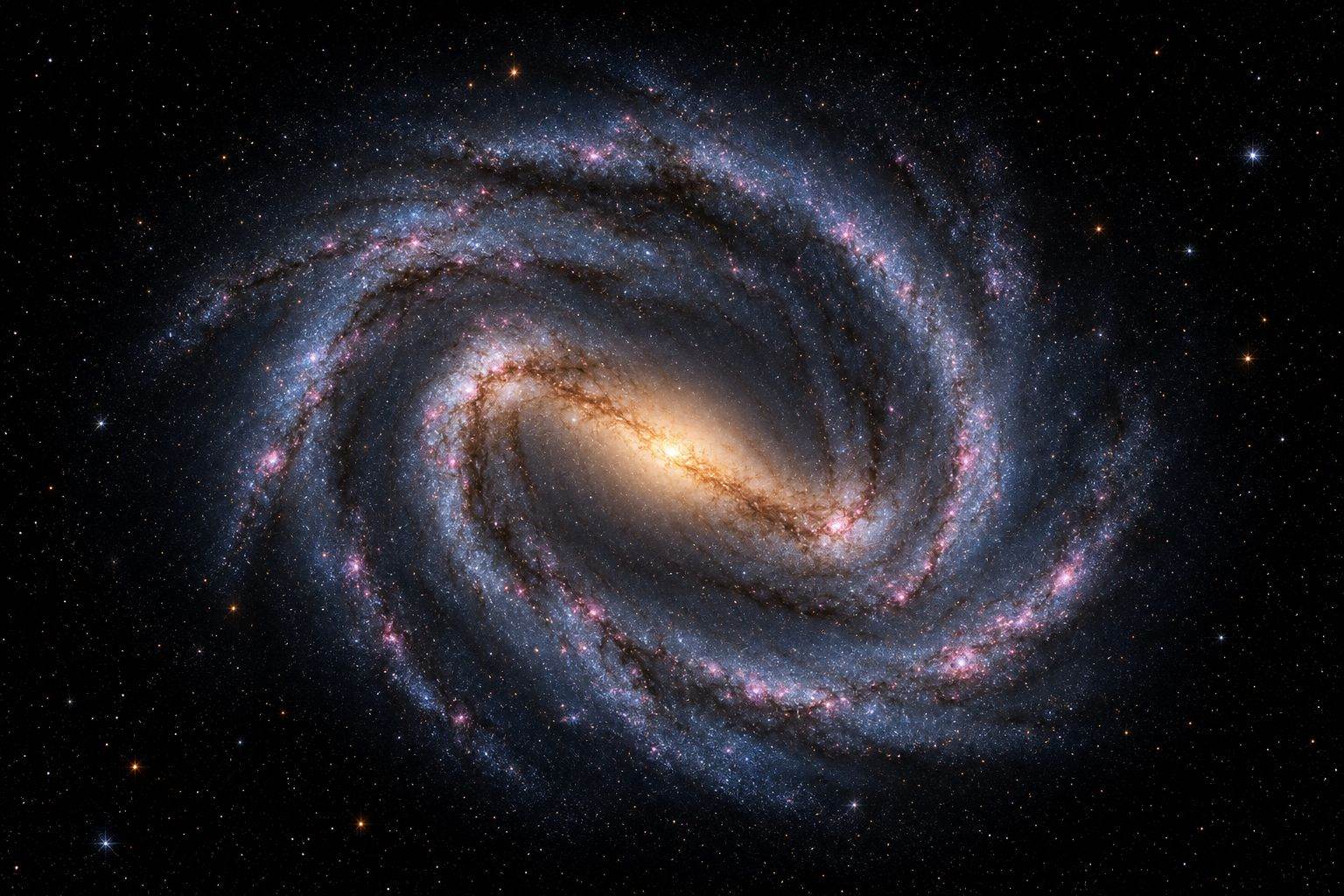
From outside, our galaxy would look something like this: a barred spiral. A bar of stars about thirty thousand light-years long crosses the centre, confirmed by the Spitzer Space Telescope in 2005.

Around the centre sits a peanut-shaped bulge of older, redder stars, then a disk about a hundred thousand light-years across, with one hundred to four hundred billion stars.

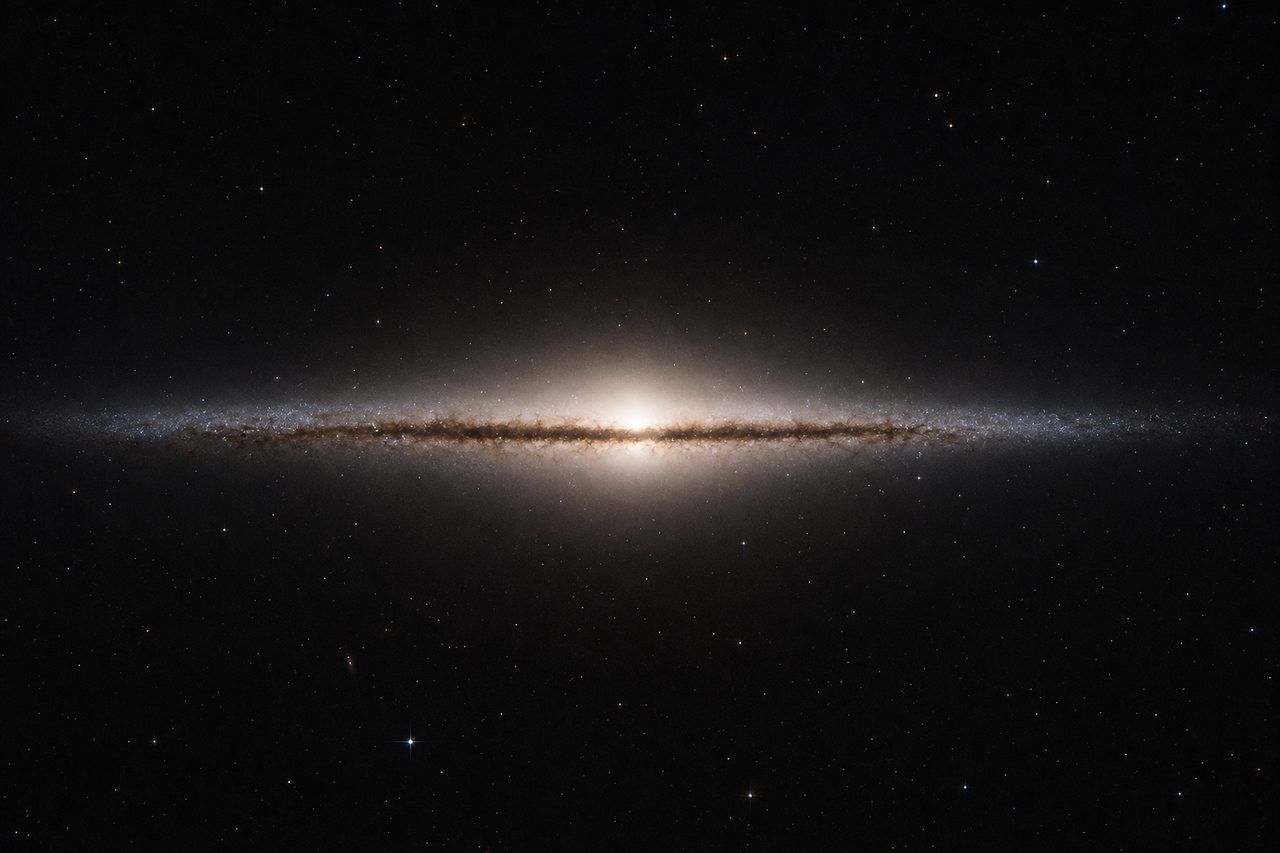
From the side, the disk is thin: around a thousand light-years thick in the arms. Shrink it to the width of a dinner plate, and it would be two and a half millimetres thick.

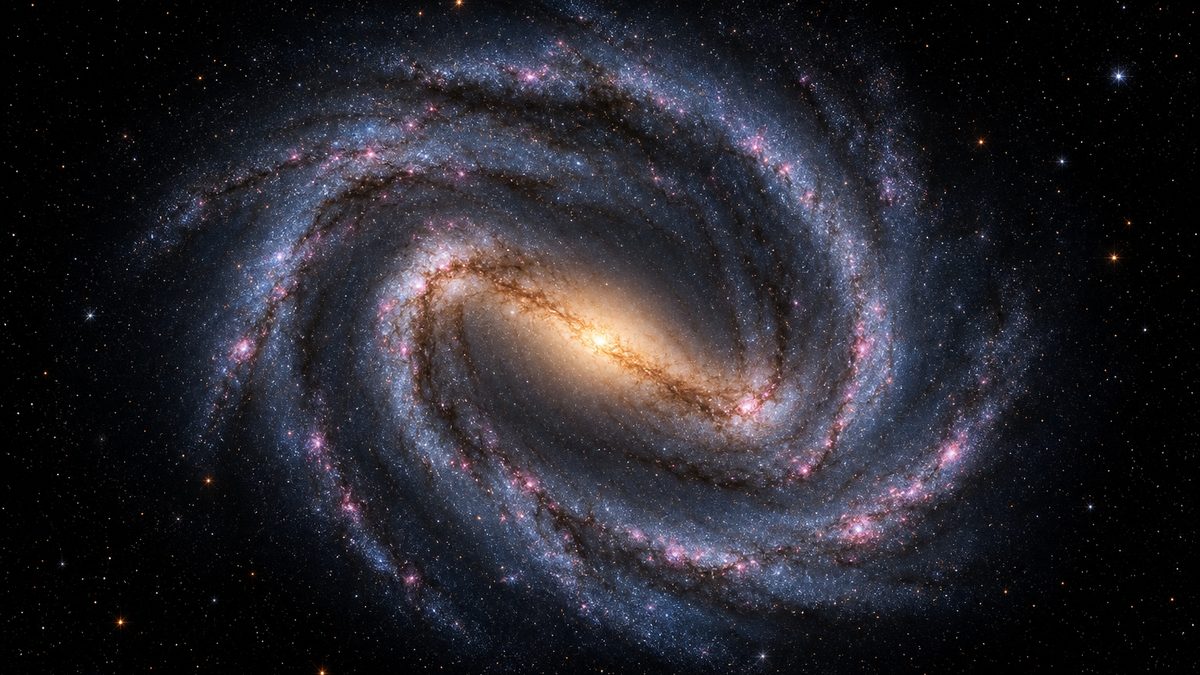
Face-on An impression of a barred spiral seen from above: golden bar, blue arms, pink star-forming clouds. AI-generated illustration.
~100,000 ly
across the stellar disk
100–400 bn
stars
~13.6 bn yrs
age
The Milky Way (RMG, NASA)
Edge-on A spiral seen exactly side-on: a thin bright disk cut by a dark lane of dust. AI-generated illustration.
Chapter III · The shape of home

Our galaxy’s shape

Royal Museums Greenwich: the Milky Way is a barred spiral about 13.6 billion years old with 100–400 billion stars. Its bar is about 30,000 light-years long, holds about 10% of the stellar mass and was confirmed by the Spitzer telescope in 2005; the bulge is peanut-shaped with older, redder stars; the disk is about 1,000 light-years thick in the arms. NASA gives the stellar disk as about 100,000 light-years across.

The plate comparison is our own arithmetic: 100,000 to 1,000 is 100 to 1, so a 25 cm plate would be 2.5 mm thick.

The 3D galaxy is a simplified teaching model built from published sizes; arm positions, satellite directions and star numbers are schematic.

Sources: Royal Museums Greenwich: A guide to the Milky Way, our home galaxy; NASA Imagine the Universe: The Milky Way galaxy

Chapter III · The shape of home

The galactic year

Where we are, and how fast we are going.

Spiral arms wind out from the bar. Astronomers count four main ones, though the exact number is still debated.

The Sun sits in a smaller arm, the Orion Arm, about twenty-six thousand light-years from the centre.

And everything is moving. The Sun races around the centre at about 230 kilometres a second, more than eight hundred thousand kilometres an hour.

Even so, one lap takes about 230 million years: a single galactic year.

Inside an arm Glowing gas clouds, young blue clusters and dark dust: where new stars are born. AI-generated illustration.
  • Perseus
  • Scutum–Centaurus
  • Sagittarius–Carina
  • Norma / Outer
  • the Sun: in the minor Orion Arm
Main arms (RMG)
~230 km/s
828,000 km/h
60–70 m yrs
to bob up and down through the disk
The Sun’s orbit (RMG)
~230 million yrs
for the Sun to go once around the centre
One galactic year (RMG)
Chapter III · The shape of home

The Sun’s place

Royal Museums Greenwich: four main arms (Perseus, Scutum-Centaurus, Sagittarius-Carina, Norma/Outer), though the count is not settled; the Sun lies in the minor Orion Arm about 26,000 light-years from the centre, moving at about 828,000 km/h (230 km/s) and taking about 230 million years per orbit, bobbing up and down every 60–70 million years. OpenStax: the Sun is about 70 light-years above the mid-plane.

These are rounded estimates. Other measurements give 240 km/s and 24,800–26,700 light-years (Universe Today, reporting Hunt et al. 2016, using Gaia and RAVE data).

The 3D galaxy is a simplified teaching model built from published sizes; arm positions, satellite directions and star numbers are schematic.

Sources: Royal Museums Greenwich: A guide to the Milky Way, our home galaxy; OpenStax Astronomy (LibreTexts): Observing our galaxy; Universe Today: the distance and speed of the Sun’s orbit around the galactic centre measured (Hunt et al. 2016)

Chapter IV · The heart

Chapter IV · The heart

Something heavy, unseen

The black hole at the centre.

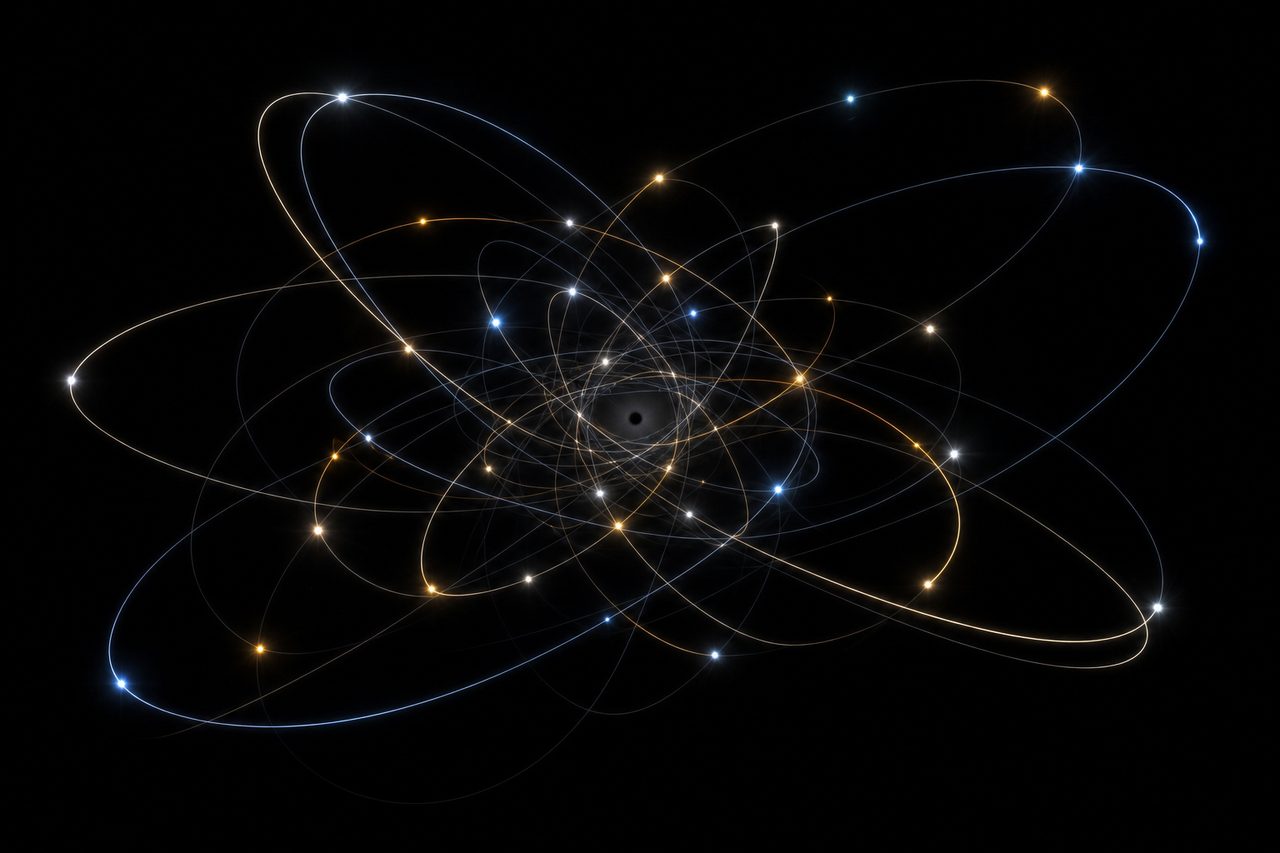
At the very centre, stars whirl around something invisible, on tight, fast orbits.

The faster a star circles, the more mass must be pulling it. Following those stars for decades, teams led by Reinhard Genzel and Andrea Ghez weighed the object at about four million Suns, and shared the 2020 Nobel Prize in Physics.

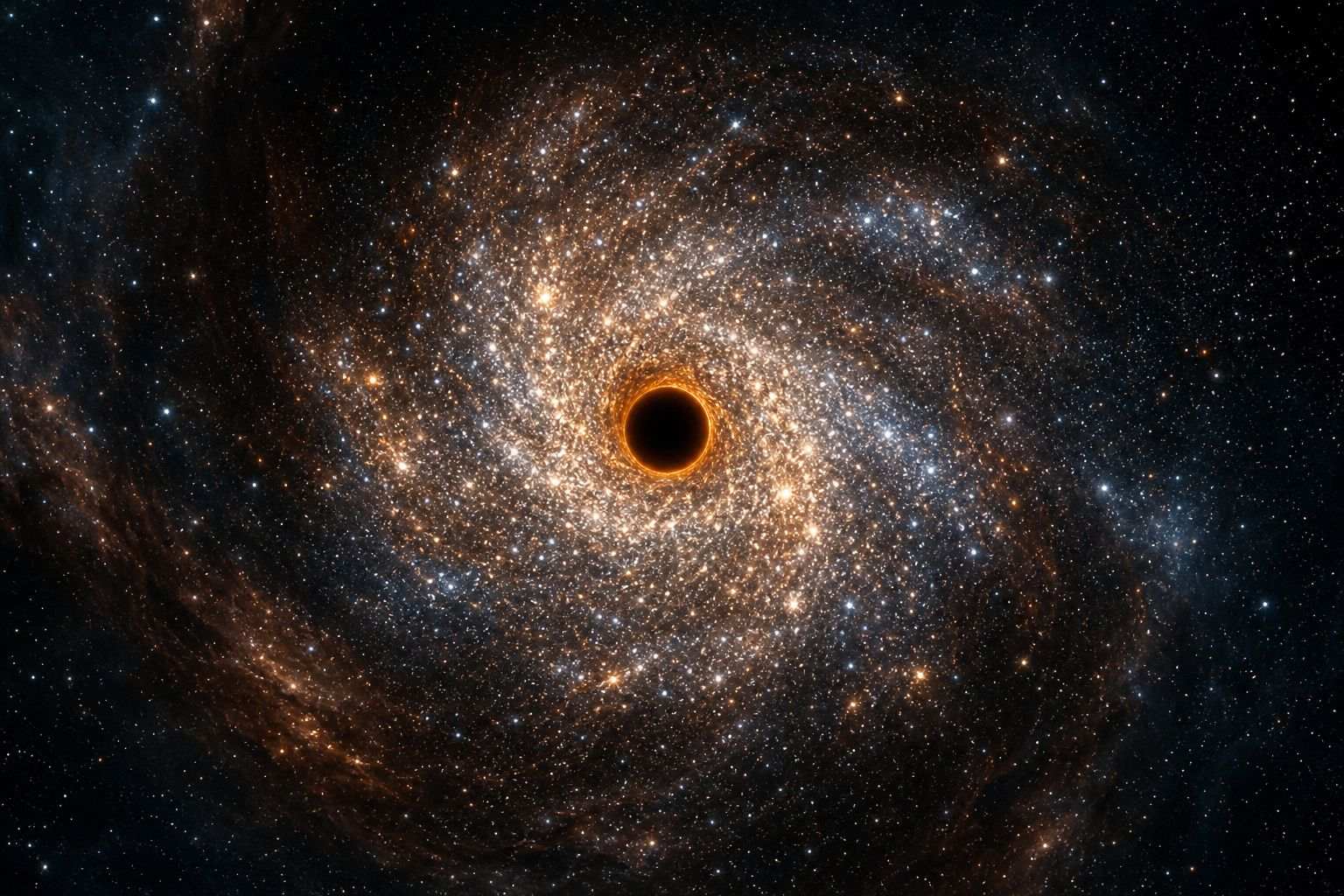
It is a supermassive black hole, Sagittarius A*. In 2022 the Event Horizon Telescope, radio dishes around the Earth working as one, showed its shadow.

Weighing by orbits works for the whole galaxy too. And there, it led to a puzzle.

Tight orbits Stars looping around a single unseen point: the clue that something heavy is there. AI-generated illustration.
~4 million
times the Sun’s mass
26,000–27,000 ly
from Earth (sources round differently)
Sagittarius A* (UC, ScienceDaily)
  1. 6 Oct 2020 Nobel: Genzel and Ghez (with Penrose)
  2. 12 May 2022 first image of Sagittarius A*
Weighing the centre
A shadow in a ring An impression of a dark shadow framed by glowing gas; from Earth the real ring looks about the size of a doughnut on the Moon. AI-generated illustration.
  • planets’ orbits weigh the Sun
  • stars’ orbits weigh the black hole
  • star speeds across the disk weigh the galaxy
Weighing by orbits
Chapter IV · The heart

Sagittarius A*

University of California (2020): Reinhard Genzel and Andrea Ghez shared half of the 2020 Nobel Prize in Physics “for the discovery of a supermassive compact object at the centre of our galaxy”, of about 4 million solar masses; Ghez used the Keck telescopes, Genzel’s team ESO telescopes. ScienceDaily (12 May 2022): the Event Horizon Telescope linked eight radio observatories into one Earth-sized telescope to image Sagittarius A*, about 27,000 light-years away; from Earth it appears about the size of a doughnut on the Moon.

Sources round the distance to the centre differently: 26,000 or 27,000 light-years.

The 3D galaxy is a simplified teaching model built from published sizes; arm positions, satellite directions and star numbers are schematic.

Sources: University of California (2020): UCLA and UC Berkeley faculty share 2020 Nobel Prize in Physics; ScienceDaily (12 May 2022): First image of the black hole at the centre of the Milky Way

Chapter V · The missing mass

Chapter V · The missing mass

Too fast

A galaxy that spins as if it were heavier.

In our solar system, the outer planets orbit more slowly than the inner ones, because almost all the mass is in the middle, in the Sun.

If a galaxy's mass were only where its stars shine, its outer stars should slow down in the same way.

In the 1970s Vera Rubin, after whom the new observatory is named, and Kent Ford measured how fast spiral galaxies spin. In 1980 they reported twenty-one of them: the outer parts did not slow down.

Rubin wrote that the conclusion was inescapable: there is matter out there that does not shine.

v=G M(r)rv = \sqrt{\dfrac{G\,M(r)}{r}}
vv
orbital speed
M(r)M(r)
mass inside radius r
rr
distance from the centre
GG
gravitational constant
Expected orbital speed If M stops growing beyond the stars, v must fall as 1/√r.
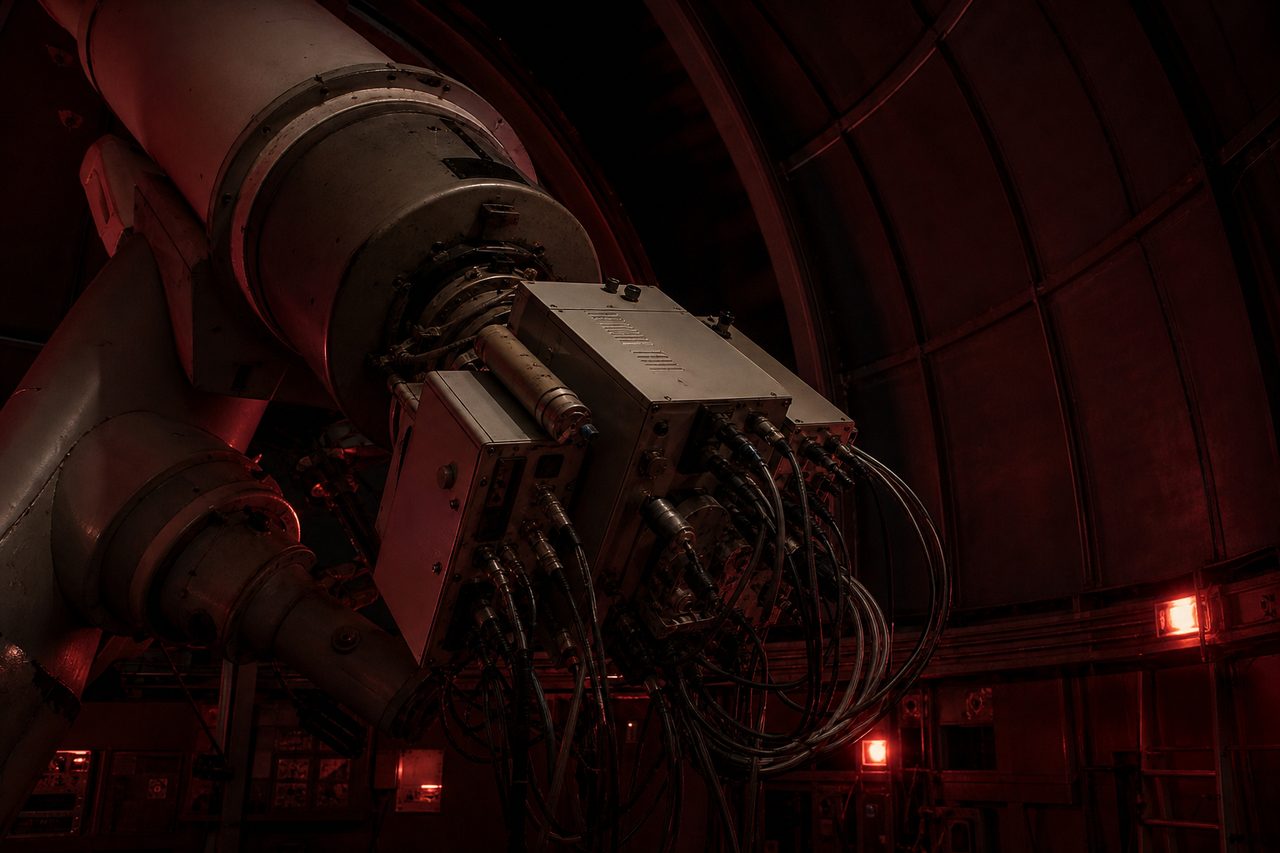
Measuring spin A 1970s-style spectrograph, which splits starlight to read its speed. AI-generated illustration.
21
spiral galaxies, all with flat rotation curves
Rubin and Ford, 1980 (APS News)
The conclusion is inescapable that non-luminous matter exists beyond the optical galaxy.Vera Rubin et al., 1980 (APS News)
Chapter V · The missing mass

Flat rotation curves

APS News (2023): Vera Rubin and Kent Ford published on Andromeda (M31) in 1970, using Ford’s image-tube spectrograph; their 1980 paper showed flat rotation curves in 21 spiral galaxies and concluded that “non-luminous matter exists beyond the optical galaxy.” Yale News: the Rubin Observatory is named after Vera Rubin.

The two curves in the scene are schematic shapes, not measured data: one shows what visible matter alone would predict, the other the flat shape Rubin and Ford found.

The 3D galaxy is a simplified teaching model built from published sizes; arm positions, satellite directions and star numbers are schematic.

Sources: APS News (2023): Vera Rubin’s paper on dark matter; Yale News (28 Oct 2026): Historic new observatory reveals two hidden companions of the Milky Way

Chapter V · The missing mass

An invisible halo

Most of our galaxy is something we cannot see.

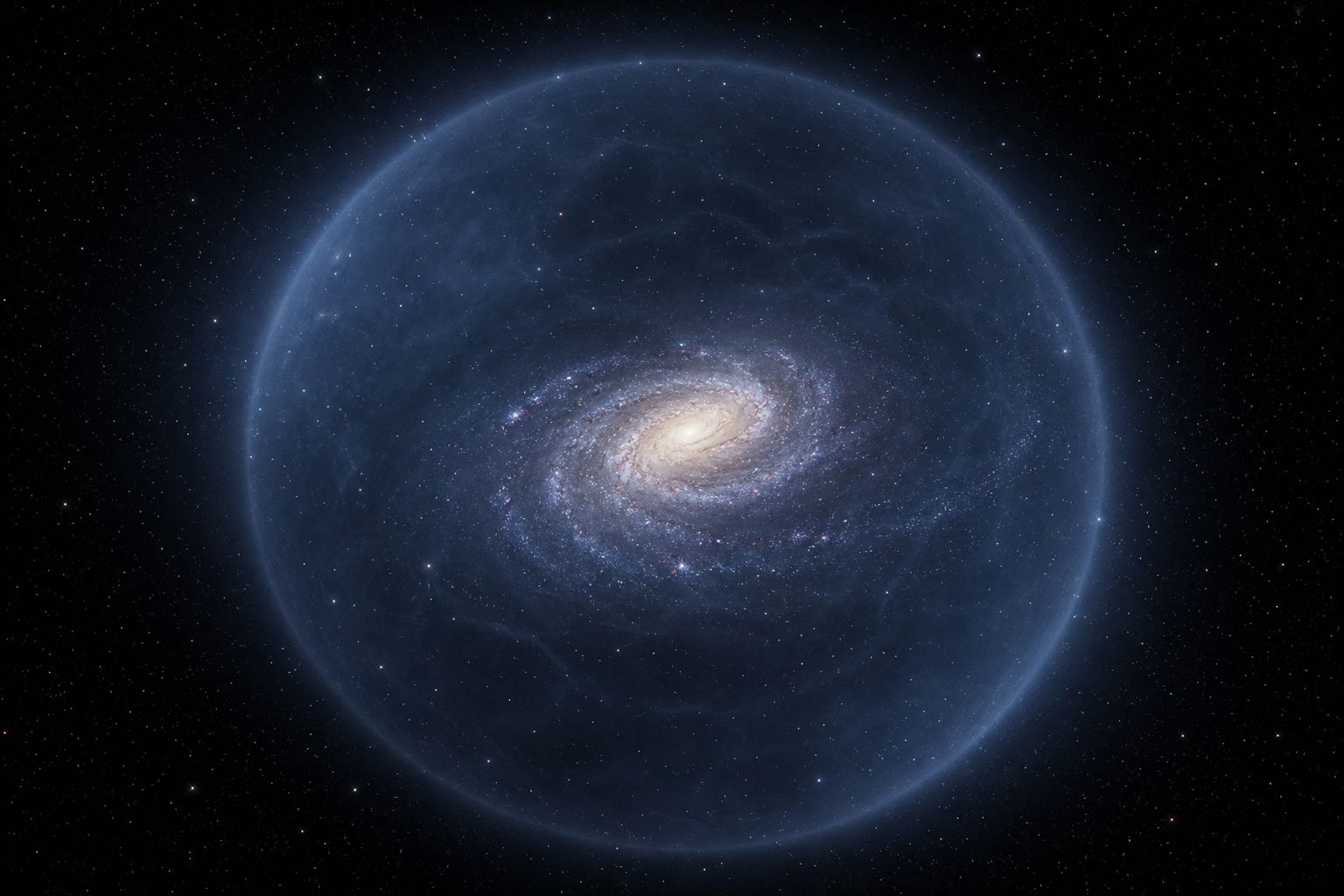
That unseen matter is called dark matter. It gives off no light, but its gravity holds the galaxy together.

In the Milky Way, it is thought to fill a round halo about a million light-years across, and to make up about ninety percent of the galaxy's mass.

What dark matter is made of, nobody yet knows.

Wrapped in the dark A spiral inside a huge faint sphere: an impression of matter that does not shine. AI-generated illustration.
~1 million ly
wide
The dark matter halo (RMG)
dark matter~90%
everything else: stars, gas, dust~10%
What the Milky Way’s mass is made of (RMG)
Chapter V · The missing mass

The halo

Royal Museums Greenwich: the dark matter halo is about 1 million light-years wide and makes up about 90% of the galaxy’s total mass; the stellar halo is more than 300,000 light-years across, holds only about 1% of the stars and about 160 known globular clusters.

The halo sphere in the scene is drawn smaller than it really is so that it fits on screen.

The 3D galaxy is a simplified teaching model built from published sizes; arm positions, satellite directions and star numbers are schematic.

Sources: Royal Museums Greenwich: A guide to the Milky Way, our home galaxy

Chapter VI · Companions

Chapter VI · Companions

Little galaxies

What orbits the Milky Way.

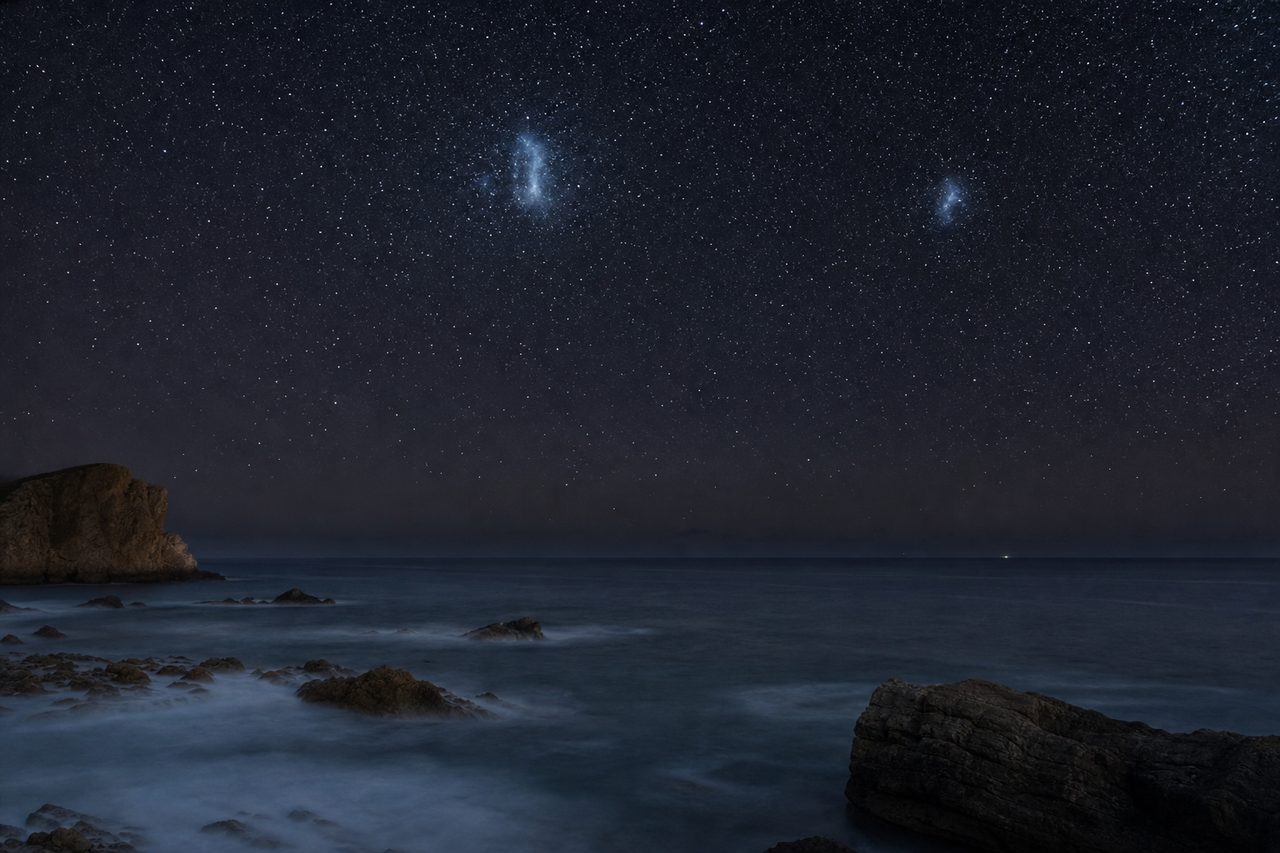
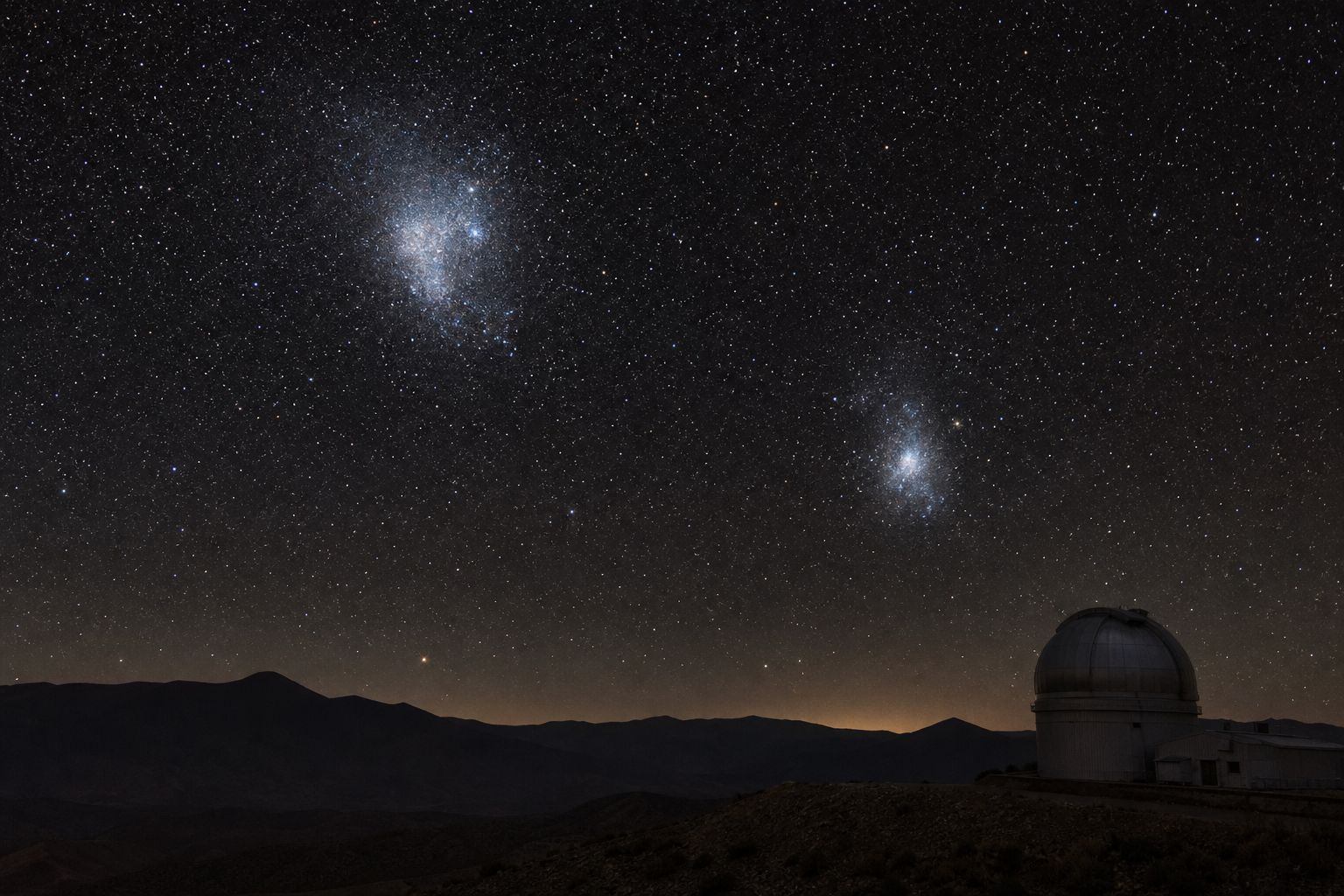
The halo is also home to small galaxies that orbit ours. The two biggest, the Large and Small Magellanic Clouds, can be seen with the naked eye from the southern hemisphere.

The Large Cloud is about a hundred and sixty thousand light-years away; the Small Cloud about two hundred thousand.

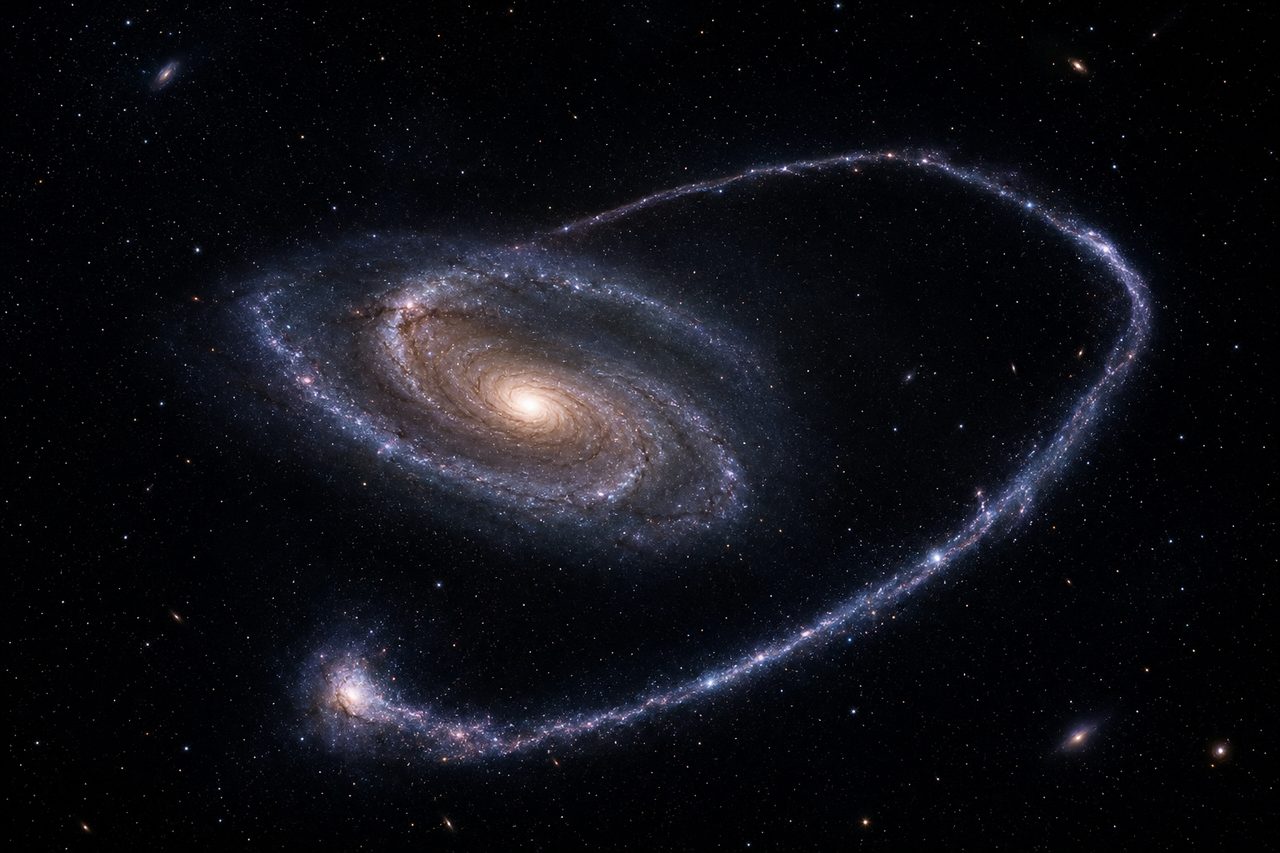
The Sagittarius dwarf galaxy, found in 1994 on the far side of the centre, is being torn into long streams of stars that wrap around the Milky Way.

Two clouds Two pale patches in a southern sky: not clouds at all, but galaxies. AI-generated illustration.
Large Magellanic Cloud~160
Small Magellanic Cloud~200
Aquarius IV~355
Distance from us (Universe Today; Cerny et al.)
Torn apart A loop of stars pulled out of a small galaxy by a larger one. AI-generated illustration.
Chapter VI · Companions

Satellite galaxies

Universe Today: the Large Magellanic Cloud is about 160,000 light-years away and about a tenth of the Milky Way’s mass; the Small Magellanic Cloud about 200,000; both are naked-eye patches from the southern hemisphere. IAC: the Sagittarius dwarf galaxy was discovered in 1994 on the far side of the galactic centre and is being torn into streams. Symmetry Magazine: the Dark Energy Survey, a survey that maps the sky, found 17 new dwarf-satellite candidates in 2015.

The 3D galaxy is a simplified teaching model built from published sizes; arm positions, satellite directions and star numbers are schematic.

Sources: Universe Today: Astronomy jargon 101, the Magellanic Clouds; Instituto de Astrofísica de Canarias: remains of the Sagittarius dwarf galaxy; Symmetry Magazine (Aug 2015): Dark Energy Survey finds more celestial neighbours; Cerny et al. (2026): Discovery of the distant, ultra-faint Milky Way satellite Aquarius IV (arXiv)

Chapter VI · Companions

A galaxy that eats

Reading the Milky Way’s past in the motions of its stars.

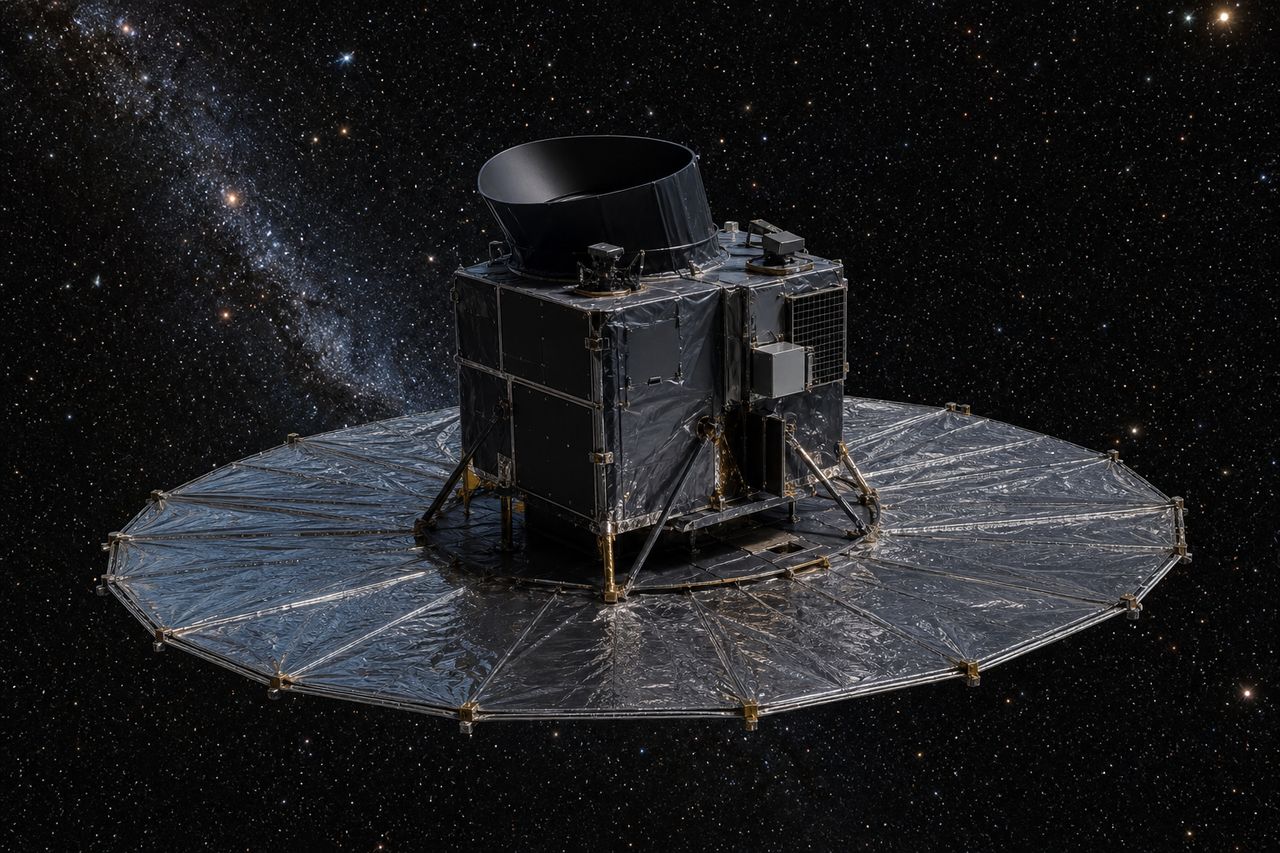
The Milky Way grew partly by swallowing its neighbours. The clearest record comes from Gaia, a European space telescope that measured almost two billion stars and other objects.

In 2018, astronomers used its data to find the debris of a galaxy now called Gaia–Enceladus, which merged with ours about ten billion years ago.

Its stars still move differently from the rest, and make up most of the inner halo.

Gaia A star-mapping spacecraft with a wide sunshield; Gaia worked from 2013 to 2025. AI-generated illustration.
~10 bn yrs ago
when it merged with the Milky Way
Gaia–Enceladus (ESA)
  • about the size of a Magellanic Cloud
  • found among 7 million Gaia stars; ~30,000 are its debris
  • probably helped make the thick disk
Gaia–Enceladus (ESA, Helmi et al. 2018)
Chapter VI · Companions

Gaia and Gaia–Enceladus

ESA (2018): Helmi et al. in Nature (31 October 2018) used 7 million Gaia stars, about 30,000 of them debris, to show a galaxy about the size of a Magellanic Cloud merged with the Milky Way about 10 billion years ago; its stars form most of the inner halo and the merger probably helped make the thick disk. Space.com: Gaia launched on 19 December 2013, measured almost 2 billion stars and other objects and ended science observations on 15 January 2025.

The 3D galaxy is a simplified teaching model built from published sizes; arm positions, satellite directions and star numbers are schematic.

Sources: ESA (2018): Galactic ghosts, Gaia uncovers a major event in the formation of the Milky Way; Space.com (Jan 2025): Goodnight Gaia, the star-tracking spacecraft shuts down

Chapter VI · Companions

Hundreds still hidden?

What the Rubin Observatory is looking for.

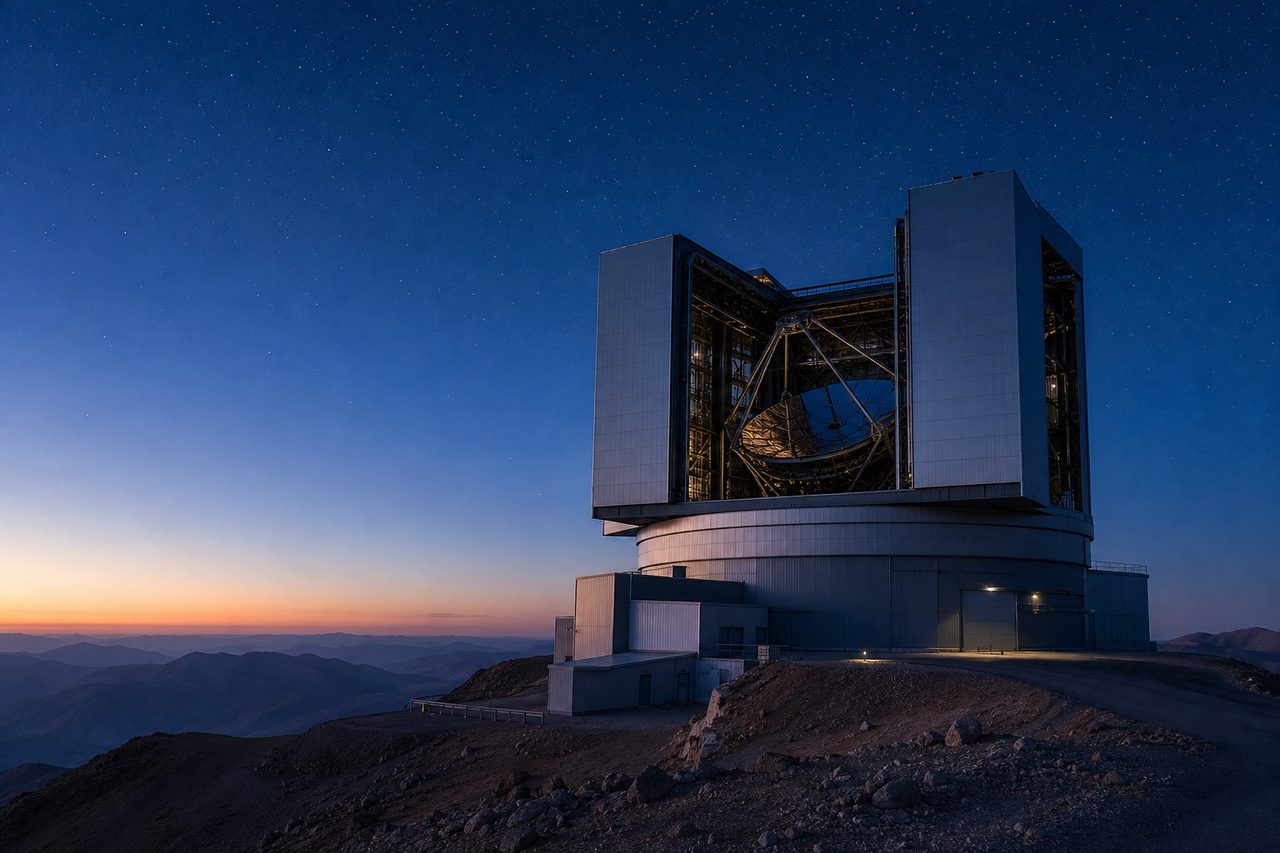
This is what the Rubin Observatory is for. Its camera, the largest digital camera ever built, sweeps the southern sky every three nights.

Aquarius IV turned up in early data covering only about seven percent of the sky.

Ultra-faint galaxies like it are almost entirely dark matter, with only a sprinkling of stars, so counting them tests our ideas of how galaxies form.

Rubin-GC1 was probably brought in with the Sagittarius dwarf galaxy, whose stream it seems to belong to.

Cerro Pachón, Chile A survey telescope on a dry ridge: an 8.4-metre mirror and a 3.2-gigapixel camera. AI-generated illustration.
~7%
of the sky searched so far
10 years
of survey ahead
Rubin preview data (UW, DOE)
Mostly dark An ultra-faint dwarf: a handful of stars inside a clump of dark matter. AI-generated illustration.
~9.2 bn yrs
old; a faint globular cluster seen towards the bulge
Rubin-GC1 (Universe Today)
Chapter VI · Companions

The Rubin Observatory

Yale News: the observatory on Cerro Pachón, Chile, has the 8.4 m Simonyi Survey Telescope and a 3.2-gigapixel camera, the largest digital camera ever built, and is named after Vera Rubin. US DOE: the 10-year Legacy Survey of Space and Time (LSST) was under way by 30 June 2026, producing about 10 TB a night. Space.com: it scans the southern sky every three nights. UW and ScienceDaily: the preview data covered about 7% of the sky; ultra-faint galaxies are almost entirely dark matter, which makes them tests of galaxy formation. Universe Today: Rubin-GC1 is a very faint globular cluster about 9.2 billion years old, probably captured and linked to the leading stream of the Sagittarius dwarf.

The 3D galaxy is a simplified teaching model built from published sizes; arm positions, satellite directions and star numbers are schematic.

Sources: Yale News (28 Oct 2026): Historic new observatory reveals two hidden companions of the Milky Way; US DOE Office of Science: Rubin Observatory begins capturing the greatest cosmic movie; Space.com (June 2025): Vera C. Rubin Observatory reveals its first images; University of Washington News (5 Nov 2026): Rubin Observatory reveals two hidden companions of the Milky Way; ScienceDaily (Nov 2026): Rubin Observatory discovers two hidden companions of the Milky Way; Universe Today: The Vera Rubin has found two more of the Milky Way’s dim satellites
Chapter VII · The future

Chapter VII · The future

Collisions ahead?

What may happen to our galaxy.

The swallowing is not over. A 2025 study found the Large Magellanic Cloud is almost certain to merge with the Milky Way within about two billion years.

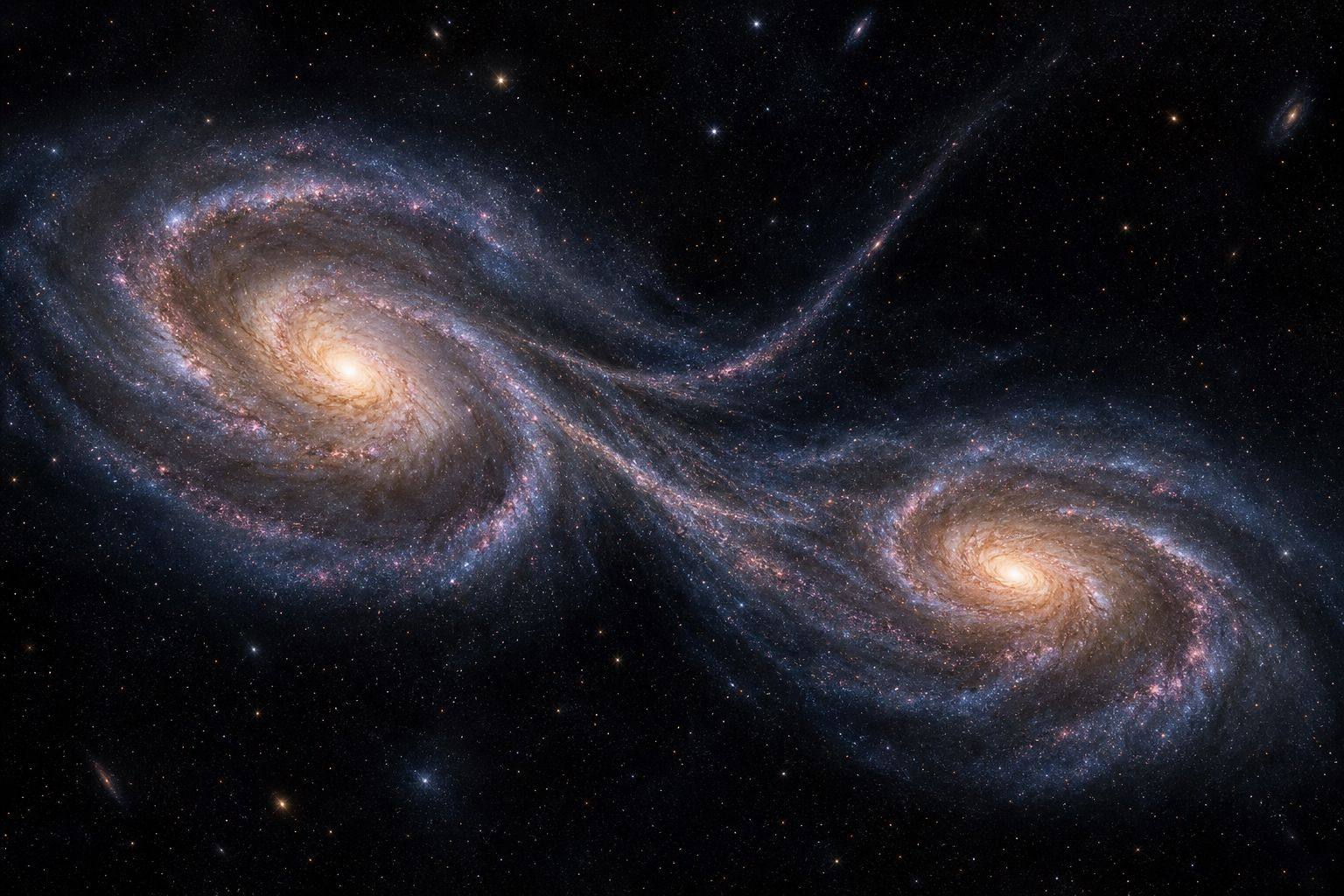
Andromeda, two and a half million light-years away, is heading towards us at about 110 kilometres a second.

For decades, a collision in four to five billion years was widely expected. The 2025 study, using Hubble and Gaia data, put the chance of a collision within ten billion years at only about one in two.

The next meal Two small galaxies above a southern observatory: the larger one is the Large Magellanic Cloud. AI-generated illustration.
An approach Two big spirals drawing together, streams of stars starting to stretch between them. AI-generated illustration.
~50%
chance of a Milky Way–Andromeda collision within 10 bn years
Sawala et al., Nature Astronomy 2025
A sky to come? Imagined: a neighbouring spiral looming beside the Milky Way, billions of years from now. AI-generated illustration.
Chapter VII · The future

Future collisions

Sci.News, reporting Sawala et al. in Nature Astronomy (2 June 2025), using Hubble and Gaia data: about a 50% chance of a Milky Way–Andromeda collision within 10 billion years; a Milky Way–Large Magellanic Cloud merger is almost certain within about 2 billion years. Durham University: only about a 2% chance of a collision within 5 billion years. Royal Museums Greenwich: Andromeda is about 2.5 million light-years away and approaching at about 110 km/s; the classic forecast was a collision in 4–5 billion years.

These are probabilities from simulations with uncertain inputs, not certainties.

The 3D galaxy is a simplified teaching model built from published sizes; arm positions, satellite directions and star numbers are schematic.

Sources: Sci.News (June 2025): Milky Way–Andromeda collision odds (Sawala et al., Nature Astronomy); Durham University (June 2025): New study casts doubt on a Milky Way–Andromeda collision; Royal Museums Greenwich: A guide to the Milky Way, our home galaxy

Epilogue

Epilogue

Home, from the inside

Timeline and sources.

Two questions are still open: what dark matter is made of, and how many faint companions are still hidden. Rubin's ten-year survey will search the southern sky for them.

You can look for yourself. In Thailand, NARIT says the Milky Way's bright core is best seen from late April to early October, at least about thirty kilometres from city lights.

That pale river of light is our home, seen from the inside.

  1. 1785 the Herschels: a disk
  2. 1917 Shapley: the Sun is off centre
  3. 1923 Hubble: Andromeda is another galaxy
  4. 1980 Rubin and Ford: flat rotation curves
  5. 2018 Gaia: Gaia–Enceladus
  6. 2022 image of Sagittarius A*
  7. 2026 Rubin: Aquarius IV, Rubin-GC1
Mapping the Milky Way
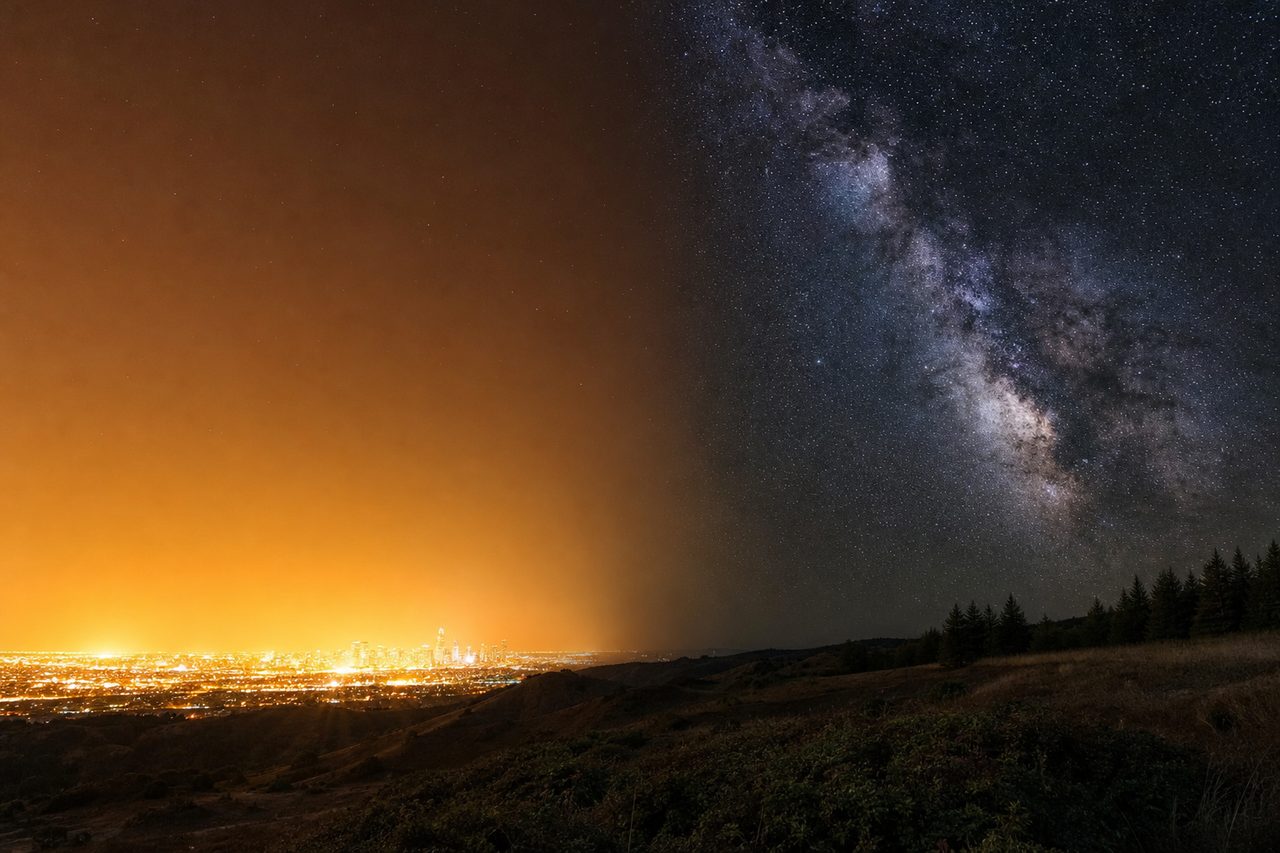
Find a dark sky City glow on the left hides what a dark rural sky on the right shows. AI-generated illustration.
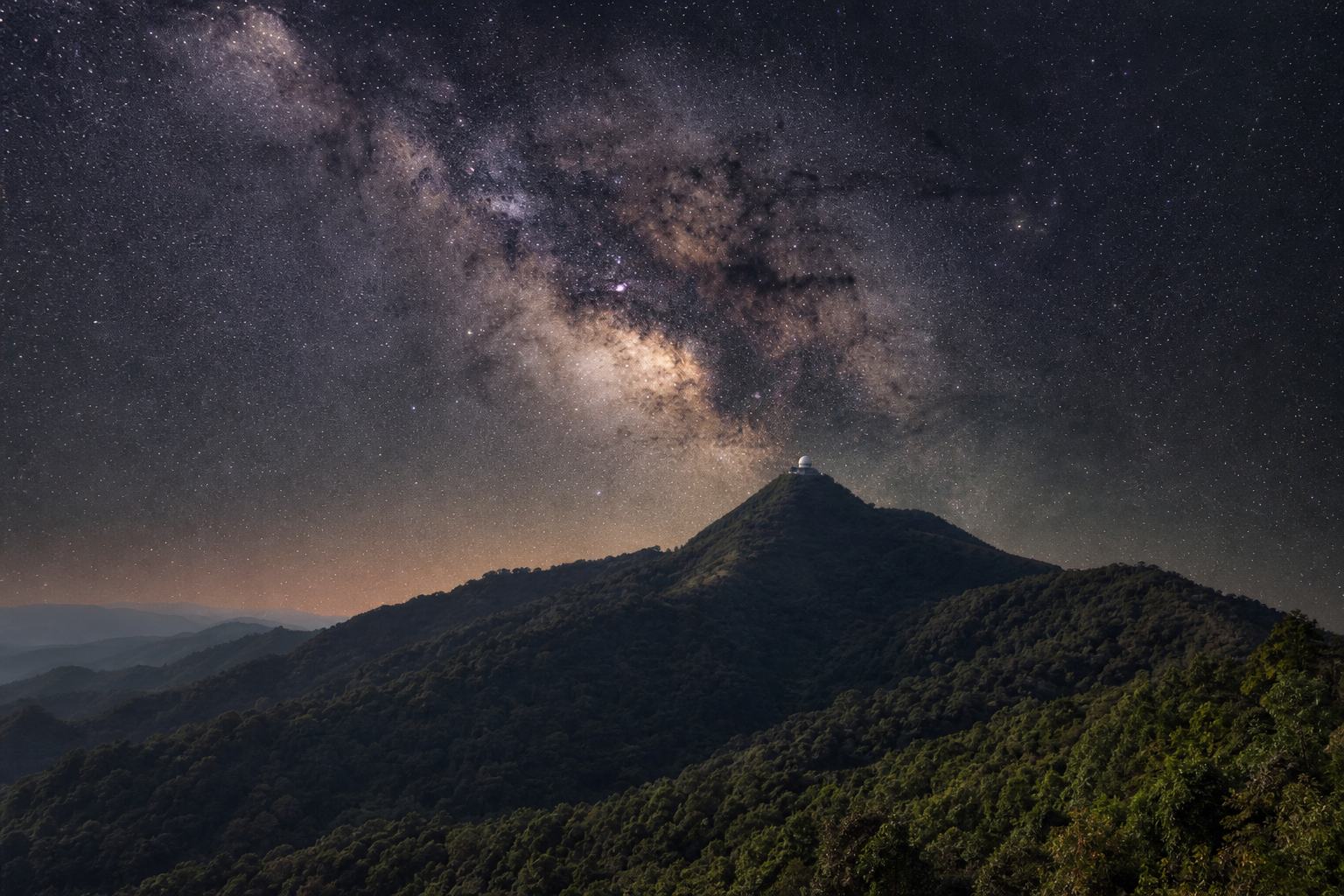
Look up The galactic core over mountain ridges, towards Sagittarius; NARIT’s national observatory stands on Doi Inthanon at 2,457 m. AI-generated illustration.
Epilogue · Sources

Sources

Every fact in this film comes from the sources below. Where sources differ (the Sun’s distance from the centre, the number of known satellites), the film gives a rounded common value and the panels give the range. NARIT, via Bangkok Biz News (2024): the core is easiest to see near Scorpius and Sagittarius from late April to early October, cannot be seen from late November to early February, and is best viewed at least about 30 km from cities. The chapter stills and pictures are AI-generated illustrations, not photographs of the real objects. The 3D galaxy, the rotation curves, the halo and the satellite directions are simplified teaching models. The Rubin results are recent: Aquarius IV is still a candidate dwarf galaxy awaiting confirmation.

Sources: University of Washington News (5 Nov 2026): Rubin Observatory reveals two hidden companions of the Milky Way; Yale News (28 Oct 2026): Historic new observatory reveals two hidden companions of the Milky Way; ScienceDaily (Nov 2026): Rubin Observatory discovers two hidden companions of the Milky Way; Cerny et al. (2026): Discovery of the distant, ultra-faint Milky Way satellite Aquarius IV (arXiv); Universe Today: The Vera Rubin has found two more of the Milky Way’s dim satellites; US DOE Office of Science: Rubin Observatory begins capturing the greatest cosmic movie; Space.com (June 2025): Vera C. Rubin Observatory reveals its first images; Royal Museums Greenwich: A guide to the Milky Way, our home galaxy; NASA Imagine the Universe: The Milky Way galaxy; OpenStax Astronomy (LibreTexts): Observing our galaxy; Universe Today: the distance and speed of the Sun’s orbit around the galactic centre measured (Hunt et al. 2016); AAAS (2016): One third of people cannot see the Milky Way; Bangkok Biz News (Feb 2024): when to see the Milky Way in Thailand, advice from NARIT; NARIT: Thai National Observatory, Doi Inthanon; Britannica: Harlow Shapley; AAVSO: Shattering Shapley’s universe (Hubble’s variable in Andromeda); APS News (2023): Vera Rubin’s paper on dark matter; University of California (2020): UCLA and UC Berkeley faculty share 2020 Nobel Prize in Physics; ScienceDaily (12 May 2022): First image of the black hole at the centre of the Milky Way; Universe Today: Astronomy jargon 101, the Magellanic Clouds; Instituto de Astrofísica de Canarias: remains of the Sagittarius dwarf galaxy; Symmetry Magazine (Aug 2015): Dark Energy Survey finds more celestial neighbours; ESA (2018): Galactic ghosts, Gaia uncovers a major event in the formation of the Milky Way; Space.com (Jan 2025): Goodnight Gaia, the star-tracking spacecraft shuts down; Sci.News (June 2025): Milky Way–Andromeda collision odds (Sawala et al., Nature Astronomy); Durham University (June 2025): New study casts doubt on a Milky Way–Andromeda collision