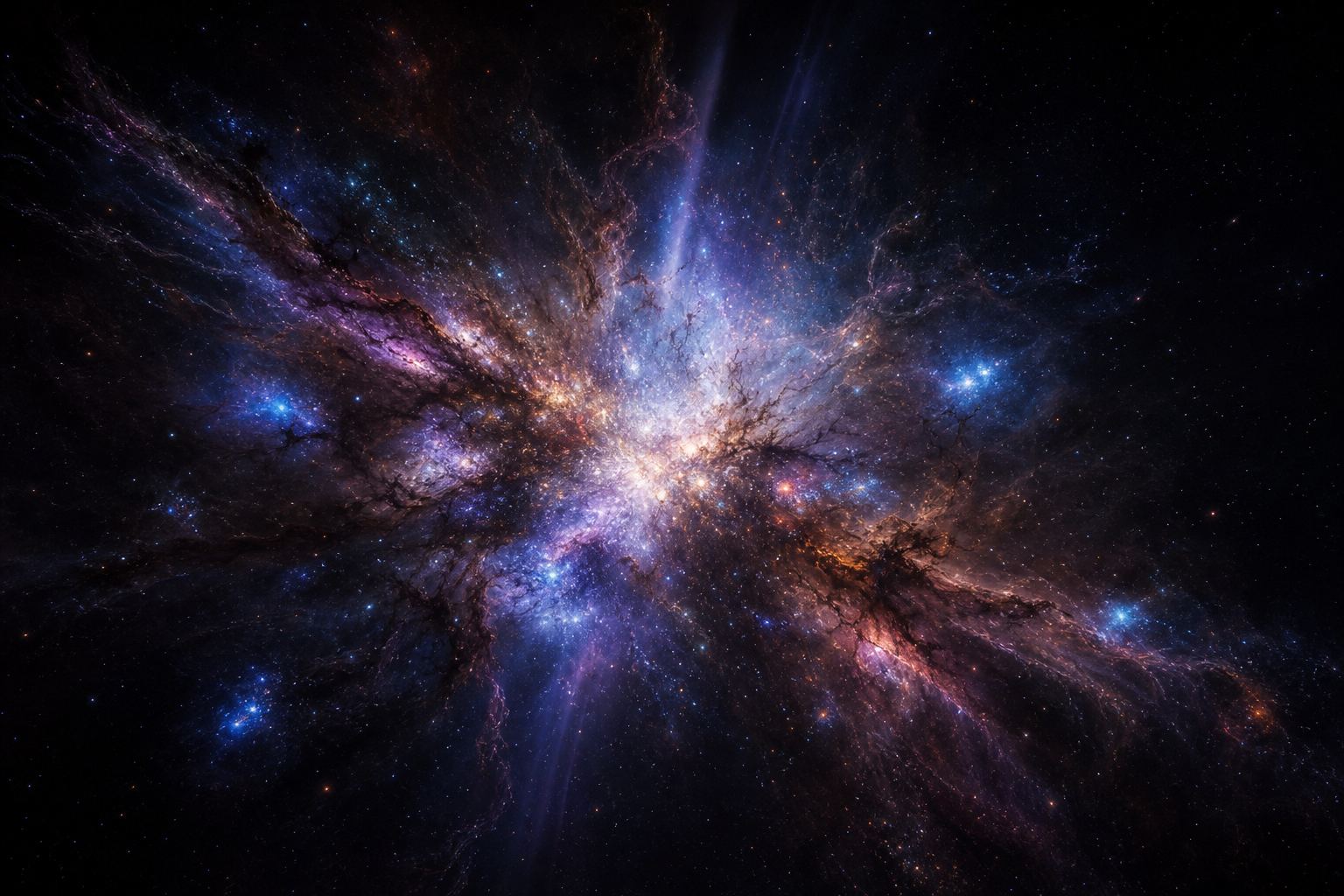
In October 2026 a Hubble study in Nature Astronomy reported that nearby galaxies with the strongest supernova winds let the least ionising light escape, a new clue to how the early universe cleared. This film explains the fundamentals: how the first light was set free 380,000 years after the Big Bang, the dark ages that followed, the first stars and galaxies, how their ultraviolet light broke hydrogen atoms apart and blew bubbles that merged, how quasar light and the microwave background show when it happened, and what is still unknown.
Interactive 3D film9 min13.8 billion years ago to todayPublished 31 October 2026
The space between the galaxies seems empty and clear. It was not always so. For hundreds of millions of years, the young universe was filled with a fog of hydrogen gas that swallowed ultraviolet light.
In October 2026, a small Hubble study of nearby galaxies found a twist. Those with the strongest winds, gas blown out by exploding stars, let out the least ultraviolet of the kind that breaks hydrogen apart.
The story behind it is well established. How did the first stars burn the fog away, and how do we know?
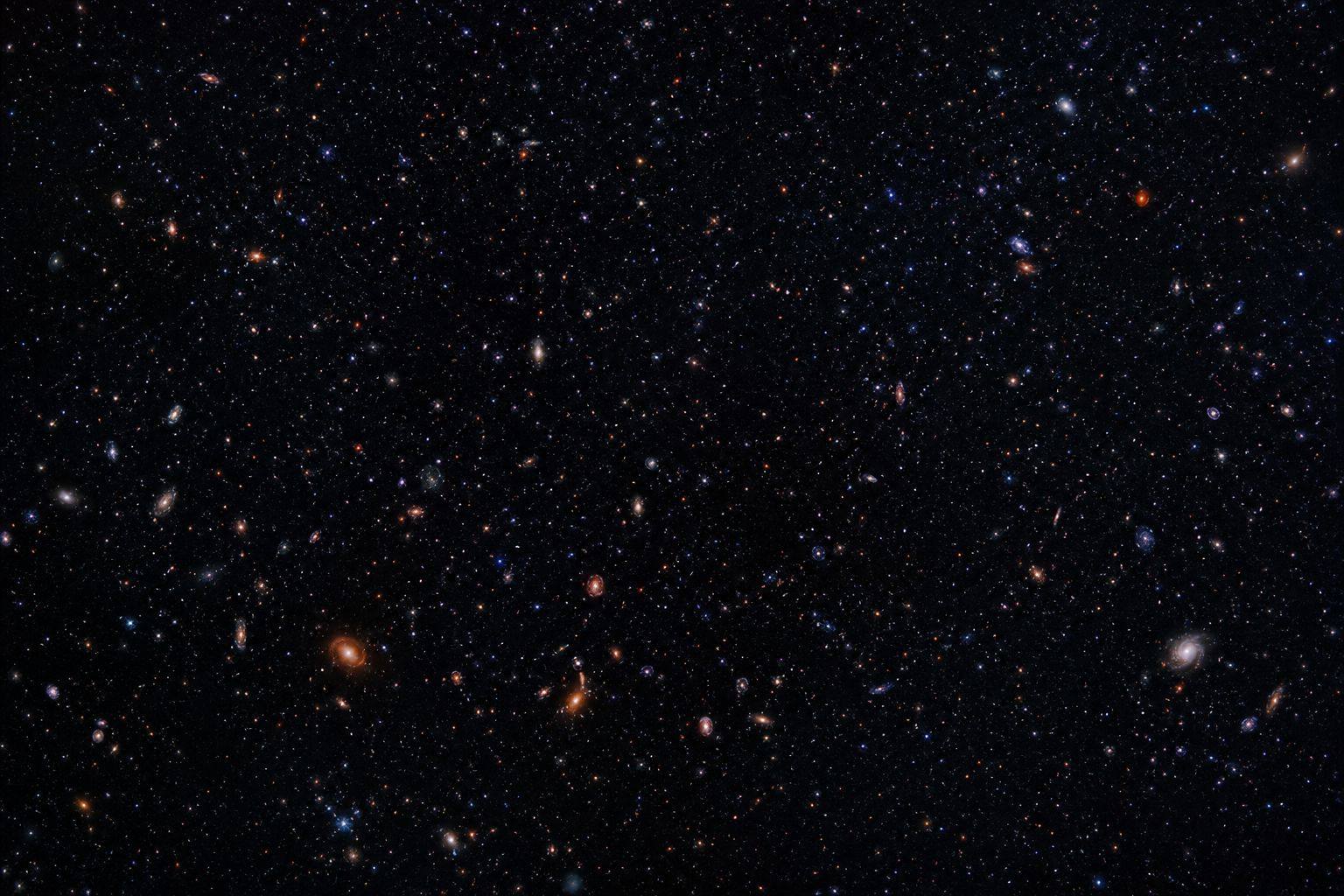
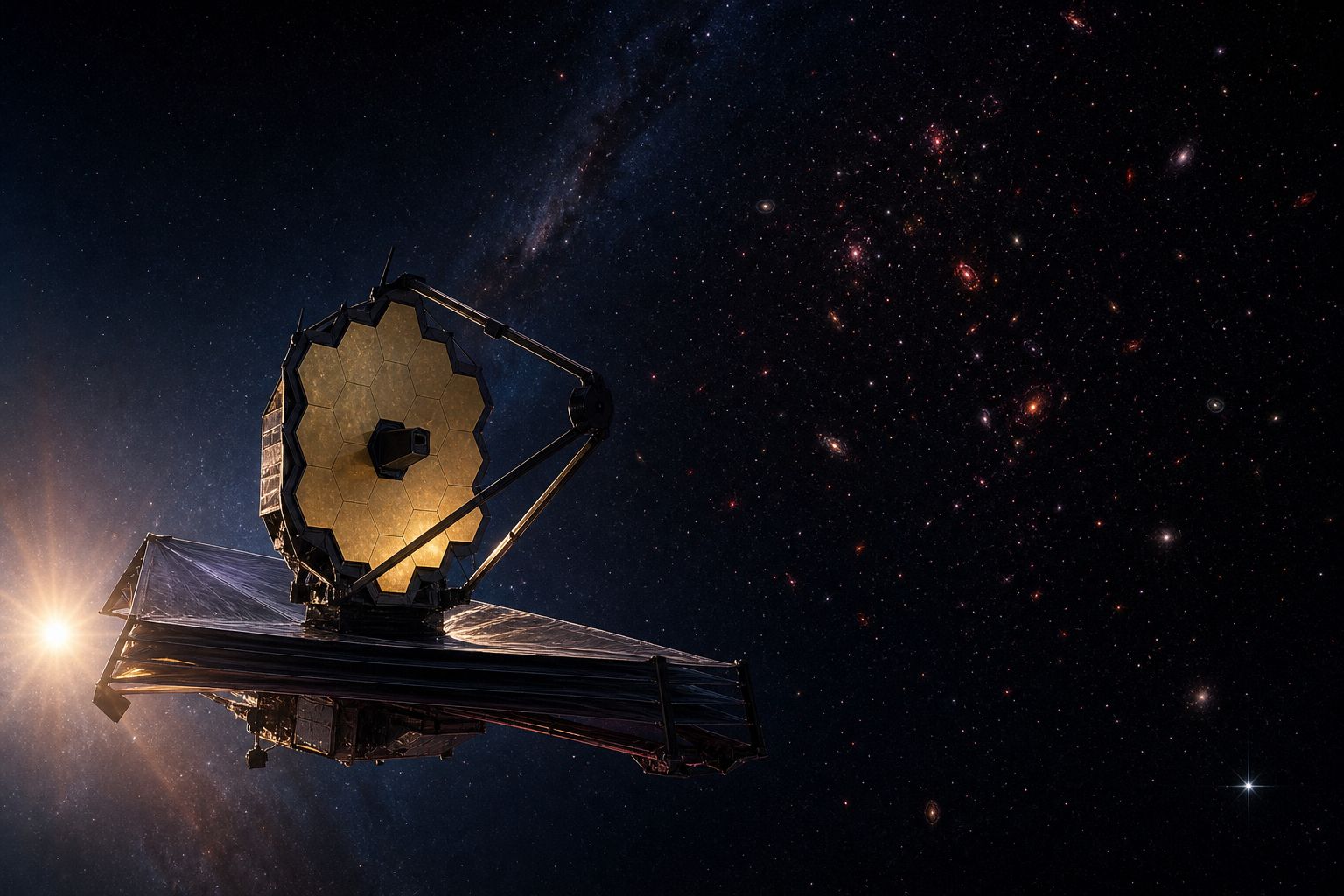
Looking back in time Faint, distant galaxies on a black sky. AI-generated still.
6
compact starburst galaxies studied with Hubble
Fastest winds
went with the least escaping ionising light
The new study (Nature Astronomy, 2026)
Basically, how these galaxies were leaking ionizing radiation isn’t what we thought.Cody Carr, lead author (ScienceDaily, 2026)
The first light, 380,000 years in
The dark ages and the first stars
Bubbles that burned the fog
How quasars and old light date it
In this film
Prologue
A twist from Hubble
ScienceDaily and the University of Michigan (29 October 2026), on a study in Nature Astronomy led by Cody Carr: using Hubble, the team compared the speed of galactic winds with the share of hydrogen-ionising radiation escaping from nearby starburst galaxies, and found that the galaxies with the fastest winds let the smallest fraction escape, the opposite of what a widely held idea predicted. The Brighter Side of News (23 October 2026): the sample is six compact starburst galaxies from the Low-redshift Lyman Continuum Survey, observed with Hubble’s Cosmic Origins Spectrograph; the authors note that the sample is small and nearby.
The 3D scenes are simplified teaching models: the cube of gas, the bubbles, the atom and the spectra are schematic, not to scale and not real data.
Go back to the beginning. At first the universe was a hot, glowing soup of bare atomic nuclei and free electrons. Light could not travel far: it kept bouncing off the electrons, like headlights in thick fog.
About three hundred and eighty thousand years after the Big Bang, it had cooled to roughly three thousand degrees. Electrons could settle around protons, forming neutral hydrogen atoms. This is called recombination.
Suddenly, light flew free. It is still arriving today, stretched by the expansion of space into microwaves less than three degrees above absolute zero: the cosmic microwave background.
A glowing fog Hot gas thinning until light streams through. AI-generated still.
~3,000 K
temperature when atoms formed
2.725 K
the same light today
~1,100×
how much its waves have stretched
Recombination (University of Alberta) · K = kelvin, ≈ °C + 2731+z=2.725K3000K≈1100
z
redshift of the first light
How much the first light has stretched Its waves are now about a millimetre long: microwaves. 0 K is absolute zero, the coldest possible.
0 Big Bang: hot, dense, opaque
~380,000 yr Atoms form; light flies free
After The dark ages begin
The first 400,000 years (NASA)
Chapter I · First light
The first light
NASA Science (Webb): about 380,000 years after the Big Bang, during recombination, hydrogen and helium atoms formed. University of Alberta lecture notes: below about 3,000 K, protons and electrons combined into neutral hydrogen, which barely hinders photons, so the universe became transparent (the time of last scattering); since then the expansion has stretched those photons by a factor of about 1,100, so today they are microwaves at 2.725 K, with wavelengths near 1 mm. NASA APOD (2018): the Planck satellite (2009–2013) mapped this cosmic microwave background in unprecedented detail; its final results in 2018 give the universe an age of about 13.8 billion years.
Press “Hot” and “Cool” to switch between the plasma and the first atoms.
The 3D scenes are simplified teaching models: the cube of gas, the bubbles, the atom and the spectra are schematic, not to scale and not real data.
Then came a long era called the cosmic dark ages. The universe was almost entirely hydrogen and helium gas, slowly cooling, with no stars and no galaxies.
But it was not perfectly smooth. Tiny differences in density, the ones we see as warm and cool spots in the microwave background, kept growing as gravity pulled the denser patches together.
In the densest clumps, gas grew hot enough for nuclear fusion to begin.
The cosmic dark ages Cold gas and faint threads, with no starlight. AI-generated still.
Neutral hydrogen, and helium
The fading glow of the first light
No stars and no galaxies yet
What filled the dark ages (Knowable)
~380,000 yr Atoms; dark ages begin
First stars Exact time unknown
~290 million yr Earliest galaxy confirmed by 2024 (ESA/Webb)
Out of the dark (NASA)
Chapter I · First light
The cosmic dark ages
Knowable Magazine (2024): after recombination came the dark ages, when the universe was filled with neutral hydrogen and had no stars; the first stars, at “cosmic dawn”, formed roughly 100 million years or more after the Big Bang. NASA Science (Webb): the first stars formed between recombination and the oldest known galaxies, about 400 million years after the Big Bang, but their exact time is unknown. NASA APOD (2018): Planck mapped the slight temperature differences across the microwave background. ESA/Webb (2024): JADES-GS-z14-0, seen about 290 million years after the Big Bang, was then the most distant galaxy known.
The 3D scenes are simplified teaching models: the cube of gas, the bubbles, the atom and the spectra are schematic, not to scale and not real data.
The first stars, called Population Three, formed from pure hydrogen and helium, with none of the heavier elements found in stars like the Sun. Models suggest they appeared within the first hundred million years or so.
Theory suggests many were giants, perhaps tens to hundreds of times the Sun's mass. They burned hot and bright, and died young, as supernovae or as black holes.
No one has seen one for certain. In 2026, astronomers using the James Webb Space Telescope reported a faint galaxy that might contain such stars, but it is only a candidate, waiting for confirmation.
Only hydrogen and helium
No heavier elements, which astronomers call “metals”
Formed around 100 million years in (models)
What made them different (AAS Nova)Population III (artist’s view) A huge blue star lighting a cavity in pristine gas. AI-generated still.
10–1,000
times the Sun’s mass, an estimate
~50–100 million
years after the Big Bang
What theory suggests (Universe Today)
Seen at redshift 6.5, magnified by a galaxy cluster
Colours fit metal-free stars best
Needs a spectrum to confirm
GLIMPSE-16043 (AAS Nova, 2026)
Chapter II · The first stars
Population III
AAS Nova (21 April 2026): Population III stars were the first generation, formed from pristine gas with no elements heavier than helium, likely around 100 million years after the Big Bang; none has yet been observed; the ultra-faint galaxy GLIMPSE-16043 at redshift 6.5, magnified by the cluster Abell S1063, passed two photometric tests for Population III light but needs spectroscopy to show it is truly metal-free. Universe Today: one modelling study estimates characteristic masses of about 10 to 1,000 solar masses and formation around 50 to 100 million years after the Big Bang; such stars lived briefly and ended as supernovae or black holes.
Press “Light a star” to switch on the first stars one by one.
The 3D scenes are simplified teaching models: the cube of gas, the bubbles, the atom and the spectra are schematic, not to scale and not real data.
To see this era, astronomers use the fact that light takes time to travel. The farther away a galaxy is, the longer its light has been on the way, so we see it as it was long ago.
In 2004, the Hubble Ultra Deep Field stared at one tiny patch of sky for more than eleven days and found nearly ten thousand galaxies. The faintest were seen when the universe was about eight hundred million years old.
Webb sees deeper still. In 2024 it confirmed a galaxy called JADES-GS-z14-0, seen about two hundred and ninety million years after the Big Bang.
A telescope as a time machine A space telescope aimed at a field of faint red galaxies. AI-generated still.
~10,000
galaxies in one small field
11.3 days
of exposure, over 400 orbits
1/10
of the Moon’s width across
Hubble Ultra Deep Field (ESA/Hubble, 2004)13.8−0.8≈13billion yearsLook-back time, roughly Light from the faintest Ultra Deep Field galaxies has travelled about 13 billion years (our calculation).
14.32
redshift
~290 million
years after the Big Bang
JADES-GS-z14-0 (ESA/Webb, May 2024)
Chapter II · The first stars
Light takes time
ESA/Hubble (9 March 2004): the Hubble Ultra Deep Field, in the constellation Fornax, is about one-tenth the diameter of the full Moon across; it took 800 exposures over 400 Hubble orbits, 11.3 days in total, between September 2003 and January 2004, and shows nearly 10,000 galaxies; the smallest, reddest ones may be seen when the universe was about 800 million years old. ESA/Webb (30 May 2024): JADES-GS-z14-0 has a redshift of 14.32 and is seen less than 300 million years after the Big Bang, about 290 million years; it was then the most distant galaxy known.
Press a galaxy to send its light along the timeline. The timeline is drawn to a stretched scale.
The 3D scenes are simplified teaching models: the cube of gas, the bubbles, the atom and the spectra are schematic, not to scale and not real data.
Why so red? As light crosses expanding space, its waves are stretched to longer, redder wavelengths. This is redshift. Its number, z, says how much: the wavelength grows by a factor of one plus z.
So at redshift six, the waves arrive seven times longer: ultraviolet light has become infrared. That is why the earliest galaxies are found with telescopes that see infrared.
λobserved=(1+z)λemitted
λ
wavelength
z
redshift
Redshift Lyman-alpha is hydrogen’s strongest ultraviolet line. At 121.6 nm, it lands near 851 nm at z = 6 and near 1,860 nm at z = 14.3.
× 7
at z = 6
× 15.3
at z = 14.3
Stretch factor 1 + z
Emitted (UV)
122
z = 6 (infrared)
851
z = 14.3 (infrared)
1,862
Where 121.6 nm ultraviolet ends up
Chapter II · The first stars
Redshift
Light from distant galaxies reaches us stretched by the expansion of space: its wavelength is multiplied by (1 + z), where z is the redshift. Wikipedia (Lyman series): Lyman-alpha, the line from the electron dropping from the second level to the first, is at 121.567 nm. Multiplying by 1 + z puts it near 851 nm (infrared) for z = 6, and near 1,860 nm for z = 14.32, the redshift ESA/Webb gives for JADES-GS-z14-0 (our calculation).
Press z = 0, 6 or 14 to stretch the spectrum.
The 3D scenes are simplified teaching models: the cube of gas, the bubbles, the atom and the spectra are schematic, not to scale and not real data.
The new stars poured out ultraviolet light. To tear the electron from a hydrogen atom, a single photon needs at least thirteen point six electron volts, which means ultraviolet light shorter than about ninety-one nanometres.
Weaker photons cannot do it, however many there are. A strong enough one knocks the electron free and leaves a bare proton: the atom is ionised.
Because this undid recombination, the great change that followed is called reionisation.
E≥13.6eV⇔λ≤91.1nm
E
photon energy; 1 eV (electronvolt) is a tiny unit of energy
λ
wavelength
The Lyman limit
Visible light: passes by
~2.5
Lyman-alpha (121.6 nm): lifts the electron one level, cannot free it
10.2
Ionising UV: frees the electron
≥13.6
Photon energy vs what it does to hydrogen
A first galaxy Blue young stars inside a bubble of glowing gas. AI-generated still.
Before ~380,000 yr Hot gas: hydrogen ionised
~380,000 yr Recombination: neutral atoms
Cosmic dawn Starlight ionises it again
Why “re”-ionisation
Chapter III · Lifting the fog
Breaking hydrogen
Wikipedia (Lyman limit): 13.6 eV is the energy needed to free an electron from the ground state of a hydrogen atom; the matching wavelength, the Lyman limit, is 91.13 nm (911.3 Å). Wikipedia (Lyman series): the Lyman-alpha line, at 121.567 nm, comes from an electron dropping from the second level (n = 2) to the ground state (n = 1); its energy, 13.6 × (1 − 1/4) ≈ 10.2 eV, can lift the electron but not free it (our calculation). ScienceDaily (2026): intense radiation from early galaxies stripped electrons from hydrogen atoms, leaving protons and free electrons, in the period called reionisation.
Press a photon energy and watch what it does to the atom.
The 3D scenes are simplified teaching models: the cube of gas, the bubbles, the atom and the spectra are schematic, not to scale and not real data.
Around each early galaxy, a bubble of ionised gas formed inside the neutral fog, clear to ultraviolet light. As more stars and galaxies switched on, the bubbles grew.
Eventually they touched and merged, until almost all the hydrogen between the galaxies was ionised. Measurements from the Planck satellite suggest the process was about half done when the universe was some seven hundred million years old.
Astronomers call reionisation the last major phase transition of the universe. Ever since, most of the gas between galaxies has stayed ionised.
Bubbles in the fog Glowing regions spreading and joining in dark gas. AI-generated still.
~700 million
years: reionisation half complete
Quick
and later than earlier data suggested
Planck (2016)
~700 million yr About half ionised
~1 billion yr Nearly all ionised
Today Still mostly ionised
How far along (Planck; Fan et al.)
We call reionization the last major phase transition of the universe.Cody Carr, University of Michigan (2026)
A phase transition is a change of state, like ice melting into water: here, neutral gas turning ionised.
Chapter III · Lifting the fog
Bubbles that merged
Knowable Magazine (2024): reionisation began with cosmic dawn and is thought to have ended about 1.1 billion years after the Big Bang. Planck / IPAC (2016): Planck data show the universe was about half reionised when it was about 700 million years old, a quick process that started later than earlier, less precise measurements had suggested. ScienceDaily (2026): when radiation had ionised most of the hydrogen filling intergalactic space, reionisation was over; Cody Carr calls it “the last major phase transition of the universe”.
Press a time to see how much of the cube is ionised. The bubbles are drawn schematically.
The 3D scenes are simplified teaching models: the cube of gas, the bubbles, the atom and the spectra are schematic, not to scale and not real data.
How do we know when the fog lifted? Astronomers look at quasars, very bright and very distant galaxy cores, and study the light that has crossed the fog on its way to us.
In 1965, James Gunn and Bruce Peterson predicted what to look for. Once the fog has cleared, the quasar's ultraviolet shines through, crossed only by thin dark lines. Through a neutral fog, a whole band of it is simply missing.
In 2001, a quasar from the Sloan Digital Sky Survey showed that dark gap. Many more quasars since suggest the fog was almost gone about a billion years after the Big Bang.
Quasar
a galaxy core lit up by a black hole feeding on gas
What a quasar is (Knowable)
1965 Gunn and Peterson predict the trough
2001 Seen at z = 6.28 (Becker et al., SDSS)
2006 19 quasars: the end near z ≈ 6
Reading quasar light (Wikipedia; Fan et al.)
After: light gets through, crossed by thin lines (a “forest”)
Before: a whole band is missing (a dark “trough”)
Press “After” and “Before” to compare
Before and after the fog lifts
5.74–6.42
redshift range studied
19
quasars from the Sloan survey
Fan et al. (2006), 19 SDSS quasars
Chapter IV · Reading the fog
The Gunn–Peterson trough
Wikipedia (Gunn–Peterson trough): predicted in 1965 by James Gunn and Bruce Peterson, and independently by Peter Scheuer, it is the suppression of light from distant quasars just short of the redshifted Lyman-alpha line, caused by neutral hydrogen in the intergalactic medium; it was first observed in 2001 by Robert Becker and colleagues, using Sloan Digital Sky Survey data, in a quasar at redshift 6.28. Fan et al. (2006): in 19 SDSS quasars at redshifts 5.74–6.42, the evolution of the intergalactic gas speeds up beyond z = 5.7, the neutral fraction near z = 6.2 is about 1–4% and rose more than tenfold from z = 5.7 to 6.4; the authors suggest z ≈ 6 marks the end of the overlap stage of reionisation. Knowable Magazine (2024): quasars are powered by supermassive black holes feeding on matter.
Press “After” and “Before” to compare a quasar seen through mostly ionised gas and through a neutral fog.
The 3D scenes are simplified teaching models: the cube of gas, the bubbles, the atom and the spectra are schematic, not to scale and not real data.
A second clue comes from the oldest light itself. Once the gas was ionised, its electrons were free again, and a few of the microwave background's photons bounced off them on their way to us.
That faint scattering leaves a subtle imprint. From it, Planck measured that only about one photon in twenty was scattered, which points to a fairly late reionisation, in step with the quasars.
2009–2013
mapping the microwave background
13.8 billion
years: the age it gives the universe
The Planck satellite (NASA APOD)τ=0.054±0.007⇒1−e−τ≈5%
τ
optical depth: how much of the microwave background light was scattered on the way
How much old light was scattered (Planck 2018) About one microwave photon in twenty met a freed electron (our calculation from τ).
Quasars: the fog nearly gone by z ≈ 6
Microwave background: half done at ~700 million years
Together: fairly late
Two clues that agree
Chapter IV · Reading the fog
A clue in the oldest light
Planck Collaboration (2020), Planck 2018 results VI: the reionisation optical depth is τ = 0.054 ± 0.007; the fraction of microwave background photons scattered by free electrons after reionisation is 1 − e^−τ, about 5% (our calculation). Planck / IPAC (2016): the Planck data show the universe was about half reionised at about 700 million years, a quick process that began later than earlier measurements had suggested. Knowable Magazine (2024): the scattering of the microwave background constrains the total amount of reionisation since recombination.
The 3D scenes are simplified teaching models: the cube of gas, the bubbles, the atom and the spectra are schematic, not to scale and not real data.
So reionisation happened. The open question is what did it. The suspects are the many faint dwarf galaxies, the rarer bright galaxies, and quasars, whose feeding black holes give out intense radiation.
To count, astronomers need two numbers: how much ionising light the stars made, and what share escaped into the space between galaxies, past the gas and dust around the stars.
Webb has added a twist. Faint early galaxies may make about four times more ionising light than expected. With that much light the fog should have cleared sooner, so one 2024 paper asked whether there is a photon budget crisis.
Many faint dwarf galaxies
Fewer, brighter galaxies
Quasars: black holes feeding on gas
The suspects (Knowable)light out=light made×fesc
fesc
escape fraction: the share that gets out
The light budget, in words
Reionization after JWST: a photon budget crisis?Title of a 2024 paper by Muñoz and colleagues
~4×
the ionising light expected from faint early galaxies
Atek et al., via Knowable (2024)
Chapter V · Who did it?
A light budget
ScienceDaily (2026): astronomers still do not fully understand which objects supplied the radiation responsible for reionisation, or how enough of it escaped from early galaxies; Cody Carr: “We know that it took place, but we don’t have complete answers to those questions.” Knowable Magazine (2024): the candidates include ultraviolet light from early stars escaping their galaxies and high-energy emission from supermassive black holes feeding on matter; Webb results reported by Hakim Atek and colleagues suggest faint early galaxies may produce about four times the expected reionising light, so much that reionisation should have finished sooner; a 2024 paper by Julian Muñoz and colleagues is titled “Reionization after JWST: a photon budget crisis?”.
Press a suspect to light up that kind of source in the cube.
The 3D scenes are simplified teaching models: the cube of gas, the bubbles, the atom and the spectra are schematic, not to scale and not real data.
This is where the new Hubble study comes in. The team, led by Cody Carr, used Hubble's Cosmic Origins Spectrograph on six compact starburst galaxies near us, stand-ins for the young galaxies of cosmic dawn.
A leading idea held that supernova winds blast holes in the gas and let ultraviolet light out. Instead, the galaxies with the fastest winds leaked the smallest share of ionising light.
The team suggests the light escapes early, from very young stars, before supernovae stir up the gas and dust. With six galaxies, it is an early result, and they are seeking more Hubble time to test it.
A starburst galaxy Young star clusters, with gas and dust blown outward. AI-generated still.
6
compact starburst galaxies near us
COS
Hubble’s Cosmic Origins Spectrograph: it splits light into its colours
The study (Nature Astronomy, 2026)
Energy input from supernovae has stirred up the surroundings and increased, rather than decreased, the coverage of neutral gas and dust.Stephan McCandliss, Johns Hopkins (ScienceDaily, 2026)
Old idea: supernova winds clear the way
Hubble: fastest winds, least light out
New idea: light leaves first, winds come later
Two ideas (ScienceDaily, 2026)
Chapter V · Who did it?
Light first, winds later?
ScienceDaily and the University of Michigan (29 October 2026): a prominent explanation held that supernova-driven winds clear paths for ultraviolet radiation; Hubble spectra of nearby starburst galaxies, stand-ins for the galaxies of reionisation, showed that stronger winds went with less escaping ionising radiation; Stephan McCandliss (Johns Hopkins): supernova energy seems to have “increased, rather than decreased, the coverage of neutral gas and dust”; the team favours light escaping from young massive stars before supernova winds form, and is seeking more Hubble time. The Brighter Side of News (23 October 2026): the six galaxies were observed with the Cosmic Origins Spectrograph; the strongest leakers have light-weighted stellar ages below about 4 million years; the authors note the sample is small and nearby.
Press “Young stars” and “Supernova winds” to compare. The share escaping in the scene is illustrative, not measured.
The 3D scenes are simplified teaching models: the cube of gas, the bubbles, the atom and the spectra are schematic, not to scale and not real data.
Next, astronomers hope to map the fog itself. Neutral hydrogen gives off faint radio waves twenty-one centimetres long, from a tiny flip in its electron's spin. The line was first detected in our galaxy in 1951.
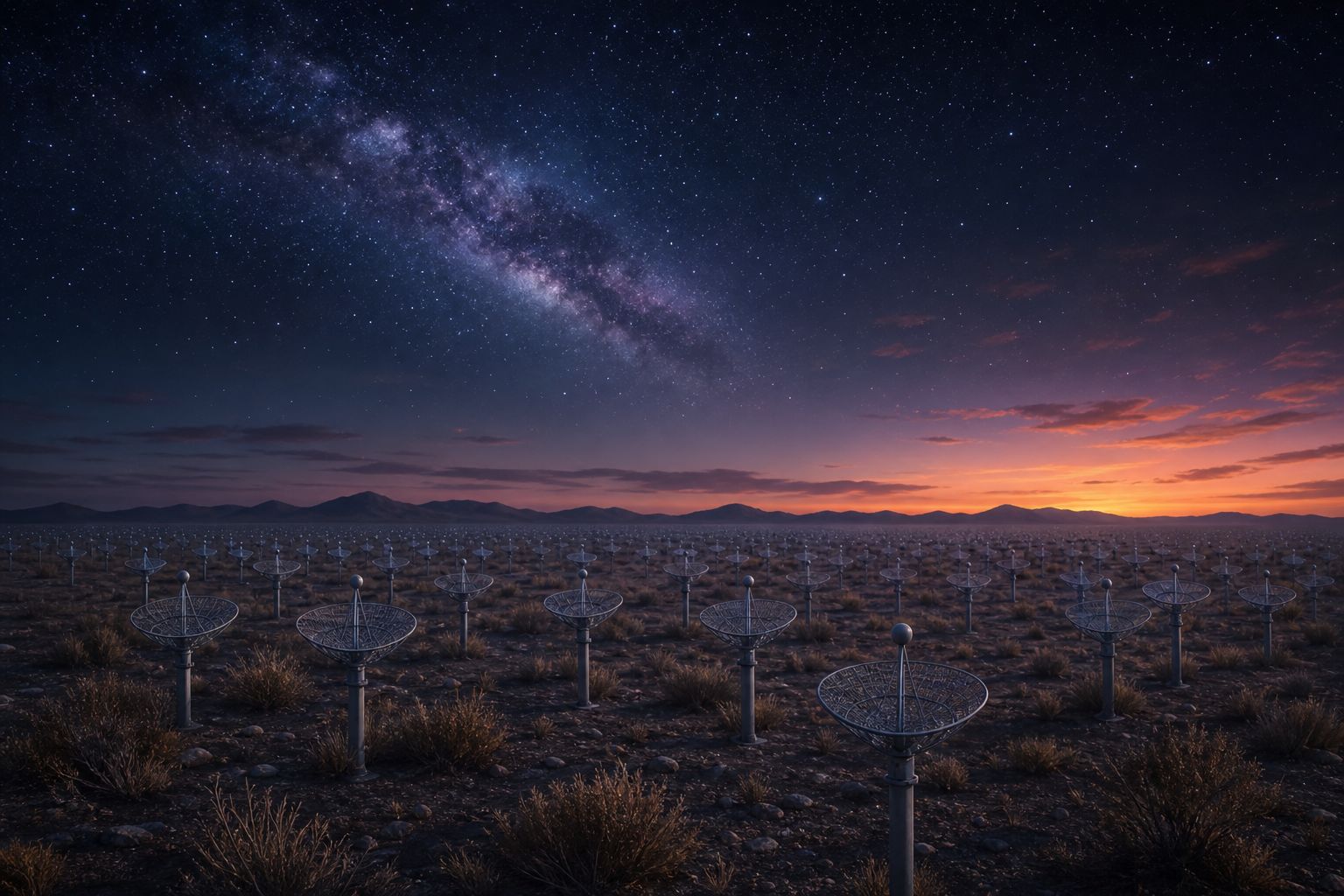
From cosmic dawn the signal arrives stretched to far longer wavelengths, and very faint. Arrays such as HERA, with three hundred and fifty antennas in South Africa, are searching for it, and the Square Kilometre Array aims to map it.
In 2018 one experiment, EDGES, claimed a detection, but many scientists doubt it. A clear map is still to come.
21 cm
wavelength, from a “spin flip”: the electron’s spin turns over
1,420 MHz
frequency
1951
first seen, by Ewen and Purcell
The hydrogen line (HyperPhysics)A radio array Hundreds of small wire-mesh dishes in a dry landscape. AI-generated still.21cm×(1+9)=2.1mStretched radio waves From redshift 9, the 21-cm line arrives about two metres long (our calculation).
2018 EDGES claim: stronger than expected, doubted
Now HERA: 350 antennas, Northern Cape
2024 on SKA stations take first data
Hunting the signal (Knowable)
Chapter VI · Listening for hydrogen
The 21-centimetre line
HyperPhysics (Georgia State University): the 21-cm line, at 1,420 MHz, comes from a spin flip in the ground state of hydrogen: the electron’s spin flips relative to the proton’s; it maps hydrogen through dust clouds; Harold Ewen and Edward Purcell first observed it in 1951, after H. C. van de Hulst predicted it in 1944. Knowable Magazine (2024): the 21-cm signal is the main planned probe of neutral hydrogen before and during reionisation and has not been definitively detected from the early universe; EDGES reported a claimed detection of the averaged signal in 2018 that was stronger than expected and has drawn scepticism; HERA has 350 antennas in South Africa’s Northern Cape; the Square Kilometre Array, with stations in South Africa and Australia that took first data in 2024, will map the signal across the sky.
Press “Starlight” and “21 cm” to switch between what galaxies show and what a radio map of hydrogen would show.
The 3D scenes are simplified teaching models: the cube of gas, the bubbles, the atom and the spectra are schematic, not to scale and not real data.
So the clear sky we see is a late arrival. For roughly its first hundred million years the universe had no stars. Then the first stars and galaxies lit it, bubble by bubble, until the fog was gone about a billion years after the Big Bang.
We know that it happened, and roughly when. The open question is who did most of the work, and how did the light get out?
380,000 yr First light flies free
~100 million yr First stars (theory)
~290 million yr JADES-GS-z14-0
~700 million yr Half reionised (Planck)
~1 billion yr Fog nearly gone (quasars)
13.8 billion yr Today
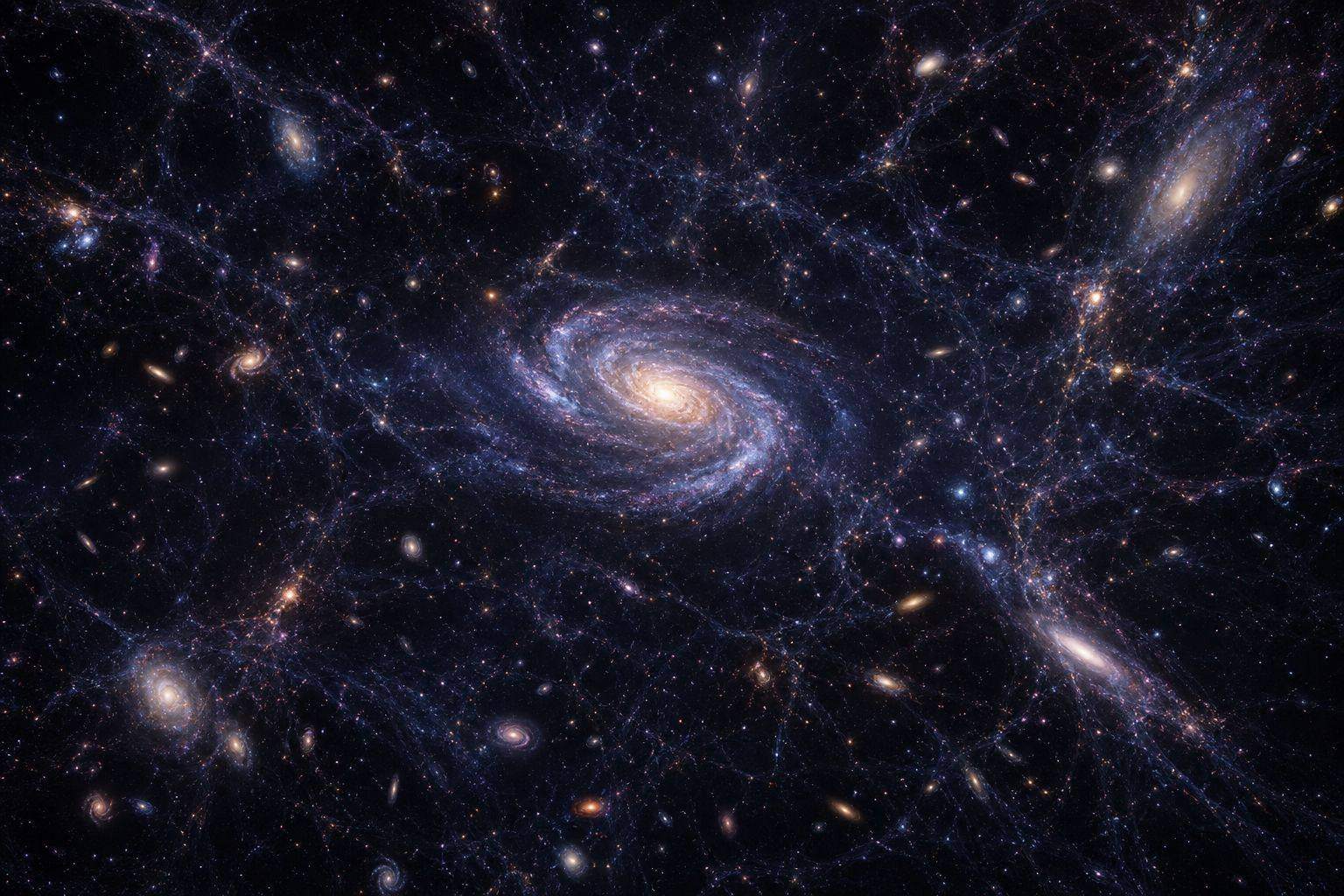
From dark to clear (approximate times)A transparent universe Galaxies seen across clear space today. Sources for every fact are in the side panel; the 3D scenes are simplified models. AI-generated still.
Which sources did most of the work
How their light escaped
What the first stars were like
A clear 21-cm map
Still open
We know that it took place, but we don’t have complete answers to those questions.Cody Carr, University of Michigan (2026)
Epilogue
What we know
Reionisation is established by independent evidence: quasar spectra (Fan et al. 2006) show the intergalactic gas was nearly fully ionised by redshift about 6, roughly a billion years after the Big Bang, and the microwave background (Planck) shows reionisation was about half complete at about 700 million years. Which sources did most of the work, and how their ionising light escaped, are open questions (ScienceDaily, 2026; Knowable Magazine, 2024). All facts in this film come from the sources listed in each panel; the full list is below. The 3D scenes are simplified teaching models and the still images are AI-generated.
Press “Dark ages”, “~700 million yr” or “Today” to run the cube from dark to clear.
The 3D scenes are simplified teaching models: the cube of gas, the bubbles, the atom and the spectra are schematic, not to scale and not real data.