In September 2026 chemists at the University of Warwick reported that a copper-based superconductor studied for about forty years hides a patchwork of slightly different atomic arrangements. This film explains what superconductors are: how resistance wastes energy, how Heike Kamerlingh Onnes saw mercury's resistance vanish in 1911, how superconductors push out magnetic fields and make magnets float, how electrons team up in Cooper pairs, how the cuprates of 1986 and 1987 broke the liquid-nitrogen barrier, why their mechanism is still not fully understood, how superconducting magnets run MRI scanners, the Large Hadron Collider and the fastest train on Earth, and why the 2023 claim of a room-temperature superconductor did not hold up.
Interactive 3D film9 min1908 to 2026Published 26 October 2026
In September, chemists at the University of Warwick reported that a copper-based superconductor, studied for about forty years, hides a patchwork of slightly different atomic arrangements inside.
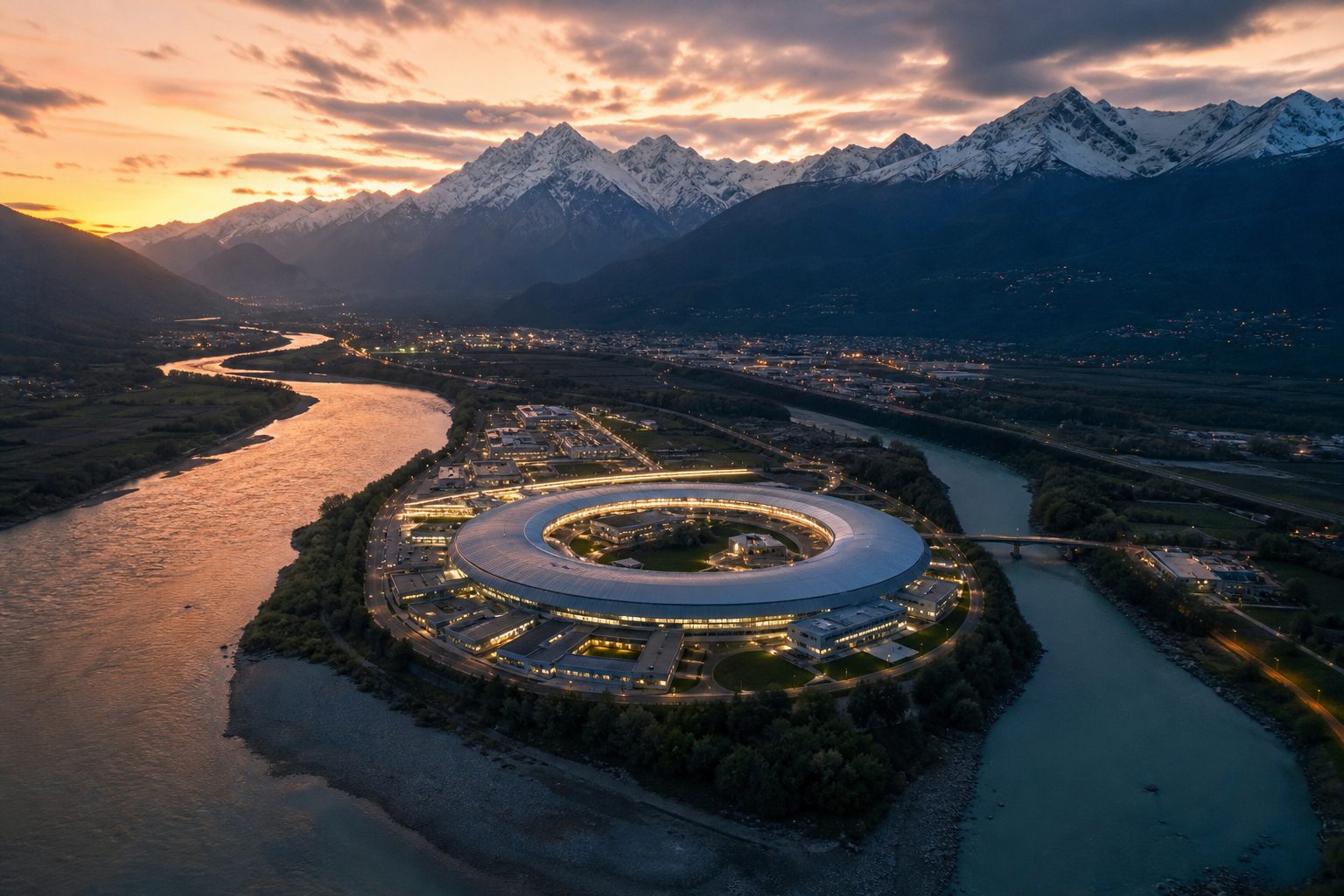
They used one of the world's brightest X-ray sources, in France, to look inside the crystal in three dimensions, much as a hospital CT scan looks inside a body.
It is one new study, and other labs will test it. But it is a reminder that these materials still hold secrets. So what is a superconductor?
~40 years
this cuprate family has been studied
~150 nm
width of the boundaries between patches
The new study
3D X-rays
scanning diffraction at the ESRF, Grenoble, France
How they looked
Why wires waste energy
Zero resistance and floating magnets
Electrons that travel in pairs
MRI, colliders, maglev, and hype
In this film
Prologue
A hidden patchwork
University of Warwick (17 September 2026): using scanning 3D X-ray diffraction at the European Synchrotron Radiation Facility, a team led by Prof. Mark Senn found that a “214” cuprate superconductor is not uniform but contains regions with two subtly different atomic arrangements, separated by boundaries about 150 nm wide, much wider than expected, which “likely work against superconductivity”. The paper, “Giant Domain Walls and Intrinsic Heterogeneity in 214 Cuprate Superconductors”, is published in Physical Review Letters. ScienceDaily (24 October 2026): the team suggests some past measurements and theories may need revisiting. This is a single new study; independent groups have yet to test its implications.
The 3D scene is a teaching model: atoms, electrons, pairs and field lines are drawn schematically and not to scale; temperatures and resistance in the readouts follow the values in the sources.
An electric current is a flow of electrons through a metal. On their way they keep bumping into the vibrating atoms of the crystal.
Each collision turns some of the electrical energy into heat. That is resistance, and it is why a heater glows and why power lines lose energy.
Cool a metal and the atoms vibrate less, so the resistance falls. But in an ordinary metal, it never quite reaches zero.
The same loss happens in every cable that carries power to our homes.
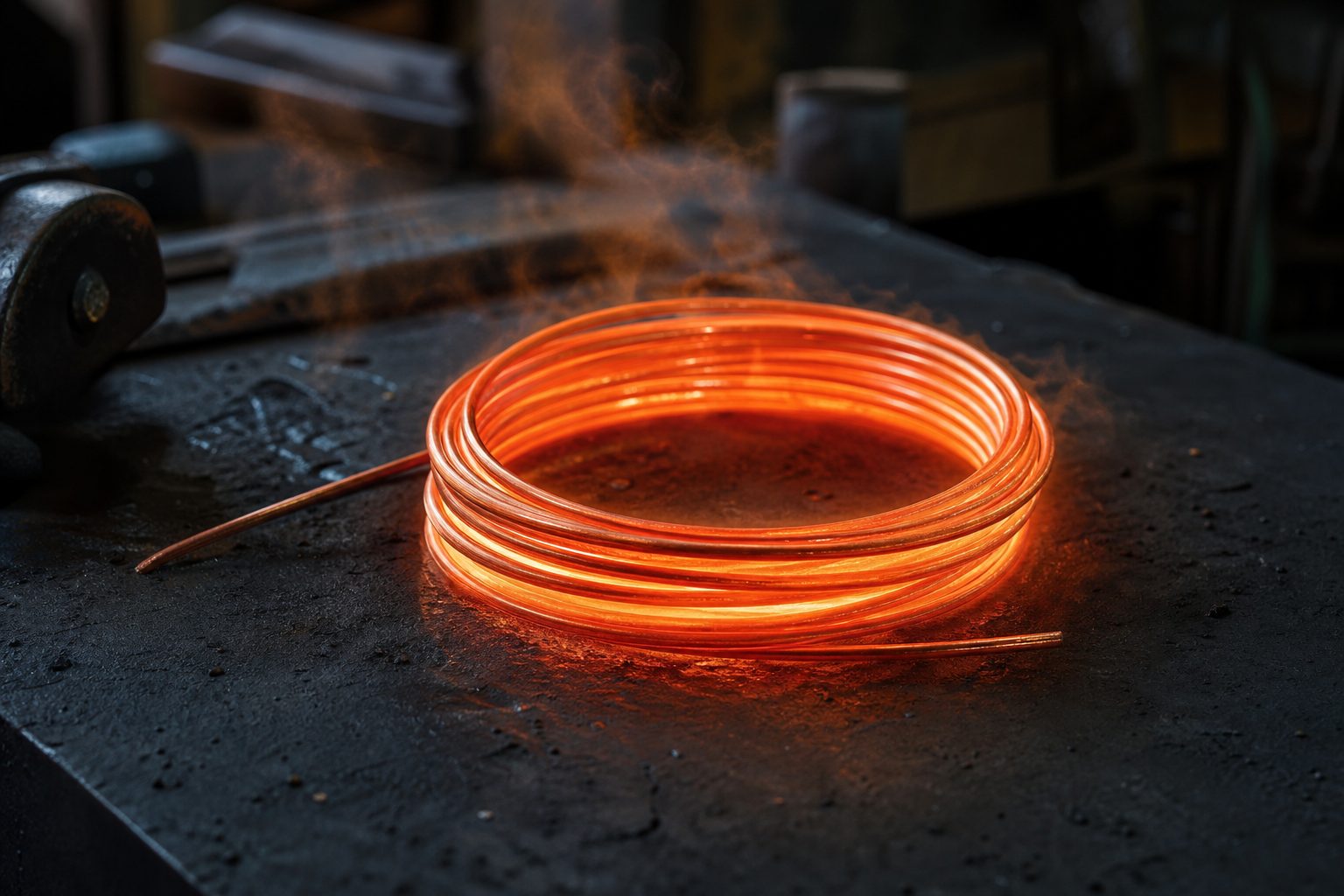
Wasted as heat A coil glowing with heat. AI-generated still.P=I2R
P
power turned into heat, in watts
I
current, in amperes
R
resistance, in ohms
Heat from resistance
0 W
no heat, however large the current
If R = 0
Power cables and transformers
Motors and generators
Every warm phone charger
Where resistance costs energy
Chapter I · Resistance
Why wires get warm
In an ordinary metal, conduction electrons scatter off lattice vibrations and impurities; each scattering event dissipates energy as heat, and the power lost is P = I²R. Cooling reduces the lattice vibrations, so resistance falls, but in a normal metal it levels off at a finite value. Wikipedia, superconductivity: in a superconductor, by contrast, resistance drops abruptly to exactly zero below a characteristic critical temperature.
On screen: blue dots are electrons, gold spheres are atoms; each flash is a collision that makes heat.
The 3D scene is a teaching model: atoms, electrons, pairs and field lines are drawn schematically and not to scale; temperatures and resistance in the readouts follow the values in the sources.
In 1908, the Dutch physicist Heike Kamerlingh Onnes became the first to liquefy helium, at four point two kelvin, just above absolute zero. Until then, the coldest anyone could reach was fourteen kelvin.
On the eighth of April 1911, he cooled mercury to four point one nine kelvin and measured its resistance. It had vanished.
He called it superconductivity, and won the 1913 Nobel Prize in Physics for his work at low temperatures. Cool the mercury and watch the resistance drop.
A year later he found that a gold and mercury alloy did the same, so all his careful work purifying the mercury had not been needed.
0 K
absolute zero, −273.15 °C
4.2 K
liquid helium boils, about −269 °C
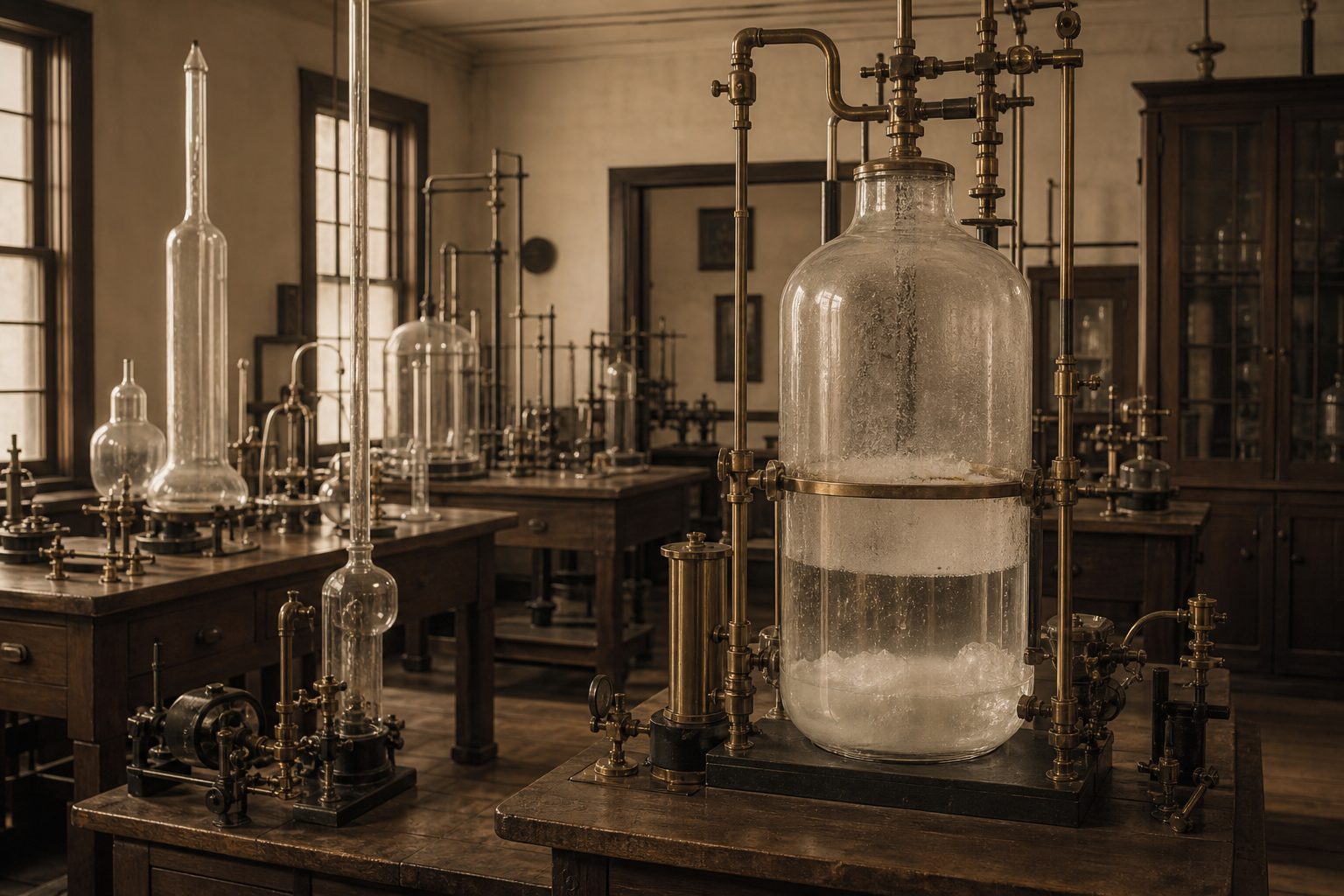
KelvinLeiden, 1911 Glass cryostats and brass valves. AI-generated still.
10 Jul 1908 Helium liquefied for the first time
8 Apr 1911 Mercury at 4.19 K: zero resistance
1913 Nobel Prize in Physics
The discovery
“Supra-conductivity”Onnes’s first name for it, later “superconductivity” (Argonne)
Au + Hg
a gold–mercury alloy: not pure, still superconducting
1912
Chapter I · Resistance
Onnes and mercury
Argonne National Laboratory: Heike Kamerlingh Onnes first liquefied helium on 10 July 1908; helium liquefies at 4.2 K. On 8 April 1911 he cooled mercury to 4.19 K and measured zero resistivity, and he received the 1913 Nobel Prize in Physics. He first called it “supra conductivity”, later “superconductivity”. Before liquid helium, the lowest available temperature was 14 K, from solid hydrogen. Absolute zero, 0 K, is −273.15 °C.
Try it: “Cool” lowers the temperature step by step; below 4.19 K the resistance of mercury drops to zero. The curve is schematic.
The 3D scene is a teaching model: atoms, electrons, pairs and field lines are drawn schematically and not to scale; temperatures and resistance in the readouts follow the values in the sources.
With no resistance, a current set running in a closed superconducting loop just keeps going, with no battery.
In one instrument in Belgium, a superconducting current flowed for more than twenty-eight years, until the experiment was switched off in 2024.
Theory suggests such a current could even outlast the age of the universe, depending on the wire.
No battery
once started, the current circulates by itself
A persistent current
28 y 7 m 27 d
4 Aug 1995 to 31 Mar 2024
≥ 100,000 y
lower limit on the lifetime from experiments
Superconducting gravimeter, Belgium
Measured: 28 years and counting, then switched off
Experiments: at least 100,000 years
Theory: possibly longer than the age of the universe
How long could it last?
Chapter I · Resistance
Currents that last
Wikipedia, superconductivity: currents in superconducting coils can persist for years without measurable decay; experimental evidence points to a lifetime of at least 100,000 years. Currents in a superconducting gravimeter in Belgium persisted for 28 years, 7 months and 27 days, from 4 August 1995 to 31 March 2024. Theoretical estimates can exceed the age of the universe, depending on wire geometry and temperature.
The 3D scene is a teaching model: atoms, electrons, pairs and field lines are drawn schematically and not to scale; temperatures and resistance in the readouts follow the values in the sources.
In 1933, Walther Meissner and Robert Ochsenfeld found a second, stranger property. As tin or lead became superconducting, it pushed the magnetic field out of itself.
Currents at its surface cancel the field inside. That makes a superconductor a perfect diamagnet: it repels magnets.
A merely perfect conductor could not do this. Cool the disc and watch the field lines bend away.
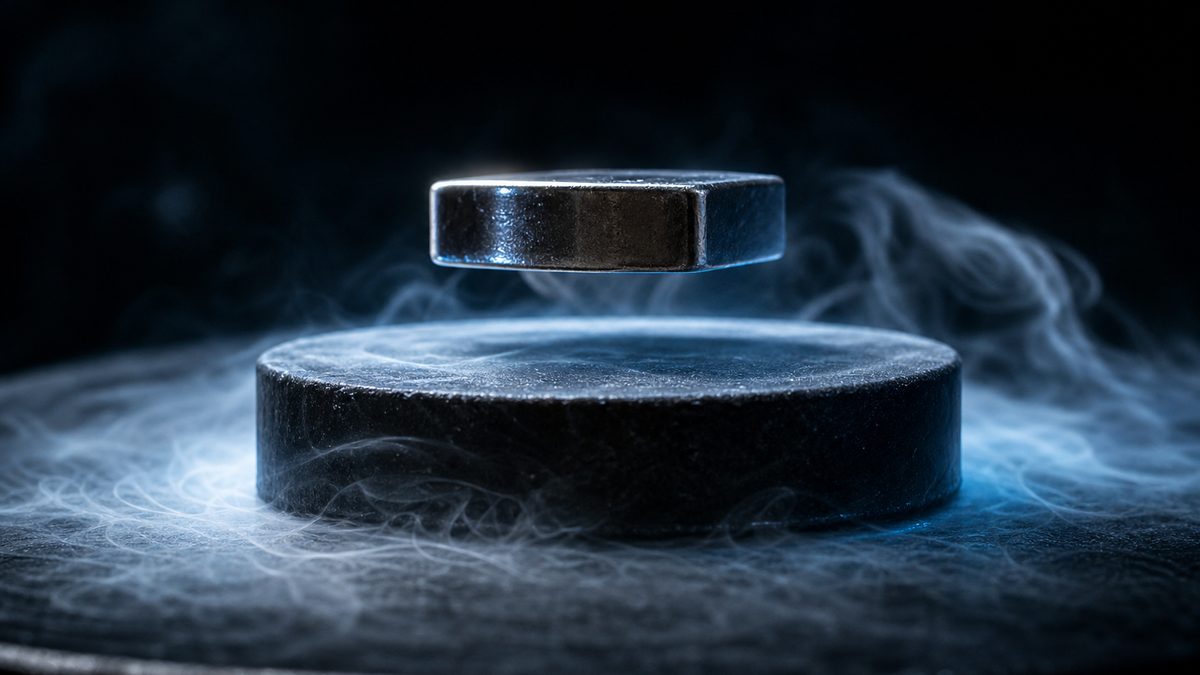
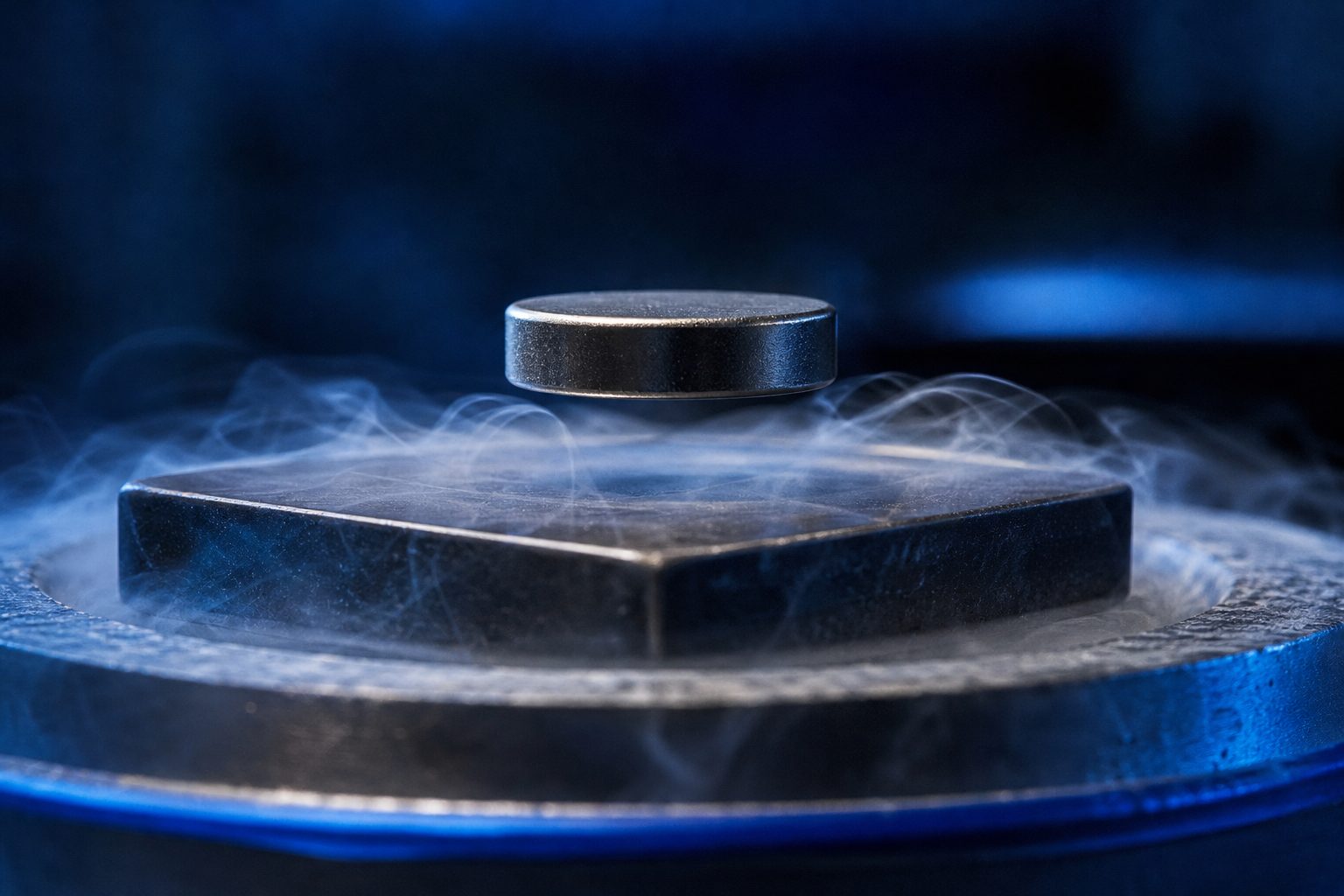
Push a magnet's field away hard enough, and the magnet itself can float above the superconductor.
Tin, lead
the samples they measured
Field out
as each became superconducting
Meissner and Ochsenfeld, 1933Levitation A magnet floating above a cold superconductor. AI-generated still.
Perfect conductor: a field present on cooling stays frozen inside
Superconductor: the field is expelled, whatever its history
Superconductor or perfect conductor?
Repels
any nearby magnet, which can float
A perfect diamagnet
Chapter II · Floating magnets
The Meissner effect
Wikipedia, Meissner effect: Walther Meissner and Robert Ochsenfeld discovered the effect in 1933 by measuring the field outside superconducting tin and lead samples. As a material cools below its critical temperature, persistent screening currents near its surface cancel the field in the bulk, so the superconductor behaves as a perfect diamagnet and repels nearby magnets. A merely perfect conductor would keep any field that was present when it was cooled; a superconductor expels the field whatever its history, which shows superconductivity is a true thermodynamic state.
Try it: “Cool” takes the disc below its critical temperature and the field lines are pushed out; “Warm” lets them back in.
The 3D scene is a teaching model: atoms, electrons, pairs and field lines are drawn schematically and not to scale; temperatures and resistance in the readouts follow the values in the sources.
Most pure metals are type one: a strong enough magnetic field simply destroys their superconductivity.
Nearly all alloys and compounds are type two. They let the field in through tiny whirlpools, called vortices, while keeping zero resistance. That is what lets them carry the huge currents of powerful magnets.
Alexei Abrikosov, who predicted those whirlpools, shared the 2003 Nobel Prize in Physics.
One critical field
Field fully expelled below it
Most pure elements
Type I
Two critical fields
Field enters as quantised vortices
Nearly all alloys and compounds, and niobium
Type II
2003
Nobel Prize in Physics for Alexei Abrikosov and others
Vortices
Chapter II · Floating magnets
Type I and type II
Wikipedia, superconductivity: a type I superconductor has a single critical field, above which superconductivity is lost and below which the field is fully expelled. A type II superconductor has two critical fields; between them, magnetic flux penetrates as quantised vortices while the resistance remains zero for currents that are not too large. Most pure elemental superconductors are type I, except niobium and carbon nanotubes; nearly all impure and compound superconductors are type II. Alexei Abrikosov, who predicted the vortices, shared the 2003 Nobel Prize in Physics (Argonne).
The 3D scene is a teaching model: atoms, electrons, pairs and field lines are drawn schematically and not to scale; temperatures and resistance in the readouts follow the values in the sources.
Why does it happen? It took until 1957 for John Bardeen, Leon Cooper and Robert Schrieffer to explain it.
An electron passing through the crystal slightly tugs on the atoms around it, and that ripple in the lattice draws in a second electron. The two become bound together as a Cooper pair.
All the pairs then move together as one collective state. Breaking a single pair would take a minimum amount of energy, so at low temperature nothing can scatter them. Compare normal and paired electrons.
The three of them shared the Nobel Prize in Physics in 1972.
An electron pulls on nearby atoms
The lattice ripples
The ripple attracts a second electron
How a Cooper pair formsMoving as one Two skaters gliding in step: a metaphor, not a picture of electrons. AI-generated still.
Δ
minimum energy needed to break a pair
Low T
too little thermal energy to pay it
The energy gap
1957
Bardeen, Cooper, Schrieffer
1972
their Nobel Prize in Physics
BCS theory
Chapter III · Pairs
Cooper pairs
The Nobel Prize, physics 1972: the theory developed by Bardeen, Cooper and Schrieffer in 1957 explains superconductivity through the interaction between electrons and vibrations of the crystal lattice, which binds electrons into pairs, now called Cooper pairs. The pairs are strongly linked to one another in a collective state in which many electrons act together; disturbing one pair disturbs the whole system, so breaking a pair needs energy above a threshold (the energy gap), which accounts for many of the superconductor’s properties.
Try it: “Normal” shows lone electrons scattering; “Paired” shows pairs gliding through the lattice. A simplified picture: real Cooper pairs are far larger than the spacing between atoms and overlap one another.
The 3D scene is a teaching model: atoms, electrons, pairs and field lines are drawn schematically and not to scale; temperatures and resistance in the readouts follow the values in the sources.
For seventy-five years, superconductors needed extreme cold, usually from expensive liquid helium. Then, in 1986, Georg Bednorz and Alex Müller at IBM in Zurich found a copper-oxide ceramic, a cuprate, that superconducted at thirty-five kelvin.
A year later, Paul Chu's group in Houston made yttrium barium copper oxide, which superconducts at about ninety-three kelvin. For the first time, liquid nitrogen, at seventy-seven kelvin, was cold enough. Pick a material.
As physicists liked to say: liquid helium costs as much as scotch, but liquid nitrogen is cheaper than beer.
35 K
a lanthanum-based copper oxide: a record
~23 K
the best before, Nb₃Ge
IBM Zurich, 1986Liquid nitrogen Pouring the coolant: nitrogen boils at 77 K. AI-generated still.
Mercury, 1911
4.19
Nb₃Ge, before 1986
~23
La-cuprate, 1986
35
YBCO, 1987
93
Hg-cuprates
>130
Critical temperatures Liquid nitrogen boils at 77 K; liquid helium at 4.2 K.
“Liquid helium costs as much as scotch, but liquid nitrogen is cheaper than beer.”A saying among physicists, quoted by Argonne National Laboratory
Chapter IV · Warmer
High-temperature superconductors
Argonne: in 1986 Bednorz and Müller of IBM Zurich found a lanthanum-based material superconducting at 35 K, a record; in 1987 Paul Chu produced yttrium barium copper oxide with a transition temperature of 92 K, the first superconductor usable with liquid nitrogen. “Liquid helium costs as much as scotch, but liquid nitrogen is cheaper than beer.” Argonne counts five Nobel Prizes in Physics for superconductivity up to 2003: 1913, 1972, 1973, 1987 and 2003. IEEE Milestones: Chu’s group found YBCO and related compounds with Tc of 93 K, the first above 77 K, the boiling point of liquid nitrogen; before 1987 the highest known Tc was about 23 K (Nb₃Ge). Wikipedia, superconductivity: mercury-based cuprates superconduct above 130 K.
Try it: pick a material to see its critical temperature on the thermometer and which coolant it needs. YBCO is given as 92–93 K by different sources.
The 3D scene is a teaching model: atoms, electrons, pairs and field lines are drawn schematically and not to scale; temperatures and resistance in the readouts follow the values in the sources.
Forty years on, nobody can fully explain the copper oxides. Their electrons still pair up, but what glues them together at such high temperatures is still not clear.
That is why the Warwick result matters. Their 3D X-ray scan found patches of two arrangements, with boundaries about a hundred and fifty nanometres wide, which they say likely work against superconductivity.
If it holds up, some old measurements may need a second look.
They suggest such hidden structure may be common across the copper oxides.
Electrons pair up, as in BCS
The pairing mechanism is not yet clear
The pair symmetry is still debated
What is known about cupratesA synchrotron A ring-shaped X-ray facility in a mountain valley. AI-generated still.
2
slightly different atomic arrangements, in patches
~150 nm
boundary width, far wider than expected
Warwick, 2026 (one study)
“The crystal is fundamentally patchworked and textured.”Prof. Mark Senn, University of Warwick
Chapter IV · Warmer
Why cuprates are still a puzzle
Wikipedia, superconductivity: in the high-temperature cuprates, two-electron pairing is involved but the basic mechanism behind their high critical temperatures is not yet clear, and the pairing symmetry remains controversial. University of Warwick: the team’s scanning 3D X-ray diffraction at the ESRF in France gave the first 3D picture of the interior of a 214 cuprate and found a patchwork of two subtly different arrangements with boundaries about 150 nm wide, which “likely work against superconductivity”; the release suggests such hidden structure may be common across cuprates. ScienceDaily: some past measurements and theories may need revisiting. This is one study and remains to be tested by other groups.
On screen: two colours of crystal patch with a wide boundary between them, drawn schematically.
The 3D scene is a teaching model: atoms, electrons, pairs and field lines are drawn schematically and not to scale; temperatures and resistance in the readouts follow the values in the sources.
Superconductors' biggest job today is making strong magnets. Nearly every superconducting MRI scanner uses coils of niobium-titanium wire, which superconducts below about nine kelvin, bathed in liquid helium.
The wire is made of many fine niobium-titanium filaments set in copper, which carries the current safely if any part stops superconducting.
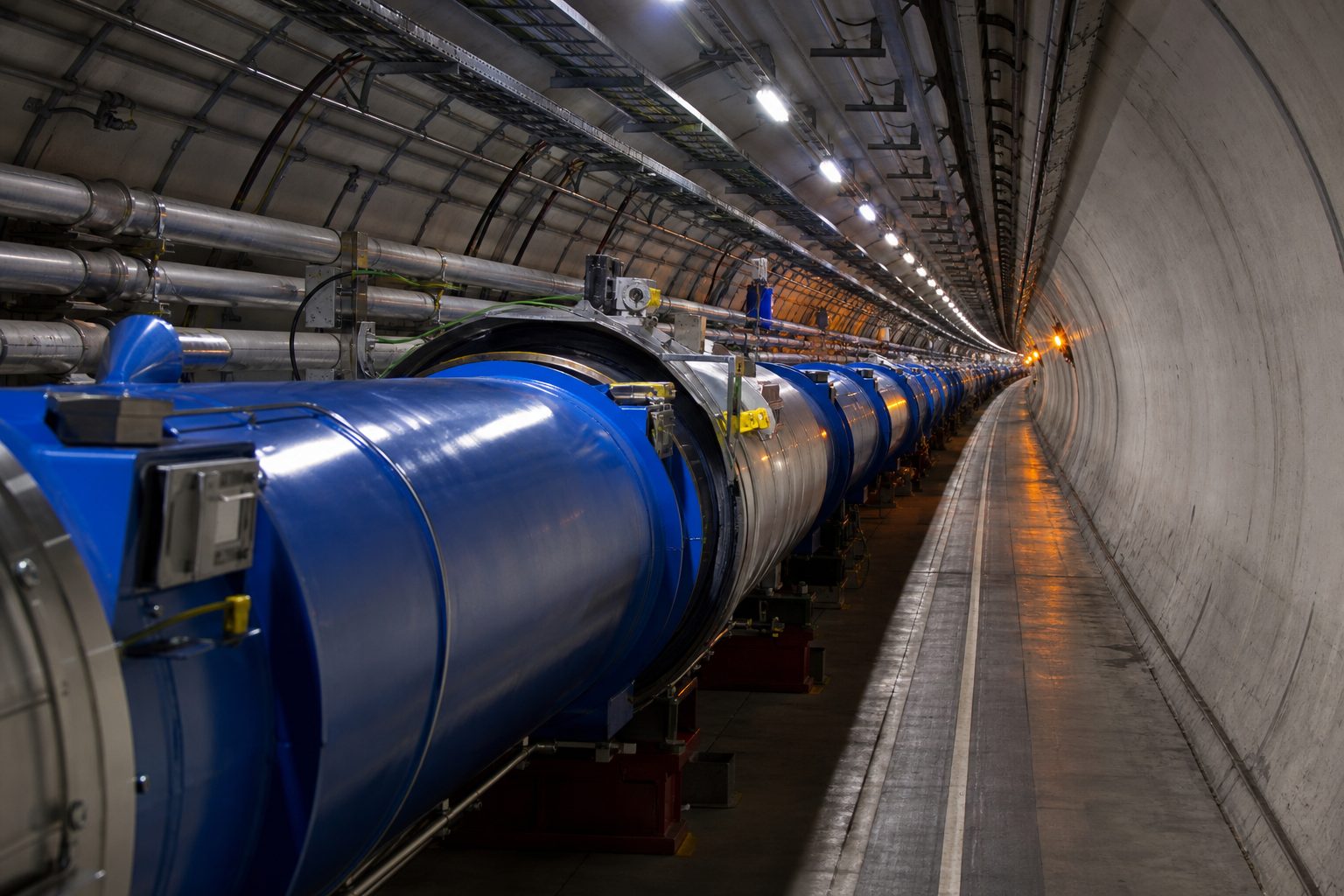
The Large Hadron Collider at CERN uses one thousand two hundred and thirty-two superconducting dipole magnets, each fourteen metres long, cooled to one point nine kelvin to bend its beams.
Each LHC magnet carries around eleven thousand eight hundred amperes and makes a field of about eight point three tesla, with no resistance at all.
An MRI scanner Inside the ring: a superconducting coil in a helium bath. AI-generated still.
NbTi
superconducts below ~9.3 K
~4.2 K
operating temperature, liquid helium
MRI magnetsAn accelerator tunnel Rows of magnets curving into the distance. AI-generated still.
1,232
dipoles, 14.3 m each
8.3 T
field, at 1.9 K
~11,850 A
current, with no resistance
LHC dipole magnets (CERN)
Chapter V · Uses and hype
Superconducting magnets
Questions and Answers in MRI: nearly all modern MR scanners use niobium-titanium (NbTi), which becomes superconducting below about 9.3 K; magnets run near liquid-helium temperature (about 4.2 K) for a safety margin, with many fine NbTi filaments in a copper stabiliser; Nb₃Sn is used above 10 T, and magnesium diboride (about 39 K) is emerging. CERN: the LHC needs 1,232 dipole magnets, each 14.3 m long, made with niobium-titanium coils and operated at 1.9 K, producing about 8.3 T with a current of about 11,850 A.
The 3D scene is a teaching model: atoms, electrons, pairs and field lines are drawn schematically and not to scale; temperatures and resistance in the readouts follow the values in the sources.
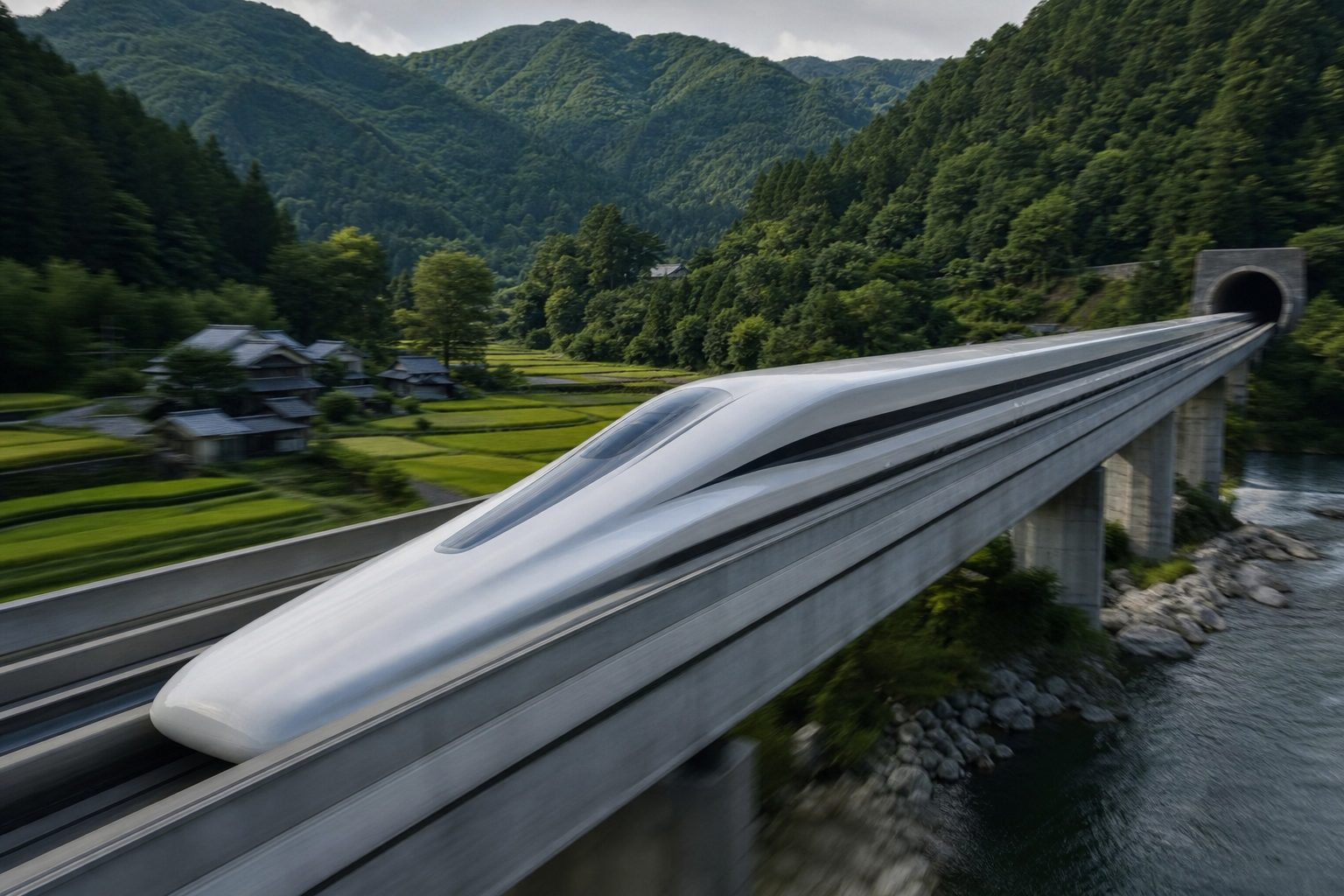
Superconducting magnets also lift trains. On the twenty-first of April 2015, Japan's L0 Series maglev, with superconducting magnets in its bogies, reached six hundred and three kilometres an hour on a test line in Yamanashi.
It is still the world speed record for any train.
Japan plans to open a superconducting maglev line from Tokyo to Nagoya in 2034.
603 km/h
L0 Series, 21 April 2015
Fastest train on EarthA maglev at speed A maglev on a concrete guideway. AI-generated still.
2034
planned opening, Tokyo to Nagoya
Chūō Shinkansen
Chapter V · Uses and hype
A floating train
Guinness World Records: the fastest maglev train reached 603 km/h on 21 April 2015 on the Yamanashi Maglev Line, with the Series L0 operated by Central Japan Railway. Wikipedia, SCMaglev: the train’s bogies carry superconducting magnets; the record, set by a seven-car L0 train, is the world speed record for all trains; the Chūō Shinkansen between Tokyo and Nagoya is scheduled to open in 2034.
The 3D scene is a teaching model: atoms, electrons, pairs and field lines are drawn schematically and not to scale; temperatures and resistance in the readouts follow the values in the sources.
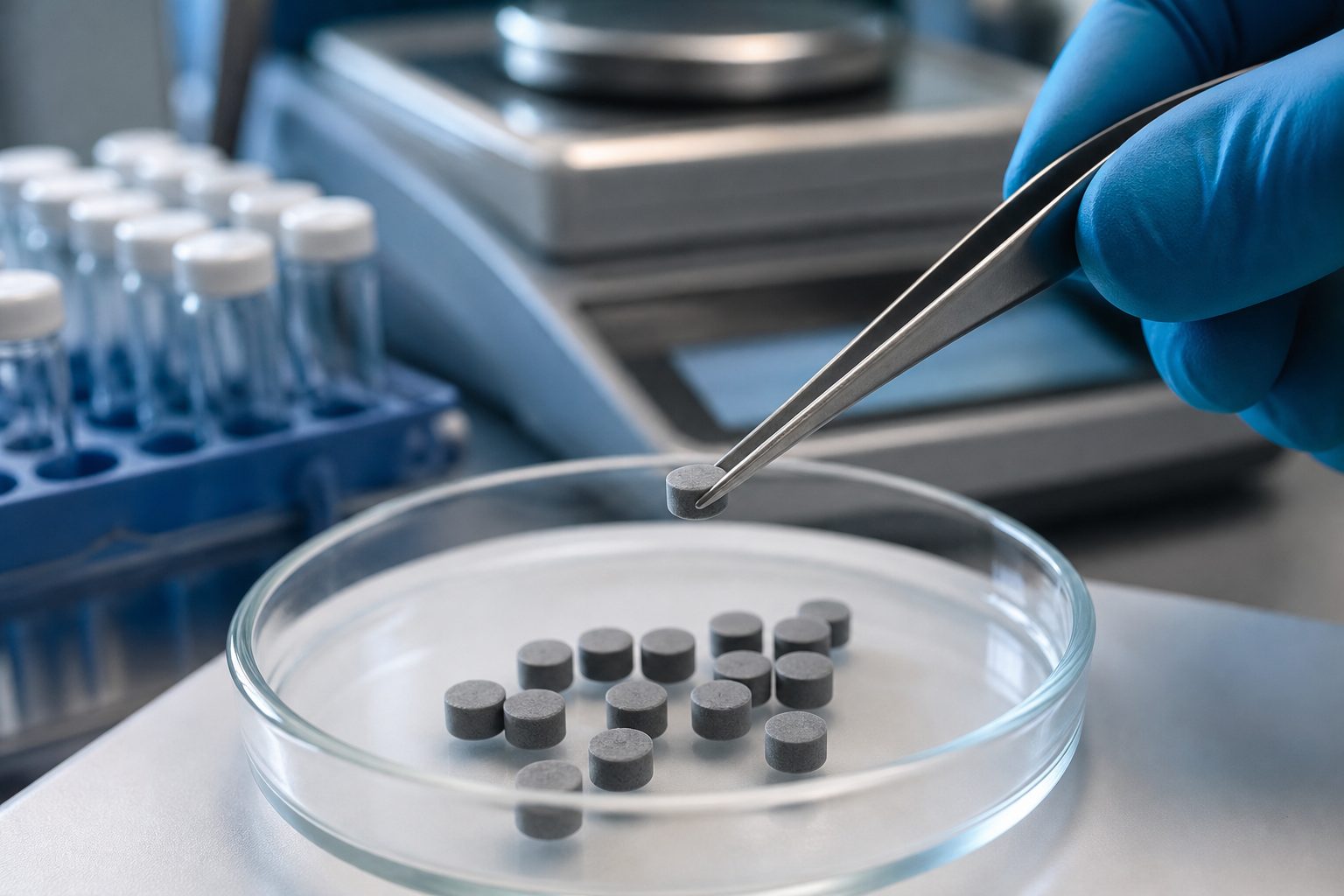
Because the prize is so big, claims spread fast. In July 2023, a team in South Korea posted two preprints claiming a room-temperature superconductor called LK-99, with a drop in resistance near a hundred and five degrees Celsius.
Labs around the world tried to repeat it. A peer-reviewed study traced the effects to impurities of copper sulfide, and the samples never showed zero resistance. LK-99 is not a superconductor.
The lesson: one exciting result is not proof until other labs can reproduce it.
A claimed breakthrough A small ceramic pellet held in tweezers. AI-generated still.
Preprints, not yet peer-reviewed
Independent labs repeat the recipe
Copper sulfide impurities explain the jumps
No zero resistance: not a superconductor
How the claim was tested
0 Ω
resistance exactly zero
Meissner
magnetic field expelled
The test for a superconductor
Chapter V · Uses and hype
LK-99
ScienceAlert (30 November 2023): in July 2023 a South Korean team claimed in two preprints, neither peer-reviewed, that LK-99 was a room-temperature superconductor, with a resistance drop near 105 °C. Shilin Zhu and colleagues at the Institute of Physics, Chinese Academy of Sciences, found in a peer-reviewed study in Matter that the superconductor-like behaviour likely came from copper(I) sulfide impurities, and their samples did not show zero resistivity. Nature reported that the question appeared “pretty decisively settled”.
The 3D scene is a teaching model: atoms, electrons, pairs and field lines are drawn schematically and not to scale; temperatures and resistance in the readouts follow the values in the sources.
A material that superconducts at room temperature and ordinary pressure would change power grids, motors and medicine.
Nobody has found one yet. Until someone does, and other labs confirm it, superconductors will keep needing the cold.
The best copper oxides at ordinary pressure still need temperatures far below minus one hundred degrees Celsius.
1911 Mercury: zero resistance
1933 The Meissner effect
1957 BCS theory: Cooper pairs
1986–87 Cuprates beat liquid nitrogen
2015 Maglev at 603 km/h
2023 LK-99 claim fails
2026 A hidden patchwork in a cuprate
A century of superconductors
What glues electrons in cuprates?
A superconductor at room temperature and pressure?
Will other labs confirm the Warwick finding?
Still open
>130 K
mercury-based cuprates, still far below −100 °C
The best at ordinary pressure
Epilogue · Sources
Sources
Every fact in this film comes from the sources below. The chapter stills and pictures are AI-generated illustrations. The 3D scenes of atoms, electrons, Cooper pairs and field lines are schematic teaching models, not to scale. The Warwick result is a single new study.