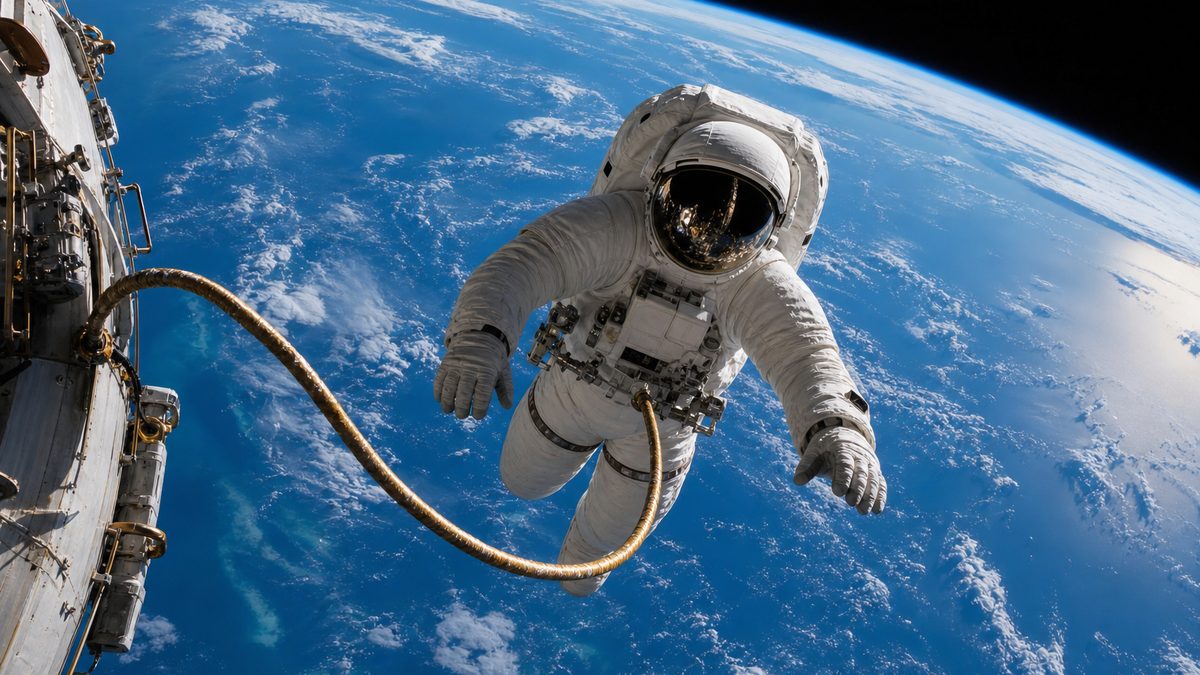
Gemini 12 launched on 11 November 1966. In about five and a half hours outside, Buzz Aldrin showed that the problems of earlier spacewalks could be overcome, paving the way for Apollo. Sixty years on, this film explains how spacewalks work: Alexei Leonov’s first outing in 1965 and his ballooning suit; Ed White’s and Gene Cernan’s struggles; why Newton’s third law makes a wrench turn the astronaut instead of the bolt; the handholds, foot restraints, tethers and underwater training that fixed it; the space around a station that circles the Earth every ninety minutes at 28,000 km/h, from −157 °C in shadow to +121 °C in sunlight; why a spacesuit runs at 4.3 psi of pure oxygen, and why astronauts breathe oxygen first to avoid the bends; its cooling tubes, layers and rescue jetpack; NASA’s Neutral Buoyancy Laboratory; and how spacewalks built and keep the International Space Station running, from the record of 2001 to the all-woman spacewalk of 2019 and the water in Luca Parmitano’s helmet in 2013.
Interactive 3D film10 min1965 to 2026Published 13 November 2026
In space you can float, but you cannot lean, kneel or push without drifting away. The first spacewalkers found that out the hard way.
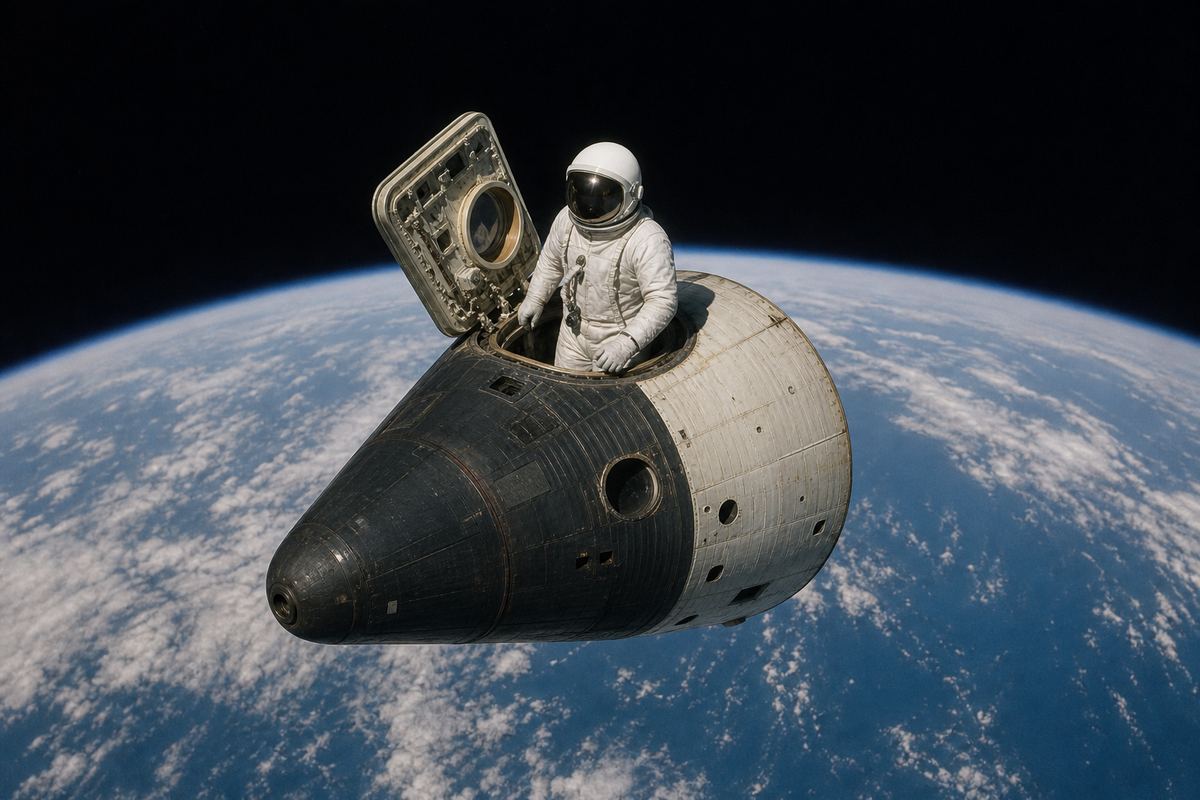
Sixty years ago this week, on 11 November 1966, two American astronauts, Jim Lovell and Buzz Aldrin, rode into orbit on Gemini 12, the last flight of NASA’s Gemini programme.
Over three outings, Aldrin spent about five and a half hours outside the cabin or standing in its open hatch, and the problems that had dogged earlier spacewalks were overcome.
Why had working outside been so hard, and how is it done today?
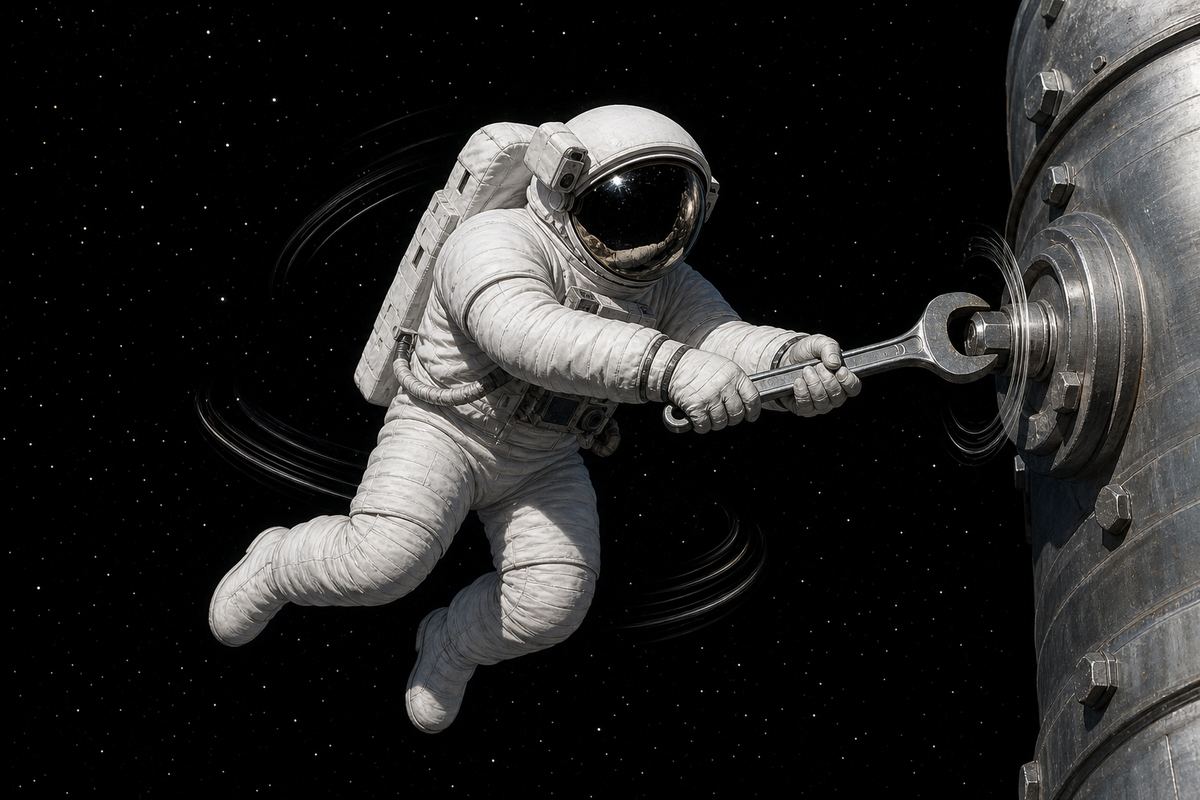
Nothing to lean on An astronaut with a wrench, body twisting the opposite way to the tool. AI-generated illustration, not a photograph.Two-seat capsule A 1960s two-person capsule in orbit, hatch open, a figure in a white suit standing up through it. AI-generated illustration, not a photograph.
11–15 Nov 1966
in orbit, the tenth and last crewed Gemini flight
3
outings for Aldrin, about 5½ hours in all
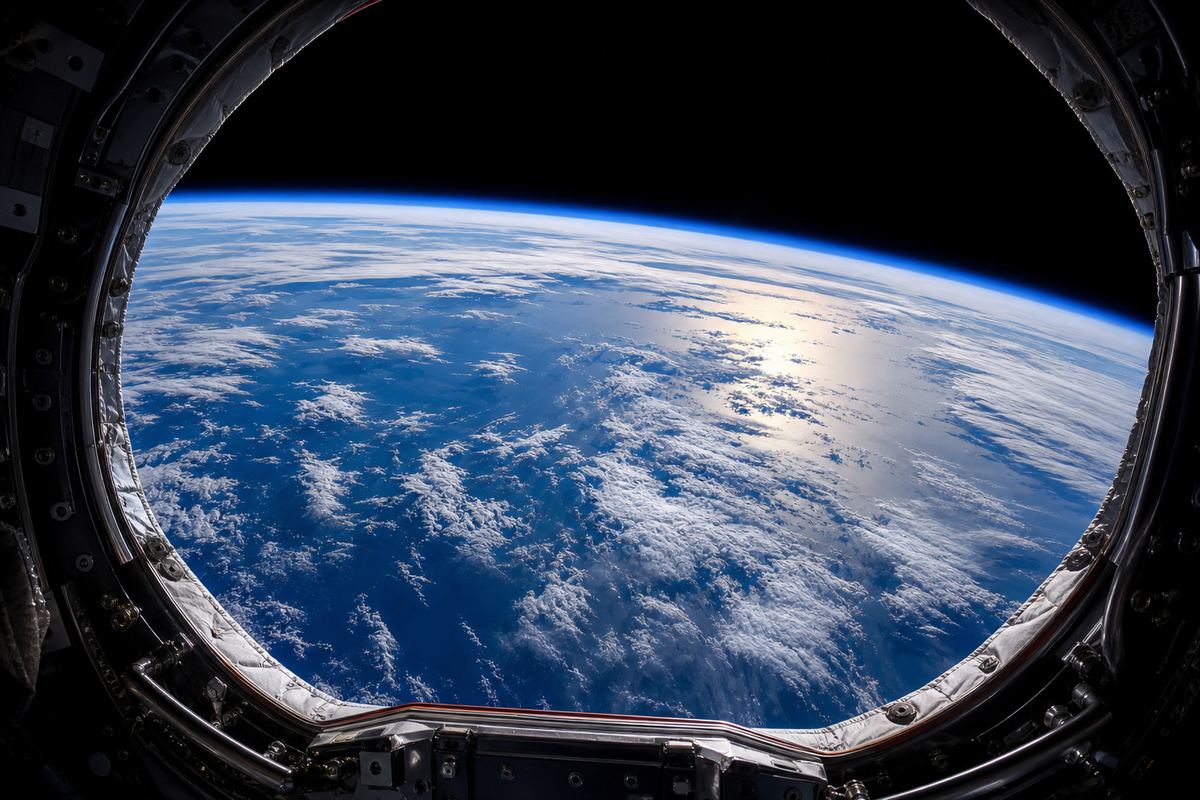
Gemini 12, NASA mission pageThe view from the hatch Clouds and ocean far below a spacecraft’s open hatch, the thin blue line of the atmosphere on the horizon. AI-generated illustration, not a photograph.
Prologue
Gemini 12
NASA (Gemini XII mission page): launched 11 November 1966, landed 15 November 1966; crew James A. Lovell Jr. and Edwin E. “Buzz” Aldrin Jr.; the tenth and final flight of the Gemini series, which bridged Mercury and Apollo. Aldrin made a standup spacewalk on 12 November (2 h 29 min), an umbilical spacewalk on 13 November (2 h 6 min) and a second standup on 14 November (55 min). NASA (55 years ago, 2021): the problems of previous Gemini spacewalks seemed overcome, paving the way for Apollo. Space.com (11 November 2026) marked the anniversary: Aldrin spent more than five hours working in space with no major problems.
NASA pages give slightly different durations for the three outings (another NASA article gives 5 h 48 min in all); the film says about five and a half hours, after the mission page.
The 3D scenes are simplified teaching models, not to scale: the astronaut, the spacecraft and the Earth are drawn, not modelled from real hardware.
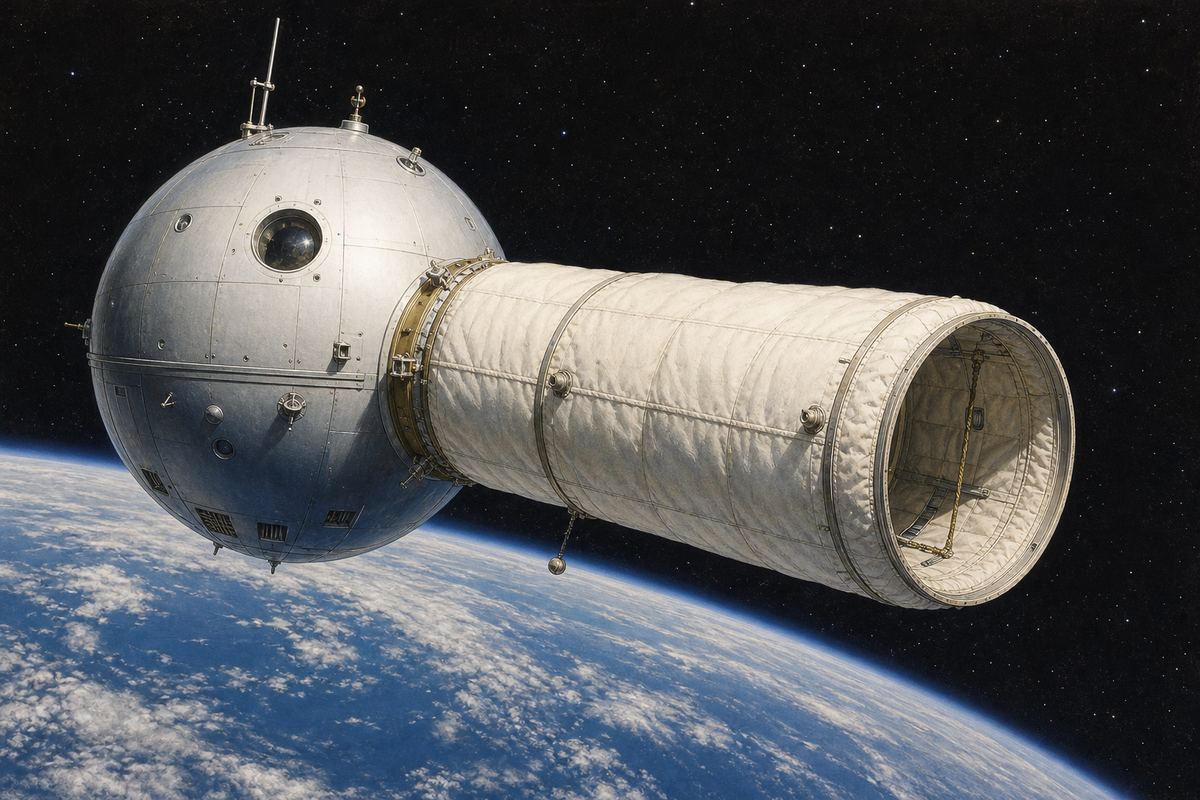
The first person to step outside a spacecraft was the Soviet cosmonaut Alexei Leonov, from Voskhod 2, on 18 March 1965. He was outside for about twelve minutes.
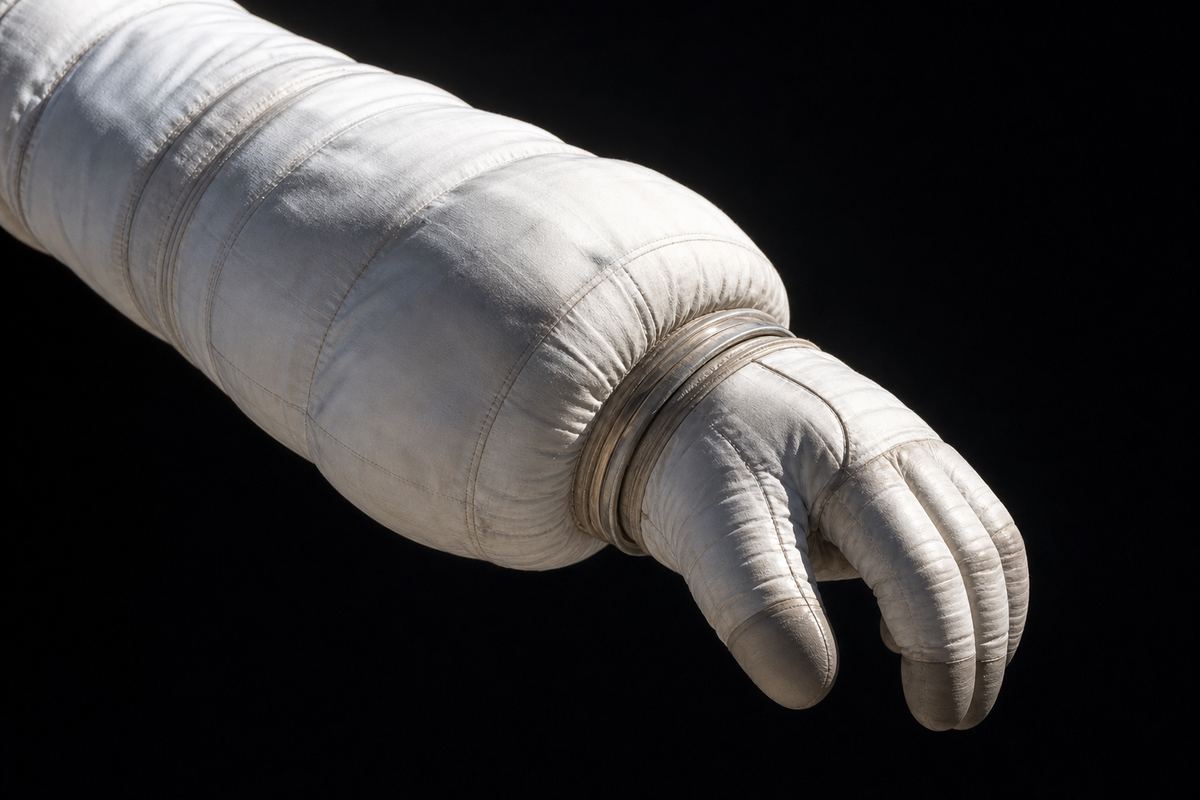
In the vacuum of space, the air inside his suit pushed outwards with nothing to push back. The suit swelled and stiffened until he could not squeeze back into the airlock.
He opened a valve and let some of the air out, until the suit was soft enough to get him through.
It was a warning: a suit full of air fights every move its wearer makes.
An inflatable airlock A cylindrical, inflatable airlock fixed to the side of a spherical capsule, as on Voskhod 2. AI-generated illustration, not a photograph.
18 Mar 1965
first spacewalk
~12 min
outside the spacecraft
Voskhod 2 (ESA)
…expanded in the vacuum… so much that he was unable to squeeze back…ESA, 50 years of spacewalks
A suit like a balloon A 1960s spacesuit glove and sleeve, puffed and rigid like an inflated balloon, against black space. AI-generated illustration, not a photograph.
Chapter I · First steps outside
The first spacewalk
ESA (50 years of spacewalks): on 18 March 1965 Russian cosmonaut Alexei Leonov became the first person to perform a spacewalk, from his Voskhod spacecraft; it lasted only 12 minutes; his suit expanded in the vacuum so much that he was unable to squeeze back into the airlock, and he opened a valve on the suit to let enough air escape for him to enter.
A NASA page for children gives about 10 minutes; the film follows ESA. The buttons swell the suit and let air out.
The 3D scenes are simplified teaching models, not to scale: the astronaut, the spacecraft and the Earth are drawn, not modelled from real hardware.
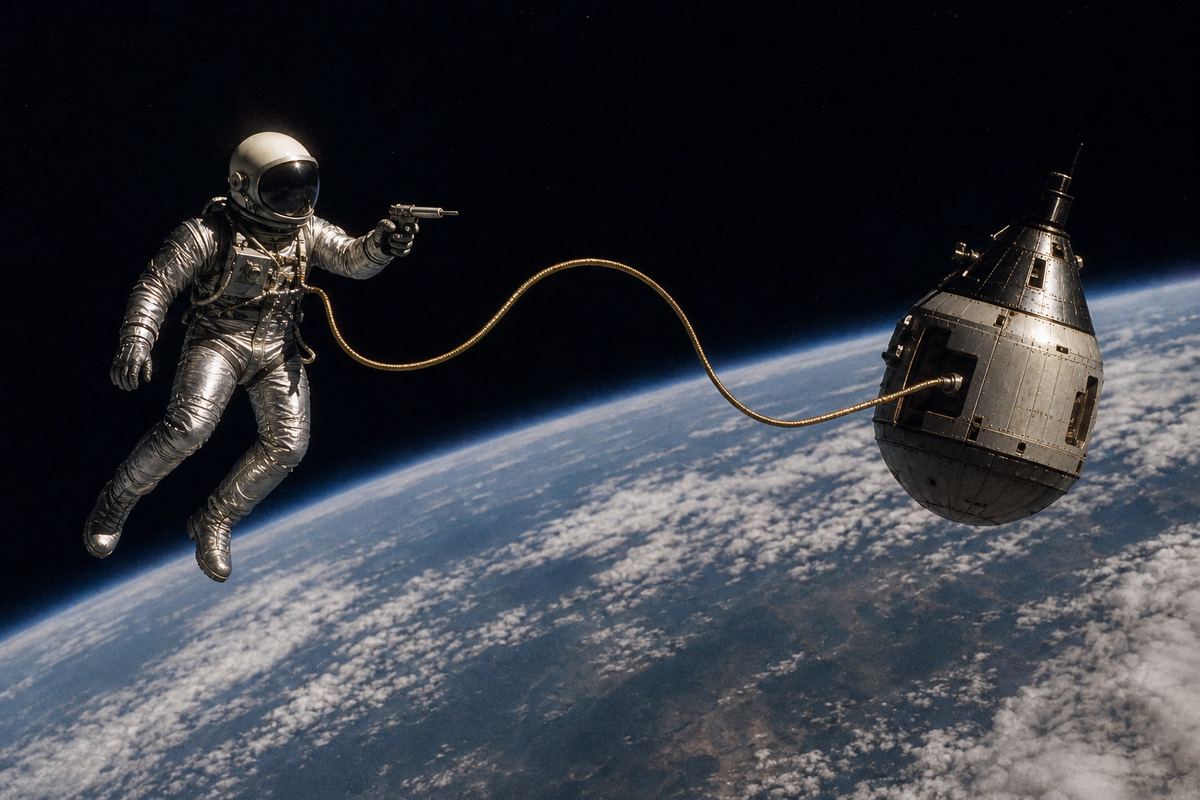
On 3 June 1965, Ed White made America’s first spacewalk from Gemini 4, tied to the capsule by a tether and an umbilical, a hose that fed him oxygen, and steering with a small hand-held gas gun.
Real work proved far harder. In June 1966 Gene Cernan went outside Gemini 9. Within minutes he was exhausted and sweating heavily.
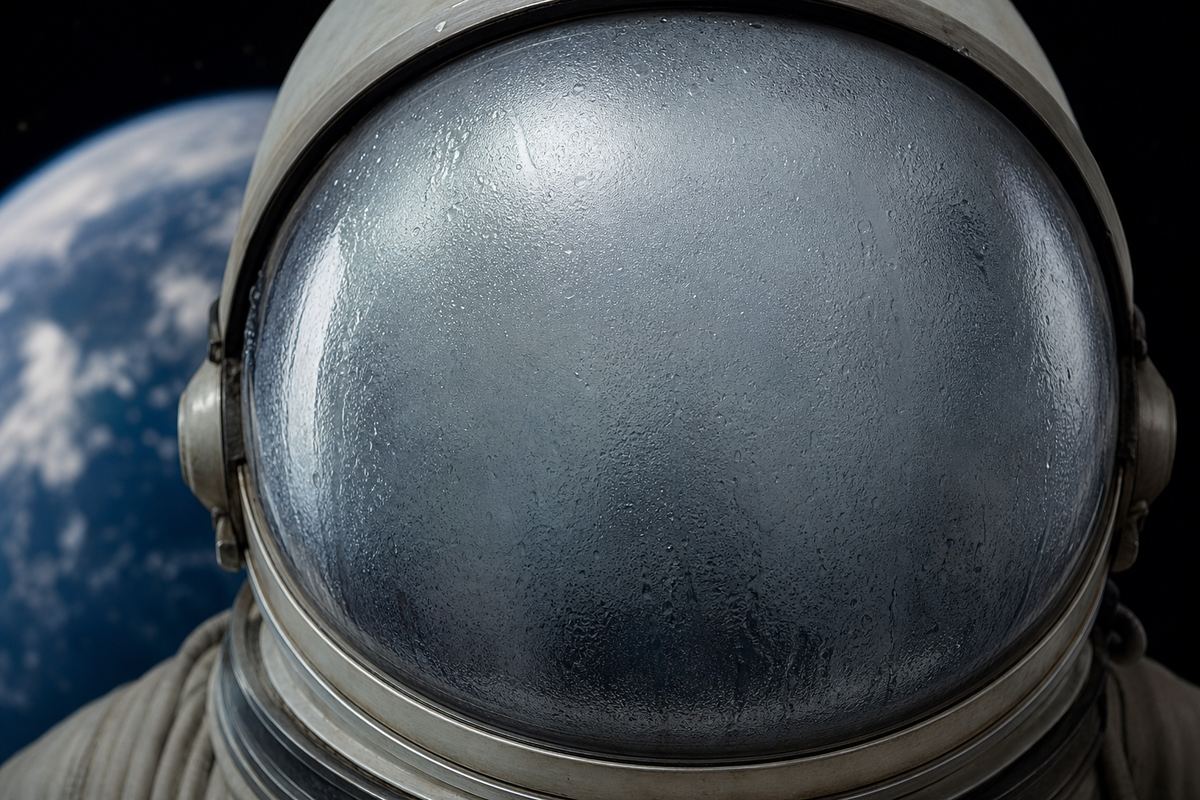
His heart rate rose to about 180 beats a minute, and his helmet fogged over completely. The spacewalk was cut short.
Gemini 10 and 11 ran into trouble too. Nothing in space held the spacewalker still.
On a line A figure in a 1960s silver suit floats beside a capsule on a long golden tether and umbilical, holding a small gas gun. AI-generated illustration, not a photograph.
3 Jun 1965 Gemini 4: Ed White, about 21 minutes (ESA)
5 Jun 1966 Gemini 9: Cernan, planned 167 min, ended at 2 h 8 min
1966 Gemini 10 and 11: more difficulties
Gemini spacewalks
~180
heartbeats a minute
fogged
helmet visor, completely
Gene Cernan, Gemini 9 (NASA)Blind and drifting A 1960s helmet visor misted with condensation, the Earth only a blur behind it. AI-generated illustration, not a photograph.
Chapter I · First steps outside
Early American spacewalks
NASA (June 3, 1965): Ed White, pilot of the Gemini IV four-day mission, made America’s first spacewalk using a Hand-Held Self-Maneuvering Unit, secured by a 23-foot tether line and a 25-foot umbilical; ESA gives about 21 minutes outside. NASA (Gemini IX): Cernan’s spacewalk on 5 June 1966 was scheduled for 167 minutes and ended after two hours and eight minutes; within minutes he was exhausted and sweating profusely, his heart rate rose to about 180 beats per minute and his helmet fogged over completely. NASA (Gemini XII at 55): astronauts on Gemini IX, X and XI had significant difficulties during their spacewalks.
The 3D scenes are simplified teaching models, not to scale: the astronaut, the spacecraft and the Earth are drawn, not modelled from real hardware.
The reason is Newton’s third law: for every action there is an equal and opposite reaction. On Earth, your feet press on the ground and friction holds you in place.
In orbit, everything is falling together, so there is no weight to press you down. Push on a panel, and you and the panel drift apart. Try to turn a bolt, and the bolt may stay still while you turn.
Every movement has to be braced against something. Without a foothold, an astronaut spends their strength just holding position. Try both buttons.
Even keeping still takes effort, because every reach pulls the body somewhere new.
Fyou on bolt=−Fbolt on you
F
a force, with a direction
Action and reaction
…turning a nut with a wrench, can become quite difficult in space because the astronaut — and not the nut — may turn.NASA, Suited for Spacewalking teacher’s guide
Who turns? An astronaut with a wrench, body twisting the opposite way to the tool, no foothold in sight. AI-generated illustration, not a photograph.
on Earth
weight and friction
in orbit
only what you grip or clip to
What holds you
Chapter II · Push, and you fly away
Action and reaction
NASA (Suited for Spacewalking teacher’s guide): for every action there is an opposite and equal reaction; pushing on an object causes the object and the crew member to float away in opposite directions; turning a nut with a wrench can become quite difficult in space because the astronaut, and not the nut, may turn. In orbit the station, the astronaut and their tools are all in free fall around the Earth together, which is why nothing has weight relative to anything else.
Press “No foothold” and “Feet fixed” to compare.
The 3D scenes are simplified teaching models, not to scale: the astronaut, the spacecraft and the Earth are drawn, not modelled from real hardware.
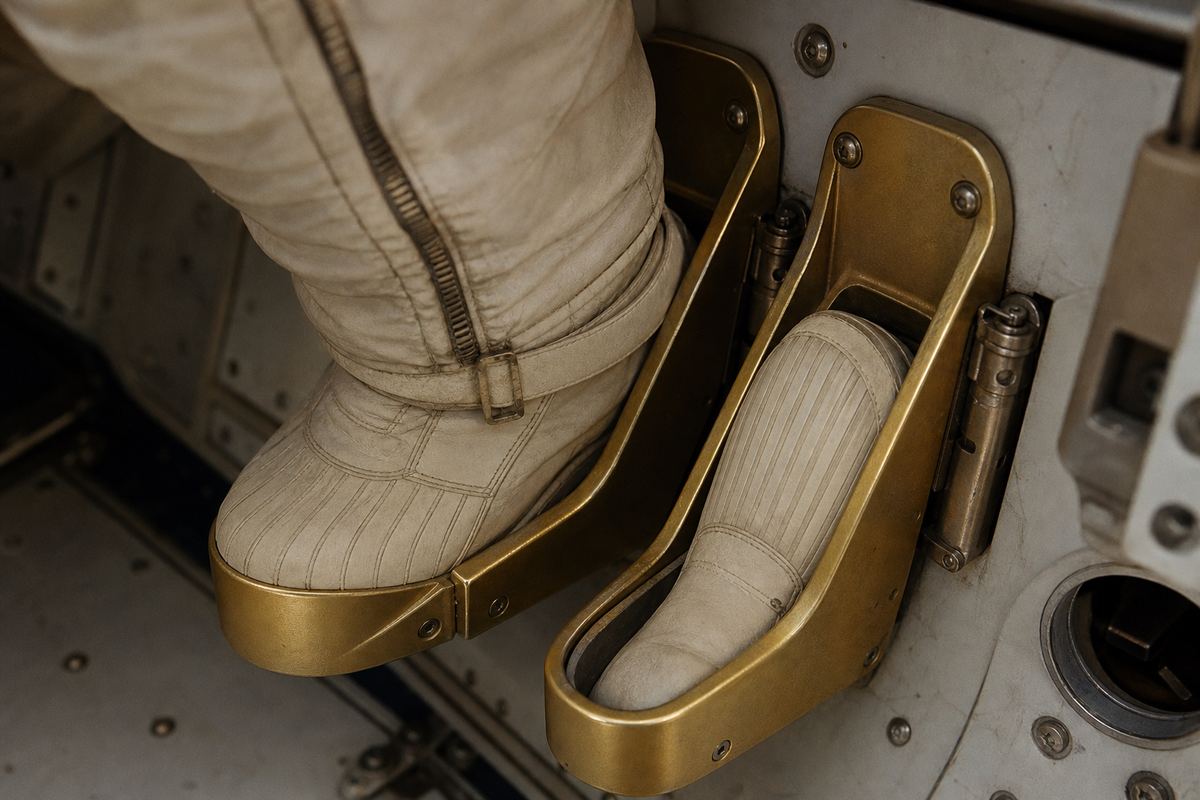
For Gemini 12, NASA changed the job instead of the astronaut. More handrails and handholds were fitted, and Aldrin put his feet into foot restraints nicknamed the golden slippers.
A waist tether held his body close to the work, so he could turn a wrench without turning himself. He fitted a portable handrail, then used it the next day.
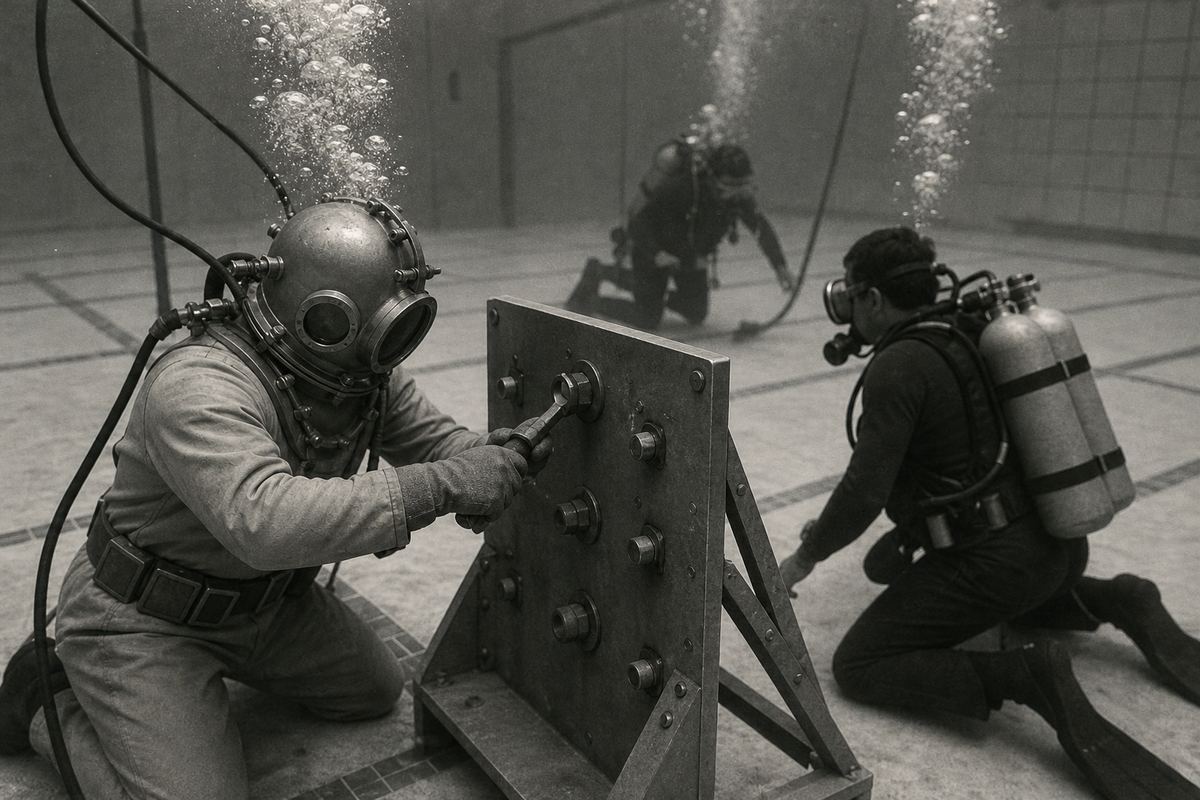
And he had practised under water. From September 1966 he rehearsed his tasks in a swimming pool in Maryland, the first astronaut to train for a spacewalk this way. He credited his success to it.
Feet locked in Boots of a 1960s spacesuit slotted into gold-coloured foot restraints on the side of a spacecraft. AI-generated illustration, not a photograph.
more handrails and handholds
foot restraints, the “golden slippers”
a waist tether to work with wrenches
rest periods and underwater rehearsal
What changed for Gemini 12 (NASA)Rehearsing in a pool A diver in a 1960s pressure suit practises at a mock-up panel at the bottom of a school swimming pool. AI-generated illustration, not a photograph.
The underwater simulation duplicated the actual extravehicular actions and reactions with a high degree of fidelity.NASA, on Gemini 12
Chapter II · Push, and you fly away
The fixes
NASA (Gemini XII at 55): Aldrin was secured in foot restraints called “golden slippers”, evaluated a waist tether restraint system while performing additional tasks, and installed a portable handrail on the Agena target for the next day’s umbilical spacewalk; he was the first astronaut to use neutral buoyancy to train for his spacewalks, starting on 12 September 1966 in a pool at the McDonogh School in Owings Mills, Maryland, and attributed his success to that training. NASA (Gemini XII crew masters spacewalks, 2016): more handrails and handholds were added; a waist tether gave him the ability to turn wrenches; the underwater simulation duplicated the actual extravehicular actions and reactions with a high degree of fidelity.
The button adds the rails, foot restraints and tether in turn.
The 3D scenes are simplified teaching models, not to scale: the astronaut, the spacecraft and the Earth are drawn, not modelled from real hardware.
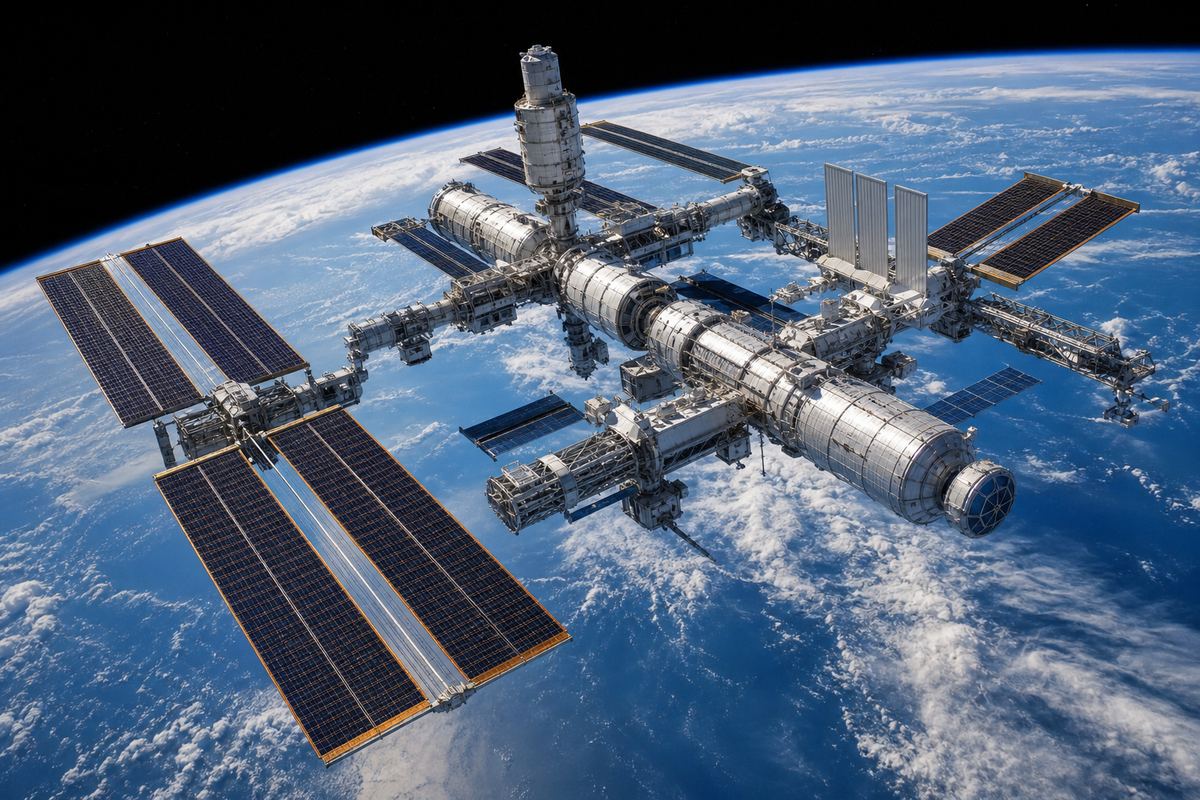
Most of today’s spacewalks happen at the International Space Station, about 400 kilometres up; China’s astronauts also work outside their Tiangong station. It travels at about 28,000 kilometres an hour and circles the Earth every ninety minutes.
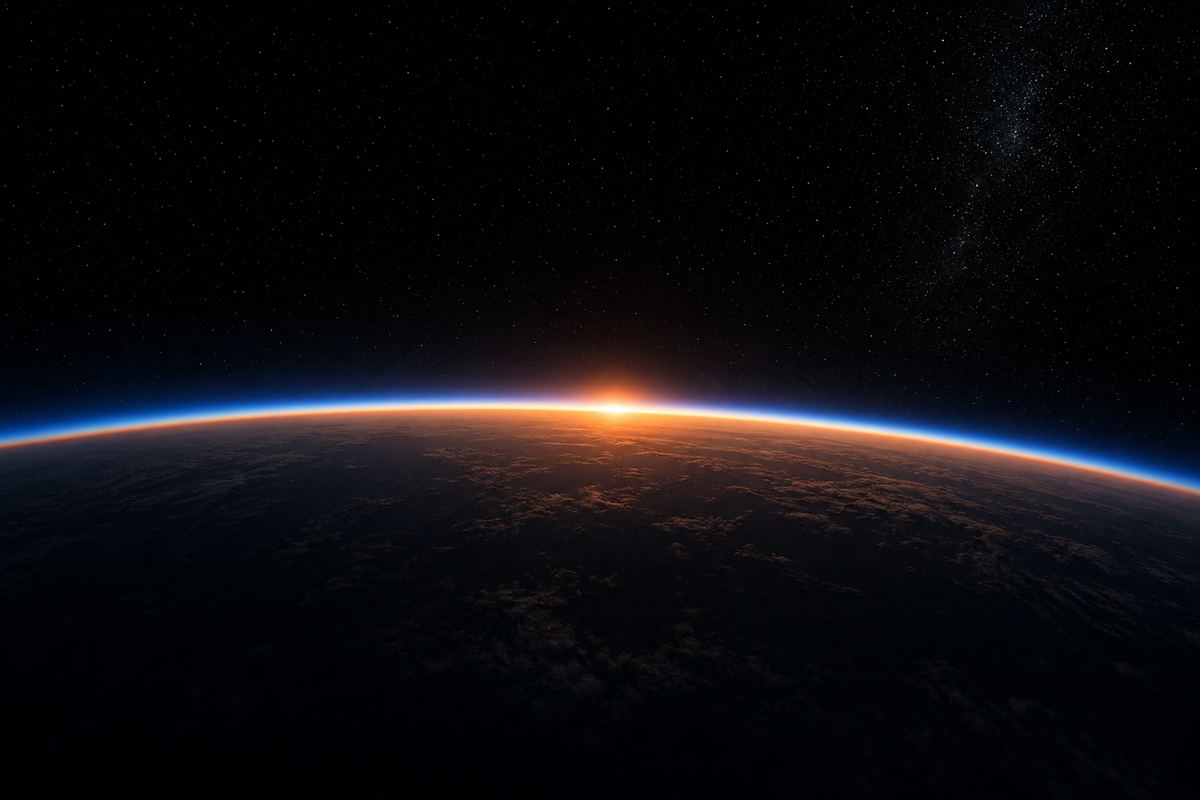
That makes sixteen sunrises and sixteen sunsets every day.
In sunlight, a surface can reach about 121 degrees Celsius. In the Earth’s shadow it can fall to about minus 157. Tiny grains of rock called micrometeoroids, and bits of space debris, fly past at very high speed; even a fleck of paint can hit like a tiny bullet.
Each lap swings a spacewalker from searing sun to deep cold and back. To work out there, you need a spacecraft of your own.
A station in orbit A large modular space station with wide solar arrays, the curve of the Earth below. AI-generated illustration, not a photograph.
~400 km
up (about 250 miles)
28,000 km/h
about 17,500 mph
16
sunrises and sunsets a day
The International Space Station (NASA)
in sunlight
+121
in shadow
−157
Temperatures a spacesuit must handle (NASA)
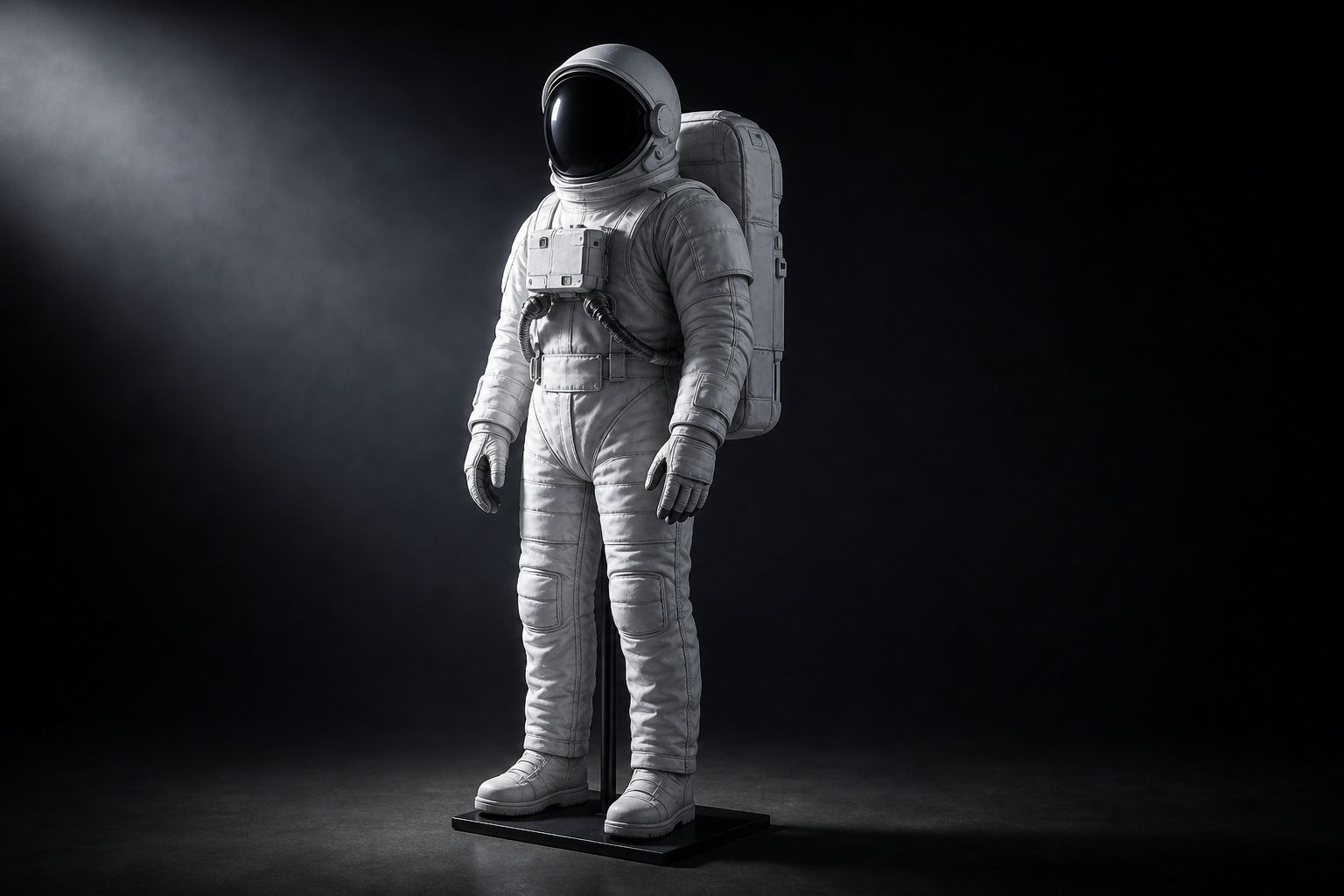
Sunrise from orbit A thin band of orange and blue on the Earth’s rim as the Sun rises, seen from orbit, one of sixteen that day. AI-generated illustration, not a photograph.Your own spacecraft An empty modern spacesuit on a stand, its backpack and helmet ready: what the next chapter takes apart. AI-generated illustration, not a photograph.
Chapter III · A spacecraft you wear
The environment
NASA: the station orbits at an average altitude of about 250 miles (about 400 km); it travels at about 17,500 mph (28,000 km/h) and orbits the Earth once every 90 minutes; in 24 hours it makes 16 orbits, through 16 sunrises and sunsets. NASA (spacewalk spacesuit basics): conditions range from about −250 °F to 250 °F in sunlight (about −157 °C to +121 °C). NASA (teacher’s guide): the suit’s layers protect against micrometeoroids, which travel at very high velocities; even a paint chip can travel at thousands of kilometres an hour.
Celsius values are converted from NASA’s Fahrenheit figures; “like a tiny bullet” is an image, not a measurement. The button moves the station into sunlight or shadow.
The 3D scenes are simplified teaching models, not to scale: the astronaut, the spacecraft and the Earth are drawn, not modelled from real hardware.
Why a spacesuit runs at under a third of cabin pressure.
Leonov’s problem never went away: a suit full of air is a stiff balloon. Every bend of a finger works against the pressure inside.
So NASA’s spacewalking suit runs at just 4.3 pounds per square inch, against about 14.7 in the station’s cabin.
Suits are designed to run at the lowest reasonable pressure, to give the best movement and dexterity. Even so, gloves are tiring, and hand fatigue is a common complaint.
Think of squeezing a stiff rubber ball with every grip, for six hours.
To stay alive at that low pressure, the suit is filled with pure oxygen, which gives the wearer more oxygen than breathing air at sea level.
The hardest part A modern spacesuit glove gripping a handrail, its fingers padded and stiff. AI-generated illustration, not a photograph.
station cabin, sea-level air
14.7
NASA spacesuit (EMU), pure oxygen
4.3
Pressure (NASA)
…the lowest reasonable pressure… to permit optimal crew member mobility and dexterity.NASA, Extravehicular Activities (Gernhardt & Dervay, 2013)
29.6 kPa
of pure oxygen (NASA EMU fact sheet)
4.3 psi is
no nitrogen in the suit at all
more oxygen than breathing air at sea level
a softer suit that bends more easily
Pure oxygen, low pressure (NASA)
Chapter III · A spacecraft you wear
Pressure and mobility
NASA (EMU fact sheet): the station’s spacesuit, the Extravehicular Mobility Unit, is pressurized to 4.3 psia (29.6 kPa). NASA technical brief on decompression sickness: cabin pressure has historically been 14.7 psia. Gernhardt & Dervay (NASA, 2013): suits are designed to operate at the lowest reasonable pressure to permit optimal mobility and dexterity; suit pressure produces biomechanical constraints, and there is significant hand fatigue related to glove resistance. NASA (teacher’s guide): pure oxygen at low pressure provides the wearer with more oxygen than an unsuited person breathes at sea level.
The buttons inflate the glove to cabin pressure or to suit pressure; at 14.7 psi the fingers barely bend.
The 3D scenes are simplified teaching models, not to scale: the astronaut, the spacecraft and the Earth are drawn, not modelled from real hardware.
Dropping from cabin pressure to suit pressure has a danger, the same one divers face. At normal pressure, nitrogen from the air dissolves in the blood and body.
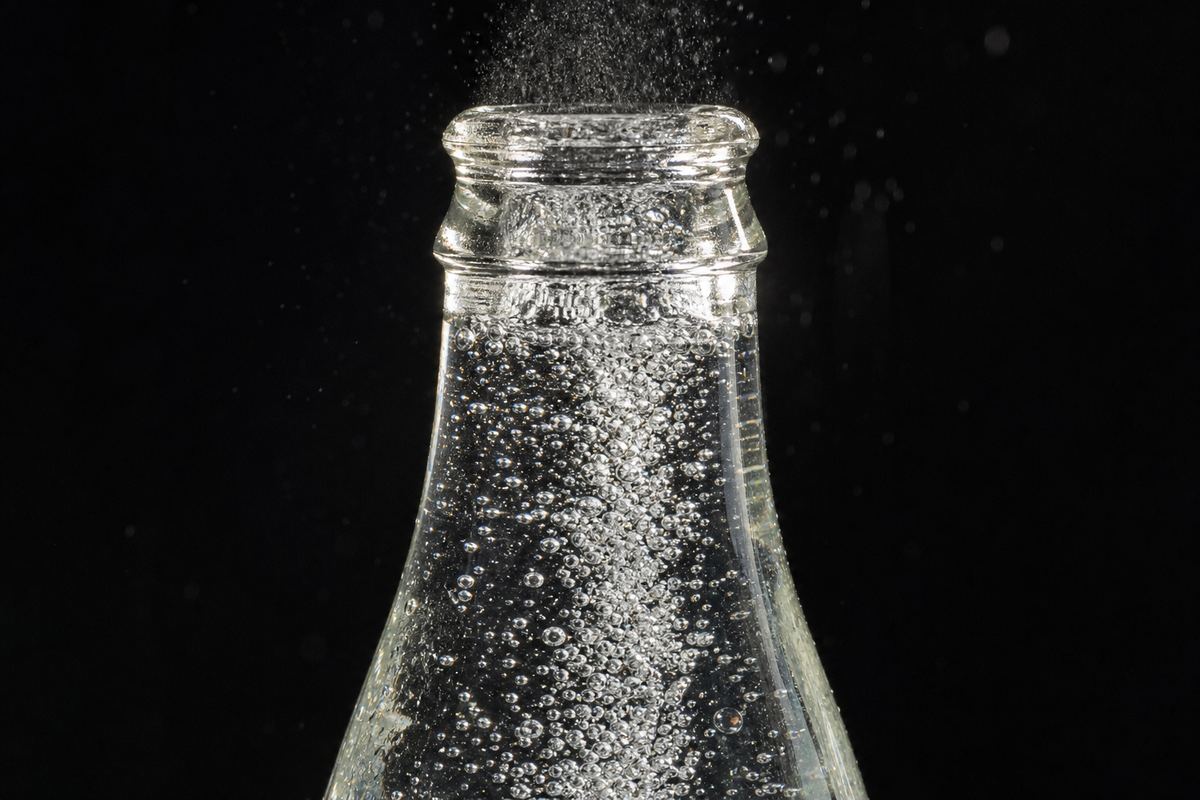
Lower the pressure quickly, and that nitrogen can come out as bubbles, like opening a fizzy drink. That is decompression sickness, the bends.
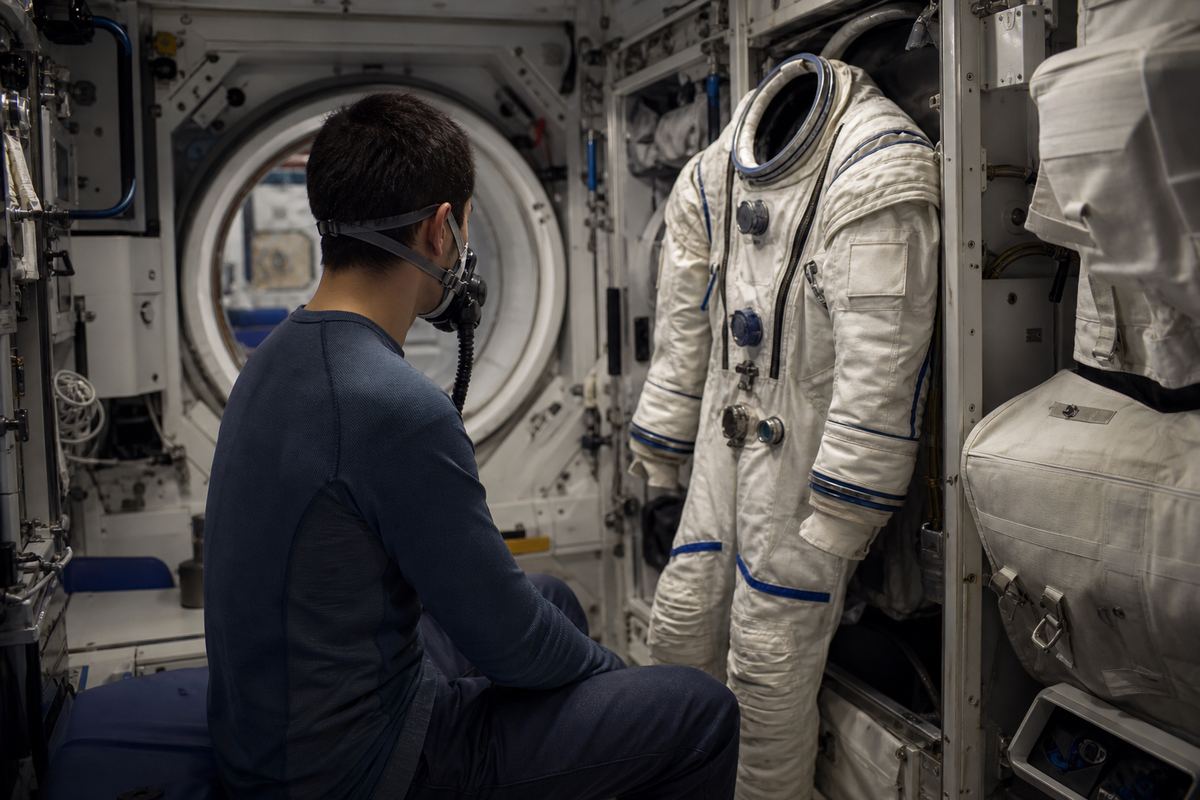
So before a spacewalk, astronauts breathe pure oxygen for a period, which washes the nitrogen out of their bodies first.
14.7 → 4.3
psi, cabin to suit: less than a third
Pressure dropLike a fizzy drink Bubbles rushing up in a bottle the moment the cap comes off: dissolved gas escaping as pressure drops. AI-generated illustration, not a photograph.
…the formation of inert bubbles during rapid reductions in ambient pressure.NASA technical brief on decompression sickness
Prebreathe An astronaut in the station breathing through an oxygen mask before suiting up. AI-generated illustration, not a photograph.
Chapter III · A spacecraft you wear
Decompression sickness
NASA technical brief OCHMO-TB-037: at cabin pressure, historically 14.7 psia, nitrogen equilibrates between the lungs and blood; suit pressure is historically 4.3 psia; decompression sickness comes from the formation of inert-gas bubbles during rapid reductions in ambient pressure; prebreathe works by eliminating nitrogen and replacing it with 100% oxygen. NASA (What is a spacewalk?): astronauts breathe 100 percent oxygen to get the nitrogen out of their bodies, which prevents the bends. The length of the prebreathe depends on the protocol used.
Press “Drop pressure fast” and “Prebreathe first” to compare.
The 3D scenes are simplified teaching models, not to scale: the astronaut, the spacecraft and the Earth are drawn, not modelled from real hardware.
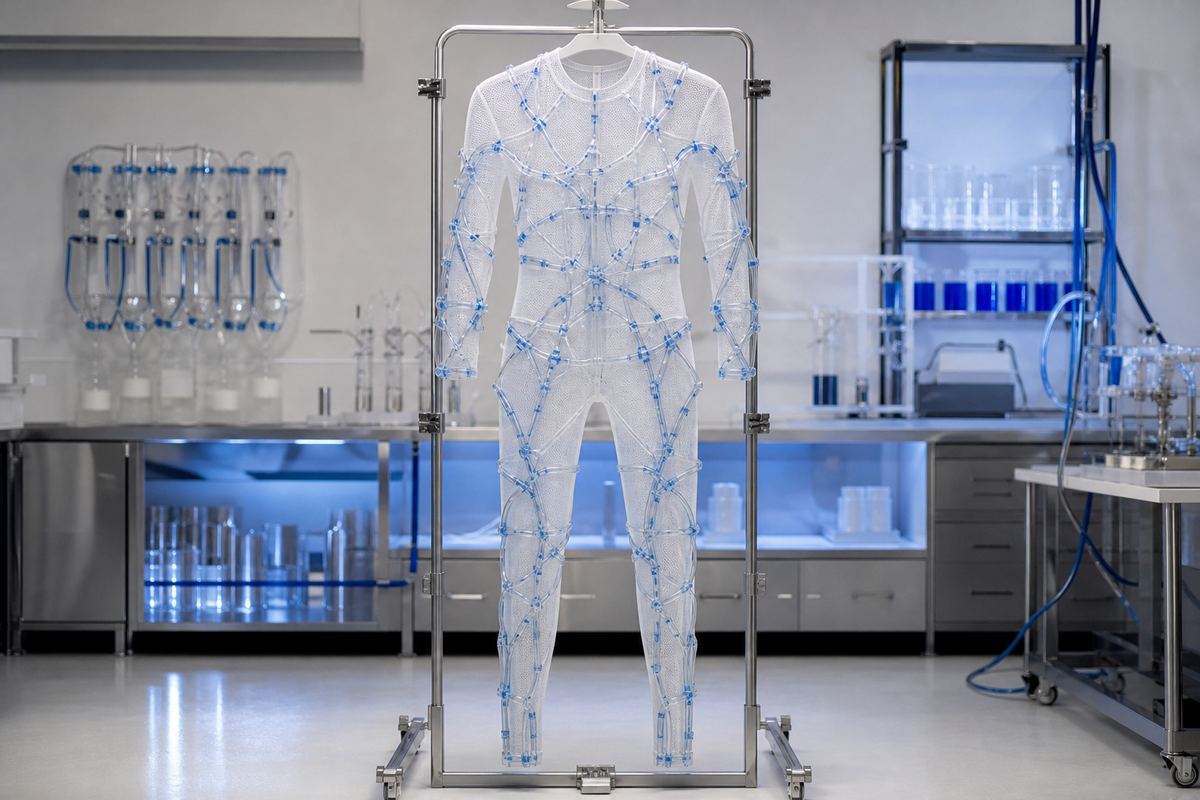
Next to the skin, a spacewalker wears a garment laced with hundreds of feet of thin tubing. Water flows through it to carry away body heat.
Over it come the pressure layers, and an outer garment of up to sixteen layers in all, against heat, cold and micrometeoroids.
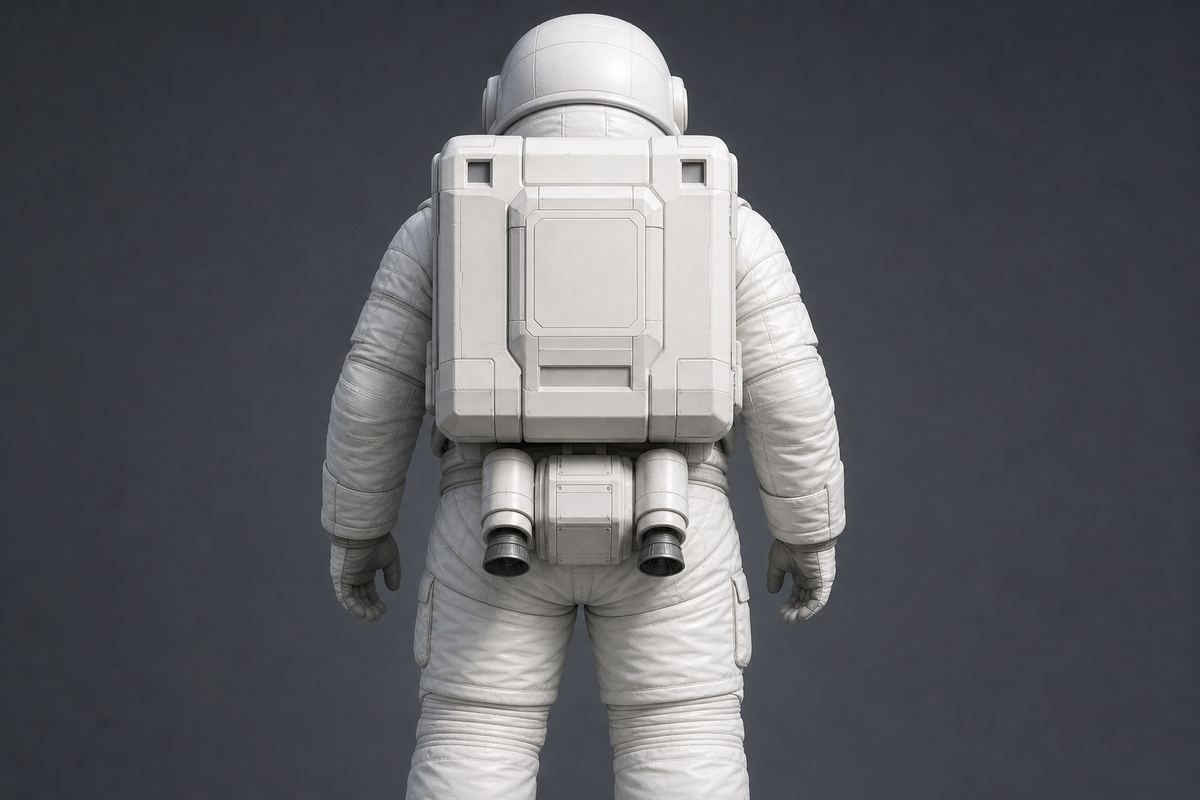
A backpack supplies oxygen, removes the carbon dioxide breathed out, and runs the cooling water.
Clipped below it is SAFER, a small unit with nitrogen jets that an astronaut can use to fly back if they ever come loose. With all of it, the suit weighs about 145 kilograms on Earth.
Cooling garment A stretchy undergarment threaded with thin plastic tubes, laid out flat. AI-generated illustration, not a photograph.
liquid cooling and ventilation garment: ~300 ft of tubing
pressure bladder and restraint
thermal and micrometeoroid garment
up to 16 layers of material in all
From the inside out (NASA)Life support on your back The back of a white spacesuit with its square life-support pack and a small jet unit below it. AI-generated illustration, not a photograph.
~145 kg
on Earth (about 319 lb)
1994
SAFER first tested, STS-64
NASA EMU, with backpack and SAFER
Chapter III · A spacecraft you wear
Inside the suit
NASA (spacewalk spacesuit basics): the suit has as many as 16 layers of material; the cooling garment carries about 300 feet of tubes. An older NASA teacher’s guide describes 14 layers on the Shuttle-era suit and 91.5 metres of tubing. NASA (EMU fact sheet): the cooling garment has water-cooling tubes running through it; the Primary Life Support System backpack supplies breathable air; with backpack and SAFER the suit weighs about 319 lb (145 kg) on Earth. NASA (STS-64 at 30): SAFER attaches to the backpack and has nitrogen jets an astronaut can use should they become untethered; it was first tested in September 1994 and is used routinely on station spacewalks.
The buttons peel the suit layer by layer.
The 3D scenes are simplified teaching models, not to scale: the astronaut, the spacecraft and the Earth are drawn, not modelled from real hardware.
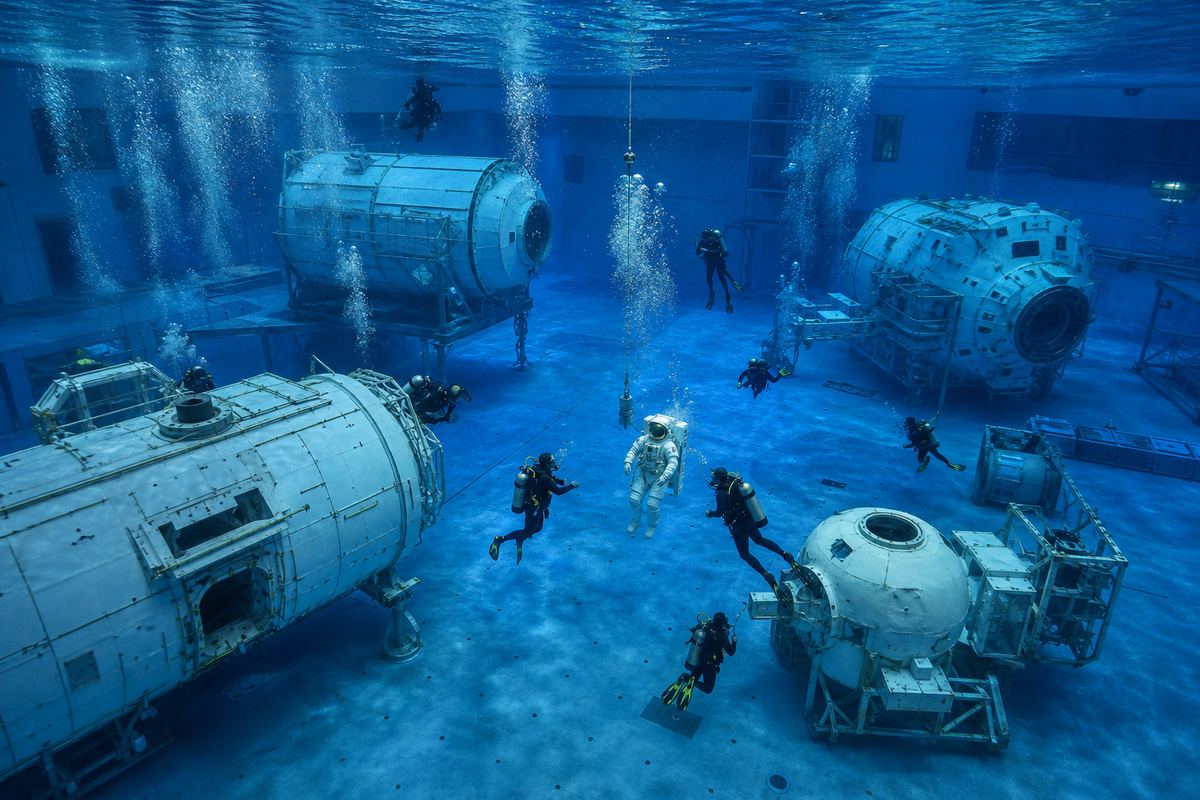
Aldrin’s pool became standard. NASA’s Neutral Buoyancy Laboratory in Houston holds 6.2 million gallons of water, about twenty-three and a half million litres, twelve metres deep.
Full-size pieces of the space station lie on the bottom. Astronauts in real suits rehearse each job there, with divers beside them.
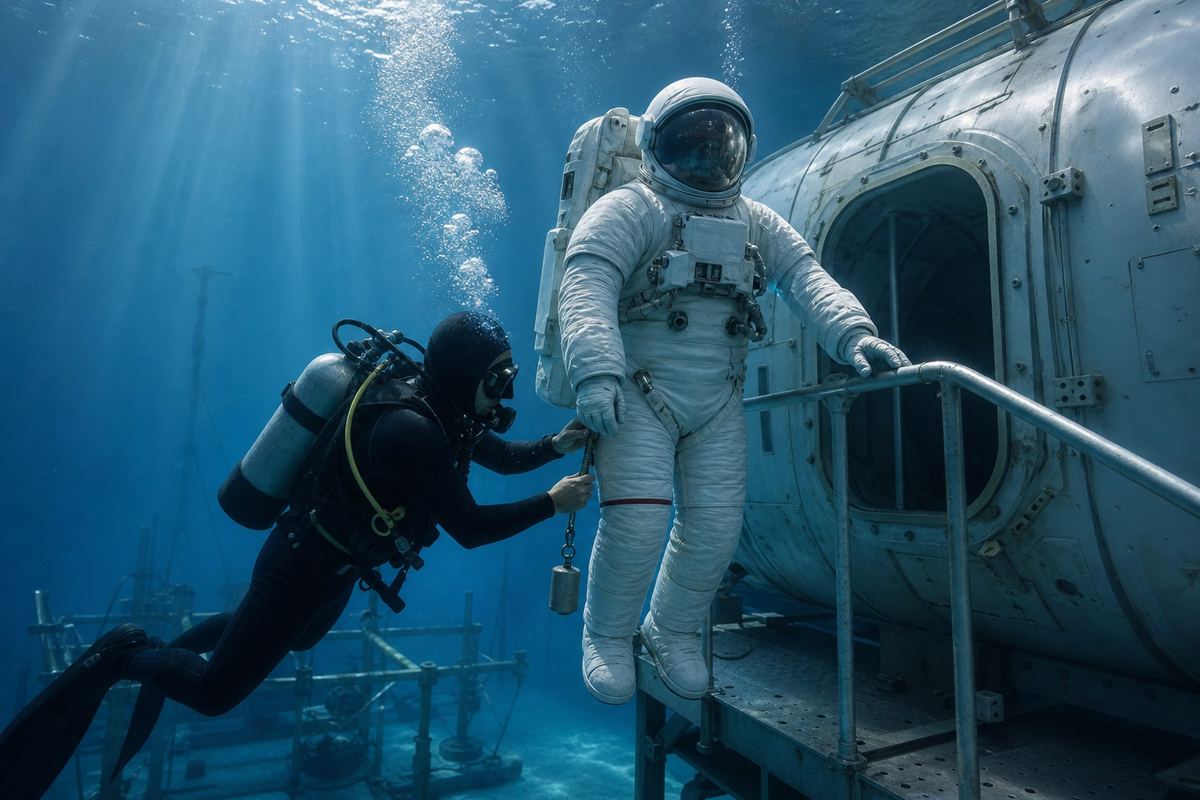
Weights and floats are added until the suited astronaut neither sinks nor rises. It is not weightlessness, since water drags on every move, but it is the closest thing on Earth to working while falling.
That is where today’s spacewalks are rehearsed, long before anyone tries them in orbit.
A pool the size of a building An enormous indoor pool with large white station modules on its floor and divers around a suited figure. AI-generated illustration, not a photograph.
61.5 × 31.1 m
length and width
12.2 m
deep
6.2 M gal
of water, about 23.5 million litres
Neutral Buoyancy Laboratory (NASA)Neither sinking nor rising A suited figure hovering beside a handrail under water, a safety diver adjusting a small weight on the suit. AI-generated illustration, not a photograph.
both: no weight pressing you to the floor
pool: water drags and slows every move
orbit: a pushed object keeps going
Pool versus orbit
Chapter IV · Practising underwater
The Neutral Buoyancy Laboratory
NASA Johnson: the Neutral Buoyancy Laboratory is 202 feet (61.5 m) long, 102 feet (31.1 m) wide and 40 feet (12.2 m) deep and holds 6.2 million gallons of water; it is part of the Sonny Carter Training Facility near Ellington Field in Houston, and a mock-up facility builds the station pieces used in it. NASA (Gemini XII crew masters spacewalks): neutral buoyancy became the primary spacewalk training method in the United States, Russia and China. The litre figure is the film’s conversion.
Water drag is why the pool is only a rehearsal: in orbit a pushed object keeps moving. The button trims the astronaut until they neither sink nor rise.
The 3D scenes are simplified teaching models, not to scale: the astronaut, the spacecraft and the Earth are drawn, not modelled from real hardware.
Spacewalks built the International Space Station and keep it working. NASA counts 284 spacewalks there since December 1998.
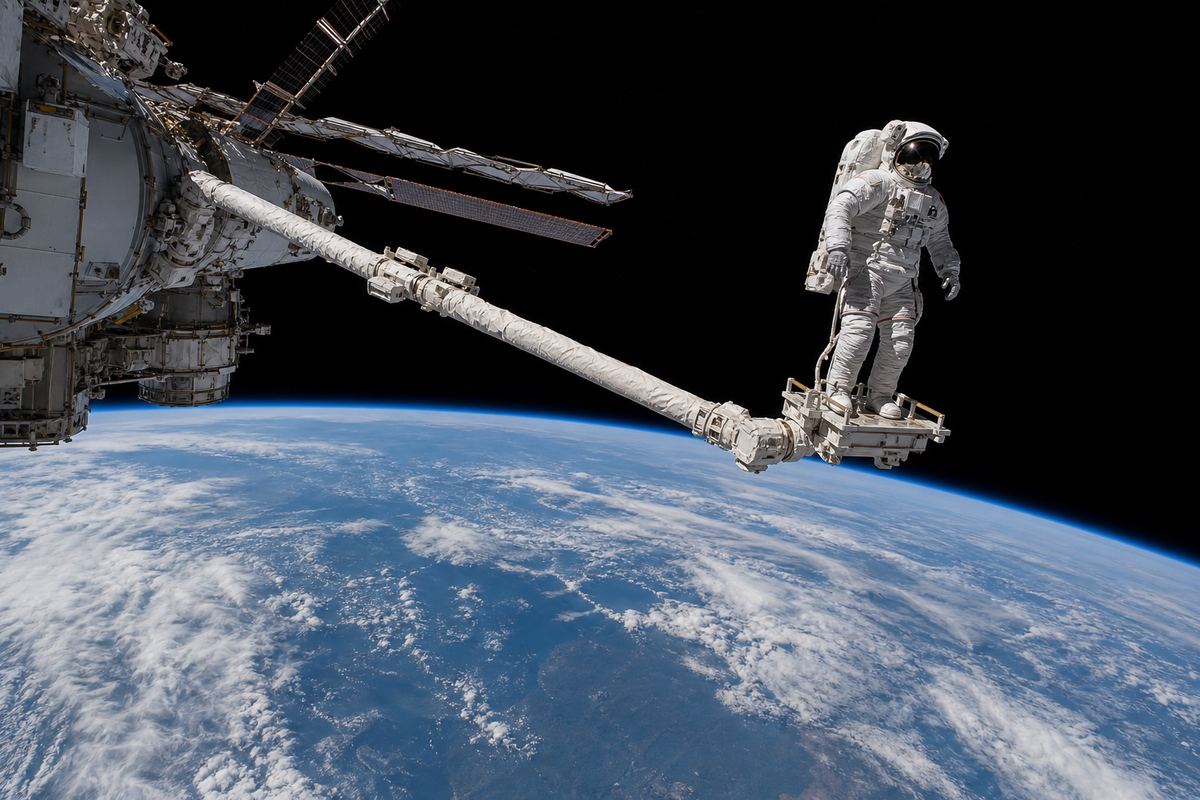
A typical one is planned for about six and a half hours, tethered all the way, with feet locked into a restraint on the robotic arm when the job allows.
The longest, by James Voss and Susan Helms in March 2001, lasted eight hours and fifty-six minutes. In October 2019 Christina Koch and Jessica Meir made the first spacewalk by two women.
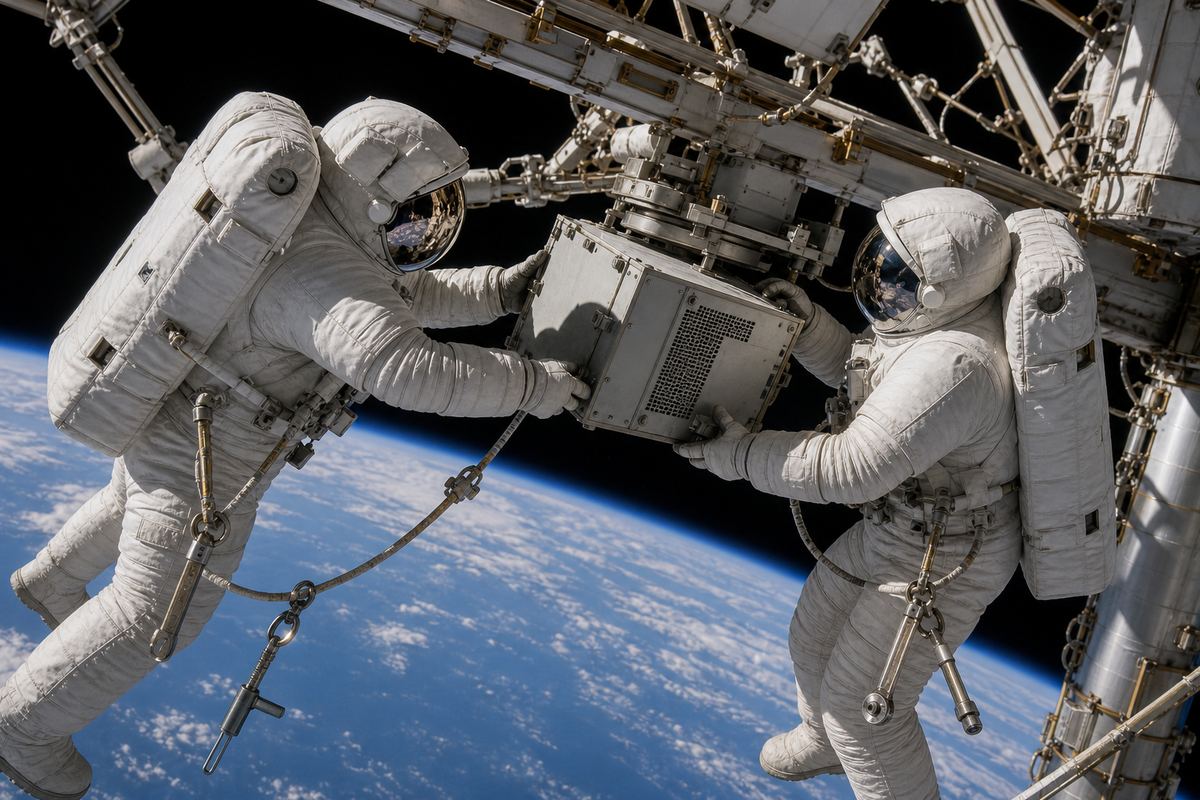
Much of the work is repair. Koch and Meir went out that day to replace a failed battery charge unit.
284
since December 1998
~6.5 h
typical planned length
Station spacewalks (NASA)On the end of the arm A spacewalker with feet locked into a restraint at the tip of a long robotic arm, the Earth below. AI-generated illustration, not a photograph.
12 Mar 2001 longest: Voss and Helms, 8 h 56 min
18 Oct 2019 first all-woman spacewalk: Koch and Meir, 7 h 17 min
1 Sep 2026 latest on NASA’s list: Meir and Adenot, 6 h 49 min
Records and firstsRepair work Two spacewalkers removing a boxy electronics unit from a station truss, tools tethered to their suits. AI-generated illustration, not a photograph.
Chapter V · Work in orbit
Station spacewalks
NASA (space station spacewalks): there have been 284 spacewalks at the International Space Station since December 1998, the latest listed on 1 September 2026 (Meir and Adenot, 6 h 49 min); the longest was by James Voss and Susan Helms on 12 March 2001, eight hours and 56 minutes. NASA (Gernhardt & Dervay): spacewalks are typically planned for at most 6.5 hours; a NASA briefing of January 2026 expected one to last about six hours and 30 minutes. NASA (What is a spacewalk?): safety tethers keep astronauts from floating away, and astronauts are attached to the robotic arm using a foot restraint. NASA (18 October 2019): Christina Koch and Jessica Meir completed a 7-hour, 17-minute spacewalk, the first with only women.
The 3D scenes are simplified teaching models, not to scale: the astronaut, the spacecraft and the Earth are drawn, not modelled from real hardware.
It is still dangerous. On 16 July 2013, during a spacewalk, the Italian astronaut Luca Parmitano reported water floating behind his head inside his helmet.
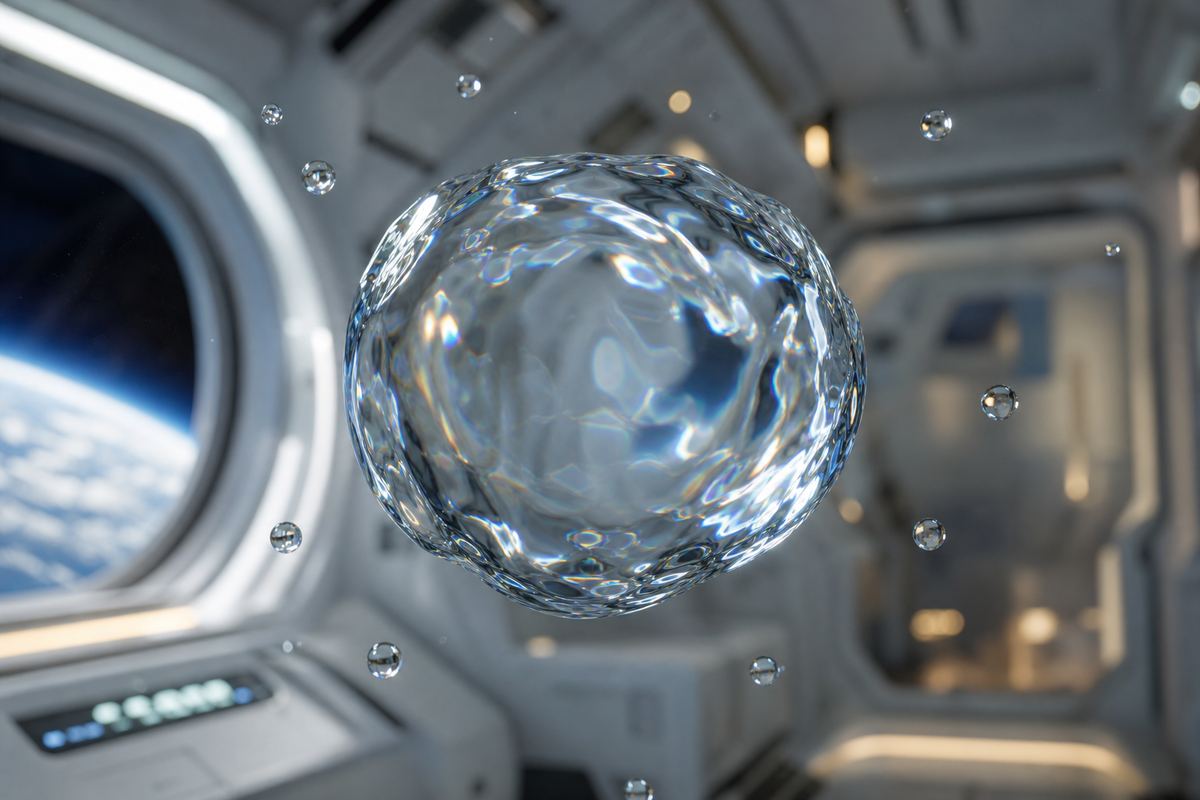
Without gravity, the water did not drain away. It crept around his head, an estimated one to one and a half litres, covering his eyes, nose and ears. The spacewalk was ended early and he made it back inside.
NASA traced it to a blocked water separator in the suit’s backpack, which let water spill into the air he breathed, and classed it as a high-visibility close call.
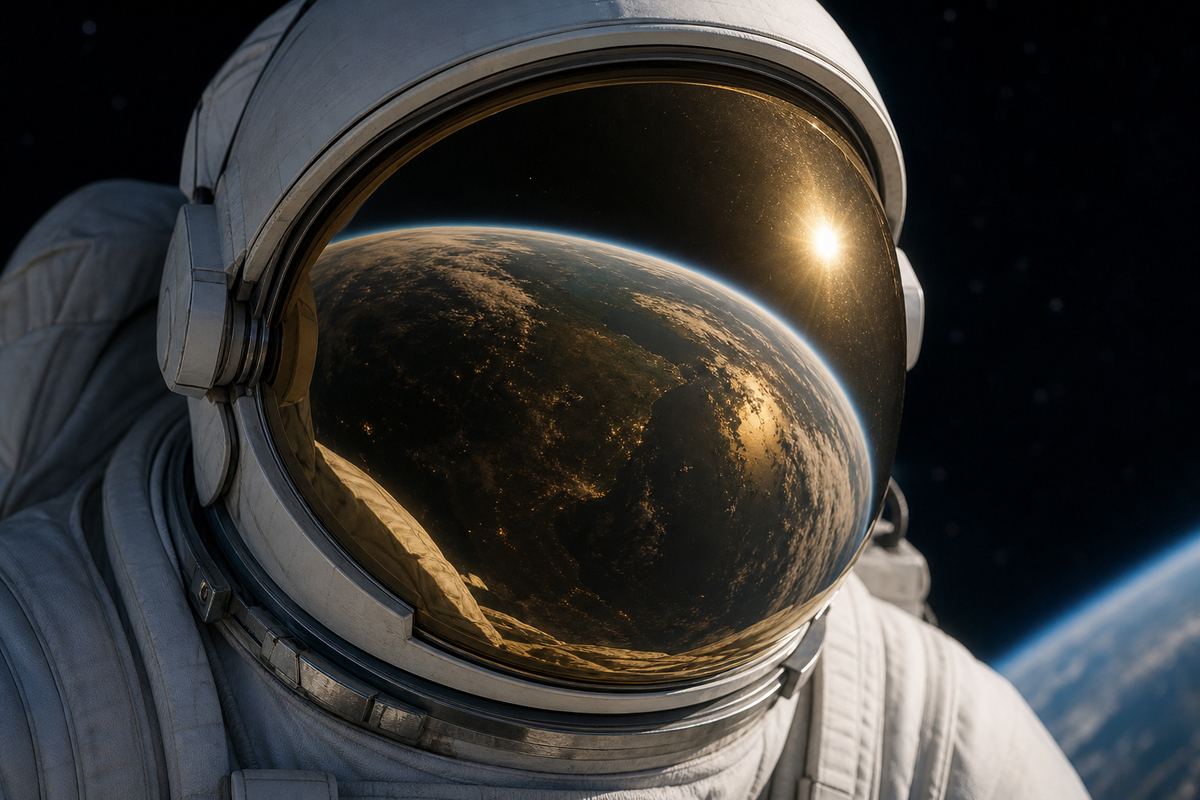
A helmet in orbit A modern spacesuit helmet with a gold sun visor, the Earth reflected in it; no face is visible. AI-generated illustration, not a photograph.Water without gravity A wobbling sphere of water floating in a spacecraft cabin, clinging to whatever it touches. AI-generated illustration, not a photograph.
1–1.5 L
of water estimated in the helmet
ended early
the spacewalk was terminated
EVA 23, NASA mishap reportThe backpack The suit’s backpack, where the water separator sits; the fault was there, not in the cooling garment. AI-generated illustration, not a photograph.
Chapter V · Work in orbit
EVA 23
NASA mishap investigation report (EVA 23, 16 July 2013): the crewmember, “EV2”, had water in the helmet estimated at 1 to 1.5 litres, covering his eyes, nose and ears; the spacewalk was terminated early; the cause was inorganic material blocking the drum holes in the suit’s water separator; the event was classified as a High Visibility Close Call. The report puts the start of the water problem roughly 44 minutes into EVA 23. NASA (image article): a little more than one hour into the spacewalk, ESA astronaut Luca Parmitano reported water floating behind his head inside his helmet.
The 3D scenes are simplified teaching models, not to scale: the astronaut, the spacecraft and the Earth are drawn, not modelled from real hardware.
In September 2024, Polaris Dawn, a privately funded SpaceX mission, made the first commercial spacewalk. Who goes outside is changing; the rules Gemini 12 taught are not.
In a place where a push sends you drifting, every job starts the same way: hold on, lock your feet, clip your tether, and only then pick up the wrench.
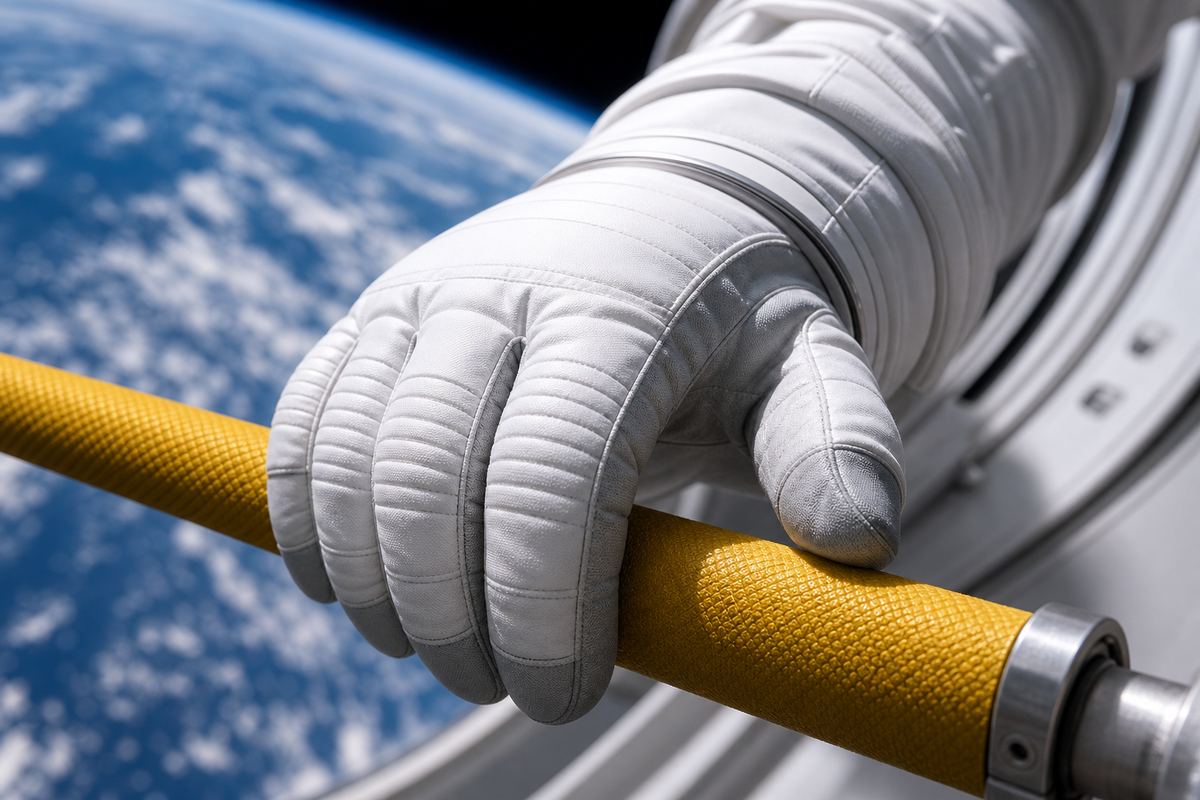
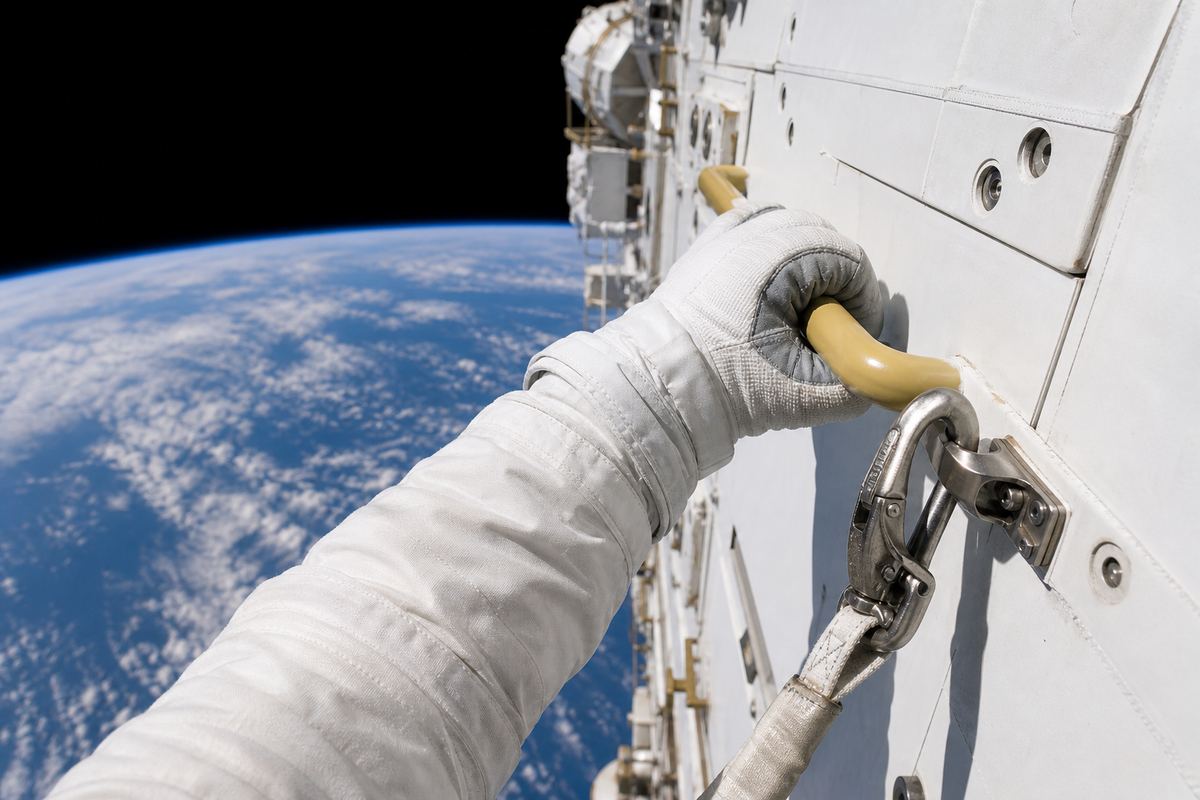
Hold on A gloved hand gripping a yellow handrail on a station module, a tether clipped beside it, the Earth far below. AI-generated illustration, not a photograph.
12 Sep 2024
first commercial spacewalk
1 h 46 min
the whole spacewalk
Polaris Dawn (Space.com)
1965 Leonov, first spacewalk; Ed White, first US
1966 Gemini 9: exhaustion; Gemini 12: handholds, restraints, pool training
1994 SAFER rescue jetpack first tested
1998 first station spacewalks
2001 longest spacewalk, 8 h 56 min
2013 water in the helmet, EVA 23
2019 first all-woman spacewalk
2024 first commercial spacewalk, Polaris Dawn
Learning to work outside
Epilogue · Sources
Sources
Every fact in this film comes from the sources below. Space.com (September 2024): Polaris Dawn, with Jared Isaacman and Sarah Gillis, made the world’s first commercial spacewalk on 12 September 2024, lasting one hour and 46 minutes. Where sources give different figures (Leonov’s time outside, Gemini 12’s durations, the number of suit layers), the film names the source it follows. Temperatures in Celsius and the pool volume in litres are the film’s conversions. The chapter stills and pictures are AI-generated illustrations, not photographs of real missions, spacecraft or people. The 3D scenes are simplified teaching models, not to scale.