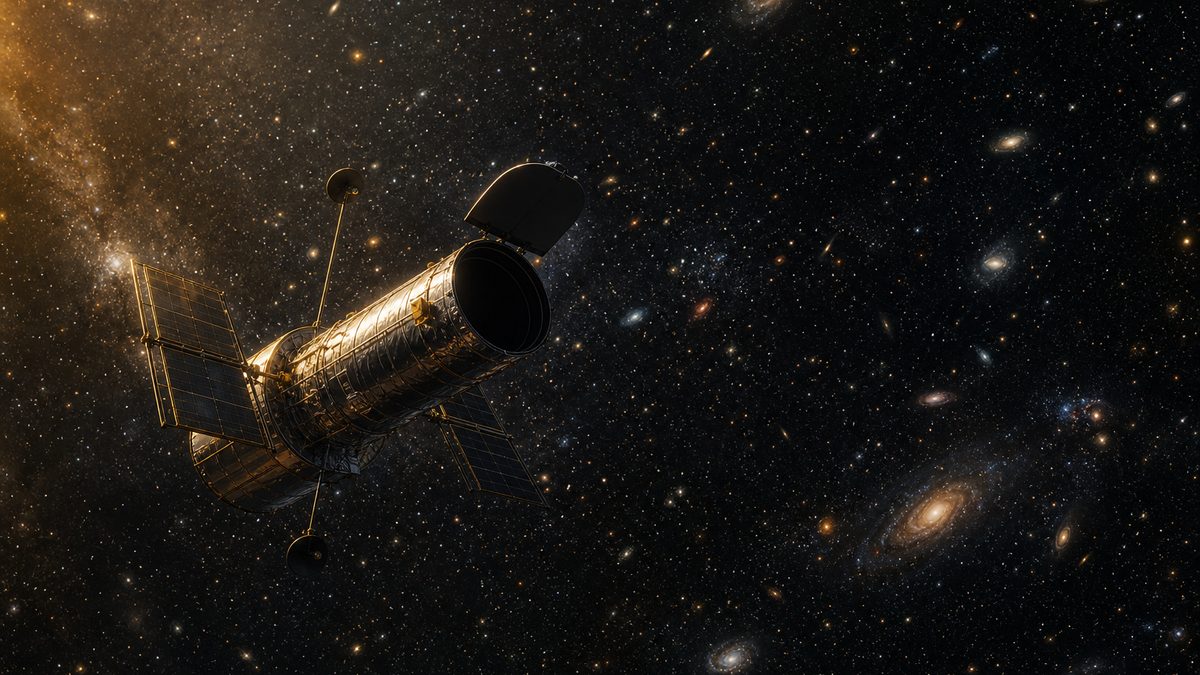
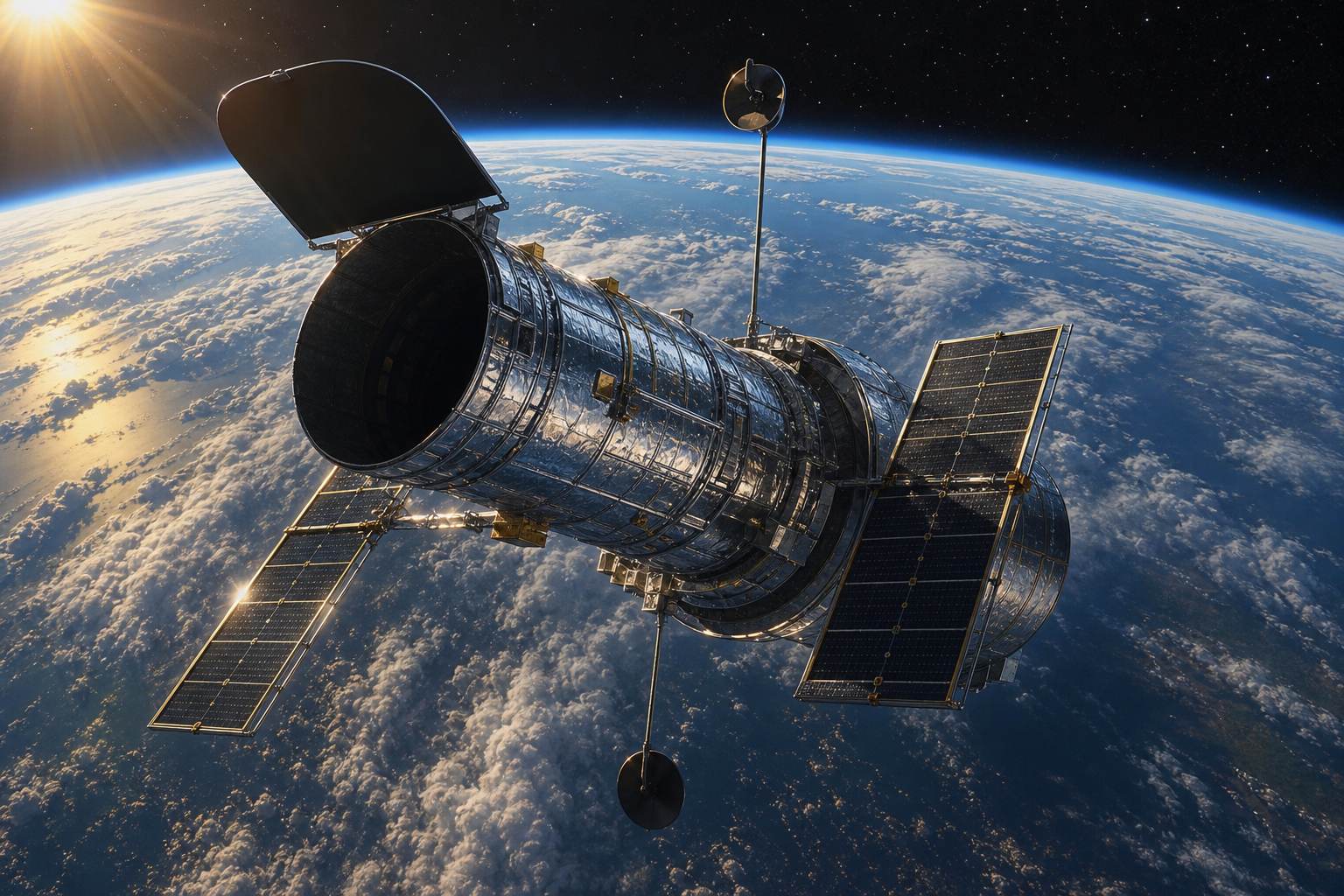
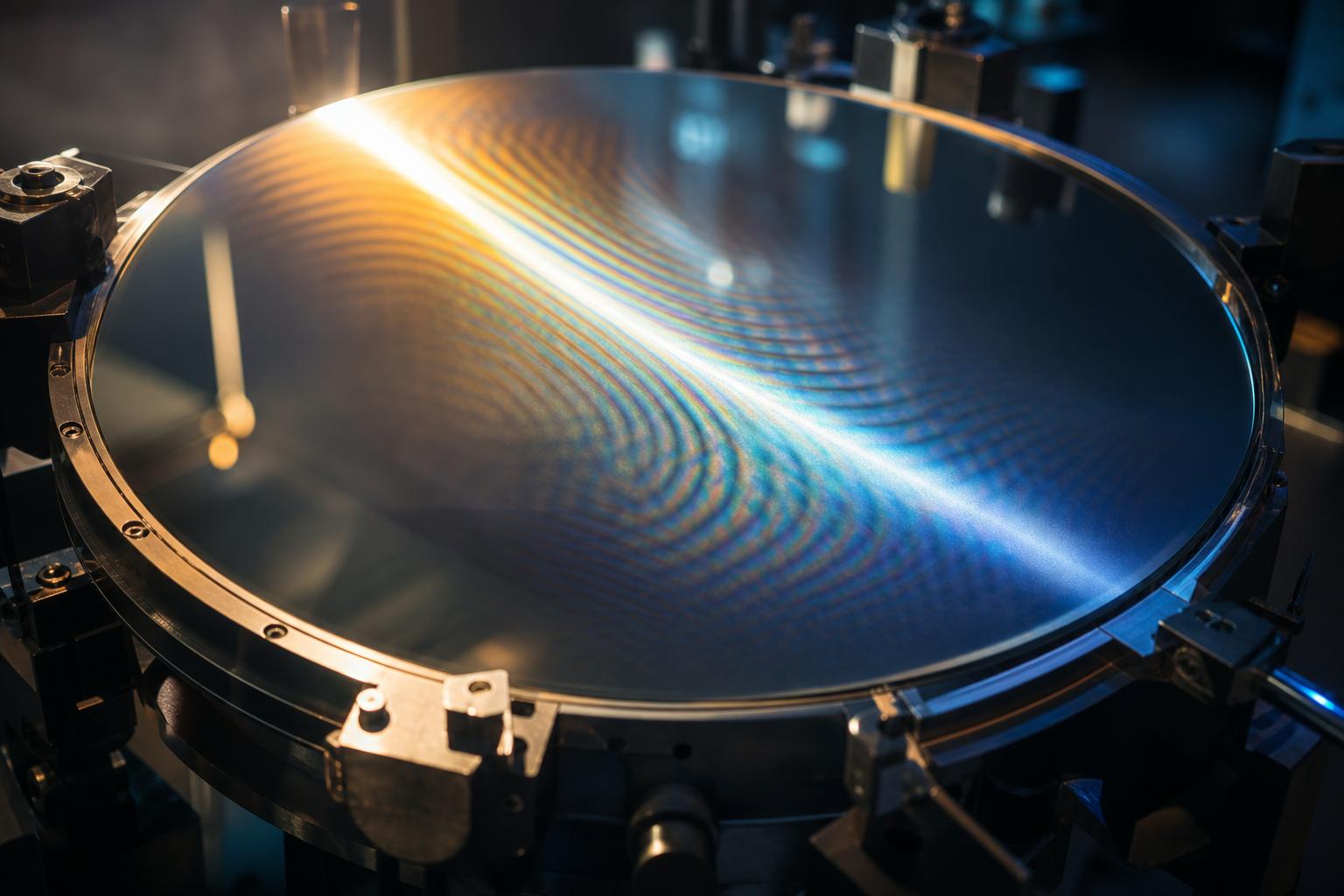
NASA's Nancy Grace Roman Space Telescope launched on 30 August 2026, and in October NASA said the optics of its main camera are nearly 30 percent better than predicted. This film explains how space telescopes work: a mirror as a bucket for light, how a reflecting telescope focuses it, what limits sharpness, how Hubble's mirror went wrong and was fixed, why the atmosphere blurs and blocks starlight, why infrared telescopes must be cold, why Webb and Roman sit a million miles away at L2, and how Roman's wide view will hunt planets by microlensing. Change the mirror, blur two stars, switch off the atmosphere and watch a star magnify another.
Interactive 3D film8 min1990 to 2026Published 19 October 2026
Recently, engineers nudged a small mirror inside a new space telescope by about one-sixteenth of the width of a human hair. NASA says its main camera's optics came out nearly thirty percent better than its own engineers had predicted.
The telescope is named after Nancy Grace Roman. A Falcon Heavy rocket launched it on the thirtieth of August 2026, toward a point about one and a half million kilometres from Earth.
What does a space telescope actually do, why does the shape of a mirror matter so much, and why send it so far away?
requirement
≈ 90 nm
measured
63 nm
Wavefront error, Wide Field Instrument Wavefront error measures how far the light’s path strays from perfect. The “30 percent” is against NASA’s own prediction, not against this requirement.
30 Aug 2026
Falcon Heavy, pad 39A, Kennedy
≈ $4.3 bn
to build, launch and run for 5 years
Roman’s launch
2.4 m
mirror, the same as Hubble’s
≥ 100 ×
Hubble’s field of view
Roman at a glance (NASA)
Prologue · The news
Roman in space
Roman launched on 30 August 2026 on a SpaceX Falcon Heavy from Launch Complex 39A at Kennedy Space Center, bound for L2, about a million miles from Earth (Spaceflight Now). On 14 October NASA reported the Wide Field Instrument’s optics at 63 nm RMS wavefront error against a requirement of about 90 nm, nearly 30% better than the team’s own prediction, after the secondary mirror was moved by about one-sixteenth of a hair’s width.
The 30% compares the result with NASA’s own prediction, not with the requirement. How to use: pick a chapter or press ← →; drag to rotate. Most steps have buttons.
The 3D scenes are schematic: sizes, distances and blur are not to scale.
Think of a telescope as a bucket standing in the rain, except the rain is light. A distant galaxy sends us only a thin drizzle of it. The wider the bucket, the more it catches.
What matters is the area of the main mirror, and area grows with the square of the width. Double the width, and you collect four times the light. That lets a big telescope see fainter objects, or see the same ones in less time.
Hubble and Roman have mirrors two point four metres across. Webb's is six and a half metres, made of segments, and NASA says it collects about six times as much light as Hubble.
Catching a drizzle Fainter objects need more collecting area, or longer exposures. AI-generated still.A=π(2D)2
A
collecting area
D
mirror diameter
Webb’s mirror is made of 18 segments, so its real area is a little less than a full circle.
Hubble, 2.4 m
≈ 4.5 m²
Roman, 2.4 m
≈ 4.5 m²
Webb, 6.5 m
≈ 33 m²
Mirror area (full circle, computed)
Chapter I · Catching light
Light-gathering power
Collecting area scales with the square of the mirror’s diameter. NASA: Hubble’s and Roman’s primary mirrors are 2.4 m across; Webb’s is 6.5 m, made of 18 hexagonal beryllium segments. Taken as full circles, (6.5 / 2.4)² ≈ 7.3; NASA’s Webb fact sheet, which allows for the segmented shape, gives about 6.25 times Hubble’s collecting area.
Areas computed from the diameters; the rain of photons in the scene is illustrative.
Large telescopes use curved mirrors rather than lenses. The big main mirror, the primary mirror, is a shallow dish that bounces all the incoming light toward one point.
Before it gets there, a smaller secondary mirror sends the light back through a hole in the primary, to the cameras and instruments behind it.
Watch the rays. It is the position of that small secondary mirror that Roman's engineers adjusted recently, by a tiny fraction of a hair's width.
Hubble’s layout Hubble uses this same two-mirror layout, with its instruments packed behind the primary. AI-generated still.
primary: large curved mirror
secondary: small mirror in front of it
instruments: cameras and spectrographs behind
A reflecting telescope
≈ 1/16
of a hair’s width: how far the secondary moved
63 nm
wavefront error afterwards
Roman’s adjustment (NASA)
Chapter I · Catching light
How a reflecting telescope works
A concave primary mirror reflects incoming light toward a focus; a smaller secondary mirror redirects it back through a central hole to instruments behind the primary. Roman’s commissioning team adjusted the secondary mirror by about one-sixteenth of the width of a human hair (NASA, Oct 2026). Hubble’s primary mirror is 2.4 m across and weighs 828 kg (NASA).
The ray diagram is a simplified two-mirror design; real telescopes add correcting optics.
Even a perfect mirror cannot make a star into a perfect point. Light is a wave, and waves spread out as they pass through an opening. This spreading is called diffraction, and because of it each star becomes a tiny blurred disc.
The smallest angle a telescope can separate is about one point two two times the wavelength, divided by the mirror's width. A wider mirror makes smaller discs, so close stars stay apart.
For Hubble, that is less than one fifty-thousandth of a degree. Watch two stars blur together as the mirror shrinks.
Light as a wave Diffraction affects every telescope, on the ground or in space; only a wider mirror shrinks it. AI-generated still.θ≈1.22Dλ
θ
smallest separable angle (radians)
λ
wavelength of the light
D
mirror diameter
The Rayleigh criterion: two discs are just separable when one’s centre sits on the other’s first dark ring.
2.8 × 10⁻⁷ rad
smallest separable angle
0.56 light years
two stars it could split in Andromeda
Hubble at 550 nm (textbook example)
Chapter II · Sharpness
The diffraction limit
College Physics: the minimum resolvable angle is θ = 1.22 λ/D. For Hubble’s 2.40 m mirror at 550 nm this is about 2.80 × 10⁻⁷ rad, less than 1/50,000 of a degree; at the Andromeda galaxy’s 2 million light years, two stars about 0.56 light years apart could just be resolved. Real performance is somewhat worse because of other imperfections.
That limit assumes the mirror has exactly the right shape. Hubble launched on the twenty-fourth of April 1990, and its first images came back blurry.
Its main mirror had been polished too flat near the edge, by an error ten times bigger than allowed. The instrument used to test it during manufacture had been set up wrongly.
In December 1993, astronauts fitted corrective optics that worked like glasses for its instruments. Since then, Hubble has sent back sharp pictures for more than thirty years. Press Before the fix to compare.
Testing a mirror The fault: a 1.3 mm spacing error inside the null corrector, the device used to check the mirror’s shape. AI-generated still.
10 ×
the allowed error
1.3 mm
spacing error in the test device
The flaw (NASA)
24 Apr 1990 launch
1990 blurred images reveal spherical aberration
Dec 1993 COSTAR and the WFPC2 camera installed
Hubble’s repair
Chapter II · Sharpness
Spherical aberration
NASA: Hubble launched on 24 April 1990. Its primary mirror was too flat near the outer edge, causing spherical aberration and blurry images; the error was ten times the specified tolerance. The cause was a misconfigured null corrector with a 1.3 mm lens-spacing error. In the December 1993 servicing mission astronauts installed WFPC2 and COSTAR, which acted like corrective glasses for Hubble’s other instruments.
The “before and after” blur in the scene is illustrative.
Why put a telescope in space at all? First, moving pockets of air bend starlight this way and that. That is why stars twinkle, and why images from the ground get blurred.
Second, the atmosphere absorbs much of the ultraviolet and infrared light coming from space, so some of it never reaches the ground at all. Telescopes on high mountains escape part of the air, but not all of it.
Hubble orbits about four hundred and eighty kilometres up, above almost all of the air. Watch the same star with the atmosphere, and without it.
Twinkle, twinkle NASA: above the atmosphere, Hubble sees “steady, unwavering light from cosmic objects”. AI-generated still.
bends light: twinkling and blur
absorbs some ultraviolet
absorbs some infrared
What the air does
≈ 483 km
about 300 miles up
1990
in orbit since
Hubble’s orbit (NASA)
Chapter III · Above the air
Why a telescope in space
NASA: moving pockets of air bend light, making stars twinkle and ground-based images blurry; the atmosphere also absorbs some ultraviolet and infrared light, which Hubble can observe. Hubble orbits at about 300 miles (483 km) and has been there since 1990.
Infrared light is the kind that warm things give off. It passes through dust that hides newborn stars, and light from the most distant galaxies reaches us as infrared, because the expanding universe has stretched its waves.
Webb, launched on Christmas Day 2021, is built to see it. Its mirror segments are coated with a thin layer of gold, which reflects infrared well.
Because a warm telescope would glow in infrared itself, Webb hides behind a sunshield the size of a tennis court and works at about minus two hundred and thirty degrees Celsius.
Through the dust Infrared images show stars forming inside clouds that block visible light. AI-generated still.
18
hexagonal beryllium segments
≈ 100 nm
gold coating
Webb’s mirror (NASA)
5
sunshield layers
−233 °C
operating temperature
Keeping cold
Chapter III · Above the air
Webb
NASA: Webb’s 6.5 m primary mirror has 18 hexagonal beryllium segments coated with about 100 nm of gold to improve infrared reflection; the mirrors operate at about −220 °C. Webb launched on 25 December 2021 on an Ariane 5 and entered orbit around L2 on 24 January 2022, behind a tennis-court-sized, five-layer sunshield; operating temperature −233 °C (Mont-Mégantic Observatory).
NASA quotes about −220 °C for the mirrors and the observatory page −233 °C for operations; both mean very cold. The reason a warm telescope must be cooled, that it would itself glow in infrared, is standard physics of thermal radiation.
Webb, and now Roman, work far beyond the Moon, at a place called the second Lagrange point, or L2: about one and a half million kilometres from Earth, on the side away from the Sun.
There, a spacecraft can circle the Sun in step with the Earth, with the Sun, Earth and Moon all roughly in one direction behind its shield.
Watch the line-up turn through the year. Webb has been there since January 2022, and Roman is on its way to join it.
≈ 1.5 million km
from Earth
≈ 4 ×
the Moon’s distance
L2
keeps pace with Earth around the Sun
Sun, Earth and Moon stay on one side
one shield can block all three
Why L2 suits a telescope
25 Dec 2021 Webb launches
24 Jan 2022 Webb in orbit around L2
30 Aug 2026 Roman launches toward L2
Telescopes at L2
Chapter III · Above the air
The second Lagrange point
L2 lies about 1.5 million km from Earth on the side opposite the Sun (Mont-Mégantic Observatory; Spaceflight Now gives about a million miles for Roman). Webb entered orbit around it on 24 January 2022. A spacecraft near L2 keeps pace with Earth around the Sun, so the Sun, Earth and Moon stay on roughly one side.
“About 4 times the Moon’s distance” uses the Moon’s average distance of about 384,000 km. Distances in the scene are not to scale.
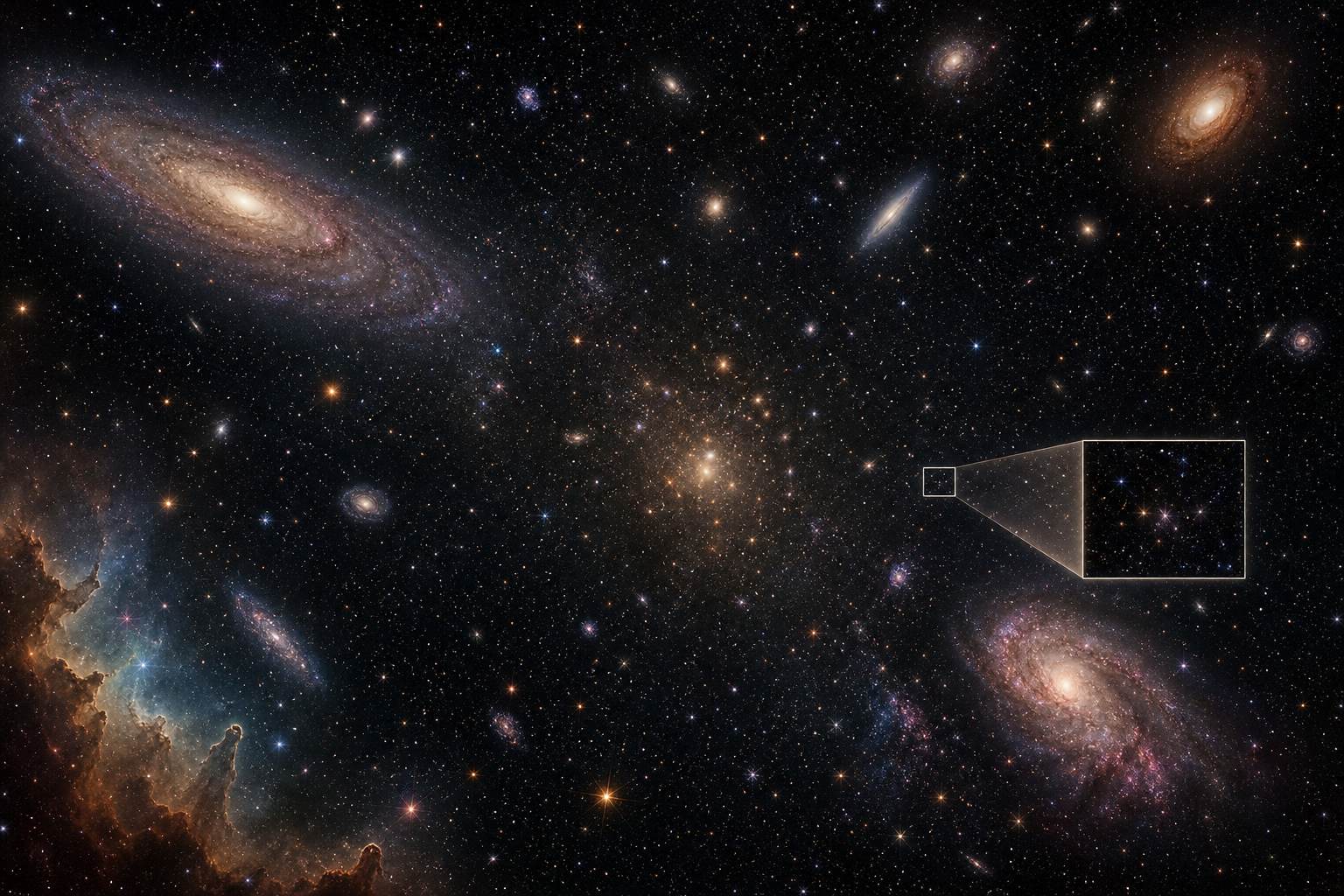
Roman's mirror is the same size as Hubble's, and its images are as sharp. What is different is how much sky each picture covers: at least a hundred times more than Hubble's camera.
That lets it map large areas of the sky about a thousand times faster. In one month it is expected to collect about as much data as Hubble gathers in a century.
Its main mirror was donated to NASA from a cancelled government satellite programme, then reshaped for astronomy. Toggle the two fields of view to compare.
One Roman picture NASA: a single Roman image holds about the detail of 100 Hubble pictures. AI-generated still.
Hubble, 30 years
≈ 172 TB
Roman, 5 years (expected)
≈ 2,500 TB
Data downlinked (Spaceflight Now)
2.4 m
donated by the National Reconnaissance Office
5 years
primary mission
Roman’s mirror
Chapter IV · Roman
A wide field
NASA: Roman’s 2.4 m mirror is the same size as Hubble’s and its images have Hubble’s resolution, while its Wide Field Instrument has a field of view at least 100 times larger. Spaceflight Now: it surveys broad areas about 1,000 times faster than Hubble, collects in a month about as much data as Hubble in a century, and should downlink about 2,500 TB in its five-year primary mission versus about 172 TB from Hubble in 30 years. The mirror was donated by the National Reconnaissance Office after a classified programme was cancelled, and refinished for astronomy.
The two frames in the scene compare areas only roughly.
One of Roman's big jobs is to stare at crowded star fields toward the centre of our galaxy, waiting for a rare alignment.
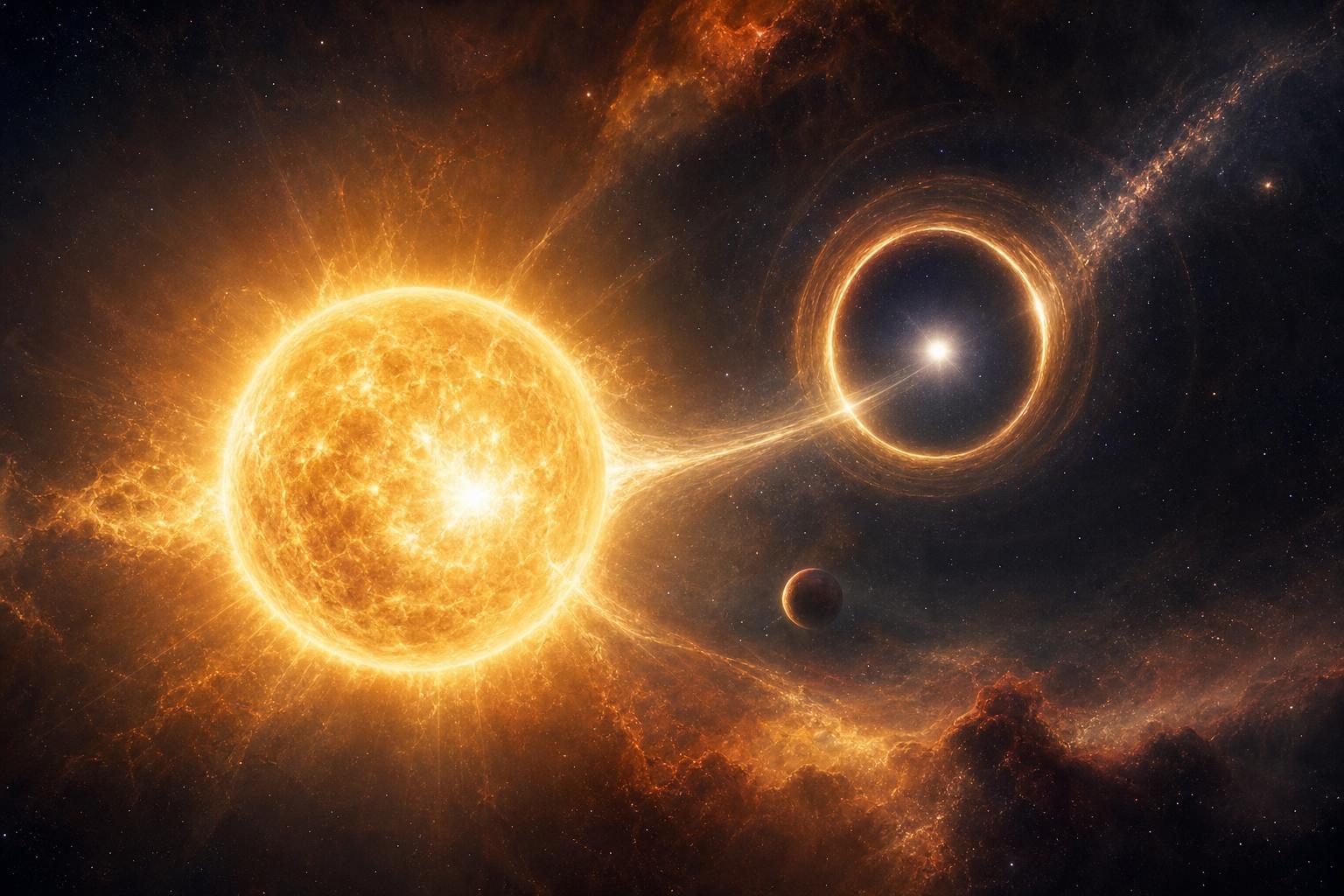
When a nearer star passes almost exactly in front of a more distant one, its gravity bends and magnifies the distant star's light, like a magnifying glass. Einstein predicted this in 1936. It is called microlensing.
If the nearer star has a planet, the planet adds a brief, sharp spike to the brightening. Watch the light curve. NASA expects Roman to find more than a thousand planets this way.
A gravitational lens Events last from days to a few months, because the stars and Earth are all moving. AI-generated still.
source: the distant background star
lens: the nearer star passing in front
planet: a brief extra spike in brightness
Who is who
7
fields, about 2 square degrees
6
seasons of about 62 days
Galactic Bulge Time Domain Survey (IPAC)
1,000+
exoplanets
Expected from microlensing (NASA)
Chapter IV · Roman
Microlensing
Caltech/IPAC: following Einstein’s 1936 prediction, when a foreground star passes very close to a background star on the sky, its gravity bends and magnifies the background star’s light; a planet around the lens star can add a brief, sharp spike. Events last from days to a few months. The survey covers seven fields (about 2 square degrees) over six seasons of about 62 days. NASA: the survey of the inner Milky Way should find more than 1,000 exoplanets.
Spaceflight Now reports a larger projection (more than 100,000 exoplanets overall); this film uses NASA’s more conservative figure for microlensing. The light curve in the scene is schematic.
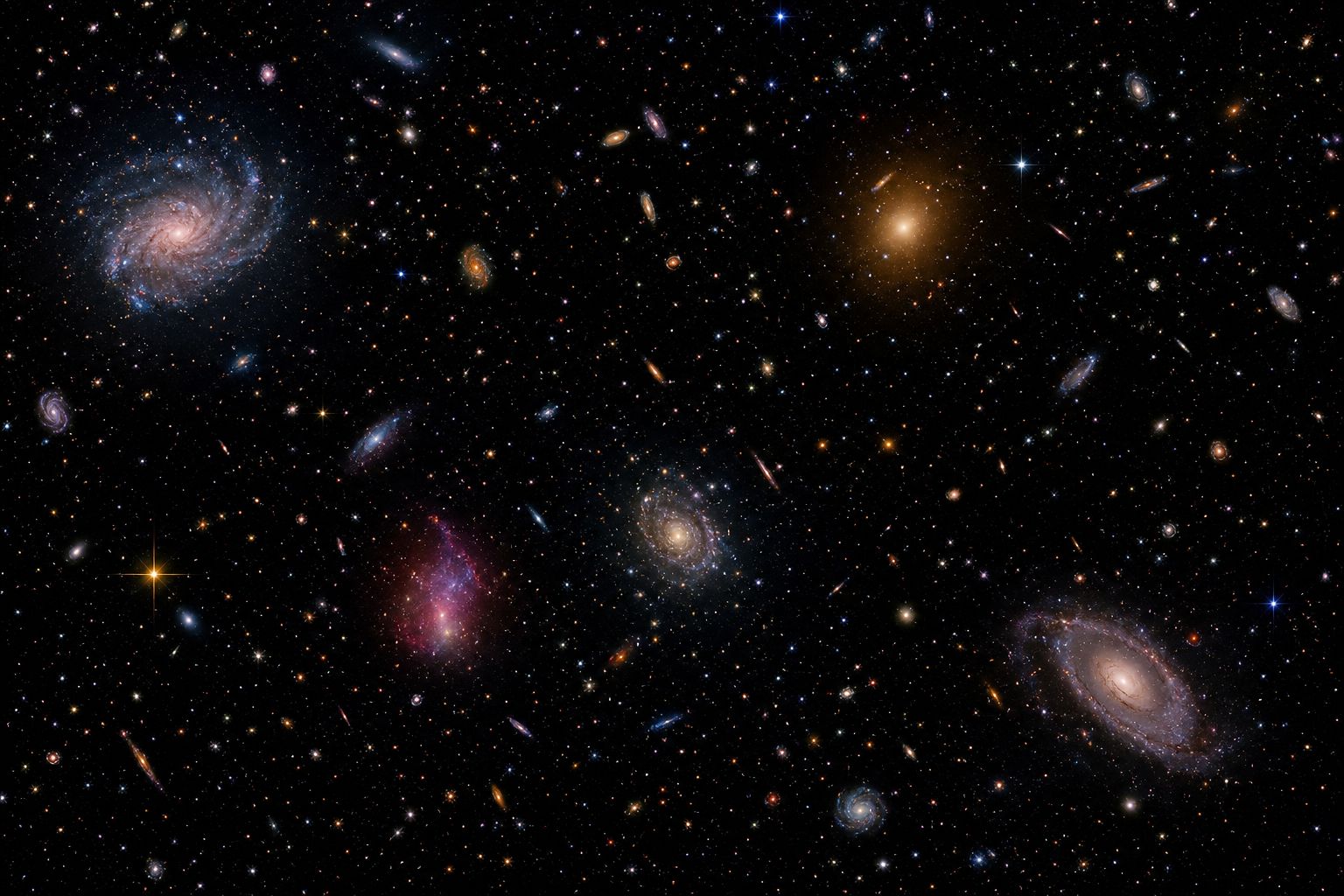
Roman's other big job is cosmology, the study of the universe as a whole. NASA plans for it to measure light from about a billion galaxies.
By mapping how galaxies are spread through space and time, astronomers hope to learn more about dark matter and dark energy, the unseen ingredients that shape the universe and its expansion.
It may also help with a puzzle called the Hubble tension, named after the astronomer Edwin Hubble, not the telescope: different ways of measuring how fast the universe is expanding today give answers that do not agree.
≈ 1 billion
galaxies measured (NASA)
5 + 5 years
primary mission, possible extension
Roman’s survey plans
dark matter: mass we detect only by its gravity
dark energy: whatever is speeding up the expansion
Unseen ingredientsA sky full of galaxies NASA lists dark energy, exoplanets and infrared astrophysics as Roman’s three big themes. AI-generated still.
Chapter IV · Roman
Cosmology with Roman
NASA: Roman aims to settle questions about dark energy, exoplanets and infrared astrophysics, measuring light from about a billion galaxies, over a 5-year primary mission with a potential 5-year extension. Spaceflight Now: it will study the effects of dark matter and dark energy on cosmic structure and expansion, and help address the “Hubble tension”, a mismatch between measured expansion rates.
PlanetPast’s film “The Big Bang and Dark Energy” explains dark energy in depth.
So a space telescope is a careful bucket for light: a mirror wide enough to collect it, shaped to within a fraction of a wavelength, and lifted above the blurring air.
Hubble showed what a sharp eye above the atmosphere can do. Webb went bigger and colder to see infrared. Roman goes wider, to survey huge areas of sky.
Next, within weeks, NASA plans to test Roman's coronagraph, a device that blocks a star's glare so that planets beside it can be seen. Then the surveys begin.
1990 Hubble launches
1993 Hubble’s vision corrected
2021 Webb launches to L2
2026 Roman launches; optics beat target
Milestones
area collects light: it grows with diameter squared
width sets sharpness: θ ≈ 1.22 λ/D
space removes blur and opens up infrared
Three ideas
3–4 months
of commissioning before surveys (Spaceflight Now)
weeks
until the coronagraph test (NASA, Oct 2026)
Coming next
Epilogue
Sources
Every figure in this film comes from the sources below. Roman’s results are early commissioning measurements reported by NASA.
Stills are AI-generated illustrations, not photographs.
The 3D scenes are schematic: sizes, distances and blur are not to scale.