United Launch Alliance plans to fly its Vulcan rocket again on 13 November 2026, nine months after a solid-booster nozzle failed in flight. This film explains how any rocket works: why throwing exhaust backwards pushes it forwards even in empty space, how a nozzle turns hot gas into speed, how Tsiolkovsky's rocket equation sets the price of every kilometre per second, why rockets are mostly propellant and are built in stages, how liquid engines and solid boosters differ, what happens when a booster nozzle fails, and how it all adds up to orbit, from Goddard's 1926 flight and Thailand's Bun Bang Fai festival to Sputnik and today's satellites.
Interactive 3D film9 min1903 to 2026Published 30 October 2026
On the twelfth of February 2026, less than thirty seconds after liftoff, a nozzle failed on one of the four solid boosters strapped to a Vulcan rocket.
The rocket still reached orbit, but it was grounded for nine months. Its maker, United Launch Alliance, now plans to fly it again on the thirteenth of November.
Why does one small part matter so much? To answer that, start with a simpler question: what does a rocket push against?
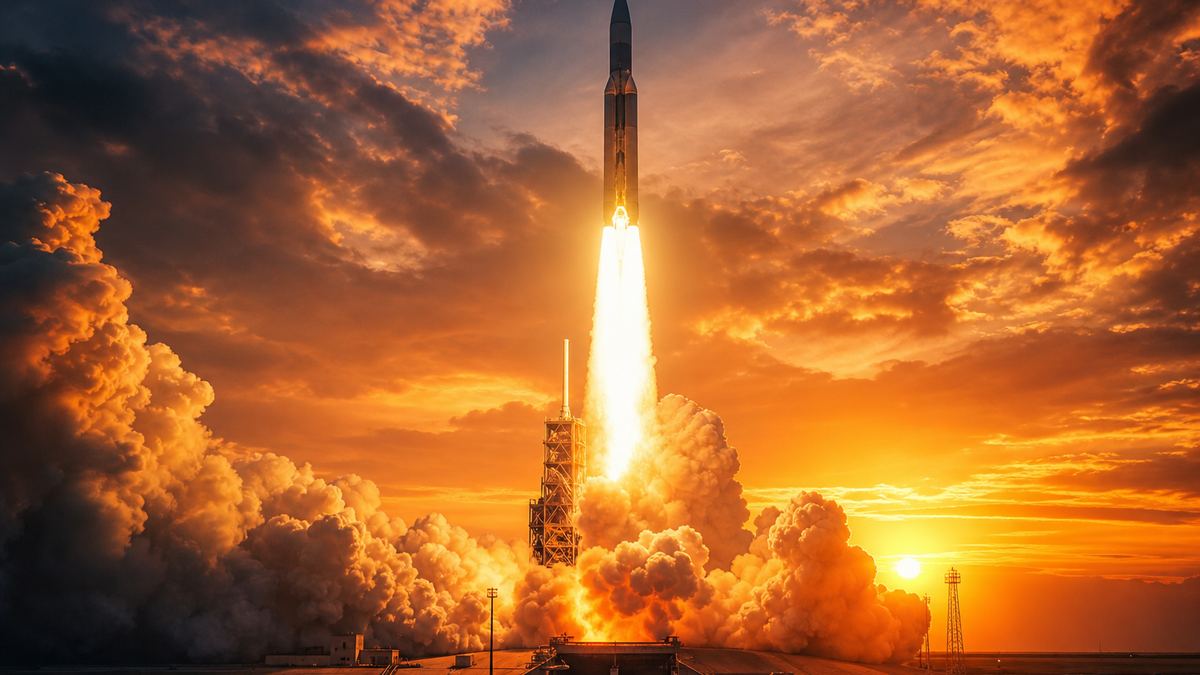
Liftoff on boosters A rocket climbing on several solid boosters. AI-generated still.
12 Feb 2026 Booster nozzle fails on flight 4 (USSF-87)
Feb–Oct Investigation; four military missions moved to other rockets
13 Nov 2026 Planned return to flight
Vulcan’s pause
Why exhaust pushes a rocket forward
The rocket equation and staging
Liquid engines and solid boosters
What a nozzle failure does
In this film
Prologue
A rocket grounded
Spaceflight Now (28 October 2026): United Launch Alliance says Vulcan will return to flight on Friday 13 November 2026 after a nine-month grounding, carrying 40 Amazon Leo internet satellites on its fifth flight, the first with six solid boosters; on the fourth flight (USSF-87, 12 February 2026) a nozzle failed on one of four boosters less than 30 seconds after liftoff, yet the rocket reached its intended orbits. Air & Space Forces Magazine: ULA called it a “significant performance anomaly”, the November flight will use a redesigned nozzle, and the Space Force moved four missions from Vulcan to SpaceX.
The 3D rockets are generic teaching models, not copies of any real vehicle; sizes, flames and exhaust particles are drawn for clarity, not to scale.
A rocket does not push against the ground or the air. It pushes against its own exhaust. Let go of an untied balloon and it flies off for the same reason: air rushes out one way, and the balloon goes the other.
Inside the engine, fuel burns with an oxidizer, a substance that supplies the oxygen, to make hot gas, and the engine throws that gas out of the back at enormous speed. By Newton's third law, the gas pushes back on the engine just as hard. That push is thrust.
Because a rocket carries its own oxidizer, it needs no air at all. That is why it works in the vacuum of space, where a jet engine or a propeller could not.
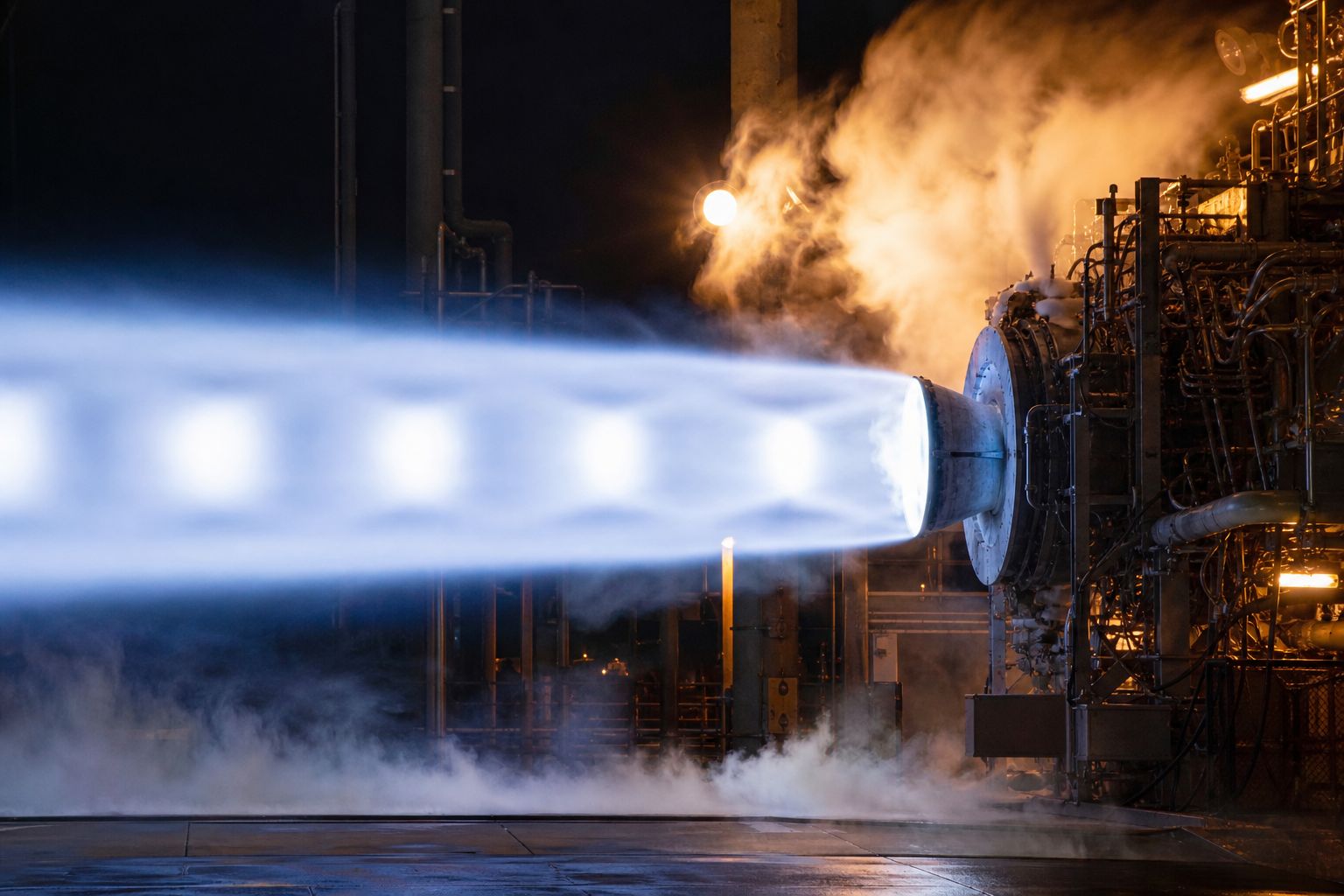
Thrust A rocket engine firing on a test stand. AI-generated still.
“Thrust is produced according to Newton’s third law of motion.”NASA, “Rocket thrust”
NASA Glenn Research CenterFrocket on gas=−Fgas on rocket
F
force; equal in size, opposite in direction
Newton’s third law
A jet breathes oxygen from the air
A rocket carries fuel and oxidizer
So a rocket works in a vacuum
Rocket vs jet engine
Chapter I · Push and push back
Action and reaction
NASA Glenn Research Center: thrust is produced according to Newton’s third law; the engine accelerates hot exhaust out of the nozzle, and the reaction pushes the rocket forward. The rocket thrust equation has no term for incoming air, because a rocket carries its own oxidizer, which is why it works in a vacuum, unlike a gas turbine or a propeller.
Try it: fire the engine and watch the exhaust go one way and the rocket the other.
The 3D rockets are generic teaching models, not copies of any real vehicle; sizes, flames and exhaust particles are drawn for clarity, not to scale.
How much thrust you get depends on two things: how much gas leaves each second, and how fast it goes.
That is the job of the bell-shaped nozzle. The gas squeezes through a narrow throat, where it reaches the speed of sound. Then, unlike water in a hose, gas moving faster than sound speeds up as the passage widens, to several kilometres a second. Without a working nozzle, the thrust drops. Remember that for chapter four.
Engineers rate engines by specific impulse: the total push each kilogram of propellant can give, counted against its weight, which comes out in seconds. The higher the number, the faster the exhaust and the less fuel the rocket needs.
F=m˙Ve+(pe−p0)Ae
m˙
mass of exhaust per second
Ve
exhaust speed at the nozzle exit
(pe−p0)Ae
pressure term; zero when exit and outside pressure match
The rocket thrust equation (NASA)
Combustion chamber: hot, high-pressure gas
Throat: the narrowest point, at the speed of sound
Bell: supersonic gas expands and speeds up
Through the nozzle
Mach 1
at the throat, where the flow chokes
Mach > 1
in the bell, faster as it widens
Gas speed in the nozzle (NASA)Isp=g0Veq
Veq
effective exhaust speed
g0
9.8 m/s², so the unit is seconds
Specific impulse (NASA)
Chapter I · Push and push back
Thrust and specific impulse
NASA Glenn: thrust F = ṁ·Ve + (pe − p0)·Ae, where ṁ is the mass flow rate, set at the choked throat, Ve is the exit velocity, set by the area ratio from throat to exit, and the pressure term vanishes when the exit pressure equals the surrounding pressure. Specific impulse is the thrust per unit weight flow of propellant; dividing the effective exhaust velocity by g₀ gives it in seconds.
NASA Glenn, nozzle design: the flow chokes at the throat, which makes it sonic; downstream, in supersonic flow an increase in area produces an increase in velocity, while subsonic flow would slow down.
Try it: raise the flow or the exhaust speed and see the thrust change. The numbers are illustrative.
The 3D rockets are generic teaching models, not copies of any real vehicle; sizes, flames and exhaust particles are drawn for clarity, not to scale.
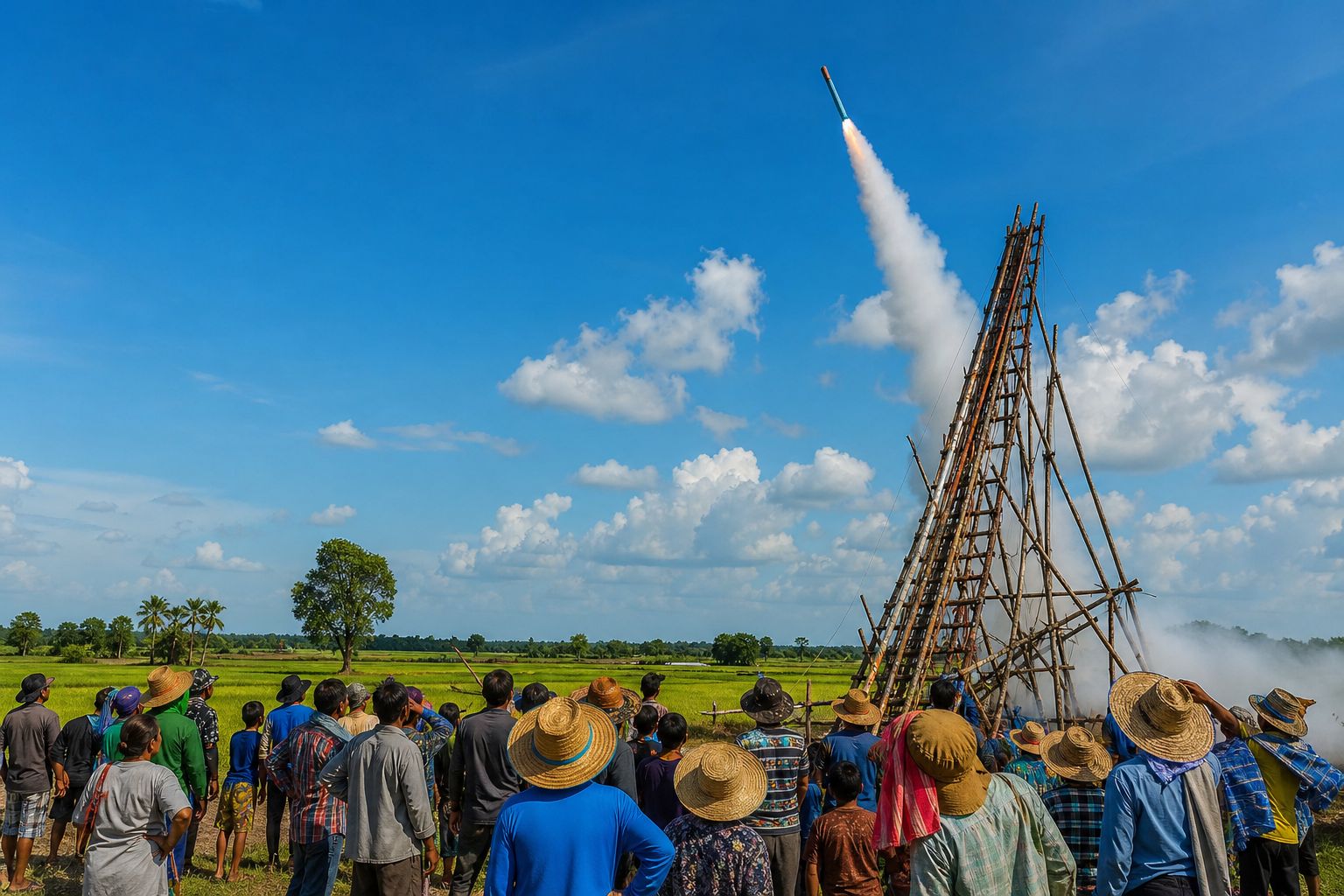
The idea is old. Every May in Yasothon, in northeast Thailand, villagers launch homemade rockets of plastic pipe packed with gunpowder, to ask the rain god for rain at the start of the rice season.
Those are solid rockets: the fuel and oxidizer are mixed in one solid charge that burns until it is gone. Liquid rockets keep the fuel and the oxidizer in separate tanks and pump them into the engine.
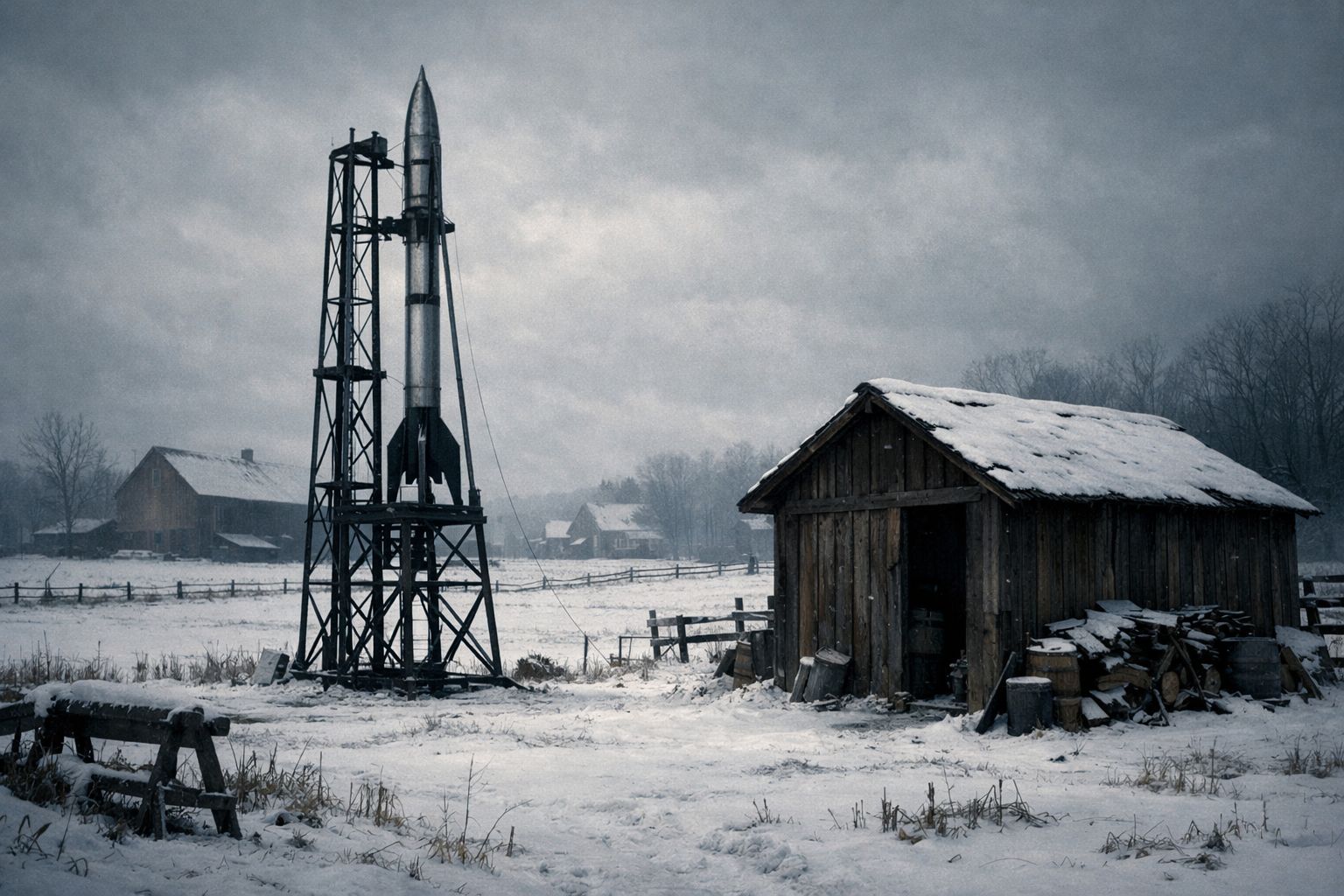
On the sixteenth of March 1926, on a snowy farm in Auburn, Massachusetts, Robert Goddard flew the first rocket burning liquids: gasoline and liquid oxygen. It flew for about two and a half seconds, rose forty-one feet and landed a hundred and eighty-four feet away, in a cabbage field.
Bun Bang Fai, Yasothon Homemade rockets on a bamboo ramp. AI-generated still.
Solid: fuel and oxidizer premixed in one block
Liquid: kept in separate tanks, pumped into the engine
Goddard, 1926: gasoline + liquid oxygen
Solid vs liquidAuburn, Massachusetts A snowy farm field with an early rocket frame. AI-generated still.
~2.5 s
in the air
41 ft
about 12.5 m up
184 ft
about 56 m away
Goddard’s first flight, 16 Mar 1926 (NASA)
Chapter II · Fire and fuel
Solid and liquid
Bangkok Post: in Yasothon province, every May, locals light home-made rockets to honour Phaya Thaen, the rain god, and ask for rain as the rice-farming season begins. Vice: the rockets are PVC pipes packed with gunpowder. NASA History: Robert Goddard’s first liquid-fuelled rocket flew on 16 March 1926 on a farm in Auburn, Massachusetts, burning gasoline and liquid oxygen; it flew for about 2.5 seconds, rose 41 feet and landed 184 feet away in a cabbage field.
NASA (2026): snow covered the ground on the morning of the flight.
The 3D rockets are generic teaching models, not copies of any real vehicle; sizes, flames and exhaust particles are drawn for clarity, not to scale.
Twenty-three years before Goddard flew, in 1903, a Russian schoolteacher, Konstantin Tsiolkovsky, published a study of how rockets could reach space. It showed that a rocket's speed depends on how fast its exhaust leaves. It also proposed liquid propellants, two decades before anyone flew one.
Today we write it as the rocket equation. The change in speed equals the exhaust speed times the natural logarithm of the mass ratio: the full rocket's mass divided by its mass once the fuel is gone.
The logarithm is the catch. Doubling the fuel does not double your speed. Try raising the mass ratio and watch how slowly the speed grows.
Kaluga, Russia A teacher’s study in the early 1900s. AI-generated still.
1898 Submitted to a journal
1903 Published: rockets for orbital spaceships, liquid propellants
Tsiolkovsky’s article (Centennial of Flight)Δv=Veln(memptymfull)
Δv
change in speed
Ve
exhaust speed
mfull/mempty
the mass ratio
The ideal rocket equation (NASA)
mass ratio 2
2.4
ratio 4
4.8
ratio 10
7.9
ratio 20
10.3
Speed gained with exhaust at ≈3.43 km/s (Isp ≈ 350 s) Worked out from the equation, ignoring gravity and drag.
Chapter III · The rocket equation
Tsiolkovsky and the rocket equation
US Centennial of Flight Commission: Tsiolkovsky (1857–1935), a schoolteacher in Kaluga province, submitted “Investigating Space With Rocket Devices” in 1898; it was published in 1903, described rockets launching orbital spaceships, showed that a rocket’s speed and range are limited by the exhaust velocity, and proposed liquid propellants. NASA Glenn, “Ideal rocket equation”: Δu = Veq·ln(MR), with MR the full mass over the empty mass and Veq = Isp·g₀; it neglects lift and drag, and gravity subtracts g₀ times the burn time.
Try it: the readout uses an exhaust speed of 3.4 km/s, close to NASA’s example of a hydrogen–oxygen engine with Isp ≈ 350 s.
The 3D rockets are generic teaching models, not copies of any real vehicle; sizes, flames and exhaust particles are drawn for clarity, not to scale.
To stay in a low orbit, about three hundred kilometres up, a satellite must travel at about seven point eight kilometres a second, roughly twenty-eight thousand kilometres an hour.
NASA works an example. With a good hydrogen and oxygen engine, the rocket's full mass must be about ten times its empty mass. So about ninety percent of what stands on the pad is propellant, and the payload is about one percent.
A rocket is mostly a flying fuel tank, with a small cargo on top. Every extra kilogram of cargo needs many more kilograms of fuel, and that fuel needs fuel of its own to lift it.
7.8 km/s
circular orbit at 300 km; one lap in about 90 min
11.2 km/s
escape velocity: leaving Earth for good
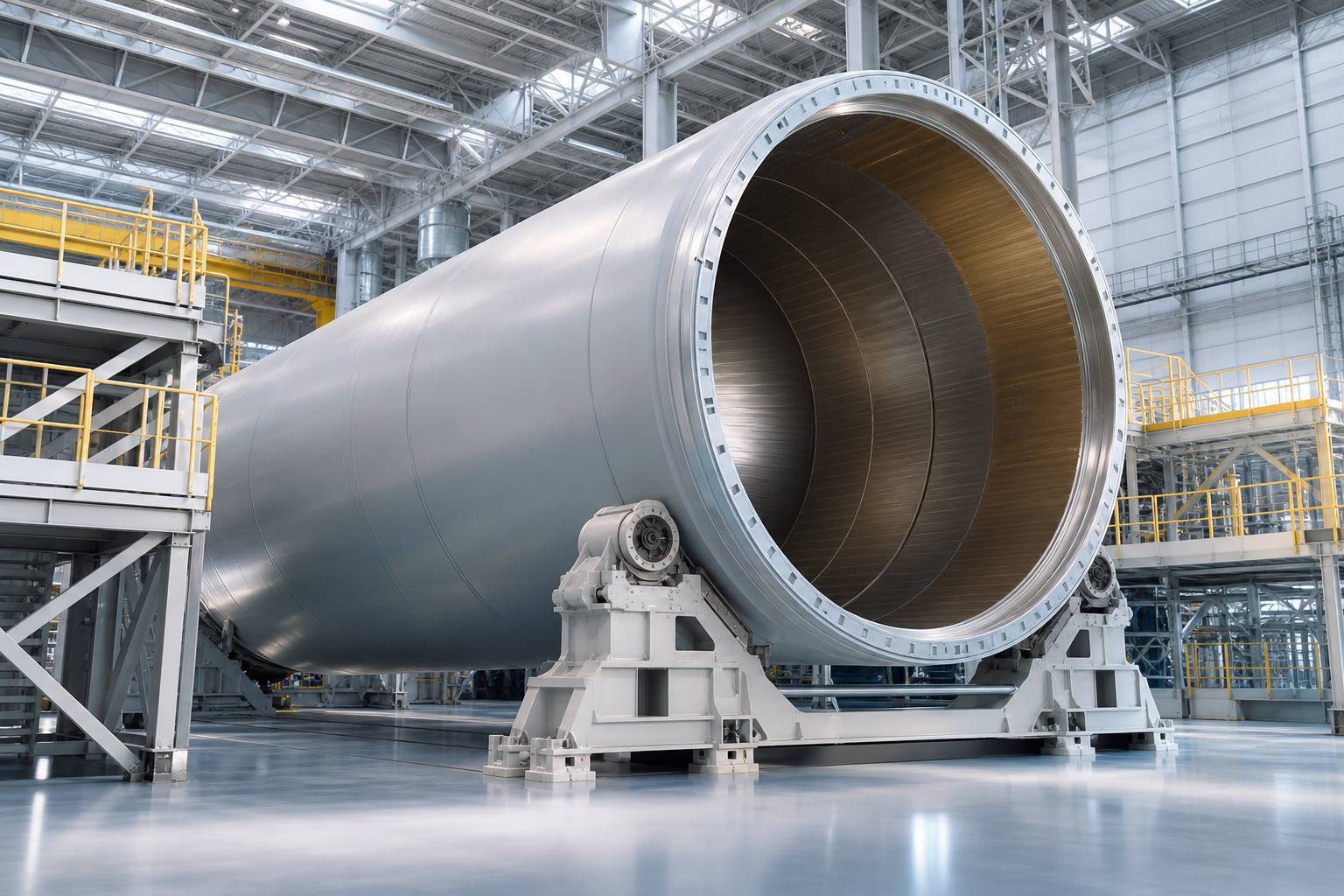
Speeds (ESA)Mostly tank A propellant tank section in a rocket factory. AI-generated still.
Propellant
~90%
Structure and engines
~9%
Payload
~1%
A rocket on the pad, NASA’s example
~350 s
specific impulse, hydrogen–oxygen engine
~10
mass ratio needed for a 200-mile orbit
NASA’s worked example
More cargo needs more fuel
More fuel is more weight to lift
So the fuel needs fuel of its own
The snowball
Chapter III · The rocket equation
The tyranny of the equation
ESA: a satellite in a circular orbit 300 km above Earth needs about 7.8 km/s (28,000 km/h) and goes round in about 90 minutes; escape velocity is 11.2 km/s. NASA Glenn: for a liquid hydrogen–liquid oxygen engine with an Isp of about 350 s, reaching a 200-mile orbit (Δu ≈ 25,000 ft/s) needs a mass ratio of about 10, so about 90% of the launch weight is propellant and the payload only about 1%.
“Structure and engines” is what remains of NASA’s example once propellant and payload are taken out.
The 3D rockets are generic teaching models, not copies of any real vehicle; sizes, flames and exhaust particles are drawn for clarity, not to scale.
There is a way to cheat the equation a little: throw away weight you no longer need. Tsiolkovsky studied multistage rockets too.
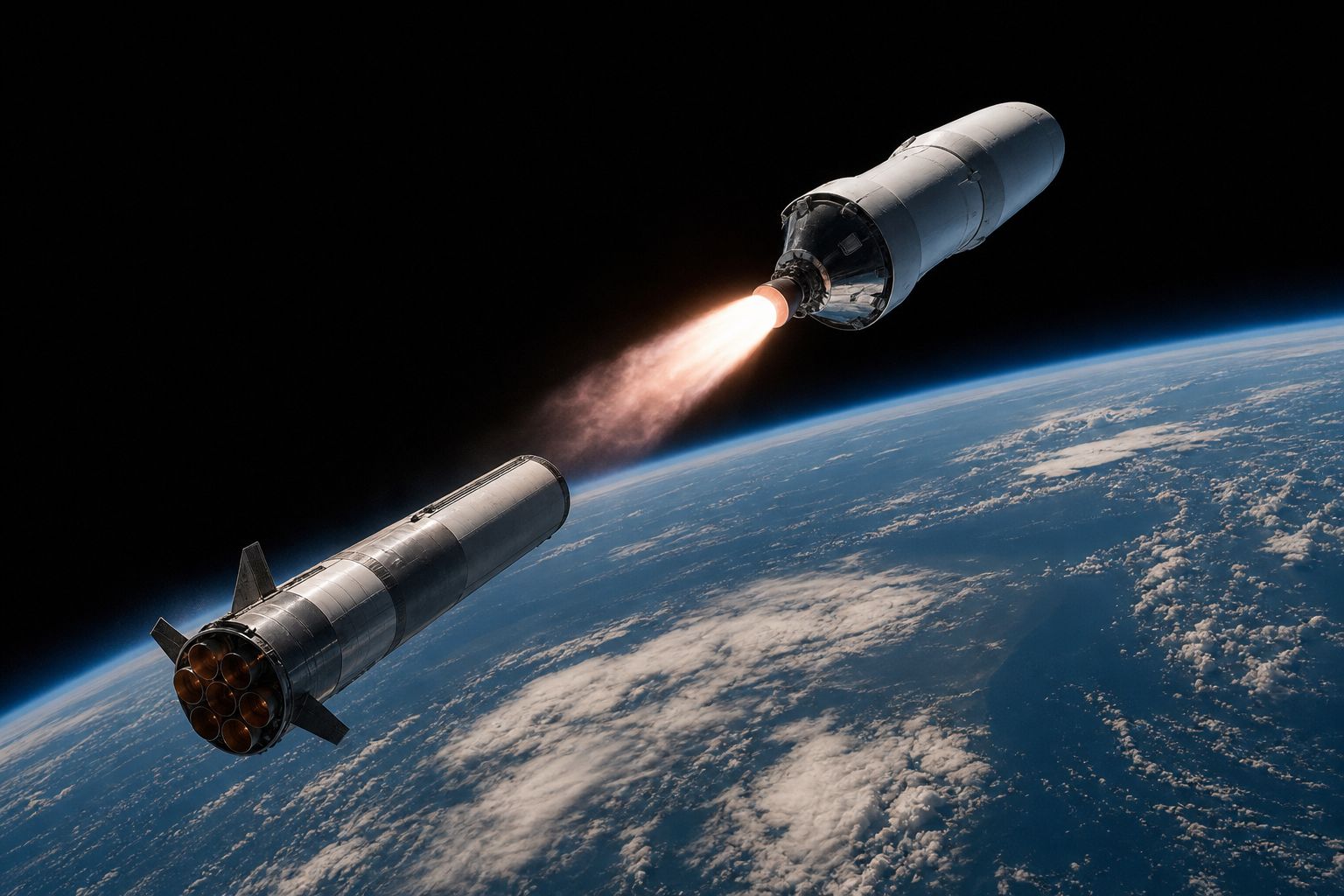
When the first stage empties its tanks, it drops away with its heavy engines. The smaller second stage then lights, and it no longer has to carry all that dead weight.
Compare the two: the same total mass, the same engines, the same payload. Built in two stages, the rocket gains about thirty percent more speed.
Stage separation A first stage falling away above Earth. AI-generated still.
Empty tanks are dead weight
Dropping them raises the mass ratio of what is left
Each stage can use an engine suited to its job
Why stages help
One stage
7.9
Two stages
10.3
Same rocket, built two ways (illustration) 100 t at launch, 2 t payload, exhaust 3.4 km/s; invented masses.
Chapter III · The rocket equation
Staging
US Centennial of Flight Commission: Tsiolkovsky expanded his studies of multistage boosters in the 1920s and 1930s. The comparison on screen applies NASA’s ideal rocket equation to an invented rocket of 100 tonnes with a 2-tonne payload and an exhaust speed of 3.4 km/s: as one stage carrying 90 t of propellant and 8 t of structure it gains about 7.9 km/s; split into a 70-tonne-propellant first stage with 6 t of structure and a 20-tonne-propellant second stage with 2 t of structure, it gains about 4.1 + 6.1 ≈ 10.3 km/s.
Try it: switch between one stage and two.
The 3D rockets are generic teaching models, not copies of any real vehicle; sizes, flames and exhaust particles are drawn for clarity, not to scale.
Vulcan, which first flew in January 2024, mixes both kinds of rocket. Its first stage, called the core stage, burns liquid methane with liquid oxygen in two big engines. Its upper stage burns liquid hydrogen and oxygen.
For heavier loads, solid boosters are strapped to its sides: none, two, four or six. They add a huge push in the first minutes, then fall away. Which version flies depends on how heavy the cargo is and how high it must go.
With six boosters, Vulcan can lift about twenty-seven tonnes to low Earth orbit. Try adding boosters and watch the thrust at liftoff grow.
First stage: 2 BE-4 engines, methane + liquid oxygen
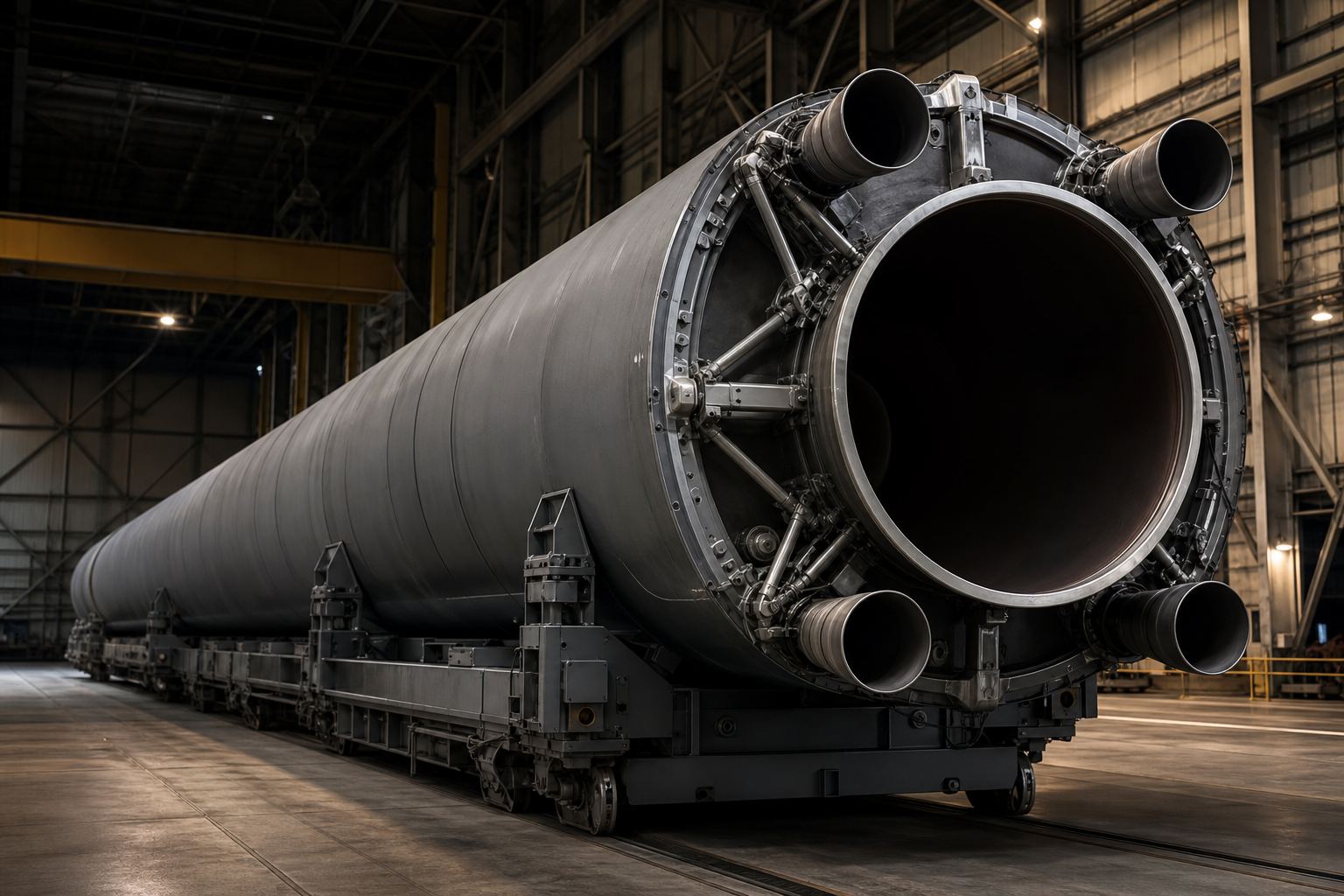
Vulcan Centaur (Wikipedia)Big hardware A rocket stage on its transport cradle. AI-generated still.
0 · 2 · 4 · 6
GEM 63XL solid boosters
27,200 kg
to low Earth orbit, with six
Lifting power (Wikipedia)
Chapter IV · Engines and boosters
Liquid and solid together
Wikipedia (Vulcan Centaur): first launch 8 January 2024 from Cape Canaveral, carrying the Peregrine lunar lander (the lander failed after separation; the rocket performed as expected); first stage with two BE-4 engines burning liquid methane and liquid oxygen; Centaur V upper stage with two RL10 engines burning liquid hydrogen and liquid oxygen; zero, two, four or six Northrop Grumman GEM 63XL solid boosters; 61.6 m tall in the standard configuration; up to 27,200 kg to low Earth orbit with six boosters.
Try it: the thrust bar is relative and illustrative; the 3D rocket is a generic model, not Vulcan’s real shape.
The 3D rockets are generic teaching models, not copies of any real vehicle; sizes, flames and exhaust particles are drawn for clarity, not to scale.
Now picture four boosters pushing together. On Vulcan's second flight, in October 2024, and again on its fourth, in February 2026, the nozzle on one booster failed.
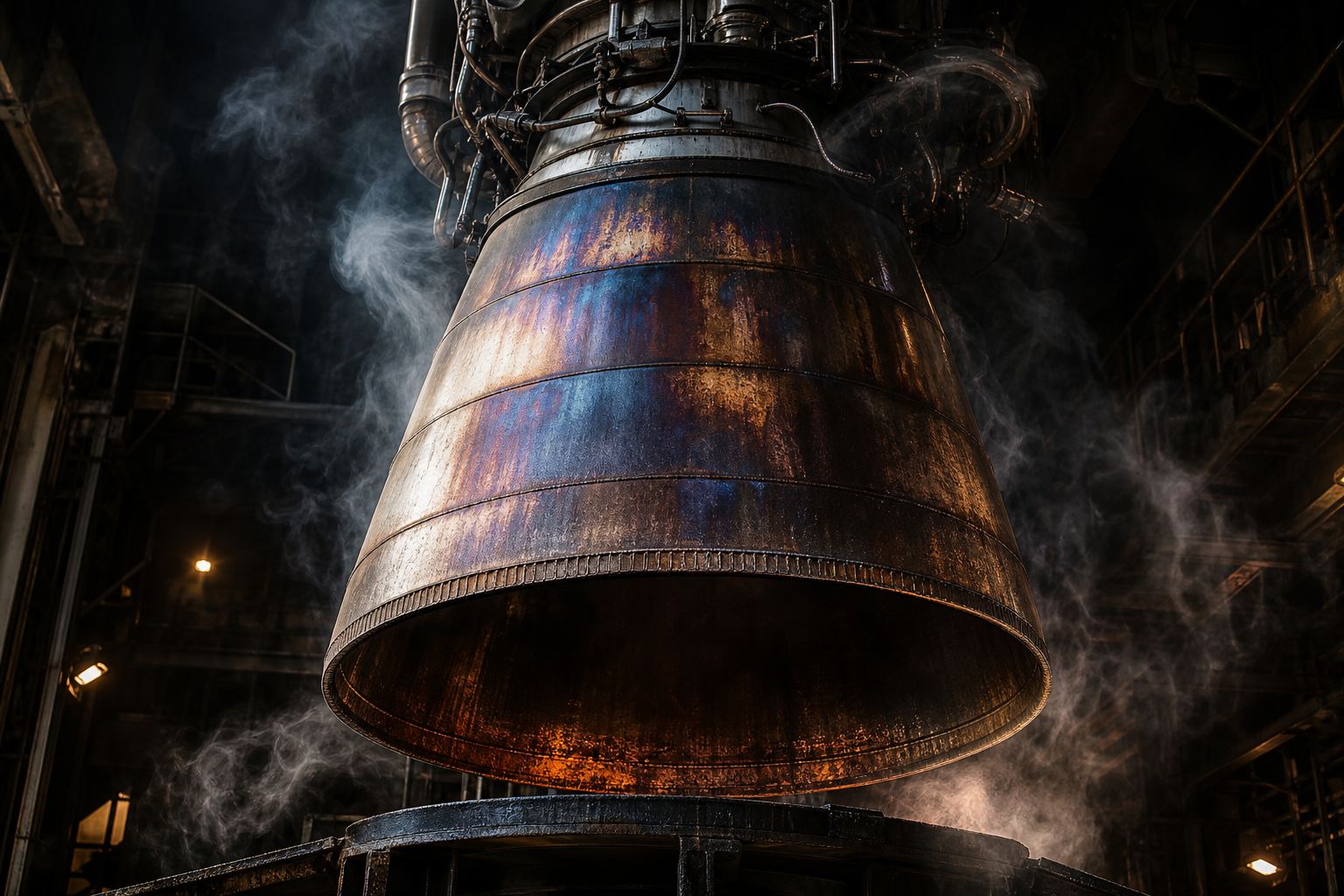
Without its nozzle, a booster can no longer speed its gas up, so it loses thrust. One side of the rocket now pushes less than the other. Try failing one yourself. Engineers from ULA, the booster maker Northrop Grumman and the Space Force traced several contributing causes.
Both times the core stage compensated, and the rocket still reached its planned orbit. But the Space Force paused its launches on Vulcan and moved four missions to other rockets. The November flight will use a redesigned nozzle while tests continue.
The nozzle A scorched nozzle on a test stand. AI-generated still.
< 30 s
after liftoff, the nozzle fails
3 + 1
three boosters at full thrust, one weakened
orbit
still reached, as planned
Flight 4, 12 Feb 2026 (Spaceflight Now)
Investigation by ULA, Northrop Grumman and the Space Force
Four military missions moved to SpaceX
Next flight: 40 Amazon Leo satellites
After February
Chapter IV · Engines and boosters
When a nozzle fails
Spaceflight Now: on Vulcan’s second flight a nozzle disintegrated on one of two GEM 63XL motors; on the fourth (USSF-87, 12 February 2026) a nozzle failed on one of four boosters less than 30 seconds after liftoff, and the rocket reached its intended orbits despite reduced, asymmetric thrust. An investigation by ULA, Northrop Grumman and the US Space Force identified several contributors; the next flight uses an improved nozzle design while testing continues. Wikipedia: on flight 2 (4 October 2024) the booster lost its nozzle; after flight 4 the Space Force paused national security launches on Vulcan. Air & Space Forces Magazine: four missions moved from Vulcan to SpaceX.
Try it: fail a nozzle. In this model the core engines swivel to keep the rocket straight, one common way of steering; the angles are exaggerated for clarity.
The 3D rockets are generic teaching models, not copies of any real vehicle; sizes, flames and exhaust particles are drawn for clarity, not to scale.
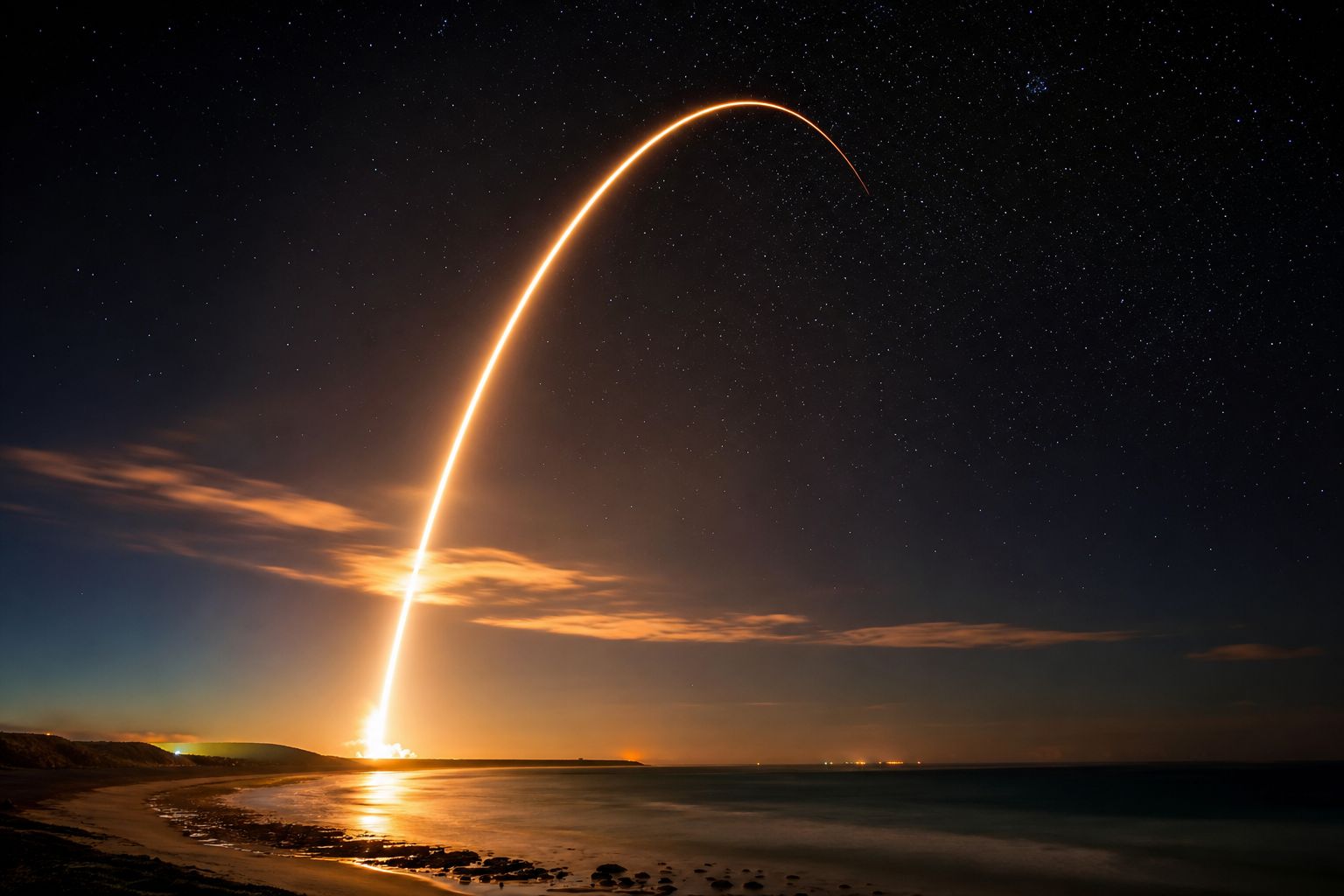
Reaching orbit is less about going up than going sideways fast. A launcher climbs out of the thick air, then tips over and spends most of its fuel building horizontal speed. At orbital speed it keeps falling around the Earth instead of back down to it.
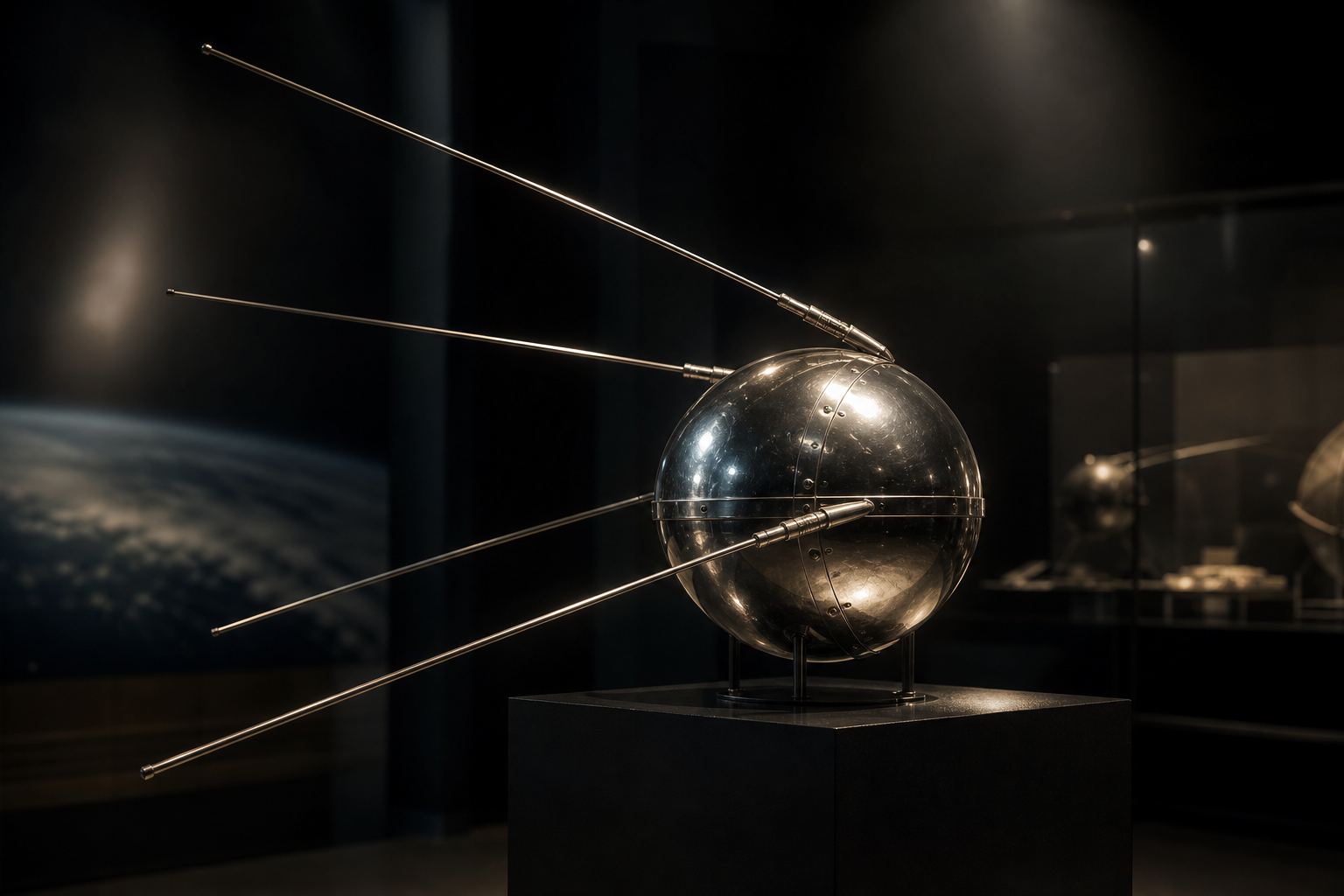
The first to get there was Sputnik 1, launched by the Soviet Union on the fourth of October 1957: a sphere fifty-eight centimetres across, weighing eighty-three point six kilograms, circling Earth every ninety-eight minutes.
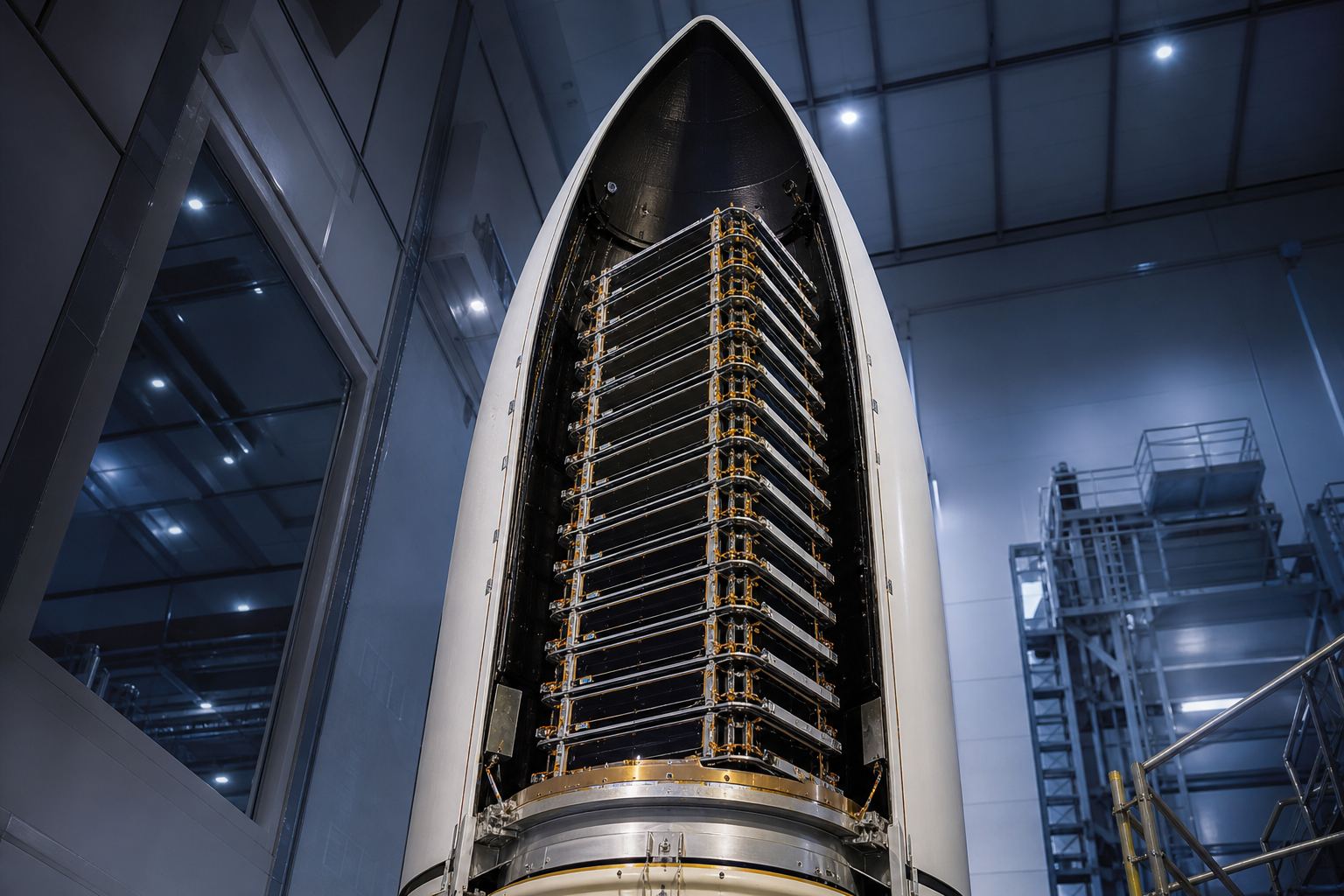
Today rockets carry whole batches. Thailand's THEOS-2 Earth-observation satellite rode a European Vega rocket from French Guiana in October 2023, and Vulcan's next flight carries forty internet satellites at once.
The arc to orbit A long-exposure night launch. AI-generated still.Sputnik 1, 4 Oct 1957 A museum-style model of a small sphere with four antennas: 58 cm, 83.6 kg (NASA). AI-generated still.
58 cm
across, about a beach ball
83.6 kg
mass
98 min
per orbit
Sputnik 1 (NASA)A batch of satellites Flat satellites stacked inside a payload fairing. AI-generated still.
Chapter V · To orbit
Getting to orbit
ESA: orbit at 300 km needs about 7.8 km/s. NASA History: Sputnik 1, launched by the Soviet Union on 4 October 1957, was about 58 cm across, weighed 83.6 kg and took about 98 minutes per orbit. Airbus (October 2023): THEOS-2, built by Airbus for Thailand, was launched on a Vega rocket from Kourou in French Guiana. Spaceflight Now: Vulcan’s fifth flight is to carry 40 Amazon Leo satellites. The climb-then-turn path on screen is a simplified illustration of a typical ascent, not a real trajectory.
Try it: launch again and follow the path from the pad to orbit.
The 3D rockets are generic teaching models, not copies of any real vehicle; sizes, flames and exhaust particles are drawn for clarity, not to scale.
Every rocket, from a bamboo-ramp festival rocket to Vulcan, runs on the same idea: throw mass backwards, fast, and you move forwards. From the rice fields of Yasothon to Cape Canaveral, the physics is the same.
The rocket equation makes orbit expensive: most of a rocket is fuel, and every small part, down to a booster nozzle, has to work perfectly.
Will the redesigned nozzle hold on the thirteenth of November? Watch the launch, and now you will know what to look for.
1903 Tsiolkovsky publishes the physics of rocket flight
1926 Goddard’s liquid-fuel rocket
1957 Sputnik 1 reaches orbit
2023 Thailand’s THEOS-2 launched
2024 Vulcan’s first flight
13 Nov 2026 Vulcan’s planned return
Rockets, step by step
Stills are AI-generated
3D rockets are generic models
Calculators use the ideal rocket equation
About this film
Liftoff: six boosters light together
The first two minutes: boosters burn out and drop
Staging: the upper stage lights
What to watch on launch day
Epilogue · Sources
Sources
Every fact in this film comes from the sources below. The chapter stills and pictures are AI-generated illustrations; the sphere with antennas is a generic museum-style model. The 3D rockets, plumes and trajectories are generic teaching models; the calculators apply NASA’s ideal rocket equation to invented masses where stated, and the Earth uses NASA Blue Marble imagery.