On 5 November 2026 the FBI and the US cybersecurity agency CISA warned that attackers were tampering with internet-connected refrigeration controllers, after hundreds of supermarkets and three blood-storage sites in Europe saw their cold rooms warm up. This film explains the established physics behind the machines being protected: why heat only flows from hot to cold on its own, why evaporation cools, how the four parts of the vapour-compression cycle move heat out of a box, why a heat pump is the same machine run the other way, how refrigeration grew from the ice trade to the home fridge, why its refrigerants had to change twice, and how much of the world's food, medicine and electricity now depends on it.
Interactive 3D film9 min1748 to 2026Published 8 November 2026
On the third of November 2026, France’s blood service said the settings at three of its blood stores had been quietly changed.
Two days later, the FBI and the US cybersecurity agency CISA warned that attackers were targeting refrigeration controllers, the small boxes that set a fridge’s temperature, if they can be reached from the internet.
Hundreds of French supermarkets had already been hit. No attacker has been named.
To see why that matters, look at what a fridge really does. It does not make cold. It moves heat.
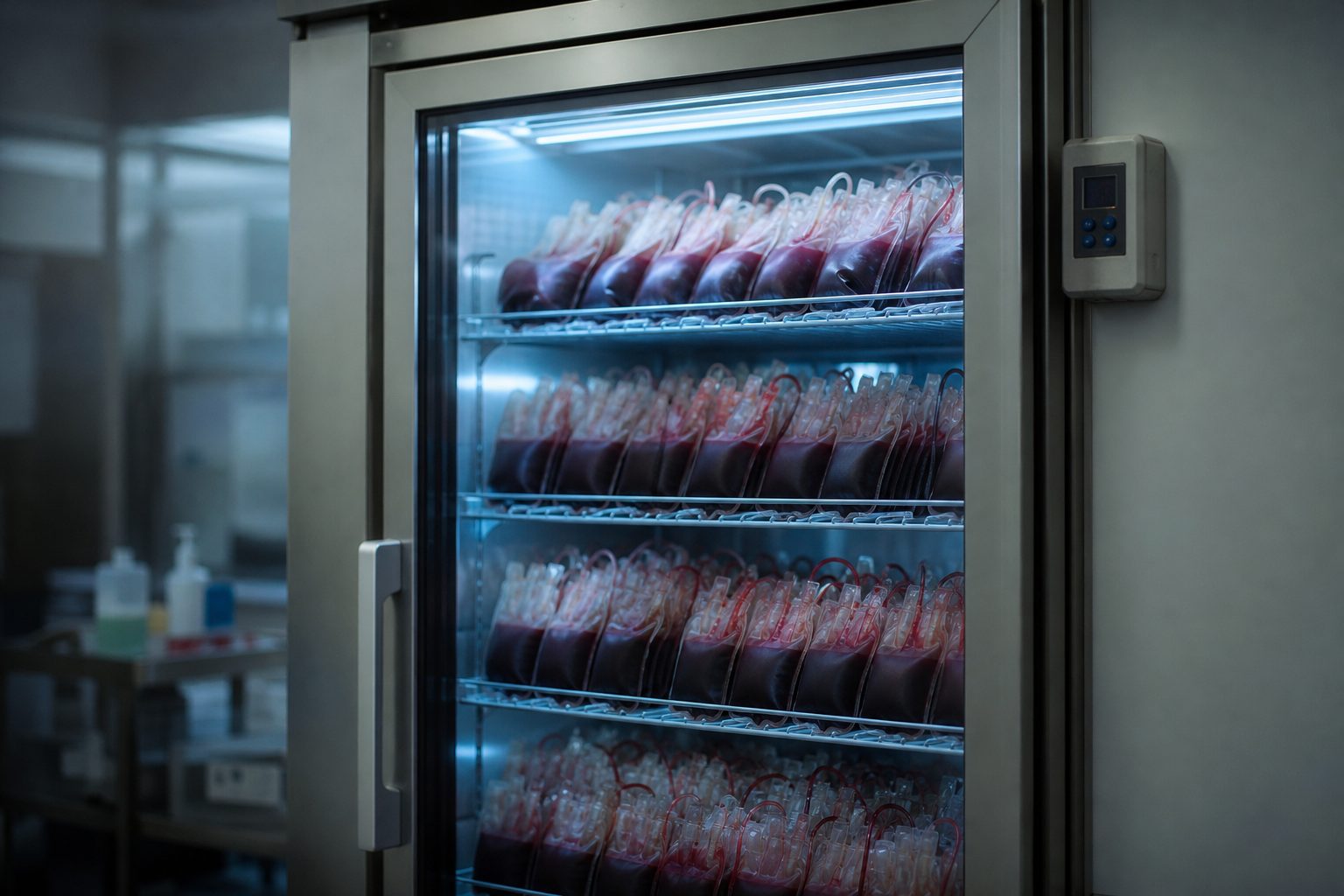
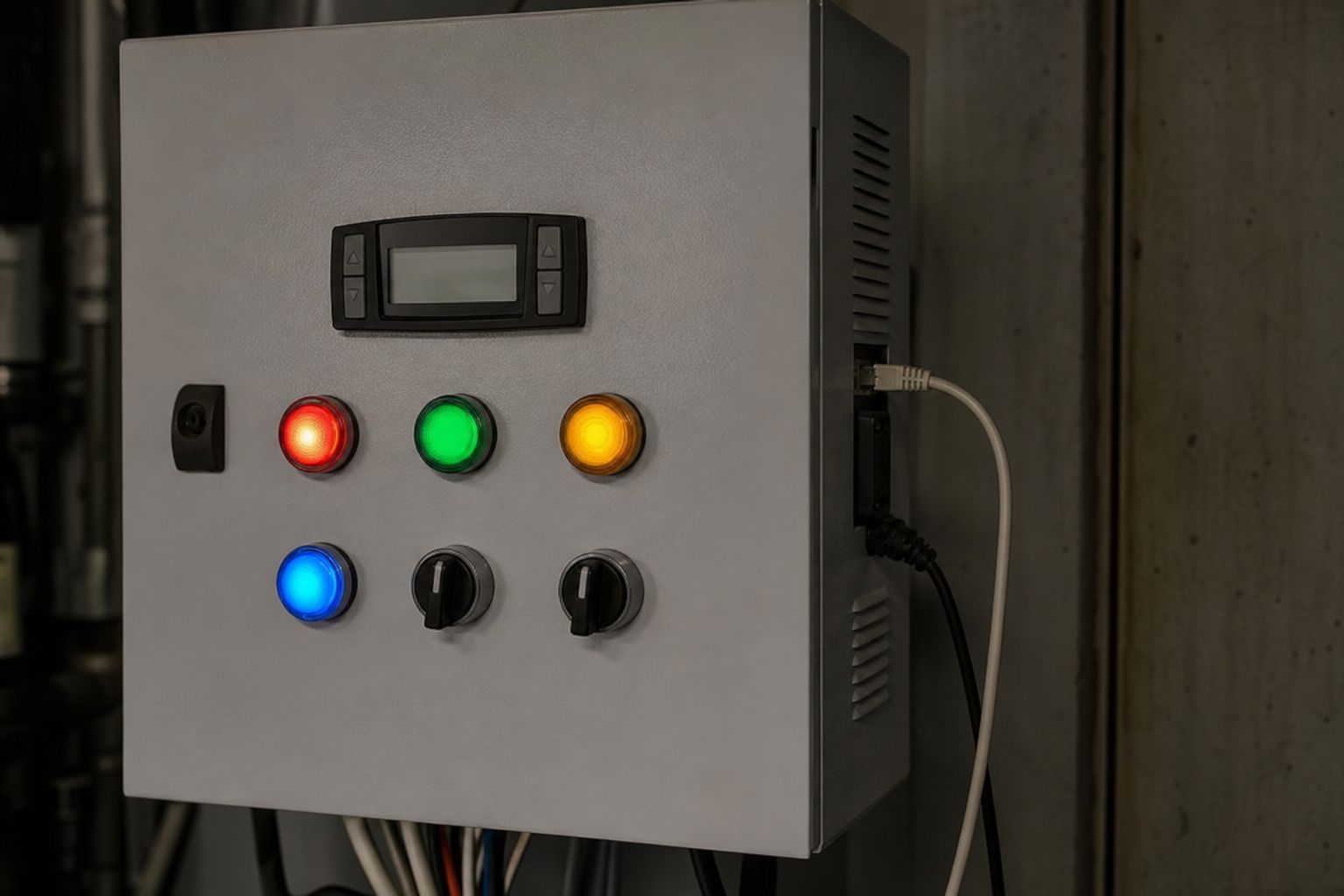
Blood store Bags of blood are kept chilled on wire shelves; a controller on the side holds the temperature. AI-generated illustration.A controller A refrigeration controller with its network cable: the target named in the advisory. AI-generated illustration.
250–350
French supermarkets hit in October (estimate)
115+
stores in six countries in a second wave, November
Reported, Oct–Nov 2026
“Every organization that depends on refrigeration and monitoring systems should assume it could be a target.”Chris Butera, CISA
Prologue
The news
BleepingComputer (5 November 2026) and Help Net Security (6 November 2026): CISA and the FBI, with HHS, USDA and DOT, warned that internet-exposed or unpatched refrigeration and temperature controllers in retail grocery, cold storage, healthcare, food and agriculture, chemical and transport are being targeted. Attackers who reach them can change setpoints or force heating or defrost, causing inventory loss. In October, controllers at an estimated 250–350 French supermarkets were compromised; in November a second wave hit more than 115 stores in six European countries; on 3 November France’s blood service (EFS) said settings were changed at three blood-storage facilities.
Who is behind it has not been identified: France’s cyber agency ANSSI says it has no specific information on any threat actor (Cybersecurity Dive).
The 3D scenes are simplified teaching models, not to scale; temperatures and colours in them are illustrative.
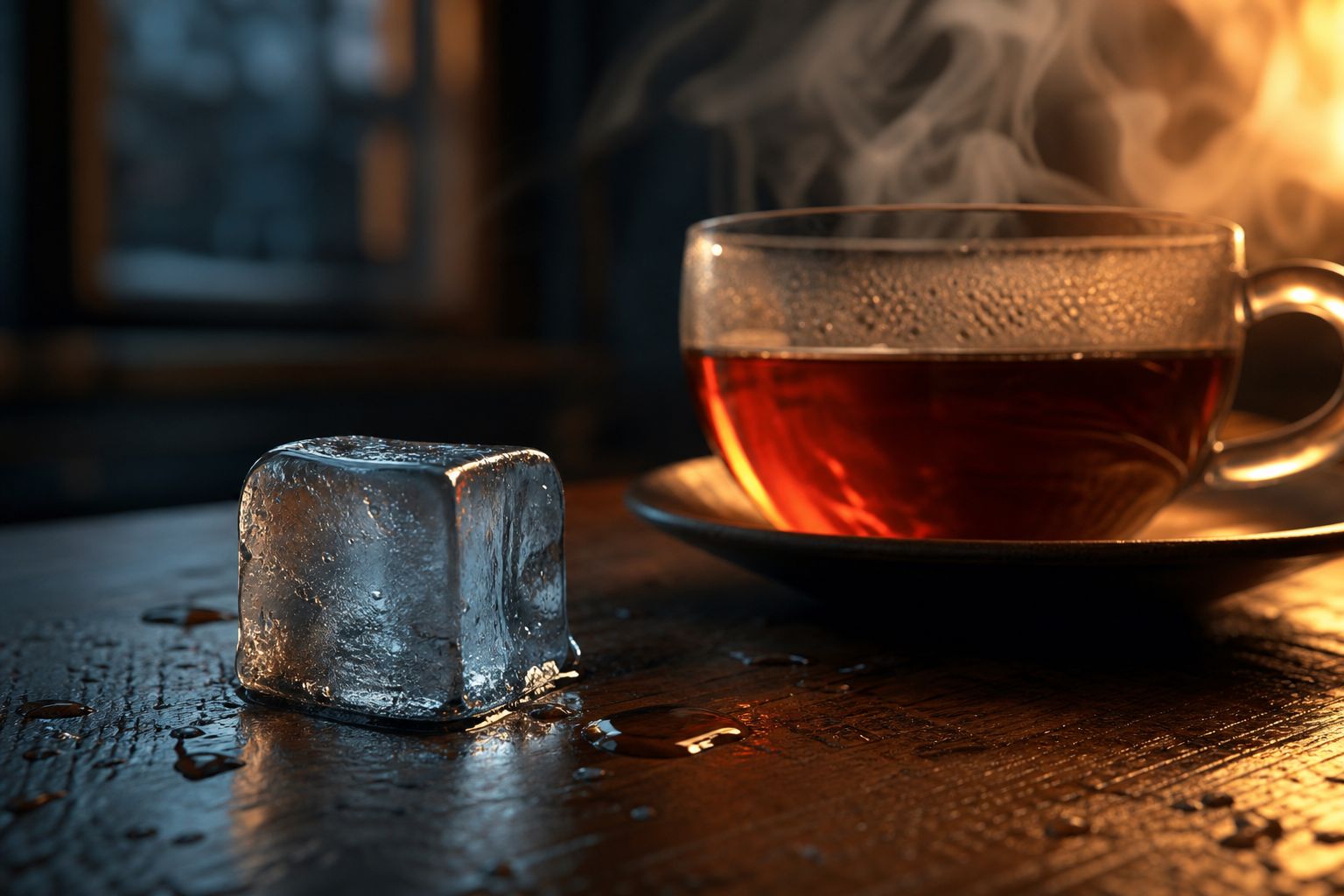
Put an ice cube next to a hot cup of tea, and heat flows one way only: from the hot tea to the cold ice.
That is the second law of thermodynamics. On its own, heat never flows from cold to hot.
Yet a refrigerator does exactly that. It takes heat out of a cool box and pushes it into a warmer kitchen.
To push heat uphill like that, it has to do work, paid for with electricity.
One way only Tea and ice end at one temperature, never the reverse. AI-generated illustration.
on its own: heat flows hot → cold
to move it cold → hot needs work
fridges, air conditioners and heat pumps all pay that work
Second law (OpenStax)A heat mover Cold inside, warm coils at the back: the heat is carried out, not destroyed. AI-generated illustration.Qh=Qc+W
Qh
heat released into the kitchen
Qc
heat taken from inside the box
W
electrical work put in
Energy in, energy out
Chapter I · Heat runs downhill
The second law
OpenStax College Physics 15.5: heat naturally flows from hot to cold. Refrigerators, air conditioners and heat pumps are heat engines run backward: they move heat from cold to hot, which requires work input, as the second law of thermodynamics demands. Penn State EGEE 102 calls a fridge a “heat mover”: it takes thermal energy from the cool interior and releases it into the warmer kitchen.
The 3D scenes are simplified teaching models, not to scale; temperatures and colours in them are illustrative.
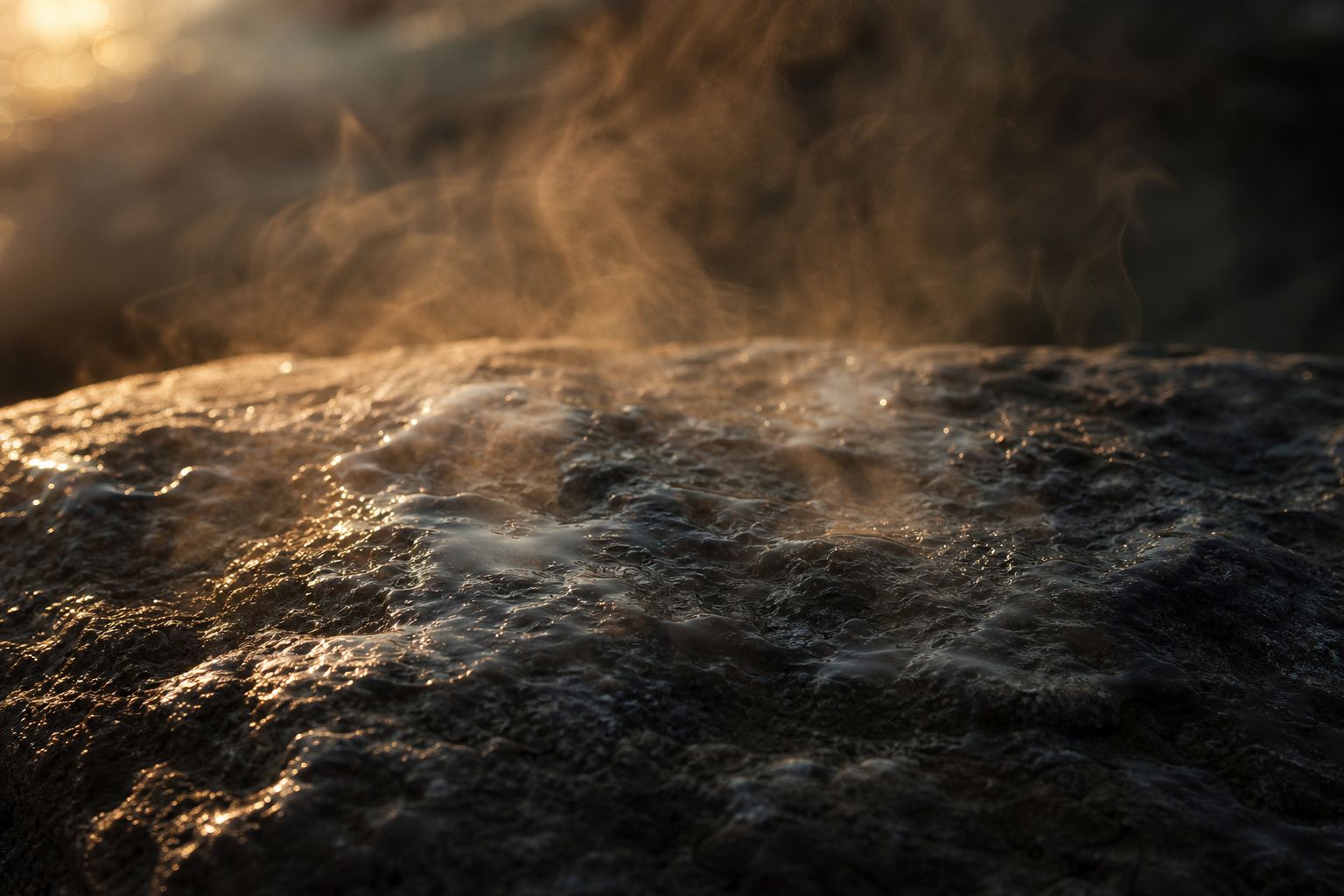
The trick a fridge uses is one your body uses too. When sweat evaporates, it carries heat away from your skin.
Turning a liquid into a gas takes a lot of energy, called latent heat, and the liquid takes it from whatever it touches.
Boiling is the same change, all through the liquid at once. While it lasts, the temperature holds steady.
Vapour rising Every wisp of vapour leaving a wet surface takes heat with it. AI-generated illustration.Q=mLv
Q
heat taken in
m
mass that evaporates
Lv
latent heat of vaporisation
Latent heat
2,430 kJ/kg
to evaporate at 37 °C
2,256 kJ/kg
to boil at 100 °C
Water (OpenStax)
Chapter I · Heat runs downhill
Latent heat
OpenStax College Physics 14.3: the latent heat of vaporisation of water is 2,256 kJ/kg at 100 °C and about 2,430 kJ/kg at 37 °C, which is why evaporating sweat cools the skin. Penn State EGEE 102: evaporation needs energy, which a fridge’s refrigerant takes as heat from the interior; its temperature stays constant while it changes phase.
The 3D scenes are simplified teaching models, not to scale; temperatures and colours in them are illustrative.
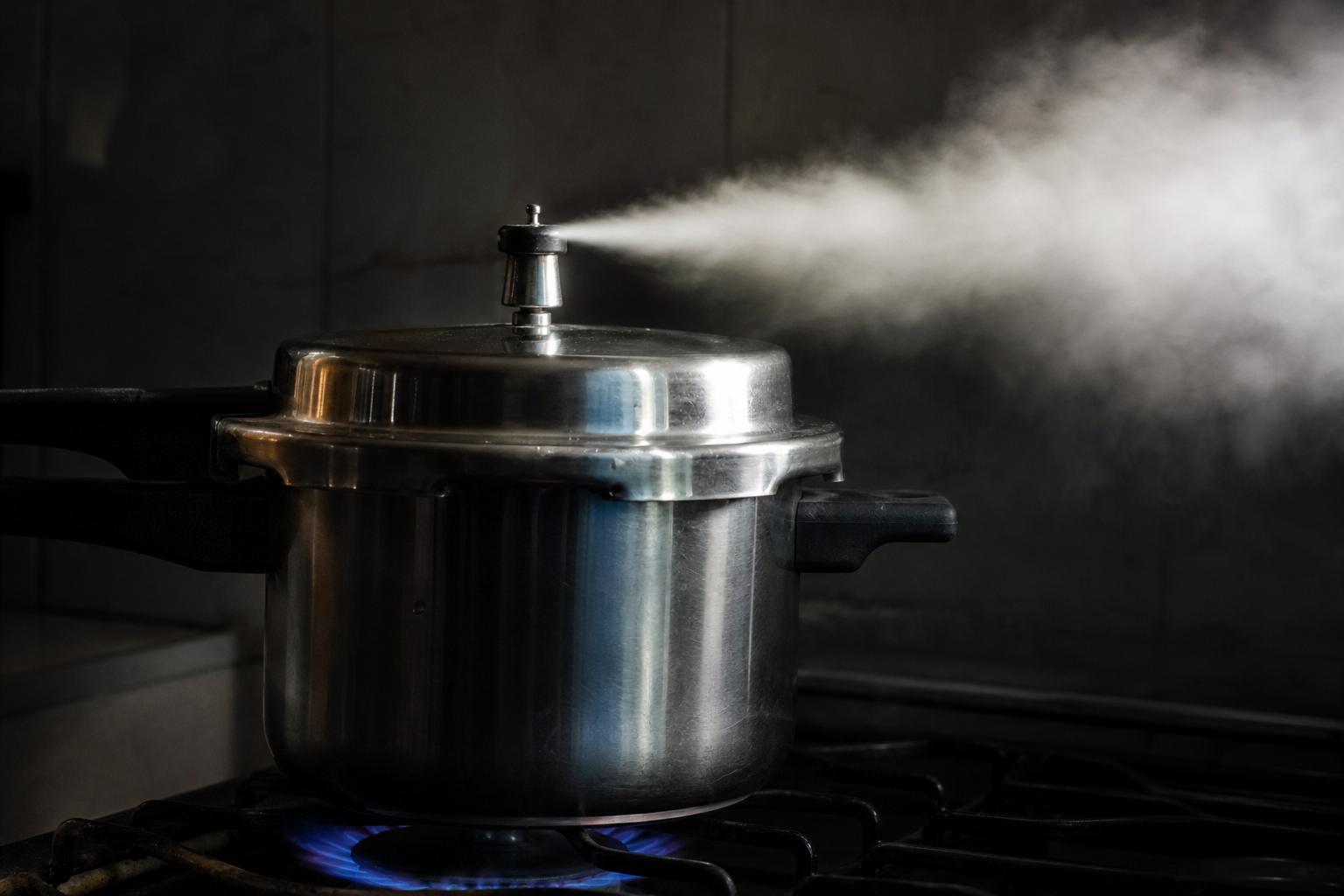
One more key. A liquid boils when the push of its own vapour, its vapour pressure, matches the pressure around it. So its boiling point depends on pressure.
Raise the pressure and it boils hotter: that is how a pressure cooker works. Lower the pressure and the same liquid boils colder.
A refrigerant is a liquid chosen to boil at a low temperature when its pressure is low, and to turn back into liquid when it is squeezed.
Pressure cooker Higher pressure inside lets water get hotter before it boils. AI-generated illustration.
100 °C
at 1 atmosphere, sea level
higher
inside a pressure cooker
Water’s boiling point (OpenStax)
boils cold at low pressure: inside the box
condenses warm at high pressure: at the back
goes round the loop again and again
A good refrigerant
Chapter I · Heat runs downhill
Boiling and pressure
OpenStax University Physics vol. 2, 1.5: a liquid boils when its vapour pressure equals the surrounding pressure, so the boiling point rises with pressure and falls when the pressure drops. Water boils at 100 °C at 1 atm, and hotter at higher pressure; pressure cookers use this. Britannica and Penn State: in a fridge, the refrigerant evaporates at low pressure inside the cabinet and condenses at high pressure outside it.
The 3D scenes are simplified teaching models, not to scale; temperatures and colours in them are illustrative.
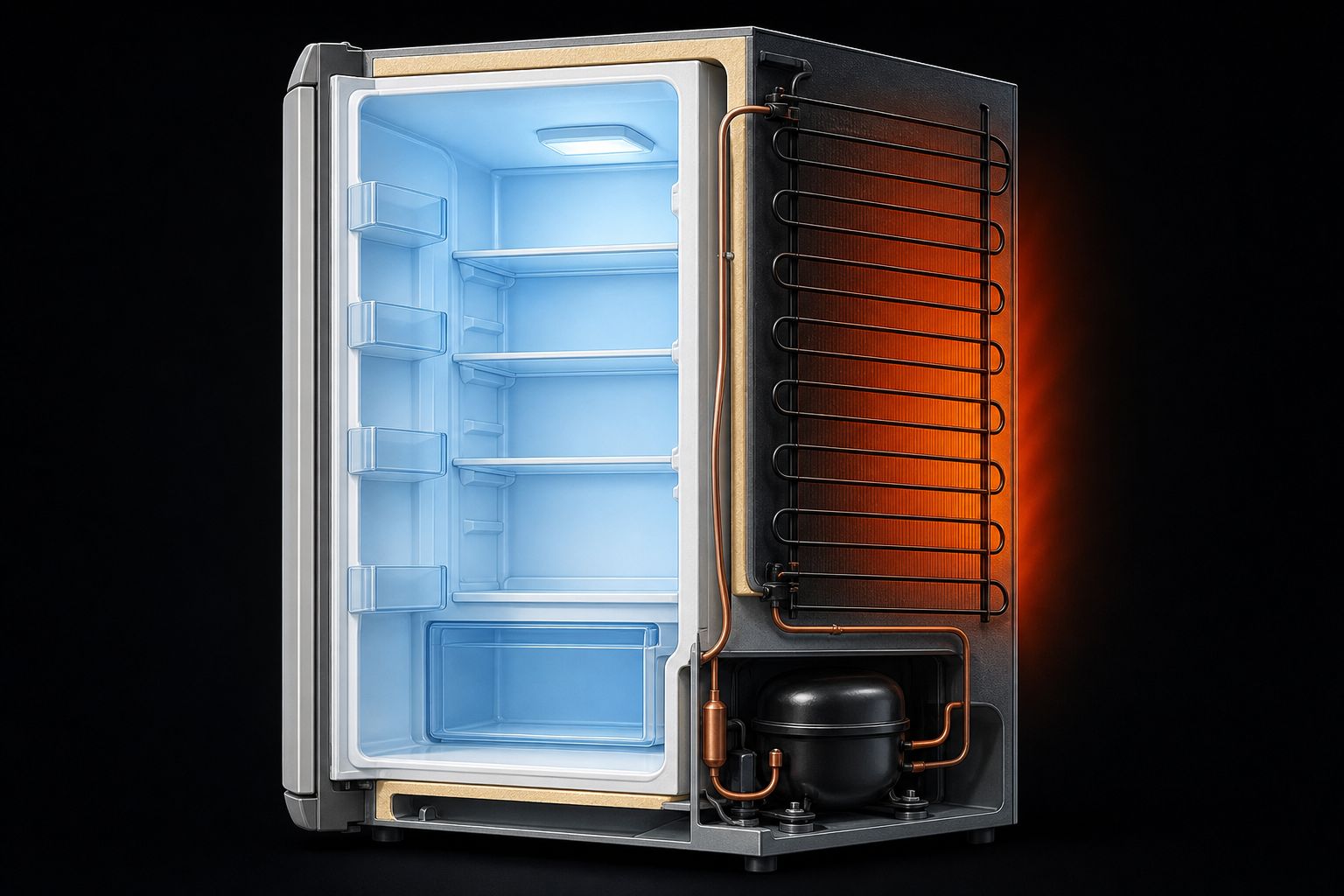
A fridge puts these ideas into a sealed loop with four parts: a compressor, a condenser, an expansion valve and an evaporator.
The same refrigerant goes round and round, picking up heat inside the box and dropping it outside.
Let us follow it once round.
Inside the cabinet A cutaway: the cold compartment, the coil grid behind, the compressor below. AI-generated illustration.
1 compressor: squeezes the gas
2 condenser: gives heat to the room
3 expansion valve: drops the pressure
4 evaporator: boils and takes heat
The loop (Britannica)
Chapter II · The loop
The vapour-compression cycle
Britannica and Penn State EGEE 102: the cycle has four parts, compressor, condenser, expansion valve and evaporator, linked in a closed loop. The refrigerant evaporates inside the cabinet, absorbing heat, and condenses outside it, releasing heat. In the 3D model the beads are coloured by temperature, and bigger beads mark liquid.
The 3D scenes are simplified teaching models, not to scale; temperatures and colours in them are illustrative.
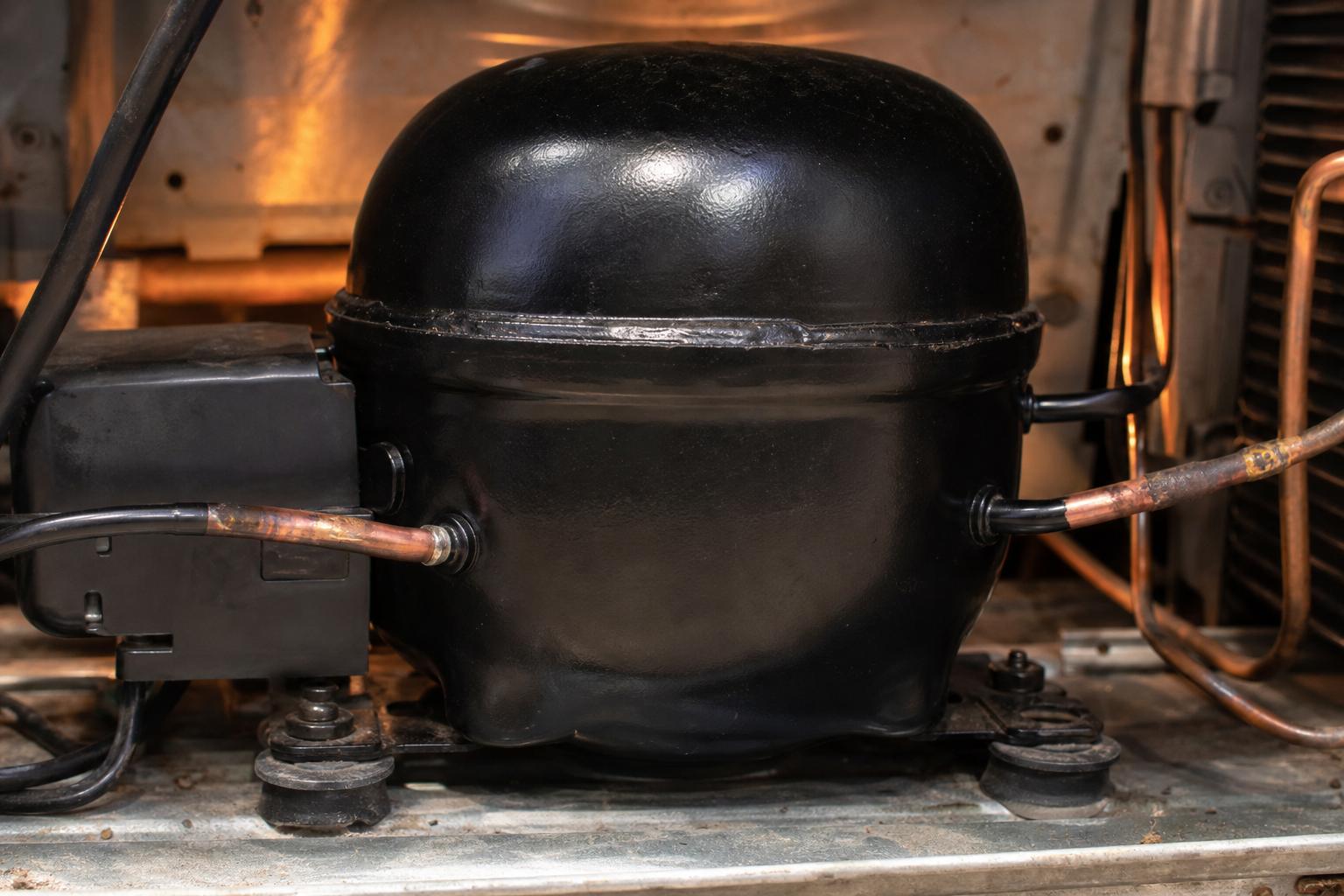
Start at the compressor, at the bottom back of the fridge. It squeezes the refrigerant gas, raising its pressure and temperature.
This is the part that uses most of the electricity.
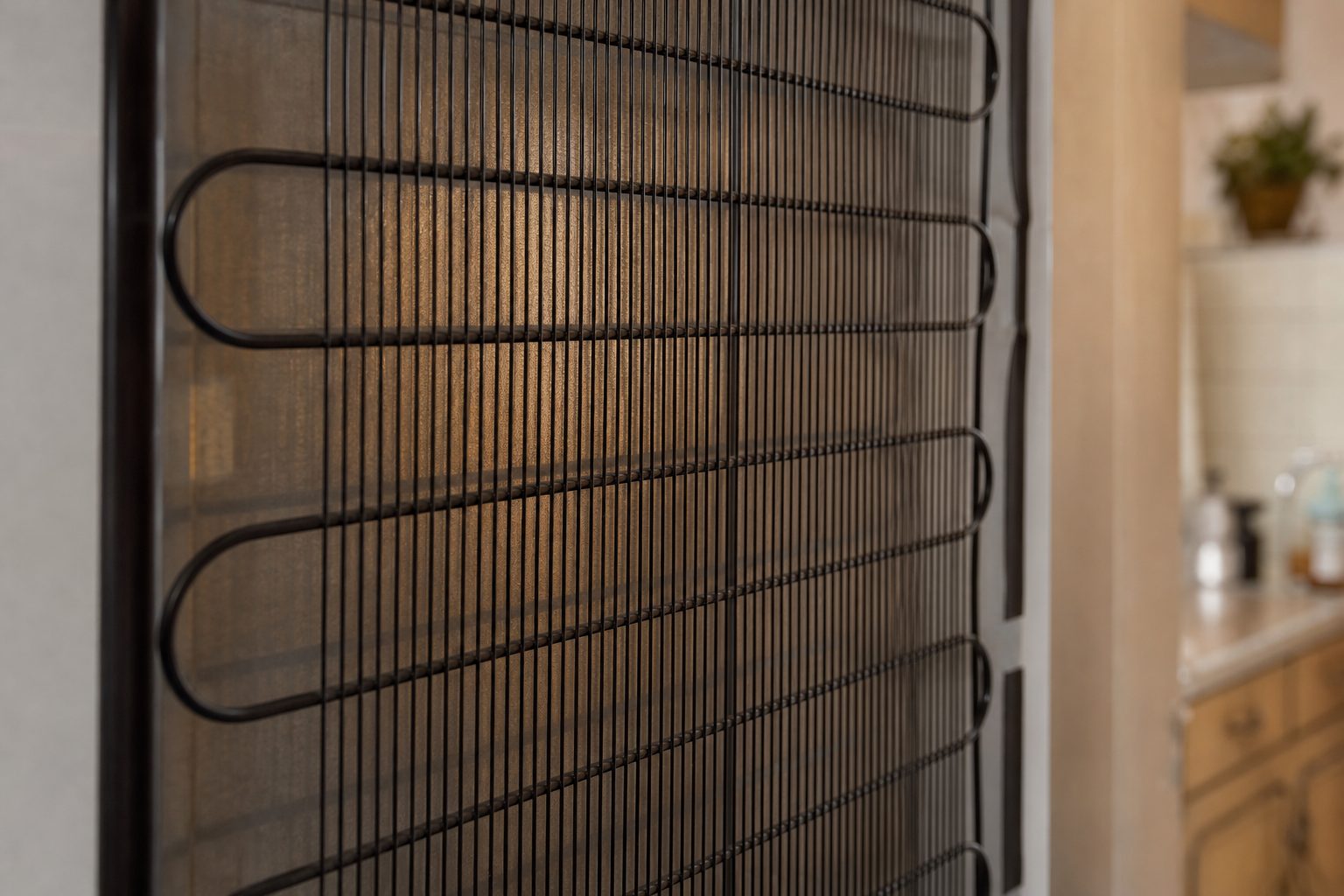
The hot gas flows into the condenser, the grid of coils at the back. Now hotter than the kitchen, it gives its heat to the room and condenses into a liquid.
That warmth at the back of your fridge is heat taken out of your food.
The compressor A sealed dome holds the pump and its motor; copper pipes carry the gas in and out. AI-generated illustration.
↑ pressure
and ↑ temperature of the gas
#1
user of the fridge’s electricity
The compressor (Penn State)
in: hot, high-pressure gas
heat flows out to the cooler room
out: warm, high-pressure liquid
At the back (Penn State)Warm coils The condenser on the back: one long tube wound through a grid of thin wire fins. AI-generated illustration.
Chapter II · The loop
Compressor and condenser
Penn State EGEE 102: the compressor compresses the refrigerant gas, raising its pressure and temperature, and is the main electricity user. The condenser coils on the back give the heat to the room, and the refrigerant condenses to a liquid.
The 3D scenes are simplified teaching models, not to scale; temperatures and colours in them are illustrative.
The warm liquid now passes through the expansion valve into a low-pressure zone. At the lower pressure some of it boils at once, taking the heat it needs from itself, so it cools sharply.
The cold refrigerant enters the evaporator inside the box. There it boils, taking latent heat from the food and the air.
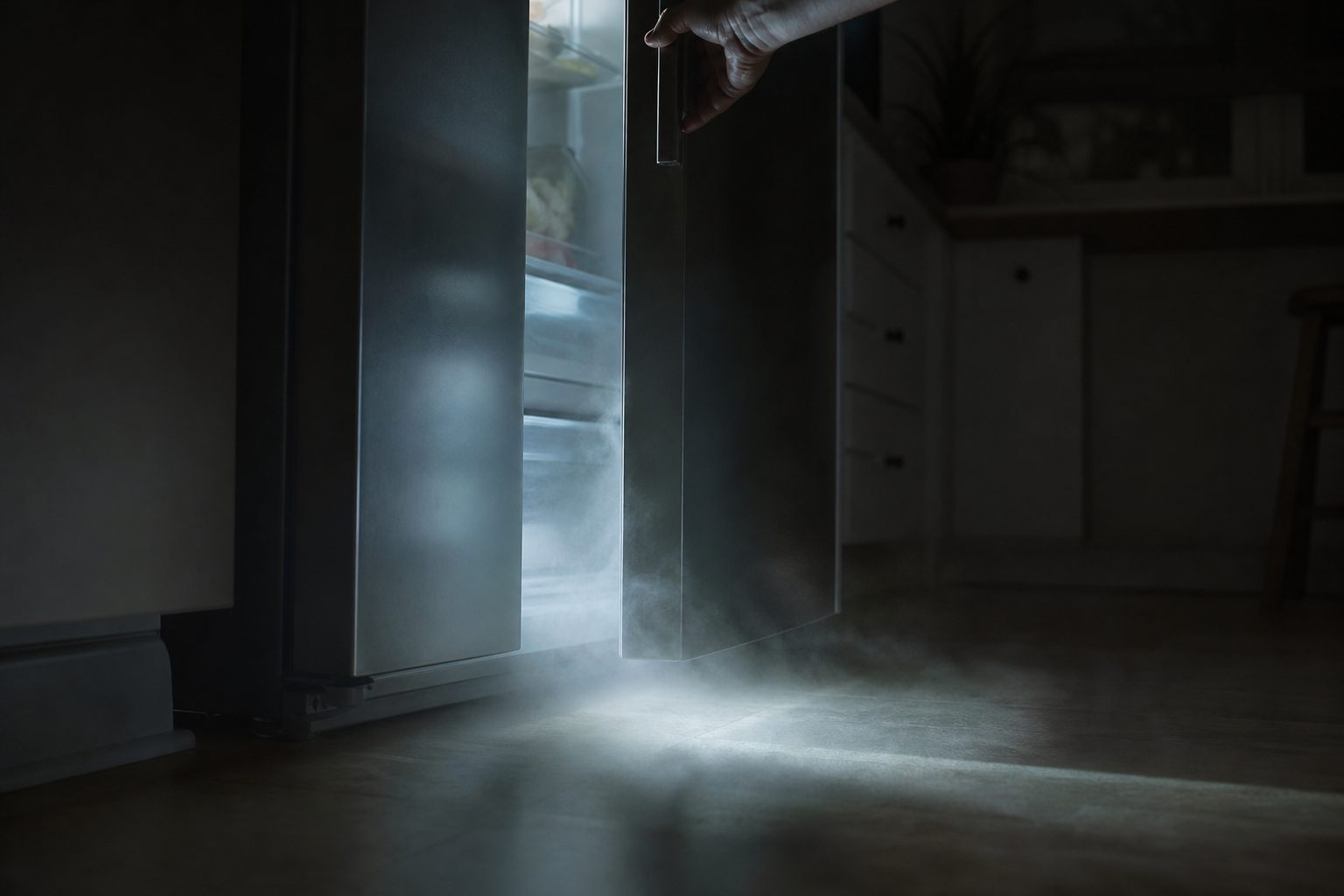
Open the door and warm air floods in. Change the setpoint, and the loop simply stops carrying enough heat away: the warmth wins. Then the gas returns to the compressor.
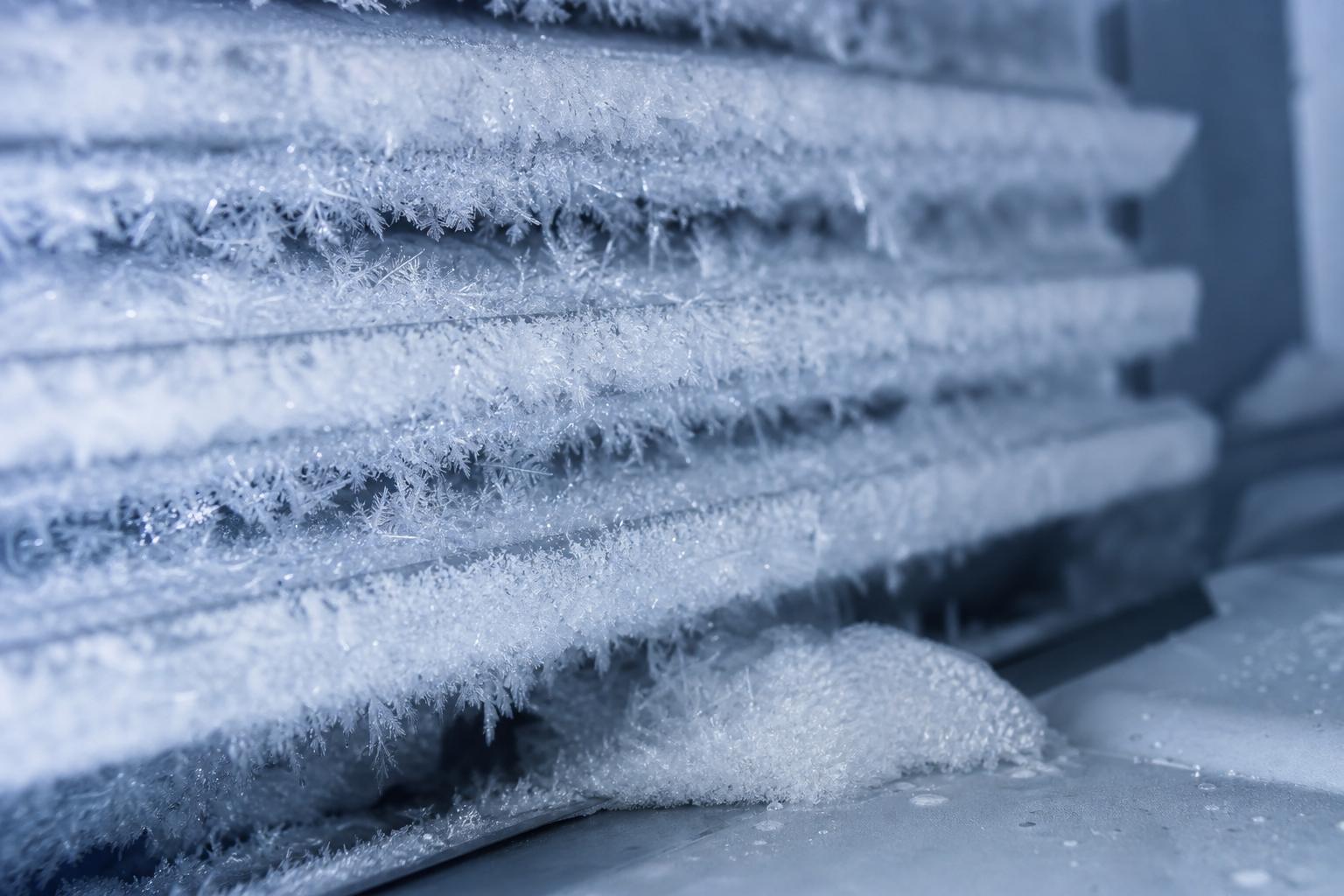
The evaporator Frost forms on the evaporator plate, the coldest surface in the fridge. AI-generated illustration.
in: cold, low-pressure liquid
boils at a steady temperature
out: cool gas, back to the compressor
Inside the box (Penn State)Door open Cold air spills out across the floor and warm kitchen air takes its place. AI-generated illustration.
Chapter II · The loop
Valve and evaporator
Penn State EGEE 102: the high-pressure liquid expands through the expansion valve into a low-pressure zone and cools. In the evaporator inside the fridge it evaporates, absorbing heat from the food and air, then returns to the compressor.
The open-door and changed-setpoint effects in the model are illustrative only.
The 3D scenes are simplified teaching models, not to scale; temperatures and colours in them are illustrative.
How well does it work? Divide the heat moved by the electrical work put in: that is the coefficient of performance.
Real fridges and air conditioners reach two to six. That is not free energy: they only move heat that is already there.
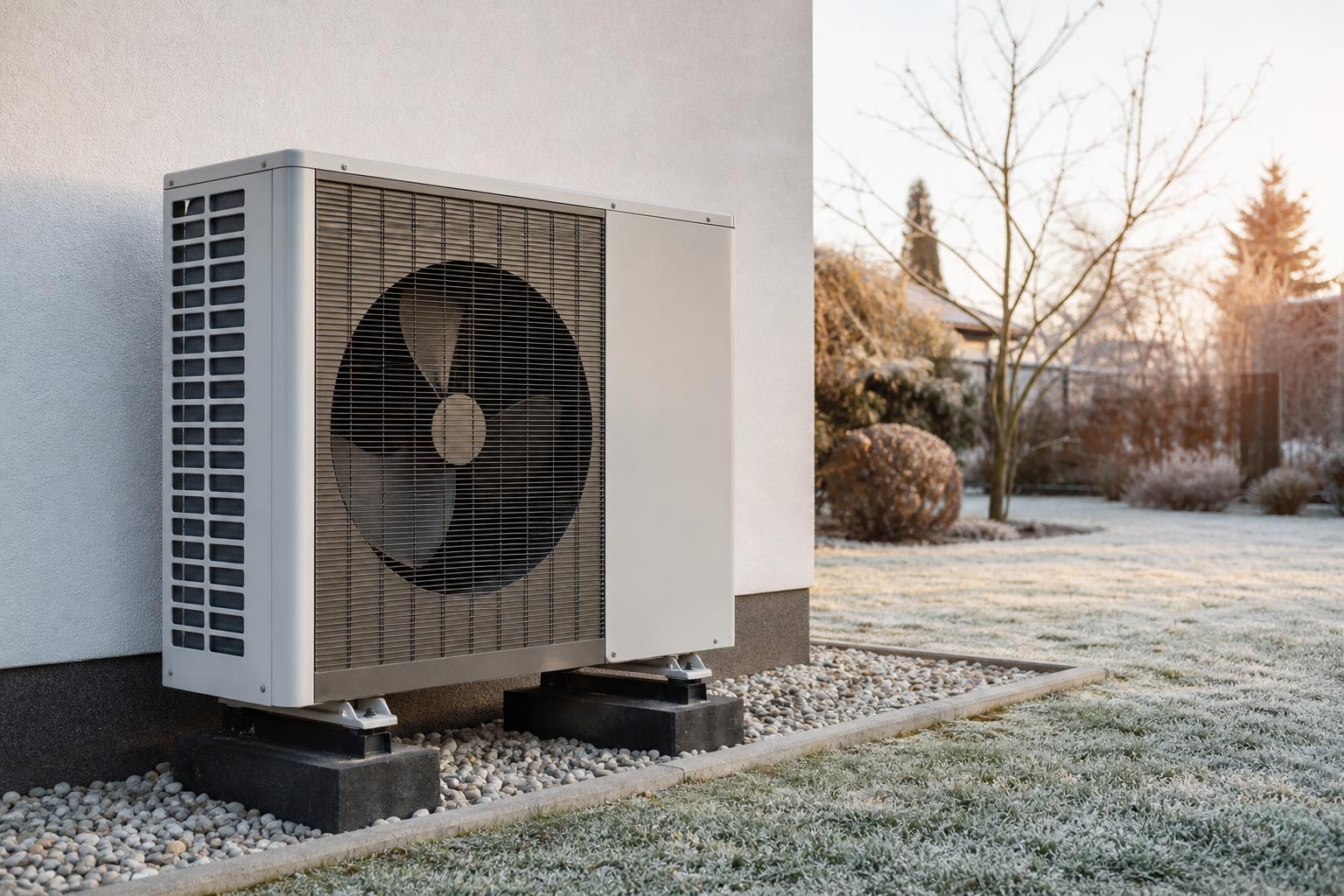
Now put the cold coil outdoors and the hot coil inside. Even cool outdoor air still holds heat, so the same loop can carry it into a home. That is a heat pump.
COP=WQc
Qc
heat removed from the cold side
W
work put in
Coefficient of performance
2–6
COP of refrigerators and air conditioners
2–4
COP of real heat pumps
Real machines (OpenStax)A heat pump A heat pump’s outdoor unit: here its coil is the cold side of the loop. AI-generated illustration.
Chapter II · The loop
COP and heat pumps
OpenStax College Physics 15.5: for a refrigerator COP = heat removed ÷ work; for a heat pump COP = heat delivered ÷ work, and at the same two temperatures the refrigerator’s COP is one less than the heat pump’s. Real heat pumps run at about 2–4, real air conditioners and refrigerators at 2–6. A heat pump is the same cycle used for heating, “essentially an air conditioner and a heating unit all in one.”
The 3D scenes are simplified teaching models, not to scale; temperatures and colours in them are illustrative.
Before machines, cold was cut from frozen lakes. In 1806, the Boston merchant Frederic Tudor shipped his first cargo of ice to the Caribbean.
He lost money, but the trade grew: by 1846, some sixty-five thousand tons of ice a year left Boston.
Ice harvest Blocks were sawn from frozen ponds in winter and stored in sawdust. AI-generated illustration.The brig Favorite Tudor’s first cargo sailed on a brig and lost him $4,500. AI-generated illustration.
1826
≈4,000
1846
≈65,000
Ice exported from Boston (HistoryNet)
180 tons
of New England ice shipped to Calcutta in 1833
The longest run (HistoryNet)
Chapter III · Before the fridge
The ice trade
HistoryNet: Frederic Tudor’s first ice shipment sailed on 10 February 1806 on the brig Favorite to St. Pierre, Martinique, and lost $4,500. Ice exports from Boston were about 4,000 tons a year in 1826 and about 65,000 tons in 1846; in 1833 a cargo of 180 tons went to Calcutta.
The 3D scenes are simplified teaching models, not to scale; temperatures and colours in them are illustrative.
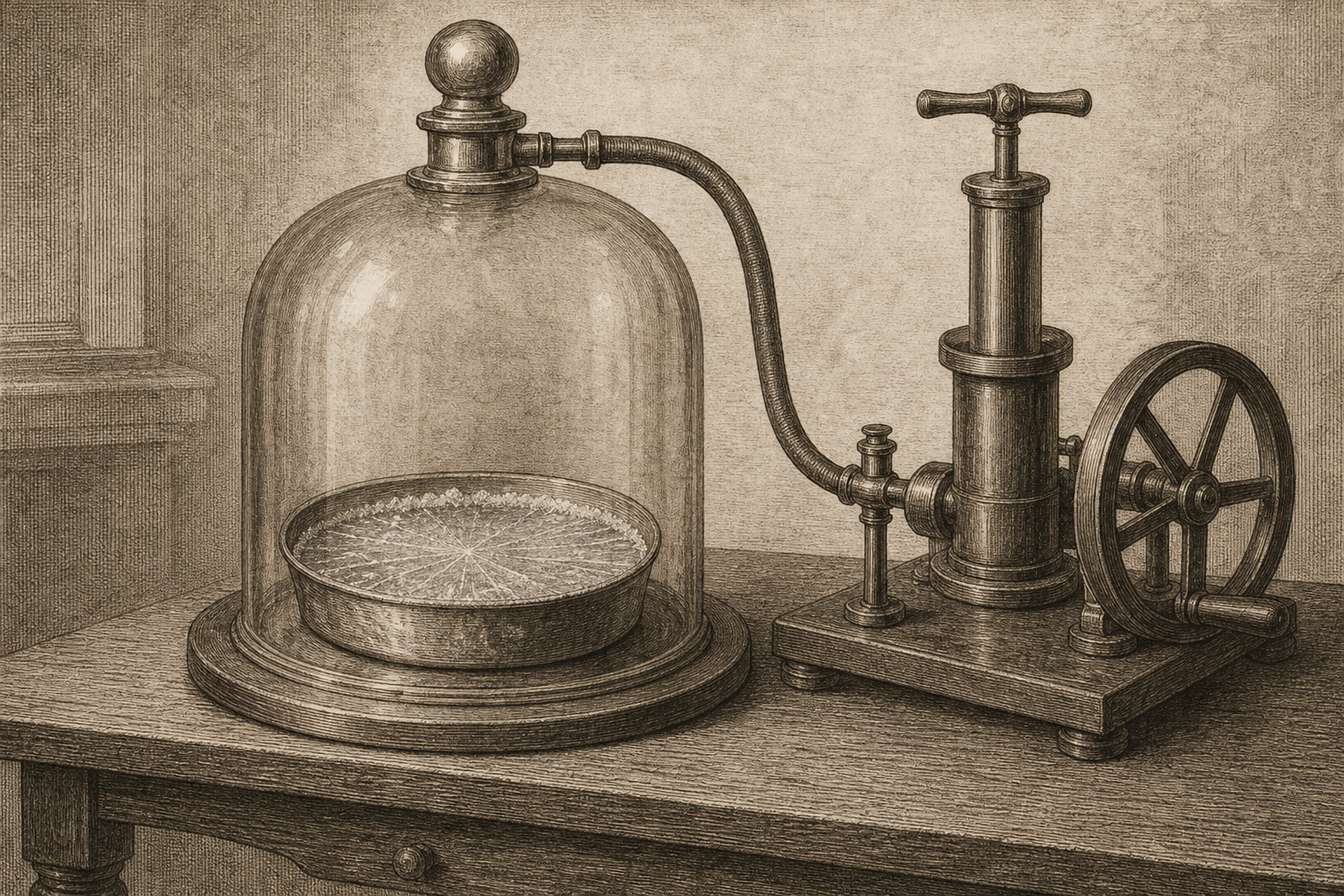
Long before the ice trade, cold had been made in a laboratory. In the 1740s, William Cullen at Glasgow chilled a liquid by letting it evaporate in a partial vacuum.
In 1834, Jacob Perkins patented in England the first working machine to use the vapour-compression cycle.
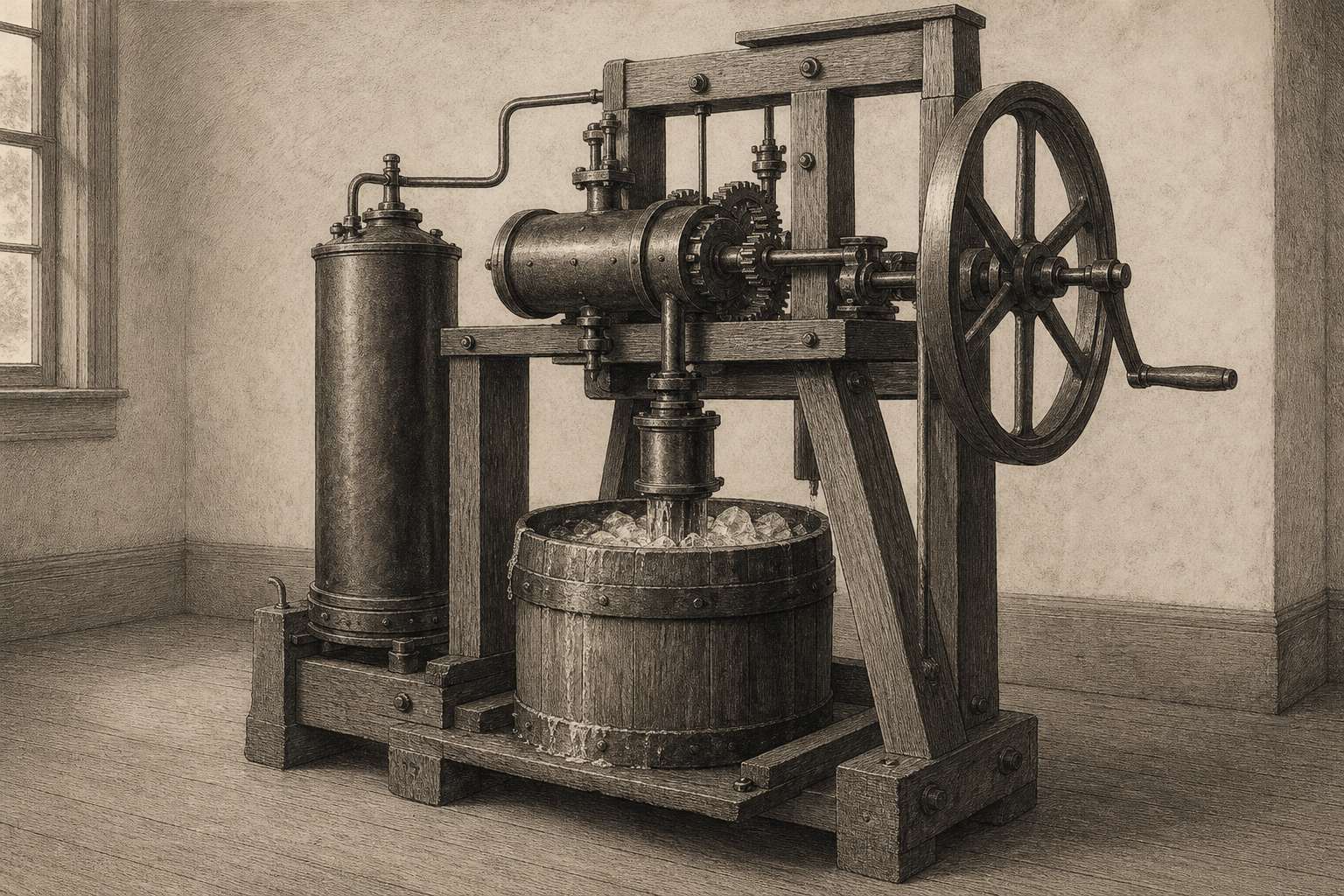
In the 1840s, a Florida doctor, John Gorrie, cooled the rooms of fever patients, and in 1851 he patented an ice machine.
Under a vacuum An engraving-style sketch of evaporation cooling water in a bell jar. AI-generated illustration.
1748 Cullen, Glasgow: ether boiled in a vacuum (Britannica)
1834 Perkins: vapour-compression patent (ASME)
1851 Gorrie: US patent No. 8080
The first machinesAn ice machine An early ice machine in engraving style: a hand crank, iron cylinders and a tub. AI-generated illustration.
Chapter III · Before the fridge
The first machines
Britannica dates William Cullen’s first known artificial refrigeration to 1748 at Glasgow, when ethyl ether boiled into a partial vacuum; the International Institute of Refrigeration dates his ice demonstration to 1755. ASME dates Jacob Perkins’s English patent to 1834 and calls it the first working vapour-compression device (the IIR note gives 1835). The Smithsonian: John Gorrie’s US Patent No. 8080, 6 May 1851, was the first US patent for a mechanical ice-making machine; it compressed and expanded air, and Gorrie used ice and cooled air to treat tropical disease. Britannica: Gorrie, a Florida physician, cooled the rooms of patients with fever in the 1840s and patented his ice machine in 1851.
The 3D scenes are simplified teaching models, not to scale; temperatures and colours in them are illustrative.
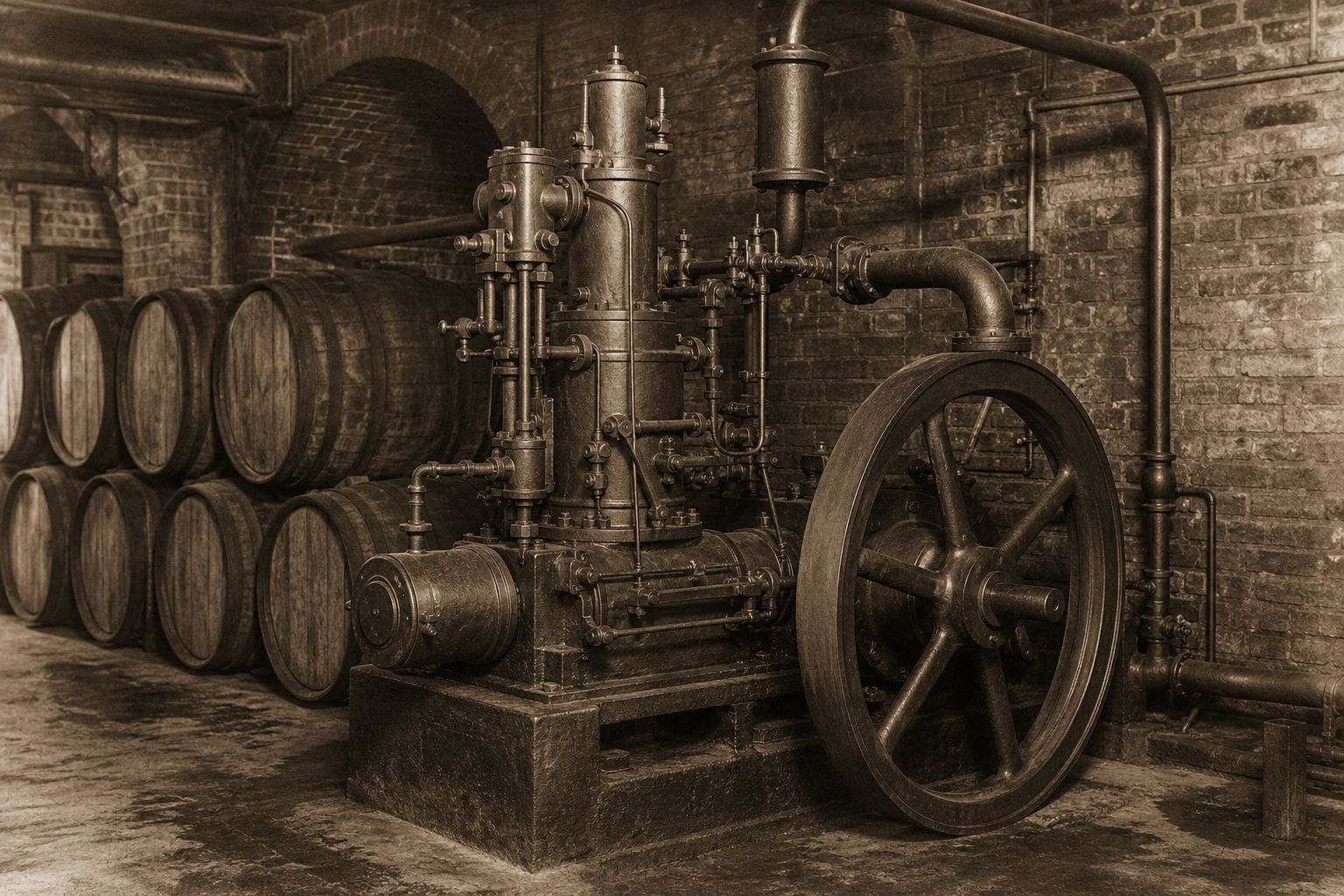
Industry came first. In 1876, the German engineer Carl von Linde built an ammonia compressor for a brewery in Trieste, so lager could be brewed even in summer.
Ammonia works well, but it is toxic, and so were the other early refrigerants.
A brewery machine A flywheel and compressor beside lager casks, in the style of an old photograph. AI-generated illustration.
1876
built for the Dreher brewery, Trieste
32 years
in service, until 1908
< 9 °C
needed to brew lager
Linde’s machine (Cooling Post)
Chapter IV · Cold for everyone
Linde’s ammonia machine
Cooling Post: Carl von Linde’s 1875 methyl-ether machine leaked; in 1876 he built an ammonia compressor at Maschinenfabrik Augsburg for the Dreher brewery in Trieste, in use until 1908. It allowed summer lager brewing; lager needs temperatures below 9 °C. Britannica and the IIR: Ferdinand Carré built an ammonia–water absorption machine in 1859.
The 3D scenes are simplified teaching models, not to scale; temperatures and colours in them are illustrative.
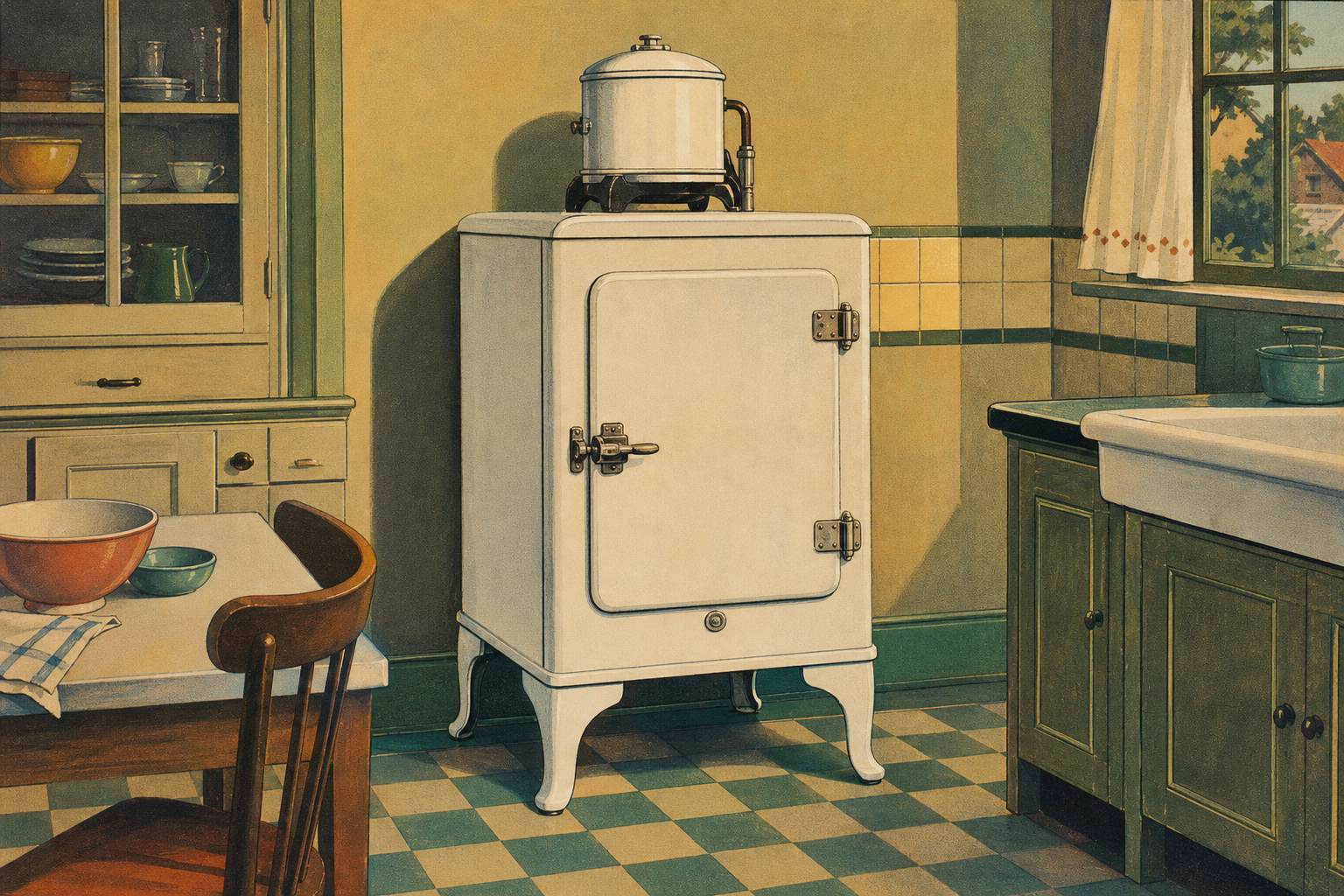
Home refrigerators followed. A famous American model of 1927 carried its round compressor on top, and its price soon fell from more than five hundred dollars to about two hundred.
But they still used toxic gases. In 1930, a team led by the chemist Thomas Midgley announced a safer one: a chlorofluorocarbon, or CFC.
To show it was safe to breathe, Midgley inhaled it and blew out a candle.
Compressor on top A 1920s-style kitchen fridge on legs, its machinery in a round turret. AI-generated illustration.
1910 GE Dumbbell
$1,000
1927 at launch
≈$525
a few years later
≈$200
A 1927 home fridge (Albany Institute)
ammonia: toxic
sulfur dioxide: toxic
methyl chloride: toxic
1930: dichlorodifluoromethane, a CFC
Refrigerants in 1930 (EBSCO)
Apr 1930
announced to chemists in Atlanta
1931
R-12 on the market
The new gas (EBSCO, IIR)
Chapter IV · Cold for everyone
The home fridge and CFCs
Albany Institute: GE’s first home unit, the 1910 “Dumbbell”, cost $1,000; its 1927 Monitor Top cost about $525 and fell to about $200 within a few years. EBSCO: in 1930 domestic refrigerants were ammonia, sulfur dioxide and methyl chloride, all toxic; Thomas Midgley’s team at Frigidaire and General Motors made dichlorodifluoromethane and announced it at the American Chemical Society meeting in Atlanta in April 1930; EBSCO dates his candle demonstration, in which he inhaled the gas and blew out a candle, to 1937, and accounts of it vary. The IIR dates the first fluorocarbons to 1930 and the market launch of R-12 to 1931.
The 3D scenes are simplified teaching models, not to scale; temperatures and colours in them are illustrative.
But CFCs had a hidden cost. In 1974, Mario Molina and Sherwood Rowland showed they could release chlorine high in the atmosphere. In 1985, the ozone hole was reported over Antarctica.
The Montreal Protocol of 1987, ratified by all 197 parties, phased CFCs out. Their replacements, hydrofluorocarbons or HFCs, spare the ozone but trap heat, so the Kigali Amendment of 2016 cuts them by over eighty percent in about thirty years.
Many fridges now use isobutane, which warms the planet only a tiny fraction as much as the HFC it replaced.
1974 Molina and Rowland: CFCs carry chlorine up
1985 ozone hole reported
1987 Montreal Protocol: universally ratified (197 parties)
2016 Kigali: HFCs cut >80% over about 30 years
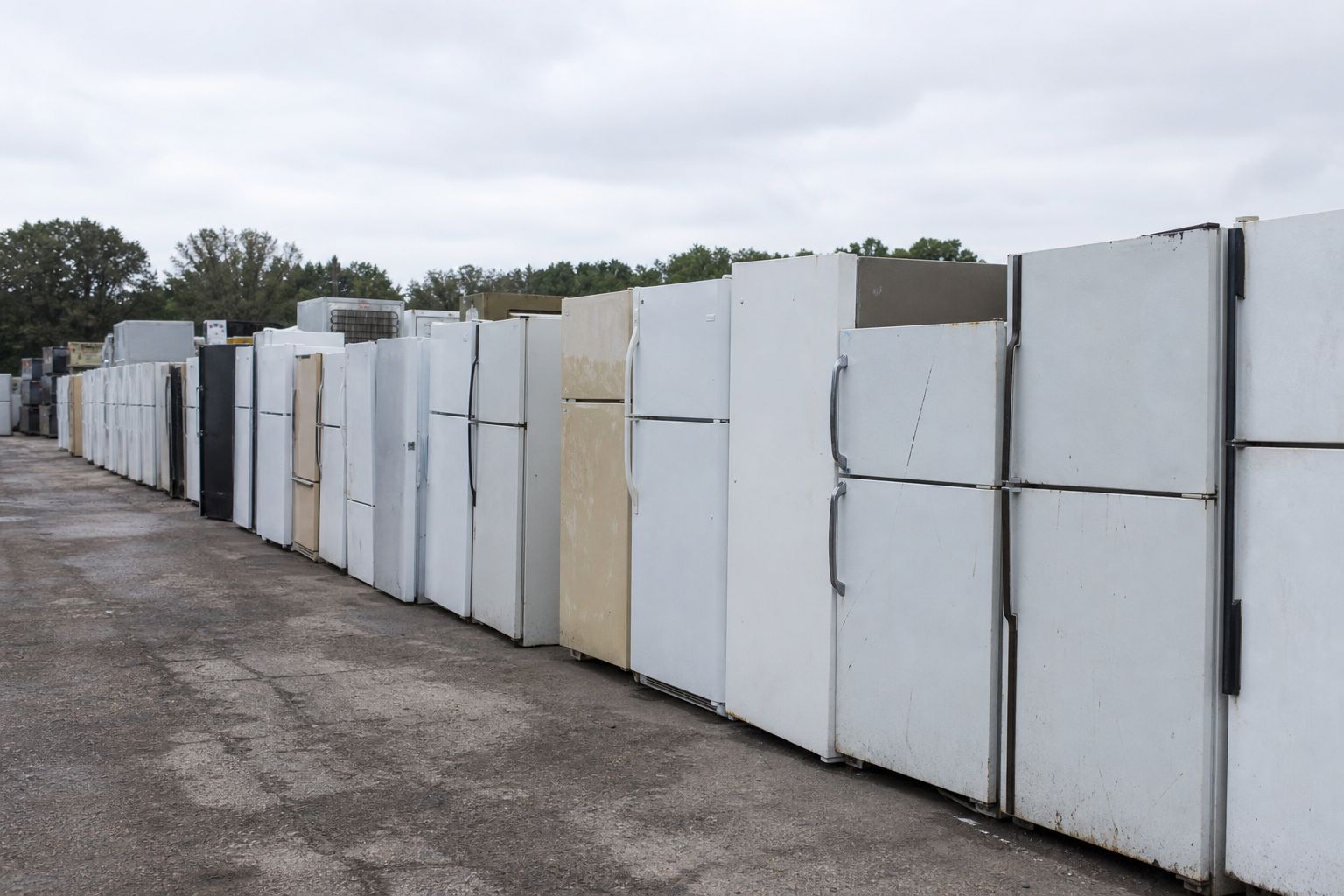
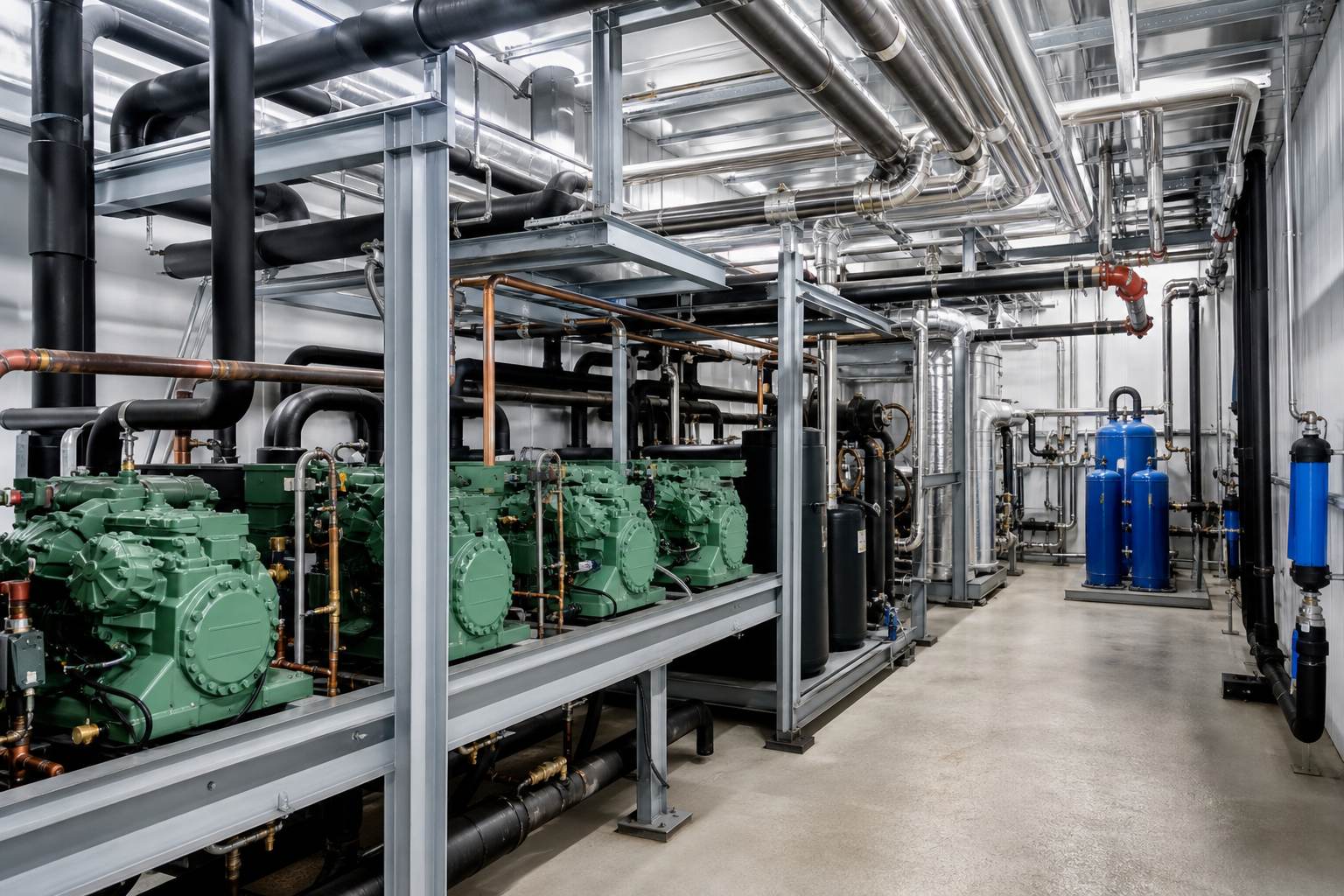
Fixing the fluid (UNEP, Britannica)Old fridges Discarded fridges wait so their refrigerant can be recovered before scrapping. AI-generated illustration.Supermarket plant Many European supermarkets now chill with carbon dioxide, GWP 1, at high pressure. AI-generated illustration.
HFC-134a
≈1,430
isobutane R-600a
8
propane R-290
3
Warming over 100 years, compared with HFC-134a (EPA)
Chapter IV · Cold for everyone
Ozone, climate and new refrigerants
Britannica: Molina and Rowland (1974) identified CFCs as a source of stratospheric chlorine; Farman, Gardiner and Shanklin of the British Antarctic Survey reported the ozone hole in 1985; Crutzen, Molina and Rowland shared the 1995 Nobel Prize in Chemistry. UNEP: the Montreal Protocol (1987) is universally ratified by 197 parties; the Kigali Amendment, adopted on 15 October 2016 and in force since 1 January 2019, cuts hydrofluorocarbons (HFCs) by more than 80% over about 30 years and could avoid up to 0.4 °C of warming by 2100. US EPA (2011): global-warming potentials of 8 for isobutane (R-600a), 3 for propane (R-290) and about 1,430 for HFC-134a; both hydrocarbons are highly flammable, so charge sizes are limited. EPA: CO₂ (R-744, GWP 1) is used in European and Australian supermarket systems.
This film keeps the ozone story short; PlanetPast’s film on the ozone layer tells it in full.
The 3D scenes are simplified teaching models, not to scale; temperatures and colours in them are illustrative.
Refrigeration now holds up modern life. According to the UN Environment Programme and the FAO, twelve percent of the world’s food is lost for lack of it.
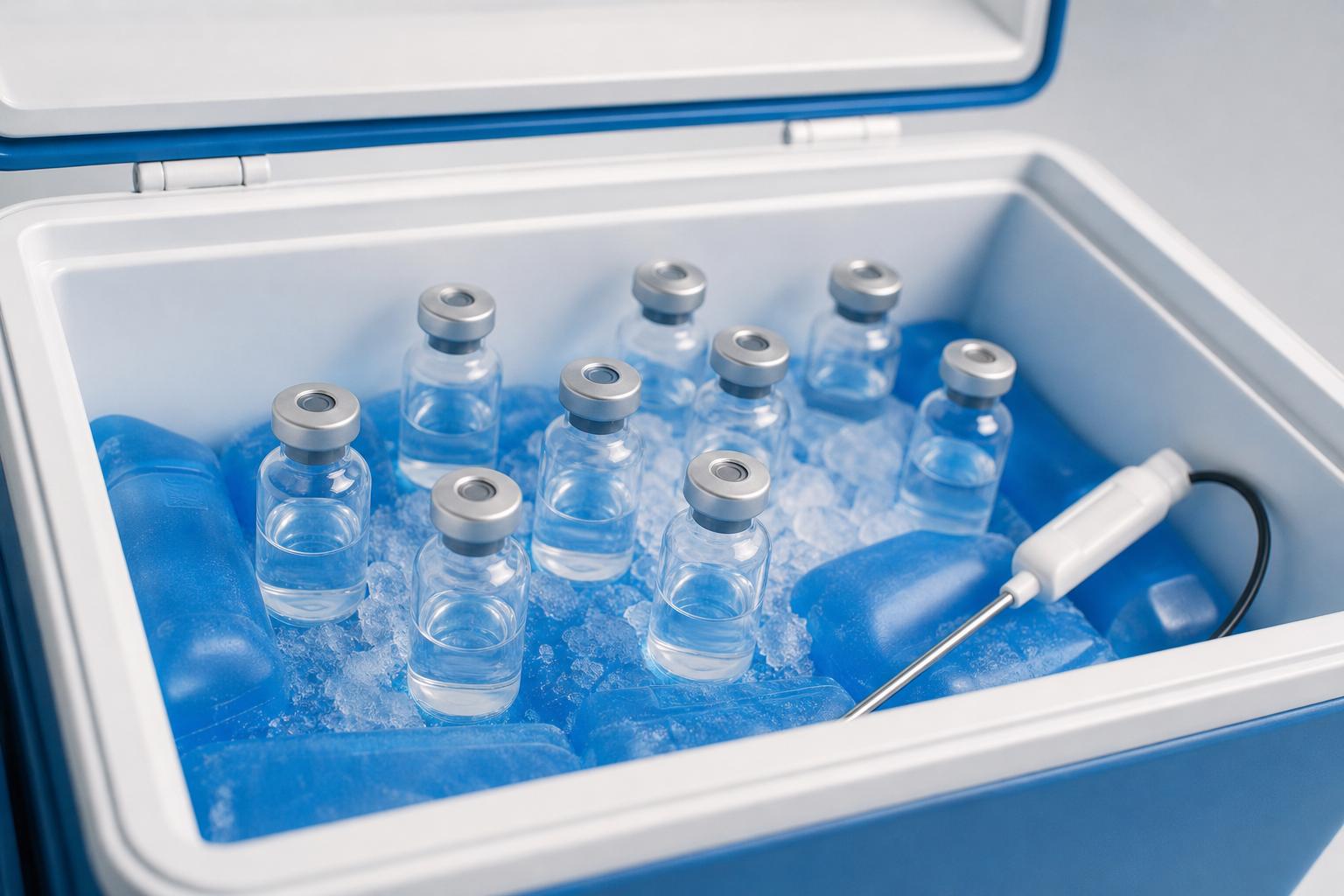
Vaccines in a fridge are kept between two and eight degrees. One warm link anywhere in the chain can spoil everything that passes through it.
The International Institute of Refrigeration estimates that refrigeration, air conditioning and heat pumps together use about a fifth of the world’s electricity.
And according to ASEAN Briefing, Thailand was the world’s third-largest exporter of air conditioners in 2024.
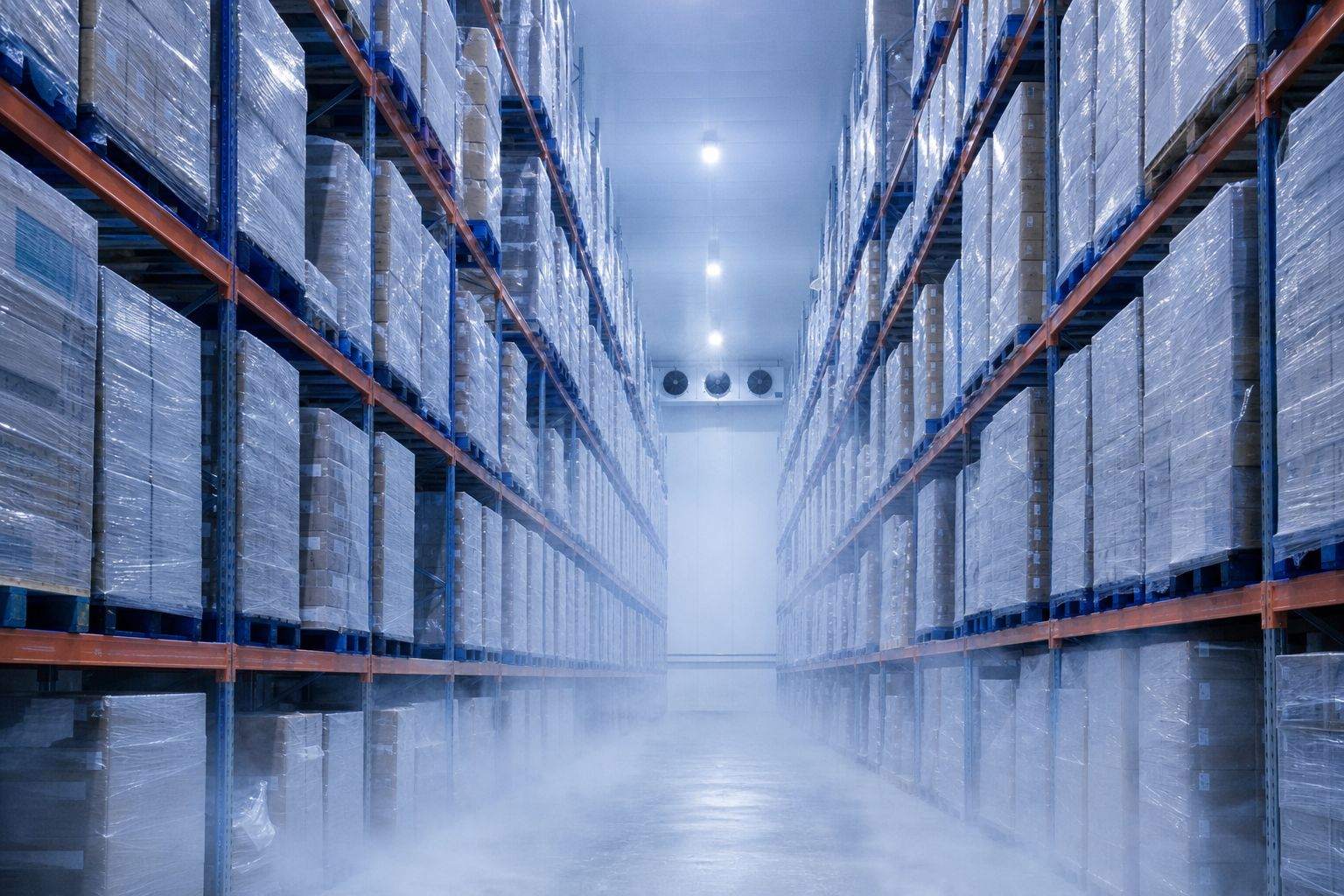
Cold store UNEP and FAO put the loss at 526 million tonnes of food a year (2022). AI-generated illustration.2–8 °C Vials on ice packs: the CDC range for vaccines in a fridge is 2 to 8 °C. AI-generated illustration.
≈20%
of world electricity: refrigeration, AC and heat pumps
≈5 bn
systems in use worldwide
Cooling’s share (IIR 2019)
≈19 million
air conditioners produced
US$7.0 bn
air-conditioner exports
Thailand, 2024 (ASEAN Briefing)
Chapter V · The cold chain
The cold chain
UNEP and FAO (12 November 2022): 526 million tonnes of food, 12% of global production, are lost for lack of refrigeration; the report calls sustainable cold chains critical to feeding the additional two billion people expected by 2050. CDC: vaccines are stored in a refrigerator at 2–8 °C. International Institute of Refrigeration (2019): about 5 billion refrigeration, air-conditioning and heat-pump systems use about 20% of the world’s electricity. IEA (2018): air conditioners and electric fans alone use about 10% of global electricity. ASEAN Briefing: in 2024 Thailand was the world’s third-largest air-conditioner exporter, after China and Mexico, with exports of US$7.04 billion from about 19 million units. EGAT’s Label No. 5 began with refrigerators; the air-conditioner label started on 20 September 1994 (IEA policy database), and EGAT marked 30 years of the scheme in 2025.
The 3D scenes are simplified teaching models, not to scale; temperatures and colours in them are illustrative.
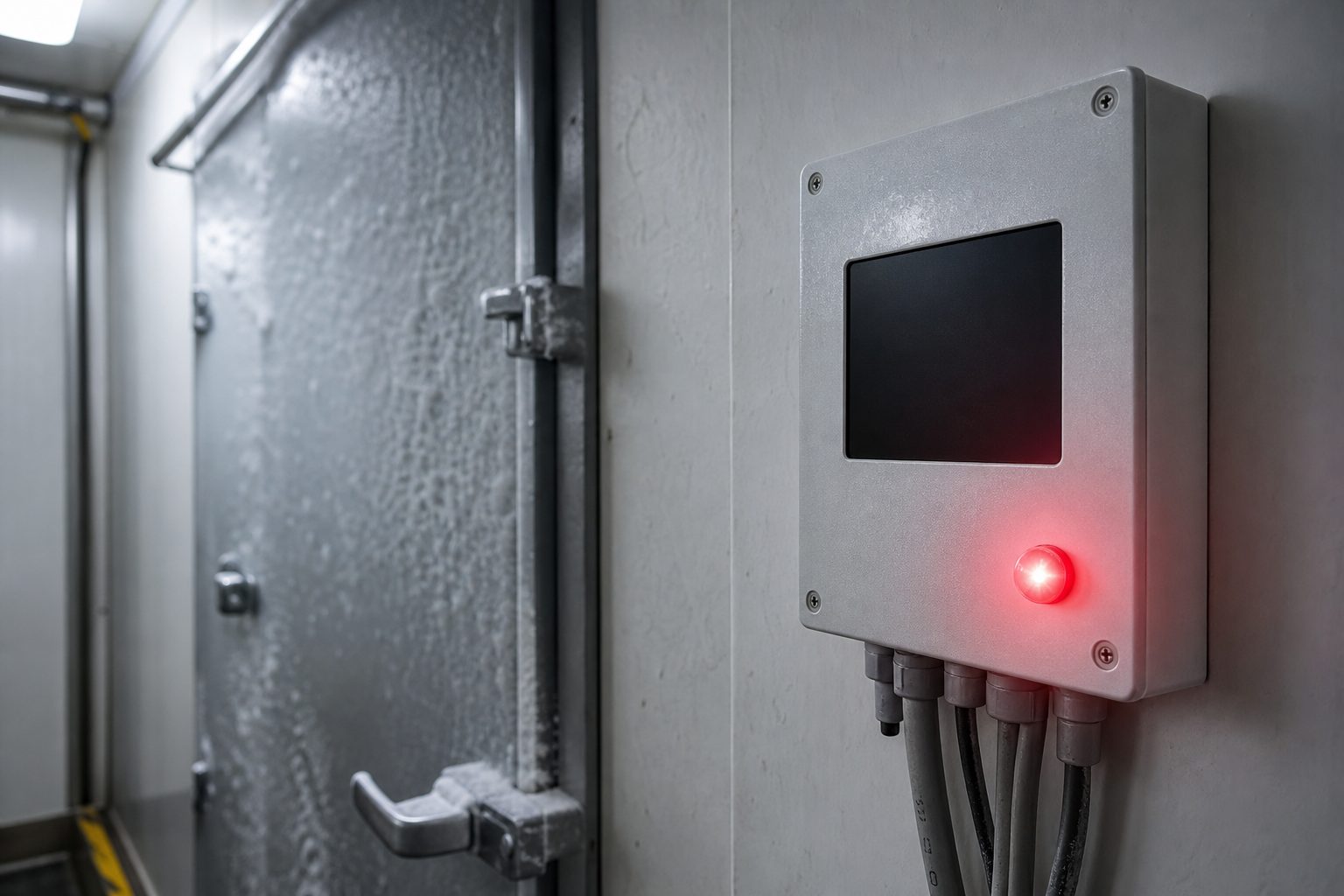
The newest part of a commercial system is its controller. It holds the temperature, raises alarms, and runs defrosting, briefly warming the cold coil to melt its ice. Those exposed to the internet are the targets.
Someone who reaches one can change its setpoint or force a heating or defrost cycle, and the food or medicine inside warms. In November’s second wave, some units reached fifty degrees.
The agencies’ advice is plain: keep controllers off the public internet, change default passwords, and keep the software up to date.
Alarm A cold-room controller beside a frosted door, its warning light on. AI-generated illustration.
115+
stores hit
6
European countries
The second wave (BleepingComputer)
take controllers off the public internet
remote access only through a secured firewall or VPN
change default passwords, use multi-factor login
patch firmware; set safe temperature limits and alarms
CISA and FBI advice
Chapter V · The cold chain
What the agencies advise
Help Net Security and BleepingComputer (5–6 November 2026): attackers can change setpoints or force units into heating or defrost, leading to “widespread inventory loss and equipment hazards”. A second wave in November hit more than 115 stores in six European countries, some units reaching 50 °C. Recommended: remove controllers from the public internet; put remote access behind a secured firewall or VPN; change default passwords and use multi-factor authentication; patch firmware and replace unsupported devices; separate operational networks from business networks; set safe temperature limits, keep logs and alerts, and keep offline backups.
The model’s setpoint and temperatures are illustrative and show only the effect described in the advisory.
The 3D scenes are simplified teaching models, not to scale; temperatures and colours in them are illustrative.
Cold is never made. It is heat carried away, all day and all night, by machines that someone has to tell how hard to work.
It began in a Glasgow laboratory, grew up on brewery floors, and now guards our food, our medicines and our blood.
So keeping things cold now also means keeping control of the small boxes that give those orders.
1748 Cullen’s evaporation experiment
1806 Tudor’s first ice cargo
1834 Perkins’s vapour-compression patent
1876 Linde’s ammonia compressor
1927–1930 home fridges; CFCs announced
1987, 2016 Montreal Protocol; Kigali Amendment
2026 warning on networked controllers
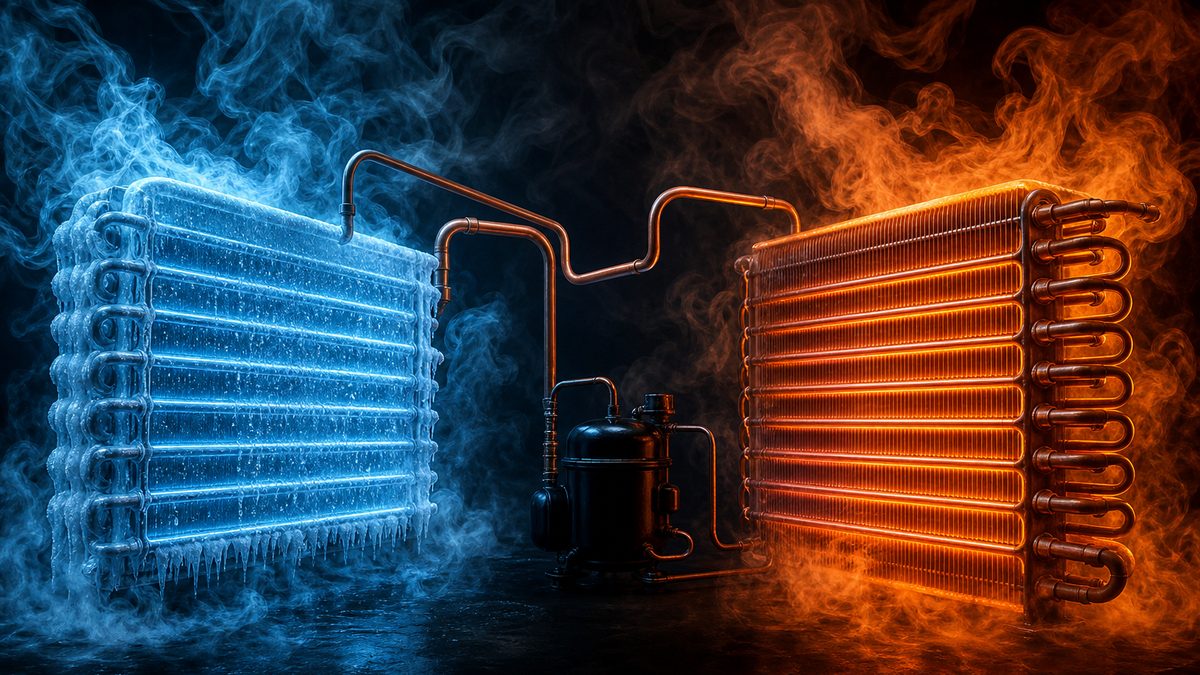
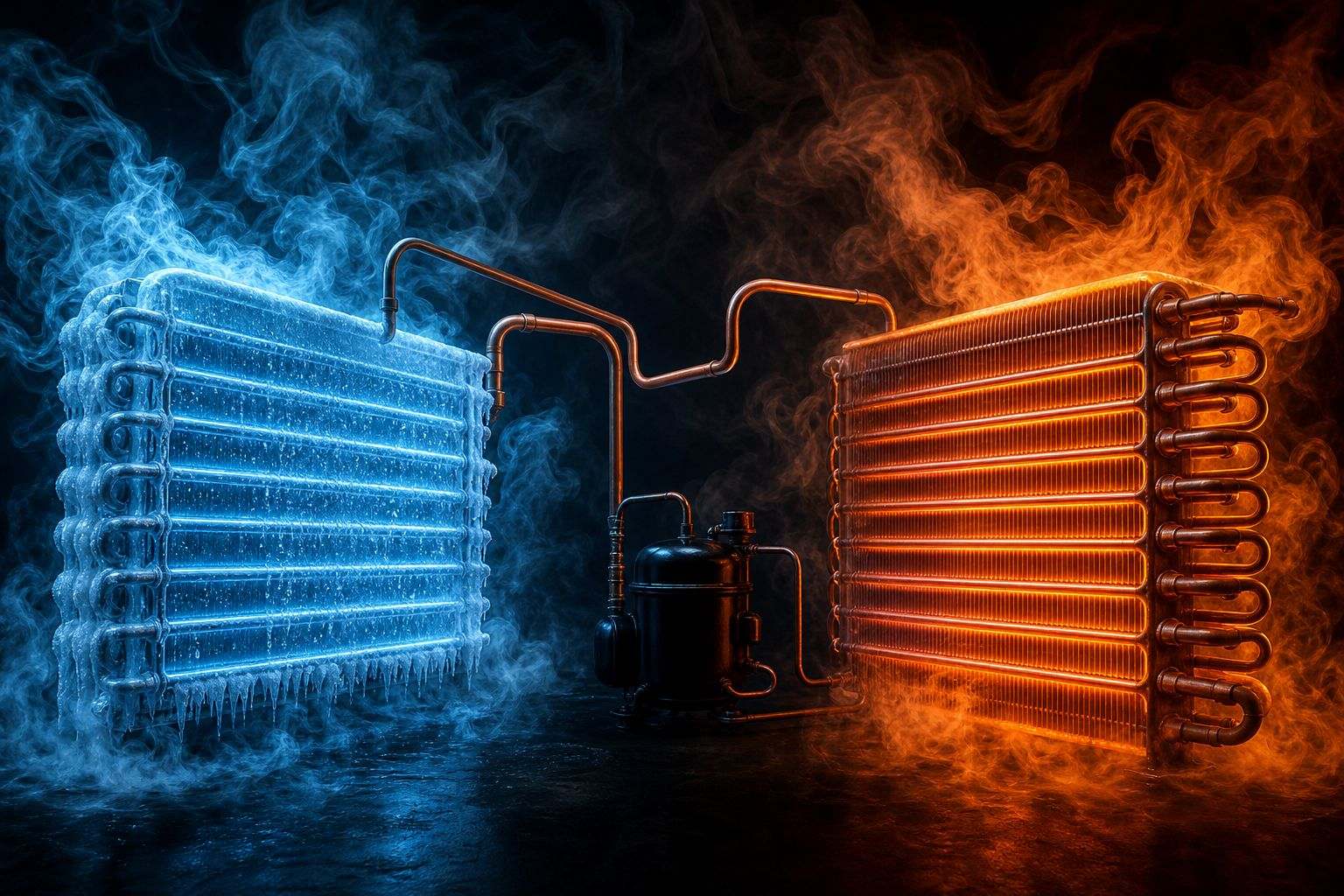
Refrigeration: a timelineCold and hot The cold coil and the hot coil: two ends of one loop. AI-generated illustration.
heat flows hot → cold unless work pushes it
evaporating takes heat; condensing gives it back
pressure decides where a liquid boils
Remember
Epilogue · Sources
Sources
Every fact in this film comes from the sources below. Where sources give different dates (Cullen 1748 or 1755; Perkins 1834 or 1835), both are named in the panels. The chapter stills and pictures are AI-generated illustrations and show no real people or products. The fridge, the molecules and the cold chain are simplified teaching models; temperatures in them are illustrative. Security advice is given in general terms only, as the agencies published it.