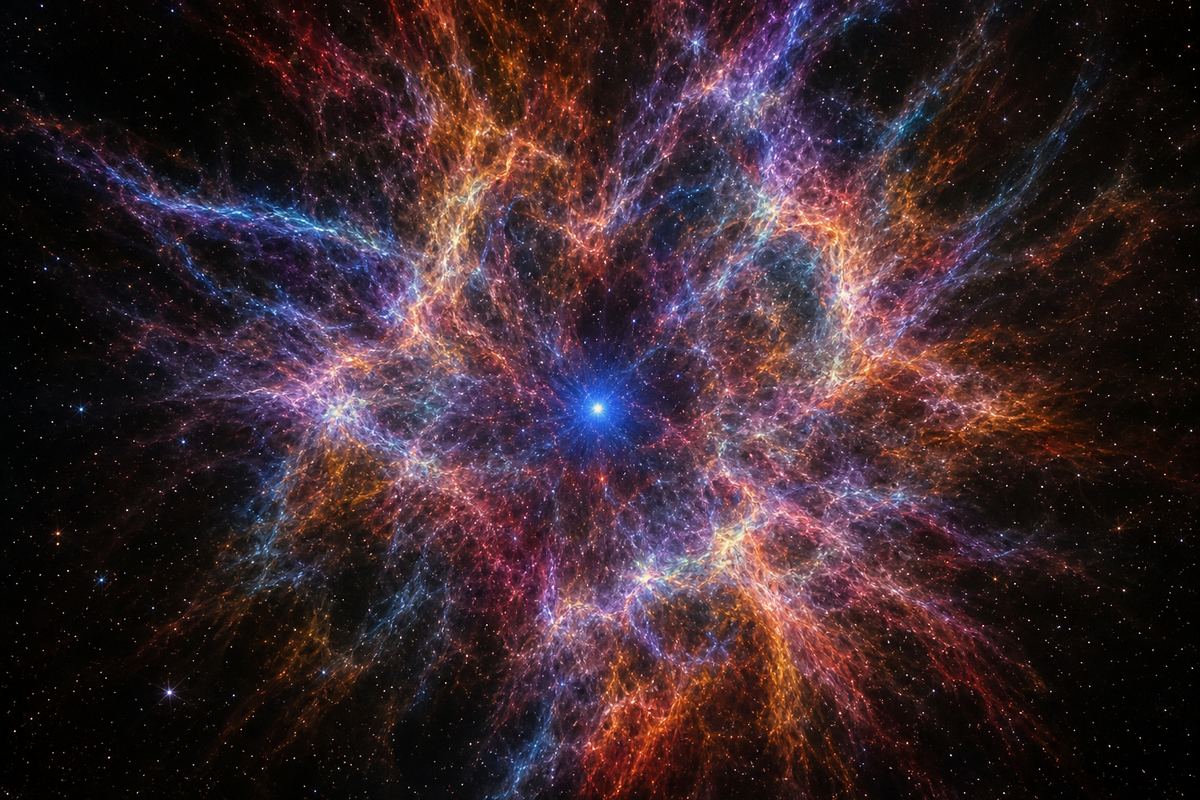
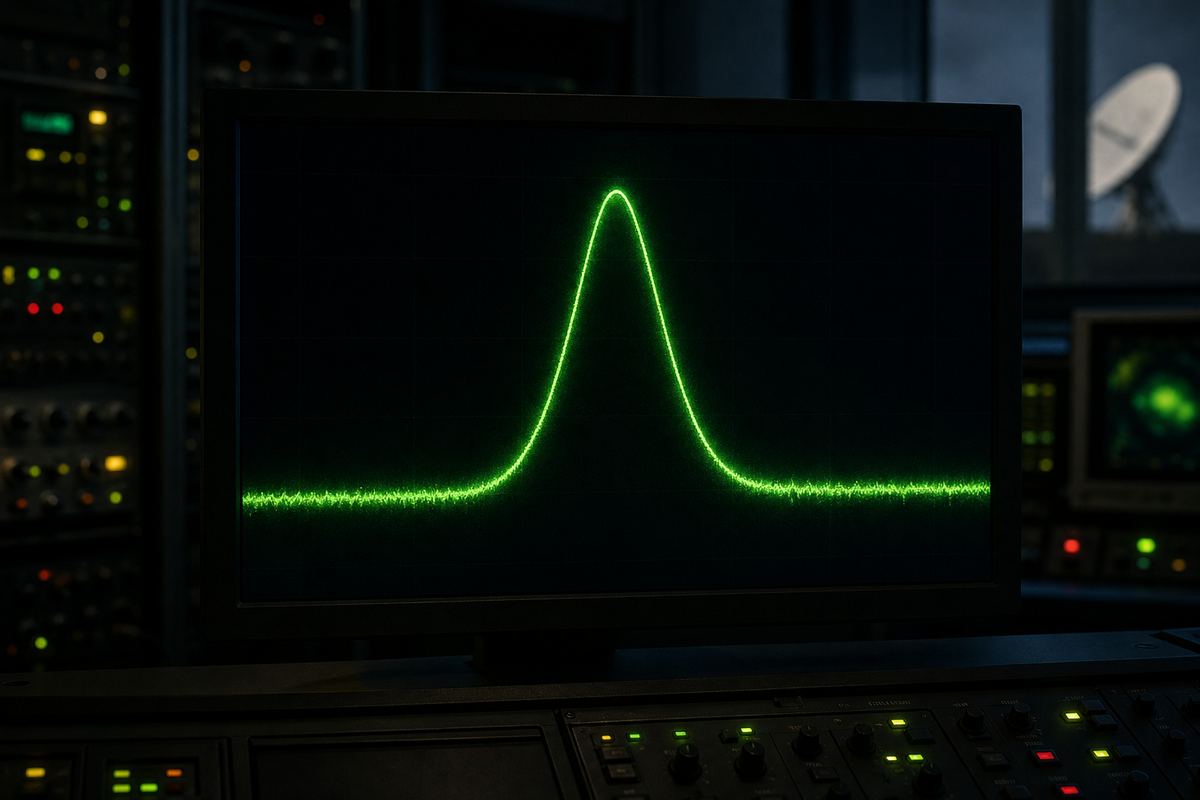
In November 2026 astronomers reported a dead star that spins every eight minutes and sends radio pulses while it orbits a Sun-like star. This film explains the stars behind such signals: how a massive star's collapse leaves a neutron star about 20 kilometres across, why a tilted magnetic field turns it into a cosmic lighthouse, how a student's 'scruff' on chart paper revealed the first pulsar in 1967, the Crab pulsar born in the supernova of 1054, pulsars spun up to 716 turns a second, pulsar clocks that gave evidence of gravitational waves, magnetars, and the slow new pulses nobody can yet explain.
Interactive 3D film10 min1054 to 2026Published 17 November 2026
In November 2026, astronomers in Australia reported a strange signal: radio pulses that repeat every eight minutes.
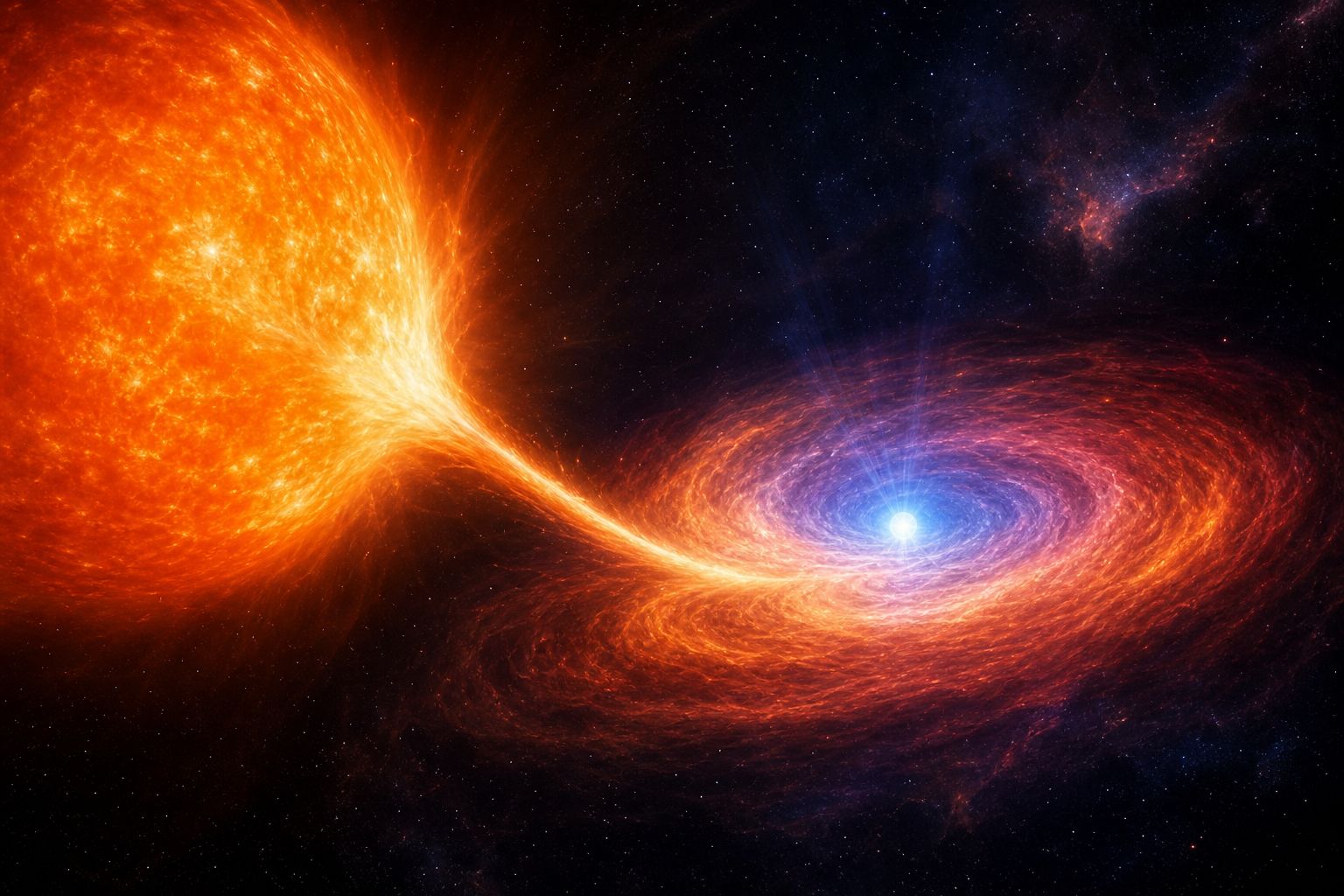
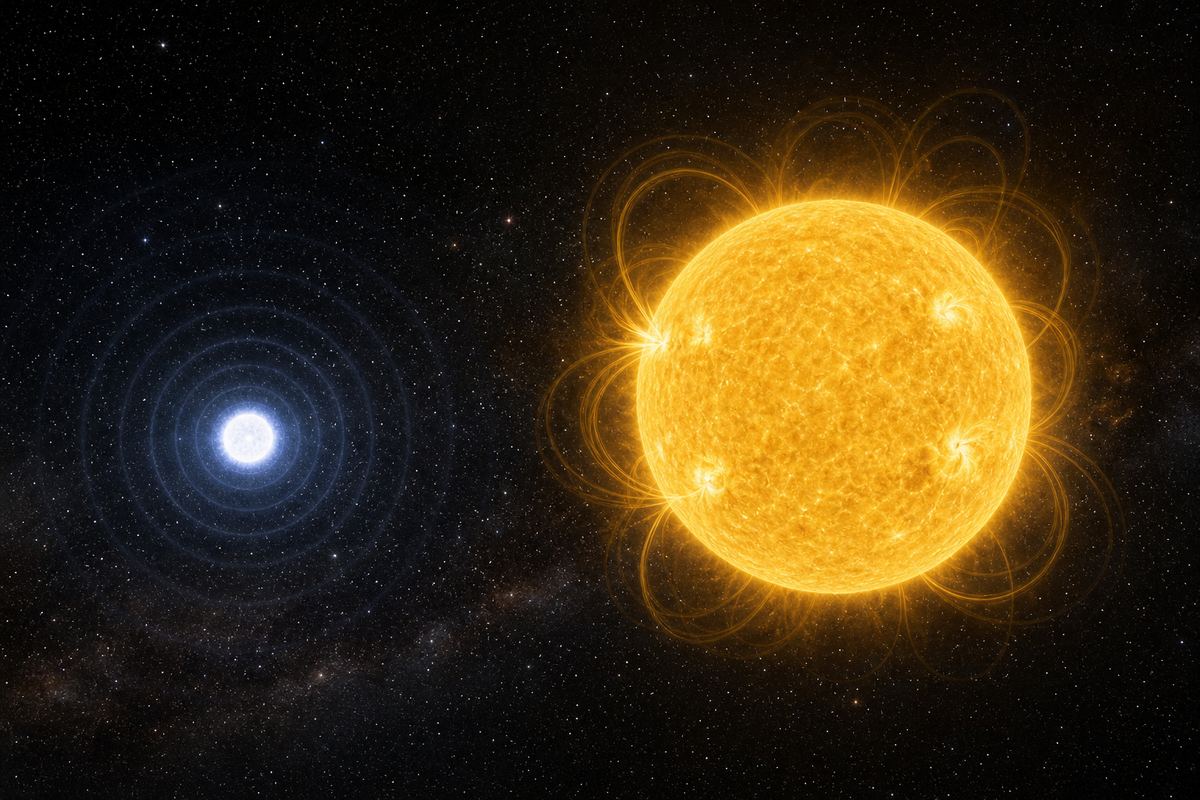
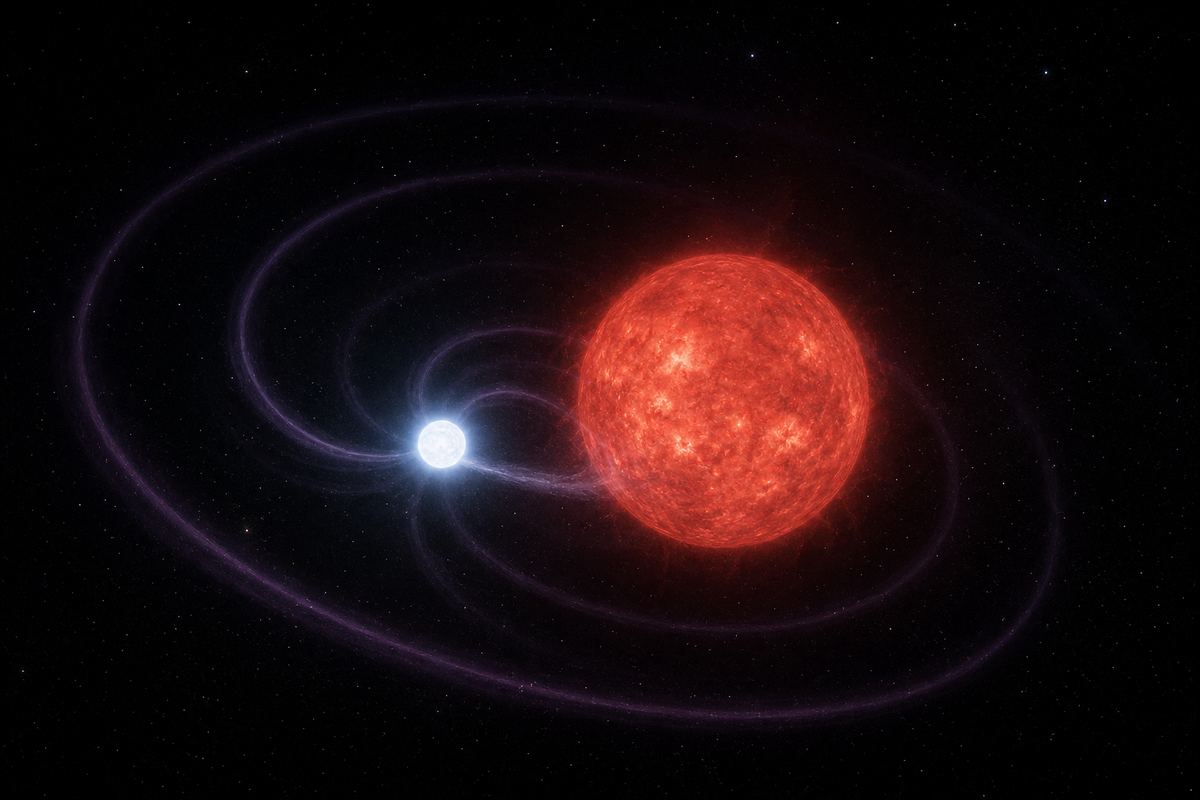
They are tied to a dead star, a white dwarf, which spins once every eight minutes as it orbits a star much like our Sun, more than five thousand light-years away.
A white dwarf is a lighter kind of dead star than the neutron stars this film is about.
Nobody is sure yet how it makes them. But astronomers have been hearing regular pulses from dead stars for almost sixty years.
Most come from pulsars: spinning neutron stars that sweep a beam across space like a lighthouse. Here is how they work, and what they have taught us.
Astronomers discover a dead star spinning every 8 minutes and sending mysterious radio pulsesHeadline, ScienceDaily, 15 November 2026
8 min
one spin, one pulse
5,000+ ly
distance from Earth
2026
Nature Astronomy paper
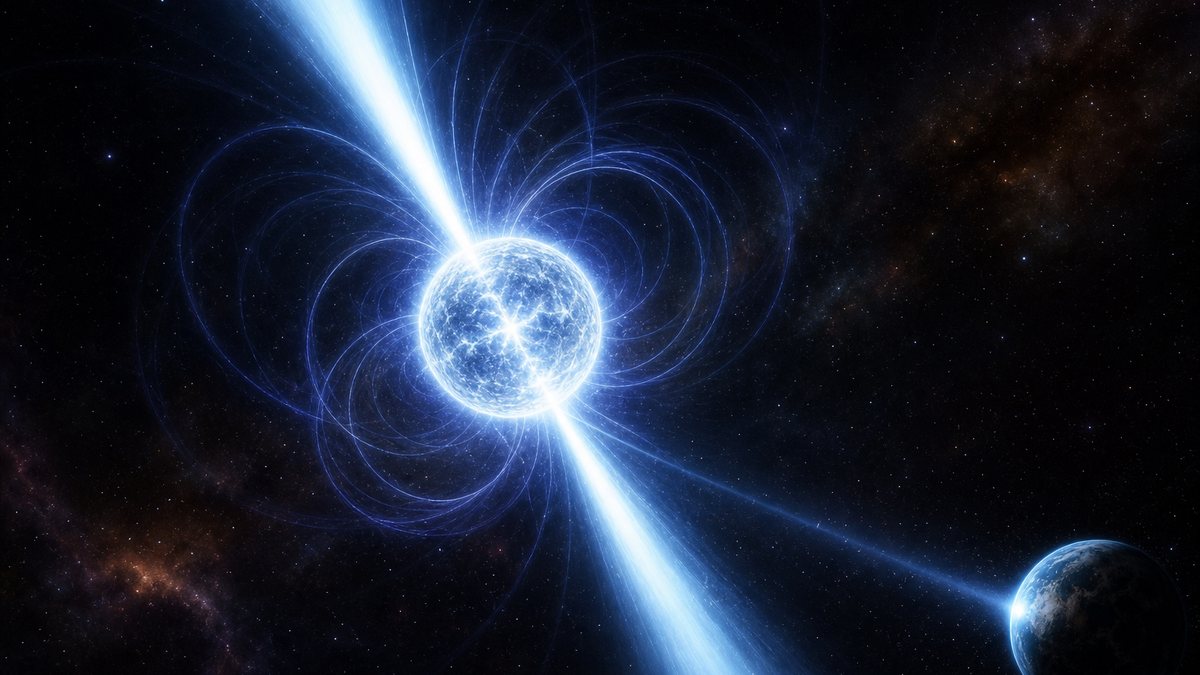
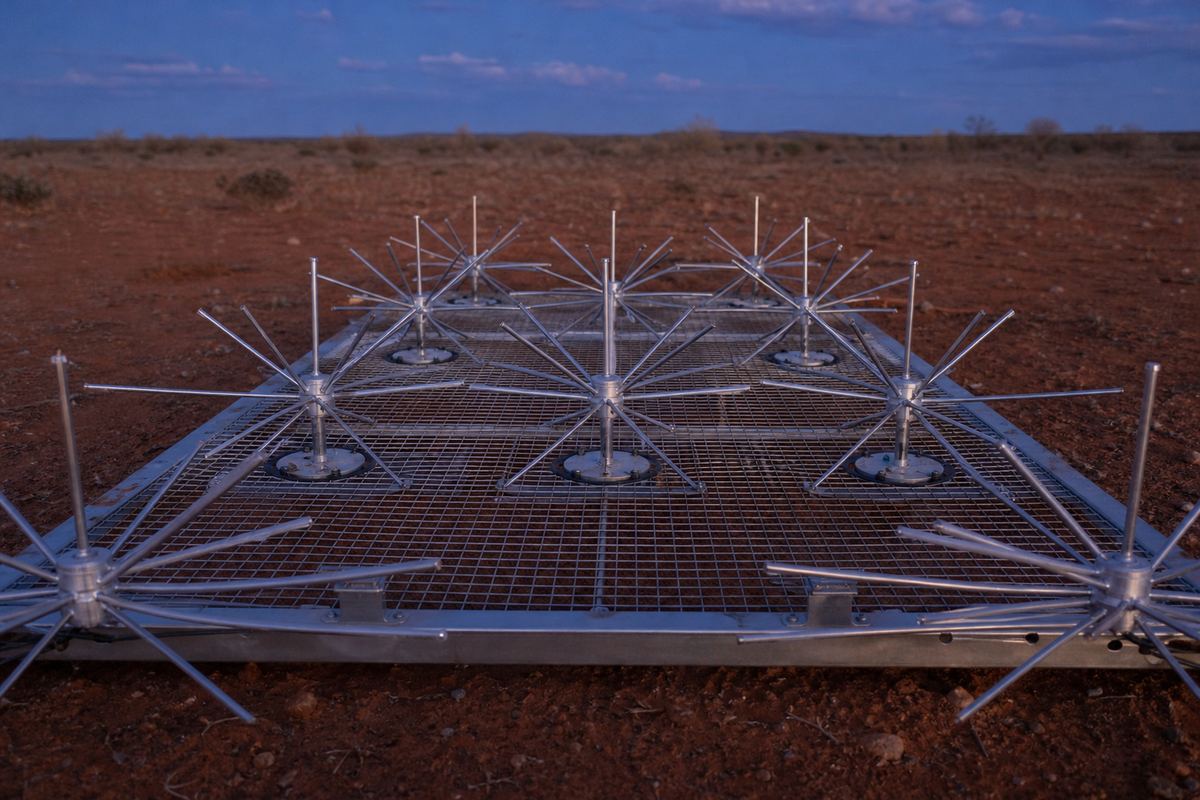
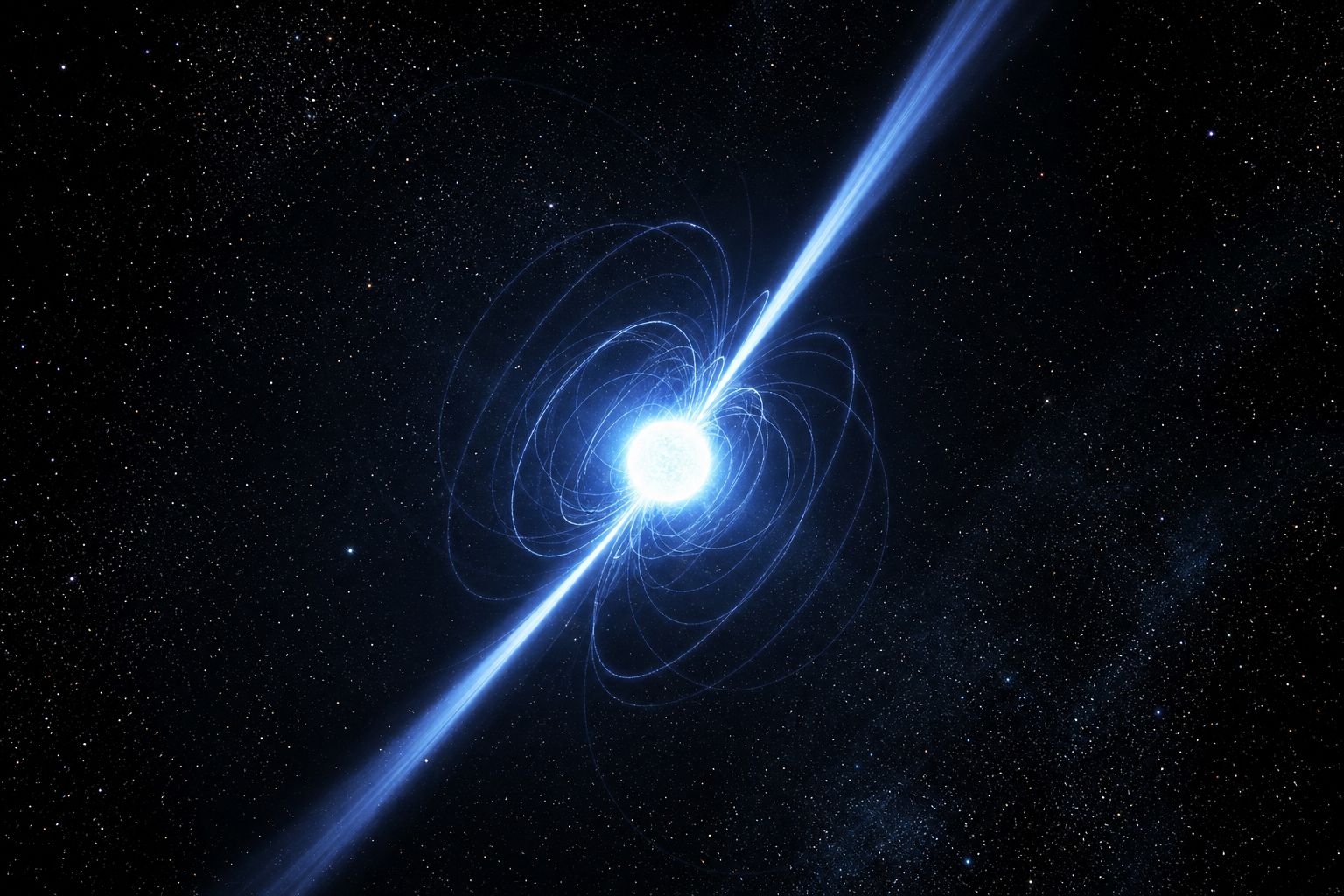
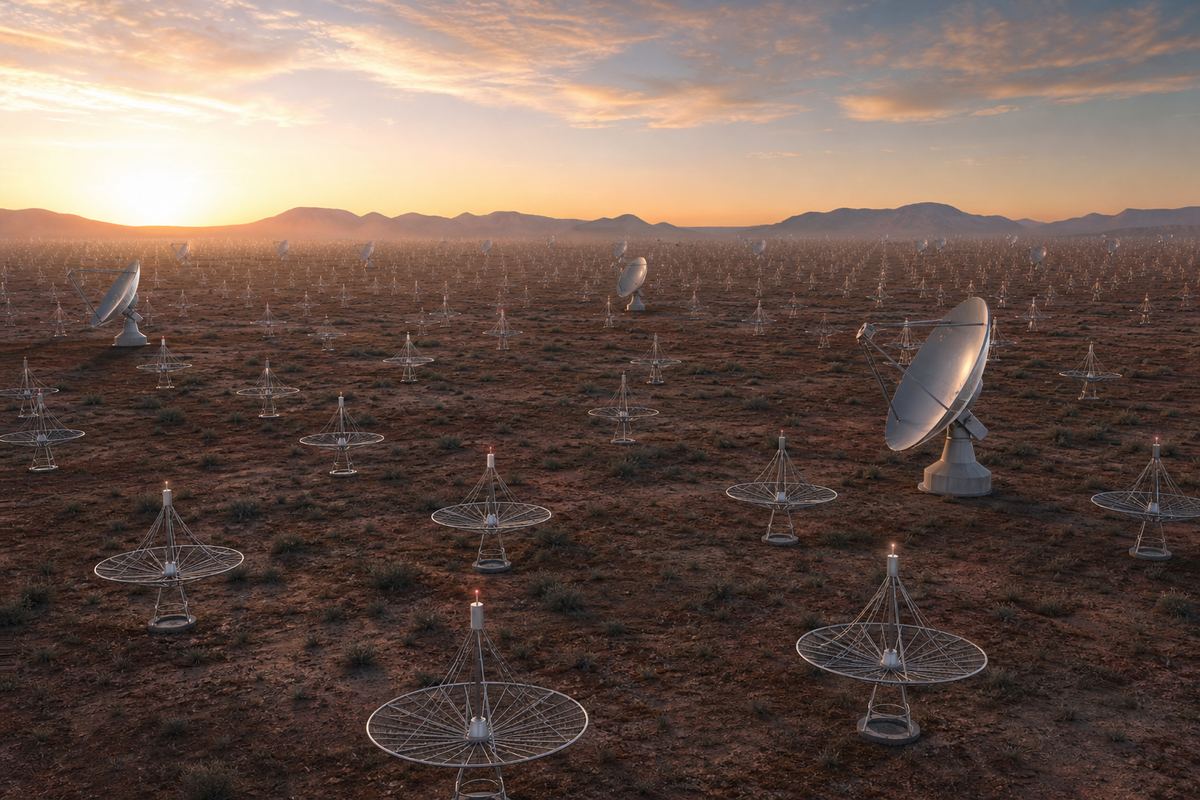
GPM J0715, in numbersWhere it was found A tile of small spider-like antennas, like those of the Murchison Widefield Array in the Western Australian outback. AI-generated illustration.A pulsar Two beams leave the magnetic poles of a neutron star, tilted away from the axis it spins on. AI-generated illustration.
Prologue
The news
ICRAR via ScienceDaily (15 November 2026) and Phys.org: a white dwarf in the system GPM J071507−114153 spins every eight minutes and sends radio pulses as it orbits a G-type, Sun-like star more than 5,000 light-years away. It was found with the Murchison Widefield Array, located precisely with MeerKAT, and its companion confirmed with the W. M. Keck Observatory. The paper, by Samuel McSweeney, Natasha Hurley-Walker and colleagues, is in Nature Astronomy.
How the pulses are made is not yet known; the film comes back to this at the end.
The 3D scenes are simplified teaching models: stars, beams, orbits and distances are drawn schematically and not to scale.
In the year 1054, sky watchers in China saw a new star appear. It was six times brighter than Venus.
It was the brightest such event in recorded history: a giant star exploding, a supernova.
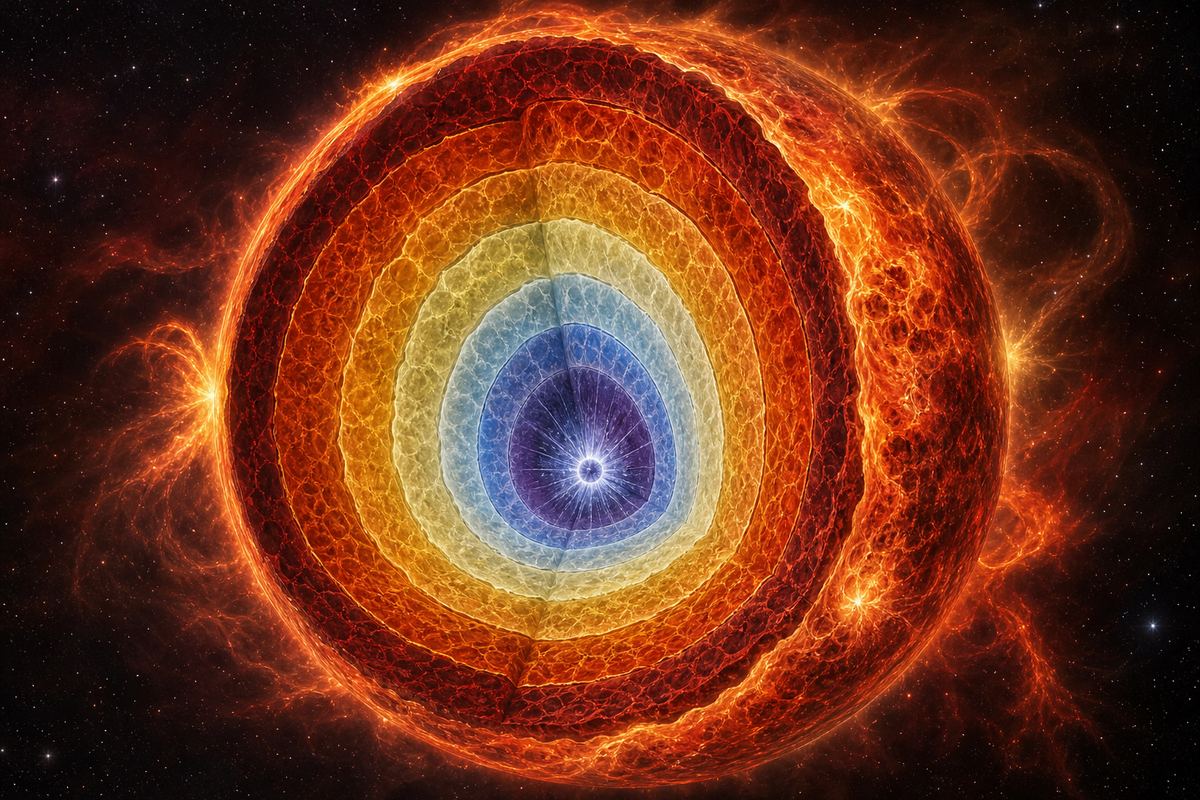
When a star much more massive than the Sun runs out of fuel, its core collapses under its own weight. That collapse is what blows the rest of the star apart.
The wreckage of that explosion is still glowing in our telescopes, as we will see.
A new light in the sky An old-style landscape painting with one star outshining all the rest. AI-generated illustration.
1054
year Chinese astronomers recorded it
6 × Venus
how bright it shone
The new star of 1054Inside a dying giant Layer upon layer of burning gas, and at the centre a core about to give way. AI-generated illustration.
a glowing, expanding cloud of debris
a crushed core at the centre
for the star of 1054: the Crab Nebula
What a supernova leaves
Chapter I · A star dies
The new star of 1054
Chandra X-ray Observatory: in 1054 AD Chinese sky watchers recorded a “new star” six times brighter than Venus, the brightest stellar event in recorded history. Its remains are the Crab Nebula. NASA: a neutron star forms when the core of a massive star collapses.
Press “Collapse” to crush the core again.
The 3D scenes are simplified teaching models: stars, beams, orbits and distances are drawn schematically and not to scale.
The collapse is so violent that protons and electrons are crushed together into neutrons.
If what is left of the core weighs between about one and three times the mass of the Sun, it becomes a neutron star.
Any heavier, and nothing can stop the collapse. It becomes a black hole.
protons + electrons → neutrons
the core shrinks to a ball
what is left depends on its mass
In the collapse
~1 to 3 Suns
a neutron star
more than 3
a black hole
Mass of the collapsed coreWhat is left A tiny, hot remnant glows inside the debris of the explosion. AI-generated illustration.
Chapter I · A star dies
A neutron star is born
NASA Imagine the Universe: when the core of a massive star collapses, protons and electrons are crushed together into neutrons. If the core has between about 1 and 3 solar masses, a neutron star is left; if it has more, the collapse continues into a black hole.
Press “1.4 Suns” or “4 Suns” to choose the mass of the core.
The 3D scenes are simplified teaching models: stars, beams, orbits and distances are drawn schematically and not to scale.
A neutron star is only about twenty kilometres across, the size of a city.
Yet into that small ball it packs about half a million times the mass of the Earth.
It is the densest object known. On Earth, a sugar cube of neutron star matter would weigh about a billion tons.
Squeezed that tight, the star is made almost entirely of neutrons. Hence the name.
City-sized A ball about 20 km wide would cover a large city from edge to edge. AI-generated illustration.
~20 km
diameter
~500,000 ×
the mass of Earth
1–3 Suns
mass of the collapsed core
A neutron starOne sugar cube About a trillion kilograms in a cube you could hold between two fingers. AI-generated illustration.
protons and electrons crushed together
what is left is almost all neutrons
the densest object known
Why “neutron star”
Chapter I · A star dies
Size and density
NASA Imagine the Universe: a neutron star is about 20 km in diameter and holds about half a million times the mass of the Earth. It is the densest object known: a sugar cube of neutron star material would weigh about 1 trillion kilograms (1 billion tons) on Earth.
Press the buttons to compare the star with a city, or to drop a sugar cube of it beside the city.
The 3D scenes are simplified teaching models: stars, beams, orbits and distances are drawn schematically and not to scale.
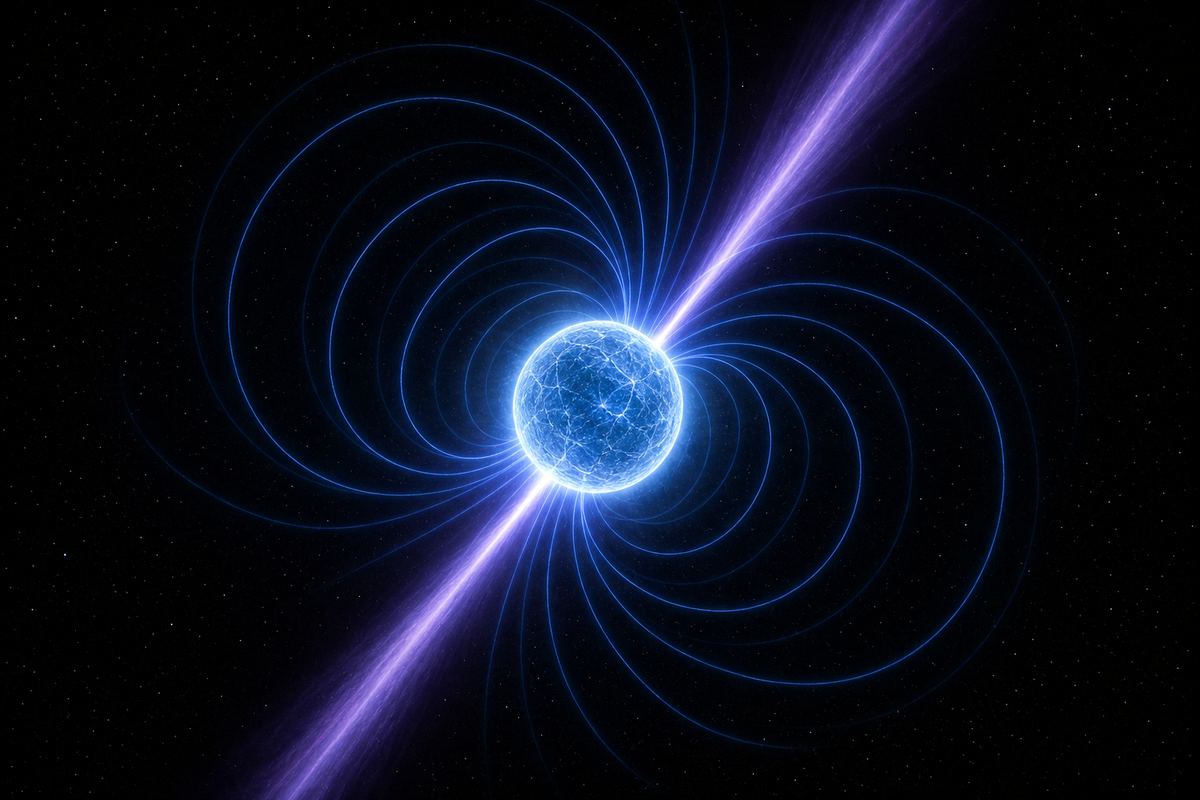
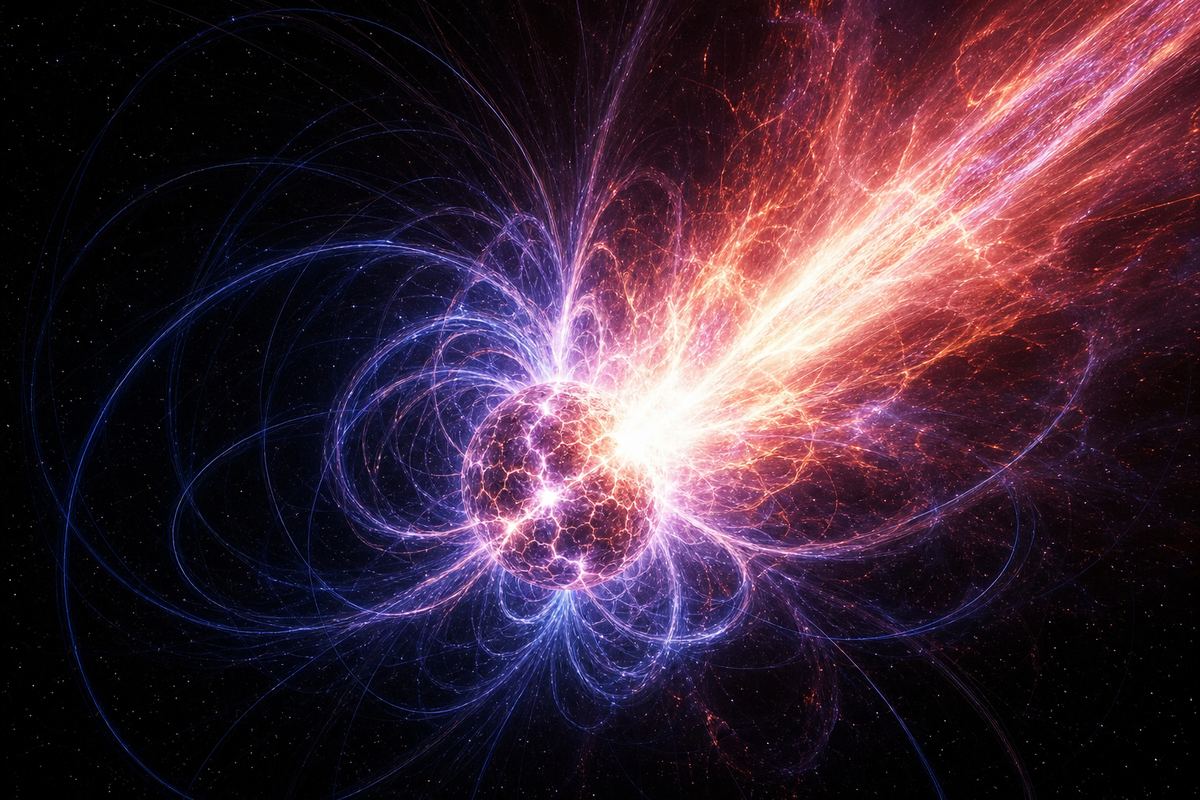
Neutron stars spin, and their magnetic fields are trillions of times stronger than the Earth's.
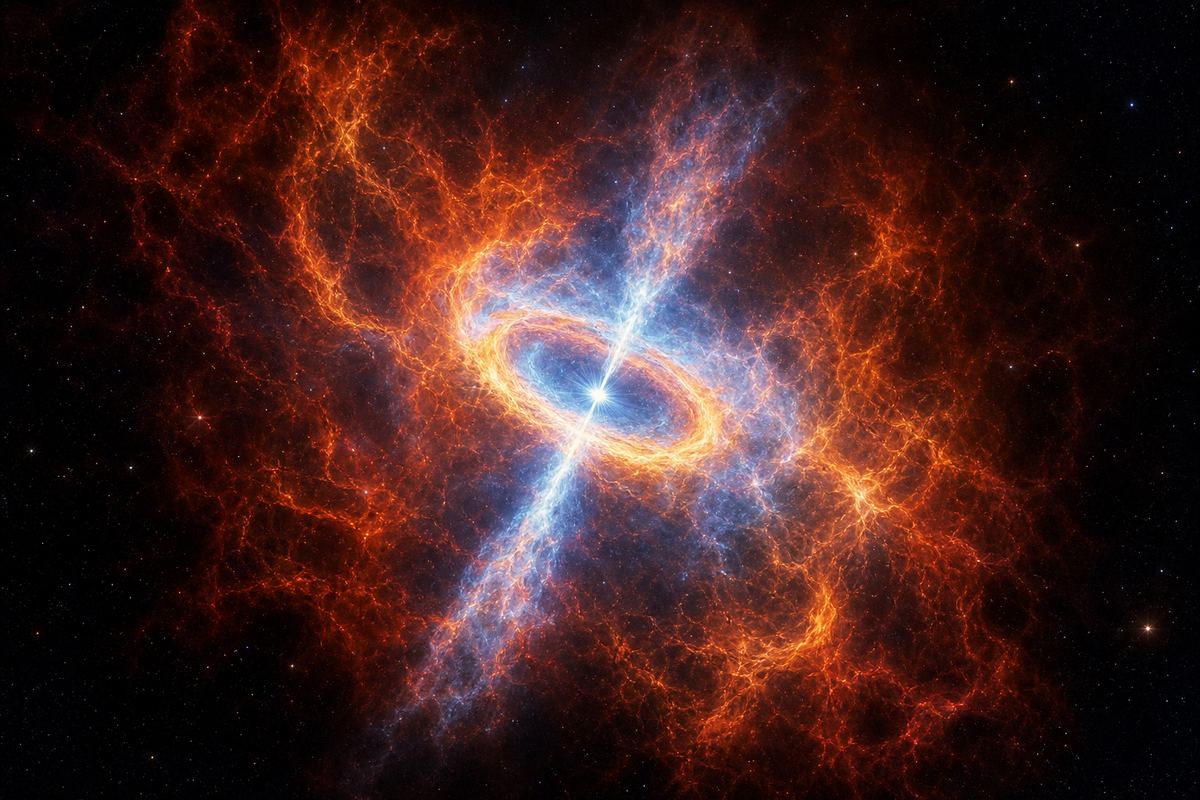
Out of the star's two magnetic poles stream two narrow beams of radiation.
The magnetic axis is often tilted away from the axis the star spins around. So as the star turns, the beams sweep around the sky.
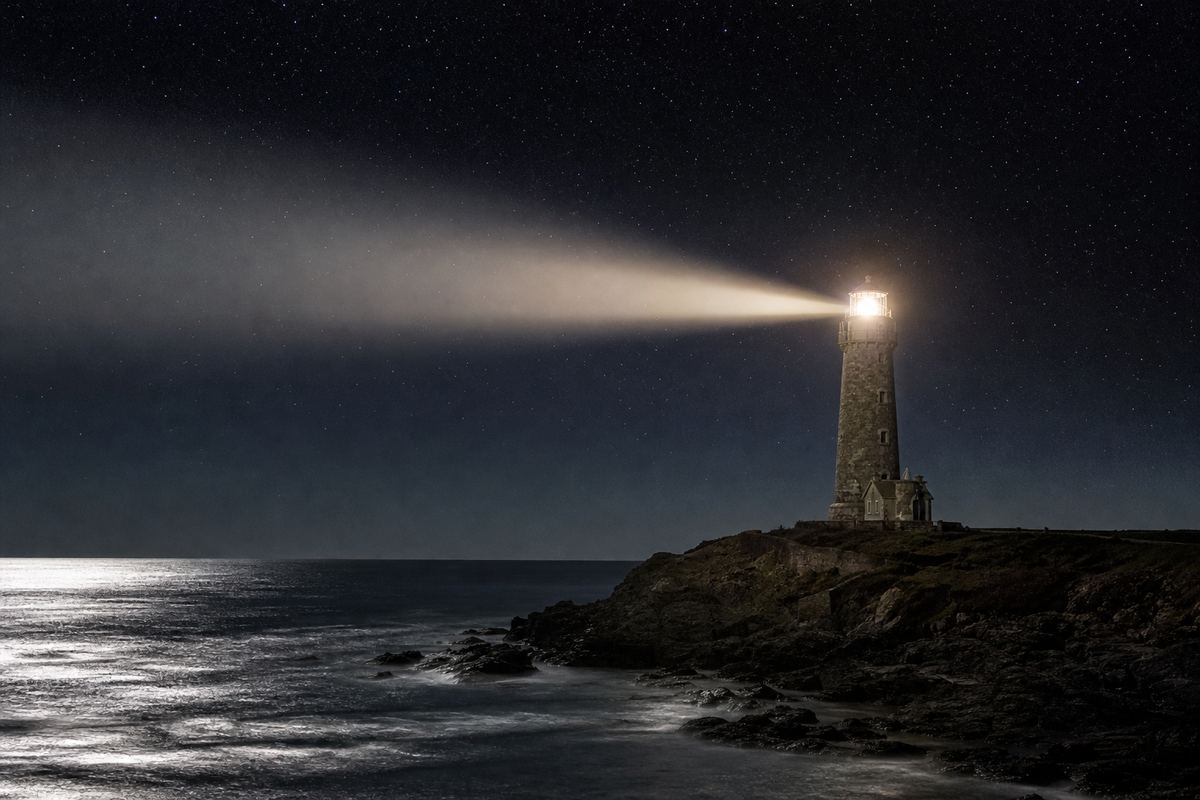
Each time a beam crosses the Earth, we see a pulse. Like a lighthouse, the star seems to blink.
The beam never switches off. We only catch it when it points our way.
trillions ×
Earth’s magnetic field
The magnetTwo axes Field lines loop from pole to pole; the beams leave along the magnetic axis, not the spin axis. AI-generated illustration.The comparison A ship sees the light only when the turning beam points its way, and darkness in between. AI-generated illustration.
Chapter II · The lighthouse
The lighthouse model
NASA Imagine the Universe: pulsars are rotating neutron stars. Their magnetic field is trillions of times stronger than the Earth’s. The magnetic axis is often not aligned with the spin axis, so the beams from the magnetic poles are swept around as the star rotates, and a pulse is seen each time a beam crosses our line of sight, like a lighthouse.
The green line marks the direction of the Earth; the trace below the star shows what a telescope would record.
The 3D scenes are simplified teaching models: stars, beams, orbits and distances are drawn schematically and not to scale.
Pulsars keep extraordinary time: one pulse every few thousandths of a second, or one every few seconds, at very regular intervals.
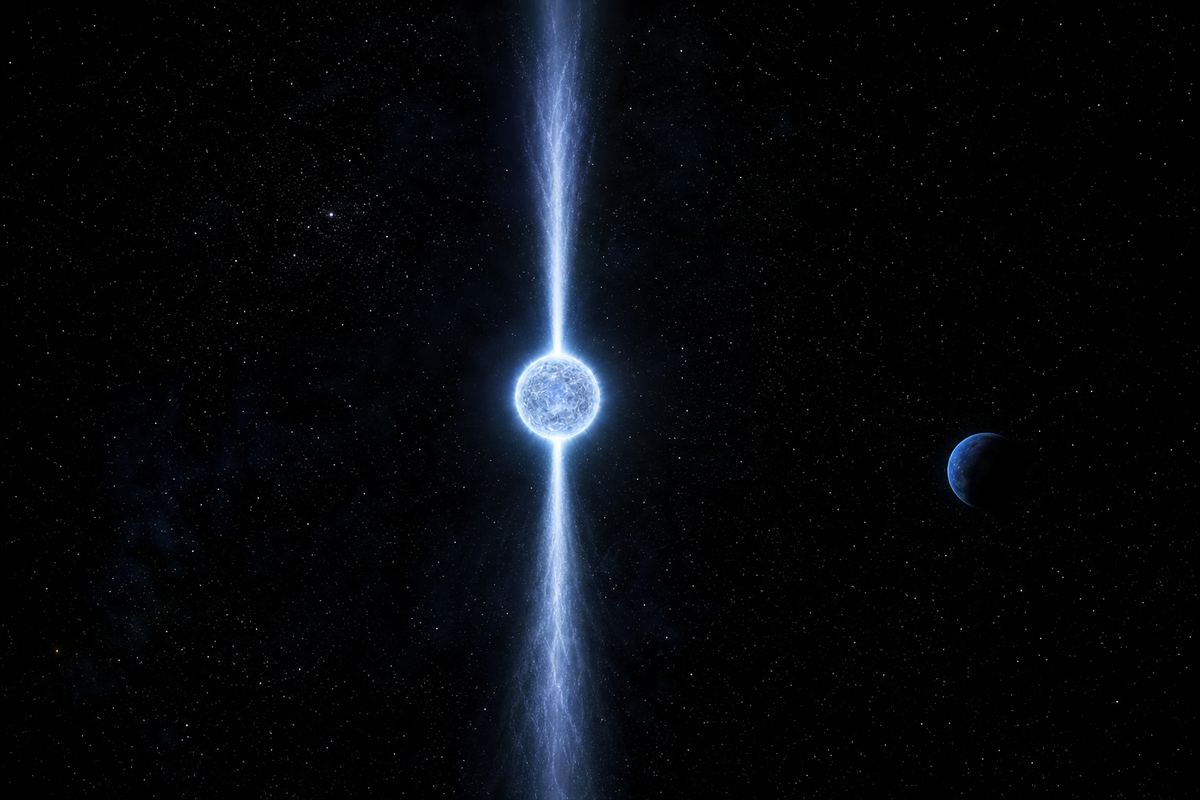
Line the beams up with the spin axis, and they never sweep across the Earth. The star is there, but it does not pulse for us.
Tilt them, or make the star spin faster, and watch how the pulses on the trace below the star change.
milliseconds
the fastest
seconds
the slower ones
Typical pulse intervalsA pulsar we cannot see Beams that point along the spin axis never sweep past the planet off to the side. AI-generated illustration.Tilted Tip the magnetic axis and each beam traces a wide cone around the sky once per turn. AI-generated illustration.
Chapter II · The lighthouse
Pulses at regular intervals
NASA Imagine the Universe: pulsars give off pulses at very regular intervals, typically from milliseconds to seconds apart. A pulse is seen only when a beam crosses our line of sight.
Buttons: “Line up” puts the beams on the spin axis, “Tilt” tips them, “Faster” and “Slower” change the spin. The speeds are slowed down so the eye can follow them.
The 3D scenes are simplified teaching models: stars, beams, orbits and distances are drawn schematically and not to scale.
In 1967, Jocelyn Bell was a PhD student at Cambridge. With her supervisor, Antony Hewish, she had built a radio telescope to study quasars.
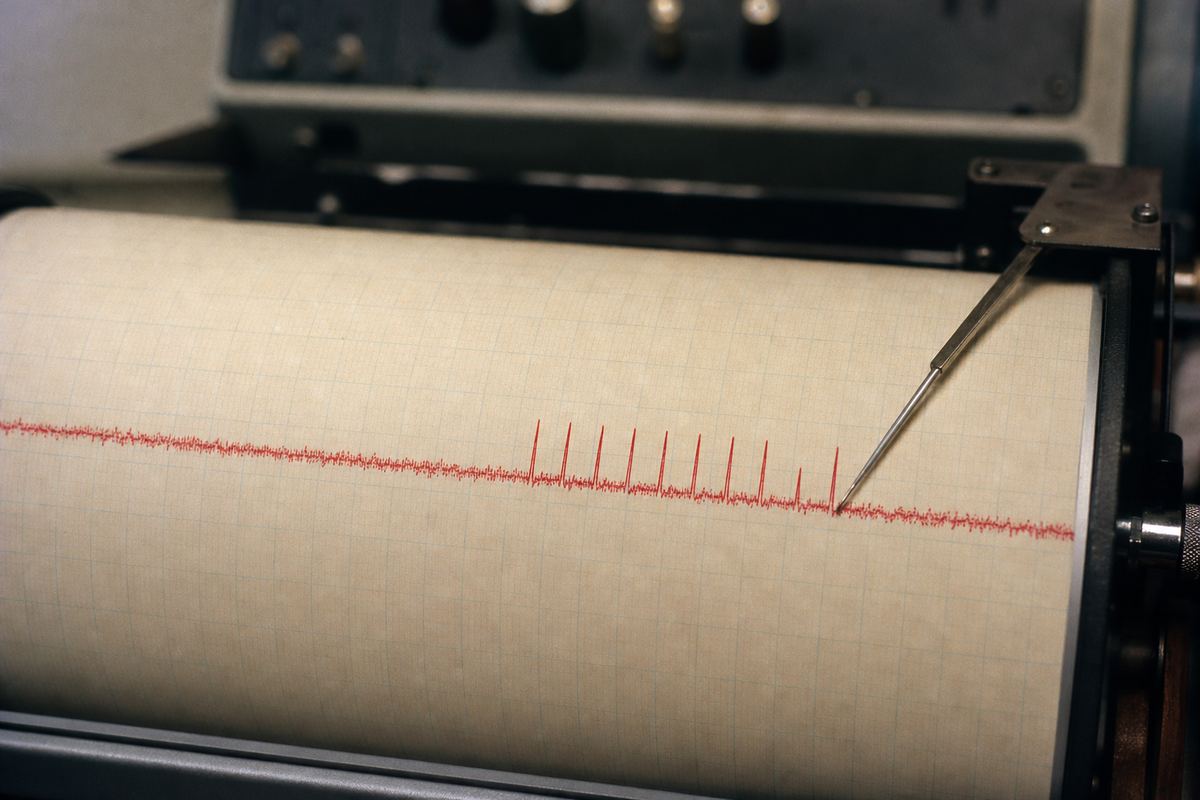
On the sixth of August she noticed something odd on the telescope's chart paper. She called it a bit of scruff.
Looked at closely, it was a flash that repeated every one point three three seven seconds.
A telescope of wires Poles and wire antennas across a field, the kind of radio telescope built at Cambridge in the 1960s. AI-generated illustration.The chart paper A pen traced the radio signal on a moving roll of paper, to be read by eye. AI-generated illustration.
1.33730 s
between flashes
6 Aug 1967
first noticed
The first pulsar
Chapter III · Scruff on the chart
The discovery
NRAO: on 6 August 1967 Jocelyn Bell, a PhD student at Cambridge, noticed “a bit of ‘scruff’” on the chart paper of a radio telescope that she and her supervisor Antony Hewish had built to study quasars. The source flashed every 1.33730 seconds.
Press “Play the signal” to run the trace with one tick per flash.
The 3D scenes are simplified teaching models: stars, beams, orbits and distances are drawn schematically and not to scale.
A signal that regular was startling. As a joke between them, Hewish and Bell nicknamed it LGM-1: little green men.
Soon a second source turned up, flashing every one point two seconds.
The discovery was announced in the journal Nature in February 1968. In 1974 Hewish received the Nobel Prize in Physics for his decisive role in it, sharing the prize with Martin Ryle, who won for other radio work.
Little green men? The night sky over flat farmland: for a few weeks, a joke about who might be out there. AI-generated illustration.
LGM-1
1.337 s, the first
1.2 s
the second, found soon after
Two sources
Aug 1967 Bell notices the scruff
Feb 1968 announced in Nature
1974 Nobel Prize for Hewish, shared with Ryle
From scruff to prizeIn print A journal and folded chart rolls on a 1960s desk: the paper trail of a discovery. AI-generated illustration.
Chapter III · Scruff on the chart
LGM-1
NRAO: the source was nicknamed “LGM-1”, for Little Green Men, a joke between Hewish and Bell. A second source, pulsing every 1.2 seconds, was found soon after. The discovery was announced in Nature in February 1968. Nobel Prize press release (15 October 1974): the Physics prize went to Martin Ryle and Antony Hewish “for pioneering research in radioastrophysics”: Ryle for his observations and inventions, in particular the aperture synthesis technique, and Hewish “for his decisive role in the discovery of pulsars”.
The 3D scenes are simplified teaching models: stars, beams, orbits and distances are drawn schematically and not to scale.
Remember the new star of 1054? What it left behind is still there, about six and a half thousand light-years away.
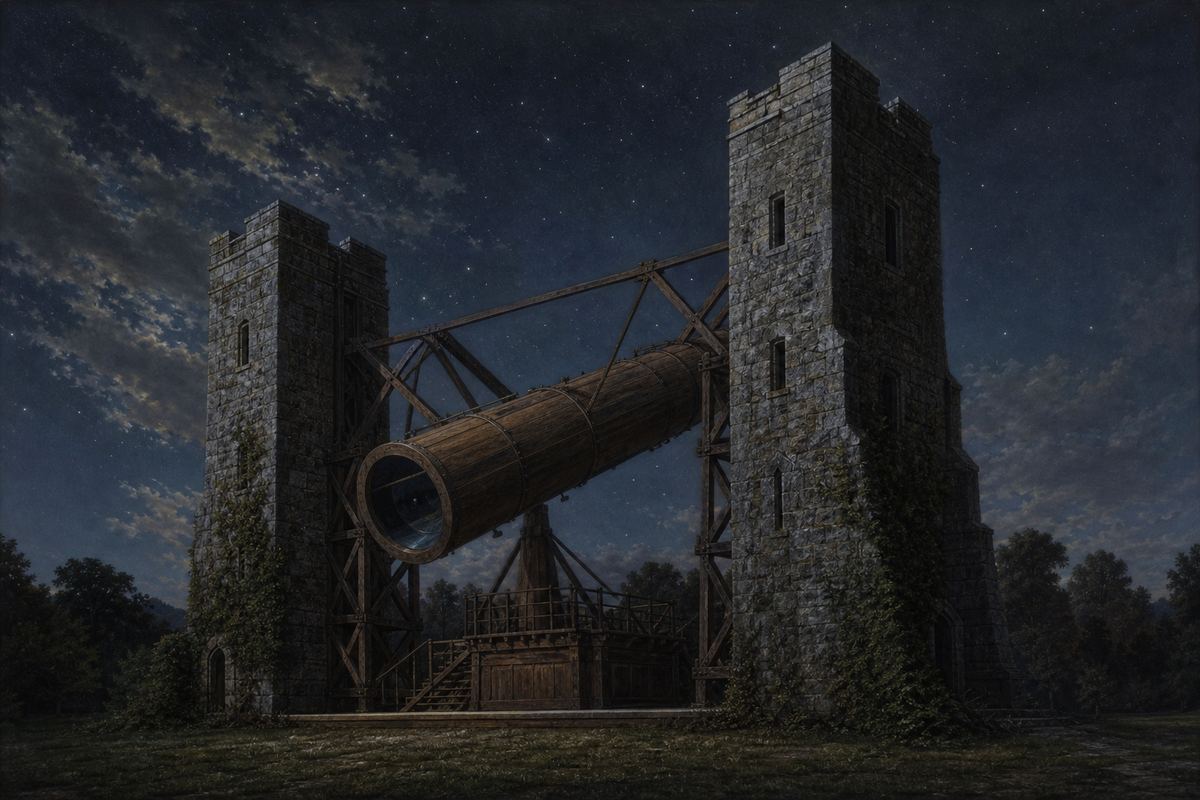
In 1844 Lord Rosse observed the glowing cloud and named it the Crab.
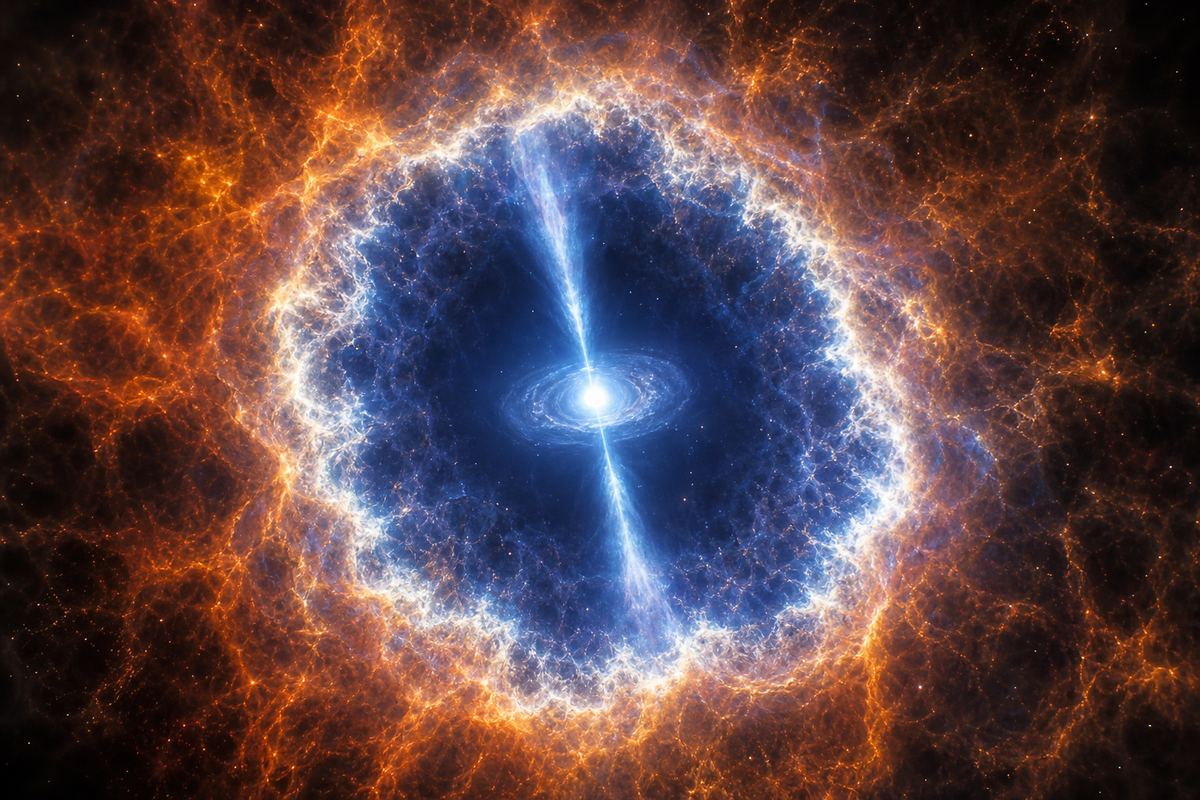
At its heart is a pulsar that sends out a burst thirty times every second. Astronomers now call the cloud around it a pulsar wind nebula.
So the guest star of 1054 never quite went out. Its crushed core is still there, spinning.
The Crab Nebula Tangled filaments around a bright inner cloud, with a ring about a light-year across near the centre. AI-generated illustration.A giant telescope A huge 19th-century reflector slung between stone walls, like the one Lord Rosse used in Ireland. AI-generated illustration.
30 a second
bursts
~6,500 ly
distance
1054
the explosion seen
The Crab pulsarThe inner ring A glowing ring and two faint jets around the spinning star at the nebula’s heart. AI-generated illustration.
Chapter III · Scruff on the chart
The Crab
Chandra X-ray Observatory: the Crab Nebula is the remnant of the supernova seen in 1054, about 6,500 light-years away. Lord Rosse observed it in 1844 and named it the Crab. The pulsar at its centre sends out bursts 30 times a second; the nebula is better classed as a pulsar wind nebula, and its inner ring is about one light-year across.
The 3D Crab pulsar is slowed down a thousand times or more; at its real speed it would be a blur.
The 3D scenes are simplified teaching models: stars, beams, orbits and distances are drawn schematically and not to scale.
Because pulsars tick so steadily, astronomers can use them as clocks.
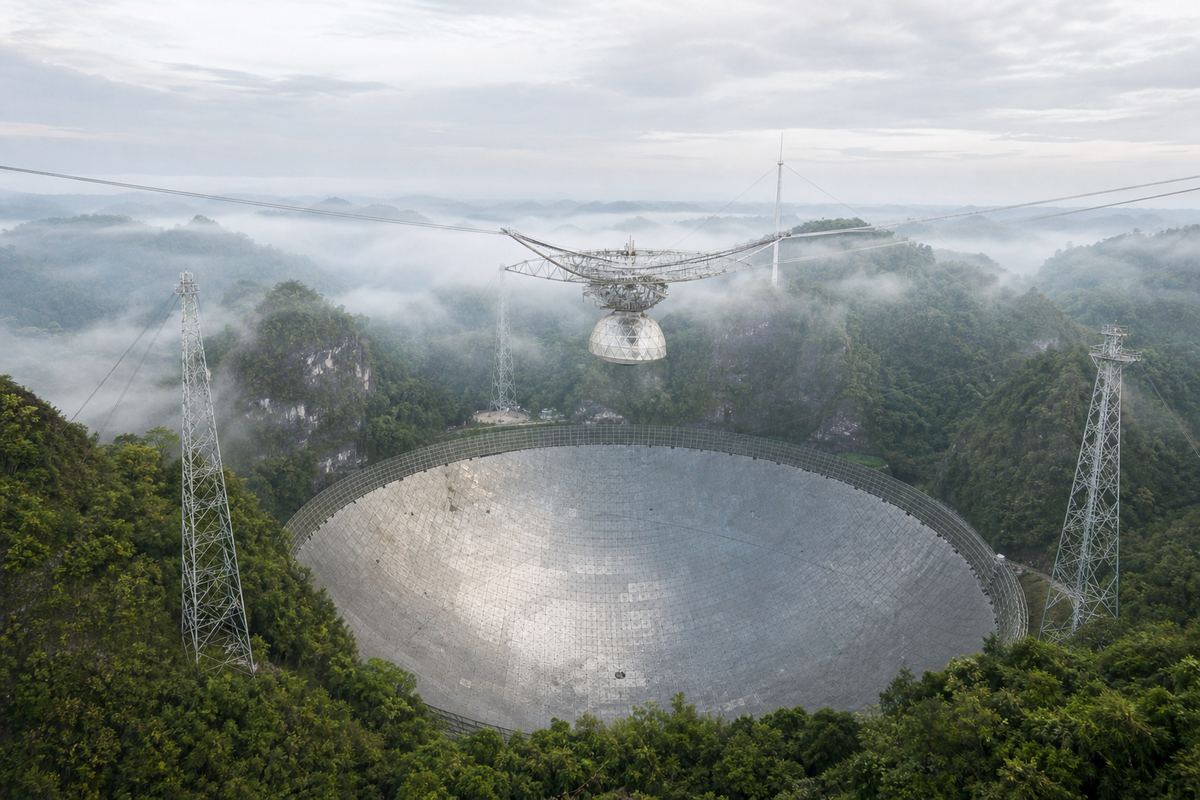
In 1974, at the Arecibo Observatory in Puerto Rico, Russell Hulse and Joseph Taylor found the first pulsar in a binary, circling a companion in less than eight hours.
Timing its pulses showed the orbit speeding up: each year the orbit takes about seventy-five millionths of a second less.
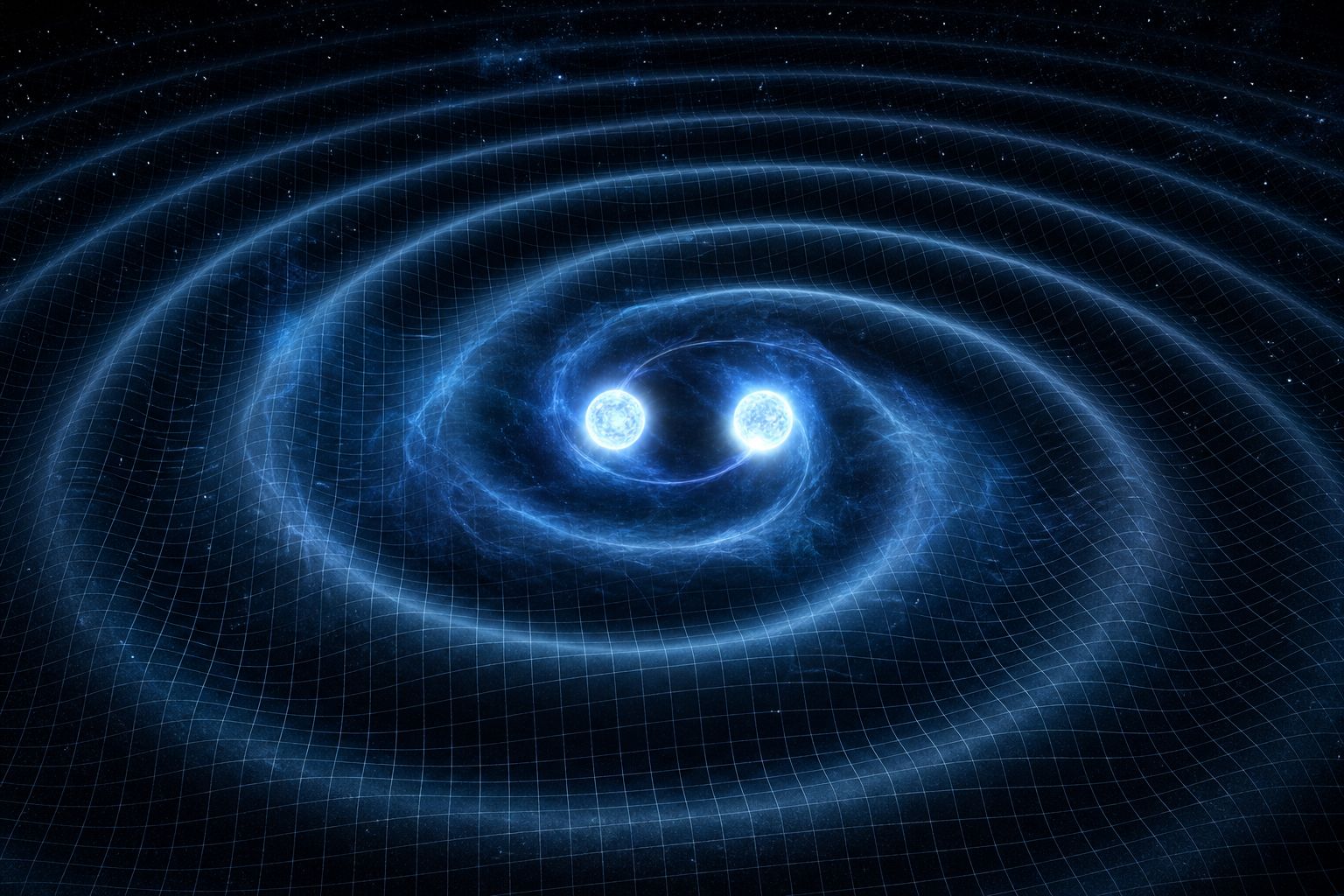
The reason is gravitational waves: ripples in space and time that carry energy away from the pair, so the orbit shrinks. The measured shrinking matches the prediction to within about half a percent. It won the 1993 Nobel Prize in Physics.
A dish in a valley A vast fixed dish set into a karst valley, like the Arecibo telescope in Puerto Rico. AI-generated illustration.
< 8 h
one orbit
~75 µs
shorter each year
~0.5%
agrees with the prediction to within
PSR 1913+16Ripples in space Two dense stars stir spacetime as they circle, and the ripples carry energy away. AI-generated illustration.
for the discovery of a new type of pulsar, a discovery that has opened up new possibilities for the study of gravitationNobel Prize in Physics 1993, Hulse and Taylor
Chapter IV · Clocks in the sky
The binary pulsar
Nobel Prize press release (1993) and CienciaPR: Russell Hulse and Joseph Taylor found PSR 1913+16, the first binary pulsar, at the Arecibo Observatory in 1974. Its orbit takes less than eight hours, and the orbital period shrinks by about 75 millionths of a second per year, agreeing within about half a percent with the prediction for gravitational-wave emission. They received the 1993 Nobel Prize in Physics “for the discovery of a new type of pulsar, a discovery that has opened up new possibilities for the study of gravitation.”
Press “Speed up time” to watch the orbit shrink; the shrinking is hugely exaggerated.
The 3D scenes are simplified teaching models: stars, beams, orbits and distances are drawn schematically and not to scale.
In 2023 the NANOGrav collaboration used sixty-seven pulsars as a single detector.
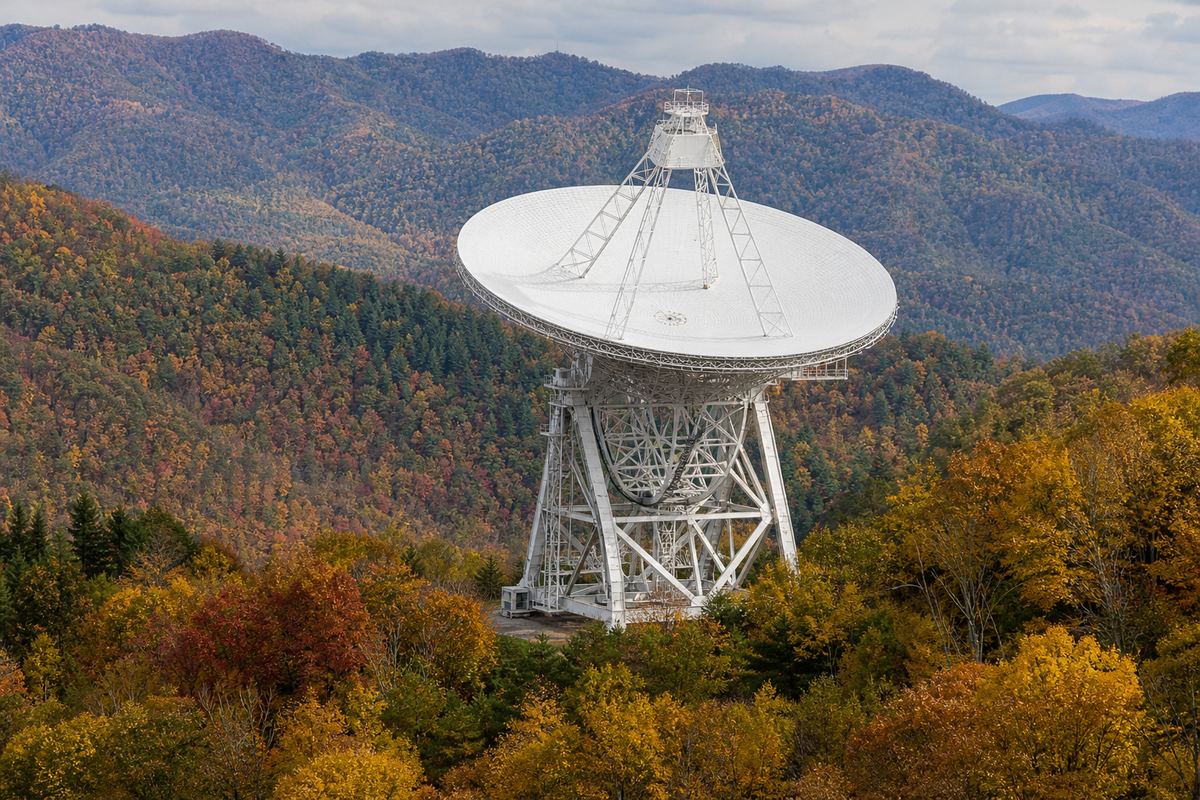
For fifteen years they timed them with the Green Bank Telescope, the Very Large Array and Arecibo, watching for tiny shifts in their ticking.
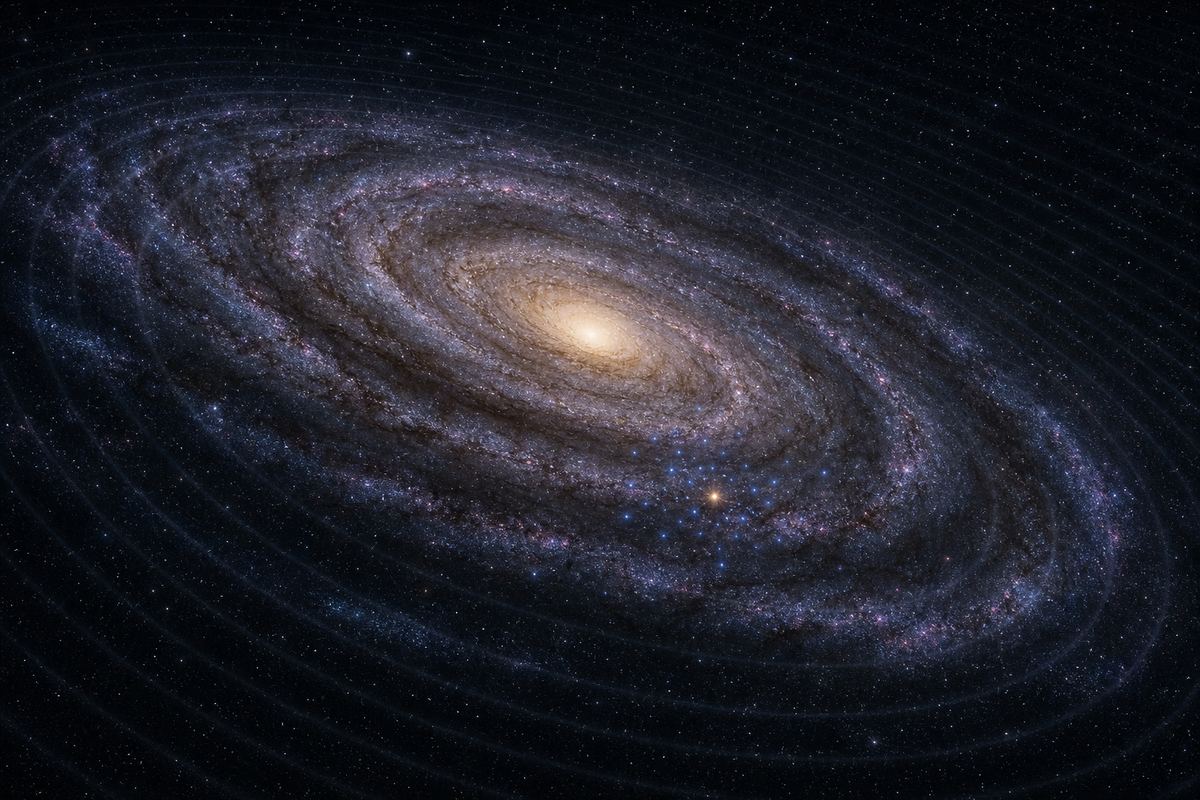
The shifts they found are the first evidence of a gravitational-wave background: many overlapping ripples arriving from all over the sky, most likely from distant pairs of ultra-massive black holes. Evidence, not yet a final detection.
67
pulsars timed
15
years of data
3
telescopes
NANOGrav, 2023A big steerable dish A giant dish on a tall frame in a forested valley, like the Green Bank Telescope in the United States. AI-generated illustration.A galaxy of clocks A passing gravitational wave nudges some pulses early and others late, in a pattern across the sky. AI-generated illustration.
the first evidence of the gravitational wave backgroundNANOGrav, via ScienceDaily, 29 June 2023
Chapter IV · Clocks in the sky
A pulsar timing array
ScienceDaily (29 June 2023): with 15 years of data from the Green Bank Telescope, the Very Large Array and Arecibo, NANOGrav used 67 pulsars as a detector. Variations in their ticking are “the first evidence of the gravitational wave background”, most likely from distant pairs of ultra-massive black holes, according to Stephen Taylor. The results are in The Astrophysical Journal Letters (951, L8).
Press “Send a wave” to see a ripple shift the arrival of the pulses; the effect is drawn millions of times larger than it is.
The 3D scenes are simplified teaching models: stars, beams, orbits and distances are drawn schematically and not to scale.
Some pulsars spin hundreds of times a second. These millisecond pulsars were spun up by a partner.
As a pulsar draws gas from a companion star, the falling gas gives it a push, and it spins faster.
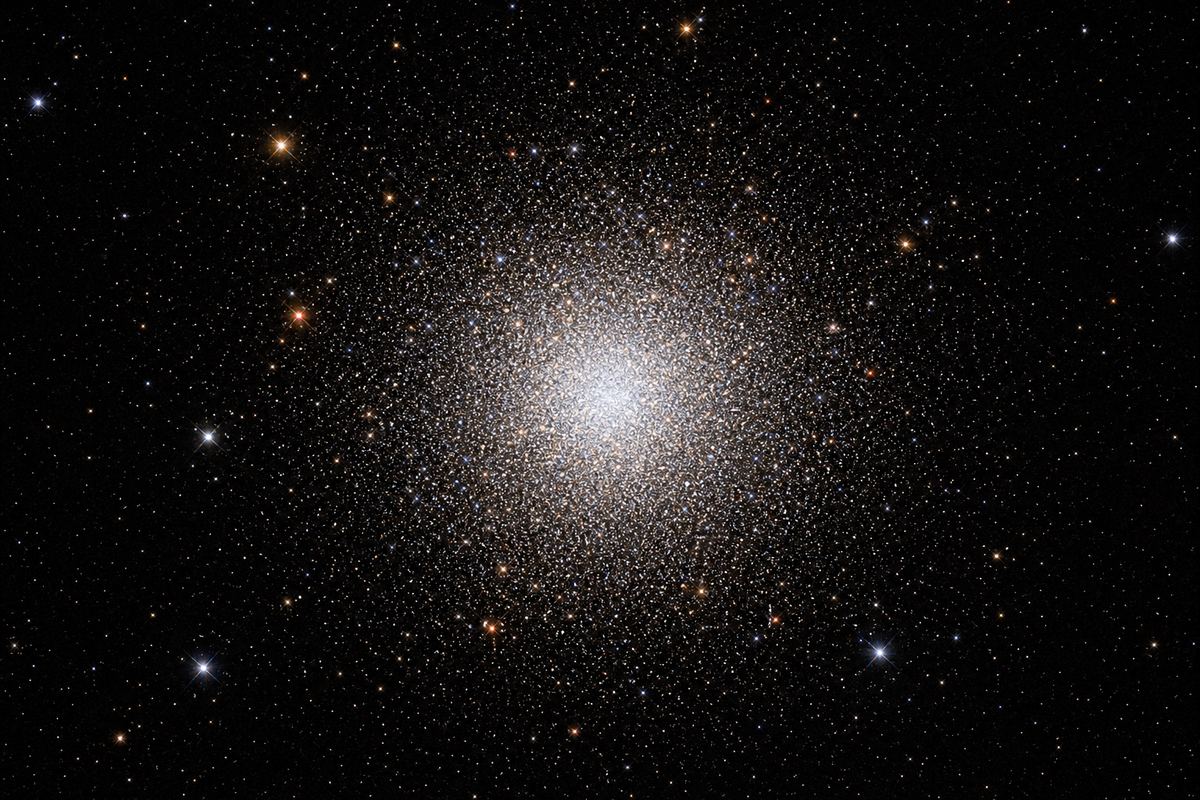
The record holder was announced in 2006. It was found with the Green Bank Telescope in the star cluster Terzan 5, about twenty-eight thousand light-years away.
It turns seven hundred and sixteen times a second. The previous record, six hundred and forty-two, had stood since 1982.
That may be close to the limit. The next-fastest pulsar known turns seven hundred and seven times a second.
All of these spin fast. So what about a dead star that pulses only once every eight minutes?
Stealing gas Gas pulled off a larger star swirls into a disc before it falls onto the neutron star. AI-generated illustration.A globular cluster Old stars packed into a ball, the kind of crowded place where Terzan 5’s record pulsar lives. AI-generated illustration.
record, 1982 to 2006
642 turns per second
next-fastest today
707 turns per second
PSR J1748−2446ad
716 turns per second
The fastest pulsars
Coming up A white dwarf beside a Sun-like star: the slow pulser from the start of the film. AI-generated illustration.
Chapter V · Spun up
Millisecond pulsars
NRAO (12 January 2006) and Sky & Telescope: PSR J1748−2446ad, found with the Green Bank Telescope in the globular cluster Terzan 5, about 28,000 light-years away in Sagittarius, spins 716 times a second; the previous record, 642, had stood since 1982. Millisecond pulsars are spun up as they draw material from a companion star, which gives them angular momentum. Universe Today (2024): 716 may be near the maximum; the next-fastest known spins 707 times a second.
Press “Feed it” to pour gas onto the star and watch the spin counter rise; the gas flow is drawn far faster than real.
The 3D scenes are simplified teaching models: stars, beams, orbits and distances are drawn schematically and not to scale.
First, a stranger relative. Some neutron stars have magnetic fields a thousand times stronger than an ordinary one's. They are called magnetars.
One of them, SGR 1806-20, released in a tenth of a second more energy than the Sun gives off in a hundred thousand years.
1,000 ×
a neutron star’s field
A magnetarSGR 1806-20 Twisted field lines snap and release a burst of energy in a fraction of a second. AI-generated illustration.
0.1 s
how long it lasted
100,000 yr
of the Sun’s output
One flare
Chapter VI · The slow ones
Magnetars
NASA Imagine the Universe: a neutron star’s magnetic field is trillions of times the Earth’s; a magnetar’s is another 1,000 times stronger. The magnetar SGR 1806-20 released, in one-tenth of a second, more energy than the Sun has emitted in 100,000 years.
Press “Flare” to replay the burst.
The 3D scenes are simplified teaching models: stars, beams, orbits and distances are drawn schematically and not to scale.
In 2021, a team at ICRAR in Australia found something new: radio pulses that last seconds to minutes, and repeat only every tens of minutes or hours.
An ordinary pulsar's pulse lasts a few thousandths of a second. These long-period transients are different, and only about a dozen are known.
In 2025 one was traced to a white dwarf and a red dwarf that orbit each other every 125 minutes, about sixteen hundred light-years away.
For most of them, whether the pulses come from white dwarfs or neutron stars has not yet been proven.
ordinary pulsar: pulses of milliseconds
long-period transient: pulses of seconds to minutes
repeating every tens of minutes to hours
Pulses comparedA slow pulse One long, smooth rise and fall where a pulsar would show a needle-thin spike. AI-generated illustration.A white dwarf and a red dwarf The 2025 system: two small stars circling a shared centre every 125 minutes. AI-generated illustration.
2021
first found, by ICRAR
~12
known so far
125 min
orbit of the 2025 pair
Long-period transients
Chapter VI · The slow ones
Long-period transients
University of Oxford (12 March 2025): long-period transients are radio pulses lasting seconds to minutes and repeating every tens of minutes to hours, whereas ordinary pulsar pulses are on the order of milliseconds. A 2025 study in Nature Astronomy traced one to a white dwarf and a red dwarf about 1,600 light-years away that orbit a common centre every 125 minutes; whether such pulses come from white dwarfs or neutron stars is not yet proven. ICRAR via ScienceDaily (2026): the team found the first in 2021, and only about a dozen are known; their origins remain poorly understood.
Buttons switch the trace between the Crab pulsar, Bell’s first pulsar, the 2025 red-dwarf pair and GPM J0715. Every rhythm is slowed down or squeezed to fit the screen; read the period in the box.
The 3D scenes are simplified teaching models: stars, beams, orbits and distances are drawn schematically and not to scale.
Which brings us back to November 2026, and the discovery made with the Murchison Widefield Array in Western Australia.
It is the first time such pulses have been found from a white dwarf circling a Sun-like star. Earlier white-dwarf systems had red dwarf partners.
The pulses are clear enough to see the white dwarf move along its orbit. So they come from close to it, or possibly from the white dwarf itself.
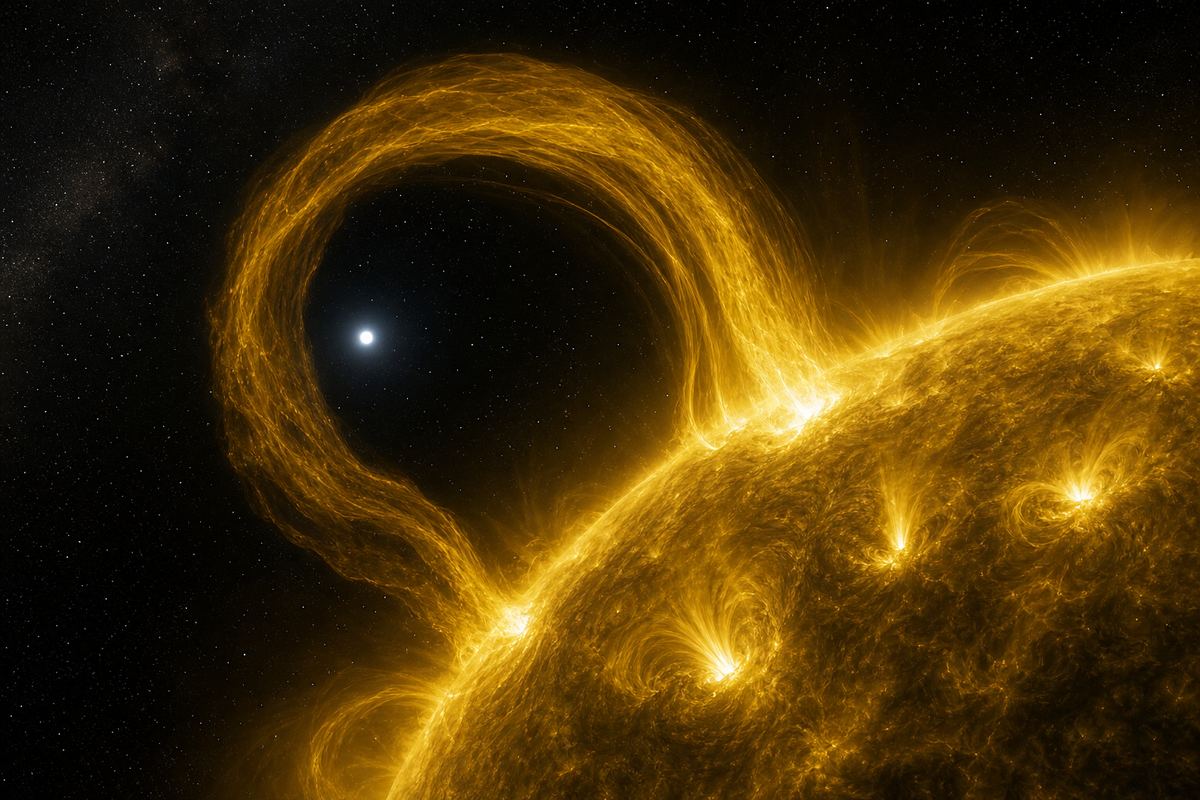
The team also saw flares on the companion, and the white dwarf passing behind a strong magnetic region, most likely a stellar prominence.
Exactly how it works is still a mystery. The coming Square Kilometre Array telescopes should find many more.
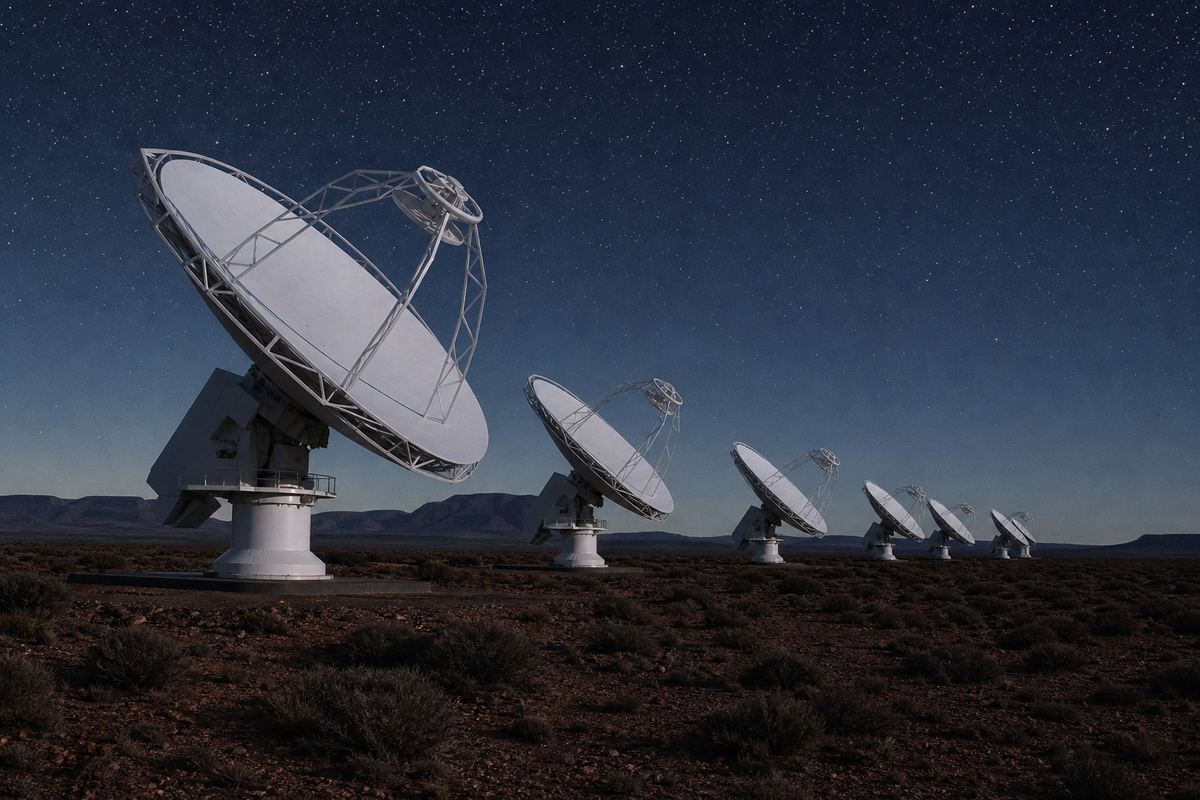
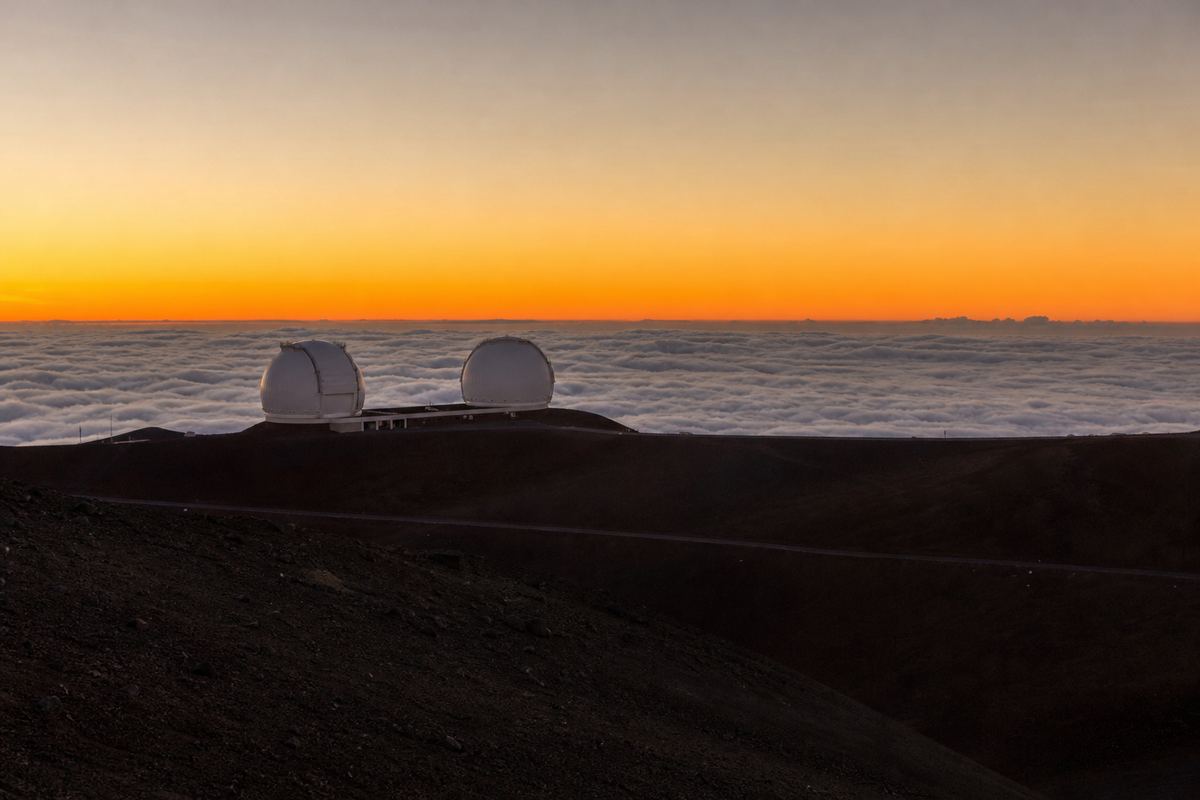
Pinning it down Dishes like those of MeerKAT in South Africa, which fixed the position of the source after the Murchison Widefield Array found it. AI-generated illustration.Seeing the partner Domes like the W. M. Keck Observatory on Maunakea, whose optical observations confirmed the Sun-like partner. AI-generated illustration.
a region close to the white dwarf, or possibly even from the white dwarf itselfSamuel McSweeney, on where the pulses come from, 2026
Behind a prominence A loop of magnetised gas above the Sun-like star; the white dwarf was seen passing behind a strong magnetic region. AI-generated illustration.More to come A future radio observatory with antennas spread across a wide plain. AI-generated illustration.
Chapter VI · The slow ones
GPM J0715
ICRAR via ScienceDaily (15 November 2026): the system was found with the Murchison Widefield Array, located precisely with MeerKAT, and its G-type companion confirmed with the W. M. Keck Observatory, using more than 100 hours of radio data. It is the first such source where a white dwarf orbits a Sun-like star; earlier examples had red dwarf companions. Samuel McSweeney: the pulses come from “a region close to the white dwarf, or possibly even from the white dwarf itself.” Natasha Hurley-Walker: the companion shows flares, and the white dwarf passed behind a strong magnetic region, “most likely a ‘stellar prominence’.” Future SKAO telescopes should find many more.
The white dwarf’s spin and orbit are drawn far faster than real, and the stars are not to scale.
The 3D scenes are simplified teaching models: stars, beams, orbits and distances are drawn schematically and not to scale.
From a guest star in 1054 to an eight-minute signal in 2026, dead stars keep sending us their beat.
Where do pulses that come only every eight minutes really come from? Nobody knows yet.
Somewhere out there, one is sweeping past the Earth right now, once every turn.
1054 a new star over China
1844 Lord Rosse names the Crab
1967 Bell sees the scruff
1974 the first binary pulsar
2006 716 turns a second
2023 NANOGrav’s evidence
2026 an 8-minute white dwarf
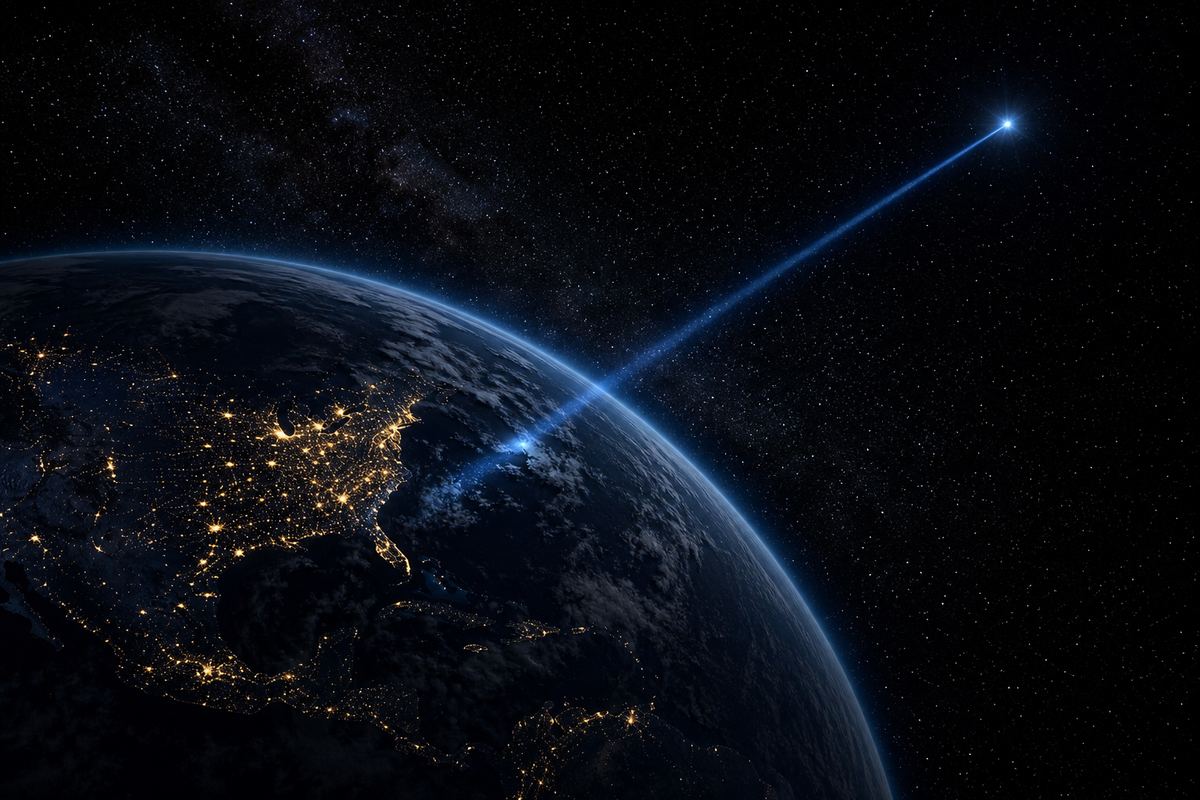
Pulsars in seven datesSwept by a beam A beam from a star thousands of light-years away brushes the night side of the Earth. AI-generated illustration.Once every turn A quiet night sky over the sea; somewhere among those points of light, beams are sweeping. AI-generated illustration.
Epilogue · Sources
Sources
Every fact in this film comes from the sources below. The 2026 system GPM J0715 comes from one new study and is presented as new: how long-period transients make their pulses is not yet known. The 3D scenes are schematic and not to scale, and spins and orbits are slowed down or speeded up so the eye can follow them. The chapter stills and pictures are AI-generated illustrations, not photographs of the objects, telescopes or people in the film.