In 2026 researchers in Germany described a bacterial enzyme that can break down a kind of polyester bioplastic. This film explains what plastic actually is: how small molecules link into chains thousands of units long, how Bakelite and polyethylene were invented, why some plastics melt and others never do, what the numbers in the recycling triangle mean, why microbes struggle to digest most plastics, how big pieces become microplastics, where the world's plastic waste ends up, how recycling works, and what plastic-eating enzymes can and cannot do. Link monomers into a chain, melt a thermoplastic, try to digest polyethylene, and break a bottle into microplastics.
Interactive 3D film9 min1907 to 2026Published 18 October 2026
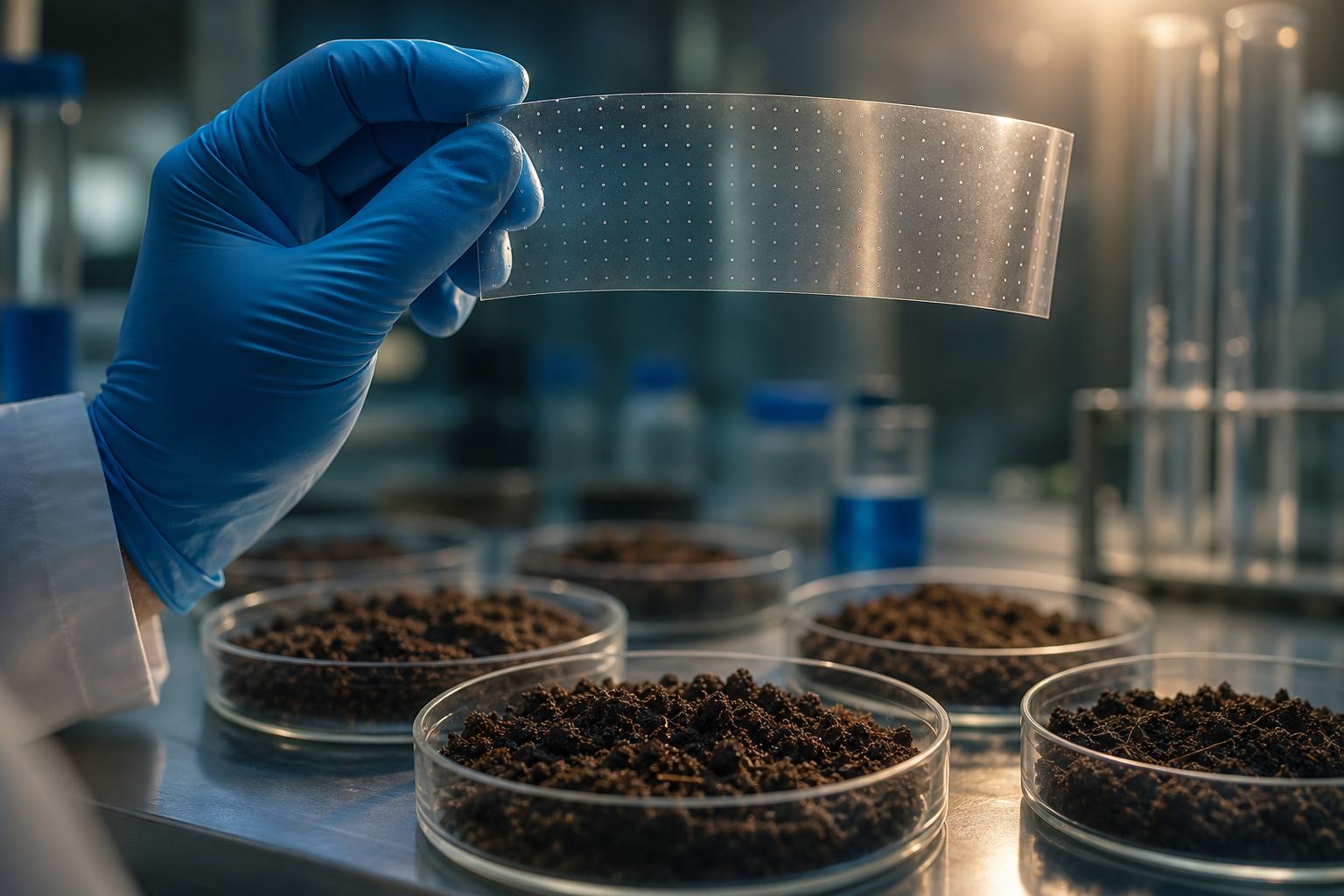
Scientists at the University of Konstanz in Germany buried plastic film in forest soil and later found tiny holes in it, each the size of a bacterium. In 2026 they described a bacterial enzyme, a protein that cuts chemical bonds, nicknamed Pac-Man for its wide-open mouth.
It works on a special plastic designed to break down. In the same soil tests, ordinary polyethylene, the stuff of shopping bags, barely changed. Why is most plastic so hard to break down?
The world made about four hundred and sixty million tonnes of it in 2019 alone. To see why it lasts, we have to zoom in to the molecules.
Pitted plastic film The holes matched the size of bacterial cells, a clue that the microbes were living inside the film. AI-generated still.
a protein made by a living cell
shaped to grip one kind of chemical bond
“Pac-Man”: an unusually wide-open active site
An enzyme is
University of Konstanz, in The ISME Journal
plastic: a polyester bioplastic made at the same university
still at the research stage
The study, in brief
460 Mt
in 2019
×2
since 2000
World plastic production (OECD)
Prologue · The news
A “Pac-Man” enzyme
A University of Konstanz team reported in The ISME Journal a bacterial enzyme, anchored to the cell surface with a wide-open active site, that breaks down long-chain aliphatic polyesters (LCAP), a bioplastic developed by Stefan Mecking’s group in Konstanz, and also inactivates penicillin. In laboratory tests with powdered plastic mixed into forest soil, LCAP degraded fully in roughly 250 to 330 days, while high-density polyethylene barely degraded. Films buried in forest soil showed holes the size of bacterial cells.
The researchers and reports describe it as early-stage research limited to certain polyesters; it is not a way to dispose of ordinary plastic waste.
How to use: pick a chapter or press ← →; drag to rotate. Most steps have buttons you can press.
Molecules in the 3D scenes are schematic: real chains are thousands of units long and far more tangled.
A polymer is a molecule made of many repeating pieces.
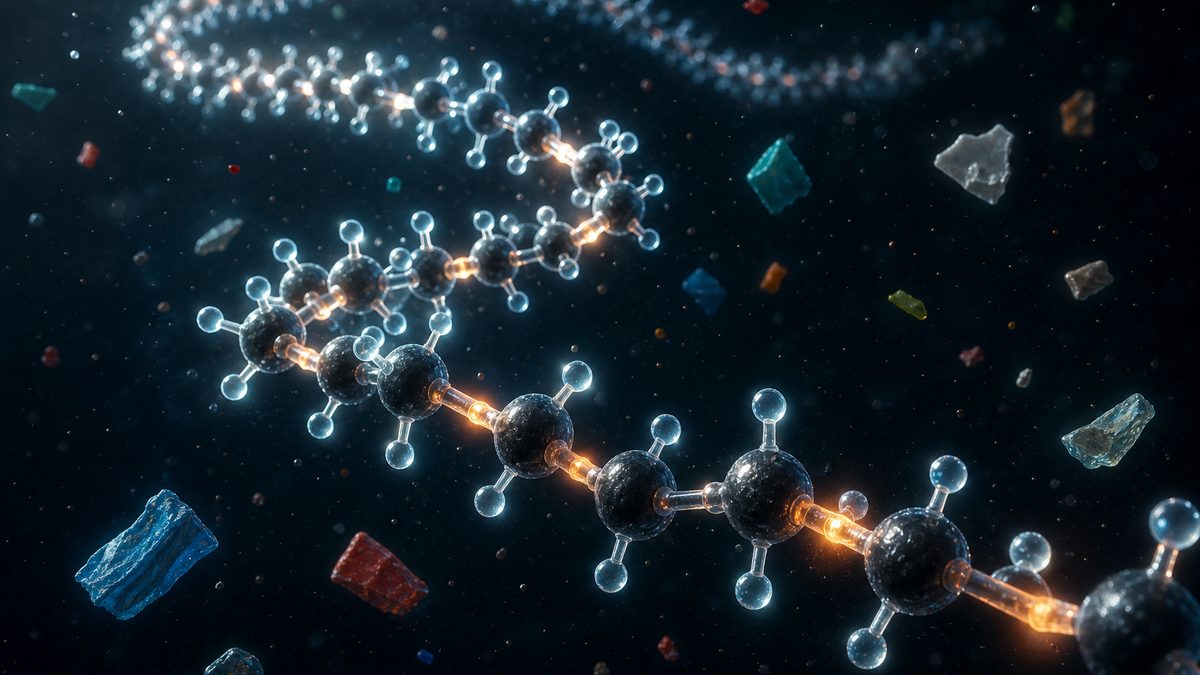
Every plastic is a polymer, from the Greek for many parts: a giant molecule built by linking small molecules, called monomers, end to end.
A single chain can contain thousands of monomers. Press Add links and watch one grow.
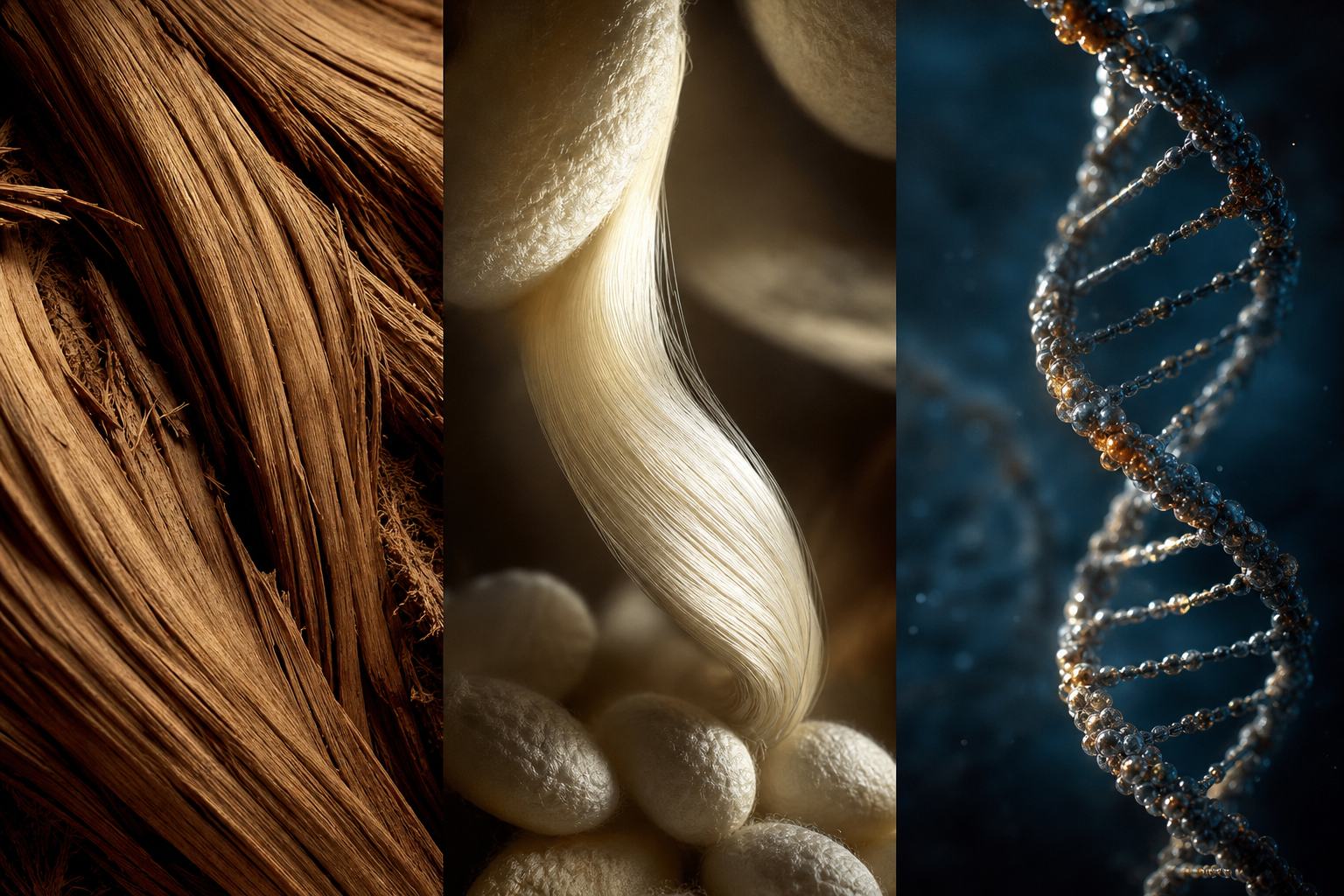
Polymers are not new. Nature is full of them: cellulose in wood and cotton, proteins like silk and keratin, and even the DNA in your cells. Plastics are polymers that we design ourselves.
nmonomers⟶one polymer chainPoly = many, mer = part. For polyethylene, n is usually in the thousands.
1,000s
of monomers, typically
One chainNature’s polymers Wood fibre, silk and DNA are all long chains of repeating units. AI-generated still.
Chapter I · Chains
What a polymer is
Polymers are long-chain, giant organic molecules assembled from many smaller molecules called monomers; polymerisation is the reaction that joins them. Natural polymers include proteins (silk, collagen, keratin), polysaccharides (cellulose, starch) and nucleic acids (DNA, RNA). A polyethylene chain is usually thousands of monomers long.
The scene shows a short chain for clarity. DNA is a nucleic acid, a natural polymer of repeating nucleotide units.
Molecules in the 3D scenes are schematic: real chains are thousands of units long and far more tangled.
One of the most common plastics, polyethylene, starts as ethylene: two carbon atoms held by a double bond, each carrying two hydrogen atoms.
Under the right conditions, the double bond, two links between the carbons, gives up one link, and each molecule grabs its neighbours. Nothing is lost; the monomers simply add on, one after another.
The result is a backbone of carbon atoms joined by single bonds, wrapped in hydrogen. Those carbon to carbon bonds are strong, and they are the heart of this story.
CH2=CH2Ethylene, C₂H₄: the double bond is the part that opens.nCH2=CH2⟶−(CH2−CH2)n−Addition polymerisation: the monomers bond without losing any atoms.
grey spheres: carbon
white spheres: hydrogen
two sticks = a double bond; one = a single bond
In the scene
a carbon backbone, single bonds only
wrapped in hydrogen atoms
in bags, films, bottles and pipes
Polyethylene is
Chapter I · Chains
Addition polymers
Ethylene is CH₂=CH₂ (C₂H₄). As a monomer its repeating unit is –(CH₂–CH₂)–, and a polyethylene chain is –(CH₂–CH₂)ₓ– where x is usually in the thousands (Carnegie Mellon University). In chain-growth or addition polymers the monomers bond to each other without losing any atoms; alkene-based polymers like polyethylene are the largest group (LibreTexts).
Press Polymerise in the scene to run the reaction step by step. Grey spheres are carbon, white are hydrogen.
Molecules in the 3D scenes are schematic: real chains are thousands of units long and far more tangled.
There is a second way to build a chain. Usually two different monomers take turns, and every time they join, they let go of a small molecule, usually water.
Chemists call these condensation polymers. Most polyesters belong here, including the polyester in clothing and the PET in drinks bottles.
Remember those links. The joint where water was released, the ester bond, is exactly where some enzymes can cut.
acid+alcohol⟶ester+H2OEach new link releases one small molecule, here water.
addition: nothing lost (polyethylene)
condensation: water released (polyesters, nylons)
Two ways to build a chain
the ester bond: where water left
a joint some enzymes can attack
remember it for Chapter VI
The weak spot
Chapter I · Chains
Condensation polymers
In step-growth or condensation polymerisation, two different monomers combine with the loss of a small molecule, usually water; most polyesters and polyamides (nylons) are made this way (LibreTexts). PET, polyethylene terephthalate, is a polyester.
The equation shows the general idea of an ester link, not the full PET reaction.
Molecules in the 3D scenes are schematic: real chains are thousands of units long and far more tangled.
The first plastic made entirely from laboratory chemicals came in 1907. The Belgian-born chemist Leo Baekeland, working in the United States, was looking for a substitute for shellac, a resin made by insects.
By carefully controlling the heat and pressure on a mix of phenol and formaldehyde, he made a hard material that could be moulded into any shape. He called it Bakelite.
Its chains are tied to each other in every direction, a rigid network. It became telephones, radios and parts for the young car industry.
1907 Baekeland makes Bakelite
1933 polyethylene, by accident
2019 460 million tonnes a year
Early plasticsphenol+formaldehydeheat, pressureBakeliteMixed with fillers, the polymer formed a hard, mouldable plastic.The Bakelite age Bakelite was especially useful to the growing car and radio industries, and became colourful consumer goods. AI-generated still.
Chapter II · Invention
Leo Baekeland
Science History Institute: Baekeland discovered the durable plastic in 1907. Bakelite is a polymer made from phenol and formaldehyde; Baekeland controlled the pressure and temperature applied to an intermediate of the two, and mixed with fillers it formed a hard, mouldable plastic, “the first fully synthetic plastic”. He had first sought a shellac replacement. It was used for telephones, radios, jewellery and billiard balls, and in the automobile and radio industries.
Bakelite is a thermoset: its chains are cross-linked into a network (Chapter III). The network in the scene is schematic.
Polyethylene was found by accident. In 1933, chemists at the British company ICI heated ethylene under very high pressure and found a white, waxy solid in the vessel.
The experiment was hard to repeat. In 1935 it worked again, because a leak had let in a trace of oxygen, which started the chain reaction.
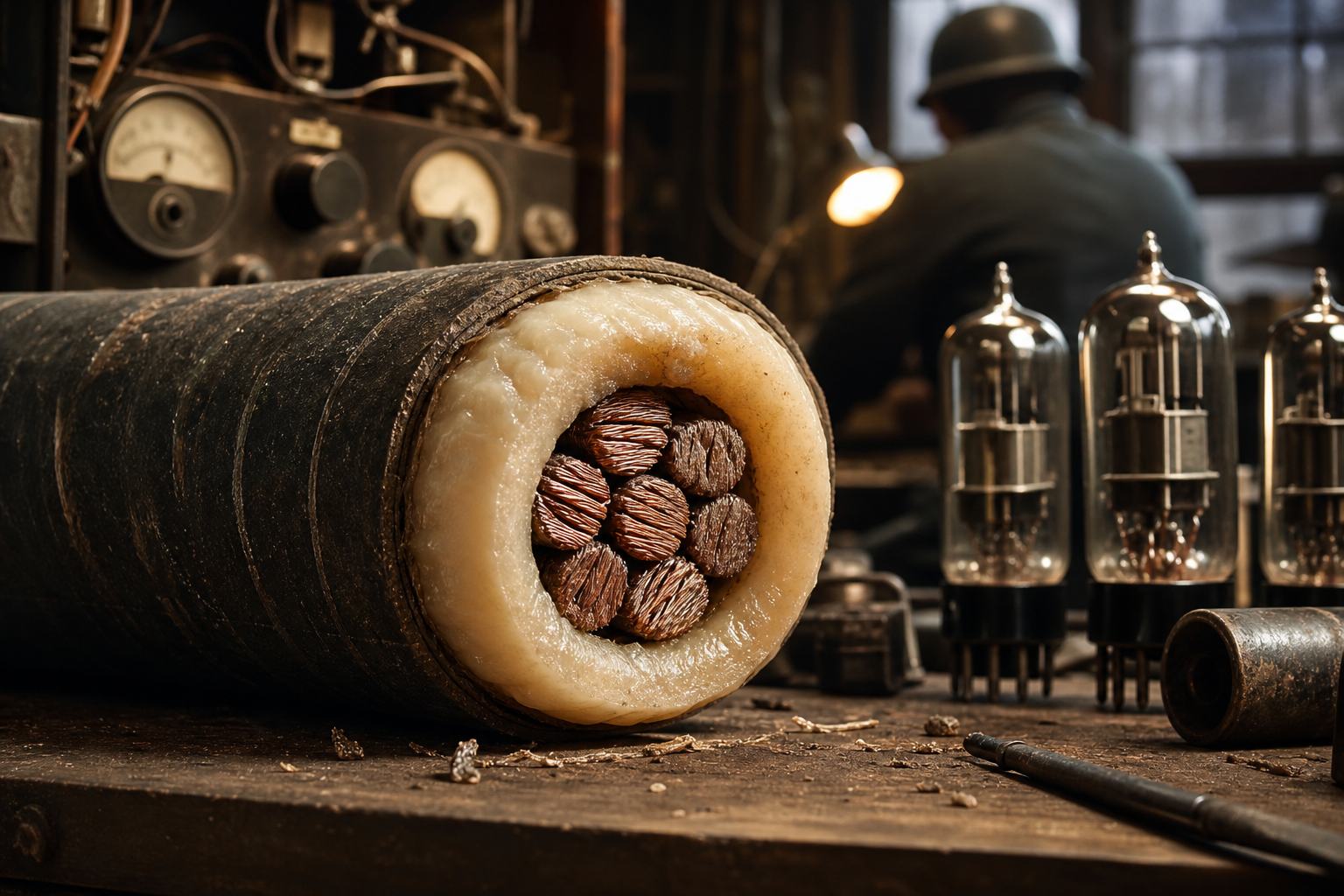
Light and an excellent electrical insulator, polyethylene went to war: it insulated airborne radar, making the sets light enough to fit in fighter planes.
1933 Gibson and Fawcett find a waxy solid
Dec 1935 8.5 g made again, thanks to a leak
1939–45 insulation for airborne radar
Polyethylene at ICI
~8.5 g
of white powder
O₂
a trace of oxygen started the reaction
The 1935 runInsulation Polyethylene was first eyed as a replacement for gutta-percha in undersea cables. AI-generated still.
Chapter II · Invention
A discovery by accident
ICIS: in 1933 ICI chemists Reginald Gibson and Eric Fawcett heated ethylene and benzaldehyde under very high pressure and got a white, wax-like solid; fear of explosive reactions halted the work. In December 1935 Edmond Williams, Michael Perrin and John Paton repeated it with ethylene alone and recovered about 8.5 g of white polyethylene, because a leak let in a trace of oxygen that acted as the initiator. In the Second World War polyethylene insulated airborne radar, reducing its weight so it could be fitted to fighter planes.
Molecules in the 3D scenes are schematic: real chains are thousands of units long and far more tangled.
Plastics come in two big families. In thermoplastics, like polyethylene, the chains are tangled like cooked spaghetti but not tied together.
Heat them and the chains slide past each other: the plastic softens and can be moulded again. Cool it and it sets. That is what makes recycling by melting possible.
In thermosets, like Bakelite or epoxy glue, the chains are cross-linked into one net. Heat cannot make them flow: once set, they cannot be remelted. Try the Heat and Cross-link buttons.
polyethylene (PE)
polypropylene (PP)
PET, nylon, polycarbonate
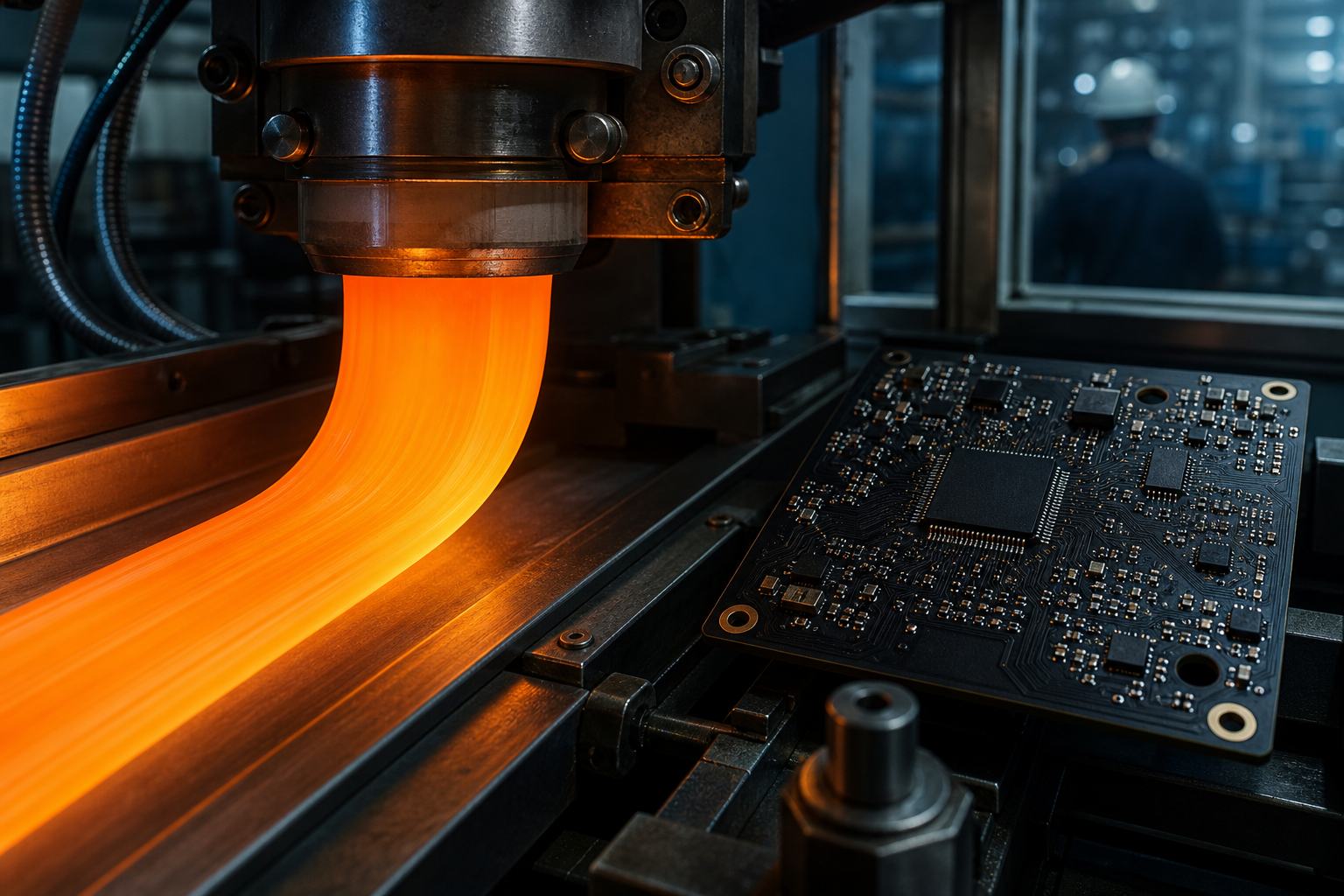
ThermoplasticsSoft when hot Thermoplastics soften on heating and harden on cooling, with no permanent chemical change. AI-generated still.
phenolic resin (Bakelite)
epoxy
silicone, polyurethane
Thermosets
Chapter III · Two families
Thermoplastics and thermosets
Thermoplastics soften when heated and harden again when cooled, with no permanent chemical change, so they can be remelted and reshaped (PP, PE, polycarbonate, nylon). Thermosets form cross-links between polymer chains when heated or catalysed; they harden irreversibly and cannot be remelted or reprocessed (phenolic resin, silicone, polyurethane, epoxy) (Xometry).
Press Heat and Cross-link in the scene. Bakelite is a phenolic resin.
Molecules in the 3D scenes are schematic: real chains are thousands of units long and far more tangled.
Turn over a plastic tub and you may find a number from one to seven in a small triangle. It tells you which plastic it is.
One is PET, two and four are high and low density polyethylene, three is PVC, five polypropylene, six polystyrene, and seven means everything else.
But the code does not mean the item can be recycled where you live. That is why the standard was changed: the old chasing arrows became a plain, solid triangle.
moulded into the base of bottles and tubs
a number with letters underneath
press 1–7 in the scene
Where to find it
1 PET · 2 HDPE · 3 PVC
4 LDPE · 5 PP · 6 PS
7 other, including multilayer
Resin identification codes
old: a number inside three chasing arrows
new (ASTM D7611): a solid triangle
same numbers, clearer meaning
Old symbol, new symbol
A resin code does not imply or mean that the product is recyclable.ComplianceGate, on ASTM D7611
Chapter III · Two families
Resin codes
Codes: 1 PETE (polyethylene terephthalate), 2 HDPE, 3 V (vinyl, PVC), 4 LDPE, 5 PP, 6 PS, 7 other (including multilayer). A code does not mean the product is recyclable. The ASTM D7611 revision replaced the original “chasing arrows” with a solid equilateral triangle to make clear that the code identifies the resin, not recyclability (ComplianceGate).
Many products still carry the older arrow symbol. Which plastics are collected depends on local services.
Microbes break things down with enzymes: proteins shaped to grip one kind of bond and snip it. They carry enzymes for the natural polymers they have always met, such as cellulose, starch and protein.
But the chains of most plastics are new to nature. As one Ohio State food scientist puts it, microbes' enzymes don't recognise the bonds that hold these polymers together, and the bonds are very strong.
So instead of being eaten, plastic stays, often for a very long time. Press the button to try digesting each chain.
cellulases: cut cellulose
amylases: cut starch
proteases: cut proteins
Enzymes nature already has
The bonds between these molecules are super strong.Yael Vodovotz, The Ohio State University
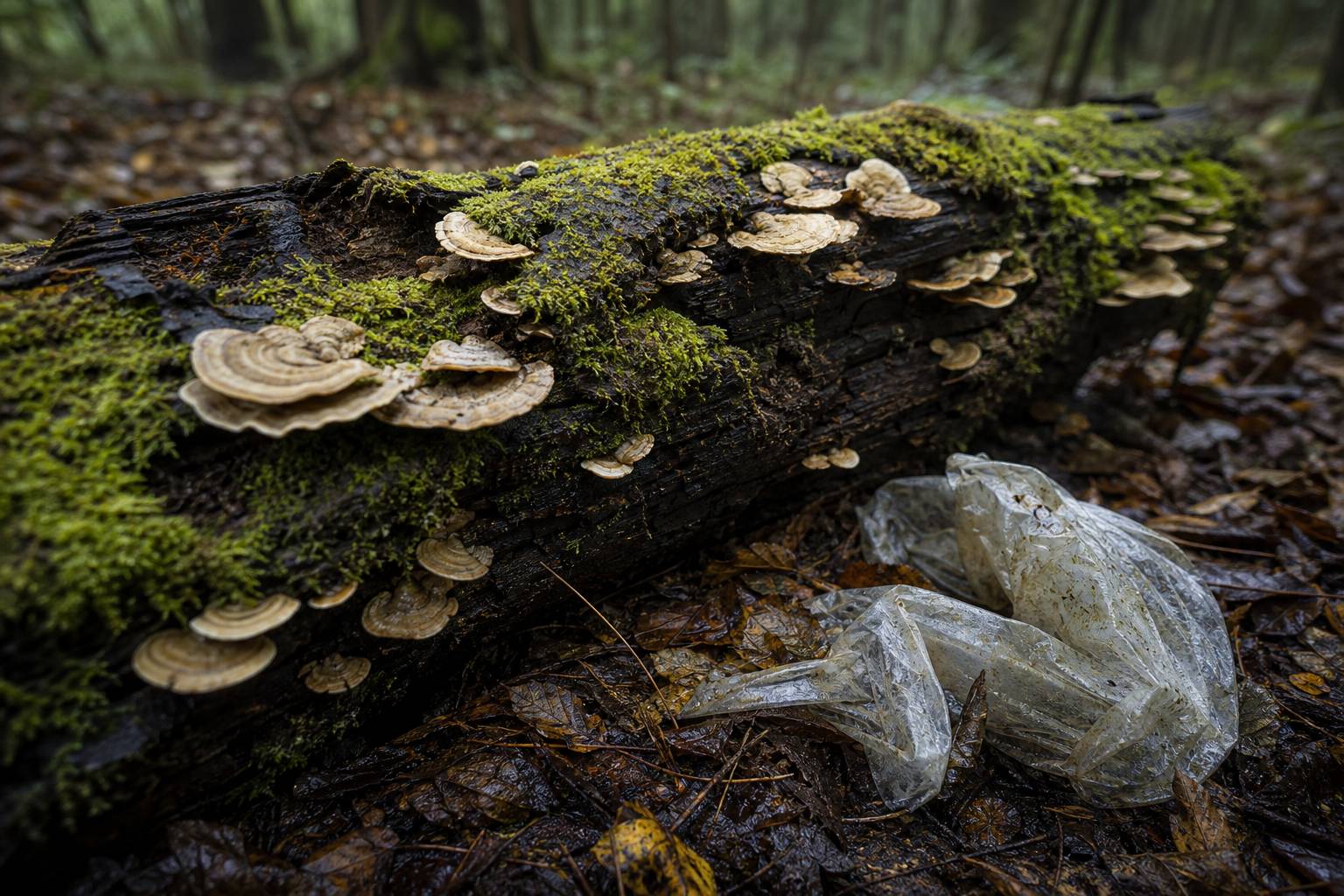
What microbes can eat Fungi and bacteria rot a fallen log because they carry enzymes for wood; a plastic bag beside it is untouched. AI-generated still.
Chapter IV · Why it lasts
Why plastic isn’t biodegradable
Yael Vodovotz (Ohio State) explains that the bonds in plastics are very strong, and that microbes’ enzymes do not recognise the bonds holding these synthetic polymers together; such synthetic chains are not abundant in nature. Plastic may eventually degrade, but meanwhile it can break into pieces that animals eat.
How long a plastic lasts depends on the polymer, its thickness and where it ends up; estimates vary widely, so this film gives no single number. The enzyme in the scene is a schematic “mouth”, not a real protein shape.
What does happen is that light breaks plastic down into smaller and smaller pieces, a process called photodegradation.
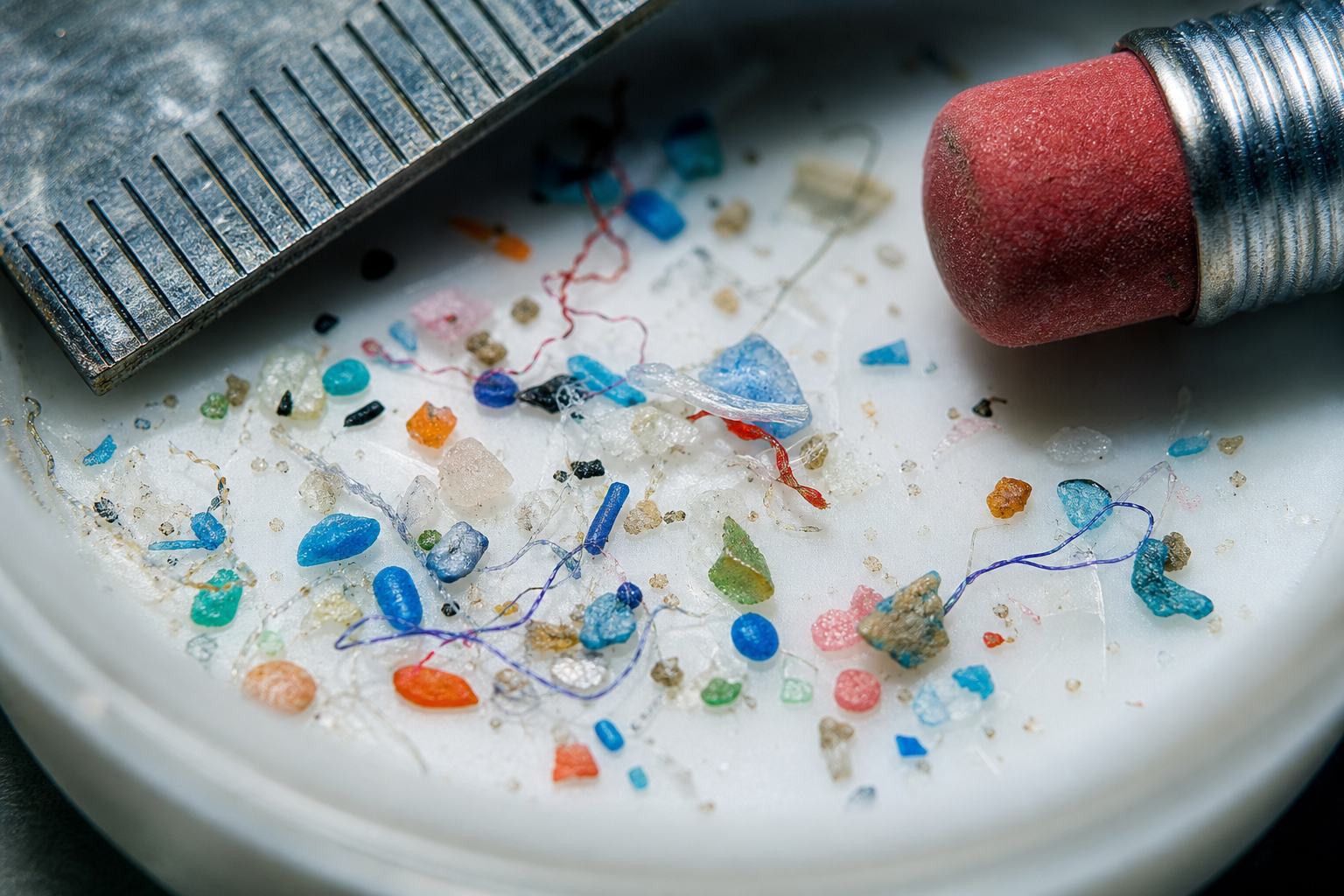
Pieces smaller than five millimetres, about the size of a pencil eraser, are called microplastics. Press Break it to see how fast the count grows.
Some are made small on purpose, like the microbeads once added to cleansers and toothpastes. Others come from bigger things breaking apart. Either way, the polymer is still there, now spread through soil, rivers and the sea.
light breaks plastic into small pieces
the pieces stay plastic
most items in the Pacific Garbage Patch are such small bits
Photodegradation (NOAA)Microplastics NOAA’s definition: plastic pieces less than five millimetres long. AI-generated still.
made small on purpose, like microbeads
larger debris that degrades into smaller pieces
microbeads easily pass through water filtration
Two ways they form
1 → 512
pieces after three rounds of halving
5 mm
the yellow bar: the microplastic threshold
In the scene
Chapter IV · Why it lasts
Microplastics
NOAA: microplastics are plastic pieces less than five millimetres in length, about the size of a pencil eraser. Microbeads, tiny polyethylene particles added as scrubbing agents to some cleansers and toothpastes, easily pass through water filtration systems; other microplastics come from larger plastic debris that degrades into smaller and smaller pieces.
The piece count in the scene is simple arithmetic: halving a piece in every direction makes eight smaller pieces. Health effects of microplastics are still being studied and are not covered here.
Molecules in the 3D scenes are schematic: real chains are thousands of units long and far more tangled.
In 2019, according to the OECD, the world threw away three hundred and fifty-three million tonnes of plastic. Forty percent of it was packaging.
Half went to landfill. Nineteen percent was burned. Twenty-two percent was mismanaged: dumped, burned in the open, or leaked into land and water. Only nine percent was recycled.
That year about one point seven million tonnes reached the oceans, which already held an estimated thirty million tonnes. Rivers held a hundred and nine million more.
353 Mt
generated, more than double 2000
40%
packaging
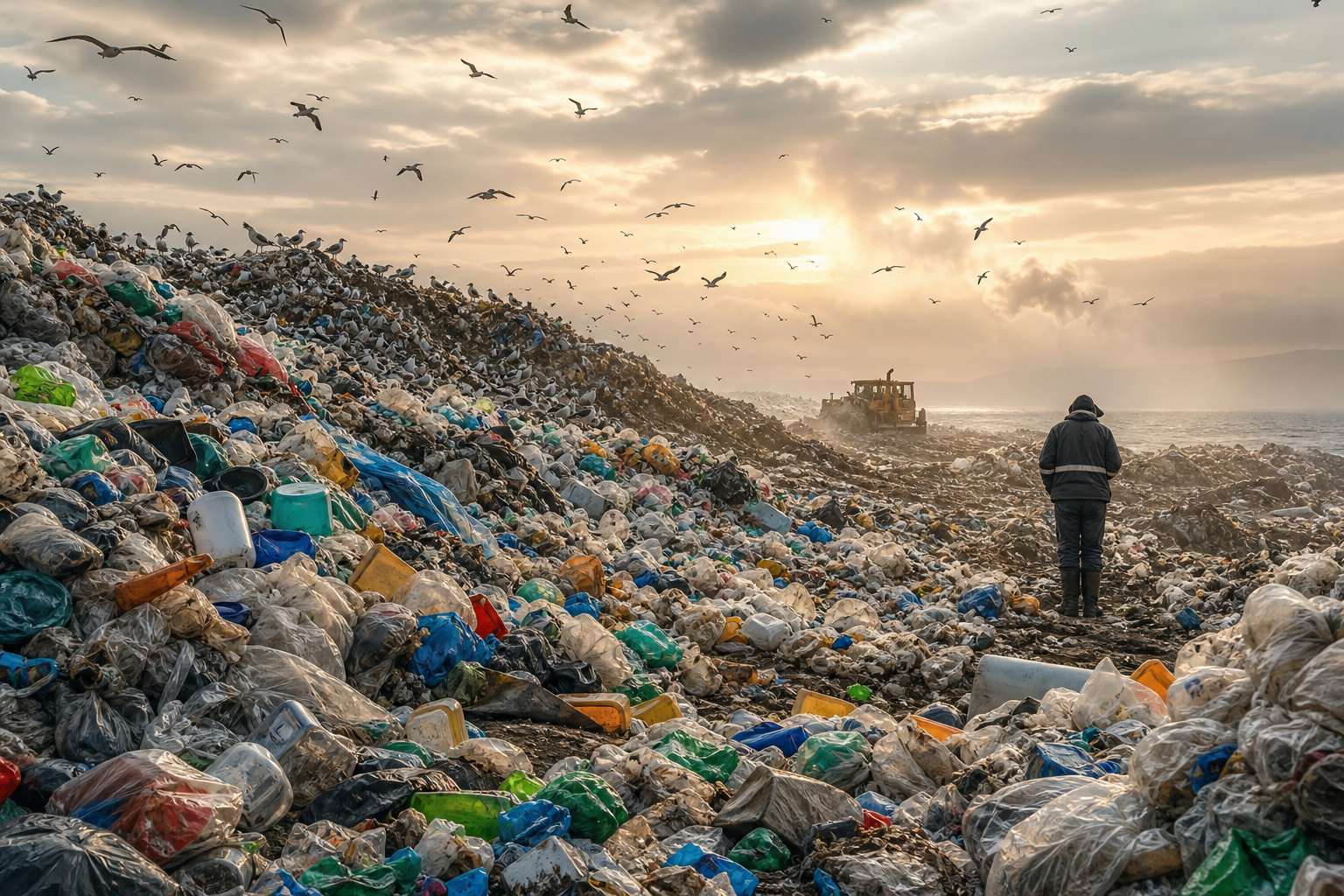
Plastic waste, 2019 (OECD)Landfill Half of all plastic waste in 2019 was buried in landfill. AI-generated still.
landfill
50%
mismanaged
22%
incinerated
19%
recycled
9%
What happened to it
1.7 Mt
into the oceans in 2019
30 Mt
stock in seas and oceans
109 Mt
stock in rivers
Already in the water (OECD)
Chapter V · Where it goes
The OECD Global Plastics Outlook
OECD (2022): production doubled from 2000 to 2019 to 460 million tonnes; plastic waste was 353 Mt in 2019, 40% of it packaging. 50% was landfilled, 19% incinerated, 22% mismanaged (uncontrolled dumpsites, open-pit burning or leakage) and 9% recycled; 15% was collected for recycling but 40% of that ended up as residue. 6.1 Mt leaked into aquatic environments in 2019, 1.7 Mt of it into oceans; an estimated 30 Mt has accumulated in seas and oceans and 109 Mt in rivers. Plastics account for 3.4% of global greenhouse gas emissions.
Press the buttons in the scene to sort the year’s waste into its four fates. The blocks are to scale with each other.
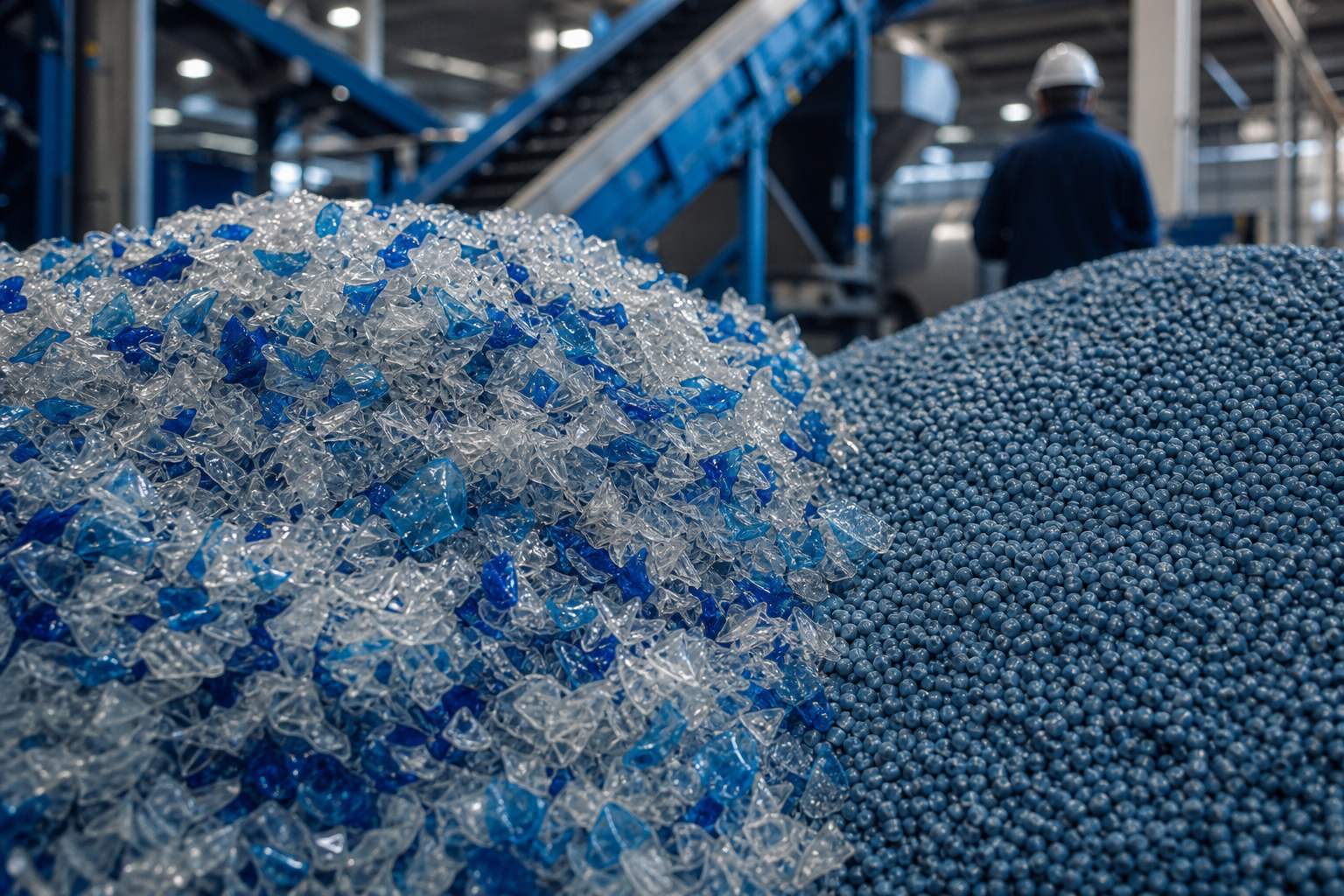
The most widely used method is mechanical recycling: the plastic is melted, made into pellets, and moulded into something new. It only works for thermoplastics.
Each time, the recycled material is usually of slightly lower quality, and mixing different plastics makes it worse. Chemical recycling breaks the chains back down to their building blocks. It can restore the original quality, but it costs a lot of energy.
Countries are also deciding whose waste they take. Since January 2025, Thailand has banned imports of plastic scrap, to build up recycling of its own waste.
Flakes and pellets Pellets of recycled plastic are what factories melt and mould again. AI-generated still.
a little worse
quality, each time it is recycled (RISE)
Mechanical recycling
mechanical: melt and remould; quality drops a little each time
mixed polymers: quality drops further
chemical: back to original quality, high energy cost
Two routes (RISE)
21 Feb 2023 cabinet resolution to regulate scrap imports
3 Dec 2024 cabinet approves the ban
1 Jan 2025 ban takes effect
Thailand’s import ban
Chapter V · Where it goes
Recycling
RISE: with mechanical recycling “the recycled raw material usually is of a slightly inferior quality for every time it is recycled,” and melting different polymers together often reduces quality; chemical recycling can return material to its original quality, at an energy cost. Thailand’s ban on plastic scrap imports took effect on 1 January 2025, following a 21 February 2023 cabinet resolution and cabinet approval on 3 December 2024, to promote domestic recycling under the Bio-Circular-Green economy model.
Press Melt (mechanical) or Unzip (chemical) in the scene. Thermosets cannot be remelted, so mechanical recycling does not work for them.
Molecules in the 3D scenes are schematic: real chains are thousands of units long and far more tangled.
Remember the ester bonds? In 2016 a Japanese team reported in the journal Science a bacterium, Ideonella sakaiensis, that can live on PET.
It uses two enzymes: one cuts PET into a smaller piece, and the second breaks that piece down. At thirty degrees Celsius, the strain almost completely degraded a thin PET film in about six weeks.
Six weeks for a thin film is fast for nature, but far too slow to clear a mountain of bottles. Still, it showed that evolution can find a way in.
Science
vol. 351, Yoshida et al.
250
samples of PET debris collected
Ideonella sakaiensis (2016)Two enzymes The first enzyme turns PET into an intermediate; the second breaks the intermediate down. Illustration, AI-generated.
~6 weeks
to nearly degrade a thin PET film
30 °C
temperature of the test
In the lab
Chapter VI · Enzymes
Ideonella sakaiensis
A team led by Kohei Oda (Kyoto Institute of Technology) and Kenji Miyamoto (Keio University), with Shosuke Yoshida as lead author, reported in Science (2016, vol. 351, pp. 1196–1199) a bacterium found by screening 250 samples of PET debris. Two enzymes (later widely called PETase and MHETase) break PET into an intermediate and then break that down; the strain nearly completely degraded a thin PET film in six weeks at 30 °C.
Since 2016, many labs have studied and engineered PET-degrading enzymes; this film describes only the original finding.
Molecules in the 3D scenes are schematic: real chains are thousands of units long and far more tangled.
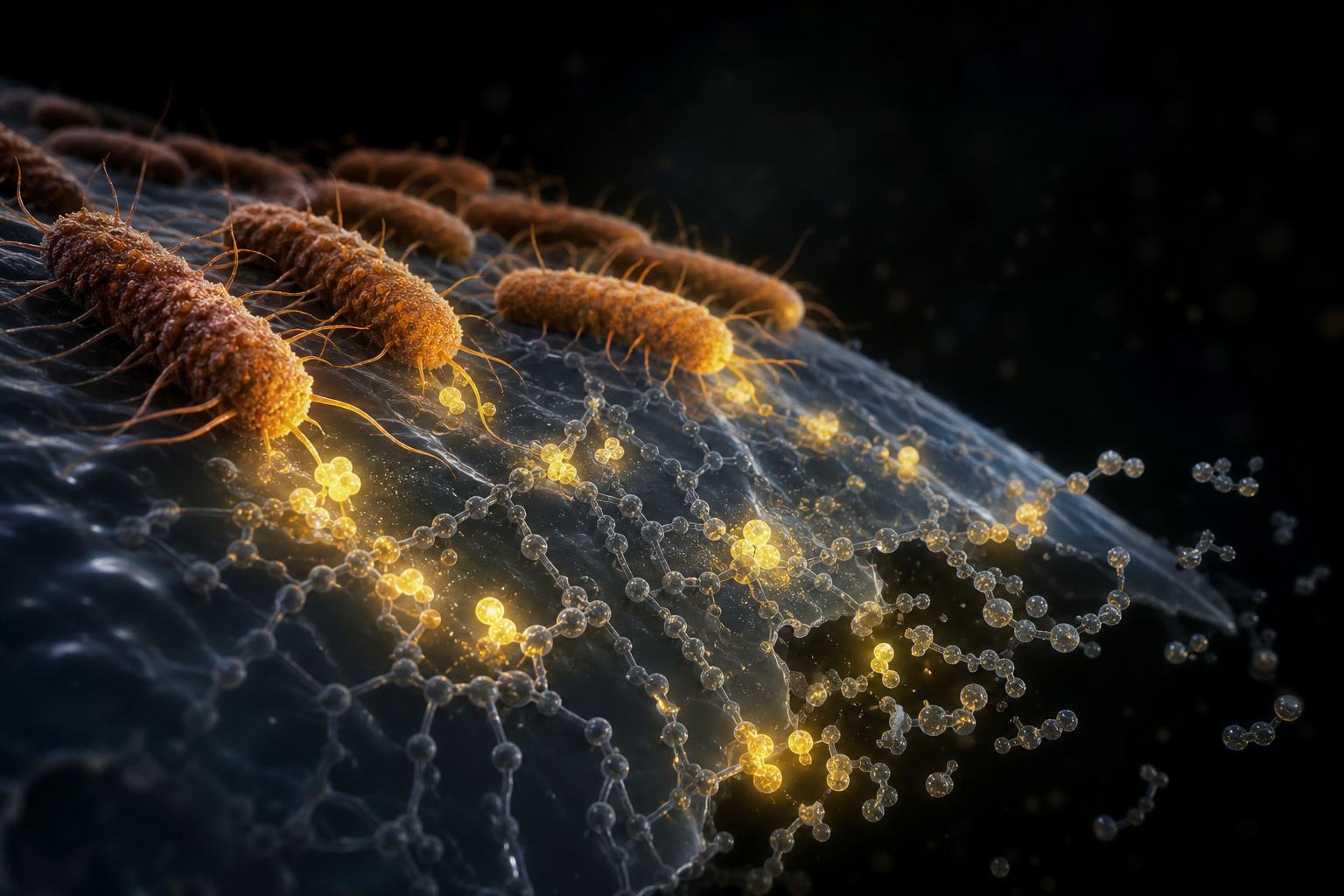
Now back to Konstanz. The new enzyme sits on the outside of the bacterial cell, and its active site, the pocket where the cutting happens, is unusually wide, so big molecules fit in.
It breaks down a polyester bioplastic designed to degrade: in lab tests with forest soil, powder of it broke down completely in under a year. It can also disable the antibiotic penicillin, a side of it the team is still studying.
But in the same tests, ordinary polyethylene barely changed. Enzymes can cut ester bonds; the plain carbon backbone of polyethylene is still a lock without a key.
anchored to the cell surface
a wide-open active site
described in The ISME Journal
The Pac-Man enzyme
LCAP bioplastic
~250–330 d
high-density polyethylene
≈ 0
Powder in forest soil, lab test (Konstanz)
LCAP: long-chain aliphatic polyester, a bioplastic
HDPE: high-density polyethylene
test: powder mixed into forest soil, in the lab
Decoding the labels
Bacteria can adapt to breaking down polyester plastics more quickly than we expected.David Schleheck, University of Konstanz
Chapter VI · Enzymes
Promise and limits
University of Konstanz: the enzyme is anchored to the bacterial cell surface and its wide-open active site lets large molecules bind; it breaks down long-chain aliphatic polyesters and inactivates penicillin. In lab tests with powder mixed into forest soil, LCAP degraded fully in roughly 250 to 330 days, while HDPE barely degraded. GreekReporter notes the work is at the research stage, limited to certain bioplastics and polyesters.
LCAP stands for long-chain aliphatic polyester; HDPE for high-density polyethylene. The bar lengths are illustrative; the study reports complete degradation of LCAP and little change in HDPE, not a percentage for HDPE.
Molecules in the 3D scenes are schematic: real chains are thousands of units long and far more tangled.
Plastic is useful because its chains are long, light and held by strong bonds that almost nothing in nature can cut. That is exactly why it stays.
Enzymes like Pac-Man are a glimpse of nature catching up, for some plastics. For the rest, the answer is still the oldest one: use less, and keep what we use in the loop.
1907 Bakelite
1933 polyethylene
2016 a bacterium that eats PET
2019 460 Mt made; 9% of waste recycled
2025 Thailand bans plastic scrap imports
2026 the Pac-Man enzyme
The plastic age
plastic = long chains of repeating units
strong bonds microbes don’t recognise
ester links are a weak spot; carbon backbones are not
Three ideas
9%
of plastic waste recycled (OECD, 2019)
Where we are
Epilogue
Sources
Every number in this film comes from the sources below.
Stills are AI-generated illustrations, not photographs.
Molecules in the 3D scenes are schematic: real chains are thousands of units long and far more tangled.